#help-23
1 messages · Page 91 of 1
 jade magnet
 safe radishBOT
@random star Has your question been resolved?
safe radishBOT
Channel closed
Closed due to timeout
Use .reopen if this was a mistake.
 Available help channel!
Send your question here to claim the channel.
Remember:
• Ask your math question in a clear, concise manner.
• Show your work, and if possible, explain where you are stuck.
• After 15 minutes, feel free to ping <@&286206848099549185>.
• Type the command .close to free the channel when you're done.
• Be polite and have a nice day!
Read #❓how-to-get-help for further information on how to ask a good question, and about conduct in the question channels.
 ornate creek
guys is n!=o(n^n)?
safe radishBOT
ornate creek
guys is n!=o(n^n)?
ornate creek
basically I have to explain why does (n+1)^4 / n!
 desert inlet
ornate creek
guys is n!=o(n^n)?
desert inlet
ornate creek
guys is n!=o(n^n)?
so n! = 0 * n^n?
ornate creek
 desert inlet
assuming n is an integer
 obtuse jackal
desert inlet
so n! = 0 * n^n?
obtuse jackal
desert inlet
so n! = 0 * n^n?
it seems you may not be familiar with little o notation
desert inlet
obtuse jackal
it seems you may not be familiar with little o notation
explain?
obtuse jackal
ornate creek
guys is n!=o(n^n)?
yes
ornate creek
aight nice then it's done thanks
obtuse jackal
obtuse jackal
yes
it is enough to notice that n! <= 1 * n^(n-1)
by Stirling's formula, you have n! / n^n ~ e^-n sqrt(2pi n)
as a little extra
ornate creek
ohh yea I see
but we haven't seen it in our class yet
we're gonna see that monday I think

but is that legit?
forgot to say that n-4 > 1 for n big enaugh but it's obvious
ornate creek
oh yea right F
safe radishBOT
@ornate creek Has your question been resolved?
Channel closed
Closed by @ornate creek
Use .reopen if this was a mistake.
Available help channel!
Send your question here to claim the channel.
Remember:
• Ask your math question in a clear, concise manner.
• Show your work, and if possible, explain where you are stuck.
• After 15 minutes, feel free to ping <@&286206848099549185>.
• Type the command .close to free the channel when you're done.
• Be polite and have a nice day!
Read #❓how-to-get-help for further information on how to ask a good question, and about conduct in the question channels.
 tender spire
How to solve √37
safe radishBOT
tender spire
How to solve √37
tender spire
Apparently it is supposed to get 20√2 but what is the method
 buoyant shadow
it's not anything
 quasi bison
sqrt(37) ≠ 20 sqrt(2).
 thin bridge
20√2
whos saying that
quasi bison
thin bridge
> 20√2
whos saying that
g-d, clearly.
tender spire
Like the q is
thin bridge
no adjustments pls
not "like"
what is the question exactly, word for word, no mods
 thin bridge
show the original question
tender spire
The original one, I'm just having difficulty solving the eq
thin bridge
not calculations from halfway
 thin bridge
show full work
tender spire
He hasn't done the full work
Neither have I he just solved via a diagram
Which I understood
thin bridge
show "your" full work that lead to sqrt(34)
Neither have I
what work have you done taht lead to taht value
tender spire
 thin bridge
you forgot about the initial position of the particle
i.e. + 2 for x-component
+4 for the y-component
and
$$\sqrt{a+b} \redneq \sqrt{\sqrt{a} + \sqrt{b}}$$
 flat frigateBOT
ℝamonov
 tender spire
thin bridge
and
$$\sqrt{a+b} \redneq \sqrt{\sqrt{a} + \sqrt{b}}$$
tender spire
thin bridge
and
$$\sqrt{a+b} \redneq \sqrt{\sqrt{a} + \sqrt{b}}$$
??
thin bridge
that's supposedly what you're doing to get from
sqrt(18^2 + 16^2) to sqrt(34)
tender spire
Yess
thin bridge
which is wrong on so many levels
because that would be implying that
18^2 + 16^2 is equal to 34
but anyway you need to fix this first
you forgot about the initial position of the particle
i.e. + 2 for x-component
+4 for the y-component
tender spire
I should put x=2 and y=4??
thin bridge
no
in your work only calculated the distance travelled by the particle in each direction
so for the final position for the x-component,
you should have 2 + 18
and for the y-component you should have
4 + 16
safe radishBOT
@tender spire Has your question been resolved?
safe radishBOT
Channel closed
Closed due to timeout
Use .reopen if this was a mistake.
safe radishBOT
Available help channel!
Send your question here to claim the channel.
Remember:
• Ask your math question in a clear, concise manner.
• Show your work, and if possible, explain where you are stuck.
• After 15 minutes, feel free to ping <@&286206848099549185>.
• Type the command .close to free the channel when you're done.
• Be polite and have a nice day!
Read #❓how-to-get-help for further information on how to ask a good question, and about conduct in the question channels.
 forest raptor
 safe radishBOT
forest raptor
safe radishBOT
forest raptor


 junior smelt
Yep seems good to me
safe radishBOT
@forest raptor Has your question been resolved?
safe radishBOT
Channel closed
Closed due to timeout
Use .reopen if this was a mistake.
safe radishBOT
Available help channel!
Send your question here to claim the channel.
Remember:
• Ask your math question in a clear, concise manner.
• Show your work, and if possible, explain where you are stuck.
• After 15 minutes, feel free to ping <@&286206848099549185>.
• Type the command .close to free the channel when you're done.
• Be polite and have a nice day!
Read #❓how-to-get-help for further information on how to ask a good question, and about conduct in the question channels.
flat frigateBOT
 safe radishBOT
@lean otter Has your question been resolved?
safe radishBOT
@lean otter Has your question been resolved?
safe radishBOT
Channel closed
Closed due to the original message being deleted
Available help channel!
Send your question here to claim the channel.
Remember:
• Ask your math question in a clear, concise manner.
• Show your work, and if possible, explain where you are stuck.
• After 15 minutes, feel free to ping <@&286206848099549185>.
• Type the command .close to free the channel when you're done.
• Be polite and have a nice day!
Read #❓how-to-get-help for further information on how to ask a good question, and about conduct in the question channels.
 knotty viper
Calc 2 differential equations
 safe radishBOT
knotty viper
Calc 2 differential equations
knotty viper
safe radishBOT
knotty viper
Calc 2 differential equations
knotty viper
I am having trouble finding out dy/dt
safe radishBOT
@knotty viper Has your question been resolved?
safe radishBOT
@knotty viper Has your question been resolved?
Channel closed
Closed by @knotty viper
Use .reopen if this was a mistake.
safe radishBOT
Available help channel!
Send your question here to claim the channel.
Remember:
• Ask your math question in a clear, concise manner.
• Show your work, and if possible, explain where you are stuck.
• After 15 minutes, feel free to ping <@&286206848099549185>.
• Type the command .close to free the channel when you're done.
• Be polite and have a nice day!
Read #❓how-to-get-help for further information on how to ask a good question, and about conduct in the question channels.
 wind abyss

 safe radishBOT
wind abyss
safe radishBOT
wind abyss
 faint seal
you can combine the fractions
safe radishBOT
@wind abyss Has your question been resolved?
safe radishBOT
Channel closed
Closed due to timeout
Use .reopen if this was a mistake.
safe radishBOT
Available help channel!
Send your question here to claim the channel.
Remember:
• Ask your math question in a clear, concise manner.
• Show your work, and if possible, explain where you are stuck.
• After 15 minutes, feel free to ping <@&286206848099549185>.
• Type the command .close to free the channel when you're done.
• Be polite and have a nice day!
Read #❓how-to-get-help for further information on how to ask a good question, and about conduct in the question channels.
 quartz sentinel
A
safe radishBOT
quartz sentinel
A
 primal kelp
B
quartz sentinel
@primal kelp could I get ur assistance on the problem again? I understand that you’ll flip your signs, but if I subtract 3-3 I’ll get 0 and that would make the problem invalid
 primal kelp
what are you dividing it by
quartz sentinel
(N+3)
quartz sentinel
Oh you don’t have to do that
quartz sentinel
Oh ok tysm
 quartz sentinel
Wait no I think u did it right lemme do it again
primal kelp
np
primal kelp
quartz sentinel
<@519746020645666816> could I get ur assistance on the problem again? I understa...
dont try to get familiar with this flipping sign
just do what i did
adding a minus to the whole bracket
i mean, if it works for you then go ahead
quartz sentinel
Yea the adding the minus to the bracket is more easier
primal kelp
👍
safe radishBOT
Channel closed
Closed by @quartz sentinel
Use .reopen if this was a mistake.
Available help channel!
Send your question here to claim the channel.
Remember:
• Ask your math question in a clear, concise manner.
• Show your work, and if possible, explain where you are stuck.
• After 15 minutes, feel free to ping <@&286206848099549185>.
• Type the command .close to free the channel when you're done.
• Be polite and have a nice day!
Read #❓how-to-get-help for further information on how to ask a good question, and about conduct in the question channels.
 worn ferry
I need help
 safe radishBOT
worn ferry
I need help
safe radishBOT
worn ferry
I need help
What step are you on?
1. I don't know where to begin
2. I have begun but got stuck midway
3. I got an answer but I'm told it's wrong
4. I got an answer and would like my work checked
5. I have a question about someone else's worked solution
6. None of the above
Show your work, and if possible, explain where you are stuck.
worn ferry
i found out the area of one circle
i used the formula
4/3 X pi X 6 cubed
which i got 904.78 rounded to 2dp
but i think i did something wrong
 stray socket
What's the height of the cylinder
Assuming the 4 tennis balls fit snugly and perfectly
stray socket
Mmhm
worn ferry
is that right
safe radishBOT
@worn ferry Has your question been resolved?
 neat kiln
The volume of cylinder is?
worn ferry
i kinda don't understand
safe radishBOT
@worn ferry Has your question been resolved?
flat frigateBOT
ssakshi
 safe radishBOT
Channel closed
Closed due to timeout
Use .reopen if this was a mistake.
safe radishBOT
Available help channel!
Send your question here to claim the channel.
Remember:
• Ask your math question in a clear, concise manner.
• Show your work, and if possible, explain where you are stuck.
• After 15 minutes, feel free to ping <@&286206848099549185>.
• Type the command .close to free the channel when you're done.
• Be polite and have a nice day!
Read #❓how-to-get-help for further information on how to ask a good question, and about conduct in the question channels.
 lean otter
How do i cancel out these
safe radishBOT
lean otter
How do i cancel out these
 safe radishBOT
@lean otter Has your question been resolved?
lean otter
<@&286206848099549185>
safe radishBOT
@lean otter Has your question been resolved?
lean otter
stray socket
What have you tried
The problem is I haven't tried 😭
I just found the LCD and i dont know hwat to do
this is like basic math too oml
lean otter
stray socket
Expand the (7/4)^2
So 14/4 on the top?
and then -33 on the bottom?
eh
I FUGRED IOUT OUT OMG
.close
safe radishBOT
Channel closed
Closed by @frail olive
Use .reopen if this was a mistake.
safe radishBOT
Available help channel!
Send your question here to claim the channel.
Remember:
• Ask your math question in a clear, concise manner.
• Show your work, and if possible, explain where you are stuck.
• After 15 minutes, feel free to ping <@&286206848099549185>.
• Type the command .close to free the channel when you're done.
• Be polite and have a nice day!
Read #❓how-to-get-help for further information on how to ask a good question, and about conduct in the question channels.
 spring vigil
 safe radishBOT
spring vigil
spring vigil
safe radishBOT
spring vigil
spring vigil
$x$
flat frigateBOT
****
 safe radishBOT
@spring vigil Has your question been resolved?
 devout shale
.close
safe radishBOT
Channel closed
Closed by @devout shale
Use .reopen if this was a mistake.
Available help channel!
Send your question here to claim the channel.
Remember:
• Ask your math question in a clear, concise manner.
• Show your work, and if possible, explain where you are stuck.
• After 15 minutes, feel free to ping <@&286206848099549185>.
• Type the command .close to free the channel when you're done.
• Be polite and have a nice day!
Read #❓how-to-get-help for further information on how to ask a good question, and about conduct in the question channels.
spring vigil
 safe radishBOT
spring vigil
spring vigil
safe radishBOT
spring vigil
spring vigil
anyone can help me on this question
safe radishBOT
@spring vigil Has your question been resolved?
spring vigil
.close
safe radishBOT
Channel closed
Closed by @spring vigil
Use .reopen if this was a mistake.
Available help channel!
Send your question here to claim the channel.
Remember:
• Ask your math question in a clear, concise manner.
• Show your work, and if possible, explain where you are stuck.
• After 15 minutes, feel free to ping <@&286206848099549185>.
• Type the command .close to free the channel when you're done.
• Be polite and have a nice day!
Read #❓how-to-get-help for further information on how to ask a good question, and about conduct in the question channels.
 sick urchin
 safe radishBOT
sick urchin
sick urchin
safe radishBOT
sick urchin
sick urchin
does anyone know how to find the acue solution for this angle
i lready found the obtuse but how do i find the acute?
 pastel verge
use sine law
pastel verge
115 is everything you need nothing more
sick urchin
ok im asking as if the question was acute
pastel verge
sick urchin
ok im asking as if the question was acute
if it was acute then you would've got acute angle
sick urchin
my teacher did this thing where he got two answers
and then he just chose one
why did they do sin inverse

do u always do it? if not when is it appropiate to do it
pastel verge
sick urchin
do u always do it? if not when is it appropiate to do it
when needed
sick urchin
when is it needed
pastel verge
sick urchin
when is it needed
if angle is obtuse
pastel verge
yes
safe radishBOT
@sick urchin Has your question been resolved?
safe radishBOT
Channel closed
Closed due to timeout
Use .reopen if this was a mistake.
Available help channel!
Send your question here to claim the channel.
Remember:
• Ask your math question in a clear, concise manner.
• Show your work, and if possible, explain where you are stuck.
• After 15 minutes, feel free to ping <@&286206848099549185>.
• Type the command .close to free the channel when you're done.
• Be polite and have a nice day!
Read #❓how-to-get-help for further information on how to ask a good question, and about conduct in the question channels.
 arctic hound
Can someone explain the last part. How can you deduce those to be the roots?
 safe radishBOT
arctic hound
Can someone explain the last part. How can you deduce those to be the roots?
safe radishBOT
arctic hound
Can someone explain the last part. How can you deduce those to be the roots?
@arctic hound Has your question been resolved?
safe radishBOT
@arctic hound Has your question been resolved?
safe radishBOT
@arctic hound Has your question been resolved?
safe radishBOT
Channel closed
Closed due to timeout
Use .reopen if this was a mistake.
Available help channel!
Send your question here to claim the channel.
Remember:
• Ask your math question in a clear, concise manner.
• Show your work, and if possible, explain where you are stuck.
• After 15 minutes, feel free to ping <@&286206848099549185>.
• Type the command .close to free the channel when you're done.
• Be polite and have a nice day!
Read #❓how-to-get-help for further information on how to ask a good question, and about conduct in the question channels.
 crisp mica
 safe radishBOT
crisp mica
safe radishBOT
crisp mica
 rugged dove
 final halo
What do opposite angles in a cyclic quadrilateral add up to
safe radishBOT
@crisp mica Has your question been resolved?
crisp mica
final halo
What do opposite angles in a cyclic quadrilateral add up to
180
thank you sm
wait
shouldn't there be 4 angles that equal 180 tho
and it looks like a kite
and these ang of the kite are not equal
safe radishBOT
@crisp mica Has your question been resolved?
crisp mica
.close
safe radishBOT
Channel closed
Closed by @crisp mica
Use .reopen if this was a mistake.
Available help channel!
Send your question here to claim the channel.
Remember:
• Ask your math question in a clear, concise manner.
• Show your work, and if possible, explain where you are stuck.
• After 15 minutes, feel free to ping <@&286206848099549185>.
• Type the command .close to free the channel when you're done.
• Be polite and have a nice day!
Read #❓how-to-get-help for further information on how to ask a good question, and about conduct in the question channels.
 delicate sierra
hi, I'm having a hard time with the last bit of this question
 delicate sierra
I found out that hte covariance is 0
but that's the easy bit
my suspicion is that this is independent
because any events {X_2 \in B} can be expressed as some disjoint union of events in U
actually
idk if this line of thinking leads to anywhere
so yea, i'd like some pointers
safe radishBOT
@delicate sierra Has your question been resolved?
 tall bough
<@&268886789983436800>
delicate sierra
well
after a while if thinking
maybe I can work on some counterexamples?
let me try the event {X1 < 0, X2 < 0}
nope, that didn't work.
delicate sierra
huh
curiously enough
X1 < sqrt(2)/2, X2 < sqrt(2)/2 works
but X1 < 1/2. X2 < 1/2 doesn't
weirddd
safe radishBOT
@delicate sierra Has your question been resolved?
safe radishBOT
Channel closed
Closed due to timeout
Use .reopen if this was a mistake.
Available help channel!
Send your question here to claim the channel.
Remember:
• Ask your math question in a clear, concise manner.
• Show your work, and if possible, explain where you are stuck.
• After 15 minutes, feel free to ping <@&286206848099549185>.
• Type the command .close to free the channel when you're done.
• Be polite and have a nice day!
Read #❓how-to-get-help for further information on how to ask a good question, and about conduct in the question channels.
 obtuse plover
 safe radishBOT
obtuse plover
safe radishBOT
obtuse plover
 safe radishBOT
Channel closed
Closed by @obtuse plover
Use .reopen if this was a mistake.
safe radishBOT
Available help channel!
Send your question here to claim the channel.
Remember:
• Ask your math question in a clear, concise manner.
• Show your work, and if possible, explain where you are stuck.
• After 15 minutes, feel free to ping <@&286206848099549185>.
• Type the command .close to free the channel when you're done.
• Be polite and have a nice day!
Read #❓how-to-get-help for further information on how to ask a good question, and about conduct in the question channels.
lean otter
Essentially, my objective is to demonstrate that if a square matrix is invertible on one side, then it is also invertible on the other side
 safe radishBOT
lean otter
Essentially, my objective is to demonstrate that if a **square** matrix is inver...
lean otter
safe radishBOT
lean otter
Essentially, my objective is to demonstrate that if a **square** matrix is inver...
lean otter
I can't use ranks, dets, Only basic Linear Algebra concepts
safe radishBOT
@lean otter Has your question been resolved?
safe radishBOT
Channel closed
Closed due to timeout
Use .reopen if this was a mistake.
Available help channel!
Send your question here to claim the channel.
Remember:
• Ask your math question in a clear, concise manner.
• Show your work, and if possible, explain where you are stuck.
• After 15 minutes, feel free to ping <@&286206848099549185>.
• Type the command .close to free the channel when you're done.
• Be polite and have a nice day!
Read #❓how-to-get-help for further information on how to ask a good question, and about conduct in the question channels.
 timid scroll
Mechanics
 safe radishBOT
timid scroll
Mechanics
safe radishBOT
timid scroll
Mechanics
 timid scroll
Mechanics
timid scroll
timid scroll
Mechanics
This is how they did it which is how I did it but I dont understand the 2nd yellow, itsnt it supposed to be 1st yellow?
Unless its the answer of it being solved which it probably is (999%) but I dont get how they got that
 bitter solstice
(1) comes from third eqn of motion (in vertical) and (2) comes from combination of second eqn of motion (in vertical and horizontal)
timid scroll
Im not sure if i get that
I understand 1st one why
2nd combo of 2nd equ of motion?
whats that
flat frigateBOT
hR1487
 bitter solstice
Eliminate t and u get (2)
timid scroll
Okokokk :)::):)):)):))))))))))
Thank you
Slowly loosing it with projectile motion hehe
safe radishBOT
@timid scroll Has your question been resolved?
Channel closed
Closed by @timid scroll
Use .reopen if this was a mistake.
Available help channel!
Send your question here to claim the channel.
Remember:
• Ask your math question in a clear, concise manner.
• Show your work, and if possible, explain where you are stuck.
• After 15 minutes, feel free to ping <@&286206848099549185>.
• Type the command .close to free the channel when you're done.
• Be polite and have a nice day!
Read #❓how-to-get-help for further information on how to ask a good question, and about conduct in the question channels.
 ebon cove
heres the problem: x^2+ax+a^2+2=0 and we know that this equation has solution and we also know that 3x1+3x2+x1x2=0 and we need to find a (x1 and x2 are solutions)
safe radishBOT
ebon cove
heres the problem: x^2+ax+a^2+2=0 and we know that this equation has solution an...
ebon cove
"a"
so i can show me work but it didnt work

This is what I did
But when I use a's it doesn't have a solution
Btw it's viet's theorem
bitter solstice
Ok so u see discriminant of x^2 + ax+ a^2+2 = 0, D = a^2 - 4 (a^2+2) = -3 a^2 - 8 which is negative regardless the value of a
So u can never have real solutions of x^2 + ax+ a^2+2 = 0 for any real value of a
safe radishBOT
Channel closed
Closed by @ebon cove
Use .reopen if this was a mistake.
Available help channel!
Send your question here to claim the channel.
Remember:
• Ask your math question in a clear, concise manner.
• Show your work, and if possible, explain where you are stuck.
• After 15 minutes, feel free to ping <@&286206848099549185>.
• Type the command .close to free the channel when you're done.
• Be polite and have a nice day!
Read #❓how-to-get-help for further information on how to ask a good question, and about conduct in the question channels.
 random steppe
Calculus
 safe radishBOT
random steppe
Calculus
random steppe
safe radishBOT
random steppe
Calculus
random steppe
Tangent line is horizontal b/c no slope, to find the tangent line equation y-y1 = m (x-x1)
Then normal line is the reciprocal of slope right? But if slopes 0?
How do you get pi/4 (normal line equation)
<@&286206848099549185>
safe radishBOT
@random steppe Has your question been resolved?
 wraith locust
For that 0 slope, it is always a horizontal line.
random steppe
wraith locust
For that 0 slope, it is always a horizontal line.
Yes but what’s the normal line equation
It says it’s pi/4 but how do you even get that
wraith locust
no explanation needed. It is what it is
It is perpendicular to the tangent line equation
random steppe
How do I find the normal line from tangent line? I thought you just -1/(tangent line)
wraith locust
so it's like since X=π/4 is given, then automatically that's the normal line
this is a different case. Slope is zero
wraith locust
as long as they are perpendicular
random steppe
What’s the difference between tangent line an tangent line equation?
wraith locust
nothing
tangent line is the line
Tangent line equation is the equation for tangent line
Sometimes they are interchangable
wraith locust
ok...
the problem said find the eqn for tangent line
in calculus, when we say "tangent line" we are talking about the derivative or y'
wraith locust
Yes
then we differentiate the given equation and substitute value of X. For this problem, X=π/4
random steppe
Yup
wraith locust
Then found out that slope or y' is zero
random steppe
Yes
wraith locust
Therefore the slope is a horizontal line at X=π/4
It means that the eqn for tangent line will pass through X=π/4
random steppe
BRB
wraith locust
Since slope is zero, let's go back to the original equation y= sin X+ cos x
wraith locust
X=π/4. Substitute to the original equation. Then we got √2
Then we now have eqn for tangent line. Yes.
Since slope is zero, normal line will always be a vertical line. It has the eqn X=k
Since it is already given, then our normal line is X=π/4
Sorry, got to go now
Good luck
Tag them helpers again if you still don't get it

random steppe
wraith locust
Sorry, got to go now
Just did Ortho lol sorry
Thanks for explanation I understand now t now
.close
safe radishBOT
Channel closed
Closed by @random steppe
Use .reopen if this was a mistake.
Available help channel!
Send your question here to claim the channel.
Remember:
• Ask your math question in a clear, concise manner.
• Show your work, and if possible, explain where you are stuck.
• After 15 minutes, feel free to ping <@&286206848099549185>.
• Type the command .close to free the channel when you're done.
• Be polite and have a nice day!
Read #❓how-to-get-help for further information on how to ask a good question, and about conduct in the question channels.
 random spindle
$cos(3x)-sin(3x)=Asin(3x+C)$
safe radishBOT
random spindle
$cos(3x)-sin(3x)=Asin(3x+C)$
flat frigateBOT
Yousssef
 safe radishBOT
@random spindle Has your question been resolved?
Channel closed
Closed by @random spindle
Use .reopen if this was a mistake.
Available help channel!
Send your question here to claim the channel.
Remember:
• Ask your math question in a clear, concise manner.
• Show your work, and if possible, explain where you are stuck.
• After 15 minutes, feel free to ping <@&286206848099549185>.
• Type the command .close to free the channel when you're done.
• Be polite and have a nice day!
Read #❓how-to-get-help for further information on how to ask a good question, and about conduct in the question channels.
 deep crater
kinda stuck on this one, I got to int(1/sinxcosx +5cosx dx) - int(sinx/sinxcos + 5cosx dx)
not sure where to go after that
 safe radishBOT
deep crater
kinda stuck on this one, I got to int(1/sinxcosx +5cosx dx) - int(sinx/sinxcos +...
faint seal
safe radishBOT
deep crater
kinda stuck on this one, I got to int(1/sinxcosx +5cosx dx) - int(sinx/sinxcos +...
faint seal
show your workj
deep crater
 faint seal
I would multiply the numerator and denominator by 1+sinx to make the numerator cos^2(x)
which cancels with the cosx in the denominator to give cosx
from there a simple u sub should work
safe radishBOT
Channel closed
Closed by @deep crater
Use .reopen if this was a mistake.
safe radishBOT
Available help channel!
Send your question here to claim the channel.
Remember:
• Ask your math question in a clear, concise manner.
• Show your work, and if possible, explain where you are stuck.
• After 15 minutes, feel free to ping <@&286206848099549185>.
• Type the command .close to free the channel when you're done.
• Be polite and have a nice day!
Read #❓how-to-get-help for further information on how to ask a good question, and about conduct in the question channels.

 safe radishBOT
 prisma glacier
prisma glacier
prisma glacier
I’m not sure how to do it

Here is the answer key
<@&286206848099549185>
Hello?
<@&286206848099549185>
I need help with question 25
 plucky elk
prisma glacier
Here is the answer key
plucky elk
prisma glacier
Here is the answer key
where in the answer do you first get lost
prisma glacier
I dontunderstand how to get started
Like Im assuming the formula for the whole cone is 1/3pir^2h
But thats kinda all I got to
And Im assuming the radius for the small cone within the cone is 1/3h thats whin the answer
However how did they get to pi/27h^3
plucky elk
prisma glacier
Like Im assuming the formula for the whole cone is 1/3pir^2h
do you follow this part


the two triangles are cross sections of the cone
prisma glacier
Not really
Its saying half of the radius
And 1/6 of the height??!!
Is the smaller cone inside
plucky elk
prisma glacier
Its saying half of the radius
no
prisma glacier
Im not sure then
plucky elk

To calculate the radius , we have to draw two similar triangles and write equal ratio of similar side . Plug in known values to calculate the value of the unknown radius hence apply the formula of volume to calculate the volume of the cone =1/3 pi radius squared x height.
prisma glacier
But I did figure out how they got pi/27
plucky elk
prisma glacier
But I did figure out how they got pi/27
follows from the similar triangles equation

do you see the similar triangles now?
plucky elk
plucky elk
https://www.youtube.com/watch?v=_Mm7jqEibmY
this video explains it better
plucky elk
what's the next equation you don't understand?
prisma glacier
Wait I still dont get it
So basically there a a triangle within the cone
And the unknow would be R/2
And the you cross multiply it with 2/6?!!
so 4/3??
Actually no I see it now
Okay yes I see it now
Thank you
.Close
.close
safe radishBOT
Channel closed
Closed by @prisma glacier
Use .reopen if this was a mistake.
safe radishBOT
Available help channel!
Send your question here to claim the channel.
Remember:
• Ask your math question in a clear, concise manner.
• Show your work, and if possible, explain where you are stuck.
• After 15 minutes, feel free to ping <@&286206848099549185>.
• Type the command .close to free the channel when you're done.
• Be polite and have a nice day!
Read #❓how-to-get-help for further information on how to ask a good question, and about conduct in the question channels.
 spring oxide
why is this the answer?
 safe radishBOT
spring oxide
why is this the answer?
plucky elk
spring oxide
why is this the answer?
safe radishBOT
spring oxide
why is this the answer?
plucky elk
spring oxide
why is this the answer?
the vectors along the direction (1, 1) gets stretched
and the vectors along the (-1, 1) direction don't
spring oxide
why is that
are there any examples online to understand this better? im having a hard time grasping why it stretches it in those directions
plucky elk
have you taken linear algebra?
spring oxide
not as a course no
plucky elk

spring oxide
hahah
plucky elk

edX
This course takes you through the first three weeks of MATH 1554, Linear Algebra, as taught in the School of Mathematics at The Georgia Institute of Technology.
spring oxide
i've mostly just grabbed pieces from there that i needed during this course, like how matrix multiplication works, transpose, inverse etc
plucky elk
Identify and construct linear transformations of a matrix.
that's the portion you need to understand
but any other free online linear algebra course should also cover it
spring oxide
plucky elk
the vectors along the direction (1, 1) gets stretched
i'll do the course but im curious did you really mean (1,1) and (-1, 1) here? don't see how that makes sense. Scrolled though some of the videos and it just looked like you handle z as a matrix in a matrix multiplication but idk i guess i might need to finish the course
plucky elk
i don't know what you mean "handle z as a matrix"
spring oxide
idk i just skipped through a few of the lessons on the khanacademy course and i dont see anything resembling this but ill take another look i guess, also wdym by (1,1) and (-1, 1) how does that make sense
plucky elk
spring oxide
idk i just skipped through a few of the lessons on the khanacademy course and i ...
(1, 1) is a vector
if you don't know linear algebra, i don't know how to help
safe radishBOT
Channel closed
Closed by @spring oxide
Use .reopen if this was a mistake.
safe radishBOT
Available help channel!
Send your question here to claim the channel.
Remember:
• Ask your math question in a clear, concise manner.
• Show your work, and if possible, explain where you are stuck.
• After 15 minutes, feel free to ping <@&286206848099549185>.
• Type the command .close to free the channel when you're done.
• Be polite and have a nice day!
Read #❓how-to-get-help for further information on how to ask a good question, and about conduct in the question channels.
lean otter
How come sqrt(sin^2x) = |sinx| ?
 safe radishBOT
lean otter
How come sqrt(sin^2x) = |sinx| ?
safe radishBOT
lean otter
How come sqrt(sin^2x) = |sinx| ?
 green bane
where does it say that
lean otter
at the end: sqrt(1-cos^2x) = sqrt(sin^2x)
 trim dune
The square root is defined to be positive here
lean otter
is the sqrt of any x^2 = |x| ?
 hot thistle
yes
lean otter
.close
safe radishBOT
Channel closed
Closed by @golden mountain
Use .reopen if this was a mistake.
Available help channel!
Send your question here to claim the channel.
Remember:
• Ask your math question in a clear, concise manner.
• Show your work, and if possible, explain where you are stuck.
• After 15 minutes, feel free to ping <@&286206848099549185>.
• Type the command .close to free the channel when you're done.
• Be polite and have a nice day!
Read #❓how-to-get-help for further information on how to ask a good question, and about conduct in the question channels.
 karmic trail
 safe radishBOT
karmic trail
karmic trail
safe radishBOT
karmic trail
karmic trail
I need help
green bane
prime but what ever
karmic trail
idk
green bane
ok so take the square roots of all
karmic trail
2
green bane
and
karmic trail
4
green bane
and
green bane
root 8 is root 8
karmic trail
k
karmic trail
yes
green bane
and what does that equal
 karmic trail
Yes
green bane
gj
safe radishBOT
@karmic trail Has your question been resolved?
safe radishBOT
Channel closed
Closed due to timeout
Use .reopen if this was a mistake.
Available help channel!
Send your question here to claim the channel.
Remember:
• Ask your math question in a clear, concise manner.
• Show your work, and if possible, explain where you are stuck.
• After 15 minutes, feel free to ping <@&286206848099549185>.
• Type the command .close to free the channel when you're done.
• Be polite and have a nice day!
Read #❓how-to-get-help for further information on how to ask a good question, and about conduct in the question channels.
 sinful thorn
can someone help me how to do pt(iii)?
 safe radishBOT
sinful thorn
can someone help me how to do pt(iii)?
sinful thorn
safe radishBOT
sinful thorn
can someone help me how to do pt(iii)?
sinful thorn
also explain to me the best approach to part (i) of this question because im taking way too long to do thi
plucky elk
sinful thorn
also explain to me the best approach to part (i) of this question because im tak...
Just show all your work so far
sinful thorn
okk
so for pt 1
im just working backwards
i did (k+1)(A_k+1 - G_k+1) -k(A_k - G_k) >= 0
fuck ill just rewrite it on paper
i just find this working rly disgusting and idk if there is a better way to do this

as for pt(iii)
i’m not sure how to go on from here
 safe radishBOT
@sinful thorn Has your question been resolved?
sinful thorn
<@&286206848099549185>
safe radishBOT
@sinful thorn Has your question been resolved?
safe radishBOT
Channel closed
Closed due to timeout
Use .reopen if this was a mistake.
Available help channel!
Send your question here to claim the channel.
Remember:
• Ask your math question in a clear, concise manner.
• Show your work, and if possible, explain where you are stuck.
• After 15 minutes, feel free to ping <@&286206848099549185>.
• Type the command .close to free the channel when you're done.
• Be polite and have a nice day!
Read #❓how-to-get-help for further information on how to ask a good question, and about conduct in the question channels.
 compact nymph
I don't understand a lot about legendre's symbol, or quadratic residues... Can anyone help with these topics?
safe radishBOT
compact nymph
I don't understand a lot about legendre's symbol, or quadratic residues... Can a...
compact nymph
Basically, I want to understand what it shows and how to calculate it
How do you find a quadratic residue?
 spiral bane
compact nymph
How do you find a quadratic residue?
spiral bane
compact nymph
How do you find a quadratic residue?
have you tried googling it
compact nymph
yes, but I dont really understand what Ive found
spiral bane
so ask specifically what you dont understand in the explanation
compact nymph
okay, lets take a look at Brilliant.com's solution

I understand the Sigma
however, when I have attempted this myself, i got the wrong answer (81), when the right one was 0... so I dont understand why.
compact nymph
and, earlier on the page, they have given us the symbol itself:

i dont understand their solution
which is why im here
spiral bane
okay so you dont know what quadratic residues are right
compact nymph
I guess not?
spiral bane
so look that up
compact nymph
I thought it was something to the effect of, when there are integers left over after a modulo
like, 10 modulo 9 would be 1...
compact nymph
(because, 99, thus the residue would be 1 to make 100)... is that incorrect?
spiral bane
compact nymph
I thought it was something to the effect of, when there are integers left over a...
thats just modulo though
compact nymph
right, but the residue would be the 1, no?
spiral bane
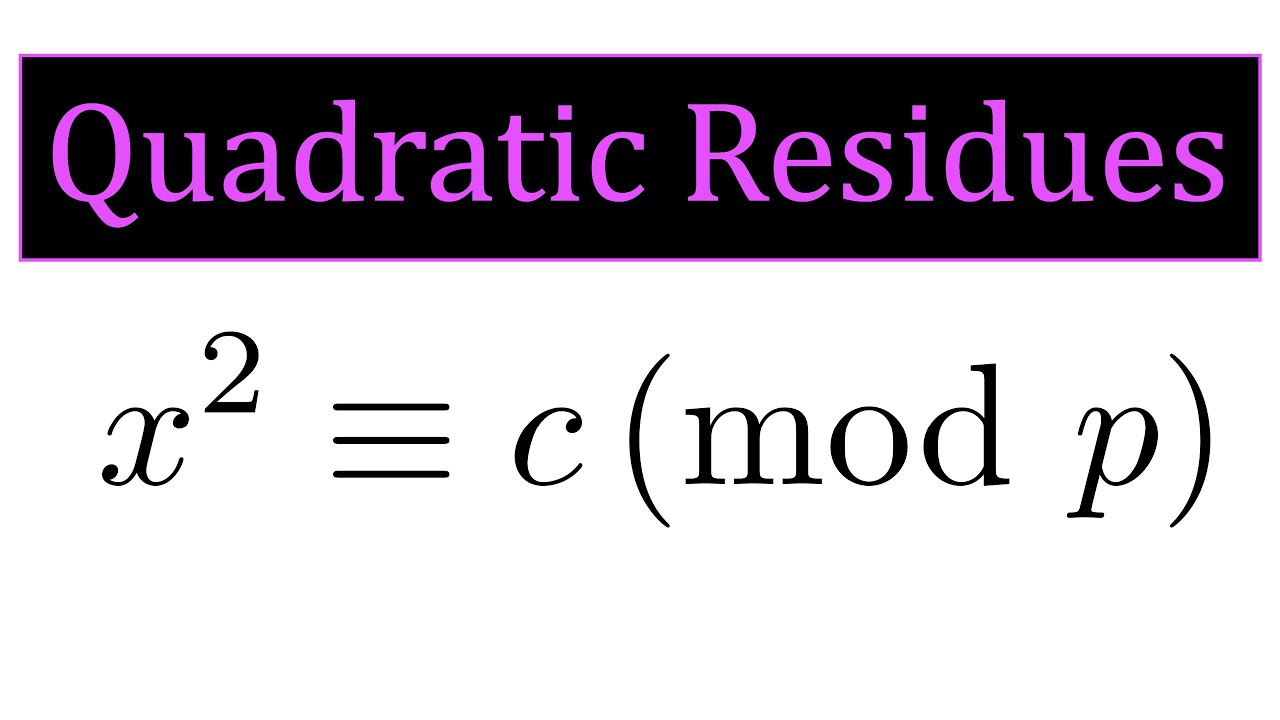
Quadratic residues are an important part of elementary number theory. Here we explain the definition of a quadratic residue mod p, go through an example of finding quadratic residues, and note one basic property.
Quadratic Residues playlist: https://www.youtube.com/playlist?list=PLug5ZIRrShJGJieICD2KnqU9cRioaEBjB
0:00 Definition
1:06 Example
2...
no idea
seems kinda pointless if it was the same thing
junior smelt
Saves me typesetting haha
compact nymph
oh, great.. thanks for the link
junior smelt
Quadratic residues are where you have solutions to the picture, non residues are where you don’t
spiral bane
compact nymph
oh, great.. thanks for the link
np, btw this was the first google result lol
compact nymph
junior smelt
Quadratic residues are where you have solutions to the picture, non residues are...
wait, what?
what's the picture you;re referring to?
junior smelt
compact nymph
wait, what?
a is a quadratic residue mod p is x^2 = a mod p has solutions in x
junior smelt
spiral bane
https://www.youtube.com/watch?app=desktop&v=M6gDsFhQugM
Talking about here, the thumbnail
Also hi SWR 
compact nymph
hmm...
ill watch this video, i suppose...
btw this is brillaince's terrible explanation im not understanding,

 last wren
yikes that is worded terribly lol
junior smelt
Did they just jump to that point?
Think there’s a better way to explain why the sum is zero
junior smelt
Well it’s still gonna be a bit skippy (and I’m like just peeking at questions while about to go back to sleep  ) but of course 163 is an odd prime
And between 1 and 162 those numbers are gonna all be coprime to 163
There’s a statement somewhere that given an odd prime p you would have (p-1)/2 quadratic residues and (p-1)/2 quadratic non residues between 1 and (p-1)
And the ones that are residues give you legradre symbol +1, the ones that aren’t give you -1
compact nymph
that video didnt really help me understand this a bit..
I appreciate your assistance, btw
junior smelt
junior smelt
There’s a statement somewhere that given an odd prime p you would have (p-1)/2 q...
As for why this is true, you can show that if you have a primitive root, that even powers and only even powers of it form quadratic residues
compact nymph
coprime (forgive me, trying to refresh here and make sure I understand) would be when the difference between two numbers is prime, right?
so, like.... 8 and 9 are not prime numbers, but the difference between them is 1
junior smelt
compact nymph
coprime (forgive me, trying to refresh here and make sure I understand) would be...
Relatively prime, where two numbers have no common factors other than 1
e.g. 8(=2^3) and 15(=3 * 5) are also coprime/relatively prime
 empty gyro
@junior smelt is 🐐
junior smelt
As for the video, yea that only covers quadratic (non/)residues but not the legradre symbol from my quick skipping through, and doesn’t cover what I said 
junior smelt
empty gyro
<@788085606483361802> is 🐐
compact nymph
junior smelt
There’s a statement somewhere that given an odd prime p you would have (p-1)/2 q...
so an odd prime, such as 163 in the example... is the p a prime number, minus 1?, divided by 2?
junior smelt
Yea p can be any odd prime - you take that prime, subtract one then divide by 2
And then you’d have the same amount of residues and nonresidues mod p
compact nymph
hmmm... so like, 23 is an odd prime, right? If we subtract 1 (22) and divide by 2 (11).. how would you have the same residues and none residues?
compact nymph
okay
junior smelt
1, 4, 9, 16 are clearly residues, that’s 4 of them
Actually can’t Wolfram make a table or something 
Forgot how you do them now
compact nymph
clearly residues?
because you can mod 5 and have left over?
I understand the 9 (mod 5 gives us 4) and 16 (mod 5 gives us 1)
junior smelt
compact nymph
clearly residues?
They’re square numbers is why
So they’re (quadratic) residues as then x^2 = “those” clearly have solutions (1,2,3,4)
compact nymph
4 being 2^2, 9 being 3^2 and 16 being 4^2?
junior smelt
Anyways, figured it out 
compact nymph
so what does legendre's symbol mean, then?
junior smelt
,w Table[x^2 mod 23, {x,1,22}]
compact nymph
given your example
flat frigateBOT


 Requested by chartbit#3171
compact nymph
Requested by chartbit#3171
compact nymph
ohhh, modular because it's gone back to 1?
junior smelt
compact nymph
so what does legendre's symbol mean, then?
So e.g. (1/23), (4/23), (9/23) and (16/23) are all +1
compact nymph
how is that +1? 9/23?
isnt that... 2.5?
(ish)
i guess what im asking is... what is + or - 1 in this example?
oh, wait...divided by 2, right?
junior smelt
flat frigate
Also note you can get 2, 3, 6, 8, 12, 13, 18 as well
junior smelt
junior smelt
1, 4, 9, 16 are clearly residues, that’s 4 of them
So those form our 11 residues
junior smelt
compact nymph
how is that +1? 9/23?
They’re not “fractions” (whoever made that notation choice  )
)
junior smelt
compact nymph
and, earlier on the page, they have given us the symbol itself:
Remember that (a/p) is a way of saying whether x^2 = a mod p has solutions (get +1) or not (get -1) - of course noting the case where a is divisible by p you get 0
compact nymph
BRB. Gotta take the dog out.
safe radishBOT
@compact nymph Has your question been resolved?
compact nymph
thanks.. im back
I think i understand it based off your excellent explanations, @junior smelt
i will keep working on this tomorrow... possible to continue this if im still confused (after doing some exercises of course)
junior smelt
Awww, well mind you my explanation was a bit tl;dr there so I haven’t covered stuff in depth, but hopefully it makes things a bit clearer! 
junior smelt
compact nymph
i will keep working on this tomorrow... possible to continue this if im still co...
But yea take some time with it, you’ll definitely get there
safe radishBOT
Channel closed
Closed due to timeout
Use .reopen if this was a mistake.
Available help channel!
Send your question here to claim the channel.
Remember:
• Ask your math question in a clear, concise manner.
• Show your work, and if possible, explain where you are stuck.
• After 15 minutes, feel free to ping <@&286206848099549185>.
• Type the command .close to free the channel when you're done.
• Be polite and have a nice day!
Read #❓how-to-get-help for further information on how to ask a good question, and about conduct in the question channels.
delicate sierra
hi, I have this question here
 safe radishBOT
delicate sierra
hi, I have this question here
delicate sierra
safe radishBOT
delicate sierra
hi, I have this question here
delicate sierra
so I did the most obvious thing and differentiate wrt m first
i get
$m = \mathbb{E}(X) \pm \sqrt{\mathbb{E}(X^2) + \mathbb{E}(X)^2$
flat frigateBOT
Azzurala
Compile Error! Click the  reaction for more information.
(You may edit your message to recompile.)
 delicate sierra
but then, i’m just kinda at a standstill here. how do you make sure to choose the point that E((X-m)^3) is maximised
and then there’s the 2nd part to the question
delicate sierra
delicate sierra
but then, i’m just kinda at a standstill here. how do you make sure to choose th...
one thing that I am trying is that I can take the 2nd derivative, but there’s still the 2nd part
delicate sierra
delicate sierra
but then, i’m just kinda at a standstill here. how do you make sure to choose th...
actually this is not bad at all, turns out the plus case is the maximised answer
Ok so I tried subbing in this value of m into the E((X-m)^3)
not a good idea
idek how to utilise the fact that X = 2-X in distribution
 misty bay
my guess is that you have to say something about E[X^2] and E[(2-x)^2]; if two random variables are equal in distribution, then all of their moments are the same
delicate sierra
misty bay
my guess is that you have to say something about E[X^2] and E[(2-x)^2]; if two r...
hmm, i see
I’ll try playing around with this ide
ty
delicate sierra
misty bay
my guess is that you have to say something about E[X^2] and E[(2-x)^2]; if two r...
what i got from this is that the expectation is 1
which actually makes sense
because if you are to retain its distribution after you reflection along the “y-axis” and translate it up by 2
the only way to do this is if it’s symmetric about “y=1”
misty bay
hmm yeah that's true
but the equality in distribution also says a lot about the other moments
maybe it'll be useful
delicate sierra
maybe
yep
i pretty much get it now i think
because from what I see
every moments can be described some functions of the second moment
well, up to the 4th moment
and the second moment is pretty easily converted to var, since E(X) = 1
@misty bay tysm for your input, I’ll try to work on this now and get back to you
misty bay
all righty, lmk how it goes
safe radishBOT
@delicate sierra Has your question been resolved?
safe radishBOT
Channel closed
Closed due to timeout
Use .reopen if this was a mistake.
safe radishBOT
Available help channel!
Send your question here to claim the channel.
Remember:
• Ask your math question in a clear, concise manner.
• Show your work, and if possible, explain where you are stuck.
• After 15 minutes, feel free to ping <@&286206848099549185>.
• Type the command .close to free the channel when you're done.
• Be polite and have a nice day!
Read #❓how-to-get-help for further information on how to ask a good question, and about conduct in the question channels.
 cloud ocean
How do I find angle BDC?
 safe radishBOT
cloud ocean
How do I find angle BDC?
cloud ocean
safe radishBOT
cloud ocean
How do I find angle BDC?
cloud ocean
Ummm
wait
i dont know how to say in English
BD Is a "Cross-angle" according to google translate
 brave wolf
BD is not even angle
cloud ocean
Line BD
faint seal
i guess you mean an angle bisector
brave wolf
Oh, it's bisector
cloud ocean
faint seal
i guess you mean an angle bisector
I mean that ABD = DBC
safe radishBOT
@cloud ocean Has your question been resolved?
safe radishBOT
Channel closed
Closed due to timeout
Use .reopen if this was a mistake.
Available help channel!
Send your question here to claim the channel.
Remember:
• Ask your math question in a clear, concise manner.
• Show your work, and if possible, explain where you are stuck.
• After 15 minutes, feel free to ping <@&286206848099549185>.
• Type the command .close to free the channel when you're done.
• Be polite and have a nice day!
Read #❓how-to-get-help for further information on how to ask a good question, and about conduct in the question channels.
lean otter
Can someone please explain me this?
safe radishBOT
lean otter
Can someone please explain me this?
lean otter
 wind folio
Virus😏
lean otter
wind folio
Virus😏
Sorry?
 broken yew
rather than some link, a screenshot would be much more helpful
and maybe highlight the part you wanted explained
lean otter

I want to understand this part:
Recall from the Orthogonal Projection Operators page that if V is an inner product space and U is a subspace of V such that V=U⊕U⊥ then any v∈V can be written as the sum v=u+w where u∈U and w∈U⊥ and the orthogonal projection operator of V onto U is PU∈(V) defined as PU(v)=u for all v∈V.
And if possible then figure also.
safe radishBOT
@lean otter Has your question been resolved?
lean otter
<@&286206848099549185>
safe radishBOT
@lean otter Has your question been resolved?
safe radishBOT
Channel closed
Closed due to timeout
Use .reopen if this was a mistake.
Available help channel!
Send your question here to claim the channel.
Remember:
• Ask your math question in a clear, concise manner.
• Show your work, and if possible, explain where you are stuck.
• After 15 minutes, feel free to ping <@&286206848099549185>.
• Type the command .close to free the channel when you're done.
• Be polite and have a nice day!
Read #❓how-to-get-help for further information on how to ask a good question, and about conduct in the question channels.
 pure yew
(y+1)^2-4(y+1)+y^2=0
safe radishBOT
pure yew
``(y+1)^2-4(y+1)+y^2=0``
flat frigateBOT
Muta
 thin bridge
how what
pure yew
solve
thin bridge
start by expanding and simplfiying
 lime dust
Do you know what expanding means?
lean otter
.reopen
lime dust
How much is (y+1)^2?
pure yew
y^2?
pure yew
ab^2
lime dust
no
pure yew
a^2+b^2
pure yew
(a+b)^2
lime dust
you must multiply like this: aa + ab +ba +bb
So you have a^2 +ab+ba+b^2
and this ia a^2+2ab+b^2
pure yew
but wait why we need ab and ba if its same like viceversa
lime dust
it's how you make the product, you have ab when you do ab, and ba when you do ba
but then, because they are the same, you add them up
so you have 2ab
pure yew
so this means 4 objects from 2ab?
lime dust
no, let's start from the begining
a and b are numbers you don't know, so we want to do the sum of them and then raise to 2.
pure yew
ok
lime dust
When you see (a+b)^2, it means you are multiplying (a+b) by itself:
(a+b) * (a+b)
Now, we will use the distributive property, which means we multiply each term in the first parentheses by each term in the second parentheses:
(a+b) * (a+b) = a * (a+b) + b * (a+b)
Now, we distribute 'a' and 'b' to both terms inside the parentheses:
a * (a+b) + b * (a+b) = aa + ab + ba + bb
Simplify each term:
aa + ab + ba + bb = a^2 + ab + ba + b^2
Notice that 'ab' and 'ba' are the same, as the order of multiplication doesn't matter (2 * 3 = 3 * 2). So, we can rewrite the expression as:
a^2 + ab + ba + b^2 = a^2 + ab + ab + b^2
Now, combine the 'ab' terms:
a^2 + ab + ab + b^2 = a^2 + 2ab + b^2
So, (a+b)^2 is equal to a^2 + 2ab + b^2. This is a quick and easy way to understand why the equation holds true.
pure yew
ok and how do we apply this formula there?
pure yew
so y^2+(2y1)+1^2 ?
lime dust
Yes
how much is 2y1 and 1^2?
please, don't solve it...
i'm trying to explain how to do it
 mortal turret
oh sorry
pure yew
so 2y1 = 2y+2 and 1^2 = 1
lime dust
2y1 is this: "2" times "y" times "1"
do that, from left to right.
how much is "2" times "y"
pure yew
2y
pure yew
2y
lime dust
there you go
so 2y1 is 2y
because you're multiplying by 1, which like doing nothing
so now you have (y+1)^2 = y^2+2y+1
now you go for the second bracket
-4(y+1)
how do you solve this?
lime dust
-4y would be -4(y)
but this is -4(y+1)
this means
-4 times (y+1)
so you have to multiply -4 with "y" and -4 with "1"
it multiplies all inside parenthesis
pure yew
so uh -4y and -4
lime dust
yes
pure yew
uh 16y?
lime dust
why 16y?
 spark ocean
@pure yew u r in which class btw?
lime dust
you got right -4y and -4
pure yew
spark ocean
<@846267205758746634> u r in which class btw?
college
pure yew
19
spark ocean
pure yew
what?
lime dust
please, avoid those comments and let us finish
spark ocean
kk
pure yew
i flanked trough algebra in highschool im not ashamed that im learning it now
lime dust
focus now Muta
spark ocean
pure yew
i flanked trough algebra in highschool im not ashamed that im learning it now
ah ok i see
pure yew
lime dust
focus now Muta
ok i get that final is -4y-4 bcs we multiplied in parenthesis
lime dust
You have y^2+2y+1 from (y+1)^2 right?
Now you got -4y -4 from -4(y+1),
and you have y^2
now show me all the terms in one line
how would it be?
pure yew
so 2y-4y-4+y
lime dust
Put everything you got
don't mind if you put all the stuff
Remember:
(y+1)^2 = y^2+2y+1
-4(y+1) = -4y -4
y^2 = y^2
pure yew
-y-4
lime dust
I want you to put everything in the same line.
Don't make anything else, only write it
change this

you rewrite this with what we got
pure yew
so : y^2+2y+1 -4y -4 + y^2
lime dust
almost, you're having one mistake
this is wrong

you expanded so you don't need parenthesis anymore
pure yew
y^2+2y+1 -4y -4 + y^2
lime dust
show me
pure yew
2y^2-2y-3
lime dust
great, so you have that is equal to 0
pure yew
ok i calculate big D now ?
pure yew
no
this is taken out of context a little bit but im doing system of equation
wait
D = 28
which doesnt make sense
lime dust
what is D?
lime dust
are you trying to use formula?
pure yew
i did
lime dust
You should solve this equations without a formula
I'll show you how
First, let the y^2 alone, without a 2. We want the y^2 alone
How do you do that?
You have this 2y^2 - 2y - 3 = 0
Remember, whatever you do in one side you do in the other side.
pure yew
divide?
lime dust
yes
pure yew
:/
pure yew
oh ok
lime dust
2y^2/2 = y^2
2y/2 = y
-3/2 = -(3/2)
0/2 = 0
pure yew
wait what
lime dust
I'll explain.
Imagine you have this equation: a = b
you can say they are similar if you do the same in both sides of the equation, for example, divide by 2
so a/2 = b/2
so in our equation, we divided by 2, both sides
so we got y^2-y-(3/2) = 0
do you understand this?
pure yew
ye
lime dust
now, the next step is to remove the ^2 from y^2
Do you remember this? (a+b)^2 = a^2+b^2+2ab?
pure yew
yes
lime dust
Now we are gonna do the opposite
if (a+b)^2 = a^2+b^2+2ab
That means a^2+b^2+2ab = (a+b)^2
right?
pure yew
yes
lime dust
Ok, before continuing u need to know that
(a-b)^2 = a^2+b^2-2ab
as you can see, the only thing that changes is 2ab with -2ab
now we have something similar
we have y^2 -y
IF, big if
(y-1) = y^2-2y+1
what's the difference between this "y^2-2y+1" and this "y^2-y"
pure yew
-y ?
lime dust
-y+1
but we are gonna forget about +1 for now
let's focus on -y
you have 1 more "-y"
because you did this: -1 * y -1 * y , so you got -2y
how do you make so it's -y
-a * y -a * y = -y
pure yew
add 2
lime dust
how much should a be?
pure yew
2 ?
lime dust
how much it would be then?
pure yew
0
lime dust
imagine "y" is a pizza
pure yew
bcs we add -2y-2y
lime dust
If i add twice some parts of the pizza, how big should be that part so when i add up twice i get a whole pizza?
pure yew
then it becomes -4y=-4y |+ 4 y=0
pure yew
lime dust
If i add twice some parts of the pizza, how big should be that part so when i ad...
8
what
pure yew
so - 16 ?
lime dust
no no
listen
I want 1 pizza, not 16
if you add 8 + 8 that's 16
but i don't want 16, i want 1
pure yew
1+0 ?
pure yew
1/2+1/2
lime dust
yes
pure yew
ok
pure yew
no we have y^2-y-3/2=0
lime dust
yes, and we have done something that is not completed but we will do it now
we changed this
y^2-y
with this (y-1/2)^2
but they are not the same
this would be y^2-y+1/4
1/4 would be from (-1/2)^2
right?
pure yew
1/4 is 0.25
lime dust
so if (y-1/2)^2 is y^2-y+1/4,
but we have y^2-y
what's the difference between y^2-y+1/4 and y^2-y
pure yew
+1/4 ?
pure yew
subtract 1/4?
lime dust
nice
so you would have this (y-1/2)^2 - 1/4
now your whole equation would be
(y-1/2)^2 - 1/4 - 3/2 = 0
how much is -1/4-3/2?
sorry
wait
i fixed, it was -3/2 not -3
pure yew
😦 i still dont get how to solve 2y^2-2y-3=0
lime dust
you will in 2 steps
we are almost done, we did the hard part
This is faster than formula, and you will understand better algebra when you use it more and more
so how much is -1/4-3/2?
pure yew
-1 3/4
pure yew
ig
lime dust
now you have this (y-1/2)^2 - 7/4 = 0
which is the same as (y-1/2)^2 = 7/4
now, how do you eliminate that ^2 in the left side equation?
pure yew
nah i think im too weak for this we are doing this equation over 30 minutes now, there are people better than me who know math like yourself so i dont want to bother maybe its not for me :/