#help-23
1 messages · Page 34 of 1
 lean otter
 frozen forge
You need to find c where the point (c, 0) is in L
When you apply the equation to (c, 0)
You got : 0 = -c +10
so c=10
frozen forge
dw
lean otter
.close
 safe radishBOT
Channel closed
Closed by @dense gazelle
Use .reopen if this was a mistake.
 Available help channel!
Send your question here to claim the channel.
Remember:
• Ask your math question in a clear, concise manner.
• Show your work, and if possible, explain where you are stuck.
• After 15 minutes, feel free to ping <@&286206848099549185>.
• Type the command .close to free the channel when you're done.
• Be polite and have a nice day!
Read #❓how-to-get-help for further information on how to ask a good question, and about conduct in the question channels.
lean otter
P is a power set here
 safe radishBOT
lean otter
P is a power set here
safe radishBOT
lean otter
P is a power set here
 plucky elk
lean otter
P is a power set here
plucky elk
lean otter
P is a power set here
do you know the definition of injective
also what is the function
lean otter
plucky elk
do you know the definition of injective
every element in one set can be mapped onto a unique element of the other set
lean otter
plucky elk
also what is the function
sorry my goal is to construct a function that is injective onto T
plucky elk

lean otter
or like
plucky elk
oh i guess binary encoding might work
lean otter
any uncountable set would work. All I need to do is to find a function f that is an injection from P(S) onto an uncountable set
so I can show that P(S) is uncountable
does this make sense? @plucky elk
plucky elk
maybe? hard to judge without an actual funciton
lean otter
well how would you prove that P(S) is uncountable?
if I can prove this I basically solved my whole assignment
plucky elk
power set of any countably infinite set is uncountable
plucky elk
 lean otter
okay so this is a proof to why P(N) is uncounable
S is bijective onto N (I already proved it). so can we imply from that fact that P(S) is also uncountable?
@plucky elk
plucky elk
lean otter
S is bijective onto N (I already proved it). so can we imply from that fact that...
yes
lean otter
plucky elk
yes
and if an uncountable set is a subset of another set, then this set is also uncountable right?
safe radishBOT
@lean otter Has your question been resolved?
safe radishBOT
@lean otter Has your question been resolved?
Channel closed
Closed by @dense ermine
Use .reopen if this was a mistake.
Available help channel!
Send your question here to claim the channel.
Remember:
• Ask your math question in a clear, concise manner.
• Show your work, and if possible, explain where you are stuck.
• After 15 minutes, feel free to ping <@&286206848099549185>.
• Type the command .close to free the channel when you're done.
• Be polite and have a nice day!
Read #❓how-to-get-help for further information on how to ask a good question, and about conduct in the question channels.
 silk flicker
Can anyone give a pair of x,y,z that show that this is not a linear transformation?
 safe radishBOT
silk flicker
Can anyone give a pair of x,y,z that show that this is not a linear transformati...
silk flicker
safe radishBOT
silk flicker
Can anyone give a pair of x,y,z that show that this is not a linear transformati...
silk flicker
Every pair I have tried pass by both scalar multiplication and matrix addition. I dont understand how this can not be a linear transformation
safe radishBOT
@silk flicker Has your question been resolved?
silk flicker
<@&286206848099549185>
safe radishBOT
@silk flicker Has your question been resolved?
safe radishBOT
@silk flicker Has your question been resolved?
safe radishBOT
@silk flicker Has your question been resolved?
 scarlet perch
Just test (0,0) and if it moves it’s not linear
 sleek narwhal
.close
safe radishBOT
Channel closed
Closed by @sleek narwhal
Use .reopen if this was a mistake.
sleek narwhal
Due to inactiveness.
safe radishBOT
Available help channel!
Send your question here to claim the channel.
Remember:
• Ask your math question in a clear, concise manner.
• Show your work, and if possible, explain where you are stuck.
• After 15 minutes, feel free to ping <@&286206848099549185>.
• Type the command .close to free the channel when you're done.
• Be polite and have a nice day!
Read #❓how-to-get-help for further information on how to ask a good question, and about conduct in the question channels.
 true nimbus
why is arctan(1) = pi/4?
safe radishBOT
true nimbus
why is arctan(1) = pi/4?
true nimbus
i am confused on how to solve for this answer
safe radishBOT
@true nimbus Has your question been resolved?
true nimbus
.close
safe radishBOT
Channel closed
Closed by @true nimbus
Use .reopen if this was a mistake.
Available help channel!
Send your question here to claim the channel.
Remember:
• Ask your math question in a clear, concise manner.
• Show your work, and if possible, explain where you are stuck.
• After 15 minutes, feel free to ping <@&286206848099549185>.
• Type the command .close to free the channel when you're done.
• Be polite and have a nice day!
Read #❓how-to-get-help for further information on how to ask a good question, and about conduct in the question channels.
 lusty widget
$b^{\frac12} \cdot{b^{\frac45}}$
 flat frigateBOT
Springsskateboard
 lean otter
oh nevermind 💀 i thought those were full fractions
lusty widget
yeah
take the reciprocal
and exponent becomes positive
yep
nice
ggwp
mhm
in ur mom’s house
lean otter
tell me where you live NOW @lusty widget
lean otter
Ayee sounds good
lean otter
lusty widget
after what happened at Seoul 💀
yeah..all over the news :(
lean otter
honestly, i doubt anything can beat what they have in india
lusty widget
didn’t study in Korea’s curriculum
lusty widget
lean otter
honestly, i doubt anything can beat what they have in india
bro India built diff
respect to them
lean otter
you are going to fight Cthulhu
lusty widget
I’m going to fight the belt
If I catch the belt then I’ll get a slipper thrown at my face
lusty widget
oh damn
lean otter
calculus isn't thaaaaaat bad
lusty widget
calculus is love
lean otter
until you get to integrals, then things kinda get harder
lusty widget
lusty widget
calculus is love
except for when it’s not
lean otter
exactly
lusty widget
let me quote what my very insightful teacher said
“>50% of students fail this class”
fking hell
I found out he was lying
Everyone passed
HAHAHHA
here we don’t have calculus as a separate class
it’s all combined into one subject
math ✨
safe radishBOT
Channel closed
Closed by @last jacinth
Use .reopen if this was a mistake.
lean otter
lusty widget
“>50% of students fail this class”
from my end
to quote my inspirational electromagnetism teacher, "you are screwed"
lusty widget
you too my bro
lusty widget
lean otter
to quote my inspirational electromagnetism teacher, "you are screwed"
HAHAHAH FUCK
I dropped physics 😎
lean otter
based
safe radishBOT
Available help channel!
Send your question here to claim the channel.
Remember:
• Ask your math question in a clear, concise manner.
• Show your work, and if possible, explain where you are stuck.
• After 15 minutes, feel free to ping <@&286206848099549185>.
• Type the command .close to free the channel when you're done.
• Be polite and have a nice day!
Read #❓how-to-get-help for further information on how to ask a good question, and about conduct in the question channels.
lusty widget
Hopped on to the good ol biology/ chemistry side
safe radishBOT
lusty widget
Hopped on to the good ol biology/ chemistry side
safe radishBOT
Channel closed
Closed by @lusty widget
Use .reopen if this was a mistake.
lean otter
lusty widget
Hopped on to the good ol biology/ chemistry side
okay nvm u went to worse
lusty widget
lean otter
okay nvm u went to worse
HAHAHAH FK OFF
lean otter
😵💫
lusty widget
bio>phy
lean otter
tbh by this point...maybe
 halcyon carbon
lusty widget
bio>phy
halcyon carbon
lusty widget
bio>phy
Wrong
lusty widget
lean otter
tbh by this point...maybe
yes, I’m shedding light on the truth
 halcyon carbon

 solar hazel
lusty widget
LITERALLY EVERYTHING ELSE > phy
solar hazel
lusty widget
LITERALLY EVERYTHING ELSE > phy
🙌
lusty widget
solar hazel
🙌
YAS
safe radishBOT
Available help channel!
Send your question here to claim the channel.
Remember:
• Ask your math question in a clear, concise manner.
• Show your work, and if possible, explain where you are stuck.
• After 15 minutes, feel free to ping <@&286206848099549185>.
• Type the command .close to free the channel when you're done.
• Be polite and have a nice day!
Read #❓how-to-get-help for further information on how to ask a good question, and about conduct in the question channels.
 white jay
Need help with some math. Lol. I want to trade in a phone with T-Mobile. T-Mobile has two promotions. Trade-ins are worth either 1000 or 800 credit depending on model.
I want to purchase a used phone for 100-300 and trade that one in for credit towards the iPhone 14 pro max (1100). Can someone help write this equation out? I have an excel spreadsheet that gives me an idea. For my budget, phones worth 1000 credit I shouldn't spend more than 300. For phones worth 800, I shouldn't spend more than 100 (maximum I can stomach coming out of pocket is 400)
(cost of iPhone 14 pro max) minus- (trade-in value of used phone) plus+ (cost of purchasing trade phone) plus+ (whatever owed/remainder to get to 1100) = (total out of pocket cost)
(1100-800=300)+X==Y
(1100-1000=100)+X==Y
X is the variability in used phone prices. I figure "Y" is my budget. Is there some sort of equation or desmos graph that will tell me at what price point the deals come out even?
safe radishBOT
white jay
Need help with some math. Lol. I want to trade in a phone with T-Mobile. T-M...
Please don't occupy multiple help channels.
 trim swan
Wait, so you essentially want to buy a used phone for the purposes of trading it into t-mobile to make a profit?
lean otter
trim swan
Wait, so you essentially want to buy a used phone for the purposes of trading it...
this feels...sketchy 
trim swan
and unrealistic
lean otter
trim swan
and unrealistic
Yeah I am not sure how something like guarantee, warranty, etc. is going to be considered here
if they are not, then i am not sure who is buying this..
trim swan
Yeah I just think t-mobile is gonna offer a pretty low amount for most phones, I don't really see this being a net gain
but @white jay I'm not really sure I understand your question anyway
If you don't want to spend more than 400, then you need the used phone to cover 700. Which means you need to buy it for 700 less than what t-mobile will offer you for it
white jay
trim swan
Wait, so you essentially want to buy a used phone for the purposes of trading it...
Profit implies I'm making money; I'm not. I need a new phone and want to get the best value and savings I can.
trim swan
Well, what I mean is, essentially you need to have a net gain of 700 from when you buy the phone to when you sell it to t-mobile
white jay
 trim swan
Right. So you want to buy a phone for $100 and sell it to T-mobile for $800
for example
That's what I meant by profit. Obviously when you buy a new phone at the same time, you're gonna walk away with less money
white jay
trim swan
Right. So you want to buy a phone for $100 and sell it to T-mobile for $800
Yes. However. The 14 costs 1100. If I spent less than 300 purchasing a used phone to trade, that would be a better deal than the 800 credit offer.
white jay
trim swan
Well, what I mean is, essentially you need to have a net gain of 700 from when y...
How did you get 700?
trim swan
In both your examples, the difference between "trade-in cost" and "trade-in credit" is 700
800-100=700
and
1000-300=700
I don't understand your "difference" column
white jay
trim swan
In both your examples, the difference between "trade-in cost" and "trade-in cred...
Ahh. I see. The 100/300 are arbitrarily put there bc my max budget is 400. Online prices are all over the place and the 100/300 should be variable
trim swan
Oh yeah ok
white jay
Difference column is difference between trade credit and price of iphone 14 pro max
trim swan
Ok
Yeah bottom line is if you want to pay 400 instead of 1100, then you need to profit 700 buying and selling the used phone
400+700=1100
Basically just that
white jay
It would be neat to see a desmos graph with an x slider that plugged into both equations (trade credit offers)
trim swan
white jay
It would be neat to see a desmos graph with an x slider that plugged into both e...
I'm sorry, I'm not sure what you mean. Here x represents what?
white jay
The variable cost of purchasing a used phone to trade in.
trim swan
And the outputs of the functions would be?
How much you need to be able to sell it for?
It's not really a complicated function, if I understand correctly.
You need to buy the phone for x and trade it in for x+700
white jay
trim swan
And the outputs of the functions would be?
You lost me there. I suppose the question is: with a max budget of 400, what method could I use to quickly determine which is offer is the better deal? Keep in mind: later models trade-in for 1000 credit, but cost more; older models cost less but only trade for 800 credit
trim swan
Oh, the 1000 and 800 are known for sure?
white jay
My best equation for this is to know exactly my budget, and use excel to quickly tell me total out of pocket cost
white jay
trim swan
Oh, the 1000 and 800 are known for sure?
Yes. With qualifying models of phones
For example: the iphone XR lowest price I've seen is 100, but only trades for 800 credit. An iphone 11 pro trades for 1000, but if I spend 300 purchasing it, I break even with the other deal. The deals are effectively the same after all is said and done with
Because I'm OOP 400
trim swan
Gotcha
So if you buy the used phone for x dollars
If you buy an older ($800) phone, your OOP cost will be x+300
If you buy a newer ($1000) phone, your OOP cost will be x+100
white jay
trim swan
If you buy an older ($800) phone, your OOP cost will be x+300
That doesn't sound right
trim swan
OOP = 1100 - (trade in value) + (what you paid for used phone)
If the trade in value is 800, that's 300 + x
If the trade in value is 1000, that's 100 + x
white jay
trim swan
If the trade in value is 800, that's 300 + x
Older phone worth 800 trade in will cost me 300+X
white jay
trim swan
If the trade in value is 1000, that's 100 + x
Bingo
trim swan
white jay
Bingo
that's literally what I said lol
white jay
trim swan
that's literally what I said lol
Beat me to it
trim swan
I mean, it's the same thing you just said sounded wrong
white jay
trim swan
I mean, it's the same thing you just said sounded wrong
The wording got me
trim swan
Okay lol
Yeah, if you buy an older phone for x, your OOP is 300+x
And if you buy a newer phone for x, your OOP is 100+x
white jay
trim swan
Yeah, if you buy an older phone for x, your OOP is 300+x
And if you buy a newer...
Is it really just that simple? Is there a graph that I can put a slider on X for both equations that would quickly tell me my OOP?
trim swan
Yeah lol I'll make a desmos graph
But yes it is that simple
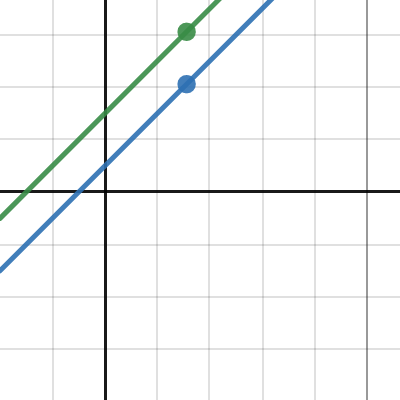
Desmos
x-value is the price you pay for the used phone
Green y-value is your OOP if it's an older model.
Blue y-value is your OOP if it's a newer model
You can drag the points back and forth like a slider
@white jay
safe radishBOT
@white jay Has your question been resolved?
Channel closed
Closed by @white jay
Use .reopen if this was a mistake.
white jay
trim swan
<@533149848682364950>
Thanks!
trim swan
No problem 👍
trim swan
white jay
Thanks!
Good luck. I wouldn't have thought it's actually possible to buy phones that cheap to trade in
safe radishBOT
Available help channel!
Send your question here to claim the channel.
Remember:
• Ask your math question in a clear, concise manner.
• Show your work, and if possible, explain where you are stuck.
• After 15 minutes, feel free to ping <@&286206848099549185>.
• Type the command .close to free the channel when you're done.
• Be polite and have a nice day!
Read #❓how-to-get-help for further information on how to ask a good question, and about conduct in the question channels.
 crude star
If im tryin to find the equation of a secant line that passes through two points (a, b) and (c, d) is y - b = [(d - b)/(c - a)] (x - a) the valid formula?
safe radishBOT
crude star
If im tryin to find the equation of a secant line that passes through two points...
crude star
where [(d-b)/(c-a)] is to find the slope
safe radishBOT
@crude star Has your question been resolved?
crude star
Determine a linear mathematical model for the temperature, T (in degrees Celsius), as a function of depth, z (in meters) by finding an equation of the secant line that goes between Nico’s two data points.


Is this right?
Or am I missing something
safe radishBOT
@crude star Has your question been resolved?
safe radishBOT
Channel closed
Closed due to timeout
Use .reopen if this was a mistake.
Available help channel!
Send your question here to claim the channel.
Remember:
• Ask your math question in a clear, concise manner.
• Show your work, and if possible, explain where you are stuck.
• After 15 minutes, feel free to ping <@&286206848099549185>.
• Type the command .close to free the channel when you're done.
• Be polite and have a nice day!
Read #❓how-to-get-help for further information on how to ask a good question, and about conduct in the question channels.
 fierce ore
dy/dx = x+y
 safe radishBOT
@fierce ore Has your question been resolved?
safe radishBOT
Channel closed
Closed due to timeout
Use .reopen if this was a mistake.
safe radishBOT
Available help channel!
Send your question here to claim the channel.
Remember:
• Ask your math question in a clear, concise manner.
• Show your work, and if possible, explain where you are stuck.
• After 15 minutes, feel free to ping <@&286206848099549185>.
• Type the command .close to free the channel when you're done.
• Be polite and have a nice day!
Read #❓how-to-get-help for further information on how to ask a good question, and about conduct in the question channels.
 teal bobcat
<@&286206848099549185>
safe radishBOT
@teal bobcat Has your question been resolved?
safe radishBOT
Channel closed
Closed due to the original message being deleted
Available help channel!
Send your question here to claim the channel.
Remember:
• Ask your math question in a clear, concise manner.
• Show your work, and if possible, explain where you are stuck.
• After 15 minutes, feel free to ping <@&286206848099549185>.
• Type the command .close to free the channel when you're done.
• Be polite and have a nice day!
Read #❓how-to-get-help for further information on how to ask a good question, and about conduct in the question channels.
 magic mantle
 safe radishBOT
magic mantle
magic mantle
safe radishBOT
magic mantle
magic mantle
y’’ -4y’ +5y = 21e^(2x)
I got Yp = 21e^(2x)
Which is the same as f(x)
Is this possible?
Or have I made an oopsie somewhere in my solution?
 crimson field
,w y’’ -4y’ +5y = 21e^(2x)
flat frigateBOT


 Requested by stabulo#9301
magic mantle
Requested by stabulo#9301
magic mantle
Wow, very useful 👀
crimson field
Your general solution is correct. Just a coincidence that y_p(x) = f(x).
magic mantle
Uh but wait
My general solution is e^x * (c1cosx + c2sinx)
The bot’s solution has e^(2x) instead?
magic mantle
That means I did the easy part wrong 
 crimson field
🙂
 safe radishBOT
Channel closed
Closed by @magic mantle
Use .reopen if this was a mistake.
safe radishBOT
Available help channel!
Send your question here to claim the channel.
Remember:
• Ask your math question in a clear, concise manner.
• Show your work, and if possible, explain where you are stuck.
• After 15 minutes, feel free to ping <@&286206848099549185>.
• Type the command .close to free the channel when you're done.
• Be polite and have a nice day!
Read #❓how-to-get-help for further information on how to ask a good question, and about conduct in the question channels.
 hidden steppe
hello, how can I solve this?
 safe radishBOT
hidden steppe
hello, how can I solve this?
safe radishBOT
hidden steppe
hello, how can I solve this?
 white hollow
right so what's g in terms of kg
white hollow
that's correct, but you still need to deal with the cm
white hollow
how many cm in 1 meter
hidden steppe
100
hidden steppe
100 cm^3 = 1 m^3
 white hollow
the cubes are the same
volume of a cube is just side^3
so volume of the left cube is (100cm)^3 which is 1000000cm^3
and volume of the right cube is (1m)^3 which is 1m^3
so 1,000,000cm^3 = 1m^3
hidden steppe
but how can that be, cubic just means that it's 3 dimensions
white hollow
yeah exactly
it's volume
the volume of a cube with side length 100cm is not 100cm^3
it's 100^3 cm^3
hidden steppe
I'm afraid I don't follow you
white hollow
ok let me illustrate in 2 dimensions, might help you understand better

these 2 squares are the same
as 100cm = 1m
what's the area of each of them?
white hollow
don't worry about tha rn
just tell me the area of left square, in terms of cm^2, and area of right square in terms of m^2
hidden steppe
10 000cm^2
white hollow
and the right square?
hidden steppe
1m^2
 fathom fjord
Guys on day 0 you send a chain letter to 6 friends each of them sends it to 4 friends the next day and each of those people send it to 4 more friends the next day and so on i need recursive and explicit
white hollow
hidden steppe
1m^2
right so since the squares are the same, the areas are the same
so 10 000 cm^2 = 1m^2
in other words ten thousand square centimeters makes 1 square meter
now do you see how the same logic applies to the cube?
 sand minnow
square*
white hollow
yeah ty
white hollow
fathom fjord
Guys on day 0 you send a chain letter to 6 friends each of them sends it to 4 fr...
this channel is occupied, check out #❓how-to-get-help
hidden steppe
white hollow
in other words ten thousand square centimeters makes 1 square meter
yeah I see that now but how can I know this? is there some formula I can use to figure this out
white hollow
what do you mean
you just convert the units
for example lets say we have km and m
1000m = km
and then cube / square
hidden steppe
yes but I know that k stands for thousand. How can I know that 10 000 square cm equals 1 square meter
hidden steppe
but it doesn't make sense to me since they are both using cubic
sand minnow
easiest way is probably just knowing the first one. so you have that $km=1000m$ then you square both sides to get $(km)^2=(1000m)^2=1 000 000 m^2$
flat frigateBOT
Duh Hello
 sand minnow
this is how it works
hidden steppe
but lets say I had something else like 1 square meter to square mm
how can I calculate that
sand minnow
so you know that $m=1000mm$ right? then you have that $m^2=(1000mm)^2=1000000mm^2$
flat frigateBOT
Duh Hello
 hidden steppe
oh so I can just square it
hidden steppe
what if there is 4 dimensions?
hidden steppe
okay
sand minnow
so for the start problem, you have $m=100cm$, how much is $m^3$ in $cm^3$?
flat frigateBOT
Duh Hello
 hidden steppe
so to convert cm3 to m3 I have to divide by 10 000?
sand minnow
not quite, if it was cm^2 to m^2 then yes you would divide by 10 000
hidden steppe
so now it's 1 000 000
sand minnow
since $m^2=(100cm)^2=10000cm^2$ but you have $m^3=(100cm)^3=?$
flat frigateBOT
Duh Hello
 sand minnow
exactly yes
sand minnow
white hollow
this is what bo luo was illustrating here
would recommend looking at it and try to understand why
hidden steppe
I couldn't understnad that
but I still can't grasp how I can go about solving this problem
sand minnow
its two cubes, one measured in cm and one measured in m
let me just repost it so you dont have to scroll
 hidden steppe
sand minnow
its two cubes, one measured in cm and one measured in m
hidden steppe
sand minnow
its two cubes, one measured in cm and one measured in m
yeah I can see the cubes but I can't read the symbols
sand minnow
the one on the left shows that one side is 100cm, the one on the right shows that the side is 1m
but we know that 1m=100cm so they cubes are equal
hidden steppe
yes I already knew that
sand minnow
so what is it that you dont understand about the picture?
flat frigateBOT
Duh Hello
 sand minnow
so the left one has volume $$V=l\cdot w\cdot h=100 cm\cdot 100 cm\cdot 100cm$$ and the one on the right has volume $$V=l\cdot w\cdot h=1m \cdot 1m\cdot 1m$$
flat frigateBOT
Duh Hello
 sand minnow
could you show your work?
hidden steppe
sand minnow
could you show your work?
 sand minnow
there should not be a 2.5 in the denominator
hidden steppe
2.5 / 1 000 000
sand minnow
you have that $kg=1000 g$ so $g =\frac{1}{1000}kg$, you then have that $$m^3=10^6cm^3$$ so you then have that $$cm^3=10^{-6}m^3$$you then have that$$2.5\frac{g}{cm^3}=2.5\frac{\frac{1}{1000}kg}{10^{-6}m^3}=2500\frac{kg}{m^3}$$
flat frigateBOT
Duh Hello
 hidden steppe
flat frigate
**Duh Hello**
hidden steppe
flat frigate
**Duh Hello**
didn't understand any of that
sand minnow
ok ill remove scientific notation
you have that $kg=1000 g$ so $g =\frac{1}{1000}kg$, you then have that $$m^3=1000000cm^3$$ so you then have that $$cm^3=\frac{1}{1000000}m^3$$you then have that$$2.5\frac{g}{cm^3}=2.5\frac{\frac{1}{1000}kg}{\frac{1}{1000000}m^3}=2500\frac{kg}{m^3}$$
hidden steppe
I understand scientific notation
flat frigateBOT
Duh Hello
 hidden steppe
but I have never seen the format you are using
sand minnow
i find an expression for $g$ and for $cm^3$ in terms of $kg$ and $m^3$ and then i just put them into the original expression which is $2.5\frac{g}{cm^3}$
flat frigateBOT
Duh Hello
 sand minnow
which is what you are doing when you convert units
hidden steppe
what step did I get wrong?
sand minnow
well you only showed the answers both times and both were wrong so i dont know
you gotta show all the steps for me to see where you went wrong
hidden steppe
well first I converted 2.5g to kg by dividing by 1000
then I did the same with the cm3 to m3
but dividing by 1000 000
and that got me the wrong answer
hidden steppe
0.001
sand minnow
ok. what is 1 cm^3 in m^3?
hidden steppe
I don't know how I can calculate that
sand minnow
well you know that $m^3=10^6cm^3$ right? what happens when you solve for $cm^3$?
flat frigateBOT
Duh Hello
 sand minnow
going to scientific notation since you said you understand it, then i dont have to count zeroes anymore
sand minnow
but you cant convert those, they arent something you convert
they are different dimensions
its like trying to convert seconds to meters
they arent the same measurement so you cant convert them
but look at this equation $$m^3=10^6cm^3$$
flat frigateBOT
Duh Hello
 sand minnow
what do you have to do to get $cm^3$ alone?
flat frigateBOT
Duh Hello
 hidden steppe
no idea
sand minnow
well you divide by $10^6$
flat frigateBOT
Duh Hello
 sand minnow
this is just basic algebra
its the same as saying $y=3x$, what do you do to get $x$ alone?
flat frigateBOT
Duh Hello
 sand minnow
maths isnt just about remembering equations, its about using logic
hidden steppe
well you don't know x so that isnt possible
sand minnow
$x=\frac{y}{3}$
flat frigateBOT
Duh Hello
 hidden steppe
sand minnow
maths isnt just about remembering equations, its about using logic
hidden steppe
sand minnow
maths isnt just about remembering equations, its about using logic
of course but it's important to know the formulas
sand minnow
thats solving for x
sand minnow
but you can use logic to know that
hidden steppe
actually math is pretty much built on that, pemdas, distributive property etc
but anyways I just need to know the method for calculating this problem
 hidden steppe
maybe you can do cubic root to get rid of the exponent
flat frigateBOT
Duh Hello
 flat frigateBOT
Duh Hello
 hidden steppe
okay I don't understand the logic of it
sand minnow
the logic is that you want $g$ in terms of $kg$ and $cm^3$ in terms of $m^3$ so you can substitute them into the equation $$2.5\frac{g}{cm^3}$$to get the right answer in $$\frac{kg}{m^3}$$
flat frigateBOT
Duh Hello
 hidden steppe
but how do you get cm3 to m3?
sand minnow
this is what i am showing
hidden steppe
where
sand minnow
flat frigate
**Duh Hello**
here
hidden steppe
where do you get the 1 and million from?
sand minnow
but to get there i used the equation $$m^3=10^6cm^3$$ and solved for $cm^3$ to get $cm^3$ in terms of $m^3$
flat frigateBOT
Duh Hello
 hidden steppe
flat frigate
**Duh Hello**
hidden steppe
flat frigate
**Duh Hello**
and where did you get the 10^6 from?
sand minnow
from that $1 m^3$ is 1 million $cm^3$
flat frigateBOT
Duh Hello
 sand minnow
maybe i should switch away from scientiffic notation
seems you are getting confused by it
hidden steppe
10^6 is 1 000 000 no?
sand minnow
yes
hidden steppe
how am I getting confused
sand minnow
so why is it hard for you to get $cm^3$ alone?
hidden steppe
I just don't understand the logic behind the formulas you are using
flat frigateBOT
Duh Hello
 hidden steppe
because I don't know the method
sand minnow
its just dividing both sides by 1 million
in words, 1/(1 millionth) of a m^3 is 1 cm^3
hidden steppe
I feel like you are jumping over steps. I have cm3 and I want to get to m3
how can I do that?
I don't know where you get your numbers from
sand minnow
you find an expression for cm^3 from m^3
and since you know the relation $$m^3=(100cm)^3=10^6cm^3$$ you can then divide both sides by $10^6$ to get $$cm^3=\frac{1}{10^6}m^3$$
flat frigateBOT
Duh Hello
 hidden steppe
flat frigate
**Duh Hello**
hidden steppe
flat frigate
**Duh Hello**
I don't know that relation
hidden steppe
the other guy told me that m3 was not equal 100cm3
sand minnow
exactly. and you found that 1 m^3 is 1 million cm^3
after some time
and now i have been using that
hidden steppe
how can 1m3 be 1 000 000 cm3
sand minnow
hidden steppe
oh so I can just square it
i thought you understood it at this point
hidden steppe
you haven't explained it. You just stated it was the case but I don't know the method for calculating it
sand minnow
flat frigate
**Duh Hello**
follow this
i was explaining it here
but you seemed to understand it
since you had the right answer while i was typing it
either way i think you have the wrong mindset when it comes to math. you just want to know how to do things with zero understanding of how it works. this will lead you down a bad path. i think im gonna have to call it quits here, maybe someone else can help you
hidden steppe
sand minnow
either way i think you have the wrong mindset when it comes to math. you just wa...
I'm not sure what you mean by that. I'm trying to figure out a method I can use for converting this
anyways thanks for taking the time
I appreciate the help
sand minnow
would probably ping helpers
safe radishBOT
@hidden steppe Has your question been resolved?
lean otter
hidden steppe
hello, how can I solve this?
convert each unit using powers of 10
show ur workings
where did u go wrong?
hidden steppe
lean otter
convert each unit using powers of 10
show ur workings
where did u go wrong?
I don't know how I can convert cm3 to m3
lean otter
hidden steppe
I don't know how I can convert cm3 to m3
ok
how many cm in 1 m?
@hidden steppe
@hidden steppe ??
hidden steppe
10^2
hidden steppe
yes makes sense
hidden steppe
0.01
hidden steppe
lean otter
1 cm^3 = 1 cm * 1 cm * 1 cm
= 0.01 m * 0.01 m * 0.01m
what
lean otter
converted each of the 1 cm to meters
hidden steppe
I don't understand the 2nd line
hidden steppe
0.01
lean otter
1 cm^3 = 1 cm * 1 cm * 1 cm
= 0.01 m * 0.01 m * 0.01m
= 10^{-6} m^3
hidden steppe
lean otter
1 cm^3 = 1 cm * 1 cm * 1 cm
= 0.01 m * 0.01 m * 0.01m
...
what is last line
hidden steppe
I don't understand it
hidden steppe
10^-6 = 1/10^6
lean otter
what??
hidden steppe
no z
hidden steppe
no I don't understand
lean otter
what??
hidden steppe
the last line
hidden steppe
yes
lean otter
what grade r u in?
hidden steppe
I am not in school
lean otter
doesnt mean that you dont know basics at all costs
lean otter
hidden steppe
I graduated
r u srs?
hidden steppe
yes
lean otter
graduated with what
hidden steppe
but I forgot pretty much all math I did
hidden steppe
so I had to redo everything
hidden steppe
I know how to multiply
lean otter
when you multuply 0.01 by 0.01 by 0.01
lean otter
hidden steppe
so I can just put it in there
idrc how u get the answer
so do u get the answer?
yes or no?
hidden steppe
yes
lean otter
ok
hidden steppe
0.000001
hidden steppe
I have no idea what you mean
lean otter
hidden steppe
0.000001
this is in meter cubed
and is = 1 cm^3
and that was ur q
so done
gl
lean otter
hidden steppe
0.000001
multiply this by 2.5 then
hidden steppe
lean otter
multiply this by 2.5 then
I don't understand why that number is relevant
lean otter
hidden steppe
I don't understand why that number is relevant
because it shows how many m^3 in 1 cm^3
hidden steppe
lean otter
because it shows how many m^3 in 1 cm^3
I still have no idea how to solve my problem
that doesn't help me
lean otter
ah srry cant help i gtg
hidden steppe
lean otter
ah srry cant help i gtg
alright thanks anyways for taking the time
<@&286206848099549185> could someone help me with this problem please
safe radishBOT
@hidden steppe Has your question been resolved?
hidden steppe
<@&286206848099549185>
lean otter
i got you bro
safe radishBOT
@hidden steppe Has your question been resolved?
hidden steppe
<@&286206848099549185> could anyone help me
hidden steppe
 broken shell
Whats the problem
broken shell
Whats the problem
 broken shell
Ok so
Im not on pc so i cant use latex but try to understand me
1kg = 1000g right
hidden steppe
yes
hidden steppe
I don't follow
broken shell
So basically when you are converting "cubes"
If you jump for example, from m³ to dm³
You multiply by 1000
1 step = 1000 units
Ok?
hidden steppe
I see, is it the same principle for m2 to dm2? but with 100
safe radishBOT
@hidden steppe Has your question been resolved?
safe radishBOT
Channel closed
Closed due to timeout
Use .reopen if this was a mistake.
Available help channel!
Send your question here to claim the channel.
Remember:
• Ask your math question in a clear, concise manner.
• Show your work, and if possible, explain where you are stuck.
• After 15 minutes, feel free to ping <@&286206848099549185>.
• Type the command .close to free the channel when you're done.
• Be polite and have a nice day!
Read #❓how-to-get-help for further information on how to ask a good question, and about conduct in the question channels.
 worthy hemlock
Why does that say 25 marks?
I'm not stupid
I'm questioning if that's a test or not
 swift fjord
look at the numbers man
 cedar rivet
worthy hemlock
cedar rivet
worthy hemlock
<@&268886789983436800> Got a troll
 twilit furnace
cheers
safe radishBOT
@olive mirage Has your question been resolved?
safe radishBOT
Channel closed
Closed due to timeout
Use .reopen if this was a mistake.
safe radishBOT
Available help channel!
Send your question here to claim the channel.
Remember:
• Ask your math question in a clear, concise manner.
• Show your work, and if possible, explain where you are stuck.
• After 15 minutes, feel free to ping <@&286206848099549185>.
• Type the command .close to free the channel when you're done.
• Be polite and have a nice day!
Read #❓how-to-get-help for further information on how to ask a good question, and about conduct in the question channels.
Channel closed
Closed due to the original message being deleted
safe radishBOT
Available help channel!
Send your question here to claim the channel.
Remember:
• Ask your math question in a clear, concise manner.
• Show your work, and if possible, explain where you are stuck.
• After 15 minutes, feel free to ping <@&286206848099549185>.
• Type the command .close to free the channel when you're done.
• Be polite and have a nice day!
Read #❓how-to-get-help for further information on how to ask a good question, and about conduct in the question channels.
 prime nacelle
 safe radishBOT
prime nacelle
prime nacelle
safe radishBOT
prime nacelle
prime nacelle
yea simplifies to 8x+13y=130
 deep depot
,w Plot 8x+13y=130
flat frigateBOT

 Requested by 𝓐𝓡𝓝𝓐𝓑 𝓟𝓐𝓛#6985
deep depot
Requested by 𝓐𝓡𝓝𝓐𝓑 𝓟𝓐𝓛#6985
deep depot
No I just did it without any reason
deep depot
Wait you have to find x+y
prime nacelle
ya
 twin lantern
deep depot
,w Plot 8x+13y=130
twin lantern
deep depot
,w Plot 8x+13y=130
plotting isnt necessary bro its trigonometry
deep depot
13+2=15
prime nacelle
deep depot
13+2=15
how u get 13 and 2
deep depot
twin lantern
plotting isnt necessary bro its trigonometry
It is triangular algebra cause I have to find integer I have to find by using graph
It would be easier
deep depot
8x+13y=130 there are some other possibilities like
x=0 and y= 10
But we know that x and y are positive integer so
Yeah
Bro at first I was confused but when I saw the integer word I got that in my mind
twin lantern
deep depot
8x+13y=130 there are some other possibilities like
x=0 and y= 10
But we know t...
no
it should sum up to 180
prime nacelle
it does
deep depot
Yupp
prime nacelle
twin lantern
no
how would u propose to do it
deep depot
,w plot x^2 + {y -3/4(x^2)^(1/3)}^2 = 1
flat frigateBOT
 Requested by 𝓐𝓡𝓝𝓐𝓑 𝓟𝓐𝓛#6985
prime nacelle
Requested by 𝓐𝓡𝓝𝓐𝓑 𝓟𝓐𝓛#6985
prime nacelle
.close
safe radishBOT
Channel closed
Closed by @prime nacelle
Use .reopen if this was a mistake.
Available help channel!
Send your question here to claim the channel.
Remember:
• Ask your math question in a clear, concise manner.
• Show your work, and if possible, explain where you are stuck.
• After 15 minutes, feel free to ping <@&286206848099549185>.
• Type the command .close to free the channel when you're done.
• Be polite and have a nice day!
Read #❓how-to-get-help for further information on how to ask a good question, and about conduct in the question channels.
 plush juniper
Hey there, I would appreciate some advice to approach the following question (underlined and circled part).
This is about joint continuity of partial derivatives of the jacobian. Currently seeing this in Calculus.
Thanks!
 safe radishBOT
plush juniper
Hey there, I would appreciate some advice to approach the following question (un...
safe radishBOT
plush juniper
Hey there, I would appreciate some advice to approach the following question (un...
@plush juniper Has your question been resolved?
crimson field
I feel like you should include in information from the start of the question.

 crimson field
Does your book say what jointly continuous means?
 crimson field
I just get statistics stuff when I search for jointly continuous.
plush juniper
Yea true I cant seem to easily find this on the internet as well
crimson field
Oh. I think that's uniform continuity.
Well for x > 0 each of the partial derivatives are continuous and continuous functions are also uniformly continuous.
I think showing they are continuous for x > 0 will be enough.
plush juniper
so I got these partial derivatives, how do i check if the bottom left arrow is continuous?
 crimson field
They are all clearly continuous for x > 0. Proving them seems unnecessary though.
I think just saying they are all defined for x > 0 will be sufficient and the rest of the problem will come from showing that the jacobian 2(x^2 + y^2)/x^2 > 0.
plush juniper
Ok, the thinking process is the following:
- Each partial derivative is continuous and such is uniformly continuous
- If all are uniformly continuous then x and y are also jointly continuous
Is this right?
crimson field
I think that jointly continuous is just your courses terminology for uniform continuous.
 plush juniper
But in this it uses the derivatives of the function at a particular point right? I don't think the definition I got uses that.
crimson field
They seem very similar but your definition defined it for a point but has the conditions to be satisfied on a neighbourhood about it.
x', x'', y' and y'' are not derivatives in my image. Just names for points.
plush juniper
I see
crimson field
I'm just noting the similarity between them so I think they might be equivalent. Which then allows us to only need to explain why they are continuous.
safe radishBOT
Channel closed
Closed by @plush juniper
Use .reopen if this was a mistake.
Available help channel!
Send your question here to claim the channel.
Remember:
• Ask your math question in a clear, concise manner.
• Show your work, and if possible, explain where you are stuck.
• After 15 minutes, feel free to ping <@&286206848099549185>.
• Type the command .close to free the channel when you're done.
• Be polite and have a nice day!
Read #❓how-to-get-help for further information on how to ask a good question, and about conduct in the question channels.
lean otter
1/3 + 1/6 = 2/6 + 1/6 = 3/6 = 0.5
1/3.5 + 1/5 = 14/35 + 7/35 = 21/35 ≈ 0.6
Is this correct?
safe radishBOT
lean otter
1/3 + 1/6 = 2/6 + 1/6 = 3/6 = 0.5
1/3.5 + 1/5 = 14/35 + 7/35 = 21/35 ≈ 0.6
Is ...
 grizzled fossil
How is 1/3.5=14/35?
lean otter
lean otter
1/3 + 1/6 = 2/6 + 1/6 = 3/6 = 0.5
1/3.5 + 1/5 = 14/35 + 7/35 = 21/35 ≈ 0.6
Is ...
hmmm not quite
lean otter
grizzled fossil
How is 1/3.5=14/35?
Oh, should it be 10/35?
lean otter
grizzled fossil
How is 1/3.5=14/35?
yes, try to be consistent with your numerator and denominator scaling
lean otter
lean otter
Oh, should it be 10/35?
yeppie
17/35 ≈ 0.5
Right?
yeah
good job
Thanks
.close
safe radishBOT
Channel closed
Closed by @rugged wasp
Use .reopen if this was a mistake.
Available help channel!
Send your question here to claim the channel.
Remember:
• Ask your math question in a clear, concise manner.
• Show your work, and if possible, explain where you are stuck.
• After 15 minutes, feel free to ping <@&286206848099549185>.
• Type the command .close to free the channel when you're done.
• Be polite and have a nice day!
Read #❓how-to-get-help for further information on how to ask a good question, and about conduct in the question channels.
 raven stream
Why would the pointwise limit not be integrable? Isn't it just infinity at 0 and 0 elsewhere? Which would be measurable with integral 0, no?
 safe radishBOT
raven stream
Why would the pointwise limit not be integrable? Isn't it just infinity at 0 and...
safe radishBOT
raven stream
Why would the pointwise limit not be integrable? Isn't it just infinity at 0 and...
@raven stream Has your question been resolved?
safe radishBOT
Channel closed
Closed due to timeout
Use .reopen if this was a mistake.
safe radishBOT
Available help channel!
Send your question here to claim the channel.
Remember:
• Ask your math question in a clear, concise manner.
• Show your work, and if possible, explain where you are stuck.
• After 15 minutes, feel free to ping <@&286206848099549185>.
• Type the command .close to free the channel when you're done.
• Be polite and have a nice day!
Read #❓how-to-get-help for further information on how to ask a good question, and about conduct in the question channels.
 dense yacht
Hi all. [Real Analysis]
I'm proving that the sequence 1/2, 2/5, 5/12, 12/29, ... , x_{n+1} = 1 / (2 + x_{n}) is convergent
I need to show that the odd terms (n starts at 1) form a decreasing sequence and the even terms form an increasing sequence.
I already figured out that x_{n+1} - x_{n} = -2 (x_n^2 + 2x_n - 1) / (5 + 2x_n)... which means that for x_n < sqrt(2) - 1, it is decreasing and for x_n > sqrt(2) - 1 it is increasing.
My question is: how do I tie this information with the subsequences? I mean, how do I guarantee that the odd sequence will stay above sqrt(2) - 1 and the even subsequence will stay bellow sqrt(2)-1?
safe radishBOT
dense yacht
Hi all. [Real Analysis]
I'm proving that the sequence 1/2, 2/5, 5/12, 12/29, .....
dense yacht
Sorry I was writing the full thing and hit enter by mistake
frozen forge
x_1 = 0 i guess ?
dense yacht
x_1 = 1/2
 compact wraith
Hi all. [Real Analysis]
I'm proving that the sequence $1/2, 2/5, 5/12, 12/29, ... , x_{n+1} = \frac{1}{ (2 + x_{n})}$is convergent
I need to show that the odd terms (n starts at 1) form a decreasing sequence and the even terms form an increasing sequence.
I already figured out that $x_{n+1} - x_{n} = \frac{-2 (x_n^2 + 2x_n - 1)}{(5 + 2x_n)}$... which means that for $x_n < \sqrt(2) - 1$, it is decreasing and for $x_n > \sqrt(2) - 1$ it is increasing.
My question is: how do I tie this information with the subsequences? I mean, how do I guarantee that the odd sequence will stay above $\sqrt(2) - 1$ and the even subsequence will stay bellow $\sqrt(2)-1$?
flat frigateBOT
Max..
 compact wraith
just so i can actually read it easier lol
dense yacht
compact wraith
Hi all. [Real Analysis]
I'm proving that the sequence $1/2, 2/5, 5/12, 12/29, ....
That's cool, thanks
compact wraith
i think for this question you need to show that the sequence is bounded and it's montonically increasing or decreasing
dense yacht
Yes exactly.
compact wraith
first of all we know $x_n>0$ so $x_{n+1}$ can be bounded from above
flat frigateBOT
Max..
 dense yacht
The $\frac{1}{2 + x_n}$ gives us the 1/2 upper bound, since all $x_n > 0$
compact wraith
yeah nice
then you have shown $x_{n+1}-x_n=\frac{-2 (x_n^2 + 2x_n - 1)}{(5 + 2x_n)}$

 compact wraith
im not sure where you got that?
$x_{n+1}-x_n=\frac{1}{2+x_n}-x_n=\frac{1-2x_n-x_n^2}{2+x_n}$
flat frigateBOT
Max..
 dense yacht
compact wraith
yeah nice
dense yacht
compact wraith
yeah nice
Oh, I jumped some steps... this comes from the rule for skipping one element... $skip_{n+1} = \frac{2 + skip_{n}}{5+2*skip_{n}}$... since the original sequence is alternating, but the skip elements are all decreasing (for the odd ones) and increasing (for the even ones)... I mean, that's what I have to show...
flat frigateBOT
keepitalphanumeric
 compact wraith
ah ok ic
dense yacht
So odd(1) = 1/2, odd(n+1) = skip(n+1); even(1) = 2/5, even(n+1) = skip(n+1)... just to define what I was talking about...
1/2 is above sqrt(2) - 1, I hope to show that all odd(k) stay that way. While 2/5 is bellow sqrt(2) - 1, and I hope to show that all even(k) stay that way...
compact wraith
I mean for even it's easy as you can show it's monontically decreasing between even terms by the fact x_2=2/5 < 0.414 (sqrt(2)-1), then for even terms it's monotonically increasing
dense yacht
The original sequence is oscilating towards the limit... Both the even and the odd subsequences converge to the same limit.... like a dampening sine wave kind of thing...
The original sequence isn't monotonic, but it's even and odd terms are.
At least that's what i'm going for...
compact wraith
my bad yea i got confused with increasing and decreasing lool
yeah i mean you've got it no?
you've found the difference between the odd and even terms
and then as they are monotonically increasing but bounded above and monotonically decreasing but bounded below you have shown both sequences converge
you havent shown what it converges to but you've shown it converges
dense yacht
compact wraith
you've found the difference between the odd and even terms
My problem is garanteeing that it doesn't overshoot the limit... why can I say that from one step to the other this subsequences doesn't pierce the sqrt(2) - 1 bound (I mean how do a garantee that all odd terms will stay above, for instance). They are above and decreasing, but they may decrease too fast and pierce the limit ... I have to prove that they can't do that.
I mean, why is odd(k) > sqrt(2) - 1 for all k? Once I establish this, I can say that for all k, odd(k) is decreasing... But, I have just shown that at k = 1, odd is decreasing (since 1/2 is greater than sqrt(2) -1 ).
My question should be rephrased to:
 devout flume
I think you can create new sequence y_n = x_n - (sqrt(2)-1) for n is odd and (sqrt(2)-1) - x_n when n is even
and prove than y_n > y_(n+1)
dense yacht
i'm thinking about it...
devout flume
Actually i can prove that ||y_n+1 < y_n/2||
safe radishBOT
@dense yacht Has your question been resolved?
devout flume
Hint: ||In original recursion, minus both sides by sqrt(2)-1 and use conjugate on fraction side||
dense yacht
devout flume
Hint: ||In original recursion, minus both sides by sqrt(2)-1 and use conjugate o...
@devout flume Cool. I think I got it.
$y_{n+1} = \frac{1}{(2+x_n)(sqrt(2)+1)}} * y_{n}$. So {y} is decreasing.
flat frigateBOT
keepitalphanumeric
Compile Error! Click the  reaction for more information.
(You may edit your message to recompile.)
 dense yacht
Now why can I say that Y is bounded by sqrt(2) - 1? I have to use a previous knowledge that the original sequences were bounded by that, right? I keep coming back to this statement.
devout flume
If limit of y when n->inf is 0, then we can guaranteed that sequence x_n converges
it is the definition of limit
the epsilon thing
dense yacht
Once I know that each subsequence converges to that same limit, I can transform the original sequence into Y, and know that lim Y -> 0. Got it! Thank you so much. This problem was destroying by brain! I am finally set free! hahaha THANKS! @devout flume @compact wraith
devout flume
It is nice problem tho
safe radishBOT
Channel closed
Closed by @dense yacht
Use .reopen if this was a mistake.
safe radishBOT
Available help channel!
Send your question here to claim the channel.
Remember:
• Ask your math question in a clear, concise manner.
• Show your work, and if possible, explain where you are stuck.
• After 15 minutes, feel free to ping <@&286206848099549185>.
• Type the command .close to free the channel when you're done.
• Be polite and have a nice day!
Read #❓how-to-get-help for further information on how to ask a good question, and about conduct in the question channels.
 unique basalt
 safe radishBOT
unique basalt
unique basalt
safe radishBOT
unique basalt
unique basalt
in the interval [1, 7] why is 4 a local maximum
flat frigateBOT
cookie2
 unique basalt
And so the only critical points are 0 and -8 right?
but they are not in the interval
flat frigateBOT
cookie2
 unique basalt
Ok this is the derivative
 ornate creek
wait a second I'll do it on a piece of paper
unique basalt
ok
ornate creek
wait a second, are you sure there isn't a mistake in the derivative you've sent?
 ornate creek
yea
that's the derivative
and now you try to tell where is the top fucntiuon positive and when is it negative
you can then tell where the local maximum is
unique basalt
do i just plugin random numbers?
ornate creek
nope try to find P(x)=0
P(x) being the thing on the top
you can use the quadradic formula or idk hiow it's called
ornate creek
yea now that you'vefound the derivative you find the solutions of the polynomial on the top so you can tell when it's positive and when it's negative
then you find that 4 is the number at which the derivative goes from positive to negative
thus it's a local maximum
@unique basalt did you solve ?
safe radishBOT
@unique basalt Has your question been resolved?
unique basalt
ornate creek
<@986949429141581884> did you solve ?
ive been trying, idk how to solve it
i dont know how i get a 4 anywhere
ornate creek
 unique basalt
I think its just my algebra
ornate creek
you fiond the solutions of the polynomial on the top
unique basalt
i needed to simplify the parentheses
ornate creek
oh maybe idk but the thing is that you have to find the roots of the polynomial then factor the polynomial out thanks to the roots
and then you can easily find the sing of the polynomial
safe radishBOT
Channel closed
Closed by @unique basalt
Use .reopen if this was a mistake.
safe radishBOT
Available help channel!
Send your question here to claim the channel.
Remember:
• Ask your math question in a clear, concise manner.
• Show your work, and if possible, explain where you are stuck.
• After 15 minutes, feel free to ping <@&286206848099549185>.
• Type the command .close to free the channel when you're done.
• Be polite and have a nice day!
Read #❓how-to-get-help for further information on how to ask a good question, and about conduct in the question channels.
 quick leaf
L1 = {w ∈ I⋆ | w is divisible by 2 or 3 when converted to its equivalent decimal number}
safe radishBOT
quick leaf
`L1 = {w ∈ I⋆ | w is divisible by 2 or 3 when converted to its equivalent decima...
quick leaf
I'm supposed to design a NFA for this
But I'm a little confused by the "when converted to its equivalent decimal number" part
safe radishBOT
@quick leaf Has your question been resolved?
safe radishBOT
@quick leaf Has your question been resolved?
quick leaf
<@&286206848099549185>
safe radishBOT
@quick leaf Has your question been resolved?
quick leaf
does it look answered 😭
safe radishBOT
@quick leaf Has your question been resolved?
safe radishBOT
Channel closed
Closed by @quick leaf
Use .reopen if this was a mistake.
safe radishBOT
Available help channel!
Send your question here to claim the channel.
Remember:
• Ask your math question in a clear, concise manner.
• Show your work, and if possible, explain where you are stuck.
• After 15 minutes, feel free to ping <@&286206848099549185>.
• Type the command .close to free the channel when you're done.
• Be polite and have a nice day!
Read #❓how-to-get-help for further information on how to ask a good question, and about conduct in the question channels.
 feral remnant
 safe radishBOT
feral remnant
feral remnant
safe radishBOT
feral remnant
feral remnant
@glass carbon from yesterday if the answer was 2.708
If u convert to a mixed fraction
There is no answer given
flat frigateBOT
Result:
2.7083333333333
 glass carbon
it's not 2.708 !!!
feral remnant
Then why did the calc say it
flat frigateBOT
Modus
 glass carbon
,calc 2 + 17/24
flat frigateBOT
Result:
2.7083333333333
 neat kiln
There should be an option in your calculator for that
feral remnant
Ye
But I would need to know how to do it irl in case the teacher asks how I solved it
neat kiln
,w how to convert decimals into fractions
flat frigateBOT
Wolfram Alpha doesn't understand your query!
Perhaps try rephrasing your question?
Click here to refine your query online
 Requested by Diesel#5243
neat kiln
Requested by Diesel#5243
neat kiln
This app is very stupid
glass carbon
feral remnant
But I would need to know how to do it irl in case the teacher asks how I solved ...
just work on fractions
you'll get that
$$\frac{5 \cdot 6.5}{12}=\frac{5 \cdot 6\frac{1}{2}}{12}=\frac{5 \cdot \frac{13}{2}}{12}=$$
$$=\frac{\frac{65}{2}}{12}=\frac{65}{2 \cdot 12}=\frac{65}{24}=$$
$$=2\frac{17}{24}$$
flat frigateBOT
Modus
 feral remnant
glass carbon
$$\frac{5 \cdot 6.5}{12}=\frac{5 \cdot 6\frac{1}{2}}{12}=\frac{5 \cdot \frac{13}...
feral remnant
glass carbon
$$\frac{5 \cdot 6.5}{12}=\frac{5 \cdot 6\frac{1}{2}}{12}=\frac{5 \cdot \frac{13}...
I should pay u for typing this
.close
safe radishBOT
Channel closed
Closed by @feral remnant
Use .reopen if this was a mistake.
Available help channel!
Send your question here to claim the channel.
Remember:
• Ask your math question in a clear, concise manner.
• Show your work, and if possible, explain where you are stuck.
• After 15 minutes, feel free to ping <@&286206848099549185>.
• Type the command .close to free the channel when you're done.
• Be polite and have a nice day!
Read #❓how-to-get-help for further information on how to ask a good question, and about conduct in the question channels.
lean otter
is this correct
 lean otter
.close
safe radishBOT
Channel closed
Closed by @bitter cairn
Use .reopen if this was a mistake.
Available help channel!
Send your question here to claim the channel.
Remember:
• Ask your math question in a clear, concise manner.
• Show your work, and if possible, explain where you are stuck.
• After 15 minutes, feel free to ping <@&286206848099549185>.
• Type the command .close to free the channel when you're done.
• Be polite and have a nice day!
Read #❓how-to-get-help for further information on how to ask a good question, and about conduct in the question channels.
lean otter
I’m not too sure how else to prove it
 icy crystal
so how can I solve this problem? I know how to normally determine dy/dx but I'm not sure what to do regarding the logarithmic differentiation

oh this channel is already occupied sorry.
neat kiln
So you know induction?
safe radishBOT
@lean otter Has your question been resolved?
lean otter
neat kiln
So you know induction?
Uhhh didn’t learn that yet
safe radishBOT
@lean otter Has your question been resolved?
safe radishBOT
Channel closed
Closed due to timeout
Use .reopen if this was a mistake.
Available help channel!
Send your question here to claim the channel.
Remember:
• Ask your math question in a clear, concise manner.
• Show your work, and if possible, explain where you are stuck.
• After 15 minutes, feel free to ping <@&286206848099549185>.
• Type the command .close to free the channel when you're done.
• Be polite and have a nice day!
Read #❓how-to-get-help for further information on how to ask a good question, and about conduct in the question channels.
 novel thicket
Does anyone know how to solve this?
 safe radishBOT
novel thicket
Does anyone know how to solve this?
novel thicket
safe radishBOT
novel thicket
Does anyone know how to solve this?
novel thicket
i have already tried to let z = c + di and formulated an expression that satisfies the required solution form: d = 3c - 2
thus, z = c + (3c - 2)i
i then expanded the modulus equation using the conjugate property zz* = |z|^2
i am stuck here...
<@&286206848099549185>
safe radishBOT
@novel thicket Has your question been resolved?
novel thicket
<@&286206848099549185>
devout flume
Can you show how much have you done from there
novel thicket
devout flume
Can you show how much have you done from there
hey, thank you so much for responding
i have stated what i have done so far
in the end, i derived an equality in terms of a, b and c
but, i was not sure how to proceed from there
devout flume
Ok that equation is true for every c right?
novel thicket
devout flume
Ok that equation is true for every c right?
yes
but i need to find specific a and b
devout flume
I think you can compare coeffcient of 1,c,c^2
novel thicket
devout flume
I think you can compare coeffcient of 1,c,c^2
wait, can u show me how u would approach the derivation
to compare my equality with yours, bcs i am not sure if it is correct?
devout flume
Well i didn’t do yet. But it must be able to write in polynomial of c
novel thicket
devout flume
Well i didn’t do yet. But it must be able to write in polynomial of c
it would be greatly appreciated if u could derive just the equality so i can compare my answer with yours
i can then take it from there and apply ur suggestion
thanks
devout flume
 novel thicket
devout flume
Well i didn’t do yet. But it must be able to write in polynomial of c
novel thicket
devout flume
Well i didn’t do yet. But it must be able to write in polynomial of c
to get the first expression, did u use the conjugate property or the modulus definition |z|^2 = c^2+d^2?
novel thicket
so u would then construct a system of equations
but, u would then have two equations for 3 variables which is a deficient system right?
devout flume
💯
safe radishBOT
@novel thicket Has your question been resolved?
Channel closed
Closed by @novel thicket
Use .reopen if this was a mistake.
Available help channel!
Send your question here to claim the channel.
Remember:
• Ask your math question in a clear, concise manner.
• Show your work, and if possible, explain where you are stuck.
• After 15 minutes, feel free to ping <@&286206848099549185>.
• Type the command .close to free the channel when you're done.
• Be polite and have a nice day!
Read #❓how-to-get-help for further information on how to ask a good question, and about conduct in the question channels.
lean otter
Consider the function g(x) = −2x² + 3x + 4. Which inequality correctly orders the values of g(−3), g(3), g(0), and g(2)?