#help-23
1 messages · Page 24 of 1
 safe radishBOT
 tropic wagon
10x^6
safe radishBOT
@lean otter Has your question been resolved?
safe radishBOT
Channel closed
Closed due to timeout
Use .reopen if this was a mistake.
 Available help channel!
Send your question here to claim the channel.
Remember:
• Ask your math question in a clear, concise manner.
• Show your work, and if possible, explain where you are stuck.
• After 15 minutes, feel free to ping <@&286206848099549185>.
• Type the command .close to free the channel when you're done.
• Be polite and have a nice day!
Read #❓how-to-get-help for further information on how to ask a good question, and about conduct in the question channels.
 kind dove
 kind dove
can someone help me sort these function in a correct order according how fast they grow
 lean otter
kind dove
can someone help me sort these function in a correct order according how fast th...
lean otter
kind dove
can someone help me sort these function in a correct order according how fast th...
Can you compare log(x) and x^a?
safe radishBOT
@kind dove Has your question been resolved?
kind dove
lean otter
Can you compare log(x) and x^a?
Don't know how
lean otter
log(x) grows slower than any x^a for a>0
Do you accept it or do you want to derive it?
Do you know, how to write sqrt(x) as x^a?
kind dove
x^1/2
lean otter
yes
 sharp crane
If you compare
$$x^{\ln x} \quad \text{vs.} \quad 2^\sqrt{x}$$
it might make sense to write $x = e^{\ln x}$
 flat frigateBOT
nvx
Compile Error! Click the  reaction for more information.
(You may edit your message to recompile.)
 lean otter
yes
kind dove
e^ln(x)^ln(x) vs 2^sqrt(x) ?
lean otter
yes
sharp crane
e^(ln^2 x) vs 2^sqrt(x)
where e ≈ 2.71
that reduces it to comparing the exponents in growth
kind dove
x^ln(x) is largest out of those functions ?
sharp crane
no
kind dove
and which one?
sharp crane
if you compare ln^2 x < sqrt(x)
you get ln x < x^(1/4) for large x
ln grows slower than x^(1/4) asymptotically
lean otter
try to find it yourself - take logarithm of all functions
sharp crane
so 2^sqrt(x) is already growing faster
kind dove
sharp crane
if you compare ln^2 x < sqrt(x)
you get ln x < x^(1/4) for large x
ln grows slo...
how do you know that it grows slower ?
sharp crane
consider the derivatives of lnx and x^(1/4)
lean otter
for large x
ln^2 x < sqrt(x) because ln x < x^(1/4) because log(x) grows slower than any x^a for a>0
sharp crane
x^(-1) vs. (1/4) x^(-3/4)
the exponent -3/4 is larger than -1 thus it grows faster
that works for any x^a where a < 1 as bartek said
kind dove
what to do with 7^log_3(x)log_3(x)
lean otter
the same as with 2^sqrt(x)
kind dove
hmm
lean otter
on the other hand, taking logarithm of 4x^4+ln(x) is too hard
kind dove
oh, so difficult
lean otter
in a sense it is close to 4x^4, do you see it?
kind dove
lean otter
in a sense it is close to 4x^4, do you see it?
yes
i think that this is the largest function
lean otter
I hope that you really see it, but it is not the largest
kind dove
why?
lean otter
you were right that x^ln(x) is larger and 2^sqrt(x) is even larger
calculate all the logarithms, using 4x^4 instead of 4x^4+ln(x)
lean otter
"the same as with 2^sqrt(x)" (ln(2)*sqrt(x)) - I am sory, I already did one example for you, I cannot do all of them - where do you have problems?
kind dove
e^ln(7)^log_3(x)log_3(x) ?
kind dove
when i want to compare it with 2^sqrt(x)
do i need to aslo rewrite 2^sqrt(x) ?
e^ln(2)^sqrt(x)
lean otter
yes
actually you should write 7^(log_3(x)log_3(x)), e^(ln(7)log_3(x)log_3(x)) and e^(ln(2)sqrt(x)), because without brackets somebody who has not seen the original could not interpret it correctly
$$2^2^2$$
flat frigateBOT
BartekChom
$$2^2^2$$
```Compilation error:```! Double superscript.
l.57 $$2^2^
           2$$
I treat `x^1^2' essentially like `x^1{}^2'.

Preview: Tightpage -1310720 -1310720 1310720 1310720
[1{/usr/local/texlive/2020/texmf-var/fonts/map/pdftex/updmap/pdftex.map}]
(./585863267084402689.aux) )
Here is how much of TeX's memory you used:
 18265 strings out of 479485
359576 string characters out of 5871962``` lean otter
I am sorry, apparently TeX is closer to your ideas than I thought.
kind dove
ln(7)log_3(x)log_3(x) and ln(2)sqrt(x)
lean otter
yes
kind dove
what is larger
lean otter
constants are not important, log_a(b)=ln(b)/ln(a) is useful too
kind dove
lean otter
constants are not important, log\_a(b)=ln(b)/ln(a) is useful too
why this formula, on the right side is sqrt
lean otter
to simplify ln(7)log_3(x)log_3(x)
kind dove
hmm
lean otter
log_3(x)=?
kind dove
ln(x)/ln(3)
lean otter
yes
kind dove
how did help me?
lean otter
simplify ln(7)log_3(x)log_3(x), remove constants, and you will have a comparison that you have already done once
lean otter
yes
lean otter
I think so
kind dove
so how to deal with x^e and 4x^4 + ln(x)
lean otter
ignore ln(x), do you see it now?
x^((1+1/x)^x)≈x^e vs 4x^4+ln(x)≈4x^4
"constants are not important"
kind dove
4x^4 larger
lean otter
yes
kind dove
but is it larger than 2^sqrt(x) ?
lean otter
you need to compare logarithms again
kind dove
e^ln(4x) vs e^ln(2)sqrt(x)
lean otter
LHS is e^4ln(x), when you ignore constant: x^4=e^(4ln(x))
lean otter
yes
kind dove
so what is the final order of those functions
lean otter
you should be able to find it
actually there is one tricky comparison where you need constants because only they are different
kind dove
can be x^ln(x) asymptotically equal to 4x^x + ln(x)
kind dove
4x^4 + ln(x) is smaller than x^ln(x)
lean otter
yes
lean otter
x^ln(x)
2^sqrt(x)
4x^4+ln(x)
7^(log_3(x)log_3(x))
x^((1+1/x)^x)
maybe just cut, paste and reorder
kind dove
thanks a lot for help
lean otter
- 2^sqrt(x)
- 7^(log_3(x)log_3(x))=e^(ln(7)/ln^2(3)*ln^2(x))≈e^(1.612ln^2(x))
- x^ln(x)=e^(ln^2(x))
- 4x^4+ln(x)≈4x^4
- x^((1+1/x)^x)≈x^e≈x^2.718
no problem
safe radishBOT
@kind dove Has your question been resolved?
Channel closed
Closed by @kind dove
Use .reopen if this was a mistake.
safe radishBOT
Available help channel!
Send your question here to claim the channel.
Remember:
• Ask your math question in a clear, concise manner.
• Show your work, and if possible, explain where you are stuck.
• After 15 minutes, feel free to ping <@&286206848099549185>.
• Type the command .close to free the channel when you're done.
• Be polite and have a nice day!
Read #❓how-to-get-help for further information on how to ask a good question, and about conduct in the question channels.
 thin briar
guys in gauss elimination can i also use colums or is it only row
safe radishBOT
thin briar
guys in gauss elimination can i also use colums or is it only row
@thin briar Has your question been resolved?
 plucky elk
Usually just rows only
thin briar
plucky elk
Usually just rows only
so i can use colums=
plucky elk
thin briar
so i can use colums=
I have no idea how you got that from what I said
Do you have an actual problem
thin briar
i just remember someone from the server said i can use colums as well
but i wasnt too sure
just wanted to confirm it again
i asked like 2 weeks ago
 hot thistle
to solve a system of linear equations whose coefficients are written in terms of rows? in general, no
but you could just as well take the matrix representation of the system $$\begin{cases} x+2y = 3 \ 2x + 3y = 1\end{cases}$$ and transpose it to get $$\begin{bmatrix}1 & 2 & 3 \ 2 & 3 & 1\end{bmatrix}^T = \begin{bmatrix}1 & 2 \ 2 & 3 \ 3 & 1\end{bmatrix}$$ and use column reduction on that
flat frigateBOT
maximo
 thin briar
.close
safe radishBOT
Channel closed
Closed by @thin briar
Use .reopen if this was a mistake.
Available help channel!
Send your question here to claim the channel.
Remember:
• Ask your math question in a clear, concise manner.
• Show your work, and if possible, explain where you are stuck.
• After 15 minutes, feel free to ping <@&286206848099549185>.
• Type the command .close to free the channel when you're done.
• Be polite and have a nice day!
Read #❓how-to-get-help for further information on how to ask a good question, and about conduct in the question channels.
 unique valley
 safe radishBOT
unique valley
unique valley
safe radishBOT
unique valley
unique valley
Is W_i all unit vectors?
 cosmic grove
yes
unique valley
I see but I don’t get the second part
why is w_i • w_j =0
Surely it only =0 when the vectors for the basis are perpendicular
 peak estuary
well that's what the theorem is saying
(5.23) is only true if the basis is perpendicular
cosmic grove
unique valley
why is w_i • w_j =0
$w_i \cdot w_j = \delta_{ij} = \begin{cases} 0, i \neq j \ 1, i = j \end{cases}$
flat frigateBOT
Herels
 unique valley
Oh I see, this proposition is on perpendicular basis
cosmic grove
yea
the dot product is also defined on a basis where the vector arent perpendicular too
there will be an extra term in the formula
unique valley
Makes sense, thanks
cosmic grove
np
safe radishBOT
@unique valley Has your question been resolved?
safe radishBOT
Channel closed
Closed due to timeout
Use .reopen if this was a mistake.
Available help channel!
Send your question here to claim the channel.
Remember:
• Ask your math question in a clear, concise manner.
• Show your work, and if possible, explain where you are stuck.
• After 15 minutes, feel free to ping <@&286206848099549185>.
• Type the command .close to free the channel when you're done.
• Be polite and have a nice day!
Read #❓how-to-get-help for further information on how to ask a good question, and about conduct in the question channels.
 mental patrol
 safe radishBOT
mental patrol
mental patrol
safe radishBOT
mental patrol
mental patrol
I use the formula for 48 A but was wrong 😭
Am not sure what to do since I thought was right with the formula
 grizzled fossil
That is the formula
mental patrol
I know
However I used it and still got wrong answer
This is answer but it confuses me

I do not understand why this process look different from the formula
safe radishBOT
@mental patrol Has your question been resolved?
safe radishBOT
@mental patrol Has your question been resolved?
safe radishBOT
@mental patrol Has your question been resolved?
safe radishBOT
@mental patrol Has your question been resolved?
mental patrol
.close
safe radishBOT
Channel closed
Closed by @mental patrol
Use .reopen if this was a mistake.
Available help channel!
Send your question here to claim the channel.
Remember:
• Ask your math question in a clear, concise manner.
• Show your work, and if possible, explain where you are stuck.
• After 15 minutes, feel free to ping <@&286206848099549185>.
• Type the command .close to free the channel when you're done.
• Be polite and have a nice day!
Read #❓how-to-get-help for further information on how to ask a good question, and about conduct in the question channels.
lean otter
I don't know the last part, tried graphing it but I got it wrong.

 quasi bison
do you know what 'breaking even' means
lean otter
the x intercepts
safe radishBOT
@lean otter Has your question been resolved?
safe radishBOT
Channel closed
Closed due to timeout
Use .reopen if this was a mistake.
Available help channel!
Send your question here to claim the channel.
Remember:
• Ask your math question in a clear, concise manner.
• Show your work, and if possible, explain where you are stuck.
• After 15 minutes, feel free to ping <@&286206848099549185>.
• Type the command .close to free the channel when you're done.
• Be polite and have a nice day!
Read #❓how-to-get-help for further information on how to ask a good question, and about conduct in the question channels.
 safe radishBOT
 neat spruce
https://gyazo.com/28ba6056b371b8eb13178755684a8cad
neat spruce
neat spruce
https://gyazo.com/28ba6056b371b8eb13178755684a8cad
neat spruce
how would i solve this?
safe radishBOT
@neat spruce Has your question been resolved?
safe radishBOT
@neat spruce Has your question been resolved?
safe radishBOT
@neat spruce Has your question been resolved?
 crimson field
I'd try to identify the period, amplitude and phase of the graph.
Give this a read to assist yourself in completing the problem.
 safe radishBOT
Channel closed
Closed due to timeout
Use .reopen if this was a mistake.
Available help channel!
Send your question here to claim the channel.
Remember:
• Ask your math question in a clear, concise manner.
• Show your work, and if possible, explain where you are stuck.
• After 15 minutes, feel free to ping <@&286206848099549185>.
• Type the command .close to free the channel when you're done.
• Be polite and have a nice day!
Read #❓how-to-get-help for further information on how to ask a good question, and about conduct in the question channels.
 sick reef
Debra invested her savings in two investment funds. The amount she invested in Fund A was $4000 less than the amount she invested in Fund B. Fund A returned a 6% profit and Fund B returned a 4% profit. How much did she invest in Fund B, if the total profit from the two funds together was $1360?
safe radishBOT
sick reef
Debra invested her savings in two investment funds. The amount she invested in F...
sick reef
can someone help me solve this
 thin bridge
since you're interested in finding the amount in fund B, introduce a variable to represent that for convenience
sick reef
x
thin bridge
what's the amount invested in A (in terms of x)
sick reef
4000 - x
sick reef
1360 + 0.06
thin bridge
no
my question was directly related to what i just asked
using amount invested in A = 4000 - x
and profit percentage for fund A= 6%
what the the expression for the amount of profit from A
focus on these two things only
sick reef
4000 - (0.06x)
sick reef
4000 - 0.06x
thin bridge
no
what's the first thing you think you should do?
don't skip ahead and/or do other stuff
sick reef
i think adding 0.06 to the equation will make it the right equation
thin bridge
no
sick reef
x + 0.06
thin bridge
no
using amount invested in A = 4000 - x
and profit percentage for fund A= 6%
what the the expression for the amount of profit from A
focus on these two things only
sick reef
4000 - x + 0.06
sick reef
i cant
sick reef
i did but i lost it in my papers
thin bridge
lost them in 30 minutes?
read the chat logs
consider a simpler example,
if $100 was invested, and a profit of 5% was made. what was the profit in dollars?
and how did you obtain that value
sick reef
4000 * 0.06 = 240
sick reef
4000 * 0.06x
sick reef
4000 - x (0.06)
thin bridge
no
you need to multiply the WHOLE amount by 0.06,
not just the x
(4000 - x) * 0.06
does that make sense
sick reef
yes
thin bridge
profit from A = 0.06 * (4000 - x)
now recalling that x represents amount invested in B
and B returns a profit of 4%,
what's the expression for the amount of profit from B
sick reef
0.06 * 0.04(4000-x)
sick reef
0.04 * (4000 - x)
thin bridge
no
now recalling that x represents amount invested in B
and B returns a profit of 4%,
focus on only these two pieces of information and NOTHING ELSE
sick reef
0.04 - x
thin bridge
no
sick reef
0.04 + x
sick reef
0.04x
sick reef
your right about the overthinking
thin bridge
now just to restate what we have
you are told that the total profit is 1360
can you use this to set up an equation
thin bridge
no
also sry, i overlooked the mistake you had at the start
because i was getting a little impatient
sick reef
all good
thin bridge
amount invested in A is actually x-4000 (not 4000-x)
which meant that the profit from A would be 0.06 * (x-4000)
do you know what total profit means
sick reef
no
thin bridge
do you know what total means
sick reef
whole number
thin bridge
too concise,
anyway in this context total profit is the sum of profits from all sources
i.e. the sum of profit from A and profit from B
that's the total profit / amount of money you're making from this investment
sick reef
0.06 * (x-4000) + 0.04x = 1360
thin bridge
yes
safe radishBOT
Channel closed
Closed by @sick reef
Use .reopen if this was a mistake.
Available help channel!
Send your question here to claim the channel.
Remember:
• Ask your math question in a clear, concise manner.
• Show your work, and if possible, explain where you are stuck.
• After 15 minutes, feel free to ping <@&286206848099549185>.
• Type the command .close to free the channel when you're done.
• Be polite and have a nice day!
Read #❓how-to-get-help for further information on how to ask a good question, and about conduct in the question channels.
 stone blaze
im confused with the last part
 safe radishBOT
stone blaze
im confused with the last part
safe radishBOT
stone blaze
im confused with the last part
@stone blaze Has your question been resolved?
safe radishBOT
@stone blaze Has your question been resolved?
safe radishBOT
@stone blaze Has your question been resolved?
safe radishBOT
@stone blaze Has your question been resolved?
safe radishBOT
Channel closed
Closed due to timeout
Use .reopen if this was a mistake.
Available help channel!
Send your question here to claim the channel.
Remember:
• Ask your math question in a clear, concise manner.
• Show your work, and if possible, explain where you are stuck.
• After 15 minutes, feel free to ping <@&286206848099549185>.
• Type the command .close to free the channel when you're done.
• Be polite and have a nice day!
Read #❓how-to-get-help for further information on how to ask a good question, and about conduct in the question channels.
lean otter
 safe radishBOT
lean otter
lean otter
safe radishBOT
lean otter
lean otter
Pls I don’t know which reasonement should I do
quasi bison
perhaps factorize n^3 + 3n^2 + 2n as n(n^2 + 3n + 2) and then as n(n+1)(n+2)
lean otter
quasi bison
perhaps factorize n^3 + 3n^2 + 2n as n(n^2 + 3n + 2) and then as n(n+1)(n+2)
Yeah already did it but how should I prove that it € N ?
I mean uh
Btw thank u I got the solution
.close
safe radishBOT
Channel closed
Closed by @tame otter
Use .reopen if this was a mistake.
Available help channel!
Send your question here to claim the channel.
Remember:
• Ask your math question in a clear, concise manner.
• Show your work, and if possible, explain where you are stuck.
• After 15 minutes, feel free to ping <@&286206848099549185>.
• Type the command .close to free the channel when you're done.
• Be polite and have a nice day!
Read #❓how-to-get-help for further information on how to ask a good question, and about conduct in the question channels.
 grand sable
I feel like I did something wrong here. Did I commit a mistake on the vertex? Should it be (1,1) instead of (0,1)?
I just need to know if I did something wrong on the vertex before answering the standard equation.
 safe radishBOT
grand sable
I feel like I did something wrong here. Did I commit a mistake on the vertex? Sh...
safe radishBOT
grand sable
I feel like I did something wrong here. Did I commit a mistake on the vertex? Sh...
@grand sable Has your question been resolved?
 grand sable
.close
safe radishBOT
Channel closed
Closed by @grand sable
Use .reopen if this was a mistake.
grand sable
 cobalt aspen
Can someone explain numbers 2 and 3 on the right please
cobalt aspen
Can someone explain numbers 2 and 3 on the right please
my request wasn't answered, reopen it again so that it'd be under yours this time
safe radishBOT
Available help channel!
Send your question here to claim the channel.
Remember:
• Ask your math question in a clear, concise manner.
• Show your work, and if possible, explain where you are stuck.
• After 15 minutes, feel free to ping <@&286206848099549185>.
• Type the command .close to free the channel when you're done.
• Be polite and have a nice day!
Read #❓how-to-get-help for further information on how to ask a good question, and about conduct in the question channels.
cobalt aspen
grand sable
my request wasn't answered, reopen it again so that it'd be under yours this tim...
What does req meann
safe radishBOT
cobalt aspen
What does req meann
safe radishBOT
@cobalt aspen Has your question been resolved?
safe radishBOT
Channel closed
Closed due to timeout
Use .reopen if this was a mistake.
safe radishBOT
Available help channel!
Send your question here to claim the channel.
Remember:
• Ask your math question in a clear, concise manner.
• Show your work, and if possible, explain where you are stuck.
• After 15 minutes, feel free to ping <@&286206848099549185>.
• Type the command .close to free the channel when you're done.
• Be polite and have a nice day!
Read #❓how-to-get-help for further information on how to ask a good question, and about conduct in the question channels.
 fickle trail
 safe radishBOT
fickle trail
fickle trail
safe radishBOT
fickle trail
fickle trail
“As x approaches” on the bottom left
Would it need to also include as x approaches 0, f(x) approaches infinity?
 nova creek
f(x) doesn't approach infinity when x approaches 0
nova creek
4/(7x²) is not the function
It's just approximately the function for very large x (or very negatively large)
0 is not very large however
quasi bison
@fickle trail you are taking an approximation that is only good for x approaching either infinity, and trying to apply it for x approaching 0
you are applying an approximation outside of its scope
it is only natural that you get bullshit
namely asymptotes happening where they otherwise would not have, as now
flat frigateBOT


 quasi bison
there
fickle trail

Desmos
Hmmm, OK.. that looks quite different from the original function
The original function is odd end behavior for some reason
but the simplified version just by looking at leading terms is even end behavior
Isn't the original function supposed to have even end behavior too? If the simplified approximation says so
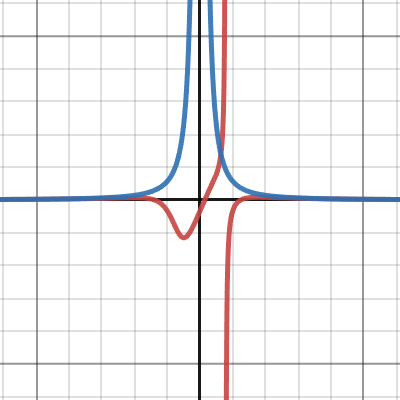
 toxic stratus
the red is not odd
it is not even either
as x goes to +- infinity the graphs are very close to each other

 worthy hemlock
Also, you're focusing on what the middle looks like, you're looking at the lim as x approaches negative infinity and positive infinity, which is pretty much identical for both plots
toxic stratus
see how theyre basically overlapping
fickle trail
Oh, you're right.. that red looked like odd to me at first.
The right side is flipped for some reason
on the red
So it's neither odd nor even because of that right side flip, it seems like
So what is the point of the approximation for end behavior if it doesn't match up with the original function anyways?
toxic stratus
the red function is neither odd nor even because f(x) != f(-x) and f(x) != -f(-x)
but that has nothing to do with how it behaves as it approaches +- infinity
both the red and blue functions asymptote to 0
the behaviour of the functions near 0 is not described by their asymptotic behaviour at +- infinity
fickle trail
So the approximation (blue graph) tells me it has even end behavior, because power 2 is even after looking at the ratio of leading terms in the num/den. But when I graph the the original function in red it does not follow this end behavior.
The only point of graphing the blue simplified version is to find any asymptote(s)? Or...
toxic stratus
toxic stratus
see this again
the two functions are asymptotically equivalent at infinity
fickle trail
The only point of graphing the blue is to find limits
toxic stratus
at infinity
worthy hemlock
The limit as x approaches negative infinity and positive infinity
fickle trail
as x approaches infinity
toxic stratus
you are looking at their behaviour near 0
fickle trail
f(x) approaches 0
toxic stratus
that has nothing to do with their behaviour at infinity
 worthy hemlock
When you do lim as x approaches negative infinity and positive infinity, you can look at the simplified function, because the simplified and original will behavior the same as you approach +- infinity for x
You were focused on what happens when x approaches 0, which is different for the simplified and the original
fickle trail
Wait but doesn't odd end behavior approach infinity the same way as even end behavior?

 toxic stratus
why is odd and even coming into this
1/x and 1/x^2 are not asymptotically equivalent
1/x^2 decays much faster than 1/x
fickle trail
toxic stratus
why is odd and even coming into this
Because of this
 toxic stratus
that doesnt really explain it
worthy hemlock
fickle trail
Wait but doesn't odd end behavior approach infinity the same way as even end beh...
This is when there's no vertical shifts. So not all odd functions will do the same thing as an even function
toxic stratus
they dont do the same thing anyway
for integer powers of x at least
they will necessarily have different rates of growth/decay
worthy hemlock
fickle trail
Because of this
Also, you are way too focused on even/odd functions. You don't need that when you are trying to find the lim as x approaches negative infinity and positive infinity
fickle trail
worthy hemlock
This is when there's no vertical shifts. So not all odd functions will do the sa...
If I flip these vertically it would seem that x still approaches infinity (the two screenshots above)
fickle trail
I'm just following Professor Leonard's video, here is where he talks about this: https://youtu.be/D-H9N-_Y77Y?t=671

Support: https://www.patreon.com/ProfessorLeonard
Professor Leonard Merch: https://professor-leonard.myshopify.com
How to identify when a horizontal asymptote will occur in a rational function, how to find it, and why they happen according to limits.
worthy hemlock
Okay, and? As stated, both the original and simplified equations, will behave the same horizontally
One will approach 0 sooner than the other but as both functions tends to +- infinity, the horizontal asymptote is going to be the same
fickle trail
If it was odd end behavior it would do the exact same thing?
I think what this is getting at, for even/odd end behavior.. is if the output can be positive or negative
anything with even root is going to be positive no matter what
worthy hemlock
It is unnecessary to be talking about even and odd functions, when you are determining the horizontal asymptote of a function
fickle trail
but odd root can be negative
toxic stratus
i still don't understand what all this odd and even is about
fickle trail
it's talked about in the link
toxic stratus
why is that relevant
fickle trail
I think it's to help see the graph beforehand
approximation
Professor Leonard talks about it in detail
worthy hemlock
As I mentioned, you are thinking too much about even and odd functions, when it is completely unnecessary when you are trying to find the horizontal asymptote
fickle trail
I'm just following Professor Leonard's instructions
trying to understand the difference, why it matters to approximate beforehand
worthy hemlock
Then you are misunderstanding what the video is about
fickle trail
"Is it approaching 0 positively, is it approaching 0 negatively"
"In Calculus it's kind of important to know"
toxic stratus
odd/even only matters when you're trying to determine which infinity a vertical asymptote goes to from which direction
if you have a horizontal asymptote going to 0
it's all the same whether it approaches from negative or positive
if you want to graph the function that's another matter
but then it depends on more than whether or not it's odd or even
fickle trail
I think what Professor Leonard is getting at is: It's how the asymptote is created in the first place. Here is the exact time he speaks about this: https://youtu.be/D-H9N-_Y77Y?t=996
Support: https://www.patreon.com/ProfessorLeonard
Professor Leonard Merch: https://professor-leonard.myshopify.com
How to identify when a horizontal asymptote will occur in a rational function, how to find it, and why they happen according to limits.
toxic stratus
whether or not it approaches 0 is not dependent whether it's an odd or even power of x
it all goes to 0
fickle trail
but it's how the asymptote is created in the first place
from even or odd end behavior
toxic stratus
the asymptote exists because it goes to 0
end of story
there doesn't need to be an odd or even exponent at all
fickle trail
yes but it can exist from even end behavior or odd end behavior
apparently in calculus it helps to know this
that's what he is saying
later on maybe I haven't gotten there yet
toxic stratus
it could be 1/x^1.393832021 for all i know
fickle trail
but still good to know
fickle trail
toxic stratus
there doesn't need to be an odd or even exponent at all
Why would Professor Leonard be talking about this if it isn't important? He's been legendary so far, in his method of teaching
toxic stratus
because you probably want to know how to graph these things
but graphing is more complicated than just looking at end behaviour
worthy hemlock
You are completely misunderstanding the purpose of the video. It is talking about horizontal asymptotes, as snow stated, even and odd is unnecessary for horizontal asymptotes. You will need to know even/odd functions for vertical asymptotes
fickle trail
Not important for having the asymptote itself, but important for understanding how the asymptote gets there in the first place
fickle trail
fickle trail
I think what Professor Leonard is getting at is: It's how the asymptote is creat...
Go to the link I posted here and watch, he is talking about vertical asymptotes in regards to even and odd end behavior
toxic stratus
odd or even has nothing to do with it
fickle trail
It merely shows how the vertical asymptote is created in the first place. From even or odd end behavior. That is all
fickle trail
fickle trail
Like this, or the screenshot below it
toxic stratus
vertical asymptotes occur because of divergence to infinity at finite inputs
fickle trail
Both have asymptote y=0 yes
toxic stratus
not because of anything else either
fickle trail
but the way they are created is different
toxic stratus
asymptotes are simply limiting behaviour
odd or even have basically nothing to do with it
it is being taught because you probably want to know how to graph these things
fickle trail
I know this, he's just talking about how a vertical asymptote can be created in the first place. It can will be created from the even or odd end behavior of the simplified function. That is it
toxic stratus
but it's not inherently tied to what an asymptote is
nova creek
fickle trail
Go to the link I posted here and watch, he is talking about vertical asymptotes ...
The asymptotes in your problem are horizontal, not vertical
fickle trail
Oh, I misunderstood...
OK thanks, good to know we are talking about x only here..
That's why he hasn't gotten into the limits as y approaches + or - infinity, that would be vertical asymptote
Phew! I am finally starting to see it
Sorry for the confusion, thanks for the clarification
toxic stratus
... no the y value is approaching 0
fickle trail
fickle trail
Here it is going straight up or straight down
fickle trail
Oh I see what you are saying
For the horizontal asymptote
y approaches 0
for the vertical asymptote y approaches + - Inf
toxic stratus
fickle trail
y approaches 0
IF there are no vertical offsets
fickle trail
Like shifting?
toxic stratus
yes
fickle trail
a constant such as +3 at the end of the polynomial
that would shift it up 3
and so the horizontal asymptote would be +3 instead of 0
toxic stratus
the polynomial?
fickle trail
Err, the *function?
toxic stratus
you aren't dealing with polynomials
they are rational functions
ratios of polynomials
fickle trail
I thought rational functions are polynomial/polynomial
toxic stratus
yes but the rational function is not a polynomial
fickle trail
so if the polynomial in num or den has a constant trailing term, that will affect the vertical shift
toxic stratus
no
fickle trail
toxic stratus
yes but the rational function is not a polynomial
Will use rational function instead of polynomial(s) in the future, more descriptive
fickle trail
toxic stratus
no
Are you sure?
toxic stratus
i am sure
fickle trail
x^2 + 3 has a constant of +3 and it will have a vertical shift of +3
toxic stratus
it must be a constant added to the entire rational function
fickle trail
yes
toxic stratus
a constant in just the numerator or denom will be dominated by higher powers of x
fickle trail
so after the ratio has been divided, find the constant term of the entire rational function
and that constant from the quotient will determine the vertical shift
fickle trail
fickle trail
and *that* constant from the quotient will determine the vertical shift
..I think that's how it would work. Constants seem like the easiest thing to understand, they are + or - onto the output of y
flat frigateBOT

 toxic stratus
alright well
you can see the horizontal asymptote is at y=3
because the constant term is 3
fickle trail
Oh.. it seems more complicated to understand for rational functions
if there was a constant outside of the fraction, it would be much easier to see the vertical shift
toxic stratus
do polynomial division
fickle trail
Would you use long division or synthetic for this?
toxic stratus
synthetic is always faster
fickle trail
factor first I guess, try to do synthetic if you can find a factor
if irreducible forced to do long maybe
fickle trail
I thought synthetic can works on any polynomial as long as there is a linear factor
toxic stratus
synthetic division let's you divide any two arbitrary polynomials
linear or not
go look it up on the wikipedia page
fickle trail
what do you mean by "arbitrary"?
fickle trail
Hmmm, I thought Professor Leonard said linear factors only.. needs to be power 1 as your divisor for synthetic division
toxic stratus
that's an underpowered version of synthetic division
fickle trail
Oh
toxic stratus
the general synthetic division algorithm works on arbitrary polynomial divisors
fickle trail
I haven't learned the advanced synthetic division yet
fickle trail
So you basically don't need to ever do long division?
toxic stratus
yes
fickle trail
Synthetic can be used 100% of the time?
toxic stratus
yes
fickle trail
Interesting...
But you can't have irreducible fraction as your divisor, right?
Or sqrt in divisor?
fickle trail
right
toxic stratus
division by irreducible quadratic factors is something you can do with long division
so it is something you can do with synthetic division
fickle trail
what about radical for a constant in the polynomial being divided?
fickle trail
you can use synthetic on something like x^2 + sqrt(3)?
toxic stratus
yes
fickle trail
but how do you determine the output for sqrt(3)?
toxic stratus
what output
you're just adding numbers
add numbers like any other time you add numbers
fickle trail
oh and because the constant comes last, it won't affect the output of the terms by throwing a sqrt in there
toxic stratus
even if it isn't it doesn't matter
fickle trail
really?!
toxic stratus
your calculations might not look nice but you can still multiply and add numbers
it literally has no consequence
fickle trail
drop down sqrt(3) multiply by 1.. now how do you multiply sqrt(3) with the next term x^2 using synthetic division?
toxic stratus
just add
fickle trail
like that as two terms?
toxic stratus
1 + sqrt(3) is 1 + sqrt(3)
fickle trail
yikes
toxic stratus
just do an example
fickle trail
that could get ugly with synthetic division
fickle trail
especially if there are a lot of terms involved and sqrt involved
toxic stratus
you suffer the same amount of pain
fickle trail
hmmm
toxic stratus
just quicker with synthetic
toxic stratus
it literally doesn't matter
toxic stratus
the numbers could be in Z/7Z for all i care
fickle trail
right now i only know baby synthetic division, linear factor for divisor only
could you use sqrt(3) as your divisor in synthetic division?
toxic stratus
it literally doesn't matter
toxic stratus
,w the answer to everything
flat frigateBOT
 fickle trail
lol
fickle trail
fickle trail
(x - 0^0)
but would you interpret this as 0 or 1?
toxic stratus
neither
fickle trail
so not possible with synthetic division?
toxic stratus

fickle trail
as your divisor
0^0
the only value that doesn't work? everything else will?

😉
Maybe I accidentally found the only answer?!

.close
safe radishBOT
Channel closed
Closed by @fickle trail
Use .reopen if this was a mistake.
fickle trail
.reopen
safe radishBOT
✅
fickle trail
Btw, thanks for everything @toxic stratus - appreciate the help! 😄
still learning.. gotta stay vigilant with my studies..
.close
safe radishBOT
Channel closed
Closed by @fickle trail
Use .reopen if this was a mistake.
Available help channel!
Send your question here to claim the channel.
Remember:
• Ask your math question in a clear, concise manner.
• Show your work, and if possible, explain where you are stuck.
• After 15 minutes, feel free to ping <@&286206848099549185>.
• Type the command .close to free the channel when you're done.
• Be polite and have a nice day!
Read #❓how-to-get-help for further information on how to ask a good question, and about conduct in the question channels.
mental patrol
 safe radishBOT
mental patrol
mental patrol
safe radishBOT
mental patrol
mental patrol
I do not understand where to look to see how they are significant or not. Meaning what to compare
plucky elk
they're just looking at the p value and comparing it to the alpha level
"Since a p value of 0.133 > 0.05 then ..."
mental patrol
Ooh
Ty
Sorry I am trying to study
Ty


My last question is about 64
I’m confused where to look to find the difference
I know the sig area in .000 might be where I should look? In multiple comparison section
Is just kind of confusing for me to tell how it is significant
Or different I mean
safe radishBOT
@mental patrol Has your question been resolved?
safe radishBOT
@mental patrol Has your question been resolved?
safe radishBOT
@mental patrol Has your question been resolved?
mental patrol
.close
safe radishBOT
Channel closed
Closed by @mental patrol
Use .reopen if this was a mistake.
Available help channel!
Send your question here to claim the channel.
Remember:
• Ask your math question in a clear, concise manner.
• Show your work, and if possible, explain where you are stuck.
• After 15 minutes, feel free to ping <@&286206848099549185>.
• Type the command .close to free the channel when you're done.
• Be polite and have a nice day!
Read #❓how-to-get-help for further information on how to ask a good question, and about conduct in the question channels.
 true estuary
help plz
safe radishBOT
lean otter
hint: $F_{r+1}=(F_r-1)^2+1$
flat frigateBOT
Toby
 true estuary
flat frigate
**Toby**
true estuary
flat frigate
**Toby**
so
true estuary
lean otter
hint: $F_{r+1}=(F_r-1)^2+1$
for prove true for k = 1
whats my LHS and RHS
so far i have F1 = 2^2(1) = 1 = 5
lean otter
and what is F_0?
true estuary
lean otter
and what is F_0?
3
lean otter
so does F_1 satisfy the hypothesis?
true estuary
lean otter
try using my hint
first of all what r we trying to prove
is it wat ive just wrote down?
lean otter
we are trying to prove this
 true estuary
lean otter
we are trying to prove this
true estuary
lean otter
we are trying to prove this
so what ive wrote down under the first line of 3
what should i write next
as im a bit stuck
lean otter
write my hint and try to use the inductive hypothesis on that
true estuary
lean otter
write my hint and try to use the inductive hypothesis on that
instead of r should i use k+1
lean otter
yes
lean otter
no, dont substitute F_{k+1} with the definition, you want to use the inductive hypothesis
expand the square
then substitute the inductive hypothesis
true estuary
lean otter
then substitute the inductive hypothesis
wats the inductive hypothesis
lean otter
true estuary
wats the inductive hypothesis
 true estuary
lean otter
true estuary
lean otter
ok
lean otter
this with k instead of n+1
true estuary
k
true estuary
lean otter
this with k instead of n+1
Think I’m wrong so far
lean otter
there should be a product symbol somewhere
true estuary
lean otter
there should be a product symbol somewhere
where
flat frigateBOT
Toby
 lean otter
instead, $F_{k+1}-2=\prod_{r=0}^k F_r$
flat frigateBOT
Toby
 true estuary
lean otter
instead, $F_{k+1}-2=\prod_{r=0}^k F_r$
true estuary
lean otter
instead, $F_{k+1}-2=\prod_{r=0}^k F_r$
apologies, ur help has aided me in the right direction imma attempt this tmr, ill come back to u to lyk how i get on
lean otter
alg
true estuary
.close
safe radishBOT
Channel closed
Closed by @true estuary
Use .reopen if this was a mistake.
Available help channel!
Send your question here to claim the channel.
Remember:
• Ask your math question in a clear, concise manner.
• Show your work, and if possible, explain where you are stuck.
• After 15 minutes, feel free to ping <@&286206848099549185>.
• Type the command .close to free the channel when you're done.
• Be polite and have a nice day!
Read #❓how-to-get-help for further information on how to ask a good question, and about conduct in the question channels.
 zenith blade
how did this website get 2.1 as a root ? I've been trying using a calculator but I can't get it. I know it's probably simple but I need help a bit
 safe radishBOT
zenith blade
how did this website get 2.1 as a root ? I've been trying using a calculator but...
plucky elk
safe radishBOT
zenith blade
how did this website get 2.1 as a root ? I've been trying using a calculator but...
plucky elk
,w roots 2x^4 - 6x^2 - 6x
flat frigateBOT


 Requested by riemann#2529
flat frigateBOT
Requested by riemann#2529
flat frigateBOT
Result:
[2.1038034027355]
wait huh
plucky elk
The cubic formula is the closed-form solution for a cubic equation, i.e., the roots of a cubic polynomial. A general cubic equation is of the form z^3+a_2z^2+a_1z+a_0=0 (1) (the coefficient a_3 of z^3 may be taken as 1 without loss of generality by dividing the entire equation through by a_3). The Wolfram Language can solve cubic equations e...
 arctic oak
zenith blade
how did this website get 2.1 as a root ? I've been trying using a calculator but...
arctic oak
zenith blade
how did this website get 2.1 as a root ? I've been trying using a calculator but...
if nothing works use sridharacharya formula
zenith blade
Never heard of it
arctic oak
It will work out for even complex numbers
zenith blade
Alright I'll look it up
arctic oak
you are doing quadratic and you never heard of it. Strange thing anyways
 zenith blade
Oh this
arctic oak
it will be 4 ac
zenith blade
I know this lol
arctic oak
then use it
zenith blade
its just my English vocabulary
arctic oak
and see
lean otter
arctic oak
you are doing quadratic and you never heard of it. Strange thing anyways
the question is a cubic
arctic oak
lean otter
the question is a cubic
Oh shit!!!! I did a mistake
zenith blade
huh
Yeah I dont think we studied this
I'm just learning maths from the internet tbh
safe radishBOT
@zenith blade Has your question been resolved?
zenith blade
.close
safe radishBOT
Channel closed
Closed by @zenith blade
Use .reopen if this was a mistake.
Available help channel!
Send your question here to claim the channel.
Remember:
• Ask your math question in a clear, concise manner.
• Show your work, and if possible, explain where you are stuck.
• After 15 minutes, feel free to ping <@&286206848099549185>.
• Type the command .close to free the channel when you're done.
• Be polite and have a nice day!
Read #❓how-to-get-help for further information on how to ask a good question, and about conduct in the question channels.
 chrome remnant
hi
safe radishBOT
chrome remnant
hi


 unreal dock
multiply both sides by the denominator of the LHS
you’ll get the following
$4x^2 + 16x + 15 = A(x+2)^2 + B(x+1)(x+2) + C(x+1)$
flat frigateBOT
Doug Judy
 unreal dock
now you expand the brackets on the RHS and collect like terms, that is, collect all the x^2 terms, all the x terms, and all the constant terms
then you compare coefficients with the LHS to get a system of equations
solve that system to get your values of A, B, and C
chrome remnant
chrome remnant
instead of
why do you choose those denominators on the RHS though as opposed to these ones
because you would usually just split it into its factors for ones that dont have repeated roots
safe radishBOT
@chrome remnant Has your question been resolved?
safe radishBOT
@chrome remnant Has your question been resolved?
safe radishBOT
Channel closed
Closed due to timeout
Use .reopen if this was a mistake.
Available help channel!
Send your question here to claim the channel.
Remember:
• Ask your math question in a clear, concise manner.
• Show your work, and if possible, explain where you are stuck.
• After 15 minutes, feel free to ping <@&286206848099549185>.
• Type the command .close to free the channel when you're done.
• Be polite and have a nice day!
Read #❓how-to-get-help for further information on how to ask a good question, and about conduct in the question channels.
 rugged wedge
Show that u × v and 2i − 14j + 2k cannot be
orthogonal for any α real number, where u = i + 7j − k
and v = αi + 5j + k
safe radishBOT
rugged wedge
Show that u × v and 2i − 14j + 2k cannot be
orthogonal for any α real number, wh...
nova creek
What have you tried
nova creek
What's u x v?
safe radishBOT
Channel closed
Closed by @rugged wedge
Use .reopen if this was a mistake.
Available help channel!
Send your question here to claim the channel.
Remember:
• Ask your math question in a clear, concise manner.
• Show your work, and if possible, explain where you are stuck.
• After 15 minutes, feel free to ping <@&286206848099549185>.
• Type the command .close to free the channel when you're done.
• Be polite and have a nice day!
Read #❓how-to-get-help for further information on how to ask a good question, and about conduct in the question channels.
 delicate pumice
 safe radishBOT
delicate pumice
delicate pumice
safe radishBOT
delicate pumice
delicate pumice
I need to find integral of e^(-9p)
But when I check the answer it says integral is -1/9(e^-9p)
Not sure how it got that
Oh wait
I should probably use u sub huh
safe radishBOT
@delicate pumice Has your question been resolved?
safe radishBOT
Channel closed
Closed due to timeout
Use .reopen if this was a mistake.
Available help channel!
Send your question here to claim the channel.
Remember:
• Ask your math question in a clear, concise manner.
• Show your work, and if possible, explain where you are stuck.
• After 15 minutes, feel free to ping <@&286206848099549185>.
• Type the command .close to free the channel when you're done.
• Be polite and have a nice day!
Read #❓how-to-get-help for further information on how to ask a good question, and about conduct in the question channels.
 pliant moon
 safe radishBOT
pliant moon
pliant moon
safe radishBOT
pliant moon
pliant moon
can someone please help me out with the first step
is f=vm a formula in physics can't find out
 fresh garnet
pliant moon
is f=vm a formula in physics can't find out
fresh garnet
pliant moon
is f=vm a formula in physics can't find out
This isnt dimensionally correct
pliant moon
ok ty for the help
safe radishBOT
@pliant moon Has your question been resolved?
safe radishBOT
Channel closed
Closed due to timeout
Use .reopen if this was a mistake.
safe radishBOT
Available help channel!
Send your question here to claim the channel.
Remember:
• Ask your math question in a clear, concise manner.
• Show your work, and if possible, explain where you are stuck.
• After 15 minutes, feel free to ping <@&286206848099549185>.
• Type the command .close to free the channel when you're done.
• Be polite and have a nice day!
Read #❓how-to-get-help for further information on how to ask a good question, and about conduct in the question channels.
 tired wedge
!help
safe radishBOT
tired wedge
!help
tired wedge

i only got a part of it
r-1
cuz i know that he had to rent one less movie
so i got
$\frac{0.5}{r-1}$
flat frigateBOT
Ruokiela
 flat frigateBOT
Ruokiela
 safe radishBOT
Channel closed
Closed by @tired wedge
Use .reopen if this was a mistake.
Available help channel!
Send your question here to claim the channel.
Remember:
• Ask your math question in a clear, concise manner.
• Show your work, and if possible, explain where you are stuck.
• After 15 minutes, feel free to ping <@&286206848099549185>.
• Type the command .close to free the channel when you're done.
• Be polite and have a nice day!
Read #❓how-to-get-help for further information on how to ask a good question, and about conduct in the question channels.
lean otter
 safe radishBOT
lean otter
lean otter
safe radishBOT
lean otter
lean otter
the answer is just no right?
lean otter
quasi bison
5.2 is not a whole number
ty would be able to help me with any of these problems?

im a bit on the slow side
unfortunately being born with autism doesnt help me with math
quasi bison
don't have the time/energy for this rn sorry
but also autism is not by itself an impediment to mathematical ability in most cases in my experience - take me, for example
lean otter
oh alright
safe radishBOT
@lean otter Has your question been resolved?
Channel closed
Closed by @outer pasture
Use .reopen if this was a mistake.
Available help channel!
Send your question here to claim the channel.
Remember:
• Ask your math question in a clear, concise manner.
• Show your work, and if possible, explain where you are stuck.
• After 15 minutes, feel free to ping <@&286206848099549185>.
• Type the command .close to free the channel when you're done.
• Be polite and have a nice day!
Read #❓how-to-get-help for further information on how to ask a good question, and about conduct in the question channels.
 devout harbor
 safe radishBOT
devout harbor
devout harbor
safe radishBOT
devout harbor
devout harbor
Can someone explain how to find theta of a cartesian coordinate?

Thought it was just one of these but they don't seem to be working
I'll get sin theta = 0
which should just be zero but idk
or cos theta = 1
worthy hemlock
If you mean tan^-1(0)
devout harbor
yes
worthy hemlock
Yes
worthy hemlock
What's tan^-1(0)?
devout harbor
pi/4
worthy hemlock
Are you sure?
devout harbor
my reasoning is the sin / cos there is 0
 robust stream
is it
devout harbor
but maybe that reasoning is flawed
worthy hemlock
Did you use a calculator?
 thick nacelle
Yo quick question, what type of line would 0x=7 be
devout harbor
no
worthy hemlock
To do tan^-1(0)?
devout harbor
no I did not use a calculator
worthy hemlock
You should try that
devout harbor
it unfort is ded
devout harbor
is it zero?
worthy hemlock
Yes
devout harbor
why?
devout harbor
ah
robust stream
when would you get a 0 here
devout harbor
sin must be zero
 worthy hemlock
Because it does say $0 < \theta \leq 2 \pi$
flat frigateBOT
dldh06
 robust stream
that is quite sneaky ngl
worthy hemlock
So you can't include 0
worthy hemlock
It is
robust stream
when would it be pi
worthy hemlock
But also look that the coordinates you are given, (7, 0)
robust stream
tbh what were the explicit formulas for polar <-> rectengular I don't remember but this is easy just by visualizing
if angle was pi it would be (-7,0) point
 devout harbor
ah I see
robust stream
yeah but the formula should be able to distinguish here right
lemme look
ah, the full formula is actually quite messy and it is because of the sign stuff
so yeah, you just have to use some common sense
sadly
safe radishBOT
Channel closed
Closed by @devout harbor
Use .reopen if this was a mistake.
Available help channel!
Send your question here to claim the channel.
Remember:
• Ask your math question in a clear, concise manner.
• Show your work, and if possible, explain where you are stuck.
• After 15 minutes, feel free to ping <@&286206848099549185>.
• Type the command .close to free the channel when you're done.
• Be polite and have a nice day!
Read #❓how-to-get-help for further information on how to ask a good question, and about conduct in the question channels.
 manic juniper
hi
safe radishBOT
Channel closed
Closed due to timeout
Use .reopen if this was a mistake.
safe radishBOT
Available help channel!
Send your question here to claim the channel.
Remember:
• Ask your math question in a clear, concise manner.
• Show your work, and if possible, explain where you are stuck.
• After 15 minutes, feel free to ping <@&286206848099549185>.
• Type the command .close to free the channel when you're done.
• Be polite and have a nice day!
Read #❓how-to-get-help for further information on how to ask a good question, and about conduct in the question channels.
 jaunty owl
Can someone tell me if I'm understanding the Chinese Remainder Theorem correctly..?
If we have a number N and have the remainders for it mod(any prime numbers) then we can figure out the least possible value of N mod (the product of the prime numbers)
safe radishBOT
jaunty owl
Can someone tell me if I'm understanding the Chinese Remainder Theorem correctly...
jaunty owl
and also we can use bezout's lemma to find out what that is
safe radishBOT
@jaunty owl Has your question been resolved?
 velvet stratus
jaunty owl
Can someone tell me if I'm understanding the Chinese Remainder Theorem correctly...
velvet stratus
jaunty owl
Can someone tell me if I'm understanding the Chinese Remainder Theorem correctly...
pretty much, just a few small corrections
it doesn't have to be prime, just comprime
meaning that even if I have a system of congruences like x=3(mod 10) and x=2(mod 3), it'll still work since 10 and 3 are coprime
second, I wouldn't say it's the least possible value of N mod (the product of coprime numbers), but rather it proves that there exists only one unique solution less than the product of the coprime numbers
but yeah, I think you can use bezout's lemma to find the solutions
safe radishBOT
@jaunty owl Has your question been resolved?
safe radishBOT
Channel closed
Closed due to timeout
Use .reopen if this was a mistake.
Available help channel!
Send your question here to claim the channel.
Remember:
• Ask your math question in a clear, concise manner.
• Show your work, and if possible, explain where you are stuck.
• After 15 minutes, feel free to ping <@&286206848099549185>.
• Type the command .close to free the channel when you're done.
• Be polite and have a nice day!
Read #❓how-to-get-help for further information on how to ask a good question, and about conduct in the question channels.
lean otter
When do you use Square bracket [ ] vs parenthesis ( )
lean otter
I got like 3 problems wrong bc of this
 void plank
There are no rules about that
void plank
Do you mean in set theory?
lean otter
pretty sure they mean that [] is when the endpoint is included in the set and () doesn't
 void plank
You use [] for closed intervals and () for open intervals
lean otter
lean otter
pretty sure they mean that [] is when the endpoint is included in the set and ()...
yeah read this.
So anytime it stops [ if it keeps going )
void plank
Yup
safe radishBOT
Channel closed
Closed by @narrow wing
Use .reopen if this was a mistake.
Available help channel!
Send your question here to claim the channel.
Remember:
• Ask your math question in a clear, concise manner.
• Show your work, and if possible, explain where you are stuck.
• After 15 minutes, feel free to ping <@&286206848099549185>.
• Type the command .close to free the channel when you're done.
• Be polite and have a nice day!
Read #❓how-to-get-help for further information on how to ask a good question, and about conduct in the question channels.
 restive haven
 safe radishBOT
@restive haven Has your question been resolved?
restive haven
.close
safe radishBOT
Channel closed
Closed by @restive haven
Use .reopen if this was a mistake.
safe radishBOT
Available help channel!
Send your question here to claim the channel.
Remember:
• Ask your math question in a clear, concise manner.
• Show your work, and if possible, explain where you are stuck.
• After 15 minutes, feel free to ping <@&286206848099549185>.
• Type the command .close to free the channel when you're done.
• Be polite and have a nice day!
Read #❓how-to-get-help for further information on how to ask a good question, and about conduct in the question channels.
 shut rose
\
 safe radishBOT
shut rose
\
safe radishBOT
safe radishBOT
shut rose
\
safe radishBOT
Channel closed
Closed by @shut rose
Use .reopen if this was a mistake.
safe radishBOT
Available help channel!
Send your question here to claim the channel.
Remember:
• Ask your math question in a clear, concise manner.
• Show your work, and if possible, explain where you are stuck.
• After 15 minutes, feel free to ping <@&286206848099549185>.
• Type the command .close to free the channel when you're done.
• Be polite and have a nice day!
Read #❓how-to-get-help for further information on how to ask a good question, and about conduct in the question channels.
 final flax
can someone explain this to me please
safe radishBOT
final flax
can someone explain this to me please
final flax

 lusty widget
wdym no restrictions
they say no restrictions then proceeds to restrict stuff for the next stuff
maybe
this is just
some stuff I don’t understand
hm
final flax
I think it means repitition
 upper badge
lusty widget
they say no restrictions then proceeds to restrict stuff for the next stuff
upper badge
lusty widget
they say no restrictions then proceeds to restrict stuff for the next stuff
those are 5 sub-questions
upper badge
final flax
any thoughts/attempt?
void plank
How many ways are there for arranging 5 letters in a row?
lusty widget
5^
final flax
120
final flax
is there anyone else that you know that can help me
@upper badge Is there any way you can provide me assistance
void plank
final flax
120
That is the answer for part a
final flax
alright
final flax
final flax
@shut rose are you able to provide me help on this question
void plank
Try part b yourself
safe radishBOT
Channel closed
Closed by @final flax
Use .reopen if this was a mistake.
Available help channel!
Send your question here to claim the channel.
Remember:
• Ask your math question in a clear, concise manner.
• Show your work, and if possible, explain where you are stuck.
• After 15 minutes, feel free to ping <@&286206848099549185>.
• Type the command .close to free the channel when you're done.
• Be polite and have a nice day!
Read #❓how-to-get-help for further information on how to ask a good question, and about conduct in the question channels.
 dawn forge
Ok i have the question
cos(2theta)=-1/2
I know that arccos -1/2 = 2pi/3, 4pi/3 divided by 2 = pi/3, 2pi/3
however i am confused now because i would think because the period of cod is 2pi / 2 (because that is the number inside the cod function).
so i thought the answer would be pi/3 + pi, 2pi/3 + pi. But this is wrong where did i mess up?
safe radishBOT
dawn forge
Ok i have the question
```cos(2theta)=-1/2```
I know that arccos -1/2 = 2pi/3, ...
dawn forge
.close
safe radishBOT
Channel closed
Closed by @dawn forge
Use .reopen if this was a mistake.
Available help channel!
Send your question here to claim the channel.
Remember:
• Ask your math question in a clear, concise manner.
• Show your work, and if possible, explain where you are stuck.
• After 15 minutes, feel free to ping <@&286206848099549185>.
• Type the command .close to free the channel when you're done.
• Be polite and have a nice day!
Read #❓how-to-get-help for further information on how to ask a good question, and about conduct in the question channels.
 dense coral
equate the derivative by zero
then solve for it u will get the turning points
,w y = x lnx
flat frigateBOT

 Requested by JoDKrishna#6149
dense coral
Requested by JoDKrishna#6149
dense coral
now equate log x + 1 = 0
log x = -1
x = 1/e
1/e is the turning point
@paper lark
safe radishBOT
Channel closed
Closed by @paper lark
Use .reopen if this was a mistake.
Available help channel!
Send your question here to claim the channel.
Remember:
• Ask your math question in a clear, concise manner.
• Show your work, and if possible, explain where you are stuck.
• After 15 minutes, feel free to ping <@&286206848099549185>.
• Type the command .close to free the channel when you're done.
• Be polite and have a nice day!
Read #❓how-to-get-help for further information on how to ask a good question, and about conduct in the question channels.
 dull rose
Hi ! I was trying to simplify this and found out that this is equal to x*2^(x+1). But I can not figure out how those 2 are equal. Could anyone tell me how ? (Sorry if the image is too big etc. Trying to do this on my mobile)
