#help-23
1 messages · Page 23 of 1
 foggy salmon
 pliant inlet
c)
pliant inlet
c)
yea
pliant inlet
gotcha
foggy salmon
the div n mult is closed under
d i think no
cuz some numbers r not covered
which shld b kinda obv
from the x^3
or u can write out a few terms ig
foggy salmon
um
ye i think that cld work
just show the fn is monotonic
n cant ever hit some number ig
pliant inlet
N \ {x}?
pliant inlet
ill just find the values
foggy salmon
ye
i guess
so then it maps to not all of N
so the set it maps to
cant be equal to N
pliant inlet
right
foggy salmon
ay
 safe radishBOT
@pliant inlet Has your question been resolved?
safe radishBOT
Channel closed
Closed due to timeout
Use .reopen if this was a mistake.
 Available help channel!
Send your question here to claim the channel.
Remember:
• Ask your math question in a clear, concise manner.
• Show your work, and if possible, explain where you are stuck.
• After 15 minutes, feel free to ping <@&286206848099549185>.
• Type the command .close to free the channel when you're done.
• Be polite and have a nice day!
Read #❓how-to-get-help for further information on how to ask a good question, and about conduct in the question channels.
 earnest bough
sb help me with this
 safe radishBOT
earnest bough
sb help me with this
safe radishBOT
earnest bough
sb help me with this
@earnest bough Has your question been resolved?
safe radishBOT
@earnest bough Has your question been resolved?
safe radishBOT
@earnest bough Has your question been resolved?
safe radishBOT
Channel closed
Closed due to timeout
Use .reopen if this was a mistake.
Available help channel!
Send your question here to claim the channel.
Remember:
• Ask your math question in a clear, concise manner.
• Show your work, and if possible, explain where you are stuck.
• After 15 minutes, feel free to ping <@&286206848099549185>.
• Type the command .close to free the channel when you're done.
• Be polite and have a nice day!
Read #❓how-to-get-help for further information on how to ask a good question, and about conduct in the question channels.
 wet heath
How would I go about proving: Let 𝑎 and 𝑏 be integers. Prove that if 𝑎𝑏 and 𝑎+𝑏 are relatively prime, then 𝑎 and 𝑏 are relatively prime.
Using the theorem: Integers 𝑎 and 𝑏 are relatively prime if and only if 𝑎𝑥 + 𝑏𝑦 = 1 for some 𝑥, 𝑦 ∈ Z.
I know how to do the math as seen below but I do not how to go further than that or describe it in words to form a proof:
(ab)x + (a+b)y = 1
abx + ay + by. = 1
a(bx + y) + by = 1
ak + by = 1 for k = bx+y belonging to the set of integers.
safe radishBOT
wet heath
How would I go about proving: Let 𝑎 and 𝑏 be integers. Prove that if 𝑎𝑏 and ...
@wet heath Has your question been resolved?
 pseudo siren
What you did is correct, you just have to provide the context for it. You can do it the following way:
"We aim to prove that a and b are relatively prime. Meaning, we'd like to find integers x and y such that:
ax + by = 1. We know that ab and a + b are relatively prime."
From there, you can continue as you did with showing that ab and a + b being relatively prime means that a and b are prime in algebraic terms.
"Using the theorem, since ab and a + b are relatively prime, then there exist integers X and Y such that:
(ab)X + (a + b)Y = 1"
As you have shown, this can be rewritten as:
a(bX + Y) + bY = 1
Notice that this is the form that we are looking for. (We were looking for an equality of the form ax + by = 1 where x and y are integers, so we finish the proof by showing how this is what we aimed to achieve.)
"Choosing x = bX + Y and y = Y, we get that ax + by = 1, where, since b, x and Y are integers, then bX + Y and Y are integers as well."
safe radishBOT
Channel closed
Closed by @wet heath
Use .reopen if this was a mistake.
Available help channel!
Send your question here to claim the channel.
Remember:
• Ask your math question in a clear, concise manner.
• Show your work, and if possible, explain where you are stuck.
• After 15 minutes, feel free to ping <@&286206848099549185>.
• Type the command .close to free the channel when you're done.
• Be polite and have a nice day!
Read #❓how-to-get-help for further information on how to ask a good question, and about conduct in the question channels.
 mental patrol
 safe radishBOT
mental patrol
mental patrol
safe radishBOT
mental patrol
mental patrol
I know there is an ss between/ss total formula but not sure what exactly to do to start?
mental patrol
No
This is for exam practice
I can use a calculator but only for simple things
Ss=sum of squares I think
safe radishBOT
@mental patrol Has your question been resolved?
safe radishBOT
@mental patrol Has your question been resolved?
Channel closed
Closed by @mental patrol
Use .reopen if this was a mistake.
safe radishBOT
Available help channel!
Send your question here to claim the channel.
Remember:
• Ask your math question in a clear, concise manner.
• Show your work, and if possible, explain where you are stuck.
• After 15 minutes, feel free to ping <@&286206848099549185>.
• Type the command .close to free the channel when you're done.
• Be polite and have a nice day!
Read #❓how-to-get-help for further information on how to ask a good question, and about conduct in the question channels.
 dire fjord
Hii everyone
safe radishBOT
dire fjord
Hii everyone
dire fjord
I have 2 equations $x^2+y^2=2 $ and $x^2/(2-y) +y^2/(2-x)=2$
 flat frigateBOT
calculus is fun
 dire fjord
I need all real couples (x;y) that satisfy both equations
The couple I reached is (1;1) is there any other one
 plucky elk
dire fjord
I need all real couples (x;y) that satisfy both equations
plucky elk
dire fjord
I need all real couples (x;y) that satisfy both equations
you can solve for one variable and plug it into the other equation
dire fjord
What i did is that I equated LHS of both equations then did common denominator
After that I had an expression with forms of x identical to that of y
plucky elk
it'd be easier if you just showed your work
dire fjord
I got $x^2(2-x)(1-y)+y^2(2-y)(1-x)=0$
flat frigateBOT
calculus is fun
 dire fjord
Wait I'll write everything I did and send a pic

So that's my work
Is there something wrong with it
Or something missing ??
plucky elk
you might have multiplied by 0 to get here

what if (2-y) = (2-x) = 0 ?
oh i guess it's undefined since that's in the denominator of the second eqn
dire fjord
Yea it is undefined
I forgot to write the condition
So is it missing anything or this is the correct and complete answer ??
dire fjord
plucky elk
you might have multiplied by 0 to get here
What could I have multiplied by 0 to get here ??
 dire fjord
Yea because y can't be different than x If this expression is equal to 0
plucky elk
why?
dire fjord
plucky elk
you might have multiplied by 0 to get here
You can confirm this if you divide this by (1-y)(1-x)
If you do this and then simplify you will get the following
plucky elk
you should include that work then
 flat frigateBOT
 dire fjord
In this case the expression of x is identical to that of y
So the equation doesn't hold unless x=-y
Wait
x=-y not y
Is this correct now ??
??
safe radishBOT
@dire fjord Has your question been resolved?
 sick ice
I can find the derivative of the function, but I'm struggling with plugging in one. Wouldn't that still leave some y's in the answer? The problem wants me to type in a "number" for my answer. I don't think that includes y variables

 rigid inlet
safe radishBOT
rigid inlet
safe radishBOT
@dire fjord Has your question been resolved?
dire fjord
.close
safe radishBOT
Channel closed
Closed by @dire fjord
Use .reopen if this was a mistake.
Available help channel!
Send your question here to claim the channel.
Remember:
• Ask your math question in a clear, concise manner.
• Show your work, and if possible, explain where you are stuck.
• After 15 minutes, feel free to ping <@&286206848099549185>.
• Type the command .close to free the channel when you're done.
• Be polite and have a nice day!
Read #❓how-to-get-help for further information on how to ask a good question, and about conduct in the question channels.
 granite pike
I’m stuck making 2 equations for this. Can someone help making the equations, you don’t need to solve. Thanks!
 safe radishBOT
granite pike
I’m stuck making 2 equations for this. Can someone help making the equations, yo...
safe radishBOT
granite pike
I’m stuck making 2 equations for this. Can someone help making the equations, yo...
 rigid inlet
plucky elk
rigid inlet
plucky elk
 haughty widget
this channel's occupied. read #❓how-to-get-help
granite pike
<@&286206848099549185>
safe radishBOT
@granite pike Has your question been resolved?
safe radishBOT
@granite pike Has your question been resolved?
safe radishBOT
Channel closed
Closed due to timeout
Use .reopen if this was a mistake.
granite pike
.reopen
safe radishBOT
✅
safe radishBOT
@granite pike Has your question been resolved?
safe radishBOT
@granite pike Has your question been resolved?
granite pike
<@&286206848099549185>
 idle hearth
granite pike
I’m stuck making 2 equations for this. Can someone help making the equations, yo...
idle hearth
granite pike
I’m stuck making 2 equations for this. Can someone help making the equations, yo...
Chris = x
Anna = y
ur 1st eq is correct which is x=3y
"by his next birthday" that just means plus 1 right, so, x+1=2y (2y bcs he will double her age which is anna's age)
safe radishBOT
@granite pike Has your question been resolved?
safe radishBOT
Channel closed
Closed due to timeout
Use .reopen if this was a mistake.
Available help channel!
Send your question here to claim the channel.
Remember:
• Ask your math question in a clear, concise manner.
• Show your work, and if possible, explain where you are stuck.
• After 15 minutes, feel free to ping <@&286206848099549185>.
• Type the command .close to free the channel when you're done.
• Be polite and have a nice day!
Read #❓how-to-get-help for further information on how to ask a good question, and about conduct in the question channels.
 marsh granite
why is my answer wrong?
 safe radishBOT
marsh granite
why is my answer wrong?
safe radishBOT
marsh granite
why is my answer wrong?
 quasi bison
6+3 isn't 12
and 4+3 isn't 10
@marsh granite the question did not say that the numbers on the spinner had to be 1 through 6
you were wrong to assume that
 safe radishBOT
Channel closed
Closed by @marsh granite
Use .reopen if this was a mistake.
Available help channel!
Send your question here to claim the channel.
Remember:
• Ask your math question in a clear, concise manner.
• Show your work, and if possible, explain where you are stuck.
• After 15 minutes, feel free to ping <@&286206848099549185>.
• Type the command .close to free the channel when you're done.
• Be polite and have a nice day!
Read #❓how-to-get-help for further information on how to ask a good question, and about conduct in the question channels.
 robust sigil
help me for d?
 safe radishBOT
robust sigil
help me for d?
robust sigil
safe radishBOT
robust sigil
help me for d?
robust sigil
how to solve this?
 spiral crescent
robust sigil
help me for d?
spiral crescent
robust sigil
help me for d?
fg can be continuos only if f and g are both continuous themselves
oh my bad lol i thought i read if fg continous
robust sigil
so the answer is -2 ?
spiral crescent
robust sigil
so the answer is -2 ?
which one?
for d not -2
for d factor the expression and when some expression times some other expression are both in limit, and one of the expression when you put in the limit is non zero or not infinity, then you can evaluate it seperately and take it outside the limit
AH D IS -2
i was reading b
robust sigil
ohh thank u
can u explain why it was -2?
i am not sure about my answr even
.close
safe radishBOT
Channel closed
Closed by @robust sigil
Use .reopen if this was a mistake.
Available help channel!
Send your question here to claim the channel.
Remember:
• Ask your math question in a clear, concise manner.
• Show your work, and if possible, explain where you are stuck.
• After 15 minutes, feel free to ping <@&286206848099549185>.
• Type the command .close to free the channel when you're done.
• Be polite and have a nice day!
Read #❓how-to-get-help for further information on how to ask a good question, and about conduct in the question channels.
quasi bison
need a sanity check over here
is it true that the ring $\bZ/P_n\bZ$, where $P_n$ is the product of the first $n$ primes, has exactly $n$ maximal ideals (the quotients modulo which are $\bZ/(2), \bZ/(3), \dots, \bZ/(p_n)$?
safe radishBOT
quasi bison
need a sanity check over here
is it true that the ring $\bZ/P_n\bZ$, where $P_n$...
flat frigateBOT
Ann
 safe radishBOT
@quasi bison Has your question been resolved?
safe radishBOT
@quasi bison Has your question been resolved?
safe radishBOT
@quasi bison Has your question been resolved?
Channel closed
Closed by @quasi bison
Use .reopen if this was a mistake.
Available help channel!
Send your question here to claim the channel.
Remember:
• Ask your math question in a clear, concise manner.
• Show your work, and if possible, explain where you are stuck.
• After 15 minutes, feel free to ping <@&286206848099549185>.
• Type the command .close to free the channel when you're done.
• Be polite and have a nice day!
Read #❓how-to-get-help for further information on how to ask a good question, and about conduct in the question channels.
 lime stratus
How would I go about calculating y3 here ?
I've tried so many things but so far none of them worked...
 safe radishBOT
lime stratus
How would I go about calculating y3 here ?
I've tried so many things but so far...
safe radishBOT
lime stratus
How would I go about calculating y3 here ?
I've tried so many things but so far...
 peak estuary
unless you have more information you are not giving us, this is impossible to solve
peak estuary
well where are you taking that information from
y3 could also be 703132
for all we know
can you state the whole question?
lime stratus
Okay
X3 and Y3 are in-between X1,Y1 and X2, Y2
Let's just say I know it
What I'm asking is, based off of that information, is there a way to calculate Y3 ?
peak estuary
no
y3 could be anything
if you know that for example y depends linearly on x, then you can do something
that is, y=mx+b
peak estuary
so you were not giving us all information
lime stratus
Okay
peak estuary
do you know that the slope is given as rise over run?
$m = \frac{y_2-y_1}{x_2-x_1}$
flat frigateBOT
Denascite
 lime stratus
Ohhhh right
So then m = -70/38500
Which means m = -0.00181818181
So then..
x3 = 1800m+b
peak estuary
well first we now have to find b
lime stratus
But first I need to figure out b
Yes
So
90 = 1500m + b
B = 90-1500m
B=90-1500*-0.00181818181
B = 92.727272715
peak estuary
+92.etc, not *92.etc
safe radishBOT
Channel closed
Closed by @lime stratus
Use .reopen if this was a mistake.
Available help channel!
Send your question here to claim the channel.
Remember:
• Ask your math question in a clear, concise manner.
• Show your work, and if possible, explain where you are stuck.
• After 15 minutes, feel free to ping <@&286206848099549185>.
• Type the command .close to free the channel when you're done.
• Be polite and have a nice day!
Read #❓how-to-get-help for further information on how to ask a good question, and about conduct in the question channels.
 violet compass
$\int_{0}^{π/2} \frac{dx} {5cosx + 3sinx}$
safe radishBOT
violet compass
$\int_{0}^{π/2} \frac{dx} {5cosx + 3sinx}$
flat frigateBOT
Derek ♡
 peak estuary
that looks nasty. weierstrass sub maybe?
violet compass
what sub?
peak estuary
often called weierstrass sub. which according to the article is a misattribution. TIL
safe radishBOT
Channel closed
Closed by @violet compass
Use .reopen if this was a mistake.
Available help channel!
Send your question here to claim the channel.
Remember:
• Ask your math question in a clear, concise manner.
• Show your work, and if possible, explain where you are stuck.
• After 15 minutes, feel free to ping <@&286206848099549185>.
• Type the command .close to free the channel when you're done.
• Be polite and have a nice day!
Read #❓how-to-get-help for further information on how to ask a good question, and about conduct in the question channels.
 edgy rover
how do i find cos2(x), i got sin2(x), but when i subbed what i knew into the formula i messed up.
safe radishBOT
edgy rover
how do i find cos2(x), i got sin2(x), but when i subbed what i knew into the for...
edgy rover

i got, (4xroot7)/11 = sin2(x)
the missing side is, root7
when i tried to get cos^2(x) i thought to do, (root7/2)^2 ?
 maiden jetty
$\cos^2 x = \left( \frac{\sqrt{7}}{\sqrt{11}}\right)^2=\frac{7}{11}$
flat frigateBOT
秋水
 safe radishBOT
@edgy rover Has your question been resolved?
safe radishBOT
Channel closed
Closed due to timeout
Use .reopen if this was a mistake.
Available help channel!
Send your question here to claim the channel.
Remember:
• Ask your math question in a clear, concise manner.
• Show your work, and if possible, explain where you are stuck.
• After 15 minutes, feel free to ping <@&286206848099549185>.
• Type the command .close to free the channel when you're done.
• Be polite and have a nice day!
Read #❓how-to-get-help for further information on how to ask a good question, and about conduct in the question channels.
 ruby phoenix
f is a function defined on interval [a;b]
f-1 is its reciprocal function
if i have f-1(f(x))
what is that equal to? is it equal to just x ?
safe radishBOT
ruby phoenix
f is a function defined on interval [a;b]
f-1 is its reciprocal function
if i...
 obtuse jackal
If f is invertible yes
 toxic stratus
obtuse jackal
If f is invertible yes
toxic stratus
obtuse jackal
If f is invertible yes
then this
toxic stratus
if the inverse exists
obtuse jackal
To have an inverse
ruby phoenix
toxic stratus
if the inverse exists
oh okay
ruby phoenix
to prove that the inverse exists should i prove that f is continuous and either strictly decreasing or increasing?
toxic stratus
thats not a necessary condition
obtuse jackal
Strictly monotone is enough
obtuse jackal
Continuous just guarantees f^-1 will be continuous as well
ruby phoenix
ummmm☠☠ PERIODDDD t.
ruby phoenix
obtuse jackal
Continuous just guarantees f^-1 will be continuous as well
uhhhh okay!
😂👍
thanks yall
still
toxic stratus
its sufficient but not necessary
ruby phoenix
arctan(tan(x)) = x
only if x is in ]-pi/2 ; pi/2[
right?
toxic stratus

obtuse jackal
Yes, because otherwise x is out of arctan's range, so it can't be equal
flat frigateBOT


 toxic stratus
you get a chainsaw
ruby phoenix
ummm yeah so wait
obtuse jackal
Otherwise you have 2 different, parallel lines
toxic stratus
i see what you mean now
ruby phoenix
suppose f goes from [a;b] to IR
f-1 goes from IR to [a;b]
then f-1 (f(x)) = x
if and only if x is in [a;b]
is this correct?
toxic stratus
outside [a, b] f(x) isnt defined
toxic stratus
it is
obtuse jackal
ruby phoenix
suppose f goes from [a;b] to IR
f-1 goes from IR to [a;b]
then f-1 (f(x)) = x
...
f^-1 doesn't have R as its domain, only f([a, b])
obtuse jackal
I mean... x -> x^2 is a function from R to R
That's the entire reason why the concept of surjectivity exists
toxic stratus
no like
"suppose f : [a, b] -> R and f^-1 : R -> [a, b]"
then it would be part of the assumption that f^-1 has domain R
obtuse jackal
Since he skipped 2 lines, to me it didn't feel like a part of the assumption anymore
toxic stratus
if its not then f^-1 doesnt necessarily have domain R
but like
the then occurs after the line saying f^-1 goes from R to [a, b]
so supposedly everything before then is part of the assumptions
safe radishBOT
@ruby phoenix Has your question been resolved?
Channel closed
Closed by @ruby phoenix
Use .reopen if this was a mistake.
safe radishBOT
Available help channel!
Send your question here to claim the channel.
Remember:
• Ask your math question in a clear, concise manner.
• Show your work, and if possible, explain where you are stuck.
• After 15 minutes, feel free to ping <@&286206848099549185>.
• Type the command .close to free the channel when you're done.
• Be polite and have a nice day!
Read #❓how-to-get-help for further information on how to ask a good question, and about conduct in the question channels.
 solar cloud

 split ether
You can use Pythagorean theorem to express h in terms of r and l first
Then you can express l in terms of r using the fact that S = 100
solar cloud
split ether
Then you can express l in terms of r using the fact that S = 100
could u help me w somethin
also so i got 100 = pi * r * l
and h^2 + r^2 = l^2
split ether
solar cloud
also so i got 100 = pi * r * l
Yes, now isolate l
solar cloud
alright, 100/(pi*r) = l?
solar cloud
split ether
And just take sqrt
how 😐
split ether
h = sqrt(10000/pi^2r^2 - r^2)
solar cloud
100/
split ether
100 got squared, so now it's 10000
 solar cloud
split ether
100 got squared, so now it's 10000
solar cloud
split ether
100 got squared, so now it's 10000
what does the demoniminator become?
pi*r - r?
flat frigateBOT
A Lonely Bean
 split ether
Yeah you can't get rid of it
 split ether
flat frigate
**A Lonely Bean**
split ether
flat frigate
**A Lonely Bean**
Just plug this into that
 split ether
What did you get for V?
flat frigateBOT
A Lonely Bean
 split ether
Yeah, now you let r^2 into the sqrt
solar cloud
split ether
Yeah, now you let r^2 into the sqrt
huh
split ether
So you get $V = \frac{1}{3}\pi \sqrt{\frac{10000r^2}{\pi^2}-r^4}$
flat frigateBOT
A Lonely Bean
 split ether
So now you need to evaluate the maximum of 10000r^2/pi^2 - r^4
solar cloud
mhm
wait
@split ether what did u get for it?
i got 530.516
that correct?
also what would the domain be
solar cloud
flat frigate
**A Lonely Bean**
also can u explain why the r^2 went above the line? or was that just mistake
split ether
You got that for the sqrt or the entirety of V?
split ether
solar cloud
also can u explain why the r^2 went above the line? or was that just mistake
r^4/r^2 = r^2
solar cloud
oh
solar cloud
split ether
You got that for the sqrt or the entirety of V?
entirety
split ether
It also looks like you need to specify the r value for that maximum though
The domain is irrelevant
split ether
Ah
Then just solve 10000r^2/pi^2 - r^4 >= 0
Which you can simplify into 10000/pi^2 >= r^2
split ether
I think there's /rep or smth
solar cloud
/rep
+rep @split ether
rep @split ether
/rep @split ether
hm
alright cya my man, thanks for the help
.close
safe radishBOT
Channel closed
Closed by @solar cloud
Use .reopen if this was a mistake.
Available help channel!
Send your question here to claim the channel.
Remember:
• Ask your math question in a clear, concise manner.
• Show your work, and if possible, explain where you are stuck.
• After 15 minutes, feel free to ping <@&286206848099549185>.
• Type the command .close to free the channel when you're done.
• Be polite and have a nice day!
Read #❓how-to-get-help for further information on how to ask a good question, and about conduct in the question channels.
 lament forge
anyone good with like inverse fourier transforms
safe radishBOT
lament forge
anyone good with like inverse fourier transforms
peak estuary
just ask a question
safe radishBOT
@lament forge Has your question been resolved?
safe radishBOT
Channel closed
Closed due to timeout
Use .reopen if this was a mistake.
Available help channel!
Send your question here to claim the channel.
Remember:
• Ask your math question in a clear, concise manner.
• Show your work, and if possible, explain where you are stuck.
• After 15 minutes, feel free to ping <@&286206848099549185>.
• Type the command .close to free the channel when you're done.
• Be polite and have a nice day!
Read #❓how-to-get-help for further information on how to ask a good question, and about conduct in the question channels.
 signal granite
The following exercise:
An even function f is right continuous in x = 0. Show that the function is continuous in x = 0
i know intuitively why its right but I'm not sure how to write it down/prove it rigorously.
What i have so far: Since f(x) is an even function we know that for every x in its domain -x is also in its domain and that f(x) = f(-x). lim x-->0+ (fx) = 0, meaning approaching x=0 from [0,x] = f(0). Approaching x=0 from [-x,0] also gives f(0) since for every -x, f(-x) = f(x). Therefore a left limit exists and is equal to the right limit in point x = 0 with lim x-->0 f(x) = 0 which makes the point continuous
safe radishBOT
signal granite
The following exercise:
An even function f is right continuous in x = 0. Show ...
@signal granite Has your question been resolved?
 bronze nymph
signal granite
The following exercise:
An even function f is right continuous in x = 0. Show ...
bronze nymph
signal granite
The following exercise:
An even function f is right continuous in x = 0. Show ...
so we need to proof that for every epsilon...
let epsilon > 0, f is right continuous on x=0 then exits delta > 0 s.t for every x thats in (0, delta) f(x)-f(0) < epsilon
because f is even, then f(-x) = f(x) < epsilon.
so, for every x in (-delta, 0) and (0, delta) epsilon is greater than f(x)-f(0), hence f is continuous
safe radishBOT
Channel closed
Closed by @signal granite
Use .reopen if this was a mistake.
safe radishBOT
Available help channel!
Send your question here to claim the channel.
Remember:
• Ask your math question in a clear, concise manner.
• Show your work, and if possible, explain where you are stuck.
• After 15 minutes, feel free to ping <@&286206848099549185>.
• Type the command .close to free the channel when you're done.
• Be polite and have a nice day!
Read #❓how-to-get-help for further information on how to ask a good question, and about conduct in the question channels.
 merry atlas
 safe radishBOT
merry atlas
merry atlas
safe radishBOT
merry atlas
merry atlas

I don't understand question c. how would I show this?
isnt the answer already there?
safe radishBOT
@merry atlas Has your question been resolved?
safe radishBOT
Channel closed
Closed due to timeout
Use .reopen if this was a mistake.
Available help channel!
Send your question here to claim the channel.
Remember:
• Ask your math question in a clear, concise manner.
• Show your work, and if possible, explain where you are stuck.
• After 15 minutes, feel free to ping <@&286206848099549185>.
• Type the command .close to free the channel when you're done.
• Be polite and have a nice day!
Read #❓how-to-get-help for further information on how to ask a good question, and about conduct in the question channels.
Channel closed
Closed due to the original message being deleted
Available help channel!
Send your question here to claim the channel.
Remember:
• Ask your math question in a clear, concise manner.
• Show your work, and if possible, explain where you are stuck.
• After 15 minutes, feel free to ping <@&286206848099549185>.
• Type the command .close to free the channel when you're done.
• Be polite and have a nice day!
Read #❓how-to-get-help for further information on how to ask a good question, and about conduct in the question channels.
 fickle trail
an example of a linear factor is just (x-1) right?
safe radishBOT
fickle trail
an example of a linear factor is just (x-1) right?
fickle trail
power 1 being the highest degree term
what about (x-1)^2? also a linear factor, just twice?
 worthy hemlock
fickle trail
what about (x-1)^2? also a linear factor, just twice?
worthy hemlock
fickle trail
what about (x-1)^2? also a linear factor, just twice?
Not
worthy hemlock
Because (x - 1)^2 = (x - 1)(x - 1) results as a quadratic
fickle trail
so (x-1)(x-1) is not a linear factor
worthy hemlock
No
fickle trail
so a linear factor is just one factor on it's own
x=1
therefor the factor is (x-1)
and that's it
in order to be a linear factor it can't be next to another factor?
Wait

but wouldn't (x-1)(x-2) result in a quadratic?
fickle trail
fickle trail
so (x-1)(x-1) is not a linear factor
I think this is linear
fickle trail
worthy hemlock
No
When you say No are you agreeing or disagreeing
worthy hemlock
I think you just worded it weirdly
worthy hemlock
fickle trail
This is correct
fickle trail
fickle trail
so (x-1)(x-1) is not a linear factor
but this is not linear?
an example of linear factorization, rather
i guess i should be more clear
not a single linear factor but two linear factors?
worthy hemlock
That's actually fine, it's linear factors
fickle trail
OK
I think I understand now (finally)
just anything that is power 1
and (x-1)^2 is not in linear form but (x-1)(x-1) is in linear form
 thin bridge
linear factorisation is a product of linear factors (and constant)
thin bridge
yeh
fickle trail
sum is addition
difference subtraction
i need to remember this.. so often i see these terms thrown around
thin bridge
(x-1)^2 is the product of (x-1) and (x-1),
it's perfectly fine to have (x-1)^2 in your linear factorisation
fickle trail
wait so it is still considered linear to have (x-1)^2?
worthy hemlock
fickle trail
^
I misunderstood what you were asking, just listen to ram
fickle trail
OK
thin bridge
as long as the factorisation is representative of a product of linear factors and constants
thin bridge
by definition of exponentiation, yes
thin bridge
,w expand (x-1)^30(x-7)^8
flat frigateBOT


 Requested by ramonov#0921
thin bridge
Requested by ramonov#0921
thin bridge
eg if asked for the linear factorisation of that monster
fickle trail
just a quick and easy factorization -_-
thin bridge
you would not have to explicitly write out
(x-1) 30times
and (x-7) 8 times
thin bridge
the factorisation is linear
thin bridge
no
fickle trail
but the "factorization" is linear
hmmm, so what do we call this? if it's not linear
(x-1)^30(x-7)^8
thin bridge
product of linear factors
fickle trail
interesting..
thin bridge
the expression itself isn't linear as it's a degree 38 polynomial
fickle trail
and obv you can't have any variable with a power inside of the factor itself either, correct? to be considered a linear factor
(x^2 - 1) for example
fickle trail
ty, typo will fix that
(2^2 - 1) would not be a factor at all, it would just be a constant 3
thin bridge
a constant factor is still a factor
fickle trail
to be a factor it must include an x term, right? the whole point is to factorize the polynomial
fickle trail
thin bridge
a constant factor is still a factor
oh...
thin bridge
2x-2 = 2(x-1)
fickle trail
i thought constant is just indicating the dynamic of the graph
and even or odd
but still still the same end behavior depending on the leading term power
fickle trail
thin bridge
2x-2 = 2(x-1)
but if there are multiple factors the 2 can be moved next to any factor, based on the commutative property
fickle trail
I thought the constant is more about stretch, compression, or if it's flipped vertically
so in this case 2x-2 = 2(x-1), (x-1) is the linear factor? 2 is just a constant
but (2x-2) is also a linear factor, afaik?
thin bridge
yeh
fickle trail
weird lol..
thin bridge
though 2(x-1) would be the simplified factorise form
fickle trail
So (2x-2) secretly has vertical stretch in there too
even though it's not as clear as 2(x-1)
and that 2 for vertical stretch is applied to the entire polynomial
but (2x-2) is also considered linear.. so I just gotta be careful. I always wanna factor. factor factor factor. Before anything else, factor.
thin bridge
you can describe stuff relative to other things
2x-2 =2(x-1) is a vertical stretch of (x-1)
though you can also just consider 2x-2 as it is
safe radishBOT
@fickle trail Has your question been resolved?
Channel closed
Closed by @fickle trail
Use .reopen if this was a mistake.
Available help channel!
Send your question here to claim the channel.
Remember:
• Ask your math question in a clear, concise manner.
• Show your work, and if possible, explain where you are stuck.
• After 15 minutes, feel free to ping <@&286206848099549185>.
• Type the command .close to free the channel when you're done.
• Be polite and have a nice day!
Read #❓how-to-get-help for further information on how to ask a good question, and about conduct in the question channels.
 tranquil fog
Where did I mess up
 safe radishBOT
tranquil fog
Where did I mess up
thin bridge
safe radishBOT
tranquil fog
Where did I mess up
thin bridge
you messed up the product of
x^(1/2) and 3x^(1/2)
safe radishBOT
@tranquil fog Has your question been resolved?
safe radishBOT
Channel closed
Closed due to timeout
Use .reopen if this was a mistake.
safe radishBOT
Available help channel!
Send your question here to claim the channel.
Remember:
• Ask your math question in a clear, concise manner.
• Show your work, and if possible, explain where you are stuck.
• After 15 minutes, feel free to ping <@&286206848099549185>.
• Type the command .close to free the channel when you're done.
• Be polite and have a nice day!
Read #❓how-to-get-help for further information on how to ask a good question, and about conduct in the question channels.
tranquil fog
 safe radishBOT
tranquil fog
tranquil fog
safe radishBOT
tranquil fog
tranquil fog
Where did I go wrong this time
safe radishBOT
@tranquil fog Has your question been resolved?
safe radishBOT
Channel closed
Closed by @tranquil fog
Use .reopen if this was a mistake.
Available help channel!
Send your question here to claim the channel.
Remember:
• Ask your math question in a clear, concise manner.
• Show your work, and if possible, explain where you are stuck.
• After 15 minutes, feel free to ping <@&286206848099549185>.
• Type the command .close to free the channel when you're done.
• Be polite and have a nice day!
Read #❓how-to-get-help for further information on how to ask a good question, and about conduct in the question channels.
 grizzled saffron
Suppose triangle ABC has BC = √6, ∠BAC = 60°, ∠ABC = 45°. The length of AC is:
A. AC = 4 B. AC = √2 C. AC = 2, D. AC = 1
safe radishBOT
grizzled saffron
Suppose triangle ABC has BC = √6, ∠BAC = 60°, ∠ABC = 45°. The length of AC is:
...
grizzled saffron
.close
safe radishBOT
Channel closed
Closed by @grizzled saffron
Use .reopen if this was a mistake.
Available help channel!
Send your question here to claim the channel.
Remember:
• Ask your math question in a clear, concise manner.
• Show your work, and if possible, explain where you are stuck.
• After 15 minutes, feel free to ping <@&286206848099549185>.
• Type the command .close to free the channel when you're done.
• Be polite and have a nice day!
Read #❓how-to-get-help for further information on how to ask a good question, and about conduct in the question channels.
 lean otter
need help understanding how to convert recurrence relations to expressions
safe radishBOT
lean otter
need help understanding how to convert recurrence relations to expressions
lean otter
usually I guess the expression and it works
this time theres a few unknowns
so idrk
what to do
$$4u_{n+2} = 4bu_{n+1} - b^2u_n$$
flat frigateBOT
idecanymore

 obsidian oracle
ah, the infamous double order recurrence
There is only one way to do it that I know of
let's say that you have un+2 = aun+1 + bun
the first step is to find all r such that r^2 = ar + b
We call this equation the "characteristic equation of the series"
obsidian oracle
the point is you have to find r that verifies r^2 = ar + b
 halcyon carbon
Similar process to differential equation
obsidian oracle
in order to find the correct values of r, you're gonna ofc use the quadratic formula.
Then, you have to distinguish between the cases "2 real roots" ; "1 real root" and "2 complex roots"
halcyon carbon
lean otter
what is r
We are basically saying let u_n = r^n
obsidian oracle
flat frigate
**idecanymore**
and we're trying to find out if there exists any geometrical series that verify this
lean otter
i think it comes from the assumption that there is some r such that u_n = c*r^n, and then if you plug that into the equation you get:
c*r^(n+2) = a*c*r^(n+1) + b*c*r^n
and dividing it all by c and r^n we get r² = ar + b
obsidian oracle
yep
lean otter
halcyon carbon
Similar process to differential equation
yeah someone told me about this
it didnt make sense to me why
tbh
then there will be 2 solutions (in most cases) and in the end our equation will look something like this:
u_n = c1 * (r1)^n + c2 * (r2)^n
even youtube'd it
it still didnt make sense
obsidian oracle
flat frigate
**idecanymore**
Point is : there always will be geometrical series that verify this, whether real or complex.
We also use the fact that the set of sequences that are solutions to this form a vector space
lean otter
halcyon carbon
We are basically saying let u_n = r^n
all right
so i do this
geometrical sum way
obsidian oracle
yes, to find which values of r work
lean otter
$$4r^{n+2} = br^{n+1} - b^2r^n$$
$$4r^2 - br -b^2 = 0$$
flat frigateBOT
idecanymore
 obsidian oracle
yep
obsidian oracle
basically
lean otter
$u_n = r_1^n + r_2^n$
lean otter
lean otter
then there will be 2 solutions (in most cases) and in the end our equation will ...
this
?
and then plug in n=1 and n=2
flat frigateBOT
idecanymore
 lean otter
$u_n = c_1 r_1^n + c_2 r_2^2$
flat frigateBOT
rbit ✨
 obsidian oracle
Then, three distinct cases depending on the possible values of r :
Case 1 : r can be r1 or r2 distinct real numbers ; then un = A(r1)^n + B(r2)^n
Case 2 : r can only be a single real value ; then un = (A + nB) x r^n
obsidian oracle
Boy here we go
lean otter
then its complex
hypothetically
like
if i get a relation
where r
is complex
what do i do
obsidian oracle
if it's complex, we write them r1 = Ce^(ix) and r2 = Ce^(-ix)
lean otter
does it matter?
lean otter
obsidian oracle
if it's complex, we write them r1 = Ce^(ix) and r2 = Ce^(-ix)
ik how to write complex numbers thats not my point
lean otter
because what the term will spit out will still be real at the end
obsidian oracle
un = Ar1^n + B r2^n
lean otter
you wrote that its c1r1^n + c2r2^n only for real distinct roots
thats why im asking
no other reason
obsidian oracle
if you're looking for real solutions to un, then the complex roots case is not the same
obsidian oracle
obsidian oracle
un = Ar1^n + B r2^n
sure, this is also true for complex roots, but you have to make it so un is real
obsidian oracle
so un = A|r|^n cos(nx) + B|r|^n sin(nx)
obsidian oracle
obsidian oracle
so un = A|r|^n cos(nx) + B|r|^n sin(nx)
@lean otter they're not exactly the "same" because you want un to always be real
obsidian oracle
I mean if you want to keep it to the case where un is complex sure
I was assuming you wanted un to stay real
obsidian oracle
If you extend to un complex, then you only have two cases : distinct roots or unique root
obsidian oracle
np
lean otter
.close
safe radishBOT
Channel closed
Closed by @last quest
Use .reopen if this was a mistake.
Available help channel!
Send your question here to claim the channel.
Remember:
• Ask your math question in a clear, concise manner.
• Show your work, and if possible, explain where you are stuck.
• After 15 minutes, feel free to ping <@&286206848099549185>.
• Type the command .close to free the channel when you're done.
• Be polite and have a nice day!
Read #❓how-to-get-help for further information on how to ask a good question, and about conduct in the question channels.
 stark robin
How do I solve this? I usually would find the test statistic for the sample but it wouldn’t include the mean or SD, only the sample size and successes.
 safe radishBOT
stark robin
How do I solve this? I usually would find the test statistic for the sample but ...
safe radishBOT
stark robin
How do I solve this? I usually would find the test statistic for the sample but ...
@stark robin Has your question been resolved?
safe radishBOT
@stark robin Has your question been resolved?
lean otter
stark robin
How do I solve this? I usually would find the test statistic for the sample but ...
 stark robin
So we’d do 40.7-41.6 first?
lean otter
stark robin
So we’d do 40.7-41.6 first?
Correct
S is given
Ur n too
Hope it helps
safe radishBOT
@stark robin Has your question been resolved?
safe radishBOT
Channel closed
Closed due to timeout
Use .reopen if this was a mistake.
Available help channel!
Send your question here to claim the channel.
Remember:
• Ask your math question in a clear, concise manner.
• Show your work, and if possible, explain where you are stuck.
• After 15 minutes, feel free to ping <@&286206848099549185>.
• Type the command .close to free the channel when you're done.
• Be polite and have a nice day!
Read #❓how-to-get-help for further information on how to ask a good question, and about conduct in the question channels.
 sudden phoenix
1b
 safe radishBOT
sudden phoenix
1b
foggy salmon
safe radishBOT
sudden phoenix
1b
foggy salmon
,rccw
flat frigateBOT
 sudden phoenix
The answer from the textbook
 safe radishBOT
@sudden phoenix Has your question been resolved?
sudden phoenix
<@&286206848099549185>
sudden phoenix
flat frigate
This is qs
sudden phoenix
sudden phoenix
The answer from the textbook
This is ans
 marsh walrus
sudden phoenix
This is ans
marsh walrus
sudden phoenix
This is ans
you are unable to get the derivative?
sudden phoenix
1b
sudden phoenix
Got a but idk how to do b
marsh walrus
so did you get to the derivative okay?
sudden phoenix
Yea
marsh walrus
here lemme share uhh
sorry not sure how to share this directly
you need to set the derivative to 0
if you have derivative 0 at some point, then no change
sudden phoenix
Ok
marsh walrus
with one equation, you can do this on a line
sudden phoenix
I think I'll just send u my working
marsh walrus
okay
 marsh walrus
,rotate -90
flat frigateBOT
 flat frigateBOT
jan Niku
 flat frigateBOT

 Requested by jan Niku#2119
sudden phoenix
marsh walrus
use a unit circle
Requested by jan Niku#2119
sudden phoenix
marsh walrus
use a unit circle
What's unit circle
 sudden phoenix
 dense galleon
But how do I use this from sinx=cosx
marsh walrus
first coordinate is cosine
second is sine
and the number with pi along the line to each pair of numbers is the angle
sudden phoenix
marsh walrus
first coordinate is cosine
Wdym by this
marsh walrus
sudden phoenix
Wdym by this
look at the pairs of numbers in the image
one is cosine, the other is sine, of that corresponding angle measurement
sudden phoenix
marsh walrus
theres another one
Like this?
 marsh walrus
yea
so you have the x values where the derivative is 0 right
well, you have conditions on x which make the derivative 0
you got 2 values of of that condition
now you have a formula for getting y values from x values
@sudden phoenix
the problem is also asking you to find their stability, i think
sudden phoenix
marsh walrus
now you have a formula for getting y values from x values
How am I supposed to get the y values
marsh walrus
sudden phoenix
Like this?
if you express these angles as pi/4 and -3pi/4
you should recover the answers in the book, im guessing
sudden phoenix
marsh walrus
if you express these angles as pi/4 and -3pi/4
How
marsh walrus
sudden phoenix
How
its just trigonometry
im using the unitcircle, mostly
do you mean how to get those angle measures?
or how to get the answers or
sudden phoenix
marsh walrus
if you express these angles as pi/4 and -3pi/4
Yea how do I get these
marsh walrus
sudden phoenix
Yea how do I get these
use the unit circle

find 45
what is the radian measure associated with it
sudden phoenix
π/4?
sudden phoenix
sudden phoenix
The answer from the textbook
The ans doesn't have π/4 tho
sudden phoenix
marsh walrus
find 225
5π/4
marsh walrus
there should be two answers
marsh walrus
sudden phoenix
5π/4
right, is this between -pi and pi?
the problem tells you it has to be between those numbers
sudden phoenix
Oh
sudden phoenix
sudden phoenix
The answer from the textbook
Then how am I supposed to get this if the value is out of the range
marsh walrus
sudden phoenix
Then how am I supposed to get this if the value is out of the range
you can represent it another way
5pi/4 is going forward from 0
maybe you can start at 0 and move backwards?
sudden phoenix
marsh walrus
maybe you can start at 0 and move backwards?
135?
But why mmove backwards
I thought moving backwards only for negative
marsh walrus
sudden phoenix
I thought moving backwards only for negative
because they problem gives you a range
they say you need to find x values that are at most pi rotation away from 0
so pi forward, or pi backward
marsh walrus
once you get those angle measures you are basically there
marsh walrus
sudden phoenix
Ok got it
can you vc?
sudden phoenix
marsh walrus
can you vc?
Not at the moment sry
marsh walrus
i just wanna say that
sudden phoenix
This?
 sudden phoenix
Oh
sudden phoenix
45 and -135
marsh walrus
what are they in radians
 marsh walrus
,rotate -90
flat frigateBOT
 sudden phoenix
The textbook ans says π/4 is wrong but -3π/4 is correct
sudden phoenix
sudden phoenix
The answer from the textbook
This is the answer provided
marsh walrus
im not sure how they say that but okay
maybe they only want the stable one
,w plot e^(-x)(sinx-cosx)
flat frigateBOT
 Requested by jan Niku#2119
marsh walrus
sudden phoenix
This is the answer provided
Requested by jan Niku#2119
marsh walrus
sudden phoenix
This is the answer provided
what else is required for the problem
sudden phoenix
So the answer provided is wrong or something?
marsh walrus
sudden phoenix
So the answer provided is wrong or something?
there are 2
but only one of them is stable
so maybe thats what they want
sudden phoenix
So is π/4 correct?
marsh walrus
it is but its unstable
sudden phoenix
 flat frigateBOT
jan Niku
 marsh walrus
you have an x
sudden phoenix
flat frigate
**jan Niku**
How did u get this
 sudden phoenix
Oh
safe radishBOT
Channel closed
Closed by @sudden phoenix
Use .reopen if this was a mistake.
marsh walrus
sudden phoenix
Thx so much
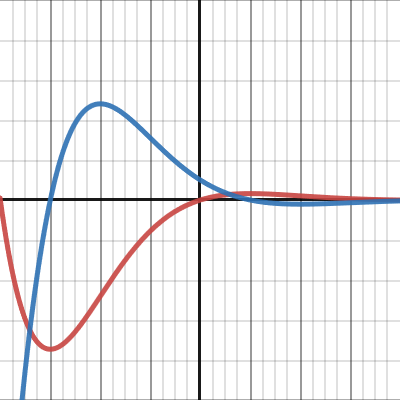
Desmos
if youre curious
red is curve, blue is derivative
you can maybe kinda see
anyways
safe radishBOT
Available help channel!
Send your question here to claim the channel.
Remember:
• Ask your math question in a clear, concise manner.
• Show your work, and if possible, explain where you are stuck.
• After 15 minutes, feel free to ping <@&286206848099549185>.
• Type the command .close to free the channel when you're done.
• Be polite and have a nice day!
Read #❓how-to-get-help for further information on how to ask a good question, and about conduct in the question channels.
 gentle valley
In a density experiment a student measures sides of square object and
measures the mass. Density is mass / volume.
I have height, width, depth and density given. How do I calculate the volume so I can then get density
safe radishBOT
gentle valley
In a density experiment a student measures sides of square object and
measures t...
gentle valley
but is it a cuboid?
gentle valley
gentle valley
In a density experiment a student measures sides of square object and
measures t...
that's all I'm given with no shapes attached
that's the question copy pasted
alright thanks!
.close
safe radishBOT
Channel closed
Closed by @gentle valley
Use .reopen if this was a mistake.
safe radishBOT
Available help channel!
Send your question here to claim the channel.
Remember:
• Ask your math question in a clear, concise manner.
• Show your work, and if possible, explain where you are stuck.
• After 15 minutes, feel free to ping <@&286206848099549185>.
• Type the command .close to free the channel when you're done.
• Be polite and have a nice day!
Read #❓how-to-get-help for further information on how to ask a good question, and about conduct in the question channels.
 patent vault
 safe radishBOT
patent vault
patent vault
safe radishBOT
patent vault
patent vault
i made the equation sqrt(x)+sqrt(y)=a/b where a, b Z and gcd(a, b) = 1
not sure what do next
can i get a hint?
toxic stratus
x and y should be irrational
patent vault
toxic stratus
x and y should be irrational
ye
toxic stratus
hint: a - a = 0
patent vault
why would that not be true?
toxic stratus
?
patent vault
not sure how to use it
patent vault
whats "it"
flat frigateBOT
 patent vault
flat frigate
patent vault
flat frigate
what would i possibly add
flat frigateBOT
 toxic stratus
if you would like
 toxic stratus
thats just an arbitrary choice
you want the irrational parts cancelling
leaving behind the rational parts
patent vault
could it be the other way around
toxic stratus
i mean
you dont have to keep the a, b, c around
just
replace them with any random integer
patent vault
?
 toxic stratus
no like
we really dont need so much generality
just pick like
your favourite couple of integers
like
okay
a = 1, b = 2, c = 2
so


 patent vault
toxic stratus
your favourite couple of integers
patent vault
toxic stratus
your favourite couple of integers
is there a reason why we can do this
toxic stratus
why not
its just a random example
just
pick any integers you want
provided that they work ofc
i mean you couldve just started with saying like
flat frigateBOT
 toxic stratus
so lets set the first thing = sqrt(x) and the second thing = sqrt(y)
then there isnt any picking of integers involved is there
its just a true equation
patent vault
flat frigate
how do you know those values are irrational
bc sqrt(2) is irrational?
thanks for ur help btw
.close
safe radishBOT
Channel closed
Closed by @patent vault
Use .reopen if this was a mistake.
safe radishBOT
Available help channel!
Send your question here to claim the channel.
Remember:
• Ask your math question in a clear, concise manner.
• Show your work, and if possible, explain where you are stuck.
• After 15 minutes, feel free to ping <@&286206848099549185>.
• Type the command .close to free the channel when you're done.
• Be polite and have a nice day!
Read #❓how-to-get-help for further information on how to ask a good question, and about conduct in the question channels.
 misty coral
 safe radishBOT
misty coral
misty coral
safe radishBOT
misty coral
misty coral
what is a "motive"?
 woven urchin
a motive is like a reason to be motivated.
"His motive for killer her was because she stole all his sandwiches"
woven urchin
i guess, Ive heard of the other terms related to complex but not that one
misty coral
well I know of all the other ones and know a complex number has them but I have no clue what a motive is
in relation to the
m
woven urchin
modulus is absolute scalar value (or distance from 0), conjugate is when the imaginary part of number is negative (I think), argument is the imaginary component of complex number
never heard of it, so its probably that
misty coral

so if i = sqrt(-1) then I think c and d are both true right
wait
nvm
ty for help
.close
safe radishBOT
Channel closed
Closed by @misty coral
Use .reopen if this was a mistake.
Available help channel!
Send your question here to claim the channel.
Remember:
• Ask your math question in a clear, concise manner.
• Show your work, and if possible, explain where you are stuck.
• After 15 minutes, feel free to ping <@&286206848099549185>.
• Type the command .close to free the channel when you're done.
• Be polite and have a nice day!
Read #❓how-to-get-help for further information on how to ask a good question, and about conduct in the question channels.
lean otter
can someone help me out with this infinite series. please also tell me what i need to know in order to solve it
safe radishBOT
lean otter
can someone help me out with this infinite series. please also tell me what i ne...
lean otter

i think it's some kind of algebraic-geometric series, but i'm not sure
please ping
$\sum_{i=0}^{\infty} x^i = \frac{1}{1-x}$
take a look at this sum and take the derivative on both sides
(for |x| < 1)
lean otter
lean otter
$\sum_{i=0}^{\infty} x^i = \frac{1}{1-x}$
where does that come from?
geometric sum
geometric series
oh wait
could you link some proof please
flat frigateBOT
rbit ✨
 lean otter
index should start at 0
i just want to understand it intuitively
$\sum_{i=0}^{n} q^i = \frac{1-q^{n+1}}{1-q}$
flat frigateBOT
rbit ✨
 lean otter
prove this per induction, and then assume |q|<1 and take the limit as n goes to infinity
although thats not very intuitive
lean otter
huh?
lean otter
look at what ive written before
toxic stratus
 imblind
lean otter
lean otter
prove this per induction, and then assume |q|<1 and take the limit as n goes to ...
yeah... not very intuitive
i mean we can write it out:
im sure theres some youtube video with some nice visualizations, but if you want to prove it rigurously then induction is a good way
wait i think there was another way
toxic stratus

This is a short, animated visual proof demonstrating the infinite geometric series formula for any positive ratio r with r less than 1. This series is important for many results in calculus, discrete mathematics, and combinatorics. #mathshorts #mathvideo #math #calculus #mtbos #manim #animation #theorem #pww #proofwithoutwords #visualpr...
this is the nicest visualisation ive seen
lean otter
lean otter
im sure theres some youtube video with some nice visualizations, but if you want...
okay, but please just let me know what i need to know in order to solve this
lean otter
toxic stratus
https://youtu.be/TGUWt5xcB8M
are you sure
1+q+q²+... = S
q+q²+q³+... = qS
1+q+q²+... = 1+qS
S = 1+qS
S(1-q) = 1
S = 1/(1-q)
works because its absolutely convergent
toxic stratus
assuming convergence tho
lean otter
i don't know man, i've asked this question to many people, a lot of them got it wrong, and the rest just gave me the solution right away
without giving proper explanation, which wasn't very useful you know
soo, what parts are you still struggling with? do you get the derivation i gave or do i need to explain it more?
safe radishBOT
@lean otter Has your question been resolved?
lean otter
lean otter
soo, what parts are you still struggling with? do you get the derivation i gave ...
give me a sec, let me write it out
btw we need to show first its convergent, do you know any convergence tests for infinite series, in particular the root test?
$1+2\cdot\left(\frac{1}{1,998}\right)+3\cdot\left(\frac{1}{1,998}\right)^2+4\cdot\left(\frac{1}{1,998}\right)^3+...+n*\left(\frac{1}{1,998}\right)^{n-1}+...$
flat frigateBOT
Windy
 lean otter
right?
wait we first gotta derive the geometric series
that "*" at the end is just multipilcation
$1+x+x²+x³+... = \frac{1}{1-x}$
flat frigateBOT
rbit ✨
 lean otter
is it?
if we then take the derivative of that, we get what you want:
$1+2x+3x²+4x³+... = \frac{1}{(1-x)²}$
flat frigateBOT
rbit ✨
 safe radishBOT
@lean otter Has your question been resolved?
safe radishBOT
Channel closed
Closed due to timeout
Use .reopen if this was a mistake.
lean otter
.reopen