#help-23
1 messages · Page 5 of 1
 stray socket
 ivory gate
gradians* sorry
stray socket
Whatever those are
ivory gate
you dont know??
stray socket
I'm not French
 foggy salmon
isnt it pi gra
ivory gate
400 gradians in a circle
foggy salmon
what
 muted ibex
breh
stray socket
Sounds like a shit unit
ivory gate
nono
muted ibex
Nono
foggy salmon
omg
ivory gate
its quite inuitive
stray socket
Never heard of gradians it just sound like degrees with extra steps
 muted ibex
true
ivory gate
then use gradian angle laws
 safe radishBOT
@limpid pewter Has your question been resolved?
 limpid pewter
ivory gate
then use gradian angle laws
limpid pewter
ivory gate
then use gradian angle laws
gradian angle laws?
ivory gate
limpid pewter
gradian angle laws?
yesyes
are you familiar with gradians?
the new unit
muted ibex
yesyes
ivory gate
the better unit
muted ibex
the superior unit
limpid pewter
nope
safe radishBOT
@limpid pewter Has your question been resolved?
Channel closed
Closed by @limpid pewter
Use .reopen if this was a mistake.
 Available help channel!
Send your question here to claim the channel.
Remember:
• Ask your math question in a clear, concise manner.
• Show your work, and if possible, explain where you are stuck.
• After 15 minutes, feel free to ping <@&286206848099549185>.
• Type the command .close to free the channel when you're done.
• Be polite and have a nice day!
Read #❓how-to-get-help for further information on how to ask a good question, and about conduct in the question channels.
 reef basin
 safe radishBOT
reef basin
reef basin
safe radishBOT
reef basin
reef basin
Someone tell me where to start pls ;-;
 tardy mango
Solve y<0 and y>0 (note that if the numerator and the denominator are both negative or positive, y is positive, whereas if one is negative and one is positive, y is negative)
tardy mango
Sure, sounds good
 tardy mango
,w [(x-19)(x-1)]/(x-11)<0
reef basin
Are the options wrong or am I stupid
 flat frigateBOT


 Requested by messy circle creation#1465
tardy mango
Requested by messy circle creation#1465
tardy mango
,w [(x-19)(x-1)]/(x-11)>0
flat frigateBOT
 Requested by messy circle creation#1465
tardy mango
Requested by messy circle creation#1465
tardy mango
Q = 2
reef basin
Ah fuck yeah
I'm stupid
I ignored the other + sign on my number line
So its 18+2 right
tardy mango
Yeah
safe radishBOT
Channel closed
Closed by @reef basin
Use .reopen if this was a mistake.
safe radishBOT
Available help channel!
Send your question here to claim the channel.
Remember:
• Ask your math question in a clear, concise manner.
• Show your work, and if possible, explain where you are stuck.
• After 15 minutes, feel free to ping <@&286206848099549185>.
• Type the command .close to free the channel when you're done.
• Be polite and have a nice day!
Read #❓how-to-get-help for further information on how to ask a good question, and about conduct in the question channels.
 viral current
anyone able to do discrete math?
safe radishBOT
viral current
anyone able to do discrete math?
viral current
trying to understand how to do this

 visual widget
viral current
anyone able to do discrete math?
visual widget
viral current
anyone able to do discrete math?
same
 static rover
well I don't know the math but I looked up roster notation

seems like its {1110, 1101, 1011, 0111, 1111}
safe radishBOT
@viral current Has your question been resolved?
Channel closed
Closed by @viral current
Use .reopen if this was a mistake.
Available help channel!
Send your question here to claim the channel.
Remember:
• Ask your math question in a clear, concise manner.
• Show your work, and if possible, explain where you are stuck.
• After 15 minutes, feel free to ping <@&286206848099549185>.
• Type the command .close to free the channel when you're done.
• Be polite and have a nice day!
Read #❓how-to-get-help for further information on how to ask a good question, and about conduct in the question channels.
 digital sinew
 safe radishBOT
digital sinew
safe radishBOT
digital sinew
 nova creek
What have you tried
digital sinew
Currently I have put in into an equation
let me type it out one sec
x would be 30%
y would be 11 %
so x +y = 7.6 Liters
that would be the first one
and the second i am having troubl putting together
static rover
Basically you just need to set up a ratio
so like if you have 1 liter of 30% solution how many liters of 11% solution would get you to 16%
okay I got it
so
let's say 1 liter of 30% plus x liters of 11% gets you to a 16% average
the average of something is just all of the numbers added up multiplied by the number of numbers
so we can say 30+11x=16(x+1)
we get the x+1 from the number of liters there must be
does that make sense
static rover
uh
if they're all percent
we can just multiply them all by 100 and it's fine
both sides are equal
once we have 30+11x=16(x+1)
we can expand the right side to 16x+16
30+11x=16x+16
move the x's to one side and the integers to the other
30-16=16x-11x
14=5x
x=14/5
2.8 liters
uh
we can verify this
wait is that okay to follow
digital sinew
im still a bit lost
nova creek
-
It's better to not do all the work for OP. Give them a chance to do some work themselves
-
I feel like this exercise distracts from the main problem, since it doesn't actually solve the problem, though I can see how you could use those principles and apply them to the og problem
static rover
well I'm finding the number of liters
wouldn't that be solving the problem
okay what's the equation
nova creek
You're assuming there's 1 liter of 30% solution, but that's an unjustified assumption
static rover
I'm finding the ratio
That's needed to finding the number of liters if it adds up to 7.6
digital sinew
So I am pretty sure this is a system of equations?
So we would need to find both equations.
x would be 30%
y would be 11%
first equation would be
x+y=7.6L
Correct?
nova creek
I can see what you're doing now. Still, it's better to try and lead OP to that, since at first glance, it does seem like you're solving an unrelated problem
digital sinew
I am trying to figure out the next equation and how we find it.
static rover
okay so
you wanna find the ratio first off
that's the key to solving the problem
the best way I found to do this was to assume one liter of 30% solution and find how many liters of 11% we'd need to balance this out
we can call the number of liters of 11% solution "x"
we can change the percentages to decimals sure
if we write out the average it becomes 0.3+0.11x=0.16(x+1)
x+1 because the number of liters is x plus the 1 liter of 30% solution
can you follow that
digital sinew
yes
digital sinew
oh i figured it out
static rover
oh heyo
digital sinew
x+y=7.6
.30+11y=1.216
then graphing those the line they point they intersect would be (2,5.6)
c:
digital sinew
ty for ur help tho c:
digital sinew
.close
safe radishBOT
Channel closed
Closed by @digital sinew
Use .reopen if this was a mistake.
safe radishBOT
Available help channel!
Send your question here to claim the channel.
Remember:
• Ask your math question in a clear, concise manner.
• Show your work, and if possible, explain where you are stuck.
• After 15 minutes, feel free to ping <@&286206848099549185>.
• Type the command .close to free the channel when you're done.
• Be polite and have a nice day!
Read #❓how-to-get-help for further information on how to ask a good question, and about conduct in the question channels.
 lean otter
I have the following system G_S(s) which I need to transform into a state space model
safe radishBOT
lean otter
I have the following system G_S(s) which I need to transform into a state space ...
lean otter

Before trying to transform this system into a state space model, I must convert it into an ODE, am I right? Since $$G_S(s) = \dfrac{Y(s)}{U(s)}$$, I can rewrite the transfer function to $$Y(s)=\dfrac{1}{2s^2+3s+1}U(s)$$ and finally into $$Y(s)*(1+3s+2s^2) = U(s)$$. Applying the inverse Laplace Transformation I get $$2\ddot{y}+3\dot{y}+y=u(t)$$
flat frigateBOT
Lüt
 lean otter
But according to the solution provided the ODE should be the following

Where the heck do these factors infront of the derivatives come from?
safe radishBOT
@lean otter Has your question been resolved?
safe radishBOT
@lean otter Has your question been resolved?
safe radishBOT
@lean otter Has your question been resolved?
safe radishBOT
@lean otter Has your question been resolved?
safe radishBOT
@lean otter Has your question been resolved?
lean otter
.close
safe radishBOT
Channel closed
Closed by @broken bluff
Use .reopen if this was a mistake.
Available help channel!
Send your question here to claim the channel.
Remember:
• Ask your math question in a clear, concise manner.
• Show your work, and if possible, explain where you are stuck.
• After 15 minutes, feel free to ping <@&286206848099549185>.
• Type the command .close to free the channel when you're done.
• Be polite and have a nice day!
Read #❓how-to-get-help for further information on how to ask a good question, and about conduct in the question channels.
 viscid fulcrum

 safe radishBOT
viscid fulcrum
viscid fulcrum
safe radishBOT
viscid fulcrum
viscid fulcrum
How do I find the radius for problem (b)?
wouldn't it just be the distance from 0 to 2 + the distance from 2 to 8?
6+(2-x)?
safe radishBOT
@viscid fulcrum Has your question been resolved?
Channel closed
Closed by @viscid fulcrum
Use .reopen if this was a mistake.
Available help channel!
Send your question here to claim the channel.
Remember:
• Ask your math question in a clear, concise manner.
• Show your work, and if possible, explain where you are stuck.
• After 15 minutes, feel free to ping <@&286206848099549185>.
• Type the command .close to free the channel when you're done.
• Be polite and have a nice day!
Read #❓how-to-get-help for further information on how to ask a good question, and about conduct in the question channels.
 mighty warren
Hello am kinda confused on how to solve this problem using evaluation
 safe radishBOT
mighty warren
Hello am kinda confused on how to solve this problem using evaluation
mighty warren
safe radishBOT
mighty warren
Hello am kinda confused on how to solve this problem using evaluation
mighty warren
By saying I+F does that mean I have to add the sums of F(x) and I(x) together?
 flat frigateBOT
tatpoj

 trim swan
it's the same circle symbol as in the picture you posted
mighty warren
And how do u use it?
trim swan
I'm saying $(f \circ g)(x)$ means $f(g(x))$
flat frigateBOT
tatpoj
 mighty warren
Ok
trim swan
Does that make sense?
mighty warren
Am still a bit confused
trim swan
I'll show you an example
Let's say $f(x) = x+3$ and $g(x) = x^2$.
Then
$$(f \circ g)(x)$$
$$= f\bigl(g(x)\bigr)$$
$$= f(x^2)$$
$$ = x^2 + 3$$
flat frigateBOT
tatpoj
 trim swan
Sorry I changed it a bit, I think it's clearer this way
trim swan
So since yours was K(K(a^2)), you want to plug a^2 into K, and then take what you get and plug that into K again
 trim swan
Division
mighty warren
Ok thanks
mighty warren
mighty warren
Hello am kinda confused on how to solve this problem using evaluation
Just wanted to clarify
Is my solution correct?
 trim swan
,rotate
flat frigateBOT
 trim swan
This was for (I+F)(-3)?
mighty warren
Yes
trim swan
looks good to me
But you should probably have (I+F)(-3) at least written somewhere in your work
if your teacher is picky about that kind of thing
mighty warren
Ok thanks
safe radishBOT
@mighty warren Has your question been resolved?
Channel closed
Closed by @mighty warren
Use .reopen if this was a mistake.
Available help channel!
Send your question here to claim the channel.
Remember:
• Ask your math question in a clear, concise manner.
• Show your work, and if possible, explain where you are stuck.
• After 15 minutes, feel free to ping <@&286206848099549185>.
• Type the command .close to free the channel when you're done.
• Be polite and have a nice day!
Read #❓how-to-get-help for further information on how to ask a good question, and about conduct in the question channels.
 ruby sky
Hi can anyone help me this??
 safe radishBOT
ruby sky
Hi can anyone help me this??
ruby sky
safe radishBOT
ruby sky
Hi can anyone help me this??
ruby sky
Here is my work
lean otter
Treat the original percent as a variable n
ruby sky
20%*x= 100% so x = 500%. We should increase 500% to reach 100% but 500% containt the original vaule in it, we just need to find the percent to reach the original value so we need to subtract it: 500% -100% = 400%
Am I wrong??
lean otter
Yes
ruby sky
I just wanna clear its not 500% but 400%
ruby sky
Its 5
lean otter
And 5 times is how many percent
ruby sky
500%
lean otter
And there's your answer
ruby sky
But the answer is 400%
ruby sky
Yess its say 400%
lean otter
You sure thats the right question 400% isn't one of the possible answes
Can you show more of the question
ruby sky
No the answer is 400% and the correct answer in this problem is D. Other
ruby sky
lean otter
Can you show more of the question
Its just that
 bold ferry
the question is asking how much percent to increase it by.
so 500% would be right if it was asking how much of the value it should be
here’s how I would think of it intuitively:
let’s say x is 100
we take 20% of that and it’s 20
lean otter
Why do people word questions like this
bold ferry
now increase it by a percent of 20
and 400% of 20 is ?
80
so 20 + 80 is 100
here’s an equation to represent this:
0.2x + y(0.2x) = x
lean otter
I'm sorry (Kihei is very much correct)
bold ferry
basically y is the percent you are increasing of 0.2x
bold ferry
lean otter
I'm sorry (Kihei is very much correct)
nah you’re good, I agree these kind of questions are confusing at first glance
ruby sky
Can I thought like the 500% is contain the percent should increase and the value of that so we just need find the percent to reach the original vaule so can we do this: 500% - original value
In this question i supposed the original price was 100%
Can i do like that?
ruby sky
Ok its 500%
ruby sky
bold ferry
here’s an equation to represent this:
0.2x + y(0.2x) = x
I’m sorry can you explain me more about this things. Why we should multiply y to 0.2x but not only y
And here is my equation: 0.2x + y = x
ruby sky
bold ferry
isn’t it 400%
Its 400% lol
bold ferry
so, you get 20% of the original value, x. now we have this new value, let’s call it 0.2x. and now, we need to add a “y” percent OF 0.2x, to finally get x
it gets confusing with equations so I can explain it another way if you wish
ruby sky
Ok thank you for your help
I got this
You mean like 0.2x is a new value like the big X. So we can do like this: 0,2x + y* X = x isnt it??
Oh ok i got this now
bold ferry
ruby sky
You mean like 0.2x is a new value like the big X. So we can do like this: 0,2x +...
yeah that’s a good way to think about it
but of course, big X = 0.2x
it’s just your new value
bold ferry
no worries
safe radishBOT
@ruby sky Has your question been resolved?
ruby sky
Hey
I found the fast solution for it
Lets check it
Here is my equation: (lost/remaining ) * 100
$(\frac {lost} {remaining}) * 100$
flat frigateBOT
Evelynn522
 safe radishBOT
Channel closed
Closed due to timeout
Use .reopen if this was a mistake.
ruby sky
$(\frac {lost} {remaining}) * 100$
flat frigateBOT
Evelynn522
 safe radishBOT
Available help channel!
safe radishBOT
Available help channel!
Send your question here to claim the channel.
Remember:
• Ask your math question in a clear, concise manner.
• Show your work, and if possible, explain where you are stuck.
• After 15 minutes, feel free to ping <@&286206848099549185>.
• Type the command .close to free the channel when you're done.
• Be polite and have a nice day!
Read #❓how-to-get-help for further information on how to ask a good question, and about conduct in the question channels.
ruby sky
<@&286206848099549185>
safe radishBOT
ruby sky
<@&286206848099549185>
 whole acorn
!15m
safe radishBOT
Please only use the <@&286206848099549185> ping once if your question has not been answered for 15 minutes. Please do not ping or DM individual users about your question.
whole acorn
and you didn't ask anything
whole acorn
it looks like she already found it
ruby sky
Just scroll up
 ruby sky
flat frigate
**Evelynn522**
ruby sky
flat frigate
**Evelynn522**
I find the faste way to do, hope you guys can check it for me
safe radishBOT
@ruby sky Has your question been resolved?
safe radishBOT
Channel closed
Closed due to timeout
Use .reopen if this was a mistake.
Available help channel!
Send your question here to claim the channel.
Remember:
• Ask your math question in a clear, concise manner.
• Show your work, and if possible, explain where you are stuck.
• After 15 minutes, feel free to ping <@&286206848099549185>.
• Type the command .close to free the channel when you're done.
• Be polite and have a nice day!
Read #❓how-to-get-help for further information on how to ask a good question, and about conduct in the question channels.
 hollow valve
.reopen
 slim urchin
is there a mistake here?
 safe radishBOT
slim urchin
is there a mistake here?
safe radishBOT
safe radishBOT
slim urchin
is there a mistake here?
safe radishBOT
Channel closed
Closed by @slim urchin
Use .reopen if this was a mistake.
Available help channel!
Send your question here to claim the channel.
Remember:
• Ask your math question in a clear, concise manner.
• Show your work, and if possible, explain where you are stuck.
• After 15 minutes, feel free to ping <@&286206848099549185>.
• Type the command .close to free the channel when you're done.
• Be polite and have a nice day!
Read #❓how-to-get-help for further information on how to ask a good question, and about conduct in the question channels.
 trim jackal
Pertaining to?
Do you have a proof? How is it an almost exact formula?
Natural numbers 1 to 100?
Did you do a proof tho or just calculate for 1 to 100?
It don’t matter if you don’t do a proof showing it works for all natural numbers
trim jackal
Yeah exactly. You can write a computer program to calculate it for 1 to 100 in a matter of seconds
foggy salmon
i mean even if u get 10^20 its a lot n u can make an educated guess itll continue but still u cant generalise
trim jackal
I’m just taking an intro proof class now so I can’t tell you how to write a proof for it precisely, but I know showing 1 to 100 is not enough to mean anything
foggy salmon
but to answer ur original Q
idk what u can do with a formula that can approximate how many prime numbers there are but its probably quite useful
safe radishBOT
@lean otter Has your question been resolved?
 lean chasm
@lean otter is it in a closed form
safe radishBOT
Channel closed
Closed due to timeout
Use .reopen if this was a mistake.
Available help channel!
Send your question here to claim the channel.
Remember:
• Ask your math question in a clear, concise manner.
• Show your work, and if possible, explain where you are stuck.
• After 15 minutes, feel free to ping <@&286206848099549185>.
• Type the command .close to free the channel when you're done.
• Be polite and have a nice day!
Read #❓how-to-get-help for further information on how to ask a good question, and about conduct in the question channels.
 heady trout
hi, a question about the last line
 safe radishBOT
heady trout
hi, a question about the last line
safe radishBOT
heady trout
hi, a question about the last line
 heady trout
 dusty raven
(n+1)n!=(n+1)!
dusty raven
(n+1)n!=(n+1)!
whattt
dusty raven
maybe in clearer notation (n+1)*n!
=(n+1)!
i.e you take n! and multiply it by (n+1) and you get (n+1)!
dusty raven
nice
heady trout
.close
safe radishBOT
Channel closed
Closed by @heady trout
Use .reopen if this was a mistake.
Available help channel!
Send your question here to claim the channel.
Remember:
• Ask your math question in a clear, concise manner.
• Show your work, and if possible, explain where you are stuck.
• After 15 minutes, feel free to ping <@&286206848099549185>.
• Type the command .close to free the channel when you're done.
• Be polite and have a nice day!
Read #❓how-to-get-help for further information on how to ask a good question, and about conduct in the question channels.
 maiden barn
I need to prove that:
2^2025 | (6^2022) - (2^2022)
safe radishBOT
maiden barn
I need to prove that:
2^2025 | (6^2022) - (2^2022)
maiden barn
I thought I could do it by factoring out: 2^2025 = 2^2022 * 2^3
Then saying: (6^2022) - (2^2022) = ((2*3)^2022) - (2^2022)
= 2^2022 * 3^2022 - 2^2022
= 2^2022 (3^2022 - 1)
maiden barn
maiden barn
I thought I could do it by factoring out: 2^2025 = 2^2022 * 2^3
Now, looking at this, I need to somehow prove that 3^2022 - 1 is divisible by 2^3
I thought of something like saying: 3^2022 = (3^1011)^2
maiden barn
maiden barn
= 2^2022 (3^2022 - 1)
Then saying this equals: 2^2022 ((3^1011 - 1)(3^1011 + 1))
Then I was thinking, well
3^1011 - 1 = 2k
3^1011 + 1 = 2l
But we can observe that 2l = 2k+2
Therefore, (3^1011 - 1)(3^1011 + 1) equals: 2k * (2k+2) = 4k^2 + 4k = 4k(k + 1)
Oh
Wait
Can we say it like this:
4k^2 + 4k = 4(k^2 + k)
If k is even, then (k^2 mod 2) = 0 and (k mod 2) = 0, therefore k^2 + k has a factor of two, therefore that's divisible by 8
If k is odd, then 4(k^2 + k) = 4(k(k+1)) has a factor of two, since k+1 is even if k is odd?
Did I just solve it 😳
maiden barn
Can you just
Check my sol
I want to see if my thinking is right
I can find a solution to this generally in no time
 worthy mango
your sol is longer than i think it needs to be
maiden barn
That's fine, but can you tell me whether this logic applies XD
 quasi bison
your solution is fine, just wordy
worthy mango
maiden barn
Now, looking at this, I need to somehow prove that 3^2022 - 1 is divisible by 2^...
this first bit ik is good
maiden barn
quasi bison
your solution is fine, just wordy
That's what I wanted to hear
Can we claim the following:
3^(even number) - 1 is always divisible by 8
Because
worthy mango
my advice in general would eb to consider 3^n -1
for small n and see if you notice a pattern which you can then prove
maiden barn
(3^2)^k = 9^k - 1
worthy mango
ye like that
maiden barn
But I am not so sure in my knowledge of modular arithmetics
I have considered that
But idk what's the law for it
quasi bison
wdym by law
maiden barn
Does the modulo still stay after exponentiation?
quasi bison
you can \textbf{prove} that if $a \equiv b \pmod{n}$ then $a^k \equiv b^k \pmod{n}$ for all $a, b, n, k \in \bZ$ with $k \geq 0$
worthy mango
by binomial theorem
after you expand (8+1)^k
all terms will have a factor of 8 apart from the term equal to 1
flat frigateBOT
Ann
 quasi bison
worthy mango
by binomial theorem
after you expand (8+1)^k
all terms will have a factor of 8 a...
quasi bison
worthy mango
by binomial theorem
after you expand (8+1)^k
all terms will have a factor of 8 a...
or that
worthy mango
maiden barn
3^(even number) - 1 is always divisible by 8
you can also prove this holds inductively
if 3^n - 1 = 8k
3^{2n} - 1 = 9(8k +1) - 1
=72k + 8
maiden barn
quasi bison
you can \textbf{prove} that if $a \equiv b \pmod{n}$ then $a^k \equiv b^k \pmod{...
Oh so this means that:
(3^2)^k = 1^k (mod 8)
Right?
since 1^k is simply 1
Then (3^2)^k mod 8 = 1
worthy mango
yup
quasi bison
that is better addressed to whoever is organizing your competition
maiden barn
So this is not some form of well known law?
worthy mango
it is well-known
maiden barn
worthy mango
if 3^n - 1 = 8k
3^{2n} - 1 = 9(8k +1) - 1
=72k + 8
That's a nice one, I would've tried it
worthy mango
i mean this exponentiation rule
it follows immediately from the fact that if
a=b mod k
and
c=d mod k
then
ac =bd mod k
just repeated multiplication
safe radishBOT
Channel closed
Closed by @maiden barn
Use .reopen if this was a mistake.
Available help channel!
Send your question here to claim the channel.
Remember:
• Ask your math question in a clear, concise manner.
• Show your work, and if possible, explain where you are stuck.
• After 15 minutes, feel free to ping <@&286206848099549185>.
• Type the command .close to free the channel when you're done.
• Be polite and have a nice day!
Read #❓how-to-get-help for further information on how to ask a good question, and about conduct in the question channels.
 shrewd hedge
how do I calculate 13^-1 mod 60?
safe radishBOT
shrewd hedge
how do I calculate 13^-1 mod 60?
 peak estuary
extended euclidean algorithm
safe radishBOT
Channel closed
Closed by @shrewd hedge
Use .reopen if this was a mistake.
safe radishBOT
Available help channel!
Send your question here to claim the channel.
Remember:
• Ask your math question in a clear, concise manner.
• Show your work, and if possible, explain where you are stuck.
• After 15 minutes, feel free to ping <@&286206848099549185>.
• Type the command .close to free the channel when you're done.
• Be polite and have a nice day!
Read #❓how-to-get-help for further information on how to ask a good question, and about conduct in the question channels.
 tepid stone
 safe radishBOT
tepid stone
lean otter
safe radishBOT
tepid stone
lean otter
a^3 + b^3
tepid stone
i tried
lean otter
show
tepid stone
just a sec

little messy it is
i reached the answer with a^3+b^3 problem is that -1
lean otter
consider cos^4A = (1-sin^2A)^2
tepid stone
ah its is cos^6A
well the correct ans. is -3sin^2Acos^2A
do you think -1 in the ques. is a printing mistake?
@lean otter
bcoz when there is no -1 the ans. is exactly -3sin^2Acos^2A
@lean otter u there?
 thin bridge
there is no mistake in the question
thin bridge
consider sum of two cubes
thin bridge
did you apply the factorisation for the sum of two cubes?
thin bridge
what do you have after that
 idle sage
tepid stone
idle sage
tepid stone
what’s the full qn?
tepid stone
thats the ques
idle sage
is it a proving qn?
idle sage
oh icic I saw an = sign there HAHA so I thought it was a proving qn
tepid stone
no
idle sage
any specific form u need to simplify it to?
tepid stone
well i just told u the correct ans i just want to know how to get there
tepid stone
tepid stone
well the correct ans. is -3sin^2Acos^2A
.
thin bridge
yah
what do you have after that
idle sage
tepid stone
js curious,, what’s after that = sign in ur pic
tepid stone
thin bridge
> yah
> what do you have after that
after doin what u told i got (sin^2A)^3+(cos^2A)^3 = (sin^2A+cos^2A)((sin^2A)^2+(cos^2A)^2-sin^2cos^2a)
tepid stone
idle sage
js curious,, what’s after that = sign in ur pic
nothing
thin bridge
don't forget about the - 1 s
(sin^2A)^3+(cos^2A)^3 -1 = (sin^2A+cos^2A)((sin^2A)^2+(cos^2A)^2-sin^2cos^2a) - 1
note that (sin^2A+cos^2A) could be simplified immediately
thin bridge
no
there are no 1s to cancel
ideally the -1s there because you're starting with a -1 in the original expression
idle sage
oki
tepid stone
okay if we donot cancel the -1 s we get (sin^2A)^3+(cos^2A)^3 -1 = (1)((sin^2A)^2+(cos^2A)^2-sin^2cos^2a) - 1
 tepid stone
idle sage
I THINK idk?
tepid stone
idle sage
I THINK idk?
the ans is correct
idle sage
darnn is my method wrong
tepid stone
but i cannot say wether the steps are correct
idle sage
I tried 🕊
thin bridge
and then consider what (sin^2(A) + cos^2(A))^2 expands out to
and compare that to ((sin^2A)^2+(cos^2A)^2-sin^2cos^2a)
tepid stone
(sin^2A)^2+(cos^2A)^2= (sin^2A+cos^2A)^2-2sin^2Acos^2A
(sin^2A+cos^2A)^2-2sin^2Acos^2A=(1)-2sin^2Acos^2A
 empty phoenix
idle sage
darnn is my method wrong
empty phoenix
idle sage
darnn is my method wrong
there isnt a method its just calculation or identities analysation
thin bridge
(sin^2A)^2+(cos^2A)^2= (sin^2A+cos^2A)^2-2sin^2Acos^2A
hence the stuff inside your parentheses
(sin^2A)^2+(cos^2A)^2 - sin^2(A)cos^2(A) = ?
idle sage
empty phoenix
there isnt a method its just calculation or identities analysation
will it be accepted?
I am so confused 😭
tepid stone
idle sage
will it be accepted?
well its ginig the ans correct
idle sage
but the way we get to the ans needs to be right tho
empty phoenix
idle sage
will it be accepted?
i was just saying you should not use method word , you can say may be you were incorrect
thin bridge
no, multiple wrongs don't make a right
tepid stone
bcoz when theres no -1 in the ques it gives -3sin^2Acos^2A-1
 idle sage
but the 1s cancel out no?
tepid stone
yah
idle sage
empty phoenix
https://tenor.com/view/mega-brain-big-brain-math-pineapple-gif-gif-25841999
me rn
except it’s all zzzzzzz
thin bridge
multiple wrongs don't make a right, there were multiple things very wrong in that work
idle sage
bec it’s midnight
thin bridge
(sin^2A)^2+(cos^2A)^2= (sin^2A+cos^2A)^2-2sin^2Acos^2A
hence the stuff inside your parentheses
(sin^2A)^2+(cos^2A)^2 - sin^2(A)cos^2(A) = ?
empty phoenix
hmm
tepid stone
but romonov is saying no
idle sage
thin bridge
multiple wrongs don't make a right, there were multiple things very wrong in tha...
what was it I want to correct it
tepid stone
idle sage
bec it’s midnight
midnight? its 10 pm here where u from?
idle sage
Singapore
 lone compass
bro he's yellow he's never incorrect
tepid stone
idle sage
Singapore
oh
empty phoenix
sin^2(A) ? what wont it be sin^2A ?
tepid stone
lone compass
bro he's yellow he's never incorrect
😅
empty phoenix
all the best
tepid stone
which grade u in ?
thin bridge
actually i suppose it was just one unnecesary line that was wrong
idle sage
oh I’m 17 idk what grade
thin bridge
misread some of yuor handwriting earlier
idle sage
thin bridge
misread some of yuor handwriting earlier
oop- sry HAHA
thin bridge
 idle sage
oo why
thin bridge
freshmans dream
idle sage
HAHA how do we write it
tepid stone
we have to write it as (sin^2A)^3+(cos^2A)^3
thin bridge
you just erase that line, it was completely wrong/unnecessary
tepid stone
since theres a diff b/w
idle sage
ohhhh
tepid stone
(a+b)^3
idle sage
so I just cancel that line off
tepid stone
and a^3+b^3
thin bridge
apart from that mishap, that approach works
tepid stone
yah
thin bridge
as does the one i'm guiding you towards
(sin^2A)^2+(cos^2A)^2= (sin^2A+cos^2A)^2-2sin^2Acos^2A
hence the stuff inside your parentheses
(sin^2A)^2+(cos^2A)^2 - sin^2(A)cos^2(A) = ?
thin bridge
(building on the equation above)
 idle sage
wait why so
tepid stone
oh wait
thin bridge
wtf...
tepid stone
got it
thin bridge
sin^2(A)+cos^2(A) simplifies to 1
 idle sage
wooooo
thin bridge
why did you do some weird crap to it,
and top of that committed some parenthesins
 thin bridge
the original -1 wasn't present throughout the work
idle sage
oh that
tepid stone
im so confused
thin bridge
1 - 3sin^2(A)cos^2(A) isn't the same as -3sin^2(A)cos^2(A)
tepid stone
thin bridge
1 - 3sin^2(A)cos^2(A) isn't the same as -3sin^2(A)cos^2(A)
why dont u just do it on paper buddy
thin bridge
because i wanted to see you put in the effort first
instead giving the solution away
now that you have most of it, i'll give you decent formatting
tepid stone
ok
thin bridge
$\sin^6(A) + \cos^6(A) - 1 = (\sin^2(A) + \cos^2(A))((\sin^2(A))^2 + (\cos^2(A))^2 - \sin^2(A)\cos^2(A)) - 1\
= (\sin^2(A) + \cos^2(A))^2 - 2\sin^2(A)\cos^2(A) - \sin^2(A)\cos^2(A)) - 1 \
=1 - 3\sin^2(A)\cos^2(A) - 1 \
=- 3\sin^2(A)\cos^2(A)$
flat frigateBOT
ℝamonov
 thin bridge
argh, stupid tex wrapping
safe radishBOT
@tepid stone Has your question been resolved?
Channel closed
Closed by @tepid stone
Use .reopen if this was a mistake.
safe radishBOT
Available help channel!
Send your question here to claim the channel.
Remember:
• Ask your math question in a clear, concise manner.
• Show your work, and if possible, explain where you are stuck.
• After 15 minutes, feel free to ping <@&286206848099549185>.
• Type the command .close to free the channel when you're done.
• Be polite and have a nice day!
Read #❓how-to-get-help for further information on how to ask a good question, and about conduct in the question channels.
 lunar lagoon
“The sides of a right - angled triangle are x cm, (× + 7) cm and (x + 8) cm. Find
the lengths of the sides.” How am I supposed to know which length goes onto the the height, base and Hypotenuse?
safe radishBOT
lunar lagoon
“The sides of a right - angled triangle are x cm, (× + 7) cm and (x + 8) cm. Fin...
 upbeat galleon
Hi
lunar lagoon
Hello
upbeat galleon
There is an equation for all triangles
lunar lagoon
Oh so x+8 would be the hypotenuse. What about the other 2 angles then? Does it not matter where I put x and x+7?
lunar lagoon
Oh ok thanks for the help
upbeat galleon
Because the sides will match anyways the theorem of pifagor as it's given the triangle is right angled
You are welcome
lunar lagoon
.close
safe radishBOT
Channel closed
Closed by @lunar lagoon
Use .reopen if this was a mistake.
Available help channel!
Send your question here to claim the channel.
Remember:
• Ask your math question in a clear, concise manner.
• Show your work, and if possible, explain where you are stuck.
• After 15 minutes, feel free to ping <@&286206848099549185>.
• Type the command .close to free the channel when you're done.
• Be polite and have a nice day!
Read #❓how-to-get-help for further information on how to ask a good question, and about conduct in the question channels.
lunar lagoon
lunar lagoon
“The sides of a right - angled triangle are x cm, (× + 7) cm and (x + 8) cm. Fin...
Would x= 1? For this question
safe radishBOT
lunar lagoon
Would x= 1? For this question
lunar lagoon
This is what I did(my handwriting ain’t the greatest srry)

Did I need to send the x over in the second step since (x+7) is in a bracket
 vast obsidian
sqrt(a^2+b^2) is Not a+b
lunar lagoon
Wdym? For which step
vast obsidian
1st to 2nd
lunar lagoon
What else would it be tho. Wouldn’t the sqrt cancel out the ^2?
Like doing sqrt2^2 keep it as the number 2
vast obsidian
If we square sqrt(a^2+b^2) what do you get?
lunar lagoon
Would just get would you get a^2 + b^2?
But I didn’t do that here for this question. Since the squares was outside the bracket
vast obsidian
vast obsidian
sqrt(a^2+b^2) is Not a+b
I want to show you why this is wrong
If we square a+b what do you get then?
lunar lagoon
A^2 +b^2?
vast obsidian
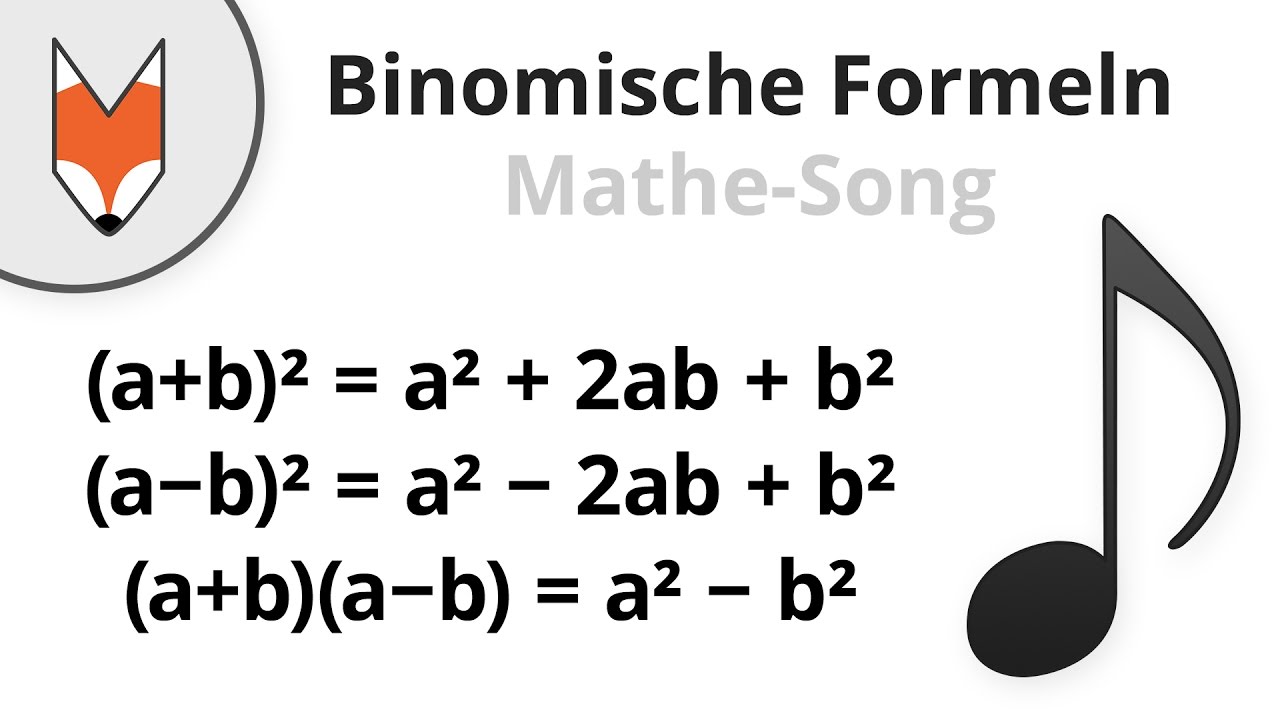
Ein Song zu den Binomischen Formeln, inclusive Herleitung.
Patreon: https://www.patreon.com/DorFuchs
T-Shirts: http://www.DorFuchs.de/t-shirts/
Facebook: http://www.facebook.com/DorFuchs
YouTube: http://www.youtube.com/DorFuchs
Twitter: http://www.twitter.com/DorFuchs
Website: http://www.DorFuchs.de/
weitere Mathe-Songs:
http://www.youtube.com...
Listen to this song and you'll remember it
lunar lagoon
Oh ok I kinda understand now
So I assuming after expanding those brackets. I move the square root over to make (x+8) into (x+8)^2
I mean this
vast obsidian
My point is if
sqrt(a^2+b^2) = a+b then
a^2+b^2 = a^2+2ab+b^2
0= 2ab, which is not true for all pairs a,b
So your 2nd step is wrong
lunar lagoon
So is this correct?
 vast obsidian
,rotate
flat frigateBOT
 lunar lagoon
Aka does x=5 cm?
vast obsidian
I've no idea what you did, but
- x1= -3 as it is (x+3) in the brackets
- These are the two correct solutions
- Yes, it is 5
lunar lagoon
Ok of thanks(so that it’s illegible) I understand what I did wrong I
Thanks for spending the time to help
.close
safe radishBOT
Channel closed
Closed by @lunar lagoon
Use .reopen if this was a mistake.
Available help channel!
Send your question here to claim the channel.
Remember:
• Ask your math question in a clear, concise manner.
• Show your work, and if possible, explain where you are stuck.
• After 15 minutes, feel free to ping <@&286206848099549185>.
• Type the command .close to free the channel when you're done.
• Be polite and have a nice day!
Read #❓how-to-get-help for further information on how to ask a good question, and about conduct in the question channels.
 stable osprey
Can someone help me comprehend 2 things?
What are ordinary differential equations and where did they spawn from?
What are we exactly finding from these?
I am so used to calculus 3 material where we investigate rate of changes and back and forth where the concept of ODE and PDE confuse me a lot
safe radishBOT
stable osprey
Can someone help me comprehend 2 things?
What are ordinary differential equatio...
stable osprey
Also in addition, How did E^(-x^2) + E^C go to
Ce^(-x^2)

Since they have different powers we cant add them together can we?
Im missing some stupid info for context in this subject
(im checking my curriculum which checks Z transforms and bernoulli and the likes, and im so lost from calculus 3, what the hell are these about xD)
stable osprey
Know what you are right, i dont know why that confused me
Probably cause i keep remembering i cant do
X^2 + X
lean otter
understandable
safe radishBOT
@stable osprey Has your question been resolved?
stable osprey
One further question

Here why do we only get c2 as our second constant?
i mean why is it inside that parenthesis, it should be directly outside since we add C2 to the integral total of both xe^x and -e^x and c1
so i guess mentally it makes more sense to write
xe^x - e^x - e^x + c1x + c2
lean otter
well solve the second integral by doing each term
When you do each term and write everything in order you get
$$xe^x-e^x+c_2-\int{e^xdx}+\int{c_1dx}$$
flat frigateBOT
Alham
 lean otter
Then integrate the other 2 and you get what he has
in that exact order
@stable osprey
stable osprey
No thats not my issue
my issue is not how we integrate (i see why we do that and so on)
also wait
isnt C2 also a term produced by the other 2 integrals?
or do we get 3 types of constants then
to my recollection we just get 1 constant per integration
so the constant would end up after all 3 integrations
C2 wouldnt come inside a defined integration per example, but rather after all 3 integrations in an area are calculated for
lean otter
oh i see
Well your doing 3 integrals and get 3 constants which combine into one, which would be called c2 since c1 is stuck with x
Where he has it in the video is arbitrary, you can put the terms anywhere as long as you understand the simplification on that part
stable osprey
Yea that much i understand great
it doesnt matter if its 3 constants, cause its still a constant in the end of the day
different from the constant of a later integration ofcourse
Anywho, can you explain to me what exactly are then differential equations all about?
I get how to solve them (also in the process of studying how to solve them atm)
but i dont get what they are about
To rephrase clearly, after finishing calc 4 and constantly flipping between solving rates and partial derivatives i am kinda used to that
so now just seeing equations with derivatives stuck on to them seems confusing and out of place
its like seeing the Graph equation of a circle without ever knowing its merely just the Pythagorean theorem
Also in addition to that
Whats up with these people just moving around the "dx" and "dy" of the operator, it makes no sense
Dy/Dx is an operator as a whole
stable osprey
Yea i get that, its similar to partial derivatives and derivatives
and how we were taught "treat it as a function even though its not"
"cause at the end of the day you get the same result"
it has gotten at a stage it boggles my mind though now
lean otter
oh i ser
stable osprey
Yea like i get to some degree we do that to simplify the logic of it
but at the same time it makes no sense
its without context
lean otter
wait so your stuck on what a differential IS or why we can move them and work with the terms like that
intuition vs math
stable osprey
no i am asking why its defined as an operator, but people keep treating it as a fraction
Its hard definition is "the derivative of Y in respect to X'
which makes sense
But if you move "in respect to x" what is that even anymore
its just
"The derivate of y (unknown respect anymore)"
lean otter
Oh i see
well the derative of y with respect to x becomes, (after the operation), the derivative of y over the derivative of x.
The whole reason we flip the meaning like that is because in differentials we dont know the expresion for dx, like if i gave you
dy/dx * y^2 = x+x^3
The dy and dx here are just placeholders for the actual equations of each
We keep it in this notation because it makes more sense when we integrate the function later
stable osprey
So
Dy y^2 = x+x^3 dx
means "the derivative of y over the derivative of x"
what does that describe? what does "over the derivative" of something mean?
i get its placeholder we use to integrate later on
but i also find a gap in between these 2 steps
lean otter
over the is just describing the fraction form, because in reality the derivatives are
$$\frac{\frac{d}{dy}}{\frac{d}{dx}}$$
flat frigateBOT
Alham
 stable osprey
hmm
i get it, but i also still dont get why we can just use 'dx' like that without the integration (which denotes the integration respect later on)
its like i get the steps but not the meaning still
$$x^2{dx}$$
Per example this means nothing without the integration
flat frigateBOT
Neroid
 lean otter
'means' as in what? Because that is just derivative of x times x^2, (maybe think of a literal rate of change of x in an applied situation)
stable osprey
But thats not the derivative of it
The derivative is denoted as D/Dx
what does "dx" alone stand for
x^2 "in respect to x" is the only thing i can understand it as
which makes sense word wise but not math wise
lean otter
dx alone is the differential which is a infinitesimal small change in x
stable osprey
oh
So in respect to X when moved to the other side is merely the change of dx in our domain/area
lean otter
ye
stable osprey
still confusing but atleast i get that they are equivalent when multiplied and simplified from both sides
lean otter
it is that in all times actually, my explanation earlier about it being called the derivative with respect and what not was wrong
like dy/dx always symbolizes that tiny change
one is for y one is for x
stable osprey
ooooooooooh, now that makes more sense
due to M being the rate of change as well
And that is dy over dx
so the derivative as a rate of change comes together more nicely
cause the derivative is our rate of change for our slope
okay now that comes better in mind when compared mentally with geometry and calc
lean otter

stable osprey
Okay one last question
i think i got most of what i needed to get out of my mental block
What are the differences between a general and a partial solution for derivative equations?
i dont exactly get the difference or why we get a general solution from combining 2 partial solutions
while some videos online while explaining these call "general solutions" the "partial solutions" without the need for combining any second equation
it again seems like some step or explanation is skipped between those 2
This is in greek per example, but one on the left denotes "Partial solution"
The other denotes "General Solution"
 lean otter
partial meaning one of the possible solutions in this context
With the C you account for every possible function which when derived gives you y'(t)
stable osprey
Is partial solution the same as a particular solution?
cause in our university that hasnt been referenced even once
as a terminology i mean
lean otter
Partial is also used when differentiating 2 or more variable, because something like xyz has 3 changing variables, but it is also true to treat y and z as constants (since they are variables they could also act as constants when 'they' wish) and only derive x. This ofcourse only accounts for very few possibilities
Oh particular is specific to some case
stable osprey
Yea but partial derivatives i can get, cause we assume 1 of the variables as constant
lean otter
Like in that example treating y and z as some known constant would give you a particular solution
stable osprey
Partial solutions to single variable derivatives i cant - doesnt make sense
cause at the end of the day so far up to calc 4 we always get a specific integration solution
its always plus some constant
why do we suddenly do C*e^X
lean otter
so like
When deriving x^x without some natural log business we cannot derive unless we treat one of the x's as constant
stable osprey
ln|X^X| which equals pretty much xln|x| anywho yea
lean otter
if we treat the exponent as a constant and then the base as a constant we surpisingly get 2 halves of the actual derivative, when you combine them you have the actual derivative
each half solution is then called partial
and full is the general sol
stable osprey
Is the partial given usually?
when requested to solve these kind of equations i mean
Im asking cause our textbooks tend to be without a lot of context

so if you notice here i dont get why 1 is explained as
y = C e ^x
and then he goes and divides to get 1
(which makes sense to split y and x variables into both sides of the equation)
lean otter
because the top solution is only one of the ways of solving y'-y=0, i think the textbook is just showcasing methods but im not sure without looking at the rest of the image
Nothing is assumed here
stable osprey
the full page after the first is like this

While the previous says "solution by integration"

I guess this makes more sense if you assume he always has Dy/Dt = e^-t
but he does a poor job conveying that, anywho i guess ill go with that in mind
Thank you a lot for all the explanations Allham
.close
safe radishBOT
Channel closed
Closed by @stable osprey
Use .reopen if this was a mistake.
Available help channel!
Send your question here to claim the channel.
Remember:
• Ask your math question in a clear, concise manner.
• Show your work, and if possible, explain where you are stuck.
• After 15 minutes, feel free to ping <@&286206848099549185>.
• Type the command .close to free the channel when you're done.
• Be polite and have a nice day!
Read #❓how-to-get-help for further information on how to ask a good question, and about conduct in the question channels.
lean otter
how do you cube fractions
safe radishBOT
lean otter
how do you cube fractions
 fallen grotto
Distribute the exponent to the numerator and denominator
lean otter
so 125 / 9
fallen grotto
yea
safe radishBOT
Channel closed
Closed by @elder thicket
Use .reopen if this was a mistake.
Available help channel!
Send your question here to claim the channel.
Remember:
• Ask your math question in a clear, concise manner.
• Show your work, and if possible, explain where you are stuck.
• After 15 minutes, feel free to ping <@&286206848099549185>.
• Type the command .close to free the channel when you're done.
• Be polite and have a nice day!
Read #❓how-to-get-help for further information on how to ask a good question, and about conduct in the question channels.
 cobalt dagger
Hi
safe radishBOT
cobalt dagger
Hi
cobalt dagger


 final halo
 cobalt dagger
I need help for all these except 13
final halo
is this a test
cobalt dagger
No this is hw
cobalt dagger
final halo
is this a test
They just gave us last semesters test as preparation for the upcoming one
<@&286206848099549185>
Geometry
safe radishBOT
@cobalt dagger Has your question been resolved?
safe radishBOT
@cobalt dagger Has your question been resolved?
safe radishBOT
Channel closed
Closed due to timeout
Use .reopen if this was a mistake.
Available help channel!
Send your question here to claim the channel.
Remember:
• Ask your math question in a clear, concise manner.
• Show your work, and if possible, explain where you are stuck.
• After 15 minutes, feel free to ping <@&286206848099549185>.
• Type the command .close to free the channel when you're done.
• Be polite and have a nice day!
Read #❓how-to-get-help for further information on how to ask a good question, and about conduct in the question channels.
 hazy fulcrum
This is the fifth time I'm putting this problem here. Don't ban me please if it comes up as spam.
Basically I did some code utilizing the 4 basic operators and the 4 numbers (at the branches) in the 3rd figure. Randomly mashing them until it hits one of the choices given. What I got was only a.) 60. Using this rule (15*2)(6-4) the computer gave.
But it doesn't seem to align to the other figures. So I think using only, + - / * is out of the picture (Maybe that helps?). That's all I got.
Help.
 safe radishBOT
hazy fulcrum
This is the fifth time I'm putting this problem here. Don't ban me please if it ...
safe radishBOT
hazy fulcrum
This is the fifth time I'm putting this problem here. Don't ban me please if it ...
@hazy fulcrum Has your question been resolved?
safe radishBOT
@hazy fulcrum Has your question been resolved?
 steep dove
there's an interesting way of doing this...
assume that the relationship between the 4 numbers in the corner determines the middle number, and that relationship is linear
flat frigateBOT
 steep dove
then you can chuck this into a matrix as follows
flat frigateBOT
 flat frigateBOT

 Requested by S̨̥̫#8871
steep dove
Requested by S̨̥̫#8871
steep dove
we want this to probably be an integer

 steep dove
so now we know our number must have a remainder of 2 mod 9
steep dove
hazy fulcrum
This is the fifth time I'm putting this problem here. Don't ban me please if it ...
simply check all numbers mod 9 and see which one has remainder 2
these kinds of problems are really stupid imo because there are so many ways to define a relationship
but this problem is super interesting as using this method pins down one and only one solution (as unlikely as that may seem)
 toxic stratus
theres no way the intended solution looks something like 19a + b - 15c - 27d
thats just absurd
lean otter
yea
steep dove
toxic stratus
thats just absurd
the question is absurd
toxic stratus
you are right about that too i guess
safe radishBOT
Channel closed
Closed due to timeout
Use .reopen if this was a mistake.
lean otter
.reopen
safe radishBOT
Available help channel!
Send your question here to claim the channel.
Remember:
• Ask your math question in a clear, concise manner.
• Show your work, and if possible, explain where you are stuck.
• After 15 minutes, feel free to ping <@&286206848099549185>.
• Type the command .close to free the channel when you're done.
• Be polite and have a nice day!
Read #❓how-to-get-help for further information on how to ask a good question, and about conduct in the question channels.
 opaque sorrel
hi, how can i prove that every matrix has a unique reduced row-echelon form?
safe radishBOT
opaque sorrel
hi, how can i prove that every matrix has a unique reduced row-echelon form?
opaque sorrel
@feral linden
 feral linden
The process itself is a constructive proof I think
opaque sorrel
hmm
sorry kinda forgot whats that
i quite rarely use constructive proofs lol
does it begin with "let x be ..."
feral linden
No I mean
The process of how to construct a reduced row-echelon form
Itself
Is a proof
feral linden
Like Euclidean algorithm
feral linden
Np
opaque sorrel
.close
safe radishBOT
Channel closed
Closed by @opaque sorrel
Use .reopen if this was a mistake.
Available help channel!
Send your question here to claim the channel.
Remember:
• Ask your math question in a clear, concise manner.
• Show your work, and if possible, explain where you are stuck.
• After 15 minutes, feel free to ping <@&286206848099549185>.
• Type the command .close to free the channel when you're done.
• Be polite and have a nice day!
Read #❓how-to-get-help for further information on how to ask a good question, and about conduct in the question channels.
 worthy vault
Answer says B=81 but I got 1/72
 safe radishBOT
worthy vault
Answer says B=81 but I got 1/72
worthy vault
safe radishBOT
worthy vault
Answer says B=81 but I got 1/72
worthy vault
How is it 81?
 idle parrot
,w partial fraction (x^2+1)/((x-9)(x-8)^2)
flat frigateBOT

 Requested by Deep.#0001
idle parrot
Requested by Deep.#0001
idle parrot
Might have to check again
worthy vault
idle parrot
Might have to check again
did i write the equation for B correctly?
idk why i cnat get 81 😭
-81
idle parrot
The equation you’ve written is not correct
It should be
$1= A(-8)^2 + B(-9)(-8) + C(-9)$
flat frigateBOT
Deep.
 idle parrot
Get it?
worthy vault
no where'd the x's go?
idle parrot
We’ve put x=0
idle parrot
flat frigate
**Deep.**
And we know here A and C so we just substitute here
idle parrot
,w 1= 82*64 + B(-9)(-8) + (-65)(-9)
flat frigateBOT
 Requested by Deep.#0001
 worthy vault
.close
safe radishBOT
Channel closed
Closed by @worthy vault
Use .reopen if this was a mistake.
safe radishBOT
Available help channel!
Send your question here to claim the channel.
Remember:
• Ask your math question in a clear, concise manner.
• Show your work, and if possible, explain where you are stuck.
• After 15 minutes, feel free to ping <@&286206848099549185>.
• Type the command .close to free the channel when you're done.
• Be polite and have a nice day!
Read #❓how-to-get-help for further information on how to ask a good question, and about conduct in the question channels.
 vestal rampart
help
safe radishBOT
vestal rampart
help
 crude heath
Ok
vestal rampart
wait!
 bright wharf
lol
safe radishBOT
@vestal rampart Has your question been resolved?
safe radishBOT
Channel closed
Closed due to timeout
Use .reopen if this was a mistake.
Available help channel!
Send your question here to claim the channel.
Remember:
• Ask your math question in a clear, concise manner.
• Show your work, and if possible, explain where you are stuck.
• After 15 minutes, feel free to ping <@&286206848099549185>.
• Type the command .close to free the channel when you're done.
• Be polite and have a nice day!
Read #❓how-to-get-help for further information on how to ask a good question, and about conduct in the question channels.
lean otter
I'm having some difficulty finding the distinction between n^2 and 2^n in the context of big o complexity.
One example of 2^n that I see a lot is brute forcing a password, but isn't that just going to be n amount of for loops corresponding to how many numbers in the password?
safe radishBOT
lean otter
I'm having some difficulty finding the distinction between n^2 and 2^n in the co...
 fiery merlin
lean otter
I'm having some difficulty finding the distinction between n^2 and 2^n in the co...
fiery merlin
lean otter
I'm having some difficulty finding the distinction between n^2 and 2^n in the co...
No, you can't tell whether you have the right password until you have the whole thing.
You can't do separate loops for each character.
The closest is nested loops.
Let's say the password is in digits.
If it's a one character password, you have 10 choices.
lean otter
fiery merlin
No, you can't tell whether you have the right password until you have the whole ...
digits = [1, 2, 3, 4, 5, 6, 7, 8, 9, 0]

for i in range(len(digits)):
    for j in range(len(digits)):
print("combination: ", digits[i], digits[j])```wouldn't what i posted work for a password of length 2
like 17
fiery merlin
Yes, that'll do two digit passwords.
No, it's 100.
10².
With three digits, what would it be?
lean otter
10^3
fiery merlin
Right, so the thing that changes based on length is the exponent.
lean otter
Right so all we do is add a new for loop for every new position in the combination
But that isn't 2^n
I'm not seeing how brute forcing is 2^n rather than just the nested for loop n^x thing weJust did
fiery merlin
It's 10ⁿ, which is (2ᵖ)ⁿ where p is the power of 2 that becomes 10.
Need to think for a moment.
fiery merlin
No, the size here is the length of the password.
So, if it's a 5 digit password, n = 5.
lean otter
Are you sure?
A linear search where we just take in a list of 10 things and loop over it is N = 10.
If we loop over it twice, not nested but consecutive, that's 2N.
If we nest loop, its N*N
this makes me think N refers to the size of the list
rather than the amount of combinations we lookFor
fiery merlin
You can't get a password letter by letter.
It's not like it'll tell you when you have one of the letters correct.
It only tells you when you have the entire password.
So, you have to try all passwords, which is 10ⁿ.
lean otter
which is why two consecutive loops (2N) would not work.
But a a nested loop would work for that
fiery merlin
Yes, and that's O(10ⁿ) work.
There are two different ns there.
N is the number of possibilities for each character.
n is the length of the password.
lean otter
oh i didn't realize big on notation has different Ns
fiery merlin
No, you have different ns.
You brought up N.
Big O doesn't care about which letters you use.
lean otter
to me N = the input list you're iterating over, regardless of how many times you need to iterate over it
fiery merlin
What problem are you solving?
lean otter
Just trying to build an intuition for how n^somenumber is different than 2^n
In a algorithms' class and studying
fiery merlin
Well, O(n²) isn't a function. It's a set of functions.
Any function that, when n² is multiplied by a constant, with a high enough n is at least as large as the absolute value of the function.
So, like 3n² + n is in O(n²).
Because you can multiply n² by 4 and it will eventually stay larger than |3n² + n|.
Similarly, n is in O(n²), because when you multiply n² by 1, it eventually gets and stays larger than |n|.
Does that make sense?
lean otter
my bad
fiery merlin
Big O is intended to not care about constant factors (constants you multiply the function by).
This is because the algorithm might take 100 steps to do one inner loop iteration.
We don't care that it's worse than one that takes 50 steps.
Because if you have 100n vs 50n², the n² one is going to be worse after a while.
The idea is to get the general idea of how fast the function grows.
lean otter
gotcha
fiery merlin
You also won't necessarily know how many processor cycles an iteration can take, so you can ignore that.
As long as it has a maximum number of cycles per iteration.
That has the downside that sometimes those constant factors matter and make an O(n²) algorithm better than O(n) for small inputs.
Because maybe the constant on the n² is really small and on n is really big.
But we're just focusing on the way it increases, basically.
O(2ⁿ) includes all the functions in O(n²) and more.
That's because you can multiply 2ⁿ by 1 and it'll eventually become and stay larger than |10000000n²| or whatever function in O(n²) you try it with.
Does that make sense?
safe radishBOT
@lean otter Has your question been resolved?
safe radishBOT
Channel closed
Closed due to timeout
Use .reopen if this was a mistake.
safe radishBOT
Available help channel!
Send your question here to claim the channel.
Remember:
• Ask your math question in a clear, concise manner.
• Show your work, and if possible, explain where you are stuck.
• After 15 minutes, feel free to ping <@&286206848099549185>.
• Type the command .close to free the channel when you're done.
• Be polite and have a nice day!
Read #❓how-to-get-help for further information on how to ask a good question, and about conduct in the question channels.
 hollow gazelle
 safe radishBOT
hollow gazelle
hollow gazelle
safe radishBOT
hollow gazelle
hollow gazelle

I'm following up to the second step-I'm not quite sure what the S^2 symbol represents?
Can some please kindly explain 🙂
safe radishBOT
@hollow gazelle Has your question been resolved?
safe radishBOT
Channel closed
Closed due to timeout
Use .reopen if this was a mistake.
Available help channel!
Send your question here to claim the channel.
Remember:
• Ask your math question in a clear, concise manner.
• Show your work, and if possible, explain where you are stuck.
• After 15 minutes, feel free to ping <@&286206848099549185>.
• Type the command .close to free the channel when you're done.
• Be polite and have a nice day!
Read #❓how-to-get-help for further information on how to ask a good question, and about conduct in the question channels.
lean otter
i still don't understand why it's being marked wrong.


 lean otter
what i'm doing is making the S and Additions into scientific notations and dividing them, aka what it's telling me to do but it marks me as wrong
 sharp crane
 safe radishBOT
Channel closed
Closed by @elfin gorge
Use .reopen if this was a mistake.
Available help channel!
Send your question here to claim the channel.
Remember:
• Ask your math question in a clear, concise manner.
• Show your work, and if possible, explain where you are stuck.
• After 15 minutes, feel free to ping <@&286206848099549185>.
• Type the command .close to free the channel when you're done.
• Be polite and have a nice day!
Read #❓how-to-get-help for further information on how to ask a good question, and about conduct in the question channels.
 pallid lantern
 safe radishBOT
Channel closed
Closed due to timeout
Use .reopen if this was a mistake.
Available help channel!
Send your question here to claim the channel.
Remember:
• Ask your math question in a clear, concise manner.
• Show your work, and if possible, explain where you are stuck.
• After 15 minutes, feel free to ping <@&286206848099549185>.
• Type the command .close to free the channel when you're done.
• Be polite and have a nice day!
Read #❓how-to-get-help for further information on how to ask a good question, and about conduct in the question channels.
 normal hedge
hey guys how would i try to integrate e^2x / (1 + e^x ) dx?
normal hedge
i was wonderiing hahaha
lean otter
or take sub u=e^x
 dire crypt
then ibp?
lean otter
dire crypt
then ibp?
no