#help-19
1 messages · Page 221 of 1
 modest nacelle
Tips, manipulate the fraction so that the numerator no longer contains x
 main cape
modest nacelle
Tips, manipulate the fraction so that the numerator no longer contains x
main cape
modest nacelle
Tips, manipulate the fraction so that the numerator no longer contains x
x?
 manic sleet
you have to prove it via epsilon-delta?
main cape
manic sleet
you have to prove it via epsilon-delta?
Yep
But it doesnt click
The method
Its unorthodox to what ive learnt in highschool
manic sleet
so you must show that (\forall\epsilon>0,\exists N\in\mathbb{N}:n>N):
[\left|\frac{2n-3}{n+2}-2\right|<\epsilon]
apparently I suck at LaTeX 
 clever fjordBOT
PajamaMamaLlama
 main cape
 main cape
manic sleet
apparently I suck at LaTeX <:whyyy:1277609025873117275>
main cape
manic sleet
apparently I suck at LaTeX <:whyyy:1277609025873117275>
Whats that 😂
manic sleet
main cape
Whats that 😂
"coding" language for math
main cape
 sand horizon
So n is ?
sand horizon
So n is ?
So i have to get n alone?
sand horizon
Yup
That'll be the rank for a given epsilon
Beware that n is a natural number and not a real number
 sand horizon
You just shown that for any epsilon > 0 there exist n in N such that |u_n - 2| < epsilon which is the definition of u_n tends to 2
 cinder plover
anubhav bro kat jaoge mit jaoge
 stark flame
clever fjord
PajamaMamaLlama
stark flame
clever fjord
PajamaMamaLlama
bumboclat
main cape
sand horizon
You just shown that for any epsilon > 0 there exist n in N such that |u_n - 2| <...
Its done?
sand horizon
Pretty much yeah
sand horizon
Not meant to be hard
 odd edgeBOT
@main cape Has your question been resolved?
If you are done with this channel, please mark your problem as solved by typing .close
Channel closed
Closed due to timeout
Use .reopen if this was a mistake.
odd edgeBOT
 Available help channel!
Send your question here to claim the channel.
Remember:
• Ask your math question in a clear, concise manner.
• Show your work, and if possible, explain where you are stuck.
• After 15 minutes, feel free to ping <@&286206848099549185>.
• Type the command .close to free the channel when you're done.
• Be polite and have a nice day!
Read #❓how-to-get-help for further information on how to ask a good question, and about conduct in the question channels.
 vocal willow
can anyone help me with this?
 odd edgeBOT
vocal willow
can anyone help me with this?
odd edgeBOT
vocal willow
can anyone help me with this?
 wooden python
do you know
properties and laws of log
vocal willow
not that much
 silk stream
Its basic
vocal willow
wait
i think i get it
what exponent do i give to the base? to match the number of the yk
vocal willow
yep
vocal willow
0?
 gusty fiber
sorry mistype
yeah that’s the answer
what do you raise to 5 in order for it to become (5)^2
vocal willow
2
gusty fiber
correct
vocal willow
and number 3 is 0?
vocal willow
exponent of 1
gusty fiber
yes
so every time you see a logarithm
phrase this question in your head
“what do I raise to (small number in the bottom) in order for it to become (big number on the right most)?”
vocal willow
thank broo
gusty fiber
yeah do you get it?
vocal willow
also i just wanna ask a clarifying questuob
vocal willow
gusty fiber
yeah do you get it?
yes
gusty fiber
whats your question
vocal willow
vocal willow
also i just wanna ask a clarifying questuob
not related to this

if its addition its just putting them next to each other
and if - is always using the deision
vocal willow
idk i think its a typo or something
thanks for the help dude
im okay now
.close
odd edgeBOT
Channel closed
Closed by @vocal willow
Use .reopen if this was a mistake.
odd edgeBOT
Available help channel!
Send your question here to claim the channel.
Remember:
• Ask your math question in a clear, concise manner.
• Show your work, and if possible, explain where you are stuck.
• After 15 minutes, feel free to ping <@&286206848099549185>.
• Type the command .close to free the channel when you're done.
• Be polite and have a nice day!
Read #❓how-to-get-help for further information on how to ask a good question, and about conduct in the question channels.
 exotic oracle
how can we prove this using the defintion
 sand horizon
C'est quoi la définition de la limite que tu as ?
exotic oracle
pour tou epsilon posi. il existe alpha posi. tel que 0<|x-a|<alpha implique |fx-l|< epsilon
sand horizon
Tu connais la notion de voisinage ?
exotic oracle
non
mmm je connais "au voisinage" de quelque chose cad de l'approcher
comment on peut dire well en frc?
sand horizon
Un voisinage d'un point c'est un intervalle autour de ce point oui
sand horizon
exotic oracle
comment on peut dire well en frc?
Bien ?
exotic oracle
ah oui
exotic oracle
sand horizon
Un voisinage d'un point c'est un intervalle autour de ce point oui
donc je la connais
masi ca sert a quoi?
sand horizon
A rendre les choses un peu plus simple mais comme il demande la définition de la limite on va faire avec la definition
exotic oracle
je ne vois pas ou on faut commencais
sand horizon
L'écrire pour (f ○ g)(x) -> l
sand horizon
f est continue ?
sand horizon
Ok
exotic oracle
c'est trop dur 😭
sand horizon
exotic oracle
les trois quon a
Oui ducoup
sand horizon
exotic oracle
c'est trop dur 😭
Non, faut juste pas se perdre dans toutes les écritures mais sinon c'est comme des lego les définitions vont s'embriquer les unes dans les autres
exotic oracle
je pense que j'aura labandonner
exotic oracle
sand horizon
Non, faut juste pas se perdre dans toutes les écritures mais sinon c'est comme d...
oui moi suassi je la trouver facile on thoery mais je suis perdu dans tous les ecritures comme vous avez dire
odd edgeBOT
@exotic oracle Has your question been resolved?
 gleaming turtle
exotic oracle
how can we prove this using the defintion
gleaming turtle
exotic oracle
how can we prove this using the defintion
This is false as written (assuming I understood what it's asking). You need an extra condition to make it work. For example, if f(x) = 0 for all x, and g(x) = 7 when x=0 and g(x)=13 when x=/=0, then lim_(x -> 0) f(x) = 0 and lim_(y -> 0) g(y) = 13, but lim_(x -> 0) g(f(x)) = lim_(x->0) g(0) = 7.
(One such condition would be that f(x) =/= b in some neighborhood of a.)
gleaming turtle
It's usually true
But not always
Because of how limits don't say anything about the value of the function at the actual point
gleaming turtle
No, but I can try to understand anyways
 gleaming turtle
Yeah so the fluff isn't enough to solve the issue
exotic oracle
how so
gleaming turtle
gleaming turtle
This is false as written (assuming I understood what it's asking). You need an e...
Did you see this example I gave^
exotic oracle
yeah
gleaming turtle
It'll come up in the proof when you need to show that 0 < |f(x) - b| < delta but you'll only know that |f(x) - b| < delta
exotic oracle
gleaming turtle
It'll come up in the proof when you need to show that 0 < |f(x) - b| < delta but...
no? we have to prove that if 0<|x-a|<alpha then f(x)-b|< epsilon
or am i missing something
gleaming turtle
You'll see when you write the proof
exotic oracle
gleaming turtle
You'll see when you write the proof
ive been trying for hours man
i swear
gleaming turtle
You already wrote the definition of a limit, so this is what it says for f and g (choosing different letters for each to hopefully make things less confusing when we combine them):
- For every epsilon' > 0, there exists alpha > 0 such that 0 < |x-a| < alpha implies |f(x)-b| < epsilon'
- For every epsilon > 0, there exists beta > 0 such that 0 < |y-b| < beta implies |g(y)-l| < epsilon
Does that make sense?
exotic oracle
i dont think we need different epsilons?
exotic oracle
gleaming turtle
Does that make sense?
yeah i got there
gleaming turtle
exotic oracle
i dont think we need different epsilons?
It doesn't need to be different, but you're allowed to choose a different letter and it can help if we want to set one of them to a specific value
exotic oracle
wait
epsilon is a value that very close to zero right?
do i remeber that correctly?
gleaming turtle
Epsilon isn't a specific number, but the idea is that if it's true for every epsilon > 0 then it's true for epsilon as small as you want.
exotic oracle
ok i understand
gleaming turtle
What we want to prove is that
- For every epsilon > 0, there exists alpha > 0 such that 0 < |x-a| < alpha implies |g(f(x))-l| < epsilon
exotic oracle
yeah
gleaming turtle
So when we need to prove a "for all"/"for every" we use "let". So the first line of the proof is going to be "Let epsilon > 0."
We need to eventually get to |g(f(x)) - l| < epsilon, yeah?
gleaming turtle
gleaming turtle
You already wrote the definition of a limit, so this is what it says for f and g...
So it makes sense to use the second bullet point here, since it says the same thing if you pick y=f(x)
exotic oracle
and we have |f(x)-b|< epslon
gleaming turtle
Well what we know is
For every epsilon' > 0, there exists alpha > 0 such that 0 < |x-a| < alpha implies |f(x)-b| < epsilon'
We can choose epsilon' to be whatever we want, it doesn't have to be epsilon
(this is why I chose to use a different name here)
What should we choose epsilon' to be, do you think?
exotic oracle
beta?
gleaming turtle
yep!
exotic oracle
but thats way too obvious no?
gleaming turtle
it is the obvious choice, yes, but that's what the other person meant by saying it's like lego
gleaming turtle
The difficulty in this proof is getting used to working with these sorts of definitions and proofs, not the content itself
quantifiers, especially
exotic oracle
thanks @gleaming turtle and @sand horizon
gleaming turtle
And one last thing
exotic oracle
gleaming turtle
The difficulty in this proof is getting used to working with these sorts of defi...
yeah ill practice more
exotic oracle
gleaming turtle
You'll get |f(x) - b| < beta
yeah
gleaming turtle
But you need 0 < |f(x) - b| < beta
exotic oracle
i get it now
exotic oracle
gleaming turtle
But you need 0 < |f(x) - b| < beta
cant we work around that?
gleaming turtle
You'll need an extra condition like f(x) =/= b for all x in I or that g is continuous. Otherwise the f and g I gave you earlier are a counterexample
exotic oracle
question; why would it being continous change anything?
gleaming turtle
If g is continuous then l=g(b) so you'll get |g(f(x)) - l| = 0 when f(x)=b
So you can deal with that case separately
odd edgeBOT
@exotic oracle Has your question been resolved?
Channel closed
Closed by @exotic oracle
Use .reopen if this was a mistake.
odd edgeBOT
Available help channel!
Send your question here to claim the channel.
Remember:
• Ask your math question in a clear, concise manner.
• Show your work, and if possible, explain where you are stuck.
• After 15 minutes, feel free to ping <@&286206848099549185>.
• Type the command .close to free the channel when you're done.
• Be polite and have a nice day!
Read #❓how-to-get-help for further information on how to ask a good question, and about conduct in the question channels.
 stiff finch
I need help with this two-part answer. I tried to put this answer I got in different ways, and it keeps saying it is wrong
 odd edgeBOT
stiff finch
I need help with this two-part answer. I tried to put this answer I got in diffe...
odd edgeBOT
stiff finch
I need help with this two-part answer. I tried to put this answer I got in diffe...
 stoic cloud
you gotta wait a tincy bit longer before ping helpers my friend 🙃 (4 min)
stoic cloud
Nah it’s good.
 outer hinge
stiff finch
I need help with this two-part answer. I tried to put this answer I got in diffe...
outer hinge
stiff finch
I need help with this two-part answer. I tried to put this answer I got in diffe...
im having a massive shit rn
anyways bottom area is (M-4x)(M-2x)
outer hinge
ts an open box so you just take the volume and minus the roof
stiff finch
So how do i find my part b, im so confused
Because for c i know the graph is the first one is correct
 vapid bolt
i think the diagram is a bit confusing the box dimensions should be:
h: x w: 32-4x l: 32-2x
outer hinge
stiff finch
So how do i find my part b, im so confused
ok so if you got V(x) you reduce it to like
a quadratic or something
and find its minmax
vapid bolt
cuz of the locking tabs
 sly yoke
stiff finch
How about above
sly yoke
stiff finch
How about above
Use his formula for the bottom area and you'll see where it goes to zero
stiff finch
sly yoke
Use his formula for the bottom area and you'll see where it goes to zero
Okay there's another part for this i'm about to take the picture

for the X
outer hinge
find x in v(x) = max
sly yoke
Ok, do you know derivatives? Or are you supposed to lol?
stiff finch
I don't know tbh I take online course of math in college and this what i'm assigned
The second picture and the first picture are the same picture just broken apart
Wait
Is x=4?
i had 5.3 before
stiff finch
stiff finch
I need help with this two-part answer. I tried to put this answer I got in diffe...
This part right here i can't seem to get the right answer
is B [0,16] instead of (0,16) or am i wrong?
sly yoke
ok, you could derivate the function obtained by multiplying the terms of V(x). Since you don't know derivatives I think you can just look at the graph
sorry for the delay btw
try to see for what X the curve has the largest result
stiff finch
can you reply to what image your telling me about so i don't get lost
sly yoke
stiff finch
is B [0,16] instead of (0,16) or am i wrong?
For b consider the formula for the volume (32-4x)(32-2x)x. The upper limit is not 16, because there is a lower x that anything higher than it would output a negative volume
stiff finch
Oh okay that’s interesting
sly yoke
btw I'm trying to not give straight up answers cause I figured you might prefer that
stiff finch
I’m deadass so confused and lost im trying to get it done before it closes at 11;59, like your giving me the step by step process but this is imo really hard to understand
sly yoke
stiff finch
can you reply to what image your telling me about so i don't get lost
I think all of the graphs have the peak at about the same x. What course is this for?
stiff finch
sly yoke
I think all of the graphs have the peak at about the same x. What course is this...
MATH 175 pre-calculus
stiff finch
sly yoke
I think all of the graphs have the peak at about the same x. What course is this...
The correct graph is the top left one
I got that part correct
I just needed the A) and B) part because I’m confused and keep getting it incorrect
sly yoke
stiff finch
I’m deadass so confused and lost im trying to get it done before it closes at 11...
Ok, I'm sorry for this. In that new formula, because of the (32-4x), anything for x higher than 8 will output a negative volume, which is wrong. So the limit is (0,8), they don't include 0 and 8 because with those numbers the volume would be zero
sly yoke
stiff finch
MATH 175 pre-calculus
gotcha
stiff finch
sly yoke
gotcha
I’m a chemistry major sorry if I sound dumb for my major, math is really hard for me
stiff finch
sly yoke
Ok, I'm sorry for this. In that new formula, because of the (32-4x), anything fo...
Okay see now that makes sense
sly yoke
stiff finch
I just needed the A) and B) part because I’m confused and keep getting it incorr...
Did you get the new formula for the volume? It was (32 - 2x)(32 - 4x)x
stiff finch
sly yoke
Did you get the new formula for the volume? It was (32 - 2x)(32 - 4x)x
Yeah I got that correct eneded up figuring that out
I didn’t figure the (0,8) on my own though
sly yoke
stiff finch
I’m a chemistry major sorry if I sound dumb for my major, math is really hard fo...
No problem at all. I'm here to help! Sorry if I sound unfriendly, english is not my main language and I'm trying to be effective in my communication here
sly yoke
stiff finch
Yeah I got that correct eneded up figuring that out
great!
stiff finch
sly yoke
No problem at all. I'm here to help! Sorry if I sound unfriendly, english is not...
No you sound perfectly fine I don’t get offended easily, unless you were to just say “you’re dumb.” Your being nice and calm and understand I really do appreciate it
stiff finch
sly yoke
great!
Thank you so much @sly yoke and @outer hinge
sly yoke
You're welcome! Did you get everything you needed?
odd edgeBOT
Channel closed
Closed by @stiff finch
Use .reopen if this was a mistake.
odd edgeBOT
Available help channel!
Send your question here to claim the channel.
Remember:
• Ask your math question in a clear, concise manner.
• Show your work, and if possible, explain where you are stuck.
• After 15 minutes, feel free to ping <@&286206848099549185>.
• Type the command .close to free the channel when you're done.
• Be polite and have a nice day!
Read #❓how-to-get-help for further information on how to ask a good question, and about conduct in the question channels.
 sinful cave
hm dumb question but did I mess up here?
 sinful cave
I got y right
so I tried clearing for x, and Im stuck at the blue part
I know that the answer is the red solution
how can I get there from that fraction?
honestly I mustve messed up somewhere, just cant tell where
odd edgeBOT
@sinful cave Has your question been resolved?
sinful cave
just noticed I messed up the sign
specifically, I multiplied y by r, and forgot the sign when moving it to the other side
.close
odd edgeBOT
Channel closed
Closed by @sinful cave
Use .reopen if this was a mistake.
odd edgeBOT
Available help channel!
Send your question here to claim the channel.
Remember:
• Ask your math question in a clear, concise manner.
• Show your work, and if possible, explain where you are stuck.
• After 15 minutes, feel free to ping <@&286206848099549185>.
• Type the command .close to free the channel when you're done.
• Be polite and have a nice day!
Read #❓how-to-get-help for further information on how to ask a good question, and about conduct in the question channels.
 remote cloud
Why does this require the map to be invertable? is surjectivity not enough?
 odd edgeBOT
remote cloud
Why does this require the map to be invertable? is surjectivity not enough?
odd edgeBOT
remote cloud
Why does this require the map to be invertable? is surjectivity not enough?
 forest sky
the point is that by proving injectivity we can then prove surjectivity (because both are equivalent to invertibility when dimensions are the same)
odd edgeBOT
@remote cloud Has your question been resolved?
Channel closed
Closed by @remote cloud
Use .reopen if this was a mistake.
odd edgeBOT
✅
remote cloud
@forest sky I get that but i dont understand how having the map be invertable proves this
forest sky
because if you have a linear map T from V to W with dim(V) = dim(W) then T injective iff T invertible iff T surjective
so we prove injectivity and that implies surjectivity
remote cloud
No, like
I dont understand how the exsistance of such a polynomial is proven with the map being invertable
forest sky
"for all q, there exists a polynomial p such that Tp = q" is just stating the defn of surjectivity for that map
remote cloud
Ok, so if we only proved surjectivity would this work?
why does it also need to be injective?
are we using injevtivity to prove surjetivity
to show that a solution exsists
forest sky
remote cloud
are we using injevtivity to prove surjetivity
yes, that is what we are doing
remote cloud
ok so the main condition we need is surjectivity, not invertability
but because they have the same dimention, we can use injectivity to imply surjectivity which is what we need
forest sky
it's reasoning in the form
"T is injective, T is surjective iff it is injective, therefore T is surjective"
remote cloud
the fact that its invertable isnt really needed it for this
ok, this came right after the definition about invertablility so i was curious
So, suppose we proved that its surjective
would that be enough?
forest sky
yes so there's a bunch of thing equivalent to a linear map being invertible (including injective and surjective). this is an example of where one of those equivalencies can be usedul
forest sky
remote cloud
So, suppose we proved that its surjective
sure, but that's what we're doing here. just in a more roundabout way because injectivity is easier
remote cloud
ah ok that makes snese
sence
sasjlf
so what is important is, if u cant prove surjectivity right away
and the dimentions of the domain and co domain line up
you can prove injectivity?
forest sky
yes, and more generally if you want to prove one of the statements equivalent to invertibility but another one is easier to prove, just prove whichever is easiest and then the thing you want to prove follows
here is a list of two dozen such equivalencies, which you build up over the course of a linear algebra class:
https://mathworld.wolfram.com/InvertibleMatrixTheorem.html
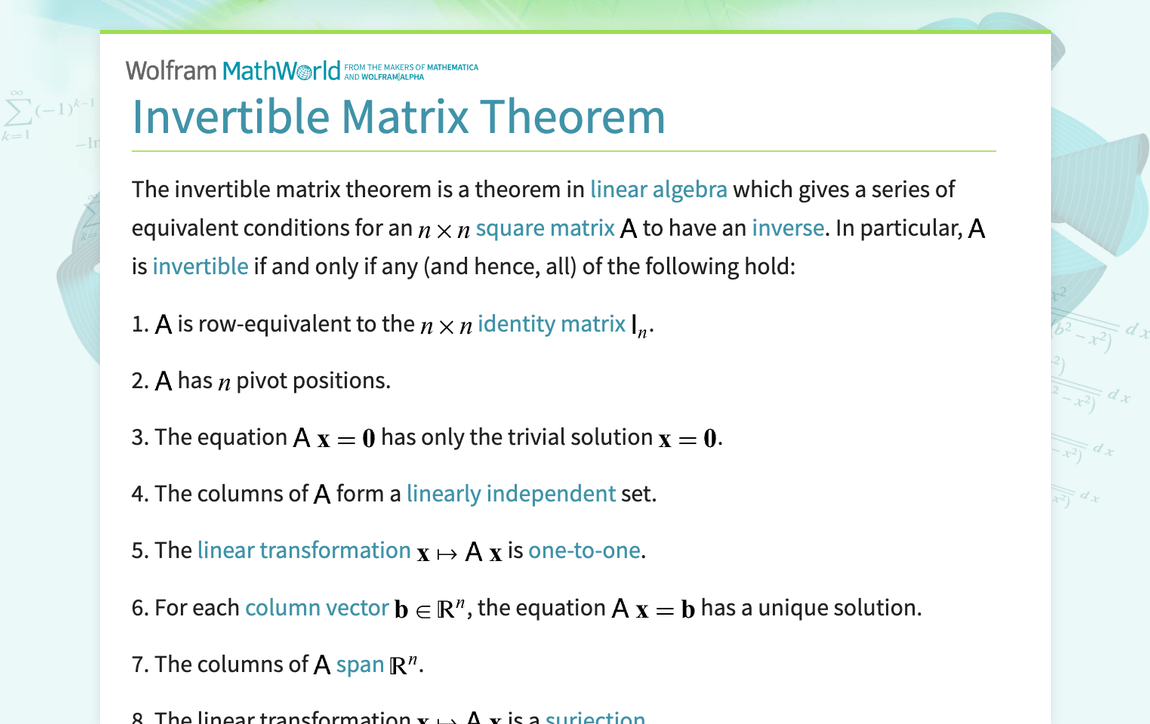
The invertible matrix theorem is a theorem in linear algebra which gives a series of equivalent conditions for an n×n square matrix A to have an inverse. In particular, A is invertible if and only if any (and hence, all) of the following hold: 1. A is row-equivalent to the n×n identity matrix I_n. 2. A has n pivot positions. 3. The equation...
remote cloud
Ok cool, so for same dimention its jsut a chain
Like
Is invertable $\iff$ is injective $\iff$ is surjective
clever fjordBOT
BOSS
 remote cloud
and then we use either one to prove the other two in cases its needed.
forest sky
yes
alternatively if you prove any of them is false then all the others are also false
remote cloud
so invertable maps are only between two codomains of the same size
forest sky
a map can only possibly be invertible if the domain and codomain have the same dimension, yes
remote cloud
Also, is an isomorphism just an invertable function which is a bijective function
like are they not all the same definition?
forest sky
an isomorphism is a bit more specific because it also has to "preserve the structure" of the spaces in question
in linear algebra "preserves the structure" means being linear. so an isomorphism is a bijective linear map
remote cloud
Also, is an isomorphism just an invertable linear map which is a bijective linear map ***
Ok yeah, and the last two are also the same
why do we sometiomes say isomophism and other times say invertable linear map
its just he same thing right/
 lofty spade
they mean the same thing in the context of vector spacs
forest sky
in linear algebra there are a bunch of terms which are basically equivalent
so pick your favorite
lofty spade
remote cloud
its just he same thing right/
sometimes you want to emphasize different things
like that the two vector spaces are isomorphic
remote cloud
forest sky
in linear algebra there are a bunch of terms which are basically equivalent
w ok
remote cloud
lofty spade
like that the two vector spaces are isomorphic
Ok, i just wanted to make sure im not going crazy in thinking all these definitions mean the same thing
lofty spade
there are other kinds of isomorphisms, like group isomorphisms and ring isomorphisms, but they don’t come up in linear algebra
remote cloud
in group theory i remember there was more to an isomphism
yeah
I did those before this class and i dont remember those things being the exact same
alr tyty
.close
odd edgeBOT
Channel closed
Closed by @remote cloud
Use .reopen if this was a mistake.
odd edgeBOT
✅
forest sky
well there is only one vector space of each dimension up to isomorphism
which might leave out a bunch of information that isn't part of the vector space structure
remote cloud
 forest sky
but as far as the vector space structure goes (taking linear combinations etc) they are the same
forest sky
this is actually very useful because it means every problem about finite dimensional vector spaces and linear transformations can be reduced to a problem about F^n and matrices
remote cloud
Wild okm
thats really cool
so again like cyclic groups or the mod groups in group theory
lofty spade
forest sky
this is actually very useful because it means every problem about finite dimensi...
(because you can always choose a basis)
but some vector spaces don’t have a “natural” basis
forest sky
lofty spade
(because you can always choose a basis)
yeah it's all completely basis dependent
remote cloud
$F^2$
clever fjordBOT
BOSS
 remote cloud
so that means like
lofty spade
like the subspace ${(x, y, z) \in F^3: x+y+z=0}$
clever fjordBOT
soup_norm
 remote cloud
$\mathcal{P}_n(F) \cong F^{(n+1)}$
clever fjordBOT
BOSS
 forest sky
indeed
remote cloud
ok cool its starting to make mroe sense
they are not exactly the same tho
they just have the same structure
forest sky
they have the same structure as vector spaces
remote cloud
so i would have to define a map
and then i can do all my work in F^n
but at the end i would have to bring it back to the origninal vector space
lofty spade
remote cloud
and then i can do all my work in F^n
yes, that’s what you can do if you only care about the vector space structure
lofty spade
remote cloud
but at the end i would have to bring it back to the origninal vector space
yes
forest sky
well the canonical map will be the map where you map each basis vector to the corresponding basis vector of the other space
this of course requires you to pick bases of each space in the first place
remote cloud
ok wait going back to a previous lemma
There is one that states there is always a map from the basis of some vector to the same number of elements in another vector
Can i choose these vectors?
lofty spade
forest sky
well the canonical map will be the map where you map each basis vector to the co...
(this is only canonical once you’ve got a basis)
remote cloud
or is it just given by the lemma
lofty spade
remote cloud
There is one that states there is always a map from the basis of some vector to ...
same number of elements? what do you mean?
remote cloud
let me find it
forest sky
remote cloud
Can i choose these vectors?
you can choose them, yes
 forest sky
you can choose to map the basis vectors of the domain to any vectors in the codomain. once you do that then the output for every other vector in the domain is fixed though
lofty spade
remote cloud
Can i choose these vectors?
which vectors do you want to choose?
lofty spade
remote cloud
then its surjective
remember it can’t be surjective if V has a strictly smaller dimension than W
remote cloud
then its an isomorphism right?
forest sky
remote cloud
so if we choose the basis
if we choose the list of w's to be a basis then we get an isomorphism, yes
remote cloud
remote cloud
if they are the same dim
^
ok cool
i was just going to use that to prove the theorem lol
Like if we have two maps, of the same dim, i can just map them togetehr
and thats an isomorphism
remote cloud
remote cloud
for this
 coarse shale
hello
forest sky
yes so that proves the backward direction
odd edgeBOT
@remote cloud Has your question been resolved?
odd edgeBOT
Channel closed
Closed due to timeout
Use .reopen if this was a mistake.
odd edgeBOT
Available help channel!
Send your question here to claim the channel.
Remember:
• Ask your math question in a clear, concise manner.
• Show your work, and if possible, explain where you are stuck.
• After 15 minutes, feel free to ping <@&286206848099549185>.
• Type the command .close to free the channel when you're done.
• Be polite and have a nice day!
Read #❓how-to-get-help for further information on how to ask a good question, and about conduct in the question channels.
 torn tulip
 odd edgeBOT
torn tulip
odd edgeBOT
torn tulip
 wicked olive
torn tulip
wicked olive
torn tulip
I think you could apply distance constant approach
torn tulip
 wet ridge
can you assume the new speed?
wet ridge
can you assume the new speed?
yeah
wet ridge
try useing 3/4(V)(t+35/60) = vt ?
torn tulip
d-50/3S/4
torn tulip
wicked olive
I think you could apply distance constant approach
yeah but i am not getting the answer
torn tulip
i did
torn tulip
$$
\frac{D-50}{3S/4} = t + 35
$$
and
$$
\frac{D-74}{3\frac{S}{4}} = t +
15
are these correct?
clever fjordBOT
Rabbit
Compile Error! Click the  reaction for more information.
(You may edit your message to recompile.)
 wet ridge
hmm yes
wet ridge
I guess its a calculation error
torn tulip
i changed 35 into hour too
wet ridge
is ti 24?
so what you want to do is take the difference in time b/w the two cases which is 1/3rd hour
(\mathbf{V}): Normal speed (\Delta t=(35-15)\text{\ min}=20\text{\ min}=\frac{1}{3}\text{\ h})
$$
\frac{24}{\frac{3}{4}\mathbf{V}}-\frac{24}{\mathbf{V}}=\frac{1}{3}
$$
$$
\frac{32}{\mathbf{V}}-\frac{24}{\mathbf{V}}=\frac{1}{3}
$$
$$
\frac{8}{\mathbf{V}}=\frac{1}{3}
$$
$$
\mathbf{V}=8\times 3
$$
$$
\mathbf{V}=24
$$
clever fjordBOT
qfalcon_
 torn tulip
where didyou get 24?
wet ridge
24 is the distacne extra
odd edgeBOT
@torn tulip Has your question been resolved?
Channel closed
Closed by @torn tulip
Use .reopen if this was a mistake.
Available help channel!
Send your question here to claim the channel.
Remember:
• Ask your math question in a clear, concise manner.
• Show your work, and if possible, explain where you are stuck.
• After 15 minutes, feel free to ping <@&286206848099549185>.
• Type the command .close to free the channel when you're done.
• Be polite and have a nice day!
Read #❓how-to-get-help for further information on how to ask a good question, and about conduct in the question channels.
 pale bison
 odd edgeBOT
pale bison
pale bison
odd edgeBOT
pale bison
pale bison

 short terrace
pale bison
short terrace
pale bison
,rccw
clever fjordBOT
 short terrace
Worthless piece of shit bot
pale bison
When using BIDMAS does the indices outside the bracket apply before the 5 on the outside
short terrace
Yes indices first
pale bison
Ok
short terrace
The 5 on the outside is a multiplication
pale bison
.close
odd edgeBOT
Channel closed
Closed by @pale bison
Use .reopen if this was a mistake.
Available help channel!
Send your question here to claim the channel.
Remember:
• Ask your math question in a clear, concise manner.
• Show your work, and if possible, explain where you are stuck.
• After 15 minutes, feel free to ping <@&286206848099549185>.
• Type the command .close to free the channel when you're done.
• Be polite and have a nice day!
Read #❓how-to-get-help for further information on how to ask a good question, and about conduct in the question channels.
pale bison
Help with question 12 d
 odd edgeBOT
pale bison
Help with question 12 d
odd edgeBOT
pale bison
Help with question 12 d

 austere jolt
are you allowed to use calculus?
austere jolt
if yes, derivatives kill this problem in one shot
if not, find the vertex of the function h(t)
odd edgeBOT
Channel closed
Closed by @pale bison
Use .reopen if this was a mistake.
odd edgeBOT
Available help channel!
Send your question here to claim the channel.
Remember:
• Ask your math question in a clear, concise manner.
• Show your work, and if possible, explain where you are stuck.
• After 15 minutes, feel free to ping <@&286206848099549185>.
• Type the command .close to free the channel when you're done.
• Be polite and have a nice day!
Read #❓how-to-get-help for further information on how to ask a good question, and about conduct in the question channels.
 left quarry
Find every shape that's have a special name and prove it why
 short terrace
…what
short terrace
No thanks
left quarry
10 robux
short terrace
Best wishes though
odd edgeBOT
Please show the original problem, exactly as it was stated to you, with the entire original context. A picture or screenshot is best. If the original problem is not in English, then post it anyway! The additional context might still be helpful. Do your best to provide a translation.
short terrace
In case that makes it slightly better
austere jolt
this looks like an architect's fever dream, and I agree that the original question would be interesting to see
odd edgeBOT
@left quarry Has your question been resolved?
odd edgeBOT
Channel closed
Closed due to timeout
Use .reopen if this was a mistake.
Available help channel!
Send your question here to claim the channel.
Remember:
• Ask your math question in a clear, concise manner.
• Show your work, and if possible, explain where you are stuck.
• After 15 minutes, feel free to ping <@&286206848099549185>.
• Type the command .close to free the channel when you're done.
• Be polite and have a nice day!
Read #❓how-to-get-help for further information on how to ask a good question, and about conduct in the question channels.
Channel closed
Channel closed due to the original message being deleted.
If you did not intend to do this, please open a new help channel,
as this action is irreversible, and this channel may abruptly lock.

 pale bison
Oh
 mystic nova
You'll have to claim another channel
odd edgeBOT
Available help channel!
Send your question here to claim the channel.
Remember:
• Ask your math question in a clear, concise manner.
• Show your work, and if possible, explain where you are stuck.
• After 15 minutes, feel free to ping <@&286206848099549185>.
• Type the command .close to free the channel when you're done.
• Be polite and have a nice day!
Read #❓how-to-get-help for further information on how to ask a good question, and about conduct in the question channels.
 sand matrix
 odd edgeBOT
sand matrix
sand matrix
odd edgeBOT
sand matrix
sand matrix
Is my h'(y) = 0?
Also this is solving an ODE that started off as not exact but using a method to make it so and to solve using that.
odd edgeBOT
@sand matrix Has your question been resolved?
odd edgeBOT
Channel closed
Closed due to timeout
Use .reopen if this was a mistake.
odd edgeBOT
Available help channel!
Send your question here to claim the channel.
Remember:
• Ask your math question in a clear, concise manner.
• Show your work, and if possible, explain where you are stuck.
• After 15 minutes, feel free to ping <@&286206848099549185>.
• Type the command .close to free the channel when you're done.
• Be polite and have a nice day!
Read #❓how-to-get-help for further information on how to ask a good question, and about conduct in the question channels.
 cursive sigil
Does anybody have any tricks on how to find domain and range of equations ? I’m very bad at this and always feel like I’m just guessing if it’s not just X cannot equal somthing or if it’s a root 3 equation
odd edgeBOT
cursive sigil
Does anybody have any tricks on how to find domain and range of equations ? I’m ...
 safe vapor
There isn't a universal trick for domain & range. Domain can be fairly easy by just remembering the domains of common discontinous functions (ie. sqrtx, lnx, rationals, etc.)
odd edgeBOT
@cursive sigil Has your question been resolved?
cursive sigil
safe vapor
There isn't a universal trick for domain & range. Domain can be fairly easy by j...
For the root of three is the domain and range always ( negative infinity , infinity ) ?
clever fjordBOT
Stitches
 odd edgeBOT
Channel closed
Closed due to timeout
Use .reopen if this was a mistake.
Available help channel!
Send your question here to claim the channel.
Remember:
• Ask your math question in a clear, concise manner.
• Show your work, and if possible, explain where you are stuck.
• After 15 minutes, feel free to ping <@&286206848099549185>.
• Type the command .close to free the channel when you're done.
• Be polite and have a nice day!
Read #❓how-to-get-help for further information on how to ask a good question, and about conduct in the question channels.
left quarry
odd edge
<@1205060712087425076> Has your question been resolved?
Nope
odd edgeBOT
left quarry
Nope
 bitter folio
 thorny shore
cursive sigil
Does anybody have any tricks on how to find domain and range of equations ? I’m ...
thorny shore
cursive sigil
Does anybody have any tricks on how to find domain and range of equations ? I’m ...
Just write down the function in terms of both the dependent variable and independent variable: y = ... and x = ...
Then, see what shouldn't fit, like checking for division by zero or negative inside root, etc.
This should suffice for most.
 mystic nest
left quarry
Nope
mystic nest
left quarry
Nope
ghi tiếng việt đi e rồi để người ta dịch ra t.a
odd edgeBOT
@left quarry Has your question been resolved?
odd edgeBOT
Channel closed
Closed due to timeout
Use .reopen if this was a mistake.
odd edgeBOT
Available help channel!
Send your question here to claim the channel.
Remember:
• Ask your math question in a clear, concise manner.
• Show your work, and if possible, explain where you are stuck.
• After 15 minutes, feel free to ping <@&286206848099549185>.
• Type the command .close to free the channel when you're done.
• Be polite and have a nice day!
Read #❓how-to-get-help for further information on how to ask a good question, and about conduct in the question channels.
 empty dune
Hello guys 👋
I am trying to learn dsa and am kinda stuck on the maths part
I want to take some time and try to learn some maths so it would become easier
Any good books/resources on number theory and combinatorics would be grateful 😄
Thanks in advance 🙏
odd edgeBOT
empty dune
Hello guys 👋
I am trying to learn dsa and am kinda stuck on the maths part
I w...
empty dune
.close
odd edgeBOT
Channel closed
Closed by @empty dune
Use .reopen if this was a mistake.
odd edgeBOT
Available help channel!
Send your question here to claim the channel.
Remember:
• Ask your math question in a clear, concise manner.
• Show your work, and if possible, explain where you are stuck.
• After 15 minutes, feel free to ping <@&286206848099549185>.
• Type the command .close to free the channel when you're done.
• Be polite and have a nice day!
Read #❓how-to-get-help for further information on how to ask a good question, and about conduct in the question channels.
empty dune
 proven harbor
Tho chatgpt is also really good \s
proven harbor
Tho chatgpt is also really good \s
Thank you ver much😄
odd edgeBOT
empty dune
Thank you ver much😄
empty dune
.close
odd edgeBOT
Channel closed
Closed by @empty dune
Use .reopen if this was a mistake.
Available help channel!
Send your question here to claim the channel.
Remember:
• Ask your math question in a clear, concise manner.
• Show your work, and if possible, explain where you are stuck.
• After 15 minutes, feel free to ping <@&286206848099549185>.
• Type the command .close to free the channel when you're done.
• Be polite and have a nice day!
Read #❓how-to-get-help for further information on how to ask a good question, and about conduct in the question channels.
 somber remnant
Does anyone have any ideas on how to do number 5a?
 wooden python
have you done limits of rational functions before
somber remnant
yes
wooden python
ok, what do you usually do with these?
somber remnant
if we r talking about finding the limits of rational function i will just substitute x into the function and see if its 0/0 or inf/inf
or any other intermediate form
if it is then i will do L'hopital next.
somber remnant
wooden python
ok, what do you usually do with these?
If it isnt then either i have the answer or it does not exist.
somber remnant
somber remnant
if we r talking about finding the limits of rational function i will just substi...
its case by case tho if it can cancel each other out i will cancel it out first
wooden python
i mean if all you know is l'hôpital then i guess you need to l'hôpital.
there are better ways for rational functions tho
somber remnant
wooden python
i mean if all you know is l'hôpital then i guess you need to l'hôpital.
i dont have a shed of experience on how to use mean thingy tho
wooden python
mean thingy?
wooden python
the question doesnt say to use MVT...
somber remnant
but never used it before
wooden python
and it isnt applicable here either
somber remnant
we r talking about 5a right?

@wooden python
mmm ima just to do this tmrw ig
its fairly late for me
appreciate ur help tho
.close
odd edgeBOT
Channel closed
Closed by @somber remnant
Use .reopen if this was a mistake.
wooden python
hlgjsADK:G
fuck
sorry
i was looking at the wrong thing the entire time im so sorry.
i had my eyes on 6a the entire time
sorry
odd edgeBOT
Available help channel!
Send your question here to claim the channel.
Remember:
• Ask your math question in a clear, concise manner.
• Show your work, and if possible, explain where you are stuck.
• After 15 minutes, feel free to ping <@&286206848099549185>.
• Type the command .close to free the channel when you're done.
• Be polite and have a nice day!
Read #❓how-to-get-help for further information on how to ask a good question, and about conduct in the question channels.
 lavish mesa
 odd edgeBOT
lavish mesa
lavish mesa
odd edgeBOT
lavish mesa
lavish mesa
what is the motivation/visualisation behind these
 quasi sparrow

Mathematics LibreTexts
odd edgeBOT
@lavish mesa Has your question been resolved?
Channel closed
Closed by @lavish mesa
Use .reopen if this was a mistake.
Available help channel!
Send your question here to claim the channel.
Remember:
• Ask your math question in a clear, concise manner.
• Show your work, and if possible, explain where you are stuck.
• After 15 minutes, feel free to ping <@&286206848099549185>.
• Type the command .close to free the channel when you're done.
• Be polite and have a nice day!
Read #❓how-to-get-help for further information on how to ask a good question, and about conduct in the question channels.
 vernal ibex
- What makes a differential equation linear
- What makes a differential equation homogeneous
- Why do we care about whether a function has constant coefficients
- Why are questions 1-3 important for solving a differential equation?
odd edgeBOT
vernal ibex
1) What makes a differential equation linear
2) What makes a differential equati...
Please don't occupy multiple help channels.
 amber veldt
what have you tried, what do you know, etc etc
sand horizon
- you can superpose solutions and apply linear algebra things
- dy/dx = F(x,y) where F(tx,ty) = t^nF(x,y) (F is homogenous of degree n so)
- in DE ? Not the same methods when its not
- to solve it tbh
quasi sparrow
vernal ibex
1) What makes a differential equation linear
2) What makes a differential equati...
In this section give an in depth discussion on the process used to solve homogeneous, linear, second order differential equations, ay'' + by' + cy = 0. We derive the characteristic polynomial and discuss how the Principle of Superposition is used to get the general solution.
odd edgeBOT
@vernal ibex Has your question been resolved?
odd edgeBOT
Channel closed
Closed due to timeout
Use .reopen if this was a mistake.
odd edgeBOT
Available help channel!
Send your question here to claim the channel.
Remember:
• Ask your math question in a clear, concise manner.
• Show your work, and if possible, explain where you are stuck.
• After 15 minutes, feel free to ping <@&286206848099549185>.
• Type the command .close to free the channel when you're done.
• Be polite and have a nice day!
Read #❓how-to-get-help for further information on how to ask a good question, and about conduct in the question channels.
clever fjordBOT
brandon

 sinful jewel
If you’re in a city with a university or college, then you could just go to the library. They should have some resources. This should also be free
(Are you from Germany? Where did you find this problem?)
Ah ok. Bc this was a problem from the BWM (Bundeswettbewerb Mathematik) and I tried (and failed) it
sinful jewel
sinful jewel
If you’re in a city with a university or college, then you could just go to the ...
Maybe also Archive?
Yeah… next year maybe?
Or you could try the books from springer. They have a lot
A that’s unfortunate. Yes it is
Aber bist du denn in einer Uni Stadt. Weil dort gibt es das fr alles. (Habe mal in einer normalen Bibliothek geschaut, da war die Ausbeute sehr mau…)
Yes there actually is a video from DorFuchs about it. It’s quite understandable. After that it seemed pretty easy
Nah, das natürlich blöd. Manchmal kann man bei denen einen Account machen und dann online ausleihen
sinful jewel
sinful jewel
Yes there actually is a video from DorFuchs about it. It’s quite understandable....
Also one of my friends has a solution if you just want a latex pdf
sinful jewel
sinful jewel
Also one of my friends has a solution if you just want a latex pdf
Jaa, das sollte auch lange reichen. Ich hatte das halt mal probiert und bin nach 30 Seiten abgestorben. Man muss halt echt alles noch mal selbst durchdenken und die Aufgaben sind auch schwer. Davor hält das Buch dann aber auch lange…
Aber ich bin auch nicht so alt wie du (außer du hast Klassen übersprungen) also kann es bei dir ja auch ganz anders sein
Ja das war zweite Runde. Also die anderen habe ich gemacht (hoffentlich richtig, dann AIMO). Die gingen eigentlich. Ich saß nur leider sehr lange an 1a), weil mir der richtige Ansatz fehlte. Man musste das alles mit Latex schreiben, also wenn du was haben willst kann ich es gerne schicken
Ja, 3 war am einfachsten tatsächlich
Wait a sec
Ups, habe mich gedoxt...
odd edgeBOT
Channel closed
Closed by @upper pebble
Use .reopen if this was a mistake.
Available help channel!
Send your question here to claim the channel.
Remember:
• Ask your math question in a clear, concise manner.
• Show your work, and if possible, explain where you are stuck.
• After 15 minutes, feel free to ping <@&286206848099549185>.
• Type the command .close to free the channel when you're done.
• Be polite and have a nice day!
Read #❓how-to-get-help for further information on how to ask a good question, and about conduct in the question channels.
 mystic saffron
Can anyone help me with simultaneous equations, ive soent a week trying to understand them and its so hard too
odd edgeBOT
mystic saffron
Can anyone help me with simultaneous equations, ive soent a week trying to under...
quasi sparrow
do you have a specific problem/question
mystic saffron
quasi sparrow
do you have a specific problem/question
I mean not really but let me find a example
quasi sparrow
do one problem correctly first
mystic saffron
What do you mean
quasi sparrow
i mean do one problem before doing a lot of them
mystic saffron
Alright
odd edgeBOT
@mystic saffron Has your question been resolved?
odd edgeBOT
Channel closed
Closed due to timeout
Use .reopen if this was a mistake.
Available help channel!
Send your question here to claim the channel.
Remember:
• Ask your math question in a clear, concise manner.
• Show your work, and if possible, explain where you are stuck.
• After 15 minutes, feel free to ping <@&286206848099549185>.
• Type the command .close to free the channel when you're done.
• Be polite and have a nice day!
Read #❓how-to-get-help for further information on how to ask a good question, and about conduct in the question channels.
 torn sonnet
why cant this be simplified to 13/29
odd edgeBOT
torn sonnet
why cant this be simplified to 13/29
torn sonnet
 amber veldt
$$\frac{1 + 3}{2+3} \ne \frac 3 3$$
clever fjordBOT
gfauxpas
 torn sonnet
amber veldt
$$\frac{1 + 3}{2+3} \ne \frac 3 3$$
torn sonnet
amber veldt
$$\frac{1 + 3}{2+3} \ne \frac 3 3$$
wouldnt u do $$\frac{1+3}{2+3} = \frac{1}{2}$$
clever fjordBOT
vfx
 amber veldt
that's not true either
odd edgeBOT
Channel closed
Closed by @torn sonnet
Use .reopen if this was a mistake.
Available help channel!
Send your question here to claim the channel.
Remember:
• Ask your math question in a clear, concise manner.
• Show your work, and if possible, explain where you are stuck.
• After 15 minutes, feel free to ping <@&286206848099549185>.
• Type the command .close to free the channel when you're done.
• Be polite and have a nice day!
Read #❓how-to-get-help for further information on how to ask a good question, and about conduct in the question channels.
 split olive
Okay so this all makes sense, but how did width go from 20->16 cm??? Like I get it cannot be 20cm cause 28-20(2) is negative and volume cannot have a negative dimension but still
 odd edgeBOT
split olive
Okay so this all makes sense, but how did width go from 20->16 cm??? Like I get ...
split olive
odd edgeBOT
split olive
Okay so this all makes sense, but how did width go from 20->16 cm??? Like I get ...
split olive
Why the number 16
Like length and height both were
-2(4) and then the equation was gotten for them
But why those ones and not height? Is it because height is only reflected of x in the equation while they were
-2(x)
 cold sage
its just 28-12 no?
since x is 6
the width being 20 is the x=4 case
the notation on the left makes me sad though, should be 0 rather than V(x)
and the V(4)
now I wont be able to sleep in peace
odd edgeBOT
@split olive Has your question been resolved?
split olive
cold sage
the width being 20 is the x=4 case
What so we plug in x because each is equal to l - 2x?
Or w -2x?
cold sage
they did two cases
x=4 and x=6 since x=20 wasnt acceptable
then they just used w=28-2x and l=32-2x
for each one
split olive
Okay but why would the factor be used
Like for two different dimensions
Is it cause it gives us the value of x? The value of x could be 6 though no?
I think I don't understand the context of this honestly
I get it's volume and the different dimensions
but why did we use x -4? It was the factor that led to the rest of the values?
cold sage
x here is the height
they then wrote the length and width in terms of x
and then wrote V in terms of x by V= lwh
then they set V=1920 and solved for x
cold sage
it was always going to factor into 4(x-4)(x-6)(x-20)=0
though how they got 4 simply is a mystery, you could try the rational root theorem or guessing, whichever floats your boat
split olive
Oh I did
But I'm saying why did we then do 32 -2x and make x = 4
For this
Why didn't we plug in x = 6
Or another one
I think I'm tripping
cold sage
x=4 and x=6 are both valid heights, since they give us the volume we wanted
thats why we were solving V=1920 in terms of x
we only excluded x=20 because it wouldnt make physical sense
mathematically, it would also be a solution
thats why at the bottom they have two sets of h, w and l
one for x=4 and the other for x=6
 split olive
So to equal the volume it has to be subtracted by 4 because the factor of the height is less
cold sage
confusion
split olive
OKay so it's 1920 = (x-4)(32-2x)(28-2x)
cold sage
no
cold sage
1920=x(32-2x)(28-2x)
cold sage
cold sage
1920=x(32-2x)(28-2x)
we arent just choosing x-6 and x-4 arbitrarily
they were things we got by solving this
split olive
Oh
But x = 4 or 6 right? So the x we put into that equation will also change the value for the other two factors
cold sage
yeah
cold sage
theyre both possible solutions
so you have to state both
split olive
LIke can I just choose 6 instead and use that dimensions
Why did my teacher only do one?
cold sage
they state the x=4 solutions
then the x=6 solutions
 split olive
Maybe she just wanted to?
cold sage
they did both
split olive
Oh
OHHHH
Wait
Oh
Dude I thought she used the left side
and the final was the right
I didn't know how everything changed
cold sage
aha, no, different cases
cold sage
always state em all
cold sage
no worries
split olive
.close
odd edgeBOT
Channel closed
Closed by @split olive
Use .reopen if this was a mistake.
odd edgeBOT
Available help channel!
Send your question here to claim the channel.
Remember:
• Ask your math question in a clear, concise manner.
• Show your work, and if possible, explain where you are stuck.
• After 15 minutes, feel free to ping <@&286206848099549185>.
• Type the command .close to free the channel when you're done.
• Be polite and have a nice day!
Read #❓how-to-get-help for further information on how to ask a good question, and about conduct in the question channels.
 cloud galleon
why is the third one's dericative not 3?
 cloud galleon
so far i know option 1 and 4 are correct, but am confused about the third
f(2)=-1
f'(2)=3
how does one find the derv of the third?
 dim bramble
Maybe u forgot the chain rule for sin(πx)?
 golden sonnet
cloud galleon
So 3pi cos (pix)?
golden sonnet
cloud galleon
So 3pi cos (pix)?
yea
odd edgeBOT
@cloud galleon Has your question been resolved?
Channel closed
Closed by @cloud galleon
Use .reopen if this was a mistake.
odd edgeBOT
Available help channel!
Send your question here to claim the channel.
Remember:
• Ask your math question in a clear, concise manner.
• Show your work, and if possible, explain where you are stuck.
• After 15 minutes, feel free to ping <@&286206848099549185>.
• Type the command .close to free the channel when you're done.
• Be polite and have a nice day!
Read #❓how-to-get-help for further information on how to ask a good question, and about conduct in the question channels.
 near swan
in CRT, what if the left-hand side does not have an x but something like, say, 3x (and different values for each expression)? how do we solve the system, then?
odd edgeBOT
near swan
in CRT, what if the left-hand side does not have an x but something like, say, 3...
 haughty fulcrum
if 3 does not divide the modulus, you can multiply by 3's inverse
if 3 does divide the modulus, you divide by 3
cases like 3x=2(mod 6) would be considered no solutions
haughty fulcrum
yes
odd edgeBOT
Channel closed
Closed by @near swan
Use .reopen if this was a mistake.
odd edgeBOT
Available help channel!
Send your question here to claim the channel.
Remember:
• Ask your math question in a clear, concise manner.
• Show your work, and if possible, explain where you are stuck.
• After 15 minutes, feel free to ping <@&286206848099549185>.
• Type the command .close to free the channel when you're done.
• Be polite and have a nice day!
Read #❓how-to-get-help for further information on how to ask a good question, and about conduct in the question channels.
near swan
[repost because i have forgottten how we did this] how do we calculate these again?
 odd edgeBOT
near swan
[repost because i have forgottten how we did this] how do we calculate these aga...
wicked olive
near swan
so we break 2537 into 43 and 59, and solve it?
odd edgeBOT
near swan
[repost because i have forgottten how we did this] how do we calculate these aga...
wicked olive
near swan
so we break 2537 into 43 and 59, and solve it?
Yes
But ig using euler’s is easy
near swan
we find phi(43) and then do 1819 ^ (phi(43)) ≡ 1 (mod 43)?
wicked olive
near swan
we find phi(43) and then do 1819 ^ (phi(43)) ≡ 1 (mod 43)?
Yeah the only problem with euler is that the power is too small
So ig crt is the only way here
odd edgeBOT
Channel closed
Closed by @near swan
Use .reopen if this was a mistake.
odd edgeBOT
Available help channel!
Send your question here to claim the channel.
Remember:
• Ask your math question in a clear, concise manner.
• Show your work, and if possible, explain where you are stuck.
• After 15 minutes, feel free to ping <@&286206848099549185>.
• Type the command .close to free the channel when you're done.
• Be polite and have a nice day!
Read #❓how-to-get-help for further information on how to ask a good question, and about conduct in the question channels.
 pearl prawn
I'm out of idea after writing out
f(x) = 3x for x>0
f(x) = x for x<0
 dim bramble
Maybe you forgot abt the f(x+3) = f(x) part?
pearl prawn
ya, because I don't really know how to deal with it
proven harbor
if f(x + T) = f(x)
the T is called the period of f(x)
pearl prawn
period? like function of sin cos?
wooden python
sin and cos are famous for being periodic yes
anyway
graph y = x for -1 ≤ x ≤ 0 and then y = 3x for 0 < x < 2
show us the result
pearl prawn
 dim bramble
.
odd edgeBOT
If you are done with this channel, please mark your problem as solved by typing .close
proven harbor
proven harbor
if f(x + T) = f(x)
the T is called the period of f(x)
this means that the graph starts to repeat after that
so what you draw between -1 to 2
just copy paste that everywhere
proven harbor
pearl prawn
period? like function of sin cos?
yes like that
pearl prawn
ok, so I repeat until it reach [-4, 5]
and I just calculate the y value and find the range
.close
odd edgeBOT
Channel closed
Closed by @pearl prawn
Use .reopen if this was a mistake.
Available help channel!
Send your question here to claim the channel.
Remember:
• Ask your math question in a clear, concise manner.
• Show your work, and if possible, explain where you are stuck.
• After 15 minutes, feel free to ping <@&286206848099549185>.
• Type the command .close to free the channel when you're done.
• Be polite and have a nice day!
Read #❓how-to-get-help for further information on how to ask a good question, and about conduct in the question channels.
 toxic rose
if 3 naturals a,b,c are in AP and a+b+c=21, find the number of ordered triplets of a,b,c?
odd edgeBOT
toxic rose
if 3 naturals a,b,c are in AP and a+b+c=21, find the number of ordered triplets ...
toxic rose
so i reduced it solving $x+y=6$ for $x,y \geq 0$
clever fjordBOT
rak³en
 toxic rose
wooden python
can you show your steps for the reduction
toxic rose
wooden python
can you show your steps for the reduction
ok
first set $a=x,b=x+y,c=x+2y$ to reduce it to $x+y=7$ such that $x \geq 1, y \geq 0$ and then replace $x$ by $x'+1$ so that $x' \geq 0$
clever fjordBOT
rak³en
 wooden python
you dont know that y > 0
wooden python
decreasing APs are still APs
toxic rose
okay cant come up with one but yeah
toxic rose
wooden python
decreasing APs are still APs
yes
toxic rose
wooden python
its much easier to think in terms of the fact that b=7
set a,b,c = 7-d,7,7+d?
so i have 15 choices for d ic ic
wait wtf the answer key says 13?
oh okay so d cant be 7 or -7
right so 13
thx
.close
odd edgeBOT
Channel closed
Closed by @toxic rose
Use .reopen if this was a mistake.
odd edgeBOT
Available help channel!
Send your question here to claim the channel.
Remember:
• Ask your math question in a clear, concise manner.
• Show your work, and if possible, explain where you are stuck.
• After 15 minutes, feel free to ping <@&286206848099549185>.
• Type the command .close to free the channel when you're done.
• Be polite and have a nice day!
Read #❓how-to-get-help for further information on how to ask a good question, and about conduct in the question channels.
 south shore
Hi, can I ask a question here?
odd edgeBOT
south shore
Hi, can I ask a question here?
wooden python
south shore
Hi, can I ask a question here?
yes. you've already claimed this channel just by posting in it
post your question
south shore
Oh, thank you
wooden python
in the future you can (& should) simply post your question from the get go.
short terrace
You can still post the question here lol
south shore
it's ok
short terrace
But if you're done, you close it by typing .close
wooden python
.close to close the channel
south shore
.close
odd edgeBOT
Channel closed
Closed by @south shore
Use .reopen if this was a mistake.
south shore
thank you
short terrace
If you ask questions in the future, just post them directly to the channel!
south shore
ok
odd edgeBOT
Available help channel!
Send your question here to claim the channel.
Remember:
• Ask your math question in a clear, concise manner.
• Show your work, and if possible, explain where you are stuck.
• After 15 minutes, feel free to ping <@&286206848099549185>.
• Type the command .close to free the channel when you're done.
• Be polite and have a nice day!
Read #❓how-to-get-help for further information on how to ask a good question, and about conduct in the question channels.
dim bramble
Question.
Let d_n := { 2n, if n is prime; n, otherwise } (and take d_1 = 1). For n∈ℕ define
I_n := ∫0^1 x^{x/d_n},dx,
where x^{x/d_n} at x=0 is taken by continuous extension (value 1). Evaluate
L := lim{n→∞} n(1 − I_n).
Give a complete, rigorous proof.
odd edgeBOT
dim bramble
Question.
Let d_n := { 2n, if n is prime; n, otherwise } (and take d_1 = 1). Fo...
dim bramble
can anyone help?
 noble forge
maybe
dim bramble
Can anyone help?...
dim bramble
noble forge
maybe
Will u?
 low crow
I'm out of my league here but if no one else comes along in 15 minutes you can ping Helpers as the Bot said
dim bramble
Alr thanks
wooden python
looking at $J_n := \int_0^1 x^{x/n} \dd{x}$ seems like a good idea
clever fjordBOT
Ann
 odd edgeBOT
Channel closed
Closed by @dim bramble
Use .reopen if this was a mistake.
odd edgeBOT
Available help channel!
Send your question here to claim the channel.
Remember:
• Ask your math question in a clear, concise manner.
• Show your work, and if possible, explain where you are stuck.
• After 15 minutes, feel free to ping <@&286206848099549185>.
• Type the command .close to free the channel when you're done.
• Be polite and have a nice day!
Read #❓how-to-get-help for further information on how to ask a good question, and about conduct in the question channels.
 mellow cape
can anyone teach me how to find out square and cube roots quickly plz.
lofty spade
mellow cape
can anyone teach me how to find out square and cube roots quickly plz.
in what context?
mellow cape
wdym ?
lofty spade
for fun? in an exam? with or without a calculator?
of any positive number or just square numbers?
lofty spade
and just for fun, right?
stoic cloud
Well you could memorize the cubes and squares — probably start with those so you could recognize certain roots.
lofty spade
mellow cape
any positive number
there’s a numerical square root extraction method somewhere on internet, maybe wikipedia, let me try to find it (though it only gives approximate solutions)
mellow cape
no like if i need to solve a question with square or cube roots
mellow cape
stoic cloud
Well you could memorize the cubes and squares — probably start with those so you...
school wont give such easy questions
lofty spade
mellow cape
no like if i need to solve a question with square or cube roots
generally they won’t ask you to evaluate the square root without a calculator, right?
stoic cloud
mellow cape
school wont give such easy questions
If you’re dealing with roots that will result in irrational answers, there are probably strategies littered all over YouTube and wiki.
mellow cape
lofty spade
generally they won’t ask you to evaluate the square root without a calculator, r...
man im indian so unfortunately, no calc for me
mellow cape
stoic cloud
If you’re dealing with roots that will result in irrational answers, there are p...
yea but like there are too many so i like wanted to ask someone which is the best
stoic cloud
mellow cape
yea but like there are too many so i like wanted to ask someone which is the bes...
Well do you know exactly what’s going to be on your assignment? Ex: radical simplification, rearrangement, blah blah blah
lofty spade
mellow cape
no like if i need to solve a question with square or cube roots
can you send an example of a question where you need to calculate the square root of a given positive number?
usually there are other methods to get the answer that aren’t as tedious
mellow cape
stoic cloud
Well do you know **exactly** what’s going to be on your assignment? Ex: radical ...
man im in 9th this kinda shi has'nt been tought to us
mellow cape
lofty spade
can you send an example of a question where you need to calculate the square roo...
well tbh i didnt have any in mind i wanted to know a trick or smth to help me in the future
im sry is this was kinda an irrelevant question
lofty spade
mellow cape
without a calculator
you can try some of these methods https://en.wikipedia.org/wiki/Square_root_algorithms but usually they shouldn’t be necessary
Square root algorithms compute the non-negative square root
        S


{\displaystyle {\sqrt {S}}}
of a positive real number
S
…
lofty spade
mellow cape
im sry is this was kinda an irrelevant question
it’s a reasonable question, don’t worry
stoic cloud
mellow cape
man im in 9th this kinda shi has'nt been tought to us
I feel like it would at this point.
lofty spade
mellow cape
well tbh i didnt have any in mind i wanted to know a trick or smth to help me in...
like usually you can do other (and more exact) things to get the answer
stoic cloud
Rad. Simplification is pretty much taught right after you learn radicals no? 
mellow cape
stoic cloud
I feel like it would at this point.
nah only like the radical sign thingy
stoic cloud
mellow cape
nah only like the radical sign thingy
Interesting.
stoic cloud
mellow cape
nah only like the radical sign thingy
Well do you know exactly what’s going to be on your assignment?
Could you still possibly answer this question?
lofty spade
if you’re doing these algorithms, you could memorize the squares of the natural numbers up to 30 or 32 (since sqrt(1000) is 31.6…)
that might help
mellow cape
well ok then, thanks @lofty spade , @stoic cloud
odd edgeBOT
@mellow cape Has your question been resolved?
Channel closed
Closed by @mellow cape
Use .reopen if this was a mistake.
Available help channel!
Send your question here to claim the channel.
Remember:
• Ask your math question in a clear, concise manner.
• Show your work, and if possible, explain where you are stuck.
• After 15 minutes, feel free to ping <@&286206848099549185>.
• Type the command .close to free the channel when you're done.
• Be polite and have a nice day!
Read #❓how-to-get-help for further information on how to ask a good question, and about conduct in the question channels.
toxic rose
A is a set of cardinality $n$. What is the number of ways of choosing two subsets of A such that they have exactly 2 common elements?
odd edgeBOT
toxic rose
A is a set of cardinality $n$. What is the number of ways of choosing two subset...
clever fjordBOT
rak³en

 woeful briar
What have you tried
wooden python
toxic rose
A is a set of cardinality $n$. What is the number of ways of choosing two subset...
are the subsets allowed to be any size
wooden python
ok and what then
i will say i have a much more elegant way in mind but continue yours
toxic rose
then the number of ways of choosing p and q $= \binom{n}{2} \sum_{0 \leq a,b \leq n-2} \binom{n-2}{a} \binom{n-2}{b}$
clever fjordBOT
rak³en
 toxic rose
wooden python
i will say i have a much more elegant way in mind but continue yours
toxic rose
wooden python
i will say i have a much more elegant way in mind but continue yours
does that give nc2 * 3^(n-2) as the answer
wooden python
it does
and you can arrive at that much easier
first pick which 2 of A's n elements go in P \cap Q
then for each of the other n-2 elements independently of the others
you have 3 choices: go in P only, go in Q only, or go in neither
toxic rose
yes i found that on the web
toxic rose
clever fjord
rak³en
question is this correct?
wooden python
it uhhh doesnt look that way
but it's also a very ☠️ way of doing it even if it is correct
toxic rose
wooden python
it uhhh doesnt look that way
what do u think am missing
toxic rose
wooden python
but it's also a very ☠️ way of doing it even if it is correct
indeed
@wooden python ?
wooden python
what.
sorry i cant rly indulge you on this extremely complicated and needlessly difficult solution strategy
toxic rose
wooden python
sorry i cant rly indulge you on this extremely complicated and needlessly diffic...
😐
 tepid pelican
clever fjord
rak³en
tepid pelican
clever fjord
rak³en
I agree with Ann that this is needlessly complicated, but once u choose the 2 common elements, that sum is supposed to count the number of ways you can form 2 disjoint subsets out of n-2 elements, right?
If you wanna suffer less, try finding a different way to count that 2nd part (counting n.o. ways in which u can form 2 disjoint subsets of n-2 elements)
toxic rose
tepid pelican
If you wanna suffer less, try finding a different way to count that 2nd part (co...
already done lol i am trying to suffer more for no reason
toxic rose
tepid pelican
I agree with Ann that this is needlessly complicated, but once u choose the 2 co...
yes, i hope
tepid pelican
oh, well
enjoy your suffering
it actually doesnt even look correct, shouldnt it be (n-2)Ca * (n-2-a)Cb
toxic rose
tepid pelican
it actually doesnt even look correct, shouldnt it be (n-2)Ca * (n-2-a)Cb
i wrote that initially but thought it was wrong
oh wait
yes
tepid pelican
and it still overcounts
toxic rose
tepid pelican
and it still overcounts
but why..?
tepid pelican
you can choose the same subset with a = 7 and b = 3 and with b = 7 and a = 3 e.g.
it will be counted in both
toxic rose
tepid pelican
you can choose the same subset with a = 7 and b = 3 and with b = 7 and a = 3 e.g...
wait those are the same?
.close
odd edgeBOT
Channel closed
Closed by @toxic rose
Use .reopen if this was a mistake.
odd edgeBOT
Available help channel!
Send your question here to claim the channel.
Remember:
• Ask your math question in a clear, concise manner.
• Show your work, and if possible, explain where you are stuck.
• After 15 minutes, feel free to ping <@&286206848099549185>.
• Type the command .close to free the channel when you're done.
• Be polite and have a nice day!
Read #❓how-to-get-help for further information on how to ask a good question, and about conduct in the question channels.
 manic grail
why du/dυ= 0?
 odd edgeBOT
manic grail
why du/dυ= 0?
manic grail
odd edgeBOT
manic grail
why du/dυ= 0?
manic grail
t-u = υ <=> u= t- υ => du/dυ = -1?
wooden python
i think you mean v and not ypsilon there btw
manic grail
wooden python
i think you mean v and not ypsilon there btw
there is no v
this is ypsilon
 clever fjordBOT
Ann
 manic grail
how is that v
wooden python
$v \upsilon$
clever fjordBOT
Ann
 wooden python
ypsilon is wider
manic grail
v is v wdym
wooden python
but also i dont remember ever seeing lowercase ypsilon as a variable name anywhere in math
manic grail
i havent seen in any text v be written like that
wooden python
$\mathrm{v} v \mathbf{v}$
clever fjordBOT
Ann
 wooden python
idk what to tell you, this is what v looks like in the LaTeX font.
manic grail
manic grail
t-u = υ <=> u= t- υ => du/dυ = -1?
why is the derivative 0 and not -1 like i showed here
wooden python
anyway uhhhh
yeah ngl i got nothing either
it is mighty confusing wtf they're trying to achieve here
wooden python
i looked over your pic 5 times yet cannot figure out why ∂u/∂v is supposed to be 0
manic grail

this is the integral
and we set t= u + v
the jacobian should be 2 from my calculations
over the region Ruv
oh wait actually maybe ik
@wooden python i see why its 0 we cant do the u= t-v because in the jacobian we transform each variable and u stays the same its not dependant on v
its u=u , t= u-v
the transformation
.close
odd edgeBOT
Channel closed
Closed by @manic grail
Use .reopen if this was a mistake.
odd edgeBOT
Available help channel!
Send your question here to claim the channel.
Remember:
• Ask your math question in a clear, concise manner.
• Show your work, and if possible, explain where you are stuck.
• After 15 minutes, feel free to ping <@&286206848099549185>.
• Type the command .close to free the channel when you're done.
• Be polite and have a nice day!
Read #❓how-to-get-help for further information on how to ask a good question, and about conduct in the question channels.
 frigid canopy
 odd edgeBOT
frigid canopy
frigid canopy
odd edgeBOT
frigid canopy
frigid canopy
To start $Y(\omega) = e^{X(\omega)} \forall x \in \Omega$, where $\Omega$ is the sample spae and $\omega \in \Omega$
clever fjordBOT
wai
 frigid canopy
$P(Y(\omega)) = P(e^{X(\omega)})$
clever fjordBOT
wai
 frigid canopy
the issue is working with the right hand side now
 low locust
probabilities of single numbers for continuous distributions are always zero
so thats not the correct thing to look at
frigid canopy
so a subset of the sample sapce instead
low locust
well I see two options
either you have the transformation formula for PDF's
then you just plug in
a different option would be to find the CDF of Y first and differentiate that
and there are surely also other options
 clever fjordBOT
wai

 leaden karma
frigid canopy
leaden karma
frigid canopy
log-normal distribution 🥰
frigid canopy
so I need to integrate over $\frac{1}{√{2π}} e^{-x^2/2}≤y$
low locust
yes but you dont need to actually compute the integral
clever fjordBOT
wai
 low locust
nvm
frigid canopy
hmm?
low locust
you should never ever have the expression for the density in such an inequality
you want to rewrite P(e^X <= y) to something of the form P(X <= something) so that you can write this as integral_-infty^something (density of X)
frigid canopy
<@&268886789983436800>
frigid canopy
low locust
you want to rewrite P(e^X <= y) to something of the form P(X <= something) so th...
so I want X≤ln(y)
leaden karma
So what does the CDF look like
frigid canopy
Let $A={x \mid \frac{1}{\sqrt{2\pi}e^{-x^2/2}}}$.
\ $\int_{A} N(0,1)$
clever fjordBOT
wai
 low locust
frigid canopy
so basically this
low locust
frigid canopy
so basically this
forget this. thats needed for more difficult situations. not here
leaden karma
clever fjord
wai
What
frigid canopy
low locust
forget this. thats needed for more difficult situations. not here
so I use the other method you described?
low locust
low locust
you want to rewrite P(e^X <= y) to something of the form P(X <= something) so th...
this
low locust
frigid canopy
so basically this
its the same as this. but at a slightly lower level of formality
this set A_y only seems to confuse you
clever fjordBOT
wai
 frigid canopy
and now I differentiate this
low locust
yes
frigid canopy
that would give me $\frac{1}{y} \frac{1}{\sqrt{2π}} e^{-(\ln(y))^2}/2}$
clever fjordBOT
wai
Compile Error! Click the reaction for more information.
(You may edit your message to recompile.)
 leaden karma
Yes