#help-19
1 messages · Page 214 of 1
 vernal yacht
 bitter folio
Algebra bashing is the way
 minor bronze
tell that to whb
bitter folio
If you dont bash i bash you
bitter folio
minor bronze
tell that to whb
He knows
 warped glacier
looks like Ptolemy's theorem in disguise but I won't comment further
bitter folio
He already hit me
 stoic cloud
Isn’t that like your job as a helpful tho..? 
bitter folio
warped glacier
looks like Ptolemy's theorem in disguise but I won't comment further
fair enough
warped glacier
stoic cloud
Isn’t that like your job as a helpful tho..? <:sadde:974048903295037500>
helpers are volunteers
 vernal yacht
stoic cloud
Isn’t that like your job as a helpful tho..? <:sadde:974048903295037500>
vernal yacht
stoic cloud
Isn’t that like your job as a helpful tho..? <:sadde:974048903295037500>
Nah, helpfuls are not paid unfortunately
stoic cloud
bitter folio
Wait what job?
do you need me to censor the j word?
stoic cloud
bitter folio
Wheres my salary @modulators
modulators
bitter folio
Ding dong bro @minor bronze at least tell me you did it via bashing
minor bronze
i need a helpless role
minor bronze
no bro
bitter folio
Then bye
minor bronze
how to find DF?
bitter folio
Turn to the dark side
minor bronze
how to find ED?
minor bronze
oh no trig bash
minor bronze
bitter folio
小菜一碟
石榴煎酒
help
im helpless
@bitter folio @bitter folio
nvm then tmr ill just see ur soln
vernal yacht
lol
bitter folio
minor bronze
nvm then tmr ill just see ur soln
I didnt even write it out
I did it in my head
Like 10 min solve
bitter folio
No help now
minor bronze
🙁
bitter folio
Later i help you too much then whb think you better than me when you show him your sols
vernal yacht
Uzu rip
minor bronze
@mathcord
bitter folio
minor bronze
ill try to figure out
Good
 bitter folio

stoic cloud
minor bronze
i might be saved
it’s gonna hallucinate and fail your assignment
you’re far from being saved my guy
minor bronze
oh no
bitter folio
I do some nt
minor bronze
@minor bronze whb will go through tmr rite
bitter folio
minor bronze
<@1398538692569600062> whb will go through tmr rite
duh
bitter folio
unless he deems it too easy
minor bronze
wait
 autumn bolt
it just seems like you dont want to start
minor bronze
i do know cosine rule
minor bronze
autumn bolt
it just seems like you dont want to start
i do not like endorse bashing
how do you cosine rule this
autumn bolt
just write the first step
minor bronze
BD^2 = a^2 + b^2- 2abcos theta?
 minor bronze
gimme a while to think
OOOHH
OHHHH DAMNNN
damnn
tysm @autumn bolt
.c l o s e...
.close
 odd edgeBOT
Channel closed
Closed by @minor bronze
Use .reopen if this was a mistake.
minor bronze
help 45
odd edgeBOT
 Available help channel!
Send your question here to claim the channel.
Remember:
• Ask your math question in a clear, concise manner.
• Show your work, and if possible, explain where you are stuck.
• After 15 minutes, feel free to ping <@&286206848099549185>.
• Type the command .close to free the channel when you're done.
• Be polite and have a nice day!
Read #❓how-to-get-help for further information on how to ask a good question, and about conduct in the question channels.
 somber remnant
if x > 0 why does (-x)^(2/3) always return an imaginary term
 lethal granite
?
 fleet lake
When ull have a discussion ping me I'll have my all to know it
 signal yacht
??
lethal granite
you mean (-x)^3/2 ?
 tall ivy
Wait should it, I can't see why?
tall ivy
lethal granite
you mean (-x)^3/2 ?
Yeah exactly, that would
somber remnant
like, isnt it smth like:
((-x)^2)^(1/3) --> (+)^(1/3) ---> +
((-x)^(1/3))^2 --> (-)^2 ---> +
fleet lake
tall ivy
Yeah exactly, that would
Now that's ohk
tall ivy
somber remnant
like, isnt it smth like:
((-x)^2)^(1/3) --> (+)^(1/3) ---> +
((-x)^(1/3))^2 --> ...
Yeah this shouldn't be imaginary I suppose in the first place
somber remnant
like wont it just always return a positive number no matter what thing u do first ( whether u do 1/3 first or 2)
 clever fjordBOT


 fleet lake
It is a square root
In which it shouldnt be -ve
somber remnant
 somber remnant
ye i did ask wolfam alpha but it returns with i
lethal granite
signal yacht
,wolf (-4)^\frac23
the thing about testing this way is that , only one example is required to prove otherwise???, so not that helpfull
fleet lake
somber remnant
if x > 0 why does (-x)^(2/3) always return an imaginary term
It is not imaginary
tall ivy
I mean logically if we solve it, it's just cube root of 81, why should that be imaginary, is wolfram glitching or something
signal yacht
no it is
fleet lake
Like -x has cube roots and we ll square it and get real no.
tall ivy
Or square of the cube root of -9, it's just gonna be a positive real number
fleet lake
somber remnant
No it's Ohk
It's right
signal yacht
 fleet lake
Also 81 doesn't have cube roots
signal yacht
this makes sense 👍🏼
fleet lake
Rational ones
signal yacht
we have $x=(-8)^\frac23$, and it does have 3 roots
clever fjordBOT
Περσυ
 signal yacht
2 of which are complex
tall ivy
Ahhhhh, like the roots of unity
signal yacht
..idk what that has to do with that
somber remnant
ummm so basically there IS a real root and complex root right?
signal yacht
yes
lethal granite
somber remnant
ummm so basically there IS a real root and complex root right?
a real root and a ~pair~ of complex roots
yes
somber remnant
oh alr
signal yacht
 signal yacht
..idk what that has to do with that
signal yacht
signal yacht
..idk what that has to do with that
ok im def dumb lol
we shall ignore that
somber remnant
im wondering why my calculator returns imaginary number and when checked with wolfam it does the same thing
btw unrelated but
lethal granite
signal yacht
..idk what that has to do with that
? equation has degree 3 , so it will have 3 roots ,1 real , and pair ofimg roots
lethal granite
signal yacht
ok im def dumb lol
oh slip up thats fine
im having an internet issue , messages looks like they are sending in late mb
somber remnant
if we have $(x^2)^(1/2)$ do we do x^2 first then ^ (1/2) or we do x^(1/2) first then ^ 2
fleet lake
clever fjord
**Περσυ**
Yep it might have complex roots too
clever fjordBOT
Compile Error! Click the  reaction for more information.
(You may edit your message to recompile.)
 lethal granite
somber remnant
if we have $(x^2)^(1/2)$ do we do x^2 first then ^ (1/2) or we do x^(1/2) first ...
lethal granite
somber remnant
if we have $(x^2)^(1/2)$ do we do x^2 first then ^ (1/2) or we do x^(1/2) first ...
same thing doesnt matter
(x^a)^b = (x^b)^a
signal yacht
somber remnant
if we have $(x^2)^(1/2)$ do we do x^2 first then ^ (1/2) or we do x^(1/2) first ...
neither works.
lethal granite
signal yacht
neither works.
question mark
signal yacht
$\sqrt{x^2}$ is $|x|$, actually
clever fjordBOT
Περσυ
 somber remnant
if x is negative and we do ^ 2 first we will get a positive interger but if we do 1/2 first then we will get negative integer no?
lethal granite
clever fjord
**Περσυ**
yeah but he isnt solving for it he asked as an expression
somber remnant
clever fjord
**Περσυ**
ohhh alr
lethal granite
somber remnant
if x is negative and we do ^ 2 first we will get a positive interger but if we d...
oh yeah that is explaned by the thing the greek letter name guy pointed out
signal yacht
lethal granite
yeah but he isnt solving for it he asked as an expression
'do first' sounds like solving
hm ok
odd edgeBOT
Channel closed
Closed by @somber remnant
Use .reopen if this was a mistake.
lethal granite
signal yacht
'do first' sounds like solving
.yeah fair that was actually helpfull here on what he was asking my bad
odd edgeBOT
Available help channel!
Send your question here to claim the channel.
Remember:
• Ask your math question in a clear, concise manner.
• Show your work, and if possible, explain where you are stuck.
• After 15 minutes, feel free to ping <@&286206848099549185>.
• Type the command .close to free the channel when you're done.
• Be polite and have a nice day!
Read #❓how-to-get-help for further information on how to ask a good question, and about conduct in the question channels.
 urban stone
How do I find the area of the shaded region without counting in the non shaded region??
The answer I got for the whole area of the sector of circle is 523.8cm² well, I'm not sure if that's correct tho
 odd edgeBOT
urban stone
How do I find the area of the shaded region without counting in the non shaded r...
odd edgeBOT
urban stone
How do I find the area of the shaded region without counting in the non shaded r...
Show your work, and if possible, explain where you are stuck.
tall ivy
Alright, so basically, you know how to find area of circle through ratio of angle?
urban stone
Yes
urban stone
tall ivy
Alright, so basically, you know how to find area of circle through ratio of angl...
Do you mean a sector or the whole circle
wait ain't they the same thing
Uh
tall ivy
Area of a sector
urban stone
Yeahh I know the formula
But I just don't know how to find the area of the white part because I'm thinking you have to minus it to get the area of the shaded region??
tall ivy
Alright, so area of entire sector minus area of smaller sector
tall ivy
urban stone
But I just don't know how to find the area of the white part because I'm thinkin...
Okay, think of the smaller sector of radius 12 cm
The angle is same, and you know the radius, so you can find the area
Basically what you're doing is, finding area of the entire sector of radius 30 cm, and then removing the part with radius 12 cm, the area of what's left is the shaded region
The angle is same in both cases so that shouldn't be an issue
urban stone
Wait so does the red part that I coloured here not affect the area of the white part??

Cos before I coloured it red it was shaded
 nimble blaze
that's just there to indicate the 150° angle
tall ivy
I mean they've given no information regarding this, I believe it's just a printing error
urban stone
Oh I see 😭😭😭
tall ivy
nimble blaze
that's just there to indicate the 150° angle
Ahhhh yes or that, that makes more sense
odd edgeBOT
Channel closed
Closed by @urban stone
Use .reopen if this was a mistake.
odd edgeBOT
Available help channel!
Send your question here to claim the channel.
Remember:
• Ask your math question in a clear, concise manner.
• Show your work, and if possible, explain where you are stuck.
• After 15 minutes, feel free to ping <@&286206848099549185>.
• Type the command .close to free the channel when you're done.
• Be polite and have a nice day!
Read #❓how-to-get-help for further information on how to ask a good question, and about conduct in the question channels.
 umbral epoch
what would i do for b?
 odd edgeBOT
umbral epoch
what would i do for b?
umbral epoch
odd edgeBOT
umbral epoch
what would i do for b?
umbral epoch
i think i did a correctly
 pallid epoch
umbral epoch
i think i did a correctly
pallid epoch
umbral epoch
i think i did a correctly
Planes have a normal vector, right?
 manic lava
pallid epoch
Planes have a normal vector, right?
manic lava
pallid epoch
Planes have a normal vector, right?
Hiii
 nocturne brook
have you tried finding all points where the planes intersect?
umbral epoch
n2=<2,-1,3>
pallid epoch
The normal vector is perpendicular to all vectors in the plane, right?
umbral epoch
yes
umbral epoch
nocturne brook
have you tried finding all points where the planes intersect?
what do i do for that
pallid epoch
And that applies to both planes, right?
umbral epoch
yeah
pallid epoch
Okay so we want a vector that is perpendicular to both normal vectors
Any ideas how to do that?
pallid epoch
Yup
That's the direction vector of the line of intersection
Then we just need any point on the line
nocturne brook
sorry I think this is different from what's currently happening, but if you assume a point $(x,y,z)$ lies in both planes, then the point simultaneously satisfies the two equations, [\left{\begin{array}{rcl}x+y-z&=&2\2x-y+3z&=&1\end{array}\right}]
clever fjordBOT
Flip
 umbral epoch
okay i got 2i-5j-3k
pallid epoch
umbral epoch
okay i got 2i-5j-3k
Then you just need any point that lies on the line
umbral epoch
clever fjord
**Flip**
so for this id find x, for example, and then solve for the other variables?
umbral epoch
pallid epoch
Then you just need any point that lies on the line
how do i know
nocturne brook
try greenie's approach first, I don't think this one is the same
pallid epoch
Okay so unless the line is parallel to the x-axis, it will pass through all possible x values
Happy with that?
pallid epoch
No
pallid epoch
pallid epoch
Okay so unless the line is parallel to the x-axis, it will pass through all poss...
Are you happy with this notion?
umbral epoch
i suppose
pallid epoch
In that case, our line is guaranteed to pass through a point where x = 0
So we can set x = 0
umbral epoch
okay
umbral epoch
which 2 equations?
umbral epoch
yes
pallid epoch
So any point on the line satisfies both planes
umbral epoch
yes
pallid epoch
So the 2 equations are the equations of your planes
We know from the direction vector of the line that it is not parallel to the x-axis
umbral epoch
the x+y-z=2 and 2x-y+3z=1?
pallid epoch
Yes
umbral epoch
okay
pallid epoch
Does it make sense why I'm doing this?
umbral epoch
yes, to find y and z?
umbral epoch
i think so yes
pallid epoch
There is a full line of intersection points
umbral epoch
3/2
pallid epoch
An infinite number of options
pallid epoch
We only need to know one of those points
pallid epoch
And we know one of those has x = 0
umbral epoch
right
pallid epoch
Also, since the line is not parallel to the y or z axis, we could also set y = 0 or z = 0
(not all at the same time)
I just chose x = 0 to make our life easier, and x because it's the first variable
But you can choose any variable and any value if you want to
umbral epoch
how would we know if it is parallel to the axis
if the component is =0 from the cross product?
pallid epoch
The direction vector
Okay sorry
I've been saying parallel for a while
I meant perpendicular
Let's just go over that one more time to fix the issue
umbral epoch
yes
pallid epoch
So it takes all possible x-values
A line that is perpendicular to the x-axis only has 1 x-value
So as long as the line is not perpendicular to the x-axis, it takes all possible x-values
umbral epoch
yea
pallid epoch
If the direction vector of the line has a value of 0 for one of the components, that means the line doesn't change in that direction
Which means it's perpendicular to that axis
So [0, 2, 3] is perpendicular to the x-axis
 final vigil
math
pallid epoch
[2, 0, 3] is perpendicular to the y-axis
umbral epoch
i thought that if the cross product is 0 then it's parallel
umbral epoch
okay
pallid epoch
The dot product one is relevant I suppose
So if the dot product is 0, then they're perpendicular, right?
umbral epoch
so if n has a component =0, then it's parallel to its respective axis
umbral epoch
pallid epoch
So if the dot product is 0, then they're perpendicular, right?
yeah
pallid epoch
n?
pallid epoch
The normal vector of a plane and the direction vector of a line are different things
umbral epoch
yes
 umbral epoch
okay i see
pallid epoch
The direction vector of a line points along the line
Does that make sense?

Is that okay now?
pallid epoch
umbral epoch
v is the normal vector in the top picture?
n is the normal vector in the top picture. There is no v in the top picture
pallid epoch
That was the vector equation of a line
Lines don't have normal vectors
Planes have normal vectors
Lines have direction vectors
umbral epoch
okay i understand
pallid epoch
umbral epoch
then why did i do the cross product
Do you still need me to answer this?
umbral epoch
no
pallid epoch
Are you sure?
umbral epoch
yes
pallid epoch
Okay so now we have a point on the line
Do you know how to find the vector equation of the line now?
@umbral epoch
umbral epoch
sorry yes
pallid epoch
What equation did you get?
pallid epoch
Looks good 👍
pallid epoch
If it wanted the vector equation of the line, it would be:
r = [0, 7/2, 3/2] + t [2, -5, -3]
And it should be fairly obvious how to switch between the vector equation and the parametric equation
Which you've done already
odd edgeBOT
Channel closed
Closed by @umbral epoch
Use .reopen if this was a mistake.
pallid epoch
Do all the steps make sense? @umbral epoch
umbral epoch
pallid epoch
Do all the steps make sense? <@691070898807111740>
yeah
pallid epoch
Any questions about anything?
pallid epoch
Oki doki
odd edgeBOT
Available help channel!
Send your question here to claim the channel.
Remember:
• Ask your math question in a clear, concise manner.
• Show your work, and if possible, explain where you are stuck.
• After 15 minutes, feel free to ping <@&286206848099549185>.
• Type the command .close to free the channel when you're done.
• Be polite and have a nice day!
Read #❓how-to-get-help for further information on how to ask a good question, and about conduct in the question channels.
Channel closed
Channel closed due to the original message being deleted.
If you did not intend to do this, please open a new help channel,
as this action is irreversible, and this channel may abruptly lock.
 balmy flower
.close
odd edgeBOT
Available help channel!
Send your question here to claim the channel.
Remember:
• Ask your math question in a clear, concise manner.
• Show your work, and if possible, explain where you are stuck.
• After 15 minutes, feel free to ping <@&286206848099549185>.
• Type the command .close to free the channel when you're done.
• Be polite and have a nice day!
Read #❓how-to-get-help for further information on how to ask a good question, and about conduct in the question channels.
 signal bison
Hi, I just want to check if i did it right
f: A -> B, A = {1,2,...,m}, B={1,2,...,n}
I need to find how many functions f are monotonous increasing
I asked for help earlier with a similar problem and I got adviced to try to change it to something I understand, so I made this:
Being B = {amount of adopted dogs}
and A = {days}
Then we have n dogs and m days.
The day m, n dogs get adopted
The day m-1, n-1 dogs get adopted
and so on until day 0 where 0 dogs get adopted
so the answer would be n! * m!
I asked this to someone on this server but i had to leave for a few minutes so i ask it again. He told me this wasn't alright but i had to leave before he could explain further. I would appreaciate if someone could explain it to me. Thank you
odd edgeBOT
signal bison
Hi, I just want to check if i did it right
f: A -> B, A = {1,2,...,m}, B={1,2,....
 short terrace
Man is your old channel gone
signal bison
what
 atomic hornet
short terrace
Man is your old channel gone
atomic hornet
short terrace
Man is your old channel gone
it's gone
odd edgeBOT
Channel closed
Closed by @signal bison
Use .reopen if this was a mistake.
odd edgeBOT
Available help channel!
Send your question here to claim the channel.
Remember:
• Ask your math question in a clear, concise manner.
• Show your work, and if possible, explain where you are stuck.
• After 15 minutes, feel free to ping <@&286206848099549185>.
• Type the command .close to free the channel when you're done.
• Be polite and have a nice day!
Read #❓how-to-get-help for further information on how to ask a good question, and about conduct in the question channels.
 tame mesa
 tame mesa
isn't this wrong, because it is not mentioned that we are not allowed to overlap the parabolas
 wooden python
do you think you can manage it with overlaps allowed
tame mesa
feels like we can do it
wooden python
try it
 night grotto
you now know why it doesn't work
tame mesa
um I don't
night grotto
tame mesa
ok maybe not
??
tame mesa
seems related to the convex nature of parabola maybe
night grotto
instead of looking at what can be covered, you find what cannot be covered
then there you go
so is there at least one way to show that there are parts not covered?
tame mesa
lemme try
 dapper canyon
night grotto
so is there at least one way to show that there are parts not covered?
dapper canyon
night grotto
so is there at least one way to show that there are parts not covered?
is ur proof geometric
 cerulean vortex
what if you like, let r be the radius of a circle containing all the vertices of the parabolas
and then bound the intersection of a parabola with a circle of radius R
tame mesa
cerulean vortex
what if you like, let r be the radius of a circle containing all the vertices of...
I didn't really get that sorry can you explain a bit more
night grotto
dapper canyon
is ur proof geometric
there are many approaches to this ahaha
night grotto
cerulean vortex
what if you like, let r be the radius of a circle containing all the vertices of...
ahh then you can argue that circle covers more area
by isoperimetric theorem
but there still remains uncovered areas
tame mesa
wait I just got an idea when two parabolas intersect, we gotta draw one more parabola with its axis as the common chord to cover the left over area, so we would constantly have an increasing number of intersection hence infinite parabolas
is this right?
tame mesa
night grotto
by isoperimetric theorem
ok I don't know what that is
night grotto
dapper canyon
is ur proof geometric
i believe the issue falls under packing, there are multiple papers on it
night grotto
tame mesa
ok I don't know what that is
theorem says the largest area with the smallest perimeter
tame mesa
maybe I should mention that this is a question from a college entrance exam so I think we are supposed to high school knowledge
night grotto
night grotto
theorem says the largest area with the smallest perimeter
but we're concerned with largest area here
cerulean vortex
tame mesa
I didn't really get that sorry can you explain a bit more
 night grotto
tame mesa
maybe I should mention that this is a question from a college entrance exam so I...
night grotto
tame mesa
maybe I should mention that this is a question from a college entrance exam so I...
oh okay good mention, then you're gonna use circles
tame mesa
cerulean vortex
what am I supposed to do from this?
dapper canyon
cerulean vortex
maybe think about what does the area of the intersection grow like with r
dapper canyon
or u could try an algebraic approach
cerulean vortex
this picture alone isn't a proof
need to bound the black arc based on the radii of the two circles
tame mesa
what do the purple and black circle represent here
cerulean vortex
the purple circle is any circle containing the vertices of every parabola
tame mesa
and the black circle is any circle containing the poi's of all parabolas?
cerulean vortex
the black circle is a circle which you can enlarge until it's too big for the parabolas to completely cover its circumference
tame mesa
ah so the parabolas can just barely cover the black circle?
but how does that prove that we require infinite parabolas?
cerulean vortex
it's a proof by contradiction, i suppose
the parabolas supposedly cover R^2 but there's a big enough black circle, where the parabolas can't cover its circumference
well, no, maybe it is a direct proof
for any finite collection of parabolas, we construct the black circle and demonstrate there are points on its circumference which are not covered, thus the parabolas do not cover R^2
tame mesa
yea so we just have to show that we can make such a circle
cerulean vortex
yeah
tame mesa
ok lemme try
cerulean vortex
hint:
|| make an inequality ||
|| if A is the black arc, you need A < f(R,r) ||
tame mesa
ok since the parabolas are finite, there are finitely many poi's, and if we make a circle that contains all those poi's then we would have some parts of the circle not contained in the parabolas
is this right?
cerulean vortex
it sounds like you're taking a different approach
since the parabolas are finite, there are finitely many poi's
this is not correct
wait
are you just talking about their points of intersection?
tame mesa
yes
cerulean vortex
yeah there should be finitely many points of intersection
not sure where to go from there, though
the next step you took seems hand-wavey
maybe there's a way to justify it
tame mesa
ok I can't really go ahead from my approach I'll see your hint
tame mesa
cerulean vortex
what you said seems right though...
intuitively yes but idk how to prove it
tame mesa
cerulean vortex
hint:
|| make an inequality ||
|| if A is the black arc, you need A < f(R,r) ||
are you going for a contradiction here?
tame mesa
wait but then aren't we supposed to show A > f(R,r) cuz the black circle is outside the region of the parabola
cerulean vortex
i want to find an upper bound for the length of the solid black arc
tame mesa
I'm sorry I haven't really done these types of problems so I can't understand properly
cerulean vortex
i'm struggling to find the bound, so i can't go further at this point
tame mesa
wait you don't have the proof?
cerulean vortex
no
tame mesa
oh alright
ig I'll try a bit more on my approach
I'll have to go to sleep in a bit so what do I do just keep the channel occupied?
is there any limit on how long you can occupy a channel
cerulean vortex
in order to keep it open you have to hit a reaction when you get pinged
so if you go to sleep you'll lose the channel
BTW i found A < 2R^(1/4)
tame mesa
oh does that prove the thing?
cerulean vortex
no, but it's a step forward
tame mesa
we are supposed to get A<R right?
cerulean vortex
no
tame mesa
bruh then what
cerulean vortex
we need A * number of parabolas < 2pi*R
tame mesa
A was the black arc right?
cerulean vortex
yeah
tame mesa
and R was the radius of what?
cerulean vortex
the black circle
tame mesa
ohh okay I think I'm getting it kinda
oookay I finally got what you're trying to prove here
cerulean vortex
nice
tame mesa
but it's not necessarily true right? cuz some portion of the black circle can overlap within so just multiplying it with the number of parabolas may result in the product being more than 2piR
cerulean vortex
it can overlap with what?
tame mesa
I mean the same portion of the black circle can be in the interior of two parabolas, so you're counting that length twice
tame mesa
I mean if you prove the inequality then yes the proof is done but what if the inequality is impossible then we won't get anything from it
not impossible but maybe in some case it is not possible
cerulean vortex
it's like this
one arc is less than 2R^(1/4)
if the arcs don't overlap at all, then the sum of their lengths is less than 2R^(1/4) * N
if the arcs do overlap, then the covered portion of the circumference is yet smaller, and so it's still less than 2R^(1/4) * N
tame mesa
yea but what I'm saying is that it might be possible that 2R^(1/4) * N > 2piR, in that case you wouldn't get the desired inequality
cerulean vortex
i think we can make R big enough to avoid this
cerulean vortex
all right
tame mesa
if you get anything you can dm me maybe
I'll wake up in like 6 hours and then occupy a new channel so if you're available we can continue over there as well
cerulean vortex
all right
tame mesa
so should I juse close this one or wait for the bot to do it
I'll close it ig
.close
odd edgeBOT
Channel closed
Closed by @tame mesa
Use .reopen if this was a mistake.
odd edgeBOT
Available help channel!
Send your question here to claim the channel.
Remember:
• Ask your math question in a clear, concise manner.
• Show your work, and if possible, explain where you are stuck.
• After 15 minutes, feel free to ping <@&286206848099549185>.
• Type the command .close to free the channel when you're done.
• Be polite and have a nice day!
Read #❓how-to-get-help for further information on how to ask a good question, and about conduct in the question channels.
 hybrid crypt
 odd edgeBOT
hybrid crypt
clever fjordBOT
odd edgeBOT
hybrid crypt
clever fjordBOT
Ann
 wooden python
certainly you cannot conclude a=2 or b=2 or any combination of these
same way you cannot solve the equation t^2 + t - 2 = 0 by writing it as t(t+1)=2. it's just kinda useless
stoic cloud
hybrid crypt
I did like that:
sin x(sin x + 1) = 2
sin x = 1
also I’d put parentheses around sin. Makes this less ambigious
wooden python
and also that.
nimble blaze
well you can actually deduce sin(x) = 1 is a solution by inspection from that
but that doesn't tell you about other potential solutions
wooden python
ok so let's forget about your math grade
do you know how to solve quadratic equations or perhaps you know them as second-degree equations?
hybrid crypt
wooden python
ok so let's forget about your math grade
It was to indicate that i am not good at it
hybrid crypt
wooden python
do you know how to solve **quadratic equations** or perhaps you know them as **s...
I think so
wooden python
ok
hybrid crypt
Give me an example
wooden python
(it doesnt have anything to do with your question directly, just trying to figure out what you know)
hybrid crypt
wooden python
do you know how to solve equations like this one?
I forgot
I used to make 2 parentheses
wooden python
cool ok then thats something you have to review.
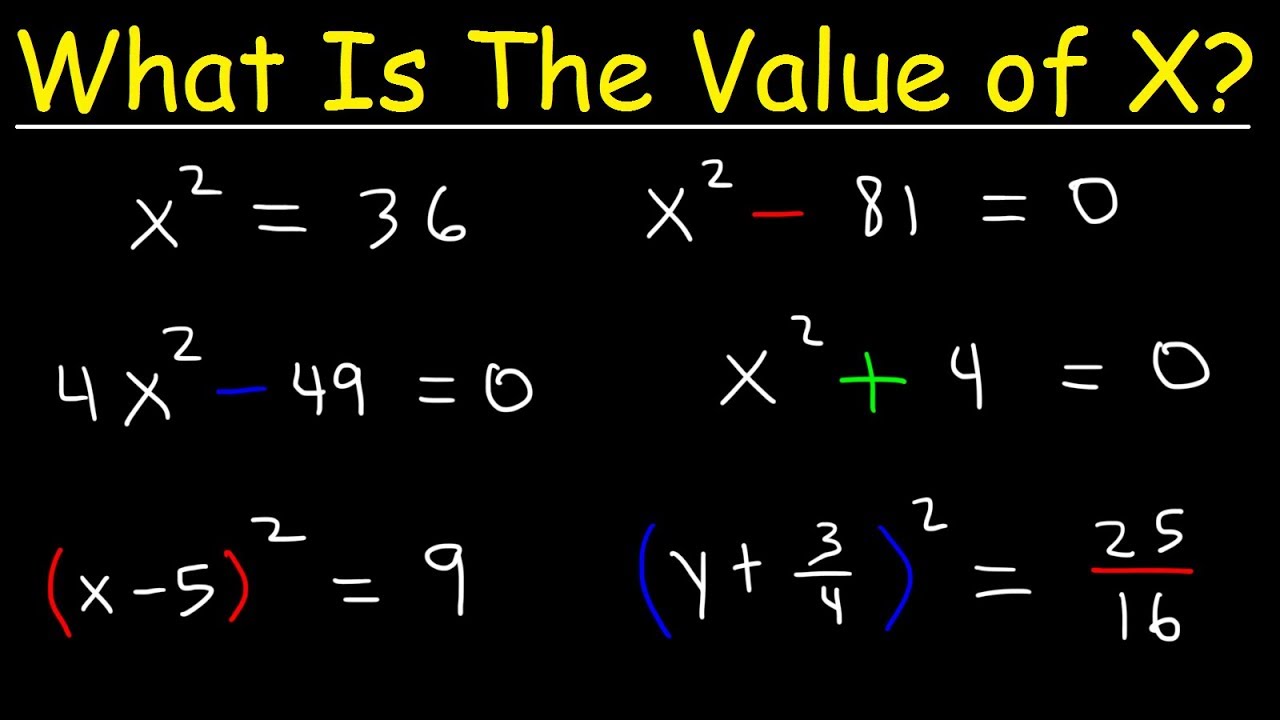
This algebra video tutorial explains how to solve simple quadratic equations using the square root feature. This video contains plenty of examples and practice problems.
Quadratic Equations - Free Formula Sheet: https://bit.ly/3WZ8v1Z
How To Solve Simple Quadratic Equations:
https://www.youtube.c...
hybrid crypt
wooden python
https://www.youtube.com/watch?v=-KWsS2FZVTA&list=PLzr_MlWyOdDt87OAJCKpZtxUmYv8r1...
I know how to do when it is only 2 stuff on a side
What u sent had one additional thing, -69
wooden python
ok then. again. this is something you forgot or never learned. so you have to go (re)learn it.
this trigonometry will only get in your way right now.
hybrid crypt
I know how to do the video u sent
wooden python
i sent an entire PLAYLIST.
hybrid crypt
Oh
wooden python
i recommend watching the entire thing
hybrid crypt
Can't you just tell me the answer to my original question ? @wooden python
clever fjordBOT
This is sad 😢
 atomic hornet
@hybrid crypt
wooden python
hybrid crypt
Can't you just tell me the answer to my original question ? <@183668144404037632...
!noans
odd edgeBOT
hybrid crypt
Can't you just tell me the answer to my original question ? <@183668144404037632...
The purpose of this server is to help you learn, not to hand out answers. Do not ask someone to give you the answer directly.
wooden python
hybrid crypt
t(t + 1) - 2
this is basically the same pseudofactorization that you started with and showed to me
 atomic hornet
hybrid crypt
Is it not a rule not to tell ppl answer
atomic hornet
hybrid crypt
Is it not a rule not to tell ppl answer
yes

While asking questions, make sure to mention all relevant details, including what you have tried and what you're stuck at. Do not expect others to simply solve your questions for you.
 errant turret
Just use quadratic formula
It’s the best way
Ibr
Unless ur allowed calculator
Then use that
atomic hornet
● When asking a question, show what you tried to solve the problem. We are not here to do your homework for you, but we are here to help you learn how to do your homework. See ❓how-to-get-help for more info on how to ask questions.
 errant turret
You can also do a trick
If you have something in the form
ax^2 + bx + c, you need to find a pair of numbers which sum to “b” and multiple to give you “a multiplied by c”
wooden python
hybrid crypt
Is it not a rule not to tell ppl answer
it is our policy not to give out answers directly
and this goes both ways
odd edgeBOT
Channel closed
Closed by @hybrid crypt
Use .reopen if this was a mistake.
Available help channel!
Send your question here to claim the channel.
Remember:
• Ask your math question in a clear, concise manner.
• Show your work, and if possible, explain where you are stuck.
• After 15 minutes, feel free to ping <@&286206848099549185>.
• Type the command .close to free the channel when you're done.
• Be polite and have a nice day!
Read #❓how-to-get-help for further information on how to ask a good question, and about conduct in the question channels.
 hoary flower
I'm not really seeing the obvious claim here
 hoary flower
they seem to assume that N_1 is an h interval?
like I see V is a G_sigma set
but that doesnt prove that V is u* measurable
odd edgeBOT
@hoary flower Has your question been resolved?
odd edgeBOT
Channel closed
Closed due to timeout
Use .reopen if this was a mistake.
Available help channel!
Send your question here to claim the channel.
Remember:
• Ask your math question in a clear, concise manner.
• Show your work, and if possible, explain where you are stuck.
• After 15 minutes, feel free to ping <@&286206848099549185>.
• Type the command .close to free the channel when you're done.
• Be polite and have a nice day!
Read #❓how-to-get-help for further information on how to ask a good question, and about conduct in the question channels.
 mild owl
I need help with coordinate maths- ive answered a which is gradient of minus 2 but i cant seem to do b i dont understand it please can anyone explain please
 odd edgeBOT
mild owl
I need help with coordinate maths- ive answered a which is gradient of minus 2 b...
mild owl
odd edgeBOT
mild owl
I need help with coordinate maths- ive answered a which is gradient of minus 2 b...
mild owl
<@&286206848099549185>
odd edgeBOT
Please only use the <@&286206848099549185> ping once if your question has not been answered for 15 minutes. Please do not ping or DM individual users about your question.
 orchid torrent
mild owl
I need help with coordinate maths- ive answered a which is gradient of minus 2 b...
orchid torrent
mild owl
I need help with coordinate maths- ive answered a which is gradient of minus 2 b...
Note that a point lies on a line if and only if its coordinates satisfy the equation
ex. let's say we have y = x + 1
(1,2) lies on it because x=1 and y=2 makes y=x+1 true
but (1,3) does not because x=1 and y=3 does not make y=x+1 true
does that make sense
orchid torrent
odd edge
Please only use the <@&286206848099549185> ping **once** if your question has no...
also ignore this
mild owl
Im not sure i understand im so sorry
orchid torrent
mild owl
Im not sure i understand im so sorry
What part don't you understand?
mild owl
Sorry ive just re read it and i understand what your saying
Yes i get that because 1 + 1 =2
But how do you find out the answer to question b??? Ive looked in videos that say its a formula but im not sure i understand the logistics of it
I have done this before but i only remember finding the mid point at some point
nimble blaze
the slope between any two points on the same line will be the same
mild owl
So the gradient???
nimble blaze
yeh, same thing
mild owl
How would i find that out??
mild owl
Oh so i just need to find out the gradient again?
nimble blaze
yes
orchid torrent
oh yeah you can do that too
 clever fjordBOT
ραμOmeganato5
 mild owl
Oh thank you i will change it
Thanks for helping me i was so stuck
I will close the chat now but thank you so much
.close
odd edgeBOT
Channel closed
Closed by @mild owl
Use .reopen if this was a mistake.
Available help channel!
Send your question here to claim the channel.
Remember:
• Ask your math question in a clear, concise manner.
• Show your work, and if possible, explain where you are stuck.
• After 15 minutes, feel free to ping <@&286206848099549185>.
• Type the command .close to free the channel when you're done.
• Be polite and have a nice day!
Read #❓how-to-get-help for further information on how to ask a good question, and about conduct in the question channels.
 last geode
Help! 🥲
I’m lost-ish
 odd edgeBOT
last geode
Help! 🥲
I’m lost-ish
odd edgeBOT
last geode
Help! 🥲
I’m lost-ish
 amber veldt
last geode
Help! 🥲
I’m lost-ish
amber veldt
last geode
Help! 🥲
I’m lost-ish
if the function were 5sin(3x)/(3x), would you be able to do it?
 tacit wasp
Think of how you can transform 4x into 3x without changing the function expression
amber veldt
$$\lim_{x \to 0} \frac{5\sin(3x)}{4x}$$
clever fjordBOT
gfauxpas
 amber veldt
limits have the property that you can factor in and out constant multiples
think of a clever way to multiply by 1 and then factor in and out numerator and denominators until you get what you want
last geode
amber veldt
limits have the property that you can factor in and out constant multiples
Right
last geode
amber veldt
think of a clever way to multiply by 1 and then factor in and out numerator and ...
And what wud we do here then?
last geode
tacit wasp
Think of how you can transform 4x into 3x without changing the function expressi...
I tried 😭 and it doesn’t make sense 🥲
amber veldt
you want to multiply by (number)/(number)
and then factor the numerator and denominator seperately
last geode
amber veldt
you want to multiply by (number)/(number)
Get 12x on both numerator and denom?
last geode
U mean by 3/4?
amber veldt
try it
I dont want to tell you the answer, you'll learn better by experimenting and trying wrong answers until you find the right one
last geode
amber veldt
play around
😭😭 I ain’t have time for all that ngl. Maybe on the weekends but I have a whole unit test tmrw 🙏
odd edgeBOT
Someone else is already using this help channel. If you need help with a question, please open your own help channel/thread (see #❓how-to-get-help for instructions).
 pure yoke
heck no
last geode
amber veldt
factor out 5/4
Hehe, it’s coming back to me 😅😅
pure yoke
im using this
amber veldt
<@&268886789983436800> troll
pure yoke
heck no
amber veldt
last geode
Separate the number into 5/4x and sin 3x/4x
nah I would just do
last geode
amber veldt
nah I would just do
Oh
amber veldt
$$\frac 5 4 \lim_{x \to 0} \frac{\sin(3x)}{x}$$
clever fjordBOT
gfauxpas
 amber veldt
is this allowed?
okay you have to do SOME work here though sorry, i did the first step and it's a big one
last geode
amber veldt
okay you have to do SOME work here though sorry, i did the first step and it's a...
I know 😭😭
 tropic remnant
amber veldt
<@&268886789983436800> troll
tropic remnant
amber veldt
<@&268886789983436800> troll
I'm guessing that the message got deleted? Was it Cee?
last geode
I was hoping u cud explain it?
amber veldt
last geode
I was hoping u cud explain it?
so now you just have to evaluate this limit of
$$\lim_{x \to 0} \frac{\sin(3x)}{x}$$
clever fjordBOT
gfauxpas
 amber veldt
my hint to you is to multiply by 1 = (number)/(number)
tropic remnant
pure yoke
heck no
Thanks for deleting your messages here. Please make sure you don't do this kind of thing in the future.
last geode
clever fjord
**gfauxpas**
I can do this.
But you’re telling me it’s ok to just take out the 5/4?
amber veldt
there's a theorem
suppose lim_{x to c}f(x) exists and is equal to L
let a be some number
then lim_{x to c}af(x) exists and is equal to aL
in other words, multiplying the function by a constant multiplies the limit by that constant
so you can find the limit first and then multiply after
last geode
Ok ok, I think i get it. It’ll prolly stick after some days but thanx
amber veldt
if the limit doesnt exist, then multiplying it by a nonzero number won't make it exist
np
so you can even test if a limit exists by factoring
in other words, if youre not sure if the limit of 5g(x) exists at x=c, you can take the limit of g(x), and if that limit doesnt exist, 5g(x) wont have a limit either
if it DOES have a limit, then the limit of g(x) at c will be 1/5 the limit of 5g(x)
make sense?
last geode
amber veldt
if the limit doesnt exist, then multiplying it by a *nonzero* number won't make ...
Won’t make it exist?
last geode
amber veldt
make sense?
A bit, it’ll prolly make more sense if I heard it but I get what u mean. Thanx!!
Imma close this channel tho
.close
odd edgeBOT
Channel closed
Closed by @last geode
Use .reopen if this was a mistake.
Available help channel!
Send your question here to claim the channel.
Remember:
• Ask your math question in a clear, concise manner.
• Show your work, and if possible, explain where you are stuck.
• After 15 minutes, feel free to ping <@&286206848099549185>.
• Type the command .close to free the channel when you're done.
• Be polite and have a nice day!
Read #❓how-to-get-help for further information on how to ask a good question, and about conduct in the question channels.
 raven tendon
i’m stuck on this section, i’m not sure how i’m supposed to get the answer and what formula (if there is a formula) to use

 odd edgeBOT
raven tendon
i’m stuck on this section, i’m not sure how i’m supposed to get the answer and w...
odd edgeBOT
raven tendon
i’m stuck on this section, i’m not sure how i’m supposed to get the answer and w...
 indigo dirge
deltamath ptsd 😭 ok anyways, dyk what the IVT states?
raven tendon
not a single clue
raven tendon
like it doesn’t disconnect it keeps going
 marble laurel
That's the simple explanation
raven tendon
trying to keep it simple for my brain
indigo dirge
marble laurel
That's the simple explanation
i believe it is enough for ivt though
marble laurel
It is enough
Intermediate value theorem basically says given a continuous function's 2 endpoints, the function must pass through the values in between them
Imagine you are at home and you wanna go to the bus station at some place on the map
raven tendon
wait let me get my notebook out
marble laurel
You can have multiple paths to go there, but you must pass through at least the portion in between your house and the bus station
raven tendon
the least portion?
marble laurel
The portion sandwiched between the 2 endpoints
marble laurel
So if you're given 2 function's endpoints, say (0,10) and (5,3), you can predict that it must pass through values of x from 0 to 5 and values of y from 3 to 10, provided that it's a continuous function
raven tendon
i don’t understand
would this be right

i’m gunna sen it
I WAS RIGHT
YOOOO
thanks team i learned so much and nothing at the same time

.close
odd edgeBOT
Channel closed
Closed by @raven tendon
Use .reopen if this was a mistake.
odd edgeBOT
Available help channel!
Send your question here to claim the channel.
Remember:
• Ask your math question in a clear, concise manner.
• Show your work, and if possible, explain where you are stuck.
• After 15 minutes, feel free to ping <@&286206848099549185>.
• Type the command .close to free the channel when you're done.
• Be polite and have a nice day!
Read #❓how-to-get-help for further information on how to ask a good question, and about conduct in the question channels.
 grim bridge
On number 3, I don’t know how you could tell

 glass vault
the graph is the derivative of the derivative of g
so throughout the domain from 0 to 3 the rate of change is decreasing
grim bridge
Yes
glass vault
if the rate of change is decreasing from 0 the function itself can only be decreasing
so thats your answer
grim bridge
So because from 0 to 3 on the second derivative is negative, it means the first derivative has a negative rate of change which means the graph of g is also negative?
 frosty relic
since g'(0) =0
and g''(0)<0, at g(0), a local maxima occurs,
so on the right and left side of x=0, function will be decreasing
grim bridge
Why does g’’ being negative indicate a local minima
 fiery geode
Guys
frosty relic
grim bridge
Why does g’’ being negative indicate a local minima
sorry, meant to say local maxima, rest is correct
frosty relic
this is the 2nd derivative test
fiery geode
I dunno how to solve
grim bridge
frosty relic
this is the 2nd derivative test
Wouldn’t you need to know 2 is a critical point to use second derivative test
frosty relic
grim bridge
Wouldn’t you need to know 2 is a critical point to use second derivative test
we are using 2nd derivative test at 0, as it is the only info given
grim bridge
frosty relic
we are using 2nd derivative test at 0, as it is the only info given
Ah, then since it’s negative it means there’s a maximum
frosty relic
yes
grim bridge
This stuff is rly hard to visualize
fiery geode
Yo how do you integrate with trig functions with exponents
grim bridge
.close
odd edgeBOT
Channel closed
Closed by @grim bridge
Use .reopen if this was a mistake.
frosty relic
grim bridge
This stuff is rly hard to visualize
keep practicing, and make rough sketches of graphs, you will be more comfortable
fiery geode
Is anybody good at integrals
frosty relic
fiery geode
Is anybody good at integrals
open your doubt channel and ask one doubt at once, people will respond
fiery geode
Thank you
frosty relic
fiery geode
Thank you
refer #❓how-to-get-help
odd edgeBOT
Available help channel!
Send your question here to claim the channel.
Remember:
• Ask your math question in a clear, concise manner.
• Show your work, and if possible, explain where you are stuck.
• After 15 minutes, feel free to ping <@&286206848099549185>.
• Type the command .close to free the channel when you're done.
• Be polite and have a nice day!
Read #❓how-to-get-help for further information on how to ask a good question, and about conduct in the question channels.
 crystal radish
 odd edgeBOT
crystal radish
crystal radish
odd edgeBOT
crystal radish
crystal radish
We know the chance of a positive test given a patient has the flu/does not
but how do I flip that?
so, we know the chance of having the flu given a positive test
then I just compound that with the initial 20%
its just that flipping part that has me confused
 safe vapor
have you covered bayes theorem
crystal radish
no
crystal radish
Can you remind me what | and ∩ mean? I think thats or and intersection but idk
amber veldt
| denotes conditional probability
amber veldt
 tacit elm
P(A|B) = P(A ∩ B) / P(B) et P(B|A) = P(A ∩ B) / P(A)
tacit elm
P(A|B) = P(A ∩ B) / P(B) et P(B|A) = P(A ∩ B) / P(A)
P(A) if B happens
oops didnt mean to auote
crystal radish
got it
amber veldt
to understand the theorem
multiply both sides by P(B), imo its more intuitive that way
safe vapor
i don't think conditional probability is actually usable here? I think you need bayes
You can derive bayes from conditional probability but that's hard to do independently
I would use a tree
crystal radish
what is bayes/how do you use a tree?
safe vapor
Bayes' theorem is a theorem to (basically) find P(A|B) if you know P(B|A) and some extra info. You'll learn it at some point.
To use a tree, start by making two branches: patient has bird flu/patient doesnt have bird flu
Then for each branch, make a sub branch: patient tests positive/patient tests negative
 errant dew
$P(A|B)P(B)=P(B|A)P(A)$
clever fjordBOT
BBMaths
 safe vapor
afterwards, you can find the portion of "patient has the flu" is in "patient tests positive". might be hard to understand through text so you can send a photo of your labelled tree (with probabilities)
crystal radish
sure 1sec
safe vapor
\cap
errant dew
I knew cap from doing latex in Microsoft word but I didn’t know if that was standard or if I could just write intersect
clever fjordBOT
BBMaths
 errant dew
I’ve made a mess of this lol
 errant dew
Try to use the Bayes theorem equation, you’ll need to pick what A and B mean (Positive test result, has the flu)
crystal radish
 errant dew
crystal radish
what is bayes/how do you use a tree?
errant dew
crystal radish
what is bayes/how do you use a tree?
You drew a tree at the start and right now, ^.4% not 4% but unimportant
crystal radish
lol ik i meant in the context of bayes how do i draw a tree
safe vapor
okay, so 19.6 people with the flu test positive, and 32 people without the flu tested positive. Of the 32+19.6 people who tested positive, what percentage actually has the flu?
safe vapor
The formalization of this is Bayes' Theorem. Look it up if you want so you won't need to make a tree every single time
Yep
safe vapor
P(Flu | Positive) = P(Positive | Flu) * P(Flu) / P(Positive). Which is what you did by hand.
crystal radish
btw which class will i learn this in?
because i see it is not apart of AP Stats so
safe vapor
Probability, isn't that what you;re doing now?
crystal radish
will it be in a college class?
safe vapor
oh
safe vapor
AP Stats might have it in the Probability chapter... not sure
It's a pretty simple theorem, you might do it in hs if you ever take a "Prob & Stats" type class. Otherwise intro Probability in college yeah
odd edgeBOT
Channel closed
Closed by @crystal radish
Use .reopen if this was a mistake.
odd edgeBOT
Available help channel!
Send your question here to claim the channel.
Remember:
• Ask your math question in a clear, concise manner.
• Show your work, and if possible, explain where you are stuck.
• After 15 minutes, feel free to ping <@&286206848099549185>.
• Type the command .close to free the channel when you're done.
• Be polite and have a nice day!
Read #❓how-to-get-help for further information on how to ask a good question, and about conduct in the question channels.
 fading nimbus
Would my answer here be sufficient proof for question 9?


 vivid wyvern
fading nimbus
Would my answer here be sufficient proof for question 9?
vivid wyvern
fading nimbus
Would my answer here be sufficient proof for question 9?
The working is fine but nothing abt the interval was mentioned in ur work
fading nimbus
vivid wyvern
The working is fine but nothing abt the interval was mentioned in ur work
Oh for part b or?
Or do i have to mention for part a as well
vivid wyvern
fading nimbus
Oh for part b or?
Part a
Part b Has a different interval
vivid wyvern
fading nimbus
Or do i have to mention for part a as well
Yes
fading nimbus
Oh qould i do that to eliminate the negstive root?
vivid wyvern
fading nimbus
Oh qould i do that to eliminate the negstive root?
Negative root?
fading nimbus
The 1-x^2
Under the swuare root it can be positive or negstive
If i soecify interval of pi/2 to 0 it will only be pisitive?
vivid wyvern
Mention that when 0<_x<_1
The angle is [0,90]
vivid wyvern
fading nimbus
Under the swuare root it can be positive or negstive
It cant be negative(if we dont take complex number into consideration)
fading nimbus
Yeah i havent taken imaginary numbers yet
fading nimbus
vivid wyvern
Mention that when 0<_x<_1
The angle is [0,90]
Okok ty
vivid wyvern
fading nimbus
If i soecify interval of pi/2 to 0 it will only be pisitive?
Within that range sinx is always positive or 0
Cuz sin0=0 and sin90=1
fading nimbus
From pi/2 to 0 same thing yes
vivid wyvern
And the value of sqrt(something) is always positive or 0
So u can say that this interval is satisfied
vivid wyvern
fading nimbus
From pi/2 to 0 same thing yes
Yea
odd edgeBOT
Channel closed
Closed by @fading nimbus
Use .reopen if this was a mistake.
odd edgeBOT
Available help channel!
Send your question here to claim the channel.
Remember:
• Ask your math question in a clear, concise manner.
• Show your work, and if possible, explain where you are stuck.
• After 15 minutes, feel free to ping <@&286206848099549185>.
• Type the command .close to free the channel when you're done.
• Be polite and have a nice day!
Read #❓how-to-get-help for further information on how to ask a good question, and about conduct in the question channels.
tame mesa
 tame mesa
so I had asked this question yesterday night but couldn't get any answer, I was trying to prove it by showing that the parabolas cannot cover the entire circumference of a big enough circle
short terrace
Uh this can be done using affine maps, but since you have the pre-uni flair I doubt that's gonna be helpful
tame mesa
it was asked in a college entrance exam
 quasi falcon
tame mesa
quasi falcon
tame mesa
My best idea was that you can show that not matter what kind of parabola, supposing their interior intersects at their apexes, eventually their border will cross, creating space which is not covered by any of the two
short terrace
I don't see a way to rigorously prove this without using the fact that all parabolas are affine maps of y = x²
short terrace
quasi falcon
My best idea was that you can show that not matter what kind of parabola, suppos...
Yes intuitively this works
tame mesa
quasi falcon
My best idea was that you can show that not matter what kind of parabola, suppos...
yea I was going for that too but couldn't prove it
tame mesa
tame mesa
so I had asked this question yesterday night but couldn't get any answer, I was ...
it is essentially what I was trying to do with circles
short terrace
Essentially the idea becomes that
As you go farther and farther in the parabola
Your angle gets smaller and smaller
You prove this for y = x²
And then you show that the proof transfers over affine transformations
tame mesa
short terrace
Your angle gets smaller and smaller
you mean the angle between the slope and axis?
short terrace
Yes
tame mesa
short terrace
And then you show that the proof transfers over affine transformations
I don't know that
short terrace
Yes I know
Which is why I'm confused as to how you'd do this
You could prove it directly for the general form of a parabola ig
But that sounds like hell
tame mesa
short terrace
But that sounds like hell
yea
tame mesa
cerulean vortex
yesterday someone was trying to do something from this (you can read the convo and maybe get something from it)
quasi falcon
This is on the lines of what you already said, but, for y = x^2, suppose you draw a cone from x = 0, to both x = \pm a
as a -> inf does the angle -> 0?
short terrace
It does yes
quasi falcon
If you take the asymptotic behaviour you can think that the parabolas basically cover no space if considering the whole plane
short terrace
That's a.. not difficult proof
quasi falcon
I think that should be valid
short terrace
quasi falcon
If you take the asymptotic behaviour you can think that the parabolas basically ...
That is measure theory territory though
But yes it is reasonable to claim that
short terrace
quasi falcon
This is on the lines of what you already said, but, for y = x^2, suppose you dra...
But the problem is, now you need to show this for an arbitrary parabola
quasi falcon
Any transformation that has ax^2, a =/= 0 will still have to follow that idea in the end
short terrace
Intuitively yes
tame mesa
quasi falcon
This is on the lines of what you already said, but, for y = x^2, suppose you dra...
um can you explain what you're trying to prove here?
quasi falcon
ill try to graph it out in desmos to showcase the idea
tacit elm
Actually Let’s think of this differently
short terrace
tame mesa
um can you explain what you're trying to prove here?
A parabola subtends an arbitrarily small angle
tame mesa
short terrace
A parabola subtends an arbitrarily small angle
ig yea you can say it if we compare it with pair of straight lines
short terrace
That doesn't exactly work since it's "fatter" at the bottom
But yes that's the idea
tacit elm
The Line x = m intersects the parábolas in a finite number of points
Since the line is infinite
short terrace
Oh holy shit
tacit elm
There are infinite points within the line that are not covered
short terrace
That is genius
tame mesa
um but how does that prove the question?
tacit elm
I just proved that there are points in the plane that are not in the parábolas
tame mesa
It may not lie inside 1 parabola but some part of it may lie inside other parabolas
short terrace
Not boundaries
tame mesa
short terrace
Not boundaries
yea
short terrace
tacit elm
The Line x = m intersects the parábolas in a finite number of points
So this doesn't work
short terrace
You can say the intersection has finite measure in L_1
But that feels way too overboard for a college entrance exam
short terrace
tacit elm
Again Let’s formalize this cleanly
I'm listening
tacit elm
A parábola crosses a random line in at most 2 points
So take any line of the plane
It will have at most 2n intersections with all the parábolas
Since the line has infinite points
There is an infinity of points that are in the line and not in the intersection
tame mesa
if we take two parabolas that touch each other at the vertex and the line as their axis then the number of poi's is finite but the line still lies within the parabolas
tacit elm
So they are in the plane and not in the intersection
tacit elm
tame mesa
if we take two parabolas that touch each other at the vertex and the line as the...
What ??
If they touch each other at the vertex, the intersection is 1 point
short terrace
A parabola rotated 90° is still a parabola no?
tame mesa
um I think just showing that the number of point of intersections being finite doesn't mean the line will not lie inside the parabolas entirely
tacit elm
That’s Why I said at most 2 points
quasi falcon
Yeah, you can easily prove by exhaustion that an infinite line is either:
- Crosses the parabola once, half of it is inside the parabola, the other out.
- It crosses it two times.
- It doesnt cross it at all
The big problem would be 1. But that only happens when the axis of the parabola is parallel to the line itself
So, to cover for all "slopes" of a line, you would have to exhaust all angles, and that requires infinite parabolas.
short terrace
tacit elm
A parábola crosses a random line in at most 2 points
That feels like an immediate counterexample to this cuz the interval is to infinity on one side
tacit elm
tame mesa
um I think just showing that the number of point of intersections being finite d...
A line can never lie in a parábola
tame mesa
tacit elm
A line can never lie in a parábola
but it can lie inside multiple parabolas
short terrace
Consider x = y² and x = -y², the line x = 0 lies entirely in these two
quasi falcon
yes, but you can rotate your line
tacit elm
tame mesa
but it can lie inside multiple parabolas
Yes again, the number of parábolas is finite
So no
Ok let’s pose for a second please
Take any line and any parábola
Orient them however you want
Rótate them squeeze them
The number of intersections Is at most 2 points
So if you take one Line, and a finite number of parabolas (say n)
The parábolas cover at most 2n points of the line
So an infinite number of points in the line are not covered by the parábolas
tame mesa
quasi falcon
Yeah, you can easily prove by exhaustion that an infinite line is either:
1. Cro...
ok this seems like the proof shaki is going for
short terrace
A line and a parabola's interior can have an intersection of the form [n, ∞] no
tame mesa
but yea I can see why it works
quasi falcon
I missed the case where the line is tangent, but thats pretty trivial to prove that it has points outside of it
tame mesa
quasi falcon
I missed the case where the line is tangent, but thats pretty trivial to prove t...
that is just the special case of 2 only
quasi falcon
Theres another:
tame mesa
limiting case actually
short terrace
quasi falcon
Yeah, you can easily prove by exhaustion that an infinite line is either:
1. Cro...
Proving 1 is the problem here lol
quasi falcon
Not really, it can never not be inside of the parabola:
 tame mesa
short terrace
Proving 1 is the problem here lol
tame mesa
short terrace
Proving 1 is the problem here lol
yea but even if you show that 1 line doesn't lie inside all the parabolas we are done we don't have to show for all lines
quasi falcon
Suppose you have two opposite looking parabolas, just rotate your line by some angle
and then its outside of both
And since for every other case, it cant be fully contained inside of the parabola, you would need infinite rotated parabolas
quasi falcon
oh, btw, on the original idea i had about the cone just cause i have the mp4:
When you go further up the parabola, the angle it fully covers gets smaller and smaller
tame mesa
yea that can work as well ig
quasi falcon
its a bit more convoluted, the geometric reasoning is 100% better
odd edgeBOT
Channel closed
Closed by @tame mesa
Use .reopen if this was a mistake.
odd edgeBOT
Available help channel!
Send your question here to claim the channel.
Remember:
• Ask your math question in a clear, concise manner.
• Show your work, and if possible, explain where you are stuck.
• After 15 minutes, feel free to ping <@&286206848099549185>.
• Type the command .close to free the channel when you're done.
• Be polite and have a nice day!
Read #❓how-to-get-help for further information on how to ask a good question, and about conduct in the question channels.
 peak heath
can anyone tell me where to start on this problem
 peak heath
i tried to express the equation as 2x/((2x^2 - 2x + 3) - 3x) + 13x/((2x^2 - 2x + 3) + 3x) = 6, but idk what to do
odd edgeBOT
@peak heath Has your question been resolved?
 snow rune
you can always bash it out
snow rune
multiply both sides by the product of the denominators
vivid wyvern
peak heath
uh ok
Did u try what cis(x) suggested?
vivid wyvern
peak heath
but the denominators are not factoranble (the second onE)
If we dont take complex number into consideration then yes it isnt factorable
But inspite of not being able to factorize it u can multiply both lhs and rhs by the product of denominators
And expand
peak heath
but i got 8x^4 - 26x^3 + 35x^2 - 39x + 18 = 0, and what can i do with this