#help-19
1 messages · Page 199 of 1
 amber schooner
other way
 dawn roost
.close
 odd edgeBOT
Channel closed
Closed by @dawn roost
Use .reopen if this was a mistake.
 Available help channel!
Send your question here to claim the channel.
Remember:
• Ask your math question in a clear, concise manner.
• Show your work, and if possible, explain where you are stuck.
• After 15 minutes, feel free to ping <@&286206848099549185>.
• Type the command .close to free the channel when you're done.
• Be polite and have a nice day!
Read #❓how-to-get-help for further information on how to ask a good question, and about conduct in the question channels.
 keen solar
Can anyone tell how I can write the range for number 3😭😭😞😞
 keen solar
f(x) = -(x-4)² + 2
 unkempt lichen
do you have the maximum value?
keen solar
What's that
unkempt lichen
of this function
since this function opens downward, it must have a maximum value
hint: look at your vertex
unkempt lichen
so the max is 2, and it can extend infinitely down there, right?
keen solar
{y | y > 2} like this?😭😭😞
unkempt lichen
flip that inequality sign
if you write it like this, your graph opens upwards
you're saying that's the minimum of y
keen solar
Ohh
unkempt lichen
correct, but normally i would not write a range in set notation like this i suppose
but since you wrote the other two like that, yeah
amber schooner
to develop the habit of using inequalities, in the future you could note that -(x - 4)^2 <= 0 with equality when x = 4 so adding 2 to both sides gives -(x - 4)^2 + 2 <= 2 with equality when x = 4
odd edgeBOT
Channel closed
Closed by @keen solar
Use .reopen if this was a mistake.
odd edgeBOT
Available help channel!
Send your question here to claim the channel.
Remember:
• Ask your math question in a clear, concise manner.
• Show your work, and if possible, explain where you are stuck.
• After 15 minutes, feel free to ping <@&286206848099549185>.
• Type the command .close to free the channel when you're done.
• Be polite and have a nice day!
Read #❓how-to-get-help for further information on how to ask a good question, and about conduct in the question channels.
 lyric hedge
hi!! i’m in highschool IM2 and i was wondering if someone could help me with quadratic sequences. i get the concept but i dont really know how to solve for the equation if that makes sense 😭 i have a quiz tmr so if anyone’s free pls help!
odd edgeBOT
lyric hedge
hi!! i’m in highschool IM2 and i was wondering if someone could help me with qua...
 crude remnant
can you post ur q

 crude remnant
so i dont know the terms you guys use in class but i would recommend taking a look at the jumps between each pair of y's
lyric hedge
so the common differences?
crude remnant
whats the sequence of differences
lyric hedge
 crude remnant
ok from this its pretty easy to get future terms and previous terms right?
 white brook
amber schooner
to develop the habit of using inequalities, in the future you could note that -(...
white brook
amber schooner
to develop the habit of using inequalities, in the future you could note that -(...
/transler
amber schooner
white brook
/transler
what
lyric hedge
crude remnant
ok from this its pretty easy to get future terms and previous terms right?
ya i know how to do that i just dont know how to put it into the equation
 mental lotus
do you know the general form of how a quadratic equation looks like?
mental lotus
good
mental lotus
lyric hedge
so you know that, there is gonna be some specific one value for each of a,b,c such that you get the equation that fits these numbers
that means, if you put the values of (x1, y1) into the equation y = ax^2+bx+c, you will satisfy the equality if the a,b,c are correct
lyric hedge
uhh 😭
mental lotus
do you get what I am saying here?
lyric hedge
kinda
mental lotus
feel free to ask if you got stuck somewhere
lyric hedge
when my teacher explained he said to solve for b it’s the 2nd common difference - 1st common difference - 3
and for c it’s the whenever x = 0
mental lotus
yea, thats the similar idea to what I am saying
I was just planning to explain the idea of what that means
but, sure I can directly show you the equation
mental lotus
yep
you can check for yourself by putting in the numbers back into the equation
you know for x1 = 1, you have y1 = -1
lyric hedge
yeah
mental lotus
and indeed, if you put it in the equation, you get it back
and same for the rest too
lyric hedge
ok thank you!
i know how to do the work but i js wanted to double check cuz my teacher sucks at teaching 💔
mental lotus
np
mental lotus
lyric hedge
i know how to do the work but i js wanted to double check cuz my teacher sucks a...
you might wanna watch this, if you still feel unsure https://www.youtube.com/watch?v=7Isa4P8lISc
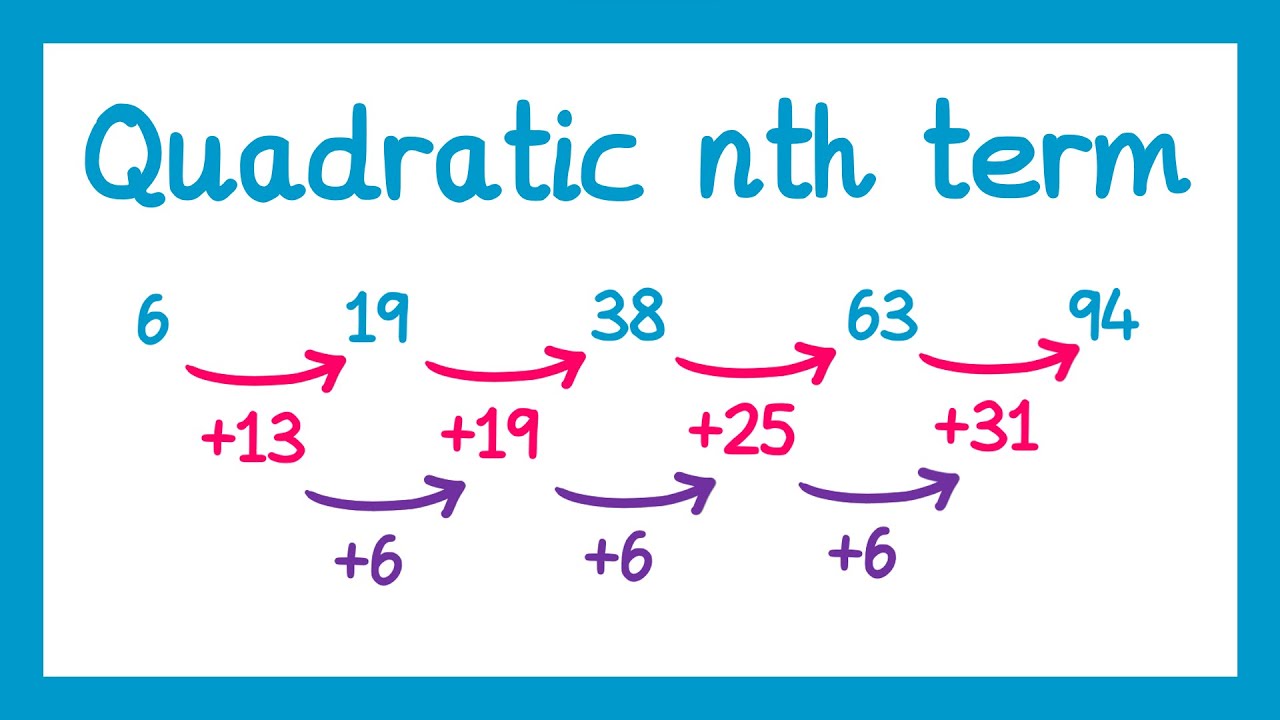
This video is for students aged 14+ studying GCSE Maths.
A video explaining how to find the nth term of a quadratic sequence. This topic is on the GCSE Maths Higher course and not foundation. If you want to check linear sequences use this video: https://www.youtube.com/watch?v=0vOwE2NHAEk&t=414s
Exam Question Booklets:📝
🔗Exam Question E...
lyric hedge
omg thank you ur genuinely a lifesaver
odd edgeBOT
@lyric hedge Has your question been resolved?
Channel closed
Closed by @lyric hedge
Use .reopen if this was a mistake.
Available help channel!
Send your question here to claim the channel.
Remember:
• Ask your math question in a clear, concise manner.
• Show your work, and if possible, explain where you are stuck.
• After 15 minutes, feel free to ping <@&286206848099549185>.
• Type the command .close to free the channel when you're done.
• Be polite and have a nice day!
Read #❓how-to-get-help for further information on how to ask a good question, and about conduct in the question channels.
 fleet oracle
Photo loading
odd edgeBOT
fleet oracle
Photo loading
 mental lotus
you cant divide the factors like that
unkempt lichen
for all of them, common factors can include binomials too!
fleet oracle
16-21
unkempt lichen
in case you didn't know that
mental lotus
mental lotus
you cant divide the factors like that
in 17, you just made the common factors disappear
fleet oracle
I am absolute stuck on them ☹️
mental lotus
but you did it correctly in 16
unkempt lichen
factor the common factors out first
fleet oracle
Let’s start with 17, what did I do wrong?
mental lotus
you see, in 16, you preserved the common factors, by taking them outside the equation, and combining the rest of the terms together
however, in 17, you made those factors disappear
you need to take them as common factor, and combine the leftovers into a single term
all this needs to be multiplied by (x+1)(x-3) still
 fleet oracle
( 2-3 )? <- wrong
mental lotus
fleet oracle
( 2-3 )? <- wrong
2-3 is not wrong
fleet oracle
So (x+1)(x-3)(2(x-3)-3(x+1)?
mental lotus
mental lotus
all this needs to be multiplied by (x+1)(x-3) still
the algebra in this snap is correct, but you needed the extra two factors too thats all
fleet oracle
How do I multiply that?
mental lotus
fleet oracle
So (x+1)(x-3)(2(x-3)-3(x+1)?
this is correct
fleet oracle
I know, do I just leave it as it is?
mental lotus
you can simplify the last part as you did before
make it -1*(x+9)
so you get -(x+1)(x-3)(x+9)
if you do that, then 17 becomes complete
16 was already good, so no problems there
but you need to redo 18
sadly, that one step you did is also wrong 
fleet oracle
 mental lotus
,rccw
 clever fjordBOT
 mental lotus
?
fleet oracle
I’m stuck…
mental lotus
your algebra was all good you just didnt write the two factors thats alll
you didnt have to do this
 wooden python
what's the original problem & the goal here
 odd viper
fleet oracle
odd viper
fleet oracle
- Take common (x+1)^3/2
fleet oracle
- Solved
odd viper
fleet oracle
What about the fractions?
Take them common
In 7/2
3/2 also came so take it outside eq will be like
(x^2+1)^3/2 (1+(x^2+1)^2)
fleet oracle
Where does the 7/2 go and what’s the +1?
wooden python
$(x^2+1)^{7/2} = (x^2+1)^{3/2} \cdot (x^2+1)^2$
clever fjordBOT
Ann
 wooden python
maybe it's easier if we temporarily replace x^2+1 with a single letter like z
z^(7/2) = z^(3/2) * z^2
z^(3/2) + z^(7/2)
= z^(3/2) * 1 + z^(3/2) * z^2
= z^(3/2) (1 + z^2)
@fleet oracle does that make it clearer
fleet oracle
It doesn’t…
wooden python
ok let's see
let's maybe also remove the fractional exponents and go for a different example
z^4 + z^9 = z^4(1+z^5)
does this make sense to you
(entirely different expression with no direct link to your hw problem but im trying to illustrate a point with it)
fleet oracle
Yes it does.
wooden python
ok right
this is because z^9 can be written as z^4*z^5 so we can factor a z^4 out of both terms
fleet oracle
Can I factor 3/2 out of both terms from question 18?
wooden python
and since the first term was just z^4 on its own, after factoring z^4 out it becomes just 1
wooden python
fleet oracle
Can I factor 3/2 out of both terms from question 18?
not 3/2 itself.
you can (and should) factor out (x^2+1)^(3/2).
fleet oracle
I got to go so I unfortunately have to leave the last 4 questions unanswered to get points 😓
I’m just gonna have to submit…

wooden python
welp, that's your decision to make
odd edgeBOT
@fleet oracle Has your question been resolved?
 rough birch
do you have other questions king?
fleet oracle
Too late…already submitted. 😪
rough birch
okk, just .close then to close the help channel
unkempt lichen
!done
odd edgeBOT
If you are done with this channel, please mark your problem as solved by typing .close
unkempt lichen
and all the best with your marks
odd edgeBOT
@fleet oracle Has your question been resolved?
odd edgeBOT
Channel closed
Closed due to timeout
Use .reopen if this was a mistake.
odd edgeBOT
Available help channel!
Send your question here to claim the channel.
Remember:
• Ask your math question in a clear, concise manner.
• Show your work, and if possible, explain where you are stuck.
• After 15 minutes, feel free to ping <@&286206848099549185>.
• Type the command .close to free the channel when you're done.
• Be polite and have a nice day!
Read #❓how-to-get-help for further information on how to ask a good question, and about conduct in the question channels.
 vale knoll
Hey
odd edgeBOT
vale knoll
Hey

 odd edgeBOT
@vale knoll Has your question been resolved?
vale knoll
No hasn’t
@rough birch
Anyone
<@&286206848099549185> I
Why am i being ditcheddddd
Guys
odd edgeBOT
Channel closed
Closed due to timeout
Use .reopen if this was a mistake.
Available help channel!
Send your question here to claim the channel.
Remember:
• Ask your math question in a clear, concise manner.
• Show your work, and if possible, explain where you are stuck.
• After 15 minutes, feel free to ping <@&286206848099549185>.
• Type the command .close to free the channel when you're done.
• Be polite and have a nice day!
Read #❓how-to-get-help for further information on how to ask a good question, and about conduct in the question channels.
 woeful briar
@vale knoll hi
odd edgeBOT
woeful briar
<@1090941040413917234> hi
odd edgeBOT
Channel closed
Closed by @woeful briar
Use .reopen if this was a mistake.
 marble laurel
What
odd edgeBOT
Available help channel!
Send your question here to claim the channel.
Remember:
• Ask your math question in a clear, concise manner.
• Show your work, and if possible, explain where you are stuck.
• After 15 minutes, feel free to ping <@&286206848099549185>.
• Type the command .close to free the channel when you're done.
• Be polite and have a nice day!
Read #❓how-to-get-help for further information on how to ask a good question, and about conduct in the question channels.
 fickle bluff
Im not sure what to do on this question. Cofactorization? Can I use the properties of eigenvectors on this?
 odd edgeBOT
fickle bluff
Im not sure what to do on this question. Cofactorization? Can I use the properti...
fickle bluff
odd edgeBOT
fickle bluff
Im not sure what to do on this question. Cofactorization? Can I use the properti...
fickle bluff
Am I allowed to do row elimination so my matrix is triangular?
fickle bluff

fickle bluff
on A so the matrix is triangular then the diagonal is just the eigenvalues right?
 low locust
you cant do that
fickle bluff
.close
odd edgeBOT
Channel closed
Closed by @fickle bluff
Use .reopen if this was a mistake.
odd edgeBOT
Available help channel!
Send your question here to claim the channel.
Remember:
• Ask your math question in a clear, concise manner.
• Show your work, and if possible, explain where you are stuck.
• After 15 minutes, feel free to ping <@&286206848099549185>.
• Type the command .close to free the channel when you're done.
• Be polite and have a nice day!
Read #❓how-to-get-help for further information on how to ask a good question, and about conduct in the question channels.
 clear cobalt
I need help with question C ii
 odd edgeBOT
clear cobalt
I need help with question C ii
odd edgeBOT
clear cobalt
I need help with question C ii

 wanton sierra
well if that angle is 90 degrees, what are the other angles of that bottom triangle
?
clear cobalt
45
wooden python
clear cobalt
Well ik it’s 90
you also know x = h cot(10°) by the same logic as for y
clear cobalt
What
wooden python
<@&268886789983436800> scam
clear cobalt
Bruh what is this
wooden python
you also know x = h cot(10°) by the same logic as for y
so you can apply pythagoras
<@&268886789983436800> second time
clear cobalt
Please stop that
clear cobalt
wooden python
you also know x = h cot(10°) by the same logic as for y
so you can apply pythago...
Thanks
Makes sense now
.close
odd edgeBOT
Channel closed
Closed by @clear cobalt
Use .reopen if this was a mistake.
Available help channel!
Send your question here to claim the channel.
Remember:
• Ask your math question in a clear, concise manner.
• Show your work, and if possible, explain where you are stuck.
• After 15 minutes, feel free to ping <@&286206848099549185>.
• Type the command .close to free the channel when you're done.
• Be polite and have a nice day!
Read #❓how-to-get-help for further information on how to ask a good question, and about conduct in the question channels.
 teal jungle
 odd edgeBOT
teal jungle
teal jungle
odd edgeBOT
teal jungle
teal jungle
Can somebody give me a hint on where to go on from here?
Also for the step where I square root both sides to remove the square for cos, how do I know where the answer is positive or negative?
 crystal charm
teal jungle
Also for the step where I square root both sides to remove the square for cos, h...
crystal charm
teal jungle
Also for the step where I square root both sides to remove the square for cos, h...
it's both
you get cosx = 3/4 and cosx = -3/4
teal jungle
Should I write that out with the plus minus symbol
 vernal yacht
teal jungle
Can somebody give me a hint on where to go on from here?
vernal yacht
teal jungle
Can somebody give me a hint on where to go on from here?
You’re pretty close from here
 warped glacier
which quadrant does pi/2 < x < pi represent?
teal jungle
Second quadrant
warped glacier
yeah, and so will cos be positive or negative in the 2nd quadrant?
teal jungle
I’m just not sure where to go from the triangle I drew 🥲
Negative
So it should be cos x= -3/4 right?
warped glacier
yeah and then sin will be positive, so that means sin/cos will be negative
warped glacier
teal jungle
I’m just not sure where to go from the triangle I drew 🥲
right, so what's opposite/adjacent in your triangle
teal jungle
Root 7 over 3
warped glacier
teal jungle
Root 7 over 3
yep, so you just need the negative of that!
teal jungle
i dont really understand how tan will give x
warped glacier
because in actual fact you have $\frac{\sqrt{7} / 4}{-3 /4} = - \frac{\sqrt 7}{3}$
clever fjordBOT
south
 warped glacier
teal jungle
i dont really understand how tan will give x
warped glacier
teal jungle
i dont really understand how tan will give x
it's literally SOHCAHTOA
but instead of 3 you have to write -3
teal jungle
ill get tan x = -sqrt 7 / 3, but how do i find x? i cant get an exact value from this
😭
warped glacier
teal jungle
ill get tan x = -sqrt 7 / 3, but how do i find x? i cant get an exact value from...
read the question again.....
teal jungle
thank you so much
warped glacier
teal jungle
thank you so much
.close
odd edgeBOT
Channel closed
Closed by @warped glacier
Use .reopen if this was a mistake.
odd edgeBOT
Available help channel!
Send your question here to claim the channel.
Remember:
• Ask your math question in a clear, concise manner.
• Show your work, and if possible, explain where you are stuck.
• After 15 minutes, feel free to ping <@&286206848099549185>.
• Type the command .close to free the channel when you're done.
• Be polite and have a nice day!
Read #❓how-to-get-help for further information on how to ask a good question, and about conduct in the question channels.
 waxen pivot
Hi, so I have the following as answer for an exercise I'm making. How can you say that the two angles are the same?
 odd edgeBOT
waxen pivot
Hi, so I have the following as answer for an exercise I'm making. How can you sa...
waxen pivot
odd edgeBOT
waxen pivot
Hi, so I have the following as answer for an exercise I'm making. How can you sa...
waxen pivot
The alpha in red and the alpha in black
 zealous reef
waxen pivot
The alpha in red and the alpha in black
zealous reef
waxen pivot
The alpha in red and the alpha in black
cause they have the same sine
waxen pivot
zealous reef
cause they have the same sine
Ok so how can you say that
zealous reef
waxen pivot
Ok so how can you say that
sine a = opposite/hypotenuse
whcih has been defined to be 1/5 for this angle
and the red angle also has a sine of 1/5 so they're the same
can you send the whole problem though
it's hard to say without knowing what these mean
waxen pivot
Yes, give me a minute, I will translate
A bundle of protons is brought to high speed and curved in a magnetic field like shown in the picture. In the zone where there is no magnetic field, the bundle goes straight. Then the bundle comes in a zone of 5 cm width where there is a magnetic field. It follow the circlular path with r=25cm. Then it leaves the magnetic field and goes straight again. The angle between the path before and after the magnetic field is called a. Which of the following is valid.
 waxen pivot
Hi, so I have the following as answer for an exercise I'm making. How can you sa...
waxen pivot
waxen pivot
Hi, so I have the following as answer for an exercise I'm making. How can you sa...
And this is the solution, so I'm wondering how you can say that a is the same as that angle in red
odd edgeBOT
@waxen pivot Has your question been resolved?
waxen pivot
Could someone help me out please?
crystal charm
you can ping helpers
odd edgeBOT
@waxen pivot Has your question been resolved?
odd edgeBOT
Channel closed
Closed by @waxen pivot
Use .reopen if this was a mistake.
 glossy basin

@waxen pivot I am not sure if this is correct this is what I think.
The green is the beam of protons.
The beam left the rectangle box tangent to the arc, so angle between green beam and red radius = 90°.
Let the above black line outside the box denote the old path of beam and the below black line be parallel to the above black line and be drawn at where proton left the box.
We will later prove how our given alpha (angle between proton beam after leaving field and the above black line is equal to the angle between proton beam leaving field and the below black line, so for now just accept the angle alpha is same as shown in figure.
If we join the green beam which left the magnetic field to the centre of the arc, such that the yellow line is parallel to the above 2 black lines, we get this triangle in the figure.
If we let theta be angle of arc, then we get by triangle theta is the angle on right between green and yellow lines.
Now, between two parallel lines (below black line and yellow line), green is transversal and so angle theta = angle alpha.
 digital shore
nvm
glossy basin
no, this will prolly close automatically after some time
waxen pivot
Thank you!
waxen pivot
glossy basin
<@382194692453826561> I am not sure if this is correct this is what I think.
T...
Yeah this makes sense, appreciate it. Worth the wait
odd edgeBOT
Available help channel!
Send your question here to claim the channel.
Remember:
• Ask your math question in a clear, concise manner.
• Show your work, and if possible, explain where you are stuck.
• After 15 minutes, feel free to ping <@&286206848099549185>.
• Type the command .close to free the channel when you're done.
• Be polite and have a nice day!
Read #❓how-to-get-help for further information on how to ask a good question, and about conduct in the question channels.
 proud vine
guys so i completed high school 1 and a half years back, and now im in uni, doing engineering. the sem 1 maths module is what i did in 11th and 12th grade. and well honestly rn im kinda cooked cause i have a class test in week 8, and rn we're in week 4. any tips on how i can improve?? i have limits and derivatives, continuity, and integration
odd edgeBOT
proud vine
guys so i completed high school 1 and a half years back, and now im in uni, doin...
crystal charm
proud vine
guys so i completed high school 1 and a half years back, and now im in uni, doin...
you practice them
unkempt lichen
do you have particular questions you are stuck on?
proud vine
crystal charm
you practice them
alrighty
crystal charm
crystal charm
you practice them
also maybe it's best you go ask this in #study-discussion
crystal charm
proud vine
alrighty
I mean it really does come down to practice a lot
proud vine
unkempt lichen
do you have particular questions you are stuck on?
pretty much i get stuck when it comes to limits
unkempt lichen
if you are stuck on some questions due to not knowing techniques, you can post them here as examples to practice some of the common techniques
crystal charm
and also watching videos to understand concepts
proud vine
crystal charm
I mean it really does come down to practice a lot
i'll do that then
unkempt lichen
but for open-ended questions like yours, it might be better to ask in discussion channels
proud vine
sure, i did but i didnt get replies yet, but thank you guys
unkempt lichen
alright, good luck!
odd edgeBOT
@proud vine Has your question been resolved?
Channel closed
Closed by @proud vine
Use .reopen if this was a mistake.
Available help channel!
Send your question here to claim the channel.
Remember:
• Ask your math question in a clear, concise manner.
• Show your work, and if possible, explain where you are stuck.
• After 15 minutes, feel free to ping <@&286206848099549185>.
• Type the command .close to free the channel when you're done.
• Be polite and have a nice day!
Read #❓how-to-get-help for further information on how to ask a good question, and about conduct in the question channels.
 trim sentinel
For a positive integer n, define n! = 1 × 2 × · · · × n. Call a quadruple (a, b, c, d) of positive integers red if 1 < a < b < c < d and a!b!c! = d!. We say
(ai, bi, ci, di) < (aj , bj , cj , dj ) if di < dj . Arrange all red quadruples in ascending order. If
the fourth quadruple in this list is (a4, b4, c4, d4), compute c4 + d4
odd edgeBOT
trim sentinel
For a positive integer n, define n! = 1 × 2 × · · · × n. Call a quadruple (a, b,...
 sand oak
do you have an idea how to do the brute force approach
as in enumerate each red quadruple in order
odd edgeBOT
@trim sentinel Has your question been resolved?
trim sentinel
sand oak
as in enumerate each red quadruple in order
brute force is not tidy
sand oak
then do you know any instance of a red quadruple. doesnt even have to be the first one
 ashen yew
odd edgeBOT
ashen yew
odd edgeBOT
Channel closed
Closed due to timeout
Use .reopen if this was a mistake.
odd edgeBOT
Available help channel!
Send your question here to claim the channel.
Remember:
• Ask your math question in a clear, concise manner.
• Show your work, and if possible, explain where you are stuck.
• After 15 minutes, feel free to ping <@&286206848099549185>.
• Type the command .close to free the channel when you're done.
• Be polite and have a nice day!
Read #❓how-to-get-help for further information on how to ask a good question, and about conduct in the question channels.
 marsh bridge
Does anyone know how I can figure out these values easily?

 amber veldt
marsh bridge
Does anyone know how I can figure out these values easily?
amber veldt
marsh bridge
Does anyone know how I can figure out these values easily?
there are 2 fundamental approaches to these types of problems
one is, to add one equation to another. the other, to subitute one equation into another
for the former example, what happens if you add the equations together?
for the latter example, what happels if you write the first equation as A = -B ?
if you need an explanation of WHY you're allowed to do things like add equations to one another LMK
 sinful grove
marsh bridge
Does anyone know how I can figure out these values easily?
sinful grove
marsh bridge
Does anyone know how I can figure out these values easily?
When you have something of the form 1/(x-a)(x-b) with a ≠ b and want to write it as A/(x-a) + B/(x-b) then there’s a very easy and direct approach which avoids solving a system
Notice that if 1/(x-a)(x-b) = A/(x-a) + B/(x-b) then we can recover A by multiplying both sides by x-a and plugging in x=a
And vice versa for B
So ur rule for getting A is 1/(a-b) while for B it’s -1/(a-b)
marsh bridge
Ah I forgot about solving systems, went back to review that and now I’ve remembered how to solve it
.close
odd edgeBOT
Channel closed
Closed by @marsh bridge
Use .reopen if this was a mistake.
odd edgeBOT
Available help channel!
Send your question here to claim the channel.
Remember:
• Ask your math question in a clear, concise manner.
• Show your work, and if possible, explain where you are stuck.
• After 15 minutes, feel free to ping <@&286206848099549185>.
• Type the command .close to free the channel when you're done.
• Be polite and have a nice day!
Read #❓how-to-get-help for further information on how to ask a good question, and about conduct in the question channels.
 lone elbow
 odd edgeBOT
lone elbow
odd edgeBOT
lone elbow
 wanton bison
no translation no trabajo
 pastel orbit
ah? didn’t you get help with this last night? 
 wanton bison
pastel orbit
ah? didn’t you get help with this last night? <:pikathink:879066872513970227>
wanton bison
pastel orbit
ah? didn’t you get help with this last night? <:pikathink:879066872513970227>
last night was so hard, the hungover made him forget
lone elbow
transitive: xRy ,yRz => xRz
unkempt lichen
wanton bison
last night was so hard, the hungover made him forget
i mean...
lone elbow
equiv rela = reflexive + symmetric + transitive
wanton bison
unkempt lichen
i mean...
Actually, it's good for you
lone elbow
poset = reflexive + antisymmetric + transitive
wanton bison
you get to farm helpful XP again
unkempt lichen
no thx, it's midnight here
lone elbow
pre order = reflexive + transitive
mental lotus
unkempt lichen
no thx, it's midnight here
no way you are letting that stop you
lone elbow
all the relations on A that are symmetric and antisymmetric are such that
xRy => yRx
xRy, yRx => x=y
unkempt lichen
mental lotus
~~no way you are letting that stop you~~
i need to touch grass tmr or i will eat grass for the resto of the month LOL
plus i already answered part a more or less to completion
lone elbow
so basically the relations which have only reflexive pairs
wanton bison
unkempt lichen
plus i already answered part a more or less to completion
real just refer to last help channel
lone elbow
basically, all relations in A that have pairs that are solely reflexive are symmetric and antisymmetric by nature
for a relation to be of partial order and an equivalence relation we need
partial order = reflexive + antisymmetric + transitive
equiv rela = reflexive + symmetric + transitive
both = reflexive + symmetric + antisymmetric + transitive
wanton bison
do you have a question btw or are you just active recalling
lone elbow
- xRx ∀x ∈ A
- xRy => yRx
- xRy, yRx => x=y
- xRy, yRz => xRz
lone elbow
wanton bison
do you have a question btw or are you just active recalling
lets say I have a relation R that has only reflexive pairs, it is antisymmetric and symmetric by nature, but is it transitive?
what I mean is , R = {(1,1),(2,2)} for example
and A = {1,2}
2R2, 2R2 => 2R2
1R1, 1R1 => 1R1
unkempt lichen
so... have you answered your own question?
lone elbow
is hard to put it in a proof
untitively both hold for relations which have all self loops
i think
like My answer will be
,, \mathcal{R} \subseteq { (a,a) \mid a \in A}
clever fjordBOT
Renato
 lone elbow
thats the answer for i)
if you notice @wanton bison
i used subseteq and not equality
because the relation is not necessarily reflexive
in the case of ii) it needs to be reflexive
recall reflexive = xRx ∀x ∈ A
wirh emphasis in the FOR ALL
so in the case of ii) the answer is
R = {(a,a) : a ∈ A}
not subseteq
wanton bison
lone elbow
is hard to put it in a proof
I think you can prove it by writing down the definitions of symmetric and antisymmetric
unkempt lichen
wanton bison
I think you can prove it by writing down the definitions of symmetric and antisy...
(what i said earlier)
wanton bison
Try to apply them on the definition of transititvy
wanton bison
unkempt lichen
(what i said earlier)
Oh, didn't read
unkempt lichen
nono it's fine
wanton bison
I was trying to figure it on my own too
unkempt lichen
but just emphasizing
lone elbow
unkempt lichen
(what i said earlier)
where?
 sturdy cape
So, this relation is literally the = relation
wanton bison
last help channel 
unkempt lichen
lone elbow
where?
your prev help channel
lone elbow
oh you mean in another day
sturdy cape
Transitivity would mean that x = y and y = z imply that x = z; is this true @lone elbow?
lone elbow
sturdy cape
Transitivity would mean that x = y and y = z imply that x = z; is this true <@11...
yes, the equality relation is transitive
so?
sturdy cape
clever fjord
**Renato**
Also, this is a subset of this?
lone elbow
whats your point
lone elbow
sturdy cape
Also, this is _a subset_ of this?
what u mean by this the first time you said this
sturdy cape
R is a subset of the equality relation?
lone elbow
sturdy cape
R is a subset of the equality relation?
i guess so, I just didnt thought of it that way
but is good that you guys have creative ideas
unkempt lichen
sturdy cape
R is a subset of the equality relation?
a) only asks for sym and antisym
lone elbow
yeah, we can find a lower bound
like, the subseteq set builder I showed is smaller of a set than the set of equality relation
lone elbow
sturdy cape
R is a subset of the equality relation?
ahh you mean for ii)?
sturdy cape
clever fjord
**Renato**
I only meant to ask for a clarification of this
lone elbow
we would need to know if the equality relation is exactly an equivalence relation and a poset
wanton bison
 set
set
lone elbow
sturdy cape
I only meant to ask for a clarification of this
its subseteq because i) is symmetric and antisymmetric and not necessarily reflexive
what I mean is
let A = {1,2,3}
take R = {(1,1),(2,2)}
this relation is sym and antisym
but is not reflexive, becase 3 doeant relate with 3
@sturdy cape sorry if I am not being formal enough, this is my first week of university dude
sturdy cape
tbf, you're the one adding a lot of words here
I'm guessing the one remaing is (ii), then - not (i)?
lone elbow
ii) is exactly R = {(a,a) : a in A}
sturdy cape
yep
lone elbow
but I am having trouble with
last question

one relation on A is it possible its not sym and not antisymmetric?
sturdy cape
So, first establish what R being not symmetric means
Similarly for R being not antisymmetric
sturdy cape
"R is symmetric in A" means "$\forall x,y \in A, xRy \iff yRx$"
clever fjordBOT
Waes (Wires)
 sturdy cape
What's the logical negation of this
lone elbow
idk how to negate <=>
sturdy cape
P iff Q - i.e. both P and Q are true, or both P and Q are false
So how would we negate this
meaning-wise? (we'll deal with the symbols later)
lone elbow
first we negate P and Q
wanton bison
lone elbow
idk how to negate <=>
When you are doing counter examples, you try to find one example so that the thing you claim doesn't work, so simply you find some x,y such that xRy iff yRx is not true
lone elbow
like
sturdy cape
sturdy cape
P iff Q - i.e. both P and Q are true, or both P and Q are false
@lone elbow By "negate" - I mean, what would I actually mean if I said that this relation is false?
wanton bison
you don't have to focus on iff
lone elbow
assume it's not symmetric, then the hypothesis for antisymmetric doesn't hold
wanton bison
lone elbow
like
I would think of it as $\neg (\forall x,y) P \equiv (\exists x,y) \neg P$
clever fjordBOT
 wanton bison
like my point was you dont have to unravel iff into other logical operations
lone elbow
sturdy cape
"R is symmetric in A" means "$\forall x,y \in A, xRy \iff yRx$"
R is not symmetric in A means ∃x,y in A, such that , xRy <=> yRx
this?
lone elbow
wanton bison
like my point was you dont have to unravel iff into other logical operations
like P = (xRy iff yRx)
sturdy cape
lone elbow
R is not symmetric in A means ∃x,y in A, such that , xRy <=> yRx
Not quite
sturdy cape
sturdy cape
<@1187916384341078070> By "negate" - I mean, what would I actually mean if I sai...
@lone elbow
wanton bison
lone elbow
like P = (xRy iff yRx)
yes
sturdy cape
"I take an umbrella with me IF AND ONLY IF it is raining" - what would be the opposite of this?
lone elbow
sturdy cape
<@1187916384341078070> By "negate" - I mean, what would I actually mean if I sai...
R is not symmetric in A means ∃x,y in A, such that , ~(xRy <=> yRx)
lone elbow
sturdy cape
"I take an umbrella with me IF AND ONLY IF it is raining" - what would be the op...
it's not raining therefore I don't take my umbrella?
lone elbow
sturdy cape
"I take an umbrella with me IF AND ONLY IF it is raining" - what would be the op...
its raining iff I take an umbrella!
???
sturdy cape
What scenarios does the original statement mean?
lone elbow
sturdy cape
What scenarios does the original statement mean?
I only take my umbrella if its a rainy day
sturdy cape
Bruh, I mean which combinations of "it is raining", "it is not raining", "I take an umbrella" and "I don't take an umbrella" are true?
lone elbow
sturdy cape
Bruh, I mean which combinations of "it is raining", "it is not raining", "I take...
either both true or both false
sturdy cape
Right
wanton bison
when it rains it pours
lone elbow
🌧️
sturdy cape
"It's raining and I haven't got an umbrella"
"It's not raining and I have an umbrella"
wanton bison
ooposite = negation? 
sturdy cape
sturdy cape
"I take an umbrella with me IF AND ONLY IF it is raining" - what would be the op...
Do you see how that's the logical negation of this statement?
lone elbow
lone elbow
either both true or both false
(one true, one false) and (one false, one true)
sturdy cape
There we go
lone elbow
sturdy cape
Do you see how that's the logical negation of this statement?
sort of, is hard dude
sturdy cape
clever fjord
**Waes (Wires)**
So how would we negate xRy iff yRx?
We've got the "there exists x,y in A" part, that's correct
"such that..."?
lone elbow
(xRy, ~(yRx)) and (yRx, ~(xRy))
wanton bison
(maybe) words are better than formalism
lone elbow
(xRy but not yRx) and (yRx but not xRy)
wanton bison
so you actually understand
sturdy cape
There we go
(now, in practice, if xRy but not yRx, we can swap x and y around to get "yRx but not xRy")
wanton bison
lone elbow
(one true, one false) and (one false, one true)
it should be an OR?
sturdy cape
So we can simplify this to
"R is not symmetric in A precisely when $\exists x, y \in A$ such that $xRy$ but not $yRx$"
clever fjordBOT
Waes (Wires)
 lone elbow
wanton bison
it should be an OR?
lone elbow
wanton bison
it should be an OR?
swap x with y and you get both are true
what I mean is. both say the same thing
I think?
lone elbow
sturdy cape
(now, in practice, if xRy but not yRx, we can swap x and y around to get "yRx bu...
we are assuming that x =y, meaning we are assuming reflexivity?
wanton bison
like i meant even if (one true, one false) is true, that suffices for the equivalence to fail, regardless if (one false, one true) was true or false
lone elbow
I am getting confused dude
wanton bison
A iff B is true when both A, B were true or both false.
So A iff B can only be false if A was true and B was false OR A was false and B was true, you cannot have an AND because that's impossible
I actually don't understand why we focused so heavily on the logic
You know how to disprove things or how counterexamples work
lone elbow
wanton bison
A iff B is true when both A, B were true or both false.
So A iff B can only be f...
yes, but we negated the or
first it was a or
then we negated the iff, we got an and
lone elbow
wanton bison
You know how to disprove things or how counterexamples work
is it false or true the proposition? that not antisymmetric and not symmetric is possible
lone elbow
wanton bison
You know how to disprove things or how counterexamples work
can a relation on A be not antisymmetric and not symmetric?
wanton bison
lone elbow
yes, but we negated the or
It's not a logical or, it's a xor
But anyway let's move on
lone elbow
wanton bison
It's not a logical or, it's a xor
true
lone elbow
wanton bison
But anyway let's move on
how?
we got stuck in propositional logic territory
wanton bison
lone elbow
can a relation on A be not antisymmetric and not symmetric?
I think yes?
lone elbow
do you have any example?
wanton bison
symmetric and antisymmetric implied transitivity irrc so consider the contraposition
lone elbow
I am trying to get intuition
lone elbow
wanton bison
symmetric and antisymmetric implied transitivity irrc so consider the contraposi...
contrapositive?
wanton bison
{(1,2),(2,1),(3,4)}
wanton bison
lone elbow
contrapositive?
yes
lone elbow
you mean p => q consider ~q => p
lone elbow
wanton bison
{(1,2),(2,1),(3,4)}
this relation is symmetric and not antisymmetric
wanton bison
symmetric and antisymmetric implied transitivity, right?
lone elbow
wanton bison
symmetric and antisymmetric implied transitivity, right?
yes
because then R ⊂ {(a,a) | a in A}
lone elbow
wanton bison
symmetric and antisymmetric implied transitivity, right?
x R y => y R x
x R y , y R z => x = y
x R y, y R z => x R z
wanton bison
Maybe the | relation
lone elbow
what does that symbol mean? divisibility
sturdy cape
yes
wanton bison
nvm that doesn work either
lone elbow
the waes dude reading silently 
sturdy cape
I went to eat ffs
wanton bison
ok the contraposition may imply it's true but that doesnt prove there exists an example necessarily?
lone elbow
from my perspective is like this dude
wanton bison
lone elbow
this relation is symmetric and not antisymmetric
Ok then let's add (3,4)
wanton bison
Yes
lone elbow
wanton bison
Ok then let's add (3,4)
it's not reflexive, not symmetric not antisymmetric and not transitive I think
assuming A = {1,2,3,4}
wanton bison
Yea this example is stronger than the contrapositive
lone elbow
wanton bison
Yea this example is stronger than the contrapositive
wdym?
it's still possible we find a counterexample
lone elbow
wanton bison
Yea this example is stronger than the contrapositive
oh I see
wanton bison
The contraposition implies it's true but that doesnt show it exists actually one
Like vacuously true
lone elbow
the answer is, yes it is possible
lone elbow
wanton bison
Like vacuously true
we found one example that is not symmetric and not antisymmetric
lone elbow

the question is
is it possible a relation in A not be symmetric and not antisymmetric
the question is yes
wanton bison
the question to the question
lone elbow
lone elbow
the question is yes
answer*
we found one relation that is not symmetric and not antisymmetric
which shows that it is possible
odd edgeBOT
Channel closed
Closed by @lone elbow
Use .reopen if this was a mistake.
Available help channel!
Send your question here to claim the channel.
Remember:
• Ask your math question in a clear, concise manner.
• Show your work, and if possible, explain where you are stuck.
• After 15 minutes, feel free to ping <@&286206848099549185>.
• Type the command .close to free the channel when you're done.
• Be polite and have a nice day!
Read #❓how-to-get-help for further information on how to ask a good question, and about conduct in the question channels.
 edgy frigate
I need help
 odd edgeBOT
edgy frigate
I need help
odd edgeBOT
edgy frigate
I need help
 mystic nova
Make a diagram first
edgy frigate
I have no idea
 mystic nova
Yeah I know
edgy frigate
I dont have any ideas ahhhhh
mystic nova
Do you expect where MN is so that it divided the prism into 2 equal parts
edgy frigate
I cant
mystic nova
Oh
edgy frigate
Thats is problem
If i denote v1 n v2 as the volume of 2 parts
We got if v1 = v2
=> v1/v = 1/2
v2/v = 1/2
Whats next
What should i do next
mystic nova
hold on gimme a min
edgy frigate
Sure
 mystic nova
Idk, my brain freeze
Ng VN đk
Nhớ là làm bài này 1 lần rồi nhma quên cách làm 
2h sáng não đơ rồi
mystic nova
Thử tạo 1 hình lăng trụ tứ giác đi, cho mặt DD'C'C song song vs AA'B'B
Vẽ hình rồi gửi sang đây xem thử, h đang k có bút ko có giấy k có gì cả
edgy frigate
T nghĩ chỉ cần dựng mặt phẳng alpha r chứng minh là đc mà ta
 odd edgeBOT
@edgy frigate Has your question been resolved?
odd edgeBOT
Channel closed
Closed due to timeout
Use .reopen if this was a mistake.
Available help channel!
Send your question here to claim the channel.
Remember:
• Ask your math question in a clear, concise manner.
• Show your work, and if possible, explain where you are stuck.
• After 15 minutes, feel free to ping <@&286206848099549185>.
• Type the command .close to free the channel when you're done.
• Be polite and have a nice day!
Read #❓how-to-get-help for further information on how to ask a good question, and about conduct in the question channels.
 shy robin
Tried integrating $\int_0^4 x\sqrt{1+2x}, dx$ and got $\frac{68}{3}$, is this true?
odd edgeBOT
shy robin
Tried integrating $\int_0^4 x\sqrt{1+2x}\, dx$ and got $\frac{68}{3}$, is this t...
clever fjordBOT
Bakoles

 marble laurel
Hmm
 mystic saffron
du is not that
mystic saffron
yes
shy robin
really?
mystic saffron
yes
shy robin
i thing i remember a formula for d/dx sqrt(x) is 1\2sqrt(x)
shy robin
so what do i do
shy robin
u'v + uv' no?
shy robin
okay
mystic saffron
do you know chain rule?
shy robin
nope
mystic saffron
 mystic saffron
shy robin
and got 1\2sqrt(1+2x)
mystic saffron
shy robin
and got 1\2sqrt(1+2x)
nope
 tall ivy
Also why not just u = 1 + 2x, a more simple integral to solve
and a simple 1/2 after differentiating
shy robin
shy robin
f'(g(x)) should be d\dx sqrt(1+2x)
is this right or wrong
mystic saffron
tall ivy
Also why not just u = 1 + 2x, a more simple integral to solve
that also works, but I guess he just want to use ibp
tall ivy
shy robin
is this right or wrong
Yeah
If you're talking about the substitutes differential
tall ivy
mystic saffron
that also works, but I guess he just want to use ibp
Ahhhh I see, well integration is diverse, I'll respect his approach too
shy robin
okay screw it, i'll use u = 1+2x
tall ivy
Wait I'll solve with your approach
shy robin
alright
tall ivy
I'll send it, one sec
shy robin
du should be $\frac{1}{\sqrt{1+2x}}$?
clever fjordBOT
Bakoles
 mystic saffron
yes
mystic saffron
keep going
 fast basin
Hi, I’m judy. I just started studying again after 3 year. I’m not smart at all. I’m from Norway and I’m studying economics degree. We have math and I hope I can ask you guys whenever I don’t understand anything. I’m very social person so studying it’s not really easy for me after the 3 years. 😭
But I really need to get this degree
shy robin
 tranquil willow
1+2x=u² substitution will work??
tranquil willow
1+2x=u² substitution will work??
i didn't think of that
tranquil willow
By parts?
tranquil willow
Think so
tall ivy
Are you sure about your answer?

I'm getting 298/15, solved it with your approach @shy robin, differentiation was lengthy but integral was fairly simple
shy robin
ugh
tall ivy
1 + 2x = t would simplify the differential too
tranquil willow
shy robin
i could try that
It would come smoothly
shy robin
i dunno what i did wrong tho
tall ivy
Let me check
tall ivy
Also there's no 1/2 after differentiating
It's just 1/sqrt(1 + 2x), you missed chain rule, you differntiate (1 + 2x) too and multiply it to the numerator
shy robin
yeah i changed that
shy robin
clever fjord
**Bakoles**
here
tall ivy
So that 2 from differentiating 1 + 2x would remove the 1/2 from d/dx (sqrt(f(x))
Ahhhh okay
shy robin
then it's the outside part that is wrong?
tall ivy
I'll solve using ibp too then, let's see if something works
 tall ivy
Here you go @shy robin
 tall ivy
Are you sure about your answer?
tall ivy
tall ivy
Are you sure about your answer?
Didn't show the differentiation because I have done that here, I just took dx = t dt
shy robin
i use u substitution this time
tall ivy
shy robin
thanks
Anytime mate
 tall ivy
shy robin
i use u substitution this time
tall ivy
shy robin
i use u substitution this time
Try it with IBP too
You'll learn from your mistakes
tall ivy
fast basin
Hi, I’m judy. I just started studying again after 3 year. I’m not smart at all. ...
Sure mate, whenever you got a question you can ask here 🙂
tall ivy
shy robin
yeah i'm kinda stuck
What is it?
shy robin
how do i integrate this
tall ivy
u⁵/10 - u³/6
shy robin
okay thanks
tall ivy
And just add the limits, I think you're doing it correctly if my memory serves me well
shy robin
i hope so
tall ivy
You got it?
shy robin
i'm doing the substraction
tall ivy
Yeah yeah take your time
tall ivy
Ayyyyyy
shy robin
thanks a lot
tall ivy
Great mate
tall ivy
shy robin
thanks a lot
Anytime
tall ivy
tall ivy
Here you go <@794842854706380830>
Now solve it with IBP too, and if you get stuck then counter-check with this
shy robin
alright i'll try that
tall ivy
Learn from your mistakes
tall ivy
shy robin
alright i'll try that
Great!
shy robin
maybe later cause i'm about to fall asleep
tall ivy
shy robin
maybe later cause i'm about to fall asleep
Yeah sure, but remember to do this, it adds confidence to this approach
shy robin
quick question
tall ivy
And it's not a bad approach at all
tall ivy
shy robin
quick question
Yeah?
shy robin
i'll be year one student at infosec very soon
and i wonder if i need to study discrete mathematics
by myself
tall ivy
Ahhhh I'm unaware of that, I'm an undergraduate too
shy robin
alright good luck 👍
tall ivy
shy robin
alright good luck 👍
Same to you mate
shy robin
.close
odd edgeBOT
Channel closed
Closed by @shy robin
Use .reopen if this was a mistake.
odd edgeBOT
Available help channel!
Send your question here to claim the channel.
Remember:
• Ask your math question in a clear, concise manner.
• Show your work, and if possible, explain where you are stuck.
• After 15 minutes, feel free to ping <@&286206848099549185>.
• Type the command .close to free the channel when you're done.
• Be polite and have a nice day!
Read #❓how-to-get-help for further information on how to ask a good question, and about conduct in the question channels.
 harsh frigate
could someone check my work?
 odd edgeBOT
harsh frigate
could someone check my work?
mystic saffron
odd edgeBOT
harsh frigate
could someone check my work?
mystic saffron
you need to use the angle between the arrow and a horizontal line at the start of the arrow
if you draw a flat line above the 60 arrow then another down to the 120 angle you will have drawn a right angle triangle
then you can find the angle between the 60 arrow and the new line at the top. that angle will be 30 degrees
thats the angle you use to seperate the vector into horizontal and verticle components
the 100 line doesnt need to be seperated into directions because its already horizontal
odd edgeBOT
@harsh frigate Has your question been resolved?
harsh frigate
wait so which part would i have to redo, would you be able to draw it out for me?
mystic saffron
 odd edgeBOT
Channel closed
Closed due to timeout
Use .reopen if this was a mistake.
mystic saffron
the purpose of splitting a vector into horizontal and verticle ones is that its easy to add vectors which point in the same direction
odd edgeBOT
Available help channel!
Send your question here to claim the channel.
Remember:
• Ask your math question in a clear, concise manner.
• Show your work, and if possible, explain where you are stuck.
• After 15 minutes, feel free to ping <@&286206848099549185>.
• Type the command .close to free the channel when you're done.
• Be polite and have a nice day!
Read #❓how-to-get-help for further information on how to ask a good question, and about conduct in the question channels.
 reef sinew
Where's the mistake?
 odd edgeBOT
reef sinew
Where's the mistake?
reef sinew
odd edgeBOT
reef sinew
Where's the mistake?
reef sinew
.close
odd edgeBOT
Channel closed
Closed by @reef sinew
Use .reopen if this was a mistake.
odd edgeBOT
Available help channel!
Send your question here to claim the channel.
Remember:
• Ask your math question in a clear, concise manner.
• Show your work, and if possible, explain where you are stuck.
• After 15 minutes, feel free to ping <@&286206848099549185>.
• Type the command .close to free the channel when you're done.
• Be polite and have a nice day!
Read #❓how-to-get-help for further information on how to ask a good question, and about conduct in the question channels.
 graceful parrot
Find the domain of f(x,y) = log(x^2-y^2)
graceful parrot
Would i set the inside function to x^2 - y^2 > 0
i dont think log can be 0
wait can it
,graph logx
,w graph logx
clever fjordBOT


 Requested by dark945850
 graceful viper
it cannot
graceful parrot
graceful viper
it cannot
ah okay
x^2 - y^2 > 0 so my presumption here would be correct
,calc log(0)
clever fjordBOT
Result:
-Infinity
So then I would acknowledge that x^2 > y^2
yea?
i think
idk
 vivid wyvern
Yea ig
 fair prism
x^2-y^2>0 should be good enough
vivid wyvern
U can get rid of the square as well
graceful parrot
 okay
okay
graceful parrot
fair prism
x^2-y^2>0 should be good enough
im still not sure how to write this in terms of my domain answer
sorry 🙏
fair prism
The domain is all x and y such that x^2-y^2 > 0 or in set notation ${(x,y) \mid x^2-y^2>0}
clever fjordBOT
Light

 quasi falcon
you can basically solve the inequation to find the whole domain, you will get a set of values of x in terms of y > or viceversa
graceful parrot
quasi falcon
you can basically solve the inequation to find the whole domain, you will get a ...
ah okay
quasi falcon
the logic of x^2 > y^2 is basically correct yeah
graceful parrot
it doesnt ask me for it, but how would i find range for this?
unsure of where id start if i wantt o find that
quasi falcon
graceful parrot
it doesnt ask me for it, but how would i find range for this?
It isnt exactly a "range" in the usual sense
graceful parrot
oh okay
quasi falcon
the lowerbound* for x will be a function
graceful parrot
fair prism
The domain is all x and y such that x^2-y^2 > 0 or in set notation $\{(x,y) \mid...
and thx
quasi falcon
btw, you can drop the squares too and use abs.
odd edgeBOT
Channel closed
Closed by @graceful parrot
Use .reopen if this was a mistake.
odd edgeBOT
Available help channel!
Send your question here to claim the channel.
Remember:
• Ask your math question in a clear, concise manner.
• Show your work, and if possible, explain where you are stuck.
• After 15 minutes, feel free to ping <@&286206848099549185>.
• Type the command .close to free the channel when you're done.
• Be polite and have a nice day!
Read #❓how-to-get-help for further information on how to ask a good question, and about conduct in the question channels.
lone elbow

 narrow crypt
[ W = \vec{F} \cdot \vec{s}]
clever fjordBOT
k
 narrow crypt
@lone elbow "Find the work done by a force F=(8,-6,9) that moves an object from point P=(0,10,8) to point Q=(6,12,20) along a straight line. The distance is measured in meters and the force in newtons."
is this correct
lone elbow
 narrow crypt
cool
narrow crypt
clever fjord
**k**
.
lone elbow
narrow crypt
<@1187916384341078070> "Find the work done by a force F=(8,-6,9) that moves an o...

,w sqrt(6^2+2^2+12^2) * sqrt(8^2 + 6^2 + 9^2)
clever fjordBOT

 Requested by renatoxbz
lone elbow
Requested by renatoxbz
lone elbow
,w sqrt(6^2+2^2+12^2)
clever fjordBOT
 Requested by renatoxbz
lone elbow
Requested by renatoxbz
lone elbow
,calc 46*4
clever fjordBOT
Result:
184
,w sqrt(8^2 + 6^2 + 9^2)
clever fjordBOT
 Requested by renatoxbz
lone elbow
narrow crypt
<@1187916384341078070> "Find the work done by a force F=(8,-6,9) that moves an o...
Requested by renatoxbz
lone elbow
narrow crypt
<@1187916384341078070> "Find the work done by a force F=(8,-6,9) that moves an o...
?
@narrow crypt @narrow crypt @narrow crypt @narrow crypt @narrow crypt
dude what does s vector mean?
,calc cos(0)
clever fjordBOT
Result:
1
,w ( {6,12,20} - {0,10,8}) . {8,-6,9}
clever fjordBOT
 Requested by renatoxbz
lone elbow
Requested by renatoxbz
lone elbow
.solved
odd edgeBOT
Channel closed
Closed by @lone elbow
Use .reopen if this was a mistake.
odd edgeBOT
Available help channel!
Send your question here to claim the channel.
Remember:
• Ask your math question in a clear, concise manner.
• Show your work, and if possible, explain where you are stuck.
• After 15 minutes, feel free to ping <@&286206848099549185>.
• Type the command .close to free the channel when you're done.
• Be polite and have a nice day!
Read #❓how-to-get-help for further information on how to ask a good question, and about conduct in the question channels.
 tawdry glacier
hii can i get help. generally forgot how to caculate area

 smoky nacelle
what area do you need to calculate?
tawdry glacier
the whole thing
 trail reef
Can we assume the red line is parallel to the 12m line?
tawdry glacier
 tawdry glacier
trail reef
Can we assume the red line is parallel to the 12m line?
tawdry glacier
trail reef
Can we assume the red line is parallel to the 12m line?
i believe so
trail reef
Okay great
tawdry glacier
i understand that
trail reef
 tawdry glacier
its just i forgot how to caculate the area of the triangle
trail reef
Yeah it's purple plus red
smoky nacelle
tawdry glacier
its just i forgot how to caculate the area of the triangle
the height multiply with base then divided by 2
trail reef
But the first step is to find the length green and red lines
smoky nacelle
as far as i remember
tawdry glacier
what does the 10m represent
trail reef
smoky nacelle
the height multiply with base then divided by 2
Correct, but since this is a right angle you can just multiply the cathete
Aka the red times the green
Do you know how to find that?
tawdry glacier
so 5 times 12
smoky nacelle
then just divide it by 2 i think
trail reef
My bad
trail reef
Multiply by the cathete and divide by 2
smoky nacelle
since the base x height is to find the area of a rectangle
trail reef
OOPSIE
smoky nacelle
yep
smoky nacelle
type .close i think
tawdry glacier
.close
odd edgeBOT
Channel closed
Closed by @tawdry glacier
Use .reopen if this was a mistake.
odd edgeBOT
Available help channel!
Send your question here to claim the channel.
Remember:
• Ask your math question in a clear, concise manner.
• Show your work, and if possible, explain where you are stuck.
• After 15 minutes, feel free to ping <@&286206848099549185>.
• Type the command .close to free the channel when you're done.
• Be polite and have a nice day!
Read #❓how-to-get-help for further information on how to ask a good question, and about conduct in the question channels.
 slow cradle
 odd edgeBOT
slow cradle
slow cradle
odd edgeBOT
slow cradle
slow cradle
does anyone know
how to solve this
i saw a way
but its like
completely random and i have no clue where they got all the rules from
i didnt even know there were rules
wooden python
do you know the sine rule, a.k.a. sine law, a.k.a. law of sines?
or ig there is a somewhat different way to look at it even if you don't -- but you'll still need to know your trig basics
@slow cradle do you want:
A) an explanation via the law of sines?
B) an explanation via more basic trig?
slow cradle
wooden python
<@1369699114022998057> do you want:
A) an explanation via the law of sines?
B) a...
can you try with law of sines
i tried doing it
but i didnt get the answer
wooden python
ok gimme a moment to make a diagram so we can talk about stuff more easily with names
@slow cradle sorry i was away

so here i've labelled the pts for convenience
we're gonna be focusing on angle C here
sine law says $\frac{\sin(A)}{a} = \frac{\sin(C)}{c}$. isolating $\sin(C)$ gives $$\sin(C) = \frac{c \sin(A)}{a}$$ and putting our values in ($a = x-1$, $\angle A = 30\dg$, $c = -x^2+6x-5$) we get $$\sin(C) = \frac{\frac12 (-x^2+6x-5)}{x-1}$$
clever fjordBOT
Ann
 wooden python
so far so good? @slow cradle
odd edgeBOT
@slow cradle Has your question been resolved?
odd edgeBOT
Channel closed
Closed due to timeout
Use .reopen if this was a mistake.
slow cradle
.reopen
odd edgeBOT
✅
slow cradle
wooden python
so far so good? <@1369699114022998057>
yes
you can factorise the quadratic and ull get (x-1)(5-x)
wooden python
ok wonderful so this lets us whittle the thing down a bit
and we get $\sin(C) = \frac12 (5-x)$
clever fjordBOT
Ann
 wooden python
now the key insight will be to note that we must have $0 < \sin(C) < 1$
clever fjordBOT
Ann
 slow cradle
yes
slow cradle
wooden python
now the key insight will be to note that we must have $0 < \sin(C) < 1$
thats because you want double solutions right
wooden python
indeed
you want two solutions in (0, 180°)
that's why sin(C) has to be positive
and it also can't be exactly 1 cause that would leave you only with C=90°
slow cradle
yh
 slow cradle
wooden python
yeah so then 0 < 1/2 (5-x) < 1 and you solve for x
slow cradle
wooden python
yeah so then 0 < 1/2 (5-x) < 1 and you solve for x
i tried that
i got it wrong
the ans is D
wooden python
that so?
oh yeah i guess we actually need x-1 and -x^2+6x-5 both > 0 don't we
or... is that the issue? 
slow cradle
possibly
that might be the issue actually
but why would it though
yh it os
it works now for some reason
odd edgeBOT
@slow cradle Has your question been resolved?
odd edgeBOT
@slow cradle Has your question been resolved?
odd edgeBOT
Channel closed
Closed due to timeout
Use .reopen if this was a mistake.
Available help channel!
Send your question here to claim the channel.
Remember:
• Ask your math question in a clear, concise manner.
• Show your work, and if possible, explain where you are stuck.
• After 15 minutes, feel free to ping <@&286206848099549185>.
• Type the command .close to free the channel when you're done.
• Be polite and have a nice day!
Read #❓how-to-get-help for further information on how to ask a good question, and about conduct in the question channels.
 noble solstice
there should be a mistake here somewhere but i'm just not seeing it  the correct answer is p = -17
 odd edgeBOT
noble solstice
there should be a mistake here somewhere but i'm just not seeing it <:blobcry:97...
odd edgeBOT
odd edgeBOT
noble solstice
there should be a mistake here somewhere but i'm just not seeing it <:blobcry:97...
odd edgeBOT
Please show the original problem, exactly as it was stated to you, with the entire original context. A picture or screenshot is best. If the original problem is not in English, then post it anyway! The additional context might still be helpful. Do your best to provide a translation.
noble solstice
its just saying that the remainder is R when divided by x-1 and -R when divided by x-2
did i usse the mod notation incorrectly? i hate modular arithmetic i swear 😭😭
but i also have to use correct notation when setting up the problem otherwise my brain cant continue solving it
oh wait it should be at the end mb
Sorry i was on my phone, here is the exact original statement
 wooden python
noble solstice
did i usse the mod notation incorrectly? i hate modular arithmetic i swear 😭😭
wooden python
noble solstice
did i usse the mod notation incorrectly? i hate modular arithmetic i swear 😭😭
it is a very odd use of mod imo
better to just say "let f(x) = [that], then f(1) = R and f(-2) = -R"
by the looks of it you miswrote x+2 as x-2
thats where your error's from
wooden python
better yet tbh, write f(1) + f(-2) = 0
 stark agate
 wooden python
stark agate
wooden python
stark agate
!nogpt
odd edgeBOT
stark agate
Please do not trust ChatGPT or similar AI tools for mathematical tasks, as they often generate output which "sounds correct" but has numerous factual or logical errors. Use of these AI tools to answer other people's help questions is strictly against server rules (see #rules).
wooden python
also irrelevant to this q anyway
noble solstice
stark agate
Use another channel :)
stark agate
alr
noble solstice
wooden python
better yet tbh, write f(1) + f(-2) = 0
Yea thats how the book solved it
I just summed the 2 equations
But I wanted to ask about the mod thing, is it weird to write it that way? Cause my notes on this topic use that notation everywhere lol.
e.g.
P(x) equiv P(c) mod (x-c)
wanton sierra
stark agate
this is the silliest google AI thing ive ever seen oh my god did anyone actually read this
wooden python
mmm
wanton sierra
i thought that was fake
noble solstice
or f(x) is a factor of g(x) iff g(x) equiv 0 mod f(x)
wooden python
ok like you can write modular equivalence for polynomials in the same way as for integers ig
i have just never really seen a practical use for that sort of notation in problem-solving
as it is much easier to just express remainders modulo a linear via the polynomial's value at that pt directly
noble solstice
I've seen some very interesting functions that are defined this way
OEIS A120372
noble solstice
noble solstice
https://oeis.org/A120372
btw this function is really interesting as it equals 0 only if it is between two primes, prove that the function has infinite 0's and uve solved the twin prime conjecture
anyways, thanks a lot :)
.close
odd edgeBOT
Channel closed
Closed by @noble solstice
Use .reopen if this was a mistake.
noble solstice
wanton sierra
this is the silliest google AI thing ive ever seen oh my god did anyone actually...
ive seen worse
@wanton sierra

 wanton sierra
noble solstice
<@393744903386955796>
wanton sierra
noble solstice
<@393744903386955796>
yeah this is just wrong, but i find it hilarious how the other one said yes, then provided ONLY counter-examples, then backpedaled. how useless is that
noble solstice
lol ai will take over the world lol
odd edgeBOT
Available help channel!
Send your question here to claim the channel.
Remember:
• Ask your math question in a clear, concise manner.
• Show your work, and if possible, explain where you are stuck.
• After 15 minutes, feel free to ping <@&286206848099549185>.
• Type the command .close to free the channel when you're done.
• Be polite and have a nice day!
Read #❓how-to-get-help for further information on how to ask a good question, and about conduct in the question channels.