#help-19
1 messages · Page 195 of 1
 fluid tundra
 jade ice
oh
jade ice
.
mqnic said dont use ai generated questions
i dont get it what is wrong wtih it
but i couldnt find it
i might actually listen to his idea this question doesnt makes sense...
the answer is garbage...
fluid tundra
there are math books full of questions, online repositories full of questions, full of them
pull up any one of those and get a question from there
jade ice
let me see if i can do few problems from it
fluid tundra
you can also ask AI for sources of questions depending on your needs, it can probably give you those
but whatever you do, do not ask it to generate a question itself. you will be wasting your time (and the time of others if you ask for help on these bad questions)
there are a lot of things AI is good for. generating questions is not one of those things
jade ice

this problem kinda just bounced off my head...
i was wondering if anyone could help me with this
fluid tundra
jade ice
i was wondering if anyone could help me with this
it would be good to consider how the (-1)^{k(k + 1) / 2} term behaves
jade ice
fluid tundra
it would be good to consider how the (-1)^{k(k + 1) / 2} term behaves
and what exactly does that mean
ohhh
meaning the parten?
that it generates?
jade ice
alright
ohhh i get it
it repeats as 1 raised to 2 - 2 raised 2 + 3 raised to 2......
and then we can just generate a pattern of pairs for 3 raised to 2 - 1 raised to 2 and same with 4 and 2
 mortal geode
Telescopic series????
jade ice
which gives is the general formula of 4n(4n+1)
now i just need to verify it through answers
 odd edgeBOT
Channel closed
Closed by @jade ice
Use .reopen if this was a mistake.
 iron trail
Find X
odd edgeBOT
 Available help channel!
Send your question here to claim the channel.
Remember:
• Ask your math question in a clear, concise manner.
• Show your work, and if possible, explain where you are stuck.
• After 15 minutes, feel free to ping <@&286206848099549185>.
• Type the command .close to free the channel when you're done.
• Be polite and have a nice day!
Read #❓how-to-get-help for further information on how to ask a good question, and about conduct in the question channels.
odd edgeBOT
 frail lintel
odd edgeBOT
frail lintel
odd edgeBOT
Channel closed
Closed by @frail lintel
Use .reopen if this was a mistake.
odd edgeBOT
Available help channel!
Send your question here to claim the channel.
Remember:
• Ask your math question in a clear, concise manner.
• Show your work, and if possible, explain where you are stuck.
• After 15 minutes, feel free to ping <@&286206848099549185>.
• Type the command .close to free the channel when you're done.
• Be polite and have a nice day!
Read #❓how-to-get-help for further information on how to ask a good question, and about conduct in the question channels.
 ashen hatch
Given $x^2+8xy-11y^2-16x+8y+16=0$, maximize the value of $x+y$.
 clever fjordBOT
laestia

 tepid pelican
hold on
 mystic nova
this seems like some kind of (.....)^2 + (....)^2=0
 tacit haven
is there a sol
ashen hatch
tepid pelican
its actually quite weird
exactly 😭
ashen hatch
tacit haven
is there a sol
solution is apparently 4
tacit haven
x + y ends up depending on y
ashen hatch
idk how thats supposed to work tho
tacit haven
ashen hatch
solution is apparently 4
are you sure you typed it correctly
ashen hatch
tacit haven
are you sure you typed it correctly
yeah
tepid pelican
Choose arbitrarily large x, then I can simply choose large enough y which makes it 0
ashen hatch
x, y must be integers tho
ashen hatch
that's a req I forgot to mention
ashen hatch
or was it rational
tacit haven
ashen hatch
idk how thats supposed to work tho
if you want to be really bashy (and boring), treat the entire expression as a quadratic in x
ashen hatch
idk i don't know how to translate this
looks to be rational
Given $x^2+8xy-11y^2-16x+8y+16=0$, maximize the value of $x+y$ such that x and y are rational numbers.
clever fjordBOT
laestia
 tepid pelican
what chapter is this from?
 turbid parcel
i figured it out
tepid pelican
its a degenerate conic (pair of lines)
turbid parcel
given the restriction that x and y must be rational, it's a disguised discrimnant question
where you wanna try to make a quadratic and find the value where you get a perfect square discrimnant, or 0
does that make sense?
ashen hatch
sub x+y=k and reduce it to a nice quadratic?
 celest osprey
Looks like calculus
ashen hatch
kk I'll try that
turbid parcel
and sub y
ashen hatch
yeah no I'm stuck
turbid parcel
whered you get
turbid parcel
nope this is all correct
i'd reccomend rearranging for a positive x^2 coeff
my trackpad is acting up give me a second
I'm on phone now
turbid parcel
turbid parcel
where you wanna try to make a quadratic and find the value where you get a perfe...
and then do this
ashen hatch
I haven't even finished factoring it 😭
ashen hatch
discrim is b²-4ac right
turbid parcel
yes
the thing that goes under the root in the quadratic formula and thus determines whether roots are rational or not given integer coeffs
odd edgeBOT
Channel closed
Closed by @ashen hatch
Use .reopen if this was a mistake.
odd edgeBOT
Available help channel!
Send your question here to claim the channel.
Remember:
• Ask your math question in a clear, concise manner.
• Show your work, and if possible, explain where you are stuck.
• After 15 minutes, feel free to ping <@&286206848099549185>.
• Type the command .close to free the channel when you're done.
• Be polite and have a nice day!
Read #❓how-to-get-help for further information on how to ask a good question, and about conduct in the question channels.
 mossy raven
 odd edgeBOT
mossy raven
odd edgeBOT
mossy raven
 hybrid vortex
It's D right?
mossy raven
so i have found that my derivation of displacement is:
x = 8* sin(pi/5* t)-Vt
mystic nova
I use circle to solve this, tbh circle make this type of problem easy
mystic nova
mossy raven
so i have found that my derivation of displacement is:
x = 8* sin(pi/5* t)-Vt
This's not true
$x=8\cos(\frac{\pi t}{5}-\frac{\pi}{2})$
clever fjordBOT
Alexis_Fx
 mossy raven
mystic nova
This's not true
mossy raven
mystic nova
This's not true
how so?
mystic nova
if you use cos here, the beginning angle is -pi/2
hybrid vortex
I am not sure what type of formula should you use, but if the period is 10 seconds then that means it takes 10 seconds to go back and forth. Therefore, it takes 2.5 seconds to go half the distance to one side (or from the centre to 8m left/right and vice versa). So for 7.5seconds, you have gone once to the left, once back to the central point, and once to the right (total of three movements each by 2.5 sec). So you end up 8m to the right
mossy raven
clever fjord
**Alexis\_Fx**
sorry i meant to say sin,
mossy raven
hybrid vortex
I am not sure what type of formula should you use, but if the period is 10 secon...
im confused?
because since its initially moving to the left with V velocity, then the velocity would be:
v=8* pi/5* cos(pi/5*t)-V
because left is negative?
mystic nova
$v=8\frac{\pi}{5}\cos(\frac{\pi t}{5})$
clever fjordBOT
Alexis_Fx

 mystic nova
you should imagine it with a spring
mossy raven
hybrid vortex
okay because 2.5*4 = 10
hybrid vortex
mossy raven
okay because 2.5*4 = 10
yeah
mossy raven
and the center of motion is in the middle right?
hybrid vortex
yeah
mystic nova
It's only true for a pendulum to be harmonic motion when the angle less than 10 degree
hybrid vortex
mystic nova
It's only true for a pendulum to be harmonic motion when the angle less than 10 ...
but why so
mossy raven
clever fjord
**Alexis\_Fx**
i think i know my mistake
hybrid vortex
I haven't learned any Physics, but how big of a change does it have when we assume it is still harmonic, even tho it's not
mossy raven
v should be 8/5* pi cos(8/5* t),
and v0 or V = 8/5* pi * cos(0)
= 8/5*pi
mystic nova
hybrid vortex
I haven't learned any Physics, but how big of a change does it have when we assu...
In physic?, it will make your whole solution wrong, we have different approach when the angle greater than 10 degree which is using energy
mystic nova
mossy raven
v should be 8/5* pi cos(8/5* t),
and v0 or V = 8/5* pi * cos(0)
= 8/5*pi
What do you think the maximum velocity is
mossy raven
i don't know? 8+8/5 pi?
hybrid vortex
mystic nova
In physic?, it will make your whole solution wrong, we have different approach w...
but it is said that it moves in harmonic motion
it hasn't said anything about an angle
so i think it's right to assume that the angle is appropriate for it to be in shm
in this case below 10 degrees
mossy raven
What do you do with V?
mystic nova
mystic nova
It's ALMOST harmonic motion
if the angle's less than 10 degree
hybrid vortex
mystic nova
It's ALMOST harmonic motion
well in physics you round stuff up so
we say it is exactly, for the sake of simplicity
like pi = 3
and a cow is a sphere
clever fjordBOT
Alexis_Fx
 mossy raven
8* pi/5
mystic nova
well it's 2kpi
mossy raven
k being an integer
mystic nova
anyway
mystic nova
mystic nova
well it's 2kpi
is this even right?
anyway
you know what V stated in the problem is
mossy raven
8/5* pi
hybrid vortex
doesn't that give you v?
mystic nova
hybrid vortex
doesn't that give you v?
yeah
maybe plug t=7.5 to v function and see if it Vmax or 0
if it's Vmax or -Vmax then it's in the center
hybrid vortex
we get zero since cos(3pi/2) = 0
mystic nova
if it's 0 then it's at the border
hybrid vortex
shouldn't we use sin
mossy raven
mystic nova
maybe plug t=7.5 to v function and see if it Vmax or 0
It's negative 8
mystic nova
mossy raven
It's negative 8
you mean x or v
mossy raven
mystic nova
you mean x or v
X
mystic nova
if it's -8 it could be to the left, it's pretty much depend on the problem
-8 and 8 is the border
so v=0
hybrid vortex
it said it's initially moving to the left
so i think the minus would mean to the right
but again i think we use sin
oh no
v being zero means at the border
mystic nova
no it's to the left side, the angle move counter clockwise
hybrid vortex
mystic nova
no it's to the left side, the angle move counter clockwise
the period is 10 seconds
no way it's to the left
mystic nova
hmm, hold on
hybrid vortex
just look at it with 2.5 sec movements
you move three times left, right, right
and you end up at the right border
mystic nova
yeah
mystic nova
 mossy raven
hybrid vortex
can you check the answer
mossy raven
hybrid vortex
can you check the answer
The answer is D
hybrid vortex
great then
mystic nova
mystic nova
I just need to draw 3 line here and know where it end up be
mossy raven
I'm still confused on how to find the equation of displacement?
mystic nova
you mean x?
mossy raven
Yes
mystic nova
harmonic motion can be $x=A\cos(\omega t+\phi)$ or $x=A\sin(\omega t+\phi)$
clever fjordBOT
Alexis_Fx
 mystic nova
let say you choose the sin one
at the start x=0 that give us $\sin(\omega.0+\phi)=0$
clever fjordBOT
Alexis_Fx
 mystic nova
so $\sin(\phi)=0$
clever fjordBOT
Alexis_Fx
 mystic nova
yes, you should only give $\phi$ value from $[-\pi,\pi]$
clever fjordBOT
Alexis_Fx
 mystic nova
$T=\frac{2\pi}{\omega}$
clever fjordBOT
Alexis_Fx
 mossy raven
So x=8sin(pi/5* t)
clever fjordBOT
Alexis_Fx
 mystic nova
what do you think phi is here
mossy raven
I'm just confused why it's not c)
Because at t=7.5 you get x=-8
And negative means it's to the "left" of the motion usually
mystic nova
I think it got shifted
mossy raven
Wait actually
I think left is the positive direction in this case
Because it says it's moving initially to the left
With v=V
Which implies v is positive which implies left is the positive direction
mystic nova
mossy raven
Because it says it's moving initially to the **left**
no
It always move to the left
itmove counter clockwise
I would be more surprise if it move to the right
mystic nova
I'm thinking of a circle
 mossy raven
Left from center point and right from a center point
Okay
I understand now
But I'm curious what the circle is
mystic nova
 mystic nova
mossy raven
But I'm curious what the circle is
mystic nova
mossy raven
But I'm curious what the circle is
it represent harmonic motion in term of circular motion
When it moving from B' to B
The angle move from -pi to 0
mystic nova
I know what's going on here

Let say it slide from B' to B
so B = 8 and B'=-8
When we use sin, we shift this circle 90 degree
odd edgeBOT
Channel closed
Closed by @mossy raven
Use .reopen if this was a mistake.
odd edgeBOT
Available help channel!
Send your question here to claim the channel.
Remember:
• Ask your math question in a clear, concise manner.
• Show your work, and if possible, explain where you are stuck.
• After 15 minutes, feel free to ping <@&286206848099549185>.
• Type the command .close to free the channel when you're done.
• Be polite and have a nice day!
Read #❓how-to-get-help for further information on how to ask a good question, and about conduct in the question channels.
 split cypress
what am i supposed to do here?
Be the function f, f:R->R, f(x)= (x-1)[x], where [a] is the whole part of the number a. Then:
A. X=2 is a value of continuity for the function
B. X=1 is a value of discontinuity
C function is continuous on R
D x=2 is a value of discontinuity
odd edgeBOT
split cypress
what am i supposed to do here?
Be the function f, f:R->R, f(x)= (x-1)[x], where ...
split cypress
for both 1 and 2, the function is (0-1)[1 or 2]
they end up giving me -1 for x=1 and -2 for x=1
how do i go about doing the lateral limits to prove/disprove continuity where the function takes only one form
 manic sleet
i'm not familiar with lateral limits, but you could just do a one sided limit from left and right and show they're not equal
split cypress
and thats where i would get the not whole part of the number to change, thus altering the final value depending on the side?
split cypress
manic sleet
i'm not familiar with lateral limits, but you could just do a one sided limit fr...
i proved that both 1 and 2 aren't points of continuity, but the book answer is that only 2 is a point of discontinuity
wait i might have fucked up
oh wait the lateral limit influences the whole part
okay im dumb
.close
thx
odd edgeBOT
Channel closed
Closed by @split cypress
Use .reopen if this was a mistake.
odd edgeBOT
Available help channel!
Send your question here to claim the channel.
Remember:
• Ask your math question in a clear, concise manner.
• Show your work, and if possible, explain where you are stuck.
• After 15 minutes, feel free to ping <@&286206848099549185>.
• Type the command .close to free the channel when you're done.
• Be polite and have a nice day!
Read #❓how-to-get-help for further information on how to ask a good question, and about conduct in the question channels.
 thin rune
would anyone be able to help me understand what this question is asking?

 novel hinge
thin rune
would anyone be able to help me understand what this question is asking?
novel hinge
thin rune
would anyone be able to help me understand what this question is asking?
What do you understand about it so far?
thin rune
ig my understanding and attempt have more or less been, uncertainty(std deviation in this case ig) / actual value, I am just confused on what the actual value would be,
like is it?
0.3 / 2.32 or 0.3 / 41.76
I dont know why the give 18 pieces otherwise? but it might just be irrelevant?
 mental lotus
thin rune
ig my understanding and attempt have more or less been, uncertainty(std deviatio...
mental lotus
thin rune
ig my understanding and attempt have more or less been, uncertainty(std deviatio...
do you know the actual formula to calclulate this quantity?
Like do you have it at hand for reference?
thin rune
mental lotus
do you know the actual formula to calclulate this quantity?
theres an actual formula, thats just I was taught to do it in physics?
oh wait
mental lotus
Something along the lines of this
 thin rune
mental lotus
Something along the lines of this
thin rune
mental lotus
Something along the lines of this
I have never it expressed in that notation but that seems to be the general idea i was meant to be using
mental lotus
good
then you have 18 threads tested in this experiment
so that means 18 is the sample size
and you have the average as well as sd given
all you need to do is plug the values in appropriate places
thin rune
is this more binomial and stats formula, I cant find it listed as uncertainty
in which case, i dont think its the right approach?
thin rune
this is more a physics question tho
like because its part of that class's practice problems
mental lotus
I dont think physics would have a different formula for this kind of a problem tho
look thru your notes and other stuff if you have any formula for this
thin rune
we usually do something like, value *sqrt(uncertainty(in this case sd maybe)/ actual value )
mental lotus
to find what?
odd edgeBOT
@thin rune Has your question been resolved?
thin rune
uncertainty?
mental lotus
thin rune
uncertainty?
value *sqrt(uncertainty(in this case sd maybe)/ actual value )
why do you have uncertainty in the formula to calculate the uncertainty?
thin rune
i think I explained it poorly but thats just how it works
mental lotus
ok idk then 
thin rune
Ig I will just wait 15 before I can ping helpers and hopefully get told I am going in the wrong direction
 unkempt lichen
are you perhaps looking to use the standard error of mean formula?
and is the uncertainty here the error of the mean?
(error in physics, not the erf - if you don't know what the erf is then ignore this)
thin rune
unkempt lichen
are you perhaps looking to use the standard error of mean formula?
i think so, to me its just uncertainty in physics
thin rune
unkempt lichen
and is the uncertainty here the **error** of the mean?
based on thats what the questions ask, i assume so
thin rune
unkempt lichen
then this seems to just be a plug and chug formula
if so, i dont have one, do you know where in a physics textbook or somewhere I would find one
the current course of this is flipped, so videos and then discussion and problems in class, I dont believe a formula was mentioned tho
thin rune
unkempt lichen
(error in physics, not the erf - if you don't know what the erf is then ignore t...
i definetly think i have heard this but not part of this lecture set up till this point so possibly not relevant, but can you tldr incase it is?
unkempt lichen
unfortunately, this is also a statistical formula
thin rune
unkempt lichen
unfortunately, this is also a statistical formula
erf is a statistical formula?
unkempt lichen
because this question is statistical by nature
erf is a different formula, connected to statistics
actually, more appropriate to call erf a function
its proper name is the Gaussian error function (or just error function)
you can ignore that function for now though
thin rune
unkempt lichen
then this seems to just be a plug and chug formula
what do I do if I dont have a formula tho?
thin rune
unkempt lichen
are you not allowed to look for it?
i am, i just assumed it would be covered in flipped videos
but also everything uncertainty and physics comes up with stuff I already know?
unkempt lichen
thin rune
but also everything uncertainty and physics comes up with stuff I already know?
i'm sorry, i don't get this question
thin rune
can I have the name of the formula so I can look it up myself because I cant find anything other calclated lab uncertainties?
unkempt lichen
it's called the standard error of the mean
thin rune
.close
odd edgeBOT
Channel closed
Closed by @thin rune
Use .reopen if this was a mistake.
odd edgeBOT
Available help channel!
Send your question here to claim the channel.
Remember:
• Ask your math question in a clear, concise manner.
• Show your work, and if possible, explain where you are stuck.
• After 15 minutes, feel free to ping <@&286206848099549185>.
• Type the command .close to free the channel when you're done.
• Be polite and have a nice day!
Read #❓how-to-get-help for further information on how to ask a good question, and about conduct in the question channels.
 pastel orbit
so here's a proof I just wrote up.
I'm actually less interested in its correctness (though I'd still appreciate it if anybody is willing to review that!) and more in its structure
 odd edgeBOT
pastel orbit
so here's a proof I just wrote up.
I'm actually less interested in its correctn...
pastel orbit
odd edgeBOT
pastel orbit
so here's a proof I just wrote up.
I'm actually less interested in its correctn...
pastel orbit
I'm experimenting with trying a different proof structure, because I want to become more accustomed to saying "it suffices to prove xyz, here's why:" and then ending the proof once xyz is proven
to this end, is the way I've formatted this proof both readable and understandable?
I'm looking for feedback here so I can improve my writing 
pastel orbit
pastel orbit
so here's a proof I just wrote up.
I'm actually less interested in its correctn...
and just in case, here're the definitions of a subbundle and a bundle homomorphism over M


but correctness is again, not my primary focus
 thin latch
it was not about the destination , it was about the journey and friends we made along the way..
odd edgeBOT
@pastel orbit Has your question been resolved?
 tidal matrix
i won't speak to the correctness because i havent taken diff geo properly yet ;-; i would like to share some tips on the structure as a fellow "wordy proof writer" (aka yapper):
\begin{itemize}
\item \textbf{line breaks / paragraph breaks are your friend:} with this much text, i think it's easy for someone skimming the text to be unsure what each sentence is doing. again, no hate on that, because i do it too B) but i think you could put paragraph breaks to delineate sections. \
I would put a paragraph break before "To this end..." and i would put a break before "In order to show this..." to make it clearer what you're doing. so the first paragraph is the short assumptions, the second paragraph explains why we are working towards xyz, then the last paragraph proves xyz.
\item \textbf{double dollar signs for important equations:} I think it helps the reader pick out the equations that are important if you center them. For example, I would center $$\pi_D = \pi_E \big|_D = \pi_E \circ \iota$$ because it is 1/3 of the smooth bundle homomorphism definition. I would also center something like $$\iota|D_p(D_p) = D_p = D \cap E_p \subseteq E_p$$. Personally, I'd also be inclined to center some of the longer equations at the bottom, but I think that's more personal taste and I don't see why you couldn't do that. Also note, centering equations automatically makes line breaks in the text which imo helps readability.
\item You have a bracket "(note that the image of...)" which goes on for about a line. This feels like less of a throwaway comment you're quickly sticking there, rather something of note that isn't directly relevant. I would thus recommend putting it in either a seperate sentence or maybe a remark at the end of the proof? It feels too long for me to be in a bracket is what I'm getting at.
\item The sentence "Now, note that it suffices..." is quite long - it takes up 5 lines! I would recommend splitting it.
\end{itemize}
clever fjordBOT
haseeb
 tidal matrix
hopefully those tips are helpful to you! let me write it out as a proof
oh good lord the latex
\textit{Proof.} The inclusion map $\iota$ is smooth by the definition of an embedded submanifold. Furthermore, by the definition of a subbundle, we have
$$\pi_D = \pi_E\big|D = \pi_E \circ \iota,$$
thus it remains to show that every $\iota$ is linear; i.e., that every $\iota\big|{D_p} = \pi^{-1}_D(p)$ is linear. \[2pt]
To this end, let $p \in M$ be arbitrary, and let $D_p = \pi^{-1}_D(p)$ be the associated fibre. We claim it suffices to prove that $$D_p = D \cap E_p.$$ This is because, as follows from the definition of a subbundle, $D_p$ is a linear subspae of $E_p.$ Additionally, $\iota\big|D_p$ is an inclusion map from a linear subspace to its ambient space, so these conditions impliy $\iota\big|D_p$ is linear.^\dagger \ ; \
In order to show this, let $d \in D_p.$ Then $p = \pi_D(d) = (\pi_E \circ \iota)(d) = \pi_E(d),$ so $$d \in \pi_E^{-1}(p) = E_p.$$
Conversely, suppose $d \in D \cap E_p.$ Then $\pi_D(d) = (\pi_E \circ \iota)(d) = \pi_E(d)$ which is simply $p,$ thus $$D \in \pi_D^{-1}(p) = D_p.$$ Since we have $D_p = D \cap E_P,$ then $\iota$ is linear. Since it is also smooth, it is a smooth bundle homomorphism over $M. \quad \blacksquare$ \ ; \ ; \
\textit{Remark.} ;^\dagger Note that the image of the $\iota\big|D_p$ will lie in $E_p,$ because $\iota\big|D_p(D_p) = D_p = D \cap E_p$ which is of course contained in $E_p$.
pastel orbit
clever fjord
**haseeb**
hm, I do think I need to work on knowing when to break my paragraphs, but my entire proof here is only like 7 sentences - does that really require a line break? 
the double dollar signs is probably fair
I just have a habit of doing intext lines 
tidal matrix
pastel orbit
hm, I do think I need to work on knowing when to break my paragraphs, but my ent...
up to you! i am probably a bit biased because i am reading ahlfors right now, and he has a horrible habit of starting theorems mid-paragraph. i think it does help clarify what each sentence is proving, exactly, so skimming it would be a bit easier?
tidal matrix
pastel orbit
I just have a habit of doing intext lines <:giggle:1375952582559797249>
i have a habit of centering too much, honestly, but im sure you can find a healthy balance
pastel orbit
clever fjord
**haseeb**
to the bracket part: I genuinely did not know how I'd write it out as anything but an additional comment 
clever fjordBOT
haseeb
Compile Error! Click the  reaction for more information.
(You may edit your message to recompile.)
 pastel orbit
the reason I have is because like, ${\iota|}_{D_p}$ is the restriction of $\iota: D \to E$ to the subset $D_p \subseteq D$
clever fjordBOT
higher!
 pastel orbit
but when you talk about a restriction map, the codomain remains the same, yeah?
so I need to justify why I'm allowed to restrict the codomain also
i.e. I need to show that the image lies in $E_p$
clever fjordBOT
higher!
 tidal matrix
ohh i see, so it is important to the proof and maybe not a remark
pastel orbit
but showing that $D_p = D \cap E_p$ suffices for this purpose, because then $D_p \subseteq E_p$
clever fjordBOT
higher!
 tidal matrix
i think the thing that got me was that you have an equation in brackets, and that seems like it's then too important to be contained in a bracket
pastel orbit
tidal matrix
i think the thing that got me was that you have an equation in brackets, and tha...
the issue is that it's kinda not really relevant to the actual vector bundle theory
it's more or less purely a set theory thing, and something that I have no doubt would be ignored by most writers
written off as a detail the reader should figure out themselves
they'd just say the codomain can be E_p without saying why
it's the filling in of these details that's proven troublesome when it comes to writing for me
tidal matrix
how about "In particular, $\iota\big|D_p (D_p) = D_p$, so if $D_p = D_p = D \cap E_p \subseteq E,$ we can restrict $\iota\big|D_p$ to its codomain $E_p$ "
clever fjordBOT
haseeb
 tidal matrix
or if E_p is this ambient space, you could say "to its ambient space E_p"
tidal matrix
pastel orbit
written off as a detail the reader should figure out themselves
it could be worth bringing up in your proof, though! i think the rule is you are writing for an audience of your fellow peers, so if they needed clarification on this set theory topic, you should state it so they definitely have it
 pastel orbit
tidal matrix
it could be worth bringing up in your proof, though! i think the rule is you are...
pastel orbit
tidal matrix
it could be worth bringing up in your proof, though! i think the rule is you are...
in principle, my audience would be late UGs/early grad students, who probably wouldn't need smth like this spelled out so explicitly
but I have the tendency to write my proofs in a way that I'd be able to read without having to fill in details myself, and I'm kinda slow when it comes to these minor details, so..
tidal matrix
better to have it and be perceived as redundant, than to not have it and be perceived as wrong, in my opinion
it is ultimately up to you. i think any comment of that length, though, should ideally be its own sentence
pastel orbit
hm, at what point should somebody stop writing stuff like that then? 
tidal matrix
but yeah you probably wouldn't need to state what a restriction map does for late UGs
pastel orbit
the textbook I'm reading has left out more major details before, and it's already known to be a very verbose book when it comes to its proofs
at some point I'll have to figure out what to leave out
pastel orbit
clever fjord
**haseeb**
oh, lastly. yeah that "it suffices" sentence is really long haha
I have a tendency to write super long sentences with multiple clauses
maybe something to fix as well 
tidal matrix
i once wrote a sentence that was a quarter of an A4 page long. i had loooots of editing to do that day 
so i feel this pain
pastel orbit

tidal matrix
we can chalk it up to the editing stage hehe
tidal matrix
pastel orbit
hm, at what point should somebody stop writing stuff like that then? <:pandathin...
i think at the point where you become comfortable enough to know it, because you're writing for fellow students. like maybe once you get a few more chapters in, and you get "more used to" these ideas, those set theory connections will be second nature because you'll know the maps so well
but it's difficult because if you go back after being rusty, you might need those details again
i think unfortuntately it really depends on who you're writing the proof for and there's no good answer 
pastel orbit

hm, I'm running into problems with the editing of that "it suffices" line..
Now, we claim that it suffices to prove that $D_p = D \cap E_p$. From this fact, it follows from the definition of a subbundle that $D_p$ is a linear subspace of $E_p$, and therefore that ${\iota|}{D_p}$ is linear, since it is being the inclusion map from a linear subspace to its ambient space (note that the image of ${\iota|}{D_p}$ will lie in $E_p$ because ${\iota|}_{D_p}(D_p) = D_p = D \cap E_p \subseteq E_p$).
clever fjordBOT
higher!
 pastel orbit
my problem remains with that note at the end
I can't say that the inclusion is a map from a subspace to an ambient space yet, because it's not yet stated that E_p really is the ambient space of D_p
that's what the note is for
but at the same time, I need to expain why the inclusion is linear
pastel orbit
pastel orbit
I can't say that the inclusion is a map from a subspace to an ambient space yet,...
and I can only do so in terms of saying the first thing here
so I can't tell what to say first
or if I need to change the sentence structure altogether
tidal matrix
ooh tricky! what about this:
"... from a linear subspace to E_p. However, (bracket thingy), so iota goes from a linear subspace to its ambient space."
or should it be to E, at first?
pastel orbit
wdym to E, at first?
tidal matrix
i.e. "from a linear subspace to E. However, ..."
because you can't quite yet say that iota restricts to E_p
if i understood you correctly, that is
pastel orbit
ah, so here's the thing
pastel orbit
${\iota|}_{D_p}: D_p \to E$ is set theoretically correct as a restriction map, right?
tidal matrix
wh
 sullen hollow

clever fjordBOT
higher!
 pastel orbit
but the problem is that E is not a vector space
so it makes no sense to claim that this is a linear map
tidal matrix
sullen hollow
Does anyone else have cameras on their bathrooms?
welcome to mathcord! this is someone else's help channel, #discussion for... more "general" convos
pastel orbit
you need to restrict the codomain to E_p for it to even be possible that this map is linear
sullen hollow
tidal matrix
welcome to mathcord! this is someone else's help channel, <#268882317391429632> ...
thanks
okay
pastel orbit
It remains to show that $\iota$ is linear on each fibre of $\pi_D$, i.e. that ${\iota|}_{D_p}: D_p \to E_p$ is linear.
clever fjordBOT
higher!
 tidal matrix
oh yeah ofc
pastel orbit
but a priori, we don't even know that the image of D_p lies in E_p 
tidal matrix
Now, we claim that it suffices to prove that $D_p = D \cap E_p$. From this fact, it follows from the definition of a subbundle that $D_p$ is a linear subspace of $E_p$. Then the image of ${\iota|}{D_p}$ will lie in $E_p$ because $${\iota|}{D_p}(D_p) = D_p = D \cap E_p \subseteq E_p$$. Therefore, ${\iota|}{D_p}: D_p \to E_p$ is linear, going from a linear subspace to its ambient subspace.
clever fjordBOT
haseeb
 tidal matrix
i.e. just move the comment up and treat it like an integral part of the proof
uh oh floating period strikes again
pastel orbit
clever fjord
**haseeb**
hm, this is good
I do feel like the image line is clunky though, because it's not clear until the next line why we're suddenly discussing this
but maybe that's the best we can do
tidal matrix
right, and we wanted the "it suffices to show xyz. this is because"
pastel orbit
yeah
tidal matrix
Now, we claim that it suffices to prove that $D_p = D \cap E_p$. From this fact, it follows from the definition of a subbundle that $D_p$ is a linear subspace of $E_p$. Then if the image of ${\iota|}{D_p}$ lies in $E_p$, ${\iota|}{D_p}: D_p \to E_p$ is linear. In fact, $${\iota|}{D_p}(D_p) = D_p = D \cap E_p \subseteq E_p,$$
so $\iota |_{D_p}$ is a linear map from a linear subspace to its ambient subspace.
clever fjordBOT
haseeb
 tidal matrix
we can also put the equation inline
pastel orbit
Now, we claim that it suffices to prove that $D_p = D \cap E_p$. From this fact, it follows from the definition of a subbundle that $D_p$ is a linear subspace of $E_p$. However, because the image of ${\iota|}{D_p}$ will then also lie in $E_p$ as ${\iota|}{D_p}(D_p) = D_p = D \cap E_p \subseteq E_p$, we have that $E_p$ is the ambient vector space of $D_p$. Thus, ${\iota|}_{D_p}$ would be the inclusion map from a linear subspace to its ambient space, and therefore linear.
clever fjordBOT
higher!
 pastel orbit
hm, this is what I just edited it to
Now, we claim that it suffices to prove that $D_p = D \cap E_p$. From this fact, it follows from the definition of a subbundle that $D_p$ is a linear subspace of $E_p$. However, because the image of ${\iota|}{D_p}$ would then also lie in $E_p$ (since ${\iota|}{D_p}(D_p) = D_p = D \cap E_p \subseteq E_p$), we'd have that $E_p$ is the ambient vector space of $D_p$. At last, it follows that ${\iota|}_{D_p}$ would be the inclusion map from a linear subspace to its ambient space and therefore linear. With this in mind, we focus our attention on proving this set equality.
clever fjordBOT
higher!
 pastel orbit
another edit?
tidal matrix
ooh i do like that
pastel orbit
I turned the equality chain back into a quick remark
this proof structure is so scuffed
tidal matrix
it doesn't explicitly follow the "xyz because" structure, but i think it works and is very smooth
probably because 2 people are discussing it at once
i think altogether that works, and the wordiness honestly helps understand what's going on.
more words in proofs!!
pastel orbit
pastel orbit
tidal matrix
it doesn't explicitly follow the "xyz because" structure, but i think it works a...
that's fine
I like the clarity of this honestly
pastel orbit
tidal matrix
i think altogether that works, and the wordiness honestly helps understand what'...
I will continue to be a yapper then 
this one remark literally makes up half the proof now though LOL

okay, edited once again

I realized that I didn't need the "E_p is the ambient vector space" part because that follows directly from the "D_p is a linear subspace of E_p" @tidal matrix 
Now, we claim that it suffices to prove that $D_p = D \cap E_p$. From this fact, it follows from the definition of a subbundle that $D_p$ is a linear subspace of $E_p$. However, because the image of ${\iota|}{D_p}$ would then also lie in $E_p$ (since ${\iota|}{D_p}(D_p) = D_p = D \cap E_p \subseteq E_p$), we'd at last conclude that ${\iota|}_{D_p}$ is the inclusion map from a linear subspace to its ambient space and therefore linear.
clever fjordBOT
higher!
 pastel orbit
this is the line now
eh, maybe I don't like the at last part
I'll delete it
just those two words
Now, we claim that it suffices to prove that $D_p = D \cap E_p$. From this fact, it follows from the definition of a subbundle that $D_p$ is a linear subspace of $E_p$. However, because the image of ${\iota|}{D_p}$ would then also lie in $E_p$ (since ${\iota|}{D_p}(D_p) = D_p = D \cap E_p \subseteq E_p$), we conclude that ${\iota|}_{D_p}$ is the inclusion map from a linear subspace to its ambient space and therefore linear.
clever fjordBOT
higher!
 tidal matrix
pastel orbit
okay, edited once again
tidal matrix
pastel orbit
okay, edited once again
i think this is the one! it's super clear and it flows nicely between all the different things
and the sentence is good either way, although i do like it without the last two words
it does get a touch verbose there, but very well done 
pastel orbit
thank you for all your feedback, this was super helpful 
doing this alone would've been really painful
dang it
how many edits
LOL
tidal matrix
of course! i hope i was helpful, keep yapping in your proofs  it makes the world go round
odd edgeBOT
Channel closed
Closed by @pastel orbit
Use .reopen if this was a mistake.
pastel orbit
congrats on Helpful!!
odd edgeBOT
Available help channel!
Send your question here to claim the channel.
Remember:
• Ask your math question in a clear, concise manner.
• Show your work, and if possible, explain where you are stuck.
• After 15 minutes, feel free to ping <@&286206848099549185>.
• Type the command .close to free the channel when you're done.
• Be polite and have a nice day!
Read #❓how-to-get-help for further information on how to ask a good question, and about conduct in the question channels.
 mystic saffron
HI
odd edgeBOT
mystic saffron
HI
mystic saffron
does e or ln or cos or sin etc has complex roots ?
 quasi sparrow
if their arguments are complex, then yes
mystic saffron
quasi sparrow
if their arguments are complex, then yes
ive e to power complex function
quasi sparrow
oh then no not the exponetial
mystic saffron
quasi sparrow
oh then no not the exponetial
how about tringomatric fucntions ?
quasi sparrow
,w solve e^z = 0 for complex z
clever fjordBOT


Wolfram Alpha doesn't understand your query!
Perhaps try rephrasing your question?
Click here to refine your query online
 Requested by rie.mann
 brittle beacon
(worth noting the latter three have real, hence complex, roots)
 wooden python
trig(z)=0 has no solutions beyond the real ones
quasi sparrow
oh yes if sin(z) = cos(z) = 0 then z must have 0 imaginary part
wooden python
quasi sparrow
oh yes if sin(z) = cos(z) = 0 then z must have 0 imaginary part
sin(z)=cos(z)=0 
mystic saffron
is this web solution 100% correct ?
brittle beacon
There are no real or complex solutions to e^z = 0, yes
odd edgeBOT
@mystic saffron Has your question been resolved?
Channel closed
Closed by @rough gale
Use .reopen if this was a mistake.
Available help channel!
Send your question here to claim the channel.
Remember:
• Ask your math question in a clear, concise manner.
• Show your work, and if possible, explain where you are stuck.
• After 15 minutes, feel free to ping <@&286206848099549185>.
• Type the command .close to free the channel when you're done.
• Be polite and have a nice day!
Read #❓how-to-get-help for further information on how to ask a good question, and about conduct in the question channels.
 wanton bison
. @austere dragon
 austere dragon
ye
odd edgeBOT
austere dragon
ye

 pliant nexus
uh what is $\sqrt{9}$
clever fjordBOT
Arnavutköy
 austere dragon
what D =
pliant nexus
the way to solve this is slowly to remove things from the left hand side until you are left with D
 stark heart
Take it step by step
First what is √9
austere dragon
3
stark heart
Ok so how to get it to the rhs
austere dragon
yes'
nvm guys i used chatgpt
its 8=D
wait
why does that look like a pp
my friend trollin me
stark heart
It is nice that you got the answer
But it would be better to be able to solve it yourself
austere dragon
ok
stark heart
What would you do if you got a similar question on a quiz or in an exam
stark heart
austere dragon
calculator
The "Show your steps"
austere dragon
stark heart
The "Show your steps"
um idk
stark heart
So how to get the +3 to the other side?
stark heart
We currently have
$$\log_2(2^3\cdot \frac{D}8)+3=6$$
clever fjordBOT
Sherif Player
 austere dragon
 stark heart
How can we remove the 3 from the LHS or how to move it to the RHS
austere dragon
subract
stark heart
If you're satisfied with chatgpt answer then there is no need for me to explain
austere dragon
ok
stark heart
!done
odd edgeBOT
If you are done with this channel, please mark your problem as solved by typing .close
austere dragon
.close
odd edgeBOT
Channel closed
Closed by @austere dragon
Use .reopen if this was a mistake.
austere dragon
.skibidi
odd edgeBOT
Available help channel!
Send your question here to claim the channel.
Remember:
• Ask your math question in a clear, concise manner.
• Show your work, and if possible, explain where you are stuck.
• After 15 minutes, feel free to ping <@&286206848099549185>.
• Type the command .close to free the channel when you're done.
• Be polite and have a nice day!
Read #❓how-to-get-help for further information on how to ask a good question, and about conduct in the question channels.
 vagrant oxide
Aaaaaaaa
odd edgeBOT
vagrant oxide
Aaaaaaaa
 crystal charm
hi, what's your question you need help with?
Alright I guess you just wanted to jumpscare us with the "Aaaaaaaa"
odd edgeBOT
@vagrant oxide Has your question been resolved?
odd edgeBOT
Channel closed
Closed due to timeout
Use .reopen if this was a mistake.
Available help channel!
Send your question here to claim the channel.
Remember:
• Ask your math question in a clear, concise manner.
• Show your work, and if possible, explain where you are stuck.
• After 15 minutes, feel free to ping <@&286206848099549185>.
• Type the command .close to free the channel when you're done.
• Be polite and have a nice day!
Read #❓how-to-get-help for further information on how to ask a good question, and about conduct in the question channels.
 rare roost
 odd edgeBOT
rare roost
odd edgeBOT
rare roost

 rough birch
Did you flip the - 45 to a +45?
rare roost
rough birch
Did you flip the - 45 to a +45?
im not to sure what im doing tbh
rough birch
Okay, we know we want
sin(x-45) = sqrt2 /2
let’s let u = x - 45 for now and just find all the solutions
when does sin(u) = sqrt2 /2 in general
rare roost
45, 135,
rough birch
yup and just those +- multiples of 360 right
rare roost
yes
 outer cradle
Math
rough birch
now we want x - 45 = (45 or 135) + k * 360, where k is any integer
rare roost
mhm
rough birch
if we add 45 to both sides we get
x = (90 or 180) + k * 360
rare roost
yes
rough birch
and now we just need to find the right k value for each solution to be within our interval
here it’s pretty simple
rough birch
I think you’re over complicating it, we already did the hard bit
We solved for all solutions for x in general
Now we just need to find the ones between 0 and 360
rough birch
rough birch
if we add 45 to both sides we get
x = (90 or 180) + k * 360
If these are our solutions, which ones are within the domain we want (0 <= x <= 360)
rare roost
rough birch
If these are our solutions, which ones are within the domain we want (0 <= x <= ...
i’m not to sure
rough birch
let’s start with the 90 solution
x = 90 + k * 360 for any integer k
Which value(s) of k put x between 0 and 360
rare roost
rough birch
Which value(s) of k put x between 0 and 360
uhm
rough birch
what does x equal if k is 0
rare roost
what does *360 mean?
rough birch
times 360
if you add multiples of 360 degrees to an angle, the trig expression won’t change right
rough birch
yes exactly!
rare roost
so one solution is 90??
rough birch
yup
And 90 is within our domain too so it’s perfect
are there any other solutions that lie in our domain of 0 to 360?
rare roost
180
rough birch
yes, that’s from the 180 solution
And we can’t add or subtract 360 from either of these because then we would be either below 0 or above 360
so our only solutions are 90 and 180
odd edgeBOT
Channel closed
Closed by @rare roost
Use .reopen if this was a mistake.
Available help channel!
Send your question here to claim the channel.
Remember:
• Ask your math question in a clear, concise manner.
• Show your work, and if possible, explain where you are stuck.
• After 15 minutes, feel free to ping <@&286206848099549185>.
• Type the command .close to free the channel when you're done.
• Be polite and have a nice day!
Read #❓how-to-get-help for further information on how to ask a good question, and about conduct in the question channels.
 pseudo island
So I decided to take a de college algebra but the thing is I'm shit at algebra. Def cuz I wouldn't pay attention and would fall asleep in algebra 1 and that messed me up in algebra 2. But I pulled through and end 2 with a 91. (Bad but it could've been worse so) havnt done any math in like a yr and I forget easily. Tried khan academy but it's boring the videos make me sleepy and the question seem repetitive. Don't like it, need better studying stuff cuz I need to relearn this stuff I'm trying get good grades to boost my GPA for the algebra fumble
odd edgeBOT
pseudo island
So I decided to take a de college algebra but the thing is I'm shit at algebra. ...
crystal charm
What's your question though?
Also is english not your native language, I had a bit of trouble reading that
crystal charm
crystal charm
What's your question though?
oh nvm you're asking for better studying stuff
pseudo island
Yh, English is my 2nd language
crystal charm
I guess you could try textbooks, if watching videos is not your thing?
pseudo island
I could but they ain't cheap. Also not the best visual learner. I'll give it a try tho, u know any online textbooks? (download able preferred)
crystal charm
I don't really know textbooks for algebra if i'm going to be honest with you, you can probably google or ask someone else
 simple epoch
Search algebra textbooks openstax. Openstax hosts free textbooks written by professors so they’re probably your best bet
crystal charm
If it's for calculus, I've heard stewart's is pretty good
I've never personally used it though
pseudo island
That too taking pre calculus next semester
simple epoch
This is the textbook my university uses for algebra, https://academics.uccs.edu/kcliff/collegealgebra/
They also have online lecture videos, iirc nonstudents can access those, lemme check
Edit: not for college algebra sadly.
odd edgeBOT
@pseudo island Has your question been resolved?
odd edgeBOT
Channel closed
Closed due to timeout
Use .reopen if this was a mistake.
Available help channel!
Send your question here to claim the channel.
Remember:
• Ask your math question in a clear, concise manner.
• Show your work, and if possible, explain where you are stuck.
• After 15 minutes, feel free to ping <@&286206848099549185>.
• Type the command .close to free the channel when you're done.
• Be polite and have a nice day!
Read #❓how-to-get-help for further information on how to ask a good question, and about conduct in the question channels.
pseudo island
simple epoch
This is the textbook my university uses for algebra, https://academics.uccs.edu...
Thanks for all the help guy sorry for responding late.
crystal charm
np
pseudo island
.close
odd edgeBOT
Channel closed
Closed by @pseudo island
Use .reopen if this was a mistake.
Available help channel!
Send your question here to claim the channel.
Remember:
• Ask your math question in a clear, concise manner.
• Show your work, and if possible, explain where you are stuck.
• After 15 minutes, feel free to ping <@&286206848099549185>.
• Type the command .close to free the channel when you're done.
• Be polite and have a nice day!
Read #❓how-to-get-help for further information on how to ask a good question, and about conduct in the question channels.
 shrewd trellis
guys im so lost
 odd edgeBOT
shrewd trellis
guys im so lost
shrewd trellis
odd edgeBOT
shrewd trellis
guys im so lost
shrewd trellis
what is this even saying
unkempt lichen
this seems like the definition of a definite integral
 meager juniper
A sketch of the proof of the Fundamental Theorem of Calculus
unkempt lichen
!occupied
odd edgeBOT
Someone else is already using this help channel. If you need help with a question, please open your own help channel/thread (see #❓how-to-get-help for instructions).
unkempt lichen
meager juniper
Was that in response to me?
no, there was another person who posted their question here
he's in #help-12 now
sorry
shrewd trellis
wait whats happening
shrewd trellis
oh
shrewd trellis
meager juniper
A sketch of the proof of the Fundamental Theorem of Calculus
whats a proof?
unkempt lichen
a proof is how you show a statement is true
or false, depending on context
but in this case, we want to show why the statement is true
 unkempt lichen
dx (or d-whatever) tells you the variable that is being integrated here
if it's da, then the integral is with respect to a
if dn, then the integral is with respect to n
shrewd trellis
could u show me an example?
unkempt lichen
of what
shrewd trellis
of a variable being integrated
unkempt lichen
here
 unkempt lichen
indefinite integral
unkempt lichen
doesn't matter, the concept of variable of integration is the same
shrewd trellis
what is a indefine integral
unkempt lichen
when you don't have upper/lower bounds
shrewd trellis
ohh
unkempt lichen
i mean if it helps you we can put some random bounds

but it doesn't change my point here
shrewd trellis
unkempt lichen
when you don't have upper/lower bounds
so it applies to the whole function
unkempt lichen
wdym
shrewd trellis
like what does an indefinte integral do
unkempt lichen
if you think about integrals being the area under a curve
definite integrals give you a definite answer about the area under a curve
indefinite integrals simply give you a way to find the area under a curve
but because no bounds are set, no area can be defined
but i'm curious. have you not faced these terms before? you're already facing definite integrals, and it's a bit interesting if you have not met even a single indefinite integral yet by this point
shrewd trellis
unkempt lichen
indefinite integrals simply give you a way to find the area under a curve
but be...
so u could be finding area infinitily
unkempt lichen
not infinitely
that is a whole other story
indefinite integrals result in functions
definite integrals usually result in numbers
shrewd trellis
example?
unkempt lichen
can you integrate this?
 shrewd trellis
x^2/2
unkempt lichen
you're missing something
shrewd trellis
+c
unkempt lichen
of course we can't, right? we didn't specify the bounds
unkempt lichen
yes, but we know that if we do have bounds, we can find the area under the curve between those bounds using this formula
or rather, this function
unkempt lichen
shrewd trellis
x^2/2
this
unkempt lichen
suppose we now have bounds though

that means we now have a way to find the area under this curve (or line), because we have a solid area to work with
that's the difference between indefinite and definite integrals
unkempt lichen
I mean
let's say we have this curve

by the nature of indefinite integrals, we don't have bounds
so which area are we talking about?
this one?

this one?

or perhaps even this one?

that's why they are called indefinite
definite means that there is a concrete answer
shrewd trellis
so it goes forever
unkempt lichen
it doesn't go forever in that sense
unkempt lichen
i'd rather you think that indefinite is too vague, yes
because, again, we don't have bounds on where to start measuring the area from and to
it's like asking someone to measure the length of a section of the road
without giving them some landmarks to start and end at
where is the guy supposed to measure? which section?
but they know that if they want to measure the length of this road, they would need some measuring tape
indefinite integrals are this measuring tape. definite integrals give you those start and end points
but later in your studies you might meet integrals being used to calculate volumes
shrewd trellis
wdym indefine integrals are this measuring tape
unkempt lichen
that's a story for another time though
shrewd trellis
yeah exactly
unkempt lichen
shrewd trellis
wdym indefine integrals are this measuring tape
as mentioned, indefinite integrals give you the function you can use to calculate the area under a curve
much like a measuring tape gives you the ability to measure the length of a section of the road
shrewd trellis
oh yes right
 woven cedar
shrewd trellis
oh yes right
woven cedar
shrewd trellis
oh yes right
indefinite integral of a function makes it so you can calculate any area within two x values under the function by just plugging them in as upper and lower limits
also called antiderivative and used as the opposite of deriving in some questions
Hana did a fantastic job explaining it
unkempt lichen
woven cedar
Hana did a fantastic job explaining it
took me like four tries though hahah, wouldn't consider this fantastic
shrewd trellis
woven cedar
indefinite integral of a function makes it so you can calculate any area within ...
wdym?
is this what hana explained
or new info?
shrewd trellis
unkempt lichen
~~took me like four tries though hahah, wouldn't consider this fantastic~~
you did an amazing job
woven cedar
shrewd trellis
is this what hana explained
it pretty much is yeah
I just wanted to add a few things
unkempt lichen
in short, indefinite integrals are the tools to measure the area under a curve. definite integrals tell you where you should measure that area
tidal matrix
$$\underbrace{\int^b_a f(x) ; \dd x}{\text{specific area \ under curve, \ from a to b}} = \underbrace{F}{\text{measuring tape}}(\underbrace{b}{\text{applied to }b}) - \underbrace{F}{\text{measuring tape}}(\underbrace{a}_{\text{applied to }a})$$
oh good lord
that's even WORSE
ok bad formatting but maybe you can see the idea that hana was saying, in terms of the fundamental theorem
woven cedar
@shrewd trellis you should watch visualisation vids on yt
clever fjordBOT
haseeb
 tidal matrix
(the cutoff says "applied to a")
unkempt lichen
here's a simple visualization
 woven cedar
this applies to any b and a value as long as the function is defined in that interval
even if you have some weird partial function
woven cedar
yeah
unkempt lichen
otherwise this theorem will not work
 amber schooner
woven cedar
this applies to any b and a value as long as the function is defined in that int...
amber schooner
woven cedar
this applies to any b and a value as long as the function is defined in that int...
thomaes function?
woven cedar
amber schooner
thomaes function?
popcorn
unkempt lichen
in relation to the fundamental theorem of calculus
i mean sure step functions are integrable, but i don't think that's the question here, no?
unkempt lichen
f must be continuous in the interval [a, b] for the fundamental theorem of calculus to apply, doesn't it?
amber schooner
which FTC?
unkempt lichen
the one shown in the image
woven cedar
amber schooner
which FTC?
F(b)-F(a)
amber schooner
oh
shrewd trellis
what did I miss?
shrewd trellis
fundamental thereoum of calc 1?
woven cedar
the concept of integrals
unkempt lichen
tbh the moment you were confused about indefinite integrals, you should probably revise that
https://www.youtube.com/watch?v=rfG8ce4nNh0&pp=ygUVM2JsdWUxYnJvd24gaW50ZWdyYWxz
here's a good vid to start
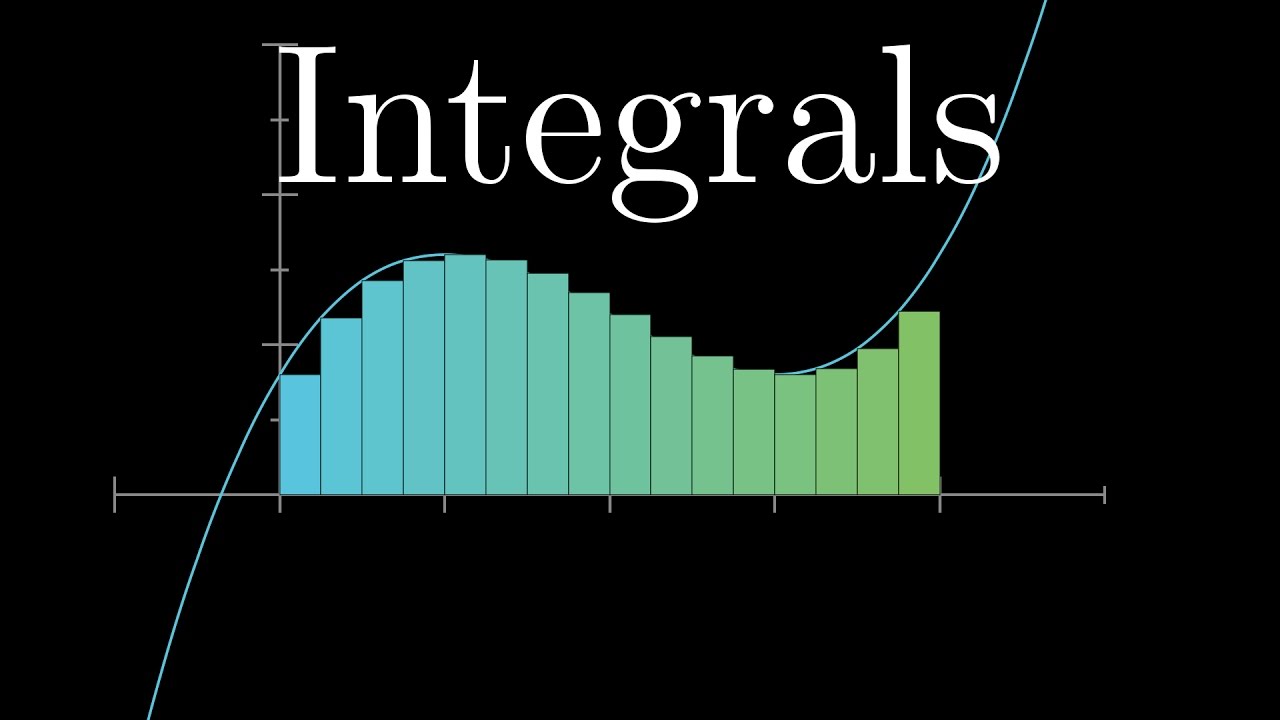
Intuition for integrals, and why they are inverses of derivatives.
Help fund future projects: https://www.patreon.com/3blue1brown
An equally valuable form of support is to simply share some of the videos.
Special thanks to these supporters: http://3b1b.co/lessons/integration#thanks
Check out the Art of Problem Solving: https://aops.com/3blue1bro...
woven cedar
indefinite integral is just the short way, mathematicians just find shorter ways to do stuff
same way how you dont take limits everytime you calculate derivatives
its just essentially 2 tangent points very close to eachother
you take the limit
odd edgeBOT
@shrewd trellis Has your question been resolved?
Channel closed
Closed by @shrewd trellis
Use .reopen if this was a mistake.
odd edgeBOT
Available help channel!
Send your question here to claim the channel.
Remember:
• Ask your math question in a clear, concise manner.
• Show your work, and if possible, explain where you are stuck.
• After 15 minutes, feel free to ping <@&286206848099549185>.
• Type the command .close to free the channel when you're done.
• Be polite and have a nice day!
Read #❓how-to-get-help for further information on how to ask a good question, and about conduct in the question channels.
 naive sierra

 odd edgeBOT
naive sierra
wooden python
odd edgeBOT
naive sierra
wooden python
$4^{x^2} = 4^{(x^2)} \neq (4^x)^2$
clever fjordBOT
Ann
 wooden python
$(4^x)^2 = 4^{2x}$ rather
clever fjordBOT
Ann
 wooden python
so you misread the equation and ended up with a completely wrong working
odd edgeBOT
Channel closed
Closed by @naive sierra
Use .reopen if this was a mistake.
odd edgeBOT
Available help channel!
Send your question here to claim the channel.
Remember:
• Ask your math question in a clear, concise manner.
• Show your work, and if possible, explain where you are stuck.
• After 15 minutes, feel free to ping <@&286206848099549185>.
• Type the command .close to free the channel when you're done.
• Be polite and have a nice day!
Read #❓how-to-get-help for further information on how to ask a good question, and about conduct in the question channels.
 manic grail
Hello im struggling with limit of f/g proof
manic grail

I did this but cant see how to control 1/|g(x)| idk if i should have taken a different approach
wooden python
you should use the fact that l ≠ 0 somehow
wooden python
there exists a nbhd of x_0 in which |g(x)| ≥ |l|/2
manic grail
Can i say |g(x)| > 0?
manic grail
wooden python
there exists a nbhd of x_0 in which |g(x)| ≥ |l|/2
Why?
wooden python
manic grail
Can i say |g(x)| > 0?
you can but it won't help.
wooden python
manic grail
Why?
epsilon-delta defn with epsilon = |l|/2.
manic grail
Wdym nbhd?
wooden python
nbhd = neighborhood
wooden python
gimme a sec to write it out
manic grail
Alr
wooden python

this is the formalism behind it
the informal idea is that g(x) is separated from 0
in some nbhd of x_0
manic grail
Oh wait
ε= |l|/2
Thought you said ε = l/2
Ok yes i see


So like this ?
@wooden python
wooden python
honestly dont feel like reading all that rn sorry
manic grail
Nws
manic grail
manic grail
If someone could review this i think its correct but not sure if i made any mistake
odd edgeBOT
@manic grail Has your question been resolved?
Channel closed
Closed by @manic grail
Use .reopen if this was a mistake.
Available help channel!
Send your question here to claim the channel.
Remember:
• Ask your math question in a clear, concise manner.
• Show your work, and if possible, explain where you are stuck.
• After 15 minutes, feel free to ping <@&286206848099549185>.
• Type the command .close to free the channel when you're done.
• Be polite and have a nice day!
Read #❓how-to-get-help for further information on how to ask a good question, and about conduct in the question channels.
mystic saffron
I have so far been able to find that (log(a))^3/2 = (3 +sqrt(5))/2 and (log(b))^3/2 = (3-sqrt(5))/2
 odd edgeBOT
mystic saffron
I have so far been able to find that (log(a))^3/2 = (3 +sqrt(5))/2 and (log(b))^...
odd edgeBOT
mystic saffron
I have so far been able to find that (log(a))^3/2 = (3 +sqrt(5))/2 and (log(b))^...
 narrow crypt
[ \log_\alpha \beta \cdot \log_\beta \alpha = 1]
clever fjordBOT
k
 narrow crypt
would cubing this work

 wispy river
narrow crypt
would cubing this work
wispy river
narrow crypt
would cubing this work
it works
narrow crypt
[ 3(\log_\alpha \beta)^{4/3}(\log_\beta \alpha)^{2/3} = 3\log_\alpha\beta^{2/3} \cdot 1]
clever fjordBOT
k
 wispy river
(a+b)^3 = a^3 + b^3 + 3ab(a+b) this form helps
narrow crypt
clever fjord
**k**
@mystic saffron
mystic saffron
yes that works
mystic saffron
mystic saffron
I have so far been able to find that (log(a))^3/2 = (3 +sqrt(5))/2 and (log(b))^...
is there a way to move forward using this piece of information
wooden python
was nobody going to suggest putting x := log_alpha(beta)^(1/3) or sth
wispy river
wooden python
was nobody going to suggest putting x := log_alpha(beta)^(1/3) or sth
using log properties is easier here
wispy river
wooden python
was nobody going to suggest putting x := log_alpha(beta)^(1/3) or sth
I think op has found the roots already using this method
 meager palm
I have to do 5 chapters in a few hours for my maths exam tmr what shuld i do? 😭
mystic saffron
wooden python
was nobody going to suggest putting x := log_alpha(beta)^(1/3) or sth
i did x := log_alpha(beta)^(2/3) to find the roots
wispy river
mystic saffron
i did x := log_alpha(beta)^(2/3) to find the roots
thats why you got 3+root5/2 and 3-root5/2 right
mystic saffron
yes
wispy river
you can cube them to get the answer as well
mystic saffron
wait let me try
narrow crypt
meager palm
I have to do 5 chapters in a few hours for my maths exam tmr what shuld i do? 😭
lock the tf in and !occupied
!occupied
odd edgeBOT
Someone else is already using this help channel. If you need help with a question, please open your own help channel/thread (see #❓how-to-get-help for instructions).
odd edgeBOT
Channel closed
Closed by @dense stirrup
Use .reopen if this was a mistake.
odd edgeBOT
Available help channel!
Send your question here to claim the channel.
Remember:
• Ask your math question in a clear, concise manner.
• Show your work, and if possible, explain where you are stuck.
• After 15 minutes, feel free to ping <@&286206848099549185>.
• Type the command .close to free the channel when you're done.
• Be polite and have a nice day!
Read #❓how-to-get-help for further information on how to ask a good question, and about conduct in the question channels.
 tiny pendant
 odd edgeBOT
tiny pendant
tiny pendant
odd edgeBOT
tiny pendant
tiny pendant
first i got this

the only valid inequality which still allows the above expression to hold true are x=y>z and x=y=z
right>
so whats the final answer
wooden python
lemme double-check that...
tiny pendant
tiny pendant
first i got this
im not making any progress after this
216000=2^6 x 3^3 x 5^3'
wooden python
so it's either x=y=z or x<y=z or y<x=z or z<x=y
i.e. two are equal and the third is lower, or all 3 are equal
000 111 222 333 444 555 666
011 101 110
022 122 202 212 220 221
033 133 233 303 313 323 330 331 332
044 ...
yea
so how will we get to the final answer
wooden python
well, you break a, b and c into their prime factorizations
$a = 2^{x_1} 3^{x_2} 5^{x_3}, b = 2^{y_1} 3^{y_2} 5^{y_3}, c =2^{z_1} 3^{z_2} 5^{z_3}$
clever fjordBOT
Ann
 wooden python
(x_1, y_1, z_1) must be a trio satisfying the inequality condition you worked out and with all numbers between 0 and 6 inclusive
(x_2, y_2, z_2) and (x_3, y_3, z_3) must be the same but with the numbers between 0 and 3
odd edgeBOT
@tiny pendant Has your question been resolved?
odd edgeBOT
Channel closed
Closed due to timeout
Use .reopen if this was a mistake.
Available help channel!
Send your question here to claim the channel.
Remember:
• Ask your math question in a clear, concise manner.
• Show your work, and if possible, explain where you are stuck.
• After 15 minutes, feel free to ping <@&286206848099549185>.
• Type the command .close to free the channel when you're done.
• Be polite and have a nice day!
Read #❓how-to-get-help for further information on how to ask a good question, and about conduct in the question channels.
 odd edgeBOT
 slow cradle

 clever fjordBOT
ImOakley
 slow cradle
 glass vault
You expanded the denominator wrong
glass vault
You expanded the denominator wrong
thats not me
so basically
can i not just simplify the 3^x at the start
 minor bronze
im pretty sure $ 2^{9^x} $ is not equal to $2^{(9^x)}$
clever fjordBOT
hecker
 slow cradle
bro idrk
i got it wrong mysel
i tried to make the the numerator and denominator
have 3^x
glass vault
Oh wait its $3(3^x)=3^{x+1}$
clever fjordBOT
ImOakley
 glass vault
My bad
glass vault
Yeah thats fine
glass vault
Because then you can simplify it
glass vault
$\frac{x^a}{x^b}=x^{a-b}$
clever fjordBOT
ImOakley
 glass vault
Yes
glass vault
Doesnt matter