#help-19
1 messages · Page 188 of 1
 ocean bramble
x is measured as an arc length. As in the ratio of the arc length covered divided by the radius
so x is usually called "angle"
 shrewd trellis
Is sin x same as sin theta?
ocean bramble
tan^-1(x) means the arc with a tangent of x
shrewd trellis
 wooden cypress
yes, x and theta are just variables
wooden cypress
yes, x and theta are just variables
So for finding reciprocal of sin theta, wee get the value and do 1/that value we just found from sin theta
ocean bramble
so tan^-1(tan[x]) means the arc with a tangent of the tangent of x, which is x
wooden cypress
shrewd trellis
So for finding reciprocal of sin theta, wee get the value and do 1/that value we...
If you do that you will get cosec theta yes
shrewd trellis
wooden cypress
If you do that you will get cosec theta yes
But how is that same to hyp/opp
Do they give u same value?
wooden cypress
If you look at the diagram I sent
sin x = opp / hyp
So cosec x = 1 / sin x = hyp / opp
Everything you need is in the diagram and in this message
wooden cypress
Yeah exactly
a, b, and c aren't exactly defined
Because you could for example double them all
shrewd trellis
It looks at similar triangles that has same ratios
wooden cypress
But their ratios are defined, and those ratios are the trig functions
wooden cypress
Ye
shrewd trellis
wooden cypress
a, b, and c aren't exactly defined
Wdym
wooden cypress
Well if for example x = 45 degrees
Then you could draw a triangle where a = b = 1, and c = sqrt 2
But you could also draw a triangle where a = b = 2, and c = 2 sqrt 2
So you can't just say what a is
But in both cases, a / b = 1
So tan (45 degrees) is 1
shrewd trellis
wooden cypress
Then you could draw a triangle where a = b = 1, and c = sqrt 2
Why did u make a = b
shrewd trellis
I mean what I’m trying to say is I don’t understand what you mean
wooden cypress
Okay let's say we've got a triangle like this

Exactly the same as the previous diagram, but with x = 45 degrees
Then what is the angle marked with a ?
shrewd trellis
Well we could find that by trig ratios if atleast two sides of the triangles are known
wooden cypress
Nope you don't need any trig
Just basic geometry
But you're right
If you know two of the sides, you can work out the other angle with trig
What do the angles in a triangle add up to?
shrewd trellis
180
shrewd trellis
40
wooden cypress
Try again
shrewd trellis
55
shrewd trellis
45
wooden cypress
Much better
So this is what the triangle looks like now

What kind of triangle is it?
shrewd trellis
Right angle triangle
shrewd trellis
Isiscikes
shrewd trellis
Iscoscoles
wooden cypress
But yes it is
It's okay nobody really knows how to spell it haha
So what does that tell you about a and b?
shrewd trellis
They are equal
wooden cypress
Exactly
wooden cypress
shrewd trellis
Why did u make a = b
Does that answer your question?
shrewd trellis
Oh yep, now I need to understand after that
shrewd trellis
wooden cypress
a, b, and c aren't exactly defined
I don’t understand this and the sentence after it
wooden cypress
My honest advice would be to really make sure you have a solid handle on geometry like that before you move on to trig, otherwise it might just confuse you
But the fact that a = b means that tan 45 = 1
Okay yeah
so
If we want, we can just declare that a = 1
That make sense?
Then from that, you know what b is
Then you can use pythagoras to work out what c is
But equally, you can declare that a = 2, or 3, or any other (positive) number you can possibly think of
Then from that, you know what b is
Then you can use pythagoras to work out what c is
shrewd trellis
wooden cypress
If we want, we can just declare that a = 1
Why did u make a =1
shrewd trellis
Oh
wooden cypress
Just some positive number
1 is just a really nice number to work with
Often, for reasons that won't make sense to you for another few years, mathematicians like to set c = 1
That has some pretty nice properties
But ultimately it doesn't matter one bit
shrewd trellis
wooden cypress
So you can't just say what a is
U said something about these variables aren’t defined, and why can’t we say it’s just what a is
wooden cypress
wooden cypress
Then you could draw a triangle where a = b = 1, and c = sqrt 2
Well in this example, a = 1
wooden cypress
wooden cypress
But you could also draw a triangle where a = b = 2, and c = 2 sqrt 2
But in this example, a = 2
Those are both right angled triangles with an angle of 45 degrees
But they don't have the same a value
So the angle alone is not enough to work out a
You need more information than that
 odd edgeBOT
@shrewd trellis Has your question been resolved?
Channel closed
Closed due to timeout
Use .reopen if this was a mistake.
 Available help channel!
Send your question here to claim the channel.
Remember:
• Ask your math question in a clear, concise manner.
• Show your work, and if possible, explain where you are stuck.
• After 15 minutes, feel free to ping <@&286206848099549185>.
• Type the command .close to free the channel when you're done.
• Be polite and have a nice day!
Read #❓how-to-get-help for further information on how to ask a good question, and about conduct in the question channels.
 maiden delta
help
odd edgeBOT
maiden delta
help
 green elm
maiden delta
green elm
maiden delta
can i get some help
 agile sinew
what's ur question 🙏
green elm
not unless you ask a question
 turbid parcel
@maiden delta
 maiden delta
divide it
turbid parcel
by?
turbid parcel
and it would become?
turbid parcel
but i gave you 3 divided by 6 😄
maiden delta
so 2
turbid parcel
does this make sense to you
 maiden delta
how did the 6 turn into 3x2
turbid parcel
what is 3x2 equal to
maiden delta
6
turbid parcel
so can i rewrite 6 as 3*2
maiden delta
but ontop u just copied 3 right?
turbid parcel
does this make sense to you
 turbid parcel
in a fraction if you multiply or divide BOTH the top (numerator) and bottom (denominator) by the SAME thing the fraction value remains the same
so let's say i had 1/2

2/4 is the same thing as 1/2
maiden delta
wait so basically 3 had an x and u cut 3 from x and x is a visual representation of 1 so u wrote one and u cut 3 from x2 so u copied 2
or
turbid parcel
x was a multiply sign...
maiden delta
when u cut top 3 and cut down 3 it remained x2 but since theres no top number x became 1 and 2 become 2
maiden delta
turbid parcel
x was a multiply sign...
oh i thought it was a variable
man nun of these making sense to me
i still dont get this
 turbid parcel
maiden delta
i still dont get this
turbid parcel
maiden delta
i still dont get this
we'll get to it
you need to understand fractions first
your core concept is lacking which we need to address

this is what i did if the 3x2 didnt make sense to you
3 divided by 3 is 1
6 divided by 3 is 2
maiden delta
3 divide by 3 is 1 and 6 by 3 is 2
turbid parcel
so we got 1/2
yes brilliant
now
do you know that a^2 means a*a
a multiplied by a
maiden delta
a squared?
turbid parcel
yes
maiden delta
yes
maiden delta
yea
turbid parcel
so a^4 would be
maiden delta
for every * is a squared or an exponent?
so aaa* is a cubed
i get it
yo
whered u go
maiden delta
ok
turbid parcel
now
maiden delta
ok
turbid parcel
we've established that a^2 is a times a
what if i asked you

evaluate this
what can we do here
maiden delta
a times a and a

 maiden delta
so 0 times 0 and 0?
turbid parcel
we could just cancel the 3s because what we were doing was
dividing by 3 on top and at the bottom
correct?
and we were left with 1
maiden delta
turbid parcel
does this make sense to you
this?
turbid parcel
maiden delta
this?
yes
 sturdy cape
maiden delta
so 0 times 0 and 0?
sturdy cape
maiden delta
so 0 times 0 and 0?
[dividing by zero is almost always dangerous]
maiden delta
sturdy cape
[dividing by zero is almost always dangerous]
nothing times nothing
maiden delta
turbid parcel
yes
yea i get it
turbid parcel
maiden delta
yea i get it
perfect so now we go to your question
a^4/a^7 can be written out as
(i want you to write it out)
sturdy cape
That's fine, but seeing that it came after a fraction, it reads like you plugged in a =
0, so be careful]
maiden delta
a times a times a times a times a times a times a times a times a times a times a times a times however many left
 turbid parcel

 maiden delta
im back
maiden delta
turbid parcel
1/3?
maiden delta
yea
turbid parcel
if you dont mind me asking, how old are you?
maiden delta
il get to that after we answer this
turbid parcel
we already did
 turbid parcel
and i waited until we were done answering it so i could ask you
turbid parcel
turbid parcel
1/(a cubed)
what was this an answer to
maiden delta
1 over a cubed?
maiden delta
14
turbid parcel
ah alright no worries
odd edgeBOT
If you are done with this channel, please mark your problem as solved by typing .close
maiden delta
im gonna ask more later
turbid parcel
alright
odd edgeBOT
@maiden delta Has your question been resolved?
Channel closed
Closed by @maiden delta
Use .reopen if this was a mistake.
odd edgeBOT
Available help channel!
Send your question here to claim the channel.
Remember:
• Ask your math question in a clear, concise manner.
• Show your work, and if possible, explain where you are stuck.
• After 15 minutes, feel free to ping <@&286206848099549185>.
• Type the command .close to free the channel when you're done.
• Be polite and have a nice day!
Read #❓how-to-get-help for further information on how to ask a good question, and about conduct in the question channels.
 humble jungle
Can someone tell me when do we consider the special case of (n-1)!/2 in circular permutations?
odd edgeBOT
humble jungle
Can someone tell me when do we consider the special case of (n-1)!/2 in circular...
humble jungle
I can't visualise it
Ik it happens when mirror images are equal like on a necklace
But how exactly it differs from the case where we take (n-1)!
Like isn't that a circular permutation too
I think (n-1)! Is used when anti clockwise and clockwise direction matters
 pallid badge
Its because you can flip a necklace or a garland
humble jungle
And (n-1)!/2 is used when it doesnt matter
When you can flip in the third 3rd dimension
And make anti clockwise equal to clockwise
humble jungle
pallid badge
Its because you can flip a necklace or a garland
1,2,3 and 1,3,2 are different in table arrangement
But why are they different
U can just go from the opposite direction in 1,3,2 and they will be same
Ik in a necklace u can go from both directions
Because they can be "flipped over"
And "tables can't be flipped over"
Ugh
So direction in circular arrangement only matters till they can't be flipped over
And made equal?
odd edgeBOT
@humble jungle Has your question been resolved?
humble jungle
Why is combination with unlimited repetition similar to permutation with limited repetition

 narrow crypt
humble jungle
Why is combination with unlimited repetition similar to permutation with limited...
narrow crypt
humble jungle
Why is combination with unlimited repetition similar to permutation with limited...
i beg ur pardon?
humble jungle
narrow crypt
i beg ur pardon?
Combination with unlimited repetition => n+(r-1)C(r-1) has the same form as the Mississippi problem where u scramble all the letters and find all the arrangements of the word
Am i noticing

Or completely off

narrow crypt
this means that one 's' is not the same as the other 's'
humble jungle
U gotta account for identical letters
humble jungle
Isn't it similar to combination with unlimited repetition
Like the identical chocolate distribution problem
Nvm I'm holding this channel for silly shit that's probably not true
.close
odd edgeBOT
Channel closed
Closed by @humble jungle
Use .reopen if this was a mistake.
 glacial loom
does anyone know where i can find solutions to serge lang basic maths????
odd edgeBOT
Available help channel!
Send your question here to claim the channel.
Remember:
• Ask your math question in a clear, concise manner.
• Show your work, and if possible, explain where you are stuck.
• After 15 minutes, feel free to ping <@&286206848099549185>.
• Type the command .close to free the channel when you're done.
• Be polite and have a nice day!
Read #❓how-to-get-help for further information on how to ask a good question, and about conduct in the question channels.
 echo relic
If the divider is removed, what is the height of the water
 odd edgeBOT
What step are you on?
1. I don't know where to begin.
2. I have begun but got stuck midway.
3. I got an answer but I was told that it's wrong.
4. I got an answer and would like my work checked.
5. I have a question about someone else's work/solution.
6. I have completed the problem and don't need help anymore. Thank you.
7. None of the above
@echo relic
 wooden python
hmm OP is offline
narrow crypt
i got ghosted ):
odd edgeBOT
@echo relic Has your question been resolved?
odd edgeBOT
Channel closed
Closed due to timeout
Use .reopen if this was a mistake.
Available help channel!
Send your question here to claim the channel.
Remember:
• Ask your math question in a clear, concise manner.
• Show your work, and if possible, explain where you are stuck.
• After 15 minutes, feel free to ping <@&286206848099549185>.
• Type the command .close to free the channel when you're done.
• Be polite and have a nice day!
Read #❓how-to-get-help for further information on how to ask a good question, and about conduct in the question channels.
 frail lintel
 odd edgeBOT
frail lintel
frail lintel
odd edgeBOT
frail lintel
frail lintel
Can some please help me with this question
Also the angle which angle is it
Theta or alpha

 tacit haven
ive never seen this in my life but im just guessing its the angle of intersection between the tangent lines
narrow crypt
,rccw
 clever fjordBOT

 cold cobalt
Bro what chapter is this 😭
frail lintel
tacit haven
ive never seen this in my life but im just guessing its the angle of intersectio...
Ahh
frail lintel
cold cobalt
Bro what chapter is this 😭
Application of derivatives
narrow crypt
,rccw
clever fjordBOT
 frail lintel
Can i do it any other way
cold cobalt
Then find the other from putting it in other eq
cold cobalt
frail lintel
Can i do it any other way
How do u wanna do it
Show full working from the start
cold cobalt
,rccw
clever fjordBOT
 cold cobalt
Theek toh kar rahe the
frail lintel
Ah nvm i got it....i can jus substitute it as a cos theta and b sin theta
cold cobalt
U just have to combine this both
frail lintel
Ahhh
cold cobalt
frail lintel
Ah nvm i got it....i can jus substitute it as a cos theta and b sin theta
Alright ig
frail lintel
.close
odd edgeBOT
Channel closed
Closed by @frail lintel
Use .reopen if this was a mistake.
Available help channel!
Send your question here to claim the channel.
Remember:
• Ask your math question in a clear, concise manner.
• Show your work, and if possible, explain where you are stuck.
• After 15 minutes, feel free to ping <@&286206848099549185>.
• Type the command .close to free the channel when you're done.
• Be polite and have a nice day!
Read #❓how-to-get-help for further information on how to ask a good question, and about conduct in the question channels.
odd edgeBOT
 frigid isle
Wtf
odd edgeBOT
Channel closed
Channel closed due to the original message being deleted.
If you did not intend to do this, please open a new help channel,
as this action is irreversible, and this channel may abruptly lock.
Available help channel!
Send your question here to claim the channel.
Remember:
• Ask your math question in a clear, concise manner.
• Show your work, and if possible, explain where you are stuck.
• After 15 minutes, feel free to ping <@&286206848099549185>.
• Type the command .close to free the channel when you're done.
• Be polite and have a nice day!
Read #❓how-to-get-help for further information on how to ask a good question, and about conduct in the question channels.
 wide pollen
how can i proof that this polynomial have no roots in the interval (−∞,−1]
odd edgeBOT
wide pollen
how can i proof that this polynomial have no roots in the interval (−∞,−1]

 narrow crypt
Derivative?
wide pollen
frigid isle
Just check where the function is decreasing
i need to show that theres no solutions for px=0 in this interval
(−∞,−1]
i cant differentiate a function yet
narrow crypt
So u can only use limit?
wide pollen
yep
narrow crypt
U can’t use differentiation?
wide pollen
no
narrow crypt
The main idea that I have is to show that the function is bounded below by 1 ;-;
Over that interval
wide pollen
i cant use yet upper/lower bounds if thats what you mean.. :/
wide pollen
narrow crypt
The main idea that I have is to show that the function is bounded below by 1 ;-;
.
wide pollen
only hints plz btw
narrow crypt
This function is x^4 - x shifted up by 1
wide pollen
:/
frigid isle
wide pollen
i need to show that theres no solutions for px=0 in this interval
Just show
That the function decreases/increases in that interval
narrow crypt
we cant use derivative ):
narrow crypt
can u use that?
wide pollen
cant anything related to derivatives
wide pollen
frigid isle
U could also just lmvt
so cant use that
 merry finch
,w x^4 - x - 1
clever fjordBOT


 narrow crypt
it is true
wide pollen
btw showing that there are roots between other intervals was pretty easy using intermediate value theorem
narrow crypt
narrow crypt
x + 1 = x^4
So there should be no intersection
merry finch
ooh can you show that there doesn't exist a solution between -2 and -1
narrow crypt
narrow crypt
x + 1 = x^4
Or lhs is negative and rhs is positive so no possible intersection
merry finch
if you can then you can use cauchy's bound to show all solutions must be between -1 and 2 meaning there are no solutions in -∞ and -1
frigid isle
wide pollen
cant anything related to derivatives
Oof
narrow crypt
narrow crypt
x^4 > x + 1 for x < -1
@wide pollen is this a valid response
narrow crypt
merry finch
if you can then you can use cauchy's bound to show all solutions must be between...

merry finch
hey it was a good idea, if the problem was from -∞ to -2 you could check -2 then use cauchy's bound
narrow crypt
frigid isle
Idk what is the use of restricting students
To uhh
I don’t even know what a Cauchy hound is😭
Is it from ra
frigid isle
narrow crypt
To uhh
😨😨😨
merry finch
1 + max {|a_n-1/a_n|, |a_n-2/a_n|, ..., |a_0/a_n|}
narrow crypt
frigid isle
😨😨😨
Unoptimize a project
wide pollen
cant use cauchy didnt learn it yet
frigid isle
💀
narrow crypt
narrow crypt
x^4 > x + 1 for x < -1
How abt this 🥀
merry finch
that's the upper bound for the distance of all roots in any complex polynomials
frigid isle
merry finch
that's the upper bound for the distance of all roots in any complex polynomials
U think they would let the use of cauchy but not derivatives
wide pollen
narrow crypt
How abt this 🥀
checking it
wide pollen
lmaoo
wide pollen
frigid isle
what are u allowed to do
in calculus one we reached continous of functions
frigid isle
If i was u i would go to the teacher and ask he/she to plot the entire graph without the use of anything but basic arithmetic 🗣️🗣️
wide pollen
sry for my bad english
narrow crypt
frigid isle
If i was u i would go to the teacher and ask he/she to plot the entire graph wit...
Built like desmos😎
wide pollen
frigid isle
Not allowed
its just week 2 of calculus one :/
narrow crypt
wide pollen
checking it
So..
frigid isle
So only limits are allowed?
 wide pollen
yes
wide pollen
narrow crypt
Limits + continuity
.
wide pollen
narrow crypt
x^4 > x + 1 for x < -1
how can i prove it
narrow crypt
x^4 >= 0 is true in general
narrow crypt
Yes
narrow crypt
narrow crypt
x^4 >= 0 is true in general
Since x < -1
narrow crypt
narrow crypt
Since x < -1
Might want to rearrange this👀
narrow crypt
narrow crypt
x^4 >= 0 is true in general
With this
wide pollen
ok just a secd
@narrow crypt is it smth like that

how can i prove better the green barracks?
narrow crypt
Equality only holds when x = 0
Since x is never 0 here
Strictly inequality is allowed
wide pollen
oh and thats it?
wide pollen
narrow crypt
Equality only holds when x = 0
can i just say it in words
 amber veldt
narrow crypt
amber veldt
narrow crypt
Wonderful
wide pollen
.close
odd edgeBOT
Channel closed
Closed by @wide pollen
Use .reopen if this was a mistake.
odd edgeBOT
Available help channel!
Send your question here to claim the channel.
Remember:
• Ask your math question in a clear, concise manner.
• Show your work, and if possible, explain where you are stuck.
• After 15 minutes, feel free to ping <@&286206848099549185>.
• Type the command .close to free the channel when you're done.
• Be polite and have a nice day!
Read #❓how-to-get-help for further information on how to ask a good question, and about conduct in the question channels.
 dire belfry
I'm learning about improper integrals of type 2 in my second semester at university. One of the examples in the lecture slides shows a function with a discontinuity at a point c∈(a,b), and they write that f(x)is continuous on (a,c) and (c,b)
But this confused me, from my understanding, writing (a,c) and (c,b) implies that f(x) is not defined at a and b either, which would make both sub-integrals improper. Wouldn't it be more accurate to write [a,c)and (c,b] instead? That way, it's clear the only discontinuity is at c, and f(x) is fine at the endpoints.
Is there a reason why my lecturer used round brackets.
 odd edgeBOT
dire belfry
I'm learning about improper integrals of type 2 in my second semester at univers...
sturdy cape
dire belfry
I'm learning about improper integrals of type 2 in my second semester at univers...
odd edgeBOT
dire belfry
I'm learning about improper integrals of type 2 in my second semester at univers...
sturdy cape
dire belfry
I'm learning about improper integrals of type 2 in my second semester at univers...
Logically, the sum of the area under the curve at the point a (i.e. a singular point) is fundamentally 0
Because the interval [a,a] = {a} has measure 0
It's slightly bleeding into Measure Theory (cf. Lebesgue integration) at this point, suffice it to say that we don't necessarily have to have the boundaries explicitly defined on the function for it to be integrable
Thus, integrating "from a to b" amounts to intgrating over the open interval (a,b)
It's not that f(a) and f(b) don't exist; it's more that it doesn't matter if they don't
The definition here is trying to explain something related but essentially different
Namely, even if the interval you're integrating over has a discontinuity somewhere (call it c), we can still integrate it, but we need to play it safe
The limits there have to be specified anyways because the two limits don't necessarily have to agree
odd edgeBOT
Channel closed
Closed by @dire belfry
Use .reopen if this was a mistake.
odd edgeBOT
Available help channel!
Send your question here to claim the channel.
Remember:
• Ask your math question in a clear, concise manner.
• Show your work, and if possible, explain where you are stuck.
• After 15 minutes, feel free to ping <@&286206848099549185>.
• Type the command .close to free the channel when you're done.
• Be polite and have a nice day!
Read #❓how-to-get-help for further information on how to ask a good question, and about conduct in the question channels.
 covert root
$\lim _{x\to 1+}\left(sin\left(3x-3\right)^{ctg\left(3x-3\right)}\right)$
clever fjordBOT
Rubix
 covert root
first natural log then lhopital?
 stable sequoia
ctg as in cot?
covert root
yes
or what if its taken as x^0 = 1
since one is from the right
symbolab and wolfram cant solve this
covert root
covert root
first natural log then lhopital?
and by this route i still get indeterminate forms after first derivatives
odd edgeBOT
@covert root Has your question been resolved?
 woeful vine
covert root
and by this route i still get indeterminate forms after first derivatives
woeful vine
covert root
and by this route i still get indeterminate forms after first derivatives
Can you show?
covert root
 woeful vine
L'Hôpital rule is for ratios, not for products, you can't just apply it to cot(3x-3)log(sin(3x-3)) like that
 woeful vine
do you know what L'Hôpital's rule says?
covert root
we find the derivative of the ratios
woeful vine
not really, no
covert root
if its 0/0 or inf/inf
woeful vine
(Under some right hypotheses)
$$
\lim_{x\to x_0} \frac{f(x)}{g(x)} = \lim_{x \to x_0} \frac{f'(x)}{g'(x)}
$$
clever fjordBOT
Luigi
 woeful vine
that is not the derivative of the ratio, but the ratio of the derivatives
covert root
my bad fam
lemme resolve
We good fam?

Think we good, sorry for my braindead theorem executions
woeful vine
you missed a ⨯3 in the derivative of the denominator
also, the derivative of tan is sec², not csc²
remember also that whatever you get is not the final result, you applied log at the beginning, so you need a final exp
covert root
Right thanks
woeful vine
Just have to have to fix the mistakes I mentioned
 woeful vine
There are still few weird steps
covert root
I didnt know what to do with 3cos^3/3sin so i went another way
woeful vine
red --> that should not be an equal sign, you want to say “let's study lim log (...)”
blue --> just what happened there?
 woeful vine
covert root
I didnt know what to do with 3cos^3/3sin so i went another way
woeful vine
covert root
I didnt know what to do with 3cos^3/3sin so i went another way
what's cos³(3x-3) as x --> 1⁺?
woeful vine
blue doesn't make much sense
covert root
Wait
woeful vine
you have cos³(3x-3)/sin(3x-3), what do the numerator and denominator tend to as x --> 1⁺?
covert root
1/0
woeful vine
specifically 1/0⁺
 woeful vine
covert root
so +inf?
woeful vine
covert root
so +inf?
yes
covert root
this is what i did, i fixed my mistake and still get cos^2 of (3x-3)/ 3sin(3x-3)
woeful vine
covert root
this is wrong
covert root
so the result is e^inf == inf
covert root
yeah
woeful vine
covert root
this is what i did, i fixed my mistake and still get cos^2 of (3x-3)/ 3sin(3x-3)
this also doesn't track, 3 should cancel out and it should be cos³
(Note that writing “cos^2 of (...)” makes it sound like the whole thing coming is the argument of cos², which I don't think is what you meant)
covert root
yeah fair, forgot the 3, in this case however it doesnt change the outcome
think thats it, its inf
woeful vine
but if it did you would be like “why is this wrong?”
you can't know if something changes the outcome until someone tells you the correct outcome
Just saying, let's try to avoid computational mistakes
covert root
im not justifying my mistakes xd just higlighting them to be clear
thanks a lot you've been very helpful
.close
odd edgeBOT
Channel closed
Closed by @covert root
Use .reopen if this was a mistake.
odd edgeBOT
Available help channel!
Send your question here to claim the channel.
Remember:
• Ask your math question in a clear, concise manner.
• Show your work, and if possible, explain where you are stuck.
• After 15 minutes, feel free to ping <@&286206848099549185>.
• Type the command .close to free the channel when you're done.
• Be polite and have a nice day!
Read #❓how-to-get-help for further information on how to ask a good question, and about conduct in the question channels.
 sharp bridge
it said the answer was (−∞,1)∪(3,4).
 odd edgeBOT
sharp bridge
it said the answer was (−∞,1)∪(3,4).
odd edgeBOT
sharp bridge
it said the answer was (−∞,1)∪(3,4).
 quasi sparrow
do you know what decreasing means?
sharp bridge
dont be condescending in a tutoring server
quasi sparrow
sharp bridge
dont be condescending in a tutoring server
i wasn't being condescending
simple yes would be fine
 quasi sparrow
no, not all intervals can be written as (x, y)
quasi sparrow
sharp bridge
dont be condescending in a tutoring server
also this isn't a "tutoring server"
no one's getting paid here
sharp bridge
im not gonna argue the logistics of tutoring w you i just want help w my math
quasi sparrow
sharp bridge
dont be condescending in a tutoring server
¯_(ツ)_/¯
sharp bridge
bro are you trolling what is happening
quasi sparrow
don't say so many wrong things
sharp bridge
jesus i bet your fun at parties
quasi sparrow
 quasi sparrow
sharp bridge
if the -∞ is x where did 3 come from
quasi sparrow
sharp bridge
if the -∞ is x where did 3 come from
so what's with not understanding the 3?
quasi sparrow
do you know what $\cup$ symbol means?
clever fjordBOT
riemann
 quasi sparrow
quasi sparrow
quasi sparrow
do you know what decreasing means?
that's exactly why i wasn't being condescending here
sharp bridge
nah go somewhere else
quasi sparrow
be less snowflakey for the next helper
 radiant oriole
sharp bridge
it said the answer was (−∞,1)∪(3,4).
radiant oriole
sharp bridge
it said the answer was (−∞,1)∪(3,4).
Its - infinity to 1 because 1 is where it starts increasing i think
and since this is an angled line it goes infinitely forever that way

i think
sharp bridge
im on 2
sharp bridge
thanks thouth
sharp bridge
radiant oriole
its just - infinity and 3 then for that one
yeah but am i mapping x,x
sharp bridge
well like normally it would be mapped x,y for data points
so i put (-infinity,-6)
x,y
how did you know to use x,x
radiant oriole
its just like at what x value does y start decreasing and what x value does it stop decreasing
sharp bridge
ohh
radiant oriole
its just asking when x starts and stops decreasing, so both values should be x i think
 north sparrow
sharp bridge
it said the answer was (−∞,1)∪(3,4).
north sparrow
sharp bridge
it said the answer was (−∞,1)∪(3,4).
(x,y) can describe two things a point in the plane and an interval of values like here (-infty,1) is the set of x values from -infty to 1 excluding 1
the U symbol is used to combine two intervals
sharp bridge
yea did a little chatgpt refresher on union and intersection totally forgot that was a thing
 north sparrow
sharp bridge
are intervals not written (x,y)?
north sparrow
sharp bridge
are intervals not written (x,y)?
here it's assumed the parabola y(x) keeps going up when x becomes less than 0. All they want then is for you to describe the set of x values you could plug in y(x). Maybe this picture will make more sense
sharp bridge
I put (-inf,1)U(1,4)
north sparrow
 sharp bridge
yea that makes way more sense
radiant oriole
i mean that one is just (1,4) right
cause it starts decreasing at 1 and stops at 4
north sparrow
sharp bridge
I put (-inf,1)U(1,4)
idk why you put (-inf,1) but (1,4) is good
sharp bridge
do i ignore the infinity on these?
sharp bridge
what about the other infinity??
radiant oriole
wdym
 red perch
if is - , its downwards (which decreasing)
north sparrow
red perch
we use f'(x)=0
f is not explicitely given
sharp bridge
like this one is (-6,-2)U(1,inf)

so why is infinity mapped here and not the other one
radiant oriole
because this one is asking for increasing
and you can tell that it starts increasing infinitely at 1
and as far as you know it doesnt stop
sharp bridge
no i understand that but theres no difference between this being pos infinity and the last one including negative infinity do i just ignore the left side infinity? im confused
radiant oriole
For this one, if you increase x it goes up until 1

and then it keeps going up
at 5
so when its at 5 and it keeps going up itll go to 6,7,8 etc, these are all positive numbers, there cant be a negative number there
but for the other one
 sharp bridge
but wouldnt it start at neg infinity
north sparrow
increasing means that whatever x and y you pick on this range of values x > y imply f(x) >= f(y).
radiant oriole
the parabola starts decreasing at negative infinity
lets just say that it starts decreasing at x = -2,
north sparrow
but that might be more confusing
north sparrow
 sharp bridge
i appreciate the help[
radiant oriole
🙂
sharp bridge
i finished it
i understand all of it now i was like subconsciously plotting y everytime
1 assignment down 7 more and the exam to go
north sparrow
.close
odd edgeBOT
Channel closed
Closed by @north sparrow
Use .reopen if this was a mistake.
odd edgeBOT
✅
north sparrow
!done
odd edgeBOT
If you are done with this channel, please mark your problem as solved by typing .close
sharp bridge
confused as to what im doing here

 limpid adder
sharp bridge
confused as to what im doing here
limpid adder
sharp bridge
confused as to what im doing here
do you understand what (g/f)(x) is saying?
sharp bridge
for reference i missed 6 classes in a row bc i was camping in yellowstone so i just dont know the content its all new to me
limpid adder
oh alr
sharp bridge
limpid adder
do you understand what (g/f)(x) is saying?
no
limpid adder
ok so it means (g/f)(x)=g(x)/f(x)
sharp bridge
are g and f just meaningless variables
limpid adder
oh they are considered functions
sharp bridge
how does the assumption change the problem
limpid adder
like f(x)=x that is a function
g(x)=x^2-1 is another function
the reason why theyre different is because they are different functions
so you assign a different name which is g(x)
the x inside the parenthesis means it is the value you plug in
aka the independent variable
sharp bridge
makes sense
limpid adder
so (g/f)(x) is like a different way of writing g(x)/f(x)
basically you are dividing g(x) by f(x)
sharp bridge
how does the assumption affect the problem
limpid adder
which assumption
sharp bridge
x does not equal 1
limpid adder
its because when you plug x=1 into (g/f)(x) it is undefined
sharp bridge
wym
sharp bridge
im on a new problem now hold on
Note that we had to assume x≠1 , because if x was equal to 1
, we would have had a denominator equal to zero, making the function undefined.
what does this mean in laymans
 velvet gull
What would 5 divided by 0 equal to?
 hidden token
You know that if the denominator of a fraction is 0, it is undefined?
sharp bridge
0
velvet gull
No, it's undefined
 tawny lake
please first write g(x) / f(x)
velvet gull
It does not have an answer
 mystic saffron
sharp bridge
0
mystic saffron
sharp bridge
0
Bro there are certain things u gotta assume and accept in maths to proceed otherwise, u can't solve problems
sharp bridge
huh
ive taken stats and stuff so its not like im incapable i just havent touched algebra since like 10th grade
and i missed 6 lectures
so im teaching myself from scratch
mystic saffron
So basically for fx/gx to be equal to f/g (x), there has to be a condition that is g(x) can't be equal to 0 since dividing by 0 will give an undefined result
mystic saffron
sharp bridge
so im teaching myself from scratch
That's a nice initiative
 abstract harbor
do you know what (g/f) (x) is ?
mystic saffron
mystic saffron
So basically for fx/gx to be equal to f/g (x), there has to be a condition that ...
Do u understand this part?
sharp bridge
cant be 0 bc its impossible?
mystic saffron
sharp bridge
cant be 0 bc its impossible?
See, I'll give u a simple exercise
abstract harbor
sharp bridge
cant be 0 bc its impossible?
yes dividing anything by 0 is impossible, the answer is undefined
mystic saffron
Try dividing 2 by 0
sharp bridge
error
mystic saffron
Do it manually and tell me the answer
mystic saffron
mystic saffron
Do it manually and tell me the answer
Not by any calculator
Try to divide 2 by 0
sharp bridge
uh you physically cant
mystic saffron
sharp bridge
uh you physically cant
Why can't u?
U obviously can
If u go by the assumption dividing by 0 will give 0, u should obviously be able to right?
So let's try dividing it?
2/0
Let's try 0*1
mystic saffron
mystic saffron
Let's try 0*1
We will try to multiply a number with 0 so that we reach 2
Now try to multiply 200
0*200
sharp bridge
still nothing
mystic saffron
0 right?
sharp bridge
im not special needs im just teaching myself from scratch
mystic saffron
Now 999999*0
mystic saffron
sharp bridge
im not special needs im just teaching myself from scratch
Okk bear with me
mystic saffron
mystic saffron
Now 999999*0
What's the answer?
sharp bridge
the number doesnt matter if you x0 its nothing
mystic saffron
Yup
So no matter how big the number u take it's still never gonna be 2
So what is the quotient of the division?
Something that is veeeery large
How large?
We don't know
So we call it undefined
To understand the undefined part u need to go deeper but for now this explanation will be ok for u
abstract harbor
bros really breaking it down
mystic saffron
abstract harbor
bros really breaking it down
I'm trying lol
limpid adder
you could also do this to show that it will always stay 2, therefore having a large number as the answer but it wont be because 0x=0 so we call it undefined
 sharp bridge
i think math theory is gay i just want a decent grade on my exam that i have to take in 9 hours
mystic saffron
limpid adder
you could also do this to show that it will always stay 2, therefore having a la...
Absolutely
abstract harbor
sharp bridge
i think math theory is gay i just want a decent grade on my exam that i have to ...
how well do you understand functions?
sharp bridge
i understand how to translate the problem and simplify it
abstract harbor
sharp bridge
i understand how to translate the problem and simplify it
what do you get
mystic saffron
sharp bridge
i think math theory is gay i just want a decent grade on my exam that i have to ...
Well maths isn't a 1 day thing and more so if u want to understand all the concepts in 9 hrs
So nothing much can help u bro
Good luck
abstract harbor
dw ill take over
limpid adder
you just gotta take things one at a time
sharp bridge
it sjust college algebra you acting like its a death sentence
its not hard i just need the concepts explained so i can identidfy what the steps are on each problem
abstract harbor
sharp bridge
it sjust college algebra you acting like its a death sentence
show me what you've written for the question so far
abstract harbor
sharp bridge
its not hard i just need the concepts explained so i can identidfy what the step...
yeah show me how far you've gotten on the question at hand so I can see how much you understand
if you don't know how to start then that's fine
sharp bridge
gotta download phone discord hold on
limpid adder
you could type it here
abstract harbor
oh no problem you can explain it as well
 limpid adder
oh another question
sharp bridge
yea im on this one
abstract harbor
oh you solved the other one or just pushed it aside for now?
limpid adder
do you know what (f+g)(x) means
sharp bridge
f+g = x?
limpid adder
ok uh
you see how it gives you f(x) and g(x)
those are the functions for f and g
think of f and g as like a name to the function
sharp bridge
yea
abstract harbor
yeah the way i like to think about it
f(x) just means what would F output if we plug x into it
f(x) = x + 1
sharp bridge
so this 1428?
abstract harbor
sharp bridge
so this 1428?
try solve this f(x) = x + 1 where x = 1
or what is f(1)
sharp bridge
 limpid adder
its quite blurry
abstract harbor
sharp bridge
no you don't multiply them
sharp bridge
sry not super legible
abstract harbor
you actually add the functions
 abstract harbor
is this a different question
sharp bridge
yea this is the example
 abstract harbor
let's try to stick to 1 question
abstract harbor
Yes exactly
abstract harbor
yeah f represents whatever equation it's equal to
sharp bridge
so its 116
sharp bridge
sharp bridge
f+g(10)= (x+4)(x^2+2)
this
limpid adder
Addition: $(f+g)(x)=f(x)+g(x)$
Substraction: $(f-g)(x)=f(x)-g(x)$
Multiplication: $(f \cdot g)(x)=f(x) \cdot g(x)$
Division: $\left(\frac{g}{f}\right)(x)=\frac{g(x)}{f(x)}$
clever fjordBOT
ava 💕
 limpid adder
this may help
 abstract harbor
don't be intimidated just stick to what you learned
you can see what each function f and g are equal to
and what you need to do with them
and what you need to substitute
limpid adder
its the same thing but longer equations
sharp bridge
 abstract harbor
 tepid gust
as (6x^2+2x+2/3)*(5x-2/3)*(1/3)
tepid gust
as (6x^2+2x+2/3)*(5x-2/3)*(1/3)
not needed
abstract harbor
sharp bridge
1 sec
north sparrow
sharp bridge
,rccw
clever fjordBOT
 sharp bridge
6(1/3)^2 = 2/3
limpid adder
what is 2.01
sharp bridge
2/3+2/3+2/3
sharp bridge
i think the calc just did it wrong
abstract harbor
2.01 is your answer?
abstract harbor
(2/3 + 2/3 + 2/3) * ( 5/3 - 2/3)
limpid adder
yea
abstract harbor
do this again ^
limpid adder
they did 5/3-2/3
sharp bridge
its 2 i got it
abstract harbor
sharp bridge
its 2 i got it
oh yeah well done
im so confused where 2.01 came from
 abstract harbor
sharp bridge
idk i put it in the calc wrong
abstract harbor
sharp bridge
idk i put it in the calc wrong
oh im not sure if u need a calc for 2/3 + 2/3 + 2/3 lol u can just know its 6/3 which is 2
limpid adder
sharp bridge
you know what to do here
apply what you know
abstract harbor
yeah just ping me when u want ur workings checked
sharp bridge
i put everything in the calc just so i dont do mental math wrong and get the whole question wrong
abstract harbor
sharp bridge
i put everything in the calc just so i dont do mental math wrong and get the who...
do you guys not have non-calc papers in your country?
limpid adder
you can write:
2/3+2/3+2/3=3(2/3)=2
limpid adder
write out f(x) - g(x)
 limpid adder
uh thats wrong lemme get my paper
abstract harbor
sharp bridge
i got 3x^2-6x+3
not quite
you multiplied them?
it says to take them away
sharp bridge
i got it
limpid adder
make sure you distribute here!
 abstract harbor
(3x^2 - 2x + 1) - (-4x + 2)
sharp bridge
yea i added them instead of subtracting them
its always silly shit like that that fucks me ovber
limpid adder
you just need to take your time
abstract harbor
happens to the best of us
abstract harbor
limpid adder
you just need to take your time
ur not at college level and helping a college student?
sharp bridge
the x3 x2 x are all there own variable so i cant divide them
 limpid adder
abstract harbor
ur not at college level and helping a college student?
limpid adder
abstract harbor
ur not at college level and helping a college student?
i self taught myself
abstract harbor
limpid adder
i self taught myself
oh nice
sharp bridge
abstract harbor
ur not at college level and helping a college student?
tbf this is super simple math i just dont remember any of it
limpid adder
sharp bridge
the x3 x2 x are all there own variable so i cant divide them
just put the function over the other one, plug the x value and bam!
abstract harbor
sharp bridge
tbf this is super simple math i just dont remember any of it
yeah in my country its high school
limpid adder
you dont need to divide the variables
sharp bridge
f/g?
limpid adder
abstract harbor
oh nice
thanks, im currently trying to study for IMB however im lazy
limpid adder
sharp bridge
f/g?
yes
 signal oar
sharp bridge
the x3 x2 x are all there own variable so i cant divide them
signal oar
sharp bridge
the x3 x2 x are all there own variable so i cant divide them
(f/g)(x) stands for f(x)/g(x)
Write that out and then see how you could continue
sharp bridge
i wrote it out im js confused as to what im dividing if none of the variables match up
sharp bridge
x isnt given
sharp bridge
ill just get it wrong and read the explanation
limpid adder
sharp bridge
ill just get it wrong and read the explanation
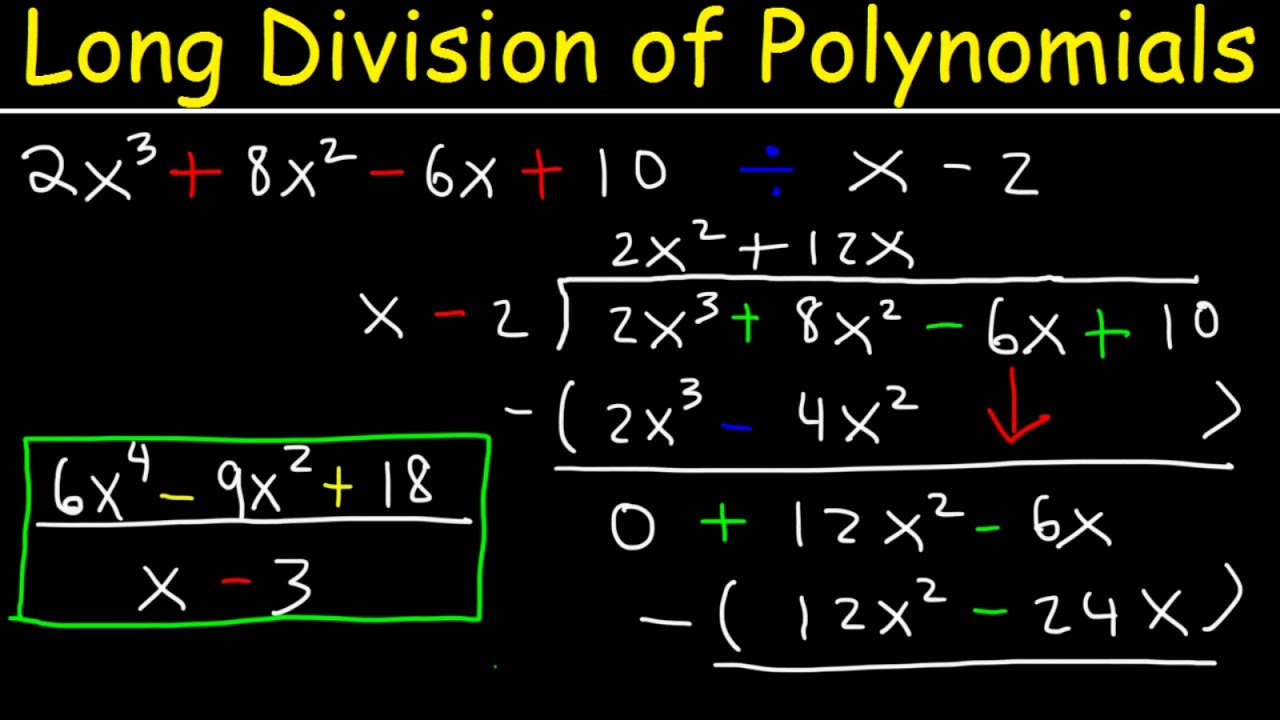
This video tutorial explains how to perform long division of polynomials with remainder and with missing terms.
Algebra Review: https://www.youtube.com/watch?v=i6sbjtJjJ-A
Join My Newsletter:
https://bit.ly/4jUXp6M
Algebra - Free Formula Sheets:
https://www.video-tutor.net/formula-sheets.html...
watch this
this will help quite a bit
sharp bridge
so simplify the x3 by subtracting x1 from the top and then the top and bottom cancel?
 sharp bridge

this is confusing me
so im finding h with one and then plugging the answer of h into f?
limpid adder
so if you see f(h(x)) it means to find the value of h(x) then use that value for f
sharp bridge
oh okay this is light
mystic saffron
Wow this doubt has been going on for a long time
sharp bridge
i have maybe 4 more hours of math to do
limpid adder
oh dear
sharp bridge
doing a whole unit in a day
mystic saffron
Good luck buddy
sharp bridge
light work ive done it many times before
limpid adder
i suggest watching the organic chemistry tutor on algebra topics
sharp bridge
im 3 hours in and i feel really good about everything so far
mystic saffron
But I suggest u to focus on stuff ur confident in
mystic saffron
limpid adder
i suggest watching the organic chemistry tutor on algebra topics
But girlie this is college maths... Not that easy
sharp bridge
im gonna have a cheat sheet for the exam bc its an online honorlock exam
this is unit 1 so i wouldnt call it college math yet
limpid adder
mystic saffron
But girlie this is college maths... Not that easy
i learned this by myself in 4th grade, so im sure others can do it too using that ytber
mystic saffron
sharp bridge
this is unit 1 so i wouldnt call it college math yet
Don't treat it lightly coz if u don't understand these, things will fly over ur head before long
mystic saffron
limpid adder
i learned this by myself in 4th grade, so im sure others can do it too using tha...
That's same for me too but what I'm surprised about is someone struggling with these in college
limpid adder
it could be the country
mystic saffron
limpid adder
i learned this by myself in 4th grade, so im sure others can do it too using tha...
And who knows u might be a genius unlike us commoners
🙇🏻♂️
 limpid adder
mystic saffron
And who knows u might be a genius unlike us commoners
limpid adder
mystic saffron
And who knows u might be a genius unlike us commoners
true except i dont understand any geometry concepts 😎 (only algebra and number theory by beloved)
sharp bridge
i destroyed geo i had a 96
limpid adder
so find g(-1)
mystic saffron
sharp bridge
I'm sure this isn't the right way to solve this
sharp bridge
was i supposed to find g first and not f
sharp bridge
o
limpid adder
evaluate from the inside
mystic saffron
limpid adder
evaluate from the inside
Missy is right
U could think another way too
It says fg x
So first we put g in f
For the x in f, substitute the expression of g
And then u will get a final expression wherein u put x=-1 to solve
 mystic saffron
By fog they mean f of g
limpid adder
its f(g(x))
mystic saffron
G goes into f
 sharp bridge
this one is GoF
mystic saffron
sharp bridge
Yeah
limpid adder
sharp bridge
this one is GoF
oh
sharp bridge
 limpid adder
(a+b)^2=a^2+2ab+b^2
sharp bridge
is it 4x^2 or 16x
sharp bridge
where did 40 come from
sharp bridge
(4x+5)^2 = 4x^2+20x+25??
limpid adder
limpid adder
(a+b)^2=a^2+2ab+b^2
here
sharp bridge
i do not remember doing ts ever😭
limpid adder
$(4x+5)^2=(4x)^2+2(4x)(5)+(5)^2$
clever fjordBOT
ava 💕

 limpid adder
yea because it is 2ab
sharp bridge
okay
limpid adder
2(4x)(5)=40x