#help-19
1 messages · Page 187 of 1
 narrow crypt
 daring frost
Just write it in form a(x-x_1)(x-x_2) and then you know?
narrow crypt
daring frost
Just write it in form a(x-x_1)(x-x_2) and then you know?
ye
i sent op on the journey to find how that method works already
 mystic nova
daring frost
Just write it in form a(x-x_1)(x-x_2) and then you know?
mystic nova
daring frost
Just write it in form a(x-x_1)(x-x_2) and then you know?
ofc I know, but sometime we have irrational roots
That's painful to factor
narrow crypt
completing the square > quadratic eq
 odd edgeBOT
Channel closed
Closed by @tepid beacon
Use .reopen if this was a mistake.
narrow crypt
u got it??
 tepid beacon
yes
odd edgeBOT
 Available help channel!
Send your question here to claim the channel.
Remember:
• Ask your math question in a clear, concise manner.
• Show your work, and if possible, explain where you are stuck.
• After 15 minutes, feel free to ping <@&286206848099549185>.
• Type the command .close to free the channel when you're done.
• Be polite and have a nice day!
Read #❓how-to-get-help for further information on how to ask a good question, and about conduct in the question channels.
 edgy holly
How to simplify...
 odd edgeBOT
edgy holly
How to simplify...
odd edgeBOT
edgy holly
How to simplify...
 nocturne belfry
edgy holly
nocturne belfry
nocturne belfry
edgy holly
nocturne belfry
componendo Dividendo and cubc both sides
mystic nova
It looks like $(a+b)^3$ expansion
 clever fjordBOT
Alexis_Fx
 edgy holly
Also tried to form perfect cube
nocturne belfry

edgy holly
not helping, I dunno how to foorm tho
narrow crypt
[ 90\sqrt{6} = 90\sqrt{3}\sqrt{2}]
clever fjordBOT
k
 narrow crypt
by guessing its prolly smth like ${(a\sqrt{3} + b\sqrt{2})^3}$ = [3a\sqrt{3} + 2b\sqrt{2} + 3a^2b\sqrt{2} + 3ab^2\sqrt{3}]
edgy holly
the term with $\sqrt{2}$ and $\sqrt{3}$ are the $a^3+b^3$ and $a^3-b^3$, and rest are $3a^2 b$ and $3ab^2$
clever fjordBOT
Double_mytrouble
 clever fjordBOT
k
 clever fjordBOT
Double_mytrouble
 narrow crypt
fair
 waxen talon
edgy holly
How to simplify...
waxen talon
edgy holly
How to simplify...
You should note that $\sqrt{6} = \sqrt{2}\sqrt{3}$
clever fjordBOT
1 divided by 0 equals Infinity
 mystic nova
clever fjord
**1 divided by 0 equals Infinity**
mystic nova
clever fjord
**1 divided by 0 equals Infinity**
already did man
edgy holly
clever fjord
**1 divided by 0 equals Infinity**
how does that help
waxen talon
Then i think like $a = \sqrt{2}$ and $b = \sqrt{3}$
clever fjordBOT
1 divided by 0 equals Infinity
 edgy holly
?
 tacit haven
edgy holly
How to simplify...
tacit haven
edgy holly
How to simplify...
offtopic but whys the file name whatsapp_image
edgy holly
are you suggesting to transform the equation taking a and b as variable?
edgy holly
tacit haven
offtopic but whys the file name whatsapp_image
I sent it to my whatsapp and downloaded it so I can post it from my laptop
I can't take pic from my laptop
edgy holly
edgy holly
I can't take pic from my laptop
or atleast clear ones
waxen talon
edgy holly
are you suggesting to transform the equation taking a and b as variable?
Yeah
tacit haven
,w expand (a + bsqrt(2) + csqrt(3))^3
clever fjordBOT


 Requested by copterforgor
narrow crypt
Requested by copterforgor
narrow crypt
💀
edgy holly
bro 💀
edgy holly
I ain't solving that shit
tacit haven
fair
edgy holly
<@&286206848099549185>
 desert jolt
edgy holly
How to simplify...
desert jolt
edgy holly
How to simplify...
Are m and n integers?
 lean yew
clever fjord
lean yew
clever fjord
but this essentially is what you need
narrow crypt
i give up
mystic nova
lean yew
but this essentially is what you need
I don't think so, the denominator is an integer which means the numerator must somehow cancel it out and I don't think it can with that
narrow crypt
clever fjord
**Double\_mytrouble**
it is indeed this
edgy holly
This is a olympiad question and time given for it is 6 minute....
 hidden token
Were there options?
edgy holly
I don't think comparing coefficient is the way
narrow crypt
wait
edgy holly
yeah, first level of Indian olympiad easiest level...
here its like IOQM-->RMO-->INMO-->IMOTC-->PDC-->IMO. IOQM has 3 sections, easy medium and hard, this is the easy one
narrow crypt
ye i cant solv eit
mystic nova
I thought "I will solve this last problem and then sleep" and now I'm still trying
I give up 
narrow crypt
mystic nova
I thought "I will solve this last problem and then sleep" and now I'm still tryi...
lmao
the so-called "6 minute"
 brittle plinth
odd edgeBOT
brittle plinth
odd edgeBOT
@edgy holly Has your question been resolved?
desert jolt
edgy holly
here its like IOQM-->RMO-->INMO-->IMOTC-->PDC-->IMO. IOQM has 3 sections, easy m...
which year PRMO was this
interesting question
odd edgeBOT
Channel closed
Closed due to timeout
Use .reopen if this was a mistake.
Available help channel!
Send your question here to claim the channel.
Remember:
• Ask your math question in a clear, concise manner.
• Show your work, and if possible, explain where you are stuck.
• After 15 minutes, feel free to ping <@&286206848099549185>.
• Type the command .close to free the channel when you're done.
• Be polite and have a nice day!
Read #❓how-to-get-help for further information on how to ask a good question, and about conduct in the question channels.
 random pumice
Problem 1.7 (Greece Junior MO 2015). Find all values of the real parameter a, so that
the equation x2 + (a−2)x−(a−1)(2a−3) = 0 has two real roots, so that one is the
square of the other.
odd edgeBOT
random pumice
Problem 1.7 (Greece Junior MO 2015). Find all values of the real parameter a, so...
random pumice
Progress: D>0 and vieta
narrow crypt
!show
odd edgeBOT
Show your work, and if possible, explain where you are stuck.

 shut nymph
Solve the inequation
random pumice
Then
random pumice
?
shut nymph
i didnt see the second part of the problem lol mb
First of all i think you made a mistake in your polynomial with a
I get 9a^2 - 24a + 16
So you can start by giving the condition you found on a for there to be 2 real roots, then work from there
random pumice
I think i solve this problem
Subs a = 2-n2-n
Use rational root theorem
(r+1 and r-1/2 are roots
odd edgeBOT
@random pumice Has your question been resolved?
odd edgeBOT
Channel closed
Closed due to timeout
Use .reopen if this was a mistake.
Available help channel!
Send your question here to claim the channel.
Remember:
• Ask your math question in a clear, concise manner.
• Show your work, and if possible, explain where you are stuck.
• After 15 minutes, feel free to ping <@&286206848099549185>.
• Type the command .close to free the channel when you're done.
• Be polite and have a nice day!
Read #❓how-to-get-help for further information on how to ask a good question, and about conduct in the question channels.
 errant inlet
For this question, Im having trouble finding the solution for x(0). I understand how to find the other missing eigenvector (In this case its [1,1,1]), and my understanding of how to find x(t) is $$x(t) = \Phi (t) \Phi (0)^{-1} x(0)$$. Yet, with the way the fundamental matrix is created here, its impossible to invert and thus, obtain $$\Phi (0)^{-1}$$. Im not sure on what to do next here
 odd edgeBOT
errant inlet
For this question, Im having trouble finding the solution for x(0). I understand...
clever fjordBOT
odd edgeBOT
errant inlet
For this question, Im having trouble finding the solution for x(0). I understand...
clever fjordBOT
Emperor Voldy
 odd edgeBOT
@errant inlet Has your question been resolved?
odd edgeBOT
@errant inlet Has your question been resolved?
 sharp oak
x(t) = Σ C(eigenvector)e^(λt)
Or something like that
Oh, that's only if the matrix has n linearly independent eigenvectors though
odd edgeBOT
@errant inlet Has your question been resolved?
errant inlet
sharp oak
Oh, that's only if the matrix has n linearly independent eigenvectors though
What if they aren't linearly independent?
odd edgeBOT
Channel closed
Closed due to timeout
Use .reopen if this was a mistake.
Available help channel!
Send your question here to claim the channel.
Remember:
• Ask your math question in a clear, concise manner.
• Show your work, and if possible, explain where you are stuck.
• After 15 minutes, feel free to ping <@&286206848099549185>.
• Type the command .close to free the channel when you're done.
• Be polite and have a nice day!
Read #❓how-to-get-help for further information on how to ask a good question, and about conduct in the question channels.
 sharp dew
How do i solve this? Super lost
 odd edgeBOT
sharp dew
How do i solve this? Super lost
nocturne belfry
odd edgeBOT
sharp dew
How do i solve this? Super lost
nocturne belfry
sorry whats the question?
sharp dew
SORRY height of the tree
- Find the height of the tree in the diagram below to the nearest foot.
nocturne belfry
sure, what have you tried
sharp dew
i calculated all the angles, Dont know how to get the full base since i only have the base of one triangle
also just whole i have help, Is the angle behind 75 just 105?
nocturne belfry
sharp dew
also just whole i have help, Is the angle behind 75 just 105?
it is, yea
nocturne belfry
sharp dew
i calculated all the angles, Dont know how to get the full base since i only hav...
this is fine, you can name it something else
 restive fern
Well, for a 45 45 90 triangle the opposite and adjacent must be the same so we just find the value where decreasing the adjacent by 20 gives us a 75 15 90 triangle, that's the best I can do because I suck at trig
sharp dew
Just got an idea, Do i calculate the hypotenuse of the smaller triangle, then get the height?
since i have 3 angles and a side?
sharp dew
i consider myself mathematically illiterate, i'll be back with an attempt lol
restive fern
Lol
nocturne belfry
 nocturne belfry
sharp dew
i consider myself mathematically illiterate, i'll be back with an attempt lol
nocturne belfry
sharp dew
i consider myself mathematically illiterate, i'll be back with an attempt lol
you draw all the angles, and label all the important quantities
then you identify how many unknowns you have, and search out that many equations


 clever fjordBOT
jan Niku
 nocturne belfry
and $\frac{x}{\sin 15} = \frac{h}{\sin 75}$
clever fjordBOT
jan Niku
 nocturne belfry
by substitution, $h = \frac{20}{1 - \frac{\sin 15}{ \sin 75} }$
clever fjordBOT
jan Niku
 odd edgeBOT
@sharp dew Has your question been resolved?
Channel closed
Closed by @sharp dew
Use .reopen if this was a mistake.
Available help channel!
Send your question here to claim the channel.
Remember:
• Ask your math question in a clear, concise manner.
• Show your work, and if possible, explain where you are stuck.
• After 15 minutes, feel free to ping <@&286206848099549185>.
• Type the command .close to free the channel when you're done.
• Be polite and have a nice day!
Read #❓how-to-get-help for further information on how to ask a good question, and about conduct in the question channels.
 glossy marsh
back at it again
odd edgeBOT
glossy marsh
back at it again
 steep mantle
?
glossy marsh
crap im sorry im forgetting how to word it
steep mantle
take your time
glossy marsh
copied: yall this is a hobby thing ive already talked abt here months ago but im trying to make a cheat sheet where (a√5 + b) can be expressed as n1(√5 + 1)^n2
for example (4√5+9) = ((√5+1)^6)/64
i have no way of telling if (√5+4) can fit this pattern
aside from brute force
so far it has its own category
(√5-7) = -(√5+4)8/((√5+1)^2)
glossy marsh
glossy marsh
https://discord.com/channels/268882317391429632/905286165316403271/1396004680273...
this is the question
everyone reading this
oh wow theres very few help channels rn
well ig that makes sense
it aint school season
steep mantle
n_1 at the start allows you to just consider the ratio between a and b
glossy marsh
what
steep mantle
im p sure you can expand it into a sum of binomials that represent a and b, and using some algebra you can simplify it
glossy marsh
i did graph it but it just made shit harder
with n1 being x and n2 being y
was (√5 + 4) = n1(√5 + 1)^n2
to solve for the 4 one
oh
ohh
wait whyd you delete that
i thought you meant between n1 and n2 and i was like no?
steep mantle
so like, $\frac{a}{b}=\frac{\sum_{i=0}^{\floor{\frac{n_2-1}{2}}}5^{\floor{\frac{n_2-1}{2}}}\binom{n_2}{2i+1}}{\sum_{i=0}^{\floor{\frac{n_2}{2}}}5^{\floor{\frac{n_2}{2}}}\binom{n_2}{2i}}$
if im not mistaken
glossy marsh
steep mantle
so like, $\frac{a}{b}=\frac{\sum_{i=0}^{\floor{\frac{n_2-1}{2}}}5^{\floor{\frac{...
i
i dont know calculus
clever fjordBOT
skissue.in.a.teacup
 steep mantle
glossy marsh
i
i dont know calculus
steep mantle
glossy marsh
i
i dont know calculus
theres no calculus here
glossy marsh
what is the sigma
steep mantle
sum
glossy marsh
i dont know how to read that
glossy marsh
steep mantle
sum
oh right
steep mantle
glossy marsh
sum of... i = 0 and (n2-1)/2???????
sum of f(i) from i=0 to floor((n2-1)/2)
glossy marsh
steep mantle
sum of f(i) from i=0 to floor((n2-1)/2)
the hell
steep mantle
glossy marsh
copied: yall this is a hobby thing ive already talked abt here months ago but im...
if n1 is a real number you literally can just set n2=1 and n1 will do the rest
glossy marsh
no
steep mantle
ie $\sqrt{5}+4=\frac{\sqrt{5}+4}{\sqrt{5}+1}(\sqrt{5}+1)^1$
glossy marsh
if n2 = 1, n1 cant be an intiger
clever fjordBOT
skissue.in.a.teacup
 glossy marsh
i checked
steep mantle
glossy marsh
if n2 = 1, n1 cant be an intiger
does n1 have to be an integer?
glossy marsh
i brute forced sqrt5 + 4 a lot
glossy marsh
steep mantle
does n1 have to be an integer?
yea i just said that
steep mantle
didnt see that
glossy marsh
glossy marsh
n1 or x is any positive intiger
right here
well ok it dont need to be positive
sometimes these things get a random negative
but when i plugged in the equasion,
it showed no negative x
and i just assumed
i realise now that thats wrong
idk where it went wrong
but x might be negative
steep mantle
a lot of a,b arent possible to represent like that then
glossy marsh
glossy marsh
was (√5 + 4) = n1(√5 + 1)^n2
basically im factoring (√5 +4) with (√5 + 1) and √5 as potential factors
steep mantle
also
glossy marsh
glossy marsh
basically im factoring (√5 +4) with (√5 + 1) and √5 as potential factors
i will be doing this for everything on my dumb cheet sheet
steep mantle
"say for example (√5+3) = ((√5+1)^2)/2"
you used n1=1/2?
steep mantle
n1 is rational then?
glossy marsh
the only irrational numbers allowed are sqrt5 and sqrt5 + 1
glossy marsh
steep mantle
n1 is rational then?
yes
steep mantle
clever fjord
**skissue.in.a.teacup**
then this should work if i didnt crunch the numbers wrong
glossy marsh
N2 needs to be an intiger, and n1 is rational, and not 0
thanks for pointing that out
glossy marsh
steep mantle
then this should work if i didnt crunch the numbers wrong
i cant read it but thank you
steep mantle
honestly this is so arbitrary, whats the cheat sheet for?
 steep mantle
tldr you make the binomial and split the odd terms and even terms
steep mantle
everything i used should be precalc
 steep mantle
every terminology i used should be precalc, the usage might not be specifically
glossy marsh
i dont know how to read this
steep mantle
google sigma notation
glossy marsh
😭
oh my god this is so dumb um

so its uh
n plus itself times the thing next to it capping at the thing atop it?
i hate this
i got it yay
although im only 2 minutes in :devestation: https://youtu.be/xavgv1m9feE
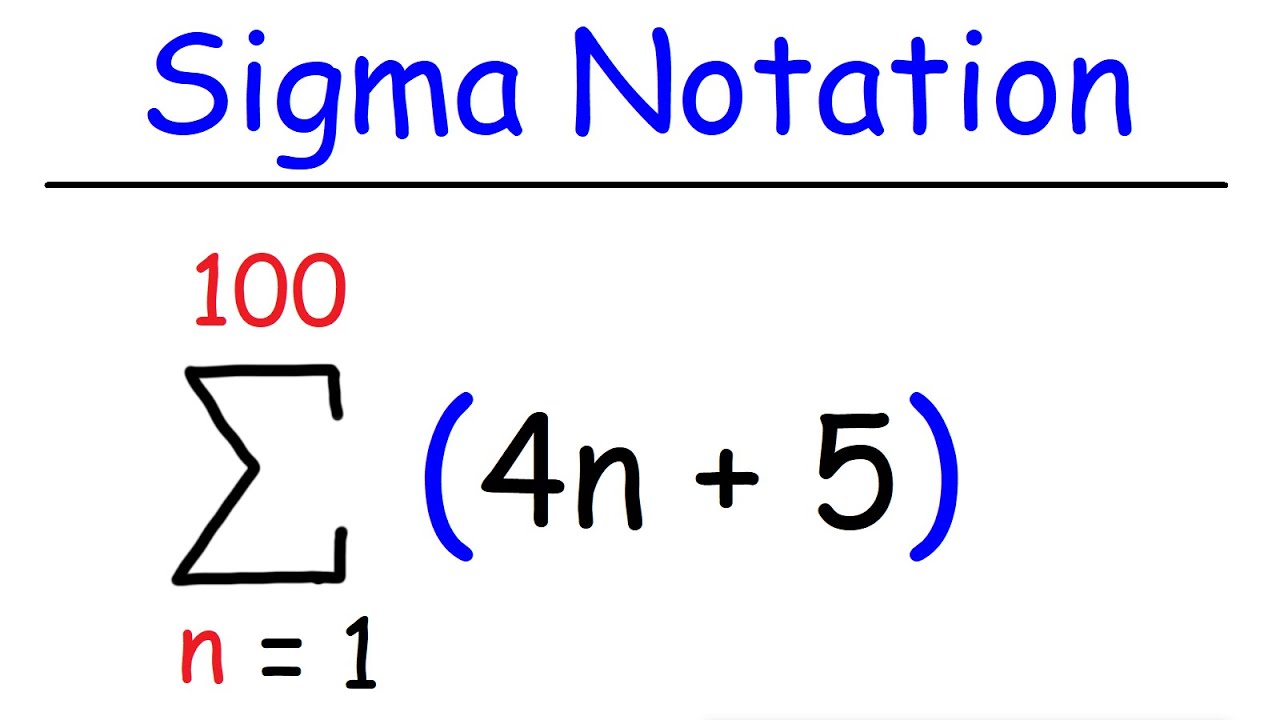
This algebra and precalculus video tutorial provides a basic introduction into solving summation problems expressed in sigma notation. It also explains how to find the sum of arithmetic and geometric sequences.
Sequences - Free Formula Sheet: https://www.video-tutor.net/algebra-formula-sheet.html
Final Exam and Test Prep Videos: ...
oh wait what
no but
but
no
he did it wrong i think
5
Σ n^2 = 1^2 + 2^2 + 3^2 + 4^2 + 5^2
n = 1
OH
OH
6
Σ 2^n =
n = 1
does not mean 2^1 + 4^2 + 6^3
no
bc only n is changing and 2 is not n
oh god
wait
is the top "until n is 6" or "do it 6 times" @steep mantle
 north sparrow
glossy marsh
is the top "until n is 6" or "do it 6 times" <@750992393502720010>
north sparrow
glossy marsh
is the top "until n is 6" or "do it 6 times" <@750992393502720010>
from n=1 until n=6 by increment of 1
glossy marsh
north sparrow
from n=1 until n=6 by increment of 1
k thanks
what if n = 2
than itd be 3 things adding?
 merry finch
if it says n = 2 then it does it 5 times
it'll add up when n = 2, n = 3, n = 4, n = 5, and n = 6
glossy marsh
merry finch
it'll add up when n = 2, n = 3, n = 4, n = 5, and n = 6
what
merry finch
$\sum_{n=2}^6 f(n) = f(2) + f(3) + f(4) + f(5) + f(6)$
clever fjordBOT
frosst
 glossy marsh
the fuck
merry finch
$\sum_{n=2}^6 n^2 = 2^2 + 3^2 + 4^2 + 5^2 + 6^2$
clever fjordBOT
frosst
 merry finch
here f(n) = n^2
glossy marsh
clever fjord
**skissue.in.a.teacup**
ok so i think i can start to apply this
glossy marsh
clever fjord
**skissue.in.a.teacup**
@steep mantle
is this supposed to be (√5 + 4) = n1(√5 + 1)^n2
 loud mural
did you guys try factoring it?
glossy marsh
adam fuck off
steep mantle
glossy marsh
is this supposed to be (√5 + 4) = n1(√5 + 1)^n2
no its general
loud mural
glossy marsh
wym
"wym" refine your choice of words
glossy marsh
@short seal maybe you could be of help
loud mural
@short seal can you help
glossy marsh
steep mantle
no its general
have i done this correctly so far

i dont know what the L brackets mean nor how to apply them
steep mantle
L brackets are floor

 quasi sparrow
glossy marsh
i cant figure out how to express this in desmos
quasi sparrow
glossy marsh
i cant figure out how to express this in desmos
Desmos Help Center
What’s the sum of the first 100 counting numbers? Where does the sum of the powers of ½ converge to? How can you visualize the Taylor series expansion for sine?
Answer these questions (and more!) w...
glossy marsh
quasi sparrow
https://help.desmos.com/hc/en-us/articles/33685875217677-Summation
i think if there is a part explaining how to express floor like that its this but eh

i think it means a and b

quasi sparrow
glossy marsh
i think if there is a part explaining how to express floor like that its this bu...
Yes try googling floor desmos
glossy marsh
this is stupid
 bitter lodge
i think im nearly at a proof to say that not all values of a/b are possible
glossy marsh
quasi sparrow
Yes try googling floor desmos
i know i can have floor(input) but i dont know enough abt this to apply it
glossy marsh
bitter lodge
i think im nearly at a proof to say that not all values of a/b are possible
not all combinations are
bitter lodge
is that not the goal of this help channel ?
glossy marsh
well that and like a has to be rational and b needs be a whole number but can be 0 or negative
glossy marsh
bitter lodge
is that not the goal of this help channel ?
the goal is to find out how to tell how to factor all instancesx of (a√5+b) considering (√5+1) is a factor and so is √5
although i am pretty freaking sure (√5+4) cannot be expressed as such
but i can only make progress via brute force
glossy marsh
glossy marsh
im still confused bc i cant read this but ive made progress
skissue made that equasion
quasi sparrow
glossy marsh
i have a cheat sheet
That's not informative
glossy marsh
my brain wont retreive the word
quasi sparrow
That's not informative either
glossy marsh
i have a spreadsheet of different values of a and b for this
quasi sparrow
bitter lodge
i think im nearly at a proof to say that not all values of a/b are possible
Can you state your goal if it's not this
steep mantle
bitter lodge
i think im nearly at a proof to say that not all values of a/b are possible
cant you like a=1 b=0
glossy marsh
quasi sparrow
That's not informative either
stop it i know im tryoing im just slow
i know that
im trying to get the information out
i know that
quasi sparrow
Feel free to type only when you've understood what you're trying to say
glossy marsh
id show it here but adams here
quasi sparrow
Adams?
glossy marsh
adam is here
quasi sparrow
Is that supposed to mean something
glossy marsh
quasi sparrow
Feel free to type only when you've understood what you're trying to say
dont be a dick
im trying my best
glossy marsh
quasi sparrow
Is that supposed to mean something
are you stupid
glossy marsh
oure telling me to not talk unlress i can be 100% cohesive but you have no idea how names work
odd edgeBOT
Helpers are just people volunteering their time to help you. Be polite and patient.
glossy marsh
riemans being rude though
and why is the bot a she they what
 meager juniper
let me read up and check
I've read the above, and riemann isn't reading as rude, just a bit blunt. It's a tendency with people involved in math to state things really quite bluntly, mostly because clarity of communication is valued. I don't doubt that he was being sincere and trying to clarify things with you.
Please don't take it personally
riemann, please be a little more charitable in the future. This sort of back and forth can be avoided.
quasi sparrow
meager juniper
riemann, please be a little more charitable in the future. This sort of back an...
Alright man I get called stupid and I'm the one being asked to change?
meager juniper
The particular message where I feel you could have been a little nicer on was prior to that.
but it's just a minor thing
quasi sparrow
meager juniper
The particular message where I feel you could have been a little nicer on was pr...
Wut
meager juniper
quasi sparrow
Feel free to type only when you've understood what you're trying to say
This one.
Like, I don't doubt that you meant well.
 carmine idol
i'm seeing two people prioritizing two different conversational norms
quasi sparrow
quasi sparrow
Alright man I get called stupid and I'm the one being asked to change?
I don't know how that addresses what I said here
meager juniper
I'm asking you both to change, and not by the same amount?
OP is clearly in the wrong here.
anyway, this is an interesting problem.
glossy marsh
im not saying anything bc i dont know how to appropriately acknowledge this
meager juniper
I wonder if there's a closed form for the summation of every other binomial coefficient.
carmine idol
meager juniper
I wonder if there's a closed form for the summation of every other binomial coef...
I think there is
just expand $(1+1)^n+(1-1)^n$
clever fjordBOT
Element118
 glossy marsh
what 😭
meager juniper
glossy marsh
im not saying anything bc i dont know how to appropriately acknowledge this
This is just an informal warning, I'm not even noting it down. It's really not a big deal.
carmine idol
yeah i also think it's not such a big deal, after all, this place is to get help
glossy marsh
meager juniper
This is just an informal warning, I'm not even noting it down. It's really not ...
regardless if i persist with "but they did blah and its ok i did blah" thatd make shit worse
thats all
meager juniper
glossy marsh
regardless if i persist with "but they did blah and its ok i did blah" thatd mak...
With help threads, sometimes frustrations can mount, and all that's really required is a reset, and that's fine.
glossy marsh
carmine idol
yeah i also think it's not such a big deal, after all, this place is to get help
why are you oganession
carmine idol
glossy marsh
the goal is to find out how to tell how to factor all instancesx of (a√5+b) cons...
I'm thinking we can make use of the norm in $\mathbb{Q}[\sqrt{5}]$ (assuming we haven't yet)
clever fjordBOT
Element118
 carmine idol
glossy marsh
why are you oganession
carmine idol
glossy marsh
why are you oganession
i used to be, and it stuck around
it might be time for a rebrand
meager juniper
oh, so the summation is apparently 2^(n-1)? Even on odd rows?
glossy marsh
thar be this
graphing it made brute force harder
#help-31 message
meager juniper
that makes a certain amount of sense.
glossy marsh
i dont list obvious factors, like (2√5 + 2) in the cheat sheet
im debating not listing thngs that include sqrt5
carmine idol
but basically the norm in $\mathbb{Q}[\sqrt{5}]$ is $a+b\sqrt{5}\mapsto a^2-5b^2$, which for $\sqrt{5}+4$ is $16-5=11$, since 11 is prime, $\sqrt{5}+4$ only has units and associates as factors.
clever fjordBOT
Element118
 meager juniper
slick
glossy marsh
clever fjord
**Element118**
no idea what this means
carmine idol
glossy marsh
no idea what this means
don't worry, we'll get there at your pace
The norm is $(a+b\sqrt{5})(a-b\sqrt{5})$. Try expanding that.
clever fjordBOT
Element118
 glossy marsh
glossy marsh
glossy marsh
also this is the main reason im doing this
lots of shit youd have no idea you could simplify
like how am i sposed to know (3√5-7) = -32/((√5+1)^4)
glossy marsh
clever fjord
**Element118**
i got major brainfog im sorry ppl
what do you mean by norm
carmine idol
okay sorry i didn't cover the prerequisite field theory
glossy marsh
glossy marsh
also this is the main reason im doing this
lots of shit youd have no idea you co...
i mean like fractions and square roots involving asqrt5 + b
in really large things
carmine idol
so what happens is that $\mathbb{Q}[\sqrt{5}]$ is a field containing $\mathbb{Q}$. It's a two dimensional field extension of $\mathbb{Q}$.
An analogy is how $\mathbb{C}$ is a two dimensional field extension of $\mathbb{R}$
clever fjordBOT
Element118
 glossy marsh
😭
carmine idol
two dimensional, as in, it's also a two dimensional $\mathbb{Q}$ vector space
clever fjordBOT
Element118
 meager juniper
I don't think nicole is familiar with "fields" or "vector spaces" perhaps
carmine idol
yeah skill issue on my end
glossy marsh
probably not no
carmine idol
You know about rational numbers right
we can add subtract multiply divide-by-nonzero
glossy marsh
carmine idol
You know about rational numbers right
yea
carmine idol
we call this a field
meager juniper
any set of numbers where we can do all of thing things you'd normally expect out of numbers (add, subtract, multiply, divide) and get back the same sort of number, we call a field.
So rationals are fields, because when you apply these operations to them, you always get back other rational numbers.
carmine idol
[okay vector spaces might be important, maybe we cover that too]
meager juniper
But integers are not a field, because if you divide two integers you might not get an integer back
glossy marsh
meager juniper
any set of numbers where we can do all of thing things you'd normally expect out...
weird ok
carmine idol
so if you have a field $\mathbb{Q}$, we can get a vector space $\mathbb{Q}^n$ (read: n-tuples of rationals)
clever fjordBOT
Element118
 meager juniper
we care about fields, because if we have something that isn't exactly the numbers as we're used to them, but they have the above behaviors, we can do algebra on them the way we would normally expect.
carmine idol
Example time:
$(1/2, 1/3)\in\mathbb{Q}^2$
clever fjordBOT
Element118
 carmine idol
two rationals, it's a vector from $\mathbb{Q}^2$
clever fjordBOT
Element118
 glossy marsh
meager juniper
But integers are not a field, because if you divide two integers you might not g...
glossy marsh
meager juniper
But integers are not a field, because if you divide two integers you might not g...
so like
shit im confused as to how my thing works now
carmine idol
now, with vectors we can do cool stuff, like adding entry-wise
meager juniper
glossy marsh
so like
shit im confused as to how my thing works now
I'll let Og explain.
glossy marsh
meager juniper
we care about fields, because if we have something that isn't exactly the number...
what 😭
carmine idol
$(1/2,1/3)+(1/4,1/5)=(3/4,8/15)\in\mathbb{Q}^2$
clever fjordBOT
Element118
 glossy marsh
i think i need to go eat and get water
carmine idol
yeah go get some water
stay hydrated
Also, you can multiply by a rational multiple, term-wise:
$6\times(1/2, 1/3)=(3,2)$
clever fjordBOT
Element118
 carmine idol
huh, to talk about norms i might need matrices and determinants to explain why they work
meager juniper
yeah, it's pretty difficult to go from high school math directly to field extensions
carmine idol
lemme see if there's a shortcut
i can basically replace it with an assertion that $a+\sqrt{5}b$ and $a-\sqrt{5}b$ are in some sense "algebraically indistinguishable"
clever fjordBOT
Element118
 carmine idol
in some sense, we are just treating $\sqrt{5}$ as a symbol instead of the usual value of $2.236$-ish
clever fjordBOT
Element118
 carmine idol
!xy
odd edgeBOT
Please show the original problem, exactly as it was stated to you, with the entire original context. A picture or screenshot is best. If the original problem is not in English, then post it anyway! The additional context might still be helpful. Do your best to provide a translation.
carmine idol
though
carmine idol
glossy marsh
because the main aim might be this
odd edgeBOT
@glossy marsh Has your question been resolved?
glossy marsh
meager juniper
yeah, it's pretty difficult to go from high school math directly to field extens...
well i mean i know high school math
and a bunch of random other shit
i know lambda calc
and todat learned how to use sigma
meager juniper
knowing about lambda calculus but not knowing about summation notation is a pretty odd progression, ngl
glossy marsh
carmine idol
because the main aim might be this
no this is a whole new project at this point
glossy marsh
meager juniper
knowing about lambda calculus but not knowing about summation notation is a pret...
yea
i learned lambda calc from this and the guy it coulda done a better job explaining why the false and true function work
https://www.youtube.com/watch?v=RcVA8Nj6HEo

ERRATA:
• The "Church-Turing Thesis" is different from the "Church-Turing Theorem". The "theorem" is the claim which I discussed in the video- namely, that the Turing machine and lambda calculus are equally powerful. The "thesis" is the informal claim that the two of these systems are a sufficient formalization which capture the idea of "arbit...
had to watch it 3 timrs and still didnt get it
bitter lodge
ok, heres my elementary approach, skipping over a lot of algebra and etc, just giving an overview \
we set up the equation $\sqrt{5} + q = a (\sqrt{5} + 1)^k$, where $a, q \in \mathbb{Q}$ and $k \in \mathbb[N}$ \
when you do binomial expansion on the RHS, half of the terms will be a multiple of rt5, the other half will be rational\
now, in our equation we already know the coefficient of rt5 from the LHS, its 1. this allows us to find the value of $a$ in terms of $k$ \
this in turn gives us an expression for $q$ in terms of $k$
as a quick aside, i've done the math with a variable $x$ in place of the $5$ and that's what ill be using from hereon. the only conditions are $x > 1$ and non-square. i also define $r = \left(\frac{\sqrt{x} + 1}{\sqrt{x} - 1}\right)^2$ for convenience
\begin{align*}
q_{2k} &= \frac{\sum \limits_{i=0}^k {{2k} \choose {2i}} x^i}{\sum \limits_{i=0}^{k-1} {{2k} \choose {2i+1}} x^i} = \sqrt{x} \frac{r^k + 1}{r^k - 1}\
q_{2k+1} &= \frac{\sum \limits_{i=0}^k {{2k+1} \choose {2i}} x^i}{\sum \limits_{i=0}^k {{2k+1} \choose {2i+1}} x^i} = \sqrt{x} \frac{r^{k + \frac{1}{2}} - 1}{r^{k + \frac{1}{2}} + 1} \
\end{align*}
at this stage, i did a ton of algebra that couldve been avoided, anywho the result was $q_{2k}$ is a decreasing sequence with limit $\sqrt{x}$ and $q_{2k+1}$ is an increasing sequence with limit $\sqrt{x}$. these results are enough to rule out a lot of possibilities for $q$ (and thus prove that not all values of $q$ are possible) \
you can go one step further and find the inverse functions of the above to determine if any particular value of $q$ is achievable
\begin{align*}
\text{for } q > \sqrt{x} \text{, if } &\frac{\log \frac{q + \sqrt{x}}{q - \sqrt{x}}}{\log \frac{\sqrt{x} + 1}{\sqrt{x} - 1}} \text{ is an even integer, or}\
\text{for } q < \sqrt{x} \text{, if } &\frac{\log \frac{ \sqrt{x} + q}{\sqrt{x} - q}}{\log \frac{\sqrt{x} + 1}{\sqrt{x} - 1}} \text{ is an odd integer}
\end{align*}
then $q$ is achieved with that integer
clever fjordBOT
Acman
Compile Error! Click the  reaction for more information.
(You may edit your message to recompile.)
 glossy marsh
cant find a subtraction nor pred function that work but i think its half skill issue half bad resources
bitter lodge
the problem is fun and id recommend you try to go through it yourself, you can use that overview as a guide for hints / to check
if a mod or whoever has a problem that thats just the answer laid out then feel free to delete, imo this is the kind of instance where its reasonable to do so
glossy marsh
well im glad you like my dumb problem
i still cant do like 3 or 4 kinds of functions being used here
bitter lodge
clever fjord
**Acman**
Compile Error! Click the <:errors:504266556054962196> reaction for mor...
just clarify at the bottom by "q is achieve by that integer" i mean k = that integer will give that q (with the appropriate value of a)
carmine idol
glossy marsh
no this is a whole new project at this point
alright then, if you want i can try to bring you towards the field theory that you can use to check how to factor numbers of the form $a+b\sqrt{5}$
clever fjordBOT
Element118
 carmine idol
but it's definitely going to take a while
glossy marsh
carmine idol
alright then, if you want i can try to bring you towards the field theory that y...
well thanks
um
i cant think words
oh right yea
was going to say i dont think ill need this nearly as frequently as i used to
... maybe ill make a rotatable icosahedron next. :3c
carmine idol
ah okay
glossy marsh
dont think i said it but i did get water and coffee and took care of myself and stuff
yay
carmine idol
yay
glossy marsh
@carmine idol @meager juniper @bitter lodge ill delete this in a sec but
the colored regions are known to be of the same family of things, the red ones definately fit the rule, the gold ones fit the rule if we include sqrt4 + 5, and the others i havent pried into yet
the dark ones have common factors and as such arent worth listing, and grey is "i havent gotten around to it yet"
the red ones seem to have this strange property where asqrt5 + b is the reciprical of asqrt - b times or devided by a perfect 2, though this is too compressed to see the equasions
i was surprised the red did that, but even more surprised to fail to find gold NOT doing that
carmine idol
hmm
carmine idol
glossy marsh
<@104219409991626752> <@173636598150332416> <@123599022731689984> ill delete thi...
in your investigation, you see that $a+b\sqrt{5}$ and $a-b\sqrt{5}$ seem to behave similarly right
clever fjordBOT
Element118
 glossy marsh
well yea
carmine idol
great we have enough to talk about norms
glossy marsh
sometimes the result will randomly become negative though
if b is negative
like um
(√5-1) = 4/(√5+1)
carmine idol
so if $c+d\sqrt{5}$ is a factor of $a+b\sqrt{5}$, then $c-d\sqrt{5}$ is a factor of $a-b\sqrt{5}$.
Multiplying them out:
$(c+d\sqrt{5})(c-d\sqrt{5})$ is a factor of $(a+b\sqrt{5})(a-b\sqrt{5})$
glossy marsh
reciprical x or / perfect 2
clever fjordBOT
Element118
 glossy marsh
clever fjord
**Element118**
glossy marsh
clever fjord
**Element118**
i followed until the last line
and
and
its only true for the red ones and im not sure why but i think i know how to figiure that out
carmine idol
it follows this logic:
5 is a factor of 15
7 is a factor of 21
(5 times 7) is a factor of (15 times 21)
glossy marsh
clever fjord
**Element118**
ok i understand now
glossy marsh
carmine idol
it follows this logic:
5 is a factor of 15
7 is a factor of 21
(5 times 7) is a ...
yea i got it
just took a sec
clever fjordBOT
Element118
 glossy marsh
i cant prove the reciprical thing, the property is just aperent, though i do think its easily provable
carmine idol
(of course, I'm sweeping away some details, but that's the main idea you can use to help check if you can factor $a+b\sqrt{5}$)
clever fjordBOT
Element118
 glossy marsh
i think honestly i need to brute force a bit more to get the easy ones down and see which of the colored regions are the same in the small scale so i can get more of the chart filled out
what i was doing is far faster than trying to make a formula for it
despite sucking
i um
i guess ill start working on things we can assume as truths for shortcuts in any proofs i might be able tio use
i should have a proof list
(√5+1)(√5-1) = 4 aint listed anywhere in me notes
though that is an easy one
i need some special sign
bc i want to say (√5+1) = (4√5-9) but thats not true
"=" is wrong
they both fit the pattern
but its like saying 15 = 12 bc they share the factor 3
i might make a sign
work in progress idfk

its dumb
@carmine idol should i organize this so instead of pairing (√5+1) with (√5-1) i just make the counting order go negative like a numbre line
im considering it
ykw ima make a copy once ive made more progress on the redorange chunk
the bottom 4 oranges are new

the only patterns i can see in the color groups behavious is factors
which make repeating patterns bc yea
ok uh
i did that
has pros and cons
im actively trying to color it correctly
carmine idol
What's this table for by the way
carmine idol
glossy marsh
<@104219409991626752> should i organize this so instead of pairing (√5+1) with (...
are you just trying to factor numbers of the form $a+b\sqrt{5}$ or is there some organisation I'm not aware of
clever fjordBOT
Element118
 glossy marsh
carmine idol
are you just trying to factor numbers of the form $a+b\sqrt{5}$ or is there some...
glossy marsh
carmine idol
are you just trying to factor numbers of the form $a+b\sqrt{5}$ or is there some...
yea
im tired
uh
uh
basically if i use the factors in the ruleset to convert one equasion into another they get the same color
if i find that 2 colors express the same group, they just become one color
left and right is the a that sqrt5 is multiplied by
up and nown is how much b
meager juniper
so just to confirm, you're looking for all numbers a + b sqrt(5) which are obtainable from c (1 + sqrt(5))^n, where c is some rational value?
glossy marsh
meager juniper
so just to confirm, you're looking for all numbers a + b sqrt(5) which are obtai...
all instances of asqrt(5) +b where a and b are whole numbers have a block in the chart
except the chart is very small rn
meager juniper
and n is a postive integer?
glossy marsh
meager juniper
and n is a postive integer?
no n can be negative
likew half of these are devided by (sqrt5 + 1) at least once
i reorganized it
so now +b and -b are no longer paired
i need a big ass screen for this

i do need to color it more
black is when theres an obvious whole number factor
color groups are when the factor difference shared between them includes (sqrt5 + 1)

theres a few goals
one is to prove if color groups are the same as eachother
the point is to make it so i can simplify instances of asqrt5 + b that show up in huge equasions in irregular ways ig
glossy marsh
glossy marsh
if i can find how/if (√5+4) can be expressed with (√5+1), i can do that for (3√5+1) bc (3√5+1) = (√5+4)(√5-1)
and then the gold section would also be red
itl probably be more than good enough if i can do this for every instance where a and b are between -16 and 16
but i dont need to express negative a because then thered be symetry due to the double negatives
red is probably going to be symetrical in the +-b bc thats whats been happening
yall were typing
carmine idol
I feel this might be similar to the idea of ideals.
(for any other people on math server who knows what this means so they can continue: $\frac{1+\sqrt{5}}{2}$ is a unit in $\mathbb{Z}[\frac{1+\sqrt{5}}{2}]$)
clever fjordBOT
Element118
 glossy marsh
i only started coloring the graph in things that werent greyscale 2 days ago
didnt touch this in almost a year prior to that
this is quite a bit more detailed now
meager juniper
let z = sqrt(5) for brevity, so we have (a + bz) (c + dz) = ac + 5bd + (ad + bc)z, additionally, we have (a + bz)/(c + dz) = (ac - 5bd + (bc - ad)z) / (c^2 - 5d^2)
If we imagine an (x, y) plane where we plot 4 + 5 sqrt(5) on the point (4, 5) (for instance) then we can figure out the geometry of multiplication. Because we can freely scale this value up or down, all we need to worry about is the direction of this vector.
So instead, let's move from cartesian coordinates to polar (r, t), and really all we care about is t.
We have x = r cos t, and y = r sin t, and we are assuming r is irrelevant, so it will be treated as 1. (a + bz) (c + dz) = (cos t + z sin t)(cos s + z sin s) = cos t cos s + 5 sin t sin s + z (sin t cos s + cos t sin s)
So atan2(sin t cos s + cos t sin s, cos t cos s + 5 sin t sin s) is the resulting angle. We can clean this up a little bit by using some trig identities. cos t cos s + sin t sin s = cos(t - s), sin t cos s + cos t sin s = sin(t + s), so we have atan2(sin(t + s), cos(t - s) + 4 sin t sin s)
However, this is not a very nice expression, and the geometry it induces doesn't seem to be anything that I'm familiar with.
glossy marsh
just multiplying a "(asqrt5 + b)" with sqrt5 + 1 and removing the factors (always perfect 2s????) i get another different (asqrt5 + b) and thats how ive been doing this
or deviding
carmine idol
glossy marsh
just multiplying a "(asqrt5 + b)" with sqrt5 + 1 and removing the factors (alway...
yeah there are always 2s there, and there are good reasons why
involving field theory
glossy marsh
alr
ive tried brute forcing a = 1 b = 4 last year and didnt record most of what i found mostly bc it was almost exclusively giant numbers
bc i went big
trying to make it work and fit into the red
i doubt itl happen
carmine idol
glossy marsh
ive tried brute forcing a = 1 b = 4 last year and didnt record most of what i fo...
yeah, there's a whole class of massive numbers. No smaller ones though.
glossy marsh
?
red so far is the biggest group
and red is the stuff that can be made of only sqrt5 + 1, sqrt5, and n
i havent even found all of the small red
though i have not explored the other colors nearly as much and am just yesterday and today doing the oranges
glossy marsh
i know that
though i dont know the math to do so
so im doing it it this way
well not yet
id like to know but i also think itd be faster to do it this way than learn
bc itd be slow that way too
there are lots of boxes
technically infinite but im doing the 16x32 rn
bc that should be enough
and bc the page isnt giiant yet
and at that point a ton of the expansion would be factors of these
and if i have say (2sqrt5 +35)
i could express it as ((sqrt5 +5) +(sqrt5 +5)+25) and then disect those
or something
wouldnt help all cases
but itd be useful
i realise now i do need to solve for everythings xsqrt5 equivilent
bc i do need list those
im sorry yall
odd edgeBOT
@glossy marsh Has your question been resolved?
Channel closed
Closed by @glossy marsh
Use .reopen if this was a mistake.
 faint knot
that sucks
odd edgeBOT
Available help channel!
Send your question here to claim the channel.
Remember:
• Ask your math question in a clear, concise manner.
• Show your work, and if possible, explain where you are stuck.
• After 15 minutes, feel free to ping <@&286206848099549185>.
• Type the command .close to free the channel when you're done.
• Be polite and have a nice day!
Read #❓how-to-get-help for further information on how to ask a good question, and about conduct in the question channels.
 undone grove
Q 6 idk how to disprove an answer
 odd edgeBOT
undone grove
Q 6 idk how to disprove an answer
lean yew
odd edgeBOT
undone grove
Q 6 idk how to disprove an answer
lean yew
i see 12 and 5 and my mind immediately thinks of pythagorean triples
undone grove


 clever fjordBOT
 lean yew
ah ok
undone grove
Ye
 wooden python
btw what is this
 lean yew
undone grove
lean yew
undone grove
huh, they asked for the value of t. it seems like you got the value of t already?
wooden python
what's an equals sign doing in the numerator of a fraction
lean yew
oh wait i just noticed
undone grove
Ye mb mistake
undone grove
undone grove
Q 6 idk how to disprove an answer
.
lean yew
wait disprove an answer?
undone grove
Ye something doing with tan has to be positive I think
Bc a has a domain
I think it's called
lean yew
so have you gotten a value of t yet? seems like you have
lean yew
seems to me this is in radians
undone grove
O
lean yew
oh i'm mistaken i think
wooden python
undone grove
1/5 -5
did you miss a comma here
lean yew
i'll let Ann explain, since if it's not i don't think i get it
undone grove
Ye
wooden python
so you got the values of t as -5 and 1/5?
undone grove
Yes
clever fjordBOT

 wooden python
,w simplify 2*(1/5)/(1-(1/5)^2)
clever fjordBOT
 wooden python
ok we're good to go those t-values are correct
undone grove
Ye
wooden python
now remember t = tan(A/2) and A lies between 180° and 270°
between what two values does A/2 lie?
undone grove
Pi and 3pi/2 ?
wooden python
i didn't ask you to convert anything into radians
undone grove
O oops
wooden python
and even if you did, that would be wrong still
bc pi and 3pi/2 are just 180° and 270° resp
(180°, 270°) is the interval in which A itself lives.
in what interval does A/2 live?
in degrees.
undone grove
90, 135
wooden python
ok
so 90° < A/2 < 135°
so, in what quadrant does A lie?
1st, 2nd, 3rd, or 4th?
undone grove
2nd
undone grove
Ooo negative
undone grove
O thanks I thought I had to sub back in but clearly not
And I didn't find the region of a/2
.close
odd edgeBOT
Channel closed
Closed by @undone grove
Use .reopen if this was a mistake.
Available help channel!
Send your question here to claim the channel.
Remember:
• Ask your math question in a clear, concise manner.
• Show your work, and if possible, explain where you are stuck.
• After 15 minutes, feel free to ping <@&286206848099549185>.
• Type the command .close to free the channel when you're done.
• Be polite and have a nice day!
Read #❓how-to-get-help for further information on how to ask a good question, and about conduct in the question channels.
 sick pier
the answer should be just pi/4 right?
 odd edgeBOT
sick pier
the answer should be just pi/4 right?
sick pier
odd edgeBOT
sick pier
the answer should be just pi/4 right?
sick pier
yea inverse
 sinful grove
Some high school math like to do that for some reason with this notation
sick pier
wdym some sort of fibre
sinful grove
taking the preimage of {pi/4}
mystic nova
Assume this is arcsin(x) the output should only be in [-pi/2,pi/2] so, yeah
sinful grove
So what I’m saying is, yes that is correct. But I’m only complaining how sometimes it’s not clear with lower level math questions
They sometimes abuse notation
sick pier
sick pier
the answer should be just pi/4 right?
sooo, 3pi/4, pi/4 +2*pi*n and so on are technically right?
sinful grove
sick pier
sooo, 3pi/4, pi/4 +2`*`pi`*`n and so on are technically right?
No
Only within [-pi/2, pi/2] (which is only pi/4) if this is the actual sin inverse theyre using and not some sort of abuse of notation
 sinful grove
Welp as I knew it would…
sick pier
welp
sinful grove
sick pier
sooo, 3pi/4, pi/4 +2`*`pi`*`n and so on are technically right?
Okay so in that case these are right
sick pier
🙂
mystic nova
"In mathematics, a function from a set X to a set Y assigns to each element of X exactly one element of Y" so a function should only have one output for each input
sinful grove
mystic nova
"In mathematics, a function from a set X to a set Y assigns to each element of X...
Theyre abusing notation and taking the fibre of pi/4
sick pier
erm
sinful grove
sick pier
erm
Do you see what the “full solution set” is?
sick pier
heh
sinful grove
Youre solving sin(x) = 1/sqrt2
sick pier
yep
sick pier
sinful grove
Do you see what the “full solution set” is?
this is the lecture with the workings and lecturer solving it ^
welp
sinful grove
!status
odd edgeBOT
What step are you on?
1. I don't know where to begin.
2. I have begun but got stuck midway.
3. I got an answer but I was told that it's wrong.
4. I got an answer and would like my work checked.
5. I have a question about someone else's work/solution.
6. I have completed the problem and don't need help anymore. Thank you.
7. None of the above
5
sinful grove
sick pier
5
What is the question?
sick pier
why is the answer not just pi/4?
sinful grove
It seems your teacher is using the notation sin^-1(y) for solving the problem of finding all x such that sin x = y. This solution set will be infinite and pi/4 is just one solution.
However youre correct if sin^-1 represented what it actually does in math, which is an inverse function. Then pi/4 would be the only answer by how it’s defined
sinful grove

sick pier
.close
odd edgeBOT
Channel closed
Closed by @sick pier
Use .reopen if this was a mistake.
Available help channel!
Send your question here to claim the channel.
Remember:
• Ask your math question in a clear, concise manner.
• Show your work, and if possible, explain where you are stuck.
• After 15 minutes, feel free to ping <@&286206848099549185>.
• Type the command .close to free the channel when you're done.
• Be polite and have a nice day!
Read #❓how-to-get-help for further information on how to ask a good question, and about conduct in the question channels.
 round pivot
Hiii
odd edgeBOT
round pivot
Hiii
 dense moth
iiiH
wooden python
round pivot
Hiii
hello, do you have a question to ask?
if you do, then ask it; otherwise, if you just wanted to chat, there's #discussion and #chill.
 sturdy cape
Damn, you beat me to it; I was about to say "Not the relevant place to do this - these channels are for math help"
wooden python
!occupied
odd edgeBOT
Someone else is already using this help channel. If you need help with a question, please open your own help channel/thread (see #❓how-to-get-help for instructions).
sturdy cape
[use an OPEN channel to ask this]
 odd edgeBOT
@round pivot Has your question been resolved?
odd edgeBOT
Channel closed
Closed due to timeout
Use .reopen if this was a mistake.
odd edgeBOT
Available help channel!
Send your question here to claim the channel.
Remember:
• Ask your math question in a clear, concise manner.
• Show your work, and if possible, explain where you are stuck.
• After 15 minutes, feel free to ping <@&286206848099549185>.
• Type the command .close to free the channel when you're done.
• Be polite and have a nice day!
Read #❓how-to-get-help for further information on how to ask a good question, and about conduct in the question channels.
 sonic juniper
I need someone if I'm doing it correctly, its about operations on functions

 odd edgeBOT
sonic juniper
I need someone if I'm doing it correctly, its about operations on functions
wooden python
odd edgeBOT
sonic juniper
I need someone if I'm doing it correctly, its about operations on functions
wooden python
your pictures are a bit blurry and i can't read the top of the first one, can you re-upload?

 odd edgeBOT
@sonic juniper Has your question been resolved?
 graceful gate
hello guys
sonic juniper
hii
graceful gate
how can I improve my level in maths? I am grade 8 and I want to be intellegent
sonic juniper
I personally not a mathematician or sort of math wizard, im weak in math but most people say is to be familiarize with the formulas and how you solve different kinds of equations
just be familiarized with the lesson
sonic juniper
sonic juniper
^
sonic juniper
sonic juniper
I need someone if I'm doing it correctly, its about operations on functions
<@&286206848099549185>
odd edgeBOT
@sonic juniper Has your question been resolved?
sonic juniper
<@&286206848099549185>
 inner berry
Mhm?
sonic juniper
sonic juniper
I need help in checking my answers
inner berry
kk
sonic juniper
its about operations on functions and im not 100% if my answers are correct
inner berry
I love your keyboard
sonic juniper
oh thank u 😅
sonic juniper
hmm
inner berry
May I see where u got the questions from
 inner berry
Which grade are u or how old are u
sonic juniper
i'd like to keep my grade confidential but i'm 16
inner berry
- ✅
- ✅
- ✅
- ✅
- ✅
- ✅
- ✅
- ✅
- ❌
little one
did u take domains and restricted values?
sonic juniper
from 10-12, idk what I have been doing T_T
i've tried watching tutorials on how but that's what I can do T_T
inner berry
- ✅
Try to understand harder examples
Or try to solve it again
Maybe u miscalculated smt or skipped a step without knowing
sonic juniper
I've actually asked for help here recently, and that's what we have discussed
I solved this with assistance
and I tried practicing after since the person who helped me needed to go 😭
inner berry
sonic juniper
and I tried practicing after since the person who helped me needed to go 😭
ooooo
sonic juniper
rlly? I have only 1 mistake?
inner berry
practice means ur determined
inner berry
sonic juniper
rlly? I have only 1 mistake?
mhm
sonic juniper
I swear I was not on my right mind when I was solving these
inner berry
oop
sonic juniper
I just remembered what the person told me to do in solving these and watched a few
and was confused mainly from 9-12
sonic juniper
can u assist me in no. 9?
inner berry
Mhm
sonic juniper
=(-x^2 - 1 - 2x)(x +5)
 inner berry
Mhm
sonic juniper
that what I only know what to do..
inner berry
:>
sonic juniper
oh wait
inner berry
mhm
sonic juniper
i added a subtraction by accident
sonic juniper
okey, thank u
inner berry
no problem
sonic juniper
=(-x^2 - 1 - 2x)(x +5)
im stuck here ;)
inner berry
$(-x^2 - 1 - 2x)(x +5)$
clever fjordBOT
someone
 inner berry
this?
sonic juniper
yup
sonic juniper
im not sure but is it = -x^2 - 4 - 2x?
inner berry
Try again
Try to listen to smt calming instead of this
so u can focus
what’s ur name chomp
sonic juniper
u can call me lou
inner berry
Lulu u stuck or u solving?
sonic juniper
im stuck..
inner berry
show me
sonic juniper
im just trial and erroring it
sonic juniper
clever fjord
**someone**
but im stuck here
inner berry
Mhm
sonic juniper
okay im blank
sonic juniper
yea..
inner berry
I mean u still did the others correct
lemme help
$(-x² - 1 - 2x) - (x + 5)
-x² - 1 - 2x - x - 5 = -x² - 3x - 6$
clever fjordBOT
someone
 inner berry
No
Wrong
(-x² - 1 - 2x) - (x + 5)
-x² - 1 - 2x - x - 5 = -x² - 3x - 6
like this
Simplification after ur step
 pastel steeple
sonic juniper
yea..
pastel steeple
sonic juniper
yea..
make a 3x2 table if you need to
inner berry
@sonic juniper lulu
sonic juniper
??
inner berry
(-x² - 1 - 2x) - (x + 5)
-x² - 1 - 2x - x - 5 = -x² - 3x - 6
It’s a subtraction
so u just put it out
Expand
And then u solve
Combine like terms
sonic juniper
inner berry
(-x² - 1 - 2x) - (x + 5)
-x² - 1 - 2x - x - 5 = -x² - 3x - 6
how did u get that
inner berry
😭
didn’t u get it too
the one ur stuck on
It’s subtraction
So u just take off the brackets
sonic juniper
how did u get = -x² - 3x - 6?
pastel steeple
sonic juniper
how did u get = -x² - 3x - 6?
i assume you're missing the negative sign turning the +5 in the parentheses into a -5
inner berry
numbers
inner berry
pastel steeple
i assume you're missing the negative sign turning the +5 in the parentheses into...
are u sure?
pastel steeple
i said assume didnt i
inner berry
Where’s the positive 5
pastel steeple
can you show what you got for the subtraction @sonic juniper
inner berry
the 5 is negative
pastel steeple
inner berry
Where’s the positive 5
i said +5 in parentheses
inner berry
That’s correct
pastel steeple
sonic juniper
are you familiar with the FOIL method?
have you done the subtraction correctly first
inner berry
Mhm
sonic juniper
First Outer, Inner Last is the meaning
inner berry
Ye ik
sonic juniper
so do I have to do that? or just simply combine like terms ?
inner berry
combine em
pastel steeple
sonic juniper
so do I have to do that? or just simply combine like terms ?
what do you currently have on your paper for this problem?
sonic juniper
-x² - 1 - 2x - x - 5 = -x² - 3x - 6 this one then I have to solve like he said
correct me if im wrong
pastel steeple
ok good so that's g - f
inner berry
mhm
inner berry
To find (f+g)(x), add f(x) and g(x)
pastel steeple
what the hell are you talking about
inner berry
what
pastel steeple
we are on number 9 right?
sonic juniper
this one
 inner berry
Sorry
sonic juniper
its okayy
sonic juniper

inner berry
CMONN DONT LET ME DOWN
pastel steeple
multiply by x
sonic juniper
hold on
inner berry
oki
inner berry
^3 or 2
sonic juniper
^3?
inner berry
maybe u use a different method
sonic juniper
i combined like terms
inner berry
😭
sonic juniper
AM I IN THE WRONG PATH
inner berry
SHOW ME WHAT U WROTE
sonic juniper
pastel steeple
multiply by x
I followed this
so
(-x^2)(x)-(1)(x)-(2x)(x)-(x)(x)-(5)(x)
IDK
IM SO WEAK IN MATH
pastel steeple
great now simplify it by combining like terms
pastel steeple
sonic juniper
i already got -x^3
then (-1)(x) = -x?
inner berry
wait wait
sonic juniper
pastel steeple
then (-1)(x) = -x?
yes
odd edgeBOT
@sonic juniper Has your question been resolved?
odd edgeBOT
Channel closed
Closed due to timeout
Use .reopen if this was a mistake.
Available help channel!
Send your question here to claim the channel.
Remember:
• Ask your math question in a clear, concise manner.
• Show your work, and if possible, explain where you are stuck.
• After 15 minutes, feel free to ping <@&286206848099549185>.
• Type the command .close to free the channel when you're done.
• Be polite and have a nice day!
Read #❓how-to-get-help for further information on how to ask a good question, and about conduct in the question channels.
 lone ether
if 0.25m is 1/4th of one meter why do I need 16 tiles to make up 1 meter?

 late sinew
nocturne belfry
lone ether
if 0.25m is 1/4th of one meter why do I need 16 tiles to make up 1 meter?
late sinew
nocturne belfry
lone ether
if 0.25m is 1/4th of one meter why do I need 16 tiles to make up 1 meter?
its not 1 m, its 1 m^2
you dont need something 1 m long or 1 m wide, you need something 1 m long AND 1 m wide
lone ether
nocturne belfry
you dont need something 1 m long or 1 m wide, you need something 1 m long AND 1 ...
wouldn't 0.25m be 1/4 wide and long
nocturne belfry
it is, yea
lone ether
If one tile is 1/4th of 1 m^2 why do I need 16 tiles
nocturne belfry
one tile isnt actually 1/4th of 1 m^2
 amber veldt
(1/4 m)²=1/16 m²
nocturne belfry
lone ether
If one tile is 1/4th of 1 m^2 why do I need 16 tiles
we need to make a shape thats 1 m long, and 1 m wide
so start with 4 of your tiles in a line
this shape is 1 m wide, but its only 1/4 m tall, yea?
amber veldt
you are confusing (1/4 m)² with 1/4 m²
lone ether
I think I see it I'm only adding 4 tiles on the length to get 1 but I forgot I need to do the same with the width
lone ether
.close
odd edgeBOT
Channel closed
Closed by @lone ether
Use .reopen if this was a mistake.
lone ether
thanks y'all
odd edgeBOT
Available help channel!
Send your question here to claim the channel.
Remember:
• Ask your math question in a clear, concise manner.
• Show your work, and if possible, explain where you are stuck.
• After 15 minutes, feel free to ping <@&286206848099549185>.
• Type the command .close to free the channel when you're done.
• Be polite and have a nice day!
Read #❓how-to-get-help for further information on how to ask a good question, and about conduct in the question channels.
 hazy falcon
Hi need help
odd edgeBOT
hazy falcon
Hi need help
 mystic saffron
what do you need help with?
quasi sparrow
hazy falcon
Hi need help
odd edgeBOT
@hazy falcon Has your question been resolved?
odd edgeBOT
Channel closed
Closed due to timeout
Use .reopen if this was a mistake.
Available help channel!
Send your question here to claim the channel.
Remember:
• Ask your math question in a clear, concise manner.
• Show your work, and if possible, explain where you are stuck.
• After 15 minutes, feel free to ping <@&286206848099549185>.
• Type the command .close to free the channel when you're done.
• Be polite and have a nice day!
Read #❓how-to-get-help for further information on how to ask a good question, and about conduct in the question channels.
odd edgeBOT
 noble dome
Let ( f : A \to B ) be a function. If ( f ) has a left inverse, then it is unique.\
\textbf{Proof:} Suppose there exists ( g: B \to A ) such that ( (g \circ f)(x) = x ).
Also suppose there exists ( h: B \to A ) such that ( (h \circ f)(x) = x ).
Then, ( (g \circ f)(x) = (h \circ f)(x) ).
clever fjordBOT
licentia
 odd edgeBOT
Channel closed
Channel closed due to the original message being deleted.
If you did not intend to do this, please open a new help channel,
as this action is irreversible, and this channel may abruptly lock.
Available help channel!
Send your question here to claim the channel.
Remember:
• Ask your math question in a clear, concise manner.
• Show your work, and if possible, explain where you are stuck.
• After 15 minutes, feel free to ping <@&286206848099549185>.
• Type the command .close to free the channel when you're done.
• Be polite and have a nice day!
Read #❓how-to-get-help for further information on how to ask a good question, and about conduct in the question channels.
 shrewd trellis

 odd edgeBOT
shrewd trellis
https://cdn.discordapp.com/attachments/1366639984374710365/1396475826492674110/i...
shrewd trellis
odd edgeBOT
shrewd trellis
https://cdn.discordapp.com/attachments/1366639984374710365/1396475826492674110/i...
shrewd trellis
do u know why tan and tan inverse gets canceled out?
 latent scaffold
Because tan inverse is the inverse of tan
 wooden cypress
It's a trig function but it doesn't actually matter what it is for this to make sense
tan^-1 is just defined as the inverse of tan
shrewd trellis
What about the reciprocal trig functions
Cotan
Cosec
Sec
I don’t know what they mean
latent scaffold
They're the reciprocals of the usual trig functions.
shrewd trellis
latent scaffold
They're the reciprocals of the usual trig functions.
Ik
latent scaffold
They do carry geometric meaning, but not much more than sin, cos and tan do
shrewd trellis
So what do they mean
wooden cypress

For any number x, you can draw a right angled triangle like that
With that angle being of size x
then $\tan x = {a\over b}$, $\sin x={a\over c}$, $\cos x={b\over c}$
clever fjordBOT
depression
 wooden cypress
If you want to actually compute one of the functions, it's a bit trickier, so you would just use a calculator
But that's where the functions come from
shrewd trellis
wooden cypress
If you want to actually compute one of the functions, it's a bit trickier, so yo...
“Compute on if the functions” do u mean calculate without calculator
wooden cypress
Yeah
It can be done but it's a pain
My point is it doesn't matter what the functions are exactly
You can still do all the math with them, without acutally having to worry what $\tan^{-1}\left({8\over10}\right)$ is exactly
clever fjordBOT
depression
 shrewd trellis
So what do they mean
shrewd trellis
shrewd trellis
So what do they mean
I’m talking about the reciprocal trig functions