#help-19
1 messages · Page 186 of 1
 mystic saffron
 brittle plinth
what kind of triangle is AED?
mystic saffron
isco
brittle plinth
?
mystic saffron
nvm'
mystic saffron
ok
 warped glacier
brittle plinth
actually I should mention that BCDE is a rectangle
warped glacier
brittle plinth
actually I should mention that BCDE is a rectangle
smart
 odd edgeBOT
@mystic saffron Has your question been resolved?
 pallid trench

 brittle plinth
pallid trench
brittle plinth
pallid trench
haiyaa too long also op already solved it that way also it is wrong
odd edgeBOT
Channel closed
Closed due to timeout
Use .reopen if this was a mistake.
 Available help channel!
Send your question here to claim the channel.
Remember:
• Ask your math question in a clear, concise manner.
• Show your work, and if possible, explain where you are stuck.
• After 15 minutes, feel free to ping <@&286206848099549185>.
• Type the command .close to free the channel when you're done.
• Be polite and have a nice day!
Read #❓how-to-get-help for further information on how to ask a good question, and about conduct in the question channels.
 quasi shard
so I know that the text is implying that integral s <= I <= integral T. but all it is saying is that I must be between both integrals. if integral s = 3 and integral t = 7. you wouldn't say that 7 or 3 is between 7 or 3.
 odd edgeBOT
quasi shard
so I know that the text is implying that integral s <= I <= integral T. but all ...
odd edgeBOT
quasi shard
so I know that the text is implying that integral s <= I <= integral T. but all ...
 robust lagoon
quasi shard
so I know that the text is implying that integral s <= I <= integral T. but all ...
robust lagoon
quasi shard
so I know that the text is implying that integral s <= I <= integral T. but all ...
It just seems to be an elementary bound, you will take the supremum over all such s and the infimum over all such t, and if the function is nice enough this will end up being the definition of the integral
quasi shard
two things what is an elementary bound? And I understand that we show that s has a sup S and t has an inf T and if supS = supT then if the lower and upper integral are equal then I exists. but for all this we need the inequality integral s <= I <= integral T
but this leads me back into how we can say a number falls between two bounds if it is the bounds
robust lagoon
I just mean bound. For the moment we don't have any notion of what the integral of f should be, but we know that s(x) <= f(x) <= t(x) for all x. In our natural rectangle sense of area we can see that the integral of s <= the integral of t. For the definition of the integral of f to make sense, we require it to be between these values. I think it's less that we can say that, and more that we want it to be true when we make our definition
quasi shard
but in his explanation we use the comparison theorem which explicitly states that integral s < integral t . so s(x) < t(x) and that I is between them. He never states anything about I being equal to.
robust lagoon
does your book define the integral? and is this a measure theory course or just basic integration? because there is a more general Lebesgue integral
quasi shard
this is just basic integration and what do you mean by define integration. because first he says there must exist an I between integral s and integral t. which we call integral f(x). then he says that a(q) = I where q is the ordinate set for f(x). then he goes on to say that if the sup S = inf T then I exists. And finally he goes on to prove that supS = inf T. But the thing that is getting me hung up is the equals part in the picture I sent
 low locust
there is no equals part in the picture you sent
robust lagoon
When you say 'there must exist an I' I don't understand. Also are you assuming that f is continuous or piecewise continuous because in general supS =/= inf T?
quasi shard
robust lagoon
When you say 'there must exist an I' I don't understand. Also are you assuming t...
well in the photo I sent he starts off by saying that we will apply this to general functions. Later on when he shows how to prove that the integral will exist he says that we are only proving this for bounded monotonic functions.
quasi shard
low locust
if sup S = inf T, then we define integral f = sup S = inf T
yes I understand that but don't we first need this inequality integral s <= I <= integral T
robust lagoon
quasi shard
well in the photo I sent he starts off by saying that we will apply this to gene...
okay yes these are always integrable
low locust
that inequality doesnt appear anywhere
only integral s < integral t
dont make stuff up that doesnt exist
robust lagoon
quasi shard
yes I understand that but don't we first need this inequality integral s <= I <=...
we are trying to define I, it doesn't a priori make sense to talk about it
 amber veldt
the sup of a set or sequence need not be in the set or sequence
maybe that's why youre confused?
quasi shard
but this is before we get to the sup s part
amber veldt
then not sure what youre asking
quasi shard
he is just saying that using the comparison theorem there must exist an I that satisfies the theorem
low locust
he is not saying that
amber veldt
whats the comparison theorem?
robust lagoon
can you show us this part of the text?
quasi shard
amber veldt
whats the comparison theorem?
 robust lagoon
here there is no mention of I right?
quasi shard
robust lagoon
here there is no mention of I right?
 quasi shard
robust lagoon
here there is no mention of I right?
quasi shard
robust lagoon
here there is no mention of I right?
that was just the definition of the comparision theorem
robust lagoon
Ah okay, see the start of the sentence, 'If the integral of f...' this is an explanation of what we would like for our integral to make sense
It is motivation
quasi shard
so he is just saying how we would like to define our integral
robust lagoon
He is saying 'this is what we would like to be true for it to be a good definition'
quasi shard
so if we go on with that chain of thought we either get integral s < I < integral t or integral s <= I <= integral t. we know the latter to be true but I don't see how I can get that from the text when he just says I is between these two integrals
amber veldt
maybe you want a book that gets to the rigor more quickly, spends less time on intuition. most students arent like that, but I was like that...
quasi shard
yes
amber veldt
between doesnt mean strictly between
quasi shard
if something is between two bounds I thought it cannot be equal to those bounds
low locust
its just conversational english
amber veldt
that would be the phrase strictly between
quasi shard
let say we have bounds 3 and 7
low locust
and like, who cares if the equality is ever satisfied
quasi shard
how could 3 be between them
amber veldt
3 is between 3 and 7
quasi shard
but 3 is the bound
robust lagoon
between often includes equality
you would say strictly between otherwise
to emphasise
quasi shard
ok
low locust
if 3<x<7 is true, then 3<=x <=7 is still true
thats just a weaker version of the statement
amber veldt
but the fact that you're so hung up on the wording MAY suggest a deeper issue you have with the text
or it may not
but examine it
quasi shard
ok
amber veldt
whats your background?
quasi shard
no background
low locust
its also not like you ever will actually have integral s = integral f (if f is e.g. continuous)
amber veldt
no analysis knowledge?
quasi shard
well I took calculus last year and wanted to learn it from a rigorous standpoint. And I have no "rigorous math background"
quasi shard
no I understand the only background I have is just high school math
robust lagoon
I like Abbott Understanding Analysis
amber veldt
Abbott has a good reputation, never read it
robust lagoon
I used for self study if that's what you're doing
quasi shard
my whole objective was too learn calculus in a more rigorous manner and I feel like I have already invested too much time to drop the book now
quasi shard
maybe so. but I feel like that from when I have started the book compared to now I feel like my general skills have improved a good amount
amber veldt
an oddity of analysis is that the Lebesgue integral is simpler than the Riemann integral for rigor
amber veldt
quasi shard
maybe so. but I feel like that from when I have started the book compared to now...
thats great
quasi shard
I think another issue lies in the fact that before this I had no experience with any sort of proofs
robust lagoon
you should make learning proof writing/logic a priority before anything else you want to do in rigourous mathematics
I learned it in conjunction with an introductory real analysis course
quasi shard
well thats what the introduction was about
amber veldt
i learned it in lin alg
quasi shard
because he made us prove theorems for field axioms and introduced proof by induction
amber veldt
mostly
quasi shard
so I feel like I have learned some proof skills
robust lagoon
the main thing you should be comfortable with is given a statement 'what do I actually need to do here'
to prove it is true
or disprove etc
amber veldt
beginning of Knuth's TAOCP is good for that actually
before he gets to computer stuff
thats discrete math,but still
quasi shard
amber veldt
beginning of Knuth's TAOCP is good for that actually
for proofs?
amber veldt
yeah
quasi shard
ok will check it thanks
odd edgeBOT
@quasi shard Has your question been resolved?
odd edgeBOT
Channel closed
Closed due to timeout
Use .reopen if this was a mistake.
Available help channel!
Send your question here to claim the channel.
Remember:
• Ask your math question in a clear, concise manner.
• Show your work, and if possible, explain where you are stuck.
• After 15 minutes, feel free to ping <@&286206848099549185>.
• Type the command .close to free the channel when you're done.
• Be polite and have a nice day!
Read #❓how-to-get-help for further information on how to ask a good question, and about conduct in the question channels.
 low aurora
Hello, I need help with statistics.
Addt'l Instructions:
Identify the following;
a.) Variable
b.) Type of data (if quantitative, classify as discrete or continuous)
c.) Level of measurement
d.) Range
e.) Class intervals
f.) Interval width
 odd edgeBOT
low aurora
Hello, I need help with statistics.
**Addt'l Instructions:**
Identify the follo...
low aurora
odd edgeBOT
low aurora
Hello, I need help with statistics.
**Addt'l Instructions:**
Identify the follo...
low aurora
I'm confused on how I should state the variable
amber veldt
its difficult because it kind of straddles the border of quantitative and qualitative
how would you describe the possible values the RV can take? lets start with that @low aurora
odd edgeBOT
@low aurora Has your question been resolved?
odd edgeBOT
Channel closed
Closed due to timeout
Use .reopen if this was a mistake.
Available help channel!
Send your question here to claim the channel.
Remember:
• Ask your math question in a clear, concise manner.
• Show your work, and if possible, explain where you are stuck.
• After 15 minutes, feel free to ping <@&286206848099549185>.
• Type the command .close to free the channel when you're done.
• Be polite and have a nice day!
Read #❓how-to-get-help for further information on how to ask a good question, and about conduct in the question channels.
 swift steeple
May I have some help with the questions attached?
The first image is a subproblem that came about in my and my friends' attempts to try to solve the related problem in the second image. My belief is that there are infinitely many such triples, but finding a proof for whatever the case may be has proven difficult. I have been able to explicitly find triples that work i.e (2,8,5), (3,3,7) (and of course any shuffling of these triples works) but that has only come about by being more specific, which doesn't answer the most general case.

 odd edgeBOT
swift steeple
May I have some help with the questions attached?
The first image is a subprobl...
odd edgeBOT
swift steeple
May I have some help with the questions attached?
The first image is a subprobl...
@swift steeple Has your question been resolved?
 hidden token
The terms in the r.h.s remind me of the relation between the coefficients and roots of cubic polynomials
swift steeple
I agree, but the problem is that we can set up our -b/a, c/a and -d/a as usual, and make them all positive integers without the individual roots being positive integers... eg x^3+x-1
Or at least, that felt like a problem to me
odd edgeBOT
@swift steeple Has your question been resolved?
odd edgeBOT
Channel closed
Closed due to timeout
Use .reopen if this was a mistake.
odd edgeBOT
Available help channel!
Send your question here to claim the channel.
Remember:
• Ask your math question in a clear, concise manner.
• Show your work, and if possible, explain where you are stuck.
• After 15 minutes, feel free to ping <@&286206848099549185>.
• Type the command .close to free the channel when you're done.
• Be polite and have a nice day!
Read #❓how-to-get-help for further information on how to ask a good question, and about conduct in the question channels.
 ebon oar
 ebon oar
why?
ebon oar
But why it is LD?
 nocturne brook
because 1 * 0 = 0
ebon oar
how can we sure at it?
 narrow crypt
nah wait
nocturne brook
linear independence demands that whenever a sum of scaled vectors is the null vector, the scalar terms themselves are 0
but in your field, you have the scalar 1, and 1 * 0 = 0, but 1 is not 0
ebon oar
nocturne brook
but in your field, you have the scalar 1, and 1 \* 0 = 0, but 1 is not 0
i did not get it properly
nocturne brook
but in the set of real numbers, you have the real number 1, and 1 * [the null vector] = [the null vector], but 1 is not equal to 0
narrow crypt
narrow crypt
there should only be the trivial soln
if they are linearly independent
ebon oar
i guess you are saying that
a1v1+a2v2+a3v3+....=0 so here suppose v1 is null vector
and i am bound that a1 is not 0
but the multiplication will make it zero
so yeahhhhhhhhhhhhhhhhhhhhhhh
hm
thanks
the proof is like HELL
 nocturne brook
it's really not so bad
 narrow crypt
ebon oar
maths proofs are funny
narrow crypt
ebon oar
maths proofs are funny
i dont think they are..
nocturne brook
existence-based ones can be unintuitive in general, sure
ebon oar
Both of you looks master degree?
narrow crypt
no
nocturne brook
nah
nocturne brook
I graduated and have a bachelors in math, that's it thus far
nocturne brook
physics, or maybe just some choice of science, was mandatory for the degree
nocturne brook
but my last four semesters consisted solely of math courses, plus some random elective for elective's / variety's sake
narrow crypt
they are the elements of the designated field
nocturne brook
ebon oar
scalers are real numbers?
your vector space can choose R, C, or any other "field" as its set of scalars
narrow crypt
can also be 0,1 in mod 2 field
nocturne brook
in early linear algebra, you don't define a field, and instead just assume all vector spaces choose the reals as its field
narrow crypt
narrow crypt
can also be 0,1 in mod 2 field
@nocturne brook is this right? 😭
ebon oar
it sticks me to topic
nocturne brook
maybe the complex numbers if you need them
ebon oar
narrow crypt
<@191038258728140801> is this right? 😭
addtion and multiplication both
thanks
.close
odd edgeBOT
Channel closed
Closed by @ebon oar
Use .reopen if this was a mistake.
Available help channel!
Send your question here to claim the channel.
Remember:
• Ask your math question in a clear, concise manner.
• Show your work, and if possible, explain where you are stuck.
• After 15 minutes, feel free to ping <@&286206848099549185>.
• Type the command .close to free the channel when you're done.
• Be polite and have a nice day!
Read #❓how-to-get-help for further information on how to ask a good question, and about conduct in the question channels.
 karmic stirrup
how would i do this assume no calc allowed

 tribal ingot
karmic stirrup
tribal ingot
karmic stirrup
i dont know where to start
tribal ingot
have you learned l'hopitals rule
narrow crypt
sinx/x -> 1
karmic stirrup
narrow crypt
sinx/x -> 1
i know that
narrow crypt
tribal ingot
have you learned l'hopitals rule
it wokrs but plz dont
narrow crypt
not beautiful 
tribal ingot
think about what k said
 lean yew
can't you rewrite sin(2x) as something else
narrow crypt
no need for trig mani
tribal ingot
narrow crypt
not beautiful <:KEK:586240877358350341>
l'hopital was my saving grace 
 tacit wasp
karmic stirrup
i know that
tacit wasp
karmic stirrup
i know that
Then use it
karmic stirrup
tacit wasp
Then use it
how
narrow crypt
tribal ingot
l'hopital was my saving grace <:ded:1042959877519200359>
definitely a tool in exam rooms for speed running 🙏
oh do u know that ap allows desmos now?
tribal ingot
if you rewrite sinx as sinx/x
tacit wasp
narrow crypt
no need for trig mani
In this case it's pretty quick and useful, I'd say
tribal ingot
then what can you rewrite 1/sin2x as so that you end up with the original expression
 wooden python
sin(2x) = 2sin(x)cos(x) kills this problem in particular
tribal ingot
narrow crypt
oh do u know that ap allows desmos now?
wtf
narrow crypt
tacit wasp
In this case it's pretty quick and useful, I'd say
sure
tribal ingot
deadass
tacit wasp
karmic stirrup
how
By dividing numerator and denominator by 2x
wooden python
though it isn't generalizable
tribal ingot
like starting next year?
narrow crypt
tribal ingot
deadass
deadass, i sat the ap calc ab this year.
karmic stirrup
tacit wasp
By dividing numerator and denominator by 2x
that doesnt make sense
wooden python
karmic stirrup
that doesnt make sense
do you want easy but ad-hoc, or do you want harder but generalizable
tribal ingot
amazing news
tacit wasp
karmic stirrup
that doesnt make sense
Lol, then what way would you do it?? Let's listen...
karmic stirrup
wooden python
do you want easy but ad-hoc, or do you want harder but generalizable
harder
wooden python
ok
then let me try to explain the general idea that hopefully you can get mileage out of
namely that you can go on to apply it somewhere other than this specific limit question
karmic stirrup
tacit wasp
Lol, then what way would you do it?? Let's listen...
great
 clever fjordBOT
Ann
 wooden python
you know this, right?
karmic stirrup
yea
 bold elbow
Can someone help me with this question?-How many ways can you pick three different numbers from 1 to 1999 so that any two numbers in the chosen set are at least 9 apart?
tribal ingot
!occupied
odd edgeBOT
Someone else is already using this help channel. If you need help with a question, please open your own help channel/thread (see #❓how-to-get-help for instructions).
wooden python
bold elbow
Can someone help me with this question?-How many ways can you pick three differe...
!occupied
odd edgeBOT
bold elbow
Can someone help me with this question?-How many ways can you pick three differe...
Someone else is already using this help channel. If you need help with a question, please open your own help channel/thread (see #❓how-to-get-help for instructions).
wooden python
is that given a constant $k$, you have $\lim_{x \to 0} \frac{\sin(kx)}{x} = k$
clever fjordBOT
Ann
 wooden python
you can also view this as $\lim_{x \to 0} \frac{\sin(kx)}{kx} = 1$ [same fundamental limit as before] and then multiplying both sides by $k$
karmic stirrup
ig that makes sense
clever fjordBOT
Ann
 wooden python
yeah ok
tribal ingot
oh shit i see where this is going
wait this is beautiful
i didnt think of it like this
 mystic nova
Indeed
wooden python
you can also say $\lim_{x \to 0} \frac{x}{\sin(x)} = 1$
clever fjordBOT
Ann
 tribal ingot

wooden python
@karmic stirrup
karmic stirrup
is it becuase
both sides have to be the same for it to be 1
so u can flop it?
flip
wooden python
mmm no you're kinda overthinking it
it's just that lim 1/f(x) = 1/(lim f(x)) assuming the limit of f(x) exists and isnt 0
and the reciprocal of 1 is still 1
that make sense?
karmic stirrup
yea
wooden python
lim[x->0] x/sin(x) is the same as the cornerstone limit of sin(x)/x just reciprocal'd
alright.
now when it comes to $\lim_{x \to 0} \frac{\sin(x)}{\sin(2x)}$
clever fjordBOT
Ann
 wooden python
as of yet, we don't have any sin(x)/x that we could squeeze out of this
so you'll see that it looks like we can't apply the sin(x)/x limit yet
yes?
karmic stirrup
yeah
karmic stirrup
O:
wooden python
and the way to make it happen is:
$\frac{\sin(x)}{\sin(2x)} = \frac{\sin(x) \cdot x}{\sin(2x)\cdot x} = \frac{\sin(x)}{x} \cdot \frac{x}{\sin(2x)}$
clever fjordBOT
Ann
 narrow crypt
wooden python
as of yet, we don't have any sin(x)/x that we could squeeze out of this
narrow crypt
wooden python
as of yet, we don't have any sin(x)/x that we could squeeze out of this
"squeeze out of this" (reference?)🔥
wooden python
no, nothing about squeeze thm @narrow crypt
wooden python
karmic stirrup
becuase 1 * 2
x/sin(2x) will go to 1/2, not 2.
narrow crypt
):
karmic stirrup
oh
tribal ingot
wow this is pretty nice
wooden python
basically kinda introduce the missing x factor for sin(x)/x in this way
wooden python
lhop is completely soulless
lean yew
TIL, taking notes
wooden python
and also unnecessary heavy machinery
karmic stirrup
i like your solution cuz it doesnt use trig identiys i wouldent know
wooden python
watch and learn, y'all
 leaden yarrow
karmic stirrup
how would i do this assume no calc allowed
leaden yarrow
karmic stirrup
how would i do this assume no calc allowed
Is the answer 1/2?
tribal ingot
anytime i see a trig limit in an indeterminate form i pull out my good pal l'hopital
karmic stirrup
tribal ingot
anytime i see a trig limit in an indeterminate form i pull out my good pal l'hop...
how do u use l'hoptial
tacit wasp
But also knowing the identity sin(2x) = 2sinxcosx is very useful, not only for limits
@karmic stirrup (just a side note)
wooden python
gonna second alberto here
knowing trig identities is pretty useful
but also, the following intuition is useful:
for small values of x, sin(x) ≈ x
tribal ingot
karmic stirrup
how do u use l'hoptial
if you have a limit in an indeterminate form you can differentiate the numerator and denominator and take that limit
wait lemme write it out
wooden python
@karmic stirrup have you seen the "engineers think sin(x)=x" meme?
lean yew
wooden python
for small values of x, sin(x) ≈ x
should probably add for radians?
karmic stirrup
not realy
wooden python
yes obviously radians!
in calculus you need to put your big girl pants on and use radians all the time
tacit wasp
karmic stirrup
how do u use l'hoptial
By checking if you have 0/0 or ∞/∞ form and applying the theorem
narrow crypt
i love sin(x) ≈ x ≈ tan(x) 
tribal ingot
 narrow crypt
the ol' reliable
wooden python
tribal ingot
important: lim f'(x)/g'(x) has to exist
lean yew
clever fjord
**Ann**
i really need to learn to know when to introduce an x/x factor in all situations that call for it
karmic stirrup
does it work all the time?
wooden python
karmic stirrup
does it work all the time?
no, you need to be very very careful checking for applicability
narrow crypt
- indeterminate
- the derivative exists
tacit wasp
karmic stirrup
does it work all the time?
There are few cases where it doesn't. Let me send you a video I've watched some time ago
tribal ingot
in all honesty though what Ann said is right you should learn the manual way instead of relying on l'hopital
tacit wasp
tacit wasp
There are few cases where it doesn't. Let me send you a video I've watched some ...
 karmic stirrup
it looks quite simple to do considering most trig functions derivatives loop in a circle
tribal ingot
oh dr peyam i love that guy
leaden yarrow
sin(2x)=2sin(x)cos(x)
sin(x)/2sin(x)cos(x) = 1/ 2 cos(x)
now take the limit as x-->0
lim x tends to 0 (1/2cos(x)) = 1/2cos(0) = 1/2(1) = 1/2
tribal ingot
karmic stirrup
it looks quite simple to do considering most trig functions derivatives loop in ...
yea thats what a lot of people use it for
well if you're in a time crunch l'hopital could be easier and better
but in general
knowing how to normally do the limit is the way to go
wooden python
leaden yarrow
sin(2x)=2sin(x)cos(x)
sin(x)/2sin(x)cos(x) = 1/ 2 cos(x)
now take the limit as x...
this is correct but late to the punch
karmic stirrup
yea im in a time crunch got my ap calc final in 3 days and i dont know a lick of it
wooden python
also @karmic stirrup l'hôpital is slow-acting brain poison
narrow crypt
tacit wasp
https://youtu.be/KZ90b3n3NVI?feature=shared
i mean they work just wrong application, no?
karmic stirrup
wooden python
also <@776696276972208128> l'hôpital is slow-acting brain poison
my favorite kinda poison
tribal ingot
wooden python
also <@776696276972208128> l'hôpital is slow-acting brain poison
I can agree
wooden python
there's like... a select few situations when l'hop is appropriate
but generally
99% of the time there is something better
like the x/x trick
mystic nova
wooden python
also <@776696276972208128> l'hôpital is slow-acting brain poison
Too overpower ikr
tribal ingot
karmic stirrup
yea im in a time crunch got my ap calc final in 3 days and i dont know a lick of...
like highschool course?
lean yew
overusing l'hopital sends you to the hospital i suppose
karmic stirrup
yea im testing out of ap calc ab monday
 karmic stirrup
ill need it
lean yew
karmic stirrup
yea im testing out of ap calc ab monday
glgl
 tribal ingot
yes you could
wooden python
not recommended
karmic stirrup
are there situations i wouldent be able to use l'hoptial and would be forced to use reg trig rules
tacit wasp
There's no such rule for this, I'd say
tribal ingot
you can technically use l'hopitals as long as the limit is indeterminate and the limit with the derivative of the numerator and denominator exists
narrow crypt
[ \lim_{x \to \infty} \frac{e^x}{x^3} ]
clever fjordBOT
k
 karmic stirrup
if the derivative doesnt work could i just keep taking the deravtives untill it does work
tribal ingot
yes you could
butttt i would strongly recommend that unless you need to solve something on a time crunch don't use l'hopitals
karmic stirrup
ok yes master ):
tribal ingot
and don't think of l'hopitals as your first option when you see an indeterminate limit
because you will see a lot of those in ap exams whenever limits show up
narrow crypt
narrow crypt
l'hopital gives u the algebraic thingy
(nvm expansion also works)
karmic stirrup
quick question how would i take deravitive of this
 tribal ingot
differentiate each term separately
tribal ingot
the - sign applies to the root(x+1)
karmic stirrup
how do u do the power rule for (x+1)^1/2
tacit wasp
Well, if you don't either know derivatives, de l'Hôpital for you is FORBIDDEN...
karmic stirrup
i know deravtives 1/10 of the time
wooden python
karmic stirrup
how do u do the power rule for (x+1)^1/2
$\dv{x} (x^p) = px^{p-1}$ works even when $p=\frac12$ or any other non-integer
clever fjordBOT
Ann
 tacit wasp
karmic stirrup
i know deravtives 1/10 of the time
tacit wasp
karmic stirrup
i know deravtives 1/10 of the time
Lol
tribal ingot
karmic stirrup
i know deravtives 1/10 of the time
i would suggest u brush up
wooden python
karmic stirrup
i know deravtives 1/10 of the time
then lhop is still very much off the table for you
tacit wasp
tacit wasp
Lol
And you think you can apply l'Hôpital? How? 😅
karmic stirrup
yeah
tribal ingot
pretty much anything can be differentiated by some rule that exists
unlike integrals 😔
tacit wasp
$$\lim_{x \to +\infty} \ \frac{x\ e^x}{e^{2x}}$ $
karmic stirrup
i wouldent know where to start i havent deal with limits to infity yet
clever fjordBOT
Alberto Z.
Compile Error! Click the  reaction for more information.
(You may edit your message to recompile.)
 narrow crypt
domination?
tacit wasp
karmic stirrup
i wouldent know where to start i havent deal with limits to infity yet
This is ... very weird
tribal ingot
try expanding e^(2x)
tribal ingot
karmic stirrup
i wouldent know where to start i havent deal with limits to infity yet
wait what
tacit wasp
clever fjord
**Alberto Z.**
Compile Error! Click the <:errors:504266556054962196> reaction fo...
@karmic stirrup Do you think l'Hôpital works and/or it is useful?
karmic stirrup
tacit wasp
This is ... very weird
ive worked with em ofc but whenever i compute em i just used a calculator
tribal ingot
lean yew
oh dear
karmic stirrup
tacit wasp
<@776696276972208128> Do you think l'Hôpital works and/or it is useful?
i bet i could im built dif
tribal ingot
if you're weak with limits and derivatives testing out of ap calc in 3 days might not be the move
karmic stirrup
like test to test out of the class
lean yew
idgi. what do you mean "testing out" of ap calc?
karmic stirrup
like skipping a year in math
lean yew
oh so you are taking a test to jump years?
karmic stirrup
yeah
lean yew
um
narrow crypt
ap can let u jump years??
karmic stirrup
no
 late sinew
Why r u jumping without knowing the content for the jump test 
karmic stirrup
well i was planning on studying
for the past 6 months
then i lost my minecraft account
and got in depresion
narrow crypt
karmic stirrup
for the past 6 months
😭
tribal ingot

late sinew
karmic stirrup
and now its sorta late
lean yew
then uh...
tribal ingot
narrow crypt
ap can let u jump years??
you can test out of the course in some schools
tribal ingot
yea wait i would highly recommend not jumping
considering you are pretty weak with derivatives and limits
 quasi sparrow
jump backwards 
lean yew
you're already struggling here, and you wanna jump ahead?
tribal ingot
which are really foundational
karmic stirrup
yeah
lean yew
you'd be skipping so much stuff
karmic stirrup
ik
lean yew
karmic stirrup
yeah
why?
lean yew
but you can't deal with the basics?
tacit wasp
Lol
late sinew
karmic stirrup
even if im dumb in them
Thats illogical
tribal ingot
karmic stirrup
i like harder classes
well you needa know what you're doing to understand the "harder classes"
i'd suggest you just take your ap class
lean yew
wait.
tribal ingot
you have a headstart anyway
karmic stirrup
tribal ingot
well you needa know what you're doing to understand the "harder classes"
nah for the most part i just fail the harder classes but i still end up learning more so i take em anyway
tribal ingot
😭
lean yew
are you going in harder classes just for the prestige of being in them?
tribal ingot
thats not a good strat
just take the ap class
you have a headstart anyway because you know some calculus
lean yew
karmic stirrup
nah for the most part i just fail the harder classes but i still end up learning...
no, see
tribal ingot
bits and pieces
lean yew
yes, you learn from classes harder than your current standard
BUT
if the classes are so hard you understand those as well as you understand arabic
which is to say, you don't
narrow crypt
u kinda need to pass classes for colleges..
karmic stirrup
lean yew
are you going in harder classes just for the prestige of being in them?
i dont plan to go to college
lean yew
then what are the benefits of going to those harder classes?
narrow crypt
ok
karmic stirrup
lean yew
then what are the benefits of going to those harder classes?
less stupid people and i can learn more and they are often easier cuz its more test based instead of assigements
karmic stirrup
well in normal classes tests are worth 50% of my grade so its impossible to pass cuz i dont do assignenemnts but in ap its like 70% so i can pass em
lean yew
"i don't do assignments"
personal opinion, but i think that's gonna hurt you more in the working world, good sir
karmic stirrup
i relize
lean yew
if you realize all this and still choose this route, i suppose i can only wish you luck
you have been warned
odd edgeBOT
Channel closed
Closed by @karmic stirrup
Use .reopen if this was a mistake.
odd edgeBOT
Available help channel!
Send your question here to claim the channel.
Remember:
• Ask your math question in a clear, concise manner.
• Show your work, and if possible, explain where you are stuck.
• After 15 minutes, feel free to ping <@&286206848099549185>.
• Type the command .close to free the channel when you're done.
• Be polite and have a nice day!
Read #❓how-to-get-help for further information on how to ask a good question, and about conduct in the question channels.
Channel closed
Channel closed due to the original message being deleted.
If you did not intend to do this, please open a new help channel,
as this action is irreversible, and this channel may abruptly lock.
odd edgeBOT
Available help channel!
Send your question here to claim the channel.
Remember:
• Ask your math question in a clear, concise manner.
• Show your work, and if possible, explain where you are stuck.
• After 15 minutes, feel free to ping <@&286206848099549185>.
• Type the command .close to free the channel when you're done.
• Be polite and have a nice day!
Read #❓how-to-get-help for further information on how to ask a good question, and about conduct in the question channels.
quasi shard
can someone help me understand why absolute value is introduced here
 quasi shard
what I understand from this image is that if we have proven that upper I = lower I. Then I exists and it equals upper I and lower I. We also said that integral of f(x) = I. So we can replace Upper I with I and lower I with integral f(x). To get 0 <= I - integral f(x) <= c/n
 odd edgeBOT
@quasi shard Has your question been resolved?
odd edgeBOT
@quasi shard Has your question been resolved?
 orchid torrent
quasi shard
can someone help me understand why absolute value is introduced here
orchid torrent
quasi shard
can someone help me understand why absolute value is introduced here
The idea is that because the two numbers are both in the interval, the distance between them (hence absolute value) cannot be more than the length of the interval (which is C/n)
odd edgeBOT
Channel closed
Closed due to timeout
Use .reopen if this was a mistake.
Available help channel!
Send your question here to claim the channel.
Remember:
• Ask your math question in a clear, concise manner.
• Show your work, and if possible, explain where you are stuck.
• After 15 minutes, feel free to ping <@&286206848099549185>.
• Type the command .close to free the channel when you're done.
• Be polite and have a nice day!
Read #❓how-to-get-help for further information on how to ask a good question, and about conduct in the question channels.
 pulsar tiger
How to solve this?
|1/f(x) - 1/g(x)| = |g(x) - f(x)|/|f(x)g(x)|
 pulsar tiger
Relevant theorem and definitions used:

 cerulean flare
$\left | \frac{1}{f(x)}-\frac{1}{f(y)}\right |=\frac{\left | f(x)-f(y)\right |}{|f(x)||f(y)|}<\frac{\epsilon }{k^2} =\epsilon '$
clever fjordBOT
TargetVN
 cerulean flare
numerator is smaller than epsilon, according to the definition, and denominator >= k^2 because the problem gives |f(x)| >= k
then set epsilon/k^2 to another arbitrarily small variable and done
pulsar tiger
I still don't see why K^2
quasi sparrow
k * k = k^2
pulsar tiger
Why is there two k's
quasi sparrow
How many f's are there in the denominator
 pulsar tiger
So, why have 1/f(x) - anything?
quasi sparrow
Wut
pulsar tiger
?
narrow crypt
 narrow crypt
clever fjord
**TargetVN**
narrow crypt
clever fjord
**TargetVN**
This is literally from the definition of uniform continuity😭

I havent done real anal yet
But it seems to follow a similar trend to ur generic epsilon-delta proof
narrow crypt
cerulean flare
numerator is smaller than epsilon, according to the definition, and denominator ...
|f(x)| and |f(y)| are both greater than k are both implied from the given inequality
narrow crypt
cerulean flare
numerator is smaller than epsilon, according to the definition, and denominator ...
Epsilon here is taken from the epsilon used to prove that |f(x) - f(y)|
Whatever it is, we don’t know
But we know that it exists
Which is sufficient
odd edgeBOT
@pulsar tiger Has your question been resolved?
odd edgeBOT
Channel closed
Closed due to timeout
Use .reopen if this was a mistake.
Available help channel!
Send your question here to claim the channel.
Remember:
• Ask your math question in a clear, concise manner.
• Show your work, and if possible, explain where you are stuck.
• After 15 minutes, feel free to ping <@&286206848099549185>.
• Type the command .close to free the channel when you're done.
• Be polite and have a nice day!
Read #❓how-to-get-help for further information on how to ask a good question, and about conduct in the question channels.
 honest rivet
Would i be able to receive some help interpreting interaction plots?
I am trying to identify some but I am stumped on the significant variables for th ebottom 3. I think I am just genuinely confused what variable A affects and what variable B affects

 odd edgeBOT
honest rivet
Would i be able to receive some help interpreting interaction plots?
I am trying...
honest rivet
odd edgeBOT
honest rivet
Would i be able to receive some help interpreting interaction plots?
I am trying...
honest rivet
This is how my prof explains it but I am having a hard time understanding it
To interpret an interaction plot:
the x-axis variable influences the slope of a line connecting the average y-axis value across both levels of the x-axis variable (disregard the line-type variable)
the line-type variable influences the average vertical distance between the lines (disregard the x-axis variable)
the interaction effect is assessed by comparing the slope among the lines (i.e. are they parallel or not).
odd edgeBOT
@honest rivet Has your question been resolved?
odd edgeBOT
Channel closed
Closed due to timeout
Use .reopen if this was a mistake.
Available help channel!
Send your question here to claim the channel.
Remember:
• Ask your math question in a clear, concise manner.
• Show your work, and if possible, explain where you are stuck.
• After 15 minutes, feel free to ping <@&286206848099549185>.
• Type the command .close to free the channel when you're done.
• Be polite and have a nice day!
Read #❓how-to-get-help for further information on how to ask a good question, and about conduct in the question channels.
 frozen barn
Why is it when you reflect a point (a,b) to the line y=x
The image is (b,a)
odd edgeBOT
frozen barn
Why is it when you reflect a point (a,b) to the line y=x
The image is (b,a)
frozen barn
Pls help
lean yew
i'm thinking of how best to explain to you in visual form
wooden python
if a ≠ b,
- the line joining (a,b) with (b,a) always has slope -1 and thus is perpendicular to y=x
- and these two points are at the same distance from the line y=x
frozen barn
wooden python
if a ≠ b,
* the line joining (a,b) with (b,a) always has slope -1 and thus is p...
Source?
wooden python
you can prove this yourself
for the second point you will need to know how to find the distance from a point to a line
frozen barn
the 2nd point i obviously know
wooden python
i cannot give you an academic source on this, sorry.
do you wish to dismiss me as making an invalid and unsubstantiated claim?
i can disappear if so.
frozen barn
Nah don't do that
The first point you made i also understand,
Respectfully Seia you've been typing for 15 minutes
lean yew
so y = x is the line where all points on it are of the form (a, b), a = b
but if a != b, then to reflect it along the line y = x, we first have to find another point (c, c) on the line y = x
you can choose this point in one of two ways - moving along horizontally until you hit the line, or moving vertically until you hit the line
once done, you move perpendicularly to the first direction chosen the same number of spaces you moved earlier.
so suppose you chose to move horizontally from (a, b) to (c, c) on the line. but on the line y = x, we know that the x and y coordinates are equal.
since horizontal movement only changes the x-coordinate, we can then reason that the point we moved to must be (b, b) (changing the x-coordinate).
the number of steps moved, n must therefore be b - a.
now, we are moving vertically from the line the same number of steps |b - a|. since we are moving vertically, only the y-coordinate changes, and the new y-coordinate is b - (b - a) = b - b + a = a
so the new point is at (b, a), and thus the coordinates have swapped
the image shows what happens if you move vertically first
 lean yew
frozen barn
Respectfully Seia you've been typing for 15 minutes
lean yew
frozen barn
Respectfully Seia you've been typing for 15 minutes
my bad, i was trying to make sure i could be understood the best i can
i had to rewrite this two times
sorry
i hope i made sense
frozen barn
lean yew
so y = x is the line where all points on it are of the form (a, b), a = b
but if...
Yeahhh im sorry but how is moving horizontally until you hit the line and then moving vertically the same amount of distance from when you moved horizontally from the object to the line(mirror) will end you up in the exact point where the image of the reflection is
May you explain
lean yew
good question. i know that you're asking about the definition of reflection, but let me think of some way to explain to you
may need some time, apologies in advance
frozen barn
Thank you
frozen barn
lean yew
may need some time, apologies in advance
Take as much time as you need
lean yew
ok, so let me probe for understanding a little
what do you know about reflection?
how would you define reflection?
frozen barn
lean yew
how would you define reflection?
A transformation where the image and the object has the same distance to the mirror
With the line connecting them being perpendicular to the mirror
lean yew
good definition
so that means the object and image must have the same perpendicular distance to the mirror
 meager juniper
Easy mode, the reflection across the line y=x induces a linear transformation that sends the point (0,1) to (1,0) and vice versa. This linear transformation can be represented by the matrix A = {{0,1},{1,0}}. If we take a point v = (a,b) and treat it as a column vector we can run the linear transformation forward by multiplying the matrix on the left Av.
This gives us the point (b,a) back.
frozen barn
lean yew
so that means the object and image must have the same perpendicular distance to ...
Yes
lean yew
now, say you have an object
like this

you know the image must lie on a line intersecting the object as well
but there are infinite ways to draw a line through A with only this constraint
but we have another constraint - the line must be perpendicular to y = x
and we know that the gradients of perpendicular lines are connected by
m1m2 = -1
so whatever line we need to draw here, it must take the form y = -x + c
frozen barn
Ok
lean yew
if we take the point in the image as an example
A is (3, 5)
so solving for c:
5 = -3 + c
c = 8
our new object-image line is thus y = -x + 8
agreed?
frozen barn
Yes
 frozen barn
How?
lean yew
to do that, we need to find out how far A is from the black line
then, we need to find the point on the other side of the black line that is the same distance away
frozen barn
Yes correct
lean yew
so zooming in a little

if you don't wanna use the distance formula, let's count steps
so A is one vertical and one horizontal away from the black line. agreed?
 frozen barn
Its 1 × square root 2
frozen barn
lean yew
so A is one vertical and one horizontal away from the black line. agreed?
Yes
lean yew
yeah if you take the straight line distance, but visually, it's (1, 1) away, yeah?
frozen barn
True
lean yew
so knowing that, and knowing that the image is the same distance away
we can go another 1 right and 1 down
lean yew
 frozen barn
lean yew
we can go another 1 right and 1 down
frozen barn
lean yew
we can go another 1 right and 1 down
From the grey dot right
lean yew
however, notice what we have done here
frozen barn
Yes i do
lean yew
so that means, we take the y-coordinate and subtract 2 (moving down)
and we take the x-coordinate, and add 2 (moving right)
frozen barn
Yes
lean yew
so we have essentially taken some of the y-coordinate and given it to the x-coordinate
frozen barn
Yes you're correct
lean yew
but the final important thing that makes this possible is the coordinate of the mirror point
that mirror point has a coordinate of (x + (n/2), y - (n/2)), where n is the number of steps made
/2 because the mirror point is half the journey
frozen barn
What is a mirror point?
frozen barn
Ok
lean yew
the one circled in green
 lean yew
that mirror point has a coordinate of (x + (n/2), y - (n/2)), where n is the num...
lean yew
lean yew
that mirror point has a coordinate of (x + (n/2), y - (n/2)), where n is the num...
but here's the thing about that point
it lies on y = x
that means that the x and y-coordinates at this point are equal
so x + (n/2) = y - (n/2)
lean yew
so if we now also take the second half of our journey
lean yew
frozen barn
x + n = y?
yes!
this tells us that no matter how we chose to move
we will have reduced one coordinate by some number of steps
and increased the other coordinate by the same number of steps
frozen barn
y-n = x
So from the first journey from (x,y) going horizontal for n x+n=y you'd end up in (y,y) and then going down from (y,y) by n you'd end up in (y,x) which is the image?
lean yew
frozen barn
y-n = x
So from the first journey from (x,y) going horizontal for n x+n=y you'd...
yes!
excellent reasoning
let's use a number example
suppose our object is (4, 7)
we have two ways of moving for our first half
we can either move right three spaces to reach (7, 7) (x-coordinate +3)
or we can move down three spaces to reach (4, 4) (y-coordinate -3)
frozen barn
Yes correct
lean yew
but then we have to move perpendicular to our direction to the other side of the line
so if we chose to move to (7, 7), we cannot move up, since that would keep us on the same side of the lline
so we have to move down 3 spaces (remember, same number of spaces)
moving down 3 spaces reduces the y-coordinate by 3
frozen barn
We'll get to (7,4)
lean yew
correct!
now notice one thing here
if we chose to move one way in the first half
the second half must be done using the other way we didn't choose
otherwise we would remain on the same side of the line and it's no longer a reflection
in this case, we chose to move right 3 spaces first
so the second half we must move down 3 spaces
conversely, if we chose to move down 3 spaces first, the second half we must move right 3 spaces
frozen barn
I understand
Right-down vise versa or left-up vise versa
frozen barn
Ok thank you for explaining
Im gonna close this and review your explanation
I'll reopen if i have some trouble
I appreciate your help
Bye✋
lean yew
nps, glad to help!
frozen barn
.close
odd edgeBOT
Channel closed
Closed by @frozen barn
Use .reopen if this was a mistake.
odd edgeBOT
Available help channel!
Send your question here to claim the channel.
Remember:
• Ask your math question in a clear, concise manner.
• Show your work, and if possible, explain where you are stuck.
• After 15 minutes, feel free to ping <@&286206848099549185>.
• Type the command .close to free the channel when you're done.
• Be polite and have a nice day!
Read #❓how-to-get-help for further information on how to ask a good question, and about conduct in the question channels.
 pseudo rover
I would like to know where did i go wrong while taking this integral maybe it might be related to the Si(x) and Ci(x) functions idk since i dont know much about em
 odd edgeBOT
pseudo rover
I would like to know where did i go wrong while taking this integral maybe it mi...
pseudo rover
odd edgeBOT
pseudo rover
I would like to know where did i go wrong while taking this integral maybe it mi...
pseudo rover
The actual answer turns out to be this

oh wait it spoilered it when i saved it too-
i took it from my friend lol
pseudo rover
pseudo rover
I would like to know where did i go wrong while taking this integral maybe it mi...
I can explain what i tried to do if i wrote it in a messy way-
The top right part is basically for the partial fraction decomposition stuffy
odd edgeBOT
@pseudo rover Has your question been resolved?
odd edgeBOT
@pseudo rover Has your question been resolved?
 leaden karma
Are you sure this integral is supposed to be indefinite
The definite integral is much cleaner
 shell rivet
pseudo rover
I would like to know where did i go wrong while taking this integral maybe it mi...
shell rivet
pseudo rover
I would like to know where did i go wrong while taking this integral maybe it mi...
Do you know the values of sin(i) and cos(i) ?
I think your answer is correct
pseudo rover
leaden karma
Are you sure this integral is supposed to be indefinite
My friend sent the question as an indefinite integral so uh idk
pseudo rover
shell rivet
Do you know the values of sin(i) and cos(i) ?
No D:
shell rivet
Ah ok
shell rivet
pseudo rover
No D:
Do you know euler's identity?
pseudo rover
shell rivet
Do you know euler's identity?
Ye
pseudo rover
D:
shell rivet
You need to find the values of cos and sin in terms of powers of e
shell rivet
shell rivet
e^i*(theta) = cos(theta) + isin(theta)
Substitute -theta instead of theta here
You'll get two equations
 split summit
frozen barn
Why is it when you reflect a point (a,b) to the line y=x
The image is (b,a)
split summit
frozen barn
Why is it when you reflect a point (a,b) to the line y=x
The image is (b,a)
Because the line y=x runs diagonally through the plane so when you reflect an object diagram it swaps the horizontal and vertical distances from the line
pseudo rover
the e^ix - e^-ix/2i = sinx stuffy?
shell rivet
split summit
Because the line y=x runs diagonally through the plane so when you reflect an ob...
Uh
shell rivet
pseudo rover
the e^ix - e^-ix/2i = sinx stuffy?
Yupp
pseudo rover
shell rivet
You need to find the values of cos and sin in terms of powers of e
For thjs one
shell rivet
Now just put i in for x
shell rivet
For coa and sin
shell rivet
split summit
wait a second
Yeah
shell rivet
😭
pseudo rover
lol
pseudo rover
shell rivet
For coa and sin
Thank uu
shell rivet
Np
pseudo rover
do u think it would become like the answer when i do that?
(Imma close the channel if so)
(Because i dont wanna makw the channel open for too long idk D:)
(panik)
This is actually very cool

Imma try to plug em in now
Oh wait i forgot to write i for x
Yee

It looks like it equals to the same answer
pseudo rover
pseudo rover
It looks like it equals to the same answer
(Definitely didnt get lazy to do the whole thing wdym)
Thank u so much

close.
oh
.close
odd edgeBOT
Channel closed
Closed by @pseudo rover
Use .reopen if this was a mistake.
odd edgeBOT
Available help channel!
Send your question here to claim the channel.
Remember:
• Ask your math question in a clear, concise manner.
• Show your work, and if possible, explain where you are stuck.
• After 15 minutes, feel free to ping <@&286206848099549185>.
• Type the command .close to free the channel when you're done.
• Be polite and have a nice day!
Read #❓how-to-get-help for further information on how to ask a good question, and about conduct in the question channels.
 errant token
hey looking at practice questions and got lost here, isnt this step wrong?
 odd edgeBOT
errant token
hey looking at practice questions and got lost here, isnt this step wrong?
wooden python
odd edgeBOT
errant token
hey looking at practice questions and got lost here, isnt this step wrong?
wooden python
wrong how
 vivid wyvern
Yea
wooden python
oh. yeah you might be right..
errant token
alright thanks
wooden python
can you show the entire thing just in case
 narrow crypt
Ye seems wrong
wooden python
oh yeah ok it's wrong
narrow crypt
Should be y^3/3
errant token
alright thank you, i thought so
i have to close this channel now right? i forget command
vivid wyvern
.close
errant token
.close
odd edgeBOT
Channel closed
Closed by @errant token
Use .reopen if this was a mistake.
Available help channel!
Send your question here to claim the channel.
Remember:
• Ask your math question in a clear, concise manner.
• Show your work, and if possible, explain where you are stuck.
• After 15 minutes, feel free to ping <@&286206848099549185>.
• Type the command .close to free the channel when you're done.
• Be polite and have a nice day!
Read #❓how-to-get-help for further information on how to ask a good question, and about conduct in the question channels.
 tardy wedge
 odd edgeBOT
tardy wedge
tardy wedge
odd edgeBOT
tardy wedge
tardy wedge
How do i make it zero without a calculator?
are there any numbers that are predetermined that i should know?
vivid wyvern
tardy wedge
How do i make it zero without a calculator?
Wdym
 latent scaffold
Yes, there are common angles you should know from the unit circle
 tardy wedge
the function should equal zero
tardy wedge
so i just need to have the number in mind?
tardy wedge
vivid wyvern
Wait do u mean sinx=0?
no sinx = -1/2
vivid wyvern
tardy wedge
so i just need to have the number in mind?
U can hv common ones in ur mind
latent scaffold
tardy wedge
so i just need to have the number in mind?
Well you really only need to know the first quadrant to rebuild the whole unit circle if you need
But when starting you can also just refer to the unit circle directly
vivid wyvern
tardy wedge
no sinx = -1/2
Sinx is negative in 3rd amd 4th quadrant so to get rid of the negative u could represent in (pie) form as in 180 form
Sinx=-1/2
We know sin30=1/2
Amd sin is negative in 3rd or 4th quadrant
So let's say it is in 3rd quadrant
180+ refers to 3rd quadrant
So sinx=sin(180+30)
U can do the rest from here
tardy wedge
ohh i think i get it
sin30 equals 1/2
and everything over sin180 equals something negative?
vivid wyvern
Sinx is also negative in 4th quadrant
vivid wyvern
tardy wedge
and everything over sin180 equals something negative?
Uh that's not how it works
tardy wedge
from 320 to 360
tardy wedge
vivid wyvern
Uh that's not how it works
ah i understood it like that mb
vivid wyvern
So do u know where the values of sine,cosine,tangent r positive and negative
tardy wedge
not really i didnt need that before
i think there is an easier way to solve the exercise
vivid wyvern
tardy wedge
i think there is an easier way to solve the exercise
There is
basically calc input
But this isnt hard
U see in 1st quadrant every single trig function is positive
In 2nd quadrant
Sin,cosec is +,rest -
3rd
Tan,cot +,rest -
4th cos,sec + ,rest-
tardy wedge
ahh okay i see
vivid wyvern
There r reasons behind these ofcourse
But let's move with what we have
So
1st quadrant means 90°
Within 90°
So sin(90-angle) refers to 1st quadrant ryt?
 vivid wyvern
Yes but u dont need to memorize all of them
tardy wedge
no i get this sheet in the exam too
vivid wyvern
Ohh
 tacit wasp
By computing the derivative and studying its sign
vivid wyvern
tardy wedge
how i get the extreme points of this function
U alrwady did half ,didnt u
tacit wasp
tacit wasp
By computing the derivative and studying its sign
So that you can see where points of max and min occur
vivid wyvern
tardy wedge
U can find the value of x from here ryt
tardy wedge
how do i get x to stand on its own when i have sin though?
cause i need one value for x
vivid wyvern
R u allowed to use calc
vivid wyvern
tardy wedge
cause i need one value for x
U will need two if u want to fiond both extreme points
 sand horizon
tardy wedge
how i get the extreme points of this function
sand horizon
tardy wedge
how i get the extreme points of this function
on which interval ?
tardy wedge
 vivid wyvern
 sand horizon
On R so ?
tardy wedge
R?
tardy wedge
vivid wyvern
yes but i need to keep the x somehow
vivid wyvern
sand horizon
you solve it on an interval neccessarly
It isnt a must,is it
If there is notthinh we consider R ig
sand horizon
you can't invoke differentiation then
sand horizon
vivid wyvern
If there is notthinh we consider R ig
yeah ok
vivid wyvern
tardy wedge
yes but i need to keep the x somehow
See
Sinx=sin210
U eliminate the sins u get x=210
Du u get it?
tardy wedge
yeah i figured it out now i think
vivid wyvern
So how many values of x can u get
sand horizon
since you're supposedly on R you gotta report that angle with a "360" multiple
tardy wedge
i find x through arcsin
vivid wyvern
tardy wedge
i find x through arcsin
That's same
tardy wedge
 sand horizon
tardy wedge
sand horizon
tardy wedge
what are thoses two
vivid wyvern
U should get two values tho
sand horizon
arcsin can't send back two values
vivid wyvern
So i think u do know how to get 7(pie)/4
sand horizon
it goes to -pi/2, pi/2 so eliminate the evil one
vivid wyvern
tardy wedge
from the table
U gotta mention that one of them is for 3rd quadrant and other is for 4th
tardy wedge
i looked at my solution from a couple of months ago and it seems i forgot how i did it back then
tardy wedge
you mean it should be the two that you had circled in the other picture?
vivid wyvern
Yes
tardy wedge
so 11pi 6
vivid wyvern
tardy wedge
so 11pi 6
Yes
But will u be able to find it
In exam without actual maths but js a table
tardy wedge
vivid wyvern
But will u be able to find it
yes
vivid wyvern
tardy wedge
man why did i write -pi 6
Cuz that's -30
vivid wyvern
tardy wedge
yes
Extreme points?
tardy wedge
no value of x
sand horizon
tardy wedge
that is wrong, you can't apply arcsin and get two values
vivid wyvern
Okay so find f''(x)
tardy wedge
sand horizon
that is wrong, you can't apply arcsin and get two values
idk why the teacher marked it as correct
vivid wyvern
sand horizon
that is wrong, you can't apply arcsin and get two values
Yeah she didnt get 2 values from arc sin
tardy wedge
vivid wyvern
Okay so find f''(x)
ill do it
vivid wyvern
She got one and from there on she found two values vasing quadrants
sand horizon
tardy wedge
idk why the teacher marked it as correct
maybe they don't count it as wrong but it will be in a certain future of math classes
vivid wyvern
Btw @tardy wedge
If they dont ask u to specify which extreme point is maximum or minimum ,u dont need to find f''(x)
sand horizon
somehow
vivid wyvern
tardy wedge
has to do with that?
Ig
sand horizon
but they should have precise you that the arcsin use was also not good
if they were taking it in the count
tardy wedge
vivid wyvern
Btw <@1112435405749485628>
If they dont ask u to specify which extreme point is...
yeah i know I we just need to use that to make sure its an extreme point
if it doesnt equal zeri
zero
tardy wedge
sand horizon
but they should have precise you that the arcsin use was also not good
okay thank you for telling me
vivid wyvern
sand horizon
but they should have precise you that the arcsin use was also not good
Arc sin gets u to -30
So u can find two values from there sin is neg in 2 quadrants
sand horizon
sin(x) = sin(a) has two solution, (x = a mod 2pi) and (x = pi - a mod 2pi)
tardy wedge
vivid wyvern
Arc sin gets u to -30
So u can find two values from there sin is neg in 2 quadra...
thats what I saw in the table too yeah
so i just read
vivid wyvern
tardy wedge
yeah i know I we just need to use that to make sure its an extreme point
One of the reasom yea
The other is to know whether it's max or min
tardy wedge
vivid wyvern
One of the reasom yea
The other is to know whether it's max or min
yeah i know
vivid wyvern
tardy wedge
yeah i know
Alr find it then
tardy wedge
give me 5 mins ill get back to it
sand horizon
vivid wyvern
Arc sin gets u to -30
So u can find two values from there sin is neg in 2 quadra...
the problem is the use of arcsin and the writing of it which leads to presumably the periodicity being forgotten and also arcsin is bijective by definition ! so having two output values (and one of them not being in the range of arcsin) is an error, i don't know if their teacher take it in the count but someday it will and the bad habits will be "anchored"
vivid wyvern
Yes the presentation is wrong
But otherwise u'll get ryt answers,i suppose they will be taught the proper way later onwards
sand horizon
why not start today ? :)
vivid wyvern
sand horizon
why not start today ? :)
Write it down or type it out
Might help her out
sand horizon
sand horizon
sin(x) = sin(a) has two solution, (x = a mod 2pi) and (x = pi - a mod 2pi)
i did it here
the answers follows
vivid wyvern
She missed that ig
vivid wyvern
tardy wedge
you mean -2cosx ??
That's what i meant
vivid wyvern
tardy wedge
i thought ur talking about the extreme points
But did u find this
tardy wedge
im doing it righgt now
okay this was an easier task than i thought

I had just forgotten the methods and that table
but is the arcsin use fine like this?
and translation the first one is a minimum the second maximum @vivid wyvern
vivid wyvern
Um did u plug in the values of x in f(x)
vivid wyvern
tardy wedge
but is the arcsin use fine like this?
Not rlly ,u gotta write it in the form he showed
tardy wedge
vivid wyvern
Um did u plug in the values of x in f(x)
i did
the function is short like that
i only look up its value for cos
in the table
tardy wedge
vivid wyvern
Not rlly ,u gotta write it in the form he showed
well i guess its fine for now
cause honestly i have never seen that and the teacher never mentioned it
so they wont have a problem with it
and this is my last math module so i hopefully wont come across it again
vivid wyvern
tardy wedge
i only look up its value for cos
U deducted the x too from 2cosx ryt?
tardy wedge
why should i deduct it?
vivid wyvern
tardy wedge
and this is my last math module so i hopefully wont come across it again
Hopefully

Here
U need to place the values of x which u got in f(x)
tardy wedge
i placed the x into f'(x)
so the -x turns into -1
or hold on it disappears completely cuz i used f''(x)
so it is correct
vivid wyvern
Lemme tell u u find value of xusing f'(x)
Cuz that's 0 for extreme point
And then u plug in the x in f"(x) to determine whether the extreme points exist ang which one is max and which on is min
Ok ryt i misunderstood sorry
I thought they asked u ro determine the extreme vallues of the function
tardy wedge
yes haha i got confused for a moment
vivid wyvern
tardy wedge
yes haha i got confused for a moment
U r good,u did it ryt
tardy wedge
yeah
and thanks again
was easier than i thought
one min

was this what you two meant?
vivid wyvern
Similar ig
What does the n mean here
Any positive integer ig
If u multiply with any positive integer ,it refers that the the angle is in 1st quadrant where every function including sin is positive
tardy wedge
vivid wyvern
Any positive integer ig
yes for any positive
yeah and so you get every value for sin because it has 'multiple' every 2pi
sand horizon
tardy wedge
yes for any positive
since you on R (presumably) the n can be negative aswell
i.e in Z
tardy wedge
yeah thats right
 wanton bison
sand horizon
i.e in Z
wanton bison
sand horizon
i.e in Z
Ja stimmt
vivid wyvern
tardy wedge
For this sin will be positive only if n is positive
Or am i tripping
sand horizon
it depends the values of x
tardy wedge
erklärung auf deutsch wäre schneller gewesen lol
tardy wedge
vivid wyvern
For this sin will be positive only if n is positive
Or am i tripping
i guess so
vivid wyvern
Anyway our real prob was solved ryt
odd edgeBOT
Channel closed
Closed by @tardy wedge
Use .reopen if this was a mistake.
odd edgeBOT
Available help channel!
Send your question here to claim the channel.
Remember:
• Ask your math question in a clear, concise manner.
• Show your work, and if possible, explain where you are stuck.
• After 15 minutes, feel free to ping <@&286206848099549185>.
• Type the command .close to free the channel when you're done.
• Be polite and have a nice day!
Read #❓how-to-get-help for further information on how to ask a good question, and about conduct in the question channels.
 manic grail
Anyone got any source with problems in math for knowledge up to calc 3 ? Or ODEs/PDEs too
odd edgeBOT
manic grail
Anyone got any source with problems in math for knowledge up to calc 3 ? Or ODEs...
manic grail
Like any problem that utilizes calc2-3 and differential equations at any degree might be straightforward asking to calculate an integral or be a general problem thats solved through this
If anyone has a good source online thats free
odd edgeBOT
@manic grail Has your question been resolved?
Channel closed
Closed by @manic grail
Use .reopen if this was a mistake.
Available help channel!
Send your question here to claim the channel.
Remember:
• Ask your math question in a clear, concise manner.
• Show your work, and if possible, explain where you are stuck.
• After 15 minutes, feel free to ping <@&286206848099549185>.
• Type the command .close to free the channel when you're done.
• Be polite and have a nice day!
Read #❓how-to-get-help for further information on how to ask a good question, and about conduct in the question channels.
odd edgeBOT
Channel closed
Channel closed due to the original message being deleted.
If you did not intend to do this, please open a new help channel,
as this action is irreversible, and this channel may abruptly lock.
Available help channel!
Send your question here to claim the channel.
Remember:
• Ask your math question in a clear, concise manner.
• Show your work, and if possible, explain where you are stuck.
• After 15 minutes, feel free to ping <@&286206848099549185>.
• Type the command .close to free the channel when you're done.
• Be polite and have a nice day!
Read #❓how-to-get-help for further information on how to ask a good question, and about conduct in the question channels.
 tepid beacon
I am stuck with this task i do not know how to go about it, im sending what i did in a sec
 odd edgeBOT
tepid beacon
I am stuck with this task i do not know how to go about it, im sending what i di...
odd edgeBOT
tepid beacon
I am stuck with this task i do not know how to go about it, im sending what i di...
 mystic nova
U can't solve $2t^2-7t-4<0$ ?
tepid beacon
yes
clever fjordBOT
Alexis_Fx
 narrow crypt
ts factorable
mystic nova
Hmm have u learnt how quadratic function behaves?
tepid beacon
i don't think so?
tepid beacon
it sounds rly familiar but i don't know so im better off just saying no
mystic nova
What about derivatives?
narrow crypt
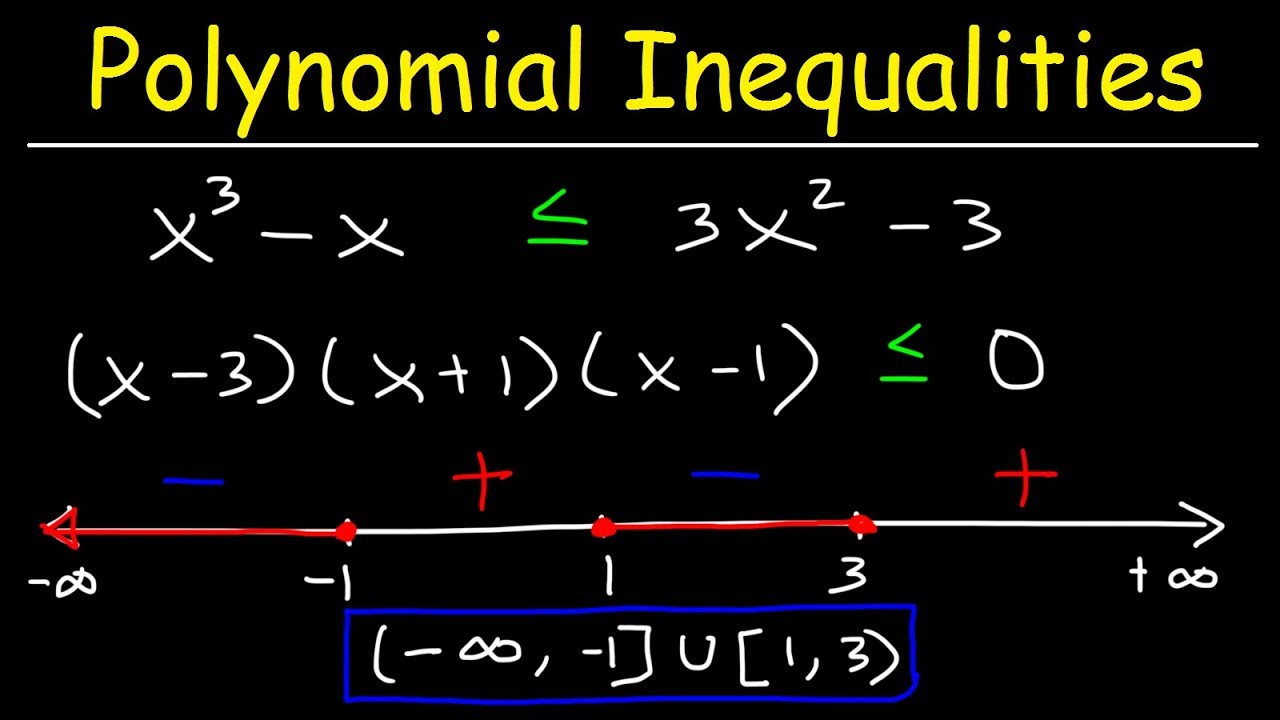
This precalculus video provides a basic introduction into solving polynomial inequalities using a sign chart on a number line and expressing the solution as an inequality using interval notation.
Algebra - Free Formula Sheets: https://www.video-tutor.net/formula-sheets.html
Polynomials - More Video Lessons:
https://www.video-tutor.net/...
narrow crypt
mystic nova
What about derivatives?
i dont think op knows derivative 😭
tepid beacon
mystic nova
What about derivatives?
i went through it but i forgot it all
narrow crypt
 tepid beacon
🥹
narrow crypt
narrow crypt
https://www.youtube.com/watch?v=Fd5ys4PQ-aM
maybe briefly review this video
and ur sleeper agent might be activated
who knows
late sinew
k with the 2s orbital pfp and a status saying chemistry is for nerds 💀 
narrow crypt
late sinew
k with the 2s orbital pfp and a status saying chemistry is for nerds 💀 <:opencr...
chemistry is for nerdds
electron is in physics
late sinew

tepid beacon
narrow crypt
maybe briefly review this video
okay will do
 daring frost
mystic nova
What about derivatives?
daring frost
mystic nova
What about derivatives?
Dont think you ead this to solve the question?