#help-19
1 messages · Page 164 of 1
 clever fjordBOT
Result:
12
 odd edgeBOT
@plucky hatch Has your question been resolved?
Channel closed
Closed by @plucky hatch
Use .reopen if this was a mistake.
 Available help channel!
Send your question here to claim the channel.
Remember:
• Ask your math question in a clear, concise manner.
• Show your work, and if possible, explain where you are stuck.
• After 15 minutes, feel free to ping <@&286206848099549185>.
• Type the command .close to free the channel when you're done.
• Be polite and have a nice day!
Read #❓how-to-get-help for further information on how to ask a good question, and about conduct in the question channels.
 lone elbow
If $n$ is any positive two-digit integer, what is the greatest positive integer that must be a factor of $n(n +1)(n + 2)(n + 3)$?
odd edgeBOT
lone elbow
If $n$ is any positive two-digit integer, what is the greatest positive integer ...
clever fjordBOT
938c2cc0dcc05f2b68c4287040cfcf71

 gilded vector
lone elbow
If $n$ is any positive two-digit integer, what is the greatest positive integer ...
gilded vector
lone elbow
If $n$ is any positive two-digit integer, what is the greatest positive integer ...
I would maybe try to start by looking at what range of values n(n+1)(...) has
when n is two digits
|| and then search for the biggest prime in that range (?) ||
lone elbow
10 to 99
gilded vector
I mean what values the expression can have
 lone elbow
gilded vector
I mean what values the expression can have
lone elbow
gilded vector
I mean what values the expression can have
unsure
gilded vector
whats the smallest two digit number
lone elbow
10
gilded vector
oh wait I think my approach is wrong
yeah it is because the integer we are looking for must always be a factor
no matter what n is
 upper onyx
what do you know about 4 consecutive numbers?
lone elbow
upper onyx
what do you know about 4 consecutive numbers?
two are even two are ods
upper onyx
yes. what else
lone elbow
upper onyx
yes. what else
unsure
upper onyx
whats about divisibility by 3?
upper onyx
lone elbow
there is always one number div 2
be more precise.
lone elbow
there is always at least one number divisible by 2 with remainder 0
upper onyx
no, you said two are even. so ...
upper onyx
lone elbow
two even are always div 2 remainder 0
and if 2 numbers are even, what does it mean by disivibilty by 4?
lone elbow
since they are multiplied, should be div 4
and div 3
because there is always one that is odd and div 3
upper onyx
be more precise. on is divisible by 2, one by 4, and one by 3.
lone elbow
the number
n(n+1)(n+2)(n+3) is div 12
unless I am tripping
how to be more precise?
upper onyx
lone elbow
n(n+1)(n+2)(n+3) is div 12
yes, but you know more.
upper onyx
upper onyx
be more precise. on is divisible by 2, one by 4, and one by 3.
read this.
upper onyx
lone elbow
like n(n+1)(n+2)(n+3) should be div 24 mayhaps
yes.
what about greater primes? 5? 7?, ...
lone elbow
lone elbow
1,2,3,4
this is never div 5
lone elbow
upper onyx
yes.
what about greater primes? 5? 7?, ...
depends on the number, can't say more, need more hints
upper onyx
yes. for every greater prime you can alwasy find 4 consecutive number where no one is divisibe by p.
lone elbow
so?
upper onyx
its only guaranted that the product of 4 consecutive numbers is divisible by 24.
lone elbow
hmm okey
upper onyx
so you would have guaranted factors 2, 3, 6, 8, 12, 24. the largest is ...
 upper onyx
i would say so.
but disclaimer: thats the way i understood the question. and we didnt use that n is a two digit number. it would be true for n = 1 too. or n = 2357.
so maybe i understood the question not in the right way.
lone elbow
the answer is correct
Solution:
Among any four consecutive positive integers, one of them must be divisible by 2, one of them must be divisible by 3, and one of them must be divisible by 4. Therefore, their product must be divisible by 24. Their product doesn't have to be divisible by any additional prime or higher prime power, because any such prime or prime power must necessarily have to be larger than 4, but the only way to guarantee that a product of $n$ consecutive integers is divisible by some prime power $p^k$ is to have $n \ge p^k$. Therefore, $\boxed{24}$ is the greatest positive integer that must be a factor of $n(n +1)(n + 2)(n + 3)$.
clever fjordBOT
938c2cc0dcc05f2b68c4287040cfcf71
 odd edgeBOT
Channel closed
Closed by @lone elbow
Use .reopen if this was a mistake.
Available help channel!
Send your question here to claim the channel.
Remember:
• Ask your math question in a clear, concise manner.
• Show your work, and if possible, explain where you are stuck.
• After 15 minutes, feel free to ping <@&286206848099549185>.
• Type the command .close to free the channel when you're done.
• Be polite and have a nice day!
Read #❓how-to-get-help for further information on how to ask a good question, and about conduct in the question channels.
 rugged pilot
Hey guys !!
i need to solve this type of question in less than 2 min
any shortcuts ?
 odd edgeBOT
rugged pilot
Hey guys !!
i need to solve this type of question in less than 2 min
any sho...
odd edgeBOT
rugged pilot
Hey guys !!
i need to solve this type of question in less than 2 min
any sho...
 sand horizon
In less than 2 minutes ?
rugged pilot
yeah, hahahah
sand horizon
What is your usual method ?
rugged pilot
rugged pilot
yeah, hahahah
fast is enough
rugged pilot
sand horizon
What is your usual method ?
i would find the 2 x's
gilded vector
zeroes
 silk quail
the minimum of this quadratic occurs at the vertex, so you should look at the vertex's location, then the value at the vertex.
sand horizon
Fish has the key idea
silk quail
reminder: the vertex's location is $x=-\frac{b}{2a}$ for a quadratic $f(x)=ax^2+bx+c$
clever fjordBOT
fish
 silk quail
the minimum doesn't mean negative
sand horizon
,w graph x² + 1
clever fjordBOT


 rugged pilot
i see !
rugged pilot
in my head, the answer ware the X's
i got it now
in this exam they generally do not ask for the x of the vertex in a positive function
i got confused
sand horizon
Probably take less than 2 minutes right ?
rugged pilot
yes, hahah
sand horizon
xd
rugged pilot
thanks a lot !
sand horizon
nw
rugged pilot
.close
odd edgeBOT
Channel closed
Closed by @rugged pilot
Use .reopen if this was a mistake.
odd edgeBOT
Available help channel!
Send your question here to claim the channel.
Remember:
• Ask your math question in a clear, concise manner.
• Show your work, and if possible, explain where you are stuck.
• After 15 minutes, feel free to ping <@&286206848099549185>.
• Type the command .close to free the channel when you're done.
• Be polite and have a nice day!
Read #❓how-to-get-help for further information on how to ask a good question, and about conduct in the question channels.
 snow hemlock
im abit stuck where to start
 odd edgeBOT
snow hemlock
im abit stuck where to start
odd edgeBOT
snow hemlock
im abit stuck where to start
 random sluice
$ln(x) + ln(y) = ln(xy)$
clever fjordBOT
@random sluice
 random sluice
$\sum_{i}^{n} ln(i) = ln(\prod_{i}^{n}i)$
clever fjordBOT
@random sluice
 snow hemlock
sorry i do not recognise what that means
random sluice
clever fjord
<@947094726513942578>
Sum of log of 2 numbers is the log of product of those two number
snow hemlock
the first bit i understnad its jsut the second message that you sent
thank you for the help as well
random sluice
Oh
 undone basin
clever fjord
<@947094726513942578>
undone basin
clever fjord
<@947094726513942578>
this is not really necessary
 south plume
snow hemlock
im abit stuck where to start
south plume
snow hemlock
im abit stuck where to start
recall that $\ln\left(\frac{a}{b}\right) = \ln(a) - \ln(b)$
snow hemlock
woudl i do method of differences
clever fjordBOT
artemetra
 snow hemlock
woudl i do method of differences
snow hemlock
snow hemlock
woudl i do method of differences
with the 2 part ln(tan(r+1)) - ln(tan(r))
south plume
yes
odd edgeBOT
Channel closed
Closed by @snow hemlock
Use .reopen if this was a mistake.
odd edgeBOT
Available help channel!
Send your question here to claim the channel.
Remember:
• Ask your math question in a clear, concise manner.
• Show your work, and if possible, explain where you are stuck.
• After 15 minutes, feel free to ping <@&286206848099549185>.
• Type the command .close to free the channel when you're done.
• Be polite and have a nice day!
Read #❓how-to-get-help for further information on how to ask a good question, and about conduct in the question channels.
 fickle pilot
Hello, can someone help explain to me why these properties are true for normal matrices?
 odd edgeBOT
fickle pilot
Hello, can someone help explain to me why these properties are true for normal m...
fickle pilot
odd edgeBOT
fickle pilot
Hello, can someone help explain to me why these properties are true for normal m...
fickle pilot
In particular the first property.
 weary pelican
fickle pilot
Hello, can someone help explain to me why these properties are true for normal m...
weary pelican
fickle pilot
Hello, can someone help explain to me why these properties are true for normal m...
can you see why det(hermitian conjugate matrix) = conjugate(det(matrix))?
then interest yourself at how det(lambda I - N) = 0 means det(lambda* I - N^dag) = 0
fickle pilot
weary pelican
can you see why det(hermitian conjugate matrix) = conjugate(det(matrix))?
by conjugate do you mean this symbol?

the cross symbol
weary pelican
hermitian conjugate that is
oops there is a conjugate
anyways
you probably remember det(A^T) = det(A)
fickle pilot
weary pelican
can you see why det(hermitian conjugate matrix) = conjugate(det(matrix))?
i think i understand why because a* b* c* ... = (a b c ...) * where * represents conjugate
weary pelican
still true for complex square matrices
fickle pilot
so if u look at det equation
fickle pilot
ok so det(N-lamba I) = 0 means det([N-lamba I] cros symbol) = 0
and [N - lambda I] cross symbol = N cross symbol - lambda cross symbol I
but lambda cross symbol is just lamba * because it is a single value
thanks bro @weary pelican i understand it now
.close
odd edgeBOT
Channel closed
Closed by @fickle pilot
Use .reopen if this was a mistake.
odd edgeBOT
Available help channel!
Send your question here to claim the channel.
Remember:
• Ask your math question in a clear, concise manner.
• Show your work, and if possible, explain where you are stuck.
• After 15 minutes, feel free to ping <@&286206848099549185>.
• Type the command .close to free the channel when you're done.
• Be polite and have a nice day!
Read #❓how-to-get-help for further information on how to ask a good question, and about conduct in the question channels.
 stuck wasp
What does Dot Product AND Cross Product actually do for vectors? Could you give me a picture of what im calculating
odd edgeBOT
stuck wasp
What does Dot Product AND Cross Product actually do for vectors? Could you give ...
 tepid pelican
check 3blue1brown
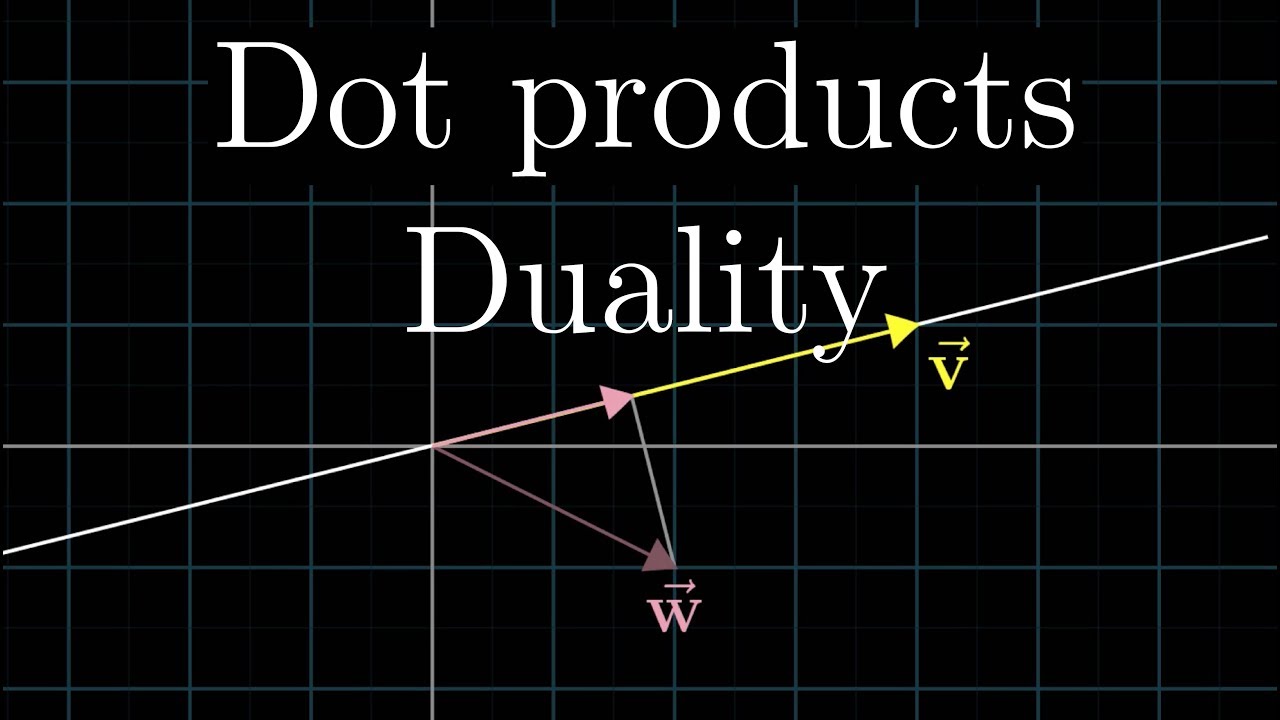
Why the formula for dot products matches their geometric intuition.
Help fund future projects: https://www.patreon.com/3blue1brown
An equally valuable form of support is to simply share some of the videos.
Home page: https://www.3blue1brown.com/
Dot products are a nice geometric tool for understanding projection. But now that we know about lin...

This covers the main geometric intuition behind the 2d and 3d cross products.
Help fund future projects: https://www.patreon.com/3blue1brown
An equally valuable form of support is to simply share some of the videos.
Home page: https://www.3blue1brown.com/
*Note, in all the computations here, I list the coordinates of the vectors as columns of a...
stuck wasp
Perfect ill check them out
undone basin
Dot product measures how close in one direction two vectors are, and cross product measures how perpendicular two vectors are, that's how I remember it
stuck wasp
thanks for the help G
stuck wasp
undone basin
Dot product measures how close in one direction two vectors are, and cross produ...
hmm
might be. ill check the vids out, thanks again
undone basin
undone basin
Dot product measures how close in one direction two vectors are, and cross produ...
helpful for doing physics
odd edgeBOT
@stuck wasp Has your question been resolved?
odd edgeBOT
Channel closed
Closed due to timeout
Use .reopen if this was a mistake.
Available help channel!
Send your question here to claim the channel.
Remember:
• Ask your math question in a clear, concise manner.
• Show your work, and if possible, explain where you are stuck.
• After 15 minutes, feel free to ping <@&286206848099549185>.
• Type the command .close to free the channel when you're done.
• Be polite and have a nice day!
Read #❓how-to-get-help for further information on how to ask a good question, and about conduct in the question channels.
 vale basin
@cerulean vortex
odd edgeBOT
vale basin
<@343767005373136896>
vale basin
Of the form : k(1)f’(ξ1) + k(2)f’(ξ2) = λ then we split the intervals [a,b] to [a,c] and [c,b] in which c = a +k*d in which ( d= (b-a)/ (k(1) + k(2))
Pasted it
 cerulean vortex
okay... i'm not familiar with that
vale basin
Ah okay then
cerulean vortex
but it seems relevant
but
you have:
f'(zeta1) = (f(2)-f(0))/(2-0)
f'(zeta2)=(f(5)-f(2))/(5-2)
so
2f'(zeta1)=f(2)-f(0)
3f'(zeta2)=f(5)-f(2)
just add these last two equations together
vale basin
From which intervals are those
cerulean vortex
[0,2] and [2,5]
vale basin
Yeah those work just fine
I can solve it with those
My problem were with the others
cerulean vortex
oh
vale basin
The formulas basically help you find which intervals work
cerulean vortex
like [0,3] and [3,5]
vale basin
Yes
cerulean vortex
find zeta1 in [3,5]
vale basin
I have
cerulean vortex
f'(zeta1)=(f(5)-f(3))/(5-3)
vale basin
Multiply both side by 2
cerulean vortex
2f'(zeta1)=f(5)-f(3)
vale basin
Yeah that seems correct I am getting confused by the variables
odd edgeBOT
@vale basin Has your question been resolved?
Channel closed
Closed by @vale basin
Use .reopen if this was a mistake.
odd edgeBOT
Available help channel!
Send your question here to claim the channel.
Remember:
• Ask your math question in a clear, concise manner.
• Show your work, and if possible, explain where you are stuck.
• After 15 minutes, feel free to ping <@&286206848099549185>.
• Type the command .close to free the channel when you're done.
• Be polite and have a nice day!
Read #❓how-to-get-help for further information on how to ask a good question, and about conduct in the question channels.
 obtuse pasture
A friend of mine sent me this problem; I just need a hint to get me going in the right direction on this
odd edgeBOT
obtuse pasture
A friend of mine sent me this problem; I just need a hint to get me going in the...
obtuse pasture

 vale vapor
try using like-triangles and write one side as x
then figure out the other sides in terms of x
vale vapor
!show
odd edgeBOT
Show your work, and if possible, explain where you are stuck.
undone basin
obtuse pasture
similar triangles
obtuse pasture
can you work it out?
vale vapor
!nosols
odd edgeBOT
As a helper, please do not give out answers that could be copied as a homework solution. Have the student work through the problem themselves and guide them along the way.
obtuse pasture
bro what
okay fine gimme a sec
x/6 = 6/y (let y be the lower leg of small triangle)
xy = 36
next. (y^2 + 36)^1/2 + (x^2 + 36)^1/2 = 20
y =36/x
(6^4/x^2 + 6^2)^1/2 + (x^2 + 36)^1/2 = 20
6(6^2/x^2 + 1)^1/2 + (x^2+36)^1/2 = 20
6/x * (x^2 + 36)^1/2 + (x^2 + 36)^1/2 = 20
pythag in bigger triangle as well
(x+6)^2 + (y+6)^2 = 400
(x^2 + 36)^1/2 + (y^2 + 36)^1/2 = 20
put xy = 36 -> y = 36/x
(x+6)^2 + (36/x + 6)^2 = 400
(x+6)^2 + 6^2/x^2 * (6+x)^2 = 400
6^2/x^2 * (x^2 + 36) + (x^2 +36) + (x^2+36)*12/x = 400subtract both eqns after expanding the squares here
12x * 36/x^2 + 12x - 12/x * (x^2 + 36) = 0
divide both sides by 12
36x/x^2 + x - x^2/x - 36/x =0
36/x + x - x + 36/x = 0
obtuse pasture
similarity
odd edgeBOT
@obtuse pasture Has your question been resolved?
odd edgeBOT
Channel closed
Closed due to timeout
Use .reopen if this was a mistake.
Available help channel!
Send your question here to claim the channel.
Remember:
• Ask your math question in a clear, concise manner.
• Show your work, and if possible, explain where you are stuck.
• After 15 minutes, feel free to ping <@&286206848099549185>.
• Type the command .close to free the channel when you're done.
• Be polite and have a nice day!
Read #❓how-to-get-help for further information on how to ask a good question, and about conduct in the question channels.
Channel closed
Channel closed due to the original message being deleted.
If you did not intend to do this, please open a new help channel,
as this action is irreversible, and this channel may abruptly lock.
 timid sky
oops
odd edgeBOT
Available help channel!
Send your question here to claim the channel.
Remember:
• Ask your math question in a clear, concise manner.
• Show your work, and if possible, explain where you are stuck.
• After 15 minutes, feel free to ping <@&286206848099549185>.
• Type the command .close to free the channel when you're done.
• Be polite and have a nice day!
Read #❓how-to-get-help for further information on how to ask a good question, and about conduct in the question channels.
 still steeple
In a sequence of positive integers, each term after the second is the product of the previous two terms. The sixth term is $4000$. What is the first term? how do u this this an amc 8 problem
odd edgeBOT
still steeple
In a sequence of positive integers, each term after the second is the product of...
clever fjordBOT
Element

 fickle silo
might help to first figure out the prime factors of 4000
fickle silo
so the first 2 terms must be something with 2 and 5
still steeple
nvm i found the solution
its by using variables to represent what happens
in each step
first term a second b
then
ab
ab^2
a^2b^3
a^3b^5
and so on
i js found one on yt
and yea u had to use prime factorization
to plug in 2^5 and 5^3
for a^3b^5
 ember oak
odd edgeBOT
ember oak
odd edgeBOT
If you are done with this channel, please mark your problem as solved by typing .close
still steeple
.close
odd edgeBOT
Channel closed
Closed by @still steeple
Use .reopen if this was a mistake.
odd edgeBOT
Available help channel!
Send your question here to claim the channel.
Remember:
• Ask your math question in a clear, concise manner.
• Show your work, and if possible, explain where you are stuck.
• After 15 minutes, feel free to ping <@&286206848099549185>.
• Type the command .close to free the channel when you're done.
• Be polite and have a nice day!
Read #❓how-to-get-help for further information on how to ask a good question, and about conduct in the question channels.
 vague siren
Hiyihi
odd edgeBOT
vague siren
Hiyihi
 ivory dock
Hiya
vague siren
I need help with 95 oz to g
ivory dock
Converting 95 oz to grams?
vale vapor
 vague siren
Yes
ivory dock
1 oz is 28.3495231 grams
upper onyx
ivory dock
Converting 95 oz to grams?

LetMeGoogleThat.com
For those who think it's easier to annoy you than to Google '95 oz to g' themselves.
ivory dock
so multiply the ammount you have by 28.3495231 and you'll get your answer
vague siren
95x28.3495231?
ivory dock
ye
odd edgeBOT
@vague siren Has your question been resolved?
 warm wren
ivory dock
so multiply the ammount you have by 28.3495231 and you'll get your answer
warm wren
ivory dock
so multiply the ammount you have by 28.3495231 and you'll get your answer
yeah just multiply it by (insert random huge number here) and there's your result!
odd edgeBOT
Channel closed
Closed due to timeout
Use .reopen if this was a mistake.
Available help channel!
Send your question here to claim the channel.
Remember:
• Ask your math question in a clear, concise manner.
• Show your work, and if possible, explain where you are stuck.
• After 15 minutes, feel free to ping <@&286206848099549185>.
• Type the command .close to free the channel when you're done.
• Be polite and have a nice day!
Read #❓how-to-get-help for further information on how to ask a good question, and about conduct in the question channels.
ivory dock
warm wren
yeah just multiply it by (insert random huge number here) and there's your resul...
It's not my fault americans use weird units
ivory dock
.close
odd edgeBOT
Channel closed
Closed by @ivory dock
Use .reopen if this was a mistake.
odd edgeBOT
Available help channel!
Send your question here to claim the channel.
Remember:
• Ask your math question in a clear, concise manner.
• Show your work, and if possible, explain where you are stuck.
• After 15 minutes, feel free to ping <@&286206848099549185>.
• Type the command .close to free the channel when you're done.
• Be polite and have a nice day!
Read #❓how-to-get-help for further information on how to ask a good question, and about conduct in the question channels.
 olive sun
 olive sun
Completely forgot how to do logistic equations, could someone please remind me?
 green sage
wouldn’t a google search be a better solution
olive sun
I've tried to search for how to do this on google but the answers were... well, less than comprehensive
vale vapor
well, its multiple choice, so you can test out all the options
olive sun
is there a general formula i can work with?
vale vapor
what do you expect when P is 500?
 vale vapor
and at P is 100?
olive sun
hold on, so p is the capacity of the theater then
green sage
yes
olive sun
green sage
what do L and K stand for again, please?
been like 2 months since we learned this
and stopped using t
it*
olive sun
one sec
working on a device i'm not used to, trying to figure out the controls. my laptop's still in repairs
found how to zoom
sweet
vale vapor
olive sun
hold on, so p is the capacity of the theater then
no, P is the current amount of people in the theater
capacity is 500
olive sun
green sage
L=500
P=100
and how do we get the constant of proportionality? 50? or like, 100/50, or what do we do?
my apologies for being denser than a blackhole
green sage
plug in the values they give you for dP/dt and P, then solve for k
olive sun
how do i solve for k without knowing exactly what i'm looking for in k? they've given me a rate of change being 50, but how could we use that to get the "constant of proportionality"
odd edgeBOT
@olive sun Has your question been resolved?
odd edgeBOT
Channel closed
Closed due to timeout
Use .reopen if this was a mistake.
odd edgeBOT
Available help channel!
Send your question here to claim the channel.
Remember:
• Ask your math question in a clear, concise manner.
• Show your work, and if possible, explain where you are stuck.
• After 15 minutes, feel free to ping <@&286206848099549185>.
• Type the command .close to free the channel when you're done.
• Be polite and have a nice day!
Read #❓how-to-get-help for further information on how to ask a good question, and about conduct in the question channels.
 sick edge
plz help me, why is there 3 correct answers?
 sick edge
isn't b, c, and d correct?
 steep mantle
no
sick edge
oh
ohhhhhhhhhhhhhhhhhhhhhhhhhhhhhhhhhhhhhhhhhhh
it's a
because
the sqrt of 4
is plus minus
is me smart?
this is why when u see three right answers, u always go with the wrong answer if it's the only wrong answer
 rose radish
first u can factor out the 4 in the 4x+4
sick edge
rose radish
first u can factor out the 4 in the 4x+4
4x-4
mhm mhm
it would be the same if u didn't but
mhm mhm
rose radish
to get (x-1)(x-2)(x+2)(x+b)
sick edge
mmmmmmmmmmmmmmmmm
rose radish
now we get to pick and choose
b can be anyone one of -1 , -2,2
so here -1 is correct
sick edge
 rose radish
u got it ?
rose radish
sick edge
🤤
wot
odd edgeBOT
Channel closed
Closed by @sick edge
Use .reopen if this was a mistake.
odd edgeBOT
Available help channel!
Send your question here to claim the channel.
Remember:
• Ask your math question in a clear, concise manner.
• Show your work, and if possible, explain where you are stuck.
• After 15 minutes, feel free to ping <@&286206848099549185>.
• Type the command .close to free the channel when you're done.
• Be polite and have a nice day!
Read #❓how-to-get-help for further information on how to ask a good question, and about conduct in the question channels.
 outer sun
Please help I'm confused, maybe even bamboozled
outer sun

I tried drawing a diagram to try and represent the info but that didn't help
I think we have to create an equation of some sort
cerulean vortex
in 15 seconds how far does andy go?
odd edgeBOT
@outer sun Has your question been resolved?
odd edgeBOT
Channel closed
Closed due to timeout
Use .reopen if this was a mistake.
odd edgeBOT
Available help channel!
Send your question here to claim the channel.
Remember:
• Ask your math question in a clear, concise manner.
• Show your work, and if possible, explain where you are stuck.
• After 15 minutes, feel free to ping <@&286206848099549185>.
• Type the command .close to free the channel when you're done.
• Be polite and have a nice day!
Read #❓how-to-get-help for further information on how to ask a good question, and about conduct in the question channels.
 indigo sonnet
L={0^n 1^m 0^p 1^m 0^n } n>0,m>0,p>0
Can anyone turn this Language to push down automata please?
I only need the answers.
odd edgeBOT
indigo sonnet
L={0^n 1^m 0^p 1^m 0^n } n>0,m>0,p>0
Can anyone turn this Language to push down ...
@indigo sonnet Has your question been resolved?
 meager juniper
!noans
odd edgeBOT
The purpose of this server is to help you learn, not to hand out answers. Do not ask someone to give you the answer directly.
Channel closed
Closed due to timeout
Use .reopen if this was a mistake.
Available help channel!
Send your question here to claim the channel.
Remember:
• Ask your math question in a clear, concise manner.
• Show your work, and if possible, explain where you are stuck.
• After 15 minutes, feel free to ping <@&286206848099549185>.
• Type the command .close to free the channel when you're done.
• Be polite and have a nice day!
Read #❓how-to-get-help for further information on how to ask a good question, and about conduct in the question channels.
 mystic saffron
i thought we use
odd edgeBOT
mystic saffron
i thought we use
mystic saffron
what does part d even mean

 dawn tiger
they give you an example of a probability distribution table for Y at the top
so basically just indicate the possible values of D and their respective probabilities
odd edgeBOT
@mystic saffron Has your question been resolved?
odd edgeBOT
Channel closed
Closed due to timeout
Use .reopen if this was a mistake.
Available help channel!
Send your question here to claim the channel.
Remember:
• Ask your math question in a clear, concise manner.
• Show your work, and if possible, explain where you are stuck.
• After 15 minutes, feel free to ping <@&286206848099549185>.
• Type the command .close to free the channel when you're done.
• Be polite and have a nice day!
Read #❓how-to-get-help for further information on how to ask a good question, and about conduct in the question channels.
mystic saffron
dawn tiger
so basically just indicate the possible values of D and their respective probabi...
so what
odd edgeBOT
mystic saffron
so what
mystic saffron
distance formula
i llug in Y into 12 and find D
how do u get the probability of that
odd edgeBOT
@mystic saffron Has your question been resolved?
odd edgeBOT
Channel closed
Closed due to timeout
Use .reopen if this was a mistake.
Available help channel!
Send your question here to claim the channel.
Remember:
• Ask your math question in a clear, concise manner.
• Show your work, and if possible, explain where you are stuck.
• After 15 minutes, feel free to ping <@&286206848099549185>.
• Type the command .close to free the channel when you're done.
• Be polite and have a nice day!
Read #❓how-to-get-help for further information on how to ask a good question, and about conduct in the question channels.
 tender carbon
so I am getting first Z but not the second. why?
tender carbon
 odd edgeBOT
@tender carbon Has your question been resolved?
 celest acorn
odd edgeBOT
celest acorn
odd edgeBOT
@tender carbon Has your question been resolved?
odd edgeBOT
Channel closed
Closed due to timeout
Use .reopen if this was a mistake.
Available help channel!
Send your question here to claim the channel.
Remember:
• Ask your math question in a clear, concise manner.
• Show your work, and if possible, explain where you are stuck.
• After 15 minutes, feel free to ping <@&286206848099549185>.
• Type the command .close to free the channel when you're done.
• Be polite and have a nice day!
Read #❓how-to-get-help for further information on how to ask a good question, and about conduct in the question channels.
 waxen ingot
I'm doing an online maths course and I've had one question bug before, but I want to make sure I'm not just being stupid.
 odd edgeBOT
waxen ingot
I'm doing an online maths course and I've had one question bug before, but I wan...
timid sky
waxen ingot
I'm doing an online maths course and I've had one question bug before, but I wan...
odd edgeBOT
waxen ingot
I'm doing an online maths course and I've had one question bug before, but I wan...
timid sky
waxen ingot
I'm doing an online maths course and I've had one question bug before, but I wan...
Yep
waxen ingot
heres my workings just in case sorry it's mucky I didn't think I'd be showing people
 timid sky
it in fact is bugging
timid sky
you're correct dw

 haughty fulcrum
perhaps they wanted 2(x+1/2)
waxen ingot
so now my score looks like this
haughty fulcrum
i would ask your teacher
waxen ingot
they said "three linear factors" specifically i think
I'm doing it by myself, no teacher
timid sky
ah thats a bummer. Big issue with online assignments i guess. But yeah do flag this to your TA/professor
waxen ingot
guess thats the risk yeah
haughty fulcrum
yeah that probably meant a(x-q)(x-r)(x-s)
timid sky
waxen ingot
I'm doing it by myself, no teacher
Surely there is some mentor
waxen ingot
nope
timid sky
i mean does the grade actually matter then
waxen ingot
its free so i cant complain much but
haughty fulcrum
do you get answers?
waxen ingot
weirdly sometimes
sometimes not
its very strange
its a free imperial college london course so youd think theyd be a bit more careful but
timid sky
if this is like something you're doing just to like self-assess yourself then just like modify the erroneous final score to reflect what you should've actually gotten
waxen ingot
https://cdn.discordapp.com/attachments/974390947712495616/1324473758748115024/image.png?ex=6778f08f&is=67779f0f&hm=858a277397b24d45e26dde5736f22a5f81e7e65c5850388a151e26ad359a94b6& this one was bugged as well
 waxen ingot
oh? i think i tried that but
ill go check rq
they didnt actually say anything about rational root theorem and I don't know if ive heard of it before
its kinda a mucky course tbh
oh wait no yeah ik what this is nvm im just stupid lol

:/
i thought i had given that a go, i think it's just flatly broke
oh my god
 timid sky
lol i love how they didn't give enough of a shit to truncate their floats either
haughty fulcrum
what the
timid sky
this seems like something an intern made on the fly
waxen ingot
it works if you rearrange it
thats so dumb
mhm
thank you for your help either way
it's been fine up until this chapter so I don't know if they guy who made this chunk is just busy gnawing on a lump of rock or something but
odd edgeBOT
@waxen ingot Has your question been resolved?
Channel closed
Closed by @waxen ingot
Use .reopen if this was a mistake.
Available help channel!
Send your question here to claim the channel.
Remember:
• Ask your math question in a clear, concise manner.
• Show your work, and if possible, explain where you are stuck.
• After 15 minutes, feel free to ping <@&286206848099549185>.
• Type the command .close to free the channel when you're done.
• Be polite and have a nice day!
Read #❓how-to-get-help for further information on how to ask a good question, and about conduct in the question channels.
 civic flax
What do I do when I have long ecuation worms with fractions over fractions and all that and I only change a bit of the total thing and I don't wanna write all that again
odd edgeBOT
civic flax
What do I do when I have long ecuation worms with fractions over fractions and a...
@civic flax Has your question been resolved?
 narrow hound
civic flax
What do I do when I have long ecuation worms with fractions over fractions and a...
narrow hound
civic flax
What do I do when I have long ecuation worms with fractions over fractions and a...

i don't know what you wanted to mean exactly
civic flax
bro
i meant LONG fractions
like...
is there an acceptable way to only write half of the big "worm" if the other half stays the same
narrow hound
tf is a worm
 narrow hound
.rotate
civic flax
civic flax
is there an acceptable way to only write half of the big "worm" if the other hal...
.
 narrow hound
so i just need see the last answer right
civic flax
im tryina rewrite everything in a simpler form. That's not the issue
i want to ask if I always have to write the part that doesnt change
like

this shit stays the same
do I have to keep writing? it takes a lot of time
narrow hound
yeah
civic flax
welp... this sucks ig
narrow hound
you can't just remove your denominator
civic flax
well it's "there" i js meant if I could write sm like
_______//__________
meh nevermind
/close
/done
.done
wtf was
narrow hound
hold on
civic flax
.close
odd edgeBOT
Channel closed
Closed by @civic flax
Use .reopen if this was a mistake.
civic flax
nah its fine
narrow hound
civic flax
.close
so you want to remove a lower part and in the end add it
because you're lazy
civic flax
yes
narrow hound
you can't
narrow hound
when you'll give that to your professor he'll read something else
civic flax
its fine forget abt it
narrow hound
civic flax
the whole thing
you need to keep the whole calcul
civic flax
alr thx
odd edgeBOT
Available help channel!
Send your question here to claim the channel.
Remember:
• Ask your math question in a clear, concise manner.
• Show your work, and if possible, explain where you are stuck.
• After 15 minutes, feel free to ping <@&286206848099549185>.
• Type the command .close to free the channel when you're done.
• Be polite and have a nice day!
Read #❓how-to-get-help for further information on how to ask a good question, and about conduct in the question channels.
Channel closed
Closed by @thin glade
Use .reopen if this was a mistake.
✅
Channel closed
Closed by @thin glade
Use .reopen if this was a mistake.
Available help channel!
Send your question here to claim the channel.
Remember:
• Ask your math question in a clear, concise manner.
• Show your work, and if possible, explain where you are stuck.
• After 15 minutes, feel free to ping <@&286206848099549185>.
• Type the command .close to free the channel when you're done.
• Be polite and have a nice day!
Read #❓how-to-get-help for further information on how to ask a good question, and about conduct in the question channels.
odd edgeBOT
Channel closed
Channel closed due to the original message being deleted.
If you did not intend to do this, please open a new help channel,
as this action is irreversible, and this channel may abruptly lock.
Available help channel!
Send your question here to claim the channel.
Remember:
• Ask your math question in a clear, concise manner.
• Show your work, and if possible, explain where you are stuck.
• After 15 minutes, feel free to ping <@&286206848099549185>.
• Type the command .close to free the channel when you're done.
• Be polite and have a nice day!
Read #❓how-to-get-help for further information on how to ask a good question, and about conduct in the question channels.
 karmic bloom
hey i have a question, so.. for point a, its a subspace of R^2, but not of R^R^2, right? since its a set of points, while R^R^2 is a set of functions defined from R^2 into R
 odd edgeBOT
karmic bloom
hey i have a question, so.. for point a, its a subspace of R^2, but not of R^R^2...
odd edgeBOT
karmic bloom
hey i have a question, so.. for point a, its a subspace of R^2, but not of R^R^2...
 echo ginkgo
it looks like the _R below is just to say what field of scalars is used
otherwise all the questions are meaningless yea
@karmic bloom
odd edgeBOT
Channel closed
Closed by @karmic bloom
Use .reopen if this was a mistake.
odd edgeBOT
Available help channel!
Send your question here to claim the channel.
Remember:
• Ask your math question in a clear, concise manner.
• Show your work, and if possible, explain where you are stuck.
• After 15 minutes, feel free to ping <@&286206848099549185>.
• Type the command .close to free the channel when you're done.
• Be polite and have a nice day!
Read #❓how-to-get-help for further information on how to ask a good question, and about conduct in the question channels.
 supple creek
Is the answer for -(x-1) + (3-x) > 3
x < 1/2
 paper onyx
Yes
supple creek
and for +(x-1) + (+(3-x)) > 3
there is no answer right
 winter berry
supple creek
and for +(x-1) + (+(3-x)) > 3
there is no answer right
winter berry
supple creek
and for +(x-1) + (+(3-x)) > 3
there is no answer right
Technically there is an answer, the answer is that there are no solutions. That is, it's a false inequality
supple creek
well yeah, but in the written form the "answer" is written as the ∅, right
winter berry
Yes you can write it like that
odd edgeBOT
@supple creek Has your question been resolved?
Channel closed
Closed by @supple creek
Use .reopen if this was a mistake.
odd edgeBOT
Available help channel!
Send your question here to claim the channel.
Remember:
• Ask your math question in a clear, concise manner.
• Show your work, and if possible, explain where you are stuck.
• After 15 minutes, feel free to ping <@&286206848099549185>.
• Type the command .close to free the channel when you're done.
• Be polite and have a nice day!
Read #❓how-to-get-help for further information on how to ask a good question, and about conduct in the question channels.
 royal frost
 odd edgeBOT
royal frost
royal frost
odd edgeBOT
royal frost
royal frost
Yo
What's the easiest way to solve this system?
I got lost when I tried to solve it
 scarlet pawn
i would start with solving for c2 in the last eq
royal frost
scarlet pawn
i would start with solving for c2 in the last eq
So how u thought abt it?
scarlet pawn
um so c2 is the only variable in 2 equations the rest are either in 3 or one and so it would be hard to use sub
 wanton bison
royal frost
What's the easiest way to solve this system?
wanton bison
royal frost
What's the easiest way to solve this system?
I would use a coefficient matrix and row reduce it until I reach row echelon form
royal frost
scarlet pawn
um so c2 is the only variable in 2 equations the rest are either in 3 or one and...
I see
royal frost
wanton bison
I would use a coefficient matrix and row reduce it until I reach row echelon for...
Didn't think abt that
scarlet pawn
idk what adwni is talking about, if you want more info on that you can ask, im not very educated in that area
royal frost
scarlet pawn
idk what adwni is talking about, if you want more info on that you can ask, im n...
I think he meant to turn the system into Matrix and solve it
One min I'll give it a try
scarlet pawn
yea idk what that is 😭
 amber schooner
scarlet pawn
yea idk what that is 😭
amber schooner
scarlet pawn
yea idk what that is 😭
a rectangular array of numbers containing the coefficient of c1, c2, and c3
scarlet pawn
amber schooner
a rectangular array of numbers containing the coefficient of c1, c2, and c3
thanks knief i knew you could save us
royal frost
wanton bison
I would use a coefficient matrix and row reduce it until I reach row echelon for...
It works perfectly here
Probably this is the best method to apply here
Thanks a lot guys. Pls continue saving poor students like me xd
Imma close this one
.close
odd edgeBOT
Channel closed
Closed by @royal frost
Use .reopen if this was a mistake.
odd edgeBOT
Available help channel!
Send your question here to claim the channel.
Remember:
• Ask your math question in a clear, concise manner.
• Show your work, and if possible, explain where you are stuck.
• After 15 minutes, feel free to ping <@&286206848099549185>.
• Type the command .close to free the channel when you're done.
• Be polite and have a nice day!
Read #❓how-to-get-help for further information on how to ask a good question, and about conduct in the question channels.
olive sun
Could anybody please help out with this? I'm struggling to remember how we generally work with logistic equations
 odd edgeBOT
olive sun
Could anybody please help out with this? I'm struggling to remember how we gener...
odd edgeBOT
olive sun
Could anybody please help out with this? I'm struggling to remember how we gener...
 royal herald
@olive sun what have you tried?
clever fjordBOT
 olive sun
royal herald
<@735549586529189979> what have you tried?
olive sun
royal herald
<@735549586529189979> what have you tried?
Well, through the process of elimination, A is unlikely to be the answer since AP classroom always has that one simple outlier.
I completely forgot how to work with logistics since we learned it months ago
Let's see
if I integrate it, it becomes H^2+t
but where do we go from there?
royal herald
cant integrate like that
royal herald
notice its a separable differential equation
royal herald
olive sun
+C
no
u need to get all terms with an H to one side, and all terms with a 't' to the other side
royal herald
royal herald
u need to get all terms with an H to one side, and all terms with a 't' to the o...
do this
olive sun
*dT on both sides, -2Hdt, and leave it as dH+2Hdt=1dt and integrate it like that?
olive sun
Sorry for my general incompetence, haven't done this in a while
royal herald
$\dv {H}{t} = [2H + 1]$
clever fjordBOT
 olive sun
oh
yeah i'm a bit puzzled here. trying to immediate move the dH leaves dHdt in the end aswell
am i that rusty that i'm failing to solve a simple differential equation?
jesus
"use it or lose it" indeed
royal herald
ill give u a hint
olive sun
dH=dt[2H+1]
royal herald
keep going
olive sun
integrate
royal herald
no
royal herald
get the H's on one side
royal herald
no
olive sun
so i just move dH back with everything else?
royal herald
show me what you mean
olive sun
0=dt[2H+1]-dH
or alternatively, 1=dt[2H+1]/dH
olive sun
hold on, lemme recheck the question to see if there are any actual given values
royal herald
no
dont do that
just think
if i have an equation
Z^2 = x * y * Z
how do i get all the Z's on one side
olive sun
divide the entire thing by Z
royal herald
good
royal herald
tell me what you see
royal herald
Yes
clever fjordBOT
 royal herald
keep going
royal herald
just do what you need
clever fjordBOT
 olive sun
completely forgot, when integrating with a present numerator, do we keep it on the side?
wait nvm that's a dH
ln[2H+1]=t
royal herald
olive sun
wait nvm that's a dH
ln[2H+1]=t
not quite
olive sun
right direction?
olive sun
it's 1dt, which, deriving would be t/1
royal herald
try differentiating the left side of ur solution - see what you get
olive sun
how do i deal with the dH in the numerator while deriving?
oh
of MY solution
wait did i just forget chainrule?
2ln[2H+1]=t instead
but
that's the wrong application of it
i treated that as a derivative
1/[2H+1]/2
multiply both sides by 2
royal herald
olive sun
1/[2H+1]/2
what does this mean
 frosty badge
@royal herald may i give him a small hint on where he messed up?
royal herald
frosty badge
<@307914411648090113> may i give him a small hint on where he messed up?
no
olive sun
lemme just run through the process, step by step
intdH/[2H+1]=intdt
which can be rephrased as
int(1/(2H+1))dH=1dt
when integrating, i need to also inverse the chain rule
ln[2H+1]/2+C=t+C
remove C from both sides
multiply both sides by 2
ln[2H+1]=2t
i messed up somewhere by removing C
because all the choices keep it
@royal herald intervention, please?
where'd i goof up
royal herald
ln[2H+1]/2+C=t+C
u dont really need the +C on the left side
its kinda useless
i mean, its correct, but conventionally we keep it on the independent variable side
so itd just be
ln[2H+1]/2 =t+C
now u multiplied out and got
ln(2H + 1) = 2t + 2C
olive sun
And how is the second C dealt with?
royal herald
note that 2C = C cuz its just an arbitrary constant
royal herald
or we coulda just had
ln[2H+1]/2 =t+A
A being our constant of integration
multiply out by 2
ln[2H+1] = 2t + 2A
let 2A = C
so solution is ?
royal herald
np
royal herald
do the integration in steps
like u forgot the u-sub, so try to remember that
remember there are different ways to isolate dH and dt
olive sun
Yeah, I fear usub with blazing terror
royal herald
thats abt it I think
royal herald
olive sun
Yeah, I fear usub with blazing terror
i mean ur in BC right? should be one of the easier concepts
olive sun
royal herald
i mean ur in BC right? should be one of the easier concepts
I haven't had the chance to properly focus on Usub unfortunately
Integration By Parts felt easier in every way
Usub requires some indirect work
royal herald
olive sun
Integration By Parts felt easier in every way
nah thats a crazy take but 🤷♂️ its subjective ig
olive sun
royal herald
nah thats a crazy take but 🤷♂️ its subjective ig
the issue is, I took AB over florida virtual school and it was done at my own pace
but I'm taking BC under a Harvard Alum
and she gave us what she calls the "reverse zorro technique"
for integration by parts, where we have U, dU, V, and dV
and we use LIPET to see where to start exactly
with usub it feels like there's some guesswork
thank you so much though, @royal herald. I'm sorry if i seem a bit dense or inexperienced
royal herald
olive sun
with usub it feels like there's some guesswork
yea i guess
royal herald
olive sun
thank you so much though, <@307914411648090113>. I'm sorry if i seem a bit dense...
no worries, ur fine
good luck
odd edgeBOT
Channel closed
Closed by @olive sun
Use .reopen if this was a mistake.
odd edgeBOT
Available help channel!
Send your question here to claim the channel.
Remember:
• Ask your math question in a clear, concise manner.
• Show your work, and if possible, explain where you are stuck.
• After 15 minutes, feel free to ping <@&286206848099549185>.
• Type the command .close to free the channel when you're done.
• Be polite and have a nice day!
Read #❓how-to-get-help for further information on how to ask a good question, and about conduct in the question channels.
 plain spire
yo guys can someone help me understand "Proof by Induction: Sum of Squares"
dm me if you can help pls
 odd edgeBOT
plain spire
yo guys can someone help me understand "Proof by Induction: Sum of Squares"
dm m...
vale vapor
odd edgeBOT
plain spire
yo guys can someone help me understand "Proof by Induction: Sum of Squares"
dm m...
vale vapor
!status
odd edgeBOT
What step are you on?
1. I don't know where to begin.
2. I have begun but got stuck midway.
3. I got an answer but I was told that it's wrong.
4. I got an answer and would like my work checked.
5. I have a question about someone else's work/solution.
6. I have completed the problem and don't need help anymore. Thank you.
7. None of the above
2
vale vapor
!show
odd edgeBOT
Show your work, and if possible, explain where you are stuck.
vale vapor
plain spire
my paper is kinda unreadable
doesnt matter
vale vapor
plain spire
I have specific questions
ask them
plain spire
so like I know that I need to replace the n with 1 but then I have to replace with n+1 but like how do I go from n+1 to n?
vale vapor
with induction, you have the base case and then the induction step
in the induction step you assume that P(n) is true, then use it to show that P(n+1) must then also be true
 quasi sparrow
<@&268886789983436800> troll
plain spire
but like what if I don't get the n at the end and like something else does that mean it was false?
vale vapor
<@&268886789983436800>
 real trellis
sorry about all that
plain spire
np
vale vapor
plain spire
but like what if I don't get the n at the end and like something else does that ...
or you did it wrong
plain spire
so like there was a queestion I did where there was a n and a i, wait I'll show you
it's not uploading


this one
the black one
like I did it but then I got stuck and I asked chatgpt and it did it in a wierd way
it wrote i/i.(i+1) twice while writing n/n+1 only once
steep mantle
!nogpt
odd edgeBOT
Please do not trust ChatGPT or similar AI tools for mathematical tasks, as they often generate output which "sounds correct" but has numerous factual or logical errors. Use of these AI tools to answer other people's help questions is strictly against server rules (see #rules).
steep mantle
do you understand the concept of induction?
vale vapor
plain spire
whats the base case here
plain spire
n>=1
plain spire
vale vapor
base case is just one n
well one n is already written so I guess that is tthe base case
plain spire
I mean I kinda understood it but can't seem to apply it
I can apply in java but not ion paper for some reason
 dusty burrow
way i understood induction is
base case: lowest value possible usually,
after you prove base case
asume its true for n = k , prove its true for k+1
The final destination you want to reach is the answer when k+1 is plugged on the RHS
but you cant just do that you'd be assuming the conclusion, but since you assumed its true for k you can use the sum for k and then you add the k+1th element
lemme know if im wrong guys
because the k +1th element is the kth element plus the new value to the k+1th value, since you proved the k value you can substitute that with the RHS but for the k+1th element you have to write it like it is (LHS)
vale vapor
induction works like dominos, you push one of the dominos over and all the other ones fall
plain spire
yh thats what I understood, like I replace the n with n+1 then try to go form n+1 to the base n, and if I did it then I prouved it or else no
vale vapor
what youre trying to explain doesnt really make sense
dusty burrow
yeah
vale vapor
or at least, im not understanding it
you show for some n (base case) its true
then you assume for n=k it is true, then you show that it is also true for n=k+1
steep mantle
real trellis
why is this channel getting targeted so much
has there been multiple ehre?
plain spire
dusty burrow
centaur you understand base case ?
yh
plain spire
Just I didn't explain it well
vale vapor
plain spire
yh
what would be the base case for your question
plain spire
n
dusty burrow
yeah
you prove for the least n possible
so if n>=1
base case would be 1
base case you prove you can climb the first step
if you can climb the first step, then you can also climb the next
plain spire
dusty burrow
if you can climb the first step, then you can also climb the next
Oh ok so thats base case, like I didn't knoiw the word that described that but like I know what it is
I mean I study in french so I have to translate and everything to understand
plain spire
no in Belgium
dusty burrow
oh
vale vapor
$P(n): 1^2+2^2+3^2+...+n^2=\sum_{i=1}^n i^2=\frac16 n(n+1)(2n+1)$
clever fjordBOT
Bonk
 vale vapor
base case: $P(1): 1^2=1=\frac16 \cdot 1\cdot (1+1)\cdot(2\cdot 1+1))=\frac16\cdot1\cdot2\cdot3=1$
dusty burrow
induction is very easy once you understand its like knowing how to use the formula,
so base case is first step, prove lowest number is true,
then assume its true for any variable, we usually call it k, if we can prove it for k then we can also prove it for k+1
clever fjordBOT
Bonk
 clever fjordBOT
Bonk
 vale vapor
clever fjord
**Bonk**
vale vapor
clever fjord
**Bonk**
here, 1 is the easiest base case, but for other questions it might be 0, or 2, or 3, or whatever other number that is usually easiest to calculate
plain spire
isn't it the other way like I use P(k+1) to arrive at P(k) to prove that it's true?
vale vapor
plain spire
isn't it the other way like I use P(k+1) to arrive at P(k) to prove that it's tr...
no, you NEED to show it the other way
if you go from k to k+1, you go to infinity
but if you go from k+1 to k you go to (usually) 0
$(p\implies q) \neq (q\implies p)$
plain spire
vale vapor
but if you go from k+1 to k you go to (usually) 0
so what I learned is that you replace n with k and then k with k+1, then you simplify it so that you arrive at k. then you've prouved it
clever fjordBOT
Bonk
 vale vapor
plain spire
so what I learned is that you replace n with k and then k with k+1, then you sim...
vale vapor
plain spire
so what I learned is that you replace n with k and then k with k+1, then you sim...
thats circular reasoning
with that you can prove everything
ill give you a first step to your example
$1^2+2^2+3^2+...+n^2=\frac16 n(n+1)(2n+1)\1^2+2^2+3^2+...+n^2+(n+1)^2=\frac16 n(n+1)(2n+1) + (n+1)^2$
clever fjordBOT
Bonk
 vale vapor
so somehow, you need to go from the RHS to $\frac16 (n+1)((n+1)+1)(2(n+1)+1)$
clever fjordBOT
Bonk
 vale vapor
if yo are able to show that, theny ou have shown P(n) to be true for all n>=1
make sense?
dusty burrow
vale vapor
so somehow, you need to go from the RHS to $\frac16 (n+1)((n+1)+1)(2(n+1)+1)$
RHS or LHS?
vale vapor
dusty burrow
RHS or LHS?
RHS, because LHS is already in the form that you want
plain spire
clever fjord
**Bonk**
is this what you get if you replace the k with k+1?
vale vapor
plain spire
is this what you get if you replace the k with k+1?
it is the RHS of P(k+1)
dusty burrow
vale vapor
RHS, because LHS is already in the form that you want
mb but isnt 1/6.... the RHS?
vale vapor
(so yes)
vale vapor
dusty burrow
mb but isnt 1/6.... the RHS?
yes?
dusty burrow
vale vapor
yes?
from RHS TO RHS?
vale vapor
we need to show:
$1^2+2^2+3^2+...+k^2=\frac16 k(k+1)(2k+1)\implies \1^2+2^2+3^2+...+k^2+(k+1)^2=\frac16 (k+1)((k+1)+1)(2(k+1)+1)$
clever fjordBOT
Bonk
 dusty burrow
OH OH i see what u mean mb
plain spire
clever fjord
**Bonk**
Ok now I get it
vale vapor
clever fjord
**Bonk**
so what i did here
is add (k+1)^2 to both sides
making it so that our LHS is as desired
sand horizon
plain spire
Oh ok so thats base case, like I didn't knoiw the word that described that but l...
Initialisation
vale vapor
and all we have left to show is that $\frac16 k(k+1)(2k+1) + (k+1)^2=\\frac16 (k+1)((k+1)+1)(2(k+1)+1)$
clever fjordBOT
Bonk
 sand horizon
plain spire
isn't it the other way like I use P(k+1) to arrive at P(k) to prove that it's tr...
sand horizon
plain spire
isn't it the other way like I use P(k+1) to arrive at P(k) to prove that it's tr...
Tu peux regarder ce que P(k+1) implique et après voir ce que te permet ton hypothèse de recurrence
plain spire
clever fjord
**Bonk**
thnx , I understand it better
dusty burrow
i suggest you workout the side you are trying to reach so that you can see what you have to do to reach it or make sure you got it
plain spire
sand horizon
Tu peux regarder ce que P(k+1) implique et après voir ce que te permet ton hypot...
Ah ok, enfaite je voulais comprendre comment passer de k+1 a K pour faire la demonstration par recurrence mais je pense je comprends mieux maintenant
sand horizon
You can surely only treat that side and then use your proprety P to see if this make it true
sand horizon
plain spire
Ah ok, enfaite je voulais comprendre comment passer de k+1 a K pour faire la dem...
Ici c'est pas nécessaire, mais pour d'autre cas comme les suites ou en arithmétique il peut être beaucoup plus efficace de regarder directement P(k+1) plutôt que de le construire à partir de P(k)
plain spire
dusty burrow
i suggest you workout the side you are trying to reach so that you can see what ...
Yh I'll practice it and see if I really understood it
plain spire
sand horizon
Ici c'est pas nécessaire, mais pour d'autre cas comme les suites ou en arithméti...
tu veut dire on peut ne pas faire le k et directement passer a k+1
?
mais genre c'est mieux quand meme de passer par k nn?
sand horizon
Si on peut, mais c'est plus simple de voir ce que donne P(k+1) sous une forme développé
dusty burrow
plain spire
Yh I'll practice it and see if I really understood it
good, let us know at what part your stuck
sand horizon
plain spire
mais genre c'est mieux quand meme de passer par k nn?
"Passer par k" veut dire utiliser ton hypothèse de recurrence, la propriété que tu définie au tout début
plain spire
sand horizon
"Passer par k" veut dire utiliser ton hypothèse de recurrence, la propriété que ...
att, peut etre nous on le fait uin peu differament genre on fait l'initialisation puis l'hérédité et puis synthese de recurrence mais je vois ce que tu veut dire
dans la partie hérédité on passe par K
plain spire
dusty burrow
good, let us know at what part your stuck
could I add you so maybe I could ask help later cause it's close 3am right now so I'll continuelater
dusty burrow
for sure
plain spire
@vale vapor you too
vale vapor
you can just open a channel whenever you want to ask a question
no need to ask personally
plain spire
sand horizon
"Passer par k" veut dire utiliser ton hypothèse de recurrence, la propriété que ...
je n'arrive pas a t'envoyer une demande d'amie mais merci beaucoup
plain spire
vale vapor
no need to ask personally
sure man thnx alot guys I'll go now cya
vale vapor
plain spire
sure man thnx alot guys I'll go now cya
gn
dusty burrow
get good sleep for this course!
plain spire
so like will my name stay in the help 19N channel or I join a new one later?
plain spire
how do I close?
dusty burrow
do dot close
the character itself and no space
".close"
there
write that without the quotations
plain spire
.close
odd edgeBOT
Channel closed
Closed by @plain spire
Use .reopen if this was a mistake.
odd edgeBOT
Available help channel!
Send your question here to claim the channel.
Remember:
• Ask your math question in a clear, concise manner.
• Show your work, and if possible, explain where you are stuck.
• After 15 minutes, feel free to ping <@&286206848099549185>.
• Type the command .close to free the channel when you're done.
• Be polite and have a nice day!
Read #❓how-to-get-help for further information on how to ask a good question, and about conduct in the question channels.
 odd adder
for finding "next term in sequence" questions, why can't you just say those questions are flawed ?
odd edgeBOT
odd adder
for finding "next term in sequence" questions, why can't you just say those ques...
odd adder
so like if there are n terms and they want you to find a sequence for it
u can just interpolate a polynomial with at least n + 1 degree
 frigid canopy
Well, technically they are but don't argue with the hand that feeds you ( or in this case grades you)
Any specific examples?
odd adder
no specific examples
 warped glacier
odd adder
for finding "next term in sequence" questions, why can't you just say those ques...
warped glacier
odd adder
for finding "next term in sequence" questions, why can't you just say those ques...
these types of questions are absolutely flawed
odd adder
i guess we all are somewhat familiar with those type of questions right
warped glacier
it's a guessing game that requires context
for instance, if you've only been learning about arithmetic and geometric sequences in class
they could give you a question where you have fractions
and say the numerator is arithmetic and the denominator is geometric, that would be valid
frigid canopy
odd adder
i guess we all are somewhat familiar with those type of questions right
yeah, espescially from Olympiads
warped glacier
but a question out of the blue, without any context?
it's just rubbish
there would be infinitely many polynomials of degree n anyways
that pass through n points
frigid canopy
In general first look for common patters
like the difference increases in a certain way
warped glacier
unless they're collinear or some shit but hey
odd adder
but like 😭 imagine if you post an ap/gp question on stackexchange
no one is going to reply with polynomial interpolation right?
or maybe if i ask a question in the channel rn
frigid canopy
Very unliekly
 shell onyx
Low taper fade low taper fade
odd adder
most people would say okay ap/gp
warped glacier
odd adder
no one is going to reply with polynomial interpolation right?
exactly
shell onyx
Pls help me on the baldi game what is 1-10 it like how u cant
shell onyx
odd adder
😑
Pls man baldi chasing me
odd adder
odd adder
u can just interpolate a polynomial with at least n + 1 degree
also whoops u only need at least an n - 1 degree polynomial not n + 1
anyway
odd adder
shell onyx
Pls man baldi chasing me
idk yumeon 😭
odd edgeBOT
@odd adder Has your question been resolved?
Channel closed
Closed by @odd adder
Use .reopen if this was a mistake.
Available help channel!
Send your question here to claim the channel.
Remember:
• Ask your math question in a clear, concise manner.
• Show your work, and if possible, explain where you are stuck.
• After 15 minutes, feel free to ping <@&286206848099549185>.
• Type the command .close to free the channel when you're done.
• Be polite and have a nice day!
Read #❓how-to-get-help for further information on how to ask a good question, and about conduct in the question channels.
 supple thunder
yo
odd edgeBOT
supple thunder
yo
supple thunder
is 1/x^2+1 same as tan inverse
sand horizon
Its the derivative of arctan
 low locust
please remember parentheses
1/(x^2-1) and 1/x^2-1 are two very different things
if you want to integrate 1/(x^2-1), do partial fractions

 stuck raven
that is hyperbolic
warped glacier
there is a proper proof (I guess tanh y = (sinh y)/(cosh y) = x and implicit diff)
warped glacier
warped glacier
replace - with +
but like there's shortcuts like this
you know how cosh(x) = cos(ix) and sinh(x) = -i sin(ix) and stuff right
that's why
odd edgeBOT
@supple thunder Has your question been resolved?
odd edgeBOT
Channel closed
Closed due to timeout
Use .reopen if this was a mistake.
odd edgeBOT
Available help channel!
Send your question here to claim the channel.
Remember:
• Ask your math question in a clear, concise manner.
• Show your work, and if possible, explain where you are stuck.
• After 15 minutes, feel free to ping <@&286206848099549185>.
• Type the command .close to free the channel when you're done.
• Be polite and have a nice day!
Read #❓how-to-get-help for further information on how to ask a good question, and about conduct in the question channels.
 modern folio
Hello world !!! I need some help I understand pretty hard some things and today on one of my math problems i found the sum of 1/sqrt(n) , how the fungus do I calculate it ?
odd edgeBOT
modern folio
Hello world !!! I need some help I understand pretty hard some things and today ...
 dense moth
Take approximation, through integration
modern folio
so is 2*sqrt(n)?
 boreal crag
It's a finite partial sum?
modern folio
yes
boreal crag
yes that is the correct integral
If you're doing approximations by hand then yeah that integration is your friend
It's easiest for me if I picture it like a Riemann sum
boreal crag
boreal crag
If you're doing approximations by hand then yeah that integration is your friend
then, you might compute the first few values by hand and start the integral at 4 or something
even if you can only get 2 significant digits it's better than the integration error at small values
but the error will always be within 1
And it'll always be an underapproximation (assuming you start your integral at 1 and not 0, which you should since otherwise youll be more than 1 off)
So if you're asked for like the floor of $\f1{\sqrt1}+\f1{\sqrt2}+\ldots+\f1{\sqrt{49}}$ you can confidently say $2\sqrt{49}-2\sqrt{1}=12$
clever fjordBOT
Dreyuk
 boreal crag
,w sum of 1/sqrt(x) from 1 to 49
clever fjordBOT


 dense moth
@modern folio you there ?
modern folio
sry , I was watching over an video of Riemann sum , I am an noob right naw on this subject
sorry for the lost time
dense moth
Dreyuk gave a good description to consider
low locust
someone really should draw the relevant picture
dense moth
clever fjord
Click on more
boreal crag
a-1<x<a{0<y<1/sqrt(a)}
this should be the relevant desmos code if someone wants to type it up lol
boreal crag
boreal crag
,w sum of 1/sqrt(x) from 1 to 49
shocking
ah
yeah it won't show riemann sums
low locust
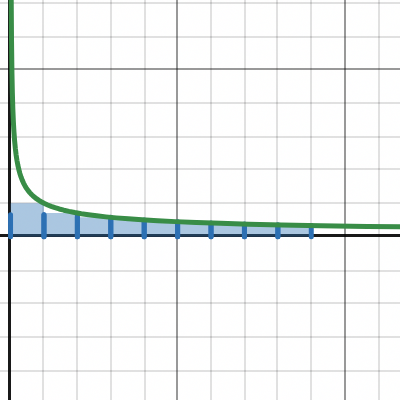
Desmos
modern folio
is OK i understood now , thx for your time and have a great day !!!
modern folio
.close
odd edgeBOT
Channel closed
Closed by @modern folio
Use .reopen if this was a mistake.
odd edgeBOT
Available help channel!
Send your question here to claim the channel.
Remember:
• Ask your math question in a clear, concise manner.
• Show your work, and if possible, explain where you are stuck.
• After 15 minutes, feel free to ping <@&286206848099549185>.
• Type the command .close to free the channel when you're done.
• Be polite and have a nice day!
Read #❓how-to-get-help for further information on how to ask a good question, and about conduct in the question channels.
frosty badge
So I've been going to math competitions for as long as I can remember and I've been doing fine, the only problem that's stopping me from going to even higher limits is combinatorics. I was wondering if there is any sort of online program or online lesson, or even online textbook for problems of combinatorics, which will make me understand combinatorics more and help me do them more efficiently, without wasting an entire hour of my competition time on it. I wanna learn to destroy combinatorics as it has always been my worst enemy in mathematics.
odd edgeBOT
frosty badge
So I've been going to math competitions for as long as I can remember and I've b...
vale vapor
perhaps khanacademy? i remember them having pretty good math courses
 wooden gorge
frosty badge
So I've been going to math competitions for as long as I can remember and I've b...
wooden gorge
frosty badge
So I've been going to math competitions for as long as I can remember and I've b...
Firstly, if you're looking to participate in higher level competitions, you should check out https://discord.gg/mods
 steady tide
vale vapor
perhaps khanacademy? i remember them having pretty good math courses
steady tide
vale vapor
perhaps khanacademy? i remember them having pretty good math courses
i'd argue khan academy is only good for people who don't already have a good background in maths
wooden gorge
wooden gorge
Firstly, if you're looking to participate in higher level competitions, you shou...
The server has exactly the kind of environment you need for math Olympiad prep, including book suggestions, daily problem of the day channels, potd grinders and is a hub for fellow aspirants like you.
vale vapor
steady tide
i'd argue khan academy is only good for people who don't already have a good bac...
was maybe a bad suggestion, its been a while since ive used khanacademy
frosty badge
thank youu
wooden gorge
frosty badge
So I've been going to math competitions for as long as I can remember and I've b...
Look into A Walk Through Combinatorics pdf
steady tide
holy fuck i was also gonna recommend that
odd edgeBOT
Channel closed
Closed by @frosty badge
Use .reopen if this was a mistake.
wooden gorge
It's a good one. I've read some parts of Mathematical Circles but I won't suggest
odd edgeBOT
Available help channel!
Send your question here to claim the channel.
Remember:
• Ask your math question in a clear, concise manner.
• Show your work, and if possible, explain where you are stuck.
• After 15 minutes, feel free to ping <@&286206848099549185>.
• Type the command .close to free the channel when you're done.
• Be polite and have a nice day!
Read #❓how-to-get-help for further information on how to ask a good question, and about conduct in the question channels.
 acoustic yacht
The number 59 has the following property: it is equal to the sum of the sum of its digits and the product of its digits.
Indeed, (5+9) + (5x9) = 14 + 45 = 59.
Counting 59, how many positive two-digit integers are there that have the same property?
I got 9 as an answer (19, 29, 39, 49, 59, 69, 79, 89, 99), just want to make sure I didn't mess up somewhere.
odd edgeBOT
acoustic yacht
The number 59 has the following property: it is equal to the sum of the sum of i...
acoustic yacht
dense moth
So 10a+b = ab + a + b
this works
dense moth
acoustic yacht
The number 59 has the following property: it is equal to the sum of the sum of i...
So yes absolutely correct