#help-19
1 messages · Page 131 of 1
 proven beacon
They assumed that for some natural number k it is true
Now they will prove that it is true for k+1
 woeful rivet
why did they add the 2k+1 in the last time
proven beacon
1 + 3 + 5 + ... + (2k-1) <- Assume is true for k
1 + 3 + 5 + ... + (2k-1) + (2(k+1)-1)
woeful rivet
wait no why do they have 2k-1 when they 2(k+1) - 1 = 2k+1
i thought u sub in n = k+1
proven beacon
woeful rivet
wait no why do they have 2k-1 when they 2(k+1) - 1 = 2k+1
2k-1 is still part
k+1 is the next term, k is still part
 static talon
basically add on to the thing that u assumed is true and reorganize the RHS of the equation and make it so that it looks almost the same as the one u assume is true
hope that helps
 quartz adder
Hey in this quadrilateral how is F the mid point of DB prove
 static talon
hey u cant do that u need to open a new one
proven beacon
Im going to work through the problem you sent (1 + 3 + 5 + ...)
quartz adder
quartz adder
Hey in this quadrilateral how is F the mid point of DB prove
Guyssss
proven beacon
1). Prove it is true for a base case
proven beacon
1 = 1^2
1 + 3 = 2^2
Seems legit to me
2). Assume it is true for n=k
1 + 3 + 5 + ... + (2k-1) = k^2
I will assume this is true.
3). Prove it is true for n=k+1
1 + 3 + 5 + ... + (2k-1) + (2k+1) = (k+1)^2
 static talon
why is it k-1
proven beacon
Why k - 1
static talon
u put n=k+1
proven beacon
proven beacon
1 + 3 + 5 + ... + (2k-1) + (2k+1) = (k+1)^2
[1 + 3 + 5 + ... + (2k-1)] + (2k+1) = (k+1)^2
k^2 + 2k + 1 = (k+1)^2
woeful rivet
oh.
proven beacon
(k+1)^2 = (k+1)^2
Therefore yes it is true that 1 + 3 + 5 + ... + (2k-1) = k^2
For natural numbers
 proven beacon
Yes
woeful rivet
oh ok
static talon
ehh
woeful rivet
...
woeful rivet
let me try the next question
static talon
and for n=k u got k(k+1)/2
 woeful rivet
um.. lets do question c!
proven beacon
question c is a little like the first question
is just that its the sum of squares instead
static talon
let me write down my way of solving the 1+2+3+4+...+n and see if it makes more sense
 static talon
does this makes sense
 woeful rivet
yer
woeful rivet
woeful rivet
for this one do i have to expand all of it
 runic swift
woeful rivet
for this one do i have to expand all of it
runic swift
woeful rivet
for this one do i have to expand all of it
factor the (k+1)
if you expand everything you're gonna have to factor a cubic
which is not fun
woeful rivet
runic swift
factor the (k+1)
okk
 static talon
looks good
static talon
static talon
does this makes sense
minor mistake for my part i forgot to add "So it is true for n=1" that might deduct a point in the exam
woeful rivet
 runic swift
i dont think you factored that correctly
runic swift
4 3 is 12
 runic swift
ok now that is correct
 odd edgeBOT
@woeful rivet Has your question been resolved?
odd edgeBOT
Channel closed
Closed due to timeout
Use .reopen if this was a mistake.
 Available help channel!
Send your question here to claim the channel.
Remember:
• Ask your math question in a clear, concise manner.
• Show your work, and if possible, explain where you are stuck.
• After 15 minutes, feel free to ping <@&286206848099549185>.
• Type the command .close to free the channel when you're done.
• Be polite and have a nice day!
Read #❓how-to-get-help for further information on how to ask a good question, and about conduct in the question channels.
 quaint token
Hello I would not say I specifically have one question but I am going to have continious as I am asking for assistance throughout my semester in statistics. I just want guidance if lost because I am not the brightest in math. Im taking regular entry level statistics in community college
odd edgeBOT
quaint token
Hello I would not say I specifically have one question but I am going to have co...
@quaint token Has your question been resolved?
odd edgeBOT
Channel closed
Closed due to timeout
Use .reopen if this was a mistake.
odd edgeBOT
Available help channel!
Send your question here to claim the channel.
Remember:
• Ask your math question in a clear, concise manner.
• Show your work, and if possible, explain where you are stuck.
• After 15 minutes, feel free to ping <@&286206848099549185>.
• Type the command .close to free the channel when you're done.
• Be polite and have a nice day!
Read #❓how-to-get-help for further information on how to ask a good question, and about conduct in the question channels.
 tardy horizon
What is the easiest way to determine which one is the top function
 odd edgeBOT
tardy horizon
What is the easiest way to determine which one is the top function
odd edgeBOT
tardy horizon
What is the easiest way to determine which one is the top function
@tardy horizon Has your question been resolved?
 sand horizon
tardy horizon
What is the easiest way to determine which one is the top function
sand horizon
tardy horizon
What is the easiest way to determine which one is the top function
See between 0 and 1 whats happening
Check if x^2 - x is negative or positive between 0 and 1
If its negative then y = x is above
If its positive then y=x^2 is above
And the really easiest way is to look at the graph of both function
odd edgeBOT
Channel closed
Closed due to timeout
Use .reopen if this was a mistake.
Available help channel!
Send your question here to claim the channel.
Remember:
• Ask your math question in a clear, concise manner.
• Show your work, and if possible, explain where you are stuck.
• After 15 minutes, feel free to ping <@&286206848099549185>.
• Type the command .close to free the channel when you're done.
• Be polite and have a nice day!
Read #❓how-to-get-help for further information on how to ask a good question, and about conduct in the question channels.
 true hazel
 odd edgeBOT
true hazel
true hazel
odd edgeBOT
true hazel
true hazel
how to justify with no knowledge of how the graph looks like?
 upper onyx
draw it, if you need the graph
true hazel
yes
its hard to draw the graph
is there another way to justify without knowing how the graph looks like
 mystic saffron
Hi I am studying for the ASBAV and AFOQT both to join either the Army or Airforce but the math problems on the real test you can't use a calculator which I can do any math with a calculator but honestly I forgot how to do it from scratch with a piece of paper any one can help me like maybe once a week or twice?
 hardy panther
Use the definition of inverse
hardy panther
mystic saffron
Hi I am studying for the ASBAV and AFOQT both to join either the Army or Airforc...
Get a fresh channel
mystic saffron
were?
odd edgeBOT
mystic saffron
were?
Someone else is already using this help channel. If you need help with a question, please open your own help channel/thread (see #❓how-to-get-help for instructions).
true hazel
the inverse would be this if it werent for that x<0 domain
mystic saffron
Thanks man
true hazel
 true hazel
hardy panther
Use the definition of inverse
true hazel
hardy panther
Use the definition of inverse
how to use that to justify the specific inverse function?
hardy panther
true hazel
how to use that to justify the specific inverse function?
You would just show, algebraically, that that formula is the inverse of f(x)
true hazel
yes
the inverse would be this

but now they are saying to reject the one that is +sqrt(b^2-4ac)
they are only taking the question with the - sign
theres that + and - sign on the numerator
but due to the domain of f(x), the - sign is only accepted
the question is how to deduce whether to use the minus or plus sign for the inverse function from the domain of f(x)
 mystic saffron
true hazel
the question is how to deduce whether to use the minus or plus sign for the inve...
mystic saffron
true hazel
the question is how to deduce whether to use the minus or plus sign for the inve...
bcz its specifically tells you for x < 0
mystic saffron
why doesn't it ?
true hazel
what if the question ask to find f(x) inverse
how would u know to use the - or + sign?
mystic saffron
true hazel
how would u know to use the - or + sign?
it would tell you if they want a specific solution
otherwise you pick both
mystic saffron
?
true hazel
one of the justification is this
look at the graph of f(x)

the range of f(x) is f<0 because the domain is x<0 in the first place
right?
true hazel
yes
mystic saffron
notice how it also touches the point x = 0
true hazel
and now f inverse is this
 mystic saffron
that means it can be f(x) <=0 for x <=0
true hazel
ye
mystic saffron
for the case f(x) = 0 , x = 0
true hazel
now the f inverse is that
mystic saffron
true hazel
and now f inverse is this
yes
true hazel
now an inverse function gives the x value from the y value given into the inverse function right?
it takes a y value then gives the coressponding x value
thats what an inverse function do
mystic saffron
yyes
true hazel
ok
now since the inverse function gives the x value
and the x value has a restriction of x<0 from the domain
mystic saffron
yes
true hazel
this means that f inverser cant be more than 0
mystic saffron
yea
true hazel
now because the inverse function can gives values more than 0
how do we know that the - sign is the solution instead of the + sign
mystic saffron
yes it can gives value more than 0 but you cant plug x's more than 0
bcz u have restriction
remember?
f(x) >0 <=> x>0
now if you would choose the + sign solution, for x <0
you would still get f(x) > 0
bcz x² grows faster than x
(in the discrimnant)
 mystic saffron
correct
true hazel
the one on the left says this
the left part means that the (f inverse with + sign) will only give a negative value for x>0
thats what it means right?
and on the right
true hazel
the f inverse function with the minus sign will only give negative values for x values inputted that is <0
mystic saffron
yea
true hazel
now since we know the range of f is f<0
meaning the domain of the f inverse is x<,0
there was a typo
mystic saffron
yea
true hazel
so we would choose the equation with x<0
mystic saffron
yea
mystic saffron
yes
true hazel
we only know to choose the minus sign equation because we know the rawnge of f
mystic saffron
coreect
true hazel
and we know the range of f because we know how the graph looks like
what if we idk how the grpah looks like
how do we know to choose the minus sign one
mystic saffron
not neccesarly , we could know the range of f by inputting values.
true hazel
yep
true hazel
mystic saffron
not neccesarly , we could know the range of f by inputting values.
actually thats kinda hard
mystic saffron
its not
 mystic saffron
u can just sketch the parabola
true hazel
if u input values from just x=0,1,2,3
and x=-1,-2,-3
u would assume the range for x<0, is y<0
mystic saffron
not neccesarly
true hazel
hmm
is inputting values the only way to find the rnage of graphs?
because inputting values is similar to looking at how the graph looks like
because a graph is simply all the x values plotted with the coressponding y values too
like desmos
they know how the graph looks like by also inputting all x values and getting the y values then plotting it on a graph
so in a sense its similar to looking at how a graph looks like
mystic saffron
true hazel
is inputting values the only way to find the rnage of graphs?
yea
 mystic saffron
wdym
true hazel
one of the way is using the lambert w function
true hazel
mystic saffron
wdym
how to solve for x
mystic saffron
i cant see the whole equation
true hazel
which x value can satisfy that equation
true hazel
mystic saffron
i cant see the whole equation
its just a simple isolating x question
finding an x value that can satisfy that equation
 true hazel
oh ok
runic swift
true hazel
finding an x value that can satisfy that equation
2 works
true hazel
runic swift
2 works
real solutions?
mystic saffron
yea
true hazel
how to find it?
lambert w function?
but listen to this tho
an eqation is like this right?
7=7
mystic saffron
i haven't studied lambert w
true hazel
agree?
mystic saffron
i studied something else
true hazel
its ok
true hazel
oki
mystic saffron
true hazel
how i would solve this equation, i would first find a solution by eye, e.g. (2), then i would prove that there doesn't exists any other solutions, bcz the function is monotonly increasing for x > 0
true hazel
interesting
thats not bad
but what if the x value is some irrational number
but thats for later
but listen to this tho
an equation is like this right?
7=7
mystic saffron
true hazel
but what if the x value is some irrational number
that's another disccusion, there are other tools we can use in the complex system.
true hazel
whatever on the left hand side is same as the on right hand side right?
true hazel
mystic saffron
that's another disccusion, there are other tools we can use in the complex syste...
ok
true hazel
yep
mystic saffron
what about it
true hazel
so whatever we do on left hand side, also have to be done on the right hand side
for it to remain an equation
mystic saffron
correct
true hazel
now to the orginal equation

what happens if both sides are differentiated?
it doesnt give the answer 2 tho
but why?
it should
 distant token
thats not how it works
mystic saffron
hah
distant token
that would be true if both sides of the equation were equal for all values of x but this equation is only true for one value of x
mystic saffron
yea
true hazel
ty for the help
mystic saffron
np
odd edgeBOT
@true hazel Has your question been resolved?
odd edgeBOT
Channel closed
Closed due to timeout
Use .reopen if this was a mistake.
Available help channel!
Send your question here to claim the channel.
Remember:
• Ask your math question in a clear, concise manner.
• Show your work, and if possible, explain where you are stuck.
• After 15 minutes, feel free to ping <@&286206848099549185>.
• Type the command .close to free the channel when you're done.
• Be polite and have a nice day!
Read #❓how-to-get-help for further information on how to ask a good question, and about conduct in the question channels.
 raven nebula
 odd edgeBOT
raven nebula
raven nebula
odd edgeBOT
raven nebula
raven nebula
how to find the derivative of this?
 pale atlas
Do you know the formula of d/dx(u/v)
 raven nebula
pale atlas
Do you know the formula of d/dx(u/v)
raven nebula
pale atlas
Do you know the formula of d/dx(u/v)
yupp
 dapper canyon
check on https://www.desmos.com/calculator

Desmos
define f(x) then graph f'(x) and ur answer to see if they match
 pale atlas
raven nebula
i cld only simplify this much
pale atlas
raven nebula
i cld only simplify this much
This is correct Volga
raven nebula
pale atlas
This is correct Volga
but the only prob is
dapper canyon
,rotate
 clever fjordBOT

 alpine hawk
pale atlas
Yes break the numerator
alpine hawk
pale atlas
Yes break the numerator
Wait let me
pale atlas
raven nebula
but the only prob is
Is?
alpine hawk
pale atlas
Yes break the numerator
Ain't gonna do that
 raven nebula
alpine hawk
raven nebula
alpine hawk
yeaa but how to simplifyy
 wanton bison
raven nebula
i cld only simplify this much
wanton bison
raven nebula
i cld only simplify this much
This looks off
alpine hawk
clever fjord
Solve this you may get the answer
dapper canyon
 raven nebula
wanton bison
~~This looks off~~
raven nebula
wanton bison
~~This looks off~~
uhmmm but when u apply uv rule thts wht i got
pale atlas
raven nebula
1st one
alpine hawk
raven nebula
yeaa but how to simplifyy
I have been wondering too
raven nebula
pale atlas
1st one
but how did u get?
raven nebula
dapper canyon
looks like the last option
its showing last option is correct but how
pale atlas
raven nebula
but how did u get?
Multiply x in numerator and denominator
raven nebula
dapper canyon
take out x^-2/3 as a factor
u will get this then ryt?
 alpine hawk
dapper canyon
x^-2/3 (1 - 5x^6/3)
alpine hawk
dapper canyon
x^-2/3 (1 - 5x^6/3)
How did u get this?
dapper canyon
how did i not get this
pale atlas
pale atlas
Multiply x in numerator and denominator
@raven nebula try this
You will get
dapper canyon
it's correct
 raven nebula
dapper canyon
x^-2/3 (1 - 5x^6/3)
raven nebula
dapper canyon
x^-2/3 (1 - 5x^6/3)
basically we r adding the powers right?
i mean when we simplify tht
alpine hawk
raven nebula
basically we r adding the powers right?
Exactly
dapper canyon
yes that's how exponents work
dapper canyon
5
raven nebula
ohhhhh
raven nebula
now it looks much easier
odd edgeBOT
Channel closed
Closed by @raven nebula
Use .reopen if this was a mistake.
Available help channel!
Send your question here to claim the channel.
Remember:
• Ask your math question in a clear, concise manner.
• Show your work, and if possible, explain where you are stuck.
• After 15 minutes, feel free to ping <@&286206848099549185>.
• Type the command .close to free the channel when you're done.
• Be polite and have a nice day!
Read #❓how-to-get-help for further information on how to ask a good question, and about conduct in the question channels.
tardy horizon
Why is this
 odd edgeBOT
tardy horizon
Why is this
tardy horizon
odd edgeBOT
tardy horizon
Why is this
tardy horizon
Isn't it supposed to be reciprocal
Cuz 1/3 is at the numerator
It's like 1/3 divided by y
Oh wait
mystic saffron
$\frac {1}{3} \cdot \frac {x}{y}$
tardy horizon
1/3 divided by 3 = 1/3 * 1/y
wanton bison
no space between $ and \frac
clever fjordBOT
daniel

 nocturne brook
decent daniel
mystic saffron
yea
tardy horizon
tardy horizon
1/3 divided by 3 = 1/3 * 1/y
So this yes?
nocturne brook
$\frac{\frac13x}y=\frac{\frac13x}y\cdot\frac33=\frac{\frac33x}{3y}=\frac x{3y}$
clever fjordBOT
Flip
 odd edgeBOT
@tardy horizon Has your question been resolved?
odd edgeBOT
Channel closed
Closed due to timeout
Use .reopen if this was a mistake.
Available help channel!
Send your question here to claim the channel.
Remember:
• Ask your math question in a clear, concise manner.
• Show your work, and if possible, explain where you are stuck.
• After 15 minutes, feel free to ping <@&286206848099549185>.
• Type the command .close to free the channel when you're done.
• Be polite and have a nice day!
Read #❓how-to-get-help for further information on how to ask a good question, and about conduct in the question channels.
 mystic bone
Did i do this right?
I had to plot a piecewise linear function(idk if its the right wording)
and then i had to solve g(x)=6
 odd edgeBOT
mystic bone
Did i do this right?
I had to plot a piecewise linear function(idk if its the ...
mystic bone
odd edgeBOT
mystic bone
Did i do this right?
I had to plot a piecewise linear function(idk if its the ...
mystic bone
so the answer to g(x)=6 is 10, 0 or 4 right?
nocturne brook
looks real
mystic bone
oo alright ty so to write a conclusion i could write
To sumarize then g(x)=6 will either be 10, 0 or 4.
would it be wrong to say x is either 10, 0 or 4?
nocturne brook
it's acceptable but not the best way
you can say something to the effect of "the only values x for which g(x) = 6 are x=10, x=0, or x=4"
or
"g(x) = 6 if and only if x=10, x=0, or x=4"
or with sets,
"g(x) = 6 if and only if x is in the set {0,4,10}"
odd edgeBOT
@mystic bone Has your question been resolved?
Channel closed
Closed by @mystic bone
Use .reopen if this was a mistake.
Available help channel!
Send your question here to claim the channel.
Remember:
• Ask your math question in a clear, concise manner.
• Show your work, and if possible, explain where you are stuck.
• After 15 minutes, feel free to ping <@&286206848099549185>.
• Type the command .close to free the channel when you're done.
• Be polite and have a nice day!
Read #❓how-to-get-help for further information on how to ask a good question, and about conduct in the question channels.
 noble solstice
I'm reading a book in measure theory and it stated that the Cantor set is perfect and totally disconnected. How is this possible? Here are the given definitions:
$\ E$ is perfect if ${\forall x \in E, \nexists r > 0 : B_r(x) \cap E = {x}}$ where $B_r(x)$ is the open ball with radius $r$ centred at $x$. In other words, There aren't any isolated points in $E$.
$\ E$ is totally disconnected if ${\forall (x < y) \in E, \exists z \notin E : x < z < y }\$
To me it seems impossible that any set can be both perfect and totally disconnected. By definition perfect means no isolated points, and totally disconnected implies that every point is isolated...
odd edgeBOT
noble solstice
I'm reading a book in measure theory and it stated that the Cantor set is perfec...
clever fjordBOT
woomy

 prime basalt
noble solstice
I'm reading a book in measure theory and it stated that the Cantor set is perfec...
prime basalt
noble solstice
I'm reading a book in measure theory and it stated that the Cantor set is perfec...
The answer is in the construction of the cantor set
noble solstice
how so?
 native canopy
set theory?
 fickle silo
consider {1, 1/2, 1/3, 1/4, ...} U {0}, is the point 0 isolated? It kinda is, but also not, depends on what exactly you mean by an "isolated point"
prime basalt
Denote K1 = [0, 1] - (1/3, 2/3)
K2 = K1 without middle intervals of the segments K1 consists of, etc.
Note that if x is a point from the Cantor set, then there exists Kn such that the edge of Kn contains x. We consider a ball B_r(x). Then we remove intervals of decreasing length, until one of those intervals intersects the ball and we get Km. The edge of Km will intersect B_r(x)
noble solstice
native canopy
set theory?
Its a book on real anaylsis, specifically measure theory, integration and hilbert spaces
noble solstice
noble solstice
Its a book on real anaylsis, specifically measure theory, integration and hilber...
(im on the first chapter, which is measure theory)
native canopy
noble solstice
Its a book on real anaylsis, specifically measure theory, integration and hilber...
I'll pass but cool
noble solstice
prime basalt
Denote K1 = [0, 1] - (1/3, 2/3)
K2 = K1 without middle intervals of the segments...
by "edge" do you mean that its on the boundary of the interval?
prime basalt
noble solstice
by "edge" do you mean that its on the boundary of the interval?
yes
The explanation is a bit vague but it should give the idea
noble solstice
So:
Kn = [0,1] - (1/3, 2/3) - ((1/9, 2/9) U (7/9, 8/9)) ...
Take x = 1/3 or 2/3 or 1/9 or 2/9 or 7/9 or 8/9 ...
Consider B_r(x) where r > 0
I'm stuck here
Then we remove intervals of decreasing length, until one of those intervals intersects the ball and we get Km. The edge of Km will intersect B_r(x)
prime basalt
We can prove that for any x from the edge of Kn there exists a sequence of intervals of decreasing length, approachign x
It's enough to show that for edge points of K1
Because other cases are just scaled down versions of K1
noble solstice
Sorry I dont think i really understand, could you maybe draw out what you mean
ohh wait i think i understood.
So we take: (a, x); (a1, x); (a2, x);
for all r > 0 there's an a_m < r so that (a_m, x) in C
therefore the ball with radius r contains both a_m and x
or am i making a mistake
prime basalt
noble solstice
Sorry I dont think i really understand, could you maybe draw out what you mean
Here white set is K1, red point is x, and purple intervals will be removed in future steps
 noble solstice
okay
fickle silo
ok looking up the definition, a point is isolated, if there exists a neighborhood that contains no other points, so there needs to be some fixed epsilon>0, such that all other points are more than epsilon away from it. This matches the definition of a perfect set and it guarantees there are no isolated points. The definition of a totally disconnected set though does not really imply this. It means we can separate any pair of points, yes, but they may lie arbitrarily close together, as my previous example shows, and so we cant really fix any epsilon
noble solstice
fickle silo
ok looking up the definition, a point is isolated, if there exists a neighborhoo...
So basically just because we can seperate 2 points, this doesnt mean that these 2 points are arbitrarily close, and thus any ball with r > 0 will contain these 2 points?
prime basalt
noble solstice
okay
The purple sequence eventually intersects B_r(x) for any r > 0
fickle silo
the set of rationals should be another example, being both perfect and totally disconnected
noble solstice
prime basalt
The purple sequence eventually intersects B_r(x) for any r > 0
ok yes
noble solstice
fickle silo
the set of rationals should be another example, being both perfect and totally d...
ohhh right
Like i understand
It just seems weird
fickle silo
noble solstice
So basically just because we can seperate 2 points, this doesnt mean that these ...
this doesnt mean that these 2 points are really far apart from each other, they may be as close to each other as you want to
noble solstice
fickle silo
this doesnt mean that these 2 points are really far apart from each other, they ...
Lets say they are epsilon > 0 close
taking r = epsilon
wouldnt b_r(x) contain x but not y
(y being the arbitrarily close point)
fickle silo
so you have (x < y) but they are separated by x<z<y, but there is no reason why there shouldnt exist some y', such that x<y'<z<y
or x<z<y'<y
ofc for sets like Z, this y' doesnt exist if we consider numbers like 3<4
but in Q, no matter what we choose for x and y, we can always get closer
noble solstice
I understand this but then you fall into this iterative behaviour where you can always say "there is a y' s.t. x<z<y'<y" and i'll rebutal with "but there's a z' s.t. y'<z<y" etc...
so which one "wins"
This isnt the first time I came across something that requires this iterative process of continuously finding a number that should contradict the statement, but hey there is another even smaller number which means its correct, but hey there is an even smaller number that contradicts the statement, but he-..... and i have no idea how to not fall in this trap or even how to get out of it hahaha
fickle silo
I guess it doesn't really matter who wins, if it's z or y'. In the end, the fact of the point x being not isolated will win, as this iterative process will yield you numbers that are as close to each other as you want to
noble solstice
okay i think i get it
so you said that also Q is perfect and totally disconnected by the same reasoning?
fickle silo
like, throw me some r, and we just repeat this process until we are inside this r region with y'
noble solstice
unlike the cantor set though Q isnt compact
noble solstice
fickle silo
like, throw me some r, and we just repeat this process until we are inside this ...
yea makes sense
fickle silo
noble solstice
so you said that also Q is perfect and totally disconnected by the same reasonin...
yeah should be, as the rationals and irrationals are dense in the reals
noble solstice
probably a fun exercise to prove it
that Q is perfect and totally disconnected
ill have a go at it once i finish this 400 page book (aka never) (i have to return it by the end of september. . .)
Thanks alot though @fickle silo @prime basalt :)
ill close the channel now
fickle silo
alright
noble solstice
.close
odd edgeBOT
Channel closed
Closed by @noble solstice
Use .reopen if this was a mistake.
odd edgeBOT
Available help channel!
Send your question here to claim the channel.
Remember:
• Ask your math question in a clear, concise manner.
• Show your work, and if possible, explain where you are stuck.
• After 15 minutes, feel free to ping <@&286206848099549185>.
• Type the command .close to free the channel when you're done.
• Be polite and have a nice day!
Read #❓how-to-get-help for further information on how to ask a good question, and about conduct in the question channels.
 timber yacht
u have a questions
odd edgeBOT
timber yacht
u have a questions
timber yacht
i have a question
 dapper creek
hello guys am new here ,wanna kniw how this works
timber yacht
dapper creek
hello guys am new here ,wanna kniw how this works
what do u need help with?
 low locust
timber yacht
i have a question
low locust
timber yacht
i have a question
then ask your question
timber yacht
3x + 1
low locust
thats not a question. thats an expression
timber yacht
ok
what about this one
The equation above shows how temperature F, measured in degrees Fahrenheit, relates to a temperature C, measured in degrees Celsius. Based on the equation, which of the following must be true?
A temperature increase of 1 degree Fahrenheit is equivalent to a temperature increase of 59 degree Celsius.
A temperature increase of 1 degree Celsius is equivalent to a temperature increase of 1.8 degrees Fahrenheit.
A temperature increase of 59 degree Fahrenheit is equivalent to a temperature increase of 1 degree Celsius.
A) I only
B) II only
C) III only
D) I and II only
low locust
well there is no equation
 upper onyx
Do no toccupiy more than in channel with the same question. close on by typing .close.
timber yacht
.close
odd edgeBOT
Channel closed
Closed by @timber yacht
Use .reopen if this was a mistake.
dapper creek
timber yacht
what do u need help with?
Understanding this app
timber yacht
ok
odd edgeBOT
Available help channel!
Send your question here to claim the channel.
Remember:
• Ask your math question in a clear, concise manner.
• Show your work, and if possible, explain where you are stuck.
• After 15 minutes, feel free to ping <@&286206848099549185>.
• Type the command .close to free the channel when you're done.
• Be polite and have a nice day!
Read #❓how-to-get-help for further information on how to ask a good question, and about conduct in the question channels.
 rustic sail
Is the vector <a,b,0> orthogonal to the unit vector k for any a,b?
 brave gale
try taking dot product
rustic sail
Okay thanks! I tohught so intuitively (and now that i think of it i couldve taken dot product)
but google didnt answer my quesiton
 warped badger
rustic sail
Is the vector <a,b,0> orthogonal to the unit vector **k** for any a,b?
warped badger
rustic sail
Is the vector <a,b,0> orthogonal to the unit vector **k** for any a,b?
I assume by unit vector you mean v=(1,1,1)?
 onyx cloak
warped badger
I assume by unit vector you mean v=(1,1,1)?
onyx cloak
warped badger
I assume by unit vector you mean v=(1,1,1)?
unit vectory k -> vector in z direction with magnitude 1
0i + 0j + 1k
rustic sail
brave gale
try taking dot product
Yeah thought about that as I was typing the question lol
warped badger
onyx cloak
unit vectory k -> vector in z direction with magnitude 1
Ok, didn't see the k part
odd edgeBOT
Channel closed
Closed by @rustic sail
Use .reopen if this was a mistake.
odd edgeBOT
Available help channel!
Send your question here to claim the channel.
Remember:
• Ask your math question in a clear, concise manner.
• Show your work, and if possible, explain where you are stuck.
• After 15 minutes, feel free to ping <@&286206848099549185>.
• Type the command .close to free the channel when you're done.
• Be polite and have a nice day!
Read #❓how-to-get-help for further information on how to ask a good question, and about conduct in the question channels.
 errant timber
I apologize if this is the wrong place for this but, for converting cm to meters wouldn't using 10^-2 m on the bottom equate to the same thing too?
 odd edgeBOT
errant timber
I apologize if this is the wrong place for this but, for converting cm to meters...
odd edgeBOT
errant timber
I apologize if this is the wrong place for this but, for converting cm to meters...
 uneven osprey
errant timber
I apologize if this is the wrong place for this but, for converting cm to meters...
uneven osprey
errant timber
I apologize if this is the wrong place for this but, for converting cm to meters...
it seems like that's what they did
odd edgeBOT
@errant timber Has your question been resolved?
Channel closed
Closed by @errant timber
Use .reopen if this was a mistake.
Available help channel!
Send your question here to claim the channel.
Remember:
• Ask your math question in a clear, concise manner.
• Show your work, and if possible, explain where you are stuck.
• After 15 minutes, feel free to ping <@&286206848099549185>.
• Type the command .close to free the channel when you're done.
• Be polite and have a nice day!
Read #❓how-to-get-help for further information on how to ask a good question, and about conduct in the question channels.
 sonic beacon
hello, i'd like to do partial fractions for this before integrating it, how am i supposed to do it?
 odd edgeBOT
sonic beacon
hello, i'd like to do partial fractions for this before integrating it, how am i...
odd edgeBOT
sonic beacon
hello, i'd like to do partial fractions for this before integrating it, how am i...
 turbid compass
This isn’t a partial fractions integral
Atleast there’s a much easier way to do it
sonic beacon
turbid compass
Atleast there’s a much easier way to do it
should i simply consider the denominator as u squared?
sonic beacon
mmm i see, if i in some case had to go through partial fractioning here, how would i do so
just out of curiousity
turbid compass
You’d have to completely factor the denominator and then set up your different fractions/equautions
But in this case it would be especially bothersome because it’s a degree 6 polynomial in the denominator
It would be easier to show with a degree two or three
sonic beacon
i see, so yes it would make sense to do it your way
thank you brother, i really appreciate it 🙏
.close
odd edgeBOT
Channel closed
Closed by @sonic beacon
Use .reopen if this was a mistake.
Available help channel!
Send your question here to claim the channel.
Remember:
• Ask your math question in a clear, concise manner.
• Show your work, and if possible, explain where you are stuck.
• After 15 minutes, feel free to ping <@&286206848099549185>.
• Type the command .close to free the channel when you're done.
• Be polite and have a nice day!
Read #❓how-to-get-help for further information on how to ask a good question, and about conduct in the question channels.
 vivid kelp
What will be the integration of S = integration of (2Pt/m)^1/2*dt where P , m are constants and t is from 0 to t
odd edgeBOT
vivid kelp
What will be the integration of S = integration of (2Pt/m)^1/2*dt where P , m ar...
 limber glade
just bring all constants out of the integration symbol
then it beconmes simple enough to apply power rule
odd edgeBOT
@vivid kelp Has your question been resolved?
odd edgeBOT
Channel closed
Closed due to timeout
Use .reopen if this was a mistake.
Available help channel!
Send your question here to claim the channel.
Remember:
• Ask your math question in a clear, concise manner.
• Show your work, and if possible, explain where you are stuck.
• After 15 minutes, feel free to ping <@&286206848099549185>.
• Type the command .close to free the channel when you're done.
• Be polite and have a nice day!
Read #❓how-to-get-help for further information on how to ask a good question, and about conduct in the question channels.
 steel sky
I need help
odd edgeBOT
steel sky
I need help
 steel sky
no
 autumn bolt
thats what were using here
 granite ferry
autumn bolt
do you know partial fractions?
granite ferry
autumn bolt
do you know partial fractions?
Would you convert this thing into a Riemann sum?
autumn bolt
granite ferry
Would you convert this thing into a Riemann sum?
no
see
basically
$\frac{1}{(g)(g+1)(g+2)} = \frac{1}{2}(\frac{1}{g(g+1)}-\frac{1}{(g+1)(g+2)})$
clever fjordBOT
 autumn bolt
you can try with simple cases like g = 1, 2
granite ferry
clever fjord
This is a telescopic form right?
autumn bolt
granite ferry
This is a telescopic form right?
yea
granite ferry
Is this also called partial fractions?
native canopy
Just for curiosity what level of math is this?
granite ferry
I mean they are partial and fractions really
steel sky
the ans is 1/4 then
granite ferry
native canopy
Just for curiosity what level of math is this?
I think it is highschool level
steel sky
i dont have access to the ans too
native canopy
granite ferry
I think it is highschool level
grade 12 was my guess but i wanted to check
autumn bolt
steel sky
the ans is 1/4 then
yep
 quasi sparrow
steel sky
the ans is 1/4 then
quasi sparrow
steel sky
the ans is 1/4 then
,w sum n=1 to inf 1/(n(n+1)(n+2))
clever fjordBOT


 steel sky
thank you so much for the idea @autumn bolt
quasi sparrow
autumn bolt
$\frac{1}{(g)(g+1)(g+2)} = \frac{1}{2}(\frac{1}{g(g+1)}-\frac{1}{(g+1)(g+2)})$
This was the hard part
autumn bolt
steel sky
thank you so much for the idea <@702550180154834984>
welcome (:
you can also extend this to longer denominators
but you need to multiply by 1/3, 1/4, 1/5 and so on
autumn bolt
yea 1 min
$\frac{1}{(g)(g+1)(g+2)(g+3)} = \frac{1}{3}\bigg(\frac{1}{g(g+1)(g+2)}-\frac{1}{(g+1)(g+2)(g+3)}\bigg)$
clever fjordBOT
 steel sky
thanks i got it!
odd edgeBOT
@steel sky Has your question been resolved?
Channel closed
Closed by @steel sky
Use .reopen if this was a mistake.
Available help channel!
Send your question here to claim the channel.
Remember:
• Ask your math question in a clear, concise manner.
• Show your work, and if possible, explain where you are stuck.
• After 15 minutes, feel free to ping <@&286206848099549185>.
• Type the command .close to free the channel when you're done.
• Be polite and have a nice day!
Read #❓how-to-get-help for further information on how to ask a good question, and about conduct in the question channels.
 potent jasper
Can someone point me to a resource that can teach me how to solve equations like this in limits?
 odd edgeBOT
potent jasper
Can someone point me to a resource that can teach me how to solve equations like...
odd edgeBOT
potent jasper
Can someone point me to a resource that can teach me how to solve equations like...
 elfin zodiac
What do you mean equations like this?
potent jasper
I’m not really sure what is the desired answer nor do I really know what would be the correct manner to solve this limit. Any resource that help me better understand it fundamentally would be appreciated.
potent jasper
elfin zodiac
What do you mean equations like this?
This limit contains an unknown variable x and I am not sure how to correctly answer it
 nimble blaze
could try looking up
limits with conjugates
potent jasper
nimble blaze
could try looking up
limits with conjugates
Most of what I can find deals with only a singular known variable. I can’t find anything that talks about a single known variable and a single unknown variable. Do you know of any resources that covers this specific case?
nimble blaze
limit definition of derivative if you want a broader search
potent jasper
nimble blaze
limit definition of derivative if you want a broader search
Ok sweet this looks more like what I am looking for
odd edgeBOT
@potent jasper Has your question been resolved?
Channel closed
Closed by @potent jasper
Use .reopen if this was a mistake.
Available help channel!
Send your question here to claim the channel.
Remember:
• Ask your math question in a clear, concise manner.
• Show your work, and if possible, explain where you are stuck.
• After 15 minutes, feel free to ping <@&286206848099549185>.
• Type the command .close to free the channel when you're done.
• Be polite and have a nice day!
Read #❓how-to-get-help for further information on how to ask a good question, and about conduct in the question channels.
 plain apex
"Josh flips a fair coin until he receives an equal amount of heads and tails. For example, HHTHTT would correspond to 6 flips. What is the expected number of flips Josh does?"
odd edgeBOT
plain apex
"Josh flips a fair coin until he receives an equal amount of heads and tails. Fo...
plain apex
Not even sure how to approach this
 red surge
plain apex
"Josh flips a fair coin until he receives an equal amount of heads and tails. Fo...
red surge
plain apex
"Josh flips a fair coin until he receives an equal amount of heads and tails. Fo...
if you let X_n be the difference between the number of heads and the number of tails flipped
then X_n defines a simple random walk on Z starting at 0
the question is then asking for the expected number of steps before we hit 0 a 2nd time
plain apex

Yeah that's what I did with my markov chain
If it was probability I could easily get the answer
Not sure how to find expected value
red surge
red surge
the question is then asking for the expected number of steps before we hit 0 a 2...
ok so i kinda expected this problem to be easier/a standard problem but i just checked my prob lecture notes and we didn't cover this in lectures lol
checked the internet and the numerical answer is apparently ||∞ ||
but i can sorta see why
if you define like x_n to be the expected number of steps required to reach 0 starting at n
you can easily create a recurrence relation with x_n, x_(n-1) and x_(n+1) using the law of total probability
we wanna find out x_1
obviously x_n >= n
playing around with it i found that
x_1 = 1 + 1/2 x_2
x_1 = 2 + 1/3 x_3
so you can probably induct to show that x_1 = n + 1/n (x_n) which implies x_1 >= n for all integers and hence is infinite
hope that helps @plain apex
odd edgeBOT
@plain apex Has your question been resolved?
plain apex
red surge
x_1 = 2 + 1/3 x_3
how did you get 2 + 1/3x_3?
red surge
red surge
x_1 = 2 + 1/3 x_3
i haven't actually done it properly so don't take my word for what it actually inducts to, but you could probably show x_1 must be unbounded
odd edgeBOT
Channel closed
Closed due to timeout
Use .reopen if this was a mistake.
Available help channel!
Send your question here to claim the channel.
Remember:
• Ask your math question in a clear, concise manner.
• Show your work, and if possible, explain where you are stuck.
• After 15 minutes, feel free to ping <@&286206848099549185>.
• Type the command .close to free the channel when you're done.
• Be polite and have a nice day!
Read #❓how-to-get-help for further information on how to ask a good question, and about conduct in the question channels.
 quartz pier
I was reading about closed subsets in $\mathbb{R}^d$ and there was this one definition that said a set $F \subset \mathbb{R}^d$ is closed if every convergent sequence of points in $F$ has its limit also inside F.
odd edgeBOT
quartz pier
I was reading about closed subsets in $\mathbb{R}^d$ and there was this one defi...
clever fjordBOT
Calc III Victim (Pt. 2)
 quartz pier
this is the example that was talked about in class

So now for any $n$ if the sequence $x_n$ is inside the set $F$ then its closed ?
for example
For this example would something like
$F = (0, 2] \times \mathbb{R} \times \mathbb{R} \times [0, 1]$ work?
I feel like Im doing it correctly but Im not 100% sure
oh wait
I thought the third componenet said n+1/n
clever fjordBOT
Calc III Victim (Pt. 2)
 quartz pier
1/n is inside (0, 2]
2, n+1 are inside R
1/n-1 is inside [0, 1]
oh wait I think Im missing something so I have to check the limit of the sequence and make sure thats inside F too right
so instead of (0, 2], [0, 2] would have worked because when taking the limit as n -> inf we have
L = [0, 2, 1, 0]
ye idk
mystic saffron
For closedness, it is necessary that all convergent sequences that take values in F have limits in F. So, in your case, the sequence x_n = [1/n,0,0,0] are in F for all n, but its limit, [0,0,0,0] is not, so F is not closed.
odd edgeBOT
@quartz pier Has your question been resolved?
odd edgeBOT
Channel closed
Closed due to timeout
Use .reopen if this was a mistake.
Available help channel!
Send your question here to claim the channel.
Remember:
• Ask your math question in a clear, concise manner.
• Show your work, and if possible, explain where you are stuck.
• After 15 minutes, feel free to ping <@&286206848099549185>.
• Type the command .close to free the channel when you're done.
• Be polite and have a nice day!
Read #❓how-to-get-help for further information on how to ask a good question, and about conduct in the question channels.
 marsh hound
Can someone help me understand the intuition
 marsh hound
I feel I almost have it
odd edgeBOT
@marsh hound Has your question been resolved?
odd edgeBOT
Channel closed
Closed due to timeout
Use .reopen if this was a mistake.
odd edgeBOT
Available help channel!
Send your question here to claim the channel.
Remember:
• Ask your math question in a clear, concise manner.
• Show your work, and if possible, explain where you are stuck.
• After 15 minutes, feel free to ping <@&286206848099549185>.
• Type the command .close to free the channel when you're done.
• Be polite and have a nice day!
Read #❓how-to-get-help for further information on how to ask a good question, and about conduct in the question channels.
marsh hound
 odd edgeBOT
marsh hound
marsh hound
odd edgeBOT
marsh hound
marsh hound
How do I do this

Here’s my workings

I see forgot to add f(x,y) but that’s not the root of the mistake
odd edgeBOT
@marsh hound Has your question been resolved?
marsh hound
Tried to split it into two integrals

Shit is =0 in the top half here
Regardless of fxy
odd edgeBOT
@marsh hound Has your question been resolved?
Channel closed
Closed by @marsh hound
Use .reopen if this was a mistake.
Available help channel!
Send your question here to claim the channel.
Remember:
• Ask your math question in a clear, concise manner.
• Show your work, and if possible, explain where you are stuck.
• After 15 minutes, feel free to ping <@&286206848099549185>.
• Type the command .close to free the channel when you're done.
• Be polite and have a nice day!
Read #❓how-to-get-help for further information on how to ask a good question, and about conduct in the question channels.
 steady spoke
no idea where to even start
 odd edgeBOT
steady spoke
no idea where to even start
odd edgeBOT
steady spoke
no idea where to even start
 summer river
steady spoke
no idea where to even start
summer river
steady spoke
no idea where to even start
have your read the problem
steady spoke
yes i have read it and looked over my notes but we didn’t do any problems related to this
summer river
steady spoke
yes i have read it and looked over my notes but we didn’t do any problems relate...
yeah no worries I acc TA for this kinda material
what do you know about work
steady spoke
oh perfect!
i can do work problems related to springs. i just haven’t done one regarding a water tank
summer river
steady spoke
i can do work problems related to springs. i just haven’t done one regarding a w...
are you given water density
steady spoke
1000kg/m^3
summer river
steady spoke
ok. i know F=mg, where m is mass and g is gravitational constant
yes
great great
what is g btw
steady spoke
9.8m/s^2
summer river
steady spoke
9.8m/s^2
okay okay great great
how can we use water density to find mass
steady spoke
mass is equal to density times volume
summer river
steady spoke
mass is equal to density times volume
great great
any ideas about volume
how can represent that
steady spoke
umm idk
summer river
steady spoke
umm idk
yeah we need a little geometry for that
can you draw two triangles for me
steady spoke
mhm i can!
btw i’m confused. is the image depiction the tank as a triangular prism?
summer river
I believe so
steady spoke
since that’s just what the end of the tank looks like
summer river
this gives me like google form vibes
summer river
steady spoke
lmaoo yeah
lets goo
steady spoke
well it’s not actually i meant i was just agreeing with that ahah. my online program has very poor graphics 😂
summer river
steady spoke
well it’s not actually i meant i was just agreeing with that ahah. my online pro...
yeah haha that makes sense
steady spoke
so this is what the tank looks like?
 summer river
steady spoke
so this is what the tank looks like?
summer river
steady spoke
so this is what the tank looks like?
yep!!!
steady spoke
okok!
summer river
steady spoke
x works
cool cool
think of x to be like the water level
like x is from the

top of this rotated triangle
to the middle
steady spoke
oops i just realized the triangles are upside down
summer river
can you send me a pic with that labeled?
summer river
steady spoke
oops i just realized the triangles are upside down
no that's good
steady spoke
like this? idk 😭
 summer river
steady spoke
like this? idk 😭
summer river
steady spoke
like this? idk 😭
give me a sec
steady spoke
kk
summer river
i can prob draw what im saying
steady spoke
ty
summer river
 steady spoke
ohh i gotcha
summer river
steady spoke
ohh i gotcha
ye ye
can you draw me another triangle
with the 5 and 4
honestly I could acc do it
 summer river
steady spoke
kinda drew a water level like u said
summer river
steady spoke
kinda drew a water level like u said
WOW
ty
do you remember similiar triangles
steady spoke
i think so. somewhat
summer river
steady spoke
i think so. somewhat
im sorry can you give me 10 mins
steady spoke
gotcha, no worries!
summer river
steady spoke
gotcha, no worries!
hi hi
steady spoke
hello!
summer river
steady spoke
hello!
how did the other q go
steady spoke
delta x would be slice of the triangular prism right?
summer river
steady spoke
delta x would be slice of the triangular prism right?
mhm
 steady spoke
yeah. is that how it was supposed to be?
summer river
steady spoke
yeah. is that how it was supposed to be?
not exactly but ur close
steady spoke
yes please. i’m not either ahah. definitely won’t judge
summer river

@steady spoke it's so bad
but like
uhh try and bare
basically it's a rectangular prism piece
I put a formula for the volume
steady spoke
that’s very helpful ty!
summer river
also @steady spoke I looked back at the problem
and look at all the answer choices
they are in feet pounds
😭
steady spoke
oh 😭
summer river
steady spoke
oh 😭
yeah so it's not 9.8
summer river
ye
steady spoke
okk
summer river
steady spoke
okk
yeah sorry I'm boiling some water
steady spoke
ur good 😊
summer river
I have not been so attentive
steady spoke
no worries lol
steady spoke
yeah that definitely helped a lot. i think i can probably figure it out from here
summer river
steady spoke
yeah that definitely helped a lot. i think i can probably figure it out from her...
are you sure?
if you need help
you can always ask
steady spoke
ok! i’ll just leave this open and close it once i figure it out
and i’ll ask if i get stuck
summer river
steady spoke
ok! i’ll just leave this open and close it once i figure it out
that sounds good!
im a bad physics TA 😭
steady spoke
noo u were very helpful
summer river
steady spoke
u got me further than i could get myself. so u definitely helped
is this physics or like a calc subpart
summer river
steady spoke
omg auto correct
ohh yeah then it doesn't matter
steady spoke
yeah. this question is just part of a quiz that i can take unlimited times. but the final is made up of all of the exact quiz questions
summer river
steady spoke
yeah. this question is just part of a quiz that i can take unlimited times. but ...
didnt the sem just start
steady spoke
i started my school year in march bc of health issues and i have 9 months to complete it from the start date
so i’m finishing it up
summer river
steady spoke
i started my school year in march bc of health issues and i have 9 months to com...
oh wow that sounds really nice
(not the health issues)
steady spoke
yess it definitely is. i get a lot more free time than in person classes
caught onto that part 😂
i got it right. tysm for all the help
.close
odd edgeBOT
Channel closed
Closed by @steady spoke
Use .reopen if this was a mistake.
odd edgeBOT
Available help channel!
Send your question here to claim the channel.
Remember:
• Ask your math question in a clear, concise manner.
• Show your work, and if possible, explain where you are stuck.
• After 15 minutes, feel free to ping <@&286206848099549185>.
• Type the command .close to free the channel when you're done.
• Be polite and have a nice day!
Read #❓how-to-get-help for further information on how to ask a good question, and about conduct in the question channels.
 feral igloo
I need help with this. How do I figure out its correct if I only have one table?
 odd edgeBOT
feral igloo
I need help with this. How do I figure out its correct if I only have one table?
odd edgeBOT
feral igloo
I need help with this. How do I figure out its correct if I only have one table?
 forest sky
what information is given about f(x)?
feral igloo
forest sky
what information is given about f(x)?

wait...
oh...
i know now
bruh i thought they were two separate problems
bro... tf?!


,rotate
clever fjordBOT
 quasi sparrow
clever fjord
quasi sparrow
clever fjord
You assumed f(x)=h(x) which are none of the choices
 woeful bobcat
feral igloo
quasi sparrow
You assumed f(x)=h(x) which are none of the choices
woeful bobcat
feral igloo
quasi sparrow
You assumed f(x)=h(x) which are none of the choices
So. What do i need to do instead for it to get the correct answer?
quasi sparrow
clever fjord
Do this for one of the choices. Try f(x+1)
feral igloo
quasi sparrow
Do this for one of the choices. Try f(x+1)
So, h(x) = f(x+1)
h(-2) = f(-2+1)
h(-1) = f(-1)
;-;
quasi sparrow
Where did h(-1) = f(-1) come from
feral igloo
quasi sparrow
Where did h(-1) = f(-1) come from
 quasi sparrow
feral igloo
quasi sparrow
feral igloo
that says h(-2)=-1
quasi sparrow
quasi sparrow
Where did h(-1) = f(-1) come from
Not this
feral igloo
Whats the correct numbers to plug in for x then?
quasi sparrow
quasi sparrow
that says h(-2)=-1
See if it equals this
feral igloo
quasi sparrow
Plug that into f(x+1)
f(-2+1)
f(-1)
quasi sparrow
What's f(-1) =?
feral igloo
;-;
quasi sparrow
quasi sparrow
that says h(-2)=-1
Did you understand this
feral igloo
ok.
huh?
https://youtu.be/-dGA_77fLbw?si=VLgZXqJOY6uizclZ&t=78
I've been solving the way this guy from the provided video guide did it
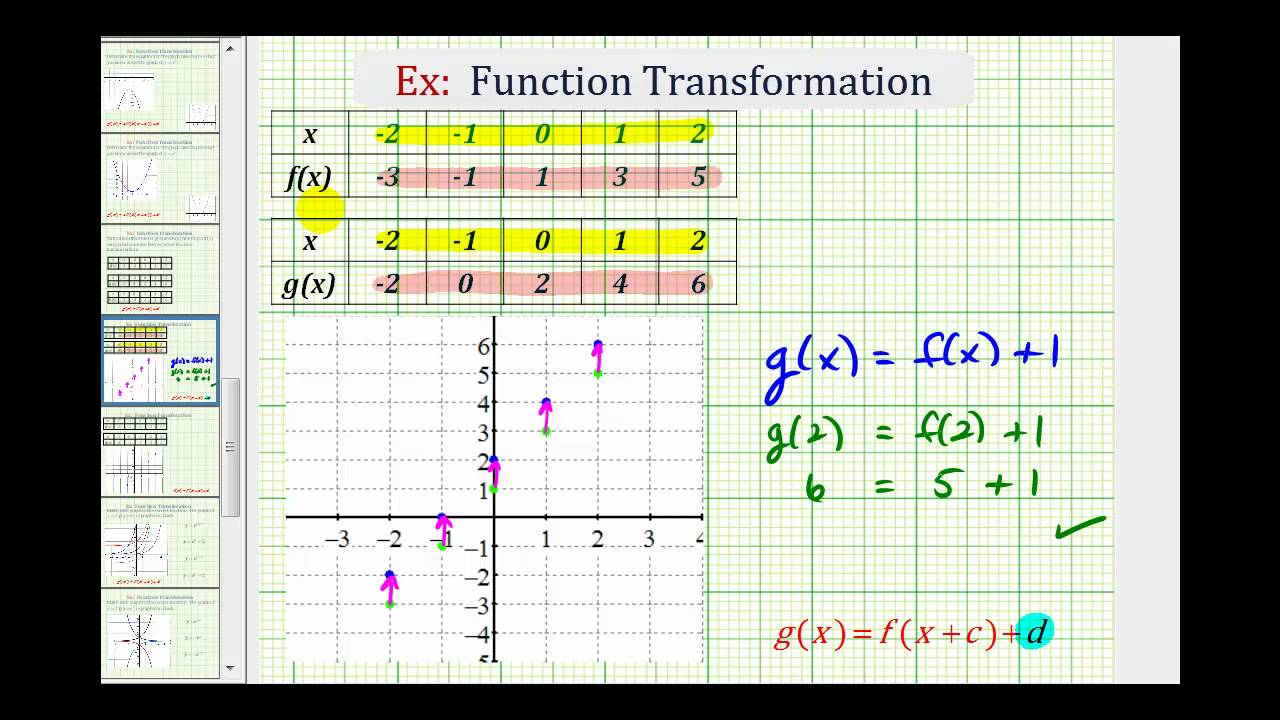
This video explains how to express one function in terms as another based upon a function transformation given in a table. The results are verified graphically.
Site: http://mathispower4u.com
feral igloo
quasi sparrow
Did you understand this
Probably not.
quasi sparrow
I'm not watching a video to help you
feral igloo
quasi sparrow
I'm not watching a video to help you
Right. So maybe help me understand where I went wrong for this one, and what I should have done to get the correct answer for it?

I think if I can maybe understand that one first, then I could maybe figure out the confusing h(x) problem
 quasi sparrow
Do the same thing I said above
quasi sparrow
feral igloo
This is exactly the same mistake as before
You're already assuming g(x) = f(x) which is none of the options
find a few values of g(x) and see if it equals f(x+1)
g(-1) = ?
feral igloo
quasi sparrow
g(-1) = ?
3?
 feral igloo
So its not g(x) = x
g(-1) = 3
which I was basing off the table
feral igloo
quasi sparrow
g(-1) = ?
then how do I find what g(-1) equals? Or, perhaps, where?
quasi sparrow
feral igloo
then how do I find what g(-1) equals? *Or, perhaps, where?*
Look for x =-1
Then go down one row
feral igloo
ok..
feral igloo
quasi sparrow
Yes 0
plug in that 0 into f(x+1) ?
quasi sparrow
quasi sparrow
find a few values of g(x) and see if it equals f(x+1)
Go back up and read

 feral igloo
quasi sparrow
Go back up and read
feral igloo
quasi sparrow
Go back up and read
so the -1 for f(x+1) --> f(-1+1) --> f(0)
quasi sparrow
Does g(x) = f(x+1)?
feral igloo
quasi sparrow
Does g(x) = f(x+1)?
yes
quasi sparrow
feral igloo
yes
No
g(0) = 3, while f(0+1) = -4
g(-1) = 0 and f(-1+1) = f(0)=3 which again aren't equal
feral igloo
Im still confused as hell.
quasi sparrow
feral igloo
Im still confused as hell.
Say in words what you think the notation f(x) means.
odd edgeBOT
@feral igloo Has your question been resolved?
odd edgeBOT
Channel closed
Closed due to timeout
Use .reopen if this was a mistake.
odd edgeBOT
Available help channel!
Send your question here to claim the channel.
Remember:
• Ask your math question in a clear, concise manner.
• Show your work, and if possible, explain where you are stuck.
• After 15 minutes, feel free to ping <@&286206848099549185>.
• Type the command .close to free the channel when you're done.
• Be polite and have a nice day!
Read #❓how-to-get-help for further information on how to ask a good question, and about conduct in the question channels.
 eternal ravine
for the function ((x-4)(x-2))/((x-2)^2(x-1)) would there be a hole or a vertical asymptote
odd edgeBOT
eternal ravine
for the function ((x-4)(x-2))/((x-2)^2(x-1)) would there be a hole or a vertical...
forest sky
there is still a factor of (x-2) in the denominator after you cancel
forest sky
yes
odd edgeBOT
Channel closed
Closed by @eternal ravine
Use .reopen if this was a mistake.
Available help channel!
Send your question here to claim the channel.
Remember:
• Ask your math question in a clear, concise manner.
• Show your work, and if possible, explain where you are stuck.
• After 15 minutes, feel free to ping <@&286206848099549185>.
• Type the command .close to free the channel when you're done.
• Be polite and have a nice day!
Read #❓how-to-get-help for further information on how to ask a good question, and about conduct in the question channels.
mystic saffron
Can someone help me with what those symbols represent in these images the U upside U the C and the underlined C - I keep getting these answers wrong- I think I’m confused about they represent

 odd edgeBOT
mystic saffron
Can someone help me with what those symbols represent in these images the U upsi...
mystic saffron
odd edgeBOT
mystic saffron
Can someone help me with what those symbols represent in these images the U upsi...
mystic saffron
<@&286206848099549185>
odd edgeBOT
mystic saffron
<@&286206848099549185>
Please only use the <@&286206848099549185> ping once if your question has not been answered for 15 minutes. Please do not ping or DM individual users about your question.
mystic saffron
No im so lost tbh
 mint mirage
mystic saffron
Can someone help me with what those symbols represent in these images the U upsi...
mint mirage
mystic saffron
Can someone help me with what those symbols represent in these images the U upsi...
$\subseteq$ means subset
 slow yoke
sets are always represented in curly braces
clever fjordBOT
CaptainNova22
 slow yoke
and with capital letters
like
R = {p/q : p,q are integers and coprime}
this is called set builder form
mint mirage
So for example choice 1, is asking if g, m, p, and s are a subset of B
slow yoke
thosesymbles represent operations of sets
C is subset
U is union of sets
so A U B = every element in A + every element in B
mystic saffron
Okay but idk why I keep getting those wrongs because if it’s subsets right it would be the ones within the circle?
slow yoke
se
see
a subset is like
A C B
so
every element of B is also an element of A
but underlined C indicates that they might be exactly the same
mint mirage
mystic saffron
Okay but idk why I keep getting those wrongs because if it’s subsets right it wo...
Not only just within
mystic saffron
Oh I understand - how about if it’s A upside u B upside u C
What’s upside U and if it’s all three does it all add up
mint mirage
Upside u meaning $\cap$?
clever fjordBOT
CaptainNova22
 mystic saffron
Yes
mint mirage
That means intersection or the terms that they have in common
slow yoke
yeah
slow yoke
mint mirage
That means intersection or the terms that they have in common
how do i get helpful role maan
mint mirage
slow yoke
how do i get helpful role maan
With time
mystic saffron
Okay so regular u is everything the have together and upside u is what intersects but if it’s three in a row is it also asking what the first and last intersect as well ?
slow yoke
mint mirage
With time
hmm
slow yoke
mystic saffron
Okay so regular u is everything the have together and upside u is what intersect...
wdym 3 in a row
see
mystic saffron
Let me take a picture
slow yoke
alr
 mint mirage
mystic saffron
mint mirage
mystic saffron
It's asking what term is in common with all 3 sets
mystic saffron
Ohhh what intersects with all three that makes a whole lot more sense
slow yoke
so
mint mirage
So is a common in all three, ie does a exist in set A, B, and C
 slow yoke
A = {c, w, s} C = {s, m} D = {a, g} B = {f, h, g, a, p, m}
mint mirage
mystic saffron
Start with the parentheses, first
slow yoke
mystic saffron
ah yes
theres also a law for that
distributive law of sets of intersection
mint mirage
Find $A \cap C$ and $B \cap D$
clever fjordBOT
CaptainNova22
 mint mirage
Then union them
slow yoke
yes
mint mirage
First what would $A \cap C$ be?
clever fjordBOT
CaptainNova22
 clever fjordBOT
CaptainNova22
 mystic saffron
A and g
mint mirage
Now union them
mint mirage
Yes