
#help-19
1 messages · Page 104 of 1
 clever fjordBOT
 olive sparrow
you can also put the 4 as 2^2
olive sparrow
$((2x+1)^2+1)$
clever fjordBOT
clonesolopros
 olive sparrow
$2^2(x+\frac{1}{2})^2 = (2(x+\frac{1}{2}))^2$
clever fjordBOT
clonesolopros

 glad wadi
it does doesnt it?
because I can put it into the arctan
and that will be my term
for u

 dawn tiger
everything is right up until you evaluated the integral at the last step
from this formula, your u is (2x+1) and your a is 1
glad wadi
oh so its just flipped?
dawn tiger
the problem is the 1/(2x+1) out front
glad wadi
how do I know which is the u and which is a?
dawn tiger
when you plug those into the formula, you should get 1/(1) * arctan((2x+1) / (1)) + C
the u is the thing that you're integrating with respect to
if you let u = 2x + 1
then du = 2dx, so this integral becomes 1/2 * 1/(u^2 + 1) du
then you know that the antiderivative of 1/(u^2 + 1) = arctan(u)
so your answer would be 1/2 arctan(2x + 1) + C
glad wadi
ahh
okay
where does the 1/2 come from though?
nevermind
I got it
lets go
.close
 odd edgeBOT
Channel closed
Closed by @glad wadi
Use .reopen if this was a mistake.
odd edgeBOT
 Available help channel!
Send your question here to claim the channel.
Remember:
• Ask your math question in a clear, concise manner.
• Show your work, and if possible, explain where you are stuck.
• After 15 minutes, feel free to ping <@&286206848099549185>.
• Type the command .close to free the channel when you're done.
• Be polite and have a nice day!
Read #❓how-to-get-help for further information on how to ask a good question, and about conduct in the question channels.
 west pecan
I just want to verify that I'm understanding this correctly
west pecan

is this a proper proof that the set is closed under addition?

I feel like I don't understand my own justification even if it's right lol
to verify that it's closed under addition, that'd be the same as verifying that f+g (where g is a member of the set) is also a member of the set for all g right?
odd edgeBOT
@west pecan Has your question been resolved?
west pecan
west pecan
is this a proper proof that the set is closed under addition?
wait I think I have to add this to the end:

is this the right thought process? did I do it right?
 granite slate
In my humble opinion, you need to show that for every f, g satisfying f'(-1) = 3f'(2) and g'(-1) = 3g(2) and for all real number r, you have f + g and r*f in your set.
(Furthermore, I feel like you show nothing actually, you are simply writing what you want to show without explaining why this is true :/)
 granite slate
Yes, this is a lot better !
west pecan
I still feel don't feel confident that there isn't a counterexample for g
granite slate
Such as ? f and g play the same role here
(Actually, you also have to check that your set is not empty, by proving that the constant null function is in your set)
west pecan
well it's assumed that it's on the interval (-4,4) so it can't be empty I think
oh yeah I'm just concerned about closure under addition rn
granite slate
west pecan
well it's assumed that it's on the interval (-4,4) so it can't be empty I think
The set of integers is not empty, but if I define S the subset of the integers which are both odd and even, it will be empty
What do I want to say with this stupid example is that you still need to check that your set is not such an example too
west pecan
oh wait you're saying I have to show that the set of differentiable real-valued functions on the interval (-4,4) such that that property holds isn't empty?
granite slate
west pecan
oh yeah I'm just concerned about closure under addition rn
You have to keep in mind that both f and g are in your set. Does it help ?
granite slate
west pecan
oh wait you're saying I have to show that the set of differentiable real-valued ...
Yes
west pecan
oh
well f(x)=0 satisfies that property as one of the conditions for a subspace anyway
granite slate
Absolutely
west pecan
and then for scalar multiplication I wrote
granite slate
But in order to have a complete proof, you need to mention it
west pecan
yeah my question here was just about verifying the closure under addition
I feel confident with the other conditions
granite slate
Okey, sorry
granite slate
No problem
west pecan
.close
odd edgeBOT
Channel closed
Closed by @west pecan
Use .reopen if this was a mistake.
odd edgeBOT
Available help channel!
Send your question here to claim the channel.
Remember:
• Ask your math question in a clear, concise manner.
• Show your work, and if possible, explain where you are stuck.
• After 15 minutes, feel free to ping <@&286206848099549185>.
• Type the command .close to free the channel when you're done.
• Be polite and have a nice day!
Read #❓how-to-get-help for further information on how to ask a good question, and about conduct in the question channels.
 limber willow
for n(c_n), should the lower bound not be 0? if not im not really sure how to do this
 odd edgeBOT
limber willow
for n(c_n), should the lower bound not be 0? if not im not really sure how to do...
odd edgeBOT
limber willow
for n(c_n), should the lower bound not be 0? if not im not really sure how to do...
@limber willow Has your question been resolved?
limber willow
Actually I just kept as is and and voided using c_0 does this work
 olive sparrow
limber willow
Actually I just kept as is and and voided using c_0 does this work
olive sparrow
limber willow
Actually I just kept as is and and voided using c_0 does this work
I have one question
isnt $\frac{d}{dx}(x^n) = nx^{n-1}$
clever fjordBOT
clonesolopros
 limber willow
olive sparrow
isnt $\frac{d}{dx}(x^n) = nx^{n-1}$
limber willow
olive sparrow
isnt $\frac{d}{dx}(x^n) = nx^{n-1}$
yes but i multiplied by x
hence nx^n instead
olive sparrow
but why
limber willow
to express (nc_n) in terms of f(x)
olive sparrow
btw do you know what is f(x)?
olive sparrow
well its the function e^x
olive sparrow
limber willow
for n(c_n), should the lower bound not be 0? if not im not really sure how to do...
wait isnt c_n supposed to be the result?
limber willow
wdym
i think it wants me to use c_n and c_0 to express (nc_n)
just cant find a use for c_0
olive sparrow
like this?:$c_n = \frac{x^n}{n!}$
clever fjordBOT
clonesolopros
 clever fjordBOT
NUT
 clever fjordBOT
NUT
 olive sparrow
but doesnt it tell you to find the sequence: $c_n$?
clever fjordBOT
clonesolopros
 olive sparrow
well its the same thing
olive sparrow
and is there a problem?
limber willow
yea its not the same
olive sparrow
its like saying: $\frac{n}{n^2}$ is not equal to $\frac{1}{n}$
clever fjordBOT
clonesolopros
 clever fjordBOT
clonesolopros
 olive sparrow
$f(n) = \frac{x^n}{n!} =c_n$
clever fjordBOT
clonesolopros
 olive sparrow
$n \cdot f(n) = \frac{x^n}{(n-1)!} = n\cdot c_n$
clever fjordBOT
clonesolopros
 odd edgeBOT
@limber willow Has your question been resolved?
Channel closed
Closed by @limber willow
Use .reopen if this was a mistake.
odd edgeBOT
Available help channel!
Send your question here to claim the channel.
Remember:
• Ask your math question in a clear, concise manner.
• Show your work, and if possible, explain where you are stuck.
• After 15 minutes, feel free to ping <@&286206848099549185>.
• Type the command .close to free the channel when you're done.
• Be polite and have a nice day!
Read #❓how-to-get-help for further information on how to ask a good question, and about conduct in the question channels.
 mystic saffron
Im learning about cylindrical coordinates and I’m wondering if there id a reason that there is a z axis but no x or y axis or why whoever made the coordinate system chose to include z instead of x or y
odd edgeBOT
mystic saffron
Im learning about cylindrical coordinates and I’m wondering if there id a reason...
mystic saffron
Oh wait I’m dumb
It’s because the x and y axis are a part of the polar coordinate system?
 green elm
yes, the x and y get converted to polar representation, and z is left alone
the choice of leaving z alone is kind of arbitrary
green elm
you can equally well do cylindrical coordinates with y and z converted to polar, or x and z convered to polar
odd edgeBOT
Channel closed
Closed by @ashen thunder
Use .reopen if this was a mistake.
mystic saffron
Thanks
odd edgeBOT
Available help channel!
Send your question here to claim the channel.
Remember:
• Ask your math question in a clear, concise manner.
• Show your work, and if possible, explain where you are stuck.
• After 15 minutes, feel free to ping <@&286206848099549185>.
• Type the command .close to free the channel when you're done.
• Be polite and have a nice day!
Read #❓how-to-get-help for further information on how to ask a good question, and about conduct in the question channels.
odd edgeBOT
Channel closed
Channel closed due to the original message being deleted.
If you did not intend to do this, please open a new help channel,
as this action is irreversible, and this channel may abruptly lock.
Available help channel!
Send your question here to claim the channel.
Remember:
• Ask your math question in a clear, concise manner.
• Show your work, and if possible, explain where you are stuck.
• After 15 minutes, feel free to ping <@&286206848099549185>.
• Type the command .close to free the channel when you're done.
• Be polite and have a nice day!
Read #❓how-to-get-help for further information on how to ask a good question, and about conduct in the question channels.
 chrome zodiac
Hi
odd edgeBOT
chrome zodiac
Hi
 dawn tiger
it might be useful to notice the change of base formula
log_x(y) is the same as ln(y) / ln(x)
you can use that to rewrite log_p(a) as ln(a) / ln(p) and log_p(b) as ln(b) / ln(p)
now try using that same change of base formula for log_ab(p) and see if you get something that looks similar to your known information, perhaps by using some other log properties
odd edgeBOT
@chrome zodiac Has your question been resolved?
Channel closed
Closed by @chrome zodiac
Use .reopen if this was a mistake.
Available help channel!
Send your question here to claim the channel.
Remember:
• Ask your math question in a clear, concise manner.
• Show your work, and if possible, explain where you are stuck.
• After 15 minutes, feel free to ping <@&286206848099549185>.
• Type the command .close to free the channel when you're done.
• Be polite and have a nice day!
Read #❓how-to-get-help for further information on how to ask a good question, and about conduct in the question channels.
mystic saffron
 odd edgeBOT
mystic saffron
mystic saffron
odd edgeBOT
mystic saffron
mystic saffron
i acquired the aos but im still stuck on the rest
 shut wedge
The axis of symmetry passes through the vertex yes?
mystic saffron
yeah so i'd have my first coordinate but i don't know where i'd go from there
shut wedge
If you have your x coordinate, how would you find your y coordinate
 shy bramble
can you help me with geometry?
mystic saffron
shut wedge
If you have your x coordinate, how would you find your y coordinate
isnt there like a formula (i lost all my notes)
shut wedge
shy bramble
can you help me with geometry?
!occupied
odd edgeBOT
shy bramble
can you help me with geometry?
Someone else is already using this help channel. If you need help with a question, please open your own help channel/thread (see #❓how-to-get-help for instructions).
shy bramble
oh sorry
shut wedge
mystic saffron
isnt there like a formula (i lost all my notes)
Look at your original equation
Its made up of x and y isnt it?
mystic saffron
yeah
shut wedge
So cant you use that to find your y coordinate?
mystic saffron
wait do i just plug it in
shut wedge
Lmao allg
mystic saffron
i cant even think critically
okay let me just
figure that out

assignment aint takin it for some reason, i dont know where i messed up
mystic saffron
because of the parentheses right
mystic saffron
shut wedge
You need rest
my bad man this is thekast thing i need to knock out then im hitting the hay
i got 8
shut wedge
mystic saffron
i got 8
Seems right
mystic saffron
yeah assignment took it
oh BROTHER one last thing man
thatll be it
let me check if my tescher had a video for it (he didnt for this one)
okay yeah he didnt
this is like the last foreign concept and thatll be over

yeah never mind im good
off to bed now! thanks man
.close
odd edgeBOT
Channel closed
Closed by @sleek whale
Use .reopen if this was a mistake.
odd edgeBOT
Available help channel!
Send your question here to claim the channel.
Remember:
• Ask your math question in a clear, concise manner.
• Show your work, and if possible, explain where you are stuck.
• After 15 minutes, feel free to ping <@&286206848099549185>.
• Type the command .close to free the channel when you're done.
• Be polite and have a nice day!
Read #❓how-to-get-help for further information on how to ask a good question, and about conduct in the question channels.
 dry plank
Hello I asked for help with this question over the weekend however I’m sort of confused.

 odd edgeBOT
dry plank
Hello I asked for help with this question over the weekend however I’m sort of c...
dry plank
odd edgeBOT
dry plank
Hello I asked for help with this question over the weekend however I’m sort of c...
dry plank
This is what I was told.

Since I can’t use sine can I instead use cos?
Or is that also wrong?
Wait I figured it out, we have to use the cos function
chrome zodiac
Whether u use sine cosine or tangent is dependent on what values u were given and what u r trying to find
dry plank
chrome zodiac
Whether u use sine cosine or tangent is dependent on what values u were given an...
Using sine is incorrect in this case because that will help me find the value of RS and not ST.
Tan is out of the picture.
But cos helps me determine what the value of ST is.
dry plank
chrome zodiac
Whether u use sine cosine or tangent is dependent on what values u were given an...
Yeah.
.close
odd edgeBOT
Channel closed
Closed by @dry plank
Use .reopen if this was a mistake.
odd edgeBOT
Available help channel!
Send your question here to claim the channel.
Remember:
• Ask your math question in a clear, concise manner.
• Show your work, and if possible, explain where you are stuck.
• After 15 minutes, feel free to ping <@&286206848099549185>.
• Type the command .close to free the channel when you're done.
• Be polite and have a nice day!
Read #❓how-to-get-help for further information on how to ask a good question, and about conduct in the question channels.
 main musk
Translation: Solve the following inequalities I am confused about question C, how do I factorize it properly like A and B
 odd edgeBOT
main musk
Translation: Solve the following inequalities I am confused about question C, ho...
odd edgeBOT
main musk
Translation: Solve the following inequalities I am confused about question C, ho...
 noble forge
main musk
Translation: Solve the following inequalities I am confused about question C, ho...
noble forge
main musk
Translation: Solve the following inequalities I am confused about question C, ho...
you need to learn to cook meth
math*
main musk
noble forge
you need to learn to cook meth
huh😭
It difficult to me despite me enjoying doing random calculation in games ;')
 frigid canopy
try completing the square
noble forge
or maybe the quadratic formula
main musk
I did it where I do ac and the sum of b
but it gave me -3 and 2
well specifically -6 and -1
frigid canopy
noble forge
or maybe the quadratic formula
there aren't any real roots though
right?
ooh
my bad
yeah
quadratic formula should work here
noble forge
main musk
when it ax^2 + bx + c?
that possess no conditions
the quadratic you mentioned has no restrictions and the quadratic formula has no restrictions
main musk
oh so aslong as there is a,b and c I could use the quadratic formula to find x?
noble forge
(talking about complex number system)
noble forge
main musk
oh so aslong as there is a,b and c I could use the quadratic formula to find x?
sure you could
main musk
seems like something very important to rmber forever lol
so far I have -x + √-2x -24 / 12, if I were to do -24 - 2x it would be -26 but √26 is like 5.1, idk if normal or I am messing up somewhere
 ember oak
main musk
when it ax^2 + bx + c?
ember oak
main musk
when it ax^2 + bx + c?
When $a\ne 0$
clever fjordBOT
SWR
 odd edgeBOT
Channel closed
Closed by @main musk
Use .reopen if this was a mistake.
odd edgeBOT
Available help channel!
Send your question here to claim the channel.
Remember:
• Ask your math question in a clear, concise manner.
• Show your work, and if possible, explain where you are stuck.
• After 15 minutes, feel free to ping <@&286206848099549185>.
• Type the command .close to free the channel when you're done.
• Be polite and have a nice day!
Read #❓how-to-get-help for further information on how to ask a good question, and about conduct in the question channels.
 ocean hamlet
can somebody please explain? i got them all wrong lol
 odd edgeBOT
ocean hamlet
can somebody please explain? i got them all wrong lol
odd edgeBOT
ocean hamlet
can somebody please explain? i got them all wrong lol
Please don't occupy multiple help channels.
ocean hamlet
Consider the relation R on the set of natural numbers greater than 10 defined by xRy if x^2 > y. Which properties does it satisfy?
frigid canopy
mind translating the options?
ocean hamlet
symmetric, transitive, irreflexive, antisymmetric, reflexive
 waxen frigate
Any germans in here it is about stochastik and analytische Geometrie
 ocean hamlet
waxen frigate
Any germans in here it is about stochastik and analytische Geometrie
ocean hamlet
waxen frigate
Any germans in here it is about stochastik and analytische Geometrie
bro open another channel please
frigid canopy
waxen frigate
Any germans in here it is about stochastik and analytische Geometrie
!occupied
odd edgeBOT
waxen frigate
Any germans in here it is about stochastik and analytische Geometrie
Someone else is already using this help channel. If you need help with a question, please open your own help channel/thread (see #❓how-to-get-help for instructions).
ocean hamlet
it's not reflexive because x^2 is not greater than x^2
it's not symmetric because if x^2 > y then y is not greater than x^2
hence it is antisymmetric and antireflexive
and it is transitive because if x^2 > y and y > z then x^2 > z
whats wrong?
odd edgeBOT
@ocean hamlet Has your question been resolved?
odd edgeBOT
@ocean hamlet Has your question been resolved?
odd edgeBOT
@ocean hamlet Has your question been resolved?
 fickle coral
But x²>x for given conditions on x and that relation is xRx
 marble bridge
ocean hamlet
can somebody please explain? i got them all wrong lol
marble bridge
ocean hamlet
can somebody please explain? i got them all wrong lol
dont understand italian
ocean hamlet
marble bridge
dont understand italian
i translated
marble bridge
ocean hamlet
i translated
ping me there
ocean hamlet
ocean hamlet
Consider the relation R on the set of natural numbers greater than 10 defined by...
.
ocean hamlet
ocean hamlet
symmetric, transitive, irreflexive, antisymmetric, reflexive
.
@marble bridge
marble bridge
ocean hamlet
<@1246116149028978822>
thanks
now that i think it may be irreflexive:
the relation is irreflexive because it doesnt not have the property of reflexivity
@ocean hamlet
ocean hamlet
marble bridge
the relation is irreflexive because it doesnt not have the property of reflexivi...
its not irreflexive
its marked wrong
marble bridge
ocean hamlet
its marked wrong
wait what?
marble bridge
ocean hamlet
.
Any number squared is always greater than or equal to itself
so no element can be related to itself under this relation,and that makes it irreflexive
@ocean hamlet
odd edgeBOT
Channel closed
Closed by @ocean hamlet
Use .reopen if this was a mistake.
odd edgeBOT
Available help channel!
Send your question here to claim the channel.
Remember:
• Ask your math question in a clear, concise manner.
• Show your work, and if possible, explain where you are stuck.
• After 15 minutes, feel free to ping <@&286206848099549185>.
• Type the command .close to free the channel when you're done.
• Be polite and have a nice day!
Read #❓how-to-get-help for further information on how to ask a good question, and about conduct in the question channels.
 tropic gulch
 odd edgeBOT
tropic gulch
odd edgeBOT
tropic gulch
 merry finch
What have u tried
tropic gulch
i dont know what goes inside the integral
i have the bounds though
outer integral is from 0 to 2π
inner integral from 0 to √theta
tropic gulch
oh shit i forgot
merry finch
Remember that a 2d integral is doing the volume under the surface
And the cross section * 1 (height) would be the volume
Which is also the cross section aka the area
tropic gulch
so its not this

 gaunt steppe

 merry finch
Huh
tropic gulch
gaunt steppe
heres my wokr
<@&286206848099549185>
pleas
@merry finch
@dawn tiger could you help me with this
got it nvvmmm
.close
odd edgeBOT
Channel closed
Closed by @tropic gulch
Use .reopen if this was a mistake.
odd edgeBOT
Available help channel!
Send your question here to claim the channel.
Remember:
• Ask your math question in a clear, concise manner.
• Show your work, and if possible, explain where you are stuck.
• After 15 minutes, feel free to ping <@&286206848099549185>.
• Type the command .close to free the channel when you're done.
• Be polite and have a nice day!
Read #❓how-to-get-help for further information on how to ask a good question, and about conduct in the question channels.
mystic saffron
HALP
odd edgeBOT
mystic saffron
HALP
 dawn tiger
what do you know about the angles in a triangle?
mystic saffron
they add up to 180
the thing is
x+59 and x+51 dont have te degree
so should I ignore the angle
dawn tiger
?
dawn tiger
that isn't really important it's assumed that they're degrees
mystic saffron
and even then it would give me a - number
dawn tiger
since the 84 is in degrees
clever fjordBOT
Pro_Hecker
 dawn tiger
clever fjord
**Pro\_Hecker**
dawn tiger
clever fjord
**Pro\_Hecker**
should be x + 51 not x + 41
but yeah
why not just solve the equation?
dawn tiger
(x+59) + (x+51) + 84 = 180
 undone basin
yes
mystic saffron
oh ok
dawn tiger
x isn't your angle
mystic saffron
then ye that was my question

also already solved
but how do u know which letter is which
i'm still having that thought
like is d the right angle
and be is both y-5 and 13?
because if u used y-5=13
y=18
then u plug it in
18-5=13
so since it shows on both sides
and it is congruent
fr?
thenwhat r the measurements for

so AD is 5x-5?
dc is x+12 or 5x-5?
ah
5x-5=x+12
so would u solve 5x-5=90?
since its a right triangle
and u r trying to solve for x
odd edgeBOT
@mystic saffron Has your question been resolved?
olive sparrow
mystic saffron
isnt (5x-5) = 90?
odd edgeBOT
Channel closed
Closed due to timeout
Use .reopen if this was a mistake.
Available help channel!
Send your question here to claim the channel.
Remember:
• Ask your math question in a clear, concise manner.
• Show your work, and if possible, explain where you are stuck.
• After 15 minutes, feel free to ping <@&286206848099549185>.
• Type the command .close to free the channel when you're done.
• Be polite and have a nice day!
Read #❓how-to-get-help for further information on how to ask a good question, and about conduct in the question channels.
mystic saffron
olive sparrow
isnt (5x-5) = 90?
yes
odd edgeBOT
mystic saffron
yes
olive sparrow
$5x-5=90 \implies x=19$
olive sparrow
then we have $(x+12) \implies (19+12) = 31$

 odd edgeBOT
@mystic saffron Has your question been resolved?
odd edgeBOT
Channel closed
Closed due to timeout
Use .reopen if this was a mistake.
Available help channel!
Send your question here to claim the channel.
Remember:
• Ask your math question in a clear, concise manner.
• Show your work, and if possible, explain where you are stuck.
• After 15 minutes, feel free to ping <@&286206848099549185>.
• Type the command .close to free the channel when you're done.
• Be polite and have a nice day!
Read #❓how-to-get-help for further information on how to ask a good question, and about conduct in the question channels.
 grand hound
just having personal wonders, does this formula work if I choose a number z=a+bi and then I want to take it to the (c+di) complex power like
z^(c+di)
 odd edgeBOT
grand hound
just having personal wonders, does this formula work if I choose a number z=a+bi...
grand hound
odd edgeBOT
grand hound
just having personal wonders, does this formula work if I choose a number z=a+bi...
grand hound
it makes a lot of sense to me
but I may be wrong in some point
you basically start at z = r * e^iθ
z = r * e^iθ
r = sqrt(a^2+b^2)
so that's a real number and therefore you can turn it into e^ln(r)*e^2kπi
with any integeer k I guess
so that's how you get
(e^ln(r) * e^2kπi)^(c+di) * (e^iθ)^(c+di)
so then you do lots of distributive
pretty trivial
 spice geyser
$e^{2k\pi i}$ is just 1
clever fjordBOT
qwertytrewq
 grand hound
yes I know
spice geyser
ah but for c+di
spice geyser
usually ud just put it with theta
grand hound
yes but theta is the one for the first complex
theta is the argument for z
and I turn |z| into polar coords to work with it as a power of e
spice geyser
grand hound
theta is the argument for z
which depends on branch cut, which would already determine your power without the need for a 2ki pi factor
grand hound
spice geyser
which depends on branch cut, which would already determine your power without th...
yeah but that part is for r, r being |z|
spice geyser
grand hound
yeah but that part is for r, r being |z|
im saying you don't need it for r. the brach cut fixes unique value of complex power
better put it should be (e^ln(r) )^(c+di) * (e^iθ* e^2kπi)^(c+di)
where e^i(theta+2kpi ) is determined by branch
grand hound
so I just take e^2πki as 1
and then times e^ln(r) just the same thing
oh makes sense
spice geyser
as long as you specify your theta from specifying a branch
it should be good.
the branch is where you pick you 2kpi factor
everything else is defined around it
spice geyser
grand hound
theta is for z tho
complex logarithm given branch gives you ln(z)=ln(|z|)+arg(z)
z^c= e^{cln(z)}
which is identical to your definition
spice geyser
grand hound
what's a branch tho
a brach cut helps you determine what theta is
say if my number is i and our brach is (0,2pi]
spice geyser
grand hound
the branch is theta?
Ah the branch is an interval of length 2pi
spice geyser
spice geyser
say if my number is i and our brach is (0,2pi]
so log(i) would be pi/2
grand hound
ya
clever fjordBOT
qwertytrewq
 spice geyser
if my branch were (pi, 3pi]
spice geyser
spice geyser
if my branch were (pi, 3pi]
so essentially it is making the argument function be in that range
so, you could imagine that your e^{2kpi} is chosen already by choosing the branch
grand hound
ok but the theta for r would always be 0
cuz it's a real number
so I just take e^ln(r)(c+di)
which is r^c*e^ln(r)di
spice geyser
grand hound
ok but the theta for r would always be 0
 how do i put it, if you have r, given the same branch, then r^{c+di} might have a 2ki multiple
but, the angle 2kpi is added to the imaginary part of ln(specific number)
grand hound
but r is the modulus of z
spice geyser
since you separated into reals and imaginary, you dont need to do it twice for real and imaginary
however, if you view r not as the modulus of z, rather as a complex number, there might be a 2kpi multiple
spice geyser
spice geyser
however, if you view r not as the modulus of z, rather as a complex number, ther...
which is not what you did ofc, but useful to distinguish those
spice geyser
grand hound
if I think about r as a complex number
then r would have a modulus of r, and a extra angle (when taking log) of possibly 2kpi
sorta like that
grand hound
yes
spice geyser
for z, the modulus is r (nothing needs to be done for the modulus, no angle needs to be added), and the argument is theta
spice geyser
👍 so is this clearer?
grand hound
what's the conclusion then?
spice geyser
grand hound
what's the conclusion then?
if you view r as the modulus of z, you dont need to add angles of 2kpi.
if you view r as a complex number, then r^(c+di) might have an argument of 2kpi.
grand hound
wdym by might have an argument
spice geyser
grand hound
wdym by might have an argument
simply put, a modulus does not have an argument, while a complex number does
by argument i mean arg(z)
the angle
spice geyser
it should be e^ln(r)(c+di)
grand hound
isn't it the same?
spice geyser
grand hound
isn't it the same?
pretty sure the 2kpi will affect c
for example (-1)^(1/2) could be i or -i
grand hound
it does cuz I just had to add this
 grand hound
spice geyser
(1)^(1/4) could be i, -i, 1, -1
grand hound
spice geyser
(1)^(1/4) could be i, -i, 1, -1
well idk about that one
wasn't the square root of a number always positive by convention?
spice geyser
grand hound
wasn't the square root of a number always positive by convention?
"positivity" becomes meaningless in complex numbers
spice geyser
is -1+i more positive than 1-i?
so, thats why we do branch cut
which, if you do different kinds of branch cut, you will have all the possible solutions
it would be a weird generalization if we single out real number and force them to satisfy some positivity clause
grand hound
ok I get it
spice geyser
grand hound
it's ok if I take r^(c+di) = r^c *e^ln(r)di
so that said this would be incorrect
grand hound
spice geyser
but in your formula 1^(1/4+0i)=1^(1/4)* e^0=1
isn't 1^(1/4) all of those you listed?
spice geyser
grand hound
isn't 1^(1/4) all of those you listed?
yeah im just showing that your formula would only produce one outcome, that is 1
but not the other outcomes
grand hound
wdym one outcome
spice geyser
grand hound
it's ok if I take r^(c+di) = r^c *e^ln(r)di
i mean if you plug in r=1 here, and c+di=1/4+0i
you would get 1 on the right side no matter what branch you pick
grand hound
oh cuz
e^ln(1) is 1
or
cuz d = 0
one of those I'm guessing
not sure which one
grand hound
but you also have r^c
grand hound
and isn't that like the 4 possible numbers
grand hound
spice geyser
i thought u r using the real definition here
didn't you say that doesn't work cuz complex
T.T
spice geyser
grand hound
and isn't that like the 4 possible numbers
if that is the case your formula didnt achieve anything, you just listed (1)^(1/4)=(1)^(1/4)
grand hound
I should be studying algebra and not this
grand hound
spice geyser
if that is the case your formula didnt achieve anything, you just listed (1)^(1/...
yes but what if you choose a diff complex
that's why I want the formula for
spice geyser
grand hound
didn't you say that doesn't work cuz complex
no, i thought u meant that r^c is powers in reals
spice geyser
r^c as powers in complex would yield different result
grand hound
that's half of the formula I'm using
mystic saffron
olive sparrow
31º is the angle its asking
oki thx
grand hound
mystic saffron
oki thx
yw
mystic saffron
grand hound
yw
??
grand hound
just joking
mystic saffron
hehehehe
spice geyser
grand hound
just having personal wonders, does this formula work if I choose a number z=a+bi...
then in you original formula is |z|^c a real power or a complex power?
i was pretty sure it is real power
mystic saffron
z^5
grand hound
spice geyser
then in you original formula is |z|^c a real power or a complex power?
depends on c
ig
spice geyser
grand hound
depends on c
c is a real number though from your assumption
spice geyser
you are using e^ln|z|c =|z|^c
grand hound
what you said
grand hound
spice geyser
you are using e^ln|z|c =|z|^c
maybe? idk
spice geyser
spice geyser
you are using e^ln|z|c =|z|^c
note that the left hand side is always real
e^(real number) is real
spice geyser
grand hound
still could give complex
so if you are not using real power the formula e^ln|z|c =|z|^c is wrong
because the left hand side is always real
but the right hand side could be complex
grand hound
wait
spice geyser
Ah also forgot to mention that, e^z is defined without branch cut
grand hound
but that's not the formula, you have to multiply by e^ln|z|di
spice geyser
grand hound
but that's not the formula, you have to multiply by e^ln|z|di
on the left hand side of the image you posted there is a |z|^c
grand hound
yes
spice geyser
grand hound
yes
it was derived from e^ln|z|c =|z|^c
grand hound
I have to change that to e^ln(|z|c)?
spice geyser
grand hound
I have to change that to e^ln(|z|c)?
you could just say its a real power
because |z|^c as power of real number does equal to e^ln(|z|)c
grand hound
but like you see how I got to |z|^c right?
spice geyser
grand hound
but like you see how I got to |z|^c right?
yeah
it works if you assume that you are doing exponentiation in reals
which is fine
you can't say that |z|^c is a complex power tho
grand hound
I'm trying to get exponentiation in complexs
spice geyser
spice geyser
you can't say that |z|^c is a complex power tho
cuz in that case e^ln(|z|)c does not equal to |z|^c
spice geyser
grand hound
I'm trying to get exponentiation in complexs
however you have reduced it to exponentiation in the reals
BTW
$$z^{a+b}\neq z^az^b$$
clever fjordBOT
qwertytrewq
 spice geyser
for complex numbers
spice geyser
grand hound
for z complex
for z,a,b complex
grand hound
wdym for a, b complex T.T
spice geyser
so, if your derivation is of complex powers, it would be wrong
spice geyser
grand hound
wdym for a, b complex T.T
im taking a and b as complex numbers
grand hound
but like
if they're both complex you can add them
and get just another complex
ok makes sense tho
cuz
yeah yeah
i'm dumb
so like
it was all just my schizo
sad moment
I'll go back to studying
spice geyser
grand hound
it was all just my schizo
there is light tho
grand hound
clever fjord
**qwertytrewq**
I'll bother another day with why this is true but for today, enough depression
.close
odd edgeBOT
Channel closed
Closed by @grand hound
Use .reopen if this was a mistake.
odd edgeBOT
Available help channel!
Send your question here to claim the channel.
Remember:
• Ask your math question in a clear, concise manner.
• Show your work, and if possible, explain where you are stuck.
• After 15 minutes, feel free to ping <@&286206848099549185>.
• Type the command .close to free the channel when you're done.
• Be polite and have a nice day!
Read #❓how-to-get-help for further information on how to ask a good question, and about conduct in the question channels.
 late terrace
Could someone help explain their approach to this question? I don't need an actual final solution since it's so tedious, I'm just curious as to how someone else might apporach to solve it
 odd edgeBOT
late terrace
Could someone help explain their approach to this question? I don't need an actu...
late terrace
odd edgeBOT
late terrace
Could someone help explain their approach to this question? I don't need an actu...
late terrace
My orignal method was factor out 100, bring it out the integral, and integrate (10+t)e^(whatever), but left me with quite a long integration by parts process
dawn tiger
this seems like something they'd seriously expect you to do with a calculator
especially since they talk about rounding to the nearest dollar
olive sparrow
integrate e^(1-t/20), and t·e^(1-t/20)
late terrace
man i hate this question
I just did it my original way, a seperate way where I split the (10+t) into the e^(whatever), so that I have an integral of 10e+te, and I can just evalaute them seperately
and both are different answers from the online calculator
olive sparrow
$1000e\int_{0}^{20} \frac{1}{e^{t/20}}dt + 100e\int_{0}^{20} \frac{t}{e^{t/20}}dt$
clever fjordBOT
clonesolopros
 olive sparrow
$100e\int_{0}^{20} \frac{10+t}{e^{t/20}}dt$
clever fjordBOT
clonesolopros
 odd edgeBOT
@late terrace Has your question been resolved?
Channel closed
Closed by @late terrace
Use .reopen if this was a mistake.
Available help channel!
Send your question here to claim the channel.
Remember:
• Ask your math question in a clear, concise manner.
• Show your work, and if possible, explain where you are stuck.
• After 15 minutes, feel free to ping <@&286206848099549185>.
• Type the command .close to free the channel when you're done.
• Be polite and have a nice day!
Read #❓how-to-get-help for further information on how to ask a good question, and about conduct in the question channels.
 eternal glade
Hey guys
odd edgeBOT
eternal glade
Hey guys
eternal glade
Let A be a symmetrical 3x3 Matrix with eigenvalues a1 < a2 < a3. I shall show that F has a saddle point at v2 (eigenvector to a2)

Is there an easy way that gets around calculating every second derivative?
25?
wdym?
nice
 lethal spoke
<@&268886789983436800>
 mild elk
Knock it off
If you're gonna contribute to these channels, then do so
If not then get out
Idk maybe
This has nothing to do with the topic of this channel
So leave
eternal glade
😵💫
green elm
eternal glade
Let A be a symmetrical 3x3 Matrix with eigenvalues a1 < a2 < a3. I shall show th...
doesn't this essentially come down to showing that A has both positive and negative eigenvalues?
mild elk
Thanks for making this easy NotVoid
Oh wait he can't hear me
Because he's dead
Ripperoni pepperoni
green elm
bye bye whoever you were haha
 raw palm
lethal spoke
<@&268886789983436800>
raw palm
lethal spoke
<@&268886789983436800>
imagine pinging moderators when the issue was directly with the moderators
eternal glade
green elm
doesn't this essentially come down to showing that A has both positive and negat...
I dont think so, the eigenvalues dont have to be negative.
lethal spoke
raw palm
imagine pinging moderators when the issue was directly with the moderators
I wanted him banned 🚫
mild elk
Yeah Bungo keep in mind the ||x||^2 term in the denominator
eternal glade
but i dont know how to prove it without the Hesse matrix
mild elk
That can cause some shenanigans
eternal glade
and i dont want to calculate the hesse matrix
because even one of the derivatives would take up over on line of my paper
mild elk
Probably try to compute directional derivatives at v_2?
eternal glade
thats a bon idea actually
mild elk
But at the other eigenvectors
green elm
mild elk
Yeah Bungo keep in mind the \|\|x\|\|^2 term in the denominator
oh hmm, good point
mild elk
The intuition is that if you approach it along the eigenvector of the larger eigenvalue the function is probably going up
And along the smaller it's probably going down
 mortal trench
hint: maybe use the fact that this matrix is symmetrical somehow.
mild elk
(For reference I literally had to Google what a saddle point was so I might be royally talking out of my ass)
eternal glade
mortal trench
hint: maybe use the fact that this matrix is **symmetrical** somehow.
I think i needed this to show that the critical points are just the eigenvectors
mild elk
(But this smells like a thing that might make sense)
 raw palm
 pastel orbit
Dami helps in the help channels now?!
pastel orbit
Dami helps in the help channels now?!
i found this wierd too
its the first time i saw him anywhere outside #book-recommendations
mild elk
Lol I popped in to handle a moderation matter
raw palm
mild elk
And was like you know what while I'm here this is more interesting than guiding middle schoolers through systems of two linear equations
mild elk
raw palm
its the first time i saw him anywhere outside <#716264872018706443>
Wait usually I live in #discussion lol
eternal glade
mild elk
(But this smells like a thing that might make sense)
Mhhm but why does a positive and negative directional derivate imply a saddle point?
mild elk
Apparently a saddle point means not a max or a min
raw palm
mild elk
Wait usually I live in <#268882317391429632> lol
i dont even go there thats why the only place i ever saw you was in #book-recommendations 
mild elk
So I'm guessing that if you pick a direction and say f is going up
And if you pick another direction and say f is going down
That feels pretty saddle-y
pastel orbit
raw palm
its the first time i saw him anywhere outside <#716264872018706443>
oh you never use discussion
green elm
doesn't the derivative also have to be zero in order to qualify as a saddle point?
think f(x) = x^3 at x=0
pastel orbit
that's why
mild elk
🤷 again I might be making no sense at all since idk multivariable calculus
mild elk
green elm
doesn't the derivative also have to be zero in order to qualify as a saddle poin...
Yeah I mean among critical points
eternal glade
wait im stupid, i completely failed at imagining it, obv. your right
mild elk
But I'm guessing proving that it's critical shouldn't be too hard
Overall the point is, you don't want to compute partial derivatives in xyz
But since A is symmetric
eternal glade
green elm
doesn't the derivative also have to be zero in order to qualify as a saddle poin...
i already proved that only eigenvectors are critical points
mild elk
Use an orthonornal eigenbasis
green elm
ah got it
raw palm
pastel orbit
that's why
yes thats the reason but you dont need to go to discussion to find this incident wierd
mild elk
That feels like the better way to go about life. Even if it boils down to computing the Hessian, compute it "in the eigenbasis"
(Probably)
(Maybe)
(Idk)
eternal glade
nah, your right, the directionals already do the job
eternal glade
hahaha
 valid tapir
Hello
I don't suppose anybody wants to help me with my maths revision please
I have an exam tomorrow
odd edgeBOT
@eternal glade Has your question been resolved?
Channel closed
Closed by @eternal glade
Use .reopen if this was a mistake.
Available help channel!
Send your question here to claim the channel.
Remember:
• Ask your math question in a clear, concise manner.
• Show your work, and if possible, explain where you are stuck.
• After 15 minutes, feel free to ping <@&286206848099549185>.
• Type the command .close to free the channel when you're done.
• Be polite and have a nice day!
Read #❓how-to-get-help for further information on how to ask a good question, and about conduct in the question channels.
 surreal mountain
im not sure where to start with this surface integral
 green elm
f is constant on the sphere, yes?
green elm
where do you see f(x,y,z) = g(x,y,z)
surreal mountain
i mean f(x,y,z) = g(sqrt(x^2+y^2+z^2))
green elm
well what is the value of x^2 + y^2 + z^2 on the sphere?
surreal mountain
4
surreal mountain
2
green elm
certainly not
surreal mountain
sqrt4 = 2?
surreal mountain
-5
surreal mountain
-5
green elm
yep
surreal mountain
do i still need the sqrt of partials + 1
green elm
kind of convoluted but in the end it's simple
green elm
surreal mountain
do i still need the sqrt of partials + 1
what do you mean
surreal mountain
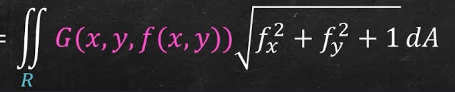 green elm
no, that's if you're parameterizing the sphere i believe
here it's simpler
you have $$\int_S (-5),dS$$
clever fjordBOT
Bungo
 clever fjordBOT
Bungo
 green elm
what is $\int_S dS$?
clever fjordBOT
Bungo
 green elm
no, that's not what the notation means
it means "integrate the surface area of the sphere, over the entire sphere"
the result is just the total surface area of the sphere
surreal mountain
ik but how do you get the surface area if there is no bounds
green elm
there's a simple formula for the surface area of a sphere
surreal mountain
4pir^2?
surreal mountain
4
green elm
no..
surreal mountain
2
green elm
for $\int_S dS$ the answer is $16\pi$
clever fjordBOT
Bungo
 green elm
you still have to multiply that by -5
odd edgeBOT
@surreal mountain Has your question been resolved?
If you are done with this channel, please mark your problem as solved by typing .close
Channel closed
Closed due to timeout
Use .reopen if this was a mistake.
Available help channel!
Send your question here to claim the channel.
Remember:
• Ask your math question in a clear, concise manner.
• Show your work, and if possible, explain where you are stuck.
• After 15 minutes, feel free to ping <@&286206848099549185>.
• Type the command .close to free the channel when you're done.
• Be polite and have a nice day!
Read #❓how-to-get-help for further information on how to ask a good question, and about conduct in the question channels.
 tiny inlet
 odd edgeBOT
tiny inlet
odd edgeBOT
tiny inlet


 latent scaffold
tiny inlet
latent scaffold
tiny inlet
This doesn't really look like it's in a "completely factored form", but it depends on what they're looking for.
For the complex one, what is i^2?
dawn tiger
i^2 = -1
latent scaffold
tiny inlet
uhh im not sure i cant remember if i^2 is -1?
Indeed, so what is 1 + i^2?
tiny inlet
0?
latent scaffold
Yes
tiny inlet
unsure
dawn tiger
you got that 1 + i^2 = 0
so you got i^7 * 0
dawn tiger
tiny inlet
i^7(0)
you said that here
so if i^7 is being multiplied by 0, can you know what that answer is without needing to know what i^7 is?
odd edgeBOT
@tiny inlet Has your question been resolved?
Channel closed
Closed by @tiny inlet
Use .reopen if this was a mistake.
Available help channel!
Send your question here to claim the channel.
Remember:
• Ask your math question in a clear, concise manner.
• Show your work, and if possible, explain where you are stuck.
• After 15 minutes, feel free to ping <@&286206848099549185>.
• Type the command .close to free the channel when you're done.
• Be polite and have a nice day!
Read #❓how-to-get-help for further information on how to ask a good question, and about conduct in the question channels.
 sturdy plume
What does it mean by "The set is the line defined by the vector"
 dawn tiger
every point in that solution set is of the form r * (2, -1, 1)
(2, -1, 1) is a particular vector in R^3, you can imagine scaling this vector by r which would lengthen it, shrink it, flip it backwards, etc. and see that every vector in that space lies on a line that contains that vector
 desert marlin
Very poorly worded for someone who should understand linear algebra enough to teach a. Course on it
 mental ridge
that took me like 3 readings to understand
desert marlin
Well and it’s even worse because infinitely many vectors work as a solution
sturdy plume
I'm sorry I didn't understand that, this has been kind of difficult for me
dawn tiger
desert marlin
Well and it’s even worse because infinitely many vectors work as a solution
maybe it's autograded to take any vector on that span as an answer
desert marlin
The solution space is spanned by:
Provide a vector
It should say soemthing like that
dawn tiger
dawn tiger
(2, -1, 1) is a particular vector in R^3, you can imagine scaling this vector by...
does my explanation up here make sense?
dawn tiger
every solution in the set is a scaled version of that vector (2, -1, 1)
you're scaling by some parameter r
when you scale a single vector by a parameter, it generates a line
for example, imagine you were in R^2 and the solution set was (r, r)
that's the same as r * (1,1)
every vector in the solution set is a scalar multiple of the vector (1,1)
if you can imagine the space containing all solutions of the form (r,r) and considering every possible value of r
this forms a diagonal line, you could think of this as y = x
so scaling a vector produces a line
in linear algebra, we say that that line is "spanned" by that vector
sturdy plume
what im understanding so far is that the vector 2,-1,1 which were the parameters I found are like the borders for everything within the vector?
dawn tiger
maybe not the borders, but every single vector in your solution set is some multiple of the vector (2,-1,1)
sturdy plume
gotcha gotcha
dawn tiger
so that solution set is spanned by the vector (2, -1, 1)
sturdy plume
so I would just write the vector I put down in that box because the vector defines everything
dawn tiger
and what your teacher very poorly worded for that last part is exactly asking for a vector that spans that space
sturdy plume
Its an online course and im fighting out here to understand anything
thank you very much
.close
odd edgeBOT
Channel closed
Closed by @sturdy plume
Use .reopen if this was a mistake.
odd edgeBOT
Available help channel!
Send your question here to claim the channel.
Remember:
• Ask your math question in a clear, concise manner.
• Show your work, and if possible, explain where you are stuck.
• After 15 minutes, feel free to ping <@&286206848099549185>.
• Type the command .close to free the channel when you're done.
• Be polite and have a nice day!
Read #❓how-to-get-help for further information on how to ask a good question, and about conduct in the question channels.
 rose belfry
im having difficulty with logic, on the third row of the truth table, how is it that the overall statement is true when M is false?
 odd edgeBOT
rose belfry
im having difficulty with logic, on the third row of the truth table, how is it ...
rose belfry
odd edgeBOT
rose belfry
im having difficulty with logic, on the third row of the truth table, how is it ...
rose belfry
would M not have to be true in order for the entire statement to be true
 drowsy root
$P \implies Q$ is always true whenever $P$ is false
clever fjordBOT
Flappie
 drowsy root
the only time when $P \implies Q$ is false, is whenever P is true but Q is false
clever fjordBOT
Flappie
 rose belfry
so does the truth value of P not matter if Q is true?
rose belfry
ok, so in this specific question, M is P and N is Q?
rose belfry
is P always the antecedent?
drowsy root
\begin{table}
\begin{tabular}{|c|c|c|}\hline
P & Q & $P\implies Q$\\hline
T & T & T\\hline
T & F & F\\hline
F & T & T\\hline
F & F & T\\hline
\end{tabular}
\end{table}
clever fjordBOT
Flappie
 rose belfry
does the biconditional q supercede the p -> q conditional in any way?
drowsy root
P is the antecedent and Q is the consequent
drowsy root
rose belfry
does the biconditional q supercede the p -> q conditional in any way?
wdym?
rose belfry
rose belfry
im having difficulty with logic, on the third row of the truth table, how is it ...
3rd row, Q is F and P is T yet the overall statement is T
(talking about the top table which is correct)
drowsy root
rose belfry
3rd row, Q is F and P is T yet the overall statement is T
in the Q is F and P is T, and the statement is F
rose belfry
$P \implies Q$ is false but the overall statement is true even though it is biconditional
clever fjordBOT
stwizzy
 drowsy root
this line right?
 rose belfry
yes i meant the compound statement on the right
what makes that T
because the consequent is F and the antecedent is T
drowsy root
you have M which is F, and n->m which is F, they are both false, so iff is true
 serene terrace
A <-> B is true if (both A and B is true) or (both A and B is false)
drowsy root
\begin{table}
\begin{tabular}{|c|c|c|}\hline
P & Q & $P\iff Q$\\hline
T & T & T\\hline
T & F & F\\hline
F & T & F\\hline
F & F & T\\hline
\end{tabular}
\end{table}
clever fjordBOT
Flappie
 drowsy root
\begin{table}
\begin{tabular}{|c|c|c|}\hline
P & Q & $P\wedge Q$\\hline
T & T & T\\hline
T & F & F\\hline
F & T & F\\hline
F & F & F\\hline
\end{tabular}
\end{table}
clever fjordBOT
Flappie
 drowsy root
hope this helps
rose belfry
in this case n->m is A and (n->m)<->m is B?
serene terrace
m is B
rose belfry
yes sorry
ok i understand now, i was blurring the difference between the two statements
.close
odd edgeBOT
Channel closed
Closed by @rose belfry
Use .reopen if this was a mistake.
Available help channel!
Send your question here to claim the channel.
Remember:
• Ask your math question in a clear, concise manner.
• Show your work, and if possible, explain where you are stuck.
• After 15 minutes, feel free to ping <@&286206848099549185>.
• Type the command .close to free the channel when you're done.
• Be polite and have a nice day!
Read #❓how-to-get-help for further information on how to ask a good question, and about conduct in the question channels.
 keen mirage
can anyone help me with understanding transformations or these problems
keen mirage

 gilded shard
which equation do you want help on
keen mirage
can we start with 8
gilded shard
so the "a" value in this is 3, that represents how much the porabola is being stretched by
keen mirage
vertically right?
gilded shard
yup
if the a value is greater then 1 then it is being verticaly stretched
if less then 1 but greater then 0 such as 0.1-0.9 then it is being compressed
keen mirage
okay but how do i gragh that do i just put a dot at 3
gilded shard
no so basically this is vertex form so you are given the vertex which ius h,k
you h value here is 2 coming from the (x-2) and the k value is 4
keen mirage
(-2,4) is the vertex?
gilded shard
when in the bracket you flip the sign so if it was (x+2) then your vertex would be -2,4
a "-" symbol in the bracket means its a positive number on the graph and a "+" symbol means its a negative number on the graph its a bit weird
so your vertex here is 2,4
gilded shard
"h" which is 2 is your x value
gilded shard
keen mirage
so thats my highest point
thats your origin depending on which way the porabola opens which is determined by the a value being negative or positive (negative means opens down and has a max value and positive means opens up and has a min value
keen mirage
it opens down rihgt?
because its 3 which is positive
doesnt the a value determine whether it opens up or down
gilded shard
keen mirage
doesnt the a value determine whether it opens up or down
yes but positive means opens up
keen mirage
oh
gilded shard
4 which is your k value will be the y in the vertex
x=2, and y=4
thats our vertex
keen mirage
okay i understand that
keen mirage
yea i dont understand what does stretch mean
gilded shard
do you know the y values on the normal porabola
41014
a table for that would look like this
x|y
-2|4
-1|1
0|0
1|1
2|4
sorry its a bit messy
gilded shard
basically to transform your current equation into something like that you need to do certain things to the x/y values
for y
the equation is (a)y+k
so (3)y+4
and for x its x (+/- depending on what the h value is) h
so in our case thats x+2
so you plug the y value into that equation
for the first 4 that would look like (3)4+4
then (3)1+4
and so on
any questoins yet
keen mirage
ok.. kinda understanding it
gilded shard
ok so for our x values what do you think the equation would look like
keen mirage
our x value is 2 right?
gilded shard
yes
gilded shard
so to find your x value equatoin you have to know what the h value is
we klnow thats 2
keen mirage
okayy..
gilded shard
then because we know 2 is positive not negative it would be plsu 2
and x is easier in that sence as you only have to know that
then you plug in the x value on the chart into x+2
so for the first one thats -2+2
and so on
keen mirage
oh so -1 +2
gilded shard
yup
keen mirage
0+2 and more
gilded shard
correct
keen mirage
okay and using those points i then plug it into the gragh?
gilded shard
?
we only need one x and y chart for the equation
your teacher probably puts the origional one and the new one next to eahcother for you to see
x|y
-2|4
-1|1
0|0
1|1
2|4
this is the origional and then with what we went over you can make the new one
do you know if your teacher wants you to write out the transformations in word form?
such as translated 2 units right
gilded shard
ok
so for that we look at "a" "h" and "k"
you know how to find those values in an equation
keen mirage
yes
gilded shard
keen mirage
ok for 9 (a)
keen mirage
a determines the vertical stretch
gilded shard
 gilded shard
keen mirage
a determines the vertical stretch
gilded shard
keen mirage
a determines the vertical stretch
correct
heres the equations
list all the transformations you know and well see if you miss any ok
or do you want me to go over them with you
keen mirage
ill try and tell u if im confused
gilded shard
sounds good
keen mirage
the relation has a vertical stretch by 1/2?
keen mirage
ohh okok
gilded shard
or BAFO if your teacher has said thats allowed just shorter
keen mirage
and its vertex is -4,7
keen mirage
gilded shard
or BAFO if your teacher has said thats allowed just shorter
i dont think he does so i wont for now
gilded shard
keen mirage
and its vertex is -4,7
yes but for the translation do you know what to write
gilded shard
keen mirage
i dont think he does so i wont for now
ok so just by a factor of
keen mirage
um not rlly..
keen mirage
ik how to do the charts things