#help-19
1 messages · Page 82 of 1
 echo mango
so since that series diverges then the other one does as well?
 cold swift
yep since the limit approaches 1
echo mango
wait how do we know it approaches 1😭
 clever fjordBOT
y0shi
 echo mango
oh we multiply it because we origionally divided by the "origional" equation?
cold swift
yeah essentially keep change flip
echo mango
okayyy
echo mango
so
when we cancel all the terms out like 3n^2 and 2n^3 we stil have 2 left over
where would that go
clever fjordBOT
y0shi
 cold swift
do you remember how to take the limit to infinity of a rational function?
you can totally lhopital this 3 times
but it is not necessary and requires too much time
echo mango
cold swift
do you remember how to take the limit to infinity of a rational function?
not rlly
cold swift
so if the degree of the numerator is greater than the degree of the denominator, the limit approaches infinity
if the degree of the denominator is greater than the degree of the numerator, it approaches 0
and if the degree of the numerator and the denominator are the same, the limit approaches the ratio of the coefficients of the highest degree term
echo mango
OHHHHHH thatttt
cold swift
this definitely something that you should try to remember since it helps a lot when computing these limits
echo mango
okay i get that
echo mango
clever fjord
**y0shi**
so how did you get to that? by canceling out terms?
cold swift
yeah 3n^2 cancels out
echo mango
ohhh ur just writing that
ok nvm nvm
i was just multiplying it out first
so i had 6n^5/6n^5 +2
cold swift
ah yeah either is fine
that works too
but be careful
the denominator should be 6n^5+6n^2
echo mango
oh ya sorry
cold swift
not that it changes the value of the limit, but if your teacher is picky it could cost you a point
cold swift
echo mango
oh ya sorry
all good
cold swift
well the series we compared it to diverges right
that means the original series must diverge as well
echo mango
oh ya the harmonic
cold swift
as long as the limit evaluates to a finite positive number, both series will either diverge together or converge together
cold swift
echo mango
oh ya the harmonic
yep
echo mango
ohh we determined if the origional is divergent first
then we used the limit comparison to let the series be divergent and compared to the origional?
and we did a_n /b_n
which the a_n was the one we were given and the b_n was the origional that we found?
cold swift
b_n is the series we compared a_n to
and we found that b_n is divergent
and since the limit evaluates to a finite positive number, the original must also be divergent
echo mango
okayyy i kinda get it now
and for the direct comparison test its kinda similar to that right
except that it has to be 0<=a_n<=b_n
cold swift
yep
also the limit comparison as a few extra conditions that basically resemble the direct comparison test
but you don’t need to know them since you can just use the direct comparison when you have those conditions
echo mango
okayyyy
and we do the same thing as the limit comparison and compare it to another series
and that series has to be greater than or equal to the one we have?
cold swift
the limit comparison test doesn’t really care whether one series is bigger than the other
which is why it helps when the direct comparison test conditions fails
echo mango
okayy i see
so do we usually use direct comparison
so the b_n in the direct comparison is what we are comparing to?
cold swift
we use direct comparison when the series we are comparing to our original to converges and is bigger than the original, or when the series we are comparing to diverges and it is smaller than the original
if the series we compared our original to converges let’s say it is smaller than the original
then the direct comparison test is inconclusive
and that’s when we turn to the limit comparison
basically we use limit comparison when direct comparison fails
cold swift
like when direct comparison fails?
echo mango
when it doesnt fail
cold swift
oh alright
echo mango
like idk which one of these works with direct comaprison
i wanna pick one to try the direct comparison test with
 cold swift
well we usually just compare it to the highest degree term there
so $\sum \frac{1}{n^2}$
clever fjordBOT
y0shi
 echo mango
ohhhh
cold swift
so does this series converge or diverge
echo mango
cold swift
well we usually just compare it to the highest degree term there
so we compare it to the highest degree term in the denominator?
well that would be lim n->infinity 1/n^2
which is 1/infinity
so
cold swift
echo mango
so we compare it to the highest degree term in the denominator?
yeah and if there was something in the numerator
we would take the highest degree term as well
echo mango
oh so how would that go
cold swift
echo mango
which is 1/infinity
which means that the divergence test fails
echo mango
like if we had n^3/ n^2+1
clever fjordBOT
y0shi
 echo mango
cold swift
which means that the divergence test fails
echo mango
cold swift
which means that the divergence test fails
but doesnt 1/infinity approach 0?
cold swift
yep
and if the limit equals 0
the divergence test is inconclusive
only when the limit doesn’t equal 0 does the divergence test say that the series is divergent
cold swift
yep
clever fjordBOT
y0shi
 cold swift
doesnt that look like a p series?
echo mango
yep
cold swift
and now for direct comparison test
we have to check whether or not this series is bigger or smaller than our original
and since this series we compared it with is convergent, for the direct comparison test to work, we need the original to be smaller
echo mango
okayyy
so we would do
1/n^2+n times n^2/1
which would be 1 bc of the limits being the same right
cold swift
well thats limit comparison test
and yes it would work
but direct comparison also works
echo mango
how would i do that
clever fjordBOT
y0shi
 echo mango
the series converges?
cold swift
the original converges yes
because it is less than 1/n^2
which converges
so by the direct comparison test, the original converges
cold swift
so if we look at the denominators
the one on the left has a bigger denominator
if it has a bigger denominator, the overall value of the fraction would be smaller
since 1/3<1/2
cold swift
yep
cold swift
yw!
cold swift
alright
echo mango
I learned so much
echo mango
🙏 better than the teacher
cold swift
haha
 odd edgeBOT
@echo mango Has your question been resolved?
Channel closed
Closed by @echo mango
Use .reopen if this was a mistake.
odd edgeBOT
 Available help channel!
Send your question here to claim the channel.
Remember:
• Ask your math question in a clear, concise manner.
• Show your work, and if possible, explain where you are stuck.
• After 15 minutes, feel free to ping <@&286206848099549185>.
• Type the command .close to free the channel when you're done.
• Be polite and have a nice day!
Read #❓how-to-get-help for further information on how to ask a good question, and about conduct in the question channels.
 wintry viper
can someone help me with B please
 odd edgeBOT
wintry viper
can someone help me with B please
wintry viper
odd edgeBOT
wintry viper
can someone help me with B please
wintry viper
i have no idea what its asking me
 open crown
Draw it out
odd edgeBOT
Channel closed
Closed by @wintry viper
Use .reopen if this was a mistake.
odd edgeBOT
Available help channel!
Send your question here to claim the channel.
Remember:
• Ask your math question in a clear, concise manner.
• Show your work, and if possible, explain where you are stuck.
• After 15 minutes, feel free to ping <@&286206848099549185>.
• Type the command .close to free the channel when you're done.
• Be polite and have a nice day!
Read #❓how-to-get-help for further information on how to ask a good question, and about conduct in the question channels.
 magic fox
y+1=-4/3 (x-1) can someone explain how to do this
 foggy ibex
what do we need to do here?
 tacit mica
magic fox
y+1=-4/3 (x-1) can someone explain how to do this
tacit mica
magic fox
y+1=-4/3 (x-1) can someone explain how to do this
what do u have to find in this?
or what do u have to do in this
magic fox
tacit mica
what do u have to find in this?
The orginal problem is Find the equation of the line that passes through (-2,3)(1,-1)
foggy ibex
then use the standard formula to find slope
magic fox
i found the slop
tacit mica
magic fox
i found the slop
then what
foggy ibex
you might have confused between y1 and y2
magic fox
ye
foggy ibex
ok have a nice day!
odd edgeBOT
@magic fox Has your question been resolved?
Channel closed
Closed by @magic fox
Use .reopen if this was a mistake.
Available help channel!
Send your question here to claim the channel.
Remember:
• Ask your math question in a clear, concise manner.
• Show your work, and if possible, explain where you are stuck.
• After 15 minutes, feel free to ping <@&286206848099549185>.
• Type the command .close to free the channel when you're done.
• Be polite and have a nice day!
Read #❓how-to-get-help for further information on how to ask a good question, and about conduct in the question channels.
 wispy birch
Guys I know this is a chemistry question but I couldn't find any similar server like this. Please be kind enough to answer this T_T
 odd edgeBOT
wispy birch
Guys I know this is a chemistry question but I couldn't find any similar server ...
wispy birch
odd edgeBOT
wispy birch
Guys I know this is a chemistry question but I couldn't find any similar server ...
wispy birch
Chapter: solid states
 frigid canopy
wispy birch
frigid canopy
https://discord.gg/RAAef3ye
frigid canopy
wispy birch
frigid canopy
https://discord.gg/RAAef3ye
I did no ones there it's dead
 fallow tapir
What do you not understand about the question?
wispy birch
fallow tapir
What do you not understand about the question?
I got something but that's not the ans
fallow tapir
show your working
wispy birch
Wait
wispy birch
fallow tapir
What do you not understand about the question?
Ok this one thing I don't get... How do we calculate for Be??
I know how to for oxide ion and Al here but there's no info for be?
fallow tapir
i asked for your working 💀
wispy birch
Al is 1/4th of TV so--> 1/4(1) =1/4
O is in ccp ---> 1
Be---? If 1
Then be4AlO4
But ans is BeAl2O4
fallow tapir
again why
wispy birch
2 atoms ryt?
fallow tapir
no
fallow tapir
no
wispy birch
What
fallow tapir
lol
fallow tapir
there are some atoms on faces too
wispy birch
It's not FCC tho ryt?
fallow tapir
its CCP yeah
wispy birch
There are no atoms in face of CCP ryt?
fallow tapir
 fallow tapir
wispy birch
There are no atoms in face of CCP ryt?
fallow tapir
wispy birch
There are no atoms in face of CCP ryt?
there are lol
wispy birch
fallow tapir
This is called FCC ryt?
Wait are FCC and CCP same??
Oh yeah I think so
fallow tapir
both have the same structure yeah
wispy birch
fallow tapir
both have the same structure yeah
Damn till now I was thinking CCP is same as SCC oh god
So let me try again
wispy birch
wispy birch
Guys I know this is a chemistry question but I couldn't find any similar server ...
Ok one info was missing here Be is 1/4 of TV.
odd edgeBOT
Channel closed
Closed by @wispy birch
Use .reopen if this was a mistake.
fallow tapir
wispy birch
Alr got it finally thank you so much actually <@799148360539308073>
oh np 
odd edgeBOT
Available help channel!
Send your question here to claim the channel.
Remember:
• Ask your math question in a clear, concise manner.
• Show your work, and if possible, explain where you are stuck.
• After 15 minutes, feel free to ping <@&286206848099549185>.
• Type the command .close to free the channel when you're done.
• Be polite and have a nice day!
Read #❓how-to-get-help for further information on how to ask a good question, and about conduct in the question channels.
 chrome jungle
helppp  i need to find the first 7 terms
 odd edgeBOT
chrome jungle
helppp <:cryingscreamingthrowingupshittin:983189152017301545> i need to find the...
odd edgeBOT
chrome jungle
helppp <:cryingscreamingthrowingupshittin:983189152017301545> i need to find the...
 tidal idol
chrome jungle
helppp <:cryingscreamingthrowingupshittin:983189152017301545> i need to find the...
tidal idol
chrome jungle
helppp <:cryingscreamingthrowingupshittin:983189152017301545> i need to find the...
what's your thought?
chrome jungle
i have no idea how to start
tidal idol
chrome jungle
i have no idea how to start
try to write sqrt in terms of power indice
chrome jungle
so like,, to the power of 1/2?
tidal idol
chrome jungle
so like,, to the power of 1/2?
yes
chrome jungle
okay buttt what then 😭 is there a formula or something
tidal idol
there is no formula, this is just multiplication with indices
tidal idol
chrome jungle
okay buttt what then 😭 is there a formula or something
show me your work and we will do this step by step
tidal idol
chrome jungle
idk what those are we haven't learned that yet
ok that's ok then, we will just do it in terms of $3\sqrt{3}$
clever fjordBOT
lgkoo
 tidal idol
chrome jungle
it says its recursive
tidal idol
chrome jungle
it says its recursive
it has a recursive pattern yeah
so $a_1 = \sqrt{3}$
then $a_2 = \sqrt{3 \cdot \sqrt{3}}$.
do you understand this?

 tidal idol
chrome jungle
where does the n-1 go
tidal idol
chrome jungle
where does the n-1 go
I substituted n = 2
they want the first 7 terms
so a_1, a_2, ..., a_7
chrome jungle
right
tidal idol
you're given a_1, and the recursive formula
where a_n is the new term, and a_n-1 is the last term
tidal idol
chrome jungle
helppp <:cryingscreamingthrowingupshittin:983189152017301545> i need to find the...
so the idea is to simply substitute the previous term into this
until you have a_7
tidal idol
chrome jungle
so a2 is 3sqrt3? and then we put that into the a3
a2 is not 3sqrt3, it is sqrt of 3sqrt3, so sqrt(3sqrt3)
tidal idol
chrome jungle
and then keep going
but yh you get the idea
tidal idol
yup
chrome jungle
okayy i need 2 more problems if you think you can help maybe 😭 sort of the same topic

just 28
tidal idol
chrome jungle
right, so we have a sequence
$a_1, 10, a_3, a_4, \frac{1250}{27}, a_6, ..., a_n, ...$
clever fjordBOT
lgkoo
 tidal idol
do you know what is the property of a geometric seq?
chrome jungle
noooo
tidal idol
chrome jungle
noooo
the property of a geometric sequence is that each consecutive terms have a common ratio r
for example
1, 2, 4, 8, 16, ...
you see how each term is two times the previous term?
That means this is a geometric seq with common ratio 2
chrome jungle
yesss right
clever fjordBOT
lgkoo
 chrome jungle
yes
tidal idol
with this hint, can you work what the common ratio of your sequence?
chrome jungle
well how do i find the first term
tidal idol
you don't need the first term
you can start from the second term
it's a common ratio
so shouldn't matter where you start if it is geometric
i.e. start from a_2 = 10
chrome jungle
and we solve that to find r
tidal idol
yes, you have to come up with an equation in terms of r and solve for r
chrome jungle
so 10 = r • a_1 ??
tidal idol
chrome jungle
so 10 = r • a_1 ??
yes, but we don't know about a_1,
think about this
a_2 = 10
a_5 = 1250/27
so how many r did we multiply 10 by to get to 1250/27?
chrome jungle
3?
chrome jungle
i'm not sureeee 😭 is it 1250/27 = 10 • 3r ??
tidal idol
no
here's an example
b_1 = 3, b_4= 24
so to get from b_1 to b_4, we have to multiply 3 by r three times
that means
b_2 = 3*r
b_3 = 3 * r * r = 3r^2
b_3 = 3 * r * r * r = 3r^3
and b_4 = 3r^3 * 3 = 3r^4
which we know is 24
so 3r^4 = 24
and you can solve for r
does this make sense?
chrome jungle
yes yes
tidal idol
tidal idol
so how many r did we multiply 10 by to get to 1250/27?
now apply the same logic to this
chrome jungle
so 10r³ ?
chrome jungle
is it 5/3?
tidal idol
yes, well done
tidal idol
clever fjord
**lgkoo**
now generally even though we have this recursive formula, we can write the nth term a_n in terms of r and the first term a_1
so we know a_2 = 10, and r = 5/3, can you find a_1?
odd edgeBOT
@chrome jungle Has your question been resolved?
chrome jungle
SORRY i had to do a test on this just now 😭 but was it 6 • 5/3^n-1 ?
odd edgeBOT
Channel closed
Closed by @chrome jungle
Use .reopen if this was a mistake.
Available help channel!
Send your question here to claim the channel.
Remember:
• Ask your math question in a clear, concise manner.
• Show your work, and if possible, explain where you are stuck.
• After 15 minutes, feel free to ping <@&286206848099549185>.
• Type the command .close to free the channel when you're done.
• Be polite and have a nice day!
Read #❓how-to-get-help for further information on how to ask a good question, and about conduct in the question channels.
 rapid kestrel
For a first order DE with dy/dx = f(x,y), df(x,y)/dy must be continuous to gurantee unique solution. Why is that not present in this definition for uniqueness of higher order DEs?
 odd edgeBOT
rapid kestrel
For a first order DE with dy/dx = f(x,y), df(x,y)/dy must be continuous to guran...
odd edgeBOT
rapid kestrel
For a first order DE with dy/dx = f(x,y), df(x,y)/dy must be continuous to guran...
@rapid kestrel Has your question been resolved?
odd edgeBOT
Channel closed
Closed due to timeout
Use .reopen if this was a mistake.
Available help channel!
Send your question here to claim the channel.
Remember:
• Ask your math question in a clear, concise manner.
• Show your work, and if possible, explain where you are stuck.
• After 15 minutes, feel free to ping <@&286206848099549185>.
• Type the command .close to free the channel when you're done.
• Be polite and have a nice day!
Read #❓how-to-get-help for further information on how to ask a good question, and about conduct in the question channels.
 pallid rock
can i get help how to solve this problem?

 tidal nest
pallid rock
can i get help how to solve this problem?
tidal nest
pallid rock
can i get help how to solve this problem?
what are guy wires?
pallid rock
tidal nest
what are guy wires?
i think they are the two blue ones on the sides going diagonal
pallid rock
i dont think so because it just says 2
pallid rock
i think the angle from the base on the left is 95 degrees and the opposite one on the right is 85 degrees because of the 5 degrees slant
ya its weird i have done similar ones before but never like this one i dont get it
tidal nest
and the 200ft is to the dotted line im guessin
pallid rock
tidal nest
and the 200ft is to the dotted line im guessin
that part im not sure because on the right it looks like its only going to the blue line (the base)
tidal nest
im pretty confused xd
pallid rock
thats the part thats weird to me too tho because if its what im thinking then you would just find the side using the law of cosines easy with a=200 and b=150 trying to find c2=a^2+b^2-2ab cos c
tidal nest
wait my brain doin smth
pallid rock
but like if the 200 goes past the base then idk
tidal nest
cosine rule could work
pallid rock
even if its a slant like that
i hate this question
can't even really tell whats what i know what u mean confusing its very badly drawn
tidal nest
yeah if it was like a better drawing it would make sense
look
i think i figured out the left wire
u can try to get the right one
pallid rock
tidal nest
i think i figured out the left wire
did u get 260.25 for the left?
tidal nest
249.28 :/
pallid rock
hmm
tidal nest
ill send what i did

last step should be A not A^2
typo from me
based on what i did for the left wire, I literally cant do the same for the right one, so maybe i've over complicated it
pallid rock
can u explain to me i dont understand why its 200-150sin5
i didnt learn that in my class yet whatever that is
pallid rock
like how u got 150 and why its why is the 150sin5 being subtracted from 200
pallid rock
ya
tidal nest
so a bit of it is underground
sin(x) = opposite side / hypotonus side
i def spelt that wrong but i hope u get it
pallid rock
thats how u found the measure of the little bit thats underground like can u explain how thats done
we never did that yet
pallid rock
idk why i was given this problem tbh like we never learned how to do this yet only the basic law of cosines not with like a slant lmao
tidal nest
i mean if we assume the building is 0m wide, i could get the other wire but this seems like the question is just weird instead xd
i think i get what ur saying
only use the slope for the angle not the lengths of anything
pallid rock
tidal nest
i mean if we assume the building is 0m wide, i could get the other wire but this...
its rigged not in my favor
pallid rock
tidal nest
only use the slope for the angle not the lengths of anything
ya cuz i never learned any other way to do it just if its regular
i might just put that and see if they accept it, cuz fuq
 odd edgeBOT
@pallid rock Has your question been resolved?
pallid rock
tidal nest
<@840441282110160947>
thanks
odd edgeBOT
Channel closed
Closed due to timeout
Use .reopen if this was a mistake.
odd edgeBOT
Available help channel!
Send your question here to claim the channel.
Remember:
• Ask your math question in a clear, concise manner.
• Show your work, and if possible, explain where you are stuck.
• After 15 minutes, feel free to ping <@&286206848099549185>.
• Type the command .close to free the channel when you're done.
• Be polite and have a nice day!
Read #❓how-to-get-help for further information on how to ask a good question, and about conduct in the question channels.
 outer wadi
Can someone teach me how to do this or send me something explaining, my teacher didn’t go over this and i can’t find anything on youtube about it
 odd edgeBOT
outer wadi
Can someone teach me how to do this or send me something explaining, my teacher ...
outer wadi
odd edgeBOT
outer wadi
Can someone teach me how to do this or send me something explaining, my teacher ...
outer wadi
I know how to find the general solution
i’m not sure what to do with the limit or what y(0) > 0 means
 mystic forge
outer wadi
i’m not sure what to do with the limit or what y(0) > 0 means
mystic forge
outer wadi
i’m not sure what to do with the limit or what y(0) > 0 means
what is ur general solution
outer wadi
 mystic forge
um
outer wadi
is that wrong 😭
mystic forge
u get this by separation

 brittle beacon
1/(a + b) is not 1/a + 1/b 
mystic forge
mystic forge
u get this by separation
then simple integration leads to the solution
which u did
but
yeah
brittle beacon
(also note that they talk about y(0), and that dividing by zero, as you would in 2/t^2, is not good for your health...)
outer wadi
I’m kinda confused on where I went wrong, was it my second step? In my first step I took the integral of 1/y^2 and got -1/y = integral of tdt which is t^2/2 + C right
outer wadi
It’s possible to take the reciprocal of both sides right? I just did it wrong?
 mystic forge
yeah
outer wadi
oh should I combine them and then take the reciprocal
mystic forge
yuh
outer wadi
also when solving for C does it matter that I keep track of wether c is 2c or c^2 because I watched a video that said we can just make 2c = c since it's still a constant but wouldn't that affect the value of C when we solve for it since we won't be diving by two?
mystic forge
it wont change the final expression
just simplify till the end
and whatever constant u have
make it A or something
brittle beacon
[though in this case, you want to have the constant in terms of y(0) if possible!]
outer wadi
brittle beacon
[though in this case, you want to have the constant in terms of y(0) if possible...
hmm back to that, what is y(0) > 0 saying again? I dont't understand what that information is for, are they saying that y(0) can be negative or positive and we want the limit when it's positive?
brittle beacon
That the initial value y(0), you're assuming positive (which is just as well, seeing that it's a denominator and in a square root in that sqrt{2/y(0)} part)
odd edgeBOT
Channel closed
Closed by @outer wadi
Use .reopen if this was a mistake.
odd edgeBOT
Available help channel!
Send your question here to claim the channel.
Remember:
• Ask your math question in a clear, concise manner.
• Show your work, and if possible, explain where you are stuck.
• After 15 minutes, feel free to ping <@&286206848099549185>.
• Type the command .close to free the channel when you're done.
• Be polite and have a nice day!
Read #❓how-to-get-help for further information on how to ask a good question, and about conduct in the question channels.
 rugged lantern
Can someone just read over this and tell me if I’m wrong
 rugged lantern
Trying to just double check the original statement is
“Disprove the statement: there are two integers m>=2 and n>=1 such that m^2+1 = 2^n”
odd edgeBOT
@rugged lantern Has your question been resolved?
rugged lantern
.close
odd edgeBOT
Channel closed
Closed by @rugged lantern
Use .reopen if this was a mistake.
odd edgeBOT
Available help channel!
Send your question here to claim the channel.
Remember:
• Ask your math question in a clear, concise manner.
• Show your work, and if possible, explain where you are stuck.
• After 15 minutes, feel free to ping <@&286206848099549185>.
• Type the command .close to free the channel when you're done.
• Be polite and have a nice day!
Read #❓how-to-get-help for further information on how to ask a good question, and about conduct in the question channels.
 wanton prawn
To keep it brief; I need to do a couple of interviews with people who have work (or have worked) as software developers or similar (Researchers (B.S-Ph.D), Web Dev, AI Devs, Data Scientists & Admins, Computer Vision Engineer, Cloud Engineers, etc....) for a sociology class I had to take to graduate. I have to ask ~20 brief questions like these:
- What kinds of things have encouraged you to stay with the ORGANIZATION NAME?
- Have you received any on-the-job training?
- How would you counsel someone on preparing for your current position at ORGANIZATION NAME?
- Are you aware of any pending laws related to labor/employment that might change your job? That is, change the relationship between you and the firm, for good or bad. If so, can you describe what those changes might be?
5) Are there any rules or policies that are specific to (Organization Name) that makes this a better (or worse) place to work than other firms who hire people to do what you do here?
Etc...
I do have to record the audio for my professor (for legitimacy purposes), so the interviews will be as brief as possible because I can listen back to the audio instead of taking notes during.
If anyone is willing to help me out, I can literally do the interview with you any day, at any time. Between April 10th and April 20th.
It would help me out a ton!
Thanks in advance.
odd edgeBOT
wanton prawn
To keep it brief; I need to do a couple of interviews with people who have work ...
@wanton prawn Has your question been resolved?
odd edgeBOT
Channel closed
Closed due to timeout
Use .reopen if this was a mistake.
Available help channel!
Send your question here to claim the channel.
Remember:
• Ask your math question in a clear, concise manner.
• Show your work, and if possible, explain where you are stuck.
• After 15 minutes, feel free to ping <@&286206848099549185>.
• Type the command .close to free the channel when you're done.
• Be polite and have a nice day!
Read #❓how-to-get-help for further information on how to ask a good question, and about conduct in the question channels.
 shrewd sky
is it 2n/n!
 odd edgeBOT
shrewd sky
is it 2n/n!
odd edgeBOT
shrewd sky
is it 2n/n!
 cold sage
no
shrewd sky
there a geometric series in a series
cold sage
where is the geometric part
shrewd sky
numerator
cold sage
thats not geometric 2 4 6 8 ...
factorise it
(what if you pulled out 2 from every component of that product?)
shrewd sky
you mean divide by 2
cold sage
factorise* but no, its not just a single 2
shrewd sky
i dont understand
first of all its 2 * 4 * 6 * 8 * 10 * 234234902394
and the denominator is a factorial
so the 2n isnt there
cold sage
?
cold sage
i dont know what youre talking about/what you mean
shrewd sky
how would i factorise a series
brittle beacon
You're happy that for each of those, they're multiples of 2 you're dealing with? That 2 is a multiple of 2, 4 is a multiple of 2, 6 is, same up to 2n?
shrewd sky
yes
cold sage
so you can factor out a 2 from each number
(2*1)*(2*2)*(2*3)*...*(2*(n-1))*(2*n)
shrewd sky
infinite
cold sage
how so?
i think youre slightly confusing the sum itself with just looking at the expression being summed
shrewd sky
i am confused on everything
i mean the numerator
its 2 being multiplied by 2 + 2 and then multiplied by 2 + 2 + 2
cold sage
if i start pulling 2's out of this
(2*1)*(2*2)*(2*3)*...*(2*(n-1))*(2*n)
itll start doing this
2 [1*(2*2)*(2*3)*...*(2*(n-1))*(2*n) ]
2^2 [1*2*(2*3)*...*(2*(n-1))*(2*n) ]
2^3 [ 1*2*3*...*(2*(n-1))*(2*n) ]
and keep going
what would be the exponent of 2 once ive taken them all out?
shrewd sky
2^n something my brain is still processing
cold sage
yup, and what would be in the square brackets?
cold sage
not quite
2^n [1*2*3*...*n]
shrewd sky
oh so youre not diving by 2
cold sage
not so fast buster
cold sage
cold sage
any idea what the stuff in the [] could be rewritten as
gotta address this fellow
shrewd sky
:(
cold sage
n going to infinity just means there will be infinite terms thats all
but we're looking at simplifying the general form of a term
cold sage
its n multiplied by every natural number less than itself
cold sage
correct
shrewd sky
WHAT
cold sage
the stuff in the [] is n!
shrewd sky
oh my god so its juist 2^n
cold sage
bingo
odd edgeBOT
Channel closed
Closed by @shrewd sky
Use .reopen if this was a mistake.
odd edgeBOT
Available help channel!
Send your question here to claim the channel.
Remember:
• Ask your math question in a clear, concise manner.
• Show your work, and if possible, explain where you are stuck.
• After 15 minutes, feel free to ping <@&286206848099549185>.
• Type the command .close to free the channel when you're done.
• Be polite and have a nice day!
Read #❓how-to-get-help for further information on how to ask a good question, and about conduct in the question channels.
 stiff reef
if you have a set of vectors and convert them to a matrix if a row of the matrix is all zeros does that mean they are linearly dependant
odd edgeBOT
stiff reef
if you have a set of vectors and convert them to a matrix if a row of the matrix...
mystic forge
stiff reef
if you have a set of vectors and convert them to a matrix if a row of the matrix...
yeah
 nocturne belfry
i dont believe so, no
mystic forge
no???
stiff reef
ooh a battle
nocturne belfry
lol its not a battle
nocturne belfry
consider the first 3 basis vectors for R4
using the standard basis
theyre LI
but youll have a row of all zeros
mystic forge
oh thats true
nocturne belfry
$\mqty[ \imat{3} \ 0 & 0 & 0 ]$
clever fjordBOT
jan Niku
 stiff reef
like if you have
[x x2 x3]
[x x2 X3]
[0 0 0]
mystic forge
yeah i was thinkin its like the one above^
stiff reef
if its in r3 and theirs 3
nocturne belfry
idk youd have to describe a bit more exactly what is happenin
stiff reef
ok wait give me one sec
mystic forge
im guessing its a square matrix
stiff reef
thats a way better explination then what i was babout to do
nocturne belfry
say its dimension n, the matrix
so the best you can hope for is the columns span R(n-1)
but, then you only need n-1 vectors to do that
so n many vectors (embedded) in R(n-1) cant be LI
maybe its easier to talk about subspaces
nocturne belfry
okay
stiff reef
would that mean if any of the rows are zero they are ld for a square matrix
like if the x compont was all zeors
or does it have to be the newst one
nocturne belfry
newst?
nocturne belfry
i wouldnt worry about that
stiff reef
it doesnt matter what row is zeros
nocturne belfry
im just trying to understand what youre asking
nocturne belfry
stiff reef
it doesnt matter what row is zeros
yea, it doesnt matter
do you understand what i mean subspace?
like, you collect these vectors as columns in a matrix
and you zero out a row
or, maybe the row is all zeros all ready
stiff reef
i think so its like if you have a vector space like r3 r2 is a subspace or r3 right
oh wait
nocturne belfry
stiff reef
i think so its like if you have a vector space like r3 r2 is a subspace or r3 ri...
yea, its like ... 'inside' R3 yea?
stiff reef
yes
i just think of it like sets and subsets
idk if that will hurt me but it makes the most sence to me that way
nocturne belfry
like $\mqty[ 1 & 0 & 1 \ 0 & 1 & 1 \ 0 & 0 & 0 ]$
clever fjordBOT
jan Niku
 nocturne belfry
the 3 vectors, assembled as columns
these vectors span a 2-dimensional subspace of r3
theyre in R3 for sure, but the subspace is only 2 dimensional
because you have a row of 0s
stiff reef
okok thank you
stiff reef
yes
nocturne belfry
but, you only need 2 vectors to make a basis for a dimensional space
stiff reef
yes
nocturne belfry
and in fact, you cant have more and keep them LI
so if the subspace is 2d
but we have 3 vectors in it
they cant be LI
thats all i meant
stiff reef
ohh yeah ok i get it now that would mean if all 3 arnt linearly dependant wich is imposible they are all linear combinations of the other two?
i think
stiff reef
idk what that means
nocturne belfry
$\mqty[1 & 1 & 0 \ 0 & 0 & 0 \ 0 & 0 & 0]$
clever fjordBOT
jan Niku
 nocturne belfry
this could also happen
stiff reef
ohh then its just a line in r3?
nocturne belfry
i dont wanna say in general what you are describing is true is all
stiff reef
so its subspace is r1
nocturne belfry
yea
or alternatively one of the vectors is the 0 vector
but assume this screwy stuff doesnt happen
stiff reef
then would it just be a dot
nocturne belfry
then yes, you can always pick one, and write it as a linear combination of the others
stiff reef
okok thank you its all kinda starting to click now
nocturne belfry
stiff reef
then would it just be a dot
no, i mean like $\mqty[1 & 0 & 0 \ 0 & 1 & 0 \ 0 & 0 & 0 ]$
clever fjordBOT
jan Niku
 stiff reef
oh ok thats just i hat and j hat right
nocturne belfry
we cant pick the second and third columns as a basis of the 2 dimensional subspace
stiff reef
it doesnt matter how many more zeros you add
nocturne belfry
do you see why?
answer: ||we cant write the first column as a linear combination of the second and third column||
stiff reef
yes because that would be r1?
nocturne belfry
well
stiff reef
like the basis vectors for r1
nocturne belfry
the first and second are LI and a basis for R2
stiff reef
hahaha yeah thats what i dont like about linear algebra
theirs always somthing
thank you though i understand now i think
nocturne belfry
if you can make a row of zeros you are in good shape
youre just looking at a smaller subspace
stiff reef
like with the row echalon form
nocturne belfry
then you need to do some investigating to figure out the size of the subspace
nocturne belfry
stiff reef
like with the row echalon form
yea
stiff reef
okok so a row and a colomn of zeros are the same they can just get "thrown out" to find the sub space
nocturne belfry
sure but you dont actually need a column of zeros
stiff reef
and the only sub spaces are R0-RN
nocturne belfry
remember this guy
stiff reef
yeah ig you right
nocturne belfry
 stiff reef
ohh okok thank you
nocturne belfry
the problem is that
if you add the first and second columns
you get the third
here we can take any two columns as a basis
but the third must be LD
stiff reef
yes but wouldnt that not be ref
nocturne belfry
hmm
nocturne belfry
no youre good i dont remember the precise defns of these things
i have to google
i believe it is rref
stiff reef
its ok
stiff reef
okok so just 1s and 0s
nocturne belfry
you may have like $\mqty[ 1 & 0 & 4 & 3 \ 0 & 0 & 1 & 2 ]$
clever fjordBOT
jan Niku
you may have like $\mqty[ 1 & 0 & 4 & 3 \\ 0 & 0 & 1 & 2 ]$
 stiff reef
okok so that would mean its a vector in r2
nocturne belfry
no this one is not square
stiff reef
i spans r2
nocturne belfry
so its not so clear
stiff reef
can i just make is square by adding two rows of 0s?
nocturne belfry
i guess
what are we talking about now, the columns?
the columns can only span a 2 dimensional subspace
$\mqty[ 1 & 0 & 4 & 3 \ 0 & 0 & 1 & 2 \ \zmat{2}{4} ]$
clever fjordBOT
jan Niku
 stiff reef
ok so would i have to cheak if the other colums are scalar multiples of eatchother
nocturne belfry
thank you god for the physics package 🙏
nocturne belfry
stiff reef
ok so would i have to cheak if the other colums are scalar multiples of eatchoth...
you dont need to check anything here there are 2 pivots
stiff reef
lmao yeah it looks alot better then
[x x x]
[x x x]
oh wait you right sorry
so the amount of pivots in ref is the span
or dimention
like the r
stiff reef
ok
nocturne belfry
then the columns span a m-dimensional subspace of Rn
stiff reef
okk i get it thank you very much can i write that as like this set of vectors spans Rm
for the m pivots
stiff reef
oh yeah ok i get that
stiff reef
nocturne belfry
this is why we have to say subspace
this sentence helped alot
nocturne belfry
because the vectors will have n-many entries right
so, they cant be in Rm
(its implicit here m < n, so they have too many entries)
but you can think of the subspace as Rm inside of Rn
like you said, a plane maybe
or a line in 3d space
something like that
but the line is still in 3d space
stiff reef
yes ok i get it it would only be rN if its an nxn matrix where all vectors are linearly dependent
otherwise its a subspan
of a dimension
nocturne belfry
otherwise the vectors span a subspace
stiff reef
sorry subspace not subspan
nocturne belfry
if you have a square matrix with at least one row of all 0s
well, we can write out a nice clean defn if you want
i get the feeling youre just chasing the idea out though
stiff reef
i think i have it but i just dont know the termanology 100% ill give it like a very short paragraph of what i think it is
if you have an nxn matrix and all vectors are linearly independent without any zero rows these vectors will span Rn. if you take out all of the zero rows when in rref and are left with an MxN matrix the vectors span an m dimentional subspace
thats the best way i could word it
nocturne belfry
stiff reef
if you have an nxn matrix and all vectors are linearly independent without any z...
have you ever seen invertible matrix theorem?
nocturne belfry
The invertible matrix theorem is a theorem in linear algebra which gives a series of equivalent conditions for an n×n square matrix A to have an inverse. In particular, A is invertible if and only if any (and hence, all) of the following hold: 1. A is row-equivalent to the n×n identity matrix I_n. 2. A has n pivot positions. 3. The equation A...
so look at # 7
any other statement there is equivalent to # 7
I would say .... maybe 1 or 2 is what you mean?
nocturne belfry
right
equivalently
- A is row-equivalent to the nxn identity matrix
or 2. A as n pivot positions
every numbered statement here is logically equivalent
so if you have one, you have all of them
i just point you at this because this is the strongest form of the 'nice' case
where the columns span R^n
if youre not in the nice case, then your subspace has equal dimension to the number of pivots
nocturne belfry
no problem
stiff reef
sorry for being a lil dumb
nocturne belfry
stiff reef
sorry for being a lil dumb
haha dont say that
youre not dumb
you just have questions
stiff reef
you made it all click though wich is the important part
stiff reef
yeah i just feel bad cuz i dont wana wast peoples time i relly apreciate the help though i was watching youtube videos all day and nothing was making it stick
nocturne belfry
hmmmmm well if u must know
I am helping other ppl because i do not understand my own work 
stiff reef
hahaha what are you working on
nocturne belfry
fractional calculus 
stiff reef
damn that sounds a lil wacky
nocturne belfry
have you taken calculus?
stiff reef
i like calculus alot but i havent gotten very far
nocturne belfry
me either
stiff reef
just to integrals
nocturne belfry
its such a big subject
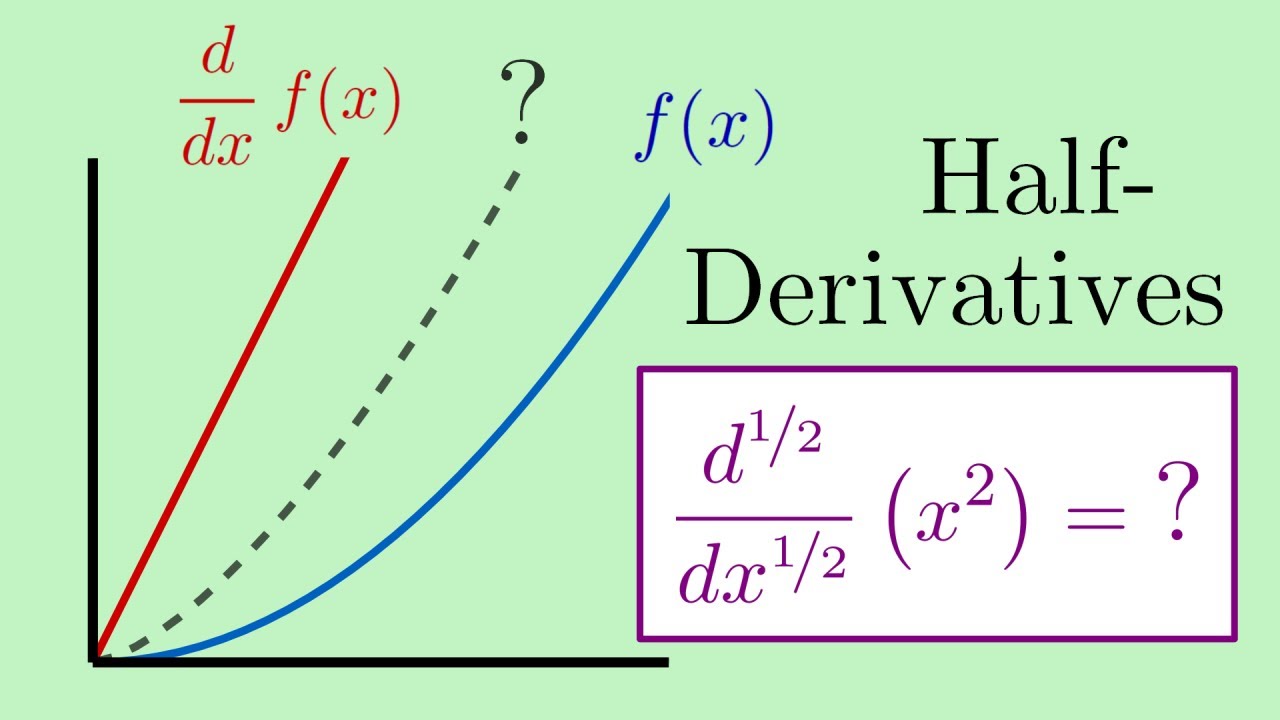
Can you take a derivative only partway? Is there any meaning to a "half-derivative"? Does such a concept even make sense? And if so, what do these fractional derivatives look like?
Previous video about Cauchy's Formula for Repeated Integration:
https://youtu.be/jNpKKDekS6k
A really nice video that derives the gamma function from scratch:
http...
if u are curious
stiff reef
like i know integration by parts and volume of solds of revilution stuff
but i like i like calculus alot more then linear algebra its just alot more intuitive
nocturne belfry
linear algebra is more important
stiff reef
damn this looks tuff
nocturne belfry
are you engineering?
stiff reef
nope im in com sci
stiff reef
lmao yeah like half of com sci is vectors and matrixes
stiff reef
hahaha its just so much work
stiff reef
yeah im trying my best but it takes a long time for me to understand the concepts but i feel like calculus just comes alot easier
wbu are you in engeneering
nocturne belfry
computational mathematics
stiff reef
what year are you in
nocturne belfry
im about to graduate
stiff reef
AYYY nice im in second year rn so i still got a lil ways to go );
stiff reef
hahaha thank you its a huge help
odd edgeBOT
Channel closed
Closed by @stiff reef
Use .reopen if this was a mistake.
Available help channel!
Send your question here to claim the channel.
Remember:
• Ask your math question in a clear, concise manner.
• Show your work, and if possible, explain where you are stuck.
• After 15 minutes, feel free to ping <@&286206848099549185>.
• Type the command .close to free the channel when you're done.
• Be polite and have a nice day!
Read #❓how-to-get-help for further information on how to ask a good question, and about conduct in the question channels.
 spring iris
Hi
odd edgeBOT
spring iris
Hi
spring iris
I need help on this

I have to prove that 3x^3 + 9x - 9x^3 is 3/2x^2(3-4x)
X is just alpha
nocturne belfry
were ookay to use x instead?
spring iris
Yea
nocturne belfry
Your problem is: I have to prove $3x^3 + 9x - 9x^3 = \frac 32 x^2 (3-4x)$
clever fjordBOT
jan Niku
 spring iris
Ye
nocturne belfry
what have you tried?
spring iris
Factoring by x^2 then by 3/2 which got me close i got the 4x term but i couldn't figure out how im gonna get the 3
nocturne belfry
you know im not sure this is true
is it possible youve made a mistake somewhere?
,w plot 3x^3+9x-9x^3 and 3/2 x^2*(3-4x)
clever fjordBOT


 nocturne belfry
Can you tell me about where this problem came from?
spring iris
I proved with integration by parts this
 nocturne belfry
Want to show: $\int _0 ^a \ln(1-x) \dd x = - a^3$
clever fjordBOT
jan Niku
 spring iris
Now im gonna use that proof to show that integral of this is this

That
3/2
Expression
nocturne belfry
Okay so if i understand
you want to otherwise assume that this is true: $$\int _0 ^a \ln (1-x) \dd x = -a^3$$
clever fjordBOT
jan Niku
 spring iris
Yea
nocturne belfry
spring iris
Now im gonna use that proof to show that integral of this is this
and You want to apply that result in order to integrate this.
spring iris
Yep
nocturne belfry
so you want to calculate $$\int _0 ^a \qty( x^2 + 1 + \ln (1-x) ) \dd x$$
clever fjordBOT
jan Niku
Compile Error! Click the  reaction for more information.
(You may edit your message to recompile.)

jan Niku
so you want to calculate $$\int _0 ^a \qty( x^2 + 1 + \ln (1-x) ) \dd x$$
 spring iris
Yep
nocturne belfry
then this should be $\qty( \frac{x^3}{3} + x ) \bigg \vert _0 ^a - a^3$, right?
clever fjordBOT
jan Niku
 spring iris
Yep
nocturne belfry
this is -2/3 a^3 + a
spring iris
Yep but the unit is 3cm so 3cm^2 is 9
nocturne belfry
$9 \int _0 ^a \qty( x^2 + 1 + \ln (1-x) ) \dd x = - 6 a^3 + 9a$
spring iris
Multiply by 9
nocturne belfry
unit? what?
clever fjordBOT
jan Niku
 spring iris
Yeah i mean i founs that result after
Correct
Its that but how can it be this

3/2 expression
nocturne belfry
I have to say that I don't have access to the entire problem
Maybe you are trying not overwhelm me with context?
Granted, I don't speak french!
spring iris
Its just a simple integral part of the problem it's sperate
nocturne belfry
but I can't say for sure what is happening I don't have enough context
nocturne belfry
clever fjord
**jan Niku**
this result checks out to me
beyond that I am not sure
spring iris
clever fjord
**jan Niku**
Yeah this is correct
nocturne belfry
If you can somehow share the entire problem
I'm lacking context to help you understand the final answer
spring iris
Its in french
nocturne belfry
maybe i can find a french helper 
or translate it
chatgpt is pretty good at translation
sometimes

 pastel orbit
I can kind of read it but not really lmao
spring iris
The final integral is just to find the blue part
 pastel orbit
a) "Verify that for x in [0,1], 1/(1-x) - 1 = x/(1-x)"
spring iris
From 0 to alpha
nocturne belfry
were on the lower part
pastel orbit
which part
nocturne belfry
c, I believe
 spring iris
Nah i wouldn't wish that on u
nocturne belfry
 spring iris
This is the 3cm trick

Remember the result is in cm squared
So u have to multiply by 9
Its hidden
nocturne belfry
no, this is not true
well, just hold on
i still dont understand the problem
C_f and T?
spring iris
Oh you dont need to worry about that T is just a slope and cf is the graph
spring iris
spring iris
The final integral is just to find the blue part
It wants u to find the blue area part
I showed here
nocturne belfry
but this says the region bounded by x=0 and x=a which isnt a region
what does C_f and T mean
is C f like the figure of f?
so whats f
spring iris
It wants to find the area thats limited by cf which is the graph t which is the tangante and x=0 which is the origin and x= alpha which is just between 0.6 and 0.7

Its that blue part
This is f

Yes figure of f
It doesn't matter cuz the real problem is proving somehow that 3x^3 +9x -9x^3 is this
 nocturne belfry
wouldnt it be the area under the curve
nocturne belfry
from x=0 to x=a
spring iris
Yep

 spring iris
Yeah
 spring iris
It doesn't matter cuz the real problem is proving somehow that 3x^3 +9x -9x^3 is...
spring iris
spring iris
It doesn't matter cuz the real problem is proving somehow that 3x^3 +9x -9x^3 is...
Yeah but that has to be this
Somehow
This is last years national exam
nocturne belfry
its not lol
spring iris
Bro
nocturne belfry
i mean its just not it doesnt even have the right order
spring iris
So ur telling me this is not possible and that the exam that the whole country did is wrong?
spring iris
Nope thats all u need to know we both came to the same expression
nocturne belfry
this function is only defined up to 1 right
spring iris
Yup
nocturne belfry
so what if a>1
nocturne belfry
spring iris
Nope thats all u need to know we both came to the same expression
or T is not just 'some tangent'
spring iris
A isnt > 1 because i proved this
 nocturne belfry
its some function or something
spring iris
nocturne belfry
or T is not just 'some tangent'
Nope it is
 nocturne belfry
spring iris
A isnt > 1 because i proved this
nocturne belfry
spring iris
A isnt > 1 because i proved this
this is a root funding problem
nocturne belfry
spring iris
The tangent equation is y= -x + 1
 this changes the answer
this is what i was asking way back when
nocturne belfry
if you want to find the area between two functions
say here f and T
then you probably want to be sure sayy
f > T on [0,a]
spring iris
Oh my god
nocturne belfry
and then look at $\int _0 ^a (f-T) (x) \dd x$
spring iris
OH MY GOD
clever fjordBOT
jan Niku
 spring iris
YES
nocturne belfry
this is it
nocturne belfry
youre good lol
nocturne belfry
well you want the area between the curves
so all the area up to f
but remove the area under T
(assuming f>= T)
nocturne belfry
odd edgeBOT
@spring iris Has your question been resolved?
Channel closed
Closed by @spring iris
Use .reopen if this was a mistake.
odd edgeBOT
Available help channel!
Send your question here to claim the channel.
Remember:
• Ask your math question in a clear, concise manner.
• Show your work, and if possible, explain where you are stuck.
• After 15 minutes, feel free to ping <@&286206848099549185>.
• Type the command .close to free the channel when you're done.
• Be polite and have a nice day!
Read #❓how-to-get-help for further information on how to ask a good question, and about conduct in the question channels.
 maiden knoll
how would you verify this not know r?
 odd edgeBOT
maiden knoll
how would you verify this not know r?
maiden knoll
odd edgeBOT
maiden knoll
how would you verify this not know r?
maiden knoll
i would do a cofactor expansion since i dont know how i would put this in my calculator
r_1 r_2 r_3 are distinct real roots, so can you just pick arbitrary r values?
clever fjordBOT
tobi

 regal leaf
for all x in the Reals
odd edgeBOT
@maiden knoll Has your question been resolved?
odd edgeBOT
Channel closed
Closed due to timeout
Use .reopen if this was a mistake.
odd edgeBOT
Available help channel!
Send your question here to claim the channel.
Remember:
• Ask your math question in a clear, concise manner.
• Show your work, and if possible, explain where you are stuck.
• After 15 minutes, feel free to ping <@&286206848099549185>.
• Type the command .close to free the channel when you're done.
• Be polite and have a nice day!
Read #❓how-to-get-help for further information on how to ask a good question, and about conduct in the question channels.
 solid niche
Hello! I need help understanding what i am doing wrong in the next expression:
Let $ E(x) = \arcsin ( \sin (2x)) ; \forall x \in \R =>\newline
\ sin (E(x))= \sin (2x) ; \forall x \in \R <=>\newline
- \sin (E(x))= - \sin (2x) ; \forall x \in \R <=>\newline
\sin ( E(x)- \pi )= \sin (2x- \pi ) ; \forall x \in \R <=>\newline
E(x) - \pi = \arcsin(\sin(2x- \pi)) + 2k \pi ; \forall x \in \R ,; k \in \Z ; <=>\newline
E(x) = \arcsin(\sin(2x- \pi)) + \pi (2k + 1) ; \forall x \in \R ,; k \in \Z
; =>\newline
\arcsin(\sin(2x))=\arcsin(\sin(2x- \pi)) + \pi(2k+1) ; \forall x \in \R , ; k \in \Z \newline
(FALSE) $
odd edgeBOT
solid niche
Hello! I need help understanding what i am doing wrong in the next expression:
...
 cursive field
...
solid niche
huh?
Why is it not turning into latex?
$ E(x) = \arcsin ( \sin (2x)) ; \forall x \in \R =>\newline
\ sin (E(x))= \sin (2x) ; \forall x \in \R <=>\newline
\sin (E(x))= - \sin (2x) ; \forall x \in \R <=>\newline
\sin ( E(x)- \pi )= \sin (2x- \pi ) ; \forall x \in \R <=>\newline
E(x) - \pi = \arcsin(\sin(2x- \pi)) + 2k \pi ; \forall x \in \R ,; k \in \Z ; <=>\newline
E(x) = \arcsin(\sin(2x- \pi)) + \pi (2k + 1) ; \forall x \in \R ,; k \in \Z
; =>\newline
\arcsin(\sin(2x))=\arcsin(\sin(2x- \pi)) + \pi(2k+1) ; \forall x \in \R , ; k \in \Z \newline
(FALSE) $
cursive field
$E(x) = \arcsin ( \sin (2x)) ; \forall x \in \R =>\newline \sin (E(x))= \sin (2x) ; \forall x \in \R <=>\newline\sin (E(x))= \sin (2x) ; \forall x \in \R <=>\newline\sin (E(x)- \pi)= \sin (2x- \pi ) ; \forall x \in \R <=>\newline E(x) - \pi = \arcsin(\sin(2x- \pi)) + 2k \pi ; \forall x \in \R ,; k \in \Z ; <=>\newline E(x) = \arcsin(\sin(2x- \pi)) + \pi (2k + 1) ; \forall x \in \R ,; k \in \Z; <=>\newline\arcsin(\sin(2x))=\arcsin(\sin(2x- \pi)) + \pi(2k+1) ; \forall x \in \R , ; k \in \Z \newline (FALSE)$