#help-19
1 messages · Page 62 of 1
 idle laurel
 paper kelp
I think yes
idle laurel
no
paper kelp
 idle laurel
Try to calculate the area of the function x^3 from 0 to 3
And then calculate the are of 6x from 0 to 3
and take the 2nd one from the 1st one
you wont get 6.75
idle laurel
yea -6.75 mb
paper kelp
It says area cant have both positive and negative values
How can I tell if it does or doesn’t
Without graphing it
Is there a way
Or does negative answer = difference of area
??
 odd edgeBOT
@paper kelp Has your question been resolved?
Channel closed
Closed by @paper kelp
Use .reopen if this was a mistake.
 Available help channel!
Send your question here to claim the channel.
Remember:
• Ask your math question in a clear, concise manner.
• Show your work, and if possible, explain where you are stuck.
• After 15 minutes, feel free to ping <@&286206848099549185>.
• Type the command .close to free the channel when you're done.
• Be polite and have a nice day!
Read #❓how-to-get-help for further information on how to ask a good question, and about conduct in the question channels.
 tardy furnace
Help with this. Am I doing this right?
 tardy furnace
.close
odd edgeBOT
Channel closed
Closed by @tardy furnace
Use .reopen if this was a mistake.
odd edgeBOT
Available help channel!
Send your question here to claim the channel.
Remember:
• Ask your math question in a clear, concise manner.
• Show your work, and if possible, explain where you are stuck.
• After 15 minutes, feel free to ping <@&286206848099549185>.
• Type the command .close to free the channel when you're done.
• Be polite and have a nice day!
Read #❓how-to-get-help for further information on how to ask a good question, and about conduct in the question channels.
 full yarrow
had a question: how many points are required to strictly define an exponential curve?
odd edgeBOT
full yarrow
had a question: how many points are required to strictly define an exponential c...
full yarrow
can you do so with only 3 points?
 mystic saffron
wait, is the base known or not?
full yarrow
an exponential should result in some form of straight line
mystic saffron
do you know if it is base e for example
full yarrow
base unknown
no
for context, i'm working on a numerical solver for the basic poisson equation (fluid mechanics)
i'm trying to reduce error, and i have 3 points that I know definitely converge to a correct answer
they form a straight line on a log-log plot (does the base matter in this case? i happen to be using base e) edit: shouldn't matter on second thought
and i'm trying to find the point which they converge to
odd edgeBOT
@full yarrow Has your question been resolved?
odd edgeBOT
Channel closed
Closed due to timeout
Use .reopen if this was a mistake.
Available help channel!
Send your question here to claim the channel.
Remember:
• Ask your math question in a clear, concise manner.
• Show your work, and if possible, explain where you are stuck.
• After 15 minutes, feel free to ping <@&286206848099549185>.
• Type the command .close to free the channel when you're done.
• Be polite and have a nice day!
Read #❓how-to-get-help for further information on how to ask a good question, and about conduct in the question channels.
 subtle sleet
 odd edgeBOT
subtle sleet
subtle sleet
odd edgeBOT
subtle sleet
subtle sleet
Can someone walk me through this problem?
The things I've written down are what I know so far
mystic saffron
yeah assuming it's sinusoidal it will have an amplitude of 2000
we have to exclude the negatives though of course so you would need to take the absolute value
something like $2000\abs{\m\cos x}$ as a preliminary version is a good start
 clever fjordBOT
 mystic saffron
then you have to adjust the period for the fluctuations
what do you think so far? @subtle sleet
subtle sleet
yes that makes sense, so right now we're unsure of how much fluctuation would occur
mystic saffron
yeah ok
subtle sleet
also to note i've forgtten the notation for how to do transformations on functions
mystic saffron
[0.6\textwidth]
so the period of a sinusoidal wave is represented by $\f{2\pi}{\abs B}$ in $A\m\cos{Bx + C} + K$
clever fjordBOT
 mystic saffron
subtle sleet
also to note i've forgtten the notation for how to do transformations on functio...
mystic saffron
subtle sleet
also to note i've forgtten the notation for how to do transformations on functio...
thats fine
so like
how much should the period be from what you wrote?
subtle sleet
entire time this is happening is over 21 days?
clever fjordBOT
 mystic saffron
solve for B
mystic saffron
clever fjord
read this
subtle sleet
sorry still slightly confused
subtle sleet
ummm sorry again i do not understand, do you mind like explaining this expression?
 mystic saffron
it's just the general shape of any cos
like
ANY cos function is of that shape
3cos(4x + 23) - 5
for example
thats just meant to describe the general shape of a cos function
im using it to explain how to find the period of a cos function
subtle sleet
ok
subtle sleet
mystic saffron
if cos(3x) then B = 3
ok i understand now that
mystic saffron
great
mystic saffron
subtle sleet
B = 2π/21
so using this what is ur cos
subtle sleet
B = 0.299 and that we multiply with x stretching the graph?
mystic saffron
no
dont approximate it
but yeah the graph stretches with the multiplication
,w plot 2000|cos(2pi/21 x)| from -50 to 50
clever fjordBOT


 subtle sleet
so cos (2π/21*x)
mystic saffron
hmmm
maybe you should say for t > 0 but idk about 21
they never mention it stops at 21
it just fluctuates
although
wait
subtle sleet
oh i see
mystic saffron
clever fjord
this is not correct completely still
the period is a bit skewed because of the uh
absolute value
subtle sleet
yeah
clever fjordBOT
 mystic saffron
the abs(cos(x)) function has a periodicity of pi
instead of 2pi with the normal case
mystic saffron
clever fjord
so here we replace 2pi witj pi
and we get like
,w plot 2000|cos(pi/21 x)| from -50 to 50
clever fjordBOT
 mystic saffron
which now is accurate
subtle sleet
yeah thats the word
mystic saffron
but yeah it defines the range as well
multiply it by a number and that's how big the thing extends to
subtle sleet
and you calculate amplitiude by max-min/ by something?
 mystic saffron
yeah
but because we are considering abs(cos(x)) instead of normal cos(x) in reality you calculate it as
A = max - min
because half the thing gets cut off (the negative portion)
max is 2000 and minimum is 0
so 2000
subtle sleet
hmmmm
odd edgeBOT
@subtle sleet Has your question been resolved?
odd edgeBOT
Channel closed
Closed due to timeout
Use .reopen if this was a mistake.
Available help channel!
Send your question here to claim the channel.
Remember:
• Ask your math question in a clear, concise manner.
• Show your work, and if possible, explain where you are stuck.
• After 15 minutes, feel free to ping <@&286206848099549185>.
• Type the command .close to free the channel when you're done.
• Be polite and have a nice day!
Read #❓how-to-get-help for further information on how to ask a good question, and about conduct in the question channels.
 velvet juniper
how do you take the dot product if you don't have the angle between them?
odd edgeBOT
velvet juniper
how do you take the dot product if you don't have the angle between them?
velvet juniper

 forest sky
you can compute the dot product from the components
so if you have 2 vectors
(a, b, c) and (x, y, z) then the dot product is ax + by + cz
odd edgeBOT
Channel closed
Closed by @velvet juniper
Use .reopen if this was a mistake.
Available help channel!
Send your question here to claim the channel.
Remember:
• Ask your math question in a clear, concise manner.
• Show your work, and if possible, explain where you are stuck.
• After 15 minutes, feel free to ping <@&286206848099549185>.
• Type the command .close to free the channel when you're done.
• Be polite and have a nice day!
Read #❓how-to-get-help for further information on how to ask a good question, and about conduct in the question channels.
 zinc wigeon
Guys, when he gets rid of the logarithm, how did he do it? What does he mean by raise 2 to each side?
 odd edgeBOT
zinc wigeon
Guys, when he gets rid of the logarithm, how did he do it? What does he mean by ...
odd edgeBOT
zinc wigeon
Guys, when he gets rid of the logarithm, how did he do it? What does he mean by ...
 lyric marlin
In other words, the definition of logarithm base 2 of x is as the number you need to take 2 to the power of to get x
So $2^{\log_2(25-x)}=25-x$ by definition
clever fjordBOT
Edward II
 odd edgeBOT
@zinc wigeon Has your question been resolved?
odd edgeBOT
Channel closed
Closed due to timeout
Use .reopen if this was a mistake.
Available help channel!
Send your question here to claim the channel.
Remember:
• Ask your math question in a clear, concise manner.
• Show your work, and if possible, explain where you are stuck.
• After 15 minutes, feel free to ping <@&286206848099549185>.
• Type the command .close to free the channel when you're done.
• Be polite and have a nice day!
Read #❓how-to-get-help for further information on how to ask a good question, and about conduct in the question channels.
 feral bone
I need a hint on how to do
\begin{align*}
\int e^{\sqrt{x}} , dx
\end{align*}
Substitution probably is the way, but I can't find the one. If we put $\sqrt{x}$ under the differential, we will have to multiply the expression by $2\sqrt{x}$ to counteract the $$(\sqrt{x})'=\frac{1}{2\sqrt{x}}$$
odd edgeBOT
feral bone
I need a hint on how to do
\begin{align*}
\int e^{\sqrt{x}} \, dx
\end{align*}...
clever fjordBOT
Sweet Tea 🧋
 feral bone
So it becomes
$$
2 \int \sqrt{x} \cdot e^{\sqrt{x}} , d(\sqrt{x})
$$
clever fjordBOT
Sweet Tea 🧋
 feral bone
I.e. $$2 \int t e^t , dt$$
clever fjordBOT
Sweet Tea 🧋
 feral bone
hmmmm, just a sec
 old berry
Hello my friend
 neat oxide
use integration by parts
feral bone
,w (2 e^(sqrt(x))(sqrt(x)-1))'
clever fjordBOT


 Requested by sweet.tea3
odd edgeBOT
Requested by sweet.tea3
odd edgeBOT
Channel closed
Closed by @feral bone
Use .reopen if this was a mistake.
Available help channel!
Send your question here to claim the channel.
Remember:
• Ask your math question in a clear, concise manner.
• Show your work, and if possible, explain where you are stuck.
• After 15 minutes, feel free to ping <@&286206848099549185>.
• Type the command .close to free the channel when you're done.
• Be polite and have a nice day!
Read #❓how-to-get-help for further information on how to ask a good question, and about conduct in the question channels.
 forest thicket
Somebody help pls
 odd edgeBOT
forest thicket
Somebody help pls
odd edgeBOT
forest thicket
Somebody help pls
 south plume
1/2 * height * base area
forest thicket
Do you know if the other ones are correct
south plume
lol
forest thicket
Retaking it
forest thicket
south plume
no, wrong base area
Do you know what it is
 wooden python
think you might be supposed to do this on your own
forest thicket
There’s options in the photo
wooden python
<@&268886789983436800>
 amber schooner
yea and retakes still count as tests lol
odd edgeBOT
@forest thicket Has your question been resolved?
Channel closed
Closed by @forest thicket
Use .reopen if this was a mistake.
Available help channel!
Send your question here to claim the channel.
Remember:
• Ask your math question in a clear, concise manner.
• Show your work, and if possible, explain where you are stuck.
• After 15 minutes, feel free to ping <@&286206848099549185>.
• Type the command .close to free the channel when you're done.
• Be polite and have a nice day!
Read #❓how-to-get-help for further information on how to ask a good question, and about conduct in the question channels.
 olive needle
Going through an old textbook and working out all of the math problems, I encountered this particular problem that I cannot seem to get the correct answer to. The answer in green is the answer in the back of the textbook. The text in red is how I originally approached the problem incorrectly. The text in blue is how I tried to reason how out how to approach the problem. The text in black is my work solving the problem which still resulted in an incorrect solution. Could someone point out what I'm doing incorrectly.
odd edgeBOT
olive needle
Going through an old textbook and working out all of the math problems, I encoun...


 cerulean geode
Is there a reason you have 16 - y as opposed to a second y in your integrand?
That seems to be the only difference
olive needle
The 16-y is how I accounted for the distance to move each volume of liquid.
From y=0, the distance would be 16-0 = 16.
cerulean geode
I think you may be right
olive needle
At y=16, the distance would be 16-16 = 0.
cerulean geode
I think that reasoning is right
I think 16-y here instead of y is correct, since you're pumping the water from wherever its height is in the tank to the top (y = 16)
 stark coyote
well we are pumping water out of the tank. that means the distance should be 0 for y=0 shouldn't it?
unless there's a spout length i didnt see
olive needle
The question states that I am pumping water to the top of the tank.
stark coyote
if its full though, wouldn't the water already be at the top and take less work?
oh i see whats going on
we are pumping from the bottom
olive needle
The difference between my solution and the answer in the back of the book is a factor of 625/4 which seems too coincidental with F_v_1 = 625pi that I got in the text in blue.
,calc 21446605.85 * 4/625
clever fjordBOT
Result:
1.3725827744e+5
Which is the answer in green.
stark coyote
if we are pumping from the bottom at all times, why would the height we move change?
16-y seems off to me
olive needle
These types of early calculus problems generally aren't concerned with "reality". 🙂
They just want to know how you would calculate moving the entire volume of water.
But you are correct. In reality you would calculate the water pressure at the bottom at any given time and how it affected pumping water to the top.
odd edgeBOT
@olive needle Has your question been resolved?
Channel closed
Closed by @olive needle
Use .reopen if this was a mistake.
olive needle
.reopen
odd edgeBOT
✅
odd edgeBOT
@olive needle Has your question been resolved?
odd edgeBOT
@olive needle Has your question been resolved?
odd edgeBOT
Channel closed
Closed due to timeout
Use .reopen if this was a mistake.
Available help channel!
Send your question here to claim the channel.
Remember:
• Ask your math question in a clear, concise manner.
• Show your work, and if possible, explain where you are stuck.
• After 15 minutes, feel free to ping <@&286206848099549185>.
• Type the command .close to free the channel when you're done.
• Be polite and have a nice day!
Read #❓how-to-get-help for further information on how to ask a good question, and about conduct in the question channels.
mystic saffron
hey so I wanted to calculate which are my two lowest and most negatively impacting grades
odd edgeBOT
mystic saffron
hey so I wanted to calculate which are my two lowest and most negatively impacti...
mystic saffron
but I don't know how to do it
 green elm
compute (numerical score x % of total grade) for each exam or score or whatever
whichever two are smallest are the ones
odd edgeBOT
@mystic saffron Has your question been resolved?
odd edgeBOT
Channel closed
Closed due to timeout
Use .reopen if this was a mistake.
odd edgeBOT
Available help channel!
Send your question here to claim the channel.
Remember:
• Ask your math question in a clear, concise manner.
• Show your work, and if possible, explain where you are stuck.
• After 15 minutes, feel free to ping <@&286206848099549185>.
• Type the command .close to free the channel when you're done.
• Be polite and have a nice day!
Read #❓how-to-get-help for further information on how to ask a good question, and about conduct in the question channels.
 outer saffron
is there any formula for a finite set to know how many equivalent relations and clasees?
suppose set is given {4,5,6}
odd edgeBOT
outer saffron
is there any formula for a finite set to know how many equivalent relations and ...
outer saffron
or I have to go through general way?
 sharp oak
Every equivalence relation is the same as a partition of the set
So for example,
{4},{5,6}
is a partition and an equivalence relation
 crisp wadi
Sterling's numbers of second kind count partitions of fixed size of a finite set
It does not have a closed form unfortunately
sharp oak

In mathematics, a partition of a set is a grouping of its elements into non-empty subsets, in such a way that every element is included in exactly one subset.
Every equivalence relation on a set defines a partition of this set, and every partition defines an equivalence relation. A set equipped with an equivalence relation or a partition is some...

 crisp wadi
Like Kaynex said, there exists a one-to-one correspondence between equivalence relation of a set and its partitions
And it will be better to count the partitions of {4, 5, 6}
outer saffron
yes it will be
i count them and make partion
and i always tried the formula
thank you
.clse
.close
odd edgeBOT
Channel closed
Closed by @outer saffron
Use .reopen if this was a mistake.
Available help channel!
Send your question here to claim the channel.
Remember:
• Ask your math question in a clear, concise manner.
• Show your work, and if possible, explain where you are stuck.
• After 15 minutes, feel free to ping <@&286206848099549185>.
• Type the command .close to free the channel when you're done.
• Be polite and have a nice day!
Read #❓how-to-get-help for further information on how to ask a good question, and about conduct in the question channels.
 olive ledge
$(sin^2(x))^2 \leq sin^2(x)$
odd edgeBOT
olive ledge
$(sin^2(x))^2 \leq sin^2(x)$
clever fjordBOT
ColdTee
 olive ledge
Is this true for all values of x
olive ledge
So this will be true for all values of x right
sharp oak
sharp oak
Note that if 0 ≤ u ≤ 1,
u² ≤ u
.
olive ledge
$0 \leq \sin^2(x) \leq 1 \
(\sin^2(x))^2 \leq \sin^2(x)$
clever fjordBOT
ColdTee
 olive ledge
sharp oak
.
olive ledge
sharp oak
.
Is this correct
sharp oak
Yes it's true for all x
olive ledge
That's what I was confused about since whatever value of x sin^2(x) will lie in [0,1] is that right
odd edgeBOT
@olive ledge Has your question been resolved?
odd edgeBOT
Channel closed
Closed due to timeout
Use .reopen if this was a mistake.
odd edgeBOT
Available help channel!
Send your question here to claim the channel.
Remember:
• Ask your math question in a clear, concise manner.
• Show your work, and if possible, explain where you are stuck.
• After 15 minutes, feel free to ping <@&286206848099549185>.
• Type the command .close to free the channel when you're done.
• Be polite and have a nice day!
Read #❓how-to-get-help for further information on how to ask a good question, and about conduct in the question channels.
 cold musk
 odd edgeBOT
@cold musk Has your question been resolved?
cold musk
Yep
 jolly narwhal
Ok so I see two ways to solve that
cold musk
Mhm
jolly narwhal
You started this with a proof by induction right?
cold musk
Yep
jolly narwhal
But your proof should have been done on un+1=2^n-1 ...
You prove that left side of equality is equal to second side
cold musk
yep but idk why it switches from r to n
jolly narwhal
It's just letters dont be bothered by it
cold musk
okay
jolly narwhal
The important thing is that they are integers
cold musk
Mhm
jolly narwhal
Ok so start again
cold musk
 cold musk
jolly narwhal
Ok so start again
cold musk
jolly narwhal
Ok so start again
Is that step right or-?
jolly narwhal
That's right, though I would have written this in two parts. First the left hand side with u1 +1 (barely nothing to do) and the second with 2^(1-1) (u1+1) = 1 x (u1+1)= u1+1
cold musk
But isnt the lhs subbing r and the other subbing n
And before it i said i was subbing just n for 1 or do i say r equals 1 for the other
jolly narwhal
I dont understand what you mean
jolly narwhal
r=n
cold musk
Ohh
jolly narwhal
Substitute it by n
It's just a letter 🙂
Could have been m, p, or whatever
provided it is a natural number
jolly narwhal
But as I said you must do a proof by induction on the second highlighted equality assuming the first highlighted equality is true.
jolly narwhal
cold musk
But the left equation ends up being uh U2=2U1+1
You dont need that equation for now
cold musk
So i dont sub 1 for the left equation?
jolly narwhal
You will need it in the second part of induction
cold musk
Because for induction when u prove the base case doesnt it have to be true and then u assume further and then the plus one
jolly narwhal
cold musk
So i dont sub 1 for the left equation?
Dont need that equation haha trust me
cold musk
ah okay
jolly narwhal
Is there latex here?
cold musk
So the next part i assume true for P(k)?
and then i rewrite it with k instead of r and n
jolly narwhal
Your P(n) is actually $u_{n+1}=2^{n+1}(u_1+1)$
clever fjordBOT
tresbienmonsieur
 cold musk
Yeah i wrote that first sentence
jolly narwhal
In your base case you must prove that the left side of equality is equal to right side
Then second part is your assume that for some k P(k) is true
So $u_{k+1}=2^{k+1}(u_1+1)$
clever fjordBOT
tresbienmonsieur
 jolly narwhal
Is true
cold musk
I dont rlly get what u mean do u mind writing the first few lines so i hv an idea?
jolly narwhal
So do you agree with what I said?
jolly narwhal
cold musk
I dont rlly get what u mean do u mind writing the first few lines so i hv an ide...
Im just trying to make clear everythings so we are on the same page
cold musk
So ur saying that the left side is equal to the right side
jolly narwhal
Thats what you must prove yes
cold musk
clever fjord
**tresbienmonsieur**
But isnt the rhs power k+1 not k-1
I meant other way around sorry
jolly narwhal
You must prove P(k+1) is true now $u_{k+2}=2^{k+2}(u_1+1)$
clever fjordBOT
tresbienmonsieur
 cold musk
But i thought it would be minus 1 for the other part
Bc if u sub n as 1

Im at this part
What was the other way with the geometric sequences?
jolly narwhal
P(1) is not good you must not use the equaton with r
Just the equation with n
Because its P(n)
The induction must be done with the equation containing n
Do you see what I mean? How did I lose you 😅
jolly narwhal
clever fjord
**tresbienmonsieur**
Im so sorry I must have brought confusions to you the rhs is 2^k and not k+1 since it was k-1
odd edgeBOT
@cold musk Has your question been resolved?
odd edgeBOT
Channel closed
Closed due to timeout
Use .reopen if this was a mistake.
Available help channel!
Send your question here to claim the channel.
Remember:
• Ask your math question in a clear, concise manner.
• Show your work, and if possible, explain where you are stuck.
• After 15 minutes, feel free to ping <@&286206848099549185>.
• Type the command .close to free the channel when you're done.
• Be polite and have a nice day!
Read #❓how-to-get-help for further information on how to ask a good question, and about conduct in the question channels.
 tidal barn
Can there be a square matrix A, that has only right inverse?
tidal barn
eg.: AX=In but XA doesnt equal In
i dont thin kso
but why?
<@&286206848099549185>
I got it, since A is square and has right inverse, it implies that no rows are 0 in row echolen form of A, since A is square, all colums of A are basis columns, therefore A has left inverse.
odd edgeBOT
@tidal barn Has your question been resolved?
odd edgeBOT
Channel closed
Closed due to timeout
Use .reopen if this was a mistake.
Available help channel!
Send your question here to claim the channel.
Remember:
• Ask your math question in a clear, concise manner.
• Show your work, and if possible, explain where you are stuck.
• After 15 minutes, feel free to ping <@&286206848099549185>.
• Type the command .close to free the channel when you're done.
• Be polite and have a nice day!
Read #❓how-to-get-help for further information on how to ask a good question, and about conduct in the question channels.
 hearty cape
.help
odd edgeBOT
Commands:
- clopen:
.close,.reopen - consensus:
.poll - factoids:
.tag - help:
.help - version:
.version
Type .help <command name> for more info on a command.
 leaden karma
Prove that in a triangle, $\frac1{a}+\frac1{b}+\frac1{c}\le\frac1{a+b-c}+\frac1{a-b+c}+\frac1{-a+b+c}$
odd edgeBOT
leaden karma
Prove that in a triangle, $\frac1{a}+\frac1{b}+\frac1{c}\le\frac1{a+b-c}+\frac1{...
clever fjordBOT
kheerii
 leaden karma
We get $\frac{\sum ab}{abc}\le \frac1{2} \sum \frac1{s-a}$
clever fjordBOT
kheerii
 leaden karma
oh come on man not now
leaden karma
I know, I thought it got fixed by now
 echo ginkgo
yeah seems like their fix didn't work or something
leaden karma
can you understand what I am trying to say though?
echo ginkgo
maybe I should refresh who knows
well I see your question yes, do I have any interesting idea about it not really
leaden karma
ok I will keep typing what I've got so far lmao
$\frac{\sum ab}{abc}\le \frac{\sum (s-a)(s-b)}{2(s-a)(s-b)(s-c)}$
clever fjordBOT
kheerii
 leaden karma
the sum on the right hand side numerator becomes $\sum (s-a)(s-b)=\sum s^2 - s\sum (a+b) +\sum ab = \sum ab - s^2$ (since $\sum (a+b)=4s)$
clever fjordBOT
kheerii
 leaden karma
and we have $s^2=\frac{\sum a^2 + 2\sum ab}{9} \ge \frac{\sum ab}{3}$, so the inequality left to prove becomes $\frac{\sum ab}{abc}\le \frac{\sum ab}{3(s-a)(s-b)(s-c)}$
clever fjordBOT
kheerii
 odd edgeBOT
@leaden karma Has your question been resolved?
leaden karma
<@&286206848099549185>
 scarlet glacier
leaden karma
clever fjord
**kheerii**
scarlet glacier
leaden karma
clever fjord
**kheerii**
After this I get $3(s-a)(s-b)(s-c)\le abc$ or $\frac{3}{4}r\le R$
clever fjordBOT
kheerii
 leaden karma
This is not even close to the optimal inequality (which would be 2r<=R), so I am certain I have made a mistake somewhere
@violet breach can you help now?
oops wrong person
@echo ginkgo
.close
odd edgeBOT
Channel closed
Closed by @leaden karma
Use .reopen if this was a mistake.
leaden karma
.reopen
odd edgeBOT
✅
 supple mural
leaden karma
This is not even close to the optimal inequality (which would be 2r<=R), so I am...
supple mural
leaden karma
This is not even close to the optimal inequality (which would be 2r<=R), so I am...
But it still holds
leaden karma
Yes, but equality never holds
supple mural
Ah
leaden karma
while it holds in the original inequality for an equilateral triangle
I should've gotten 2r<=R
supple mural
Yeah hmm
leaden karma
do you see a problem somewhere?
supple mural
leaden karma
and we have $s^2=\frac{\sum a^2 + 2\sum ab}{9} \ge \frac{\sum ab}{3}$, so the in...
Shouldn’t the second expression have denominator 4?
clever fjordBOT
kheerii
 supple mural
No
leaden karma
$\frac{\sum ab - s^2}{2}\le \frac{\frac{2}{3} \sum ab}{2}$
clever fjordBOT
kheerii
 supple mural
s^2=…/4
leaden karma
no?
supple mural
Instead of 9
supple mural
Np
leaden karma
god that took too long to figure out
supple mural
Silly mistakes are hard to identify in so much alg
supple mural
Hopefully, try it
odd edgeBOT
Channel closed
Closed by @leaden karma
Use .reopen if this was a mistake.
leaden karma
.reopen
supple mural

odd edgeBOT
✅
leaden karma
actually @supple mural Do you know of a proof of 2r<=R?
that doesn't rely on the formula for exradii
supple mural
Not off the top of my head
leaden karma
hmm
https://www.ias.ac.in/article/fulltext/reso/020/01/0075-0075 this is the only proof I am aware of
but I wish not to use exradii formulas
leaden karma
OI as in circumcenter-incenter?
supple mural
Yes
leaden karma
yeah, $\sqrt{R^2-r^2}$ right?
clever fjordBOT
kheerii
 supple mural
Not quite
supple mural
Yeah
 leaden karma
ahhhh right
supple mural
R>0
leaden karma
simple
supple mural
The proof for it iirc comes from power of a point
odd edgeBOT
Channel closed
Closed by @leaden karma
Use .reopen if this was a mistake.
supple mural
leaden karma
hmm, will look into it, thanks!
Consider the power of I wrt the Circumcircle
leaden karma
supple mural
Consider the power of I wrt the Circumcircle
yeah that's what I was thinking
should be pretty straightforward
supple mural
Yeah
leaden karma
maybe even cosine rule might work
odd edgeBOT
Available help channel!
Send your question here to claim the channel.
Remember:
• Ask your math question in a clear, concise manner.
• Show your work, and if possible, explain where you are stuck.
• After 15 minutes, feel free to ping <@&286206848099549185>.
• Type the command .close to free the channel when you're done.
• Be polite and have a nice day!
Read #❓how-to-get-help for further information on how to ask a good question, and about conduct in the question channels.
mystic saffron
I am confused about this question
 odd edgeBOT
mystic saffron
I am confused about this question
mystic saffron
odd edgeBOT
mystic saffron
I am confused about this question
mystic saffron
I know you need to find a left and right inverse, for the bijection
but in the answers, it defines the function g: [n + 1] -> X u {a}
where g(k) = {f(x) if k < n and a if k = n}
wouldnt it be a if k > n tho?
thats the part that confuses me
because if k = n, then it is still in X since [n] maps to X
I feel like this is not surjective if k = n part
because what would map to n, if k = n then k is {a}
anything else maps to an element less than n
 open onyx
the answer couldn't decide to use n+1 or <= and >
mystic saffron
lol yeah sorry f(k)
mystic saffron
 late dust
Looks like an off-by-one error
late dust
Looks like an off-by-one error
were my supsicions correct then?
mystic saffron
yeah, its a bijection, so i guess [n] and X f: [n] -> X since n is the same cardinality of X
late dust
Yeah but maybe by [n] they mean {0, 1, ..., n-1}
 late dust
Well, one of these things is wrong
mystic saffron
because 0 in N in my class
i mean it makes sense since a set is finite if there is a bijection from a subset of the natural numbers, which means 0 in [n]
late dust
That's irrelevant
mystic saffron
late dust
Well, one of these things is wrong
what do you suppose?
late dust
Wikipedia uses {1, ..., n}
https://en.wikipedia.org/wiki/Enumeration
mystic saffron
What would 0 map to then?
late dust
mystic saffron
what do you suppose?
I can't say, I'm not your teacher, but I guess it's better to hold the definitions as true and assume the given solution has a typo or something
mystic saffron
i mean would the + 1 be to map to 0 by definition of how enumeration is from {1, ..., n}
oh shoo
then you would have to fix the function definition
late dust
mystic saffron
What would 0 map to then?
Well it says "initial segment {1, ..., n}" so in that particular article N does not include 0
mystic saffron
to account for that
open onyx
mystic saffron
What would 0 map to then?
asking something that isn't in your domain maps to what in a function 
i guess undefined
mystic saffron
no, 0 in my class is in N
open onyx
oh that's terrible
mystic saffron
and if it is undefined, then that function is not valid to use because the domain is undefined
I hate this class dont worry
open onyx
but doesn't it impose 1 <= k <= n in your set construction
so 0 isn't in your enumeration anyway
late dust
Yes it doesn't matter whether N includes 0 or not, what matters is how they define [n]
They could've said [n] = {k in N | 3 <= k < n+3}, it would still work
(I mean the given solution wouldn't, but it already doesn't)
mystic saffron
late dust
Yes it doesn't matter whether N includes 0 or not, what matters is how they defi...
lets assume its 0 to n
i mean like, if n includes 0, wouldnt that mean that its basically the same idea but you use <= and then > to handle a
late dust
mystic saffron
lets assume its 0 to n
That would include n+1 elements
late dust
{0, 1, 2} is three elements
 late dust
mystic saffron
late dust
mystic saffron
So 1 to n, like here
mystic saffron
but f(k) implies that 0 is in X right
iim just trying to understand how this is surjective
late dust
f(k) doesn't imply anything
late dust
For f(k) to be defined, k must be in the domain of f, which is [n] = {k in N | 1 <= k <= n}
So that just means 1 <= k <= n
mystic saffron

i feel like, something here is defined wrong for me
because 0 is a natural number, if n is defined that way, then 0 is never mapped to
and alos [n] -> [n] is bijective
late dust
0 doesn't have to be mapped
You can have a bijection between {3, 7655, 32411} and {t, w, g}
No 0 here
mystic saffron
yes, but what if 0 in X but 0 not in [n] by the way n is defined
open onyx
mystic saffron
because 0 is a natural number, if n is defined that way, then 0 is never mapped ...
that's the stupid thing with your course treating 0 as being in N for some insane reason
by construction 0 is not in [n]
late dust
mystic saffron
yes, but what if 0 in X but 0 not in [n] by the way n is defined
It doesn't matter
What elements X contains doesn't matter, only how many elements it contains
It could contain something other than numbers
mystic saffron
oh, i understand
i guess this is why n has to start at 1 right
but then what is the size of the empty set...
they said size is defined by f:[n] -> X for some x
open onyx
the logical answer
mystic saffron
yeah it should be 0, but if n starts at 1, how is that possible
sorry im not trying to be difficult, im genuinely confused
open onyx
recall the definition of enumeration
since n = 0 there is no k satisfying 1 <= k <= 0
so what's [n] when n=0?
mystic saffron
I guess empty?
open onyx
ye, so your f maps from empty set to empty set
late dust
mystic saffron
they said size is defined by f:[n] -> X for some x
That may be how to compare sizes (or really "cardinality"), but I don't think that's a good definition of size...
mystic saffron
Is there a more clear definition that you think would be helpful?
late dust
mystic saffron
i still dont think the solution is correct tho?
Yeah, like we said earlier, either the definition or the solution is wrong
late dust
mystic saffron
Is there a more clear definition that you think would be helpful?
Well ok I may be nitpicking but I'd just define the cardinality of the set {k in N | 1 <= k <= n} to be n, and then you can compare that to the cardinality of X by constructing a bijection
("Formal definition" in particular, but it's a little complicated)
mystic saffron
could you still use the same function definition idea, but like change the signs
so that f(k) = a if k > n
so for the + 1 case
 wind gorge
Hey y’all I need help with a geometry analytic problem…
mystic saffron
@late dust
late dust
Not sure what you mean
mystic saffron
I want to find a correct bijection
late dust
g(k) = {f(k) if k <= n and a if k = n+1}
late dust
mystic saffron
thank you for helping
could i also ask about part b)
actually nvm
thanks again
.close
odd edgeBOT
Channel closed
Closed by @quartz reef
Use .reopen if this was a mistake.
Available help channel!
Send your question here to claim the channel.
Remember:
• Ask your math question in a clear, concise manner.
• Show your work, and if possible, explain where you are stuck.
• After 15 minutes, feel free to ping <@&286206848099549185>.
• Type the command .close to free the channel when you're done.
• Be polite and have a nice day!
Read #❓how-to-get-help for further information on how to ask a good question, and about conduct in the question channels.
mystic saffron
 odd edgeBOT
mystic saffron
odd edgeBOT
mystic saffron

 clever fjordBOT
4C
 mystic saffron
why is it leq
\begin{left}
\sum K(xi-x{i-1})(xi-x{i-1}) \
\leq\sum \textcolor{red}{ K\delta } (xi-x{i-1})
\leq \textcolor{red}{ K\delta}\sum (xi-x{i-1})
\leq K\delta (1-0)
=K\delta
\end{left}
clever fjordBOT
4C
Compile Error! Click the  reaction for more information.
(You may edit your message to recompile.)
 mystic saffron
.close
odd edgeBOT
Channel closed
Closed by @gleaming cipher
Use .reopen if this was a mistake.
Available help channel!
Send your question here to claim the channel.
Remember:
• Ask your math question in a clear, concise manner.
• Show your work, and if possible, explain where you are stuck.
• After 15 minutes, feel free to ping <@&286206848099549185>.
• Type the command .close to free the channel when you're done.
• Be polite and have a nice day!
Read #❓how-to-get-help for further information on how to ask a good question, and about conduct in the question channels.
 fervent hound
,plot |x|
odd edgeBOT
fervent hound
,plot |x|
fervent hound
graphically, why is the derivative at x=0 undefined ??

cause if we take a little nudge in the x direction, the function increases ? so it is defined ?
 long tinsel
because the left hand and right hand derivatives are different at x = 0
long tinsel
fervent hound
cause if we take a little nudge in the x direction, the function increases ? so ...
which direction
fervent hound
long tinsel
which direction
isn't always from left to right meaning at x=0+epsilon
long tinsel
you need to have the left and right hand derivatives be equal for the derivative to be defined
fervent hound
i mean the derivative tells us if the value of f increases then f increases/decreases right ?
why do we care about left hand derivative ?
long tinsel
that's just how it's defined man
and the derivative does not directly tell us the monotonicity of the function
clever fjordBOT
Norbert Baudin
 long tinsel
the function does not have to be differentiatiable or even continuous to be increasing
fervent hound
yeah ik that
fervent hound
long tinsel
you need to have the left and right hand derivatives be equal for the derivative...
in this video, the guy defines the derivative as nudging the input x in the direction from left to right only
https://youtu.be/AXqhWeUEtQU?t=645
Courses on Khan Academy are always 100% free. Start practicing—and saving your progress—now: https://www.khanacademy.org/math/multivariable-calculus/multivariable-derivatives/partial-derivatives/v/partial-derivatives-introduction
Partial derivatives tell you how a multivariable function changes as you tweak just one of the variables in its inp...
timestamp 10:40
late dust
"nudging the input in some direction"
doesn't specify left to right
fervent hound
 late dust
That's a representation
odd edgeBOT
@fervent hound Has your question been resolved?
Channel closed
Closed by @fervent hound
Use .reopen if this was a mistake.
Available help channel!
Send your question here to claim the channel.
Remember:
• Ask your math question in a clear, concise manner.
• Show your work, and if possible, explain where you are stuck.
• After 15 minutes, feel free to ping <@&286206848099549185>.
• Type the command .close to free the channel when you're done.
• Be polite and have a nice day!
Read #❓how-to-get-help for further information on how to ask a good question, and about conduct in the question channels.
mystic saffron
Can someone clarify the definition of contably infinite for me
 dense dew
A simple definition of countable infinity is that it can be mapped with natural numbers
mystic saffron
you can count it but it is infinite?
dense dew
If we can defined each value of it using natural number or any other defined countable infinity without missing anything from its set.
You can watch the video on how rational number between 0 and 1 are more than natural numbers it will help you build the insight about it.
odd edgeBOT
@mystic saffron Has your question been resolved?
mystic saffron
mystic saffron
you can count it but it is infinite?
You can't count, but u can find nth element or map it to some set
odd edgeBOT
Channel closed
Closed by @quartz reef
Use .reopen if this was a mistake.
Available help channel!
Send your question here to claim the channel.
Remember:
• Ask your math question in a clear, concise manner.
• Show your work, and if possible, explain where you are stuck.
• After 15 minutes, feel free to ping <@&286206848099549185>.
• Type the command .close to free the channel when you're done.
• Be polite and have a nice day!
Read #❓how-to-get-help for further information on how to ask a good question, and about conduct in the question channels.
 digital leaf
 odd edgeBOT
digital leaf
odd edgeBOT
digital leaf


 digital leaf
I don't understand what you mean , sorry can you explain it more for me since I dont learn in english


 latent scaffold
Yes. And now you have 81^x = (something you can calculate)
digital leaf
latent scaffold
Yes. And now you have 81^x = (something you can calculate)

what to do with the right side of the equation
digital leaf
am I suppose to it with a calculator at this point in the exam
I'd like to simplify it
latent scaffold
Then rewrite all the negative exponents as fractions
latent scaffold
No, 1/3^2
digital leaf
oh
digital leaf
latent scaffold
No, 1/3^2

I dont really know how to solve this without a calculator
latent scaffold
First, the 1/3^2 on the numerator is really just multiplying the denominator by 3^2
digital leaf
I threw it in a calculator it says 3^(4x) = 3
latent scaffold
So you can distribute that in
digital leaf
latent scaffold
First, the 1/3^2 on the numerator is really just multiplying the denominator by ...
I dont understand this line of text
latent scaffold
 digital leaf
latent scaffold
digital leaf
latent scaffold
and then how do you continue?
latent scaffold
Distribute the 3^2 in the denominator
digital leaf
latent scaffold
Distribute the 3^2 in the denominator
like this?
 latent scaffold
Yes
 digital leaf
latent scaffold
Yes
digital leaf
latent scaffold
Yes

but the answer shoulsbe x = 1/4
which is what I got in the calculator
oh I forgot this
 digital leaf
latent scaffold
That's the denominator
digital leaf
latent scaffold
That's the denominator
this?
 latent scaffold
 digital leaf
latent scaffold
digital leaf
latent scaffold
and 4/(4/3) = 3 ?
latent scaffold
Yes
digital leaf
latent scaffold
Yes
this makes my brain, and thanks 👍
latent scaffold
Then you can just compare the exponents on the left and right side of the equation to get x=1/4
digital leaf
yep
I wish I didn't need to these kinds of equations for my studies honestly
takes a lot out of me
thanks a lot
.close
odd edgeBOT
Channel closed
Closed by @digital leaf
Use .reopen if this was a mistake.
odd edgeBOT
Available help channel!
Send your question here to claim the channel.
Remember:
• Ask your math question in a clear, concise manner.
• Show your work, and if possible, explain where you are stuck.
• After 15 minutes, feel free to ping <@&286206848099549185>.
• Type the command .close to free the channel when you're done.
• Be polite and have a nice day!
Read #❓how-to-get-help for further information on how to ask a good question, and about conduct in the question channels.
 late wasp
 late wasp
why can they turn this into a product of two integrals
shouldnt it be int ( (cos th + sin th) int (3r^2) dr ) d th
 nimble blaze
$\int_2^3 3r^2 \dd{r}$ is a constant
clever fjordBOT
ℝαμΩℕωⅤ
 odd edgeBOT
@late wasp Has your question been resolved?
odd edgeBOT
Channel closed
Closed due to timeout
Use .reopen if this was a mistake.
odd edgeBOT
Available help channel!
Send your question here to claim the channel.
Remember:
• Ask your math question in a clear, concise manner.
• Show your work, and if possible, explain where you are stuck.
• After 15 minutes, feel free to ping <@&286206848099549185>.
• Type the command .close to free the channel when you're done.
• Be polite and have a nice day!
Read #❓how-to-get-help for further information on how to ask a good question, and about conduct in the question channels.
 visual hazel
does anyone know how to factor this? a⁴ + 4a³ - 5
visual hazel
according to my book this is the factorization: (a + 1)(a - 1)(a² + 5)
but I don't know how he did to get to that expression
 sick plaza
the first thought if you're supposed to factor polynomials is to look at (a + 1) and (a - 1)
at least thats what ive been taught when i had to do it
latent scaffold

Try to guess easy roots like 1 and -1, it helps a lot.
If not then I guess you can resort to Rational Root Theorem
visual hazel
what I am having trouble seeing is what amount to add and subtract to make the right perfect square trinomial appear and then make a common factor or a difference of squares appear
visual hazel
latent scaffold
If not then I guess you can resort to Rational Root Theorem
should be able to do it just using common factor, common factor in groups, difference of squares, etc
 cinder elk
I would first look at the powers, it tells you how many "a's" you would need in total, in this case its four so the possibilities are:
(a +- ?)(a +- ?)(a +- ?)(a +- ?),
(a +- ?)(a +- )(a^2 +- ?),
(a^2 +- ?)(a^2 +- ?),
(a +- ?)(a^3 +- ?)
sorry, the degree of the function
the next is to look at the next powers after the degree, which is just 3, which is not possible in:
(a +- ?)(a^3 +- ?) or
(a^2 +- )(a^2 +- )
so you know the function would look like:
(a +- ?)(a +- ?)(a +- ?)(a +- ?) or
(a +- ?)(a +- )(a^2 +- ?)
then you look at the numbers and go from there
visual hazel
cinder elk
the next is to look at the next powers after the degree, which is just 3, which ...
hmm, why is not possible in that cases?
cinder elk
factor them out and see
it might be possible in the first one, nvm
but a^2 and a^2
it isn't
(a^4 + ?a^2 + ?a^2 + ?)
I guess there are 3 possibilities
visual hazel
cinder elk
it might be possible in the first one, nvm
it's possible
 cinder elk
oh, so I was right the first time?
visual hazel
not possible
 cinder elk
yeah, now try the other two that are possibile solutions
visual hazel
visual hazel
what I am having trouble seeing is what amount to add and subtract to make the r...
i keep having this problem
i tried a few numbers but got nowhere
cinder elk
I mean as they said, look at -1 and +1 first, if you get 0 then you know the (x +- ?) will be the +1 or -1
the basic (x +- ?) will be roots of the function
visual hazel
a⁴ + 2a² + 1 - 1 - 2a² + 4a³ - 5
cinder elk
?
cinder elk
visual hazel
a⁴ + 2a² + 1 - 1 - 2a² + 4a³ - 5
what are you doing here?
visual hazel
cinder elk
what are you doing here?
trying to make (a² + 1)² appear
visual hazel
I just added and subtracted an amount to make the trinomial appear, but I didn't come up with anything interesting
I am really confused, I don't know what to do
cinder elk
visual hazel
according to my book this is the factorization: (a + 1)(a - 1)(a² + 5)
I just plugged this function and the original function into desmos, they aren't equal?

also, the rational root test might be beneficial for you
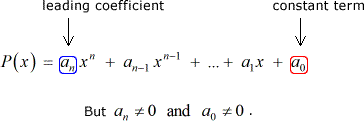
ChiliMath
The Rational Roots Test (also known as Rational Zeros Theorem) can help you find the possible rational roots of a polynomial equation.
cinder elk
latent scaffold
If not then I guess you can resort to Rational Root Theorem
as they stated
odd edgeBOT
@visual hazel Has your question been resolved?
odd edgeBOT
Channel closed
Closed due to timeout
Use .reopen if this was a mistake.
Available help channel!
Send your question here to claim the channel.
Remember:
• Ask your math question in a clear, concise manner.
• Show your work, and if possible, explain where you are stuck.
• After 15 minutes, feel free to ping <@&286206848099549185>.
• Type the command .close to free the channel when you're done.
• Be polite and have a nice day!
Read #❓how-to-get-help for further information on how to ask a good question, and about conduct in the question channels.
mystic saffron
I'm trying to understand something related to units when multiplying that I've always taken as given but never much given it thought:
Say like we have here: 30 degrees * pi radians / 180 degrees = 30pi/180 radians.
I understand the math behind how this works but I can quite understand why the degrees cancel out?
odd edgeBOT
mystic saffron
I'm trying to understand something related to units when multiplying that I've a...
mystic saffron

The degrees cancel eachother out. why? I get why the number math here works but the units of measurements cancel out why?
<@&286206848099549185>
🙏
Seriously sorry for the ping.
 wraith ginkgo
imagine you have a number x, and then you multiply that number by its multiplicative inverse, i.e 1/x. the x's cancel out
its sort of the same concept
but with units
visual hazel
∘ / ∘ = 1
mystic saffron
x/1 * 1/x = x/x = 1 but like, in the example with degrees, because degrees / degrees = 1 then 1* radian is radian?
odd edgeBOT
Channel closed
Closed by @latent scaffold
Use .reopen if this was a mistake.
mystic saffron
Appreciate the help.
wraith ginkgo
np
odd edgeBOT
Available help channel!
Send your question here to claim the channel.
Remember:
• Ask your math question in a clear, concise manner.
• Show your work, and if possible, explain where you are stuck.
• After 15 minutes, feel free to ping <@&286206848099549185>.
• Type the command .close to free the channel when you're done.
• Be polite and have a nice day!
Read #❓how-to-get-help for further information on how to ask a good question, and about conduct in the question channels.
visual hazel
cinder elk
also, the rational root test might be beneficial for you
I just had to go do something, I know the rational root theorem and I know how to use it but I am looking to understand and use other forms of factorization
odd edgeBOT
visual hazel
I just had to go do something, I know the rational root theorem and I know how t...
@visual hazel Has your question been resolved?
nimble blaze
they're not practical for this question
cinder elk
I am still wondering why the book says the other function was equivalent though
cinder elk
cinder elk
This
nimble blaze
you could attempt to introduce expressions to complete squares / form groups, but it's not easy to spot what will be helpful here
based on what was written book is incorrect
,W expand (x-1)(x+1)(x^2 +5)
clever fjordBOT

 nimble blaze
ah...ic
that's different from the expression presented to us
and is more reasonable to factor without having to apply rational root theorem / long division
@visual hazel
did you make a typo
visual hazel
clever fjord
that's right, the book has a typing error
I am going to try now
a⁴ - 1 + 4a² - 4
(a⁴ - 1) + (4a² - 4)
(a² + 1)(a² - 1) + 4(a² - 1)
(a² - 1)(a² + 1 + 4)
(a - 1)(a + 1)(a² + 5)
now yes :)))))
thanks
.close
odd edgeBOT
Channel closed
Closed by @visual hazel
Use .reopen if this was a mistake.
Available help channel!
Send your question here to claim the channel.
Remember:
• Ask your math question in a clear, concise manner.
• Show your work, and if possible, explain where you are stuck.
• After 15 minutes, feel free to ping <@&286206848099549185>.
• Type the command .close to free the channel when you're done.
• Be polite and have a nice day!
Read #❓how-to-get-help for further information on how to ask a good question, and about conduct in the question channels.
odd edgeBOT
 sweet steppe
h
sweet steppe
sweet steppe
h
sweet steppe

need help
i have no idea what to do, apparently 0.18 is wrong
tried the slope formula

 quasi sparrow
,rotate
clever fjordBOT
 quasi sparrow
that should be close to the answer
sweet steppe
but still help
quasi sparrow
if you're in the right mode
sweet steppe

 quasi sparrow
still probably missing parentheses
quasi sparrow
yes
odd edgeBOT
@sweet steppe Has your question been resolved?
Channel closed
Closed by @sweet steppe
Use .reopen if this was a mistake.
Available help channel!
Send your question here to claim the channel.
Remember:
• Ask your math question in a clear, concise manner.
• Show your work, and if possible, explain where you are stuck.
• After 15 minutes, feel free to ping <@&286206848099549185>.
• Type the command .close to free the channel when you're done.
• Be polite and have a nice day!
Read #❓how-to-get-help for further information on how to ask a good question, and about conduct in the question channels.
mystic saffron
How do I simplify $\tan^2x-\sec^2x$
odd edgeBOT
mystic saffron
How do I simplify $\tan^2x-\sec^2x$
clever fjordBOT
Matt
 mystic saffron
I know that tan=sin/cos and sec = 1/cos
 vapid quartz
pythagorean identities
mystic saffron
so it should look like $(\frac{\sin(\theta)}{\cos(\theta)})^2-(\frac{1}{\cos(\theta)})^2$
clever fjordBOT
Matt
 mystic saffron
but idk how to simplify from there
vapid quartz
distribute the squares through the parentheses
mystic saffron
ok so then itll look like $(\frac{\sin(\theta)^2}{\cos(\theta)^2})-(\frac{1^2}{\cos(\theta)^2})$
clever fjordBOT
Matt

 lusty garden
mystic saffron
but idk how to simplify from there
lusty garden
mystic saffron
but idk how to simplify from there
,tex First, we know that $\tan^2 x = \sec^2 x - 1$ from the Pythagorean identity for tangent.
clever fjordBOT
Lia 👅
 mystic saffron
$\frac{\sin(\theta)^2-1}{cos(\theta)^2}$
clever fjordBOT
Matt
 mystic saffron
 pastel orbit
and then use pythagorean
pastel orbit
and then use pythagorean
how do i use the pythagorean identities for this
mystic saffron
pastel orbit
cos^2(x) + sin^2(x) = 1
i know this identity but
mystic saffron
pastel orbit
so 1 - sin^2(x) = cos^2(x)
how did you end up with this
pastel orbit
i moved sin^2(x) to the other side?
odd edgeBOT
Channel closed
Closed by @tall river
Use .reopen if this was a mistake.
Available help channel!
Send your question here to claim the channel.
Remember:
• Ask your math question in a clear, concise manner.
• Show your work, and if possible, explain where you are stuck.
• After 15 minutes, feel free to ping <@&286206848099549185>.
• Type the command .close to free the channel when you're done.
• Be polite and have a nice day!
Read #❓how-to-get-help for further information on how to ask a good question, and about conduct in the question channels.
 haughty prairie
can anyone help me finish this up
 odd edgeBOT
haughty prairie
can anyone help me finish this up
odd edgeBOT
haughty prairie
can anyone help me finish this up
 runic cypress
haughty prairie
can anyone help me finish this up
runic cypress
haughty prairie
can anyone help me finish this up
is the first system inconsistent or consistent
haughty prairie
runic cypress
is the first system inconsistent or consistent
im not sure
runic cypress
haughty prairie
im not sure
you said they were dependent
what does it mean for them to be dependent?
haughty prairie
isnt it with the same slope & y interc
odd edgeBOT
@haughty prairie Has your question been resolved?
odd edgeBOT
@haughty prairie Has your question been resolved?
haughty prairie
haughty prairie
can anyone help me finish this up
anyone??
 dark kraken
haughty prairie
anyone??
dark kraken
haughty prairie
anyone??
I think you still need to classify the top and bottom as consistent or not
haughty prairie
dark kraken
I think you still need to classify the top and bottom as consistent or not
yea i solved it already but now im wondering if this is right
 green elm
haughty prairie
yea i solved it already but now im wondering if this is right
green elm
haughty prairie
yea i solved it already but now im wondering if this is right
options 1 and 3 don't even make sense
option 2 is correct, can you explain why?
odd edgeBOT
@haughty prairie Has your question been resolved?
Channel closed
Closed by @haughty prairie
Use .reopen if this was a mistake.
Available help channel!
Send your question here to claim the channel.
Remember:
• Ask your math question in a clear, concise manner.
• Show your work, and if possible, explain where you are stuck.
• After 15 minutes, feel free to ping <@&286206848099549185>.
• Type the command .close to free the channel when you're done.
• Be polite and have a nice day!
Read #❓how-to-get-help for further information on how to ask a good question, and about conduct in the question channels.
 high tusk
Let's say we have an exponential function, $y^x$. At the point (0,1), we have a tangent with the gradient 1. How would we calculate the value of y?
odd edgeBOT
high tusk
Let's say we have an exponential function, $y^x$. At the point (0,1), we have a ...
clever fjordBOT
sin city ☆

 nocturne belfry
youre not using the most intuitive letters here
can we switch it?
$f(x)=y=a^x$
clever fjordBOT
jan Niku
 nocturne belfry
so whats $f'(x)$
clever fjordBOT
jan Niku
 clever fjordBOT
sin city ☆
 nocturne belfry
,w derivative a^x
clever fjordBOT

 nocturne belfry
👀
nocturne belfry
okay
high tusk
we know here that the value of x would be zero
nocturne belfry
yes
high tusk
so we substitute that in
nocturne belfry
and its equAL To what?
amber schooner
it’s log a
nocturne belfry
well they say it has a gradient of 1 right
high tusk
nocturne belfry
the derivative
yes
nocturne belfry
specifically the information tells you that $f'(0)=1$
clever fjordBOT
jan Niku
 high tusk
,w a^(0)log(a)
clever fjordBOT

 high tusk
oop
high tusk
hold on
nocturne belfry
whats our formula for f'(x)?
nocturne belfry
what? no
nocturne belfry
$f(x)=a^x$
clever fjordBOT
jan Niku
 nocturne belfry
what is $f'(x)$
clever fjordBOT
jan Niku
 high tusk
$a^xlog(a)$
clever fjordBOT
sin city ☆
 high tusk
thats the derivative, right
nocturne belfry
okay, $f'(x) = a^x \log (a)$
clever fjordBOT
jan Niku
 high tusk
yes
nocturne belfry
and we know $f'(0)=1$
clever fjordBOT
jan Niku
 clever fjordBOT
sin city ☆
 high tusk
correct?
amber schooner
mhm
high tusk
which becomes
nocturne belfry
simplify
amber schooner
is the slope 1?
high tusk
$log(a)=1$
clever fjordBOT
sin city ☆
 high tusk
a= e
amber schooner
this log is ln tho
high tusk
the euler function
amber schooner
yea
high tusk
I GOT THE PROOF
nocturne belfry
high tusk
a= e
yes
odd edgeBOT
Channel closed
Closed by @high tusk
Use .reopen if this was a mistake.
Available help channel!
Send your question here to claim the channel.
Remember:
• Ask your math question in a clear, concise manner.
• Show your work, and if possible, explain where you are stuck.
• After 15 minutes, feel free to ping <@&286206848099549185>.
• Type the command .close to free the channel when you're done.
• Be polite and have a nice day!
Read #❓how-to-get-help for further information on how to ask a good question, and about conduct in the question channels.
 vale sand
Can someboady explain to me how to calculate angles in non right traingles?
nimble blaze
depending on what info you have
sine rule and cos rule would be useful
vale sand
Uh okay
example
to my best understanding
c is 7
b is 5
a is 3
what is C angle
the diagram looks like c is x and a is y and b is r
sharp oak
Cosine law would get you this
vale sand
doesnt cosine law only apply to the first part