#help-19
1 messages · Page 43 of 1
 odd edgeBOT
 wintry temple
key
 undone mauve
what's the issue
undone mauve
show the steps
 zenith tartan
also we dont tell the answer here, if you've solved it maybe then you can show your work here
undone mauve
that you followed
undone mauve
wrong
wintry temple
how?
undone mauve
check it again
undone mauve
n/2*(2a+(n-1)d)
wintry temple
yea
undone mauve
you multiplied 2a and n-1
undone mauve
substitute the values, you'll get a linear in terms of n
undone mauve
?
wintry temple
i don't get what u mean
undone mauve
substitute the values in 0 = n/2(2a+(n-1)d) and you'll get a linear equation
since its 0 you can just do 0 = 2a+(n-1)d
undone mauve
no
wintry temple
why?
wintry temple
what happened to n/2?
undone mauve
you can cancel it since its a common term
odd edgeBOT
Channel closed
Closed by @wintry temple
Use .reopen if this was a mistake.
 Available help channel!
Send your question here to claim the channel.
Remember:
• Ask your math question in a clear, concise manner.
• Show your work, and if possible, explain where you are stuck.
• After 15 minutes, feel free to ping <@&286206848099549185>.
• Type the command .close to free the channel when you're done.
• Be polite and have a nice day!
Read #❓how-to-get-help for further information on how to ask a good question, and about conduct in the question channels.
 vagrant haven
Helooooo
odd edgeBOT
vagrant haven
Helooooo
vagrant haven

Need help with num 10 only
Im confused
<@&286206848099549185>
Anyone free?😭
Hellooo
vagrant haven
vagrant haven
Num 10 on this one
So like 26²=(4x+4)²+(2x)²?
And i solve it?
Okay uhm lemme see if i can😭
Yes
Semicircle theorem i think
I believe i am now stuck again

Where do i go from here? Or is this entirely wrong?😭
Wait wha?
Where did 32x come from TT
odd edgeBOT
@vagrant haven Has your question been resolved?
vagrant haven
.close
odd edgeBOT
Channel closed
Closed by @vagrant haven
Use .reopen if this was a mistake.
Available help channel!
Send your question here to claim the channel.
Remember:
• Ask your math question in a clear, concise manner.
• Show your work, and if possible, explain where you are stuck.
• After 15 minutes, feel free to ping <@&286206848099549185>.
• Type the command .close to free the channel when you're done.
• Be polite and have a nice day!
Read #❓how-to-get-help for further information on how to ask a good question, and about conduct in the question channels.
 halcyon quail
Let f(x) = x/(x+a), where x > 0 and a > 0. If f(f(x)) = x /(3x+4) , then find the
value of a. Pls solve
odd edgeBOT
halcyon quail
Let f(x) = x/(x+a), where x > 0 and a > 0. If f(f(x)) = x /(3x+4) , then find th...
Please don't occupy multiple help channels.
halcyon quail
Ho w is it done
odd edgeBOT
@halcyon quail Has your question been resolved?
odd edgeBOT
What step are you on?
1. I don't know where to begin.
2. I have begun but got stuck midway.
3. I got an answer but I was told that it's wrong.
4. I got an answer and would like my work checked.
5. I have a question about someone else's work/solution.
6. I have completed the problem and don't need help anymore. Thank you.
7. None of the above
@halcyon quail Has your question been resolved?
 quasi sparrow
halcyon quail
Let f(x) = x/(x+a), where x > 0 and a > 0. If f(f(x)) = x /(3x+4) , then find th...
quasi sparrow
halcyon quail
Let f(x) = x/(x+a), where x > 0 and a > 0. If f(f(x)) = x /(3x+4) , then find th...
Compute f(f(x))
odd edgeBOT
Channel closed
Closed due to timeout
Use .reopen if this was a mistake.
Available help channel!
Send your question here to claim the channel.
Remember:
• Ask your math question in a clear, concise manner.
• Show your work, and if possible, explain where you are stuck.
• After 15 minutes, feel free to ping <@&286206848099549185>.
• Type the command .close to free the channel when you're done.
• Be polite and have a nice day!
Read #❓how-to-get-help for further information on how to ask a good question, and about conduct in the question channels.
 hybrid spade
how can i know X and Y? i thought the triangles were similar but they arent, the ABC perimeter is 36
 odd edgeBOT
hybrid spade
how can i know X and Y? i thought the triangles were similar but they arent, the...
odd edgeBOT
hybrid spade
how can i know X and Y? i thought the triangles were similar but they arent, the...
 whole vine
no other info?
odd edgeBOT
Please show the original problem, exactly as it was stated to you, with the entire original context. A picture or screenshot is best. If the original problem is not in English, then post it anyway! The additional context might still be helpful. Do your best to provide a translation.
 nimble blaze
apply angle bisector theorem
hybrid spade
its in another language brb
In the triangle
ABC in the figure below,
AD is the bisector of the angle
A. If its perimeter is 36 cm, then the values, in centimeters, of X and Y
It is
they are:
In the triangle
ABC in the figure below, AD is the bisector of the angle A. If its perimeter is 36 cm, then the values, in centimeters, of X and Y is:
whole vine
yeah. you can use the angle bisector theorem for this
so you get
$\frac{2x}{y} = \frac{x}{2x}$
 clever fjordBOT
Galactic Fur
 whole vine
additionally, you also know that 2x + x + 2x + y = 36
you can use these 2 eq to solve for x and y
whole vine
hybrid spade
uhh yx = 4x²
you can cancel out the x here
whole vine
yep
whole vine
now it should be easy to solve
whole vine
ggs
hybrid spade
i figured DC was double of BD

so AC would be double of AB
so y would be 4x
because i thought they were similar
but they arent
.end
.cancel
.close
odd edgeBOT
Channel closed
Closed by @hybrid spade
Use .reopen if this was a mistake.
odd edgeBOT
Available help channel!
Send your question here to claim the channel.
Remember:
• Ask your math question in a clear, concise manner.
• Show your work, and if possible, explain where you are stuck.
• After 15 minutes, feel free to ping <@&286206848099549185>.
• Type the command .close to free the channel when you're done.
• Be polite and have a nice day!
Read #❓how-to-get-help for further information on how to ask a good question, and about conduct in the question channels.
 mystic saffron

 odd edgeBOT
mystic saffron
mystic saffron
odd edgeBOT
mystic saffron
mystic saffron
How should i go about starting with this?
Since the time for one revolution is constant, this is uniform circular motion i suppose
so [
a_{\t{rad.}} = \f{4\pi^2R}{T^2}
]
clever fjordBOT
 mystic saffron
smaller values of a correspond to bigger sizes of T
so T_min corresponds to when the acceleration is maximum as well i suppose
T_max corresponds to when a is minimum as well

zenith tartan
look i think i can help, i am not sure that's gonna work but maybe that would provide some hints ig?
you know it take T time to complete one revolution, that means a angular displacement of 2pi
and $\omega=\frac{\theta}{t}$
$\omega=\frac{2\pi}{T}$
clever fjordBOT
ഴajat
 zenith tartan
you got the value of omega from here right
now we have to make thier FBD's, from which we have to use the condition F_static leq F_max
but the only problem is that we would also have the friction coefficient mu in our answer
and this omega that we calculated is gonna be used in the centripetal acc= R(omega)^2, so we can make an equation with T in it
should i elaborate myself?
"from which we have to use the condition F_static leq F_max" : and this because we have to maintain the height
@mystic saffron hello?
mystic saffron
yes i was working on it mysaelf
zenith tartan
and what did you tried?
mystic saffron
zenith tartan
you got the value of omega from here right
sadly we havent covered angular motion yet
zenith tartan
😭
mystic saffron
zenith tartan
and what did you tried?
im still thinking
zenith tartan
if you havent covered circular motion yet, then from which topic does this question belong to?
mystic saffron
i have
i just havent had it in terms of its angular terms
its okay i think tho i got an idea ill work it out
.close
odd edgeBOT
Channel closed
Closed by @dawn condor
Use .reopen if this was a mistake.
Available help channel!
Send your question here to claim the channel.
Remember:
• Ask your math question in a clear, concise manner.
• Show your work, and if possible, explain where you are stuck.
• After 15 minutes, feel free to ping <@&286206848099549185>.
• Type the command .close to free the channel when you're done.
• Be polite and have a nice day!
Read #❓how-to-get-help for further information on how to ask a good question, and about conduct in the question channels.
 spiral laurel
How do you go about approximating this (conditionally) convergent series? Hint: This should have to do with finding the remainder to a series.
 odd edgeBOT
spiral laurel
How do you go about approximating this (conditionally) convergent series? Hint: ...
odd edgeBOT
spiral laurel
How do you go about approximating this (conditionally) convergent series? Hint: ...
Please don't occupy multiple help channels.
@spiral laurel Has your question been resolved?
spiral laurel
<@&286206848099549185>
odd edgeBOT
@spiral laurel Has your question been resolved?
quasi sparrow
spiral laurel
How do you go about approximating this (conditionally) convergent series? Hint: ...
Did you use the hint
spiral laurel
I would if I knew how to, but my class skipped remainders for series’ for some reason.
quasi sparrow
spiral laurel
I would if I knew how to, but my class skipped remainders for series’ for some r...

This calculus 2 video tutorial provides a basic introduction into the alternate series estimation theorem also known as the alternate series remainder. It explains how to estimate the sum of the infinite series correct to three decimals places by calculating the number of terms needed by using the remainder estimate theorem.
Introduction to ...
Or read your book
spiral laurel
quasi sparrow
Or read your book
Our class puts empty variables in our books to teach us how to do things intuitively, but I would prefer not to multiply this problem into a series of problems that I also need to solve just to comprehend what’s going on.
Thanks for the ‘help’ though.
.close
odd edgeBOT
Channel closed
Closed by @spiral laurel
Use .reopen if this was a mistake.
Available help channel!
Send your question here to claim the channel.
Remember:
• Ask your math question in a clear, concise manner.
• Show your work, and if possible, explain where you are stuck.
• After 15 minutes, feel free to ping <@&286206848099549185>.
• Type the command .close to free the channel when you're done.
• Be polite and have a nice day!
Read #❓how-to-get-help for further information on how to ask a good question, and about conduct in the question channels.
 forest marlin
sorry i know this isnt hard but my head isnt working right now
 spiral laurel
@forest marlin Subtract the value opposite of the variable's branch from the 'root' of the branch to get the variable.
For instance, A is calculated by subtracting 14 from 23, and so forth.
spiral laurel
forest marlin
<@234408116026867715>
A should be 23 - 14.
B should be (23 - 14) - 2.
C should be 14 - 3.
odd edgeBOT
Channel closed
Closed by @forest marlin
Use .reopen if this was a mistake.
Available help channel!
Send your question here to claim the channel.
Remember:
• Ask your math question in a clear, concise manner.
• Show your work, and if possible, explain where you are stuck.
• After 15 minutes, feel free to ping <@&286206848099549185>.
• Type the command .close to free the channel when you're done.
• Be polite and have a nice day!
Read #❓how-to-get-help for further information on how to ask a good question, and about conduct in the question channels.
 tight notch
 odd edgeBOT
tight notch
tight notch
odd edgeBOT
tight notch
tight notch
i need to find x but i have no clue how
i got 48 but it was wrong
i have no clue how to do this
ping me if anyone is here to help me
 rich night
MOJ = 160 cuz angles half at circumference
tight notch
yh
rich night
JOL because = 126 because 🌟 vibes🌟
tight notch
...
so you jus guessin that JOL is126
i get one attempt at this question i need a definite explanation
lmaooo this is some weird question
no one in my calss has been able to do this
rich night
aight fine hmmm, what circle theorems do you need to know
tight notch
i have no clue
rich night
(there are a bunch out there)
tight notch
rich night
(there are a bunch out there)
only thing i know is that MOJ is 160
@crisp pasture
rich night
listen, i probably cant help with your problem, but can you help with my problem?
rich night
bro same whats your point lol
rich night
its help-27
odd edgeBOT
@tight notch Has your question been resolved?
Channel closed
Closed by @tight notch
Use .reopen if this was a mistake.
Available help channel!
Send your question here to claim the channel.
Remember:
• Ask your math question in a clear, concise manner.
• Show your work, and if possible, explain where you are stuck.
• After 15 minutes, feel free to ping <@&286206848099549185>.
• Type the command .close to free the channel when you're done.
• Be polite and have a nice day!
Read #❓how-to-get-help for further information on how to ask a good question, and about conduct in the question channels.
 oak arrow
I am supposed to check these things on reflexivity, symetry, asymetry, antisymetry and transivity.
I haven't been to the lecture to be honest, because I literally don't understand a single thing.
How difficult is this exercise ? What am I even looking at, cause I don't understand nothing ? What are the steps to solve this riddle ?
 odd edgeBOT
oak arrow
I am supposed to check these things on reflexivity, symetry, asymetry, antisymet...
odd edgeBOT
oak arrow
I am supposed to check these things on reflexivity, symetry, asymetry, antisymet...
@oak arrow Has your question been resolved?
 waxen jackal
@oak arrow pls if you have source to study this lmk , i have same your problems 🥲
<@&286206848099549185>
oak arrow
buddy, if I find good sources, I will dm you
waxen jackal
oak arrow
buddy, if I find good sources, I will dm you
I will send msg to your dm 👀
 native ruin
do you know what a relation is?
native ruin
oak arrow
buddy, if I find good sources, I will dm you
?
@oak arrow
but for the difficulty these are rather easy problems which are very straightforward once you see what you have to do
ping me when you are on again i might be able to help
oak arrow
native ruin
ping me when you are on again i might be able to help
Yes sir, a relation is a subset of the cartesian product XxX
clever fjordBOT
Homelama
 native ruin
can you come up with a pair $(m,n)$ such that $mR_1 n$
clever fjordBOT
Homelama
 oak arrow
(2,4)
oak arrow
I think if the relation is reflexive, then x = y means y = x
native ruin
no, a relation is reflexive iff $nRn$
clever fjordBOT
Homelama
 native ruin
so is this relation reflexive?
oak arrow
No
native ruin
yeah correct why?
oak arrow
Because, I think, there must be a divider m for 2m for it to be reflexive which is not possible for natural numbers
native ruin
exactly because 2m does not divide m
native ruin
ok what about symmetric?
oak arrow
Symmetric was mR1n => nR1m, right ?
Okay. Let me see
If 2m divides by n, than n cannot divide by 2m for the natural numbers. So not symmetric
native ruin
yes
oak arrow
Ok, nice
native ruin
so now to asymmetric
oak arrow
What is asymmetric and anti symmetric ?
native ruin
it means that
$$mR_1 n \implies \neg nR_1 m$$
clever fjordBOT
Homelama
 native ruin
like mRn and nRm cannot hold at the same time
native ruin
think again
oak arrow
Okay, wait...
native ruin
you just have to find one counterexample
oak arrow
Is 0/0 = 0 ?
native ruin
yeah 0|0, but 0/0 is not defined
this is like an edge case
but there are also other pairs that work
but m=n=0 would be a counterexample
oak arrow
Oh, okay. Thank you, Homelander. You helped a lot.
native ruin
sorry yeah 0 0 is the only counterexample
native ruin
so yeah, what about antisymmetric?
oak arrow
Imma close now and watch an episode of Narcos, because I really need to
I think I got the hang of it
You my hero
native ruin
oak arrow
Imma close now and watch an episode of Narcos, because I really need to
where are you in narcos?
oak arrow
I watched the whole show a year ago. I want to start over again so s01 e01
native ruin
oh very nice, i think i watched it like in a week all seasons
oak arrow
Wooow, impressive
native ruin
so have fun bye!
odd edgeBOT
Channel closed
Closed by @oak arrow
Use .reopen if this was a mistake.
Available help channel!
Send your question here to claim the channel.
Remember:
• Ask your math question in a clear, concise manner.
• Show your work, and if possible, explain where you are stuck.
• After 15 minutes, feel free to ping <@&286206848099549185>.
• Type the command .close to free the channel when you're done.
• Be polite and have a nice day!
Read #❓how-to-get-help for further information on how to ask a good question, and about conduct in the question channels.
waxen jackal
I found your
odd edgeBOT
waxen jackal
I found your
odd edgeBOT
Channel closed
Closed by @waxen jackal
Use .reopen if this was a mistake.
Available help channel!
Send your question here to claim the channel.
Remember:
• Ask your math question in a clear, concise manner.
• Show your work, and if possible, explain where you are stuck.
• After 15 minutes, feel free to ping <@&286206848099549185>.
• Type the command .close to free the channel when you're done.
• Be polite and have a nice day!
Read #❓how-to-get-help for further information on how to ask a good question, and about conduct in the question channels.
 sudden ledge
hey guys
for this question since one of the constraints is not convex
KKT does not gaurantee that the solution is globally optimal correct?
so how would I prove that the solution here is optimal
 odd edgeBOT
sudden ledge
hey guys
for this question since one of the constraints is not convex
KKT does n...
odd edgeBOT
sudden ledge
hey guys
for this question since one of the constraints is not convex
KKT does n...
@sudden ledge Has your question been resolved?
odd edgeBOT
@sudden ledge Has your question been resolved?
sudden ledge
<@&286206848099549185> any help?
 glossy summit
Well if we know all of the x's
no matter 1, 2 or 3
are 1
we know 1 to the power of 4
is 1
idk im waffling. Im new
I tried.
sudden ledge
np lol
odd edgeBOT
Channel closed
Closed by @sudden ledge
Use .reopen if this was a mistake.
odd edgeBOT
Available help channel!
Send your question here to claim the channel.
Remember:
• Ask your math question in a clear, concise manner.
• Show your work, and if possible, explain where you are stuck.
• After 15 minutes, feel free to ping <@&286206848099549185>.
• Type the command .close to free the channel when you're done.
• Be polite and have a nice day!
Read #❓how-to-get-help for further information on how to ask a good question, and about conduct in the question channels.
 hearty delta
 odd edgeBOT
hearty delta
odd edgeBOT
hearty delta

 vocal granite
depends on your bounds of integration
the double integral over the area form dA should just give you the signed area of whatever region you are integrating over
odd edgeBOT
Channel closed
Closed by @hearty delta
Use .reopen if this was a mistake.
Available help channel!
Send your question here to claim the channel.
Remember:
• Ask your math question in a clear, concise manner.
• Show your work, and if possible, explain where you are stuck.
• After 15 minutes, feel free to ping <@&286206848099549185>.
• Type the command .close to free the channel when you're done.
• Be polite and have a nice day!
Read #❓how-to-get-help for further information on how to ask a good question, and about conduct in the question channels.
 static rapids
 odd edgeBOT
static rapids
odd edgeBOT
static rapids
 lime prawn
so by letting $f(x)=y$ we can then say that $g(y)=x$
clever fjordBOT
mygenderisanonnewtonianfluid
 lime prawn
and we also know that $f'(4)=-\frac{3}{4}$
clever fjordBOT
mygenderisanonnewtonianfluid
 lime prawn
one of my favorite properties of derivatives is that $(f^{-1})'(x)=\frac{1}{f'(y)}$
clever fjordBOT
mygenderisanonnewtonianfluid
 lime prawn
and using this property, we see that $g'(y)=\frac{1}{f'(x)}$
clever fjordBOT
mygenderisanonnewtonianfluid
 lime prawn
plugging in $y$ at the point of $f$ for which the derivative is shown ($4$) gives us $g'(6)=-\frac{4}{3}$
clever fjordBOT
mygenderisanonnewtonianfluid
 static rapids
ty
and one more
i say it's B because the tangent slope in B should be the greatest?

not sure
 grizzled tide
static rapids
i say it's B because the tangent slope in B should be the greatest?
grizzled tide
static rapids
i say it's B because the tangent slope in B should be the greatest?
yea
static rapids
grizzled tide
yea
ah
lime prawn
yes
static rapids
i almost choose D because i saw that the slope is more closer to a vertical line, but i realized it's negative
alr ty
lime prawn
np
odd edgeBOT
It is suggested that you limit yourself to one question per help channel, opening a new one once your original question is answered and your original channel has been closed. This is to make your channel easier to follow for potential helpers and can bring attention to the fact that your question has changed.
odd edgeBOT
Channel closed
Closed by @static rapids
Use .reopen if this was a mistake.
Available help channel!
Send your question here to claim the channel.
Remember:
• Ask your math question in a clear, concise manner.
• Show your work, and if possible, explain where you are stuck.
• After 15 minutes, feel free to ping <@&286206848099549185>.
• Type the command .close to free the channel when you're done.
• Be polite and have a nice day!
Read #❓how-to-get-help for further information on how to ask a good question, and about conduct in the question channels.
 ember badge
 odd edgeBOT
ember badge
ember badge
odd edgeBOT
ember badge
ember badge
how to evaluate sum
 south plume
do you see 'i' anywhere in the sum
ember badge
wdym
south plume
your sum is in terms if a variable i (because you have i=5 written below)
but so you, literally, see 'i' anywhere in the body of the sum?
south plume
yep
ember badge
+4
south plume
4*5
odd edgeBOT
@ember badge Has your question been resolved?
Channel closed
Closed by @ember badge
Use .reopen if this was a mistake.
Available help channel!
Send your question here to claim the channel.
Remember:
• Ask your math question in a clear, concise manner.
• Show your work, and if possible, explain where you are stuck.
• After 15 minutes, feel free to ping <@&286206848099549185>.
• Type the command .close to free the channel when you're done.
• Be polite and have a nice day!
Read #❓how-to-get-help for further information on how to ask a good question, and about conduct in the question channels.
mystic saffron
@odd edge
mystic saffron
help
 brittle beacon
odd edge
brittle beacon
odd edge
#help-35 stay in that one and ask a question there. The bot doesn’t answer questions
.close
odd edgeBOT
Channel closed
Closed by @brittle beacon
Use .reopen if this was a mistake.
Available help channel!
Send your question here to claim the channel.
Remember:
• Ask your math question in a clear, concise manner.
• Show your work, and if possible, explain where you are stuck.
• After 15 minutes, feel free to ping <@&286206848099549185>.
• Type the command .close to free the channel when you're done.
• Be polite and have a nice day!
Read #❓how-to-get-help for further information on how to ask a good question, and about conduct in the question channels.
 kindred tartan
hi! im trying to figure out how to calculate effect size (cohen's d and r squared) while only knowing one standard deviation
 odd edgeBOT
kindred tartan
hi! im trying to figure out how to calculate effect size (cohen's d and r square...
kindred tartan
odd edgeBOT
kindred tartan
hi! im trying to figure out how to calculate effect size (cohen's d and r square...
kindred tartan
this is basic college stats btw
<@&286206848099549185>
pls help test tomorrow 😦
sudden ledge
did you try something?
kindred tartan
no i dont know how to start because our formulas need both standard deviations
and also every online calculator needs both standard deviations
lol

 sudden ledge
not sure what formulas you guys using but for the 1st question you can easily find the t-statistic with the given info
i assume thats what theyre askin
sudden ledge
i think here since you have just 1 group u dont need the pooled
u just use SD of the sample which is gven
kindred tartan
i tried that with d = (Msample - µpopulation) ⁄ σ and i got 0.3 and it said it was wrong
so im really confused
odd edgeBOT
@kindred tartan Has your question been resolved?
odd edgeBOT
@kindred tartan Has your question been resolved?
 tame comet
kindred tartan
pls help test tomorrow 😦
tame comet
kindred tartan
pls help test tomorrow 😦
i can help you cheat
i’ve helped some people cheat on diff serves
servers
what’s the test on,?
kindred tartan
i just wanna know what i’m supposed to do
real talk i do not know anything about statistics
odd edgeBOT
@kindred tartan Has your question been resolved?
odd edgeBOT
Channel closed
Closed due to timeout
Use .reopen if this was a mistake.
Available help channel!
Send your question here to claim the channel.
Remember:
• Ask your math question in a clear, concise manner.
• Show your work, and if possible, explain where you are stuck.
• After 15 minutes, feel free to ping <@&286206848099549185>.
• Type the command .close to free the channel when you're done.
• Be polite and have a nice day!
Read #❓how-to-get-help for further information on how to ask a good question, and about conduct in the question channels.
 modest plinth
 odd edgeBOT
modest plinth
modest plinth
odd edgeBOT
modest plinth
modest plinth
Can someone proofread?
The text in the middle says "so we can remove the absolute value"
for lack of better terminology lol
I put it in wolfram and got a different answer so
<@&286206848099549185>
odd edgeBOT
@modest plinth Has your question been resolved?
odd edgeBOT
@modest plinth Has your question been resolved?
odd edgeBOT
@modest plinth Has your question been resolved?
modest plinth
Can someone help me understand what I am doing wrong? <@&286206848099549185>
mystic saffron
modest plinth
Can someone help me understand what I am doing wrong? <@&286206848099549185>
What answer did you get from Wolfram?
@modest plinth
mystic saffron
hm
modest plinth
https://www.wolframalpha.com/input?i=|6x%2B5|>%7C2x-7%7C+

Wolfram|Alpha brings expert-level knowledge and capabilities to the broadest possible range of people—spanning all professions and education levels.
mystic saffron
did you try to find for other several cases?
modest plinth
the number line is 1/4 and up and also -3 and down
mystic saffron
modest plinth
the number line is 1/4 and up and also -3 and down
show me the number line u drew
modest plinth
yea
mystic saffron
hold on
 bold summit
modest plinth
more than -3
bold summit
modest plinth
more than -3
what is your problem bro
 modest plinth
how did you come to the conclusion?
mystic saffron
modest plinth
how did you come to the conclusion?
you did not make possible cases
modest plinth
wdym
mystic saffron
i think u should watch the stuff online
organic chemistry guy i think is the name
mystic saffron
modest plinth
I've not learned this much
i only know half of this stuff because im still in 8th grade, the additional lessons i get outside school is the gist of it
modest plinth
that or I'm not understanding what you are doing there
mystic saffron
modest plinth
that or I'm not understanding what you are doing there
well idek, i got the idea when I tried to perform the operations on our given homeworks
modest plinth
if abs(6x+5) > abs(2x-7)
then both abs(6x+5) and abs(2x-7) is equal or more than 0
which should mean I can just remove the abs modifier?
Then there is just one case?
that's what I gather
but obviously I'm wrong
and I don't see how you can get the other result
mystic saffron
i don't know dawg, I haven't took the abs lesson yet
modest plinth
rip
mystic saffron
but i think I tried my best to give a reason why Wolfram gave that answer
modest plinth
Thank you for trying
mystic saffron
modest plinth
Thank you for trying
you're welcome homie
odd edgeBOT
@modest plinth Has your question been resolved?
 cosmic sandal
modest plinth
Can someone proofread?
cosmic sandal
modest plinth
Can someone proofread?
You can only remove the absolute value when both sides are positive.
If only one side is positive and the other is negative, then you need to multiply one of the sides by -1. (Potentially reversing the inequality if you pick the positive side.)
If both sides are negative, then you need to multiply both sides by negative 1 which reverses the inequality.
For checking your answer, the easiest method is usually to plug in a few values.
For example, try checking it at -10, 0 and 10.
cosmic sandal
cosmic sandal
If only one side is positive and the other is negative, then you need to multipl...
For example, -3 < -2 but |-3| = 3 > 2 = |-2|
mystic saffron
cosmic sandal
If only one side is positive and the other is negative, then you need to multipl...
oh that's what abs meant bruv
odd edgeBOT
Channel closed
Closed due to timeout
Use .reopen if this was a mistake.
Available help channel!
Send your question here to claim the channel.
Remember:
• Ask your math question in a clear, concise manner.
• Show your work, and if possible, explain where you are stuck.
• After 15 minutes, feel free to ping <@&286206848099549185>.
• Type the command .close to free the channel when you're done.
• Be polite and have a nice day!
Read #❓how-to-get-help for further information on how to ask a good question, and about conduct in the question channels.
 mellow axle
”Solve for z, one of the roots is a pure imaginary number”
 mellow axle

So i got two of the roots right, but one is incorrect and i am missing two additional roots
What am i doing wrong?
<@&286206848099549185>
Here is the corrects answer:
 modest plinth
cosmic sandal
You can only remove the absolute value when both sides are positive.
modest plinth
cosmic sandal
You can only remove the absolute value when both sides are positive.
Yeah but since there's an abs value on both sides then neither can be negative?
Can you pm me ?
odd edgeBOT
@mellow axle Has your question been resolved?
 odd edgeBOT
@mellow axle Has your question been resolved?
mellow axle

In this video you will learn how to convert square meters into square centimeters and square centimeters into square meters.
clever fjordBOT
bob420
Compile Error! Click the  reaction for more information.
(You may edit your message to recompile.)
 mellow axle
Watch this^^
 heady badger
tnx I will
mellow axle
.close
odd edgeBOT
Channel closed
Closed by @mellow axle
Use .reopen if this was a mistake.
Available help channel!
Send your question here to claim the channel.
Remember:
• Ask your math question in a clear, concise manner.
• Show your work, and if possible, explain where you are stuck.
• After 15 minutes, feel free to ping <@&286206848099549185>.
• Type the command .close to free the channel when you're done.
• Be polite and have a nice day!
Read #❓how-to-get-help for further information on how to ask a good question, and about conduct in the question channels.
 rocky edge
S is an equivalence relation on ${a, b} \text{ and } |S| = 3$
clever fjordBOT
luke1
 rocky edge
!status
odd edgeBOT
What step are you on?
1. I don't know where to begin.
2. I have begun but got stuck midway.
3. I got an answer but I was told that it's wrong.
4. I got an answer and would like my work checked.
5. I have a question about someone else's work/solution.
6. I have completed the problem and don't need help anymore. Thank you.
7. None of the above
 viscid flint
is there a question here?
viscid flint
ok well a good place to start would be to look up the definition of an equivalence relation
viscid flint
rocky edge
transitivity, reflexive and symmetric
that's a list of properties
can you please go find your book's definition of an equivalence relation and post it here?
 static totem
there are 4 thngs that can be in S, and you need 3, you can examine all 4 subsets
a relation on a,b is a susbset of {a,b} × {a,b}
rocky edge
Reflexive $\forall \in S,$ $xRx$
clever fjordBOT
luke1
 rocky edge
Symmetric $\forall a,b \in S$ . $aRb \iff bRa$
clever fjordBOT
luke1
 rocky edge
Transitive $\forall a,b,c \in S$ . $aRb \land bRc \rightarrow aRc$
clever fjordBOT
luke1
 rocky edge
$aRb = (a,b) \in R$
clever fjordBOT
luke1
 rocky edge
$R \subseteq S \times S$
clever fjordBOT
luke1
 rocky edge
sry thought it was implied
viscid flint
well you seemed to be struggling with it
R is a relation on S if it's a subset of S x S
rocky edge
oh i see
we get the set {(a,a), (a,b), (b,a), (b,b)} and we have to find the pairs that have an equivalence relation
rocky edge
static totem
there are 4 thngs that can be in S, and you need 3, you can examine all 4 subset...
|S| = 4 right?
vocal granite
rocky edge
|S| = 4 right?
The space of all possible pairs has size 4, S should be some subset of this space which satisfies the definition of an equivalence relation
rocky edge
{(a,a), (a,b), (b,a), (b,b)} these are the possible pairs
and it is reflexive and symmetric no?
vocal granite
Yeah, the space of all pairs is an equivalence relation of size 4
But your question is to determine whether or not you can make a smaller equivalence relation with only 3 elements
rocky edge
cant see anyway to make this smaller
vocal granite
One way to make it smaller would be to just take the set {(a,a)}
Which is still an equivalence relation but now has size 1
But, are there any other possible equivalence relations with size between 1 and 4? And what about specifically size 3?
vocal granite
rocky edge
<@198282272493928449> Thoughts?
Doing this kind of construction by adding and removing elements is a good way to approach this
But your new set is no longer an equivalence relation!
(What does symmetry say)
rocky edge
oh (b,a) not there
i dont think this is possible
@vocal granite ?
sry for the ping
s
vocal granite
Nah, the pings are helpful  easy to lose tabs in discord
But yeah
If (a,b) is in there you also need (b,a)
vocal granite
rocky edge
i dont think this is possible
Yep! It’s not possible, can you give an argument for why?
rocky edge
wait can u explain why (a,b), (b,a), (a,a) is not an equivalence relation
@vocal granite
vocal granite
rocky edge
wait can u explain why (a,b), (b,a), (a,a) is not an equivalence relation
What does reflexivity require?
rocky edge
$(x,x) \in R$ doesn't that satisfy it?
clever fjordBOT
luke1
 vocal granite
rocky edge
$(x,x) \in R$ doesn't that satisfy it?
vocal granite
rocky edge
$(x,x) \in R$ doesn't that satisfy it?
In particular $(x,x)in R$ for all $x\in S$
clever fjordBOT
Willow
 vocal granite
Which is to say that every element must relate to itself
vocal granite
rocky edge
wait can u explain why (a,b), (b,a), (a,a) is not an equivalence relation
And in this example b doesn’t relate to itself
rocky edge
vocal granite
Yep! It’s not possible, can you give an argument for why?
to show this can I just say in order for the set to be an equivalence relation a pair relies on another pair (except a pair on its own) so we cant make 3 pairs in the set?
vocal granite
rocky edge
to show this can I just say in order for the set to be an equivalence relation a...
Yep, that’s should work
rocky edge
vocal granite
One way to make it smaller would be to just take the set {(a,a)}
for this your allowed to do this as you never introduced b ?
vocal granite
rocky edge
for this your allowed to do this as you never introduced b ?
Yeah
If b was included
Then the smallest possible equivalence relation would be {(a,a),(b,b)}
rocky edge
.close
odd edgeBOT
Channel closed
Closed by @rocky edge
Use .reopen if this was a mistake.
Available help channel!
Send your question here to claim the channel.
Remember:
• Ask your math question in a clear, concise manner.
• Show your work, and if possible, explain where you are stuck.
• After 15 minutes, feel free to ping <@&286206848099549185>.
• Type the command .close to free the channel when you're done.
• Be polite and have a nice day!
Read #❓how-to-get-help for further information on how to ask a good question, and about conduct in the question channels.
 vernal island
 odd edgeBOT
vernal island
odd edgeBOT
vernal island
 ember oak
,rotate
clever fjordBOT
 odd edgeBOT
@vernal island Has your question been resolved?
odd edgeBOT
@vernal island Has your question been resolved?
 amber niche
,rotate
clever fjordBOT
 amber niche
,rotate
clever fjordBOT
 amber niche
,rotate
clever fjordBOT
 odd edgeBOT
@vernal island Has your question been resolved?
 deep arrow
,rotate
clever fjordBOT
 amber niche
what even is that
odd edgeBOT
Channel closed
Closed due to timeout
Use .reopen if this was a mistake.
Available help channel!
Send your question here to claim the channel.
Remember:
• Ask your math question in a clear, concise manner.
• Show your work, and if possible, explain where you are stuck.
• After 15 minutes, feel free to ping <@&286206848099549185>.
• Type the command .close to free the channel when you're done.
• Be polite and have a nice day!
Read #❓how-to-get-help for further information on how to ask a good question, and about conduct in the question channels.
mystic saffron
How do i simplify [
x'y'z' + yz' + xy
]
without using a K-map into its minterms and maxterms
odd edgeBOT
mystic saffron
How do i simplify \[
x'y'z' + yz' + xy
\]
without using a K-map into its minterm...
clever fjordBOT
 mystic saffron
.close
odd edgeBOT
Channel closed
Closed by @dawn condor
Use .reopen if this was a mistake.
 cold urchin
boolean 
odd edgeBOT
Available help channel!
Send your question here to claim the channel.
Remember:
• Ask your math question in a clear, concise manner.
• Show your work, and if possible, explain where you are stuck.
• After 15 minutes, feel free to ping <@&286206848099549185>.
• Type the command .close to free the channel when you're done.
• Be polite and have a nice day!
Read #❓how-to-get-help for further information on how to ask a good question, and about conduct in the question channels.
Channel closed
Channel closed due to the original message being deleted.
If you did not intend to do this, please open a new help channel,
as this action is irreversible, and this channel may abruptly lock.
Available help channel!
Send your question here to claim the channel.
Remember:
• Ask your math question in a clear, concise manner.
• Show your work, and if possible, explain where you are stuck.
• After 15 minutes, feel free to ping <@&286206848099549185>.
• Type the command .close to free the channel when you're done.
• Be polite and have a nice day!
Read #❓how-to-get-help for further information on how to ask a good question, and about conduct in the question channels.
 pliant crest
Hi can someone help identify the problem? The answer is 41/6. But I get -3/2
 odd edgeBOT
pliant crest
Hi can someone help identify the problem? The answer is 41/6. But I get -3/2
odd edgeBOT
pliant crest
Hi can someone help identify the problem? The answer is 41/6. But I get -3/2
 latent scaffold
You have to flip the sign of the first integral.
pliant crest
latent scaffold
You have to flip the sign of the first integral.
Why?
latent scaffold
You split it, but if you do nothing, then that is just the integral of 3t-5 from 0 to 3.
The reason why you split it is that the graph is negative from 0 to 5/3.
But that will yield negative area if you just compute the integral. You want the sum of unsigned area to get the total distance travelled.
pliant crest
how do i know the graph is negative in that region?
latent scaffold
If you want (3t-5) >= 0, you can follow the steps you did at the very beginning and you wil get t >= 5/3.
So that means between 0 and 5/3 it must be negative.
It helps to draw it out in situations like this,
odd edgeBOT
@pliant crest Has your question been resolved?
odd edgeBOT
Channel closed
Closed due to timeout
Use .reopen if this was a mistake.
Available help channel!
Send your question here to claim the channel.
Remember:
• Ask your math question in a clear, concise manner.
• Show your work, and if possible, explain where you are stuck.
• After 15 minutes, feel free to ping <@&286206848099549185>.
• Type the command .close to free the channel when you're done.
• Be polite and have a nice day!
Read #❓how-to-get-help for further information on how to ask a good question, and about conduct in the question channels.
 neat pagoda
In sequences/series , for the Arithmetic formula, can An=a1+d(n-1) be used instead of An=a1+(n-1)d ?
odd edgeBOT
neat pagoda
In sequences/series , for the Arithmetic formula, can An=a1+d(n-1) be used inste...
mystic saffron
multiplication is commutative, so yes
neat pagoda
Thank you
odd edgeBOT
@neat pagoda Has your question been resolved?
Channel closed
Closed by @neat pagoda
Use .reopen if this was a mistake.
Available help channel!
Send your question here to claim the channel.
Remember:
• Ask your math question in a clear, concise manner.
• Show your work, and if possible, explain where you are stuck.
• After 15 minutes, feel free to ping <@&286206848099549185>.
• Type the command .close to free the channel when you're done.
• Be polite and have a nice day!
Read #❓how-to-get-help for further information on how to ask a good question, and about conduct in the question channels.
 toxic sigil
 odd edgeBOT
toxic sigil
toxic sigil
odd edgeBOT
toxic sigil
toxic sigil
Could someone tell me if my logic is on the right track for this problem?
Here, I'd need to determine the values of two unknowns, a and b. Each plaintext-ciphertext pairing provides a linear equation in terms of a and b. Therefore, two distinct pairings are required to set up a solvable system of two linear equations for these two unknowns, right?
odd edgeBOT
@toxic sigil Has your question been resolved?
odd edgeBOT
Channel closed
Closed due to timeout
Use .reopen if this was a mistake.
Available help channel!
Send your question here to claim the channel.
Remember:
• Ask your math question in a clear, concise manner.
• Show your work, and if possible, explain where you are stuck.
• After 15 minutes, feel free to ping <@&286206848099549185>.
• Type the command .close to free the channel when you're done.
• Be polite and have a nice day!
Read #❓how-to-get-help for further information on how to ask a good question, and about conduct in the question channels.
mystic saffron
I'm trying to represent this function as a power series, center being 0, I'm not exactly sure what I'm doing wrong though, the resulting series I'm getting isn't correct
 odd edgeBOT
mystic saffron
I'm trying to represent this function as a power series, center being 0, I'm not...
mystic saffron
odd edgeBOT
mystic saffron
I'm trying to represent this function as a power series, center being 0, I'm not...
mystic saffron

 toxic monolith
$\sum_{n=0}^{\infty }\left( -1 \right)^{n}\frac{x^{n+1}}{n+1}=\sum_{n=1}^{\infty }\left( -1 \right)^{n+1}\frac{x^{n}}{n}\text{ for }-1<x\le 1$
clever fjordBOT
Joanna Angel
 toxic monolith
I hope you undersatnd it, you did well, just you wrote in diff way
mystic saffron
why doesnt it map on on desmos?
toxic monolith
on interval i wrote, desmos shwos ok
but ouside interval, you cant compare them
Maclaurin expansion of ln(1+x) works only in interval (-1,1]
= convergence interval
odd edgeBOT
Channel closed
Closed by @torn shell
Use .reopen if this was a mistake.
Available help channel!
Send your question here to claim the channel.
Remember:
• Ask your math question in a clear, concise manner.
• Show your work, and if possible, explain where you are stuck.
• After 15 minutes, feel free to ping <@&286206848099549185>.
• Type the command .close to free the channel when you're done.
• Be polite and have a nice day!
Read #❓how-to-get-help for further information on how to ask a good question, and about conduct in the question channels.
 kindred cosmos
Is this the right place to ask for help?
 mint mirage
Depends, what kind of help are you looking for?
 ember mulch
!da2a
odd edgeBOT
No need to ask “Can I ask…?” or “Does anyone know about…?”—it’s faster for everyone if you just ask your question! See https://dontasktoask.com/
 cold sage

kindred cosmos
mint mirage
Depends, what kind of help are you looking for?
Great.
I need help with this I just don't know how to do the problem.

Is using a formula.

And 2439 is confusing me.
Because is either 9 to the power of 4 since the compliment is that it has no zeroes and there is one containing one zero so it would be 10 and the rest 9, but I can't seem to get an answer close to it.
odd edgeBOT
@kindred cosmos Has your question been resolved?
 ember oak
kindred cosmos
And 2439 is confusing me.
Because is either 9 to the power of 4 since the compli...
ember oak
kindred cosmos
And 2439 is confusing me.
Because is either 9 to the power of 4 since the compli...
How many 4 digit numbers have no zeros?
kindred cosmos
ember oak
How many 4 digit numbers have no zeros?
1
The correct answer is 2439 and for b 1512.
Problem is I have no idea how to get to those answers.
ember oak
kindred cosmos
1
1? How're you getting 1?
kindred cosmos
ember oak
1? How're you getting 1?
I am responding how many 4 digit numbers have no zeroes and is one of the digits.
Containing at least 1 zero so it would be the first digit.
ember oak
one of what digits?
kindred cosmos
ember oak
one of what digits?
0-9 1-9 1-9 1-9
10 9 9 9
Or 10 times 9 to the power of 3.
kindred cosmos
Count 0 to 9 would make it 10.
Each digit contains
4 digits with one of them containing a zero
First digit Second Digit
is 10 Is 9 and so on and so on.
The only time it is not repeatable is in question B.
Which would go from 10 9 8 7.
kindred cosmos
ember oak
one of what digits?
Hello?
Or are you still trying to figure out the problem?
odd edgeBOT
@kindred cosmos Has your question been resolved?
kindred cosmos
<@&286206848099549185>
 tight warren
In "at least ~" problems it's easier if we look at the complementary cases.
(4 digit numbers containing at least 1 zero) = (All 4 digit numbers) - (4 digits numbers that** DO NOT** contain ANY zeroes)
kindred cosmos
tight warren
(4 digit numbers containing at least 1 zero) = (All 4 digit numbers) - (4 digits...
Would it be 9 times 10 power to the 3- 9 to the power of 4?
Because it's the only way to get to 2439.
kindred cosmos
OHHHHH
kindred cosmos
tight warren
Yep
B is a bit confusing.
tight warren
It's structually the same
kindred cosmos
tight warren
It's structually the same
I got 1521 I guess this a typo in my proffesor's part? Because it's 1512 instead.
tight warren
(All 4 digit numbers with no repeating digits) - (4 digits numbers that DO NOT contain ANY zeroes AND with no repeating digits)
kindred cosmos
Answer is 1512, but the calculation is getting me 1521.
I don't know this is either a typo on his part or I am doing something wrong.
kindred cosmos
tight warren
(All 4 digit numbers with no repeating digits) - (4 digits numbers that **DO NOT...
Would be 10 * 9 87 -9 to the power of 4=1521.
tight warren
9 * 9 * 8 * 7 = 4536.
9 * 8 * 7 * 6 = 3024.
4536 - 3024 = 1512 is our final answer.
kindred cosmos
tight warren
9 * 9 * 8 * 7 = 4536.
Why is it 9 times 9 times 8 times 7 instead of 10 times 9 times 8 time 7?
kindred cosmos
Oh. That makes sense.
kindred cosmos
tight warren
because the 1000s place cannot be 0.
Ok one more thing can you help me with the monogram?
tight warren
what monogram?
kindred cosmos
kindred cosmos
Also having trouble here as well.
This
kindred cosmos
tight warren
what monogram?
^
Is a combination like (insert) NCR insert.
And that should be all everything else I can understand.
kindred cosmos
kindred cosmos
Also having trouble here as well.
<@&286206848099549185> A little help with the monogram and that's it.
Is combination or ncr.
odd edgeBOT
@kindred cosmos Has your question been resolved?
odd edgeBOT
@kindred cosmos Has your question been resolved?
kindred cosmos
<@&286206848099549185>
odd edgeBOT
@kindred cosmos Has your question been resolved?
odd edgeBOT
Channel closed
Closed due to timeout
Use .reopen if this was a mistake.
Available help channel!
Send your question here to claim the channel.
Remember:
• Ask your math question in a clear, concise manner.
• Show your work, and if possible, explain where you are stuck.
• After 15 minutes, feel free to ping <@&286206848099549185>.
• Type the command .close to free the channel when you're done.
• Be polite and have a nice day!
Read #❓how-to-get-help for further information on how to ask a good question, and about conduct in the question channels.
 sour geyser
 odd edgeBOT
sour geyser
sour geyser
odd edgeBOT
sour geyser
sour geyser
is that simply just the linear function y=2+3x???
 open onyx
ye no need to overthink
sour geyser

ok but my teacher put this in the answer
which is not just simply the function y=2+3x which is what i initially thought to do
could someone explain???
open onyx
it is simply just the function y=2+3x acting on a random variable X with uniform distribution in [0,1] it looks like
im not sure how you interpreted it when it asked for a pdf and presumably the question defined X for you in parts (a) or (b)
sour geyser
oh right so if i subbed x=0 then i get 2 and if i subbed x=1 i get 5 which is see gets me the length of the uniform distribution but what about how they get hieght 1/3???
or the E(y)
open onyx
by definition of probability a pdf has to have area 1
sour geyser
open onyx
E[aX+b]=aE[X]+b
what is that and what is a and b and x in this?
sour geyser
right so how does E[3X+2] give 3.5 tho?
open onyx
find E[X]
sour geyser
thats the integral of x(2+3x) right?
sour geyser
is that the integral of just x?
open onyx
i mean you can also just integrate Y but sure whichever way you want
open onyx
depends if you’re integrating f(X) or f(Y)
open onyx
no
sour geyser
...
open onyx
it’s just x/3
sour geyser
wait how did u get that?
open onyx
state f(X)
sour geyser
2+3x?
open onyx
no, the density for X
sour geyser
sry dunno what that is
open onyx
function for the pdf of X
(also i say density because pdf= probability density function)
sour geyser
idk what other functions there are tho
open onyx
i just want you to state the pdf of X
sour geyser
you've stumped me
open onyx
eh, i mean that in someway explains why you struggled with this
the pdf of X is just 1
sour geyser
wait as in the area is 1?
open onyx
no, the probability density function of X is given by 1 when 0 ≤ x ≤ 1
( and 0 elsewhere)
sour geyser
ok
open onyx
now find E[X]
open onyx
ye that’s it
open onyx
open onyx
in this case E[3X+2] = 3E[X]+2
then we come back to this
sour geyser
oh right so 3*0.5 + 2 = 3.5 right

also with this question is that P(-1 < X < 0.5) asking what is the probability that x will be between thoose 2 numbers given it is uniformly distributed between 0 and 1?
open onyx
ye
sour geyser
and if so i just find the cardinality of the X being in that bound -1 and 0.5 and divide it by the cardinality of the bounds 0 and 1?
which is like 0.5/1 right?
open onyx
ye or just shoving it into an integral works once you know the pdf
odd edgeBOT
Channel closed
Closed by @sour geyser
Use .reopen if this was a mistake.
Available help channel!
Send your question here to claim the channel.
Remember:
• Ask your math question in a clear, concise manner.
• Show your work, and if possible, explain where you are stuck.
• After 15 minutes, feel free to ping <@&286206848099549185>.
• Type the command .close to free the channel when you're done.
• Be polite and have a nice day!
Read #❓how-to-get-help for further information on how to ask a good question, and about conduct in the question channels.
 gleaming hedge
could someone help me understand this?
 gleaming hedge
I don't know how it got to cubic root of a b and c
 faint oak
Have you tried to visualise it? It might become apparent.
Or looking at simpler forms to see how it works?
gleaming hedge
faint oak
Have you tried to visualise it? It might become apparent.
no man that will take time
just tell me how it happened
like what formula
or something
faint oak
Sure
gleaming hedge
<@&286206848099549185>
odd edgeBOT
@gleaming hedge Has your question been resolved?
faint oak
$\lim_{{n \to \infty}}(\frac{1}{3}(a^\frac{1}{n}+b^\frac{1}{n}+c^\frac{1}{n}))^n=a^\frac{1}{3}⋅b^\frac{1}{3}⋅c^\frac{1}{3}$
This is a slightly different way to write it
gleaming hedge
hm alright
clever fjordBOT
kytsu1
Compile Error! Click the reaction for more information.
(You may edit your message to recompile.)
 faint oak
I don't know how to solve $(a^{1/n}+b^{1/n})^n$  Do you?
clever fjordBOT
kytsu1
 gleaming hedge
man
gleaming hedge
faint oak
I don't know how to solve $(a^{1/n}+b^{1/n})^n$ <:catshrug:563818735085944843> ...
my lecturer showed a way using natural logarithm
faint oak
As n approaches ∞ 1/n gets nearer zero, so we will have a^0 + b^0 + c^0.
Numbers raised to the power of 0 result in 1, so we have ((1/3)(1+1+1))^n which is 1^n = 1
gleaming hedge
right
toxic monolith
$\lim_{x \to 0^{+}} \left( \frac{a^{x}+b^{x}+c^{x}}{3} \right)^{\frac{1}{x}}=\\exp\left[ \lim_{x \to 0^{+}}\frac{\ln\left( \frac{a^{z}+b^{x}+c^{x}}{3} \right)}{x} \right]\overset{H}{=}\\exp\left[ \lim_{x \to 0^{+}}\frac{3}{a^{x}+b^{x}+c^{x}}\cdot \frac{1}{3}\cdot \left( a^{x}lna+b^{x}lnb+c^{x}lncx \right) \right]=\\=exp\left[ \frac{1}{3}\cdot \left( lna+lnb+lnc \right) \right]=\\=\left( abc \right)^{\frac{1}{3}}=\sqrt[a]{a}\sqrt[3]{b}\sqrt[3]{c}$
clever fjordBOT
Joanna Angel
 gleaming hedge
ohhh
wait
I'll try doing this myself
can I ping you, if I have questions, Joanna?
toxic monolith
ok)) sure )
gleaming hedge
toxic monolith
ok)) sure )
can you solve it without applying n->inf to x->0+
toxic monolith
gleaming hedge
can you solve it without applying n->inf to x->0+
I'm back, ok, give me 5 - 10 minutes for editing LATex
gleaming hedge
toxic monolith
I'm back, ok, give me 5 - 10 minutes for editing LATex
alright
toxic monolith
We will use here:
- inequality between the arithmetic and geometric mean
- monotonicity of the logarithmic function
- inequality of the form:
$\forall _{x>0}\left( ln\left( x+1 \right)<
x \right)$
clever fjordBOT
Joanna Angel
 toxic monolith
then we get:
$\frac{1}{n}\ln\sqrt[3]{abc}\le \ln\left[ \frac{1}{3}\left( \sqrt[n]{a}+\sqrt[n]{b}+\sqrt[n]{c} \right) \right]=\\\ln\left[ \frac{1}{3}\left( \sqrt[n]{a}-1 \right)+\frac{1}{3}\left( \sqrt[n]{b}-1 \right)+\frac{1}{3}\left( \sqrt[n]{c}-1 \right)+1 \right]<\frac{1}{3}\left[ \left( \sqrt[n]{a}-1 \right)+\left( \sqrt[n]{b}-1 \right)+\left( \sqrt[n]{c}-1 \right) \right]$
clever fjordBOT
Joanna Angel
 toxic monolith
Now just multiply the above inequality by n and use:
$\lim_{n \to \infty } n\left( \sqrt[n]{a}-1 \right)=\ln
a\text{ for }a>0$
clever fjordBOT
Joanna Angel
 toxic monolith
please write it down and then it's good 🙂
Naturally, the second method is not obvious, either you know this trick before or you will struggle all day, unless you use the trick in the first method that I showed earlier
odd edgeBOT
@gleaming hedge Has your question been resolved?
odd edgeBOT
Channel closed
Closed by @gleaming hedge
Use .reopen if this was a mistake.
Available help channel!
Send your question here to claim the channel.
Remember:
• Ask your math question in a clear, concise manner.
• Show your work, and if possible, explain where you are stuck.
• After 15 minutes, feel free to ping <@&286206848099549185>.
• Type the command .close to free the channel when you're done.
• Be polite and have a nice day!
Read #❓how-to-get-help for further information on how to ask a good question, and about conduct in the question channels.
mystic saffron
just a general question, can you do difference of cubes
mystic saffron
with ^6's?
clever fjordBOT
Moosey
 mystic saffron
so would it be two times the power of everything?
oh
so they just go on the outside?
 sullen ferry
just basically replace everywhere you see an 'x' or a 'y' with x^2 and y^2
because that is what you are cubing in this case
mystic saffron
what if there's a ^2
sullen ferry
wydm
mystic saffron
replace it with ^5?
because I have x^6-y^6, would I do the difference of square equation
sullen ferry
you could do difference of squares or difference of cubes
sullen ferry
$x^{3}-y^{3}=(x-y)(x^{2}+xy+y^{2})$
clever fjordBOT
Moosey
 clever fjordBOT
mj
 sullen ferry
$x^{6}-y^{6}=(x^2)^{3}-(y^2)^{3}=(x^{2}-y^{2})(x^{4}+x^{2}y^{2}+y^{4})$
clever fjordBOT
Moosey
 mystic saffron
hm close enough
so it's just difference of squares
*cubes
sorry
with powers
multiplied by 2
sullen ferry
yes, applying difference of cubes to x^6 and y^6
sullen ferry
mystic saffron
multiplied by 2
yes, np :)
mystic saffron
.close
odd edgeBOT
Channel closed
Closed by @next monolith
Use .reopen if this was a mistake.
Available help channel!
Send your question here to claim the channel.
Remember:
• Ask your math question in a clear, concise manner.
• Show your work, and if possible, explain where you are stuck.
• After 15 minutes, feel free to ping <@&286206848099549185>.
• Type the command .close to free the channel when you're done.
• Be polite and have a nice day!
Read #❓how-to-get-help for further information on how to ask a good question, and about conduct in the question channels.
 jagged cloud
 odd edgeBOT
jagged cloud
sullen ferry
odd edgeBOT
jagged cloud
sullen ferry
multiply ways, you could get the augmented matrix into RREF, find its inverse and multiply over (this way is bad), etc.
the first way is most typical
augmented matrix being your coefficient matrix with your solution as an extra column attached on

then the procedure for getting to RREF mainly just involves getting your main diagonal (from left to right down) being all 1s, and entries below the diagonal all zeros. This may not be possible. You do this using row operations.
the process to getting to RREF/REF form is gaussian elimination
jagged cloud
sullen ferry
then the procedure for getting to RREF mainly just involves getting your main di...
can you help me build inital step. im sure ive done this in past. maths bit rusty
sullen ferry
$\left[\begin{array}{cccc|c}
0.08 & 0 & 0 & -1 & -1.4\
3 & 7 & 3 & -1 & -1.6\
-2 & -3 & -4 & -1 & -1.8\
1 & 1 & 1 & 0 & 350
\end{array}\right]$
clever fjordBOT
Moosey
 sullen ferry
this is the matrix you start with. We want to make the first entry (the 0.08) into a 1.
jagged cloud
ok
sullen ferry
How can we do this? well, we have row operations we can work with. We can scale an entire row by any amount (like multiply), or scale and add it to another row.
jagged cloud
times by 1/0.08?
sullen ferry
OH right, and we can also switch the order of the rows

Khan Academy
This topic covers:
- Adding & subtracting matrices
- Multiplying matrices by scalars
- Multiplying matrices
- Representing & solving linear systems with matrices
- Matrix inverses
- Matrix determinants
- Matrices as transformations
- Matrices applications
sullen ferry
jagged cloud
times by 1/0.08?
yes, that will do
jagged cloud
sullen ferry
OH right, and we can also switch the order of the rows
of course bottom goes top
im tryna find my notes on this
sullen ferry
$\left[\begin{array}{cccc|c}
1 & 0 & 0 & \frac{-1}{0.08} & \frac{-1.4}{0.08}\
3 & 7 & 3 & -1 & -1.6\
-2 & -3 & -4 & -1 & -1.8\
1 & 1 & 1 & 0 & 350
\end{array}\right]$
clever fjordBOT
Moosey
 sullen ferry
Row-echelon form & Gaussian elimination section is probably what you want to look at
jagged cloud
sullen ferry
Row-echelon form & Gaussian elimination section is probably what you want to loo...
cant find notes sadly.

im in fifth. last had maths class in 3rd
sullen ferry
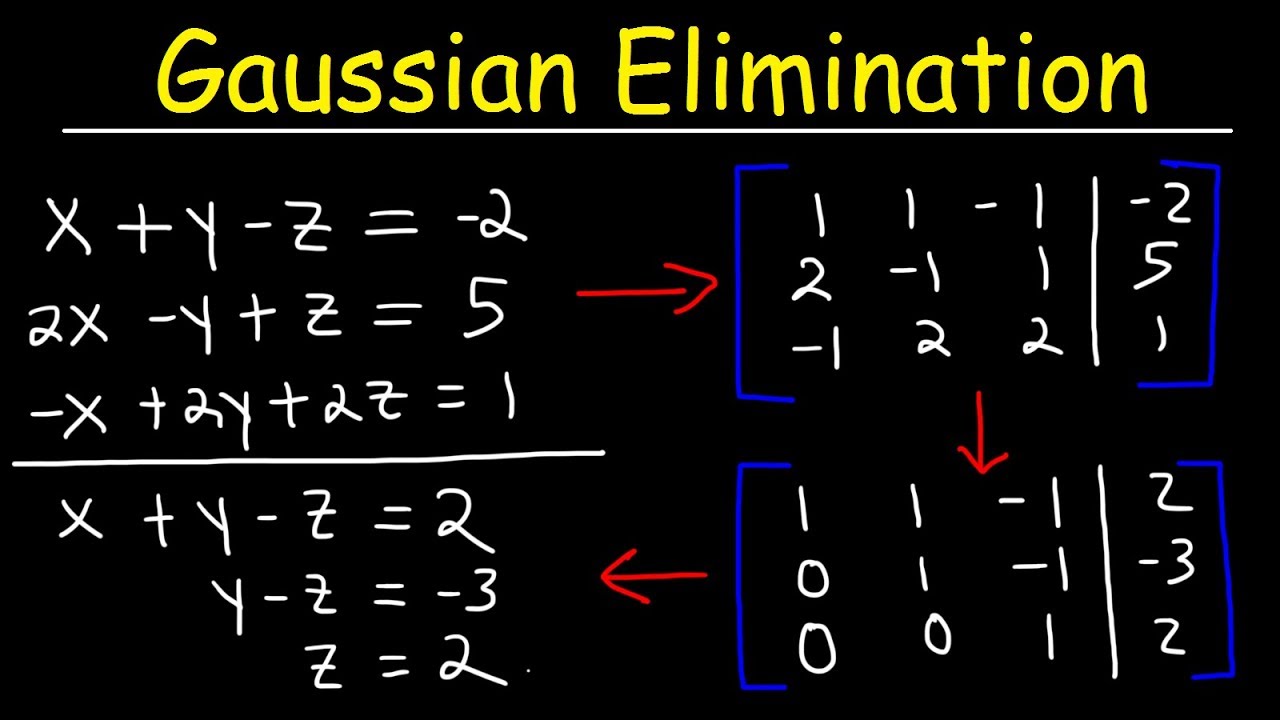
This precalculus video tutorial provides a basic introduction into the gaussian elimination - a process that involves elementary row operations with 3x3 matrices which allows you to solve a system of linear equations with 3 variables. You need to convert the system of equations into an augmented matrix and use matrix row operations to write it ...
jagged cloud
cheers. that should be enough
sullen ferry

This precalculus video tutorial provides a basic introduction into the gauss jordan elimination which is a process used to solve a system of linear equations by converting the system into an augmented matrix and using elementary row operations to convert the 3x3 matrix into its reduced row echelon form. You can easily determine the answers once...
yea, these should help and show you :)
jagged cloud

is that 1st vid u sent
essentially playing abou to get triangle of zeros bottom left
thanks @sullen ferry
jagged cloud
nice nice
jagged cloud
sullen ferry
yeee
im a final year masters elec n mech eng student. sometimes takes a bit to remember all stuff ive learnt
sullen ferry
understandable :)
jagged cloud
sullen ferry
yeee
and u want a 1 top left to make row operations easy as fuck right
sullen ferry
yea yea
jagged cloud
then use any one in middle to remove the other 2 zeros
or is it row 2 column 2 i use to get the 2 below zero

those ones to be zeros
@sullen ferry thanks
sullen ferry
np :)
jagged cloud
sorry one more thing.. if i was to move row 4 to top for ease, does the 350 also move.. top right
@sullen ferry
sullen ferry
yes
sullen ferry
US
odd edgeBOT
@jagged cloud Has your question been resolved?
odd edgeBOT
Channel closed
Closed due to timeout
Use .reopen if this was a mistake.
odd edgeBOT
Available help channel!
Send your question here to claim the channel.
Remember:
• Ask your math question in a clear, concise manner.
• Show your work, and if possible, explain where you are stuck.
• After 15 minutes, feel free to ping <@&286206848099549185>.
• Type the command .close to free the channel when you're done.
• Be polite and have a nice day!
Read #❓how-to-get-help for further information on how to ask a good question, and about conduct in the question channels.
 mystic nebula
how do I know where the boundary points are?
 mystic nebula
I know that I'm supposed to examine the critical points & and the boundary points then compare them, but idk how to find the boundary points ngl
odd edgeBOT
@mystic nebula Has your question been resolved?
 light violet
mystic nebula
I know that I'm supposed to examine the critical points & and the boundary point...
light violet
mystic nebula
I know that I'm supposed to examine the critical points & and the boundary point...
Pre sure you find the extreme along the boundary lines of the square so Lagrange multipliers I think
odd edgeBOT
Channel closed
Closed due to timeout
Use .reopen if this was a mistake.
Available help channel!
Send your question here to claim the channel.
Remember:
• Ask your math question in a clear, concise manner.
• Show your work, and if possible, explain where you are stuck.
• After 15 minutes, feel free to ping <@&286206848099549185>.
• Type the command .close to free the channel when you're done.
• Be polite and have a nice day!
Read #❓how-to-get-help for further information on how to ask a good question, and about conduct in the question channels.
 hoary jungle
 odd edgeBOT
hoary jungle
hoary jungle
odd edgeBOT
hoary jungle
hoary jungle
what does ln^2 mean?
 bright cobalt
hoary jungle
bright cobalt
hoary jungle
me too
 weary pelican
Yep (ln(x))²
weary pelican
Not even a slightest intuition?
weary pelican
hoary jungle
1+ln^2x?
Works
hoary jungle
derivative of that is 2 • ln(x) • 1/x right?
weary pelican
Yes
hoary jungle
yeah i think i solved it
also another question

what happens if i write d(1/x) instead of dx
does my e become x?
and do i get left with x^-2 * x
or is it d(lnx) that way
weary pelican
If there was written d(1/x) instead then your silent variable is just t = 1/x
So 1/x³ e^(1/x) = t³e^t
Are you asking about a variable change?
hoary jungle
thats my problem
i dont really know what im asking
my lecturer did something like that
and he talked about noticing the derivative or something while doing it
 hoary jungle
but doesnt it make it easier?
weary pelican
I'm not arguing for it tho
like just let u = x²
And write du = ...dx
(Here du = 2xdx)
hoary jungle
weary pelican
Sure but it's like delaying the inevitable variable change
i see wht you mean
hoary jungle
hoary jungle
had a feeling it would make it easier doing it that way here
toxic monolith
i do not want to interrupt, but the most important is understanding the formula: