#help-19
1 messages · Page 35 of 1
 civic citrus
m
 spice fiber
As 1
To 101
So my q becomes
Summation of case of
I+j=1 ,2....101
But permuting these would be extremely problematic xD
civic citrus
yall are way too smart tbh
spice fiber
The only reason this q is problematic is because u want a general solution xD
I cant simply multiply the cases bt 3 because we will overcount every single number divisible by 3 twice
And every odd number n-1/2 times
Oh dear

A diff approach then
 static totem
@civic citrus if this is for a program, we can solve it
civic citrus
that's fair
it's probably a lost cause then
thanks so much for trying though 
have a nice day!
.close
 odd edgeBOT
Channel closed
Closed by @civic citrus
Use .reopen if this was a mistake.
odd edgeBOT
✅
 late dust
sum_{i=0}^{101} (min(101,N-i)+1-max(N-i-101,0)) works if you can input a sum
@civic citrus
late dust
Also your number of pairs here is flawed
Unless the bounds are actually 0 and 100, inclusive
civic citrus
late dust
`sum_{i=0}^{101} (min(101,N-i)+1-max(N-i-101,0))` works if you can input a sum
would this be the solution for between 101 and 202?
or would this just generally work?
late dust
Hold on
civic citrus
cus it starts giving negative results somewhere along the way, outside of that range
which def seems weird
late dust
So if i,j,k are in [0,B], then it works when N is in [B-2,2B+2]
Yeah you wanted it to work until 3B huh
spice fiber
For rest of the cases normal beggars works lol
From 2b+2 to 3b
Its 3b-n+2c2
For before b-2 its n+2c2
late dust
late dust
So if i,j,k are in [0,B], then it works when N is in [B-2,2B+2]
(conceptually it should be [B,2B] but it also works for the boundaries)
spice fiber
These work till n =B
late dust
spice fiber
Its 3b-n+2c2
(3*101-N+2) choose 2, yeah
Parentheses are kind of important here
spice fiber
Ig
civic citrus
I'm really new to this stuff, so I was also kind of confused just now
spice fiber
I get this from pnc
You elements must sum to N
So i+j+k=n
All solution of this
Is a triplet
Basically for n from 202 to 303
spice fiber
late dust
(3*101-N+2) choose 2, yeah
This is the number
If you want to know how i get this i can tell
 odd edgeBOT
Channel closed
Closed by @civic citrus
Use .reopen if this was a mistake.
 Available help channel!
Send your question here to claim the channel.
Remember:
• Ask your math question in a clear, concise manner.
• Show your work, and if possible, explain where you are stuck.
• After 15 minutes, feel free to ping <@&286206848099549185>.
• Type the command .close to free the channel when you're done.
• Be polite and have a nice day!
Read #❓how-to-get-help for further information on how to ask a good question, and about conduct in the question channels.
 lost folio
 odd edgeBOT
lost folio
lost folio
odd edgeBOT
lost folio
lost folio
help me please
J ai essayé d'utiliser la récurrence mais j'ai été bloqué
j ai essayé de faire disjonction des cas
SOS ¨PLEASE
m tired
.close
odd edgeBOT
Channel closed
Closed by @lost folio
Use .reopen if this was a mistake.
Available help channel!
Send your question here to claim the channel.
Remember:
• Ask your math question in a clear, concise manner.
• Show your work, and if possible, explain where you are stuck.
• After 15 minutes, feel free to ping <@&286206848099549185>.
• Type the command .close to free the channel when you're done.
• Be polite and have a nice day!
Read #❓how-to-get-help for further information on how to ask a good question, and about conduct in the question channels.
 round shore
How do i solve this
 odd edgeBOT
round shore
How do i solve this
round shore
odd edgeBOT
round shore
How do i solve this
round shore
Do i use distributive
 cold sage
mhm
 ruby nacelle
yea
round shore
then 3x _< -39
ruby nacelle
✅
round shore
so x is -13?
ruby nacelle
❌
odd edgeBOT
Channel closed
Closed by @round shore
Use .reopen if this was a mistake.
Available help channel!
Send your question here to claim the channel.
Remember:
• Ask your math question in a clear, concise manner.
• Show your work, and if possible, explain where you are stuck.
• After 15 minutes, feel free to ping <@&286206848099549185>.
• Type the command .close to free the channel when you're done.
• Be polite and have a nice day!
Read #❓how-to-get-help for further information on how to ask a good question, and about conduct in the question channels.
 weary jolt
I need help with this I dont understand graphing
 ruby nacelle
expand the function
and express in y=mx+c
if m>0 answer is C
if m<0 answer is A/B
then u need to look at y-intercept
odd edgeBOT
@weary jolt Has your question been resolved?
odd edgeBOT
Channel closed
Closed due to timeout
Use .reopen if this was a mistake.
weary jolt
.reopen
odd edgeBOT
✅
 spiral raven
weary jolt
I need help with this I dont understand graphing
spiral raven
weary jolt
I need help with this I dont understand graphing
for this lazy way
do x= 0 and get y-intercept
for this part try to remember what y=x and y=-x looklike
weary jolt
i dont get it
spiral raven
u know what y-intercept is?
when x = 0 u got y-intercept from question
when y =0 u also got x-intercept
then u dot the point on the graph
y-intercept should be (0,x)
x-intercept (x,0)
weary jolt
this hurts my head i dont understand
spiral raven
its education plan or english program?
weary jolt
oh
spiral raven
iep mean two thing
odd edgeBOT
@weary jolt Has your question been resolved?
odd edgeBOT
Channel closed
Closed due to timeout
Use .reopen if this was a mistake.
Available help channel!
Send your question here to claim the channel.
Remember:
• Ask your math question in a clear, concise manner.
• Show your work, and if possible, explain where you are stuck.
• After 15 minutes, feel free to ping <@&286206848099549185>.
• Type the command .close to free the channel when you're done.
• Be polite and have a nice day!
Read #❓how-to-get-help for further information on how to ask a good question, and about conduct in the question channels.
 mystic saffron
In a certain region of the country it is known from past experience that the probability of selecting an adult over 40 years of age with cancer is 0.05. If the probability of a doctor correctly diagnosing a person with cancer as having the disease is 0.78 and the probability of incorrectly diagnosing a person without cancer as having the disease is 0.06, what is the probability that an adult over 40 years of age is diagnosed as having cancer?
odd edgeBOT
mystic saffron
In a certain region of the country it is known from past experience that the pro...
mystic saffron
from what i would think to do, i would use the total probability
$$P(A) = \sum_{i=1}^{k} P(B_i)P(A|B_i)$$
 clever fjordBOT
Quasar
 odd edgeBOT
Channel closed
Closed by @rustic smelt
Use .reopen if this was a mistake.
Available help channel!
Send your question here to claim the channel.
Remember:
• Ask your math question in a clear, concise manner.
• Show your work, and if possible, explain where you are stuck.
• After 15 minutes, feel free to ping <@&286206848099549185>.
• Type the command .close to free the channel when you're done.
• Be polite and have a nice day!
Read #❓how-to-get-help for further information on how to ask a good question, and about conduct in the question channels.
 ornate summit
so they gave us this definition
 odd edgeBOT
ornate summit
so they gave us this definition
odd edgeBOT
ornate summit
so they gave us this definition

 ornate summit
what exactly is Zm
ornate summit
[1]
would be the
every element which remainder is 1?
[1]m is a set itself?
is this an equivalence class or do i mix stuff up?
 cold urchin
Yes you put a relation on integers
ornate summit
how would this set be defined
ornate summit
hm why
cold urchin
ornate summit
hm why
They belong to the same equivalent class which we’ll call [1]
cold urchin
if and only if
cold urchin
Yeah
ornate summit
why you define it as subtraction from 2 elements
and not just one
why cant is say
n | a
cold urchin
ornate summit
so basically every a-b which divided by n
By this you mean every integer a,b s.t b-a is divisible by n and 1 is in here.
Then it’s in the set 1
cold urchin
ornate summit
n | a
I mean then what you’d just partition integers into 2 sets
One set contains all multiple of n
The other set contains all other number
How’d u define this relation anyway?
ornate summit
ah ok
cold urchin
ornate summit
[2, ,5, 8, 11 ,...]
Right
ornate summit
you kinda need 2 numbers because youll define a relation on them
ornate summit
a ~ b := n | a-b
cold urchin
Mhm
ornate summit
[a] = {z ∈ Z| m|(z − a)} = {z ∈ Z|∃k ∈ Z : z − a = k · m}
given that
m | (z-a)
m divides (z-a)
cold urchin
Correct
cold urchin
z-a is a multiple of m
ornate summit
jeah
so if m is 2
if i can divide z -a by 2
i can divide it by 4
aswell
so when i have [2]_3
[2, ,5, 8, 11 ,...]
here for example
i can do 2x3 where k =2 m=3
and 6 | 8 with rest 2
remainder 2
ornate summit
just brainstorming what this means: {z ∈ Z|∃k ∈ Z : z − a = k · m} given {z ∈ Z| m|(z − a)}
cold urchin
They’re equivalent statement
If m divides z-a
Then z-a can be written as a multiple of m
ie z-a = mk for some integer k
ornate summit
oh makes sense
and

when i have 2 of those equivalence classes
the addition is defined like that
but would i take every elements of one equivalence class and add it to the element of the other equivalence classß
e.g.
Z4
[0]_4 = {0, 4, 8, 16, ...}
cold urchin
It would but really when you think about operation in modulo you don’t really think in terms of equivalent classes
In the same way that when we think about integers we don’t think about the quotient of natural numbers
ornate summit
[1]_4 = {1, 5, 9, 17}
cold urchin
Adding this two will give you [1]
ornate summit
why?
ornate summit
[0]_4 + [1]_4 = {1, 9, 17, 33}
33:4
32 r 1
jeah true
lol
so [0]_4 is the neutral element in this group?
cold urchin
It’ll literally gives back [1]
Well no exactly but u can think of it that way
Take one element in [0] add to every element in [1]
Repeat for every element in [0]
cold urchin
Well this will still give you [1]
ornate summit
{0+1, 0+5, 0+9, 0+17, 4+1, 4+5, 4+9, 4+17, 8+1,.....}
like this?
how should i know out of this definition
 cold urchin
But if I recall correctly we can just define [x] + [y] to be we pick any element in x and y add them and see what mod it is and call it [c]
cold urchin
ornate summit
m| s - a and m| t-b means m | s+t-a-b
So s+t ~ (a+b)
ie. s+t belongs in [a+b]
odd edgeBOT
@ornate summit Has your question been resolved?
Channel closed
Closed by @ornate summit
Use .reopen if this was a mistake.
Available help channel!
Send your question here to claim the channel.
Remember:
• Ask your math question in a clear, concise manner.
• Show your work, and if possible, explain where you are stuck.
• After 15 minutes, feel free to ping <@&286206848099549185>.
• Type the command .close to free the channel when you're done.
• Be polite and have a nice day!
Read #❓how-to-get-help for further information on how to ask a good question, and about conduct in the question channels.
 vale horizon

 odd edgeBOT
vale horizon
vale horizon
odd edgeBOT
vale horizon
vale horizon
i know the dr/dt is -1 cm/min, and the dSA/dt is 8 pi r dr/dt, but im not sure where to go from there
odd edgeBOT
@vale horizon Has your question been resolved?
vale horizon
pls ping me when reply, i dont use discord often and i only get notified when pinged
odd edgeBOT
@vale horizon Has your question been resolved?
vale horizon
<@&286206848099549185> sry for the mention but it said i could ping after 15 mins
 topaz salmon
what the problem ?
vale horizon
tysm
vale horizon
can you show how you did it pls
vale horizon
here is okay, thanks
topaz salmon
okay
vale horizon
also brb sorry gime like 5 mins
topaz salmon
 topaz salmon
vale horizon
also brb sorry gime like 5 mins
topaz salmon
vale horizon
also brb sorry gime like 5 mins
dw
thats finding the upper bound
so any value of D less than that will yeild a rate less than 200cm^2/min
theres the second half of the working

hope this helps @vale horizon
vale horizon
topaz salmon
whatd you do over here?
 topaz salmon
oh thats js putting area interms of diamter
cuz r = d/2
if u plug d/2 inplace of r
then simplify
u get pid^2
vale horizon
ohh right
topaz salmon
yep
vale horizon
topaz salmon
yep
can u show me what you did here

i dont really understand where -1/2 came from
vale horizon
topaz salmon
if u js invert that dt/dD = -1/2
sry for asking so much but how did you realize that you needed to invert to find dA/dD
just trying to make sense of it all
vale horizon
yeah its confusing 😭
topaz salmon
vale horizon
sry for asking so much but how did you realize that you needed to invert to find...
i was finding a way to link dA and dD
vale horizon
so you knew dA/dD was 2piD because its the derivative of the surface area function?
topaz salmon
yes
and the first half is to find the value of D which can satisfy the condition
then the second half is now using that to find the rate of change of area
therefor dA/dt
and if u break taht down using the info we have we can say dA/dt=dA/dD times dD/dt
vale horizon
OHHHHHHHHHHHHHHH I GET IT
topaz salmon
perfect
topaz salmon
vale horizon
yeah its confusing 😭
in the start yea, but u get used to it 😄
vale horizon
to move it from the other side
topaz salmon
vale horizon
so rather than inverting dD/dt
the inversion in the first half was to find the value of d
topaz salmon
vale horizon
to move it from the other side
then yea u move it to the other side
to find dA/dt
so we found that dA/dt = -4piD
vale horizon
derivative of SA with respect to time would be SA = piD^2 --> dSA/dt = 2 piD dD/dt
then move dD/dt to the other side of the equation
topaz salmon
so when we plug the initial value of D we found, we can say that that is the upper limit
topaz salmon
vale horizon
derivative of SA with respect to time would be SA = piD^2 --> dSA/dt = 2 piD dD/...
yes that is correct
topaz salmon
ur wlcm man
odd edgeBOT
Channel closed
Closed by @vale horizon
Use .reopen if this was a mistake.
Available help channel!
Send your question here to claim the channel.
Remember:
• Ask your math question in a clear, concise manner.
• Show your work, and if possible, explain where you are stuck.
• After 15 minutes, feel free to ping <@&286206848099549185>.
• Type the command .close to free the channel when you're done.
• Be polite and have a nice day!
Read #❓how-to-get-help for further information on how to ask a good question, and about conduct in the question channels.
 jagged barn
i still need help with it
odd edgeBOT
What step are you on?
1. I don't know where to begin.
2. I have begun but got stuck midway.
3. I got an answer but I was told that it's wrong.
4. I got an answer and would like my work checked.
5. I have a question about someone else's work/solution.
6. I have completed the problem and don't need help anymore. Thank you.
7. None of the above
Channel closed
Channel closed due to the original message being deleted.
If you did not intend to do this, please open a new help channel,
as this action is irreversible, and this channel may abruptly lock.
odd edgeBOT
Available help channel!
Send your question here to claim the channel.
Remember:
• Ask your math question in a clear, concise manner.
• Show your work, and if possible, explain where you are stuck.
• After 15 minutes, feel free to ping <@&286206848099549185>.
• Type the command .close to free the channel when you're done.
• Be polite and have a nice day!
Read #❓how-to-get-help for further information on how to ask a good question, and about conduct in the question channels.
 sweet pendant
hi
odd edgeBOT
sweet pendant
hi
sweet pendant
i am in need of help for a fourier series question
i finished and solved question 1)
im now working on 2)
and i solved the
an
and the bn
my question is, i have two different values for the odd and even, how would i represent it for the f(x)
 desert marlin
!filetype
odd edgeBOT
Please post images (such as PNGs or JPGs) of the question rather than other filetypes such as PDFs which have to be downloaded. Non-image downloads can potentially contain viruses or other security risks.
sweet pendant
oh
ok

this is the question

i got An as this
i got Bn as this

my ao is this

my goal is to finally finsih and solve the question asked

which is what is the fourier series
how would i represent it as an equation
so far my professor has only given us cases where for example, the "even" bn is 0
so i never have to account for it
but in this case, they both have values, would it change the way I represent my final answer?
desert marlin
sweet pendant
my goal is to finally finsih and solve the question asked
you have the formula here
sweet pendant
yes
desert marlin
in the case where bn is 0 you just ignore the sine term
but now, don't ignore it
that's all
sweet pendant
well
what i mean is
i never seen a case where it isnt ignored
so i dont even know how to write it out
like bn as a whole isnt 0
its like when n is even
or smth
desert marlin
Well you write it out in the exact same way as you've written out the an terms in the past
but now you use the values for bn, and you write sin instead of cosine
sweet pendant
hm, are u able to give me an example?
u dont need to use same values
just a diff thing

in the past, bn would have n even = 0
but the n is odd
still exists
meaning we would reach to a value
but in this case where i have bn has a value for both n even and n odd
what should i do?
wait im stupid
this has been a dumb question
🤦
well actually
so my prof keeps it "general"

but then further simplifies it
using the odd/even idea
odd edgeBOT
@sweet pendant Has your question been resolved?
odd edgeBOT
Channel closed
Closed due to timeout
Use .reopen if this was a mistake.
Available help channel!
Send your question here to claim the channel.
Remember:
• Ask your math question in a clear, concise manner.
• Show your work, and if possible, explain where you are stuck.
• After 15 minutes, feel free to ping <@&286206848099549185>.
• Type the command .close to free the channel when you're done.
• Be polite and have a nice day!
Read #❓how-to-get-help for further information on how to ask a good question, and about conduct in the question channels.
Channel closed
Channel closed due to the original message being deleted.
If you did not intend to do this, please open a new help channel,
as this action is irreversible, and this channel may abruptly lock.

 quasi sparrow
 pale arrow
!msgdel
odd edgeBOT
pale arrow
The original post of this help channel has been deleted, and it will abruptly close and possibly lock. (This is irreversible.) Please claim a new channel, and don't delete the first message of any future channel you claim.
 viscid flint
(it was someone else who deleted the msg; you should still grab a new channel anyway @pale arrow
pale arrow
thz
odd edgeBOT
Available help channel!
Send your question here to claim the channel.
Remember:
• Ask your math question in a clear, concise manner.
• Show your work, and if possible, explain where you are stuck.
• After 15 minutes, feel free to ping <@&286206848099549185>.
• Type the command .close to free the channel when you're done.
• Be polite and have a nice day!
Read #❓how-to-get-help for further information on how to ask a good question, and about conduct in the question channels.
 warm pivot
 odd edgeBOT
warm pivot
warm pivot
odd edgeBOT
warm pivot
warm pivot
I'm trying to solve this and I think I have an answer but I'm not sure how to check if it's right or not
cold urchin
whats ur answer
warm pivot
since there's no way i know of how to fact check it and it's past due so it won't tell me if it's right or wrong
i got 10
by finding the first few i get 3, 9/10, 27/100, ...
cold urchin
that doesnt seem right
warm pivot
plugging into S_n = 1(1 - 9/10^n-1)/(1 - 9/10)
9/10^n-1 is infinitely close to 0 so 1/(1 - 9/10)
cold urchin
the ratio is acutally 3/10
cold urchin
warm pivot
by finding the first few i get 3, 9/10, 27/100, ...
look at your sequence here
warm pivot
...i confused what that number meant
cold urchin
common ratio
warm pivot
i got it into my head that number was simply the 2nd of the sequence and not the ratio
ty
cold urchin
lol np
warm pivot
1/(1 - 3/10)
1/7/3
3/7?
cold urchin
should be 30/7
warm pivot
hm... what am i missing then
cold urchin
yes
odd edgeBOT
Channel closed
Closed by @warm pivot
Use .reopen if this was a mistake.
cold urchin

odd edgeBOT
Available help channel!
Send your question here to claim the channel.
Remember:
• Ask your math question in a clear, concise manner.
• Show your work, and if possible, explain where you are stuck.
• After 15 minutes, feel free to ping <@&286206848099549185>.
• Type the command .close to free the channel when you're done.
• Be polite and have a nice day!
Read #❓how-to-get-help for further information on how to ask a good question, and about conduct in the question channels.
 stiff kettle
 odd edgeBOT
stiff kettle
stiff kettle
odd edgeBOT
stiff kettle
stiff kettle
,rotate
clever fjordBOT
 stiff kettle
How do I solve this limit
 south plume
clever fjord
south plume
clever fjord
i don't think this will work here
stiff kettle
how so
south plume
both limits diverge
stiff kettle
yes but my teacher wants me to prove
it
showing that there is an infinity
i know it diverges
because of the discontinuity
he wants me to express them as limits
and solve
 ember oak
This is an improper integral
south plume
ln |a-3| will diverge
ember oak
In that context, what you have so far is correct, just cancel out the ln|a-3| terms
ember oak
stiff kettle
its two seperate limits so i cant cancel them out no
Not necessarily. You are still fine to.
south plume
technically because you have an absolute value inside then 3+ and 3- won't matter here
stiff kettle
ok but can u explain to me why this here gives me -infinity

i know the other limit gives me +inf
but i dont get why this one is -inf
south plume
ember oak
In that context, what you have so far is correct, just cancel out the ln|a-3| te...
oh wait the integral converges right?
stiff kettle
diverge
stiff kettle
hmmm
south plume
,w integral 0 to 5 of 1/(x-3) dx
clever fjordBOT


 Requested by arte_m_etra
quasi sparrow
south plume
ln |a-3| will diverge
Requested by arte_m_etra
quasi sparrow
south plume
ln |a-3| will diverge
yea this is essentially why
stiff kettle
yeah
Ln(0^+) is +inf
but what is ln(0^-)
is it -inf
like automatically since its the opposite
south plume
stiff kettle
Ln(0^+) is +inf
no
south plume
both are -inf
cold urchin
Well ln(0-) is undefined but in your case u have the absolute value
So it’s still ln(0+)
odd edgeBOT
Channel closed
Closed by @stiff kettle
Use .reopen if this was a mistake.
Available help channel!
Send your question here to claim the channel.
Remember:
• Ask your math question in a clear, concise manner.
• Show your work, and if possible, explain where you are stuck.
• After 15 minutes, feel free to ping <@&286206848099549185>.
• Type the command .close to free the channel when you're done.
• Be polite and have a nice day!
Read #❓how-to-get-help for further information on how to ask a good question, and about conduct in the question channels.
 nocturne belfry
 odd edgeBOT
nocturne belfry
nocturne belfry
odd edgeBOT
nocturne belfry
nocturne belfry
I am kind of consfused about what my professor says
like yea okay the "order" of the bottom is higher, but doesn't this oscillate?
this limit doesnt exist does it?
like, the plot cosx = -xsinx has infinitely many intersections so we never run out of asymptotes
 tall veldt
yeah the limit doesn't exist
nocturne belfry
tall veldt
yeah the limit doesn't exist
is there some kind of good asymptotic limit here
tall veldt
i dont know anything about asymptotics sorry
odd edgeBOT
Channel closed
Closed by @nocturne belfry
Use .reopen if this was a mistake.
odd edgeBOT
Available help channel!
Send your question here to claim the channel.
Remember:
• Ask your math question in a clear, concise manner.
• Show your work, and if possible, explain where you are stuck.
• After 15 minutes, feel free to ping <@&286206848099549185>.
• Type the command .close to free the channel when you're done.
• Be polite and have a nice day!
Read #❓how-to-get-help for further information on how to ask a good question, and about conduct in the question channels.
 rocky frost
Would if be true to say that if m does not divide a - b then m * n does not divide a - b
odd edgeBOT
rocky frost
Would if be true to say that if m does not divide a - b then m * n does not divi...
 blissful musk

 tranquil granite
rocky frost
Would if be true to say that if m does not divide a - b then m * n does not divi...
tranquil granite
rocky frost
Would if be true to say that if m does not divide a - b then m * n does not divi...
if m is not a factor of a-b
why would m*n be
 outer wadi
I was thinking that, logically it makes sense but im trying to prove it and im kinda stuck
how would you prove it
rocky frost
see my question is part of a bigger proof
trying to prove that if m divides a - b then n*m divides a - b
trying to prove this by contrapositive
tranquil granite
rocky frost
trying to prove that if m divides a - b then n*m divides a - b
this is untrue
m=2, a-b=4, n=4000
2 divides 4 but 8000 obviously does not divide 4
unless if you are proving that n*m divides a-b ==> m divides a-b
odd edgeBOT
Channel closed
Closed by @rocky frost
Use .reopen if this was a mistake.
odd edgeBOT
Available help channel!
Send your question here to claim the channel.
Remember:
• Ask your math question in a clear, concise manner.
• Show your work, and if possible, explain where you are stuck.
• After 15 minutes, feel free to ping <@&286206848099549185>.
• Type the command .close to free the channel when you're done.
• Be polite and have a nice day!
Read #❓how-to-get-help for further information on how to ask a good question, and about conduct in the question channels.
 earnest moon
 odd edgeBOT
earnest moon
earnest moon
odd edgeBOT
earnest moon
earnest moon
How does the solution work in getting the value of k
I only saw the solution online so I don't know the logic behind it
odd edgeBOT
@earnest moon Has your question been resolved?
odd edgeBOT
Channel closed
Closed due to timeout
Use .reopen if this was a mistake.
Available help channel!
Send your question here to claim the channel.
Remember:
• Ask your math question in a clear, concise manner.
• Show your work, and if possible, explain where you are stuck.
• After 15 minutes, feel free to ping <@&286206848099549185>.
• Type the command .close to free the channel when you're done.
• Be polite and have a nice day!
Read #❓how-to-get-help for further information on how to ask a good question, and about conduct in the question channels.
 graceful hatch
How to solve?
 graceful hatch
<@&286206848099549185>
This what I got now, but I only guessed

Oh wait nvm
Yeah it’s right
.close
odd edgeBOT
Channel closed
Closed by @graceful hatch
Use .reopen if this was a mistake.
Available help channel!
Send your question here to claim the channel.
Remember:
• Ask your math question in a clear, concise manner.
• Show your work, and if possible, explain where you are stuck.
• After 15 minutes, feel free to ping <@&286206848099549185>.
• Type the command .close to free the channel when you're done.
• Be polite and have a nice day!
Read #❓how-to-get-help for further information on how to ask a good question, and about conduct in the question channels.
 dim cliff
im unsure about why there is a must in square rooting here.


 dim cliff
<@&286206848099549185>
 sour gyro
All terms in the expression must be multiplied by the exponent (3).
If the exponent is inside the parenthesis, it only applies to the term which it is raised to.
dim cliff
in simpler terms?
sour gyro
Such as (3+1)^3 means 3^3 + 1^3
Now if it was (3^3 + 1) it would be 3^3 + 1
For your problem, the exponent applies to the all terms as it is outside the parenthesis. Meaning all terms inside the parenthesis are raised to the third power.
sour gyro
Does that fully make sense? It’s a bit hard to explain through text.
dim cliff
i mean i still dont understand why it must be raised and why the ^3 is kept
sour gyro
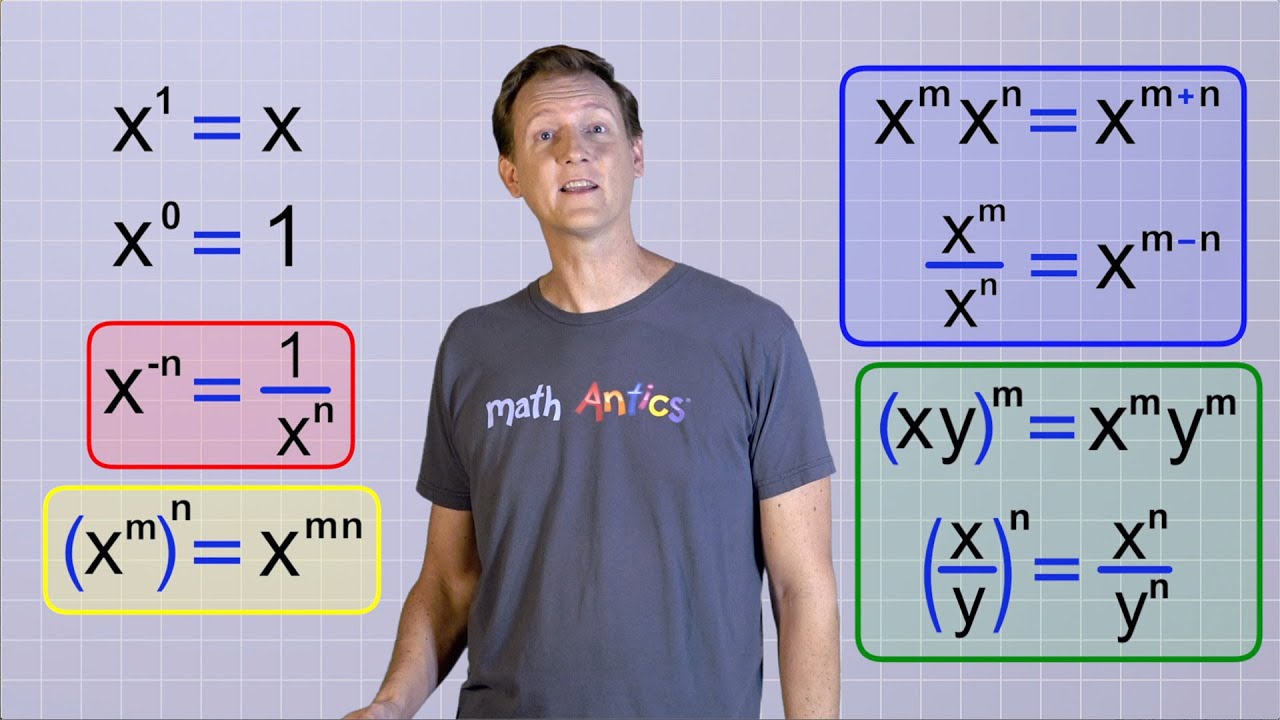
This is a re-upload to correct a minor math typo.
Learn More at mathantics.com
Visit http://www.mathantics.com for more Free math videos and additional subscription based content!
Have a look at this tutorial.
It might be easier to understand.
odd edgeBOT
@dim cliff Has your question been resolved?
odd edgeBOT
Channel closed
Closed due to timeout
Use .reopen if this was a mistake.
Available help channel!
Send your question here to claim the channel.
Remember:
• Ask your math question in a clear, concise manner.
• Show your work, and if possible, explain where you are stuck.
• After 15 minutes, feel free to ping <@&286206848099549185>.
• Type the command .close to free the channel when you're done.
• Be polite and have a nice day!
Read #❓how-to-get-help for further information on how to ask a good question, and about conduct in the question channels.
 waxen blade
How to 3(c) I've done 3a and 3b
 odd edgeBOT
waxen blade
How to 3(c) I've done 3a and 3b
odd edgeBOT
waxen blade
How to 3(c) I've done 3a and 3b
 odd edgeBOT
@waxen blade Has your question been resolved?
 zealous fossil
don't ping people
odd edgeBOT
@waxen blade Has your question been resolved?
waxen blade
No
odd edgeBOT
Channel closed
Closed due to timeout
Use .reopen if this was a mistake.
Available help channel!
Send your question here to claim the channel.
Remember:
• Ask your math question in a clear, concise manner.
• Show your work, and if possible, explain where you are stuck.
• After 15 minutes, feel free to ping <@&286206848099549185>.
• Type the command .close to free the channel when you're done.
• Be polite and have a nice day!
Read #❓how-to-get-help for further information on how to ask a good question, and about conduct in the question channels.
 toxic sigil
Define mappings f: R - > R by f(x) = 4x^(2)+1 and g: R - > R by g(x) = e^(3x).
A) Find the composite mapping fg.
B) Is fg injective? Give a proof or counterexample" Pretty sure I got A down, we do f((x)) = f(e^(3x)) = 4(e^(3x))^2+1 = 4e^(6x)+1. (edited)
I'm struggling with B.
How does one prove injectivity? How does one prove surjectivity?
odd edgeBOT
toxic sigil
Define mappings f: R - > R by f(x) = 4x^(2)+1 and g: R - > R by g(x) = e^(3x).
A...
 brittle beacon
Generally you'd prove injectivity by showing that if $f(x_1) = f(x_2)$, then you must have $x_1 = x_2$
clever fjordBOT
@brittle beacon
 brittle beacon
There are shortcuts you could use, but as they say you should prove it, probably best to do it directly
toxic sigil
brittle beacon
Generally you'd prove injectivity by showing that if $f(x_1) = f(x_2)$, then you...
I think I got it down. So I set 4e^(6x)+1 = 4e^(6y)+1, subtract on both sides, isolate for e^6x and e^6y, apply natural logs, get 6x=6y, divide by 6, we get x = y, and since x and y are injective, fg is injective. right?
What about surjectivity? How can I determine if its surjective?
brittle beacon
toxic sigil
I think I got it down. So I set 4e^(6x)+1 = 4e^(6y)+1, subtract on both sides, i...
Yep 
brittle beacon
toxic sigil
What about surjectivity? How can I determine if its surjective?
For any real number of your choosing, can you find an input that'll get you that? To reverse the question, are there any real numbers that aren't in the image of the function?
toxic sigil
brittle beacon
For any real number of your choosing, can you find an input that'll get you that...
Would I suppose f(g(a)=b an element in R, So 4e^(6x)+1 = -1 if I chose b = -1 E R?
brittle beacon
toxic sigil
Would I suppose f(g(a)=b an element in R, So 4e^(6x)+1 = -1 if I chose b = -1 E ...
Well, that's kind of the idea, does any [real] x such that it's true exist?
toxic sigil
brittle beacon
Well, that's kind of the idea, does any [real] x such that it's true exist?
Getting a wild answer, so from here I'd just solve for x, right?
brittle beacon
toxic sigil
Getting a wild answer, so from here I'd just solve for x, right?
You would try to - what's the answer you're getting?
toxic sigil
brittle beacon
You would *try to* - what's the answer you're getting?
(ln(-1/2))/6
do you get same thiing
 hmmm
brittle beacon
hmmm
brittle beacon
yep, you can't, so there's no solution to that
Another way to see it is that you know $e^p$ is strictly positive for any real $p$, so $4e^{6x} + 1 > 1$ for all real $x$
clever fjordBOT
@brittle beacon
 brittle beacon
So it's impossible to attain any values that are 1 or less
toxic sigil
brittle beacon
So it's impossible to attain any values that are 1 or less
So its not surjective? It is not surjective because there are some real numbers, like the one we just derived, is not covered. So it's not surjective over the entire set of real numbers R.
brittle beacon
toxic sigil
So its not surjective? It is not surjective because there are some real numbers,...
Yep, correct 
toxic sigil
brittle beacon
Yep, correct <:SCgoodjob2:750436894915166321>
It's making more sense. So for injectivity for functions means that if fg(x) = fg(y) then x = y. For surjectivity, we want to find any values that doesn't belong in the function?
brittle beacon
For [lack of] injectivity for a function h, you want to show that if h(x) = h(y), you must have x=y [or find two distinct x,y such that h(x) = h(y)]
For [lack of] surjectivity of h: A -> B, you want to show that for any choice of b in B, there's an a in A such that h(a) = b [or show that you can choose some b in B such that h(a) = b has no solutions in A]
odd edgeBOT
@toxic sigil Has your question been resolved?
odd edgeBOT
Channel closed
Closed due to timeout
Use .reopen if this was a mistake.
odd edgeBOT
Available help channel!
Send your question here to claim the channel.
Remember:
• Ask your math question in a clear, concise manner.
• Show your work, and if possible, explain where you are stuck.
• After 15 minutes, feel free to ping <@&286206848099549185>.
• Type the command .close to free the channel when you're done.
• Be polite and have a nice day!
Read #❓how-to-get-help for further information on how to ask a good question, and about conduct in the question channels.
 dusk spire
 odd edgeBOT
dusk spire
dusk spire
odd edgeBOT
dusk spire
dusk spire
Whats with the parallel projection and perpendicular?
for i) i did
,tex p = $(F_1 \cdot \hat{F_2}) \hat{F_2}$
clever fjordBOT
suds
 dusk spire
which was -7.49i + 25.68j
i dont know what component is acting parallel/perpendicular and as they are both worth 2 marks, i dont think that it is just the i and the j values as that would mean that ii would be 1 mark
 forest sky
all vectors can be expressed as the sum of two perpendicular component vectors. Normally those component vectors are in the x- and y- directions, but we can also consider directions that are parallel and perpendicular to some other vector
forest sky
we can split F1 into components in two different ways:
- into F1x and F1y (the x- and y- components)
- into F1 (parallel to F2) and F2(perpendicular to F2)
In both cases, F1 is the sum of these two vectors (which are perpendicular to each other), but the two sets of components are distinct
we already found the parallel component by vector projection
dusk spire
i dont understand how you split f1 into parallel to f2 and perpendicular to f2
so F1 is -31.25i + 18.75j as the x- y- components you mean?
forest sky
the component of f1 parallel to f2 is the same as the vector projection of f1 onto f2
forest sky
if we know the magnitude of vector F1 and one of its components, we can then solve for the magnitude of the other component
odd edgeBOT
Channel closed
Closed by @dusk spire
Use .reopen if this was a mistake.
Available help channel!
Send your question here to claim the channel.
Remember:
• Ask your math question in a clear, concise manner.
• Show your work, and if possible, explain where you are stuck.
• After 15 minutes, feel free to ping <@&286206848099549185>.
• Type the command .close to free the channel when you're done.
• Be polite and have a nice day!
Read #❓how-to-get-help for further information on how to ask a good question, and about conduct in the question channels.
 jagged rover
uh
jagged rover
what is the logarithms law/properties again
 noble forge
DO you want to know in general, all properties?
jagged rover
yes
for the evaluating of them i guess
i remember one of them is like the change base
noble forge


 royal herald
Nah all of them just saying the same thing
odd edgeBOT
@jagged rover Has your question been resolved?
odd edgeBOT
Channel closed
Closed due to timeout
Use .reopen if this was a mistake.
Available help channel!
Send your question here to claim the channel.
Remember:
• Ask your math question in a clear, concise manner.
• Show your work, and if possible, explain where you are stuck.
• After 15 minutes, feel free to ping <@&286206848099549185>.
• Type the command .close to free the channel when you're done.
• Be polite and have a nice day!
Read #❓how-to-get-help for further information on how to ask a good question, and about conduct in the question channels.
dusk spire
Consider the proposition
odd edgeBOT
dusk spire
Consider the proposition
dusk spire
"For all integers j and k, if jk is even then j or k must be even"
State the contrapositive and hence prove the original statement by contraposition.
I think my proof isnt enough but im not sure
so "For integers j and k, if jk is not even then neither j or k are even."
If the contrapositive is true, the original statement is true.
2jk - 1 = odd for any integer j or k
we know that any multiple of 2 is even. if jk = n then 2n - 1 is odd
let j be 2n - 1
(2n - 1)k = 2nk - k
for any integer where k is odd, 2nk -k is odd. If 2n is even, 2nk is even
Assume that this is also true for j
(2n-1)(2n-1) = 4n^2 - 4n + 1
where 4n^2 and -4n are even, the plus one makes the equation odd
therefore for all integers j and k, if jk is odd, neither j or k is even
the contrapositive of this statement is true
 leaden widget
angle multiple?
dusk spire
sorry?
leaden widget
"we know that angle multiple of 2 is even"
what does that mean?
is that a typo for every multiple?
leaden widget
oh ok
so
when you say "assume that this is also true for j"
Assume that this is also true for j
(2n-1)(2n-1) = 4n^2 - 4n + 1
dusk spire
i mean like (2n-1)k
leaden widget
youre using the same value of j for k?
dusk spire
so k could also be (2n-1)
leaden widget
j = k = 2n-1 ?
leaden widget
yeah, because j is not necessarily equal to k
leaden widget
dusk spire
it would be 4nm - 2n - 2n + 1
yup, that shows jk is odd
leaden widget
i think so, it's a bit confusing to read i guess but i think you got the gist of it
im not sure why you wrote this: "If the contrapositive is true, the original statement is true."
dusk spire
idk ive barely done any proofs
but its true that if the contrapositive is true then the original statement is true
do i not have to finish it like that when proving by contrapositive?
@leaden widget
I also have another proof i just did
Consider the proposition
"The sum of a rational and an irrational number must be irrational"
Prove the statement by contradiction
Assume this statement is false.. therefore teh sum of a rational and an irrational number must be rational
in order for a number to be rational, it can be expressed as a simplified fraction a/b where b is not 0
x,y,b,a,c are rational
a/b + sqrtc = x/y
sqrt c = x/y - a/b
sqrt c = (xb - ya)/yb
this is not true
leaden widget
why are you writing sqrt c
dusk spire
irrational numbers cannot be exporessed as simple fractions so the statement is false therefore the sum of a rational and an irrational number must be irrational
dusk spire
leaden widget
why are you writing sqrt c
square root, i cant do that with typing
dusk spire
,tex $\sqrt{c} = x/y - a/b$
clever fjordBOT
suds
 leaden widget
and what is c, c is a rational number?
leaden widget
well not all irrational numbers can be expressed as roots of rational numbers
i.e. transcendental numbers, which are also irrational
dusk spire
ok so if i just do c, it shows for all irrational numbers?
true and also c could be like 4 which is rational
thanks for that
other than that?
leaden widget
yeah you could write $c\notin\mathds{Q}$
clever fjordBOT
Soosh
Compile Error! Click the  reaction for more information.
(You may edit your message to recompile.)
 dusk spire
i just wronte where c is any irrational number
leaden widget
yea
leaden widget
ya thats fine
dusk spire
so at the end of the first proof, i shouldnt write the contraposition is true so the original statement is true
leaden widget
and well the sum \ difference of any rational numbers is also rational
dusk spire
in my actual writing i did =/ (not equal sign)
and if i say this statement is false isnt that valid?
how else do i write it?
leaden widget
dusk spire
how else do i write it?
yes just say it contradicts the premise that c is irrational
dusk spire
but when showing the working?
leaden widget
so the original assumption that the statement is false...must be false
dusk spire
oh
but if i wrong c = x/y + a/b
i know that c does not equal that
but i cant write =/ before proving it
dusk spire
yes i know but you said
dusk spire
leaden widget
which is a contradiction
.
it does imply it but it also proves that it is false
it shows that it doesnt work
leaden widget
what implies what?
what proves what is false?
i dont understand what you are asking...
dusk spire
you said that writing c = x/y - a/b implies c is rational
which is a contradiction
i thought you were saying an error in my writing?
leaden widget
no
leaden widget
dusk spire
Assume this statement is false.. therefore teh sum of a rational and an irration...
contradiction of this
dusk spire
yes it is, its supposed to be
because you prove the contradiction being wrong to prove the original statement
leaden widget
"The sum of a rational and an irrational number must be irrational"
-assume this is false (this is the assumption)
then for some irrational c and rationals a, b, we can write
c + a = b
c = b - a
but the sum of two rationals is also rational
therefore c is rational, but we assumed c is irrational
(this is the contradiction, both of those can't be true at same time)
contradiction implies our assumption on 2nd line is wrong
proof done
leaden widget
right then you get to the point that c is both irrational and rational
which makes things explode
dusk spire
dusk spire
so i say that if the equation is true, c must be rational
... which it is not
boom proof
huzzah
QED to this channel?
.close
odd edgeBOT
Channel closed
Closed by @dusk spire
Use .reopen if this was a mistake.
odd edgeBOT
Available help channel!
Send your question here to claim the channel.
Remember:
• Ask your math question in a clear, concise manner.
• Show your work, and if possible, explain where you are stuck.
• After 15 minutes, feel free to ping <@&286206848099549185>.
• Type the command .close to free the channel when you're done.
• Be polite and have a nice day!
Read #❓how-to-get-help for further information on how to ask a good question, and about conduct in the question channels.
 real fox
Hello, Sorry for disturbing.. Can anyone help me, Make a graph of F(x) = -x^2 - x + 12.
Thank you
odd edgeBOT
real fox
Hello, Sorry for disturbing.. Can anyone help me, Make a graph of F(x) = -x^2 - ...
odd edgeBOT
@real fox Has your question been resolved?
real fox
 tepid hornet
Factor it
tepid hornet
Factor it
Okaaay, THANKSS
odd edgeBOT
Channel closed
Closed by @real fox
Use .reopen if this was a mistake.
real fox
sorry i forgot to say; Thank youuu, Thankss!!
odd edgeBOT
Available help channel!
Send your question here to claim the channel.
Remember:
• Ask your math question in a clear, concise manner.
• Show your work, and if possible, explain where you are stuck.
• After 15 minutes, feel free to ping <@&286206848099549185>.
• Type the command .close to free the channel when you're done.
• Be polite and have a nice day!
Read #❓how-to-get-help for further information on how to ask a good question, and about conduct in the question channels.
 dull gulch
 odd edgeBOT
dull gulch
odd edgeBOT
dull gulch
 digital matrix
u got a calculator?
dull gulch
yeah
digital matrix
convert to exponential form
dull gulch
1/2 = x^(-1/4) ?
digital matrix
yes
dull gulch
yeah im stuck what to do after that
digital matrix
dull gulch
yeah im stuck what to do after that
get rid of the -¼
dull gulch
how do i root a number by a negative exponent
digital matrix
raise to -4
dull gulch
so reciprocal?
digital matrix
yeah
odd edgeBOT
Channel closed
Closed by @dull gulch
Use .reopen if this was a mistake.
odd edgeBOT
Available help channel!
Send your question here to claim the channel.
Remember:
• Ask your math question in a clear, concise manner.
• Show your work, and if possible, explain where you are stuck.
• After 15 minutes, feel free to ping <@&286206848099549185>.
• Type the command .close to free the channel when you're done.
• Be polite and have a nice day!
Read #❓how-to-get-help for further information on how to ask a good question, and about conduct in the question channels.
mystic saffron
 odd edgeBOT
mystic saffron
odd edgeBOT
mystic saffron
 tough rapids
distribute the 1/3 on the left hand side, if you already not have done so
Can you show your work?
mystic saffron
@mystic saffron show your work please
odd edgeBOT
@mystic saffron Has your question been resolved?
mystic saffron
mystic saffron
<@456226577798135808> show your work please
ignore the first thing can you explain this

i don't understand how it became 9 = 3/4x
@tough rapids ?
clever fjordBOT
Ab
 clever fjordBOT
Ab
 tough rapids
mystic saffron
but why did we do this
tough rapids
mystic saffron
but why did we do this
you want the x'es on one side and the numbers on the other
mystic saffron
tough rapids
you want the x'es on one side and the numbers on the other
right
tough rapids
mystic saffron
well part of it is based on what people have seen before. but if you go back to the original equation, after distributing the 1/3, you have
$1/3x-2=4/9x-2$
clever fjordBOT
Ab
 clever fjordBOT
Ab
 tough rapids
so some quantities multiplied by x'es and some that stand alone
then you just plus and minus to get the right thing
(another way of doing it)
and the plus and minus you can do is because:
it's like a balance (if you think of weight). taking away weight from both sides or adding does not change the overall equation
 mystic saffron
tough rapids
it's like a balance (if you think of weight). taking away weight from both sides...
mystic saffron
tough rapids
it's like a balance (if you think of weight). taking away weight from both sides...
I see hmm
tough rapids
and you have this unknown x quantity
mystic saffron
Yeah
tough rapids
any further questions?
tough rapids
alr then : ). you can type .close to close the channel
mystic saffron
.close
odd edgeBOT
Channel closed
Closed by @cloud bay
Use .reopen if this was a mistake.
Available help channel!
Send your question here to claim the channel.
Remember:
• Ask your math question in a clear, concise manner.
• Show your work, and if possible, explain where you are stuck.
• After 15 minutes, feel free to ping <@&286206848099549185>.
• Type the command .close to free the channel when you're done.
• Be polite and have a nice day!
Read #❓how-to-get-help for further information on how to ask a good question, and about conduct in the question channels.
 radiant crescent
This is my exercise, though I get a different result from the solution, can anyone tell me where I went wrong?
I did:
alpha = arccos(c/x) = 31,94
h = c * sine(alpha) = 2,24
 odd edgeBOT
radiant crescent
This is my exercise, though I get a different result from the solution, can anyo...
odd edgeBOT
radiant crescent
This is my exercise, though I get a different result from the solution, can anyo...
 steady tide
radiant crescent
This is my exercise, though I get a different result from the solution, can anyo...
steady tide
radiant crescent
This is my exercise, though I get a different result from the solution, can anyo...
cos = adjacent/hypotenuse, not the other way around
 frigid yew
Hi, I have a problem with this exercise, ∀n ∈ N* : (1 + 1/√2 + 1/√3 + ... + 1/√n) ≥ √n , plz can somone help me ?
odd edgeBOT
@radiant crescent Has your question been resolved?
Channel closed
Closed by @radiant crescent
Use .reopen if this was a mistake.
odd edgeBOT
Available help channel!
Send your question here to claim the channel.
Remember:
• Ask your math question in a clear, concise manner.
• Show your work, and if possible, explain where you are stuck.
• After 15 minutes, feel free to ping <@&286206848099549185>.
• Type the command .close to free the channel when you're done.
• Be polite and have a nice day!
Read #❓how-to-get-help for further information on how to ask a good question, and about conduct in the question channels.
 spring knot
im trying to get the eigen vectors for eigen value=-9 in matrix A, but im getting a zero vector... this is in the process of getting the form of a quadric
 odd edgeBOT
spring knot
im trying to get the eigen vectors for eigen value=-9 in matrix A, but im gettin...
odd edgeBOT
spring knot
im trying to get the eigen vectors for eigen value=-9 in matrix A, but im gettin...
 echo ginkgo
odd edgeBOT
echo ginkgo
odd edgeBOT
Channel closed
Closed by @spring knot
Use .reopen if this was a mistake.
spring knot
.reopen
odd edgeBOT
✅
 spring knot
i see
got it, thanks
cause i used to start with (A-Iu)u = 0 before got stuff mixed up
thanks again 🙏
.close
odd edgeBOT
Channel closed
Closed by @spring knot
Use .reopen if this was a mistake.
Available help channel!
Send your question here to claim the channel.
Remember:
• Ask your math question in a clear, concise manner.
• Show your work, and if possible, explain where you are stuck.
• After 15 minutes, feel free to ping <@&286206848099549185>.
• Type the command .close to free the channel when you're done.
• Be polite and have a nice day!
Read #❓how-to-get-help for further information on how to ask a good question, and about conduct in the question channels.
 gleaming mantle
is the number folllowing the x term a power or constant
 odd edgeBOT
gleaming mantle
is the number folllowing the x term a power or constant
odd edgeBOT
gleaming mantle
is the number folllowing the x term a power or constant
Please don't occupy multiple help channels.
 viral frost
3/2 is a constant, 2 is an exponent.
odd edgeBOT
Channel closed
Closed by @gleaming mantle
Use .reopen if this was a mistake.
odd edgeBOT
Available help channel!
Send your question here to claim the channel.
Remember:
• Ask your math question in a clear, concise manner.
• Show your work, and if possible, explain where you are stuck.
• After 15 minutes, feel free to ping <@&286206848099549185>.
• Type the command .close to free the channel when you're done.
• Be polite and have a nice day!
Read #❓how-to-get-help for further information on how to ask a good question, and about conduct in the question channels.
 lean night
HELP ME
 reef sandal
odd edgeBOT
reef sandal
odd edgeBOT
Channel closed
Closed by @reef sandal
Use .reopen if this was a mistake.
Available help channel!
Send your question here to claim the channel.
Remember:
• Ask your math question in a clear, concise manner.
• Show your work, and if possible, explain where you are stuck.
• After 15 minutes, feel free to ping <@&286206848099549185>.
• Type the command .close to free the channel when you're done.
• Be polite and have a nice day!
Read #❓how-to-get-help for further information on how to ask a good question, and about conduct in the question channels.
 ancient patrol
Did i get the first question correct

 odd edgeBOT
ancient patrol
Did i get the first question correct
ancient patrol
odd edgeBOT
ancient patrol
Did i get the first question correct
ancient patrol
and how should i approach the second question
not sure how to start
can i do the same by multiplying the top and bottom by sqroot(x^2+2x) + x ?
 cursive charm
ancient patrol
Did i get the first question correct
cursive charm
ancient patrol
Did i get the first question correct
Yeah. Though you could've done it by using the definition of a derivative, if you've studied that of course.
cursive charm
ancient patrol
can i do the same by multiplying the top and bottom by sqroot(x^2+2x) + x ?
Yeah sounds good.
ancient patrol
cursive charm
Yeah sounds good.
alright thanks for the help
ancient patrol
cursive charm
Yeah. Though you could've done it by using the definition of a derivative, if yo...
🤔 not sure what that is
.close
odd edgeBOT
Channel closed
Closed by @ancient patrol
Use .reopen if this was a mistake.
cursive charm
ancient patrol
alright thanks for the help
Actually you can do it really quickly using limit laws.
odd edgeBOT
Available help channel!
Send your question here to claim the channel.
Remember:
• Ask your math question in a clear, concise manner.
• Show your work, and if possible, explain where you are stuck.
• After 15 minutes, feel free to ping <@&286206848099549185>.
• Type the command .close to free the channel when you're done.
• Be polite and have a nice day!
Read #❓how-to-get-help for further information on how to ask a good question, and about conduct in the question channels.
 native agate
Going to find the anti derivative and just need someone to look after my method please
odd edgeBOT
native agate
Going to find the anti derivative and just need someone to look after my method ...
native agate
$$\frac{1}{x^2+1}\cdot 2x$$
clever fjordBOT
Totalani
 clever fjordBOT
Totalani
 native agate
$$\ln(u)\cdot \frac{2x^2}{2}$$
clever fjordBOT
Totalani
 odd edgeBOT
Channel closed
Closed by @native agate
Use .reopen if this was a mistake.
Available help channel!
Send your question here to claim the channel.
Remember:
• Ask your math question in a clear, concise manner.
• Show your work, and if possible, explain where you are stuck.
• After 15 minutes, feel free to ping <@&286206848099549185>.
• Type the command .close to free the channel when you're done.
• Be polite and have a nice day!
Read #❓how-to-get-help for further information on how to ask a good question, and about conduct in the question channels.
 finite birch
Write the force F as a cartesian vector
 finite birch
I don't understand how to do this
The answers are in the southern corner at the right but I don't understand the process to getting there
mystic saffron
finite birch
Write the force F as a cartesian vector
translation please
finite birch
mystic saffron
translation please
Write the force F as a cartesian vector
clever fjordBOT
$Pure2$
 zealous fossil
$F_x=F_y=\frac{F*sin(60)}{sqrt2}$
clever fjordBOT
$Pure2$
 odd edgeBOT
@finite birch Has your question been resolved?
 prisma cairn
clever fjord
**$Pure2$**
prisma cairn
clever fjord
**$Pure2$**
This is correct
Angle of F with -x axis is 60 so Fx= -Fcos(60)
And find angle with y axis using cos²a+ cos²b + cos²c = 1 where a,b,c are angles with x,y,z axis
And when you find c Fz = F cos c
Btw force along a line= F*cos(angle of F with line)
finite birch
prisma cairn
Btw force along a line= F*cos(angle of F with line)
why do you use cos
isn't it sin?
prisma cairn
No it's cos
Sin would give you Force perpendicular to the line
Cos gives force along the line
odd edgeBOT
Channel closed
Closed due to timeout
Use .reopen if this was a mistake.
finite birch
prisma cairn
No it's cos
and how do you calculate 354j then? I did 500 * sin(45) and got the answer, but i don't understand why it is sin(45)
prisma cairn
Uhh sin45 and cos 45 have the same value
odd edgeBOT
Available help channel!
Send your question here to claim the channel.
Remember:
• Ask your math question in a clear, concise manner.
• Show your work, and if possible, explain where you are stuck.
• After 15 minutes, feel free to ping <@&286206848099549185>.
• Type the command .close to free the channel when you're done.
• Be polite and have a nice day!
Read #❓how-to-get-help for further information on how to ask a good question, and about conduct in the question channels.
finite birch
right but why is it 45 degrees specifically
prisma cairn
prisma cairn
And find angle with y axis using cos²a+ cos²b + cos²c = 1 where a,b,c are angles...
Because of this
.close
odd edgeBOT
Channel closed
Closed by @prisma cairn
Use .reopen if this was a mistake.
finite birch
prisma cairn
Because of this
where a,b,c are angles with x,y,z axis
We miss the y angle though. If I do cos²(60) + cos²(60) - 1 = cos²(c) (c for the angle for y axis), I get -0.5
prisma cairn
No you get -cos²c = -0.5
 zenith tartan
(reopen the channel)
prisma cairn
zenith tartan
~~(reopen the channel)~~
Idek who's channel is it lmao
finite birch
prisma cairn
No you get -cos²c = -0.5
Do i then do cos(c) = sqrt(0.5)?
and then for the y angle i do 500 times sqrt(0.5)?
prisma cairn
-sqrt(0.5) because you can see that from the figure that it's -ve
finite birch
.close
odd edgeBOT
Available help channel!
Send your question here to claim the channel.
Remember:
• Ask your math question in a clear, concise manner.
• Show your work, and if possible, explain where you are stuck.
• After 15 minutes, feel free to ping <@&286206848099549185>.
• Type the command .close to free the channel when you're done.
• Be polite and have a nice day!
Read #❓how-to-get-help for further information on how to ask a good question, and about conduct in the question channels.
 frozen stream
Sequence (b_n)_n for n in N converges to b.
Can somebody explain this?
I understand that |b_n - b| < |b|/2 bcs we can choose ε freely . But why is |b_n| > |b|/2?
 odd edgeBOT
frozen stream
Sequence (b_n)_n for n in N converges to b.
Can somebody explain this?
I unders...
frozen stream
odd edgeBOT
frozen stream
Sequence (b_n)_n for n in N converges to b.
Can somebody explain this?
I unders...
frozen stream
I actually want to prove this, but I need to understand that Inequality first
 brittle beacon
Well reverse triangle inequality gives you that $\abs{ \abs{b_n} - \abs{b} } \leq \abs{b_n - b} < \frac{\abs{b}}{2}$, which gives that $-\frac{\abs{b}}{2} < \abs{b_n} - \abs{b} < \frac{\abs{b}}{2}$, and then $\frac{\abs{b}}{2} < \abs{b_n} < \frac{3\abs{b}}{2}$
clever fjordBOT
@brittle beacon
 brittle beacon
Last by adding |b| to all sides and simplifying, and the "lower half" of that is what you want