#help-19
1 messages · Page 10 of 1
 heavy birch
heavy birch
heavy birch
sure ill try it
 odd edgeBOT
@heavy birch Has your question been resolved?
heavy birch
when i use (x+2) twice i get a different answer
OHHHHHH
I GOT IT
i think

we only use it once when we multiply it both sides, because it is already present in both sides?
heavy birch
sorry for the trouble
odd edgeBOT
@heavy birch Has your question been resolved?
odd edgeBOT
Channel closed
Closed due to timeout
Use .reopen if this was a mistake.
 Available help channel!
Send your question here to claim the channel.
Remember:
• Ask your math question in a clear, concise manner.
• Show your work, and if possible, explain where you are stuck.
• After 15 minutes, feel free to ping <@&286206848099549185>.
• Type the command .close to free the channel when you're done.
• Be polite and have a nice day!
Read #❓how-to-get-help for further information on how to ask a good question, and about conduct in the question channels.
 left seal
What is t, for vector t(2,9) at origo and has end point y=3x+2
 wooden python
!original
odd edgeBOT
Please show the original problem, exactly as it was stated to you. A picture or screenshot is best.
If the original problem is not in English, then post it anyway! The additional context might still help helpers help you. Do your best to translate.
left seal
 left seal
wooden python
!original
left seal
wooden python
!original
ok
 hard field
left seal
What is t, for vector t(2,9) at origo and has end point y=3x+2
hard field
left seal
What is t, for vector t(2,9) at origo and has end point y=3x+2
I would consider where they meet (obviously) and find that total distance (pythag), and maybe consider what you can do with the magnitude of that vector (0,0) to (2,9)
left seal
Pythagoras sats?
left seal
Ok
hard field
left seal
Pythagoras sats?
sats?
left seal
yep
hard field
i'm sorry I have no clue what that means
wooden python
theorem i think
left seal
a^2+b^2=c^2
left seal
I thought so because i dont have c
wooden python
you want the point (2t, 9t) to lie on the line y=3x+2
hard field
it will
left seal
hard field
it will
Whats on your mind
hard field
'for what t does this point lie on this line , (for which I have an equation for)'
wooden python
left seal
but that wont help me get t
yes the fuck it will.
left seal
Yep
left seal
How is that possible
hard field
you have some vector <2,9>
you are multiplying it my some scalar t , to obtain <2t,9t>
2t is the x component, 9t is the y component...
hard field
,w plot y=3x+2
 clever fjordBOT


 left seal
Okay so hmm 🤔, What’s the start point?
hard field
a relationship between x and y? a line? I dont know what else to say
hard field
left seal
Okay so hmm 🤔, What’s the start point?
of what?
left seal
Of our vector i think
hard field
it tells you
hard field
I have no clue what you're going on about
left seal
Well. A vector is a arrow, and v= -v because they are parell
Oh 🤔
That’s why.. they wrote a arrow up and down
left seal
hard field
I have no clue what you're going on about
Do you know what parell is
hard field
left seal
Do you know what parell is
yes.
has nothing to do with this question
I would take a break for 10 minutes and just read what Ann said
and then maybe come back to what I said to get an intuitive geometric understanding
left seal
hard field
and then maybe come back to what I said to get an intuitive geometric understand...
Ok. I Will be back in 10min
hard field
try and solve it by yourself first please
hard field
alright, I have no clue what you were speaking about afterwards then
left seal
hard field
alright, I have no clue what you were speaking about afterwards then
Oh I was talking about why the vector has a arrow down in my book, but im guessing the arrow down is the vector parell

Like this
.close
odd edgeBOT
Channel closed
Closed by @left seal
Use .reopen if this was a mistake.
Available help channel!
Send your question here to claim the channel.
Remember:
• Ask your math question in a clear, concise manner.
• Show your work, and if possible, explain where you are stuck.
• After 15 minutes, feel free to ping <@&286206848099549185>.
• Type the command .close to free the channel when you're done.
• Be polite and have a nice day!
Read #❓how-to-get-help for further information on how to ask a good question, and about conduct in the question channels.
 wild anchor
what's the double derivative of f(g(x))?
wooden python
apply chain and product rules...
wild anchor
is it f''(g(x)g'(x))+f'(g'(x)g''(x))?
 uncut remnant
no, uve done an error (checked wolfram)
wooden python
uncut remnant
double derivative is vague
is it
ive never seen it refer to anything besides 2nd deriv
uncut remnant
well i couldnt parse it myself
wild anchor
the first derivative would be f'((g(x))g'(x))??
wild anchor
wait what would the derivative be then
uncut remnant
wild anchor
the first derivative would be f'((g(x))g'(x))??
check the chain rule in notes/online
odd edgeBOT
@wild anchor Has your question been resolved?
odd edgeBOT
Channel closed
Closed due to timeout
Use .reopen if this was a mistake.
Available help channel!
Send your question here to claim the channel.
Remember:
• Ask your math question in a clear, concise manner.
• Show your work, and if possible, explain where you are stuck.
• After 15 minutes, feel free to ping <@&286206848099549185>.
• Type the command .close to free the channel when you're done.
• Be polite and have a nice day!
Read #❓how-to-get-help for further information on how to ask a good question, and about conduct in the question channels.
 urban burrow
I'm having extreme trouble with logic. how can i prove or disprove the following statement
$(A \rightarrow B) \land (B \rightarrow C) \iff (A \rightarrow C)$
odd edgeBOT
urban burrow
I'm having extreme trouble with logic. how can i prove or disprove the following...
clever fjordBOT
aguaman
 urban burrow
we must do this using either logical laws, or truth assignments
uncut remnant
You can brute force
truth table on A, B, C
i assume thats truth assignments?
recall the definition of P -> Q
urban burrow
no
truth assignments are different than truth tables
truth assignments you just let the statements be true or false, and then solve given that information
 dry scarab
use ~a or b and distribute
clever fjordBOT
aguaman
 dry scarab
or make a table of all possible inputs and compare the oitputs to a->c
dry scarab
a^(b or c) <=> a^b or a^c
urban burrow
yes, but this is double distribution
dry scarab
treat ~a or b as d
odd edgeBOT
@urban burrow Has your question been resolved?
dry scarab
now simplify
odd edgeBOT
@urban burrow Has your question been resolved?
odd edgeBOT
Channel closed
Closed due to timeout
Use .reopen if this was a mistake.
Available help channel!
Send your question here to claim the channel.
Remember:
• Ask your math question in a clear, concise manner.
• Show your work, and if possible, explain where you are stuck.
• After 15 minutes, feel free to ping <@&286206848099549185>.
• Type the command .close to free the channel when you're done.
• Be polite and have a nice day!
Read #❓how-to-get-help for further information on how to ask a good question, and about conduct in the question channels.
 late loom
I wanna understand how to find the domain and range, then, I wanna find the interval when their increasing and decreasing. I genuinely want explanation. Please help
 odd edgeBOT
late loom
I wanna understand how to find the domain and range, then, I wanna find the inte...
odd edgeBOT
late loom
I wanna understand how to find the domain and range, then, I wanna find the inte...
 odd edgeBOT
@late loom Has your question been resolved?
late loom
<@&286206848099549185>
odd edgeBOT
@late loom Has your question been resolved?
late loom
.close
odd edgeBOT
Channel closed
Closed by @late loom
Use .reopen if this was a mistake.
Available help channel!
Send your question here to claim the channel.
Remember:
• Ask your math question in a clear, concise manner.
• Show your work, and if possible, explain where you are stuck.
• After 15 minutes, feel free to ping <@&286206848099549185>.
• Type the command .close to free the channel when you're done.
• Be polite and have a nice day!
Read #❓how-to-get-help for further information on how to ask a good question, and about conduct in the question channels.
 signal oar
In an experiment, one throws a six-sided, fair dice until the sum of the results first reaches a number greater than $18$. \ Which sum is the most likely to appear? \ Hint: a calculation of probabilities is not required.
odd edgeBOT
signal oar
In an experiment, one throws a six-sided, fair dice until the sum of the results...

 odd edgeBOT
@signal oar Has your question been resolved?
 storm fiber
signal oar
storm fiber
signal oar
Yeah it's correct
signal oar
storm fiber
Yeah it's correct
The reasoning too?
storm fiber
Yeah
signal oar
storm fiber
Yeah
Imagine that for n >= 36/7 = 5 + 1/7, it would instead be n >= 6 + 1/7. Then we'd have to take n = 7.
But then, 7 * 3.5 = 24.5
We couldn't say that 24.5 is the expected sum, since that's not a whole number
so what would we do?
storm fiber
I think in that case 24 and 25 are both equally likely sums to occur
signal oar
Oh
signal oar
Yes
storm fiber
You should get equal probabilities for finding sum both 10 and 11
odd edgeBOT
Channel closed
Closed by @signal oar
Use .reopen if this was a mistake.
Available help channel!
Send your question here to claim the channel.
Remember:
• Ask your math question in a clear, concise manner.
• Show your work, and if possible, explain where you are stuck.
• After 15 minutes, feel free to ping <@&286206848099549185>.
• Type the command .close to free the channel when you're done.
• Be polite and have a nice day!
Read #❓how-to-get-help for further information on how to ask a good question, and about conduct in the question channels.
signal oar
storm fiber
Yeah it's correct
It seems it's 19, actually
odd edgeBOT
signal oar
It seems it's 19, actually
signal oar
Just found https://www.matheboard.de/archive/399595/thread.html, which is German, and the same question, it says it's 19.
storm fiber
signal oar
It seems it's 19, actually
Let me check
odd edgeBOT
Channel closed
Closed by @signal oar
Use .reopen if this was a mistake.
Available help channel!
Send your question here to claim the channel.
Remember:
• Ask your math question in a clear, concise manner.
• Show your work, and if possible, explain where you are stuck.
• After 15 minutes, feel free to ping <@&286206848099549185>.
• Type the command .close to free the channel when you're done.
• Be polite and have a nice day!
Read #❓how-to-get-help for further information on how to ask a good question, and about conduct in the question channels.
 obtuse fossil
 odd edgeBOT
obtuse fossil
obtuse fossil
odd edgeBOT
obtuse fossil
obtuse fossil
Im just wondering why it’s -16t^2 for gravitational speed
9.8m converted into ft is not 16
Where is that 16 coming from
Maybe it’s more of a physics question but
 stark heart
It is not necessary to be on Earth though
Maybe it has been thrown vertically in another planet
So just solve it like this
obtuse fossil
Ooh maybe
Maybe not earth loool
Alright that makes me feel better
Thank you for your help!
.close
odd edgeBOT
Channel closed
Closed by @obtuse fossil
Use .reopen if this was a mistake.
stark heart
No problem
odd edgeBOT
Available help channel!
Send your question here to claim the channel.
Remember:
• Ask your math question in a clear, concise manner.
• Show your work, and if possible, explain where you are stuck.
• After 15 minutes, feel free to ping <@&286206848099549185>.
• Type the command .close to free the channel when you're done.
• Be polite and have a nice day!
Read #❓how-to-get-help for further information on how to ask a good question, and about conduct in the question channels.
 thin nimbus

 odd edgeBOT
thin nimbus
thin nimbus
odd edgeBOT
thin nimbus
thin nimbus
How am I supposed to graph it
dry scarab
substitute three different a
thin nimbus
Just random a?
odd edgeBOT
Channel closed
Closed by @thin nimbus
Use .reopen if this was a mistake.
Available help channel!
Send your question here to claim the channel.
Remember:
• Ask your math question in a clear, concise manner.
• Show your work, and if possible, explain where you are stuck.
• After 15 minutes, feel free to ping <@&286206848099549185>.
• Type the command .close to free the channel when you're done.
• Be polite and have a nice day!
Read #❓how-to-get-help for further information on how to ask a good question, and about conduct in the question channels.
 coral oracle
I forgot how to do this
 odd edgeBOT
coral oracle
I forgot how to do this
odd edgeBOT
coral oracle
I forgot how to do this
 worn sandal
Well g(x) is constant
so the limit to g(x) will be -3 for all x
but since there's a squared...
coral oracle
So it’s -3^2?
worn sandal
(-3)^2 yeah
odd edgeBOT
Channel closed
Closed by @coral oracle
Use .reopen if this was a mistake.
Available help channel!
Send your question here to claim the channel.
Remember:
• Ask your math question in a clear, concise manner.
• Show your work, and if possible, explain where you are stuck.
• After 15 minutes, feel free to ping <@&286206848099549185>.
• Type the command .close to free the channel when you're done.
• Be polite and have a nice day!
Read #❓how-to-get-help for further information on how to ask a good question, and about conduct in the question channels.
 hushed island
how do i do this question?
 odd edgeBOT
hushed island
how do i do this question?
odd edgeBOT
odd edgeBOT
hushed island
how do i do this question?
odd edgeBOT
@hushed island Has your question been resolved?
hushed island
<@&286206848099549185>
odd edgeBOT
@hushed island Has your question been resolved?
odd edgeBOT
Channel closed
Closed due to timeout
Use .reopen if this was a mistake.
Available help channel!
Send your question here to claim the channel.
Remember:
• Ask your math question in a clear, concise manner.
• Show your work, and if possible, explain where you are stuck.
• After 15 minutes, feel free to ping <@&286206848099549185>.
• Type the command .close to free the channel when you're done.
• Be polite and have a nice day!
Read #❓how-to-get-help for further information on how to ask a good question, and about conduct in the question channels.
 tiny blade
 odd edgeBOT
tiny blade
tiny blade
odd edgeBOT
tiny blade
tiny blade
Im trying to solve this from the perspective of modular arithmetic but have no ideas. Any hints?
odd edgeBOT
@tiny blade Has your question been resolved?
odd edgeBOT
@tiny blade Has your question been resolved?
odd edgeBOT
Channel closed
Closed due to timeout
Use .reopen if this was a mistake.
Available help channel!
Send your question here to claim the channel.
Remember:
• Ask your math question in a clear, concise manner.
• Show your work, and if possible, explain where you are stuck.
• After 15 minutes, feel free to ping <@&286206848099549185>.
• Type the command .close to free the channel when you're done.
• Be polite and have a nice day!
Read #❓how-to-get-help for further information on how to ask a good question, and about conduct in the question channels.
 mystic saffron
how can I turn -2x into x in a one variable inequality?
 tepid yacht
Can you post an image of the exact question?
 tepid yacht
Would you be able to solve -2x = 2?
tepid yacht
Did you notice that all I did was change the inequality sign to and equal sign?
mystic saffron
yes
tepid yacht
The thing to note with inequalities is when you multiply or divide by a negative, you flip the sign
mystic saffron
yeah I know that
tepid yacht
-2x < 2
So x < -1 but you flip it so it's x > -1
mystic saffron
im just going through my exams that I did bad on, some of them I did bad on I think cause I rushed through I honestly dont remember
tepid yacht
So then what are you confused on?
mystic saffron
I know how to get to 2x < 2 but dont I need it to be x
tepid yacht
tepid yacht
-2x < 2
So x < -1 but you flip it so it's x > -1
.
It's just like solving an equation
-2x = 2
Just what you did
mystic saffron
 tepid yacht
Where did 2x > -4 come from?
tepid yacht
So 2x > -2
mystic saffron
yeah
tepid yacht
You know how to solve 2x = -2, right?
mystic saffron
then divide 2x by 2 and -2 by 2 so its x > -1
tepid yacht
mystic saffron
then divide 2x by 2 and -2 by 2 so its x > -1
Yes
mystic saffron
tepid yacht
You know how to solve 2x = -2, right?
yes
tepid yacht
mystic saffron
then divide 2x by 2 and -2 by 2 so its x > -1
That's it
mystic saffron
ok I get it now
odd edgeBOT
@mystic saffron Has your question been resolved?
Channel closed
Closed by @woven current
Use .reopen if this was a mistake.
Available help channel!
Send your question here to claim the channel.
Remember:
• Ask your math question in a clear, concise manner.
• Show your work, and if possible, explain where you are stuck.
• After 15 minutes, feel free to ping <@&286206848099549185>.
• Type the command .close to free the channel when you're done.
• Be polite and have a nice day!
Read #❓how-to-get-help for further information on how to ask a good question, and about conduct in the question channels.
 timber geode
 odd edgeBOT
timber geode
odd edgeBOT
timber geode
 merry finch
What have you tried
timber geode
!status
odd edgeBOT
What step are you on?
1. I don't know where to begin
2. I have begun but got stuck midway
3. I got an answer but I'm told it's wrong
4. I got an answer and would like my work checked
5. I have a question about someone else's worked solution
6. None of the above
1
odd edgeBOT
@timber geode Has your question been resolved?
timber geode
merry finch
What have you tried
nothing really comes to mind at first sight
any ideas (?
<@&286206848099549185>
timber geode
.close
odd edgeBOT
Channel closed
Closed by @timber geode
Use .reopen if this was a mistake.
Available help channel!
Send your question here to claim the channel.
Remember:
• Ask your math question in a clear, concise manner.
• Show your work, and if possible, explain where you are stuck.
• After 15 minutes, feel free to ping <@&286206848099549185>.
• Type the command .close to free the channel when you're done.
• Be polite and have a nice day!
Read #❓how-to-get-help for further information on how to ask a good question, and about conduct in the question channels.
 devout locust
Is there a way of evaluating the above limits without like drawing the graph?

 odd edgeBOT
devout locust
Is there a way of evaluating the above limits without like drawing the graph?
odd edgeBOT
devout locust
Is there a way of evaluating the above limits without like drawing the graph?
 manic sleet
for the first one think about what happens as we put a larger and larger number in the denominator i.e. 1/10000 or 1/100000000 what happens as a result?  then think about what happens if we put a number really close to infinity in the denominator.
for the second one that is an indeterminate form however check numbers close to 0 on either side -0.0001 and 0.0001 see if they're equal :)
devout locust
manic sleet
for the first one think about what happens as we put a larger and larger number ...
Ahh I see, so I just trial those values and come up with a conclusion?
 bronze canyon
devout locust
Is there a way of evaluating the above limits without like drawing the graph?
bronze canyon
devout locust
Is there a way of evaluating the above limits without like drawing the graph?
l'hopitals rule
it isnt sin(x)/x, so l'h will not be circular reasoning
devout locust
bronze canyon
l'hopitals rule
could you expand on that?
bronze canyon
so, exactly when the limit is of indeterminant form when evaluated, 0*infinity, infinity/infinity, 0/0, etc...
you take the derivative of the top, then do the same for the bottom
it will necessarily have the same limit
 manic sleet
we cannot use l'Hôpital's because the limit doesn't exist in the first place
bronze canyon
manic sleet
~~we cannot use l'Hôpital's because the limit doesn't exist in the first place~~
iirc, if l'h diverges, the limit diverges, unless im simply wrong about something
manic sleet
bronze canyon
iirc, if l'h diverges, the limit diverges, unless im simply wrong about somethin...
ohhh ok you're doing it that way my fault, I thought you were trying to evaulate the limit to some value 
nah that's gonna be on me chief
devout locust
manic sleet
~~we cannot use l'Hôpital's because the limit doesn't exist in the first place~~
Ahhh I see, so the only way to go around it would be to sort of trial numbers heading towards infinity for the first one
manic sleet
discredit that I think you can use if the limit DNE cause then l'Hop DNE
but show that $\lim_{x\to0^{+}}f(x)\neq\lim_{x\to0^{-}}f(x)$
clever fjordBOT
MrFancy
 manic sleet
that is how you show the limit doesn't exist
devout locust
Ahh I see I see
So would the same thing work for the first question?
But instead of taking limits about 0+ or 0- we take limits about infinity plus/infinity minus??
Sorry I just started limits so I'm a bit confused TwT
manic sleet
devout locust
But instead of taking limits about 0+ or 0- we take limits about infinity plus/i...
not quite when taking the lim to 0+ the elementary way to do it is to plug in numbers really approaching really close to zero from the positive/right side, so first plug in 0.001 then plug in 0.00001, see what it goes it
then repeat the same for 0- but for the negatve side :)
odd edgeBOT
@devout locust Has your question been resolved?
Channel closed
Closed by @devout locust
Use .reopen if this was a mistake.
odd edgeBOT
Available help channel!
Send your question here to claim the channel.
Remember:
• Ask your math question in a clear, concise manner.
• Show your work, and if possible, explain where you are stuck.
• After 15 minutes, feel free to ping <@&286206848099549185>.
• Type the command .close to free the channel when you're done.
• Be polite and have a nice day!
Read #❓how-to-get-help for further information on how to ask a good question, and about conduct in the question channels.
 hardy stratus
need help with converting cartesian equations to polar equations, and finding points on the cartesian equation when a constant remains
odd edgeBOT
hardy stratus
need help with converting cartesian equations to polar equations, and finding po...
hardy stratus
i have the equation (x+5)^2 + (y-3)^2 = 16 that i've changed to polar form
so r^2 = 6rsin(theta) - 10rcos(theta) - 18
but now i gotta find the points on the ellipse that correlate to the points theta = 0, pi/2, pi, and 3pi/2
and i'm really confused on how i do that with the constant -18 in the polar equation
<@&286206848099549185>
😭😭
im dying
odd edgeBOT
@hardy stratus Has your question been resolved?
hardy stratus
NO
 quasi sparrow
hardy stratus
i have the equation (x+5)^2 + (y-3)^2 = 16 that i've changed to polar form
so r^...
quasi sparrow
hardy stratus
i have the equation (x+5)^2 + (y-3)^2 = 16 that i've changed to polar form
so r^...
Show how you got your equation
 quasi sparrow
hardy stratus
i have the equation (x+5)^2 + (y-3)^2 = 16 that i've changed to polar form
so r^...
quasi sparrow
hardy stratus
i have the equation (x+5)^2 + (y-3)^2 = 16 that i've changed to polar form
so r^...
Why can't you plug these in for theta
hardy stratus
quasi sparrow
Why can't you plug these in for theta
where does r go
if the -18 wasn't there i could just divide it out
quasi sparrow
hardy stratus
where does r go
You're solving for r
Do you know the quadratic formula?
quasi sparrow
hardy stratus
what does that have to do with anything
Is that a no?
,tex .quadratic formula
clever fjordBOT
riemann
 hardy stratus
i know what the quadratic formula is bro
hardy stratus
im just not sure that's the intended way to solve the problem
i would like to avoid having to square (6sintheta - 10costheta)
quasi sparrow
quasi sparrow
Why can't you plug these in for theta
.
hardy stratus
quasi sparrow
.
ok so i plug it in for theta
now what
im stuck with r squared equals r something minus 18
oh fuck quadratic equation
but i need
ack
i need to look at the problem again
nvm @quasi sparrow thank you
.close
odd edgeBOT
Channel closed
Closed by @hardy stratus
Use .reopen if this was a mistake.
Available help channel!
Send your question here to claim the channel.
Remember:
• Ask your math question in a clear, concise manner.
• Show your work, and if possible, explain where you are stuck.
• After 15 minutes, feel free to ping <@&286206848099549185>.
• Type the command .close to free the channel when you're done.
• Be polite and have a nice day!
Read #❓how-to-get-help for further information on how to ask a good question, and about conduct in the question channels.
 clever bay
 odd edgeBOT
clever bay
clever bay
odd edgeBOT
clever bay
clever bay
For this problem, while i can solve it, I dont really understand the exact logic that happens in the area in the red bracket
clever bay
I mean, I can follow the numbers, I just don't understand why we choose to do that
 sharp oak
Because we can easily take the limit of tan(θ)/θ
And we're close to that
The logic was to get the multiplication out of the tan()
clever bay
okay, that makes sense for the tan, then is it just using that same substitution to makes the 5x make sense
sharp oak
You can't keep an x. It's all gotta become θ
clever bay
because we're choosing to say theta is 4x, we have to make the bottom x some multiple of thetta
Okay, I got it
appreciate the brief explanation!
.close
odd edgeBOT
Channel closed
Closed by @clever bay
Use .reopen if this was a mistake.
Available help channel!
Send your question here to claim the channel.
Remember:
• Ask your math question in a clear, concise manner.
• Show your work, and if possible, explain where you are stuck.
• After 15 minutes, feel free to ping <@&286206848099549185>.
• Type the command .close to free the channel when you're done.
• Be polite and have a nice day!
Read #❓how-to-get-help for further information on how to ask a good question, and about conduct in the question channels.
 orchid garden
This lemma doesn’t seem very complicated to prove to me using the approximation property to prove that there’s a max, and if there’s a max then since it’s an element on the set it must be an integer, but I don’t understand this proof
odd edgeBOT
@orchid garden Has your question been resolved?
orchid garden
.close
odd edgeBOT
Channel closed
Closed by @orchid garden
Use .reopen if this was a mistake.
Available help channel!
Send your question here to claim the channel.
Remember:
• Ask your math question in a clear, concise manner.
• Show your work, and if possible, explain where you are stuck.
• After 15 minutes, feel free to ping <@&286206848099549185>.
• Type the command .close to free the channel when you're done.
• Be polite and have a nice day!
Read #❓how-to-get-help for further information on how to ask a good question, and about conduct in the question channels.
 spice gale
This is a physics hw assignment that I had to do a while ago, but am still confused on how to do the second part of the assignment. This is simply just finding the slope of the two tangent lines and then inputing them into an equations (slope of tangent line 2 - slope of tangent line 1/time of tangent line 2 - time of tangent line 1). I have tried to do this multiple times, but then when I use this equation for percent error I get over a 40% percent error and a negative average slope which in this equation I believe is completely wrong. I just need help figuring out how to set up finding the slope and I can do the percent error segment myself.
odd edgeBOT
spice gale
This is a physics hw assignment that I had to do a while ago, but am still confu...
spice gale

Using the bottom right graph and the data to the right
Tangent line 1 based on point (0.58, 5), Tangent line 2 based on point (3.01, 90)
<@&286206848099549185>
odd edgeBOT
@spice gale Has your question been resolved?
spice gale
<@&286206848099549185>
mystic saffron
Wait are you struggling
spice gale
Ur good
spice gale
mystic saffron
Wait are you struggling
ya
I did half of this lab hw assignment myself
and my partner didn't even help me
I just have to finish this up along with this other lab that I'll do later this is more important tho
spice gale
spice gale
https://cdn.discordapp.com/attachments/1156069236226130000/1156069579227926538/I...
this is the data
spice gale
spice gale
This is a physics hw assignment that I had to do a while ago, but am still confu...
this is what Im strugglin with
like idk how to find the proper slope of each of the tangent lines because whenever I try and find the average acceleration using them both I get a negative average acceleration which makes no sense at all
<@&286206848099549185>
<@&286206848099549185>
odd edgeBOT
@spice gale Has your question been resolved?
odd edgeBOT
@spice gale Has your question been resolved?
odd edgeBOT
Channel closed
Closed due to timeout
Use .reopen if this was a mistake.
Available help channel!
Send your question here to claim the channel.
Remember:
• Ask your math question in a clear, concise manner.
• Show your work, and if possible, explain where you are stuck.
• After 15 minutes, feel free to ping <@&286206848099549185>.
• Type the command .close to free the channel when you're done.
• Be polite and have a nice day!
Read #❓how-to-get-help for further information on how to ask a good question, and about conduct in the question channels.
mystic saffron
Can someone help me solve question 9? I’m using the PV = Rn formula but I keep getting the wrong answer.
 odd edgeBOT
mystic saffron
Can someone help me solve question 9? I’m using the PV = Rn formula but I keep g...
odd edgeBOT
mystic saffron
Can someone help me solve question 9? I’m using the PV = Rn formula but I keep g...
@mystic saffron Has your question been resolved?
Channel closed
Closed by @weary summit
Use .reopen if this was a mistake.
Available help channel!
Send your question here to claim the channel.
Remember:
• Ask your math question in a clear, concise manner.
• Show your work, and if possible, explain where you are stuck.
• After 15 minutes, feel free to ping <@&286206848099549185>.
• Type the command .close to free the channel when you're done.
• Be polite and have a nice day!
Read #❓how-to-get-help for further information on how to ask a good question, and about conduct in the question channels.
 quick wadi
I need help. I don't know how to solve it. Simplify the expression using the provision of properties and
different for sets
 odd edgeBOT
quick wadi
I need help. I don't know how to solve it. Simplify the expression using the pro...
quick wadi
odd edgeBOT
quick wadi
I need help. I don't know how to solve it. Simplify the expression using the pro...
quick wadi
сгл
 wary quail
$$({(X \cap Y) \cup (\overline{X} \cap \overline{Y})})$$
quick wadi
<@&286206848099549185>
clever fjordBOT
chlamydia
 odd edgeBOT
@quick wadi Has your question been resolved?
quick wadi
<@&286206848099549185>
 upper onyx
use this, step by step:

or in a more general way, use

Mathematics LibreTexts
The following set properties are given here in preparation for the properties for addition and multiplication in arithmetic. Note the close similarity between these properties and their corresponding …

 echo night
upper onyx
echo night
upper onyx
its like numbers. -(-x) = x
the complement of a complement of a set is again the set itself
odd edgeBOT
Channel closed
Closed by @quick wadi
Use .reopen if this was a mistake.
Available help channel!
Send your question here to claim the channel.
Remember:
• Ask your math question in a clear, concise manner.
• Show your work, and if possible, explain where you are stuck.
• After 15 minutes, feel free to ping <@&286206848099549185>.
• Type the command .close to free the channel when you're done.
• Be polite and have a nice day!
Read #❓how-to-get-help for further information on how to ask a good question, and about conduct in the question channels.
 elder vault
let 3 people play a round of finger guessing and the probability of each gestures are equivalent.
Q:what is the probability when we cannot tell who's the winner
odd edgeBOT
elder vault
let 3 people play a round of finger guessing and the probability of each gesture...
elder vault
So when it is a tie, which all of them hand the same gesture, then we are not able to determine who is the winner.
Hence the number of the particular outcome is 3 - (rock,rock,rock), (scissor,scissor,scissor), (cloth,cloth,cloth).
By the difination, we can tell the probability is 3/3^3 for that to happen
However, that is wrong.
the correct answer should be 1/3 instead
can someone check if there's anything wrong in assumptions
 low locust
what happens when they all show something different? or two of them show the same thing?
elder vault
low locust
what happens when they all show something different? or two of them show the sam...
when the gestures of 3 players are all diffrent, then we cannot tell who is the winner
low locust
so those cases you also have to count
elder vault
for the situation when two of them show the same gesture, i think there would be either two winnner or two losers.
elder vault
low locust
well can't really have two winners
when two person both hand the Rock gesture and the other one hand a cloth. Then there's two winners and a loser
low locust
no
elder vault
low locust
no
why?
low locust
cloth beats rock. so one winner and two losers
elder vault
low locust
cloth beats rock. so one winner and two losers
well, then in the other way around we will have two winners right
low locust
you are supposed to be able to tell the winner
those two people tie against each other
elder vault
low locust
you are supposed to be able to tell *the* winner
why couldnt it be the winners
low locust
its the way I interpret the question. my interpretation could be wrong
elder vault
I think so, as there's no specific rule states that there cannot be two winners
odd edgeBOT
@elder vault Has your question been resolved?
Channel closed
Closed by @elder vault
Use .reopen if this was a mistake.
Available help channel!
Send your question here to claim the channel.
Remember:
• Ask your math question in a clear, concise manner.
• Show your work, and if possible, explain where you are stuck.
• After 15 minutes, feel free to ping <@&286206848099549185>.
• Type the command .close to free the channel when you're done.
• Be polite and have a nice day!
Read #❓how-to-get-help for further information on how to ask a good question, and about conduct in the question channels.
 topaz moth
not sure how to go about this one
 odd edgeBOT
topaz moth
not sure how to go about this one
odd edgeBOT
topaz moth
not sure how to go about this one
 noble forge
topaz moth
not sure how to go about this one
noble forge
topaz moth
not sure how to go about this one
first write f(x) in terms of f(1/x)
then write f(1/x) in terms of f(x)
@topaz moth
topaz moth
noble forge
first write f(x) in terms of f(1/x)
then write f(1/x) in terms of f(x)
so f(1/(1/x)) f(1/x) = f(1/(1/x)) + f(1/x)?
topaz moth
so f(x) = f(1/x) / f(1/x) - 1
and same goes for the other way
i can get f(1) = 2 from this
noble forge
so you have $f\left(x\right)=\frac{f\left(\frac{1}{x}\right)}{f\left(\frac{1}{x}\right)-1}$ and $f\left(\frac{1}{x}\right)=\frac{f\left(x\right)}{f\left(x\right)-1}$
clever fjordBOT
B-eard
 topaz moth
yeah
noble forge
now multiply the equations
noble forge
topaz moth
i can get f(1) = 2 from this
well, that is pretty useless
topaz moth
it is actually thought that could get me somewhere
noble forge
well did you multiply the equations
topaz moth
yeah the problem is it got me to the same relation in the question
noble forge
well, do not expand
$f\left(x\right)\cdot f\left(\frac{1}{x}\right)=\frac{f\left(\frac{1}{x}\right)\cdot f\left(x\right)}{\left(f\left(x\right)-1\right)\left(f\left(\frac{1}{x}\right)-1\right)}$
clever fjordBOT
B-eard
 topaz moth
yeah got this
noble forge
$\left(f\left(x\right)-1\right)\left(f\left(\frac{1}{x}\right)-1\right)=1$
clever fjordBOT
B-eard
 noble forge
Now, let $f\left(x\right)-1=g\left(x\right)$
clever fjordBOT
B-eard
 noble forge
After which calculate f(1/x)-1 the same way
topaz moth
noble forge
After which calculate f(1/x)-1 the same way
how will we get to f'(1)?
noble forge
topaz moth
how will we get to f'(1)?
well we'll come to that
first we need to calculate what f(x) is
then only will we be able to differentiate it
odd edgeBOT
@topaz moth Has your question been resolved?
topaz moth
noble forge
first we need to calculate what f(x) is
how?
 snow marten
is f(x) really a polynomial
odd edgeBOT
@topaz moth Has your question been resolved?
odd edgeBOT
Channel closed
Closed due to timeout
Use .reopen if this was a mistake.
Available help channel!
Send your question here to claim the channel.
Remember:
• Ask your math question in a clear, concise manner.
• Show your work, and if possible, explain where you are stuck.
• After 15 minutes, feel free to ping <@&286206848099549185>.
• Type the command .close to free the channel when you're done.
• Be polite and have a nice day!
Read #❓how-to-get-help for further information on how to ask a good question, and about conduct in the question channels.
 autumn turtle
yo can someone he;lp me understand what the fuck is happenign here
 odd edgeBOT
@autumn turtle Has your question been resolved?
odd edgeBOT
@autumn turtle Has your question been resolved?
odd edgeBOT
Channel closed
Closed due to timeout
Use .reopen if this was a mistake.
Available help channel!
Send your question here to claim the channel.
Remember:
• Ask your math question in a clear, concise manner.
• Show your work, and if possible, explain where you are stuck.
• After 15 minutes, feel free to ping <@&286206848099549185>.
• Type the command .close to free the channel when you're done.
• Be polite and have a nice day!
Read #❓how-to-get-help for further information on how to ask a good question, and about conduct in the question channels.
odd edgeBOT
@warm hawk Has your question been resolved?
 warm hawk
no lmao
odd edgeBOT
@warm hawk Has your question been resolved?
Channel closed
Closed due to the original message being deleted
Available help channel!
Send your question here to claim the channel.
Remember:
• Ask your math question in a clear, concise manner.
• Show your work, and if possible, explain where you are stuck.
• After 15 minutes, feel free to ping <@&286206848099549185>.
• Type the command .close to free the channel when you're done.
• Be polite and have a nice day!
Read #❓how-to-get-help for further information on how to ask a good question, and about conduct in the question channels.
 warm pivot
 odd edgeBOT
warm pivot
warm pivot
odd edgeBOT
warm pivot
warm pivot
my math teacher never felt the need to explain this apparently so could i please get some help
i know theres infinitely many solutions i just dont know how to find the solution set
warm pivot
not really
i merely know to multiply the top equation by and the results in 0 = 0
outside of that im not sure what it would want me to do
 short temple
Ok so 1 way
Is the pivot method
Its easy in practice
You change the system into the form of an extended matrix A.x=b
Have you seen that in class?
warm pivot
they did not mention any such thing no
The solutions of the system can be written as a set of ordered pairs (x, 2 + 4x), for any real number x. Some ordered pairs in the solution set are (0, 2 + 4(0)) = (0, 2), (1, 6), (3, 14) and so on.
The solution set is {(x, 2 + 4x)}, where x is any real number.```this is the only time anything about this is mentioned
short temple
Yeah you get the ordered pair when you solve the system

Thats the extended matrix down there
Have you seen matrices no?
warm pivot
yah
short temple
Do you know how to row reduce
warm pivot
if i do i dont know it by name
short temple
Like getting the matrix to its row echelon form
Where it looks kind of like this
1 0 0 or 0 1 0
0 1 0 0 0 0 , there are a lot of possibilities
warm pivot
uh no i do not
short temple
Its pretty important maybe you can watch a video first, it isnt hard but you need to remember some things
warm pivot
i think i understand ref now
odd edgeBOT
@warm pivot Has your question been resolved?
warm pivot
.close
odd edgeBOT
Channel closed
Closed by @warm pivot
Use .reopen if this was a mistake.
Available help channel!
Send your question here to claim the channel.
Remember:
• Ask your math question in a clear, concise manner.
• Show your work, and if possible, explain where you are stuck.
• After 15 minutes, feel free to ping <@&286206848099549185>.
• Type the command .close to free the channel when you're done.
• Be polite and have a nice day!
Read #❓how-to-get-help for further information on how to ask a good question, and about conduct in the question channels.
 scenic rune
Can someone help me with this limit
 odd edgeBOT
scenic rune
Can someone help me with this limit
scenic rune
odd edgeBOT
scenic rune
Can someone help me with this limit
scenic rune
Is it undefined
wooden python
,rccw
clever fjordBOT
 scenic rune
I just don’t know to deal with the absolute value
<@&286206848099549185>
if anyone helps please ping
odd edgeBOT
@scenic rune Has your question been resolved?
 shut trail
scenic rune
I just don’t know to deal with the absolute value
shut trail
scenic rune
I just don’t know to deal with the absolute value
try to make system of equations insteam of abs
or one sided limits
scenic rune
hmmm
odd edgeBOT
@scenic rune Has your question been resolved?
odd edgeBOT
@scenic rune Has your question been resolved?
 dense gate
@scenic rune
For vector functions, is it important them to be parameterized by their arc length for the second derivative to be orthogonal to the first derivative?
odd edgeBOT
@scenic rune Has your question been resolved?
odd edgeBOT
@scenic rune Has your question been resolved?
odd edgeBOT
@scenic rune Has your question been resolved?
 raven grotto
clever fjord
raven grotto
clever fjord
the function xy^2/(x^2 + y^2) is not defined at (x,y) = (0,0). but it looks like you want to take the derivative at (0,0)? you can't take the derivative at a point where the function is undefined
@scenic rune
odd edgeBOT
Channel closed
Closed due to timeout
Use .reopen if this was a mistake.
Available help channel!
Send your question here to claim the channel.
Remember:
• Ask your math question in a clear, concise manner.
• Show your work, and if possible, explain where you are stuck.
• After 15 minutes, feel free to ping <@&286206848099549185>.
• Type the command .close to free the channel when you're done.
• Be polite and have a nice day!
Read #❓how-to-get-help for further information on how to ask a good question, and about conduct in the question channels.
 pure saddle
 odd edgeBOT
pure saddle
pure saddle
odd edgeBOT
pure saddle
pure saddle
That’s the question
Here’s my work

Idk what I did wrong
But I took the derivatives and plugged in my points
Then I took the cross product
odd edgeBOT
@pure saddle Has your question been resolved?
odd edgeBOT
@pure saddle Has your question been resolved?
odd edgeBOT
@pure saddle Has your question been resolved?
odd edgeBOT
@pure saddle Has your question been resolved?
pure saddle
.close
odd edgeBOT
Channel closed
Closed by @pure saddle
Use .reopen if this was a mistake.
Available help channel!
Send your question here to claim the channel.
Remember:
• Ask your math question in a clear, concise manner.
• Show your work, and if possible, explain where you are stuck.
• After 15 minutes, feel free to ping <@&286206848099549185>.
• Type the command .close to free the channel when you're done.
• Be polite and have a nice day!
Read #❓how-to-get-help for further information on how to ask a good question, and about conduct in the question channels.
 rare apex
 mystic saffron
Bro , read the theory
rare apex
i just want to know if i did it right
odd edgeBOT
@rare apex Has your question been resolved?
odd edgeBOT
Channel closed
Closed due to timeout
Use .reopen if this was a mistake.
Available help channel!
Send your question here to claim the channel.
Remember:
• Ask your math question in a clear, concise manner.
• Show your work, and if possible, explain where you are stuck.
• After 15 minutes, feel free to ping <@&286206848099549185>.
• Type the command .close to free the channel when you're done.
• Be polite and have a nice day!
Read #❓how-to-get-help for further information on how to ask a good question, and about conduct in the question channels.
 toxic sigil
Could someone help me understand what to do for this problem?
 toxic sigil
Specifically A right now.
I have some ideas on how to do it. For right now, for case r_1 = 0, and r_2=0, I have a remainder of 0.
So I have this: n1+n2=3k+3l=3(k+l) for some integers k and l. Remainder = 0
Am I on right track?
 lyric notch
Yes
toxic sigil
lyric notch
Yes
Can I give you next one?
lyric notch
Yes
toxic sigil
lyric notch
Yes
For when case _1 = 0, and r_2 = 1, I get:
n1+n2=3k+(3l+1)=3(k+l)+1 for some integers k and l.
Remainder = 1
Yes thats right
toxic sigil
lyric notch
Yes thats right
Sorry, double copied. Is the above, correct?
lyric notch
Yes
toxic sigil
lyric notch
Yes
How would it work if I had a case of r_1=0 and r_2=2?
lyric notch
In general, n_1 + n_2 (mod m) = r_1 + r_2 (mod m) i.e., the remainder of n_1 + n_1 will be equal to the remainder of r_1 + r_2
toxic sigil
lyric notch
In general, n_1 + n_2 (mod m) = r_1 + r_2 (mod m) i.e., the remainder of n_1 + n...
Okay, can I finish the rest and you can tell me if it makes sense?
lyric notch
Sure
toxic sigil
lyric notch
Sure
Case r_1=0,r_2=2:
n_1+n_2=3k+(3l+2)=3(k+l)+2 for some integers k and l. Remainder = 2
lyric notch
Looks good
toxic sigil
lyric notch
Looks good
Case r_1=1,r_2=0:
Similar to Case 2, Remainder = 1
lyric notch
Yes
toxic sigil
lyric notch
Yes
Case r_1=1,r_2=1:
n_1+n_2=(3k+1)+(3l+1)=3(k+l+1) for some integers k and l.
Remainder = 0
toxic sigil
lyric notch
Remainder is 2 not 0
Okay, these are my final ones:
toxic sigil
lyric notch
Remainder is 2 not 0
- Case r_1=2,r_2=0:
Similar to Case 3, Remainder = 2
Wait, I didn't do 6.
Sorry
- Case r_1=1,r_2=2:
n_1+n_2=(3k+1)+(3l+2)=3(k+l+1)+1 for some integers k and l.
Remainder = 1.
- Case r_1=2,r_2=1:
Similar to Case 6, Remainder = 1
- Case r_1=2,r_2=2:
n_1+n_2=(3k+2)+(3l+2)=3(k+l+1)+1 for some integers k and l.
Remainder = 1
lyric notch
6 and 8 wrong
The remainder of n_1 + n_2 will be equal to the remainder of r_1 + r_2
9 is good
toxic sigil
lyric notch
The remainder of n_1 + n_2 will be equal to the remainder of r_1 + r_2
So for 6 it would be 3, and 8 it would be 3?
lyric notch
Yes, but 3 has a remainder of 0
toxic sigil
lyric notch
Yes, but 3 has a remainder of 0
So both would be 0?
toxic sigil
lyric notch
n_1 + n_2 = (3k + r_1) + (3l + r_2) = 3(k+l) + (r_1 + r_2)
Got it. Can I show you my work for letter b?
 lyric notch
Yeah go ahead
toxic sigil
lyric notch
Yeah go ahead
Working on it right now!
toxic sigil
lyric notch
Yeah go ahead
So far, I have this: Case r_1=0,r_2=0:
n_1n_2=(3k)(3l)=9kl=3(3kl) for some integers k and l.
Remainder = 0
Case r_1=0,r_2=1:
n1n2=(3k)(3l+1)=9kl+3k=3(3kl+k) for some integers k and l.
Remainder = 0
Case r_1=0,r_2=2:
n1n2=(3k)(3l+2)=9kl+6k=3(3kl+2k) for some integers k and l.
Remainder = 0
Case r_1=1,r_2=0:
Similar to Case 2, Remainder = 0
Case r_1=1,r_2=1:
n1n2=(3k+1)(3l+1)=9kl+3k+3l+1=3(3kl+k+l)+1 for some integers k and l.
Remainder = 1
Case r_1=1,r_2=2:
n1n2=(3k+1)(3l+2)=9kl+6k+3l+2=3(3kl+2k+l)+2 for some integers k and l.
Remainder = 2
lyric notch
All correct
In general: (n_1)(n_2) = (3k + r_1)(3l + r_2) = 3k3l + 3kr_2 + 3lr_1 + (r_1)(r_2)
toxic sigil
lyric notch
In general: (n_1)(n_2) = (3k + r_1)(3l + r_2) = 3k3l + 3kr_2 + 3lr_1 + (r_1)(r_2...
Coming for the final ones now: Case r_1=2,r_2=0:
Similar to Case 3, Remainder = 0
Case r1_=2,r_2=1:
Similar to Case 6, Remainder = 2
Case r_1=2,r_2=2:
n1n2=(3k+2)(3l+2)=9kl+6k+6l+4=3(3kl+2k+2l+1)+1 for some integers k and l.
Remainder = 1
lyric notch
Since integer multiples of 3 have remainder 0 the remainder of (n_1)(n_2) is equal to the remainder of (r_1)(r_2)
remainder of 3k3l + 3kr_2 + 3lr_1 + (r_1)(r_2) = 0 + 0 + 0 + (r_1)(r_2)
toxic sigil
lyric notch
Since integer multiples of 3 have remainder 0 the remainder of (n_1)(n_2) is eq...
Awesome. Can I show you my tables for this? I think I have it down.
 lyric notch
Sure
toxic sigil
lyric notch
Sure
Does this work?
 lyric notch
Multiplication is good. Addition there is one error in row 2 column 2
1+1 = 2 (mod 3) not 0
toxic sigil
lyric notch
1+1 = 2 (mod 3) not 0
Yes, it should be 2_3, right?
lyric notch
Yes
toxic sigil
lyric notch
Yes
Wait, I'm confused. You mean this area, right?
 lyric notch
No, row 3 column 3
toxic sigil
lyric notch
No, row 3 column 3
Ahh, you mean this?
 lyric notch
Yes
toxic sigil
Thanks so much! BTW, for the entire problem, I mistakenly thought we had to find extra information about each subset. Do you think it makes more sense to remove it: "Subset 1: This subset contains all integers x that can be represented as x=3k, where k is an integer. These are all the numbers with a remainder of 0 when divided by 3, i.e., the multiples of 3.
Example: {…,−6,−3,0,3,6,9,…}
Subset 2: subset contains all integers x that can be represented as x=3ℓ+1, where ℓ is an integer. These are all the numbers with a remainder of 1 when divided by 3.
Example: {…,−5,−2,1,4,7,10,…}
Subset 3: contains all integers x that can be represented as x=3m+2, where m is an integer. These are all the numbers with a remainder of 2 when divided by 3.
Example: {…,−4,−1,2,5,8,11,…}
"
 lyric notch
No problem:)
toxic sigil
🙂
lyric notch
Uhm... i think its fine to remove the extra information
Is this material from a course in algebra or number theory?
toxic sigil
lyric notch
Is this material from a course in algebra or number theory?
mathematical structures, where we work on writing mathematical proofs
lyric notch
Aha
toxic sigil
lyric notch
Aha
May I ask one final question?
lyric notch
Yeah sure
toxic sigil
lyric notch
Yeah sure
I feel as if I ot this completely down but I just wanted to check in with you.

What I have for a:
Given a∣b and c∣d, we have:
b=a⋅k
d=c⋅m
Find the product bd:
bd=(ak)(cm)
bd=ac(k*m)
Here, k⋅m is also an integer (product of two integers is an integer), let's call it n where n=k⋅m.
So, we have:
bd=ac⋅n.
lyric notch
Looks good
toxic sigil
What I have for b:
Given a∣b, it means there exists an integer k such that:
b=a⋅k.
Now, let's find the square b^(2):
b^(2) = (a⋅k)^(2)
b^(2) = a^(2)⋅k^(2)
Here, k^(2) is also an integer (square of an integer is an integer), let's call it m where m=k^2.
This means that: b^(2)=a^(2)⋅m
This implies that a^(2)∣b^(2) because b^(2) can be expressed as a product of a^(2) and some integer m.
lyric notch
Yep
toxic sigil
lyric notch
Yep
***And finally, C:**Intuitively, if a∣b is true, meaning there exists an integer k such that b=a⋅k, then raising both sides to any positive integer power nn would still maintain the divisibility relationship because you would be raising both the divisor and the dividend to the same power.
For any positive integer n:
b^(n)=(a⋅k)^(n)
b^(n)=a^(n)⋅k^(n)
Since k^(n) is also an integer, the expression a^(n)⋅k^(n) implies that a^(n)∣b^(n) for all positive integers n.
lyric notch
Perfect
toxic sigil
lyric notch
Perfect
Awesome!
lyric notch
I dont know if you're interested in algebra but the partition of Z by remainders upon dividing by 3 together with the addition and multiplication forms whats known as a ring
toxic sigil
lyric notch
I dont know if you're interested in algebra but the partition of Z by remainders...
What form of algebra is this? I am taking mathematical structures and calculus 3.
lyric notch
I believe its usually introduced in abstract algebra
Then theres many more topics in algebra if you want to go deeper like galois theory, ring theory, homological algebra, commutative algebra, algebraic topology, algebraic geometry and category theory
odd edgeBOT
@toxic sigil Has your question been resolved?
lyric notch
Its very fascinating stuff. It explains a lot of math you've probably seen in different courses in terms of a more general framework
Like the set of integers modulo 3 under addition is a finite abelian group
Some sets of matrices and functions for example will also have a group structure
Rings are are abelian groups with an additional binary operation that is associative and distributes over the group operation
For example the set of real numbers with addition and multiplication
odd edgeBOT
Channel closed
Closed due to timeout
Use .reopen if this was a mistake.
Available help channel!
Send your question here to claim the channel.
Remember:
• Ask your math question in a clear, concise manner.
• Show your work, and if possible, explain where you are stuck.
• After 15 minutes, feel free to ping <@&286206848099549185>.
• Type the command .close to free the channel when you're done.
• Be polite and have a nice day!
Read #❓how-to-get-help for further information on how to ask a good question, and about conduct in the question channels.
 onyx burrow
 odd edgeBOT
onyx burrow
onyx burrow
odd edgeBOT
onyx burrow
onyx burrow
How do I figure this out
 boreal star
do you know what $\lim_{x\to\infty}f(x)=3$ is saying?
clever fjordBOT
Stumpman
 boreal star
nope not quite
onyx burrow
then what
boreal star
a function f(x) reaches 3 as x->inf not at x=inf, we say as x->inf
boreal star
so we can visualize the function getting closer and closer and closer to 3 as x-> inf
but it doesn't quite touch it
onyx burrow
yes
boreal star
boreal star
but it doesn't quite touch it
what does this sound like? 🙂
onyx burrow
horiz?
boreal star
vertical is up-down
boreal star
this is going to take a minute to comprehend and that's fine but think of it this way
we can have a VA at x=3
but it's not implied by the limit
the limit is simply saying that as we go really far out in the positive x-direction
we approach 3
but never quite reach it

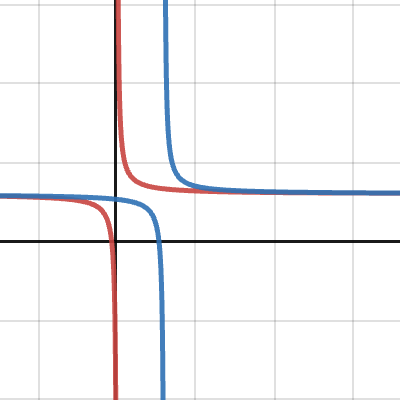 clever fjordBOT
Stumpman
 boreal star
but they have different VAs 🙂
boreal star
could i be ture?
 boreal star
how so?
boreal star
this is where I really don't like this definition, because actually yes it can, but you probably wont encounter it often
a function can cross it's HA
just not its VA
take
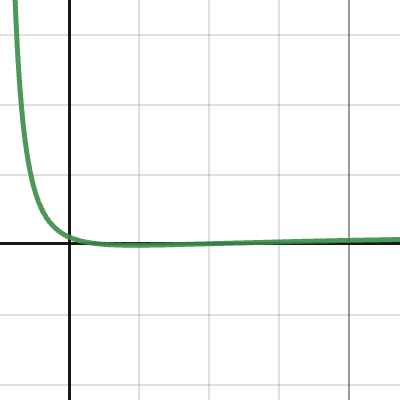
Desmos
this function passes through its VA before tending towards it again
onyx burrow
ok
boreal star
it's rare but happens so we cannot generalize for all f(x) 🙂
onyx burrow
so then it would be C.iii only
boreal star
that should be the correct answer unless they're not considering the advanced example of it passing it's HA in the x^2/x^2 example
boreal star
onyx burrow
so then it would be C.iii only
but also good job trying to justify your logic on i 🙂 it's an improtant idea in math to try to justify your answers
boreal star
boreal star
https://www.desmos.com/calculator/el5xcbf75c
if it was me, I would go with C, and if it is D ask your prof/teach about a case like this ^ and whether they're considering it
 boreal star
do you know what an oblique asymptote is?
boreal star
👍
odd edgeBOT
Channel closed
Closed by @onyx burrow
Use .reopen if this was a mistake.
boreal star
onyx burrow
ok thanks
your welcome!
odd edgeBOT
Available help channel!
Send your question here to claim the channel.
Remember:
• Ask your math question in a clear, concise manner.
• Show your work, and if possible, explain where you are stuck.
• After 15 minutes, feel free to ping <@&286206848099549185>.
• Type the command .close to free the channel when you're done.
• Be polite and have a nice day!
Read #❓how-to-get-help for further information on how to ask a good question, and about conduct in the question channels.
 charred plaza
how to find results for $x^6y^6-6x^3y^3+5$
clever fjordBOT
myfriendisahuman
 manic sleet
wdym "find results"?
manic sleet
well this is an expression, we cannot solve for y or x unless this is an equation
charred plaza
= 0
charred plaza
manic sleet
well this is an expression, we cannot solve for y or x unless this is an equatio...
.
.close
odd edgeBOT
Channel closed
Closed by @charred plaza
Use .reopen if this was a mistake.
Available help channel!
Send your question here to claim the channel.
Remember:
• Ask your math question in a clear, concise manner.
• Show your work, and if possible, explain where you are stuck.
• After 15 minutes, feel free to ping <@&286206848099549185>.
• Type the command .close to free the channel when you're done.
• Be polite and have a nice day!
Read #❓how-to-get-help for further information on how to ask a good question, and about conduct in the question channels.
 toxic sparrow
For what value of k does the equation (2k-1)x^2-8x+2=0 have two real and equal roots?
odd edgeBOT
toxic sparrow
For what value of k does the equation (2k-1)x^2-8x+2=0 have two real and equal r...
 void yew
discriminant >0
void yew
b^2 - 4ac>0
toxic sparrow
And it's asking for a specific value
void yew
oh hmm
toxic sparrow
For what value of K
void yew
Oh yeah there should only be 1
toxic sparrow
im sry could u explain pls?
 tropic copper

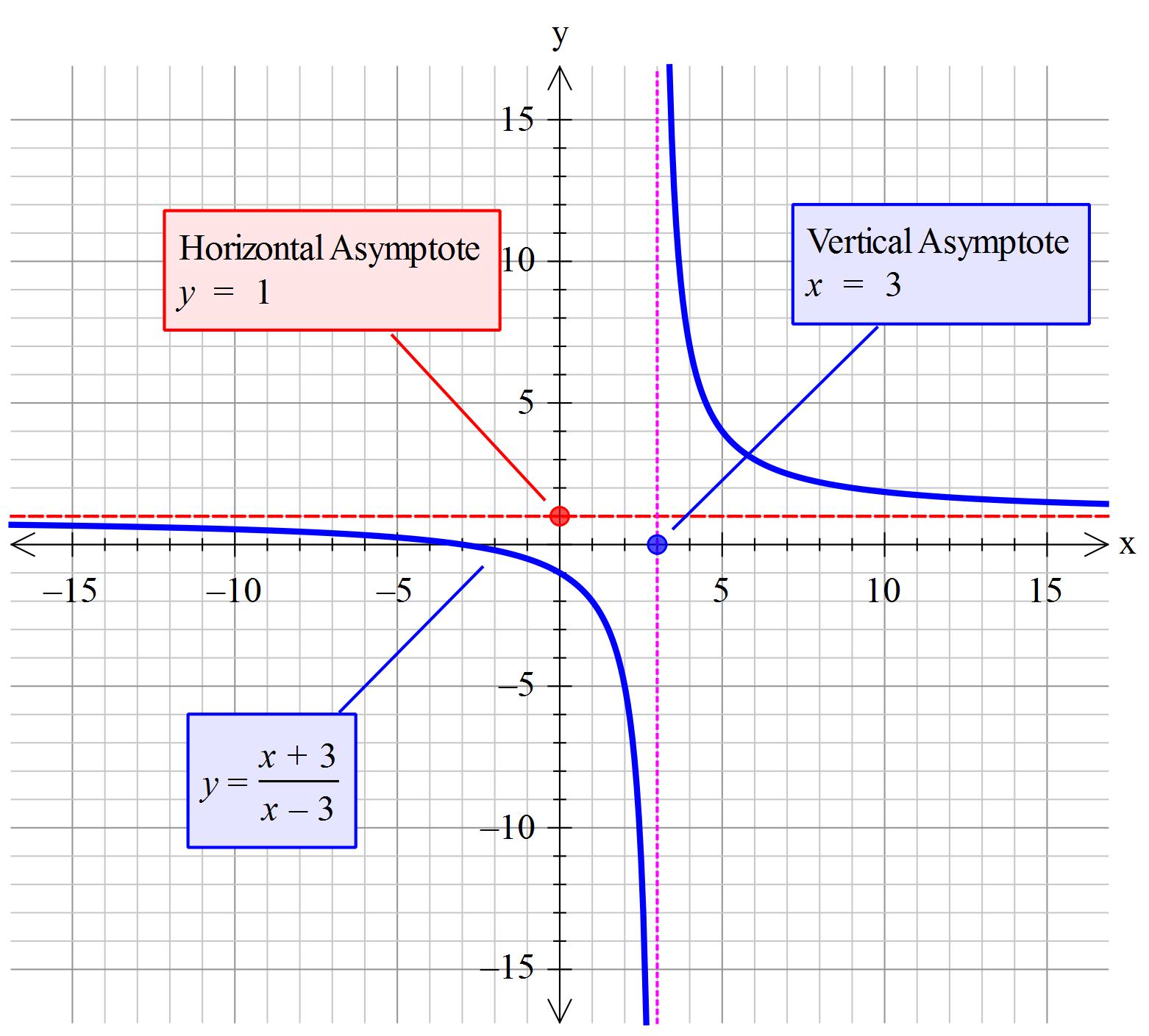
 clever fjordBOT
Bettim
 void yew
can't do all the work srry gainst the rules
toxic sparrow
ah alr
toxic sparrow
c=2?
void yew
Yup
void yew
clever fjord
**Bettim**
Plug in for a, b, c and then solve for k with this equation
toxic sparrow
I'll try and lyk ty
Does K = 7over2?
7/2
or 3.5?
Check help please
<@&286206848099549185>
Help please
Can u guys check my answer?
Or is it against the rules or smth?
.close
odd edgeBOT
Channel closed
Closed by @toxic sparrow
Use .reopen if this was a mistake.
Available help channel!
Send your question here to claim the channel.
Remember:
• Ask your math question in a clear, concise manner.
• Show your work, and if possible, explain where you are stuck.
• After 15 minutes, feel free to ping <@&286206848099549185>.
• Type the command .close to free the channel when you're done.
• Be polite and have a nice day!
Read #❓how-to-get-help for further information on how to ask a good question, and about conduct in the question channels.
mystic saffron
can someone help me understand this logic gate?
 odd edgeBOT
@mystic saffron Has your question been resolved?
Channel closed
Closed by @glossy swallow
Use .reopen if this was a mistake.
Available help channel!
Send your question here to claim the channel.
Remember:
• Ask your math question in a clear, concise manner.
• Show your work, and if possible, explain where you are stuck.
• After 15 minutes, feel free to ping <@&286206848099549185>.
• Type the command .close to free the channel when you're done.
• Be polite and have a nice day!
Read #❓how-to-get-help for further information on how to ask a good question, and about conduct in the question channels.
 covert minnow
 odd edgeBOT
covert minnow
mystic saffron
odd edgeBOT
covert minnow
mystic saffron
!status
odd edgeBOT
What step are you on?
1. I don't know where to begin
2. I have begun but got stuck midway
3. I got an answer but I'm told it's wrong
4. I got an answer and would like my work checked
5. I have a question about someone else's worked solution
6. None of the above
I started with the vertex
something like
x^2 +10
Then didn't know where to go after that
Checked answer, and it was this

absolutely no idea how it got there
mystic saffron
covert minnow
I started with the vertex
How did you find the vertex?
mystic saffron
You were right that you gotta find the vertex first
Remember the vertex is like a vertical line at x = h, where h is the x-coord of the vertex, which we actually can find
I'll draw a picture on sec
covert minnow
kk
mystic saffron

We can kind of guess the general shape of the parabola, ball goes up then goes back down with a max of 10
 covert minnow
Mhm
mystic saffron
You can find the h value in (h, k) [vertex] by taking half of 22, because the ball starts and stops at y = 1
 mystic saffron
That's where I'm stuck because the answer says (11, 9)
mystic saffron
Ohhhh
covert minnow
so it starts counting from 1
mystic saffron
👍
covert minnow
and it';s negative as it's going down
mystic saffron
Remember you can't use the vertex as (x, y) points when finding stretch factor
You good with vertex form?
covert minnow
I'm alright
mystic saffron
For reference:
y = a(x - h) + k
a = stretch factor
h = x-coord of vertex
k = y-coord of vertex
(x, y) = point on graph
(h, k) = vertex point
You can find the stretch factor by pluggin in an (x, y) point and solving through. Like (22, 1) or something
mystic saffron
covert minnow
(11, 9) x (22, 1)
What's this?
mystic saffron
mystic saffron
For reference:
y = a(x - h) + k
a = stretch factor
h = x-coord of vertex
k = y...
You can solve through for this one
Because you already found vertex (h, k)
And you know a point (22, 1) exists (where the ball stops)
covert minnow
But i don't get how we'd solve for stretch
mystic saffron
a = stretch
Algebra
1 = a(22 - 11)^2 + 9
One unkown, then you can just solve for a
covert minnow
OHhhhhhhhh
mystic saffron
Also, is there a possibility that the answer is incorrect? Back to the vertex's y-coord (9), shouldn't it be 10? The vertex is still a point on the graph, so it should be shown as a proper point
covert minnow
-9/121
wait
but it
It made it 0
so
k
k should be 10
making it so that y=1
that's a funky question
.close
odd edgeBOT
Channel closed
Closed by @covert minnow
Use .reopen if this was a mistake.
Available help channel!
Send your question here to claim the channel.
Remember:
• Ask your math question in a clear, concise manner.
• Show your work, and if possible, explain where you are stuck.
• After 15 minutes, feel free to ping <@&286206848099549185>.
• Type the command .close to free the channel when you're done.
• Be polite and have a nice day!
Read #❓how-to-get-help for further information on how to ask a good question, and about conduct in the question channels.
mystic saffron
A is a n×n square matrix. Here is my working. I am having trouble to find inverse of matrix (A+2I) in terms of A and I. Any hints?
 odd edgeBOT
mystic saffron
A is a n×n square matrix. Here is my working. I am having trouble to find invers...
odd edgeBOT
mystic saffron
A is a n×n square matrix. Here is my working. I am having trouble to find invers...
 fast spade
scenic rune
Can someone help me with this limit
fast spade
scenic rune
Can someone help me with this limit
Polar coords
odd edgeBOT
@mystic saffron Has your question been resolved?
mystic saffron
mystic saffron
A is a n×n square matrix. Here is my working. I am having trouble to find invers...
<@&286206848099549185>
 stiff glen
Yes sir, what can I do for you?
If you'd like a hint, here it is if you don't understand it please let me know.
To find the inverse of the matrix (A + 2I), where A is an n×n square matrix and I is the identity matrix of the same size, you can use the concept of matrix inversion. The inverse of a matrix (A + 2I) can be written as follows:
Inverse of (A + 2I) = (1/2) * (2I - A)
Here's the explanation of this result:
-
Start with the matrix (A + 2I).
-
To find its inverse, subtract 2I from it. This is because if (A + 2I) is the matrix you want to invert, you subtracting 2I from it will give you the identity matrix I.
-
To maintain the equation's integrity, multiply the result by (1/2). This step ensures that you are not changing the original equation, as you're effectively multiplying both sides by (1/2).
So, in terms of A and I, the inverse of (A + 2I) is given by:
Inverse of (A + 2I) = (1/2) * (2I - A)
This expression represents the inverse of the matrix (A + 2I) in terms of A and I.
Had a file saved for math subjects.
Just in case.
:)
mystic saffron
I don't even know about this method. I don't even think that it is correct because it clearly fails for A = [[0 1],[4 5]] @stiff glen
mystic saffron
mystic saffron
A is a n×n square matrix. Here is my working. I am having trouble to find invers...
Anyone else please
By inverse of some matrix A, I meant the one that goes by definition AA^(-1) = I
mystic saffron
<@&286206848099549185>
odd edgeBOT
@mystic saffron Has your question been resolved?
odd edgeBOT
Channel closed
Closed by @slim gust
Use .reopen if this was a mistake.
Available help channel!
Send your question here to claim the channel.
Remember:
• Ask your math question in a clear, concise manner.
• Show your work, and if possible, explain where you are stuck.
• After 15 minutes, feel free to ping <@&286206848099549185>.
• Type the command .close to free the channel when you're done.
• Be polite and have a nice day!
Read #❓how-to-get-help for further information on how to ask a good question, and about conduct in the question channels.
 floral stag
can i get some pointers on how to get started with the problem please

 hardy panther
floral stag
can i get some pointers on how to get started with the problem please
hardy panther
floral stag
can i get some pointers on how to get started with the problem please
Plug in x=4
Set them equal
Solve for c
floral stag
i get c^2+4c=-4
 latent scaffold
Factor it
odd edgeBOT
Channel closed
Closed by @floral stag
Use .reopen if this was a mistake.
Available help channel!
Send your question here to claim the channel.
Remember:
• Ask your math question in a clear, concise manner.
• Show your work, and if possible, explain where you are stuck.
• After 15 minutes, feel free to ping <@&286206848099549185>.
• Type the command .close to free the channel when you're done.
• Be polite and have a nice day!
Read #❓how-to-get-help for further information on how to ask a good question, and about conduct in the question channels.
 spring maple
how can i do this
 odd edgeBOT
spring maple
how can i do this
odd edgeBOT
spring maple
how can i do this
 ebon harness
@spring maple what is the difference between C2 and C1
And difference between C3 and C2
spring maple
12 and then 24?
will the difference between c3 and c4 be 36 then or possibly 48
just a guess
ebon harness
Seems like next difference will be 36
I counted 4th star to consist of 73 dots
Now try to generate a formula by this
spring maple
alright
im attempting one of the other questions
i will get back to this in around 10 - 15 minutes
odd edgeBOT
@spring maple Has your question been resolved?
spring maple
@ebon harness how do i do 6a
i think the forumla would be
uh
Cn = 12(n-1) + 1
right?
ebon harness
Let n=3 and see if its true @spring maple
spring maple
alright
ebon harness
You typed the formula as if this sequence is arithmetic
While difference is not a constant
Difference changes by 12 every time
ebon harness
Take a look at another sequence $a_n$ here:
1 3 5 7 9
Its like $a_n = 2n$
clever fjordBOT
Cyrenux
 ebon harness
Its 2n because difference between two consecutive terms is 2
spring maple
yes
ebon harness
But on your question thats not the case
spring maple
im sort of understanding?
ebon harness
So instead of typing in format of ' bn + 1' type like
'bn² + cn + 1' or something
spring maple
could you type out the formula and break it down for me please
ebon harness
Maybe the constant is not 1 so type d in place of it
ebon harness
Thats linear again
spring maple
uh
spring maple
Cn = 12(n-d)
ebon harness
What is the difference now
spring maple
i have no idea 😭
ebon harness
spring maple
Cn = 12(n-d)
Simplify this
spring maple
cn = 12n - 12d
ebon harness
Yeah so its not different from $c_n = an + b$ is it?
clever fjordBOT
Cyrenux
 spring maple
yep
ebon harness
I want you to type in format of:
$c_n = an² + bn + c$
clever fjordBOT
Cyrenux
 ebon harness
Type exactly like that
ebon harness
You know what $c_1$ $c_2$ and $c_3$ are so let n=1 then n=2 then n=3 to find the values of a,b and c