#help-19
1 messages · Page 5 of 1
 odd edgeBOT
 errant jay
torque is to do with rotation
if you apply a force in that direction
it won't apply any rotation to the wrench
hence no torque
 bright iris
suppose a 3d plane and you apply a force on the wrench, and it makes an angle theeta then Fsintheeta will also produce torque but not move
producing torque doesn't necessarily mean rotating the object
 quiet vector
you can move the force at it's line of action, by moving it to the screw no torque is made for the distance is 0
errant jay
bright iris
producing torque doesn't necessarily mean rotating the object
it does if there are no other torques
 fallow tapir
do you want a mathematical approach?
bright iris
errant jay
it does if there are no other torques
i don't quite get it
bright iris
fallow tapir
do you want a mathematical approach?
sure go ahead
bright iris
quiet vector
you can move the force at it's line of action, by moving it to the screw no torq...
yeah but in this case isn't it the same too?

 clever fjordBOT
Dyssrupt
 bright iris
yeah
fallow tapir
F cos(theta) to be specific
bright iris
yes
fallow tapir
the force Fcos(theta) and the r(vector) have an angle of?
odd edgeBOT
@bright iris Has your question been resolved?
fallow tapir
that is the r vector
 bright iris
errant jay
it does if there are no other torques
bright iris
errant jay
it does if there are no other torques
also i'm interested in this can you tell me more about it
fallow tapir
now what is the angle between r and fcos(theta)
bright iris
shit 0
fallow tapir
yes
errant jay
bright iris
also i'm interested in this can you tell me more about it
if an object is experiencing a net torque, it will experience angular acceleration
basically by definition
fallow tapir
and by cross product, we have torque = r.F.sin(theta)
now theta is 0
so torque is?
bright iris
bright iris
suppose a 3d plane and you apply a force on the wrench, and it makes an angle th...
no no i mean this case
i'm bad at taking cross product i already forgot
i know it's some determinant form but yeeah i forgot lol
fallow tapir
no
bright iris
errant jay
if an object is experiencing a net torque, it will experience angular accelerati...
but in this case the net angular accel is zero as well
 odd edgeBOT
Channel closed
Closed due to timeout
Use .reopen if this was a mistake.
clever fjordBOT
Dyssrupt
 bright iris
.reopen
odd edgeBOT
✅
bright iris
clever fjord
**Dyssrupt**
okay and?
clever fjordBOT
Dyssrupt
 fallow tapir
where theta is the angle between r and F
 eternal lily
Hi
odd edgeBOT
eternal lily
Hi
This channel is only for on-topic discussion. Please take casual conversation to #discussion or #chill.
@bright iris Has your question been resolved?
odd edgeBOT
Channel closed
Closed due to timeout
Use .reopen if this was a mistake.
odd edgeBOT
 Available help channel!
Send your question here to claim the channel.
Remember:
• Ask your math question in a clear, concise manner.
• Show your work, and if possible, explain where you are stuck.
• After 15 minutes, feel free to ping <@&286206848099549185>.
• Type the command .close to free the channel when you're done.
• Be polite and have a nice day!
Read #❓how-to-get-help for further information on how to ask a good question, and about conduct in the question channels.
 small moat
Yo can someone help me
odd edgeBOT
small moat
Yo can someone help me
 small moat
 north crow
with -1
north crow
with -1
-2,458?
clever fjordBOT
TimK
 small moat
north crow
do you know what is $49c^2$ when c = -1?
small moat
north crow
do you know what is $49c^2$ when c = -1?
-49 x -49 is 2401
small moat
how???
north crow
cause $49c^2 = 49 * c^2$
clever fjordBOT
TimK
 small moat
tbh yeah cuz either way this is a missing assignment
small moat
north crow
it is...
Thank u bro
north crow
no problem...
odd edgeBOT
@small moat Has your question been resolved?
Channel closed
Closed by @small moat
Use .reopen if this was a mistake.
Available help channel!
Send your question here to claim the channel.
Remember:
• Ask your math question in a clear, concise manner.
• Show your work, and if possible, explain where you are stuck.
• After 15 minutes, feel free to ping <@&286206848099549185>.
• Type the command .close to free the channel when you're done.
• Be polite and have a nice day!
Read #❓how-to-get-help for further information on how to ask a good question, and about conduct in the question channels.
odd edgeBOT
@signal oar Has your question been resolved?
 signal oar
<@&286206848099549185>
odd edgeBOT
@signal oar Has your question been resolved?
signal oar
.close
odd edgeBOT
Channel closed
Closed by @signal oar
Use .reopen if this was a mistake.
odd edgeBOT
Available help channel!
Send your question here to claim the channel.
Remember:
• Ask your math question in a clear, concise manner.
• Show your work, and if possible, explain where you are stuck.
• After 15 minutes, feel free to ping <@&286206848099549185>.
• Type the command .close to free the channel when you're done.
• Be polite and have a nice day!
Read #❓how-to-get-help for further information on how to ask a good question, and about conduct in the question channels.
 glad aurora
 odd edgeBOT
glad aurora
north crow
odd edgeBOT
glad aurora
north crow
what is tan(x)'s period?
clever fjordBOT


 odd edgeBOT
As a helper, please do not give out answers that could be copied as a homework solution. Have the student work through the problem themselves and guide them along the way.
glad aurora
odd edge
As a helper, please do not give out answers that could be copied as a homework s...
i understand that
i understood it
glad aurora
clever fjord
i did not understand this graph tho
glad aurora
north crow
pi/3
??
north crow
glad aurora
i did not understand this graph tho
look at the period
when you multiply the argument by some a, you squeesh it by a horizontally
meaning /a period
odd edgeBOT
Channel closed
Closed by @glad aurora
Use .reopen if this was a mistake.
odd edgeBOT
Available help channel!
Send your question here to claim the channel.
Remember:
• Ask your math question in a clear, concise manner.
• Show your work, and if possible, explain where you are stuck.
• After 15 minutes, feel free to ping <@&286206848099549185>.
• Type the command .close to free the channel when you're done.
• Be polite and have a nice day!
Read #❓how-to-get-help for further information on how to ask a good question, and about conduct in the question channels.
 gritty jolt
hi i have a question cna someone help
odd edgeBOT
gritty jolt
hi i have a question cna someone help
gritty jolt
mr dick the sparow flies to see his freind at a speed of 4 /km
when he reaches there his freind turns out to be a bitch and leave his home
so mr dick flies home at speed of 5
 cold sage

fallow tapir
bruh wtf
gritty jolt
the omplete journey took 54 mins
 topaz moth
gritty jolt
mr dick the sparow flies to see his freind at a speed of 4 /km
topaz moth
gritty jolt
mr dick the sparow flies to see his freind at a speed of 4 /km
4 per kilometer is an... interesting speed
gritty jolt
how far does that bitch lives
topaz moth
this aint math this meth
gritty jolt
lol so help me solve it
gritty jolt
oh what the book says that
 scarlet junco
Send a picture
gritty jolt
uhm
cold sage
cant be done
 summer cradle
💀
cold sage
'4 /km' and '5' arent speeds
gritty jolt
wdym
gritty jolt
i dont want awnser i want how to do it
speed is 4 when he is going to hsi freind and 5 when coming back
total time taken was 54 mins
topaz moth
let distance between him and bitch be d
scarlet junco
His friend ?
topaz moth
add the times of him going and coming back and equate it to the total time
 sand night
so assume mr dick the sparow flies with respect to air resistance in the eastern direction, you can assume he is flying the air. you then know that he is flying 4 km there and 5 km back with a total time of 54 minutes. if you do a little bit of shanaganz you can find 2.
gritty jolt
topaz moth
add the times of him going and coming back and equate it to the total time
wahts equate
u mean ad 4+5 =9 then divide it by total time taken ?
@topaz moth
@sand night
help
topaz moth
helluva drug
gritty jolt
what
did i do
come on tell me where i msd up
@topaz moth plss
@radiant merlin
yo can u help pls
fallow tapir
dont tag random helpers.
topaz moth
gritty jolt
come on tell me where i msd up
no. i meant to add the time of his journey to and from and then equate it to 54 minutes
fallow tapir
'actually'
gritty jolt
yes
fallow tapir
its still random
topaz moth
let distance between houses be d and use distance/speed = time
gritty jolt
topaz moth
no. i meant to add the time of his journey to and from and then equate it to 54 ...
wdym by equate
oh
so
d=9+54
ye i dotn think its right
topaz moth
d/5 + d/4 = 54/60
gritty jolt
why is 54 divided by 60
topaz moth
well i know that per kilometre is not a unit of speed so since you are on speed i assumed that the speeds are 4 and 5 kilometers/hour so i also need time to be in hours
gritty jolt
ohhh
sorry about that
we dont have distance value so i cant divie d/4 d/5
since they are in fraction
it wil be d/9 9/10
54/60=9/10
what do i do next
@topaz moth
is that right i u msg up again
odd edgeBOT
@gritty jolt Has your question been resolved?
odd edgeBOT
Channel closed
Closed due to timeout
Use .reopen if this was a mistake.
Available help channel!
Send your question here to claim the channel.
Remember:
• Ask your math question in a clear, concise manner.
• Show your work, and if possible, explain where you are stuck.
• After 15 minutes, feel free to ping <@&286206848099549185>.
• Type the command .close to free the channel when you're done.
• Be polite and have a nice day!
Read #❓how-to-get-help for further information on how to ask a good question, and about conduct in the question channels.
 crimson plume
Hey there I have a problem and don't know where to start. Jimmy John's delivers pizza. You can figure out if jimmy johns will deliver to your house by taking the coordinates of your house, (x,y), and plugging it into the expression (x-6)^2 + (y-9)^2. If your answer is less than or equal to 49, they will deliver. Where is Jimmy johns located? What is its delivery radius?
odd edgeBOT
crimson plume
Hey there I have a problem and don't know where to start. Jimmy John's delivers ...
@crimson plume Has your question been resolved?
crimson plume
<@&286206848099549185>
north crow
what is the formula of a distance in x-y axises?
ok, so basically the formula for a distance is $\sqrt({(x_2-x_1)^2 + (y_2-y_1)^2})$
clever fjordBOT
TimK
 north crow
and it is equal to 49 (without sqrt)
with sqrt it is 7
so distance is 7
or less
we got the radius, 7
and the coordinates are known cause of the formula
(6,9)
that's what you needed?
odd edgeBOT
@crimson plume Has your question been resolved?
odd edgeBOT
Channel closed
Closed due to timeout
Use .reopen if this was a mistake.
Available help channel!
Send your question here to claim the channel.
Remember:
• Ask your math question in a clear, concise manner.
• Show your work, and if possible, explain where you are stuck.
• After 15 minutes, feel free to ping <@&286206848099549185>.
• Type the command .close to free the channel when you're done.
• Be polite and have a nice day!
Read #❓how-to-get-help for further information on how to ask a good question, and about conduct in the question channels.
 winter hound
i don't understand khan academy theorem on finding limits of composition of functions
odd edgeBOT
winter hound
i don't understand khan academy theorem on finding limits of composition of func...
clever fjordBOT
alshfik
 winter hound
- $\lim g(x)$ exists and (2) $f(x)$ is continuous at $\lim g(x)$
clever fjordBOT
alshfik
 winter hound
"if and only if" seems to strong of a condition here, and i'll give my counterexample so someone can tell me what's wrong with it
let us define $f(1)=2$ and for the rest of the values $f(x)=|x|$
 raw palm
this isnt a map?
clever fjordBOT
alshfik
 winter hound
raw palm
this isnt a map?
winter hound
raw palm
this isnt a map?
wdym, domain R codomain R
$lim_{x \to -1}f(f(x))$ is surely equal to $1$?
raw palm
nvm continue
clever fjordBOT
alshfik
 raw palm
no
winter hound
no?
raw palm
$\lim_{x\to -1}{f(f(x))}=f(1)=2$
clever fjordBOT
calculus is fun

 weary pelican
raw palm
$\lim_{x\to -1}{f(f(x))}=f(1)=2$
weary pelican
raw palm
$\lim_{x\to -1}{f(f(x))}=f(1)=2$
f is not continuous at 1
winter hound
oh ok this makes sense
raw palm
but it is defined to be 2 there
weary pelican
raw palm
but it is defined to be 2 there
And $\lim_{x\to 1}(f(x)) = 1$
winter hound
i misinterpreted what the theorem said, that was my mistake
clever fjordBOT
rafilou2003
 winter hound
i misinterpreted what the theorem said, that was my mistake
winter hound
winter hound
i misinterpreted what the theorem said, that was my mistake
i automatically assumed if the theorem did not apply the limit does not exist
^so im guessing this assumption of mine is false?
raw palm
weary pelican
And $\lim_{x\to 1}(f(x)) = 1$
because?
raw palm
weary pelican
Because f(x) = |x| when x deq 1
yea this is for x neq 1
weary pelican
raw palm
yea this is for x neq 1
Yes, and so the limit of that is 1
f is not continuous at 1
$\lim_{x\to 1}(f(x)) = \lim_{x\to 1,x\neq 1}(f(x)) = 1$
clever fjordBOT
rafilou2003
 weary pelican
clever fjord
**alshfik**
weary pelican
clever fjord
**alshfik**
This is correct
raw palm
but wait a sec
weary pelican
clever fjord
**alshfik**
Here one of the two conditions isn't met
So lim f(f(x)) is not f(1)
raw palm
f(-1)=1 yes?
weary pelican
Because f is not continuous at 1
weary pelican
raw palm
f is continuous at -1 there is no problem there
f is not continuous at lim_{-1}(f(x)) = 1
winter hound
raw palm
so you can just sub x=-1
x=1 you mean
remember f(x)=|x| for nonone values of x
raw palm
winter hound
x=1 you mean
no i mean -1 you are gettin lim as x to -1
raw palm
weary pelican
f is not continuous at lim_{-1}(f(x)) = 1
why is it not continuous there
it is continuous at -1 i dont see a problem
weary pelican
raw palm
why is it not continuous there
As we saw, lim_{1}(f(x)) = 1 and f(1) = 2
So f is not continuous at 1, which is also lim_{-1}(f(x))
raw palm
no
weary pelican
No what?
raw palm
f is not continuous at 1 means it isnt ontinuous in this expression $\lim_{x\to -1}{f(f(x))}$
clever fjordBOT
calculus is fun
 weary pelican
You're not allowed to write $\lim_{x\to -1}(f(f(x)) = f(\lim_{x\to -1}(f(x)))$ because f is not continuous at $\lim_{x\to -1}(f(x)) = 1$
clever fjordBOT
rafilou2003
 raw palm
but f is continuous there
winter hound
guys ima need to close the help channel mind moving to another channel?
raw palm
you just said it isnt continuous there but then wrote the result of the limit as f(-1)
weary pelican
raw palm
you just said it isnt continuous there but then wrote the result of the limit as...
f is not continuous at 1
furthermore, we have lim_{-1}f(x) = 1
raw palm
winter hound
guys ima need to close the help channel mind moving to another channel?
when we are done we will close it
winter hound
oh you have close perms fine
raw palm
weary pelican
so f is not continuous at f(-1)
i agree with this
weary pelican
Do you understand the difference?
raw palm
ik i am telling this from the start
weary pelican
f is not continuous at the POINT lim_{-1}f(x)
Which is not the same as
"f is not continuous in this expression lim(...)"
weary pelican
clever fjord
**alshfik**
See the second condition here?
f is not continuous at lim(g(x))
raw palm
weary pelican
f is not continuous at the POINT lim_{-1}f(x)
Which is not the same as
"f is not...
my wording was trash but i meant that it isnt continuous at f(-1)
weary pelican
Replace g by f
raw palm
raw palm
so f is not continuous at f(-1)
i said this here so yea
weary pelican
So do we agree that f is not continuous at the point lim_{-1}f(x)?
raw palm
but i slipped on the fact that we are subbing f(-1) which f is discontinuous at
weary pelican
Yes ok
raw palm
so yea the example doesnt satisfy the condition
weary pelican
.close
odd edgeBOT
Channel closed
Closed by @weary pelican
Use .reopen if this was a mistake.
raw palm
can you check my question on my channel if youhave time
odd edgeBOT
Available help channel!
Send your question here to claim the channel.
Remember:
• Ask your math question in a clear, concise manner.
• Show your work, and if possible, explain where you are stuck.
• After 15 minutes, feel free to ping <@&286206848099549185>.
• Type the command .close to free the channel when you're done.
• Be polite and have a nice day!
Read #❓how-to-get-help for further information on how to ask a good question, and about conduct in the question channels.
 magic quail
i need help getting started
 odd edgeBOT
magic quail
i need help getting started
magic quail
odd edgeBOT
magic quail
i need help getting started
magic quail
do i use y=a(x-h)^2+k to find a
i dont even know how im supposed to find c
i know x=-4 and x=-1
when x=-1 y=0?
someone help pls
 worn sandal
magic quail
i dont even know how im supposed to find c
worn sandal
magic quail
i dont even know how im supposed to find c
C is the y-intercept
Because when f(0)=C
but that's not helpful here
worn sandal
magic quail
do i use y=a(x-h)^2+k to find a
so yeah use this
worn sandal
Well, we know $f(-4)=f(-1)=0$, so I'd start by plugging those in.
clever fjordBOT
Ari
 worn sandal
$f(-4)=16A+16+C=0$ and $f(-1)=A+4+C=0$
clever fjordBOT
Ari
 magic quail
y=a(-1)^2-4(-1)+0?
worn sandal
If you compare these equations, you can see that this means $16A+16=A+4$, so $15A=-12$, $A=-\frac45$.
clever fjordBOT
Ari
 worn sandal
magic quail
y=a(-1)^2-4(-1)+0?
worn sandal
magic quail
y=a(-1)^2-4(-1)+0?
correct
but I would use f(-1) to be more clear in your work
worn sandal
-4/5
magic quail
where does the 5 come from
worn sandal
view my work above
magic quail
i dont get it
magic quail
are we plugging in -4,0 and -1,0
worn sandal
Yes that's how I got these
 magic quail
and solving 2 equations
worn sandal
do you get this part so far
worn sandal
yes good
Now this basically a system of equations right
so you can solve for a and c
magic quail
so do i set them equal to each other
worn sandal
that's right
that's the same thing as -4/5 after simplifcation
so now plug that in and solve for C
worn sandal
A itself is a coefficient so it doesn't have x
A=-4/5
but when written in the function
Ax^2 = -4/5 * x^2
worn sandal
magic quail
x=-b/2a is that how i solve for c
actually you could have also done it from the beginning
You're not given the coordinates of the vertex, but you know the zeroes are at -4 and -1
so the axis of symmtry, aka -b/2a, is just the average of -4 and -1, which is -5/2
and you know that b=-4
worn sandal
magic quail
just plug in -4,0 for c
sure
magic quail
.close
odd edgeBOT
Channel closed
Closed by @magic quail
Use .reopen if this was a mistake.
odd edgeBOT
Available help channel!
Send your question here to claim the channel.
Remember:
• Ask your math question in a clear, concise manner.
• Show your work, and if possible, explain where you are stuck.
• After 15 minutes, feel free to ping <@&286206848099549185>.
• Type the command .close to free the channel when you're done.
• Be polite and have a nice day!
Read #❓how-to-get-help for further information on how to ask a good question, and about conduct in the question channels.
 terse lantern
 odd edgeBOT
terse lantern
terse lantern
odd edgeBOT
terse lantern
terse lantern
What is the "sufficient condition"? Is it that the limit (following) must exist?

And if so, the limit existing means that at no point within the region the function becomes undefined?
 desert marlin
The limit existing does not mean that. Take (x-1)/(x-1) as an example, x=1 is undefined yet it is still integrable. The limit existing means that the Riemann sums converge.
“If the function is bounded and continuous over R except on a finite number of smooth curves, then the double integral exists and we say that f is integrable over R”
This is what I found online, it seems sufficient to me. I couldn’t think of a better way to reword it
@terse lantern
odd edgeBOT
@terse lantern Has your question been resolved?
odd edgeBOT
Channel closed
Closed due to timeout
Use .reopen if this was a mistake.
Available help channel!
Send your question here to claim the channel.
Remember:
• Ask your math question in a clear, concise manner.
• Show your work, and if possible, explain where you are stuck.
• After 15 minutes, feel free to ping <@&286206848099549185>.
• Type the command .close to free the channel when you're done.
• Be polite and have a nice day!
Read #❓how-to-get-help for further information on how to ask a good question, and about conduct in the question channels.
 small acorn
Given the claim: Let n, c and p be positive integers such that c divides 10^p. Then c divides n if and only if c divides the (value of the) last p digits of n.
I am trying to write a direct proof of this but I am also not sure what is meant by "with both directions done simultaneously".
odd edgeBOT
small acorn
Given the claim: Let n, c and p be positive integers such that c divides 10^p. T...
small acorn
I understand that "both directions" is used when you have a proof that is if and only if
where A implies B and B implies A
but I am not sure how to really start the proof. I think I start with the definition of base 10 so d_k*10^k + .. + d_p10^p + .. d_0
but not sure how to move forward
So c | n <=> c | last p digits of n, and c | 10^p
weary pelican
Can you perhaps write "last p digits of n" mathematically?
small acorn
So like d_p10^p + d_p-1 * 10^p-1 so on?
weary pelican
let's try it differently
do you know how to express "n without its last p digits"?
weary pelican
small acorn
so if n = 100, and p = 2, its last p digits are 0
This is true
Here's maybe what I want you to express
if n=1683 and p = 2, then I want to express 1600 only in terms of n and p
start maybe by 16
(hint : use the floor function)
@small acorn want a bit of a help?
small acorn
yes
weary pelican
ok
small acorn
i never used floor function before
weary pelican
what is 1683/100
small acorn
16.83
small acorn
yeah 16.00
small acorn
yeah 1600
small acorn
so n/10^p first
weary pelican
yep
small acorn
but how do i express last p digits of n
weary pelican
well keep going
weary pelican
weary pelican
what is 1683/100
so this is generalized to n/10^p
small acorn
yeah
weary pelican
what's the next step?
small acorn
floor it
small acorn
n - floor(n/10^p)
weary pelican
you skipped a step
weary pelican
Correct!
 weary pelican
argh, let's finish the floor and proceed with a different reasoning
small acorn
alright
weary pelican
(btw it will literally be the same reasoning written without using floor function)
small acorn
oh i see
weary pelican
So (last p digits of n) = $n - 10^p\cdot floor(\frac{n}{10^p})$
small acorn
yeah i got that
weary pelican
woops
clever fjordBOT
rafilou2003
 weary pelican
but floor(...) is an integer
small acorn
yeah
weary pelican
so 10^p * floor(...) is divisible by...
small acorn
c
weary pelican
exactly
small acorn
which is an int
weary pelican
let's write m = 10^p*floor(...)
we want thus to show that c|n if and only if c|(n-m)
knowing that c|m...
you see how this now becomes trivial or do you need the next part of the reasoning?
small acorn
sorry i just started learning proofs so still understanding it all
weary pelican
ok
weary pelican
weary pelican
we want thus to show that c|n if and only if c|(n-m)
let's suppose that c|n. Why does c|(n-m)?
small acorn
since that is the last p digits of n
weary pelican
no this isn't what we're looking for in order to prove this
c|n by supposition. But we also have c|m
So c divides their...
small acorn
idk
weary pelican
c divides their difference
small acorn
i see
weary pelican
so c divides n-m, which is what we wanted to prove
small acorn
yeah
weary pelican
let's try the other way around
still knowing that c|m, suppose that c|(n-m)
why does c|n?
small acorn
c | n - m + m
weary pelican
yes!
and thus c|n
we've proven the implication both ways, so we've proven the equivalence
small acorn
yea
weary pelican
So, let's do the other proof which gets rid of floor function
let's start by writing n in base 10, $n = \sum_{k=0}^Nd_k10^k$
clever fjordBOT
rafilou2003
 small acorn
yeah i did that before
small acorn
not sure how to write it from that
small acorn
small acorn
but I am not sure how to really start the proof. I think I start with the defin...
i wrote it like this
weary pelican
sure
so I'll change the final index
let's start by writing n in base 10, $n = \sum_{i=0}^kd_i10^i = \sum_{i=0}^{p-1}d_i10^i+\sum_{i=p}^kd_i10^i$
clever fjordBOT
rafilou2003
 weary pelican
@small acorn from this, can you guess which part is "the last p digits of n"?
small acorn
3rd one right?
weary pelican
Which digit here corresponds to the last digit of n, the unit digit?
small acorn
0
weary pelican
yes
the last digit, i=0, is part of the p last digits
The 2nd last digit is for i =?
small acorn
1
weary pelican
yes...
So the p-th last digit is for i=?
Let's recall :
Last digit (or 1st last digit) is for i = 0
2nd last digit is for i = 1
small acorn
p-1?
weary pelican
small acorn
p-1?
Yes!
So the "p last digits" goes from i=0 to i=p-1
Which corresponds to?
weary pelican
clever fjord
**rafilou2003**
If we look back here
small acorn
the 2nd one right?
weary pelican
Yes the middle one
small acorn
yeah
weary pelican
What about the 3rd one? Can you maybe show if it's divisible by 10^p?
small acorn
sorry i never worked with sums so not sure how to manipulate it that well to show anything
ill try though
give me a second
weary pelican
small acorn
sorry i never worked with sums so not sure how to manipulate it that well to sho...
You can write it as $d_p10^p+d_{p+1}10^{p+1}+...+d_k10^k$ if it's easier
clever fjordBOT
rafilou2003
 small acorn
yeah this is where i was stuck at i think when i first tried, i didnt know how to express c | 10^p and such in the proof
weary pelican
I have to go soon but basically $d_p10^p+d_{p+1}10^{p+1}+...+d_k10^k = 10^p(d_p+d_{p+1}10^{1}+...+d_k10^{k-p})$
clever fjordBOT
rafilou2003
 small acorn
oh so you factor it out
weary pelican
yes
small acorn
but its written dk10^k-p?
weary pelican
small acorn
but its written dk10^k-p?
well yeah if you factor by 10^p
the bot is not working for some reason
$dp10^p+d{p+1}10^{p+1}+...+d_k10^k = 10^p(dp+d{p+1}10^{1}+...+d_k10^{k-p})$
small acorn
oh i see
weary pelican
,help
clever fjordBOT
A brief description and guide on how to use me was sent to your DMs!
Please use ,list to see a list of all my commands, and ,help cmd to get detailed help on a command!
weary pelican
$d_p10^p+d_{p+1}10^{p+1}+...+d_k10^k = 10^p(d_p+d_{p+1}10^{1}+...+d_k10^{k-p})$
eh anyways
so n = (last p digits of n) + 10^p*...
and the proof follows easily
small acorn
so how would you express the last p digits of n in terms of digits?
small acorn
weary pelican
and the proof follows easily
yeah i think i know how to do it after
but i dont know how to include c into that
clever fjordBOT
rafilou2003
 weary pelican
small acorn
so how would you express the last p digits of n in terms of digits?
weary pelican
small acorn
so how would you express the last p digits of n in terms of digits?
$\sum_{i=0}^{p-1}d_i10^i$, so in digits it looks like $\overline{d_{p-1}...d_1d_0}^{10}$
small acorn
i see ok
clever fjordBOT
rafilou2003
 small acorn
what does the line on top and the 10 mean?
weary pelican
small acorn
what does the line on top and the 10 mean?
the line is to make the difference between "multiplication" and "digits glued together"
the 10 stands for "base 10"
small acorn
i see
so $n = \overline{d{p-1}...d_1d_0}^{10} + 10^p(dp+d{p+1}10^{1}+...+d_k10^{k-p})$
clever fjordBOT
42
 small acorn
but how woudl you add c to that
small acorn
cause then this can become $n = \overline{d{p-1}...d_1d_0}^{10} + 10^p j , j\in\bZ$
oops
clever fjordBOT
42
 small acorn
ok there
weary pelican
Yes
weary pelican
So since $c|10^p$, $n = \overline{d_{p-1}...d_1d_0}^{10} + (cm) j , j,m\in\bZ$
clever fjordBOT
rafilou2003
 weary pelican
well c is c
small acorn
yea
weary pelican
n = (last p digits of n) + (something divisible by c)
So c|n <=> c|(last p digits of n)
small acorn
yea i got taht
you dont need to write it as (cm)j
and you dont need the mj anymore
then u are left with n = last p digits of n + c
wait
weary pelican
small acorn
then u are left with n = last p digits of n + c
No this isn't true
The mj is required
small acorn
n/c = (last p digits n)/c + mj, jm e Z
weary pelican
small acorn
n/c = (last p digits n)/c + mj, jm e Z
No let's not complicate things
weary pelican
clever fjord
**rafilou2003**
Let's go back to this
small acorn
this is what i did in my proof in my lecture
 weary pelican
Have you seen congruence yet?
small acorn
weary pelican
Have you seen congruence yet?
not yet no
weary pelican
Ok
weary pelican
small acorn
this is what i did in my proof in my lecture
If this is accepted then ok
weary pelican
small acorn
n/c = (last p digits n)/c + mj, jm e Z
So n/c integer <=> (last digits)/c integer
This does it
small acorn
yeah
ok thank you so much
now i need to write this all down in a final copy ahha
although i have one last small question which shouldnt take long
just 5 more minutes if u can
this is what my prof is asking
 weary pelican
well try with chat GPT and see what it says
small acorn

this is what i got
i dont think it was correct though
since it doesnt properly show the final statement
but im like not 100% sure
weary pelican
the final statement is correct
however, see that chatGPT makes the same mistake as one might do
the p last digits stop at a_p10^p
while they're supposed to stop at...
small acorn
wait isnt that right? since its decreasing to a_0, so its going from a_p10^p to a_010^0?
weary pelican
small acorn
wait isnt that right? since its decreasing to a_0, so its going from a_p10^p to ...
Count how many digits there are here
weary pelican
weary pelican
Which digit here corresponds to the last digit of n, the unit digit?
If you remember what we did back here
small acorn
oh its supposed to be p-1?
small acorn
oh its counting an extra digit
weary pelican
If you stop at a_p10^p, you're counting the last p**+1** digits
small acorn
yeah that makes sense
so if n has 5 digits
and p = 3
ur counting 1 extra digit according to chatgpt
small acorn
I see, thank you so much for all the help
I am slowly understanding proofs more, although it is still quite difficult
odd edgeBOT
@small acorn Has your question been resolved?
Channel closed
Closed by @small acorn
Use .reopen if this was a mistake.
Available help channel!
Send your question here to claim the channel.
Remember:
• Ask your math question in a clear, concise manner.
• Show your work, and if possible, explain where you are stuck.
• After 15 minutes, feel free to ping <@&286206848099549185>.
• Type the command .close to free the channel when you're done.
• Be polite and have a nice day!
Read #❓how-to-get-help for further information on how to ask a good question, and about conduct in the question channels.
 mystic saffron
This looks right to me
 odd edgeBOT
mystic saffron
This looks right to me
odd edgeBOT
mystic saffron
This looks right to me
 clever fjordBOT
What should I do

 tardy lagoon
proving the sequence approaches 0 is not sufficient to prove the series being convergent
for example the harmonic series $\sum_{n=1}^\infty\frac{1}{n}$ diverges even though $\lim_{n\to \infty}\frac{1}{n}=0$
clever fjordBOT
WhereWolf(ping if needed)
 mystic saffron
😭
that is so dumb
I HATE SERIES
AAAAAAAAAAAAAAAAAAAAAAAAAAAAAAAAAAAAAAAAAAAAAAAAAAA
TY
.close
odd edgeBOT
Channel closed
Closed by @spare epoch
Use .reopen if this was a mistake.
odd edgeBOT
Available help channel!
Send your question here to claim the channel.
Remember:
• Ask your math question in a clear, concise manner.
• Show your work, and if possible, explain where you are stuck.
• After 15 minutes, feel free to ping <@&286206848099549185>.
• Type the command .close to free the channel when you're done.
• Be polite and have a nice day!
Read #❓how-to-get-help for further information on how to ask a good question, and about conduct in the question channels.
 silent jetty
Unsure where to begin here.
 odd edgeBOT
silent jetty
Unsure where to begin here.
silent jetty
odd edgeBOT
silent jetty
Unsure where to begin here.
silent jetty
Any ideas?
 nocturne belfry
well you could find the centroid of each individual piece of the composite shape
then treat them as point masses, and find the center of mass from these
nocturne belfry
just like it sounds, a point with mass
its non-physical
but you do a lot of physics/math with them
like projectile motion is usually a point mass
what class is this?
silent jetty
Calc 2.
nocturne belfry

silent jetty
?
nocturne belfry
well okay lets start here
nocturne belfry
silent jetty
Calc 2.
i was hoping it wasnt calc and we could just use pre-existing formulas
rather than derive them
@silent jetty can you see the two simpler sub-shapes here
silent jetty
Yes.
nocturne belfry
one of them you can find the centroid of without any calculus
silent jetty
Semicircle and a rectangle.
silent jetty
Oof, I wish I could be more help here. We just got onto centroids yesterday and haven’t covered much at all.
nocturne belfry
so here, the density is constant, yea?
silent jetty
Yes.
nocturne belfry
the centroid is just the place where if you put a pencil, the shape would be balanced
center of mass
but density is constant
silent jetty
Okay that makes sense.
nocturne belfry
so you can think of it like
okay its a two dimensional shape
to find the x coordinate of the centroid
you need to average every x-coordinate in the entire shape
and similarly for the y
you can do this with calculus
but you dont need it for the rectangle
whats the average x coordinate of the rectangle?
silent jetty
silent jetty
nocturne belfry
❌
silent jetty
?
nocturne belfry
for the rectangle?
silent jetty
-1?
nocturne belfry
no
silent jetty
Hm.
nocturne belfry
okay so maybe we do the easier one with calculus
silent jetty
What is the average y component of the rectangle?
nocturne belfry
yea
silent jetty
I’m asking. Maybe I can work my way backwards if I know the value I’m looking for.
nocturne belfry
lets work through it

heres an image that doesnt 100% match up with yours, but it will work
lets take that little slice, dL, to be some very very tiny vertical slice of your rectangle
whats the vertical center of that rectangle?
the rectangle goes from 0 up to H
whats halfway between?
silent jetty
H/2?
nocturne belfry
yea
we could ask now like
do you see some reason that this wouldnt be true if instead of some slice, we just looked at the entire rectangle?
silent jetty
No. This should be true for the whole of the rectangle.
nocturne belfry
yea
silent jetty
Is there a formula or something I could use with these points to find the centroid?
Or is this something that would need to be broken up into sub shapes?
nocturne belfry
i guess you could
you can just use double integration
here the x coordinate of the centroid is obvious
so you could just use integration
youll need to determine where the vertical midpoint is, given some x
of the entire shape
which i think you can do, its going to involve trig functions
the idea is, you create some midpoint formula given x, say M(x)
which gives you the vertical midpoint at some horizontal position
then, you average the value of this function over the range of x
so here it'd look like $\frac{1}{1-(-1)} \int _{-1} ^{1} M(x) \dd x$
clever fjordBOT
jan Niku
 nocturne belfry
@silent jetty can you think of that function though?
silent jetty

nocturne belfry
dont sadcat lol
silent jetty
I cannot. Lol
nocturne belfry
well okay think like this
you know it at a few points, right?
like whats the M(1)
or M(0)
M(1) looks like -1/2
so does M(-1)
whats M(0)?
the midpoint of just that very think vertical slice at x=0

the very thin vertical slice at x=0 looks just like a rectangle
and it goes from y=-1 to y=1
silent jetty
Right I can imagine that.
nocturne belfry
alright
so a very thin rectangle sits there
whats the vertical midpoint of that rectangle?
silent jetty
0?
nocturne belfry
yea
Can you convince yourself that center of mass for some thin vertical rectangle is just the midpoint?
i mean between the top of the circle and the bottom of the rectangle
silent jetty
Sure.
nocturne belfry
alright
so whats the y coordinate of the top of the circle?
you taken trig?
think about the unit circle
silent jetty
Pi/2? Or 1?
 silent jetty
I’ve taken pre-cal.
nocturne belfry
look at the red curve
nocturne belfry
man i always hope this fantastic gif lands but it never does lol
silent jetty
It is a great gif. Lol
nocturne belfry
silent jetty
Hm, what am I to be gathering from this gif?
you are meant to gather that the red curve is giving the vertical coordinate of the circle
hmm lemme try graphing
nocturne belfry
ah im being dumb we have to do more work here 
silent jetty
Hm, maybe I’ll come back to this. I feel like this required way more knowledge than what we’ve covered so far.
nocturne belfry
here

Visit http://ilectureonline.com for more math and science lectures!
In this video I will find the center of gravity of a semi circle.
Next video in this series can be seen at:
https://youtu.be/nEJMrIm3dDI
this is my favorite guy
he can explain to you how to find this point
silent jetty
Thank you! I feel like this might have been something we should have gotten next week as an assignment. All we’ve covered were some equations for center of mass and moments, but I’m not sure how any of that applied to these coordinates. 😭
nocturne belfry
hmm i think i got it  but it wont be easy
nocturne belfry
silent jetty
Thank you! I feel like this might have been something we should have gotten next...
the trick is to split it into easier shapes
i still wanna try to make this graph
silent jetty
Yeah, I’m sure I’ll figure it out one way or another. Thank you for the help and the resource!
silent jetty
Dm me, I’m going to close this channel to avoid clogging. The help channels.
nocturne belfry
nooo
silent jetty
Lol okay I’ll wait then.
nocturne belfry
@silent jetty
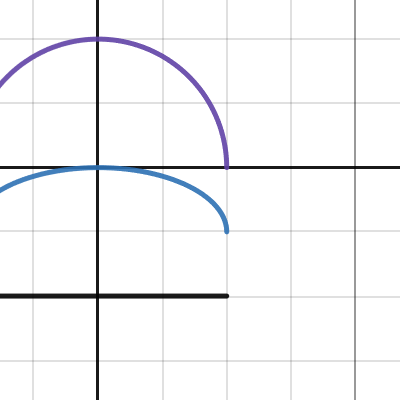
Desmos
heres the pieces
we know the semicircle has radius one, and it lives in the positive half of the plane
a circle is defined by $x^2+y^2=r^2$
clever fjordBOT
jan Niku
 nocturne belfry
so for $y>0$, we have $y = \sqrt{1-x^2}$
clever fjordBOT
jan Niku
 nocturne belfry
this is the y coordinate of the circle given some x
you agreed that the midpoint is the center of mass
the midpoint between the bottom of the rectangle and the top of the circle
so we use the midpoint formula
take the average of the two values
the bottom is y=-1
the top is y= sqrt(1-x^2)
the average is given by $\frac{ -1 + \sqrt{1-x^2}}{2}$
clever fjordBOT
jan Niku
 nocturne belfry
this is $M(x) = \frac{ -1 + \sqrt{1-x^2}}{2}$
clever fjordBOT
jan Niku
 nocturne belfry
i dont think this will be fun to integrate, but you could
$$\frac{1}{1-(-1)} \int _{-1} ^1 \frac{ -1 + \sqrt{1-x^2}}{2} \dd x$$ will give you y coordinate of the centroid
clever fjordBOT
jan Niku
 nocturne belfry
,w integral from x=-1 to x=1 of ( -1 + sqrt(1-x^2) )/2 )
clever fjordBOT

 nocturne belfry
,w 1/4 * (pi-4) / 2
clever fjordBOT
 clever fjordBOT

 silent jetty
silent jetty
I hope so.
nocturne belfry
should be 4/3pi
UNFORTUNATELY
lemme check
OH wait
no it shouldnt
@silent jetty so okay
how much should i spoil
we can get the answer
heres the two point masses
the first is at 4/(3pi) with mass pi/2
nocturne belfry
its constant density right
silent jetty
Yes.
nocturne belfry
im choosing to define a unit square to have mass 1
ultimately we will take a ratio of the two masses
so choose instead that a unit square has mass M
it will ultimately cancel
would you rather do this though?
silent jetty
No I was just curious how exactly you came to having a mass for something.
clever fjordBOT
jan Niku
 nocturne belfry
so we get pi/2
odd edgeBOT
@silent jetty Has your question been resolved?
Channel closed
Closed by @silent jetty
Use .reopen if this was a mistake.
odd edgeBOT
Available help channel!
Send your question here to claim the channel.
Remember:
• Ask your math question in a clear, concise manner.
• Show your work, and if possible, explain where you are stuck.
• After 15 minutes, feel free to ping <@&286206848099549185>.
• Type the command .close to free the channel when you're done.
• Be polite and have a nice day!
Read #❓how-to-get-help for further information on how to ask a good question, and about conduct in the question channels.
 merry kestrel
Is ${1,-1,i,-i}$ under complex multiplication homomorphic to $Z_{4}$ under modulo 4 addition ?
odd edgeBOT
merry kestrel
Is $\{1,-1,i,-i\}$ under complex multiplication homomorphic to $Z_{4}$ under mod...
clever fjordBOT
.doc
 merry kestrel
I haven’t formally studied about homomorphisms yet, but I feel like they share the same structure
 crisp wadi
It looks like mapping 1 to 0, i to 1, -1 to 2 and -i to 3 will get you a homonorphism
Yeah they do
merry kestrel
as both group contains 2 generators and cyclic
crisp wadi
Yup
crisp wadi
crisp wadi
It looks like mapping 1 to 0, i to 1, -1 to 2 and -i to 3 will get you a homonor...
In fact it's an isomorphism
merry kestrel
$f(a*_1 b) = f(a) *_2 f(b)$
How do I point out this in words?
as in convince myself this is the definition
clever fjordBOT
.doc
 merry kestrel
f from G1 to G2
crisp wadi
Btw it's $f: G_1 \to G_2$
clever fjordBOT
A Lonely Bean
 crisp wadi
merry kestrel
as in convince myself this is the definition
crisp wadi
merry kestrel
as in convince myself this is the definition
Not sure about what you mean though
merry kestrel
clever fjord
**.doc**
What specifically this means?
crisp wadi
This is the definition and you don't need to convince yourself unless you have some other idea when hearing homomorphism
merry kestrel
if I operate a and b using first group operation is same as operating same elements using second group operation?
crisp wadi
merry kestrel
What specifically this means?
That f preserves structure of G1 like we talked the last time
crisp wadi
merry kestrel
if I operate a and b using first group operation is same as operating same eleme...
Yes
crisp wadi
Not the exact same elements but their images rather
crisp wadi
Isomorphism is a bijective homomorphism
merry kestrel
I think i have to do more examples to really see it
I have just read the definition
crisp wadi
Basically homomorphism shows you how some groups have similar structure
But isomorphisms tell you that some groups have the same structure
merry kestrel
similar and same
crisp wadi
Yes
merry kestrel
I’ll keep that in mind,
Can you recall an example of groups which are only homomorphic?
crisp wadi
The simplest example would be a function that maps everything to the identity element of the other group
I think this is called the trivial homomorphism
But wait let me come up with a nontrivial one
For example orthogonal projection onto a hypersurface in some space
The simplest example would be f: R^2 -> R given by (x, y) -> x
Both groups under addition
Or f: C -> R given by z -> Re(z) or z -> Im(z)
 sharp oak
When I think of a homomorphism from A to B, I think "the structure of B exists inside A"
Like, group A is intricate enough to include B.
Then iso, you can do that both ways. They're the same.
crisp wadi
The trace function is also a homomorphism for any group of matrices
crisp wadi
crisp wadi
The simplest example would be f: R^2 -> R given by (x, y) -> x
Btw, you can immediately tell that this is not an isomorphism since you can't really tell what (x, y) is if I only give you x
Same thing with the second example, you can't know a complex number by just knowing either only its real part or only its imaginary part
merry kestrel
I see
sharp oak
A pretty abstract example, take the integers under addition.
Now we can map that onto the cyclic group of 2 elements. Every even integer goes to 0, every odd goes to 1.
This is a homomorphism. It tells us that doing addition on the integers basically gets us an addition in the cyclic group of 2 elements for free.
odd edgeBOT
@merry kestrel Has your question been resolved?
sharp oak
Put into better words, this explains the odd/even structure you normally see in addition.
odd edgeBOT
Channel closed
Closed due to timeout
Use .reopen if this was a mistake.
Available help channel!
Send your question here to claim the channel.
Remember:
• Ask your math question in a clear, concise manner.
• Show your work, and if possible, explain where you are stuck.
• After 15 minutes, feel free to ping <@&286206848099549185>.
• Type the command .close to free the channel when you're done.
• Be polite and have a nice day!
Read #❓how-to-get-help for further information on how to ask a good question, and about conduct in the question channels.
 rotund garnet
 odd edgeBOT
rotund garnet
rotund garnet
odd edgeBOT
rotund garnet
rotund garnet
hello! for #11, the slope on the answer key provided is 12, however i literally do not understand how it can be 12

the slope would be m'(-3) = f'(g(x)(g'(x)) but I don't get how it equates to 12
 night raft
rotund garnet
night raft
rotund garnet
Apply the given chain rule formula
rotund garnet
night raft
Apply the given chain rule formula
what exactly is that?
clever fjordBOT
CST
 rotund garnet
oh right. I must be doing my math wrong or something because I keep getting answers that AREN'T 12
night raft
Hmm lemme check myself
rotund garnet
thank you so much
night raft
Can I see your work? Because I did get 12
rotund garnet
night raft
Can I see your work? Because I did get 12
I have a quick question, what am i supposed to do with the f' in the first part of the rule?: f'(g(x))g'(x)
I think that is where I am messing up
rotund garnet
OHHHHHHHH
wait, let me give this a try
I must be doing something wrong because g(x) is 7 and g'(x) is 2
7x2??
rotund garnet
night raft
Check the parentheses
I think I must be overthinking it.. so at m'(-3) where g(x) is equal to 7, wouldn't that JUST be f'(g(7)
clever fjordBOT
CST
 rotund garnet
night raft
$m’(-3)=f’(g(-3))g’(-3)$, right?
rotund garnet
night raft
$m’(-3)=f’(g(-3))g’(-3)$, right?
that would be 7!
rotund garnet
night raft
So we start with g(-3), which is?
sorry, I replied to the wrong thing
I was trying to understand what I am doing wrong
but g(-3) is 7
rotund garnet
i see it now, i’ve been looking at numbers for the past 4 hours and i’m going crazy. i have just been overthinking it to hell
thank you so much
f’(7) = 6 and g’(3) = 2
night raft
Yep
 night raft
What are your ideas
rotund garnet
I don't know where to start with this type of problem really
night raft
Think of the tangent line problem
rotund garnet
OHHH OKAY i got it thank you very much.
night raft
No prob
odd edgeBOT
@rotund garnet Has your question been resolved?
Channel closed
Closed by @rotund garnet
Use .reopen if this was a mistake.
Available help channel!
Send your question here to claim the channel.
Remember:
• Ask your math question in a clear, concise manner.
• Show your work, and if possible, explain where you are stuck.
• After 15 minutes, feel free to ping <@&286206848099549185>.
• Type the command .close to free the channel when you're done.
• Be polite and have a nice day!
Read #❓how-to-get-help for further information on how to ask a good question, and about conduct in the question channels.
 earnest dagger
can someone walk me through the solution to this question
 sharp oak
T is true, and you can turn line 1 into this:
T -> ~(P V H)
odd edgeBOT
@earnest dagger Has your question been resolved?
earnest dagger
sharp oak
T is true, and you can turn line 1 into this:
T -> ~(P V H)
is that the contrapositive?
sharp oak
Yes
odd edgeBOT
Channel closed
Closed due to timeout
Use .reopen if this was a mistake.
odd edgeBOT
Available help channel!
Send your question here to claim the channel.
Remember:
• Ask your math question in a clear, concise manner.
• Show your work, and if possible, explain where you are stuck.
• After 15 minutes, feel free to ping <@&286206848099549185>.
• Type the command .close to free the channel when you're done.
• Be polite and have a nice day!
Read #❓how-to-get-help for further information on how to ask a good question, and about conduct in the question channels.
 blissful depot
geometry!!
On the side (AD) of the square ABCD, point E is considered so that the measure of the angle DCE = 15, and point T is taken on the diagonal AC, so that the measure of the angle TEA = 75 degrees.
a. Show that, if F is symmetric to T with respect to AD, then F and E and C are collinear.
b. Show that AT is the arithmetic mean of the lengths of segments ET and EC
odd edgeBOT
blissful depot
geometry!!
On the side (AD) of the square ABCD, point E is considered so that t...
 odd edgeBOT
@blissful depot Has your question been resolved?
 neon pebble
blissful depot
neon pebble
blissful depot
holy crap you all spawned in
 upper onyx
just calc the length in terms of the side of the square
blissful depot
doesn't work like that