
#help-17
1 messages · Page 307 of 1

 paper depot
so you want to prove $\Re(z\overline{w})\leq |z||w|$
 twin meteorBOT
Ann
 paper depot
which is exactly what i wanted you to distill it to
 hardy sun
Ohhh, yea so now I just have to find a way to show it?
paper depot
yes and it is not that hard actually
the key idea is that the real part of any complex number is less than or equal to its modulus


 tired trail
 feral roost
m= 34
 vocal sleetBOT
@hardy sun Has your question been resolved?
Channel closed
Closed by @hardy sun
Use .reopen if this was a mistake.
 Available help channel!
Send your question here to claim the channel.
Remember:
• Ask your math question in a clear, concise manner.
• Show your work, and if possible, explain where you are stuck.
• After 15 minutes, feel free to ping <@&286206848099549185>.
• Type the command .close to free the channel when you're done.
• Be polite and have a nice day!
Read #❓how-to-get-help for further information on how to ask a good question, and about conduct in the question channels.
 raw sage
Has x int of (0,0) ? How do I solve this
 vocal sleetBOT
raw sage
Has x int of (0,0) ? How do I solve this
vocal sleetBOT
raw sage
Has x int of (0,0) ? How do I solve this
 outer warren
identify the roots and then
start with a factored form equation
 fervent wasp
@raw sage Have you gotten started?
raw sage
idk what to do with the (0,0)
also
the turning point
is 2 numbers
what do i do with that
im trying to put it into factorised form but it aint making sense
 solar cape
What's your factored form?
raw sage
 solar cape
No hold on
raw sage
but anything times 0 is 0 no?
solar cape
Your roots are bad as well
raw sage
x-1
solar cape
So the factored form is a(x-0)(x+2)(x-1)=ax(x+2)(x-1)
solar cape
Would be where?
raw sage
on the left side
raw sage
yea
solar cape
raw sage
i though the tp would be there
The factored form doesn't tell you the turning point
Why are you suddenly talking about the turning point
@raw sage
Oh I see
(-1,4) is not the turning point
solar cape
Ok so
solar cape
solar cape
So the factored form is a(x-0)(x+2)(x-1)=ax(x+2)(x-1)
We agree that the factored form is this?
ax(x+2)(x-1)
If you want to sanity check this
raw sage
whats ax isnt it meant to be just a
solar cape
Ok hold on
Let's do a little
Experiment
Let's use your form
a(x+2)(x-1)
So if we sub in the roots we should get 0 yes?
let's try
Sub in x=-2
a(0)(-3)=0
Sub in x=1
a(3)(0)=0
Sub in x=0
a(2)(-1)=-2a
Uh oh
What happened
@raw sage
raw sage
i dunno
solar cape
What do you think the problem with your form is
raw sage
idkkkk
solar cape
Ok
Let's try the experiment with my form
ax(x+2)(x-1)
Sub in x=-2
a(-2)(0)(-3)=0
Sub in x=1
a(1)(3)(0)=0
Sub in x=0
a(0)(2)(-1)=0
Wowee
That's crazy
When multiply by x for a root at x=0
Because when x=0, then the whole expression is 0
raw sage
the whole answer is 0?
raw sage
so
but on the prac sheet the answer is y = −2x^3 − 2x^2 + 4x
and i have no clue how they came to that
solar cape
Ok we'll get to that
We aren't done yet
This was half the question
Remember the point (-1,4)
We are going to use that to find the value of a
After we find the value of a
 raw sage
x int
solar cape
Alright wait
raw sage
like the x int, y int and tp?
 drowsy hatch
no values of m n and p
solar cape
raw sage
like the x int, y int and tp?
(-1,4) is not the turning point
drowsy hatch
what are the x intercepts
drowsy hatch
yeah
so substitute it in the equation
the factorised form
a(x-0)(x+2)(x-1)
now we just need the a
raw sage
is that -1,4
solar cape
solar cape
So the factored form is a(x-0)(x+2)(x-1)=ax(x+2)(x-1)
That's what I wrote basically
solar cape
Alright jes can we do a little exercise
Just so I can see something
solve (x-2)(x-3)=0
solar cape
raw sage
also what is 01,4 if not the tp
Just a point on the cubic
raw sage
r these just like x int
raw sage
0,3
raw sage
um i got x^3+2x^3-2x
solar cape
No don't expand
solar cape
raw sage
2,3
Do what you did here
solar cape
Alright I see the issue now
Your teacher just is kinda ass
Do you know what the zero product rule is
raw sage
yea
solar cape
What does the rule say
If ab=0 then a=0 or b=0 right
But extends for like abcdef=0
a=0,b=0...or f=0
solar cape
solar cape
x(x+2)(x-1)=0
So again looking at x(x+2)(x-1)=0
Just means that x=0,x+2=0 or x-1=0
So our x intercepts are x=0,x=-2 and x=1
So that's why our factored form has a x in it
@raw sage
So we know y=ax(x+2)(x-1) passes through the point (-1,-4)
Using this info, we know that for x=-1,y=4
Using this we can find a
Subbing x=-1,y=-4 we get
-4=a(-1)(1)(-2)
-4=2a
We can then use this equation to solve for a
With a we can then expand the whole expression
And we get our answer
Yipee
vocal sleetBOT
@raw sage Has your question been resolved?
Channel closed
Closed by @raw sage
Use .reopen if this was a mistake.
Available help channel!
Send your question here to claim the channel.
Remember:
• Ask your math question in a clear, concise manner.
• Show your work, and if possible, explain where you are stuck.
• After 15 minutes, feel free to ping <@&286206848099549185>.
• Type the command .close to free the channel when you're done.
• Be polite and have a nice day!
Read #❓how-to-get-help for further information on how to ask a good question, and about conduct in the question channels.
 solid fjord
How do i solve these questions? I have been trying the 1st one for 3 days now. I have tried to substitute values somehow and create a quadratic but i doesn't work

 vocal sleetBOT
solid fjord
How do i solve these questions? I have been trying the 1st one for 3 days now. I...
solid fjord
vocal sleetBOT
solid fjord
How do i solve these questions? I have been trying the 1st one for 3 days now. I...
solid fjord
please help
 surreal basin
solid fjord
How do i solve these questions? I have been trying the 1st one for 3 days now. I...
surreal basin
solid fjord
How do i solve these questions? I have been trying the 1st one for 3 days now. I...
lets try doing this step by step to see what works
solid fjord
surreal basin
lets try doing this step by step to see what works
ok, thanks
surreal basin
for the first one, go turn (x - 2) into e^(log(x - 2))
what do you get as a result
solid fjord
Wait i actually forgot to mention a detail
surreal basin
wait does your book use log as base 10 or base e
surreal basin
10^log(x - 2) instead then
solid fjord
yeah we should get 10 ^ the exponents of x-2 X log of x-2 to the base 10
surreal basin
what would it be
solid fjord
? I don't understand the question
surreal basin
solid fjord
yeah we should get 10 ^ the exponents of x-2 X log of x-2 to the base 10
you need to tell me the actual math expression you got as a result instead of vaguely alluding to it
solid fjord
surreal basin
you need to tell me the actual math expression you got as a result instead of va...
yeah sorry
one second
10^[(log squared (x-2) + 3*log(x-2) (as the power would of x-2 would come out) - 12) X log (x-2)]
surreal basin
thats an extremely unusual way of typing it
what country did you learn this under?
just for curiosity's sake
surreal basin
well they and the rest of the world commonly use a different way of typing math through text
you are attempting to type this

now the syntax through text is to avoid using words as much as possible
solid fjord
yeah i actually type way more differently even then my classmates
so i doubt its a india thing
surreal basin
surreal basin
now the syntax through text is to avoid using words as much as possible
and also to move ^2 to the outside instead of between log and (x - 2)
I think this is carried over from writing numbers that way, so log(x - 2)^2 instead of log^2 (x - 2)
solid fjord
ok
surreal basin
also log((x - 2)^3) instead of log(x - 2)^3
solid fjord
makes sense
surreal basin
so instead of log^a(x) and log(x)^a, its log(x)^a and log(x^a)
solid fjord
yeah
surreal basin
this I think carries over from expecting the parentheses to work like math, you can think of it like in programming
bit of a new standard but you can get used to it
surreal basin
as a disclaimer its not really bad, but often weird is turned to bad on the outset
solid fjord
true
surreal basin
well go try out the new standard on the exponent by typing it out
Ill tell you if anything's off
surreal basin
surreal basin
this I think carries over from expecting the parentheses to work like math, you ...
to be fair, there might be a few variations of this standard since its mostly informal, but I think Im telling you the most common one
this is at least the one I use
surreal basin
oh right a few more changes but youre on the right track
usually people avoid using brackets and braces in favor of... nesting parentheses
solid fjord
hmm
surreal basin
also, avoid putting spaces between the log and the (x - 2)
spaces often denote multiplication, so you can put a space between things to denote that
the space can be left out like in 3x^2, but it depends on if it looks better with or without like in x^2y^2 vs x^2 y^2
solid fjord
hmm
surreal basin
so in all, its more expected to see
10^((log(x-2)^2 + 3 log(x-2) - 12) log(x-2))
surreal basin
thats good
regardless both sides now look like
10^((log(x-2)^2 + 3 log(x-2) - 12) log(x-2)) = 10^2 log(x-2)
next is to replace log(x-2) with y since every x is inside a log(x-2)
solid fjord
surreal basin
regardless both sides now look like
10^((log(x-2)^2 + 3 log(x-2) - 12) log(x-2))...
wait
i think rhs is actually 10^2 X log(x-2)
surreal basin
yep, thats the standard way to write 10^2 * log(x - 2)
the ^ operator is not "greedy"
solid fjord
oh sorry
solid fjord
surreal basin
the ^ operator is not "greedy"
nice analogy
surreal basin
a "greedy" operator when written will take up the rest of the text as much as possible
that is at least a term for regular expressions like in comparing * and *?
most operators are not "greedy" to avoid cluttering with parentheses
solid fjord
hmm
surreal basin
potential exceptions are d/dx ... and int ... dx
when you d/dx, its usually assumed it applies to the whole line
if you want to denote a specific thing to d/dx, parentheses are inserted as d/dx (only what you want differentiated)
similar with integrals, you can see int 1 + 2 dx as not requiring the parentheses even if they should be there
solid fjord
hmm
surreal basin
this "non-greedy" rule also means you can remove parentheses in other places
log x + y will usually mean log(x) + y
unfortunately since its written, it can vary depending on how spaces are used
log xy will usually mean log(xy)
log x y will usually mean log(x) y
by this point we might as well go off of context or ask to be sure, but it cant hurt to be a better guesser at all this
solid fjord
true
surreal basin
so in any case we have
10^((log(x-2)^2 + 3 log(x-2) - 12) log(x-2)) = 10^2 log(x-2)
and then we replace every log(x-2) with y
10^((y^2 + 3y - 12) y) = 10^2 y
from here, I could expand the y, so
10^(y^3 + 3y^2 - 12y) = 10^2 y
then move the 2 to the other side, which looks like
10^(y^3 + 3y^2 - 12y - 2) = y
solid fjord
that's legit beautiful
why didn't i think of dividing with the 2
i had gotten till here before
but i forgot to divide the 10
fricking genius
surreal basin
I hadnt seen it until now either, you have to look out for aesthetic choices that may matter
surreal basin
more than that, maybe a masters or a PhD
solid fjord
wow, that's my dream
can i please chat to you for a few minutes after this help session if you have the time
surreal basin
I cant really answer for anything related to the masters/PhD stuff, Im new to knowing how to get there
solid fjord
surreal basin
I cant really answer for anything related to the masters/PhD stuff, Im new to kn...
i am in high school
i am not worried about that
i just want to talk to someone who is much farther along than me in the process you know. Very few mathematicians in india
so i don't have any guidance
not that i am asking you to become my guardian angel
surreal basin
I think theres more than just a few mathematicians in india but I see where youre coming from
solid fjord
just a few minutes of your time
surreal basin
I think you might be better off asking someone who actually is in india and would know where to go next
solid fjord
nah just general questions about math studies
nvm
lets just continue with the problem solving stuff
surreal basin
its alr, we can focus more on the problem first hand
and also that Im stuck
(lol)
solid fjord
lol
surreal basin
now its around here we start looking for excuses
are you only required to approximate the solution, or do you need an exact form?
solid fjord
surreal basin
are you only required to approximate the solution, or do you need an exact form?
i will just send the answer here
 surreal basin
well I just tried x = 102 and it doesnt seem to work
solid fjord
surreal basin
well I just tried x = 102 and it doesnt seem to work
shit
is the question wrong?
surreal basin
x = 3 doesnt work either, on the left you'd get 1
on the right you'd get 0 since log(1) = 0
solid fjord
It has happened before
surreal basin
Ill be honest, the solutions Im seeing out of the graphing calculator dont look rational
around here would be when you'd do a trick of some sort that would help this along
solid fjord
yeah i think the question is just wrong
surreal basin
thats a shame
solid fjord
its a older textbook
and it had 1 or 2 wrong questions before
lets focus on the 2nd
one
solid fjord
solid fjord
How do i solve these questions? I have been trying the 1st one for 3 days now. I...
solid fjord
surreal basin
what variable does it want you to solve for
i am pretty sure its either x, y or both
nah i think its both
the answer is
 surreal basin
alr in that case I can identify a typo
the y should be an x
for constant a, b, you solve for x
solid fjord
surreal basin
the y should be an x
otherwise its unsolvable right
surreal basin
no, otherwise its too vague
solid fjord
?
surreal basin
you end up with what is essentially A - B + 6 = 0, where A and B can be any positive number you want
you can see this allows for an infinite number of solutions
solid fjord
hmm
surreal basin
so instead of a few points of solutions, you have a line
solid fjord
even though we should have only 2?
surreal basin
well youll notice putting the answers in for x, then assuming that x = y, solves the problem
it also makes sense as a trick
so assume the y is a typo for x then we can focus on the trick as the book seems to intend
solid fjord
yeah
surreal basin
now with only x, we can try on some steps to solve
(a^(log_b(x)))^2 - 5 x^(log_b(a)) + 6 = 0
now do you have any ideas about this
solid fjord
yeah you can use switch a and x in the 1st expression
surreal basin
that is true, I personally opened them up then manually swapped them to be sure
solid fjord
yeah
surreal basin
also those are usually called "terms", so 1st term of the 3
solid fjord
yeah sorry
surreal basin
so now we have
(x^(log_b(a)))^2 - 5 x^(log_b(a)) + 6 = 0
not really much else beyond here
solid fjord
yean just quadratic
 calm pecan
solid fjord
How do i solve these questions? I have been trying the 1st one for 3 days now. I...
calm pecan
solid fjord
How do i solve these questions? I have been trying the 1st one for 3 days now. I...
i dont understand this notation.
is $\log^2(f(x)) \equiv \log(f(x))^2$?
surreal basin
solid fjord
yean just quadratic
so using the quadratic formula, what do you get as solutions
twin meteorBOT
Percy
 calm pecan
is $\log(x-2)^5 \equiv \log((x-2)^5)$
twin meteorBOT
Percy
 solid fjord
surreal basin
so using the quadratic formula, what do you get as solutions
solid fjord
surreal basin
so using the quadratic formula, what do you get as solutions
i don't really know will have to calculate
surreal basin
solid fjord
@calm pecan it ultimately doesnt matter because as shown here, the answer key thinks x = 3 is a solution which cant check out in any capacity
calm pecan
i see
surreal basin
thats along with x = 102 and x = 2 + 10^-7
calm pecan
second seems doable.
surreal basin
yea the second is almost done as of now
calm pecan
if youo wanna
surreal basin
well you likely just have but just to be sure, you can say what you got
solid fjord
wait a minute
 sweet phoenix
use the laws of logarithms
a power IN the log means multiply outside
so log((x-2)^5) is 5log(x-2)
solid fjord
I am getting a weird answer
calm pecan
sweet phoenix
use the laws of logarithms
his books has weird notation
solid fjord
x = log_b(a) root of 2 or 3
surreal basin
this is where you have to be a bit more careful
surreal basin
you can use that log_b(a) = ln(a)/ln(b)
solid fjord
surreal basin
this is where you have to be a bit more careful
wait i fricking got it
surreal basin
very nice
solid fjord
Just wait
I have a cool answer here
Lets take 2 for now
log_b(a) root of 2 = 2^1/log_b(a)
but 1/log_b(a) = log_a(b)
so we can just sub that in
and get the answer of the textbook
for 3 as well
surreal basin
thats the one
surreal basin
alr
solid fjord
Thx for help everybody
surreal basin
np
solid fjord
@surreal basin @sweet phoenix @calm pecan
sweet phoenix
np
solid fjord
.close
vocal sleetBOT
Channel closed
Closed by @solid fjord
Use .reopen if this was a mistake.
vocal sleetBOT
Available help channel!
Send your question here to claim the channel.
Remember:
• Ask your math question in a clear, concise manner.
• Show your work, and if possible, explain where you are stuck.
• After 15 minutes, feel free to ping <@&286206848099549185>.
• Type the command .close to free the channel when you're done.
• Be polite and have a nice day!
Read #❓how-to-get-help for further information on how to ask a good question, and about conduct in the question channels.
 vocal timber
graph of the colored text is 2nd image, I don't understand what is highlighted text saying, Someone explain to me the text that I highlighted

 vocal sleetBOT
vocal timber
graph of the colored text is 2nd image, I don't understand what is highlighted t...
vocal timber
vocal sleetBOT
vocal timber
graph of the colored text is 2nd image, I don't understand what is highlighted t...
vocal timber
anyone here
calm pecan
vocal timber
graph of the colored text is 2nd image, I don't understand what is highlighted t...
what dont you understand
vocal timber
This blue color text
 calm pecan
what part
vocal timber
specifically when it says. we see that the value of g(x) moves towards 0. So lim x-> 0 g(x) = 0. This is intuitively clear from the graph of y = |x| for x =/ 0. (See fig 2.12, chapter 2)
here is that graph
 calm pecan
vocal timber
specifically when it says. we see that the value of g(x) moves towards 0. So lim...
calm pecan
vocal timber
specifically when it says. we see that the value of g(x) moves towards 0. So lim...
so im guessing you dont understand limits?
vocal timber
i don't understand language of the text
calm pecan
maybe consider googling it first-?
vocal timber
i have spent over 30 minutes thinking about it from mind
calm pecan
yeah google it
vocal timber
well leave it
vocal timber
some other helper will help
vocal timber
vocal timber
graph of the colored text is 2nd image, I don't understand what is highlighted t...
<@&286206848099549185> 15 minutes has elapsed, if someone could help out?
calm pecan
when you pinged that they hadnt actually
regardless, sure man
i still think youd be way better just googling it though
didnt the brit explain limits to you
vocal timber
.close
vocal sleetBOT
Channel closed
Closed by @vocal timber
Use .reopen if this was a mistake.
vocal sleetBOT
Available help channel!
Send your question here to claim the channel.
Remember:
• Ask your math question in a clear, concise manner.
• Show your work, and if possible, explain where you are stuck.
• After 15 minutes, feel free to ping <@&286206848099549185>.
• Type the command .close to free the channel when you're done.
• Be polite and have a nice day!
Read #❓how-to-get-help for further information on how to ask a good question, and about conduct in the question channels.
Please don't occupy multiple help channels.
 thin edge
exquisite link
vocal sleetBOT
Channel closed
Channel closed due to the original message being deleted.
If you did not intend to do this, please open a new help channel,
as this action is irreversible, and this channel may abruptly lock.
thin edge
if this channel locks you are stupid
calm pecan
they prolly got banned/will get banned
 tranquil charm
Troll?
calm pecan
yea
vocal sleetBOT
Available help channel!
Send your question here to claim the channel.
Remember:
• Ask your math question in a clear, concise manner.
• Show your work, and if possible, explain where you are stuck.
• After 15 minutes, feel free to ping <@&286206848099549185>.
• Type the command .close to free the channel when you're done.
• Be polite and have a nice day!
Read #❓how-to-get-help for further information on how to ask a good question, and about conduct in the question channels.
 radiant knot
I had this question the other day and was wondering why the answer is 89
Find the equation of the tangent to the circle
Y=(cosx-sinx)/sinx
vocal sleetBOT
radiant knot
I had this question the other day and was wondering why the answer is 89
Find...
calm pecan
thats a circle? 👀
radiant knot
Idk but it's supposed to be... haha
 radiant knot
Hmm
radiant knot
Well idk but part of the answer was
Y=-x+c
And the c turned out to be 89 I think
So it should be y=-x+89
Idk why or how I am very confused as you are
In the end he wants the equation of the tangent
calm pecan
!xy
vocal sleetBOT
Please show the original problem, exactly as it was stated to you, with the entire original context. A picture or screenshot is best. If the original problem is not in English, then post it anyway! The additional context might still be helpful. Do your best to provide a translation.
radiant knot
Sadly it was just as our teacher in hs stated there is nothing else to be written in the question but I still don't get how they have solved it
vocal sleetBOT
@radiant knot Has your question been resolved?
radiant knot
.close
vocal sleetBOT
Channel closed
Closed by @radiant knot
Use .reopen if this was a mistake.
Available help channel!
Send your question here to claim the channel.
Remember:
• Ask your math question in a clear, concise manner.
• Show your work, and if possible, explain where you are stuck.
• After 15 minutes, feel free to ping <@&286206848099549185>.
• Type the command .close to free the channel when you're done.
• Be polite and have a nice day!
Read #❓how-to-get-help for further information on how to ask a good question, and about conduct in the question channels.
 tribal orbit
How would u do this? I got up to breaking it up into individual vectors, but I am still confused.
 vocal sleetBOT
tribal orbit
How would u do this? I got up to breaking it up into individual vectors, but I a...
tribal orbit
vocal sleetBOT
tribal orbit
How would u do this? I got up to breaking it up into individual vectors, but I a...
tribal orbit
Would be handy if u could draw and describe it 🙏
 kind light
honestly i havent learnt vectors but a first step is prolly to find CD, and find the time it takes for AB, BC, CD
tribal orbit
Yea thats what I was thinking, But how would BC work?
calm pecan
tribal orbit
How would u do this? I got up to breaking it up into individual vectors, but I a...
what have you tried
tribal orbit
Like breaking it into AB, BC, CD
don't know if im doing it right
then I tried finding the speed for the AB vector
kind light
tribal orbit
Yea thats what I was thinking, But how would BC work?
logically BC is 20 degrees up, so
find tbe hyp
 vocal sleetBOT
@tribal orbit Has your question been resolved?
 polar burrow
tribal orbit
How would u do this? I got up to breaking it up into individual vectors, but I a...
polar burrow
tribal orbit
How would u do this? I got up to breaking it up into individual vectors, but I a...
do you have the answer with you?
cuz im getting 46.605s something
vocal sleetBOT
Channel closed
Closed due to timeout
Use .reopen if this was a mistake.
Available help channel!
Send your question here to claim the channel.
Remember:
• Ask your math question in a clear, concise manner.
• Show your work, and if possible, explain where you are stuck.
• After 15 minutes, feel free to ping <@&286206848099549185>.
• Type the command .close to free the channel when you're done.
• Be polite and have a nice day!
Read #❓how-to-get-help for further information on how to ask a good question, and about conduct in the question channels.
 vast shale
 vocal sleetBOT
vast shale
vast shale
vocal sleetBOT
vast shale
vast shale
yup
 robust spruce
vast shale
yup
robust spruce
vast shale
yup
What's your progress? Where are you stuck?
 civic otter
!status
vocal sleetBOT
What step are you on?
1. I don't know where to begin.
2. I have begun but got stuck midway.
3. I got an answer but I was told that it's wrong.
4. I got an answer and would like my work checked.
5. I have a question about someone else's work/solution.
6. I have completed the problem and don't need help anymore. Thank you.
7. None of the above
1
vast shale
go on
tranquil charm
then (x-1/x)=t
 vocal sleetBOT
Channel closed
Closed by @mild mortar
Use .reopen if this was a mistake.
Available help channel!
Send your question here to claim the channel.
Remember:
• Ask your math question in a clear, concise manner.
• Show your work, and if possible, explain where you are stuck.
• After 15 minutes, feel free to ping <@&286206848099549185>.
• Type the command .close to free the channel when you're done.
• Be polite and have a nice day!
Read #❓how-to-get-help for further information on how to ask a good question, and about conduct in the question channels.
tribal orbit
.close
 knotty obsidian
I've been stuck on my topology homework for a day. I need to prove the following:
Let X be a topological space such that the following two conditions are met:
i) Every point in X has a basis of closed neighborhoods.
ii) Every continuous image of X into a Hausdorff space Y is closed.
Prove X must be compact.
vocal sleetBOT
knotty obsidian
I've been stuck on my topology homework for a day. I need to prove the following...
knotty obsidian
I've been trying to do it following different approaches:
I tried researching different topology textbooks to see if I could find a space akin to this but I was not able to.
I tried to do it straight away by definitions and logical implications, and I got to learn some stuff about how the space X is structured, but I did not get it to prove that any of the separation axioms applied to X so I gave up.
I tried proving it by contradiction, assuming X not to be compact and trying to reach a contradiction with the premises. I first tried proving that maybe X had a compactification Y such that Y is Hausdorff and X is not closed so I could do a contradiction there, but since X is not locally compact I was not able to find such a compactification, because other compactifications do not have a neat structure.
I don't even know how to approach this and would appreciate any help.
<@&286206848099549185>
vocal sleetBOT
@knotty obsidian Has your question been resolved?
vocal sleetBOT
@knotty obsidian Has your question been resolved?
vocal sleetBOT
@knotty obsidian Has your question been resolved?
knotty obsidian
I tried what I said earlier
Now I'm trying to follow Engelking's Topology to find out if I could apply a different version of Kuratowski's theorem to this
bruh
 near pulsar
i have no idea
knotty obsidian
hahahahaha
knotty obsidian
it's alright
near pulsar
so you need to prove that X is something compact
knotty obsidian
near pulsar
so you need to prove that X is something compact
yes
near pulsar
mb, good luck though
vocal sleetBOT
@knotty obsidian Has your question been resolved?
knotty obsidian
near pulsar
mb, good luck though
thanks, i'll keep trying
vocal sleetBOT
@knotty obsidian Has your question been resolved?
vocal sleetBOT
Channel closed
Closed due to timeout
Use .reopen if this was a mistake.
Available help channel!
Send your question here to claim the channel.
Remember:
• Ask your math question in a clear, concise manner.
• Show your work, and if possible, explain where you are stuck.
• After 15 minutes, feel free to ping <@&286206848099549185>.
• Type the command .close to free the channel when you're done.
• Be polite and have a nice day!
Read #❓how-to-get-help for further information on how to ask a good question, and about conduct in the question channels.
 arctic sentinel
i need help
vocal sleetBOT
arctic sentinel
i need help
 gaunt sparrow
vocal sleetBOT
gaunt sparrow
vocal sleetBOT
@arctic sentinel Has your question been resolved?
 mellow forge
arctic sentinel
i need help
mellow forge
arctic sentinel
i need help
With?
vocal sleetBOT
@arctic sentinel Has your question been resolved?
vocal sleetBOT
Channel closed
Closed due to timeout
Use .reopen if this was a mistake.
Available help channel!
Send your question here to claim the channel.
Remember:
• Ask your math question in a clear, concise manner.
• Show your work, and if possible, explain where you are stuck.
• After 15 minutes, feel free to ping <@&286206848099549185>.
• Type the command .close to free the channel when you're done.
• Be polite and have a nice day!
Read #❓how-to-get-help for further information on how to ask a good question, and about conduct in the question channels.
 wild lake
 tranquil charm
e^c is also a constant
wild lake
tranquil charm
I think you get full marks if you don't do that also not sure
Yeah but its more clean to simplify fully
and im in AP class so i think they like it that way
tranquil charm
Ok then just learn to manipulate constants ig
 worldly bluff
vocal sleetBOT
worldly bluff
vocal sleetBOT
@wild lake Has your question been resolved?
vocal sleetBOT
Channel closed
Closed due to timeout
Use .reopen if this was a mistake.
Available help channel!
Send your question here to claim the channel.
Remember:
• Ask your math question in a clear, concise manner.
• Show your work, and if possible, explain where you are stuck.
• After 15 minutes, feel free to ping <@&286206848099549185>.
• Type the command .close to free the channel when you're done.
• Be polite and have a nice day!
Read #❓how-to-get-help for further information on how to ask a good question, and about conduct in the question channels.
 cedar charm
how do you separate x and y terms
 vocal sleetBOT
cedar charm
how do you separate x and y terms
cedar charm
vocal sleetBOT
cedar charm
how do you separate x and y terms
cedar charm
oh i got it nvm
paper depot
this is not a separable DE
 marsh jungle
find y' and see what fits the equation
paper depot
you dont actually need to do anything fancy here
just check each function against the DE
thats it
cedar charm
but my teacher said that if you do process of elimination you wont get credit
marsh jungle
it's not process of elimination it's trial and error
 regal bane
It's a first order linear DE. All such DEs can be solved with an integrating factor method
cedar charm
i dont think ive learnedd linear de
marsh jungle
find y' for each equation, and if you add the original equation to y' and get 2sinx there's your answer
vocal sleetBOT
Channel closed
Closed by @cedar charm
Use .reopen if this was a mistake.
vocal sleetBOT
Available help channel!
Send your question here to claim the channel.
Remember:
• Ask your math question in a clear, concise manner.
• Show your work, and if possible, explain where you are stuck.
• After 15 minutes, feel free to ping <@&286206848099549185>.
• Type the command .close to free the channel when you're done.
• Be polite and have a nice day!
Read #❓how-to-get-help for further information on how to ask a good question, and about conduct in the question channels.
 vital loom
for these sets of questions
 vocal sleetBOT
vital loom
for these sets of questions
vital loom
vocal sleetBOT
vital loom
for these sets of questions
vital loom
it has me confused about the negtive and positive signs
like
part d for example

i used positive 3/4
i rly dont wanna use the cast diagram
how can u just logically tell that it is negative 3/4
and not positive
.close
vocal sleetBOT
Channel closed
Closed by @vital loom
Use .reopen if this was a mistake.
vocal sleetBOT
Available help channel!
Send your question here to claim the channel.
Remember:
• Ask your math question in a clear, concise manner.
• Show your work, and if possible, explain where you are stuck.
• After 15 minutes, feel free to ping <@&286206848099549185>.
• Type the command .close to free the channel when you're done.
• Be polite and have a nice day!
Read #❓how-to-get-help for further information on how to ask a good question, and about conduct in the question channels.
vast shale
 vocal sleetBOT
vast shale
vast shale
vocal sleetBOT
vast shale
vast shale
should i think of this in terms of graph?
 bronze osprey
vast shale
should i think of this in terms of graph?
bronze osprey
vast shale
should i think of this in terms of graph?
yes, and the limiting case is when x = 0 is a root
following on from your graph idea, which values of a make the graph concave up (and down)?
vast shale
coeff of x square needs to be positive or zero
fervent wasp
vast shale
When the function is concave upward, you might get negative y value in respect to x. Reversely, you must get at least one
bronze osprey
vast shale
coeff of x square needs to be positive or zero
well just positive, because coeff of x^2 = 0 would imply a linear function
but yes
 river arch
they're fucking with you
vast shale
oh so i just do it like any normal equation ignoring that?
river arch
yes
vast shale
so basically what values of a gives me a negative output
bronze osprey
yeah so basically you can just find when f(x) has two positive or zero roots
and then every other value of a besides that
river arch
you just need the vertex to dip below the axis assuming it opens up and the vertex to be anywhere assuming it opens downwards
bronze osprey
also check the discriminant cause that needs to be >= 0
so it's a combination of the 3 things I have listed before
river arch
bronze osprey
also check the discriminant cause that needs to be >= 0
this is only for a + 1 > 0 btw
bronze osprey
f(x) = 0, (a + 1) = 0, and discriminant = 0 are your critical values of a
bronze osprey
river arch
this is only for a + 1 > 0 btw
no there's also the case when the function has no real roots
and it's concave down
river arch
where does it say real roots 
bronze osprey
river arch
where does it say real roots <:thonk:406575732563902485>
oh wait
river arch
and it's concave down, that is also not mentioned
bronze osprey
yeah I misinterpreted okay
vast shale
can someone summarize please
bronze osprey
sorry about that just check the sign of the y-coordinate of the vertex then
river arch
3 cases: coefficient of x^2 is either positive or negative, or 0
- If negative, do nothing
- If positive, ensure discriminant is greater than 0
- If 0, also do nothing
bronze osprey
but f(x) = 0 is a big hint cause there's only one value of a where that happens
vast shale
river arch
3 cases: coefficient of x^2 is either positive or negative, or 0
1. If negative,...
im not sure i understand why i do nothing
river arch
okay let's tackle it one step at a time
you know that the coefficient of x^2 would determine the concavity of f right?
vast shale
yes
river arch
how the mouth of the parabola opens up
if the coefficient of x^2 is 0, then you have a straight line, agreed?
vast shale
yep
river arch
so you can find at least one x such that f is negative
which means a + 1 = 0 ==> a = -1 is a part of our solution set
now if the coefficient of x^2 is negative, we are sure to find an x such that f is negative?
because the mouth of the parabola opens downwards
do you agree?
river arch
so all a + 1 < 0 ==> a < -1 is a part of our solution set
vast shale
river arch
so you can find at least one x such that f is negative
i didnt understand this one
if a=-1, x sqaure disappears
vast shale
-3ax becomes 3x
river arch
yes
vast shale
and 4a becomes -4
vast shale
oh the line is passing thru -4
so i do nothing
cuz the function is always giving me a negative
river arch
we do nothing because we know these functions have negative values
river arch
vast shale
cuz the function is always giving me a negative
not always
but we know it's possible for it to give it to us
vast shale
river arch
not always
right i was imagining a horizontal which is not always the case. my bad
but yeah got it
river arch
yeah
river arch
river arch
because the mouth of the parabola opens downwards
does this make sense too?
vast shale
yeah
river arch
so again, by the very construction of the function, we are sure to find some x such that f is negative
so far our solution set is a =< -1
so now for the case where the coefficient of x^2 is positive
we're not always sure that the parabola dips below the axis
specifically it only happens when f has real and distinct roots
so what's the condition for that?
vast shale
the constant should be negative
river arch
that's a possible subset
but in general you'd want the discriminant to be positive right?
vast shale
yeah ofc
river arch
yeah so your third condition is ${ a > -1 } \cap { D > 0 }$
vast shale
so it has to be greater than 0, the discriminant
twin meteorBOT
dyxn
 river arch
yes precisely
river arch
take the union of all three cases and that's your answer
river arch
why would it be intersection
we partitioned a to be disjoint anyways the intersection is 0
three cases:
- > 0
- = 0
- < 0
so to find the total set, we'd take the union
vocal sleetBOT
Channel closed
Closed by @oblique elk
Use .reopen if this was a mistake.
Available help channel!
Send your question here to claim the channel.
Remember:
• Ask your math question in a clear, concise manner.
• Show your work, and if possible, explain where you are stuck.
• After 15 minutes, feel free to ping <@&286206848099549185>.
• Type the command .close to free the channel when you're done.
• Be polite and have a nice day!
Read #❓how-to-get-help for further information on how to ask a good question, and about conduct in the question channels.
 manic lance
are the only limitations to get the integral is requireing for $\int^{a}_{b}$ that $a, b \neq 0$?
 vocal sleetBOT
manic lance
are the only limitations to get the integral is requireing for $\int^{a}_{b}$ th...
twin meteorBOT
vocal sleetBOT
manic lance
are the only limitations to get the integral is requireing for $\int^{a}_{b}$ th...
twin meteorBOT
Escanor

 patent nymph
manic lance
are the only limitations to get the integral is requireing for $\int^{a}_{b}$ th...
patent nymph
manic lance
are the only limitations to get the integral is requireing for $\int^{a}_{b}$ th...
Remember to put dx
manic lance
and can i do something in can a,b = 0 and $a\neq b$
twin meteorBOT
Escanor
 manic lance
patent nymph
Remember to put dx
manic lance
patent nymph
Remember to put dx
my TA's notes
patent nymph
manic lance
are the only limitations to get the integral is requireing for $\int^{a}_{b}$ th...
It’s undefined if you integrate over a singularity
manic lance
patent nymph
It’s undefined if you integrate over a singularity
singularity=?
patent nymph
manic lance
are the only limitations to get the integral is requireing for $\int^{a}_{b}$ th...
you can’t integrate this function from -1 to 1
manic lance
patent nymph
you can’t integrate this function from -1 to 1
why not?
it would just be 0 no?
river arch
introducing Cauchy's principal value 🔥
patent nymph
manic lance
it would just be 0 no?
This video explains why not https://youtu.be/dHwrzLDmdT8?
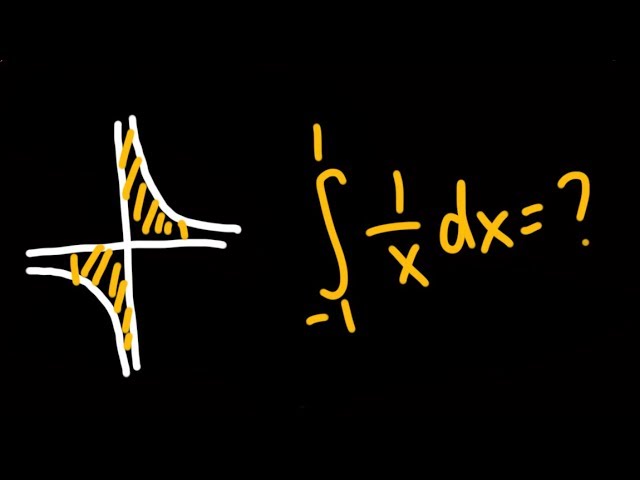
The debate of the improper integral of 1/x from -1 to 1. Is this zero or divergent?
My follow up video: "NO MORE DEBATE" https://youtu.be/b7WUupyMXJk
Let me know what you think!
blackpenredpen
patent nymph
manic lance
it would just be 0 no?
but a reason is that it’s not defined at 0, so you can’t apply the definition of riemann integration, and even if you extend the function’s domain to include 0, the resulting function can’t be riemann integrable
patent nymph
manic lance
it would just be 0 no?
intuitively, you can do a limit from both sides, but then you could approach from the left “faster” than you approach from the right, and then make the integral diverge to positive or negative infinity
so intuitively, you shouldn’t let the value of that integral be defined anyway
 gleaming fern
Hello?
manic lance
patent nymph
but a reason is that it’s not defined at 0, so you can’t apply the definition of...
i see, but if we define f(0) then it's solved right?
patent nymph
manic lance
i see, but if we define f(0) then it's solved right?
even if you extend the function’s domain to include 0, the resulting function can’t be riemann integrable
manic lance
patent nymph
even if you extend the function’s domain to include 0, the resulting function ca...
why not? we havent seen actual proofs except the proof for $\int^a_b c=c(a-b)$
twin meteorBOT
Escanor
 manic lance
and for dirchlet function
is it just because 1/x doesnt have a lim at x=0?
so as long as 0 isnt in [a,b] then the integral formula holds?
patent nymph
I’ll confess I don’t know exactly how this is proved using only the definition of riemann integration, but a proof sketch that says it could never work is:
Suppose for contradiction it were riemann integrable.
Then it would be Lebesgue integrable. But then that would require χ_([-1,0)U(0,1])*|1/x| to be Lebesgue integrable, which it isn’t
gleaming fern
I m here to ask whether this is true or not i.e n>√n for all n ∈ W??
patent nymph
gleaming fern
I m here to ask whether this is true or not i.e n>√n for all n ∈ W??
Please use another help channel, like #help-31
gleaming fern
Ohk
patent nymph
manic lance
so as long as 0 isnt in [a,b] then the integral formula holds?
Yes, in this case
manic lance
patent nymph
Yes, in this case
ty, that's also a theorem they stated earlier
patent nymph
manic lance
is it just because 1/x doesnt have a lim at x=0?
It is a theorem that if the absolute value of a continuous function is integrable, then it is integrable. In this case, the absolute value of 1/x is not integrable, so it is not guaranteed to have an integral on an interval containing 0
patent nymph
manic lance
ty, that's also a theorem they stated earlier
oh, what did it say
manic lance
patent nymph
It is a theorem that if the absolute value of a continuous function is integrabl...
i dont see why, absolute value of f = sup f?
patent nymph
manic lance
i dont see why, absolute value of f = sup f?
no, it’s abs o f
manic lance
patent nymph
oh, what did it say
according to Derbo, if f:[a,b]->R is not dffriable, then it doesnt have a predecesor function
in the domain of integration
patent nymph
manic lance
according to Derbo, if f:[a,b]->R is not dffriable, then it doesnt have a predec...
I didn’t mention differentiability, just integrability
manic lance
patent nymph
I didn’t mention differentiability, just integrability
that's what they said, i dont have one for integrability
patent nymph
patent nymph
It is a theorem that if the absolute value of a continuous function is integrabl...
let me rephrase: let f:[a,b] -> R be a continuous function such that |f| is integrable. Then f is integrable
manic lance
patent nymph
let me rephrase: let f:[a,b] -> R be a continuous function such that |f| is inte...
we havent seen this yet
patent nymph
Just mentioning this for intuition
manic lance
idk why they jumped to showing the integrals for the basic stuff
manic lance
patent nymph
let me rephrase: let f:[a,b] -> R be a continuous function such that |f| is inte...
i will keep this in mind
ty
.close
vocal sleetBOT
Channel closed
Closed by @manic lance
Use .reopen if this was a mistake.
vocal sleetBOT
Available help channel!
Send your question here to claim the channel.
Remember:
• Ask your math question in a clear, concise manner.
• Show your work, and if possible, explain where you are stuck.
• After 15 minutes, feel free to ping <@&286206848099549185>.
• Type the command .close to free the channel when you're done.
• Be polite and have a nice day!
Read #❓how-to-get-help for further information on how to ask a good question, and about conduct in the question channels.
 grim estuary
During the morning a merchant sells half of the eggs he had in his shop; in the afternoon he sells first another two dozen and then half of the remainder.
Knowing that one egg broke and that at the end of the day there were only twelve eggs in the shop, how many eggs were in the shop at the beginning of the day
vocal sleetBOT
grim estuary
During the morning a merchant sells half of the eggs he had in his shop; in the ...
 real idol
grim estuary
During the morning a merchant sells half of the eggs he had in his shop; in the ...
real idol
grim estuary
During the morning a merchant sells half of the eggs he had in his shop; in the ...
what did u try
 dark leaf
that's the amount the merchant sold
dark leaf
Total eggs - Sold = 12
real idol
dark leaf
Total eggs - Sold = 12
this and u got the "half of the remainder" part wrong
dark leaf
yea
grim estuary
what
grim estuary
grim estuary
x/2 + 24 + x/2 - 1 = 12
is this wrong or not
dark leaf
it is wrong
real idol
x/2 = sold in the morning
24 = sold in the afternoon
Remaining eggs = x-(x/2+24)
Half remaining eggs are then sold
dark leaf
so the remainder should be
1/2 * (total - 1/2x - 24)
dark leaf
x = total eggs
During the morning a merchant sells half of the eggs he had in his shop
x - x/2
in the afternoon he sells first another two dozen
x - x/2 - 2(12)
and then half of the remainder.
remainder is what is left after he sold half of the eggs and another two dozen so
remainder(r) = x - x/2 - 24
1/2 * remainder(r) = 1/2 * (x - x/2 - 24)
Knowing that one egg broke and that at the end of the day there were only twelve eggs in the shop
x - x/2 - 24 - r = 12
x - x/2 - 24 - (1/2 * (x - x/2 - 24)) = 12
hope it help! 
twin meteorBOT
Isaac
 vocal sleetBOT
@grim estuary Has your question been resolved?
Channel closed
Closed by @grim estuary
Use .reopen if this was a mistake.
vocal sleetBOT
Available help channel!
Send your question here to claim the channel.
Remember:
• Ask your math question in a clear, concise manner.
• Show your work, and if possible, explain where you are stuck.
• After 15 minutes, feel free to ping <@&286206848099549185>.
• Type the command .close to free the channel when you're done.
• Be polite and have a nice day!
Read #❓how-to-get-help for further information on how to ask a good question, and about conduct in the question channels.
 maiden nebula
how do you prove that “<“ is transitive (over the real numbers)?
maiden nebula
everything i’ve googled says “well if a<b and b<c then clearly a<c” but how do you actually prove that?
 peak matrix
maiden nebula
everything i’ve googled says “well if a<b and b<c then clearly a<c” but how do y...
peak matrix
maiden nebula
everything i’ve googled says “well if a<b and b<c then clearly a<c” but how do y...
How do you define reals?
maiden nebula
ah good point
peak matrix
the proof is gonna be highly dependent on your definition of R and <
maiden nebula
okay what if we just stuck to the integers then
idk how to define < for the integers
maiden nebula
alright how about the natural numbers, lol. using peano axioms
maiden nebula
peak matrix
have you done any set theory btw?
yes
peak matrix
maiden nebula
alright how about the natural numbers, lol. using peano axioms
Alright
we could define
a < b
as
There exists n such that b = a + n
maybe there exists n > 0
paper depot
≠*
btw no matter what set we restrict ourselves to we HAVE TO start with something for a definition.
maiden nebula
oh i see lol
peak matrix
peak matrix
maybe there exists n > 0
Yeah, we have to replace this with n ≠ 0 because < wasnt defined yet
thanks ann
maiden nebula
circular definition
peak matrix
but otherwise i think it works
and the proof of transitivity should be fairly easy, you can give it a go
maiden nebula
so b = a + n and c = b + m implies c = a + (n + m) and n + m =/= 0 because n and m are nonzero. that good?
peak matrix
Yeah, that's the outline
n + m =/= 0 because n and m are nonzero
This part would probably require a bit of elaboration, but you got the outline right
 cunning dock
Males too mainstream 🪗
Females too mainstream 🔬
Femboys too mainstream ⛓️💥
Furries too mainstream 🚰
Maybe I should give futas a try 🤤🤤🤤
peak matrix
cunning dock
Males too mainstream 🪗
Females too mainstream 🔬
Femboys too mainstream ⛓️💥
F...
Maybe move to #chill or somewhere else
 violet mason
peak matrix
Yeah, we have to replace this with n ≠ 0 because < wasnt defined yet
violet mason
peak matrix
Yeah, we have to replace this with n ≠ 0 because < wasnt defined yet
would a positive/negative type of approach be non-plausible because of this restriction, may i ask?
peak matrix
violet mason
would a positive/negative type of approach be non-plausible because of this rest...
What do you mean?
regal bane
maiden nebula
how do you prove that “<“ is transitive (over the real numbers)?
The way I see < defined on the real numbers is
"Let there be a set of real numbers we call 'positive', called P".
Then a < b if b - a is a positive number.
Obviously this takes a bit more definition (what is '-'?), but you can get all the properties from it.
 thin compass
How do I get help.... I'm very desperate to the point i went to join a math server for help 😭
violet mason
peak matrix
What do you mean?
say if i want to consider b-a as "positive", therefore a is less than b
peak matrix
regal bane
The way I see < defined on the real numbers is
"Let there be a set of real numbe...
it really depends on what we start with, if our definition of reals is through e.g. dedekind cuts, < would be exactly the same as ⊂ (in the proper subset sense)
 silk osprey
maiden nebula
how do you know subset is transitive though?
silk osprey
maiden nebula
how do you know subset is transitive though?
you can prove this easily
peak matrix
maiden nebula
how do you know subset is transitive though?
by definition
peak matrix
it comes down to transitivity of implication
peak matrix
violet mason
say if i want to consider b-a as "positive", therefore a is less than b
i still dont really get this
regal bane
Fair, I lean on my bae Tao, who does it with limits
violet mason
peak matrix
i still dont really get this
idk either lmfao
vocal sleetBOT
Channel closed
Closed by @maiden nebula
Use .reopen if this was a mistake.
vocal sleetBOT
Available help channel!
Send your question here to claim the channel.
Remember:
• Ask your math question in a clear, concise manner.
• Show your work, and if possible, explain where you are stuck.
• After 15 minutes, feel free to ping <@&286206848099549185>.
• Type the command .close to free the channel when you're done.
• Be polite and have a nice day!
Read #❓how-to-get-help for further information on how to ask a good question, and about conduct in the question channels.
vast shale
GUYS
vocal sleetBOT
vast shale
GUYS
vast shale
I need help please
someone please help pelase
I only have 1 min please Im actually in a hurry
PHEW
OK SO
WHATS THE SURFACE AREA OF 11CM RADIUS CYLINDER AND HEIGHT IS 28 CM
calm pecan
right
 alpine kestrel
what’s the formula for surface area of a cylinder………………………..
 green crow
,w 22/7 * 11 * 28
vast shale
idk
 viral copper
bro is 100% doing a test
alpine kestrel
or if u don’t know it perhaps deconstruct the cylinder yourself……..
green crow
Sorry, 2 * that
alpine kestrel
!nosols
vocal sleetBOT
As a helper, please do not give out answers that could be copied as a homework solution. Have the student work through the problem themselves and guide them along the way.
alpine kestrel
what are the faces of a cylinder…….
vast shale
circle rectangle
vast shale
but what do i DO
violet mason
study probably
alpine kestrel
tru
vast shale
I havent a choice
alpine kestrel
to find the surface area you find the area of the surface!!
vast shale
but my teacher is literally coming towards me PLEASE GAH
alpine kestrel
in this case the surface is two circles and a rectangle!!!
vast shale
is circumference 3.14159265358979... irrational number multiplied by diameter
alpine kestrel
yea sure
vast shale
and is area of circle 3.14159.. IRRATIONAL number mulitplied by radius SQUARED
alpine kestrel
yes……..
vast shale
YAYYY
green crow
Bro, google's gonna help u more than this server
vast shale
COME ON I CAN DO THIS
alpine kestrel
like
green crow
If you're cheating
vast shale
im not trust
viral copper
pending postgrad is insane
violet mason
how do you know pi to like the 20th digit but dont know the formula for a cylinders surface area
vast shale
this is just homework dw
green crow
Ok
vast shale
violet mason
how do you know pi to like the 20th digit but dont know the formula for a cylind...
i just memorize
alpine kestrel
tbf I would also struggle with a cylinder’s surface area in my postgrad probably
vast shale
mhm
violet mason
alpine kestrel
tbf I would also struggle with a cylinder’s surface area in my postgrad probably
most based statement
vast shale
Imma now go to ALGEBRA
green crow
vast shale
is circumference 3.14159265358979... irrational number multiplied by diameter
Hah, I know 3 more digits than u
vast shale
green crow
Hah, I know 3 more digits than u
How do u isolate - bro WHAT
green crow
3.14169265358979323...
vast shale
bro......
alpine kestrel
5!!
vast shale
thats only bc u must be OLDER cuz im only 11 HAH
viral copper
it was going so well...
alpine kestrel
……………….
green crow
vast shale
thats only bc u must be OLDER cuz im only 11 HAH
☹️ I'm 15
alpine kestrel
mods kill him
vast shale
oh ok sry
violet mason
honestly i knew that formula when i was 11
vast shale
hwo do u isolate like 2p plus 5 = 25/x
vast shale
25 divided by x please
violet mason
do you even know what isolate means
alpine kestrel
social distancing
twin meteorBOT
shawarma
 viral copper
this?
alpine kestrel
2p+5
violet mason
bro wtf is p
viral copper
i thought it was a type-stutter on the p
violet mason
what are we isolating
alpine kestrel
that’s so true I never thought abt it that way
violet mason
think bro got caught by his teacher
viral copper
truly a tale of all time
vocal sleetBOT
@vast shale Has your question been resolved?
alpine kestrel
let us have a moment of silence
vocal sleetBOT
Channel closed
Closed due to timeout
Use .reopen if this was a mistake.
Available help channel!
Send your question here to claim the channel.
Remember:
• Ask your math question in a clear, concise manner.
• Show your work, and if possible, explain where you are stuck.
• After 15 minutes, feel free to ping <@&286206848099549185>.
• Type the command .close to free the channel when you're done.
• Be polite and have a nice day!
Read #❓how-to-get-help for further information on how to ask a good question, and about conduct in the question channels.
 mossy cipher
Show that the nonzero ideals of K[X] are principal (i.e., generated by a unique nonzero monic polynomial)
vocal sleetBOT
mossy cipher
Show that the nonzero ideals of K[X] are principal (i.e., generated by a unique...
mossy cipher
I've no idea how to prove that
paper depot
and K is a field, yes?
mossy cipher
For the moment, I wrote :
I != {0} so there exists a polynomial P_0 of minimal degree
mossy cipher
We can also assume that P0 is monic
paper depot
show that it is precisely the generator you are looking for
mossy cipher
Yes
paper depot
because it divides everyone else
 agile orchid
cause any nonzero ideal I in K[X] must contain polynomials we can choose a non zero one f with the smallest possible degree and then using polynomial division we find that any other polynomial h in I must be a multiple of f (otherwise the remainder would be in I and have an even smaller degree, a contradiction) meaning f generates I; we can then easily make f monic by dividing by its leading coefficient

paper depot
mossy cipher
And I want to show that Q = P * something
indeed
you know that K[X] is a euclidean domain, yes?
agile orchid
idk if this enough proof
mossy cipher
agile orchid
idk if this enough proof
sure
mossy cipher
paper depot
you know that K[X] is a euclidean domain, yes?
I thought about that but I didn't wrote it :/ ( R issue )
deg(R) < deg(P0) so R = 0
thanks !
vocal sleetBOT
@mossy cipher Has your question been resolved?
vocal sleetBOT
Channel closed
Closed due to timeout
Use .reopen if this was a mistake.
vocal sleetBOT
Available help channel!
Send your question here to claim the channel.
Remember:
• Ask your math question in a clear, concise manner.
• Show your work, and if possible, explain where you are stuck.
• After 15 minutes, feel free to ping <@&286206848099549185>.
• Type the command .close to free the channel when you're done.
• Be polite and have a nice day!
Read #❓how-to-get-help for further information on how to ask a good question, and about conduct in the question channels.
 chilly tinsel
Particle A is travelling due north at 15 m/s. Particle B is travelling at 25 m/s.
At time t = 0 seconds, B is south east of A.
They are on a collision course.
(i) Show that the course of B is 19.9° west of north.
At t = 60, A and B are 278m apart.
(ii) Find the distance between A and B at t = 0.
vocal sleetBOT
chilly tinsel
Particle A is travelling due north at 15 m/s. Particle B is travelling at 25 m/s...
chilly tinsel

I have attempted to use a diagram to try and find a way to solve this, cause originally I thought B was 45 degree from the north so it’s travelling at 45 or something stupid like that and now I’m just confused on how I can find the angle it’s looking for
Would this diagram be showing what it wants? Or am I interpreting something wrong?
 cold hedge
you’re still working on part a?
chilly tinsel
Unfortunately, I feel rather bad for being stuck on that part
cold hedge
nah you’re all fine
i wonder if you could use law of cosines to solve
we know sides a b and c of our make shift triangle at t = 60
and we can use that to find the angle
or i think
oh i guess we don’t know the start position of b
hm
chilly tinsel
I attempted to use the cosine rule but then I got confused on what to do after
😖
I’m doing a topic rn called relative velocity if that’s any help
I only began doing questions and like this seems so easy but it feels like I’m interpreting something wrong
 pearl wadi
chilly tinsel
I’m doing a topic rn called relative velocity if that’s any help
pearl wadi
chilly tinsel
I’m doing a topic rn called relative velocity if that’s any help
yeah i would figure..i dont even know how u would begin solving using maths
let me try 1 sec
chilly tinsel
I even shoved it into ChatGPT to see where I might be thinking wrong but it’s thinking even further than me, cause it got 30 degrees ish, honestly feels like I’m just blind and that it’s really simple and I’m over complicating it
pearl wadi
chilly tinsel
I even shoved it into ChatGPT to see where I might be thinking wrong but it’s th...
"At t = 60, A and B are 278m apart." is this given information?
or do we have to prove this as well
chilly tinsel
It’s given information, but it’s after the first part of the question so I thought it was not relevant until part 2

That’s the photo there
cold hedge
smth about turning into vectors
gotta get off a train, but can try in a little
maybe not yet
wait nvm 10 min
chilly tinsel
Don’t stress about it! It’s my work I’m struggling at so don’t even worry, I’m so appreciative that yous are even helping to see the issue
cold hedge
X coordínate;
A: 0
B: X - 25tcos(theta)
Y coordinate
A: 15t
B: 25tsin(theta) - Y
if i’m not mistaken
wait no
now i think it’s right
chilly tinsel
pearl wadi
could someone just rotate this
I can try and take another to see if it turns
cold hedge
chilly tinsel
,rccw
twin meteorBOT
Couldn't find an attached image in the last 10 messages.
cold hedge
uh
pearl wadi
chilly tinsel
I can try and take another to see if it turns
nah dw about it let me try using ur question
chilly tinsel
 cold hedge
X coordínate;
A: 0
B: X - 25tcos(theta)
Y coordinate
A: 15t
B: 25tsin(theta) ...
cold hedge
cold hedge
X coordínate;
A: 0
B: X - 25tcos(theta)
Y coordinate
A: 15t
B: 25tsin(theta) ...
i’m assuming for any start point of the particles the angle needs to still be 19.9
so choose random values of B and plug and chug?
not positive if it will work but worth a shot
chilly tinsel
I need like a visual image of the cords you given, I’m not a very letter person 😭 let me try and plot them on paper
cold hedge
all good
just making the velocity into a vector
then making position equations with it
chilly tinsel
I hate vectors, they are the vein of my existences or whatever the saying is
cold hedge
😭
chilly tinsel
I remember doing them at the start of the year and just sobbed at all the exam questions. Well transformation matrices are worse
I swear they crawled out of hell at some point just to hunt me
cold hedge
womp womp
chilly tinsel
😖 AHHHHH
I’ll attempt question 4 for the time being until someone can point me the right way 🥲
pearl wadi
yes that should be easy
 ashen remnant
chilly tinsel
ashen remnant
chilly tinsel
this is on the right track but the other longer side should have length 25
vocal sleetBOT
@chilly tinsel Has your question been resolved?
chilly tinsel
ashen remnant
this is on the right track but the other longer side should have length 25
If you are mentioning the triangle I drew, I put 25 there because I thought if I created a triangle of 15, and 25 I would have somewhere to go if I found the resultant.
The angle 15 and 25 should make 135+x which should be 19.9 according to the show that question
Would you have any clue where to go from there?
 chilly tinsel
😨😨😨 THIS MIGHT WORK LET ME GIVE IT A TRY, THANK YOOOu
I’ll update you when I find out pfft

IT WORKED!!!! Wait how should I word why it can’t be negative
ashen remnant
distances are always positive
ashen remnant
np
btw, in the future if you want easier calculations, youcould use law of sines to get the angle at B
chilly tinsel
I’m in debt to you bro, thank you sm 🌷
Oh right! I was thinking too complicated pfft
Thank you sm tho
Thank you @pearl wadi @cold hedge For helping aswell 🤗
pearl wadi
chilly tinsel
Thank you <@728482160927047742> <@706870910468227092> For helping aswell 🤗
i did not help 😭
i was trying to solve it using physics method
chilly tinsel
pearl wadi
i did not help 😭
You attempted, better than nothing hehe
pearl wadi
since i had also learnt to solve such problems using relative velocity
chilly tinsel
pearl wadi
i was trying to solve it using physics method
Pfft 😭
pearl wadi
np, point is u solved it gj