#help-17
1 messages · Page 288 of 1
 sly mountain
 finite mist
Then u made a mistake along the way u get that number
 kind light
bro you cant just send us some random number and ask for help without context
 vast shale
i thought maybe you guys know how to break that point thing into simpler terms so that i can solve this
sly mountain
faktz
vast shale
ok ! maybe the book answer could be wrong too
i have verified my sum its coming to that point and then by using calculator the final answer doesn't match the option
.close
 vocal sleetBOT
Channel closed
Closed by @atomic lance
Use .reopen if this was a mistake.
vocal sleetBOT
 Available help channel!
Send your question here to claim the channel.
Remember:
• Ask your math question in a clear, concise manner.
• Show your work, and if possible, explain where you are stuck.
• After 15 minutes, feel free to ping <@&286206848099549185>.
• Type the command .close to free the channel when you're done.
• Be polite and have a nice day!
Read #❓how-to-get-help for further information on how to ask a good question, and about conduct in the question channels.
 steep radish
How to do this?
 vocal sleetBOT
steep radish
How to do this?
steep radish
vocal sleetBOT
steep radish
How to do this?
steep radish
I keep getting alot of cases to find
steep radish
kind light
i dont think bruteforcing is that crazy?
I tried and it kept on going tho
Should i try again?
Okay yeah got it
.close
vocal sleetBOT
Channel closed
Closed by @steep radish
Use .reopen if this was a mistake.
vocal sleetBOT
Available help channel!
Send your question here to claim the channel.
Remember:
• Ask your math question in a clear, concise manner.
• Show your work, and if possible, explain where you are stuck.
• After 15 minutes, feel free to ping <@&286206848099549185>.
• Type the command .close to free the channel when you're done.
• Be polite and have a nice day!
Read #❓how-to-get-help for further information on how to ask a good question, and about conduct in the question channels.
 neat rose
Let $a,b,c,d > 0 : a+b+c+d = 3$; Prove : $$\sum_{cyc} (abc)^3 \leq 1$$
 twin meteorBOT
Goëtia

 dense cedar
steep radish
How to do this?
dense cedar
steep radish
How to do this?
This was an application of the multinomial theorem though !
neat rose
!occupied
vocal sleetBOT
Someone else is already using this help channel. If you need help with a question, please open your own help channel/thread (see #❓how-to-get-help for instructions).
dense cedar
twin meteor
**Goëtia**
What does cyc under the summation sign means ?
 hybrid flicker
dense cedar
What does cyc under the summation sign means ?
hybrid flicker
dense cedar
What does cyc under the summation sign means ?
cycle
so a,b,c then b,c,d then c,d,a...
dense cedar
hybrid flicker
so a,b,c then b,c,d then c,d,a...
Okay !
neat rose
if someone has a basic idea , ping me, i dont want to overkill it with something that the basic highschooler doesnt know
 shut canyon
have you tried cubing the equation
neat rose
u try it
dense cedar
twin meteor
**Goëtia**
Maybe you would like to use langrange multipliers
Or ik the max value is at a=b=c=d
Or
(abcd)³(1/a³+1/b³+1/c³+1/d³)
So (abcd)^(1/4) ≤ 3/4
So (abcd)³ ≤ (3/4)^12
Idk what follows after
 paper depot
wait hold on couldn't we AM-GM this somehow
 shut wave
paper depot
wait hold on couldn't we AM-GM this somehow
shut wave
paper depot
wait hold on couldn't we AM-GM this somehow
ye but wed need d tho
why d excluded?
dense cedar
hybrid flicker
cycle
/ see this
shut wave
oh
neat rose
dense cedar
Maybe you would like to use langrange multipliers
as i said no overkill method to be used
paper depot
(abc)^3 <= (a+b+c)^3/27 and likewise under cyclical shifts
shut wave
hmm
paper depot
is that cooking?
neat rose
no
paper depot
sad! many such cases
neat rose
paper depot
(abc)^3 <= (a+b+c)^3/27 and likewise under cyclical shifts
also ur wrong here
u might have meant abc instead of (abc)^3
paper depot
oh yes i did mean that my bad
was trying to transform the ineq in my head and messed it up
ok that's definitely doing us no good then
neat rose
i bet my right arm, the trick is to use jensen's inequality on f(x) = x^3
but not sure how to use it without including that the sum is maximized at a=b=c=d=3/4
shut wave
hybrid flicker
so a,b,c then b,c,d then c,d,a...
when does the cycle end?
neat rose
Aight i think i might have found a clue
lets use what Ann-san used
abc <= ((a+b+c)/3)^3
abc <= ((3 -d)/3)^3
thus the cyclic sum of (abc)^3 <= ((3-d)/3)^9 + ... + ((3 - a)/3)^9
aight now consider g(x) = ((3-x)/3)^9
this thing is clearly convex for x in [0, 3]
then by jensen ineq
(g(a) + g(b)+g(c)+g(d))/4 >= g(a+b+c+d/4)
= g(3/4)
hybrid flicker
neat rose
(g(a) + g(b)+g(c)+g(d))/4 >= g(a+b+c+d/4)
so you're on the wrong side of Jensen
neat rose
what u talkin bout?
hybrid flicker
you wanted to upper bound (g(a) + g(b)+g(c)+g(d))/4
neat rose
hybrid flicker
so you're on the wrong side of Jensen
here is an exercise for you, prove that g(x) gets its max at x = 0
yeah i got it thx everyone
.close
vocal sleetBOT
Channel closed
Closed by @neat rose
Use .reopen if this was a mistake.
hybrid flicker
neat rose
yeah i got it thx everyone
not sure how you got it but alr
hybrid flicker
neat rose
here is an exercise for you, prove that g(x) gets its max at x = 0
-
- obvious
-
- not here to solve your exercises
neat rose
hybrid flicker
- 1) obvious
- 2) not here to solve your exercises
(g(a)+g(b) + g(c)+g(d))/4 <= 1
u asked the obvious, i gave u an exercise to help u see the obvious as u fail to see it
hybrid flicker
neat rose
(g(a)+g(b) + g(c)+g(d))/4 <= 1
and yet we're asking you to bound g(a) + g(b) + g(c) + g(d)
not (g(a) + g(b) + g(c) + g(d))/4
neat rose
whats the monotony of g(x) over [0,3]
hybrid flicker
so congratulations, your upper bound is 4
hybrid flicker
neat rose
whats the monotony of g(x) over [0,3]
yes, decreasing, so g(x) <= g(0), so your upper bound is 4g(0) = 4
not a great upper bound imo
Please stop acting condescending if you want to receive help
neat rose
hybrid flicker
Please stop acting condescending if you want to receive help
not condescending, i said i got it, u kept pushin it, not sure if u got offended
hybrid flicker
neat rose
not condescending, i said i got it, u kept pushin it, not sure if u got offended
I pushed it because it appeared you didn't solve the original question (which indeed you didn't) and I wanted to help you realize it. You give me "exercises" to "see the obvious as I fail to see it"
sounds pretty condescending
neat rose
good luck
hybrid flicker
no, I wish you good luck, it is you who has an unresolved question
neat rose
resolved it, good luck the channel was marked closed
hybrid flicker
xddddd
 bitter pilot
xddd
vocal sleetBOT
Available help channel!
Send your question here to claim the channel.
Remember:
• Ask your math question in a clear, concise manner.
• Show your work, and if possible, explain where you are stuck.
• After 15 minutes, feel free to ping <@&286206848099549185>.
• Type the command .close to free the channel when you're done.
• Be polite and have a nice day!
Read #❓how-to-get-help for further information on how to ask a good question, and about conduct in the question channels.
 sudden tundra
hello: given X and N, what is Y where X = (Y * (Y+1) * (Y+2) * (Y+3) * ... * (Y+N)) / (N+1)!
vocal sleetBOT
sudden tundra
hello: given X and N, what is Y where X = (Y * (Y+1) * (Y+2) * (Y+3) * ... * (Y...
hybrid flicker
so X = (Y+N) choose (N+1)
sudden tundra
X = (Y * (Y+1) * (Y+2) * (Y+3) * ... * (Y+N)) / (N+1)!
sudden tundra
yes
hybrid flicker
or only N?
sudden tundra
i'm not sure how to formualte the equation given a non-integer for N
hybrid flicker
sudden tundra
i'm not sure how to formualte the equation given a non-integer for N
well if you want to extend to any X,Y,N
$X = \frac{(Y+N)!}{(N+1)!(Y-1)!}$
twin meteorBOT
rafilou is not not born in 2003
 hybrid flicker
so extend using Gamma function, which generalizes factorials
$X = \frac{\Gamma(Y+N+1)}{\Gamma(N+2)\Gamma(Y)}$
twin meteorBOT
rafilou is not not born in 2003
 sudden tundra
X = (Y * (Y+1) * (Y+2) * (Y+3) * ... * (Y+N)) / (N * (N - 1) * (N - 2) * (N - 3) * .. * (N - N +1)
what is that R symbol?
sudden tundra
ok
hybrid flicker
twin meteor
**rafilou is not not born in 2003**
in any case you have this
for natural integers X,N,Y
not sure how to extract a formula for Y though
 hard atlas
for which values of X and N are you asked that question?
you could always go the bruteforce way, multiply out the polynomial and use rrt. if you know that Y is an integer then you are guaranteed to find it. it will just be painful
depending on size it will certainly be faster to just write down pascals triangle
you can also do things with the prime factorization. you have to allocate the primes in a way so that you get a product of consecutive integers
depending on size you can also just approximate X approx Y^N/(N+1)! and take the Nth root of X(N+1)!. that will give you an approximate Y and then you can look at the nearby integers and see if they work
vocal sleetBOT
@sudden tundra Has your question been resolved?
vocal sleetBOT
Channel closed
Closed due to timeout
Use .reopen if this was a mistake.
Available help channel!
Send your question here to claim the channel.
Remember:
• Ask your math question in a clear, concise manner.
• Show your work, and if possible, explain where you are stuck.
• After 15 minutes, feel free to ping <@&286206848099549185>.
• Type the command .close to free the channel when you're done.
• Be polite and have a nice day!
Read #❓how-to-get-help for further information on how to ask a good question, and about conduct in the question channels.
 waxen hawk
Given there are 5 numbers which have a sum of 45, prove that one of these number must be equivalent or bigger than 9.
vocal sleetBOT
waxen hawk
Given there are 5 numbers which have a sum of 45, prove that one of these number...
waxen hawk
.close
vocal sleetBOT
Channel closed
Closed by @waxen hawk
Use .reopen if this was a mistake.
waxen hawk
.reopen
vocal sleetBOT
✅
waxen hawk
Question:
Given there are 5 numbers which have a sum of 45, prove that one of these number must be equivalent or bigger than 9.
This one is tougher than I expected
hybrid flicker
waxen hawk
This one is tougher than I expected
!status
vocal sleetBOT
waxen hawk
This one is tougher than I expected
What step are you on?
1. I don't know where to begin.
2. I have begun but got stuck midway.
3. I got an answer but I was told that it's wrong.
4. I got an answer and would like my work checked.
5. I have a question about someone else's work/solution.
6. I have completed the problem and don't need help anymore. Thank you.
7. None of the above
I wqs thinking that I might be able to prove it if I introduce the geometric meaning of a weighted mean
hybrid flicker
waxen hawk
I wqs thinking that I might be able to prove it if I introduce the geometric mea...
oh uh no need to go complicated
hybrid flicker
waxen hawk
Question:
Given there are 5 numbers which have a sum of 45, prove that one of t...
let's analyse this statement you're tasked to prove
Here's what I see (and tell me if you agree with me or not)
waxen hawk
hybrid flicker
oh uh no need to go complicated
Yes, that would take too much effort to explain how it works
hybrid flicker
I see three parts in that statement
"There are 5 numbers"
"which have a sum of 45"
prove
"one of these numbers is equal or bigger than 9"
right now nothing fancy, right?
hybrid flicker
hybrid flicker
"There are 5 numbers"
This is the premise, nothing out of the ordinary
so say we call them a,b,c,d,e
we don't really care about their name either
waxen hawk
hybrid flicker
so say we call them a,b,c,d,e
I did, when I was trying manipulating stuff to an answer
hybrid flicker
hybrid flicker
"which have a sum of 45"
Now, what kind of statement is this?
Are we meant to prove it
or...
waxen hawk
hybrid flicker
Are we meant to prove it
You mean do the other way around, proof by contradiction
Is it how it is called
hybrid flicker
waxen hawk
Is it how it is called
I'm not going there yet, but you're smelling what I'm cooking
hybrid flicker
hybrid flicker
"which have a sum of 45"
This part of the statement, do we have to prove it?
What function does it serve
how is it called
waxen hawk
hybrid flicker
This part of the statement, do we have to prove it?
Is it the if not B then not A
hybrid flicker
waxen hawk
Is it the if not B then not A
ok you're going 1000% faster than I was anticipating
waxen hawk
If the sum isn’t 45 then the premise wouldn’t hold
hybrid flicker
waxen hawk
If the sum isn’t 45 then the premise wouldn’t hold
no that's not it
waxen hawk
Ohhh my bad
hybrid flicker
let's just go through with what I wanted you to find
hybrid flicker
hybrid flicker
"which have a sum of 45"
This part of the statement is called a hypothesis/supposition
hybrid flicker
hybrid flicker
prove
"one of these numbers is equal or bigger than 9"
and this is the result
so we're in a "prove A => B" situation
there are generally three ways to prove such a statement
you have the direct proof:
"Suppose A.
....
then B"
and then you have 2 additional kinds of proof
the contrapositive proof
which relies on the fact that "A => B" is the same as "not B => not A"
(recall the ever so great 'if I poop then I flush the toilet')
waxen hawk
I see
hybrid flicker
so the proof would go
"Suppose the result is false...
Then the hypothesis is false"
And final kind of proof that we won't use here
Proof by absurd
"Suppose the hypothesis is true but the result is false.
...
Wait, that's impossible!!!"
waxen hawk
If there is no number that bigger or equal to 9, or in other words, a,b,c,d, and e are all smaller than 9.
Then a+b+c+d+e would be smaller than 45.
Hence, if the sum of these five constants is 45, then one of them must be equivalent or bigger than 9.
waxen hawk
hybrid flicker
yep, you got it
It is easier than I expected
hybrid flicker
so when you're tasked to prove statements that look like A => B
before adventuring in a direct proof
try playing around with what the contrapositive is like, or what a proof by absurd would look like
and see if one of those is more obvious than the others
hybrid flicker
waxen hawk
Given there are 5 numbers which have a sum of 45, prove that one of these number...
cause we can agree that this statement isn't obvious at first
but if I write it in its contrapositive form "given there are 5 numbers who are all smaller than 9, prove that they have a sum not equal to 45"
definitely looks easier
waxen hawk
hybrid flicker
but if I write it in its contrapositive form "given there are 5 numbers who are ...
I never thought contraposition to be that useful and commonplace.
It is fabulous, thanks for providing such a wonderful method of proving.
vocal sleetBOT
@waxen hawk Has your question been resolved?
vocal sleetBOT
Channel closed
Closed due to timeout
Use .reopen if this was a mistake.
Available help channel!
Send your question here to claim the channel.
Remember:
• Ask your math question in a clear, concise manner.
• Show your work, and if possible, explain where you are stuck.
• After 15 minutes, feel free to ping <@&286206848099549185>.
• Type the command .close to free the channel when you're done.
• Be polite and have a nice day!
Read #❓how-to-get-help for further information on how to ask a good question, and about conduct in the question channels.
 errant flint
heyy
vocal sleetBOT
errant flint
heyy
errant flint
I need help with a division
that I cant solve it in the calculator
but its very bigs numbers
 reef agate
errant flint
I need help with a division
reef agate
errant flint
I need help with a division
Can you show the division problem
 reef agate
Do you know how to do long division?
paper depot
En aritmética, la división larga es un algoritmo para dividir dos números, obteniéndose el cociente un dígito por vez. La implementación de un proceso estándar de división permite encontrar cocientes entre números arbitrariamente grandes, sin necesidad de recurrir a tablas con los resultados. Existen numerosas variantes (como el método de la pot...
errant flint
paper depot
https://es.wikipedia.org/wiki/Divisi%C3%B3n_larga
yea I dont know how to do that
wait
I know how to do that
I tried to do that
paper depot
can you show an attempt
errant flint
yea
paper depot
ok let's see it then
errant flint
 errant flint
paper depot
ok let's see it then
errant flint
paper depot
ok let's see it then
there
paper depot
uh oh
why are you bringing three digits down
you're supposed to only bring one down at a time 😭
errant flint
really?
paper depot
yes
also might help to write down the first 9 multiples of 197 just to not have to recalculate them every time
errant flint
ok
paper depot
but in the next step you dont touch the 5 and 6 yet
and just bring 1 down so you have 1131
and all subsequent steps you bring down 1 digit at a time
paper depot
oh ok
errant flint
between the 1 and 5
paper depot
well then you want to know how many times 197 goes into 1131
paper depot
if you are doing it by hand, it's helpful to note that 197 is approximately 200
errant flint
to make it easier
errant flint
paper depot
if you are doing it by hand, it's helpful to note that 197 is approximately 200
okk
and that 1131 its close to 1130?
paper depot
1131 is between 1000 and 1200
errant flint
oh ok
paper depot
so 200 goes into it 5 times but not 6
same for 197 but double-check it
(if you end up with more than 197 as remainder, you can always just subtract another 197)
well, this or the more general trick is to write out 197*1, 197*2, 197*3, ..., 197*9 and compare your current remainder against all of those
errant flint
wait
errant flint
paper depot
so 200 goes into it 5 times but not 6
I understood this part
but when I have to subtract
I dont know what is the number I use
like
Idk how much is 197*5
paper depot
well you have to relearn how to add and multiply
without these you have no hope of doing division by hand
errant flint
paper depot
without these you have no hope of doing division by hand
Im back
got it
paper depot
you forgot manual addition and multiplication, but now you are back and have relearned it in all of 2 minutes?
errant flint
yea
paper depot
either you are a lightning fast learner or something's suspicious here.
but ok, can you work out say 197*7 on paper for me and show me the result?
as in all your work not only the answer
errant flint
paper depot
but ok, can you work out say 197*7 on paper for me and show me the result?
yea
Im sending u the picture

@paper depot
paper depot
,rcw
twin meteorBOT
 errant flint
paper depot
careful with that 9, it's easy to misread as a 4
errant flint
paper depot
careful with that 9, it's easy to misread as a 4
okk
paper depot
should i repeat my instructions for the division problem?
paper depot
ok
errant flint
paper depot
320/45?
32/45
paper depot
...
paper depot
you are confusing me
errant flint
Im gonna send a photo
paper depot
you are doing a different question than the one we started with, yes or no?
errant flint
paper depot
you are confusing me
yea I know Im confused too ahahhahah
errant flint
paper depot
you are doing a different question than the one we started with, yes or no?
its the same exercise
paper depot
huh??
errant flint
 paper depot
then why are you dividing anything by 45 when your divisor was 197??
errant flint
paper depot
then why are you dividing anything by 45 when your divisor was 197??
wait
this is a different question but they both are from the same exercise
errant flint
32
paper depot
anyway,
errant flint
but
paper depot
i did say that estimation with rounding can sometimes mean you are off by 1
paper depot
paper depot
(if you end up with more than 197 as remainder, you can always just subtract ano...
here
errant flint
as 32 is smaller than 45 I added a zero after 32 and a zero before 45
paper depot
i see your issue: 320 - 270 = 50 and that can fit another 45
errant flint
paper depot
here
okk
errant flint
paper depot
i see your issue: 320 - 270 = 50 and that can fit another 45
ok
well now Im good
thx
vocal sleetBOT
@errant flint Has your question been resolved?
vocal sleetBOT
Channel closed
Closed due to timeout
Use .reopen if this was a mistake.
vocal sleetBOT
Available help channel!
Send your question here to claim the channel.
Remember:
• Ask your math question in a clear, concise manner.
• Show your work, and if possible, explain where you are stuck.
• After 15 minutes, feel free to ping <@&286206848099549185>.
• Type the command .close to free the channel when you're done.
• Be polite and have a nice day!
Read #❓how-to-get-help for further information on how to ask a good question, and about conduct in the question channels.
 white spoke
Hello sorry to bother you, but i have got a question for 2.3 i have not done a question like that in a very long time could you please help?
 vocal sleetBOT
white spoke
Hello sorry to bother you, but i have got a question for 2.3 i have not done a q...
white spoke
vocal sleetBOT
white spoke
Hello sorry to bother you, but i have got a question for 2.3 i have not done a q...
white spoke
I have got a test comming up on monday aswell so need to revise some stuff for maths
 flat whale
,rotate
twin meteorBOT
 flat whale
find all the factors of 36 and 63
if they don't share any factors, then the HCF is just the product 36 * 63
white spoke
So with factors do you mean like one factor of 36 is 18?
twin meteorBOT


 flat whale
prime factors would make it easier to compare, but not necessary
white spoke
Oh ok i get it now and so what ever is the highest factor that is in both the numbers is the correct answer?
flat whale
The Highest Common Factor (HCF) of two numbers is the highest possible number which divides both the numbers completely. The highest common factor (HCF) is also called the greatest common divisor (GCD). Learn more about the highest common factor with solved examples, interactive worksheets & solutions from Cuemath
vocal sleetBOT
Channel closed
Closed by @white spoke
Use .reopen if this was a mistake.
Available help channel!
Send your question here to claim the channel.
Remember:
• Ask your math question in a clear, concise manner.
• Show your work, and if possible, explain where you are stuck.
• After 15 minutes, feel free to ping <@&286206848099549185>.
• Type the command .close to free the channel when you're done.
• Be polite and have a nice day!
Read #❓how-to-get-help for further information on how to ask a good question, and about conduct in the question channels.
 bleak pasture
Man idk whats wrong with my awnsers?
 vocal sleetBOT
bleak pasture
Man idk whats wrong with my awnsers?
bleak pasture
vocal sleetBOT
bleak pasture
Man idk whats wrong with my awnsers?
bleak pasture
 paper depot

also you have a doubled plus sign in there
that and also you should show your work for all of these answers
it's not really possible to diagnose your errors just from the wrong answers here
bleak pasture
paper depot
I fixed that
bleak pasture
bleak pasture
Man idk whats wrong with my awnsers?
I got the slope by doing the slope equation y1-y-2/x1-x2
Then plugged xandy
To get h
B*
and i got -10p+1930
paper depot
bleak pasture
I got the slope by doing the slope equation y1-y-2/x1-x2
ok theres multiple issues with that
one is that you're missing the parentheses
bleak pasture
paper depot
ok theres multiple issues with that
?
paper depot
two is that you're throwing away the variable names and dangerously untethering yourself from the problem's variables (and have to then get the translation back from x and y to p and q correct)
three is that this planning is all well and good but we need to see the execution as well.
show dont tell, etc.
an arithmetic error could befall absolutely ANYBODY and we need to make sure this didnt happen either
bleak pasture
Let me redo it because i didnt it on a throwaway paper
paper depot
ok
vocal sleetBOT
Channel closed
Closed by @bleak pasture
Use .reopen if this was a mistake.
vocal sleetBOT
Available help channel!
Send your question here to claim the channel.
Remember:
• Ask your math question in a clear, concise manner.
• Show your work, and if possible, explain where you are stuck.
• After 15 minutes, feel free to ping <@&286206848099549185>.
• Type the command .close to free the channel when you're done.
• Be polite and have a nice day!
Read #❓how-to-get-help for further information on how to ask a good question, and about conduct in the question channels.
 jovial copper
 vocal sleetBOT
jovial copper
vocal sleetBOT
jovial copper
 twin horizon
jovial copper
twin horizon
jovial copper
.close
vocal sleetBOT
Channel closed
Closed by @jovial copper
Use .reopen if this was a mistake.
vocal sleetBOT
Available help channel!
Send your question here to claim the channel.
Remember:
• Ask your math question in a clear, concise manner.
• Show your work, and if possible, explain where you are stuck.
• After 15 minutes, feel free to ping <@&286206848099549185>.
• Type the command .close to free the channel when you're done.
• Be polite and have a nice day!
Read #❓how-to-get-help for further information on how to ask a good question, and about conduct in the question channels.
 severe stone
 vocal sleetBOT
severe stone
vocal sleetBOT
severe stone
 twilit needle
 severe stone
So I dont i am allowed to pick 1 quarter of this square and then multiply my answer by 4 right?
flat whale
do 4 double integrals 
severe stone
is that the fastest way?
flat whale
find some symmetry and maybe do 2instead
severe stone
alright!
so i figured f(x,-y) = f(x,y) does this mean that the function is symmetrical in y=0 so the x-asis?
 civic otter
severe stone
so i figured f(x,-y) = f(x,y) does this mean that the function is symmetrical in...
civic otter
severe stone
so i figured f(x,-y) = f(x,y) does this mean that the function is symmetrical in...
I'm not so sure about that
Because you have a y³
civic otter
twilit needle

O would integrate it either with the horizontal "wires" (blue) or with the vertical "wires" (green)
civic otter
Exactly
severe stone
thank you
 tight delta
can i skip the nomials section including bi,tri,polynomials? how important is it for future maths?
severe stone
so R1= { (x,y) element R² | -1<=x<=0 , -x-1<=y<=x+1 }?
severe stone
tight delta
can i skip the nomials section including bi,tri,polynomials? how important is it...
!occupied
vocal sleetBOT
tight delta
can i skip the nomials section including bi,tri,polynomials? how important is it...
Someone else is already using this help channel. If you need help with a question, please open your own help channel/thread (see #❓how-to-get-help for instructions).
tight delta
severe stone
!occupied
come again?
severe stone
I am already using this channel for help so could u please create one yourself?
tight delta
so sorry...will do
severe stone
no worries :)
severe stone
civic otter
Exactly
is it true that this one takes really long? maybe was easier to do it horizontal?
but that will screw with the sin(x)
civic otter
Uh yeah I didn't even think about that sine
I believe horizontally is much better then
vocal sleetBOT
@severe stone Has your question been resolved?
severe stone
civic otter
Uh yeah I didn't even think about that sine
well the sine will be anoying if i do it horizontally right?
but now i am doing it vertically but makes a huge function for the outside integration
severe stone
.close
vocal sleetBOT
Channel closed
Closed by @severe stone
Use .reopen if this was a mistake.
vocal sleetBOT
Available help channel!
Send your question here to claim the channel.
Remember:
• Ask your math question in a clear, concise manner.
• Show your work, and if possible, explain where you are stuck.
• After 15 minutes, feel free to ping <@&286206848099549185>.
• Type the command .close to free the channel when you're done.
• Be polite and have a nice day!
Read #❓how-to-get-help for further information on how to ask a good question, and about conduct in the question channels.
 frosty thorn
,,3sec(x)-4cos(x)=0
vocal sleetBOT
frosty thorn
,,3sec(x)-4cos(x)=0
twin meteorBOT
☠ cj Σ

 bitter pilot
frosty thorn
so is it just pi/3 and 5pi/3
bitter pilot
frosty thorn
so is it just pi/3 and 5pi/3
they are wrong
you should have 3sec²(x)-4=0
you ignored the 3 when you factored
vocal sleetBOT
Channel closed
Closed by @frosty thorn
Use .reopen if this was a mistake.
vocal sleetBOT
Available help channel!
Send your question here to claim the channel.
Remember:
• Ask your math question in a clear, concise manner.
• Show your work, and if possible, explain where you are stuck.
• After 15 minutes, feel free to ping <@&286206848099549185>.
• Type the command .close to free the channel when you're done.
• Be polite and have a nice day!
Read #❓how-to-get-help for further information on how to ask a good question, and about conduct in the question channels.
 dire meteor
.open
 eager oxide
where does this 8 come from?
 vocal sleetBOT
eager oxide
where does this 8 come from?
eager oxide
vocal sleetBOT
eager oxide
where does this 8 come from?
eager oxide
nvmmm
 sly sierra
look at the integration bounds
sly sierra
yea they're using that the integrand is even
vocal sleetBOT
@eager oxide Has your question been resolved?
vocal sleetBOT
Channel closed
Closed due to timeout
Use .reopen if this was a mistake.
Available help channel!
Send your question here to claim the channel.
Remember:
• Ask your math question in a clear, concise manner.
• Show your work, and if possible, explain where you are stuck.
• After 15 minutes, feel free to ping <@&286206848099549185>.
• Type the command .close to free the channel when you're done.
• Be polite and have a nice day!
Read #❓how-to-get-help for further information on how to ask a good question, and about conduct in the question channels.
 rich sinew
I just need some clarification on a simultanious equaitons question
 rich sinew
it wants me to solve this for a does not equal 1/2 and a does equal 1/2
this was the first thing i did

if a does not equal 1/2, y is equal to 0 and after that getting x and z is pretty easy
but i dont see how a = 1/2 has a different solution
the answers use a parameter for y and then solves it from there
vocal sleetBOT
@rich sinew Has your question been resolved?
 sinful heron
if a = 1/2, then y can be anything
if a is not equal to 1/2, y has to be 0, otherwise your last equation does not hold, you understand?
rich sinew
oh ok thanks
i thought i had a way of obtaining y=0 without using a but i just realised it had an error lol
i understand alot better now
.close
vocal sleetBOT
Channel closed
Closed by @rich sinew
Use .reopen if this was a mistake.
vocal sleetBOT
Available help channel!
Send your question here to claim the channel.
Remember:
• Ask your math question in a clear, concise manner.
• Show your work, and if possible, explain where you are stuck.
• After 15 minutes, feel free to ping <@&286206848099549185>.
• Type the command .close to free the channel when you're done.
• Be polite and have a nice day!
Read #❓how-to-get-help for further information on how to ask a good question, and about conduct in the question channels.
 weary forge
How do I Graph/write Quadratics in standard form?
vocal sleetBOT
weary forge
How do I Graph/write Quadratics in standard form?
weary forge
I'm on this question

 mental cradle
i would draw each different part, and then add em up
first draw 2x^2, then -4x, then -6
thats a practical way, dk what you need tho
mental cradle
mental cradle
i would draw each different part, and then add em up
first draw 2x^2, then -4x, ...
well then thats good
weary forge
Alright, I did it
mental cradle
for each vertical line, add the value of each 'part', at the center it should be -6
i guess you can assume each square means only 1+-1
+-1
weary forge
???
My teacher had been explaining this, but I was absent cause I was sick, so I have no idea what to do
Apparently the x-coordinate of the vertex is - b/2a
Which in this case should be 4/2(2)
Which is 4/4, which simplified would just be 1
But plugging 1 into the equation doesn't make sense when I do the equation...
 snow dune
what happens when you plug 1 into the equation?
weary forge
Well it works out fine, but the video I watched said I had to plug something else in after 1, but the number that I plug in after leads to -144, and I don't think that's right...
snow dune
if you need to find the vertex, just plugging in 1 is fine.
weary forge
I get -6
snow dune
thats not what i mean sorry
weary forge
Oh
snow dune
if you plug in 1, the end result should be -8
weary forge
How?
snow dune
2*(1)^2-4(1)-6
weary forge
2(1)^2, doesn't that equal 4?
snow dune
2(1)^2 is the same as 2 * 1 * 1
weary forge
I though it would be the same as 2^2
snow dune
Im not quite sure how u get that
maybe ur multiplying before doing the exponent
you have to do exponents before multiplication
 wraith python
 wraith python
 weary forge
I know that, but 2 away from -8 are -10 and -6
wraith python
(x,y) = (1, -8)
That gives you a coordinate pair whose point you can plot on your graph.
That point also happens to be the vertex of the parabola.
wraith python
🙂
weary forge
.close
vocal sleetBOT
Channel closed
Closed by @weary forge
Use .reopen if this was a mistake.
vocal sleetBOT
Available help channel!
Send your question here to claim the channel.
Remember:
• Ask your math question in a clear, concise manner.
• Show your work, and if possible, explain where you are stuck.
• After 15 minutes, feel free to ping <@&286206848099549185>.
• Type the command .close to free the channel when you're done.
• Be polite and have a nice day!
Read #❓how-to-get-help for further information on how to ask a good question, and about conduct in the question channels.
 lofty sparrow
We started doing volume by slicing and I can't make sense of it I am genuinely lost on where to even start
vocal sleetBOT
lofty sparrow
We started doing volume by slicing and I can't make sense of it I am genuinely l...
lofty sparrow
this is the problem I'm currently stuck on but if someone could help me by giving me an example problem and helping guide me through it so I understand what I am doing that would be a huge help

 trim fern
so it's like a skewed semicone ish shape
oh wait the questions are simpler than i thought
so like
(for part 1) the diameter of the semicircle increase as X increases
being 0 at x=2 and 2 at x=0
simple linear function of 2-x
and then just add the other part of the formula to transform the diameter into the semicircle's area
like
since a(d) = pi*d^2/8
then A(x) = pi/8 * (2-x)^2
lofty sparrow
Well in class he usually tells us to find what we are respecting to like y or x and we find the area of a slice then use an integral to find the whole area its just when Im looking at it I got no clue what im respecting which is the first step to solving this I think
and I think its respect to x since its perpendicular to the x
trim fern
i thought of a solution w/o calculus
so
imagine if the half cone was unskewed
wait a second i forgot the cone volume formula LMAO brb
lofty sparrow
is there a good visual for that cause idk what unskewed is
trim fern
so like
if the base triangle had vertices (0,0) (0,2) (1,0)
then it'd look like /\ while having the same area
now if we extend the resulting half cone to a full cone
we get one with diameter 2 and height 2
(=> radius 1)
its volume is then 1/3 * h * pi * r^2
= 1/3 * 2 * pi * 1
= 2pi/3
we halve it to getr the half cone's volume
so pi/3
and the original shape should also have the volume pi/3
lofty sparrow
bro lowkey I se the vision
cause there was also a another similar method from class ;llike rotating the shape around an axis to get the full shape and such and then finding the area based off that
trim fern
thought i'd double check w/ the integral but then i remembered that idk how to integrate 💀
lofty sparrow
😭
its alg
Ill try it rq and see what I come up with
but you are right the area is pi/3 which is nuts cause I was trying to do it the way they taught in class which was super complicated and lowkey got me mind boggled and you solved w/o it got like wwwwoooowww
trim fern
yea wolframalpha confirms that the integral is pi/3
lofty sparrow
lofty sparrow
but you are right the area is pi/3 which is nuts cause I was trying to do it the...
and lowkey changed my perspective on the problem
yeah Im putting togther the inegral rn
see if I can come up with pi/3
yeah my brains fried I cant figure out how to put the integral togtyher its like I almost got it but then my answer came out to 8pi/3
im missing smthing
vocal sleetBOT
@lofty sparrow Has your question been resolved?
lofty sparrow
.close
vocal sleetBOT
Channel closed
Closed by @lofty sparrow
Use .reopen if this was a mistake.
vocal sleetBOT
Available help channel!
Send your question here to claim the channel.
Remember:
• Ask your math question in a clear, concise manner.
• Show your work, and if possible, explain where you are stuck.
• After 15 minutes, feel free to ping <@&286206848099549185>.
• Type the command .close to free the channel when you're done.
• Be polite and have a nice day!
Read #❓how-to-get-help for further information on how to ask a good question, and about conduct in the question channels.
 near kiln
Hi, how can I start doing this?
 vocal sleetBOT
near kiln
Hi, how can I start doing this?
near kiln
near kiln
Hi, how can I start doing this?
vocal sleetBOT
near kiln
Hi, how can I start doing this?
near kiln
near kiln
Hi, how can I start doing this?
It suggests doing a substitution but I don’t see how that can help
bitter pilot
near kiln
It suggests doing a substitution but I don’t see how that can help
have u tried it
 grim lotus
near kiln
It suggests doing a substitution but I don’t see how that can help
grim lotus
near kiln
It suggests doing a substitution but I don’t see how that can help
you won't see how it helps unless u try it
vocal sleetBOT
@near kiln Has your question been resolved?
near kiln
grim lotus
you won't see how it helps unless u try it
If we differentiate u with respect to x, we get something similar to what is inside the integrand, but I still dont see what I have to do

 leaden ingot
near kiln
Hi, how can I start doing this?
leaden ingot
near kiln
Hi, how can I start doing this?
I would not follow the suggestion.
Start by multiplying and dividing by x².
Then use the substitution u = x+1/x
vocal sleetBOT
@near kiln Has your question been resolved?
bitter pilot
near kiln
Hi, how can I start doing this?
,w Integrate[(x^2-1)/(x^2+1) * 1/sqrt(1+x^4), x]
twin meteorBOT


 Requested by adoniszgks
bitter pilot
Requested by adoniszgks
bitter pilot
what a waste of time
leaden ingot
$\frac{x^2-1}{x^2+1}\cdot \frac{1}{\sqrt{1+x^4}}=\frac{1-\frac{1}{x^2}}{x+\frac{1}{x}}\cdot \frac{1}{\sqrt{x^{2}+\frac{1}{x^2}}}$
twin meteorBOT
TargetVN
 leaden ingot
i am very disappointed that you didnt even respond
$u=x+\frac{1}{x} \text{ then }du=\left( 1-\frac{1}{x^2} \right),dx$
twin meteorBOT
TargetVN
 leaden ingot
i hope it is clear enough
if you dont understand or just dont like this apporach, at least respond instead of completely ignoring me and marking this problem as "unsolved"
bitter pilot
hi to bye 💀
vocal sleetBOT
@near kiln Has your question been resolved?
vocal sleetBOT
Channel closed
Closed due to timeout
Use .reopen if this was a mistake.
Available help channel!
Send your question here to claim the channel.
Remember:
• Ask your math question in a clear, concise manner.
• Show your work, and if possible, explain where you are stuck.
• After 15 minutes, feel free to ping <@&286206848099549185>.
• Type the command .close to free the channel when you're done.
• Be polite and have a nice day!
Read #❓how-to-get-help for further information on how to ask a good question, and about conduct in the question channels.
 sharp bay
hey, would it be possible for someone to help me figure out how to make smooth connections between the overlapping points in my graph, they have to be algebraically proven with derivatives
https://www.desmos.com/calculator/kyn7xrgm7s

Desmos
vocal sleetBOT
sharp bay
hey, would it be possible for someone to help me figure out how to make smooth c...
wraith python
You know the derivatives need to be equal at x = a. Use that to determine the coefficient of a functions antiderivative.
sharp bay
sorry what
wraith python

So you have one of these equations above already, f(x).
That is the curve that goes through the stem.
To the right of that curve, you have the equation 0.6x^2 + 8.12.
Change that to b x^2 + c.
You can solve for an arbitrary x value so that the derivative is equal at x. Once you find that x value, you can solve for c so that the curves intersect.
sharp bay
I did some calculations for 1st and 3rd function on desmos and it didn’t work
 wraith python
One moment ...
sharp bay
wraith python
You can solve for an arbitrary **x** value so that the derivative is equal at **...
im doing the calculations for this right now
wraith python
 vocal sleetBOT
@sharp bay Has your question been resolved?
sharp bay
wraith python
okay but what do these functions mean- i understand the steps but i dont get what the final functions are. 😭 🙏
tqsm btw
wraith python
sharp bay
okay but what do these functions mean- i understand the steps but i dont get wha...
Have you learned about initial value problems?
sharp bay
no i havent
wraith python
You have learned about derivatives though, correct?
sharp bay
yeah i have but some parts are still iffy
wraith python
Do you understand what an anti-derivative is?
sharp bay
i havcent learnt about that yet
i know how to derive but this whole concept of smooth function is confusing
wraith python
Ok. Well an antiderivative is the opposite of a derivative.
The caveat is that an anti-derivative adds a constant c because when you take a derivative of a function, any constants disappear so you have to add them back when you calculate an anti-derivative.

If you reverse the process of of finding the derivative of 2x, you add 1 to the exponent of x and then divide by that new exponent to reduce the coefficient.
wraith python

Here, I am adding 1 to the exponent of x instead of subtracting.
I am also dividing by that same value because previously you brought it down.
Does that make sense?

Have you learned how to do derivatives without using limits?
sharp bay
i haven't learnt about limits yet i think
wraith python
Are you in Calculus or Pre-calculus?
I assume at least Calculus since you mentioned smooth curves and differentiable.
wraith python
Weird. This is a bit of an advanced project if you don't know about limits, smooth curves, and such.
sharp bay
im pretty sure ive done limits
but my teacher didn't go in depth

this is all ive done
 wraith python

This is related to anti-derivatives.
You basically find x^n by adding **1 **to (n-1) and divide by n - 1 + 1 or just n.
 olive stag
an antiderivative is when u ask, if i know the derivative of f(x) was blah, what must the original function have been?
but u will learn it when u learn it
but taht is the basic concept
wraith python
This project may be too advanced for them. It requires an understanding of anti-derivatives, initial value problems, smoothness, and differentiability.
sharp bay
the way all my friends are doing this is that there creating a function and messing with the points until both of the functions derivatives match
wraith python
Is this an extra credit problem?
olive stag
sharp bay
hey, would it be possible for someone to help me figure out how to make smooth c...
i had a similar project in numerical analysis
sharp bay
no this is 20% of my final grade
olive stag
jinkies
wraith python
I mean, it's a trivial exercise if you know what you're doing.
Shoudn't take more than 30 minutes.
olive stag
sharp bay
hey, would it be possible for someone to help me figure out how to make smooth c...
wait so what exactly are u trying to do?
alter the parameters so u have a nice apple?
 olive stag
if she alters the bounds of each function and makes the connection points have the same slope it will work
sharp bay
olive stag
alter the parameters so u have a nice apple?
yea I guess i need to have at least 3 smooth functions in my design for a logo which in my case is an apple
wraith python
But she is having trouble with making the points of intersections differentiable.
sharp bay
originally i kept messing with points until i got them to connect but the gradient of the function were different even though they were connected
wraith python
I wrote this for her which shows the step-by-step process, but she doesn't understand what much of it means.
 sharp bay
i understand most of it
wraith python
Which parts confused you?
sharp bay
i dont get the last part
so when you assume x=1
i get it till there
but everything after that is a bit confusing
wraith python
I used x = 1 again because that is what I used to solve for the value of the derivaties.
The part after that relates to anti-derivatives.
There is a constant c that you must always account for when solving anti-derivatives, because constants are zeroed out when you differentiate it.
That is why I added a + c to g(x).
 remote kraken
Hey im doing the same assignment as her and here's an example of how the teacher wants us to do it (although im missing alot of steps and might not be accurate)
 olive stag
woah
wraith python
Yeah, that's doing the exact same thing.
olive stag
what a weird problem to give to calc 1 students
remote kraken
wraith python
Yeah, that's doing the exact same thing.
Yea i didn't know how to explain it to her
remote kraken
olive stag
what a weird problem to give to calc 1 students
Its for maths advanced (australia)
wraith python
You definitely need to have learned about initial value problems and anti-derivatives to know how to do this. It doesn't require guesswork.
wraith python
remote kraken
Its for maths advanced (australia)
Do you understand the steps in the image I posted?
remote kraken
Yea i sorta get it
wraith python
Do both of you understand how to find an anti-derivative?
sharp bay
i don't
remote kraken
Not rly
Yo if its not too crazy cld we ask if u can help on call? 😭
She lowk crashing out
wraith python
Do both of you want to learn?
olive stag
the problem of trying to connect two functions smoothly is one I saw first in a numerical analysis class, a bit more advanced than what ive seen in calc 1 where u r just introduced to derivatives
But basically the concept on how to smoothly connect two functions f(x) and g(x)
is to ask
- at what x value do I wana connect the two points? Let's call this x = a
- condition: make f(a) = g(a) so its connected
- condition: make f'(a) = g'(a) so its smooth
remote kraken
Yes pls
wraith python
Let me write something out.

That's a quick and dirty explanation.
The latter half is what is being done here.
 olive stag
i tried solving what the shared slope would be for the two lines that make the top of the apple
one is
f(x)=ax^2+b
the other
g(x)=Acos(Bx+C)+D
and jinkies, idk how to solve for the parameters w/o num analysis stuff
 olive stag
i think its just being sleep deprived but i cannot read that for the life of me rn
oh wait
sharp bay
i did the calcs and put it into desmos but its not working 😭
olive stag
.
wraith python
f'(x) = g'(x) to solve for differentiability and f(x)=g(x) for continuity.
sharp bay
This is the work I did for some of the functions before
 wraith python
You know what. Let's try something easier first. What you are doing for now is a little too complicated.
wraith python
video chatting won't necessarily make this easier.

Let's say you have this function, f(x) = x^2, that has the interval (-inf, 1].
sharp bay
yea
olive stag
wraith python
ohhh ur fixing the parameters of one and seeing what the paremeters of the next function should be
wraith python
And you want to extend that curve to the right so that it is smooth, meaning differentiable at x=1.
olive stag
dadoi i wasnt assuming that, i was so confused as to how to get the parameters
wraith python
Now, you can determine the derivative of f(x) at x = 1 rather easily. It's just f'(x) = 2x for x = 1.
olive stag
it makes sense cause u gotta start SOMEWHERE
sharp bay
yea i get it
wraith python
Let's make the simplest function we can that has a derivative of 2. The simplest example is a linear function, g(x) = 2x.

Does this make sense so far?
sharp bay
yes
wraith python
@remote kraken You still with us?
Now you can obviously see that the two equations do not intersect at x = 1.
remote kraken
wraith python
<@733673504356171811> You still with us?
Yea
sharp bay
yes
wraith python
We need to vertically shift g(x) so that it does intersect with f(x) at x = 1.
That vertical shift is the c constant that I wrote and your instructions also wrote.
 sharp bay
oh ok
wraith python

Same idea is being used for both examples.
We adjust one of the equations vertically so that they intersect at x = 1.
f(x) = g(x) + c
x^2 = 2x + c
We solve for x = 1 because that is where we want the two equations to intersect.
f(1) = g(1) + c
(1)^2 = 2(1) + c
1 = 2 + c
c = -1
sharp bay
ok yea i get that
wraith python

Now the two equations intersect at x = 1, continuous, and they have the same derivative for x = 1 at x = 1, differentiable.
wraith python
Yes, look back at my image that I posted.
The only difference is that instead of using a distinct function, I used the general form of a function.
wraith python
One moment, let me use graph what I mean.

So on the top of the apple, you have these two functions and you want them to intersect at some point as well as be differentiable at that same point.
You need to generalize one of the two functions. The easiest one to generalize is g(x).
And determine at what value of x you want it to intersect.

Here, the graph is broken up into units of 0.2.
It would make sense to have it intersect at maybe x = 0.4.
So you use g(x) = ax^2 + b and f(x) as written above. We use g(x) in a general form because polynomial functions are more easier to work with than trigonometric functions.
sharp bay
ok ill try do that
wraith python
You will need to leave x in unsimplified form because if you simplify it, the approximation will result in rounding errors.
sharp bay
Idk if I’m on the right track
 wraith python
sharp bay
Idk if I’m on the right track
wraith python
sharp bay
Idk if I’m on the right track
One moment.
Solve for the derivative being equal first.
And then solve for f(x) = g(x) + c

You need to solve for differentiability first and then solve for continuity second.
And remember that you need the general form of either function.

This is the general form of either function. As you can see, the trigonometric function has a lot more unknown variables that you would need to solve for which is why we choose the general form of g(x).
wraith python
sharp bay
Idk if I’m on the right track
Having any luck?
Honestly, I would try avoiding using trigonometric functions if possible. They make this a lot more difficult.
sharp bay
im thinking that the 2 parabolas at the bottom and top i should scratch put from my design and just try connect the side function
im trying to solve what you told me right now and i think i am getting it
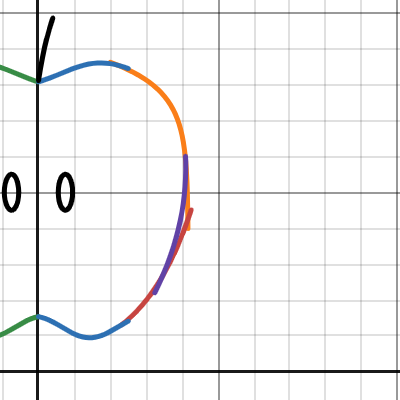
Desmos
wraith python
sharp bay
https://www.desmos.com/calculator/pcmsmjhyfh
Cool. Well I'm off for a bit, if you have any further questions regarding this problem, feel free to ping me.
sharp bay
ok thank you for your help i really appreciated it
sly mountain
ou
vocal sleetBOT
@sharp bay Has your question been resolved?
vocal sleetBOT
Channel closed
Closed due to timeout
Use .reopen if this was a mistake.
Available help channel!
Send your question here to claim the channel.
Remember:
• Ask your math question in a clear, concise manner.
• Show your work, and if possible, explain where you are stuck.
• After 15 minutes, feel free to ping <@&286206848099549185>.
• Type the command .close to free the channel when you're done.
• Be polite and have a nice day!
Read #❓how-to-get-help for further information on how to ask a good question, and about conduct in the question channels.
 north totem
i want to find the ? in this riddle
 vocal sleetBOT
north totem
i want to find the ? in this riddle
vocal sleetBOT
north totem
i want to find the ? in this riddle
 upper shell
Is there no other information given?
 atomic jasper
what is the 20 referring to?
atomic jasper
QX=BX and PX=AX
upper shell
how?
atomic jasper
from similiar triangles
upper shell
it isnt given that AB is parallel to DC
upper shell
upper shell
Is there no other information given?
thats why i asked this
 mild flower
it's not given, but it's also not contradicted. therefore you can assume it's true
upper shell
oh yeah thats smart
mild flower
you can also assume ABPQ is a rectangle if it makes it easier
or even a square if you want
upper shell
but then we cant prove that the area of the orange part is whatever we get
mild flower
why not
mild flower
if the problem has an answer, then you'll find it
if the problem does not have an answer then it's not a valid problem

upper shell
i mean yeah
but were cheesing it through and through
ok ima try it with the assumption
mild flower
what you can do at that point is unconstrain it a little bit (make it a rectangle vs a square) and see if that changes
upper shell
yeah im getting the answer with the parallel assumption
mild flower
@north totem ^
north totem
yeah?
mild flower
yeah what do you think about the discussion so far on your problem
upper shell
ok first of all is there any information you havent given us
north totem
let me see
ab is parallel to cd cp=pq=qd=ab and the cut at x the S of BXA is 20 what is the S of BCPX
vocal sleetBOT
What step are you on?
1. I don't know where to begin.
2. I have begun but got stuck midway.
3. I got an answer but I was told that it's wrong.
4. I got an answer and would like my work checked.
5. I have a question about someone else's work/solution.
6. I have completed the problem and don't need help anymore. Thank you.
7. None of the above
i think px is = to ax
upper shell
yeah
upper shell
dp/pq?
north totem
sorry dq and pq
north totem
thats is a rule
upper shell
can you prove some relation between triangle ABX and XQP
north totem
bc qx is parallel to AD
upper shell
north totem
bc qx is parallel to AD
is that given in the question statement?
north totem
no but it is given that AB is parallel to DC and that means taht abqd is a parallelogram
upper shell
yeah you're right
thats one way
so with this information
that px=ax\
and we also know that ab = qp
can you prove congruence between triangle ABX and XQP
north totem
yeah
upper shell
youre right (we also show that <PAB = <APQ cus AB and QP are parallel so we get SAS congruency)
by this congruency we get that their areas are equal
so are of XQP = 20
and also that BX = XQ
now see triangle BQC
we know that area of XQP = 20
and that XP joins the midpoints of the two sides
from this can you get the orange area
north totem
bc its a midsegment?
upper shell
kinda yeah
think what the orange area is in triangle BQC
its area of BQC - area of XQP
we know the area of XQP
can you get the area of BQC from the area of XQP
north totem
oh wait i think that 2px is bc
north totem
qp/qx=qc/qb
so they are simmilar
which mean that their areai
is a/b^2 Xs
a/b being their similarrity diffrentce
upper shell
go on
north totem
'יןבי ןד 2 אם 1
which is 2 to 1
so that means that the area of the big one is 4 times biggers
so i think its 80
north totem
its for the national olimpic in math
i think i might have not passed
i am at teh national team for coding tho
upper shell
nice i love coding
north totem
can i give u unother one that was on there?
upper shell
sure
north totem
first just so you know a calc isnt allowed
upper shell
ok
north totem
in an progression that always goes up they are those numbers 7,8 ,A,B,70,80 how many ways can a b not make an Arithmetic progression that is 4 long
so A B cannot be 9 10 50 60 and whatever it is fir 8 and 70
so there are 3 pairs that are illigel so i wanted to say the amout of pairs minus 3
but i didnht have time to count the amount of pairs
upper shell
yeah counting prolly isnt correct
ok if we first choose A
we can choose from 9 to 68
thats 60 options
upper shell
and if we choose 9,50 or ?
upper shell
north totem
and not 59
if we can choose from 1 to 5 tahts not 5-1 = 4 options
north totem
yeah right
upper shell
wait is that any natural solution to the 8 and 70 progression
if the common diff is d
then A = 8 + d
north totem
39 i thinkg
upper shell
B = 8 + 2d
70 = 8 + 3d
=> d = 62/3
=20.6
theres no whole number solution so we dont gotta care about it
upper shell
theres is no two natural numbers A and B such that 8,A,B,70 is ap
north totem
yeah
upper shell
anyways if we choose A to be 9,50 B cant be 10, 60
north totem
so its the amount of leagel pairs minus 2
upper shell
youre right
so to calculate the amount of pairs
for each A we choose we can get upto 69-A B's
north totem
no
bc a is less the b
so if we chose a 50 b must be more the 50
ans also less then 70
upper shell
im talking about the number of B's we can choose
so if we take any A
B has to fall in the range of A+1 to 69
north totem
yeah
north totem
upper shell
which is equal to 69 - (A+1) + 1 = 69-A
what those this mean
upper shell
so the number of legal pairs should be $\sum_{i=9}^{i<=68} 69-i$
twin meteorBOT
CherryMan
 north totem
yeah but there is no calc
upper shell
we can just use formulas
this is basically 60 + 59 + 58 + 57 + ... + 1
= 60(61)/2 = 1830
1830 -2 = 1828
upper shell
twin meteor
**CherryMan**
did you get this part atleast
north totem
yeah
upper shell
great then we just expand it
upper shell
upper shell
this is basically 60 + 59 + 58 + 57 + ... + 1
to get this
north totem
upper shell
this is basically 60 + 59 + 58 + 57 + ... + 1
i think this + 60 tho
upper shell
?
north totem
upper shell
this is basically 60 + 59 + 58 + 57 + ... + 1
this is the amount of b right?
ooh nvm
upper shell
this is the number of total pairs
north totem
ok litsen what i can say here t osolve this easely
north totem
twin meteor
**CherryMan**
.
upper shell
wait can i explain my reasoning
north totem
sure
upper shell
if we choose A=9, we can choose 69-9 = 60 Bs
if we choose A=10, we can choose 69-10 = 59 Bs
if we choose A=11, we can choose 69-11 = 58 Bs
...
if we choose A=68, we can choose 69-68 = 1 B
north totem
yeah
upper shell
then the some of the total number of B's for every A we choose
is the sum of all legal pairs
= 60 + 59 + ... + 1
north totem
-2
upper shell
yaeh
north totem
yeah so to calc this without using a calc
i think what u do is
i can say that the first and the last 1 is 61 and the second and the second to last is also 61 so i can do the 61 times the amount of pairs devided by 2 i think
north totem
but there might be an edge case for add amount of numbers
upper shell
this is literally the proof for the fact that 1+2+3+...+n = n(n+1)/2
north totem
ok i think if there is an odd amount u take out the middle one do what i said then add it aswell
north totem
does my thing work for odd amount of numbers too?
north totem
how??
upper shell
if n is odd
then if we first take the sum of n-1 numbers
= (n-1)(n)/2
and add n
= (n-1)(n)/2 + n = n(n+1)/2
north totem
oh yeah
north totem
dude i didnt have time ti calculate it in the test