#help-17
1 messages · Page 269 of 1
 minor rivet
 dense cedar
cos would work
minor rivet
wait so how do i start the question aft drawing
idk what to find 1srt
Omg nvm i see
wheres the right angle tho
im lowk tweasking out over this question

dense cedar

 dry lynx
dense cedar
dry lynx
dense cedar
The channel was just lost, huh !
minor rivet
but how do u know if its a eright angle tho
dense cedar
dense cedar
You just need to find angle ABD
minor rivet
idk the tangent rule thing 😭
dense cedar
minor rivet
but how do u know if its a eright angle tho
Tangent
dense cedar
minor rivet
idk the tangent rule thing 😭
A tangent to a curve is always perpendicular to the radially outwards vector
Okk?
dense cedar
Wlcmm
 vocal sleetBOT
Channel closed
Closed by @minor rivet
Use .reopen if this was a mistake.
 Available help channel!
Send your question here to claim the channel.
Remember:
• Ask your math question in a clear, concise manner.
• Show your work, and if possible, explain where you are stuck.
• After 15 minutes, feel free to ping <@&286206848099549185>.
• Type the command .close to free the channel when you're done.
• Be polite and have a nice day!
Read #❓how-to-get-help for further information on how to ask a good question, and about conduct in the question channels.
 onyx marsh
$(E-F)\cup (F-E)\iff (x\in E\land x\notin F)\lor (x\in F\land x\notin E)\iff [(x\in E\land x\notin F)\lor (x\in F)]\land [(x\in E\land x\notin F)\lor (x\notin E)]\iff [(x\in E\lor x\in F)\land (x\in F\lor x\notin F)]\land [(x\in E\lor x\notin E)\land (x\notin F\lor x\notin E)]\iff (x\in E\lor x\in F)\land (x\notin F\lor x\notin E)\iff (x\in E\cup F)\land (x\notin E\cap F)\iff x\in (E\cup F)-(E\cap F)$
vocal sleetBOT
onyx marsh
$(E-F)\cup (F-E)\iff (x\in E\land x\notin F)\lor (x\in F\land x\notin E)\iff [(x...
 twin meteorBOT
pirateking0723
 onyx marsh
is this correct
onyx marsh

 tidal dock
$(E-F)\cup (F-E)\
\iff (x\in E\land x\notin F)\lor (x\in F\land x\notin E)\
\iff [(x\in E\land x\notin F)\lor (x\in F)]\land [(x\in E\land x\notin F)\lor (x\notin E)]\
\iff [(x\in E\lor x\in F)\land (x\in F\lor x\notin F)]\land [(x\in E\lor x\notin E)\land (x\notin F\lor x\notin E)]\
\iff (x\in E\lor x\in F)\land (x\notin F\lor x\notin E)\
\iff (x\in E\cup F)\land (x\notin E\cap F)\
\iff x\in (E\cup F)-(E\cap F)$
twin meteorBOT
artemetra
 tidal dock
looks correct.. the only way i see how to simplify this further is by writing it as symmetric difference
$E \triangle F$
twin meteorBOT
artemetra
 tidal dock
finally lol
onyx marsh
tidal dock
looks correct.. the only way i see how to simplify this further is by writing it...
wdym by simplify further
onyx marsh
to let it take fewer steps to reach the other side ?
onyx marsh
tidal dock
this symbol
yes
tidal dock
yeah it's what your final expression is equivalent to
onyx marsh
in fact i am trying to prove that $E\Delta F=(E\cup F)-(E\cap F)$
tidal dock
huh
twin meteorBOT
pirateking0723
 onyx marsh
given that $E\Delta F=(E-F)\cup (F-E)$
twin meteorBOT
pirateking0723
 tidal dock

vocal sleetBOT
Channel closed
Closed by @onyx marsh
Use .reopen if this was a mistake.
vocal sleetBOT
Available help channel!
Send your question here to claim the channel.
Remember:
• Ask your math question in a clear, concise manner.
• Show your work, and if possible, explain where you are stuck.
• After 15 minutes, feel free to ping <@&286206848099549185>.
• Type the command .close to free the channel when you're done.
• Be polite and have a nice day!
Read #❓how-to-get-help for further information on how to ask a good question, and about conduct in the question channels.
 upper harness
The question is about the calculation of a basis of the kernel of a linear function - ker(l)
I dont understand what's the link between the the solution of the system and the two vectors that make up the basis
 vocal sleetBOT
upper harness
The question is about the calculation of a basis of the kernel of a linear funct...
vocal sleetBOT
upper harness
The question is about the calculation of a basis of the kernel of a linear funct...
 hard atlas
after solving for all the entries a vector in the kernel can be written as (-x5,0,0,x4,x5)
yes?
upper harness
i dont see why x4 and x5 are inclued in the end though
hard atlas
x5 can be chosen arbitrarily
as long as x1 is chosen as -x5
similarly x4 can also be chosen arbitrarily
hard atlas
well they were moved right because of it
so kind of the other way around
(and moving them to the right is a bit of an odd step imo, you dont need to do that)
upper harness
i copied this from a solution sheet made by my prof
upper harness
hard atlas
after solving for all the entries a vector in the kernel can be written as (-x5,...
i got here now
so how do I get those two column vectors as the basis
upper harness
i dont see it
upper harness
ok
but I still dont get why they're being separated
and the first -x5 doesnt appear in the first vector
hard atlas
I chose to split them up that way instead of another way
another way would also be valid but not as useful
now I have two vectors, one with only x4 and the other with only x5
which means I can move those factors out
hard atlas
hard atlas
this can also be written as x4(0,0,0,1,0)+x5(-1,0,0,0,1)
and get this
upper harness
aha ok
you chose to split them like that to make it tidier
variable segregation
let's say
hard atlas
but if we now look at this from a different perspective, this means that any vector in the kernel can be written as (some number)*(0,0,0,1,0)+(some other number)*(-1,0,0,0,1)
upper harness
(english isnt my first lang**)
hard atlas
aka as a linear combination of (0,0,0,1,0) and (-1,0,0,0,1)
hard atlas
and those vectors are obviously linearly independent
upper harness
can I ping you just in case?
hard atlas
so therefore they are a basis of the kernel
hard atlas
upper harness
can I ping you just in case?
I dont know if I will still be there
vocal sleetBOT
@upper harness Has your question been resolved?
Channel closed
Closed by @upper harness
Use .reopen if this was a mistake.
Available help channel!
Send your question here to claim the channel.
Remember:
• Ask your math question in a clear, concise manner.
• Show your work, and if possible, explain where you are stuck.
• After 15 minutes, feel free to ping <@&286206848099549185>.
• Type the command .close to free the channel when you're done.
• Be polite and have a nice day!
Read #❓how-to-get-help for further information on how to ask a good question, and about conduct in the question channels.
upper harness
Can somebody tell me if this is correct?
vocal sleetBOT
upper harness
Can somebody tell me if this is correct?
 hard atlas
yes thats a correct basis
hard atlas
stay on the server
vocal sleetBOT
@upper harness Has your question been resolved?
Channel closed
Closed by @upper harness
Use .reopen if this was a mistake.
Available help channel!
Send your question here to claim the channel.
Remember:
• Ask your math question in a clear, concise manner.
• Show your work, and if possible, explain where you are stuck.
• After 15 minutes, feel free to ping <@&286206848099549185>.
• Type the command .close to free the channel when you're done.
• Be polite and have a nice day!
Read #❓how-to-get-help for further information on how to ask a good question, and about conduct in the question channels.
 bitter pilot
Help
vocal sleetBOT
bitter pilot
Help
twin meteorBOT
𝔸dωn𝓲²s
 hard atlas
list all the elements
Z_12 is cyclic so the other one would also have to be
what could a generator be?
what do you know about homomorphisms and generators?
bitter pilot
hard atlas
Z_12 is cyclic so the other one would also have to be
1 generates Z_12 and my guess is (1,2) has to generate Z_3 x Z_4 cause the others don't seem to
hard atlas
you sure?
bitter pilot
either (2,1) or (1,2)
 signal pendant
well look at what happens to the second slot as you keep on adding (1,2) with itself and then argue why it cant be a gen
 hidden gyro
bitter pilot
1 generates Z_12 and my guess is (1,2) has to generate Z_3 x Z_4 cause the other...
hidden gyro
bitter pilot
1 generates Z_12 and my guess is (1,2) has to generate Z_3 x Z_4 cause the other...
(2,3) should work?
bitter pilot
ok it doesnt generate 2,2
bitter pilot
hidden gyro
(2,3) should work?
hmm yea prob that then
hard atlas
there is a much easier generator
hard atlas
if (a,b) generates Z3 x Z4, then a needs to generate Z3 and b needs to generate Z4
at the very least
hard atlas
just necessary
signal pendant
are you aware of the chinese remained theorem? by any chance?
signal pendant
okay dont mind that but as denascite said there is a very obvious generator which for some reason you didnt try, and it will justify why your map is an isomorphism
bitter pilot
1,3?
signal pendant
is that really the first thing you thought of
whats the most naive guess you can make
bitter pilot
as if it was really 1,1
hard atlas
it is
bitter pilot
no way
signal pendant
why dont you check
 cobalt crypt
,w Table[{n mod 3, n mod 4}, {n, 0, 11}]
bitter pilot
my first intial thought was 1 from Z_12 is a generator and would map to (1,1)
twin meteorBOT


 signal pendant
bitter pilot
my first intial thought was 1 from Z_12 is a generator and would map to (1,1)
signal pendant
bitter pilot
my first intial thought was 1 from Z_12 is a generator and would map to (1,1)
and it does
bitter pilot
but (1,1) I thought I would only get pairs like (1,1) (2,2) and (0,0) for some reason
signal pendant
in fact if you trusted your map this should be the first generator you find
 lilac pebble
f(a,b)->a+b isn't onto
cobalt crypt
f(a, b) = a + b isn't well-defined
bitter pilot
what does well defined mean
cobalt crypt
it means that the definition actually makes sense
signal pendant
it is better if you define your map in the reverse direction but you can make this work too
lilac pebble
cobalt crypt
f(a, b) = a + b isn't well-defined
how can you make it well-defined?
hard atlas
there are several ways to write the element (a,b) in Z3 x Z4
cobalt crypt
by not defining it that way
hard atlas
not all of them would give the same value for f
for example, (1,3)=(4,3) but they have different sums
cobalt crypt

cobalt crypt
f(a, b) = the solution x to x = a mod 3, x = b mod 4
hard atlas
whenever you have some object which came from some equivalence relation you have to make sure that the way you write an element does not influence the value of the function
signal pendant
bitter pilot
Z_12 -> Z_3 x Z_4
and how is it defined
cobalt crypt
Z_12 -> Z_3 has an "obvious" map which is the mod 3 map
Z_12 -> Z_4 has an "obvious" map which is the mod 4 map
that should be your first choice really
bitter pilot
two maps??
cobalt crypt
to map into a product, you need two maps
signal pendant
making them into one is why you producted them(the groups)
cobalt crypt
one to each component
twin meteorBOT
𝔸dωn𝓲²s
 hard atlas
(note that this is well defined, if you take a or a+12 or any other way to write the same element of Z_12 then f(a) still has the same value)
which is important because if you want to check that its a homomorphism then you have f(a+b) where a+b could be "bigger" than 12 and if you then had to make sure that you took the "correct" representative it would be a huge pain
vocal sleetBOT
@bitter pilot Has your question been resolved?
bitter pilot
 signal pendant
your proof of surjectivity is not a proof but the good part is you dont need it. also why does 3n = 4m imply n=m=0
i can have n = 4 and m = 3 for example
cobalt crypt
did nobody tell you that a homomorphism is injective iff its kernel is 0
cobalt crypt
when you do algebra, nobody ever checks f(x) = f(y)
its always f(x) = 0, prove x = 0
signal pendant
and here it is especially easy to check this condition. (just check every element)
signal pendant
yeah
bitter pilot
cobalt crypt
did nobody tell you that a homomorphism is injective iff its kernel is 0
but then the homomorphism needs also to be surjective in order for it to be an isomorphism
cobalt crypt
for finite sets, injective, surjective, bijective are all equivalent
bitter pilot
right..
cobalt crypt
in fact, that is how you can characterise finiteness of a set
lilac pebble
you're assuming the sets are of the same size, right?
cobalt crypt
endos
signal pendant
no
lilac pebble
endos?
cobalt crypt
,w endomorphism
twin meteorBOT
 bitter pilot
signal pendant
Z_3xZ_4 and Z_12 have the same cardinality
bitter pilot
signal pendant
Z_3xZ_4 and Z_12 have the same cardinality
that's also necessary
lilac pebble
cobalt crypt
for finite sets, injective, surjective, bijective are all equivalent
yeah i just meant this statement only holds if the sets are of the same size
signal pendant
or do you mean the thing about injective bijective surjective being equiv
cobalt crypt
that statement was for endomorphisms
in my mind i had already identified the two sets 
bitter pilot
cobalt crypt
if x = 0 mod 3 and 4, then x = 0 mod 12 because 3 and 4 are coprime
and x = 0 mod 12 implies x = 0 because x is in Z_12 so the only solution is {0} got it
signal pendant
twin meteor
 cobalt crypt
T
bitter pilot
I have to see whether [ (\mathbb{Z}_{12}^, \cdot) \cong (\mathbb{Z}_3^ \times \mathbb{Z}_4^*, \cdot). ]
I have the feeling it is, I will get soon to it!
twin meteorBOT
𝔸dωn𝓲²s
 vocal sleetBOT
@bitter pilot Has your question been resolved?
twin meteorBOT
𝔸dωn𝓲²s
 twin meteorBOT
𝔸dωn𝓲²s
 bitter pilot
yea it worked out but i still wonder if the above is sufficient
cobalt crypt
you have to check that it's a homomorphism
cobalt crypt
twin meteor
**𝔸dωn𝓲²s**
you can't just write down a random map like this and call it a day
bitter pilot
twin meteor
**𝔸dωn𝓲²s**
well it's based on that map
cobalt crypt
yeah so then you have to check it's a homomorphism
twin meteorBOT
𝔸dωn𝓲²s
 cobalt crypt
yeah
those in the know would just say that Z_12 and Z_3 x Z_4 are isomorphic as rings
bitter pilot
twin meteor
**𝔸dωn𝓲²s**
but now the bijectivity is shown
cobalt crypt
yes
bitter pilot
cobalt crypt
those in the know would just say that Z_12 and Z_3 x Z_4 are isomorphic as rings
and that makes Z_12* isomorphic to Z_3* x Z_4* ?
cobalt crypt
yes
bitter pilot
Is there an explanation for that
cobalt crypt
a unit of R x S is an element of R* x S*
bitter pilot
cobalt crypt
a unit of R x S is an element of R* x S*
Ok, so to understand it, Z_12* does not only denote the set of all integers mod 12 and g(x, 12) = 1 but it also denotes the set of all units of Z_12?
That being said Z_12* acts like a subset of Z_12. Same with Z_3* x Z_4* being a subset to Z_3 x Z_4.
If we consider them as rings (meaning we have both addition and multiplication), then it is clear that the structure in the units is therefore also persevered?
 heady ibex
Them being isomorphic is proven by proving an isomorphism exists
bitter pilot
yea that's trivial
i just wanted to get the intuition behind this
those in the know would just say that Z_12 and Z_3 x Z_4 are isomorphic as rings
that this implies immediately that Z_12* and Z_3* x Z_4* are isomorphic
heady ibex
You'd have to prove that the rings are isomorphic idk if that is any better
bitter pilot
hmm ok
In this exercise we explicitly considered them as groups actually not rings, so I am not quiet sure if I would be allowed to use Blake's argument but just for the sake of understanding, I think it makes sense
bitter pilot
I proved that there is an isomorphism between Z_12 and Z_3 x Z_4 previously
as groups tho
heady ibex
And now you have to do it for the multiplicative versions?
bitter pilot
heady ibex
And now you have to do it for the multiplicative versions?
yes
I did that too
wait
 bitter pilot
heady ibex
And now you have to do it for the multiplicative versions?
bitter pilot
heady ibex
And now you have to do it for the multiplicative versions?
I did that here
 heady ibex
Mod is addition
bitter pilot
heady ibex
Mod is addition
Can you elaborate?
heady ibex
Let p be 5
Actually
Not a prime
8
Then 2 * 4 is not an element of the multiplicative group if it is mod 8
bitter pilot
heady ibex
Then 2 * 4 is not an element of the multiplicative group if it is mod 8
But that only happens because you consider Z_8 not Z_8*
It wouldn't be a group in the first place because it wouldn't be closed
idk
lmao
😭
1st task and it's been 3 hours already
signal pendant
i believe this proof is fine to show isomorphism. what exactly is the problem you are having with it? the map is defined properly and is an isomorphism
bitter pilot
I believe the proofs are fine (snow would otherwise say something) so I am gonna mark it as solved
thanks to all! ❤️
.solved
vocal sleetBOT
Channel closed
Closed by @bitter pilot
Use .reopen if this was a mistake.
vocal sleetBOT
Available help channel!
Send your question here to claim the channel.
Remember:
• Ask your math question in a clear, concise manner.
• Show your work, and if possible, explain where you are stuck.
• After 15 minutes, feel free to ping <@&286206848099549185>.
• Type the command .close to free the channel when you're done.
• Be polite and have a nice day!
Read #❓how-to-get-help for further information on how to ask a good question, and about conduct in the question channels.
 grizzled forge
 vocal sleetBOT
grizzled forge
grizzled forge
vocal sleetBOT
grizzled forge
grizzled forge
how do i do iii and iv)
 half imp
What's the sum of all 5 roots
vocal sleetBOT
@grizzled forge Has your question been resolved?
vocal sleetBOT
Channel closed
Closed due to timeout
Use .reopen if this was a mistake.
Available help channel!
Send your question here to claim the channel.
Remember:
• Ask your math question in a clear, concise manner.
• Show your work, and if possible, explain where you are stuck.
• After 15 minutes, feel free to ping <@&286206848099549185>.
• Type the command .close to free the channel when you're done.
• Be polite and have a nice day!
Read #❓how-to-get-help for further information on how to ask a good question, and about conduct in the question channels.
 neon crypt
hello
vocal sleetBOT
neon crypt
hello

 loud walrus
!show
vocal sleetBOT
Show your work, and if possible, explain where you are stuck.
 loud walrus
Your exercise looks wrong in the middle
Your steps looks correct but idk what u wrote
Step 2 and step 3 is what u have to do but the outcome is not correct
@neon crypt
loud walrus
L2 -> L2 -2L1 is equal to 0, 1/2, -2, -2
loud walrus
 grim mason
i got a question
grim mason
i got a question
!occupied
vocal sleetBOT
grim mason
i got a question
Someone else is already using this help channel. If you need help with a question, please open your own help channel/thread (see #❓how-to-get-help for instructions).
loud walrus
And L3-> L3-5L1 should be equal to 0, -3/4, 1, -7
vocal sleetBOT
@neon crypt Has your question been resolved?
neon crypt
loud walrus
L2 -> L2 -2L1 is equal to 0, 1/2, -2, -2
why 1/2 in the L2 ?
vocal sleetBOT
Channel closed
Closed due to timeout
Use .reopen if this was a mistake.
vocal sleetBOT
Available help channel!
Send your question here to claim the channel.
Remember:
• Ask your math question in a clear, concise manner.
• Show your work, and if possible, explain where you are stuck.
• After 15 minutes, feel free to ping <@&286206848099549185>.
• Type the command .close to free the channel when you're done.
• Be polite and have a nice day!
Read #❓how-to-get-help for further information on how to ask a good question, and about conduct in the question channels.
 tawdry stirrup
Does anyone have any advice for this task, because I haven't found anything similar on the internet. I simply can't find A and B after division, which is the remainder.
 vocal sleetBOT
tawdry stirrup
Does anyone have any advice for this task, because I haven't found anything simi...
vocal sleetBOT
tawdry stirrup
Does anyone have any advice for this task, because I haven't found anything simi...
 viral copper
See if you can write x^3 + 5x^2 - 12x + 3 in the form p(x^2 - 6x + 10)(ax + b) + c
heady ibex
wolfram says long division
vocal sleetBOT
@tawdry stirrup Has your question been resolved?
Channel closed
Closed by @tawdry stirrup
Use .reopen if this was a mistake.
vocal sleetBOT
Available help channel!
Send your question here to claim the channel.
Remember:
• Ask your math question in a clear, concise manner.
• Show your work, and if possible, explain where you are stuck.
• After 15 minutes, feel free to ping <@&286206848099549185>.
• Type the command .close to free the channel when you're done.
• Be polite and have a nice day!
Read #❓how-to-get-help for further information on how to ask a good question, and about conduct in the question channels.
bitter pilot
Hi, can someone check the proof?
vocal sleetBOT
bitter pilot
Hi, can someone check the proof?
twin meteorBOT
𝔸dωn𝓲²s
 hard atlas
how have you used that a,b are coprime
bitter pilot
I forgot it
hard atlas
its a very essential condition
the problem is that the order of (1,1) is not always ab
you need that they are coprime
but here you just claimed it
tidal dock
bitter pilot
Z_2 x Z_2 = {(0,0), (0,1), (1,0), (1,1)}
well is $\mathbb{Z}_4 \cong \mathbb{Z}_2 \times \mathbb{Z}_2$?
twin meteorBOT
artemetra
 bitter pilot
Z_2 x Z_2 = {(0,0), (0,1), (1,0), (1,1)}
bitter pilot
bitter pilot
Z_2 x Z_2 = {(0,0), (0,1), (1,0), (1,1)}
Yea here [(1,1)] = {(0,0), (1,1)} only so it wouldn't be ab
vocal sleetBOT
@bitter pilot Has your question been resolved?
bitter pilot
I don't know how to show that based on the fact gcd(a,b) = 1 it is ord(1,1) = ab
ok for example
k(1,1) = (0,0) then k = 0 mod a and k = 0 mod b so that would mean if k != 0 then the smallest next possible must be lcm(a,b)
Axe
lilac pebble
ye
bitter pilot
am I on the right track
lilac pebble
i was thinking along those lines, and
lcm(a,b) = |ab| / gcd(a,b)
 inland galleon
bitter pilot
k(1,1) = (0,0) then k = 0 mod a and k = 0 mod b so that would mean if k != 0 the...
inland galleon
bitter pilot
k(1,1) = (0,0) then k = 0 mod a and k = 0 mod b so that would mean if k != 0 the...
yah it's ok except typo at the end lcd should be lcm
bitter pilot
lilac pebble
i was thinking along those lines, and
lcm(a,b) = |ab| / gcd(a,b)
ok ye
gcd(a,b) = 1 implies lcm(a,b) = ab
😭
inland galleon
and you ended up proving something better
the order of a general element in the product is lcm of the orders of the components.
also before you get the wrong idea I've been helping you cause we played minecraft together, I've been helping anyone that I've seen from the server lol
bitter pilot
hmm ok
well i basically helped Cyrenux, who built everything, on most projects, we even have a base together
but cool lol
inland galleon
then yeah I definitely benefitted from the stuff you built, so this my way of saying thanks
bitter pilot
i see, thank you too
inland galleon
np
bitter pilot
hard atlas
but here you just claimed it
and now i have shown it too 
thank you guys ❤️
.solved
vocal sleetBOT
Channel closed
Closed by @bitter pilot
Use .reopen if this was a mistake.
Available help channel!
Send your question here to claim the channel.
Remember:
• Ask your math question in a clear, concise manner.
• Show your work, and if possible, explain where you are stuck.
• After 15 minutes, feel free to ping <@&286206848099549185>.
• Type the command .close to free the channel when you're done.
• Be polite and have a nice day!
Read #❓how-to-get-help for further information on how to ask a good question, and about conduct in the question channels.
 warm vector
I'm looking for some help on sports betting statistics. I currently have an app that gives as much info on each sports bet as it can (record, avg,etc). I show the win percent of bets which is just the record of that bet happening as well as a weighted chance of happeing which is this formula: a(1-b)/(a(1-b) + b(1-a)). This takes into account the other teams liklyhood of winning the bet as well which I like. So team A has an 80% chance of winning a game based on their record, playing team B that has a 40% chance of winning. We could assume that team A has a greater than 80% of winning because team B is not good, so the above formula would come out to 85.7% chance. I use this same formula for other bets such as spread and total. What I need help on is how can I use a formula like this that adjusts team A based on team B and use it for player bets. So if I have a player that has a bet of getting over X shots, their chance of that happening is 72%, but some teams average allowing less shots per game and some on average all more per game. How can I use this in a similar way as the formula above to calculate the adjusted number for a player?
vocal sleetBOT
warm vector
I'm looking for some help on sports betting statistics. I currently have an app ...
@warm vector Has your question been resolved?
vocal sleetBOT
@warm vector Has your question been resolved?
vocal sleetBOT
@warm vector Has your question been resolved?
vocal sleetBOT
Channel closed
Closed due to timeout
Use .reopen if this was a mistake.
Available help channel!
Send your question here to claim the channel.
Remember:
• Ask your math question in a clear, concise manner.
• Show your work, and if possible, explain where you are stuck.
• After 15 minutes, feel free to ping <@&286206848099549185>.
• Type the command .close to free the channel when you're done.
• Be polite and have a nice day!
Read #❓how-to-get-help for further information on how to ask a good question, and about conduct in the question channels.
 hexed umbra
how am i supposed to find this
 vocal sleetBOT
hexed umbra
how am i supposed to find this
vocal sleetBOT
hexed umbra
how am i supposed to find this
 vocal sleetBOT
Channel closed
Closed by @hexed umbra
Use .reopen if this was a mistake.
vocal sleetBOT
Available help channel!
Send your question here to claim the channel.
Remember:
• Ask your math question in a clear, concise manner.
• Show your work, and if possible, explain where you are stuck.
• After 15 minutes, feel free to ping <@&286206848099549185>.
• Type the command .close to free the channel when you're done.
• Be polite and have a nice day!
Read #❓how-to-get-help for further information on how to ask a good question, and about conduct in the question channels.
 vast shale
Can I set this up as a proportion?
I did 27/63 =x/1.75
got 63x=47.25
Now x= .75
Point .75 of 36 is 27 which is the answer.
But I can’t work out in my head why it works.
 vocal sleetBOT
vast shale
Can I set this up as a proportion?
I did 27/63 =x/1.75
got 63x=47.25
Now x= .75...
vocal sleetBOT
vast shale
Can I set this up as a proportion?
I did 27/63 =x/1.75
got 63x=47.25
Now x= .75...
 half imp
The speeds are in a 4:3 ratio, so the times are in a 3:4 ratio
vast shale
half imp
The speeds are in a 4:3 ratio, so the times are in a 3:4 ratio
Ohh, true. I didn’t realize that
half imp
so 3/7 is the proportion of the time the first trip took to the total
in other words the first trip took (3/7)*(1hr 45min) = 45 minutes
and the second trip takes 1 hour
the second trip is the easier one to calculate the distance for, of course
I think what you did works by pure coincidence and it wouldn't work if you changed the numbers
vast shale
half imp
I think what you did works by pure coincidence and it wouldn't work if you chang...
How would you set up the problem if you saw it? Without using a calculator.
vast shale
half imp
Distance = 36\*t1 = 27*t2
Sorry, I’m really stupid. Is that systems of equations? Or two different operations?
vast shale
half imp
Distance = 36\*t1 = 27*t2
I just can’t imagine how that looks on paper
 sick turtle
vast shale
Sorry, I’m really stupid. Is that systems of equations? Or two different operati...
sick turtle
vast shale
Sorry, I’m really stupid. Is that systems of equations? Or two different operati...
Distance = 36*t1 = 27*t2
is
Distance = 36*t1
Distance = 27*t2
Yea it is system of equation
vast shale
sick turtle
```Distance = 36*t1 = 27*t2```
is
```
Distance = 36*t1
Distance = 27*t2
```

I must be stupid
vast shale
.close
vocal sleetBOT
@vast shale Has your question been resolved?
Channel closed
Closed by @faint cypress
Use .reopen if this was a mistake.
vocal sleetBOT
Available help channel!
Send your question here to claim the channel.
Remember:
• Ask your math question in a clear, concise manner.
• Show your work, and if possible, explain where you are stuck.
• After 15 minutes, feel free to ping <@&286206848099549185>.
• Type the command .close to free the channel when you're done.
• Be polite and have a nice day!
Read #❓how-to-get-help for further information on how to ask a good question, and about conduct in the question channels.
 full fox
can anyone help me solve these derivatives using limit definition instead of the table? thats how the professor wants it
27 and 28
 vocal sleetBOT
full fox
can anyone help me solve these derivatives using limit definition instead of the...
vocal sleetBOT
full fox
can anyone help me solve these derivatives using limit definition instead of the...
 hushed pewter
full fox
can anyone help me solve these derivatives using limit definition instead of the...
hushed pewter
full fox
can anyone help me solve these derivatives using limit definition instead of the...
!status
vocal sleetBOT
full fox
can anyone help me solve these derivatives using limit definition instead of the...
What step are you on?
1. I don't know where to begin.
2. I have begun but got stuck midway.
3. I got an answer but I was told that it's wrong.
4. I got an answer and would like my work checked.
5. I have a question about someone else's work/solution.
6. I have completed the problem and don't need help anymore. Thank you.
7. None of the above
2
 oak magnet
may we see what you've done so far ?
full fox
i tried this but idk if it leads anywhere

i have no clue how to get a h out and simplify
or should i multiply by 1/h and
idk man
vocal sleetBOT
@full fox Has your question been resolved?
full fox
<@&286206848099549185> ?
vocal sleetBOT
@full fox Has your question been resolved?
vocal sleetBOT
Channel closed
Closed due to timeout
Use .reopen if this was a mistake.
vocal sleetBOT
Available help channel!
Send your question here to claim the channel.
Remember:
• Ask your math question in a clear, concise manner.
• Show your work, and if possible, explain where you are stuck.
• After 15 minutes, feel free to ping <@&286206848099549185>.
• Type the command .close to free the channel when you're done.
• Be polite and have a nice day!
Read #❓how-to-get-help for further information on how to ask a good question, and about conduct in the question channels.
vocal sleetBOT
 cursive turret
(a+b)^2=a^2+2ab+b^2
why do you beleive (2/5)^2?
its the same 3/4 -> 3/8
take the half as you have taken form 3/4 -> 3/8.
3/4 divided by 2 is 3/8. 2/5 divides by 2 is 1/5.
no. (a+b)^2 = a^2 + 2ab+b^2, so if oyu have something like x^2+2/5x and you wanna have a complete square like (a-b)^2 it means that 2/5x is 2 a b, so a = x and you hav to half the rest to get b.
the technique you wanna use is called "completing the square". you have a quadratic term like x^2+10x +3 you can write it as (x^2+10x + 25)-25+3 which gives you (x+5)^2-22
10x = 2ab, use a = x -> 10 = 2b -> b = 5
vocal sleetBOT
Channel closed
Closed by @scarlet pulsar
Use .reopen if this was a mistake.
vocal sleetBOT
Available help channel!
Send your question here to claim the channel.
Remember:
• Ask your math question in a clear, concise manner.
• Show your work, and if possible, explain where you are stuck.
• After 15 minutes, feel free to ping <@&286206848099549185>.
• Type the command .close to free the channel when you're done.
• Be polite and have a nice day!
Read #❓how-to-get-help for further information on how to ask a good question, and about conduct in the question channels.
vast shale
how to solve 2/3 power 2/3?
vocal sleetBOT
vast shale
how to solve 2/3 power 2/3?
 full hatch
Wdym with solve? It's not an equation. Do you mean compute?
vast shale
vast shale
how to solve 2/3 power 2/3?
Do you require a decimal approximation for this?
,w simplify (2/3)^(2/3)
twin meteorBOT


 Requested by alison_burg3r5
vocal sleetBOT
Requested by alison_burg3r5
vocal sleetBOT
@vast shale Has your question been resolved?
vocal sleetBOT
Channel closed
Closed due to timeout
Use .reopen if this was a mistake.
Available help channel!
Send your question here to claim the channel.
Remember:
• Ask your math question in a clear, concise manner.
• Show your work, and if possible, explain where you are stuck.
• After 15 minutes, feel free to ping <@&286206848099549185>.
• Type the command .close to free the channel when you're done.
• Be polite and have a nice day!
Read #❓how-to-get-help for further information on how to ask a good question, and about conduct in the question channels.
 distant perch
 vocal sleetBOT
distant perch
distant perch
vocal sleetBOT
distant perch
distant perch
the first thing i did was multiply the first and last equation by two, but the book's answer decided to subtract the first from the last, if I subtracted the last from the first, the same answer would be achieved?
 wind geyser
as long as the operation is valid i guess
 mighty nacelle
there are many ways to solve systems of equations
the main thing is knowing that you got the right answer by plugging everything back in
if you have different methods and get the same (correct) answer, then it doesnt matter
distant perch
alright, because i added the first with the third and the last with the third, but i got a different answer at the end
So the problem probably isn't that, but something a did wrong later right
mighty nacelle
yeah probably
vocal sleetBOT
Channel closed
Closed by @distant perch
Use .reopen if this was a mistake.
vocal sleetBOT
Available help channel!
Send your question here to claim the channel.
Remember:
• Ask your math question in a clear, concise manner.
• Show your work, and if possible, explain where you are stuck.
• After 15 minutes, feel free to ping <@&286206848099549185>.
• Type the command .close to free the channel when you're done.
• Be polite and have a nice day!
Read #❓how-to-get-help for further information on how to ask a good question, and about conduct in the question channels.
 sudden compass
yo
vocal sleetBOT
sudden compass
yo
sudden compass
simple question
 cyan talon
it's $\hat i$
twin meteorBOT
aPlatypus
 sudden compass
oh thanks
okay yeah so 2 vectors
$A = a \hat i + b \hat j + c\hat k$ and $B = a' \hat i + b' \hat j + c' \hat k$ such that $a,b,c,a',b',c' \neq 0$
twin meteorBOT
rak³en
 sudden compass
What does $A \cross B$ correspond to?
twin meteorBOT
rak³en
 sudden compass
Like it makes sense for stuff like $6 \hat i \cross 7\hat j$
twin meteorBOT
rak³en
 sudden compass
twin meteor
**rak³en**
sudden compass
twin meteor
**rak³en**
but how do you a squeeze a third perpendicular vector out of this?? i'd love a diagram with an example, if someone has
 woeful igloo
Its euclids axiom. Two lines make a plane
sudden compass
ig its like how two sides make a closed plane in geometry?
woeful igloo
You can imagine the two vectors to be lines thru the origin
mighty nacelle
A X B is how much a vector "helps the other turn clockwise" so to speak
counterclockwise
sudden compass
woeful igloo
You can imagine the two vectors to be lines thru the origin
alr makes sense to me
mighty nacelle
i love conventions
sudden compass
ik how to find it bruh
mighty nacelle
so you want an intuition behind it?
sudden compass
mighty nacelle
A X B is how much a vector "helps the other turn clockwise" so to speak
hm?
sudden compass
mighty nacelle
so you want an intuition behind it?
yes
cyan talon
sudden compass
hm?
they're talking about something like torque in mechanics I guess, which is a cross product
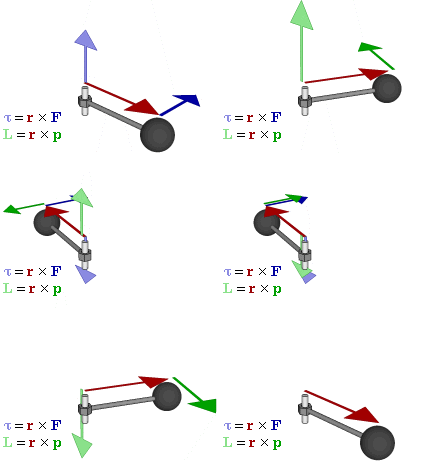
In physics and mechanics, torque is the rotational analogue of linear force. It is also referred to as the moment of force (also abbreviated to moment). The symbol for torque is typically
      τ


{\displaystyle {\boldsymbol {\tau }}}
, the lowercase Greek letter tau. When being referred to...
sudden compass
cyan talon
they're talking about something like torque in mechanics I guess, which is a cro...
thats an application, I believe
but yeah wait it makes sense to me now
if i treat the vectors as lines in 3D euclidian space
then the two lines will two planes
and the line that is perpendicular to the plane
mighty nacelle
the two lines will make one plane
sudden compass
is the cross product (line version)
cyan talon
sudden compass
thats an application, I believe
sure whatever
sudden compass
mighty nacelle
the two lines will make one plane
why? 1 plane after the point of intersection and another behind it
sudden compass
thats exactly what I did 💀
mighty nacelle
they will lie flat on your desk
cyan talon
"after the point of intersection" what's that supposed to mean
sudden compass
like the pencils form an x right (u cant form a v with lines cus then they'd have to intersect at infinity)
so the upper portion is 1 plane, and the bottom portion is another right? or are they part of the same plane
cyan talon
what about the left and right portions too
mighty nacelle
both sides of the plane make one plane
cyan talon
now we have 4 planes 
sudden compass
cyan talon
now we have 4 planes <:devilish:882819553686609981>
erm
sudden compass
cyan talon
what about the left and right portions too
okay so all of that is 1 plane
mighty nacelle
its plane and simple
the right hand rule is a big helper in understanding what A does vs B
A stays in place and B does the turning
vocal sleetBOT
Channel closed
Closed by @sudden compass
Use .reopen if this was a mistake.
vocal sleetBOT
Available help channel!
Send your question here to claim the channel.
Remember:
• Ask your math question in a clear, concise manner.
• Show your work, and if possible, explain where you are stuck.
• After 15 minutes, feel free to ping <@&286206848099549185>.
• Type the command .close to free the channel when you're done.
• Be polite and have a nice day!
Read #❓how-to-get-help for further information on how to ask a good question, and about conduct in the question channels.
 left portal
 vocal sleetBOT
left portal
left portal
vocal sleetBOT
left portal
left portal
Let $\mathbb{H}_1 = {\mathbf{x} \in \mathbb{R}^4 \mid x_1 - x_2 + x_3 - x_4 = 0}$, $\mathbb{H}_2 = {\mathbf{x} \in \mathbb{R}^4 \mid x_1 + x_3 = 0}$, and $\mathbb{S} = \langle (0, 1, 1, 2), (1, 1, 1, 0) \rangle$. Determine whether it is possible to find a projection $p: \mathbb{R}^4 \to \mathbb{R}^4$ such that $\text{Ker}(p) = \mathbb{S}$ and $p(\mathbb{H}_1) \subset \mathbb{H}_2$.
twin meteorBOT
938c2cc0dcc05f2b68c4287040cfcf71
 left portal
H1: x1-x2+x3-x4=0
x1=x2-x3+x4
(x1,x2,x3,x4)=(x2-x3+x4,x2,x3,x4)
x2(1,1,0,0)+x3(-1,0,1,0)+x4(1,0,0,1)
H1=<(1,1,0,0),(-1,0,1,0),(1,0,0,1)>
H2: x1+x3=0
x1=-x3
(x1,x2,x3,x4)=(-x3,x2,x3,x4)
x3(-1,0,1,0)+x2(0,1,0,0)+x4(0,0,0,1)
H2=<(-1,0,1,0),(0,1,0,0),(0,0,0,1)>
vocal sleetBOT
@left portal Has your question been resolved?
left portal
<@&286206848099549185>
left portal
left portal
the kernel and the image of a projection are in direct sum
Ker(p) ⊕ Im(p) = R^4
<@&286206848099549185>
 cerulean drift
left portal
<@&286206848099549185>
cerulean drift
left portal
<@&286206848099549185>
there arent going to be many people who can help you with this problem i would try going to the math channel, but pinging continuously isnt gonna change much, sorry
 blissful badge
left portal
<@&286206848099549185>
blissful badge
left portal
<@&286206848099549185>
What is the question?
cerulean drift
twin meteor
**938c2cc0dcc05f2b68c4287040cfcf71**
this @blissful badge
vocal sleetBOT
@left portal Has your question been resolved?
 spiral turtle
Hi, one second
So I think that you can answer this question by answering the slightly easier question of "what is the dimension of the intersection of H1 and S?"
left portal
cerulean drift
there arent going to be many people who can help you with this problem i would t...
nobody never helps me at lin algebra channel, I am going to be honest, maybe because this exercises are lengthy and very much involved tbh, people don't have the time to help with a lengthy exercise
spiral turtle
If the answer to the above question is "1" then it should be possible to construct p.
If it is 2, then it is not
left portal
why
spiral turtle
Well, the kernel of p is the set of all vectors that get mapped to 0 by the transform
Wait
Hmmm.... No sorry, upon reflection the above may not be true, give me a moment to think
(not about the kernel obviously)
It should be possible regardless?
left portal
S = <(0,1,1,2),(1,1,1,0)>
s in S, a,b in R
s = a(0,1,1,2)+b(1,1,1,0)
s = (0,a,a,2a)+(b,b,b,0)
s = (b,a+b,a+b,2a)
(x1,x2,x3,x4)= (b,a+b,a+b,2a)
H1 : x1-x2+x3-x4=0
b-(a+b)+(a+b)-2a=0
b-a-b+a+b-2a=0
b(1-1+1)+a(-1+1-2)=0
b-2a=0
b=2a
(b,a+b,a+b,2a)=(2a,a+2a,a+2a,2a)
(2a,3a,3a,2a)=a(2,3,3,2)
H1 ∩ S = <(2,3,3,2)>
spiral turtle
Ok cool
So if we find H1 perp (H1 cap S), this is the basis set we need to map to somewhere in H2
We can construct this with a similarity transformation
twin meteorBOT
King Hassan
Compile Error! Click the  reaction for more information.
(You may edit your message to recompile.)

King Hassan
Compile Error! Click the reaction for more information.
(You may edit your message to recompile.)
 spiral turtle
!nogpt
vocal sleetBOT
Please do not trust ChatGPT or similar AI tools for mathematical tasks, as they often generate output which "sounds correct" but has numerous factual or logical errors. Use of these AI tools to answer other people's help questions is strictly against server rules (see #rules).
twin meteorBOT
King Hassan
Compile Error! Click the reaction for more information.
(You may edit your message to recompile.)
 left portal
spiral turtle
It should be possible regardless?
left portal
spiral turtle
It should be possible regardless?
in all this exercises is always possible, because they haven't taught us proofs, so being it impossible we would need to provide proof of why is impossible :(
spiral turtle
Ok here's a way you can construct this
We do a similarity transformation
We have a change of basis matrix which contains {S, H1 perp (H1 cap S)} (as column vectors)
blissful badge
vocal sleet
Please do not trust ChatGPT or similar AI tools for mathematical tasks, as they ...
I know and understand.
spiral turtle
Then we have a mapping matrix internally which is {0, 0, v1, v2} where v1 and v2 are destination vectors that map somewhere into the H2 subspace as expressed in this basis
If our change of basis matrix is D and our mapping matrix is Q then p is D Q D^(-1)
Note that the choice of v1 and v2 is not unique
We just need to make sure they are linearly independent
And not in S
left portal
H1 =<(1,1,0,0),(-1,0,1,0),(1,0,0,1)>
v = (x1,x2,x3,x4)
- v.(1,1,0,0)=0 <==> x1+x2=0
- -x1+x3=0
- x1 + x4=0
x1 = x1
x2 = -x1
x3 = x1
x4 = -x1
H1 perp = <(1,-1,1,-1)>
spiral turtle
By H1 perp (H1 cap S) I mean the portion of H1 that is perpendicular to the intersection of H1 and S
Though I guess it's more simply expressed as H1 perp S
left portal
so the intersection between H1 and the orthogonal complement of H1 ∩ S
spiral turtle
Yes exactly.
To find v1 and v2 you'll want to also find the same thing, but for H2 and S
(and then feed it through the change of basis matrix)
But before you get to number crunching, does it at least make conceptual sense?
I'd like you to double check my work
Just to make sure I haven't made a mistake and we're on the same page
left portal
H1 ∩ S = <(2,3,3,2)>
v . (2,3,3,2)=0
2x1+3x2+3x3+2x4=0
2x1 = -3x2-3x3-2x4
x1 = (-3/2)x2 + (-3/2)x3 - x4
(x1,x2,x3,x4)=((-3/2)x2 + (-3/2)x3 - x4, x2,x3,x4)
x2((-3/2),1,0,0) + x3((-3/2),0,1,0) + x4(-1,0,0,1)
so the orthogonal complement of
H1 ∩ S is <(-3/2),1,0,0),(-3/2),0,1,0),(-1,0,0,1)>
=<(-3,2,0,0),(-3,0,2,0),(-1,0,0,1)>
blissful badge
You can check mine also, if it's shown to you.
spiral turtle
@left portal as mentioned it will probably be less work overall to find the orthogonal complement of S instead.
Because H1 perp (H1 cap S) = H1 perp S. And because you'll need to also calculate H2 perp (H2 cap S) = H2 perp S
So if you have the orthogonal complement of S you can simply reuse it later
(In long and complicated problems it is generally beneficial to make a "roadmap" of the solution, so that you can try to minimize the amount of work you need to do by hand. This is one example where it saves a little bit of effort.)
left portal
H1 cap S I can understand why we look for that
H1 is part of the preimages of p same with S, it's part of the preimages of p
the dimension of H1 cap S has to be >= 1 otherwise is impossible to define a projector p such that the conditions hold
there is a property that to uniquely define a linear transformation, and thus, a projection operator
we need to define it wrt to a basis
 spiral turtle
Well, the dimension of H1 cap S must be >= 1 by virtue of being in R^4
Because dim(H1)=3 and dim(S)=2
left portal
ye and R5 is bigger than the domain R4
we found H1 cap S, I got a bit lost with the change of basis approach and the orthogonal complements tbh
spiral turtle
That's fair!
Ok so, we want p to have a kernel equal to S
So that will mean that in your theorem above, two of the v_i will be a basis for S
And they map to the 0 vector because kernel
And the other two will need to be in H1 but not in S
And will need to map somewhere into H2
I guess I was wrong though, anywhere into H2 works, doesn't matter if it's in S or not
left portal
problem is H1 is dim(3)
left portal
the real problem then is H2 is dim 3
S=<s1,s2>
H1 but not in S = <v1,v2>
p(s1)=0
p(s2)=0
p(v1) = ?
p(v2) = ?
spiral turtle
Also not a problem.
We can just choose two vectors in H2
The choice isn't unique
But the problem doesn't specify it has to be
We can just pick 2 of the 3 basis vectors
left portal
what is the subspace H1 but not in S?
H1 ∩ S perp
spiral turtle
Yeah $H_1 \cap S^{\perp}$
twin meteorBOT
OmnipotentEntity
 spiral turtle
Which I've been writing as H1 perp S as a sort of shorthand.
left portal
ok, let me find the orthogonal complement of S
S = <(0,1,1,2),(1,1,1,0)>
v = (x1,x2,x3,x4)
v . (0,1,1,2) = 0 <==> x2+x3+2x4=0
v . (1,1,1,0) = 0 <==> x1 + x2 + x3 =0
i) x2 = -x3 - 2x4
ii) x1 = -x2 - x3
x1 = x3 + 2x4 - x3 ==> x1 = 2x4
x2 = -x3 -2x4
(x1,x2,x3,x4)=(2x4,-x3-2x4,x3,x4)
x4(2,-2,0,1) + x3(0,-1,1,0)
S perp = <(2,-2,0,1),(0,-1,1,0)>
v in S perp
a,b in R
v = a(2,-2,0,1)+b(0,-1,1,0)
v = (2a,-2a-b,b,a)
equation of plane H1
x1-x2+x3-x4=0
2a-(-2a-b)+b-a=0
2a+2a+b+b-a=0
3a+2b=0
a = (-2/3)b
(2a,-2a-b,b,a) = ( 2(-2/3)b, -2(-2/3)b - (3/3)b, b , (-2/3)b )
b( -4/3, 1/3, 1, -2/3)
H1 ∩ S perp = <(-4/3, 1/3, 1, -2/3)>
=<(-4,1,3,-2)>
left portal
spiral turtle
Because the space of vectors in H1 but not in S is dim 2
dim 1 unless I meased up

spiral turtle
Well, you found H1 cap S, and it was dim 1, right?
left portal
left portal
S = <(0,1,1,2),(1,1,1,0)>
s in S, a,b in R
s = a(0,1,1,2)+b(1,1,1,0)
s = (0,a,a,...
yeah
spiral turtle
If H1 is dim(3) it would stand to reason that H1 cap S perp is dim(2)
Because (H1 cap S) cup (H1 cap S perp) = H1
left portal
Hmm oh my
I found the orthogonal complement of S correctly it seems because
S + S perp = R^4
spiral turtle
Excellent
left portal
but maybe I messed up the intersection
spiral turtle
Maybe double check both intersections?
 twin meteorBOT


 vestal bane
🍎🍎
spiral turtle
@left portal sorry, give me a second, I went AFK
I'll work this problem now and compare notes afterwards
vocal sleetBOT
@left portal Has your question been resolved?
left portal
spiral turtle
I'll work this problem now and compare notes afterwards
I appreciate the effort, I am still trying to find the projection operator that matches, I got time so don't worry about time, time is the only thing I got these days, hopefully I manage to pass this, I feel motivated, we got this
Sometimes I think profesor doesn't want us to pass, but I will manage somehow, someway, I study a lot
spiral turtle
spiral turtle
Because (H1 cap S) cup (H1 cap S perp) = H1
This is a mistake btw.
I'm still working through the problem.
@left portal
The dimension of H1 cap S perp is definitely 1.
it's the subspace sum of the two that is 3 dimensional.
left portal
Ye A union B is most of the cases never a subspace because it's not closed under addition
Usually A + B is more appropriate
,, \cup
twin meteorBOT
938c2cc0dcc05f2b68c4287040cfcf71
 spiral turtle
yeah
So ok
we can just select v1 to be the basis of H1 cap S perp, (4, -1, -3, 2). And then v2 is some linear combination of the basis of H1 cap S perp and H1 cap S, I just chose (1, 1): which gives (6, 2, 0, 4)
these two vectors are in H1, but not in H1 cap S.
and they are linearly independent.
so we have our two vectors we map into H2.
Your work was correct btw.

Or at least it matches mine
Ignore the bit at the very top, a different problem.
spiral turtle
yeah, as in, we just want some vector off of H1 cap S
so a (non-zero) linear combination of these two spaces suffices.
left portal
Also H2 = H i pressume
left portal
Ok
spiral turtle
Edited.
left portal
S=<s1,s2>
H1 cap S perp = <v1,v2>
p(s1)=0
p(s2)=0
p(v1) = ?
p(v2) = ?
spiral turtle
p(v1) = a basis for H2
p(v2) = a different basis for H2
i guess they don't have to be different, or even bases, just two vectors in H2.
left portal
spiral turtle
i guess they don't have to be different, or even bases, just two vectors in H2.
Yeah
Exactly
left portal
Elaborate
spiral turtle
So if they were linearly dependent, then the kernel of p would be larger,
but yeah, any two linearly independent vectors in H2
it's easy enough to just choose two of the bases.
left portal
H2: x1+x3=0
x1=-x3
(x1,x2,x3,x4)=(-x3,x2,x3,x4)
x3(-1,0,1,0)+x2(0,1,0,0)+x4(0,0,0,1)
H2=<(-1,0,1,0),(0,1,0,0),(0,0,0,1)>
left portal
spiral turtle
it's easy enough to just choose two of the bases.
Wdym?
left portal
Basis vector
spiral turtle
we can choose (-1, 0, 1, 0) and (0, 1, 0, 0), or we can choose (0, 1, 0, 0) and (0, 0, 0, 1), etc.
a basis vector can be called a basis for short. And then I pluralized it to "bases" which pluralizes like that because it's a greek derived word ending in "sis"
left portal
S=<s1,s2>
H1 cap S perp = <v1,v2>
H2 = <v3,v4,v5>
p(s1)=0
p(s2)=0
p(v1) = v3
p(v2) = v4
spiral turtle
well, not quite
S=<s1,s2>
H1 cap S = <v1>
H1 cap S perp = <v2>
H2 = <v3,v4,v5>
p(s1)=0
p(s2)=0
p(v1 + v2) = v3
p(v2) = v4
left portal
x = v1+v2
Is x linearly independent to v2?
Because
We need to define it on a basis of R4
If {s1,s2,v1+v2,v2} forms a basis of dim 4 then it's fine
spiral turtle
x and v2 are independent, because if we let ax + bv2 = 0, then we have a(v1 + v2) + bv2 = 0, giving a = -b and a = 0 as the requirements for the solution
which gives the only solution at (0, 0)
oh, good point.
I don't think the entire collection is linearly independent.
 spiral turtle
I guess we need to adjoin v2 with a basis of H1 linearly independent to it and not in S.
rather than with v1.
we have (1, 1, 0, 0) which is linearly indepenent of (4, -1, -3, 2) and S.
which is just the first basis vector of H that I have in my set.
left portal
Okay good
spiral turtle
so {s1, s2, h11, v2} should be linearly indepedent, but let's double check just to make sure.
I'll use a computer for this though
left portal
(1,1,0,0) is in H1 and linearly independent to S and linearly independent from the vector of Sperp cap H1
left portal
spiral turtle
S=<s1,s2>
H1 cap S = <v1>
H1 cap S perp = <v2>
H2 = <v3,v4,v5>
p(s1)=0
p(s2)=0
p...
Yeah i forgot H1 cap S perp is dim 1, my bad
spiral turtle
So the determinant of the above matrix is -12, so we're good!
spiral turtle
so honestly, this is done, you've proven that there exists a linear transform satisfying the problem
And it doesn't say to find the linear transform
left portal

The original exercise says find a projection such that
Is just that i wrongly translated
spiral turtle
spiral turtle
If our change of basis matrix is D and our mapping matrix is Q then p is D Q D^(...
described here
our mapping matrix is going to be {0, 0, v3, v4}
left portal
H1=<(1,1,0,0),(-1,0,1,0),(1,0,0,1)>
S=<(0,1,1,2),(1,1,1,0)>
spiral turtle
and D is {s1, s2, h11, v2}
so now you just have some troublesome calculations ahead.
involving inverting D and then doing a couple of matrix multiplications
and then double checking your result.
left portal
H1 cap S perp =<(4,-1,-3,2)>
left portal
p(0,1,1,2)=0
p(1,1,1,0)=0
p(1,1,0,0) = (-1,0,1,0)
p(4,-1,-3,2) = (0,1,0,0)
Should be the projection
Ker(p) ⊕ Im(p) = R^4 aswell
left portal
spiral turtle
so now you just have some troublesome calculations ahead.
As long as it's correct is fine leaving it defined like this
In 4 equations
We can find the p(x1,x2,x3,x4) = something
With some couple extra steps tho
Let me give an example

In the example 5
twin meteorBOT
938c2cc0dcc05f2b68c4287040cfcf71
 spiral turtle
oh, thanks for the translation
left portal
No problem :') you have helped me a ton
left portal
left portal
Ker(p) ⊕ Im(p) = R^4 aswell
Hopefully our projection satisfies the kernel not having intersection with the image other than trivial intersection
spiral turtle
jfyi, it's doing the exact same thing I did above just with a handful more steps
I'm getting:
[
\frac1{6}
\begin{bmatrix}
2 & 4 & -6 & 1 \
-4 & 10 & -6 & -2 \
-6 & 12 & -6 & -3 \
0 & 0 & 0 & 0
\end{bmatrix}
]
twin meteorBOT
OmnipotentEntity
 spiral turtle
It maps S to 0, as required, but it doesn't map H1 to H2, I'm getting that for any vector (a, b, c) written in the basis of H1, it maps to (a -4b/3 + c/2, a - b/3 - c, a - 3c/2, 0)
which is only in H2 sometimes.
specifically when b = 3c/2
which means we've made a mistake regarding the whole perp S stuff
maybe we need only find a basis of H1 that includes one vector in S?
(and map that vector to 0)
left portal
Basis for H1 cap S is <(2,3,3,2)>
spiral turtle
So we have
p(0, 1, 1, 2) = 0
p(2, 3, 3, 2) = 0
and now we need two more vectors in H1 that are linearly independent of (2, 3, 3, 2)
we can select two of the bases, probably
spiral turtle
p(1, 1, 0, 0) = (-1, 0, 1, 0),
p(1, 0, 0, 1) = (0, 1, 0, 0)
let's check to make sure our vectors are linearly independent
they are
left portal
,w det {{1,1,0,0},{1,0,0,1},{0,1,1,2},{2,3,3,2}}
twin meteorBOT

 Requested by 938c2cc0dcc05f2b68c4287040cfcf71
left portal
Requested by 938c2cc0dcc05f2b68c4287040cfcf71
left portal

Its tricky to work with projections, there are some properties i didn't mentioned
Like p(v)=v if v in Im(p)
spiral turtle
ah, so you're saying that we need to find two vectors in H1, not in S and not in H2?
left portal
H being H1
left portal
Nah if they are in H1 they should be mapped to vectors contained in H2, p(H1) should map to vectors in H2
spiral turtle
The above I definitely did

sorry, my dumb that final line should be a plus rather than a minus
but it's still non-zero
oh good lord
I'm a moron, I know what I'm doing wrong.
left portal
what happened
is that mathematica
this is the solution, but is in spanish let me translate that
 spiral turtle

There, I was missing a key step
I needed to change the mapping matrix to be relative to the basis of H1
There's probably a less yick way to do this on the mathematica side.
but it works
twin meteorBOT
938c2cc0dcc05f2b68c4287040cfcf71
 left portal
why are they doing H1 n H2
left portal
spiral turtle
we prolly defined a linear transformation correctly but since is a projection, is prolly tricky with the image
spiral turtle
oh, ok, that works too
I completely missed the fact that p was supposed to be a projection all of this time
I thought it was merely supposed to be a general linear transformation.
ok ok ok
the reason why they do H1 cap H2 is because if the vector is already in H2 (and not in S) we don't want the vector to change.
it's the definition of a projection.
so we need to find the set of all vectors where this is the case.
and those are the intersection

I feel like a moron now.
anyway
left portal
you are good, this is real good practice
most people are never taught linear transformations like that
spiral turtle
it's honestly why I help.
learn new ways of approaching things, and keep myself sharp
left portal
I appreciate the help, we did a lott
like i also have to do the same for linear transformations and with projections
so is good practice still, but now that I look at the solution, projections are a bit easier
because p(v) = v if v in Im(p)
left portal
spiral turtle
and those are the intersection
yeah
spiral turtle
yeah exactly 🙂
left portal
I cannot thank you enough though, everyone ignored me, I really appreciate it omni
spiral turtle
it's not that everyone ignored you, it's just a large commitment to help with a problem like this, and there are a smaller than average number of users who can
The other guy just shat some chatgpt garbage at you, which honestly I think is infinitely worse
anyway, yo, glad we got this sorted.
sorry for leading you down a false path because I misunderstood the question at a basic level :x
left portal
spiral turtle
learn new ways of approaching things, and keep myself sharp
You are really smart, and you are a wonderful helper Omni, I appreciate it, I know it was a big commitment to help, but people also were reluctant to help in lin alg channel, I wan to be like that when I grow older, when you get older you stop learning and who that stops learning stops living. I appreciate it, we practiced linear maps aswell, thank you so much for taking the time
spiral turtle
You're very welcome
left portal
.solved
vocal sleetBOT
Channel closed
Closed by @left portal
Use .reopen if this was a mistake.
vocal sleetBOT
Available help channel!
Send your question here to claim the channel.
Remember:
• Ask your math question in a clear, concise manner.
• Show your work, and if possible, explain where you are stuck.
• After 15 minutes, feel free to ping <@&286206848099549185>.
• Type the command .close to free the channel when you're done.
• Be polite and have a nice day!
Read #❓how-to-get-help for further information on how to ask a good question, and about conduct in the question channels.
vast shale
Whoever can solve (b) shall get 1:1 succ
 vocal sleetBOT
vast shale
Whoever can solve (b) shall get 1:1 succ
vocal sleetBOT
vast shale
Whoever can solve (b) shall get 1:1 succ
 strong vortex
hushed pewter
vast shale
Whoever can solve (b) shall get 1:1 succ
strong vortex
hushed pewter
vast shale
Whoever can solve (b) shall get 1:1 succ
!noans
vocal sleetBOT
vast shale
Whoever can solve (b) shall get 1:1 succ
The purpose of this server is to help you learn, not to hand out answers. Do not ask someone to give you the answer directly.
hushed pewter
also don't be gross
vast shale
vocal sleet
The purpose of this server is to help you learn, not to hand out answers. Do not...
I've tried for an hour doebeit
o wait
i forgot to post my progres soz

I've plateud right here
ignore strat on the right side
what if the question is broken
https://www.youtube.com/watch?v=zNYdkpAcP-g here's a guide btw

Build Decision Tree using Gini Index Solved Numerical Example Machine Learning by Dr. Mahesh Huddar
In this video, I will discuss, how to build a decision tree using the Gini index for the given data set. The data set has 3 attributes weather, parent, and money. The output variable has the following possibilities - Cinema, Stay In, Tennis, Shop...
Just try harder bro!
Oh my heckin science is this it? Is person 3# undeterminable? And that's why d is 50%

 vocal sleetBOT
@vast shale Has your question been resolved?
vocal sleetBOT
Channel closed
Closed due to timeout
Use .reopen if this was a mistake.
vocal sleetBOT
Available help channel!
Send your question here to claim the channel.
Remember:
• Ask your math question in a clear, concise manner.
• Show your work, and if possible, explain where you are stuck.
• After 15 minutes, feel free to ping <@&286206848099549185>.
• Type the command .close to free the channel when you're done.
• Be polite and have a nice day!
Read #❓how-to-get-help for further information on how to ask a good question, and about conduct in the question channels.
 shy sleet
Can someone show me how to draw this?
 vocal sleetBOT
shy sleet
Can someone show me how to draw this?
hushed pewter
shy sleet
Can someone show me how to draw this?
vocal sleetBOT
shy sleet
Can someone show me how to draw this?
hushed pewter
shy sleet
Can someone show me how to draw this?
draw a circle and mark its center point as T
shy sleet
Done
hushed pewter
Draw a random point anywhere (except at T), and label it K
shy sleet
Ok done
hushed pewter
Draw the straight line KT. It will intersect with circle (twice). Mark a point at either intersection at label it Y
hushed pewter
oh hol up
one thing
It says that K will have a tangent to the circle, which means that the point K must be outside of the circle
shy sleet
Ok i did it ouside
shy sleet
Done
hushed pewter
the segment KT will intersect the circle at just a single point now. Mark that intersection and label it Y
shy sleet
The first or second intersection
hushed pewter
there should be only one in the segment KT (not the infinite line)
hushed pewter
You also need to draw a line that goes through K and is tangent to your circle
there are two possible lines that could be drawn, but you only need to choose one
shy sleet
Something like this?
 hushed pewter
No. That line is not tangent to your cirlce
 hushed pewter
yes
hushed pewter
yes
vocal sleetBOT
Channel closed
Closed by @shy sleet
Use .reopen if this was a mistake.
Available help channel!
Send your question here to claim the channel.
Remember:
• Ask your math question in a clear, concise manner.
• Show your work, and if possible, explain where you are stuck.
• After 15 minutes, feel free to ping <@&286206848099549185>.
• Type the command .close to free the channel when you're done.
• Be polite and have a nice day!
Read #❓how-to-get-help for further information on how to ask a good question, and about conduct in the question channels.
bitter pilot
Hello
vocal sleetBOT
bitter pilot
Hello
bitter pilot
Can somebody check my proof?
twin meteorBOT
𝔸dωn𝓲²s

 cedar burrow
bitter pilot
Can somebody check my proof?
cedar burrow
bitter pilot
Can somebody check my proof?
Is that last line necessarily true? Regardless, I think the implication in that direction follows in a far simpler way (choosing your n wisely)
bitter pilot
cedar burrow
Is that last line necessarily true? Regardless, I think the implication in that ...
Like x = y^n?
cedar burrow
bitter pilot
Like x = y^n?
I mean that there’s one n from which the conclusion follows trivially
bitter pilot
what do you mean one n?
cedar burrow
Since the assumption holds for all n, it in particular holds for some particular n
cedar burrow
Yep
cedar burrow
a^1 in R is the same as a in R
cedar burrow
I also see you’re up quite late (not that I’m any better)
bitter pilot
yea
honestly i am amazed how I struggled with the <= more than =>
anyway thanks again!
cedar burrow
No problem
vocal sleetBOT
Channel closed
Closed by @bitter pilot
Use .reopen if this was a mistake.
vocal sleetBOT
Available help channel!
Send your question here to claim the channel.
Remember:
• Ask your math question in a clear, concise manner.
• Show your work, and if possible, explain where you are stuck.
• After 15 minutes, feel free to ping <@&286206848099549185>.
• Type the command .close to free the channel when you're done.
• Be polite and have a nice day!
Read #❓how-to-get-help for further information on how to ask a good question, and about conduct in the question channels.
 west coyote
is my answer correct for this question?
 vocal sleetBOT
west coyote
is my answer correct for this question?
vocal sleetBOT
west coyote
is my answer correct for this question?
 bitter pilot
west coyote
bitter pilot
west coyote
seems about right
west coyote
bitter pilot
seems about right
I made the whole graph +1 up to simply integrate it with respect to x but also converse the distance of revolving radius. That's correct approach right?
west coyote
how do they solve it without geometrically shifting it?
is there another formula or something?
bitter pilot
there exists the shell method too but that requires a change of variables
vocal sleetBOT
Channel closed
Closed by @west coyote
Use .reopen if this was a mistake.
vocal sleetBOT
Available help channel!
Send your question here to claim the channel.
Remember:
• Ask your math question in a clear, concise manner.
• Show your work, and if possible, explain where you are stuck.
• After 15 minutes, feel free to ping <@&286206848099549185>.
• Type the command .close to free the channel when you're done.
• Be polite and have a nice day!
Read #❓how-to-get-help for further information on how to ask a good question, and about conduct in the question channels.
vocal sleetBOT
Channel closed
Channel closed due to the original message being deleted.
If you did not intend to do this, please open a new help channel,
as this action is irreversible, and this channel may abruptly lock.
Available help channel!
Send your question here to claim the channel.
Remember:
• Ask your math question in a clear, concise manner.
• Show your work, and if possible, explain where you are stuck.
• After 15 minutes, feel free to ping <@&286206848099549185>.
• Type the command .close to free the channel when you're done.
• Be polite and have a nice day!
Read #❓how-to-get-help for further information on how to ask a good question, and about conduct in the question channels.
 snow knot
Anyone knows how to do just question a as an example? I don’t really know how to do it in word form like is it all real numbers greater than -6 smth like that?
 vocal sleetBOT
snow knot
Anyone knows how to do just question a as an example? I don’t really know how to...
vocal sleetBOT
snow knot
Anyone knows how to do just question a as an example? I don’t really know how to...
 sullen shoal
Alright so I think I understood
Ok so consider 2a)
Do u know how to write line equation?
Oh nvm they didn't ask for equation
So basically if u see the graph for a)
x starts at what and ends at what
snow knot
3 and -6?
sullen shoal
Ah nop
Ok so
If u have arrows
It means it is a line i.e., goes all the way from -infinity to infinity
If u have 1 dot and 1 arrow, it is a ray
If u have 2 dots then it means u have a line segment, which is a small part of the line
So now say
 tulip nebula
x means the point corresponding to line on x axis
sullen shoal
@snow knot
snow knot
sullen shoal
<@803681878049161277>
Yeah so like the arrows mean it’s like never ending or sort of an undetermined number outside of the range of the graph right
snow knot
Y is the same? Or is it different
sullen shoal
Consider that C has only 1 line the middle (it means belongs)
sullen shoal
snow knot
Y is the same? Or is it different
Yes same
snow knot
Kk, I think I’ve got it, thanks :)
sullen shoal
Anytime!
snow knot
I type .close right?
sullen shoal
Yep
vocal sleetBOT
Channel closed
Closed by @snow knot
Use .reopen if this was a mistake.
vocal sleetBOT
Available help channel!
Send your question here to claim the channel.
Remember:
• Ask your math question in a clear, concise manner.
• Show your work, and if possible, explain where you are stuck.
• After 15 minutes, feel free to ping <@&286206848099549185>.
• Type the command .close to free the channel when you're done.
• Be polite and have a nice day!
Read #❓how-to-get-help for further information on how to ask a good question, and about conduct in the question channels.
 shy otter
 shy otter
how to start
 peak matrix
$\left(\left(2^{-2^{x-1}}\right)^{4}+2^{-2^{x-1}}\right)^{2^{-x}}$ it's the same thing as this I think
twin meteorBOT
MæthIsAlwaysRight
 peak matrix
$\left(\frac{\left(2^{-2^{x-1}}\right)^{3}+1}{2^{2^{x-1}}}\right)^{2^{-x}}$ which is same thing as this
twin meteorBOT
MæthIsAlwaysRight
 shy otter
how do u know
 scenic ravine
Oh, I sort of prepared for the exam
shy otter
how do u solve this though
scenic ravine
twin meteor
**MæthIsAlwaysRight**
See what @peak matrix is doing
and then make a substitution to simplify the probelm
peak matrix
scenic ravine
See what <@951190447185874994> is doing
I think i just got a better method
$\frac{1}{\sqrt{2}}\left(\left(2^{-2^{x-1}}\right)^{3}+1\right)^{2^{-x}}$
twin meteorBOT
MæthIsAlwaysRight
