#help-17
1 messages · Page 257 of 1
 severe dagger
 blissful sentinel
Hmm
blissful sentinel
Have you gone over Rice's theorem in class?
If not, check out this StackExchange post about a very similar problem https://cs.stackexchange.com/a/85238 and let me know if you have any questions about what they did

Computer Science Stack Exchange
I am trying to prove decidability of problem whether language described by Turing machine is regular. My idea is that I can simulate finite automaton with a subset of Turing machine instructions, n...
I gotta go to bed, but feel free to ping me with any questions and I'll see it when I get up
severe dagger
blissful sentinel
Have you gone over Rice's theorem in class?
yes, i take it my understanding is likely super limited lol 😭 ill revisit it and see how my answer changes
severe dagger
blissful sentinel
If not, check out this StackExchange post about a very similar problem https://c...
ty ill lyk (going to bed rn tho)
 viscid thicket
Hi, not helping but I'm curious what subject is this ?🙂
blissful sentinel
viscid thicket
Hi, not helping but I'm curious what subject is this ?🙂
theory of computation
blissful sentinel
severe dagger
yes, i take it my understanding is likely super limited lol 😭 ill revisit it an...
np, I'm not sure how to use the hint tho
severe dagger
all of the problems we've done so far have been incredibly easy so putting it into practice for more complex ones makes me fall flat
blissful sentinel
Yes that's correct
blissful sentinel
blissful sentinel
If not, check out this StackExchange post about a very similar problem https://c...
That's exactly what this answer does
It doesn't use one of the sets you have on your bullet point list but you could modify it so that it does
severe dagger
blissful sentinel
It doesn't use one of the sets you have on your bullet point list but you could ...
honestly my problem with it is that hte structure of the answer differs from how we were taught to prove it so i dont fully understand how to reformat it
blissful sentinel
What is the overall format that you want to get it in
Right
so let's start the solution to this Q like that
Let's assume that CF_TM is decidable and M is a TM which decides it....
Then what's the next step
severe dagger
blissful sentinel
Then what's the next step
either construct a a TM "D" for its behavior or find something we can reduce it to?
blissful sentinel
severe dagger
either construct a a TM "D" for its behavior or find something we can reduce it ...
Sure, so what's the TM that the answer constructs based on M?
severe dagger
blissful sentinel
Sure, so what's the TM that the answer constructs based on M?
like the whole definition or? sorry i don’t really get what you mean
severe dagger
blissful sentinel
What do you want to define D to be?
something that decides CFtm?
blissful sentinel
No, we already said M does that by assumption
You want to reduce CF_TM to some other problem
severe dagger
so like how i reduced it to A TM in my solution?
so i need to define a tm D that decides A TM using one that decides CF right
blissful sentinel
Yes that would be one way of solving the problem
I don't think the D in your solution decides A_TM, but if you could use M to define some sort of D that decides A_TM, that would be a successful reduction from CF_TM to A_TM, proving that CF_TM is undecidable.
 hidden turret
golden
severe dagger
blissful sentinel
I don't think the D in your solution decides A_TM, but if you could use M to def...
i understand the idea but the execution is kind of where im failing, how do i manage to make one that decides A through CF
like besides loosely connecting it
blissful sentinel
severe dagger
i understand the idea but the execution is kind of where im failing, how do i ma...
Have you read the stackexchange answer I linked? What does it do?
severe dagger
blissful sentinel
Have you read the stackexchange answer I linked? What does it do?
it simulates M on varying inputs and tests it behavior for non regular languages. depending on whether or not it halts on the input, it determines the regularity of the language
blissful sentinel
Okay so what is it reducing to what
severe dagger
the halting problem?
blissful sentinel
yeah, the halting problem on empty input, which is not one of your listed bullet-point examples
but you could think about adapting the same approach for your problem
severe dagger
ohh so you think i shoulder alter my proof to focus on setting up for the halting problem rather than A_TM?
blissful sentinel
(Sorry, I got the order of "reduces to" wrong, I should've said "reduction from A_TM to CF_TM, proving that CF_TM is undecidable" earlier)
I think it would be beneficial to first carefully read through how the answer there reduces {<M> | M is a TM and M halts on empty input} to {<M> | M is a TM and L(M) is regular} and then ask any questions about that that you don't understand, then try to adapt the same approach to reducing one of the problems on your list (such as HALT_TM, if that's what you choose) to CF_TM.
severe dagger
blissful sentinel
(Sorry, I got the order of "reduces to" wrong, I should've said "reduction from ...
ill try that out, thanks
severe dagger
.close
 vocal sleetBOT
Channel closed
Closed by @severe dagger
Use .reopen if this was a mistake.
 Available help channel!
Send your question here to claim the channel.
Remember:
• Ask your math question in a clear, concise manner.
• Show your work, and if possible, explain where you are stuck.
• After 15 minutes, feel free to ping <@&286206848099549185>.
• Type the command .close to free the channel when you're done.
• Be polite and have a nice day!
Read #❓how-to-get-help for further information on how to ask a good question, and about conduct in the question channels.
 dull haven
How do I interpret the results of this three factor ANOVA test?
 vocal sleetBOT
dull haven
How do I interpret the results of this three factor ANOVA test?
vocal sleetBOT
dull haven
How do I interpret the results of this three factor ANOVA test?
@dull haven Has your question been resolved?
vocal sleetBOT
@dull haven Has your question been resolved?
vocal sleetBOT
@dull haven Has your question been resolved?
Channel closed
Closed by @dull haven
Use .reopen if this was a mistake.
vocal sleetBOT
Available help channel!
Send your question here to claim the channel.
Remember:
• Ask your math question in a clear, concise manner.
• Show your work, and if possible, explain where you are stuck.
• After 15 minutes, feel free to ping <@&286206848099549185>.
• Type the command .close to free the channel when you're done.
• Be polite and have a nice day!
Read #❓how-to-get-help for further information on how to ask a good question, and about conduct in the question channels.
 hollow glen
How would i find out the minimum value of b-a when a<b are in [0,1] and b^3-a^3=0.5?
vocal sleetBOT
hollow glen
How would i find out the minimum value of b-a when a<b are in [0,1] and b^3-a^3=...
hollow glen
Yeah
 inland galleon
Do you know how to find the minima and maxima of a differentiable function?
hollow glen
Yeah
hollow glen
I factored it to b2 +a2+ab
inland galleon
yeah
hollow glen
But... a<b?
hollow glen
Yes
hollow glen
Okay, in the sense f(x)=b-a?
hollow glen
Partial derivatives?
inland galleon
Yeah
I don't remember how to do that, so someone else can help you along with computing the minima and maxima
But it should be a straightforward computation
hollow glen
I learned pde and forgot everything after a year 😦
vocal sleetBOT
@hollow glen Has your question been resolved?
hollow glen
I got b=2a, a=2b for fa and fb after i took the partial derivatives
Something's wrong

 inland galleon
Free partial derivative calculator - partial differentiation solver step-by-step
And it's symmetric, so the value should be similar for partial y
The partials are never zero
So we only need to check the boundary values
hollow glen
bit confused
inland galleon
So to find minima we need to check for critical points in the interior, and the value of the function in the boundary of its domain.
The domain is the square: [0,1] x [0,1]
actually no, it's smaller than that since a<b
hollow glen
inland galleon
https://www.symbolab.com/solver/partial-derivative-calculator/%5Cfrac%7B%5Cparti...
Here the input is incorrect
It should be xy not 2xy
inland galleon
ah I see
Well then you do have some critical points to check. But you also need to check the boundary

Here is the relevant part
hollow glen
After i obtain the partial derivatives, what happens if the system of equations dont have an unique solution?
Or in this case a=b=0
The trivial soln only?
inland galleon
hollow glen
Or in this case a=b=0
Yeah I only get this solution
But if the system of equations have multiple solutions, then you have to check all of them.
inland galleon
inland galleon
I am gonna follow this: https://sites.science.oregonstate.edu/math/home/programs...
It shows up as an example in the link I sent here
I have to go now good luck
hollow glen
Thanks!
vocal sleetBOT
@hollow glen Has your question been resolved?
vocal sleetBOT
Channel closed
Closed due to timeout
Use .reopen if this was a mistake.
Available help channel!
Send your question here to claim the channel.
Remember:
• Ask your math question in a clear, concise manner.
• Show your work, and if possible, explain where you are stuck.
• After 15 minutes, feel free to ping <@&286206848099549185>.
• Type the command .close to free the channel when you're done.
• Be polite and have a nice day!
Read #❓how-to-get-help for further information on how to ask a good question, and about conduct in the question channels.
 leaden scroll
hi how do i do this?
 vocal sleetBOT
leaden scroll
hi how do i do this?
vocal sleetBOT
leaden scroll
hi how do i do this?
 silk osprey
which
 silk osprey
i cant see the upper limit
leaden scroll
the top number is 2
leaden scroll
no 😭
 wind geyser
lmao
silk osprey
the definite integral between two points a and b represents the signed area the under curve between x = a and x = b
leaden scroll
is b 2 and a is 0
silk osprey
so in this case we are looking for the area bounded by g(x) and the x axis between x = 0 and x = 2
silk osprey
leaden scroll
is b 2 and a is 0
yes

can you tell me what that area is
it’s a common shape
you should know the area of a triangle
leaden scroll
1/2 b*h ?
silk osprey
yep
leaden scroll
do i use that in getting an answer
silk osprey
yes that’s the formula for the area of a triangle, now what’s the base length and height of this triangle
 leaden scroll
silk osprey
yes that’s the formula for the area of a triangle, now what’s the base length an...
leaden scroll
silk osprey
yes that’s the formula for the area of a triangle, now what’s the base length an...
is the base 1 and the height 2?
silk osprey
yea this is useless in almost all problems you’ll encounter for computation
it’s just giving you a more formal definition of what the integral really represents
leaden scroll
ohh okay
silk osprey
just think of it as summing up infinitely thin rectangles
if you’d like an animation search up 3b1b
i’ll link a video
wind geyser
wonder what the * represents
silk osprey
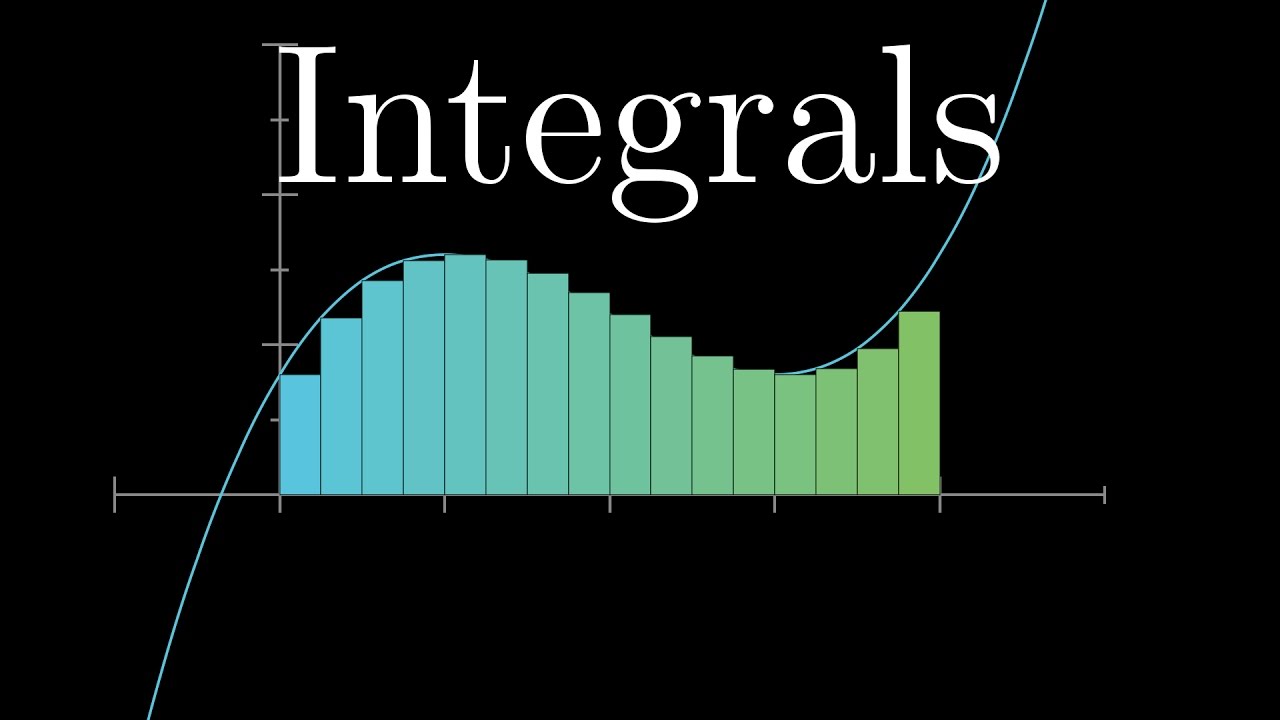
Intuition for integrals, and why they are inverses of derivatives.
Help fund future projects: https://www.patreon.com/3blue1brown
An equally valuable form of support is to simply share some of the videos.
Special thanks to these supporters: http://3b1b.co/lessons/integration#thanks
Check out the Art of Problem Solving: https://aops.com/3blue1bro...
leaden scroll
oh i see
leaden scroll
wind geyser
wonder what the * represents
?
wind geyser
ignore that
leaden scroll
okay
silk osprey
it’s just notation used for some point in the interval you’re summing usually used to distinguish between different summation methods
dw about it
leaden scroll
leaden scroll
is the base 1 and the height 2?
1/2 times 1*2 = 1
 leaden scroll
4
silk osprey
mhm
simple
can you do b now
what shape is it from 2 to 6
also note that we consider area below the graph to be negative
leaden scroll
would it be like a half circle?
leaden scroll
pi * r^2 /2
leaden scroll
4?
silk osprey
hmm not quite
that’s the diameter
since it spreads from 2 to 6
the radius is the distance to the center of the circle
leaden scroll
2?
silk osprey
leaden scroll
2pi
this is -
for the integral
that’s the area, but since we’re evaluating the definite integral we consider portions below the x axis to be negative
leaden scroll
-2pi
silk osprey
yea
so now do part c
you can split it into parts btw
like
$\int_0^7 g(x) dx = \int_0^2 g(x) dx + \int_2^6 g(x) dx + \int_6^7 g(x) dx$
 twin meteorBOT
knief
 silk osprey
we already determined the first two
leaden scroll
ohh i see
silk osprey
can you find $\int_6^7 g(x) dx$
twin meteorBOT
knief
 silk osprey
first of all what shape is it
leaden scroll
another tirangle?
leaden scroll
b is 1 and h is 2?
silk osprey
the base is indeed 1 but how’d you get the height to be 2
leaden scroll
do we not count under the graph?


 civic otter
That's not a triangle...
silk osprey
yep
silk osprey
mhm
silk osprey
twin meteor
**knief**
so what does this become
leaden scroll
4 + -2pi + 1/2
vocal sleetBOT
@leaden scroll Has your question been resolved?
Channel closed
Closed by @leaden scroll
Use .reopen if this was a mistake.
Available help channel!
Send your question here to claim the channel.
Remember:
• Ask your math question in a clear, concise manner.
• Show your work, and if possible, explain where you are stuck.
• After 15 minutes, feel free to ping <@&286206848099549185>.
• Type the command .close to free the channel when you're done.
• Be polite and have a nice day!
Read #❓how-to-get-help for further information on how to ask a good question, and about conduct in the question channels.
 jagged cargo
 vocal sleetBOT
jagged cargo
twin meteorBOT
vocal sleetBOT
jagged cargo
twin meteorBOT

 sly sierra
nope
for example say V is R^2 and U is the span of some nonzero vector v
then you can take any w that is not a scalar multiple of v, and then W = span{w} works
vocal sleetBOT
Channel closed
Closed by @jagged cargo
Use .reopen if this was a mistake.
vocal sleetBOT
Available help channel!
Send your question here to claim the channel.
Remember:
• Ask your math question in a clear, concise manner.
• Show your work, and if possible, explain where you are stuck.
• After 15 minutes, feel free to ping <@&286206848099549185>.
• Type the command .close to free the channel when you're done.
• Be polite and have a nice day!
Read #❓how-to-get-help for further information on how to ask a good question, and about conduct in the question channels.
leaden scroll
how do i do this
 vocal sleetBOT
leaden scroll
how do i do this
vocal sleetBOT
leaden scroll
how do i do this
 golden herald
leaden scroll
how do i do this
golden herald
leaden scroll
how do i do this
Might be easier than you think
remember that
[
\frac{\sqrt{y} - y}{y^2} = \frac{\sqrt{y}}{y^2} - \frac{y}{y^2}
]
twin meteorBOT
Aero
 leaden scroll
is it * dy still
leaden scroll
wut
golden herald
you can do [
\int \left(f(x) + g(x)\right) dx = \int f(x) dx + \int g(x) dx
]
twin meteorBOT
Aero


 leaden scroll
what do i do after though 😭 like what am i solving for
leaden scroll
1/y
leaden scroll
y^-3/2
leaden scroll
like the derrivative?
golden herald
no
the antiderivative
you need to apply the property that [
\int_a^b x^n dx = \frac{1}{n+1}\left[x^{n+1}\right]_a^b
]
for $n \neq -1$
twin meteorBOT
Aero
 golden herald
yeah you got it
thats the first antiderivative
the second integral, just use the other property that
[
\int_a^b x^{-1}dx = \left[\ln(|x|)\right]_a^b
]
twin meteorBOT
Aero
 leaden scroll
ln 2 ?
 loud walrus
golden herald
loud walrus
golden herald
not in this example, but i am just giving the general antiderivative
golden herald
leaden scroll
ln 2 ?
are you saying thats what the second integral evaluates to entirely?
leaden scroll
yes?
golden herald
Then no, thats incorrect
golden herald
Bingo
vocal sleetBOT
Channel closed
Closed by @leaden scroll
Use .reopen if this was a mistake.
vocal sleetBOT
Available help channel!
Send your question here to claim the channel.
Remember:
• Ask your math question in a clear, concise manner.
• Show your work, and if possible, explain where you are stuck.
• After 15 minutes, feel free to ping <@&286206848099549185>.
• Type the command .close to free the channel when you're done.
• Be polite and have a nice day!
Read #❓how-to-get-help for further information on how to ask a good question, and about conduct in the question channels.
 cold obsidian
If a function f(x-1) is reflected in the y-axis would the result be f(-x-1) or f(-(x-1))? Sorry im horrible with functions
vocal sleetBOT
cold obsidian
If a function f(x-1) is reflected in the y-axis would the result be f(-x-1) or f...
 marsh charm
cold obsidian
If a function f(x-1) is reflected in the y-axis would the result be f(-x-1) or f...
marsh charm
cold obsidian
If a function f(x-1) is reflected in the y-axis would the result be f(-x-1) or f...
if i had to take a educated guess
 tidal dock
the latter
marsh charm
id say the 2nd one
tidal dock
f(-(x-1))
cold obsidian
tidal dock
f(-(x-1))
But in desmos it gave me the first one
I thought its the second asw
tidal dock
show your desmos then
marsh charm
maybe u used desmos wrong
cold obsidian
 cold obsidian
tidal dock
show your desmos then
cold obsidian
tidal dock
show your desmos then
The black and blue one reflected in y axis….
The green one reflected in y=1
cold obsidian
I dont wtf
tidal dock
f(x-1) is shifted one unit to the right
you want your thing to be reflected around y axis and shifted one unit to the left
so it will be f(-(x+1))
cold obsidian
marsh charm
maybe u used desmos wrong
Do u get this
marsh charm
cold obsidian
Do u get this
i dont but i really dont need to
cold obsidian
marsh charm
i dont but i really dont need to
So which one is right
vocal sleetBOT
@cold obsidian Has your question been resolved?
vocal sleetBOT
Channel closed
Closed due to timeout
Use .reopen if this was a mistake.
Available help channel!
Send your question here to claim the channel.
Remember:
• Ask your math question in a clear, concise manner.
• Show your work, and if possible, explain where you are stuck.
• After 15 minutes, feel free to ping <@&286206848099549185>.
• Type the command .close to free the channel when you're done.
• Be polite and have a nice day!
Read #❓how-to-get-help for further information on how to ask a good question, and about conduct in the question channels.
 torn tangle
 vocal sleetBOT
torn tangle
marsh charm
torn tangle
I just get lost
vocal sleetBOT
torn tangle
marsh charm
torn tangle
I just get lost
do you know what a asymptote is
torn tangle
Ye, a "line" that a graph goes to but never will touch it
torn tangle
 torn tangle
Yyy, from what someone was trying to teach me, we do the lim of ±oo
marsh charm
yea
marsh charm
not infinity
from -2-
and -2+
basically just find out
if y
goes to positive or negative infinity
as x aproaches the e value
if they do
than its a asymptote
torn tangle
 golden herald
torn tangle
And then some lhopital rule and thats all i know
golden herald
torn tangle
And then some lhopital rule and thats all i know
A few good rules of thumb to remember:
\medskip
For horizontal asymptote, you're always considering $\lim_{x\to \pm\infty}$
\medskip
For vertical asymptotes, you're considering $x = c$ where $c$ is where the denominator is 0. (You need to make sure that the numerator and denominator are coprime, though)
twin meteorBOT
Aero
 torn tangle
Coprime?
golden herald
like, there are no factors between the numerator and denominator because that wouldn't be a vertical asymptote. But anyways that's not your case
golden herald
torn tangle
For example, this value of x constitutes a vertical asymptote
golden herald
torn tangle
What
x = e^-2 is where your vertical asymptote is
torn tangle
Tell me if there is like one patern that i can follow for all calculations of asymptotes
golden herald
twin meteor
**Aero**
I mean I said the methodology here
torn tangle
Okay
So
So to calculate the vertical asymptotes i just take the denominator and make it =0
Yes?
golden herald
yes, but again make sure the fraction is coprime. What I mean by this is that make sure you don't have something like [
\frac{(x+2)(x+3)}{x+3}
]
because in this case $x = -3$ is not a vertical asymptote, it's a hole rather
twin meteorBOT
Aero
 golden herald
because the x+3's "cancel"
torn tangle
Okay
Sooo
Whats then i dont have a denominator or wtv
But I have Let's say y=xe^-2/x
golden herald
in that case x = 0 isn't an asymptote either, it's just a hole
wait
do you mean $x\frac{e^{-2}}x$ or $xe^{\frac{-2}{x}}$?
twin meteorBOT
Aero

 golden herald
then yes x = 0 is an asymptote then
torn tangle
torn tangle
And have no clue what iv done here besides domain
golden herald
the actual procedure is that you need to calculate [
\lim_{x\to 0^+} xe^{-\frac{2}x}
] and
[
\lim_{x\to 0^-} xe^{-\frac{2}x}
]
twin meteorBOT
Aero
 torn tangle

I have this
Ik I have it solved but I'm trying to understand what to do, I need a scheme that I can follow
golden herald
I am sorry but I don't think I understand what you wrote in there? Anyways what I would do is utilise the fact that [
\lim_{x\to 0^+} xe^{-\frac{2}{x}} = \lim_{x\to 0^+}x \cdot \lim_{x \to 0^+} e^{-\frac{2}{x}}
]
twin meteorBOT
Aero
 torn tangle
I mean, in the [] you calculate the lim for this example 0‐, and it's 0- cuz it's -2/x and that's why there is this graph on the left, and cuz the lim was 0- * +oo it's undefinable so I did the lhopital or wtv it's called (the H above the =) and the do the lim of it
And somehow I got the asymptote
golden herald
torn tangle
And somehow I got the asymptote
I see. I think your notation might be your biggest enemy in what you wrote. Try not to substitute in stuff like "infinity" and "0^+" as it is both very improper and will confuse you. Try to keep everything in terms of x's when dealing with limits.
golden herald
twin meteor
**Aero**
Doing it like this might be more insightful for you, though. The limit of x will be 0 and to compute the limit of e^(-2/x), it's good to think of it inside out
as x becomes smaller and closer to 0 (say 0.00001), 2/x becomes huge (approaches infinity). so -2/x approaches -infinity, and the exponential function approaches 0 as its exponent approaches -inf
So your limit all in all is equal to 0 * 0
vocal sleetBOT
@torn tangle Has your question been resolved?
torn tangle
Sorry for not responding
I'm walking to other campus
I'm gonna look into it later thanks
vocal sleetBOT
Channel closed
Closed due to timeout
Use .reopen if this was a mistake.
Available help channel!
Send your question here to claim the channel.
Remember:
• Ask your math question in a clear, concise manner.
• Show your work, and if possible, explain where you are stuck.
• After 15 minutes, feel free to ping <@&286206848099549185>.
• Type the command .close to free the channel when you're done.
• Be polite and have a nice day!
Read #❓how-to-get-help for further information on how to ask a good question, and about conduct in the question channels.
vocal sleetBOT
twin meteorBOT
sotiris
 vocal sleetBOT
@stiff aspen Has your question been resolved?
vocal sleetBOT
Channel closed
Closed due to timeout
Use .reopen if this was a mistake.
Available help channel!
Send your question here to claim the channel.
Remember:
• Ask your math question in a clear, concise manner.
• Show your work, and if possible, explain where you are stuck.
• After 15 minutes, feel free to ping <@&286206848099549185>.
• Type the command .close to free the channel when you're done.
• Be polite and have a nice day!
Read #❓how-to-get-help for further information on how to ask a good question, and about conduct in the question channels.
 swift robin
can sin^2y be written as (siny)^2?
vocal sleetBOT
swift robin
can sin^2y be written as (siny)^2?
 bronze osprey
it can
swift robin
okok so as long as the whole thing is squared right
bronze osprey
$\sin^2 y = (\sin y)^2$
works for any exponent, except don't use -1 as the exponent
twin meteorBOT
southlander!
 bronze osprey
cause $\sin^{-1} y$ means $\arcsin y$
swift robin
why not -1?
twin meteorBOT
southlander!
 bronze osprey
swift robin
eh wait i meant cosecant
bronze osprey
swift robin
eh wait i meant cosecant
no
I'm saying 1/(sin x) is cosecant
but 1/(sin x) is not arcsin(x)
vocal sleetBOT
Channel closed
Closed by @swift robin
Use .reopen if this was a mistake.
vocal sleetBOT
Available help channel!
Send your question here to claim the channel.
Remember:
• Ask your math question in a clear, concise manner.
• Show your work, and if possible, explain where you are stuck.
• After 15 minutes, feel free to ping <@&286206848099549185>.
• Type the command .close to free the channel when you're done.
• Be polite and have a nice day!
Read #❓how-to-get-help for further information on how to ask a good question, and about conduct in the question channels.
 cursive prairie
Hello, I want to learn how to calculate the probability of reaching a step in a sequence of events, where if you fail one step, you return to the previous step.
Let's say we got 6 steps, everyone with a probability of success.
Step 1 60%
Step 2 40%
Step 3 40%
Step 4 20%
Step 5 20%
Step 6 9%
Every time you fail you return a step and lose a point, and every time you succeed you gain a point. I know you could multiply the chances and get a percentage chance of succeeding every step in a roll, but if you return one step, you get another chance, that would change your chances, right?
vocal sleetBOT
cursive prairie
Hello, I want to learn how to calculate the probability of reaching a step in a ...
cursive prairie
Also, this is for a game, every step uses a resource. I want to learn the average use of resources to clear all steps.
 cyan talon
right
bronze osprey
Markov chains
cyan talon
damn sniper w/ 2 word answer and nothing else 😉
cyan talon
cursive prairie
Hello, I want to learn how to calculate the probability of reaching a step in a ...
but yeah markov chains represent exactly that kind of situation
I'm wondering if there's super intro resources/videos online about them tho, I only know of fat books abt them
cursive prairie
I didn't think this would be such a complicated problem
cyan talon
well it's not a complicated problem yes
like it would take me a few minutes by hand to do
but that's cause I know what markov chains are, and those questions you asked about the situation (average number of resources used, etc...) are pretty standard
cursive prairie
Got it, I can try to search a few videos about it. Is there anything specific I should search for, or just Markov chains?
cyan talon
just markov chains yeah
https://www.youtube.com/playlist?list=PLANMHOrJaFxPMQCMYcYqwOCYlreFswAKP
this series looks alright

YouTube
Here we look at: transition diagrams, steady states, Markov chains, regular Markov chains, absorbing Markov chains and more!
& if you want something beefy but concise for more details, I found this pdf not too long ago http://www.statslab.cam.ac.uk/~rrw1/markov/M.pdf
@cursive prairie
cursive prairie
I don't know if I would understand a paper, I have only a high-school-level math knowledge. And i forgot most of the more complicated stuff already, haha
cyan talon
it's more like a small textbook, not a research paper
but yeah it's just an extra if you want to come back to it later w/ more math, I'm not suggesting you read it right now
cyan talon
cursive prairie
Hello, I want to learn how to calculate the probability of reaching a step in a ...
is this for an actual game you're playing or just some example ?
cursive prairie
that example is from a game that exists, I'm trying to calculate resource expenditure
it's quite an old game, are you familiar with Ragnarok Online?

these are the values i'm working with
cyan talon
the shadow upgrades
cursive prairie
yeah
cyan talon
aight I mean I can give you the answer now for the average resources needed, if that helps you in the moment
but if you want to figure it out all by yourself it's fine too
cursive prairie
I know it's a dum reason, but I wanted to learn how to calculate it
cyan talon
even if I spit you out the answer, you can go read about markov chains afterwards lol
it's not either/or tbf
cursive prairie
yeah
vocal sleetBOT
@cursive prairie Has your question been resolved?
cyan talon
@cursive prairie re had to go do something
resources from +3 +4 +5 +6 +7 +8 +9 to get to +10
[61.41, 60.41, 58.08, 52.08, 40.58, 36.46, 34.18]
here's what I got
vocal sleetBOT
Channel closed
Closed due to timeout
Use .reopen if this was a mistake.
Available help channel!
Send your question here to claim the channel.
Remember:
• Ask your math question in a clear, concise manner.
• Show your work, and if possible, explain where you are stuck.
• After 15 minutes, feel free to ping <@&286206848099549185>.
• Type the command .close to free the channel when you're done.
• Be polite and have a nice day!
Read #❓how-to-get-help for further information on how to ask a good question, and about conduct in the question channels.
 nova crown
We are supposed to proove that d/dx ln(x) is 1/x. We did case 1 when h > 0 and he said that case 2 when h < 0 might come on the test. But im having some struggles.
vocal sleetBOT
nova crown
We are supposed to proove that d/dx ln(x) is 1/x. We did case 1 when h > 0 and h...
nova crown
We started by drawing a graph of 1/t

Then we compared the rectangles like such

So case one when h > 0 we can divide with h and get

Then let
$h \rightarrow 0^+$
twin meteorBOT
vrsth
 nova crown
Then by the squeeze theorem we get

So my question is when doing that h < 0. Do i need to make a seperate graph where the points are switched and how would i prove it? im stuck
 cursive turret
for h < 0 you can do the same.
write k = -h, then you get pinot c and c-k instead of c and c+h, and as you said the points switch, c-k is left from c, but its the same sketch. (and 1/c is below 1/(c-k) and so on ...
nova crown
cursive turret
for h < 0 you can do the same.
write k = -h, then you get pinot c and c-k inste...
Right yeha
The points switch
Do i need to write k=-h or can i just directly write it as 1/c is below 1/(c+h)
cursive turret
nova crown
Do i need to write k=-h or can i just directly write it as 1/c is below 1/(c+h)
you do not need to use a k, you can use h and argue that h< 0.
nova crown
Right
cursive turret
in the last step (division by h) you need to be careful since there are inequalities
 cursive turret
yes
nova crown
cursive turret
in the last step (division by h) you need to be careful since there are inequali...
So just after switching the points to the picture above i just write up the comparisons of the areas
cursive turret
its the same way as in the case h>0
 cursive turret
thats why i would prefer to use k = -h, you are comparing areas here so the most left and the most right side should be positive but ypu can do it this way, too.
cursive turret
yes.
cursive turret
in really they should switch and you should "-h" (interpreted as side of an rectangle should be positive) onm the most left and most right side.
but yes, you could to it your way. but still i would recommend the way k=-h a it would be much clearer. but again, you can do it with h as well.
 limber trellis
 cursive turret
yes
limber trellis
 cursive turret
are you posting from differnt accounts?
nova crown
yes
have 2 different acocunts so i can speak with ym friends on discord trough computer at the same time as i can screenshare the tablet
nova crown
cursive turret
are you posting from differnt accounts?
But is it correct?
cursive turret
yas
limber trellis
 nova crown
Just ot be clear
nova crown
limber trellis
this pic
The inequalities witch when we divide by k since k is negative h
then i sub in -h in the spots where k is and the lns on top switch leaving us with the definition of derivative
and we can apply the squeeze theorem?
cursive turret
yes
vocal sleetBOT
Channel closed
Closed by @nova crown
Use .reopen if this was a mistake.
vocal sleetBOT
Available help channel!
Send your question here to claim the channel.
Remember:
• Ask your math question in a clear, concise manner.
• Show your work, and if possible, explain where you are stuck.
• After 15 minutes, feel free to ping <@&286206848099549185>.
• Type the command .close to free the channel when you're done.
• Be polite and have a nice day!
Read #❓how-to-get-help for further information on how to ask a good question, and about conduct in the question channels.
 rapid anvil
Sanity check: If I have $\frac{f(x)g(x)}{g(x)h(x)}$, this is always equal to $\frac{f(x)}{h(x)}$ right?
vocal sleetBOT
rapid anvil
Sanity check: If I have $\frac{f(x)g(x)}{g(x)h(x)}$, this is always equal to $\f...
twin meteorBOT
imo2025

 lone linden
rapid anvil
Sanity check: If I have $\frac{f(x)g(x)}{g(x)h(x)}$, this is always equal to $\f...
lone linden
rapid anvil
Sanity check: If I have $\frac{f(x)g(x)}{g(x)h(x)}$, this is always equal to $\f...
As long as $g(x) \neq 0$, yes.
twin meteorBOT
Civil Service Pigeon
 rapid anvil
And if $g(x)$ can equal 0 at some x?
twin meteorBOT
imo2025
 lone linden
Then the domains aren’t necessarily the same
Unless all of the zeroes of g are also zeroes of h
rapid anvil
Prototypical example, $\frac{(x-2)(x-1)}{(x-2)(x-3)}$
twin meteorBOT
imo2025
 lone linden
Yeah something like that is what I’m getting at
lone linden
twin meteor
**imo2025**
Because this doesn’t have 2 in the domain, but (x-1)/(x-3) does
rapid anvil
So there won't be an asymptote at x=2?
lone linden
Sure ig
 grizzled vault
rapid anvil
grizzled vault
rapid anvil
lol i just used lhopital and showed there was a discontinuity but i was told i overkilled
oh well
thanks guys
.close
vocal sleetBOT
Channel closed
Closed by @rapid anvil
Use .reopen if this was a mistake.
vocal sleetBOT
Available help channel!
Send your question here to claim the channel.
Remember:
• Ask your math question in a clear, concise manner.
• Show your work, and if possible, explain where you are stuck.
• After 15 minutes, feel free to ping <@&286206848099549185>.
• Type the command .close to free the channel when you're done.
• Be polite and have a nice day!
Read #❓how-to-get-help for further information on how to ask a good question, and about conduct in the question channels.
 hardy crater

 vocal sleetBOT
hardy crater
hardy crater
vocal sleetBOT
hardy crater
hardy crater
Hello, please could someone explain why dv/dt is equal to k/rooth ?
I understand everything else
 outer warren
vocal sleetBOT
outer warren
vocal sleetBOT
Channel closed
Closed by @hardy crater
Use .reopen if this was a mistake.
vocal sleetBOT
Available help channel!
Send your question here to claim the channel.
Remember:
• Ask your math question in a clear, concise manner.
• Show your work, and if possible, explain where you are stuck.
• After 15 minutes, feel free to ping <@&286206848099549185>.
• Type the command .close to free the channel when you're done.
• Be polite and have a nice day!
Read #❓how-to-get-help for further information on how to ask a good question, and about conduct in the question channels.
Channel closed
Channel closed due to the original message being deleted.
If you did not intend to do this, please open a new help channel,
as this action is irreversible, and this channel may abruptly lock.
Available help channel!
Send your question here to claim the channel.
Remember:
• Ask your math question in a clear, concise manner.
• Show your work, and if possible, explain where you are stuck.
• After 15 minutes, feel free to ping <@&286206848099549185>.
• Type the command .close to free the channel when you're done.
• Be polite and have a nice day!
Read #❓how-to-get-help for further information on how to ask a good question, and about conduct in the question channels.
 vale frigate
how do i evaluate this (no lhopitals/series expansions)

 lethal heart
Can you use notable limits?
 grim lotus

 heavy yoke
you will probably end up using these at some point

 somber portal
i'd start by replacing cos(2x) with trig identities
vale frigate
lethal heart
Can you use notable limits?
yes
vale frigate
somber portal
i'd start by replacing cos(2x) with trig identities
i used double angle identity and got (1-cosx(2cos^x -1))/x^2
somber portal
so you can now split that in two fractions
$\frac{1-cosx}{x}\cdot \frac{2cos^2x-1}{x}$
twin meteorBOT
LordFelix
 heavy yoke
twin meteor
**LordFelix**
heavy yoke
twin meteor
**LordFelix**
not sure that works
vale frigate
yea
 crisp rapids
hey
vocal sleetBOT
@vale frigate Has your question been resolved?
vocal sleetBOT
@vale frigate Has your question been resolved?
vocal sleetBOT
Channel closed
Closed due to timeout
Use .reopen if this was a mistake.
Available help channel!
Send your question here to claim the channel.
Remember:
• Ask your math question in a clear, concise manner.
• Show your work, and if possible, explain where you are stuck.
• After 15 minutes, feel free to ping <@&286206848099549185>.
• Type the command .close to free the channel when you're done.
• Be polite and have a nice day!
Read #❓how-to-get-help for further information on how to ask a good question, and about conduct in the question channels.
 frank bison
3 idk how to do this
 vocal sleetBOT
frank bison
3 idk how to do this
vocal sleetBOT
frank bison
3 idk how to do this

 flat whale
This is separable
 flat whale
That's not how separation of variables works
frank bison
it’s been a minute could you give me a hint plese 🙏
flat whale
In this section show how the method of Separation of Variables can be applied to a partial differential equation to reduce the partial differential equation down to two ordinary differential equations. We apply the method to several partial differential equations. We do not, however, go any farther in the solution process for the partial diffe...
silk osprey
or just do integrating factor but yes it’s also separable
frank bison
silk osprey
or just do integrating factor but yes it’s also separable
Thought that’s only for linears?
frank bison
I’m blanking
flat whale
flat whale
Review
https://tutorial.math.lamar.edu/classes/de/SeparationofVariables.aspx
My bad this was the PDE link. This one here is for ODEs
https://tutorial.math.lamar.edu/Classes/DE/Separable.aspx
In this section we solve separable first order differential equations, i.e. differential equations in the form N(y) y' = M(x). We will give a derivation of the solution process to this type of differential equation. We’ll also start looking at finding the interval of validity for the solution to a differential equation.
 silk osprey
bring the u^2 + 1 over
then divide by u^2 + 1
or divide by it now and subtract the 1 over after


 silk osprey
does that say + 4 or + C1
 silk osprey
well it should be -ln right
silk osprey
oh wait
frank bison
negative comes out and it’s positive
silk osprey
no you’re right
frank bison
Oh ok
silk osprey
i forgot about the -x
vocal sleetBOT
Channel closed
Closed by @frank bison
Use .reopen if this was a mistake.
vocal sleetBOT
Available help channel!
Send your question here to claim the channel.
Remember:
• Ask your math question in a clear, concise manner.
• Show your work, and if possible, explain where you are stuck.
• After 15 minutes, feel free to ping <@&286206848099549185>.
• Type the command .close to free the channel when you're done.
• Be polite and have a nice day!
Read #❓how-to-get-help for further information on how to ask a good question, and about conduct in the question channels.
 vast shale
Help question 5
 vocal sleetBOT
vast shale
Help question 5
vast shale
vocal sleetBOT
vast shale
Help question 5
vast shale
I have no idea what we are trying to look for
 calm pecan
!status
vocal sleetBOT
What step are you on?
1. I don't know where to begin.
2. I have begun but got stuck midway.
3. I got an answer but I was told that it's wrong.
4. I got an answer and would like my work checked.
5. I have a question about someone else's work/solution.
6. I have completed the problem and don't need help anymore. Thank you.
7. None of the above
I dont understand both the question and answer

This is the answer
I dont know how to start
Nor what to find
I dont know im super confused
calm pecan
vast shale
this looks pretty good
calm pecan
vast shale
I dont know how to start
do you know differentiation
vast shale
Yes
calm pecan
do you know how to find extrema
vast shale
Find critical points then plug in second derivative to decide whether minimum or maximum then plug the criticals in original equation to get their y??
twin meteorBOT
Percy
 vast shale
Yes
calm pecan
you grab $x$ and write it as $\frac{147}{7}$
twin meteorBOT
Percy
 calm pecan
you need to minimise some function of x and y, $f(x,y)$
twin meteorBOT
Percy
 calm pecan
you replaced x with smth in terms of y so now it's just a function in terms of y, $g(y)$
vast shale
twin meteor
**Percy**
Where did the 7 come from?
twin meteorBOT
Percy
 vast shale
I dont understand
calm pecan
put in values, solve
calm pecan
vast shale
Where did the 7 come from?
i meant y, they're close on the keyboard
vast shale
calm pecan
i meant y, they're close on the keyboard
Ok so after making x alone then plug it in x+3y=sum
Then what?
Finding derivative?
calm pecan
vast shale
Finding derivative?
yes
calm pecan
then...
calm pecan
vast shale
.
vocal sleetBOT
@vast shale Has your question been resolved?
vocal sleetBOT
Channel closed
Closed due to timeout
Use .reopen if this was a mistake.
Available help channel!
Send your question here to claim the channel.
Remember:
• Ask your math question in a clear, concise manner.
• Show your work, and if possible, explain where you are stuck.
• After 15 minutes, feel free to ping <@&286206848099549185>.
• Type the command .close to free the channel when you're done.
• Be polite and have a nice day!
Read #❓how-to-get-help for further information on how to ask a good question, and about conduct in the question channels.
 tight apex
Can you help me with this question?
 vocal sleetBOT
tight apex
Can you help me with this question?
tight apex
vocal sleetBOT
tight apex
Can you help me with this question?
tight apex
0.4496751137945747 I found this number
Webwork says your numbers are very close
check your calculation
flat whale
show all your calculations
tight apex
can you give me the answer pls
flat whale
!noans
vocal sleetBOT
The purpose of this server is to help you learn, not to hand out answers. Do not ask someone to give you the answer directly.
flat whale
,w 1 - 1/2 * erfc(-32/253 * sqrt(2) / 2)
twin meteorBOT


 flat whale
what does it say to round to?
tight apex
flat whale
what does it say to round to?
it says very close
tight apex
twin meteor
i didnt send this answer yet this is my last try
flat whale
do the instructions tell you to round or not?
 tight apex
can you look 4.28

i corrected it
but i didnt understand what should i do on question a
can i try 0.45
vocal sleetBOT
@tight apex Has your question been resolved?
vocal sleetBOT
Channel closed
Closed due to timeout
Use .reopen if this was a mistake.
Available help channel!
Send your question here to claim the channel.
Remember:
• Ask your math question in a clear, concise manner.
• Show your work, and if possible, explain where you are stuck.
• After 15 minutes, feel free to ping <@&286206848099549185>.
• Type the command .close to free the channel when you're done.
• Be polite and have a nice day!
Read #❓how-to-get-help for further information on how to ask a good question, and about conduct in the question channels.
 tender lotus
 vocal sleetBOT
tender lotus
tender lotus
vocal sleetBOT
tender lotus
tender lotus
For 16, what do I do after plugging in the g(x) function
vocal sleetBOT
@tender lotus Has your question been resolved?
tender lotus
<@&286206848099549185>
 twin citrus
you have to simplify
tender lotus
Simplify what
vocal sleetBOT
@tender lotus Has your question been resolved?
vocal sleetBOT
@tender lotus Has your question been resolved?
vocal sleetBOT
@tender lotus Has your question been resolved?
vocal sleetBOT
Channel closed
Closed due to timeout
Use .reopen if this was a mistake.
Available help channel!
Send your question here to claim the channel.
Remember:
• Ask your math question in a clear, concise manner.
• Show your work, and if possible, explain where you are stuck.
• After 15 minutes, feel free to ping <@&286206848099549185>.
• Type the command .close to free the channel when you're done.
• Be polite and have a nice day!
Read #❓how-to-get-help for further information on how to ask a good question, and about conduct in the question channels.
 open sage
 open sage
Let B be an orthonormal basis for a subspace V
B={v1,v2,v3}
given S = span{v1,v1+v2-v3} find an orthogonal basis for S which contains the vector v1
okay so a few things
given its orthonormal, the internal product of v1 v2 and v3 will be 0
(between themselves)
the dimension of S orthogonal will be 1
i need to find
<v1,u> = 0 and <v1+v2-v3,u> = 0
i just don't know how to force u to contain v1
 pale widget
if the u's are your orthonormal basis you set u1 = v1 and then apply gram schmidt to get u2
pale widget
How did you manage that when S is the span of 2 vectors of that form
open sage
V is a 3 dimensional subspace
since its basis is composed of 3 vectors
dim(V) = dim(S) + dim(S orth)
pale widget
I think I misread what you wrote, are you not looking for a basis of S
open sage
an orthogonal basis of S
i think i may be misunderstanding as well
am i being asked to find S orthogonal
pale widget
That's not asking for a basis of the orthogonal complement of S
pale widget
thats asking for a set of basis vectors that spans S which happen to be orthonormal
open sage
okay
got it
okay so
i need gram schmidt

we've seen it in class
i've just never used it
i just say u1=v1
correct?
which i believe is the case when using gram schmidt anyways
you set one of the vectors to be the same
(the first)
pale widget
Honestly I would double check that something wasn't lost in translation but I don't see how that question would make sense as you initially interpreted it
open sage
no no i'm pretty sure you got it right
its just
2 am
and i've been cramming a lot
lol
"find an orthogonal basis for S which contains the vector v1"
pale widget
using that screenshot you would set q1 = v1 then calculate q2 where a2 = v1+v2-v3
open sage
yeah you don't get these kinds of things named after you unless they work
or unless they're really stupid in some cases
i suppose gram and schmidt are two different people though
@pale widget

sorry to bother you
does that look fine

oh
i think i added an extra term
yeah that's right

from the solution sheet
thanks!
.close
vocal sleetBOT
Channel closed
Closed by @open sage
Use .reopen if this was a mistake.
vocal sleetBOT
Available help channel!
Send your question here to claim the channel.
Remember:
• Ask your math question in a clear, concise manner.
• Show your work, and if possible, explain where you are stuck.
• After 15 minutes, feel free to ping <@&286206848099549185>.
• Type the command .close to free the channel when you're done.
• Be polite and have a nice day!
Read #❓how-to-get-help for further information on how to ask a good question, and about conduct in the question channels.
 sturdy portal
I am able to do the first two parts, but I struggle to continue with the third part, and I keep getting it wrong
 vocal sleetBOT
sturdy portal
I am able to do the first two parts, but I struggle to continue with the third p...
vocal sleetBOT
vocal sleetBOT
sturdy portal
I am able to do the first two parts, but I struggle to continue with the third p...
vocal sleetBOT
Channel closed
Closed by @sturdy portal
Use .reopen if this was a mistake.
vocal sleetBOT
Available help channel!
Send your question here to claim the channel.
Remember:
• Ask your math question in a clear, concise manner.
• Show your work, and if possible, explain where you are stuck.
• After 15 minutes, feel free to ping <@&286206848099549185>.
• Type the command .close to free the channel when you're done.
• Be polite and have a nice day!
Read #❓how-to-get-help for further information on how to ask a good question, and about conduct in the question channels.
 sly basin
 sly basin
I have to use the divergence theorem to find the flux
 tired gorge
Where are you stuck?
heavy yoke
can you state the divergence theorem?
tired gorge
Yeah that's a good place to start
sly basin
is it the triple integral and getting the div F
tired gorge
Yep
sly basin
so <d/dx, d/dy, d/dz> dot F
tired gorge
Correct
tired gorge
What do you think? Maybe write out the divergence theorem first
tired gorge
Yep
But you should think about what volume you're integrating over
That's the hardest bit of this problem
tired gorge
Yes
 tired gorge
If you want to integrate in that order sure
sly basin
thats y i was wondering
isnt it wiser to
set up the integral (without bounds)
to see whats the easiest way to integrate
then based on that we can be picky with our bounds
tired gorge
Sounds like a good plan
sly basin
2 + 5 + 2z
7+2z
so i think its better to have dz inside right
get it out of the way
this way the and x will no powers
tired gorge
I think integrating over x and y may be smarter first, as if you integrate over z first you'll get the upper bound as a function of x and y and it'll make things harder later
But you can go about it either way
It's all polynomials so the integrals aren't bad
Remember your bounds aren't simple because your domain is a tetrahedron not a box
sly basin
jright
is there a mechanical way to solve this
or do i have to visualize it?
i was told in most of calc 3 I can get away without understanding
but just plugging and knowing formulas
tired gorge
It never hurts to draw a picture
 tired gorge
Do you know how to get your bounds?
sly basin
no idea man
tired gorge
My preferred method is to use projections, not as bad as it sounds
What is your integration order?
sly basin
what is projection method
I was thinking
we use the points
then view it at from xz plane
and use 2 points and the formua y2-y1=m(x-x2)
like that
tired gorge
Which bounds are you trying to calculate?
Your first step should be to decide your integration order
tired gorge
Like I said it doesn't really matter here but those look good enough you just have to make a decision
sly basin
i would rather have 1 fixed method
i dont really mind the integration
as long as its doable
by aprts, usub, trig sub, trig identity
idont really mind
tired gorge
Usually having your first integrals being over variables the integrand doesn't depend on is good but other times it depends on your volume, it's basically impossible to give you an order that works every time
That decision partially comes from experience unfortunately
Anyways since you've decided on your integration order it's time to work out your bounds
tired gorge
My suggestion is to work inside out: start with the first integral (in this case it's over x) and write the bounds it can vary over in terms of the other variables
sly basin
Right
it can have xyz
but it cant have
x as is its bounds right?
after integrating it it should only be y and z
right
tired gorge
Yeah you can't have any xs lying around after the integral
sly basin
so since bound cant have x it has to have y and z
so we gotta look at it from like zy plane?
or somethig?
tired gorge
Sounds about right
sly basin
(0,0,0), (4,0,0), (0,5,0) (0,0,7)
So if w looking at yz plane. We ignore x
So (0,0), (0,0), (5,0) (0,7)
tired gorge
I'm not sure what you're doing there
sly basin
like
the points?
im not sure
how do i graph it
from the yz plane
given that (0,0,0), (4,0,0), (0,5,0) (0,0,7)
tired gorge
I'd suggest looking at it this way, for any point in the y-z plane there is a line in the x direction, that line is what you're integrating over first and the start and end points of that line will give you your bounds
sly basin
is there a mechanical approach?
tired gorge
Sort of
You see that line pierces two surfaces, you should solve for x given the other variables on those two surfaces and those are your bounds
In this case those two surfaces are the planes x=0 and the slanted plane
sly basin
tired gorge
You see that line pierces two surfaces, you should solve for x given the other v...
wym
tired gorge
This is a little difficult to explain with words, but if you imagine a line in the x-direction that pierces your tetrahedron at two points
The x-coordinates of the intersection points (which will depend on y and z) are your start and end bounds for x
sly basin
im confused about something
(0,0,0), (4,0,0), (0,5,0) (0,0,7)
So given this can we not determine the plane?
there is like a x/4 + y/5 + z/7 = 1 plane?
sly basin
so can we always do that with tetrahedra?
tired gorge
You can determine equations for the sides of the tetrahedra always
And you need to
It's really nice when the tetrahedron has its points on the axes but in general it can be more difficult than that
sly basin
ok so using(0,0,0), (4,0,0), (0,5,0) (0,0,7)
x/4 + y/5 + z/7 = 1 plane?
We can solve for x
x/4 = 1-y/5-z/7
x = 4( 1-y/5-z/7)
x = 4-4y/5-4z/7
So x is going from 0 to x = 4-4y/5-4z/7
like that?
tired gorge
Looks right to me
sly basin
ok we just need. to focus on y
tired gorge
Yea
tired gorge
Not quite
Yeah
You look at the extent that y can vary depending on z
In this case we can just find y in terms of z for the line in the y-z plane
Or lines (we have y=0)
In essence we're projecting our shape down into the y-z plane
sly basin
since its dxdydz
when doing middle integral aka dy
it cant havex so only interms of y and z
thats y we doing yz plane which ignores all x"?
tired gorge
We already integrated out the x bit so the bound for y should only be in terms of z and the integrand in terms of y and z potentially
tired gorge
We "smoosh" our tetrahedron along the x-axis, in this case it'll leave us with a triangle
Then we repeat the process that we did for x, now in 2 dimensions, to solve for y in terms of z
sly basin
OHH
okok
I can kind of see it now
it basically becomes
triangle
going from up to down
right triangle
tired gorge
Yes
sly basin
so if we smoosh x axis that means we looking at yz plane
Which is a triangle with 3 points.
Now we gotta use those 3 points to find an equation for y correct?
tired gorge
Yep
