#help-17
1 messages · Page 255 of 1
 queen mountain
 fallow gull
I’ll be munching awn my noodles then 😍😍
queen mountain
😂
 queen mountain
Sorry yall js doing something wit my parent real quick shouldn’t take much longer
 vocal sleetBOT
@queen mountain Has your question been resolved?
vocal sleetBOT
Channel closed
Closed due to timeout
Use .reopen if this was a mistake.
vocal sleetBOT
 Available help channel!
Send your question here to claim the channel.
Remember:
• Ask your math question in a clear, concise manner.
• Show your work, and if possible, explain where you are stuck.
• After 15 minutes, feel free to ping <@&286206848099549185>.
• Type the command .close to free the channel when you're done.
• Be polite and have a nice day!
Read #❓how-to-get-help for further information on how to ask a good question, and about conduct in the question channels.
 random heath
Can anyone help me with rational expressions?
vocal sleetBOT
random heath
Can anyone help me with rational expressions?
 random heath
Yes, but how will I use them step by step on the expressions
 tawny sorrel
It’s the same thing you’re just adding fractions instead of whole numbers
 brittle cipher
yup
random heath
then it will become 0
brittle cipher
yeah exactly
random heath
so the answer is 1
brittle cipher
perfect!
random heath
Thank you so much I understand it now
brittle cipher
you're welcome, although I didn't really do most of the work here haha
random heath
hehe thank you for those who helped me
 spiral turtle
!done
vocal sleetBOT
If you are done with this channel, please mark your problem as solved by typing .close
spiral turtle
(if not we're still happy to help)
vocal sleetBOT
@random heath Has your question been resolved?
random heath
oh sorry
vocal sleetBOT
Channel closed
Closed by @random heath
Use .reopen if this was a mistake.
vocal sleetBOT
Available help channel!
Send your question here to claim the channel.
Remember:
• Ask your math question in a clear, concise manner.
• Show your work, and if possible, explain where you are stuck.
• After 15 minutes, feel free to ping <@&286206848099549185>.
• Type the command .close to free the channel when you're done.
• Be polite and have a nice day!
Read #❓how-to-get-help for further information on how to ask a good question, and about conduct in the question channels.
 low haven
is it true that $\abs{\sin{b}} + \abs{\cos{(a+b)}} \geq \abs{\cos{a}}, \forall a,b \in \mathbb{R}$? if so, how can i prove it?
vocal sleetBOT
low haven
is it true that $\abs{\sin{b}} + \abs{\cos{(a+b)}} \geq \abs{\cos{a}}, \forall a...
 twin meteorBOT
mod numero esperto

 bronze osprey
low haven
is it true that $\abs{\sin{b}} + \abs{\cos{(a+b)}} \geq \abs{\cos{a}}, \forall a...
bronze osprey
low haven
is it true that $\abs{\sin{b}} + \abs{\cos{(a+b)}} \geq \abs{\cos{a}}, \forall a...
https://www.desmos.com/calculator/dwejr5dhcj
interesting, the statement appears to be true

Desmos
now note that the period of the left-hand side is pi
differentiating this will be a real mess in terms of the sign choices
there should be another way
probably reverse triangle inequality on $|\cos a \cos b - \sin a \sin b|$
twin meteorBOT
south, just south
 vocal sleetBOT
@low haven Has your question been resolved?
 loud walrus
vocal sleetBOT
loud walrus
vocal sleetBOT
Channel closed
Closed by @low haven
Use .reopen if this was a mistake.
vocal sleetBOT
Available help channel!
Send your question here to claim the channel.
Remember:
• Ask your math question in a clear, concise manner.
• Show your work, and if possible, explain where you are stuck.
• After 15 minutes, feel free to ping <@&286206848099549185>.
• Type the command .close to free the channel when you're done.
• Be polite and have a nice day!
Read #❓how-to-get-help for further information on how to ask a good question, and about conduct in the question channels.
 near hearth
how do you determine if each curve is an orientation-respecting or -reversing parametrization
 vocal sleetBOT
near hearth
how do you determine if each curve is an orientation-respecting or -reversing pa...
vocal sleetBOT
near hearth
how do you determine if each curve is an orientation-respecting or -reversing pa...
@near hearth Has your question been resolved?
vocal sleetBOT
@near hearth Has your question been resolved?
Channel closed
Closed by @near hearth
Use .reopen if this was a mistake.
Available help channel!
Send your question here to claim the channel.
Remember:
• Ask your math question in a clear, concise manner.
• Show your work, and if possible, explain where you are stuck.
• After 15 minutes, feel free to ping <@&286206848099549185>.
• Type the command .close to free the channel when you're done.
• Be polite and have a nice day!
Read #❓how-to-get-help for further information on how to ask a good question, and about conduct in the question channels.
 outer warren
you added 208 and 78 instead of subtracting
vocal sleetBOT
Channel closed
Closed by @open helm
Use .reopen if this was a mistake.
outer warren
solutions aren't necessarily nice,
so not a real issue if it doesn't divide exactly
just make sure the work leading up to it is correct
vocal sleetBOT
Available help channel!
Send your question here to claim the channel.
Remember:
• Ask your math question in a clear, concise manner.
• Show your work, and if possible, explain where you are stuck.
• After 15 minutes, feel free to ping <@&286206848099549185>.
• Type the command .close to free the channel when you're done.
• Be polite and have a nice day!
Read #❓how-to-get-help for further information on how to ask a good question, and about conduct in the question channels.
vocal sleetBOT
 dim pumice
both works I guess, whether its u or v
 hard atlas
you can also do it the other way
it basically changes only a few factors
do it as an exercise
 cobalt ocean
you can either have e^-x as u and cos(nx) as v, or e^-x as v and cos(nx) as u, but you shouldn't be doing anything with e^x
vocal sleetBOT
@untold arrow Has your question been resolved?
Channel closed
Closed by @untold arrow
Use .reopen if this was a mistake.
Available help channel!
Send your question here to claim the channel.
Remember:
• Ask your math question in a clear, concise manner.
• Show your work, and if possible, explain where you are stuck.
• After 15 minutes, feel free to ping <@&286206848099549185>.
• Type the command .close to free the channel when you're done.
• Be polite and have a nice day!
Read #❓how-to-get-help for further information on how to ask a good question, and about conduct in the question channels.
vocal sleetBOT
@lean merlin Has your question been resolved?
Channel closed
Closed by @lean merlin
Use .reopen if this was a mistake.
Available help channel!
Send your question here to claim the channel.
Remember:
• Ask your math question in a clear, concise manner.
• Show your work, and if possible, explain where you are stuck.
• After 15 minutes, feel free to ping <@&286206848099549185>.
• Type the command .close to free the channel when you're done.
• Be polite and have a nice day!
Read #❓how-to-get-help for further information on how to ask a good question, and about conduct in the question channels.
 tight apex
 vocal sleetBOT
tight apex
tight apex
vocal sleetBOT
tight apex
tight apex
does anyone help my probability and stastics question?
i found 0.038
but its not correct
i made C (28,0) * (0.11)^0 * (0.89)^28
vocal sleetBOT
@tight apex Has your question been resolved?
 hexed needle
probability that none are independent = 1 - probability that all are independent
 peak matrix
hexed needle
probability that none are independent = 1 - probability that all are independent
peak matrix
hexed needle
probability that none are independent = 1 - probability that all are independent
Sus
peak matrix
tight apex
i made C (28,0) * (0.11)^0 * (0.89)^28
this seems correct I think
peak matrix
Why should it be true?
peak matrix
tight apex
but its not correct
How do you know it's not correct
hexed needle
I concur that it should be (0.89)^28
vocal sleetBOT
Channel closed
Closed due to timeout
Use .reopen if this was a mistake.
Available help channel!
Send your question here to claim the channel.
Remember:
• Ask your math question in a clear, concise manner.
• Show your work, and if possible, explain where you are stuck.
• After 15 minutes, feel free to ping <@&286206848099549185>.
• Type the command .close to free the channel when you're done.
• Be polite and have a nice day!
Read #❓how-to-get-help for further information on how to ask a good question, and about conduct in the question channels.
tight apex
peak matrix
How do you know it's not correct
my homework site says it is incorrect
vocal sleetBOT
tight apex
my homework site says it is incorrect
tight apex
.reopen
peak matrix
tight apex
my homework site says it is incorrect
try rounding it less maybe
tight apex
to which number
peak matrix
or entering it as (0.89)^28 if it allows it
vocal sleetBOT
Channel closed
Closed by @tight apex
Use .reopen if this was a mistake.
Available help channel!
Send your question here to claim the channel.
Remember:
• Ask your math question in a clear, concise manner.
• Show your work, and if possible, explain where you are stuck.
• After 15 minutes, feel free to ping <@&286206848099549185>.
• Type the command .close to free the channel when you're done.
• Be polite and have a nice day!
Read #❓how-to-get-help for further information on how to ask a good question, and about conduct in the question channels.
 cunning olive
 vocal sleetBOT
cunning olive
cunning olive
vocal sleetBOT
cunning olive
cunning olive
Can someone guide me through this question please
 meager shoal
cunning olive
meager shoal
cunning olive
A=P(1+r)^n OR A=P(1+(r/x)^nx )
I attempted it the best i could

but i think i may have gotten the x and n values mixed up
<@&286206848099549185>
vocal sleetBOT
@cunning olive Has your question been resolved?
cunning olive
<@&286206848099549185>
cunning olive
If you can, please :)
cunning olive
 marsh elk
hey
marsh elk
hey
I have 10 of each style question but dont want to attempt the other questions till i know i got the method and calculations right the first time
marsh elk
to apply an interest rate of $r$, you multiply a value by $1 + r$
twin meteorBOT
Grui ʕ•͈ⱉ•͈ʔ
 marsh elk
so say you have 1 dollar, and you have an interest rate of 100%, then $r = \frac {100}{100} = 1$
twin meteorBOT
Grui ʕ•͈ⱉ•͈ʔ
 marsh elk
so at the end of the year, you will have $1 * (1 + r) = 2$ dollars
twin meteorBOT
Grui ʕ•͈ⱉ•͈ʔ
 marsh elk
now say this interest rate is applied bi-annually, meaning twice a year
marsh elk
I have just one question, is this your correction, or is it the book's or teacher's ?
cunning olive
i dont understand your question
marsh elk
the picture you sent is a question (in red), followed by what seems to be answers
cunning olive
highlighted in red is the question, black is my attempt
cunning olive
i have difficulty differentiating the question lines from my lines
marsh elk
do you have a clear definition of what "compound" means ?
I am french so I'm not sure it means the same thing for me and you
cunning olive
somewhere in my written book yeah
let me quickly find it
interest calculated on both the initial amount and all previously generated interests
marsh elk
ok
If my understanding is correct, then you are right
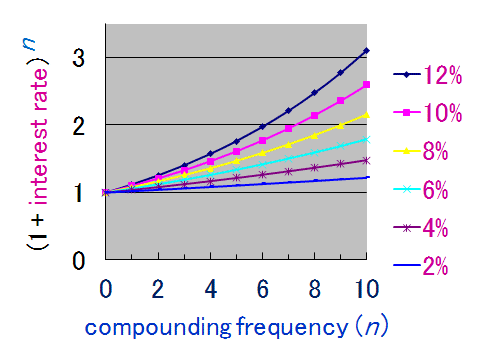
Compound interest is interest accumulated from a principal sum and previously accumulated interest. It is the result of reinvesting or retaining interest that would otherwise be paid out, or of the accumulation of debts from a borrower.
Compound interest is contrasted with simple interest, where previously accumulated interest is not added to t...

this means the interest rate is applied nth times
cunning olive
ahh ok, i see how we get the formula now
marsh elk
in this context, since there is one dollar, and the duration is a year, the formula is indeed :
$$(1 + \frac 1 n)^n$$
twin meteorBOT
Grui ʕ•͈ⱉ•͈ʔ
 marsh elk
which is a sequence that famously converges to $e$
twin meteorBOT
Grui ʕ•͈ⱉ•͈ʔ
 cunning olive
eulers number
marsh elk
yes

The number e is a mathematical constant approximately equal to 2.71828 that is the base of the natural logarithm and exponential function. It is sometimes called Euler's number, after the Swiss mathematician Leonhard Euler, though this can invite confusion with Euler numbers, or with Euler's constant, a different constant typically denoted
...
cunning olive
If we increase the compounding indefinitely, the value will stop at 2.718281828?
marsh elk
It will converge towards $e$, which is approximately that, yes
twin meteorBOT
Grui ʕ•͈ⱉ•͈ʔ
 marsh elk
there is a reason for that, but we would have to dive into a little bit of calculus
(it is because e^x is its own derivative)
cunning olive
i cant thank you enough Grui
cunning olive
i have been procrastinating and thinking im stupid for hours, i did the original question what mustve been 4-6 times, got a different answer each time
:)
marsh elk
I'm very much familiar with that feeling haha
cunning olive
Merci? if i spelt that right
cunning olive
my french is only Bonjour, and merci, thats all i know now :( 😢
marsh elk
tha'ts alright haha
cunning olive
.close
vocal sleetBOT
Channel closed
Closed by @cunning olive
Use .reopen if this was a mistake.
vocal sleetBOT
Available help channel!
Send your question here to claim the channel.
Remember:
• Ask your math question in a clear, concise manner.
• Show your work, and if possible, explain where you are stuck.
• After 15 minutes, feel free to ping <@&286206848099549185>.
• Type the command .close to free the channel when you're done.
• Be polite and have a nice day!
Read #❓how-to-get-help for further information on how to ask a good question, and about conduct in the question channels.
 hidden gyro
How do you sythetically prove that the isogonal conjugate of a point exists? (so no trig ceva)
vocal sleetBOT
hidden gyro
How do you sythetically prove that the isogonal conjugate of a point exists? (so...
@hidden gyro Has your question been resolved?
vocal sleetBOT
Channel closed
Closed due to timeout
Use .reopen if this was a mistake.
Available help channel!
Send your question here to claim the channel.
Remember:
• Ask your math question in a clear, concise manner.
• Show your work, and if possible, explain where you are stuck.
• After 15 minutes, feel free to ping <@&286206848099549185>.
• Type the command .close to free the channel when you're done.
• Be polite and have a nice day!
Read #❓how-to-get-help for further information on how to ask a good question, and about conduct in the question channels.
 wispy harness
i need help with this
 vocal sleetBOT
wispy harness
i need help with this
vocal sleetBOT
wispy harness
i need help with this
 flat whale
!show
vocal sleetBOT
Show your work, and if possible, explain where you are stuck.
vocal sleetBOT
Channel closed
Closed by @wispy harness
Use .reopen if this was a mistake.
vocal sleetBOT
Available help channel!
Send your question here to claim the channel.
Remember:
• Ask your math question in a clear, concise manner.
• Show your work, and if possible, explain where you are stuck.
• After 15 minutes, feel free to ping <@&286206848099549185>.
• Type the command .close to free the channel when you're done.
• Be polite and have a nice day!
Read #❓how-to-get-help for further information on how to ask a good question, and about conduct in the question channels.
 tropic dove
flat whale
tropic dove
flat whale
you're better off translating
tropic dove
yeah I was about to do so
 maiden iron
tropic dove
maiden iron
tropic dove
t'es à quel question
flat whale
oh a french herels has appeared
tropic dove
j'utilise le TAF pour montrer f'(a) = 0
mais je sais pas comment montrer la deuxieme
maiden iron
TAF c'est theoreme des accroissements finis c'est ça ?
tropic dove
oui
sais pas comment faire la deuxieme
f'(1/a) = 0
meme si on a deja montre que f(x) = -f(1/x)
maiden iron
tu peux me dire comment tu as fait pour f'(alpha) ?
tropic dove
on a f est derivable sure ]0,+inf[ donc derivable sur ]0,1[
on a f est est continue sur [0, +inf[ donc continue sur [0, 1]
et f(1) = f(0) = 0
maiden iron
yep, et par le TAF il existe un reel alpha dans ]0,1[ tel que f(1) - f(0) = f'(alpha)
tropic dove
maiden iron
yep, et par le TAF il existe un reel alpha dans ]0,1[ tel que f(1) - f(0) = f'(a...
si
et pour f'(1/alpha)
je sais pas
maiden iron
On a $0 \leq \alpha \leq 1$
donc on peut retrouver $\frac{1}{\alpha}$
twin meteorBOT
Herels
 tropic dove
comment peut t on projeter l'egalite precedente a cela
maiden iron
si alpha est dans ]0,1[, où se trouve 1/alpha a ton avis
tropic dove
]1, +inf[ bien sure
tropic dove
twin meteor
**Herels**
l'encadrement doit etre stricte btw
maiden iron
et sur cet intervalle, est ce que f est derivable et continue ?
maiden iron
🤔
tropic dove
mais attendddddddd
le taf n'est valide que dans un intervalle fermee
c'est une condition primordialee
maiden iron
oui je viens de me rappeler
maiden iron
tu derives f(1/x) et on voit
🤔
tropic dove
ok i'll try
maiden iron
puisque ce quil faut appliquer cest f(b)-f(a) = f'(alpha) (b-a)
tropic dove
bro yk how hard it is to be quadrolingual
maiden iron
donc faut retrouver lexpression mais avec -f(1/x)
maiden iron
tropic dove
bro yk how hard it is to be quadrolingual
quadrolingual ? 💀
tropic dove
talking in french
tropic dove
maiden iron
tu parles plusieurs langues
oui
maiden iron
génie
tropic dove
mais quand t'as pa vraiment maitriser une langue
et tu dois faire le processus de traduire les phrases a ton langage dans le cervau puis retraduire la reponse au francais
ca casse la tete
maiden iron
Mdrr oui je vois
ca me faisait la meme qd je galerais a l'anglais à l'epoque
 twin meteorBOT

 twin meteorBOT
 maiden iron
j'aurais du préciser ce que je voulais dire quoi
$(f(\frac{1}{x}))' = -\frac{1}{x²} f'(\frac{1}{x})$
twin meteorBOT
Herels
 tropic dove
twin meteor
**Herels**
tropic dove
twin meteor
**Herels**
on doit montrer cela?
maiden iron
hmm pas vrmt mais je veux juste voir si mon idée est bonne
tropic dove
twin meteor
**Herels**
autre question, cela est vrai?
a oui xd
la derivée de la composée
maiden iron
en gros en utilisant le TAF, on a :
$$f(1) - f(0) = f'(\alpha)$$
$$f(1) - f(0) = \frac{1}{\alpha²} f'\left(\frac{1}{\alpha}\right)$$
twin meteorBOT
Herels
 maiden iron
J'explique
$$f(x) = -f\left(\frac{1}{x}\right)$$
$$f'(x) = -\left(-\frac{1}{x²} f'\left(\frac{1}{x}\right)\right)$$
$$f'(x) = \frac{1}{x²} f'\left(\frac{1}{x}\right)$$
tropic dove
o
twin meteorBOT
Herels
 tropic dove
j'ai compris l'idee
maiden iron
et donc dans l'expression du TAF, j'ai juste remplacer x par alpha
on arrange et on tombe bien sur le résultat recherché
tropic dove
maiden iron
et donc dans l'expression du TAF, j'ai juste remplacer x par alpha
et cela devient ?
maiden iron
twin meteor
**Herels**
ca
tropic dove
em
maiden iron
f(1) = f(0) = 0
tropic dove
aha?
maiden iron
donc tu balance 1/alpha² a gauche et voila
tropic dove
maiden iron
bah tu las dit toi meme
je sais mais
…
lemmme get this from the beginning
we have this
f’(alpha) = f(0) - f(1) = 0
puis
f’(alpha) = (1/a^2)*f’(1/alpha)
donc
maiden iron
non, f'(a) = 1/a² f'(1/a)
maiden iron
oui
maiden iron

maiden iron
de rien 🫡
tropic dove
maiden iron
de rien 🫡
des idées pour la question suivante?
tropic dove
tropic dove
tropic dove
tropic dove
attend je vais dire ce que je pense
j’ai pensé a 2 methodes
la premiere c’est on ajoute -xln(x) au deux membres
puis une pose une nouvelle fonction
et on calcule l’image de ]0,+inf[ par cette fonction
et on dois trouvere [0,+inf[
la deuxieme
c’est de voir l’inegalité comme ça
ln(1/x)/(1/x) <= ln(e)/e
et d’utiliser taf encore une fois pour la fonction u(x) = ln(x)/x
sur l’intervalle ]1/x,e[ puis ]e,1/x[ selon x
y’a t il d’autres methodes?
maiden iron
ah oe ca fait bcp
jai rien compris mais bon
tropic dove
xd
maiden iron

maiden iron
pratiquement tout
maiden iron
hélas, j'avais pas vraiment d'idée
j'aurais réfléchi à un moyen de brute force, mais je vois pas trop comment
je crois y a un truc qui s'appelle Inégalité des accroissements finis
tropic dove
ca va devenir exponentiellement plus compliqué
car l’inegalité introduit des valeurs absolues et bla bla
maiden iron
oui malheureusement
après, le truc débile à faire c'est de dériver -x ln(x) et déterminer son maximum
tropic dove
o
maiden iron
ca marche tres bien meme si c'est un peu long
maiden iron
lmao
tropic dove
i wanna kms
maiden iron

vocal sleetBOT
@tropic dove Has your question been resolved?
vocal sleetBOT
Channel closed
Closed due to timeout
Use .reopen if this was a mistake.
Available help channel!
Send your question here to claim the channel.
Remember:
• Ask your math question in a clear, concise manner.
• Show your work, and if possible, explain where you are stuck.
• After 15 minutes, feel free to ping <@&286206848099549185>.
• Type the command .close to free the channel when you're done.
• Be polite and have a nice day!
Read #❓how-to-get-help for further information on how to ask a good question, and about conduct in the question channels.
 half jetty
I expanded the e and log(1+x) values, and simlified the denominator into x^3 (x^3 * sinx/x = x^3) what next?
 vocal sleetBOT
half jetty
I expanded the e and log(1+x) values, and simlified the denominator into x^3 (x^...
vocal sleetBOT
half jetty
I expanded the e and log(1+x) values, and simlified the denominator into x^3 (x^...
@half jetty Has your question been resolved?
Channel closed
Closed by @half jetty
Use .reopen if this was a mistake.
vocal sleetBOT
Available help channel!
Send your question here to claim the channel.
Remember:
• Ask your math question in a clear, concise manner.
• Show your work, and if possible, explain where you are stuck.
• After 15 minutes, feel free to ping <@&286206848099549185>.
• Type the command .close to free the channel when you're done.
• Be polite and have a nice day!
Read #❓how-to-get-help for further information on how to ask a good question, and about conduct in the question channels.
 atomic osprey
Finding the radius of convergence and the interval of converge
 atomic osprey

this is where I'm at with this
I was wondering for the (-5) endpoint test, can i just go straight to the divergence test because the AST wouldn't apply?
 boreal remnant
alternating series only applies if the magnitude decreases
vocal sleetBOT
@atomic osprey Has your question been resolved?
vocal sleetBOT
Channel closed
Closed due to timeout
Use .reopen if this was a mistake.
Available help channel!
Send your question here to claim the channel.
Remember:
• Ask your math question in a clear, concise manner.
• Show your work, and if possible, explain where you are stuck.
• After 15 minutes, feel free to ping <@&286206848099549185>.
• Type the command .close to free the channel when you're done.
• Be polite and have a nice day!
Read #❓how-to-get-help for further information on how to ask a good question, and about conduct in the question channels.
 olive igloo
bro what
flat whale
<@&268886789983436800>
vocal sleetBOT
Channel closed
Channel closed due to the original message being deleted.
If you did not intend to do this, please open a new help channel,
as this action is irreversible, and this channel may abruptly lock.
vocal sleetBOT
Available help channel!
Send your question here to claim the channel.
Remember:
• Ask your math question in a clear, concise manner.
• Show your work, and if possible, explain where you are stuck.
• After 15 minutes, feel free to ping <@&286206848099549185>.
• Type the command .close to free the channel when you're done.
• Be polite and have a nice day!
Read #❓how-to-get-help for further information on how to ask a good question, and about conduct in the question channels.
 strange charm
just generally how do i solve this integral
 vocal sleetBOT
strange charm
just generally how do i solve this integral
vocal sleetBOT
vocal sleetBOT
strange charm
just generally how do i solve this integral
vocal sleetBOT
@strange charm Has your question been resolved?
vocal sleetBOT
Channel closed
Closed due to timeout
Use .reopen if this was a mistake.
vocal sleetBOT
Available help channel!
Send your question here to claim the channel.
Remember:
• Ask your math question in a clear, concise manner.
• Show your work, and if possible, explain where you are stuck.
• After 15 minutes, feel free to ping <@&286206848099549185>.
• Type the command .close to free the channel when you're done.
• Be polite and have a nice day!
Read #❓how-to-get-help for further information on how to ask a good question, and about conduct in the question channels.
 crystal sail
Okay so I have an integral problem using average integrals and I'm a little lost on the final part of the problem where the function is set equal to the average of the function and solved for that. I think I should have two answers but I'm not sure how to get the second because of a lack of familiar with inverse trig functions and trig functions in general. If I could get some help, that would be really appreciated. Thanks!
 vocal sleetBOT
crystal sail
Okay so I have an integral problem using average integrals and I'm a little lost...
olive igloo
vocal sleetBOT
crystal sail
Okay so I have an integral problem using average integrals and I'm a little lost...
olive igloo
you have to calculate the average value first
crystal sail
 olive igloo
do you know what the average value would be?
crystal sail
Yeah I got that part
olive igloo
,w integrate pi/8 * sin(x) from x = 0 to pi
twin meteorBOT


 Requested by rainn1989
twin meteorBOT
Requested by rainn1989
twin meteorBOT
rain
 crystal sail
As in you're supposed to multiply it, or as in I multiplied it?
olive igloo
you multiplied it
wait
why did you put it twice
you have to divide by the length of the interval
crystal sail
At which step?
olive igloo
when you set up the integral
crystal sail
Oh wait at the start of fbar?
crystal sail
Oh that should be 1/pi
olive igloo
yes
crystal sail
So the average is 1/8
olive igloo
i think its 1/4
crystal sail
Isn't the antiderivative of sinx -cosx?
olive igloo
ok
crystal sail
And then just constant multiple makes the pi/8 stay
olive igloo
$\cos\pi = -1, \cos 0 = 1$
twin meteorBOT
rain
 crystal sail
So antiderivative of pi/8 * sinx is -pi/8 * cosx
olive igloo
ok
olive igloo
bro
you have
-pi/8(-1 - 1) = pi/4
divide by pi its 1/4
you forgot to include the 0 term
aka you cant assume cos0 = 0
crystal sail
Oh that's what I'm missing okay gotcha

Okay so that's one of the two answers I think I'm supposed to have
Now, am I missing something about how arcsin works?
Because I have x = 0.7 (rounded)
But I think I should have a second answer and I don't know how to get it
.close
vocal sleetBOT
Channel closed
Closed by @crystal sail
Use .reopen if this was a mistake.
vocal sleetBOT
Available help channel!
Send your question here to claim the channel.
Remember:
• Ask your math question in a clear, concise manner.
• Show your work, and if possible, explain where you are stuck.
• After 15 minutes, feel free to ping <@&286206848099549185>.
• Type the command .close to free the channel when you're done.
• Be polite and have a nice day!
Read #❓how-to-get-help for further information on how to ask a good question, and about conduct in the question channels.
 teal mauve
This assignment was due a while ago, and I'm not quite sure where to start
 vocal sleetBOT
teal mauve
This assignment was due a while ago, and I'm not quite sure where to start
vocal sleetBOT
teal mauve
This assignment was due a while ago, and I'm not quite sure where to start
 potent anchor
what are the roots?
vocal sleetBOT
@teal mauve Has your question been resolved?
vocal sleetBOT
Channel closed
Closed due to timeout
Use .reopen if this was a mistake.
Available help channel!
Send your question here to claim the channel.
Remember:
• Ask your math question in a clear, concise manner.
• Show your work, and if possible, explain where you are stuck.
• After 15 minutes, feel free to ping <@&286206848099549185>.
• Type the command .close to free the channel when you're done.
• Be polite and have a nice day!
Read #❓how-to-get-help for further information on how to ask a good question, and about conduct in the question channels.
 normal haven
I need help continuing the solution. I'm not sure where to go from here.
vocal sleetBOT
normal haven
I need help continuing the solution. I'm not sure where to go from here.
Please don't occupy multiple help channels.


 prisma rain
well you have it
normal haven
prisma rain
well you have it
But I don't think it's in the right form specified in the problem.
prisma rain
it is in that form, this is the same as if $c_n = \frac{1}{n}$, $x = -1$ and $a = 0$ for example
twin meteorBOT
kaue
 normal haven
I think I kind of understand, but how would you formulate an answer for the question?
prisma rain
just do what you did in paper and then give the examples for c_n, x and a if you want to prove it's in that form, but it's pretty explicit that it is
just fix the mix of u and x
prisma rain
normal haven
 normal haven
prisma rain
just do what you did in paper and then give the examples for c_n, x and a if you...
normal haven
prisma rain
just do what you did in paper and then give the examples for c_n, x and a if you...
Got it, thank you so much again!
.close
vocal sleetBOT
Channel closed
Closed by @normal haven
Use .reopen if this was a mistake.
vocal sleetBOT
Available help channel!
Send your question here to claim the channel.
Remember:
• Ask your math question in a clear, concise manner.
• Show your work, and if possible, explain where you are stuck.
• After 15 minutes, feel free to ping <@&286206848099549185>.
• Type the command .close to free the channel when you're done.
• Be polite and have a nice day!
Read #❓how-to-get-help for further information on how to ask a good question, and about conduct in the question channels.
vocal sleetBOT
Channel closed
Closed by @grim jungle
Use .reopen if this was a mistake.
vocal sleetBOT
Available help channel!
Send your question here to claim the channel.
Remember:
• Ask your math question in a clear, concise manner.
• Show your work, and if possible, explain where you are stuck.
• After 15 minutes, feel free to ping <@&286206848099549185>.
• Type the command .close to free the channel when you're done.
• Be polite and have a nice day!
Read #❓how-to-get-help for further information on how to ask a good question, and about conduct in the question channels.
 arctic wave
Hey guys, i got lost in my word problem, can you help me out

 arctic wave
is it more like this?

oops it's 350
i figured it out, it's been a few months since i've done these 😭
.close
vocal sleetBOT
Channel closed
Closed by @arctic wave
Use .reopen if this was a mistake.
vocal sleetBOT
Available help channel!
Send your question here to claim the channel.
Remember:
• Ask your math question in a clear, concise manner.
• Show your work, and if possible, explain where you are stuck.
• After 15 minutes, feel free to ping <@&286206848099549185>.
• Type the command .close to free the channel when you're done.
• Be polite and have a nice day!
Read #❓how-to-get-help for further information on how to ask a good question, and about conduct in the question channels.
 strong cloud
having trouble with this question can somebody help me?

 hushed pewter
strong cloud
having trouble with this question can somebody help me?
hushed pewter
strong cloud
having trouble with this question can somebody help me?
The rotation is basically going to create two cones joined at their bases
Find the radius of the shared base and the height of each cone and you are golden
strong cloud
67.86?
 tawny ginkgo
strong cloud
having trouble with this question can somebody help me?
tawny ginkgo
strong cloud
having trouble with this question can somebody help me?
Did it in my head real quick, simple math really. Answer is 67.86 
vocal sleetBOT
@strong cloud Has your question been resolved?
vocal sleetBOT
Channel closed
Closed due to timeout
Use .reopen if this was a mistake.
Available help channel!
Send your question here to claim the channel.
Remember:
• Ask your math question in a clear, concise manner.
• Show your work, and if possible, explain where you are stuck.
• After 15 minutes, feel free to ping <@&286206848099549185>.
• Type the command .close to free the channel when you're done.
• Be polite and have a nice day!
Read #❓how-to-get-help for further information on how to ask a good question, and about conduct in the question channels.
 scenic ravine
could someone walk me though the last part
 vocal sleetBOT
scenic ravine
could someone walk me though the last part
scenic ravine
vocal sleetBOT
scenic ravine
could someone walk me though the last part
scenic ravine
,w eigenvalues of [1,2][3,2]
twin meteorBOT

 Requested by physicsrocks
scenic ravine
Requested by physicsrocks
scenic ravine
so the diagonal matrix would be $\begin{bmatrix} 4&0\0&-1\end{bmatrix}$
twin meteorBOT
A dense set(Ping when reply)

 gaunt sparrow
P's columns are the eigenvectors
 drifting jackal
Find the eigenvectors with the corresponding eigenvalues
And your P matrix are those eigenvectors
 heavy yoke
note that A and D are both matrices which represent the same linear transformation, with respect to different bases (A wrt the standard basis, D wrt an eigenbasis). so all you need to relate them is the change of basis matrix P (and in general the change of basis matrix is formed by putting your basis vectors as columns)
note that any basis of eigenvectors will suffice as long as the order corresponds to the order of eigenvalues in your diagonal matrix
scenic ravine
so $P = \begin{bmatrix} 4&-2\12&-2\end{bmatrix}$
twin meteorBOT
A dense set(Ping when reply)
 scenic ravine
I now normalise this
heavy yoke
if those are the correct eigenvectors corresponding to 4 and -1 respectively (double check this by multiplying them with your matrix)
heavy yoke
scenic ravine
I now normalise this
that's doable but not strictly necessary
scenic ravine
hmm?
heavy yoke
the eigenvectors don't have to be unit vectors to work for this
heavy yoke
i would double check your eigenvectors just to be sure, but if they're correct you're done
scenic ravine
,w [4,-2][12,-2] \times [4,0][0,-1]
twin meteorBOT
 Requested by physicsrocks
heavy yoke
Requested by physicsrocks
heavy yoke
you can compute the right side of either D = P^(-1) A P or A = P D P^(-1) and compare it to the left. neither of which is necessary but can serve to check your arithmetic
vocal sleetBOT
@scenic ravine Has your question been resolved?
Channel closed
Closed by @scenic ravine
Use .reopen if this was a mistake.
Available help channel!
Send your question here to claim the channel.
Remember:
• Ask your math question in a clear, concise manner.
• Show your work, and if possible, explain where you are stuck.
• After 15 minutes, feel free to ping <@&286206848099549185>.
• Type the command .close to free the channel when you're done.
• Be polite and have a nice day!
Read #❓how-to-get-help for further information on how to ask a good question, and about conduct in the question channels.
 timber kite
Summation for
0•1,1•2,2•3…..
It is
(n-1)(n+1)n/3
But thats when i make n = n-1
After I’ve gotten
n(n+2)(n+1)/3 using the summation for n and n^2 formula.
Now lets say the sequence starts from
5•6,6•7,7•8…..
do just simply just make n=n+4 and get (n+5)(n+7)/2 ?
vocal sleetBOT
timber kite
Summation for
0•1,1•2,2•3…..
It is
(n-1)(n+1)n/3
But thats when i make n = ...
@timber kite Has your question been resolved?
vocal sleetBOT
Channel closed
Closed due to timeout
Use .reopen if this was a mistake.
Available help channel!
Send your question here to claim the channel.
Remember:
• Ask your math question in a clear, concise manner.
• Show your work, and if possible, explain where you are stuck.
• After 15 minutes, feel free to ping <@&286206848099549185>.
• Type the command .close to free the channel when you're done.
• Be polite and have a nice day!
Read #❓how-to-get-help for further information on how to ask a good question, and about conduct in the question channels.
 velvet karma
..
extremely
uhhh
what power
does the base need to be raised
to make the given number
thoughts on that?
ok so
u have lik
log_2(8) = 3
this means
that 2 needs to be raised to ^3 to create 8
and if theres no base
its base 10
thats like the default
 vast shale
take log(2^ 2012)
 dark kiln
you need to convert the base
dark kiln
oh yeah that's shorter
vast shale
For a number like 1050, log(1050) = 3.02118929907
Now, observe the value of log(1050) and the number of digits in 1050
Ok lemme just tell you
If log to the base 10 of a number X is n, then X has ⌈n⌉ digits
Sorry, I accidentally used the floor function
It's the ceiling function
vast shale
prisma rain
actually, floor(n) + 1
well that's the same thing
i used the ceiling function
prisma rain
not really
prisma rain
try to find how many digits 10 has
prisma rain
find floor(2012*log(2)) + 1
vast shale
,calc 2012 * log 2
twin meteorBOT
The following error occured while calculating:
Error: Unexpected type of argument in function multiplyScalar (expected: number or Complex or BigNumber or bigint or Fraction or Unit or string or boolean, actual: function, index: 0)
prisma rain
floor just means round down btw
twin meteorBOT

 Requested by anjaliji_74295
vast shale
Requested by anjaliji_74295
vast shale
ah
prisma rain
,w 2012 * log10(2)
twin meteorBOT

 prisma rain
so its 606
vast shale
prisma rain
so its 606
yeah
vocal sleetBOT
Channel closed
Closed by @nova tusk
Use .reopen if this was a mistake.
vast shale
gg
vocal sleetBOT
Available help channel!
Send your question here to claim the channel.
Remember:
• Ask your math question in a clear, concise manner.
• Show your work, and if possible, explain where you are stuck.
• After 15 minutes, feel free to ping <@&286206848099549185>.
• Type the command .close to free the channel when you're done.
• Be polite and have a nice day!
Read #❓how-to-get-help for further information on how to ask a good question, and about conduct in the question channels.
 long jackal
where is the function f(x)=1-$\sqrt{1-x^2}$ continuous ?
twin meteorBOT
Hamdy Hisham
 long jackal
Should it be (-1,1) or [-1,1]
prisma rain
do you mean where it is defined?
 cursive turret
long jackal
where is the function f(x)=1-$\sqrt{1-x^2}$ continuous ?
cursive turret
long jackal
where is the function f(x)=1-$\sqrt{1-x^2}$ continuous ?
everywhere, where its defined.
prisma rain
cursive turret
everywhere, where its defined.
but you can't take the limit from both directions on the boundaries
long jackal
prisma rain
but you can't take the limit from both directions on the boundaries
so it's (-1,1) right ?
prisma rain
yeah
cursive turret
prisma rain
but you can't take the limit from both directions on the boundaries
i am not sure, whats your definition of a continuous function is. the definition i know refers to the functions domain.
prisma rain
its continuous at a point a if lim x -> a f(x) = f(a)
cursive turret
so there s no need to take a limit from a side where the function is not defined.
prisma rain
lim only exists if it exists on both sides
long jackal
isn't this type of function continuous on it's domain ?
 long jackal
cursive turret
long jackal
cursive turret
oh through the domain so that means it can be 1 sided
prisma rain
then i learned the wrong definition
cursive turret
what i said: the definition i know refers to the functions domain. maybe you have other definitions.
 bitter pilot
no i agree with kaue
the most you can tell for the end points is that it is left/right-side continuous
hard atlas
it makes no sense to talk about limits from a side where the function doesnt even exist
if you check the epsilon def of limits then only points in the domain appear
long jackal
hard atlas
it makes no sense to talk about limits from a side where the function doesnt eve...
so that means it'll be (-1,1) ?
cursive turret
the function is defined at x = 1.
 bitter pilot
cursive turret
bitter pilot
cursive turret
but how can you say the limit exists if you approach it from only one side
you are ignoring that
long jackal
hard atlas
it makes no sense to talk about limits from a side where the function doesnt eve...
here @bitter pilot
cursive turret
bitter pilot
but how can you say the limit exists if you approach it from only one side
the definition of a continous function refers to the domain of the function. so if the function is only defined on the left of 1 i only need to check limits from the lef.t.
cursive turret
bitter pilot
you are ignoring that
you are claiming a both sides limit. show the definition of a continous function where a both sides limit is required.
anyway. I have shown the definition of a continous function I know. I have argued based on this definition and i have shown my result based on this. If someone agrees its fine, if not, its also fine for me. If someone has another definition the result can differ, of course.
vocal sleetBOT
@long jackal Has your question been resolved?
Channel closed
Closed by @long jackal
Use .reopen if this was a mistake.
Available help channel!
Send your question here to claim the channel.
Remember:
• Ask your math question in a clear, concise manner.
• Show your work, and if possible, explain where you are stuck.
• After 15 minutes, feel free to ping <@&286206848099549185>.
• Type the command .close to free the channel when you're done.
• Be polite and have a nice day!
Read #❓how-to-get-help for further information on how to ask a good question, and about conduct in the question channels.
tropic dove
Let $f(x) = \frac{-xlnx}{1+x^2}$ if $x \ne 0$ and $f(0) = 0 \ \$ 1) prove that f is continuous in $]0, +\infty[ \ \$ 2)a) prove that $\forall x \in ]0, +\infty[ , f(\frac{1}{x}) = -f(x) \$ 2)b) prove that $\exists \alpha \in ]0,1[ , f'(\alpha) = f'(\frac{1}{\alpha}) = 0 \ \$ 3)a prove that $\forall x \in ]0, +\infty[, -xln(x) \le \frac{1}{e} \$ 3)b) deduct that $\forall x \in ]0, +\infty[, f(x) \le \frac{1}{e} \$ 4) We admit that $\alpha$ and $\frac{1}{\alpha}$ are the only solutions to the equation $f'(x) = 0 \$ a) prove that $f(\alpha) > 0$ and $f(\frac{1}{\alpha}) < 0 \ \$ b) Prove that $f'$ is continuous in $]0,+\infty[\ \$ c) Prove that $f'$ doesn't change its sign in every one of the following intervals: $[0, \alpha]$, $]\alpha, \frac{1}{\alpha}]$ and $[\frac{1}{\alpha}, +\infty[$
vocal sleetBOT
tropic dove
Let $f(x) = \frac{-xlnx}{1+x^2}$ if $x \ne 0$ and $f(0) = 0 \\ \\$ 1) prove that...
tropic dove
any ideas on how we can use all the information from 4, 4)a, 4)b to prove 4)c?
twin meteorBOT
Froggy
 tropic dove
can you help guys?
vocal sleetBOT
@tropic dove Has your question been resolved?
vocal sleetBOT
@tropic dove Has your question been resolved?
tropic dove
.close
vocal sleetBOT
Channel closed
Closed by @tropic dove
Use .reopen if this was a mistake.
vocal sleetBOT
Available help channel!
Send your question here to claim the channel.
Remember:
• Ask your math question in a clear, concise manner.
• Show your work, and if possible, explain where you are stuck.
• After 15 minutes, feel free to ping <@&286206848099549185>.
• Type the command .close to free the channel when you're done.
• Be polite and have a nice day!
Read #❓how-to-get-help for further information on how to ask a good question, and about conduct in the question channels.
 wary fiber
 vocal sleetBOT
wary fiber
wary fiber
vocal sleetBOT
wary fiber
wary fiber
HOW DO I APPLY EULERS FORMULA HERE
e^ix= cos x+I sin x
HOW DID ROOT 3 THITN BECOME E
 lone linden
wary fiber
lone linden
wary fiber
 lone linden
Draw a sketch of the two cases and consider drawing a perpendicular down to the real axis to find the argument
bronze osprey
you should draw the points (-1/sqrt2, 1/sqrt2) and (-1/sqrt2, -1/sqrt2)
wary fiber
Wha
bronze osprey
then you will see the angles are pi - pi/4 and pi + pi/4
lone linden
bronze osprey
you should draw the points (-1/sqrt2, 1/sqrt2) and (-1/sqrt2, -1/sqrt2)
And then for the modulus, take the distance of those points from the origin
bronze osprey
wary fiber
Can't I do without that
drawing will help you understand
or plotting those points on desmos
bronze osprey
bronze osprey
you should draw the points (-1/sqrt2, 1/sqrt2) and (-1/sqrt2, -1/sqrt2)
these points
wary fiber
bronze osprey
you should draw the points (-1/sqrt2, 1/sqrt2) and (-1/sqrt2, -1/sqrt2)
It's in root
And why specifically this
Pls pls
@lone linden
@bronze osprey
bronze osprey
cause you know how the complex number $a + bi$ on the complex plane
is literally just $(a, b)$ on the xy-plane
twin meteorBOT
southlander!
 bronze osprey
yeah like you just swap the axes names
 bronze osprey
you should draw the points (-1/sqrt2, 1/sqrt2) and (-1/sqrt2, -1/sqrt2)
bronze osprey
bronze osprey
you should draw the points (-1/sqrt2, 1/sqrt2) and (-1/sqrt2, -1/sqrt2)
these
well like it's the same as (4, 3) then
wary fiber
And I read something sq a^2+b^2
wary fiber
bronze osprey
well like it's the same as (4, 3) then
Oh
bronze osprey
wary fiber
And I read something sq a^2+b^2
yes that's the modulus squared
wary fiber
bronze osprey
you should draw the points (-1/sqrt2, 1/sqrt2) and (-1/sqrt2, -1/sqrt2)
1 more question
wary fiber
bronze osprey
yes that's the modulus squared
???
Isn't modulus the absolute value
Like mod -6 is 6
bronze osprey
wary fiber
Isn't modulus the absolute value
correct, but there's a generalisation to complex numbers
the modulus is always the distance to the origin
wary fiber
bronze osprey
yes that's the modulus squared
Sq root a^2+b^2 is modulus?
bronze osprey
wary fiber
Sq root a^2+b^2 is modulus?
yep!
wary fiber
bronze osprey
the modulus is always the distance to the origin
By definition?
bronze osprey
yeah
wary fiber
Wait a second.. is that using distance formula?
wary fiber
bronze osprey
Ok so here
bronze osprey
wary fiber
Wait a second.. is that using distance formula?
exactly
now you're getting it
 wary fiber
lone linden
wary fiber
lone linden
Why is that converted to this weird form with sq roots?
What
What box
Nooo pls don't go
lone linden
$\frac{-1 \pm i}{\sqrt 2}=e^{\pm \frac{3\pi}{4} i} \implies \sqrt 3 \left(\frac{-1 \pm i}{\sqrt 2} \right)=\sqrt{3} e^{\pm \frac{3\pi}{4} i}$
twin meteorBOT
Civil Service Pigeon
 wary fiber
😭
lone linden
twin meteor
**Civil Service Pigeon**
The “coefficient” of the exponential factor is the modulus
wary fiber
How 3/4
lone linden
Didn’t south say that already
lone linden
It would help if you sent the diagram you have rn
wary fiber
Why do I plot specifically that?
Why can't I just use -1+i
Sorry for too many questions
Why should I find an angle?
This is all I got rn
 lone linden
wary fiber
Why do I plot specifically that?
Why can't I just use -1+i
Sorry for too many q...
lone linden
wary fiber
Why do I plot specifically that?
Why can't I just use -1+i
Sorry for too many q...
You can, but then there’s a factor of sqrt(3)/sqrt(2) you have to deal with instead
It doesn’t really matter
Just pick one and do it
lone linden
Plot either $\frac{-1 \pm i}{\sqrt 2}$ or $-1 \pm i$?
twin meteorBOT
Civil Service Pigeon
 lone linden
twin meteor
**southlander!**
lone linden
twin meteor
**southlander!**
.
lone linden
For the $-1+i$ case, yeah.
twin meteorBOT
Civil Service Pigeon
 wary fiber
AND FOR - IT IS -1 -1 RIGHT
lone linden
Yeah
lone linden
Yup
They’re conjugates, so they’re reflections of each other over the real axis
You can actually use that to find one of the arguments given the earlier, but it’s not necessary
wary fiber
Ok now next
bronze osprey
btw thanks for taking over
lone linden
Eh I’m on the train so not much else to do
wary fiber
bronze osprey
then you will see the angles are pi - pi/4 and pi + pi/4
MY EYE DOESNT SEE ANY ANGLE SIRR
@lone linden
I see two points
bronze osprey
wary fiber
MY EYE DOESNT SEE ANY ANGLE SIRR
you want the angle with the positive x-axis
say the vector (1, 0)
wary fiber
With origin?
angle with origin?

How to get angle now.....
@lone linden pls I beg u
@bronze osprey
bronze osprey
wary fiber
great, so do you see how it's pi - pi/4 and pi + pi/4 radians now
wary fiber
I don't see it
bronze osprey
think of an isosceles right triangle with 45-45-90 degree angles
wary fiber
How can I just estimate it right away
Is there a formal way
Using dot product or something
wary fiber
bronze osprey
think of an isosceles right triangle with 45-45-90 degree angles
How can I say one of the angles are 90
bronze osprey
wary fiber
How can I say one of the angles are 90

the x-length has the same length as the y-length
wary fiber
bronze osprey
I know this.. how can I say the angle is 90
bronze osprey
wary fiber
I know this.. how can I say the angle is 90
the y-axis is perpendicular to the x-axis
wary fiber
Wait which triangle are u saying is isosceles?
OH
I GOT IT
I SEE WHICH
SO THE ANGLES ARE PI/4 AND -PI/4
NOW
@bronze osprey
@lone linden
bronze osprey
yeahhhhh
wary fiber
Now what
Pls
@bronze osprey
@lone linden
<@&268886789983436800>
@everyone
@trump
 mild flower
.close
vocal sleetBOT
Channel closed
Closed by @mild flower
Use .reopen if this was a mistake.
Available help channel!
Send your question here to claim the channel.
Remember:
• Ask your math question in a clear, concise manner.
• Show your work, and if possible, explain where you are stuck.
• After 15 minutes, feel free to ping <@&286206848099549185>.
• Type the command .close to free the channel when you're done.
• Be polite and have a nice day!
Read #❓how-to-get-help for further information on how to ask a good question, and about conduct in the question channels.
bronze osprey
wary fiber
Now what
use Pythagoras to find the modulus
vocal sleetBOT
bronze osprey
use Pythagoras to find the modulus
bronze osprey
you should get the modulus of both of them is 1
so you have $r = 1$ in $re^{i \theta}$, that's polar form of a complex number btw
twin meteorBOT
southlander!
 bronze osprey
.close
vocal sleetBOT
Channel closed
Closed by @bronze osprey
Use .reopen if this was a mistake.
vocal sleetBOT
Available help channel!
Send your question here to claim the channel.
Remember:
• Ask your math question in a clear, concise manner.
• Show your work, and if possible, explain where you are stuck.
• After 15 minutes, feel free to ping <@&286206848099549185>.
• Type the command .close to free the channel when you're done.
• Be polite and have a nice day!
Read #❓how-to-get-help for further information on how to ask a good question, and about conduct in the question channels.
 hazy coyote
Is this correct for counter clockwise unit inverse unit circle
 vocal sleetBOT
@hazy coyote Has your question been resolved?
hazy coyote
I give up
vocal sleetBOT
@hazy coyote Has your question been resolved?
vocal sleetBOT
Channel closed
Closed due to timeout
Use .reopen if this was a mistake.
Available help channel!
Send your question here to claim the channel.
Remember:
• Ask your math question in a clear, concise manner.
• Show your work, and if possible, explain where you are stuck.
• After 15 minutes, feel free to ping <@&286206848099549185>.
• Type the command .close to free the channel when you're done.
• Be polite and have a nice day!
Read #❓how-to-get-help for further information on how to ask a good question, and about conduct in the question channels.
 glass forge
I got a triangle, one side is 5cm other is 9cm. Area is 20cm^2. I need to claculate the perimeter, how'd I do it?
vocal sleetBOT
glass forge
I got a triangle, one side is 5cm other is 9cm. Area is 20cm^2. I need to clacul...
boreal remnant
i don't think that's enough info mr president
glass forge
I just took extended trigonometry class
That's the entire task
I know you need a*b*sin(alpha)/2 to get one of the angles but then I'm not sure how to go further from that
 strong grove
glass forge
I know you need `a*b*sin(alpha)/2` to get one of the angles but then I'm not sur...
strong grove
glass forge
I know you need `a*b*sin(alpha)/2` to get one of the angles but then I'm not sur...
probably to do that and then use cosine law to find the 3rd side
 wispy kindle
do you know sine rule and cosine rule
strong grove
and add them together
glass forge
wispy kindle
do you know sine rule and cosine rule
No, I don't
strong grove
glass forge
No, I don't
u dont know
c^2 = a^2 + b^2 - 2abcos(C)?
might be tough to find it then without that
glass forge
No, don't think I've learnt that yet
wispy kindle
do you know how to add vectors?
glass forge
Yes
wispy kindle
try to use that
by thinking of the sides as vectors
and parellely shifting them to get the third side
vocal sleetBOT
Channel closed
Closed by @glass forge
Use .reopen if this was a mistake.
vocal sleetBOT
Available help channel!
Send your question here to claim the channel.
Remember:
• Ask your math question in a clear, concise manner.
• Show your work, and if possible, explain where you are stuck.
• After 15 minutes, feel free to ping <@&286206848099549185>.
• Type the command .close to free the channel when you're done.
• Be polite and have a nice day!
Read #❓how-to-get-help for further information on how to ask a good question, and about conduct in the question channels.
Channel closed
Channel closed due to the original message being deleted.
If you did not intend to do this, please open a new help channel,
as this action is irreversible, and this channel may abruptly lock.
Available help channel!
Send your question here to claim the channel.
Remember:
• Ask your math question in a clear, concise manner.
• Show your work, and if possible, explain where you are stuck.
• After 15 minutes, feel free to ping <@&286206848099549185>.
• Type the command .close to free the channel when you're done.
• Be polite and have a nice day!
Read #❓how-to-get-help for further information on how to ask a good question, and about conduct in the question channels.
 open sage
 open sage
Hey folks
I'm solving b), I know the solution I'm just not sure how to express it
b) Indicate whether or not the subspace S is a subspace of Rnxn. Justify your answer.
So I'm pretty sure it is. indeed a subspace.
Any matrix with a column or row of 0 will have its det = 0
so say we set the third column for a 3x3 matrix to be 0 then the rest of the numbers can be any scalars
and this verifies all three axioms for a subspace
but i'm thinking 1x1 might be a different case? unless it's just 0 which is a subspace
I'm mostly just confused with how to prove that it's a subspace
i can make up a 3x3 matrix as an example but that doesn't prove it for all nxn
 river minnow
I am confused with your reasoning, why are you setting anything to 0 inside the matrix? There are matrices with all entries nonzero and determinant zero
open sage
true
it's just one "obvious" case i thought of
but yes a matrix 2x2 where all its elements are 2 will have det = 0 for instance
river minnow
I don't see why that's relevant
open sage
well it's just
my thought process
i'm trying to come up with a solution i suppose i was thinking of which matrices may have their det = 0
i assumed it's not entirely relevant since we're not going to solve this by giving examples but
it was just my thought process
Like I could say the following:
1- A zero matrix's determinant will always be 0 for all Rnxn matrices
2- Let A,B be matrices with det=0, det(A+B) = 0
3- Let A be a matrix with det=0, det(kA) = kdet(A) = 0
i suppose I just need to prove the second one
open sage
river minnow
det(kA) is not necessarily equal to kdet(A)
sorry, yeah
det(kA)=k^ndet(A)
river minnow
Hint: ||If you can't prove something, perhaps it's false, consider looking for a counterexample to 2||
open sage
which since det(A) is 0 is just 0
open sage
river minnow
Hint: ||If you can't prove something, perhaps it's false, consider looking for a...
oh
okay
open sage
river minnow
Hint: ||If you can't prove something, perhaps it's false, consider looking for a...

yep i think that works
river minnow
That's it yeah
vocal sleetBOT
Channel closed
Closed by @open sage
Use .reopen if this was a mistake.
vocal sleetBOT
Available help channel!
Send your question here to claim the channel.
Remember:
• Ask your math question in a clear, concise manner.
• Show your work, and if possible, explain where you are stuck.
• After 15 minutes, feel free to ping <@&286206848099549185>.
• Type the command .close to free the channel when you're done.
• Be polite and have a nice day!
Read #❓how-to-get-help for further information on how to ask a good question, and about conduct in the question channels.
 crystal surge
Q. The percentage error in determining sin 30° by assuming that between 0° and 45°, the sine function may be approximated by a straight line is
a) 9.3% b) 7.5% c) 5.7% d)3.6%
vocal sleetBOT
crystal surge
Q. The percentage error in determining sin 30° by assuming that between 0° and 4...
crystal surge
idk what to do at all
dark kiln
,calc sqrt(2)/2
twin meteorBOT
Result:
0.70710678118655
,calc sin(pi/4)
twin meteorBOT
Result:
0.70710678118655
so like you would get 30/45 of that value
crystal surge
i didn't quite catch what you did there
dark kiln
i assume what they mean is that you know sin45°
dark kiln
and you draw a graph and it's a straight line
crystal surge
the approximation might work on the middle part but will falter near 0° and 45° right?
dark kiln
not it's the opposite
crystal surge
huh
dark kiln

it works everywhere pretty much, but especially well near the ends
here's a straight line for comparison

i didn't know this
dark kiln
,calc sin(pi/4)/45 * 30
twin meteorBOT
Result:
0.47140452079103
this is our approximated value
it's a linear relationship
30/45 of the argument will give 30/45 of the value
dark kiln
i don't know it's just how lines work

if x = x gives y = 2.6 then x = x/4 gives 2.6/4
probably has to start from 0
but we have that part
dark kiln
idk i'll check if you try
vocal sleetBOT
Please only use the <@&286206848099549185> ping once if your question has not been answered for 15 minutes. Please do not ping or DM individual users about your question.
dark kiln
yeah that was weird
crystal surge
it's over 15 minutes already
vocal sleetBOT
@crystal surge Has your question been resolved?
crystal surge
<@&286206848099549185>
vocal sleetBOT
Channel closed
Closed due to timeout
Use .reopen if this was a mistake.
Available help channel!
Send your question here to claim the channel.
Remember:
• Ask your math question in a clear, concise manner.
• Show your work, and if possible, explain where you are stuck.
• After 15 minutes, feel free to ping <@&286206848099549185>.
• Type the command .close to free the channel when you're done.
• Be polite and have a nice day!
Read #❓how-to-get-help for further information on how to ask a good question, and about conduct in the question channels.
 hidden wave
How to prove it wihtout using antng more than Legendre symbol properties and index (discrete log)
 vocal sleetBOT
hidden wave
How to prove it wihtout using antng more than Legendre symbol properties and ind...
vocal sleetBOT
hidden wave
How to prove it wihtout using antng more than Legendre symbol properties and ind...
 hybrid flicker
do you know the following result that is correlated to legendre: if $gcd(a,p) = 1$,
$x^2 \equiv a$ mod $p$ has solutions if and only if $a^{\frac{p-1}{2}}\equiv 1$ mod $p$
"$x^2 \equiv a$ mod $p$ has solutions" literally being $\big(\frac ap\big) = 1$ when $gcd(a,p) = 1$
hybrid flicker
hidden wave
How to prove it wihtout using antng more than Legendre symbol properties and ind...
so can you try to prove that $\big(\frac ap\big) = 1$ if and only if $\big(\frac aq\big) = 1$
twin meteorBOT
rafilou is not not born in 2003

rafilou is not not born in 2003

rafilou is not not born in 2003
 hybrid flicker
(few edits)
hidden wave
Yes I know them
hybrid flicker
twin meteor
**rafilou is not not born in 2003**
forgot to add that this is true when p is odd prime
hidden wave
Yeah, I know these theorems
hybrid flicker
alright
hybrid flicker
twin meteor
**rafilou is not not born in 2003**
so perhaps this is a way you could go
hidden wave
The struggle is mod 4a. I can do it for p ≅ q mod 4 but how to do it for 4a
hybrid flicker
you mean you've done it for p = q + 4a already
vocal sleetBOT
@hidden wave Has your question been resolved?
vocal sleetBOT
@hidden wave Has your question been resolved?
vocal sleetBOT
@hidden wave Has your question been resolved?
vocal sleetBOT
@hidden wave Has your question been resolved?
vocal sleetBOT
Channel closed
Closed due to timeout
Use .reopen if this was a mistake.
vocal sleetBOT
Available help channel!
Send your question here to claim the channel.
Remember:
• Ask your math question in a clear, concise manner.
• Show your work, and if possible, explain where you are stuck.
• After 15 minutes, feel free to ping <@&286206848099549185>.
• Type the command .close to free the channel when you're done.
• Be polite and have a nice day!
Read #❓how-to-get-help for further information on how to ask a good question, and about conduct in the question channels.
 late osprey
 vocal sleetBOT
Channel closed
Closed due to timeout
Use .reopen if this was a mistake.
Available help channel!
Send your question here to claim the channel.
Remember:
• Ask your math question in a clear, concise manner.
• Show your work, and if possible, explain where you are stuck.
• After 15 minutes, feel free to ping <@&286206848099549185>.
• Type the command .close to free the channel when you're done.
• Be polite and have a nice day!
Read #❓how-to-get-help for further information on how to ask a good question, and about conduct in the question channels.
 uneven quarry
if a video tutorial on math skips a topic, but says "see [inserts its own url here] to learn this topic", is it lying?
vocal sleetBOT
uneven quarry
if a video tutorial on math skips a topic, but says "see [inserts its own url he...
 sweet flower
Your language is a bit ambiguous, but if it doesn’t explain the topic then yeah I guess
But also is this a math question or a #discussion question?
uneven quarry
on an unrelated note, the topic of the video tutorial is recursion
 open igloo
what a question its that
uneven quarry
sweet flower
But also is this a math question or a <#268882317391429632> question?
i guess i wanted to make it more rigorous but it probably started as a #discussion question
sweet flower
uneven quarry
on an unrelated note, the topic of the video tutorial is recursion
If the self referential lesson doesn’t include the base case you’ll reach an infinite loop
uneven quarry
sweet flower
If the self referential lesson doesn’t include the base case you’ll reach an inf...
this is why i can't decide if it's lying or not
(and in some sense it does teach you about recursion, but that's not very rigorous)
sweet flower
It shouldn’t call itself before determining the base case
uneven quarry
ok
it's "lying" or "not defined" in that sense then?
sorry, the words i'm using are really too vague to be rigorous
sweet flower
Yeah you could argue it’s lying, but you could also argue it does its job of interesting you on the topic and encouraging you to learn more
uneven quarry
(thinking out loud - i guess a recursion either must have a base case defined, or can only either never end or run into undefined behavior (if we're talking about some code maybe that is run))
so if it has no base case, that implies it doesn't really have a defined "end result"
uneven quarry
sweet flower
Yeah you could argue it’s lying, but you could also argue it does its job of int...
but this is true too 🙂
sweet flower
I think you should look into search algorithms, backtracking, and dynamic programming.
uneven quarry
sweet flower
I think you should look into search algorithms, backtracking, and dynamic progra...
ok, definitely
those sound interesting
sweet flower
They are :)
vocal sleetBOT
Channel closed
Closed by @uneven quarry
Use .reopen if this was a mistake.
vocal sleetBOT
Available help channel!
Send your question here to claim the channel.
Remember:
• Ask your math question in a clear, concise manner.
• Show your work, and if possible, explain where you are stuck.
• After 15 minutes, feel free to ping <@&286206848099549185>.
• Type the command .close to free the channel when you're done.
• Be polite and have a nice day!
Read #❓how-to-get-help for further information on how to ask a good question, and about conduct in the question channels.
 jovial nexus
I want to learn lebinitz theorem please if someone is willing to call and teach id be happy
vocal sleetBOT
jovial nexus
I want to learn lebinitz theorem please if someone is willing to call and teach ...
jovial nexus
<@&286206848099549185>
hushed pewter
jovial nexus
<@&286206848099549185>
!15m
vocal sleetBOT
jovial nexus
<@&286206848099549185>
Please only use the <@&286206848099549185> ping once if your question has not been answered for 15 minutes. Please do not ping or DM individual users about your question.
 visual forge
jovial nexus
I want to learn lebinitz theorem please if someone is willing to call and teach ...
visual forge
jovial nexus
I want to learn lebinitz theorem please if someone is willing to call and teach ...
watch a youtube video and come back here with specific questions
jovial nexus
yea like pls reccomend some like im not finding the right one soo
give me a good best vid which will make me understand that
vocal sleetBOT
@jovial nexus Has your question been resolved?
vocal sleetBOT
Channel closed
Closed due to timeout
Use .reopen if this was a mistake.
vocal sleetBOT
Available help channel!
Send your question here to claim the channel.
Remember:
• Ask your math question in a clear, concise manner.
• Show your work, and if possible, explain where you are stuck.
• After 15 minutes, feel free to ping <@&286206848099549185>.
• Type the command .close to free the channel when you're done.
• Be polite and have a nice day!
Read #❓how-to-get-help for further information on how to ask a good question, and about conduct in the question channels.
vocal sleetBOT
Channel closed
Channel closed due to the original message being deleted.
If you did not intend to do this, please open a new help channel,
as this action is irreversible, and this channel may abruptly lock.
 spare smelt
 queen root
go to another help channel
queen root
go to another help channel
ok