#help-17
1 messages · Page 179 of 1
 vast shale
 brittle minnow
Yeah, yeah my bad
vast shale
brittle minnow
Yeah, yeah my bad
Okay, now plugging in <a1, b1> ≠ <a2, b2> into h. How do I show that h(<a1, b1>) ≠ h(<a2, b2>). It seems to be pretty basic algebra...
brittle minnow
vast shale
Okay, now plugging in <a1, b1> ≠ <a2, b2> into h. How do I show that h(<a1, b1>)...
Notice that a_i goes to powers of 2 which is always even while the other part is always odd
vast shale
brittle minnow
Notice that a_i goes to powers of 2 which is always even while the other part is...
I figured it out. Thanks!
.close
 vocal sleetBOT
Channel closed
Closed by @west cape
Use .reopen if this was a mistake.
vocal sleetBOT
 Available help channel!
Send your question here to claim the channel.
Remember:
• Ask your math question in a clear, concise manner.
• Show your work, and if possible, explain where you are stuck.
• After 15 minutes, feel free to ping <@&286206848099549185>.
• Type the command .close to free the channel when you're done.
• Be polite and have a nice day!
Read #❓how-to-get-help for further information on how to ask a good question, and about conduct in the question channels.
vast shale
Logarithm help:
vocal sleetBOT
vast shale
Logarithm help:


 vast shale
Because you would get 10^1.92 / m^0.05 which is not the multiplied format given
vast shale
Oh I seeeeeeeeeeeeeeee
Thanks alot I get it now
I forgot about that law
Thanks again, I guess i'll close this now.
.close
vocal sleetBOT
Channel closed
Closed by @vale vessel
Use .reopen if this was a mistake.
vocal sleetBOT
Available help channel!
Send your question here to claim the channel.
Remember:
• Ask your math question in a clear, concise manner.
• Show your work, and if possible, explain where you are stuck.
• After 15 minutes, feel free to ping <@&286206848099549185>.
• Type the command .close to free the channel when you're done.
• Be polite and have a nice day!
Read #❓how-to-get-help for further information on how to ask a good question, and about conduct in the question channels.
 verbal shuttle


 vocal sleetBOT
verbal shuttle
verbal shuttle
verbal shuttle
vocal sleetBOT
verbal shuttle
verbal shuttle
verbal shuttle
On the less triangular piece of paper i am unsure on how to find the perimeters in order to solve part b
I have solved part a as 19.2cm^2 i think
Not sure if its correct
 lone linden
verbal shuttle
I have solved part a as 19.2cm^2 i think
lone linden
verbal shuttle
I have solved part a as 19.2cm^2 i think
How did you get this?
lone linden
It says the height is 21 cm tho
 verbal shuttle
Huh why 21
lone linden
verbal shuttle
 verbal shuttle
Oh crap yeah
Ah my bad i thought the diagram wouldve been like accurate
Just didnt read properly
.close
vocal sleetBOT
Channel closed
Closed by @verbal shuttle
Use .reopen if this was a mistake.
vocal sleetBOT
Available help channel!
Send your question here to claim the channel.
Remember:
• Ask your math question in a clear, concise manner.
• Show your work, and if possible, explain where you are stuck.
• After 15 minutes, feel free to ping <@&286206848099549185>.
• Type the command .close to free the channel when you're done.
• Be polite and have a nice day!
Read #❓how-to-get-help for further information on how to ask a good question, and about conduct in the question channels.
 rugged idol
 vocal sleetBOT
rugged idol
rugged idol
vocal sleetBOT
rugged idol
rugged idol

So, this is a problem I was assigned, a while ago, My professor, gave very limited feedback, and said that I was wrong, but didnt really explain much futher, could anyone give me insight on what I could have improved on?
 subtle helm
I would start by looking at the first few terms of a_k , what you have written is incorrect
rugged idol
trying to understand where went wrong, sorry not ignoring just looking over my work
subtle helm
As for the proof, it looks like you have the right ideas, not sure why your prof Said it's wrong unless he's nitpicking over something
rugged idol
I think my professor, invalidates a proof if even the beginning is incorrect, as in his words it has no base
a1=1x6=6, a2=26=12, a3=312=36, a4= 4*36=144?
$a_1=1*6=6$
 twin meteorBOT
grouchy
 rugged idol
.close
vocal sleetBOT
Channel closed
Closed by @rugged idol
Use .reopen if this was a mistake.
Available help channel!
Send your question here to claim the channel.
Remember:
• Ask your math question in a clear, concise manner.
• Show your work, and if possible, explain where you are stuck.
• After 15 minutes, feel free to ping <@&286206848099549185>.
• Type the command .close to free the channel when you're done.
• Be polite and have a nice day!
Read #❓how-to-get-help for further information on how to ask a good question, and about conduct in the question channels.
 tulip parcel
pick the 3 easiest tasks for me
 vocal sleetBOT
tulip parcel
pick the 3 easiest tasks for me
vocal sleetBOT
tulip parcel
pick the 3 easiest tasks for me
@tulip parcel Has your question been resolved?
 thin vale
tulip parcel
pick the 3 easiest tasks for me
thin vale
tulip parcel
pick the 3 easiest tasks for me
4,5,6
tulip parcel
hmm dunno everything on there looks kinda complicated
vocal sleetBOT
@tulip parcel Has your question been resolved?
Channel closed
Closed by @tulip parcel
Use .reopen if this was a mistake.
Available help channel!
Send your question here to claim the channel.
Remember:
• Ask your math question in a clear, concise manner.
• Show your work, and if possible, explain where you are stuck.
• After 15 minutes, feel free to ping <@&286206848099549185>.
• Type the command .close to free the channel when you're done.
• Be polite and have a nice day!
Read #❓how-to-get-help for further information on how to ask a good question, and about conduct in the question channels.
Channel closed
Channel closed due to the original message being deleted.
If you did not intend to do this, please open a new help channel,
as this action is irreversible, and this channel may abruptly lock.
 real niche
Can someone please check my solution for this question. I need to prove by definition (epsilon-delta definition) the limit at the top.
Sorry for hand writing :>
 vocal sleetBOT
Available help channel!
vocal sleetBOT
Available help channel!
Send your question here to claim the channel.
Remember:
• Ask your math question in a clear, concise manner.
• Show your work, and if possible, explain where you are stuck.
• After 15 minutes, feel free to ping <@&286206848099549185>.
• Type the command .close to free the channel when you're done.
• Be polite and have a nice day!
Read #❓how-to-get-help for further information on how to ask a good question, and about conduct in the question channels.
 robust summit
Is there anything notably wrong with this?
I have:
1 gram of NaOH dissolved in 100 cm3 of distilled H2O.
Initial and Final Temperatures
Known Values
 vocal sleetBOT
robust summit
Is there anything notably wrong with this?
I have:
1 gram of NaOH dissolved in...
robust summit
vocal sleetBOT
robust summit
Is there anything notably wrong with this?
I have:
1 gram of NaOH dissolved in...
robust summit
I can provide more information if needed
 minor light
First I think this is a maths discord server lol
But I think I can check whats going on
Is this gibbs
robust summit
Yeah, I asked in #discussion and they said to post it
robust summit
thats alr
minor light
and it was like ages ago
robust summit
I just feel like I am doing something wrong
minor light
whats Q?
robust summit
c is like specific heat capacity
minor light
okok
robust summit
4.18 yeah
minor light
looks right tho
robust summit
and what im doing is dissolving naoh in water
i just worry theres like a unit mismatch
robust summit
at this point its nearing 40 hours no sleep i'll just hope its right and speak confidently
robust summit
you might need to multiply
vast shale
,calc 1004.183.2
twin meteorBOT
Result:
1337.6
100g ⋅ 4.18 J/g∘C ⋅ 3.2 K = 1337.6 J
vast shale
yea it seems like u messed up with the unit
robust summit
oo where
robust summit
it's in kelvin
but it's delta t so either way its interchangable
Ti = 19.2 + 273.15 = 292.35 K
Tf = 22.4 + 273.15 = 295.55 K
the 19.2 and 22.4 are in celcius
295.55 - 292.35 = 3.2 K
vast shale
no i mean like heat capacity is given in J/g C or am i just missing something
robust summit
uhhhh
well
"The unit for T in the equation ΔG = ΔH - T ⋅ ΔS is kelvin (K)."
however you could be onto something
vast shale
i wish i could help in a better way
robust summit
that's alr!
robust summit
.close
vocal sleetBOT
Channel closed
Closed by @robust summit
Use .reopen if this was a mistake.
vast shale
nice
 river kettle
vast shale
nice
river kettle
vast shale
nice
Yahat
vocal sleetBOT
Available help channel!
Send your question here to claim the channel.
Remember:
• Ask your math question in a clear, concise manner.
• Show your work, and if possible, explain where you are stuck.
• After 15 minutes, feel free to ping <@&286206848099549185>.
• Type the command .close to free the channel when you're done.
• Be polite and have a nice day!
Read #❓how-to-get-help for further information on how to ask a good question, and about conduct in the question channels.
 vital wave

 vocal sleetBOT
vital wave
vital wave
vocal sleetBOT
vital wave
vital wave
I think the first one is yes but my teach just didn’t actually teach us this today so idk how to determine for b or c…
vital wave
thanks but i dont know how to determine for b or c
minor light
(c) is also contradiction. Can you think of why?
vital wave
no i literally just said that
minor light
In simple terms, a limit exists when their side limits exist and their side limits converge to the same number.
vital wave
.close
vocal sleetBOT
Channel closed
Closed by @vital wave
Use .reopen if this was a mistake.
vocal sleetBOT
Available help channel!
Send your question here to claim the channel.
Remember:
• Ask your math question in a clear, concise manner.
• Show your work, and if possible, explain where you are stuck.
• After 15 minutes, feel free to ping <@&286206848099549185>.
• Type the command .close to free the channel when you're done.
• Be polite and have a nice day!
Read #❓how-to-get-help for further information on how to ask a good question, and about conduct in the question channels.
 quasi hull
how ?
 vocal sleetBOT
quasi hull
how ?
twin meteorBOT
vocal sleetBOT
quasi hull
how ?
twin meteorBOT
hayley table
 quasi hull
huh
they don't have a common denominator tho
one is e^x-1 and the other is (e^x-1)^2
 mild flower
remember how when you were adding fractions of numbers you'd multiply one of them by like 5/5 to get a common denominator?
quasi hull
so I multiply the fraction on the left by e^x-1 ?
twin meteorBOT
Joeller
 mild flower
great, now combine the fractions together
quasi hull
$\frac{e^x-e^x\cdot(e^x+1)}{(e^x-1)^2}$
twin meteorBOT
Joeller
 mild flower
you dropped a piece
twin meteorBOT
Joeller
 mild flower
great, now simplify the numerator
quasi hull
wait
mild flower
if you want, you can stop writing the denominator at this point, to make it easier
quasi hull
$\frac{(e^{2x}-e^x)-(e^{2x}-e^x)}{(e^x-1)^2}$
twin meteorBOT
Joeller
 quasi hull
mild flower
if you want, you can stop writing the denominator at this point, to make it easi...
quasi hull
mild flower
if you want, you can stop writing the denominator at this point, to make it easi...
nah its fine
wait
nvm that
smth missing
$\frac{(e^{2x}-e^x)-(-e^{2x}-e^x)}{(e^x-1)^2}$
twin meteorBOT
Joeller
 twin meteorBOT
Joeller
 quasi hull
$\frac{e^x+e^x}{(e^x-1)^2}$
quasi hull
oh wait nvm
okay
so -e^x will go with e^x
and we're left with e^2x+e^2x which is 2e^2x
$\frac{2e^{2x}}{(e^x-1)^2}$
twin meteorBOT
Joeller
 mild flower
hmm that doesn't seem to be what we wanted. check through your work
quasi hull
twin meteor
**Joeller**
this is right
mild flower
nope
quasi hull
are u sure
mild flower
yes
quasi hull
twin meteor
**Joeller**
I distributed the e^x
mild flower
signs
quasi hull
$\frac{e^{2x}-e^x-e^{2x}+e^x}{(e^x-1)^2}$
twin meteorBOT
Joeller
 mild flower
let's just write the numerators
quasi hull
ight
mild flower
$e^x(e^x-1) - e^x(e^x+1)$
twin meteorBOT
hayley table
 quasi hull
yes
quasi hull
$e^{2x}-e^x-e^{2x}-e^x$
twin meteorBOT
Joeller
 quasi hull
so now $e^{2x}-e^{2x}$ is 0 and we're left with $-e^x-e^x$ which is $-2e^x$
mild flower
are you... using o for 0?
twin meteorBOT
Joeller
 quasi hull
mistype 
mild flower
mmk
quasi hull
yeah
mild flower
anyway this seems to match now
quasi hull
$\frac{-2e^{x}}{(e^x-1)^2}$
twin meteorBOT
Joeller
 vocal sleetBOT
Channel closed
Closed by @quasi hull
Use .reopen if this was a mistake.
vocal sleetBOT
Available help channel!
Send your question here to claim the channel.
Remember:
• Ask your math question in a clear, concise manner.
• Show your work, and if possible, explain where you are stuck.
• After 15 minutes, feel free to ping <@&286206848099549185>.
• Type the command .close to free the channel when you're done.
• Be polite and have a nice day!
Read #❓how-to-get-help for further information on how to ask a good question, and about conduct in the question channels.
 worn stone
You wish to spray paint 25 spherical balloons for a party. Each balloon has a 20cm diameter. How many complete cans of spray paint must be used if one can covers 251.3 sq. cm?
vocal sleetBOT
worn stone
You wish to spray paint 25 spherical balloons for a party. Each balloon has a 20...
 storm terrace
! status
vocal sleetBOT
What step are you on?
1. I don't know where to begin.
2. I have begun but got stuck midway.
3. I got an answer but I was told that it's wrong.
4. I got an answer and would like my work checked.
5. I have a question about someone else's work/solution.
6. I have completed the problem and don't need help anymore. Thank you.
7. None of the above
2
vast shale
so
storm terrace
Where did you get stuck?
storm terrace
worn stone
I’ll snap a photo
Probably faster
worn stone
 storm terrace
So far so good
worn stone
I’m trying to find the amount of spray cans used now from 31,415.9265 cm^2 of coverage
storm terrace
Is it the complete cans part that confuses you?
worn stone
Yea, I just need to know what the next steps are. Do I divide that big number per amount of coverage for one can? (251.3 cm^2)
worn stone
You think?
vast shale
10 million dollars
vast shale
me too
worn stone
So what are the next steps then?
vast shale
which would make it even worse if you put $10m on it
worn stone
Lmao
vast shale
worn stone
So what are the next steps then?
divide it
twin meteorBOT
The following error occured while calculating:
Error: Unexpected operator , (char 3)
vast shale
,calc 31415.9265/251.3
twin meteorBOT
Result:
125.01363509749
Okay, so that means that over one hundred cans were used then?
vast shale
well
worn stone
I’ll just enter that as my answer
I’ll trust the process lol
Thank you for confirming
vast shale
yw
vocal sleetBOT
@worn stone Has your question been resolved?
vocal sleetBOT
Channel closed
Closed due to timeout
Use .reopen if this was a mistake.
Available help channel!
Send your question here to claim the channel.
Remember:
• Ask your math question in a clear, concise manner.
• Show your work, and if possible, explain where you are stuck.
• After 15 minutes, feel free to ping <@&286206848099549185>.
• Type the command .close to free the channel when you're done.
• Be polite and have a nice day!
Read #❓how-to-get-help for further information on how to ask a good question, and about conduct in the question channels.
 livid helm
what this mean
 vocal sleetBOT
livid helm
what this mean
vocal sleetBOT
livid helm
what this mean
 livid helm
 pale perch
do you know how to find the magnitude of a vector
pale perch
do you know how to find the magnitude of a vector
adding them /
pale perch
what do you mean by that
sounds like youre thinking of resultant vectors from multiple vectors
livid helm
pale perch
sounds like youre thinking of resultant vectors from multiple vectors
yeah thats what i thinking
pale perch
thats not what you need to do here
you get the magnitude squared of a vector by dot producting it with itself
livid helm
im sorry i dont nkow what dot product means ?
pale perch
ie the square root of the sum of the square of each component
eg the magnitude of (a b c) is sqrt(a^2+b^2+c^2)
the dot product of two vectors (a b c) and (x y z) is ax+by+cz, a scalar
you can extend that to as many dimensions as you please
livid helm
pale perch
ie the square root of the sum of the square of each component
eg the magnitude o...
oh ok
so
25, 100, 100 ?
pale perch
sqrt(25+100+100) yeah
livid helm
so sqrt 225
pale perch
yeah
pale perch
its an extension of the pythagorean theorem
livid helm
pale perch
the dot product of two vectors (a b c) and (x y z) is ax+by+cz, a scalar
can you explain this more ? im still not sure what a dot product is or what its useful for
pale perch
one main use is to find the angle between two vectors, you can use this to extend to planes and whatnot
the dot product of a and b is the sum of the products of matching components but its also |a||b|cos(x) where x is the angle between them
it has the quirk that if theyre perpendicular ie x=pi/2 then the dot product is 0, which is a useful check when defining planes
since you need normal vectors
livid helm
pale perch
the dot product of a and b is the sum of the products of matching components but...
im stupid
what are matching components
pale perch
hm like in (a b c) and (x y z) x and a are the first entries
they match
so do b and y
c and z
etc
vocal sleetBOT
Channel closed
Closed by @livid helm
Use .reopen if this was a mistake.
vocal sleetBOT
Available help channel!
Send your question here to claim the channel.
Remember:
• Ask your math question in a clear, concise manner.
• Show your work, and if possible, explain where you are stuck.
• After 15 minutes, feel free to ping <@&286206848099549185>.
• Type the command .close to free the channel when you're done.
• Be polite and have a nice day!
Read #❓how-to-get-help for further information on how to ask a good question, and about conduct in the question channels.
 strange crater
What is the converse of the statement
And are you saying the answer to part (a) is supposed to be true?
<@&268886789983436800>
strange crater
Ask your teacher to explain the answer then
twin meteorBOT
The current time for nutgun. is 09:43 AM (AWST) on Tue, 14/05/2024.
 mystic night
,time
twin meteorBOT
You haven't set your timezone! Set it using the interactive timezone picker with ,ti --set.
strange crater
You're asking why it's true?
mystic night
ok imma stiop texting since this is for tutroing
vocal sleetBOT
@finite hatch Has your question been resolved?
 regal parrot
.close
vocal sleetBOT
Channel closed
Closed by @regal parrot
Use .reopen if this was a mistake.
Available help channel!
Send your question here to claim the channel.
Remember:
• Ask your math question in a clear, concise manner.
• Show your work, and if possible, explain where you are stuck.
• After 15 minutes, feel free to ping <@&286206848099549185>.
• Type the command .close to free the channel when you're done.
• Be polite and have a nice day!
Read #❓how-to-get-help for further information on how to ask a good question, and about conduct in the question channels.
 waxen shell
Could someone help me see where I messed up here? Am I misunderstanding?
 vocal sleetBOT
waxen shell
Could someone help me see where I messed up here? Am I misunderstanding?
waxen shell
vocal sleetBOT
waxen shell
Could someone help me see where I messed up here? Am I misunderstanding?
waxen shell
here's my work so far:

I would actually rather do calc 2 than this, so many places to mess up arithmetic
minor light
Are you trying to do RREF?
Firstly, the final step is wrong
R1 would be in R3
R3 would be in R2
R2 would be in R1
Usually we would do it such that we have 1,0,0 on the first column, and then move on to the second one
waxen shell
I think rref is next class period, this is literally just solving the linear system haha
Thank you!
Yeah the prof said next class would be discussing how to do it more algorithmically
minor light
Well there is not much algorithm
lol
Do more practice
The complex RREF is harder lol
The one with complex numbers
waxen shell
That's both scary and fascinating haha
I fear arithmetic may be my downfall in advanced math
.close
vocal sleetBOT
Channel closed
Closed by @waxen shell
Use .reopen if this was a mistake.
vocal sleetBOT
Available help channel!
Send your question here to claim the channel.
Remember:
• Ask your math question in a clear, concise manner.
• Show your work, and if possible, explain where you are stuck.
• After 15 minutes, feel free to ping <@&286206848099549185>.
• Type the command .close to free the channel when you're done.
• Be polite and have a nice day!
Read #❓how-to-get-help for further information on how to ask a good question, and about conduct in the question channels.
 edgy peak
Didn’t even go over this in class

 vocal sleetBOT
edgy peak
Didn’t even go over this in class
vocal sleetBOT
edgy peak
Didn’t even go over this in class
@edgy peak Has your question been resolved?
edgy peak
<@&286206848099549185>
vocal sleetBOT
@edgy peak Has your question been resolved?
Channel closed
Closed by @edgy peak
Use .reopen if this was a mistake.
vocal sleetBOT
Available help channel!
Send your question here to claim the channel.
Remember:
• Ask your math question in a clear, concise manner.
• Show your work, and if possible, explain where you are stuck.
• After 15 minutes, feel free to ping <@&286206848099549185>.
• Type the command .close to free the channel when you're done.
• Be polite and have a nice day!
Read #❓how-to-get-help for further information on how to ask a good question, and about conduct in the question channels.
 ivory sonnet
How would I solve this?
 vocal sleetBOT
ivory sonnet
How would I solve this?
vocal sleetBOT
ivory sonnet
How would I solve this?
What step are you on?
1. I don't know where to begin.
2. I have begun but got stuck midway.
3. I got an answer but I was told that it's wrong.
4. I got an answer and would like my work checked.
5. I have a question about someone else's work/solution.
6. I have completed the problem and don't need help anymore. Thank you.
7. None of the above
yes
ivory sonnet
nope
vast shale
ok
that's just great
The first-derivative test examines a function's monotonic properties (where the function is increasing or decreasing), focusing on a particular point in its domain. If the function "switches" from increasing to decreasing at the point, then the function will achieve a highest value at that point. Similarly, if the function "switches" from decreasing to increasing at the point, then it will achieve a least value at that point. If the function fails to "switch" and remains increasing or remains decreasing, then no highest or least value is achieved.
is from wikipedia
ivory sonnet
ok
ivory sonnet
vast shale
The first-derivative test examines a function's monotonic properties (where the ...
So using this how would I solve?
.close
vocal sleetBOT
Channel closed
Closed by @ivory sonnet
Use .reopen if this was a mistake.
vocal sleetBOT
Available help channel!
Send your question here to claim the channel.
Remember:
• Ask your math question in a clear, concise manner.
• Show your work, and if possible, explain where you are stuck.
• After 15 minutes, feel free to ping <@&286206848099549185>.
• Type the command .close to free the channel when you're done.
• Be polite and have a nice day!
Read #❓how-to-get-help for further information on how to ask a good question, and about conduct in the question channels.
 shadow berry
Help
vocal sleetBOT
shadow berry
Help
minor light
?
 autumn plaza
! Status
vocal sleetBOT
What step are you on?
1. I don't know where to begin.
2. I have begun but got stuck midway.
3. I got an answer but I was told that it's wrong.
4. I got an answer and would like my work checked.
5. I have a question about someone else's work/solution.
6. I have completed the problem and don't need help anymore. Thank you.
7. None of the above
I need help
 minor light
First this is more like a chemistry question
shadow berry
Is there a chemistry chat here?
minor light
This is a maths server
autumn plaza
shadow berry
Is there a chemistry chat here?
Check #old-network
shadow berry
Ok
vocal sleetBOT
@shadow berry Has your question been resolved?
vocal sleetBOT
Channel closed
Closed due to timeout
Use .reopen if this was a mistake.
Available help channel!
Send your question here to claim the channel.
Remember:
• Ask your math question in a clear, concise manner.
• Show your work, and if possible, explain where you are stuck.
• After 15 minutes, feel free to ping <@&286206848099549185>.
• Type the command .close to free the channel when you're done.
• Be polite and have a nice day!
Read #❓how-to-get-help for further information on how to ask a good question, and about conduct in the question channels.
 rugged orchid
Can every vector space be turned into an inner product space? In particular the K-vector fields where K is has a finite characteristic, meaning there isn’t really an ordering on K
vocal sleetBOT
rugged orchid
Can every vector space be turned into an inner product space? In particular the ...
rugged orchid
Somehow ℂ-vector spaces work but it seems to use the fact that it contains ℝ
A vector field over some other field like ℤ5 doesn’t seem to contain ℝ
vocal sleetBOT
@rugged orchid Has your question been resolved?
vocal sleetBOT
@rugged orchid Has your question been resolved?
 cobalt crypt
rugged orchid
Can every vector space be turned into an inner product space? In particular the ...
cobalt crypt
rugged orchid
Can every vector space be turned into an inner product space? In particular the ...
i mean half of the conditions stop making sense
rugged orchid
Well that’s why I’m asking
When I google this it seems to say every vector space can be turned into an inner product space but a lot of these answers considers only ℝ or ℂ vector spaces
cobalt crypt
you need to significantly modify the definition of an inner product
rugged orchid
So then no?
cobalt crypt
well like always in maths the answer will probably become yes after you change what the question is 
but like say you have some random K-vector space where K is a subfield of C
call it V
just randomly giving V an inner product seems kinda rude surely
what if V comes with a topology
like C^\infty(\R) functions come with a topology
rugged orchid
So the fact that we want said inner product to work nicely with other structures like norms, topology, make it so even if you could define an inner product on a vector space over unordered fields it just won’t be useful
cobalt crypt
there are plenty of unordered subfields of C
but like the vector spaces where you care about having an inner product probably already have some kind of natural topology
randomly giving an inner product to a vector space doesnt seem like itll give you a topology that you'd want to work with
rugged orchid
cobalt crypt
there are plenty of unordered subfields of C <:kekehands:1130985995102322719>
Are these just field extensions of algebraic numbers
cobalt crypt
field extensions of Q even
cobalt crypt
by the usual definition i wouldnt think so
rugged orchid
Since I guess these “unordered” sub fields of ℂ still has some concept of the real line and positivity
cobalt crypt
well you have the involution right
complex conjugation
and under that involution there is a fixed field
which will be some subfield of R
and thatll be ordered
rugged orchid
Well if you’re a sub field of C you’ll inherit that involution I suppose
cobalt crypt
you can probably mimic the construction
Let $K$ be a field with involution $\sigma : K \to K$ such that the fixed field
[ K^\sigma = \set {, x \in K \where \sigma(x) = x ,} ]
is ordered. Then you can define a sesquilinear form $\inner{}{} : V \by V \to K$ by
\begin{enumerate}
\ii $\inner xx \in K^{\sigma}_{\ge 0}$ and $\inner xx = 0$ iff $x = 0$.
\ii $\inner {ax + by} z = a\inner xz + b \inner yz$.
\ii $\inner xy = \sigma(\inner yx)$.
\end{enumerate}
twin meteorBOT
 cobalt crypt
or something like that
rugged orchid
Hmmm
So if you pretty much need to require some sort of ordering and an involution to make an inner product space from any vector space
vocal sleetBOT
@rugged orchid Has your question been resolved?
Channel closed
Closed by @rugged orchid
Use .reopen if this was a mistake.
vocal sleetBOT
Available help channel!
Send your question here to claim the channel.
Remember:
• Ask your math question in a clear, concise manner.
• Show your work, and if possible, explain where you are stuck.
• After 15 minutes, feel free to ping <@&286206848099549185>.
• Type the command .close to free the channel when you're done.
• Be polite and have a nice day!
Read #❓how-to-get-help for further information on how to ask a good question, and about conduct in the question channels.
 idle tartan
Hello
vocal sleetBOT
idle tartan
Hello
idle tartan
I need help

This question please
If you know the answer I’ll gift you 200 vbucks emote
river kettle
200 VBUX??
vocal sleetBOT
@idle tartan Has your question been resolved?
idle tartan
Yes
 sullen shoal
vocal sleetBOT
sullen shoal
vocal sleetBOT
Channel closed
Closed due to timeout
Use .reopen if this was a mistake.
Available help channel!
Send your question here to claim the channel.
Remember:
• Ask your math question in a clear, concise manner.
• Show your work, and if possible, explain where you are stuck.
• After 15 minutes, feel free to ping <@&286206848099549185>.
• Type the command .close to free the channel when you're done.
• Be polite and have a nice day!
Read #❓how-to-get-help for further information on how to ask a good question, and about conduct in the question channels.
vocal sleetBOT
Channel closed
Channel closed due to the original message being deleted.
If you did not intend to do this, please open a new help channel,
as this action is irreversible, and this channel may abruptly lock.
Available help channel!
Send your question here to claim the channel.
Remember:
• Ask your math question in a clear, concise manner.
• Show your work, and if possible, explain where you are stuck.
• After 15 minutes, feel free to ping <@&286206848099549185>.
• Type the command .close to free the channel when you're done.
• Be polite and have a nice day!
Read #❓how-to-get-help for further information on how to ask a good question, and about conduct in the question channels.
 minor folio
why can you not say that the set of natural numbers is twice the size of the set of even numbers? Can you not do a Cantour mapping and say something like for every even number there are two natural numbers?
vocal sleetBOT
minor folio
why can you not say that the set of natural numbers is twice the size of the set...
 chrome raptor
No
The function f: N → 2N, given by f(n)=2n is a bijection
For every even number there are two natural numbers is okay but that's not an argument.
In fact for every natural numbers there are also two even numbers
1 → 2 and 4
2 → 6 and 8
3 → 10 and 12
...
That does not work for what you are asserting (|N|>|2N|) which is false
minor folio
hmmm
minor folio
chrome raptor
No
Is there no use in calculating the density?
On every interval of 1000, e.g. [0,1000]. There are 500 even numbers and 1000 natural numbers and then do a proof by induction?
chrome raptor
No
There's bijection
That means you can ennumerate the even numbers with natural numbers
That is enough to prove that there is the same quantity of even numbers than that of natural numbers
You have the first even, the second even, the third even... So you can have a list of all even numbers indexed by natural numbers
1 ←→ 2
2 ←→ 4
3 ←→ 6
4 ←→ 8
...
n ←→ 2n
And you can go from one set to the other
That's why the cardinal or N is equal to the cardinal of 2N
mild flower
to do Cantor diagonalization, you need to show that no matter how you number them you'll always miss one
chrome raptor
(I like 0 being natural btw, don't bully me haha)
mild flower
minor folio
Is there no use in calculating the density?
On every interval of 1000, e.g. [0,...
this is a useful thing to do for some applications. but cardinality is not one of them.
minor folio
mild flower
this is a useful thing to do for some applications. but cardinality is not one o...
hmm, alright, because I am actually wondering about a physics question, namely how we can calculate the amount of stars of type A compared to the amount of stars of type B on the assumption that the universe is infinitely sized and homogenous and isotropic.
would calculating the density be useful then?
 hard atlas
without knowing much about physics, density seems like the much better thing to compute here compared to cardinality
vocal sleetBOT
@minor folio Has your question been resolved?
vocal sleetBOT
@minor folio Has your question been resolved?
Channel closed
Closed by @minor folio
Use .reopen if this was a mistake.
vocal sleetBOT
Available help channel!
Send your question here to claim the channel.
Remember:
• Ask your math question in a clear, concise manner.
• Show your work, and if possible, explain where you are stuck.
• After 15 minutes, feel free to ping <@&286206848099549185>.
• Type the command .close to free the channel when you're done.
• Be polite and have a nice day!
Read #❓how-to-get-help for further information on how to ask a good question, and about conduct in the question channels.
 sand nova
how do i pull out a constant while differentiating?
vocal sleetBOT
sand nova
how do i pull out a constant while differentiating?
sand nova
in regards to this question specifically i can do differentiation where its a square root or a number but i have no clue how to do this

i tried to do -2x^-1 and go from there but thats wrong and do 2x^2-x^-3 but that doesnt make sense either and i dont know how to get rid of the constant
i also tride doing 6x^-2 and working from there but got a wrong answer too because i was trying to work off of this example

 bronze osprey
sand nova
in regards to this question specifically i can do differentiation where its a sq...
bronze osprey
sand nova
in regards to this question specifically i can do differentiation where its a sq...
3a is 3/2 * (derivative of 1/x^2)
You can pull constants out of the derivative; if you'd like to know why let me know
bronze osprey
Right, so you know that a derivative is a slope, (change in y)/(change in x) right?
bronze osprey
Yeah, so if f(x) is (change in y)/(change in x)
Then k * f(x) has slope (k * change in y)/(change in x)
sand nova
so the 3 on top is also a derivative?
bronze osprey
sand nova
so the 3 on top is also a derivative?
no, and I don't really know what you mean by that
bronze osprey
sand nova
and what does K stand for?
Oh k is just a constant
For question 3a this would be 3/2
sand nova
so 3 is K
bronze osprey
sand nova
3 is the change in y
Nope, I never said that
sand nova
oh
mild flower
you might be better off proving that $\dv{x}(c\cdot f(x)) = c\cdot\dv{x}(f(x))$ using the definition of a derivative (the one with limits)
twin meteorBOT
hayley table
 bronze osprey
Like if we have f(x) = 1/x^2, then (change in y)/(change in x) would be approximately f'(x) = -2x^(-3)
where the changes in x and y are really, really small
So (change in y)/(change in x) is a ratio
sand nova
yeah
bronze osprey
sand nova
oh
Btw Zaya do you know the definition of the derivative?
$\lim_{h \to 0} \frac{f(x + h) - f(x)}{h} = f'(x)$?
sand nova
gradient of individual point
twin meteorBOT
south
 bronze osprey
this definition
sand nova
f'x is drivative
sand nova
twin meteor
**south**
ive never seen this ever
bronze osprey
sand nova
ive never seen this ever
Okay thanks for letting me know
it all comes down to (change in y)/(change in x) actually

a quick YouTube search didn't give any results with this image, but I'm sure there are videos on this online
So change in y = f(x + dx) - y = f(x + dx) - f(x)
y = f(x) is the definition of a function
And here we're using dx instead of h, to mean dx = a tiny change in x
bronze osprey
sand nova
so the derivative is a small change of ratio
Yes exactly
The slope dy/dx is a ratio between dy and dx
Which mean (small change in y) and (small change in x)
bronze osprey
sand nova
so d/dx is small change in constant/small change in x
No, d/dx is never on its own
sand nova
oh
bronze osprey
When we have d/dx, we always have d/dx (y)
or d/dx (f(x))
d/dx (y) is the same thing as dy/dx
d/dx actually doesn't mean anything on its own, it's just an operator saying: take the derivative of this function
bronze osprey
sand nova
d/dx (3/2x^2)= 3/2x^2?
No, that's not right
sand nova
is 2 in 2x^2 the small change in x?
bronze osprey
The correct statement is d/dx (3/2 * 1/x^2) = 3/2 * d/dx (1/x^2)
bronze osprey
sand nova
is 2 in 2x^2 the small change in x?
No
Let me give you a simpler example
Say we have the line y = 2x
The slope is obviously 2
sand nova
Yeah
bronze osprey
We could have x = 1 and y =2
But we could also have x = 3 and y = 6
Or x = 11 and y = 22
And so on
sand nova
Yeah
bronze osprey
So just because we know dy/dx = 1/x^2 for example
Doesn't mean we know dy and dx individually
All we know is that the ratio is 1/x^2
Well, the ratio isn't a number cause it depends on what x we have
That's an additional complication
sand nova
so dy/dx is 2 in 2x
bronze osprey
sand nova
so dy/dx is 2 in 2x
Yes
bronze osprey
sand nova
so dy/dx is 2 in 2x
This means the slope of the function y = 2x is always 2
No matter which x-value you have
It's 2 everywhere
sand nova
but in other functions the slope isnt always 2 so thats why you dont know dy & dx individually?
bronze osprey
sand nova
but in other functions the slope isnt always 2 so thats why you dont know dy & d...
Yes, so calculus is when you have the idea about the slope not being a constant
The slope depends on the point you have
Which is the same as the slope varying based on the x-coordinate
sand nova
Ok
bronze osprey
sand nova
but in other functions the slope isnt always 2 so thats why you dont know dy & d...
Well, that's not the reason why you don't know dy and dx individually though
sand nova
bronze osprey
Which is the same as the slope varying based on the x-coordinate
so that is what it means when its said to find derivative in respect to the f(x)
bronze osprey
 sand nova
to find the slopes variation in respect to the x coordinate
bronze osprey
Even in the straight line example
We could let dx = 1 and dy = 2
Or dx = 4 and dy = 8
bronze osprey
sand nova
to find the slopes variation in respect to the x coordinate
Exactly!
So that once we are given the x-coordinate of the point
sand nova
i wish teachers told me this before throwing this stuff at me 🤦♂️
bronze osprey
We can just substitute x in and get the gradient at that point
So we get a number eventually don't worry
bronze osprey
sand nova
i wish teachers told me this before throwing this stuff at me 🤦♂️
that's sad
sand nova
yeah im far behind the rest of the class rn because i had a surgery and am trying to catch up but i often need to actually understand whats happening to do the math instead of just doing it
bronze osprey
sand nova
yeah im far behind the rest of the class rn because i had a surgery and am tryin...
Exactly and that's the best way to learn maths
sand nova
you actually enjoy it then asw lol
bronze osprey
Cause the formulas aren't actually that important, like they're online if you need to do your homework
bronze osprey
sand nova
you actually enjoy it then asw lol
yeah I'm a maths major in fact
bronze osprey
bronze osprey
Cause the formulas aren't actually that important, like they're online if you ne...
But if you don't know how to apply your knowledge that means you're going to have a hard time
bronze osprey
sand nova
i thought you were a teacher
Well many people I know tutor
I personally am not a tutor but it's pretty common if you can explain well enough
sand nova
yeah you could probably be a good tutor
bronze osprey
Also from the textbook I can tell you're doing IB maths
sand nova
yeah i am
bronze osprey
I actually did IB AAHL
sand nova
AASL
bronze osprey
ahhhh okay yeah that makes a lot of sense
sand nova
bronze osprey
I actually did IB AAHL
good to know youve suffered with the crappy textbooks aswell hahah
bronze osprey
yeah I hate the Oxford one
Schools should stop using it
Like why are the answers full of typos
😭
sand nova
all my teachers hate the books too but 'theres no better options' apparentally
sand nova
bronze osprey
Like *why* are the answers full of typos
or are straight up wrong
without any reasonable doubt of a typo
bronze osprey
sand nova
all my teachers hate the books too but 'theres no better options' apparentally
There are, they just aren't used to any other textbook
Haese is good but they have 2 books for dp1 and dp2
I actually had the Pearson textbook for extra practice and for AAHL it was really well explained
sand nova
my old school used haese when i did myp i miss those books
bronze osprey
ikr
sand nova
tbh i should probably just get a haese book
bronze osprey
Like I've heard from other students and they say anything is better than Oxford
Like literally any one
There's also Hodder
bronze osprey
Yeah unsurprisingly but no one seems to use Hodder for maths that much
sand nova
yeah i think haese and oxford are the most popular
bronze osprey
yeah
bronze osprey
sand nova
K is the specific point in the function
k is the vertical stretch actually
k f(x) means you stretch f(x) in the y-direction by k
sand nova
oh yeah
so its a stretch of the function f(x) in the y direction by k and because its a vertical stretch
you can pull out the constants
or not X
at least
so its a vertical stretch by 3/2
then you have d/dx(3/2)
d/dx 3/2 (1/x^2
and you can turn the 1/x^2 into exponent form
x^-2
so 3/2(x^-2)
then u do power rule
so a*x^a-1
so
-2*x^-2-1
sp
-2x^-3
am i onto something
bronze osprey
Hold on
bronze osprey
sand nova
so its a vertical stretch by 3/2
Yeah so the really important bit is that the change in y is now 3/2 * (original change in y)
But the change in x is just the original change in x
So (change in y)/(change in x) increases by 3/2 as well, even if you have a function with varying slope
So that explains why you can pull the 3/2 out of the slope or derivative
sand nova
and why you multiply 2x^-3 by 3/2
bronze osprey
What you're saying is all correct but I can't tell if you're just applying rules without understanding why or you're trying to convince yourself
sand nova
i have no idea
i probably dont fully understand it
but im using the knowledge from the other questions i can do by applying rules
bronze osprey
sand nova
but im using the knowledge from the other questions i can do by applying rules
Yeah I guess you need to let it sink in
But you do seem to know how to apply the rule at least
Maybe give it some time
sand nova
because like in 5 * 5 root of x^3
which is a question i did before
i know i can turn the root into an exponent
bronze osprey
sand nova
because like in 5 * 5 root of x^3
Yes so you get $5x^{3/5}$
twin meteorBOT
south
 bronze osprey
Yeah
sand nova
$3/5*5x^3/5-1$
twin meteorBOT
Zaya
 bronze osprey
So what is happening here is that $\frac{d}{dx} (5x^{3/5}) = 5 \frac{d}{dx} x^{3/5}$
sand nova
ok i missed it up but
twin meteorBOT
south
 bronze osprey
So yes $5 \cdot \frac{3}{5}x^{3/5 - 1}$
twin meteorBOT
south
 bronze osprey
Sometimes it helps to do things in small steps, like taking the constant out of the derivative
Cause you will have cases later on like the chain rule where you need to apply multiple steps from different differentiation rules at the same time
bronze osprey
twin meteor
**Zaya**
It sounds scary but it's just a longer version of this with more steps
So it helps to write out each step by doing small steps each time
Otherwise you will be super confused
sand nova
so the derivative in respect to X (in respect to the x axis etc.) is $3x^2/5$
twin meteorBOT
Zaya
 sand nova
bronze osprey
Otherwise you will be super confused
sand nova
bronze osprey
Otherwise you will be super confused
yeah i was so lost doing this stuff and trying to learn it off the slides it took forever to get anywhere
bronze osprey
sand nova
so the derivative in respect to X (in respect to the x axis etc.) is $3x^2/5$
Nearly
3/5 - 1 = -2/5 so $\frac{3}{5}x^{-2/5}$
twin meteorBOT
south
 sand nova
oh
bronze osprey
types out maths expressions neatly
bronze osprey
mhm
Btw you can check your answer by integration
Don't worry about how to do it, but it's basically the reverse of differentiation, so it undoes differentiation and you should get your original answer back
,w integrate 3x^(-2/5)
twin meteorBOT


 bronze osprey
cool
sand nova
sand nova
so 3x^-2/5
and you can turn this into 5 root x^-2 right
bronze osprey
sand nova
and you can turn this into 5 root x^-2 right
Yes sorry
sand nova
bronze osprey
Don't worry about how to do it, but it's basically the reverse of differentiatio...
alright
bronze osprey
You should say 5th root of x^(-2)
Cause 5 root x^(-2) can mean 5 * square root of x^(-2)
bronze osprey
sand nova
in regards to this question specifically i can do differentiation where its a sq...
Careful, it's 3/2 * 1/x^2
So $\frac{3}{2}x^{-2}$
twin meteorBOT
south
 bronze osprey
always write it in this form to avoid confusion
sand nova
yeah im just writing out how to do it so i make sure i actually understand it
because i just did it in my book but i gotta make sure
bronze osprey
okay okay
sand nova
im finding derivative in respect to x
so i can remove the constants
or well
pull them out
bronze osprey
yes
sand nova
so i i got
3/2 derivative with respect to x 1/x^2
change 1/x^2 to exponent form to be able to apply power rule
x^-2
apply power rule to make it -2*x^-2-1
so -2x^-3
bronze osprey
yes
bronze osprey
sand nova
but i have to simplify this right
yes, well (3/2) (-2 x^(-3))
but yeah you know how to do it
sand nova
i dont but im figuring it out rn
got it
ok ill do some other questions to practice thanks sm for the help south
ive asked a few people but nobody has explained it like you did ty
#1 math major
.close
vocal sleetBOT
Channel closed
Closed by @sand nova
Use .reopen if this was a mistake.
Available help channel!
Send your question here to claim the channel.
Remember:
• Ask your math question in a clear, concise manner.
• Show your work, and if possible, explain where you are stuck.
• After 15 minutes, feel free to ping <@&286206848099549185>.
• Type the command .close to free the channel when you're done.
• Be polite and have a nice day!
Read #❓how-to-get-help for further information on how to ask a good question, and about conduct in the question channels.
 edgy chasm
In need of urgent help
vocal sleetBOT
edgy chasm
In need of urgent help
edgy chasm
So uh in this vid

They transfer it right
Theey just changed the operation and its 96
BUT
In another video

They made it negativ
NOW
This is basic as hll
But its so confusing
Cause
Whats happening
js please some1 explain
 hallow plover
Didn't they do the same thing both times?
edgy chasm
hallow plover
Didn't they do the same thing both times?
the other one
js changeed
the opration
Th eothr one
Made it ngative
I calculated both
Its different if they js changed the operation
if that makes sense
hallow plover
I don't understand
In the first one they had 84 + x = 180
they subtracted 84 from both sides
edgy chasm
edgy chasm
So uh in this vid
its 96 hre
hallow plover
so 84 + x - 84 = 180 - 84
which gives x = 96
In the second example they had A + 117 = 180
they subtracted 117 from both sides
so now you have
A + 117 - 117 = 180 - 117
Which gives
A = 63
edgy chasm
hallow plover
A = 63
but generally
when we move it
IT becomes negative right
man im alzhiemers
Ty for your help
.close
vocal sleetBOT
Channel closed
Closed by @edgy chasm
Use .reopen if this was a mistake.
vocal sleetBOT
Available help channel!
Send your question here to claim the channel.
Remember:
• Ask your math question in a clear, concise manner.
• Show your work, and if possible, explain where you are stuck.
• After 15 minutes, feel free to ping <@&286206848099549185>.
• Type the command .close to free the channel when you're done.
• Be polite and have a nice day!
Read #❓how-to-get-help for further information on how to ask a good question, and about conduct in the question channels.
sand nova
bronze osprey
Nearly
south
vocal sleetBOT
sand nova
south
sand nova
i am trying to learn the chain rule
and kind of understand that its to differentiate functions of functions like f(g(x)
and that the formula is dy/dx=dy/du * du/dx
sand nova
or d/dx(y)=dy/du * du/dx
bronze osprey
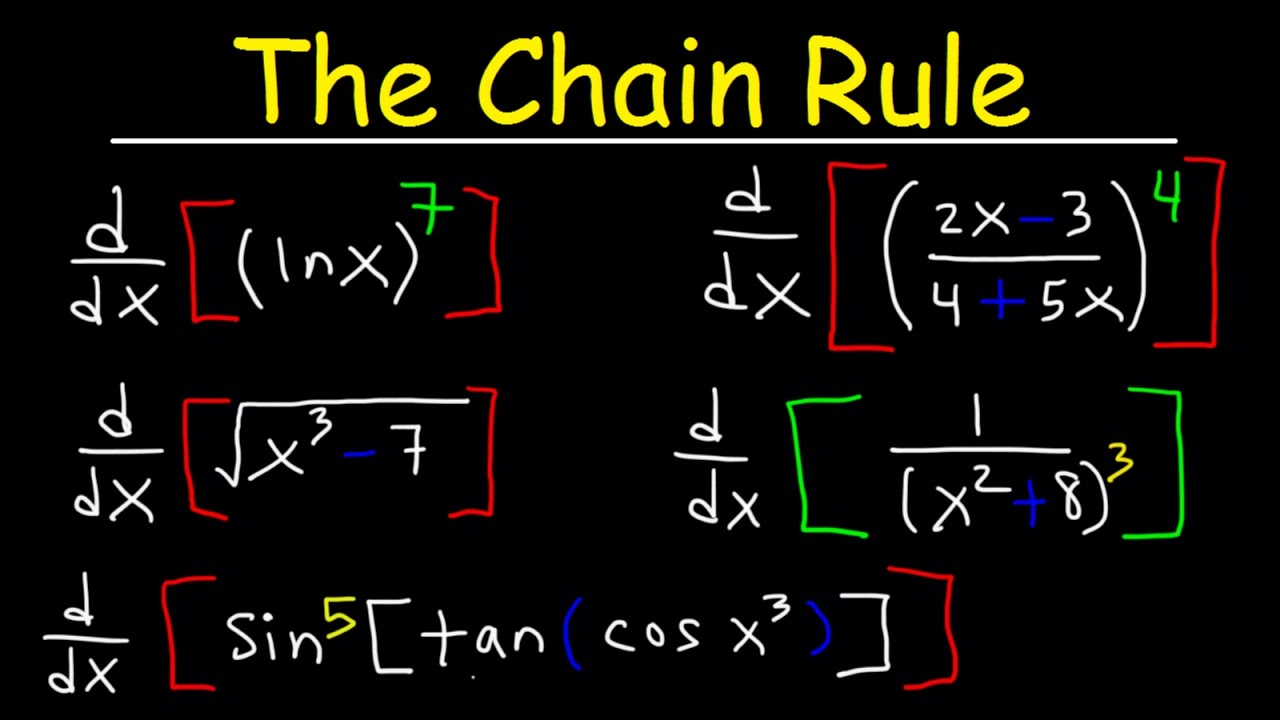
This calculus video tutorial explains how to find derivatives using the chain rule. This lesson contains plenty of practice problems including examples of chain rule problems with trig functions, square root & radicals, fractions, ln, product rule, and quotient rule. This video gives you a simple way to find the derivative of a function using ...
Try watching this video
sand nova
but the question is
3/(2x)^2
i can turn that into 3 d/dx 1/(2x)^2
what is the second fucntion in this
twin meteorBOT
south
 sand nova
bronze osprey
you don't need chain rule lol
sand nova
bronze osprey
you don't need chain rule lol
symbolab said so
bronze osprey
sand nova
symbolab said so
you don't need the chain rule anyways
you can use the chain rule but like why
 mild flower
it's good to do things in multiple different ways! that way you can check your work
sand nova
or is it the thing tweaking out
oh wait i am really stupid
nevermind thank you
or am i
im confused
-3/2x^3 isnt the same as 3/4x^2 right?
mild flower
correct those are different
sand nova
would both answers be right?
mild flower
isn't 3/4x² what you started with
 sand nova
well i tried using the power rule because ive been trying to figure out the chain rule and been getting lost
wait
ill take a better phot
 mild flower
,rcw
twin meteorBOT
 sand nova
i tried to relate 3 d/dx to dy/dx and stuff and then i remebered
these are notations
what am i doing
and then
yeah
sand nova
mhm
mild flower
so our original function is now 3/u²
aka 3u^{-2}. now we can differentiate with respect to u
using the power rule
mild flower
yep so now we need to multiply by du/dx
the way to see this is like $\dv{y}{x} = \dv{y}{u} \cdot \dv{u}{x}$ because the du's cancel out
twin meteorBOT
hayley table
 mild flower
so what's du/dx?
sand nova
(dy/dx) / dy/du?
mild flower
hmm
mild flower
du/dx just means the derivative of u with respect to x
so if u = 2x
then we differentiate both sides wrt x
du/dx on the left, what's on the right?
sand nova
dy/du?
mild flower
what's the derivative of 2x with respect to x
like if u(x) = 2x, then what's u ' (x)
sand nova
2?
mild flower
sand nova
-2*3u^-3
so from here, we know that df/dx = this thing * du/dx
sand nova
what does u stand for
mild flower
u can be anything
sand nova
but when we made u 2x
mild flower
you can make it whatever you want
sand nova
why did we make 2x u
sand nova
what is a subexpression
mild flower
uhhh like
a part of the expression
like if I had 3(x-4)³ + 7
then (x-4)³ would be a subexpression
sand nova
so 2x=u is a part of f(x) =3/(2x)^2?
mild flower
see how there's a 2x in there
sand nova
like a part of the equation basically
mild flower
yeah
sand nova
ok
so i can make a part of the equation
the subexpression
preferably the X because du/dx
mild flower
yep
the idea behind the chain rule is that you differentiate the outer thing, treating that subexpression as a variable, and then you multiply by the derivative of that variable
so in this case we had like
y = 3/(2x)²
u = 2x; du/dx = 2
y = 3/u²
dy/dx = dy/du * du/dx
dy/dx = -6/u³ * 2
but you do still need to substitute u = 2x back in
so dy/dx = -12/(2x)³
sand nova
so
fx(x) or Y=3/(2x)^2
u=2x (subexpression of f(x)
give me a minute
sorry
y=3/u^2
i mean
3u^-2
then i can apply the power rule to that
to make it 6u^-3
nvm
-6u^-3
and that was dy/du
dy/du * du/dx
is -6u^-3
*2
-12u^-3
but i dont know where i am going wrong
because thats different than your answer
oh wait
why did u multiply -6u^3 by 2?
sand nova
mild flower
so in this case we had like
y = 3/(2x)²
u = 2x; du/dx = 2
y = 3/u²
dy/dx = dy/...
and why isnt ^-3 in dy/dx negative?
mild flower
sand nova
why did u multiply -6u^3 by 2?
thats du/dx
sand nova
oh
sorry i forgot
du/dx was 2
as u was 2x and the derivative in u in respect to x was therefore 2
so you did -6/u^3 (derivative of y in respect to u) * 2 (derivative of u in respect to x)
making dy/dx -12/u^3
and then to substitute x back in
(2x)^3
is that right?
vocal sleetBOT
Channel closed
Closed by @sand nova
Use .reopen if this was a mistake.
vocal sleetBOT
Available help channel!
Send your question here to claim the channel.
Remember:
• Ask your math question in a clear, concise manner.
• Show your work, and if possible, explain where you are stuck.
• After 15 minutes, feel free to ping <@&286206848099549185>.
• Type the command .close to free the channel when you're done.
• Be polite and have a nice day!
Read #❓how-to-get-help for further information on how to ask a good question, and about conduct in the question channels.
 ember latch
ANYONE FAMILIAR WITH MAPLE
vocal sleetBOT
ember latch
ANYONE FAMILIAR WITH MAPLE
ember latch
???

HOW DO I MAKE IT WRITE IT OUT WITH THE LIKE VARIABLES YK
noone? 😔
come on maan 😔
anyonee???
PLEAAASE
THIS WOULD MAKE MY WEEK
damn
😔
 cyan talon
ember latch
HOW DO I MAKE IT WRITE IT OUT WITH THE LIKE VARIABLES YK
cyan talon
ember latch
HOW DO I MAKE IT WRITE IT OUT WITH THE LIKE VARIABLES YK
wdym, I don't understand your question
