
#help-17
1 messages · Page 136 of 1
 paper depot
no
paper depot
let me show you a diagram
 echo roost
okay
paper depot

this is what k is responsible for
also i am looking at the solns of cos(t) = 0.766 rather than cos(3θ) = 0.766 but my point still stands
does that explain it?
 vocal sleetBOT
Channel closed
Closed by @echo roost
Use .reopen if this was a mistake.
 Available help channel!
Send your question here to claim the channel.
Remember:
• Ask your math question in a clear, concise manner.
• Show your work, and if possible, explain where you are stuck.
• After 15 minutes, feel free to ping <@&286206848099549185>.
• Type the command .close to free the channel when you're done.
• Be polite and have a nice day!
Read #❓how-to-get-help for further information on how to ask a good question, and about conduct in the question channels.
echo roost
@paper depot Can I also find the second solution by using
360 - theta
vocal sleetBOT
echo roost
<@183668144404037632> Can I also find the second solution by using
360 - theta
echo roost
Is that because it is 3 theta?
paper depot
yes to the first question, no to the second.
 paper depot
the words "for example" imply that there is a connection between your previous question and this one, but i don't see it.
but anyway your first step would be to divide by 4
vocal sleetBOT
@echo roost Has your question been resolved?
vocal sleetBOT
Channel closed
Closed due to timeout
Use .reopen if this was a mistake.
Available help channel!
Send your question here to claim the channel.
Remember:
• Ask your math question in a clear, concise manner.
• Show your work, and if possible, explain where you are stuck.
• After 15 minutes, feel free to ping <@&286206848099549185>.
• Type the command .close to free the channel when you're done.
• Be polite and have a nice day!
Read #❓how-to-get-help for further information on how to ask a good question, and about conduct in the question channels.
 frosty prawn
What is the 2x2 matrix given by the linear transformation defined by:
 frosty prawn
It seems like a really easy question. I just don't get it
And i know what the answer is just don't know how to solve it
 pallid zenith
heres a dumb thought but can we use linearity?
because i mean if you had a dream, itd be that they gave you $T \mqty( 1 \ 0)$ and $T \mqty( 0 \ 1 )$
 twin meteorBOT
jan Niku
because i mean if you had a dream, itd be that they gave you $T \mqty( 1 \\ 0)$ and $T \mqty( 0 \\ 1 )$
 pallid zenith
but we should be able to use that $T(u) + T(v) = T(u+v)$ to get here
twin meteorBOT
jan Niku
 pallid zenith
@frosty prawn
frosty prawn
I have tried row reducing to get the identity but the answer is supposed to be
-2 0
5 1
pallid zenith
sure
frosty prawn
And if i subtract 11*-2 to -4 it's not 0
pallid zenith
twin meteor
**jan Niku**
```latex
because i mean if you had a dream, itd be that they gave y...
do you get what i mean about this?
like, if $T \mqty( 1 \ 0)=b$ and $T \mqty( 0 \ 1 )=c$ then your answer is just $\mqty( b & c)$
twin meteorBOT
jan Niku
 frosty prawn
I'm not sure
pallid zenith
so our normal basis is just $\mqty( \imat{2} )$ yea
frosty prawn
Now i'm more confused
twin meteorBOT
jan Niku
 frosty prawn
Yeah
pallid zenith
this is a matrix made out of column vectors, the basis vectors
so if we know where $\mqty( 1\0 )$ and $\mqty(0 \ 1)$ got sent under some transformation $T$
twin meteorBOT
jan Niku
 pallid zenith
that should be enough to describe $T$ right
twin meteorBOT
jan Niku
 pallid zenith
because every vector is just some combination of 1 \ 0 and 0 \ 1
frosty prawn
Do we? I thought the objectve was to find the identity of T and see what comes out of it?
i mean if i find
T 1 0
01
pallid zenith
the goal is to find a matrix $T$ such that $T \mqty( 1 \ 0) = \mqty( -2 \ 5)$ and $T \mqty(2 \ 1) = \mqty(-4 \ 11)$
pallid zenith
sorry
twin meteorBOT
jan Niku
 frosty prawn
Yeah
pallid zenith
my thought was that we instead use the information they gave you to find $T \mqty(1\0)$ and $T \mqty(0\1)$
twin meteorBOT
jan Niku
 pallid zenith
because really, this is what we want
frosty prawn
Yes
pallid zenith
where do the bases get sent under T?
which we can do
i mean, we have one already
twin meteorBOT
jan Niku
 pallid zenith
now, my thought was to use linearity
frosty prawn
twin meteor
**jan Niku**
This looks to me like if we put in 1 we get -2, and if we put in 0 we get 5?
pallid zenith
specifically $\mqty(2\1) = \mqty(0\1) + 2 \mqty(1\0)$
twin meteorBOT
jan Niku
 pallid zenith
frosty prawn
This looks to me like if we put in 1 we get -2, and if we put in 0 we get 5?
pallid zenith
frosty prawn
This looks to me like if we put in 1 we get -2, and if we put in 0 we get 5?
hmm?
frosty prawn
I don't get that
frosty prawn
pallid zenith
hmm?
I clearly have a really bad grasp about how linear transformations work
pallid zenith
nah its good its confusing
frosty prawn
Can i tell you how i think about it and then you can correct me on what i'm doing wrong?
pallid zenith
yea but no promises ill be able to totally correct 
frosty prawn
Alright. I think about T as a function like f(x). So i put in T (1 , 0) and it spits out -2, 5?
So that to me tells me that if i put in 1 in the first entry i get -2 and if i put in 0 in the secound entry i get 5?
And if i find the identity of T i get the starting matrix?
pallid zenith
frosty prawn
So that to me tells me that if i put in 1 in the first entry i get -2 and if i p...
sure but its maybe more natural to think of the action as grouped
as in like ...
have you ever seeen
theres that classic visualization of a grid being stretched
or skewed
frosty prawn
Alright but what calculation is going down then to make -2, 5 from 1, 0?
pallid zenith
a million and 1 people have seen the 3b1b videos
frosty prawn
4.5 million actually
pallid zenith
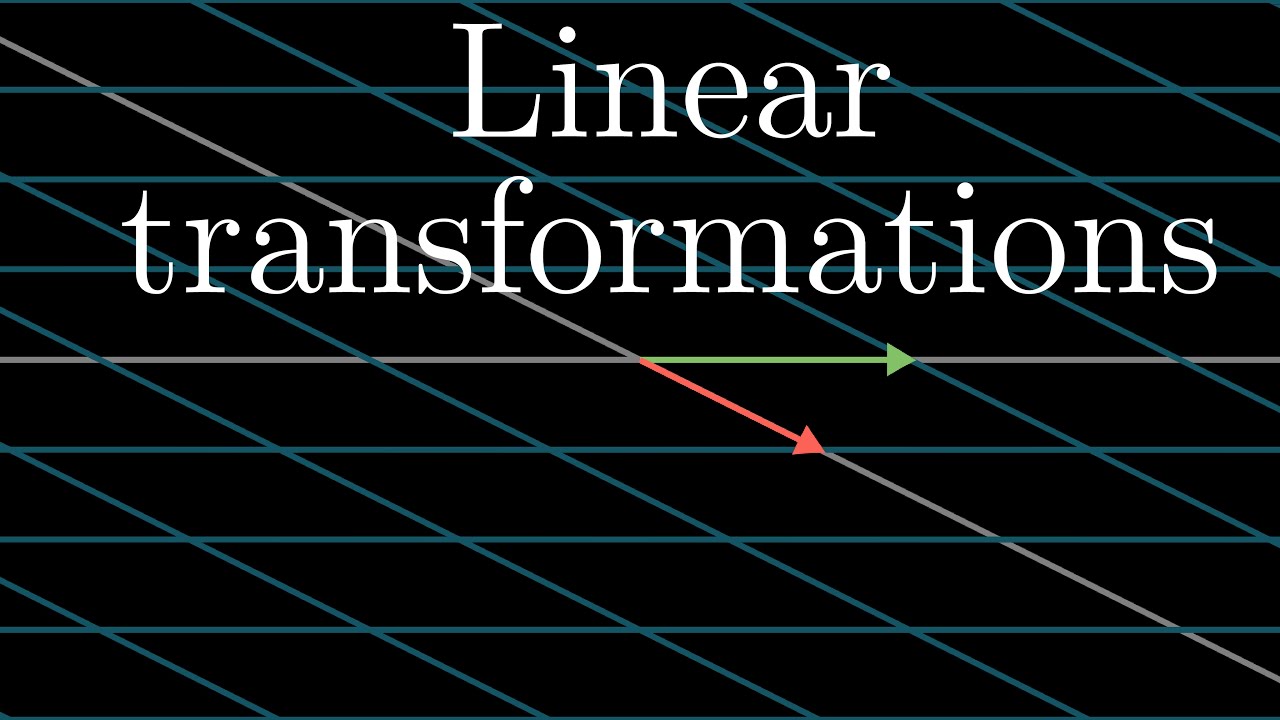
Quite possibly the most important idea for understanding linear algebra.
Help fund future projects: https://www.patreon.com/3blue1brown
An equally valuable form of support is to simply share some of the videos.
Home page: https://www.3blue1brown.com
Full series: http://3b1b.co/eola
Future series like this are funded by the community, through P...
hahaha
frosty prawn
Lol i have that video up rn
pallid zenith
it doesnt explain everything
but, yea, i mean function is helpful
it takes you from some input space to some output space
and the whole action looks nice, theres no weird fuckery of bizarre transformations, its a nice skew and stretch
frosty prawn
Yeah i can buy that
pallid zenith
but uhh
i dont think that thinking of it as two functions acting on the first and second component is correct
not that you said this explicitly
the function itself here is something that works on both components
do you see what i mean?
frosty prawn
YEs
Well, i think that's what i'm missing here
i don't relly understand how T behaves and gives me those numbers
pallid zenith
this is where idk that my like
perception is gonna totally make sense
heres one way to think about it
pallid zenith
frosty prawn
i don't relly understand how T behaves and gives me those numbers
you agreed with the whole T being made up of column vectors that describe where the bases get sent right
pallid zenith
as in like
frosty prawn
Is T what i want to find?
pallid zenith
the matrix, yea
frosty prawn
Okay so i put in 1, 0 in T and i get -2 , 5?
pallid zenith
say they gave you $T\mqty(1\0)=\mqty(a\b)$ and $T\mqty(0\1)=\mqty(c\d)$
then $T=\mqty(a & c \ b & d)$
pallid zenith
pallid zenith
you agreed with the whole T being made up of column vectors that describe where ...
this is all i mean with this
pallid zenith
frosty prawn
Okay so i put in 1, 0 in T and i get -2 , 5?
you dont 'put in' anything
frosty prawn
alright haha sorry
pallid zenith
lemme change this notation so its more straightforward
twin meteorBOT
jan Niku
 frosty prawn
Yes
twin meteorBOT
jan Niku
 pallid zenith
do you agree with me here?
frosty prawn
I can buy that for the identity matrix of T
pallid zenith
if they just gave you where the bases get sent
frosty prawn
but not in other cases?
pallid zenith
then thats it, works over
pallid zenith
frosty prawn
but not in other cases?
if they dont give you where the bases get sent then you have to do more work
frosty prawn
pallid zenith
if they dont give you where the bases get sent then you have to do more work
By this you mean that the bases get sent to -2, 5 in the first one?
pallid zenith
all i mean is that if they dont give you $T\mqty(1\0)$ or $T\mqty(0\1)$ the problem is slightly harder
twin meteorBOT
jan Niku
 frosty prawn
Yeah true
pallid zenith
frosty prawn
i don't relly understand how T behaves and gives me those numbers
but look, heres what i wanted to say originally
frosty prawn
well they do give us T ( 1, 0) right?
twin meteorBOT
jan Niku
 frosty prawn
yeah
twin meteorBOT
jan Niku
 pallid zenith
and because $T$ is linear
twin meteorBOT
jan Niku
 frosty prawn
Interresting
pallid zenith
this is $2T\mqty(1\0) +T\mqty(0\1)$
twin meteorBOT
jan Niku
 frosty prawn
Alright
pallid zenith
thats how T works on vectors, or how i think is helpful to think about it
its a combination of the action of T on the bases
pallid zenith
frosty prawn
well they do give us T ( 1, 0) right?
they do, yea
so you can basically solve your problem like this, really
they give you $T\mqty(2\1)$ right
twin meteorBOT
jan Niku
 pallid zenith
twin meteor
**jan Niku**
pallid zenith
twin meteor
**jan Niku**
but we just found another way to write this
$T\mqty(2\1) = 2 T\mqty(1\0) + T\mqty(0\1)$
twin meteorBOT
jan Niku
 pallid zenith
if you stare at this equation and believe, you should be able to see theres only one unknown here
frosty prawn
ooh right now i understnad
pallid zenith
 frosty prawn
You just break it apart
pallid zenith
twin meteor
**jan Niku**
this one
frosty prawn
Omg yes
I feel a bit overwhelmed now though. So how do you compute it then?
why 5 = 2*8 + x?
pallid zenith
because its just some number, equals 2 times some number, plus some unknown

this equation is some known vector, equals 2 times some known vector, plus some unknown vector
frosty prawn
pallid zenith
If we take this picture and now put it into the problem how would it look like?
pallid zenith
well youre given a ton of this information

specifically heres one piece

heres another
twin meteorBOT
jan Niku
$T\mqty(2\\1) = 2 T\mqty(1\\0) + T\mqty(0\\1) \Rightarrow \mqty(-4\\1) = 2 \mqty(-2\\5) + T\mqty(0\\1)$
 frosty prawn
( -4, 11)?
pallid zenith
yea
$T\mqty(2\1) = 2 T\mqty(1\0) + T\mqty(0\1) \ \mqty(-4\11) = 2 \mqty(-2\5) + T\mqty(0\1)$
maybe i can stack them

here
stare at these two images
twin meteorBOT
jan Niku
 pallid zenith
sorry i keep missing that stupid second 1
twin meteorBOT
jan Niku

 pallid zenith
im really not making any conceptual leaps here promise 

this is just given information
frosty prawn
twin meteor
**jan Niku**
Yeah i just don't understand this bottom part
Why one has a 2 and one is T
Are you saying you've multipiled in T into ( 1, 0) and then you get ( -2, 5)?
pallid zenith
frosty prawn
Are you saying you've multipiled in T into ( 1, 0) and then you get ( -2, 5)?
i guess, yea
pallid zenith
frosty prawn
Why one has a 2 and one is T
one of them is unknown
specifically we dont know what $T\mqty(0\1)$ is
twin meteorBOT
jan Niku
 pallid zenith
so i left the T, there
frosty prawn
twin meteor
**jan Niku**
It sort of makes sense that 2 * -2 + 0 is -4. And 2 * 5 + 1 is 11?
pallid zenith
oh man i really cant track what youre saying here
pallid zenith
twin meteor
**jan Niku**
theres nothing really to believe in this set of equations
frosty prawn
The top row on the bottom half
pallid zenith
all there is to do is understand that given information has been used, and how-
otherwise its just substitution
frosty prawn
-4 = 2 * -2 + T * 0
pallid zenith
theres no calculation or anything happening
frosty prawn
Alright. Well the core of all of this. How do you find the answer to this because the answer is supposed to be
-2 0
5 1
pallid zenith
we find $T\mqty(0\1)$
twin meteorBOT
jan Niku
 frosty prawn
And we row reduce to get that?
 frosty prawn
How
frosty prawn
I mean the answer is RIGHT there
But i just don't understand
Linear algebra makes me want to commit Sudoku 
pallid zenith
it can be a little painful
paper depot
what was the problem again
frosty prawn

What is the 2x2 matrix given by the linear transformation defined by:
The computation in linear algebra seems really easy. It's just understanding what is going on that's so confusing
paper depot
it looks like niku walked you thru finding the value of T(0, 1) ...
ok right so
lets back up a bit
theres this kind of important theorem in linalg that says any linear transformation is completely determined by what it does to a basis of its domain
is that familiar to you?
frosty prawn
What is it's "Domain"?
paper depot
domain as in domain of a function...
like T : V -> W, where V and W are vector spaces
V is the domain
frosty prawn
🙃
I'm sorry I think this is just an issue with me being Swedish
I do see "T : V -> W, where V and W are vector spaces" Get thrown around a lot but i don't really understand what it means
paper depot
do you know what a function is
paper depot
yes but not necessarily one from numbers to numbers
frosty prawn
From Vectors in R^m to Vectors in R^n then?
paper depot
thats better
still maybe not quite perfect, because not all vector spaces are R^n, but better.
so like
functions in all kinds of math
have inputs and outputs
and predefined sets that those inputs and outputs live in
the input set is called the domain
frosty prawn
Ooh right yeah i understood that!
The Domain is just where we plug in something that then get sent to some output?
Sorry if i get sidetracked rn. But i use Lays Linear Algebra and it's applications. Does that help?
Are you familair with it because then you could point me to specific theorems
paper depot
no sorry
frosty prawn
Could you express my problem as just Ax = b?
because that what my book use a lot of the time
Also. Is this question supposed to be really easy and i'm missing something really fundamental?
paper depot
frosty prawn
Also. Is this question supposed to be really easy and i'm missing something real...
yes you are missing something fundamental
it would take more effort to express this problem as Ax=b
than to just solve it the dumb way
frosty prawn
paper depot
yes you are missing something fundamental
Well that's great then
Where do i begin?
My teacher actually had a video on the topic.

X is the "Domain" that you spoke about?
paper depot
yes
i would begin by rereading the first chapter where the concept of a linear transformation is introduced
really soak in the concept of linearity
frosty prawn
I assume it's Fundemental yet kind of complicated then?
In my problem. X would be the ( 1, 0) that send the basis to (-2, 5) ?
Relative to the picture i sent
"T" is a matrix by itself right? That's the whole idea here. To find T?
Everything is useually so straight foward and this isn't 😔
I know you guys must be tired of me at this 'point. So could you send me to a Youtube video maybe?
vocal sleetBOT
@frosty prawn Has your question been resolved?
vocal sleetBOT
Channel closed
Closed due to timeout
Use .reopen if this was a mistake.
Available help channel!
Send your question here to claim the channel.
Remember:
• Ask your math question in a clear, concise manner.
• Show your work, and if possible, explain where you are stuck.
• After 15 minutes, feel free to ping <@&286206848099549185>.
• Type the command .close to free the channel when you're done.
• Be polite and have a nice day!
Read #❓how-to-get-help for further information on how to ask a good question, and about conduct in the question channels.
 amber agate
.help
vocal sleetBOT
Commands:
- clopen:
.close,.reopen,.solved,.unsolved - consensus:
.poll - factoids:
.tag - help:
.help - version:
.version
Type .help <command name> for more info on a command.
 wary grove
we know that a^b = e^(b * ln(a))
for some specific reason, i have to define it so a^b = e^(b * ln(|a|))
this obviously doesn't work with negative bases and odd exponents
the reason i want to define it as e^(b * ln(|a|)) is because i'm building a scientific calculator, and using e^(b * ln(|a|)) simplifies the derivative process. if i don't do that, the derivative would only work for positive x values
i have explained this pretty badly so please let me know if this requires more clarification
vocal sleetBOT
wary grove
we know that a^b = e^(b * ln(a))
for some specific reason, i have to define it s...
wary grove
so i need a way to define a^b where the derivative wouldn't require an absolute value
vocal sleetBOT
@wary grove Has your question been resolved?
wary grove
just to clear it up, this equation kinda does what i need, but it still contains a^b. i want the a^b gone: $e^{b \ln{|a|}} \cdot \frac{\sqrt[b]{a^b}}{|a|}$

of course, this has the drawback that a now can't be 0, but i'll handle that separately. i just need an equation like this without a^b inside
 flat whale
wary grove
so i need a way to define a^b where the derivative wouldn't require an absolute ...
flat whale
wary grove
so i need a way to define a^b where the derivative wouldn't require an absolute ...
Use complex logarithm
wary grove
flat whale
Use complex logarithm
how would that solve this?
flat whale
Look it uo
Complex Analysis
An online interactive introduction to the study of complex analysis.
wary grove
flat whale
Look it uo
i know that ln(-1) = i pi, but i'm failing to see how that would help solve this problem
because i would still need to add + i pi to the exponent when the result is supposed to be negative
or am i wrong
in the case of (-2)^3, this works. but if i change it to (-2)^4, i would need to conditionally remove the + i pi on the exponent if i understand everything correctly


and i don't want to do anything conditionally
because i don't know what the sign of the result of a^b would be without calculating a^b
 sage acorn
anyone please help me with this question-Consider that a, b, c, d are positive real numbers satisfying (a + c)(b + d) = ac + bd.
Find the smallest possible value of S=a/b+b/c+c/d+d/a
wary grove
sage acorn
anyone please help me with this question-Consider that a, b, c, d are positive r...
i'd appreciate if you did not hijack my question and used an empty help channel instead
sage acorn
sorry
vocal sleetBOT
@wary grove Has your question been resolved?
flat whale
wary grove
in the case of (-2)^3, this works. but if i change it to (-2)^4, i would need to...
You're not using exponent rules
,tex .exp rules
twin meteorBOT
riemann
 wary grove
flat whale
You're not using exponent rules
wary grove
flat whale
You're not using exponent rules
im not sure if i follow, isn't it the product rule so i pi should be summed?
vocal sleetBOT
@wary grove Has your question been resolved?
wary grove
nevermind, i saw the issue. i wrote the i pi outside the brackets. it should have been b (ln|a| + i pi), thank you
.close
vocal sleetBOT
Channel closed
Closed by @wary grove
Use .reopen if this was a mistake.
Available help channel!
Send your question here to claim the channel.
Remember:
• Ask your math question in a clear, concise manner.
• Show your work, and if possible, explain where you are stuck.
• After 15 minutes, feel free to ping <@&286206848099549185>.
• Type the command .close to free the channel when you're done.
• Be polite and have a nice day!
Read #❓how-to-get-help for further information on how to ask a good question, and about conduct in the question channels.
vocal sleetBOT
Please show the original problem, exactly as it was stated to you, with the entire original context. A picture or screenshot is best. If the original problem is not in English, then post it anyway! The additional context might still be helpful. Do your best to provide a translation.
vocal sleetBOT
@stuck maple Has your question been resolved?
vocal sleetBOT
Channel closed
Closed due to timeout
Use .reopen if this was a mistake.
Available help channel!
Send your question here to claim the channel.
Remember:
• Ask your math question in a clear, concise manner.
• Show your work, and if possible, explain where you are stuck.
• After 15 minutes, feel free to ping <@&286206848099549185>.
• Type the command .close to free the channel when you're done.
• Be polite and have a nice day!
Read #❓how-to-get-help for further information on how to ask a good question, and about conduct in the question channels.
 old niche
 old niche
im getting stuck for one direction...
i just dont know how to deduce that a + k = 3 and b + l = 2
 mild flower
$p^3q^2 = v \cdot p^aq^b$
twin meteorBOT
hayley
 mild flower
what happens if you divide by p^3q^2
old niche
its just subtracting the exponents right?
mild flower
yeah
old niche
that looks like i did for the reverse direction
vocal sleetBOT
@old niche Has your question been resolved?
Channel closed
Closed by @old niche
Use .reopen if this was a mistake.
Available help channel!
Send your question here to claim the channel.
Remember:
• Ask your math question in a clear, concise manner.
• Show your work, and if possible, explain where you are stuck.
• After 15 minutes, feel free to ping <@&286206848099549185>.
• Type the command .close to free the channel when you're done.
• Be polite and have a nice day!
Read #❓how-to-get-help for further information on how to ask a good question, and about conduct in the question channels.
 loud hedge
An RSA-system has the encryption function E(x) = [x^e]mod451.
Find the decryption key d given that e = 31.
vocal sleetBOT
loud hedge
An RSA-system has the encryption function E(x) = [x^e]mod451.
Find the decrypti...
twin meteorBOT
nicoco

 urban edge
totient 451
loud hedge
ok yes i see that
but why does that suddenly become an expression 400y
like where is that whole equation coming from? considering my
E(x) = [x^e]mod451
how is this related to that function 31d + 400y = 1
urban edge
You are trying to get back to 1 to find the original message
Some multiples of 31 is equal to 1 modulo 400
It might be easier to think of as 31d-400y=1 where d and y are posints
loud hedge
i think i get it
so was it wrong of me to say that E(x) = [x^e]mod451 is equivalent to 31d + 400y = 1
because 31d + 400y = 1 is actually related to the process of finding the modular inverse for d isn't it?
vocal sleetBOT
@loud hedge Has your question been resolved?
 dull bear
loud hedge
because 31d + 400y = 1 is actually related to the process of finding the modular...
dull bear
loud hedge
because 31d + 400y = 1 is actually related to the process of finding the modular...
Yep  that's basically finding the decryption key d, which is the multiplicative inverse of e
vocal sleetBOT
Channel closed
Closed by @loud hedge
Use .reopen if this was a mistake.
Available help channel!
Send your question here to claim the channel.
Remember:
• Ask your math question in a clear, concise manner.
• Show your work, and if possible, explain where you are stuck.
• After 15 minutes, feel free to ping <@&286206848099549185>.
• Type the command .close to free the channel when you're done.
• Be polite and have a nice day!
Read #❓how-to-get-help for further information on how to ask a good question, and about conduct in the question channels.
 wind python
what am i supposed to do here?
vocal sleetBOT
wind python
what am i supposed to do here?
wind python

 tall ore
Ok humor me for a minute. what are the roots of the quadratic x^2 -6x +8?
tall ore
do you know how to factorise it?
tall ore
ok well, itll be factorised into (x-a)(x-b), because you need 2 brackets to make the x^2
tall ore
the roots of the quadratic?
wind python
yes
tall ore
no. the roots are x=2 and x=4. Take a moment to understand that, I'm guessing you've seen it before and its not new to you?
wind python
yeah
tall ore
its the negative of the things inside of the brackets
wind python
its not new to me
tall ore
perfect, so getting onto the question in hand. you know that this cubic can be made of 3 brackets (x-a)(x-b)(x-c) or at least that should be apparent now ive told you
wind python
yes
tall ore
given the example we have just done with that quadratic, and it having a root of 2. and the cubic in your question also having a root of 2, what is the value for a?
does my question make sense
tall ore
so remember that an equation having A ZERO (or ROOT) at x=2, has a FACTOR (x-2)
wind python
yes
tall ore
are you happy that x^3 -10x^2 +36x -40 = (x-a)(x-b)(x-c) for some values of a,b,c
tall ore
simplifying?
wind python
i dont think i get it very much
wind python
tall ore
are you happy that x^3 -10x^2 +36x -40 = (x-a)(x-b)(x-c) for some values of a,b,...
but i guess this is fine
tall ore
It's very easy to show it, if you expand all the brackets youll see this. you can represent any polynomial like this
its just long as hell
anyway, youre told that this cubic equation has A ZERO at x=2. what is one of its ROOTS
wind python
wait
tall ore
whats up?
wind python
one of the roots is x+36?
tall ore
where did you get 36 from?
wind python
x^3 -10x^2 +36x -40
i just saw 36x
so i took it out and made it into x+36
actually lewis, its okay
i think ill just go with the answer i said before
4+2i, 4-2i
we'll see later if its right or wrong
thank you though
i appreciate you trying to help me
tall ore
ok
wind python
.close
vocal sleetBOT
Channel closed
Closed by @wind python
Use .reopen if this was a mistake.
vocal sleetBOT
Available help channel!
Send your question here to claim the channel.
Remember:
• Ask your math question in a clear, concise manner.
• Show your work, and if possible, explain where you are stuck.
• After 15 minutes, feel free to ping <@&286206848099549185>.
• Type the command .close to free the channel when you're done.
• Be polite and have a nice day!
Read #❓how-to-get-help for further information on how to ask a good question, and about conduct in the question channels.
 fervent flower
How can I solve systems that involve sin and cos
I've been trying to solve
Cos(a) * x - sin(a) * y =3
Sin(a) *x - cos (a) * y =4
?
vocal sleetBOT
fervent flower
How can I solve systems that involve sin and cos
I've been trying to solve
Cos(a...
 plain minnow
fervent flower
How can I solve systems that involve sin and cos
I've been trying to solve
Cos(a...
plain minnow
fervent flower
How can I solve systems that involve sin and cos
I've been trying to solve
Cos(a...
one approach is squaring both the sides
fervent flower
Like (cosa*x)^2?
Or the whole line
What does sides mean?
Not familiar with the English terms of maths
fervent flower
Yes
 vast salmon
If you're given 2 equations
 split wind
at first glance, i think you can name the first equation (1) and the second equation (2)
you can use method of elimination, and set
(sin(a))×(1) - (cos(a))×(2)
vast salmon
You could try turning them into a single function
vast salmon
vast salmon
You could try turning them into a single function
Yeah this will work
fervent flower
split wind
at first glance, i think you can name the first equation (1) and the second equa...
So 1 which is x= sina+cosa *y-4?
split wind
oh no that's not what i mean
vast salmon
multiply and divide with √(x²+y²)
split wind
(cos(a)x-sin(a)y)(sin(a))=3sin(a)
(sin(a)x+cos(a)y)(cos(a))=4cos(a)
vast salmon
put x/√(x²+y²)=sin(theta)
fervent flower
split wind
(cos(a)x-sin(a)y)(sin(a))=3sin(a)
(sin(a)x+cos(a)y)(cos(a))=4cos(a)
Buts it's cosax not cosasina
How I'll that work
Will*
split wind
it's like
3x+2y=2
2x-3y=3
we do
2(3x+2y)=(2)(2)
3(2x-3y)=(3)(3)
which becomes
6x+4y=4
6x-9y=9
so that we can use method of elimination
vocal sleetBOT
Channel closed
Closed by @fervent flower
Use .reopen if this was a mistake.
Available help channel!
Send your question here to claim the channel.
Remember:
• Ask your math question in a clear, concise manner.
• Show your work, and if possible, explain where you are stuck.
• After 15 minutes, feel free to ping <@&286206848099549185>.
• Type the command .close to free the channel when you're done.
• Be polite and have a nice day!
Read #❓how-to-get-help for further information on how to ask a good question, and about conduct in the question channels.
 torn pecan
 vocal sleetBOT
torn pecan
torn pecan
vocal sleetBOT
torn pecan
torn pecan
how do i solve this
 lavish river
you can probably try the options one by one
 hushed tree
yes
torn pecan
yeah but I want to know how to solve it properly
hushed tree
you cant
torn pecan
oh
 thin vale
You can?
hushed tree
you can but you still need the answer choices
 scenic ravine
you can, let * be x, then you'll have to solve the resulting expression
hushed tree
yeha but you have 2 variables
torn pecan
i mean u could use 2 variables
lavish river
well, you can let the values by x and y and solve the set of values such that
(5 + 3/x) * (y + 1/2) = 19
and see which of the options fit the span
torn pecan
Then find for x and substitute to find y
thin vale
There are infinitely many solutions, but it only wants a specific integer solution
 outer warren
well all the options for the second value is 3
lavish river
outer warren
well all the options for the second value is 3
or use that n solve yep
torn pecan
ok ty
outer warren
so you pretty much only need to solve for a single variable
torn pecan
.close
vocal sleetBOT
Channel closed
Closed by @torn pecan
Use .reopen if this was a mistake.
Available help channel!
Send your question here to claim the channel.
Remember:
• Ask your math question in a clear, concise manner.
• Show your work, and if possible, explain where you are stuck.
• After 15 minutes, feel free to ping <@&286206848099549185>.
• Type the command .close to free the channel when you're done.
• Be polite and have a nice day!
Read #❓how-to-get-help for further information on how to ask a good question, and about conduct in the question channels.
 proven monolith
 vocal sleetBOT
proven monolith
proven monolith
vocal sleetBOT
proven monolith
proven monolith
x goes from y to 1, so those are the boudns of the dx integral, but is the dy integral from 0 to 1 and not from 0 to x?
vocal sleetBOT
@proven monolith Has your question been resolved?
vocal sleetBOT
@proven monolith Has your question been resolved?
 twin citrus
proven monolith
x goes from y to 1, so those are the boudns of the dx integral, but is the dy in...
twin citrus
proven monolith
x goes from y to 1, so those are the boudns of the dx integral, but is the dy in...
well your expression says that it is from 0 to 1
vocal sleetBOT
@proven monolith Has your question been resolved?
Channel closed
Closed by @proven monolith
Use .reopen if this was a mistake.
Available help channel!
Send your question here to claim the channel.
Remember:
• Ask your math question in a clear, concise manner.
• Show your work, and if possible, explain where you are stuck.
• After 15 minutes, feel free to ping <@&286206848099549185>.
• Type the command .close to free the channel when you're done.
• Be polite and have a nice day!
Read #❓how-to-get-help for further information on how to ask a good question, and about conduct in the question channels.
 viral trail
Can anyone give me some hint🥲
 vocal sleetBOT
viral trail
Can anyone give me some hint🥲
vocal sleetBOT
viral trail
Can anyone give me some hint🥲
 vast shale
try to get common denominator
viral trail
I try to simplify it by assume a,b,c are triangle side and use cosine laws (because given term is similar with cosine law) but stuck at cosA+cosB+cosC=1 and then I can’t find and think that “what kind of triangle has property that cosA+cosB+cosC=1” so I gave up to this method and try to simplify another way.

Here’s my work.
 twilit trout
Uhh
I don't know this kind of math
But I'm pretty sure if you divide ab by ab you don't generate a 1 out of nowhere and put it on the other side
From simplifying it should still equal 5
 viral trail
twilit trout
From simplifying it should still equal 5
viral trail
twilit trout
From simplifying it should still equal 5
The answer choices are -2,-4,-6,-8
twilit trout
viral trail
But
Which should still equal 5
Ex if I say (x+4)/2 = 3 then that just means 2+(x/2) = 3
That's how I'm gonna illustrate it
Is this alg ii
viral trail
viral trail
But
Yeah I tired this one and end up with some term which is similar to law of cosine
twilit trout
Gonna pretend I know what that is lol
vocal sleetBOT
@viral trail Has your question been resolved?
vocal sleetBOT
@viral trail Has your question been resolved?
viral trail
<@&286206848099549185>
 plucky sedge
hi
vocal sleetBOT
@viral trail Has your question been resolved?
vocal sleetBOT
@viral trail Has your question been resolved?
 sweet flower
viral trail
Can anyone give me some hint🥲
sweet flower
viral trail
Can anyone give me some hint🥲
So what you probably want to do here is notice a/a=1, b/b=1, c/c=1 and anything times 1 is itself. So what happens if you multiply each of these terms by a useful “1” ?
vocal sleetBOT
@viral trail Has your question been resolved?
 blissful sentinel
They're splitting the sum in the numerator to form two separate fractions.
Please don't disrupt this person's help channel then
You can open your own help channel if you'd like
vocal sleetBOT
@viral trail Has your question been resolved?
sweet flower
This is as far as I got
$$\left[ \left( a^{2}+b^{2}-c^{2}\right) c+a\left( b^{2}+c^{2}-a^{2}\right) +\left( a^{2}+c^{2}-b^{2}\right) b\right] =2abc$$
twin meteorBOT
Pixelius
 sweet flower
I suspect there’s infinitely many solutions though
 inner osprey
viral trail
I try to simplify it by assume a,b,c are triangle side and use cosine laws (beca...
inner osprey
viral trail
I try to simplify it by assume a,b,c are triangle side and use cosine laws (beca...
building off of this reasoning... cosA + cosB + cosC = 1 describes a degenerate triangle (i.e. a straight line)
so, it's possible to cheese this problem by supposing that the degenerate triangle is "isosceles"
(this makes sense because you can imagine the degenerate case occuring with angles 0, 0, 180, i guess?)
||taking the limit to infinity as a = 2b = 2c yields -2; alternatively, plugging in values that satisfy a = 2b = 2c works too||
fairly silly/stupid solution but it works out to the correct answer
 inner osprey
😅
 inner osprey
welcome 
viral trail
.close
vocal sleetBOT
Channel closed
Closed by @viral trail
Use .reopen if this was a mistake.
vocal sleetBOT
Available help channel!
Send your question here to claim the channel.
Remember:
• Ask your math question in a clear, concise manner.
• Show your work, and if possible, explain where you are stuck.
• After 15 minutes, feel free to ping <@&286206848099549185>.
• Type the command .close to free the channel when you're done.
• Be polite and have a nice day!
Read #❓how-to-get-help for further information on how to ask a good question, and about conduct in the question channels.
 whole gate
HI
vocal sleetBOT
whole gate
HI
whole gate


Is this proof valid? i need some help with it pls
or might it be false at the first place?
i've find that x^2 sin(1/x) might be a counterexample
whole gate
whole gate
but still cant figure out which part of this proof goes wrong
vocal sleetBOT
@whole gate Has your question been resolved?
vocal sleetBOT
@whole gate Has your question been resolved?
vocal sleetBOT
Channel closed
Closed due to timeout
Use .reopen if this was a mistake.
vocal sleetBOT
Available help channel!
Send your question here to claim the channel.
Remember:
• Ask your math question in a clear, concise manner.
• Show your work, and if possible, explain where you are stuck.
• After 15 minutes, feel free to ping <@&286206848099549185>.
• Type the command .close to free the channel when you're done.
• Be polite and have a nice day!
Read #❓how-to-get-help for further information on how to ask a good question, and about conduct in the question channels.
 vale ermine
Why iss this wrong?

 vocal sleetBOT
vale ermine
Why iss this wrong?
vocal sleetBOT
vale ermine
Why iss this wrong?
Channel closed
Closed by @vale ermine
Use .reopen if this was a mistake.
✅
vale ermine
I assumed for x ,y to be rational it gotta be 0
lavish river
why did you assume it goes through 0,0?
vale ermine
Well i couldn't think of any other way of getting rational terms with a irrational
in addition
lavish river
if it instead passes through (1,1), it would also be a rational point
lavish river
ok thats all i can point out, ive no idea how to solve this, weird question :(. ill try
vale ermine
Thanks!
lavish river
meow
vale ermine

vocal sleetBOT
@vale ermine Has your question been resolved?
 vocal sleetBOT
@vale ermine Has your question been resolved?
vale ermine
.close
vocal sleetBOT
Channel closed
Closed by @vale ermine
Use .reopen if this was a mistake.
Available help channel!
Send your question here to claim the channel.
Remember:
• Ask your math question in a clear, concise manner.
• Show your work, and if possible, explain where you are stuck.
• After 15 minutes, feel free to ping <@&286206848099549185>.
• Type the command .close to free the channel when you're done.
• Be polite and have a nice day!
Read #❓how-to-get-help for further information on how to ask a good question, and about conduct in the question channels.
 halcyon turtle
 vocal sleetBOT
halcyon turtle
halcyon turtle
vocal sleetBOT
halcyon turtle
halcyon turtle
can anyone explain me how is A + O = A, O
 cyan talon
A+O = O+A = A, that's what being said
the comma just seperates two sentences
@halcyon turtle
halcyon turtle
cyan talon
the comma just seperates two sentences
so how is A + O still equal to A
cyan talon
what happens if you add a 0 to every element in the matrix A
halcyon turtle
ohhhhhh
cyan talon
nothing happens, you still have A
vocal sleetBOT
Channel closed
Closed by @halcyon turtle
Use .reopen if this was a mistake.
Available help channel!
Send your question here to claim the channel.
Remember:
• Ask your math question in a clear, concise manner.
• Show your work, and if possible, explain where you are stuck.
• After 15 minutes, feel free to ping <@&286206848099549185>.
• Type the command .close to free the channel when you're done.
• Be polite and have a nice day!
Read #❓how-to-get-help for further information on how to ask a good question, and about conduct in the question channels.
vast shale
 vocal sleetBOT
vast shale
vast shale
vocal sleetBOT
vast shale
vast shale
The formula circled in red is what I need to show is the green circled one
I would like to get my work checked so far
vocal sleetBOT
@vast shale Has your question been resolved?
vast shale
You mean the green one?
vast shale
Or when I removed 8?
vast shale
 cobalt ocean
from the thing before that to the green one
cobalt ocean
from the thing before that to the green one
Since it was top one times 8 and bottom one times 8 you can just leave 8 out right?
vast shale
I just noticed I forgot the multiply by 5 on the last 4 steps
cobalt ocean

how do you get from the top to the bottom
could use a few more steps
if it's even correct
cobalt ocean
oh i see
vast shale
That’s what I’m trying to show
cobalt ocean
in that case yeah it's fine apart from the 5
vast shale
But I feel like I’ve made a mistake along the way
cobalt ocean
why
vast shale
cobalt ocean
in that case yeah it's fine apart from the 5
Are you sure? Do you have a tip for me for the next steps?
vast shale
cobalt ocean
why
Because I don’t know where to go from here
cobalt ocean
you need to get the bottom part into the square root in the top part
and then simplify
vast shale
cobalt ocean
you need to get the bottom part into the square root in the top part
How do I get it into the sqrt? With what operation?
cobalt ocean
sqrt(a)/b = sqrt(a/b^2)
vast shale
cobalt ocean
sqrt(a)/b = sqrt(a/b^2)
And when I’ve done that I just need to simplify and I’ll have the green one?
cobalt ocean
hopefully
vast shale
cobalt ocean
hopefully
I hope too thank you very much you’ve been very helpful 
.close
vocal sleetBOT
Channel closed
Closed by @urban ginkgo
Use .reopen if this was a mistake.
Available help channel!
Send your question here to claim the channel.
Remember:
• Ask your math question in a clear, concise manner.
• Show your work, and if possible, explain where you are stuck.
• After 15 minutes, feel free to ping <@&286206848099549185>.
• Type the command .close to free the channel when you're done.
• Be polite and have a nice day!
Read #❓how-to-get-help for further information on how to ask a good question, and about conduct in the question channels.
 stuck plank
Prove or disprove that the linear space of polynomials $( K[x] ) of degree not higher than ( n ) is not isomorphic to its dual space in two cases:
(a) ( n \neq \infty )
(b) ( n = \infty )$
vocal sleetBOT
stuck plank
Prove or disprove that the linear space of polynomials $\( K[x] \) of degree not...
twin meteorBOT
nana
Compile Error! Click the  reaction for more information.
(You may edit your message to recompile.)
 stuck plank
don't have ideas on how to do first steps, can somebody please help me 😢
<@&286206848099549185>
stuck plank
okay 😢
 tidal dock
stuck plank
Prove or disprove that the linear space of polynomials $\( K[x] \) of degree not...
tidal dock
stuck plank
Prove or disprove that the linear space of polynomials $\( K[x] \) of degree not...
Pre-University
😨
stuck plank
tidal dock
>Pre-University
😨
is it supposed to be university task? 
stuck plank
yes, i'm last year
tidal dock
stuck plank
Prove or disprove that the linear space of polynomials $\( K[x] \) of degree not...
is it given whether K is a finite field or no?
 hollow summit
tidal dock
>Pre-University
😨
hollow summit
tidal dock
>Pre-University
😨
; - ;
tidal dock
tidal dock
is it given whether K is a finite field or no?
i assume it's not
i am unfortunately not much of a linear algebra expert
stuck plank
tidal dock
is it given whether K is a finite field or no?
i think no, it's not stated
vocal sleetBOT
@stuck plank Has your question been resolved?
stuck plank
<@&286206848099549185>
 remote arch
stuck plank
Prove or disprove that the linear space of polynomials $\( K[x] \) of degree not...
remote arch
stuck plank
Prove or disprove that the linear space of polynomials $\( K[x] \) of degree not...
Two finite-dimensional vector spaces of the same dimension n are isomorphic, and the dual of a finite-dimensional vector space of dimension n also has dimension n.
For the infinite-dimensional case, note that all elements of K[x] have finite support (in the sense that any element has a finite number of non-zero coefficients).


 vocal sleetBOT
@stuck plank Has your question been resolved?
vocal sleetBOT
Channel closed
Closed due to timeout
Use .reopen if this was a mistake.
Available help channel!
Send your question here to claim the channel.
Remember:
• Ask your math question in a clear, concise manner.
• Show your work, and if possible, explain where you are stuck.
• After 15 minutes, feel free to ping <@&286206848099549185>.
• Type the command .close to free the channel when you're done.
• Be polite and have a nice day!
Read #❓how-to-get-help for further information on how to ask a good question, and about conduct in the question channels.
 polar cape
Im writing an essay on solving differential equations, long story short the equation includes a recurring number (5000/11 in fractional form). Hence, the solution will also be recurring; is it okay or 'academic' if I just round all of my calculations/numbers that include a recurring number to a certain number of decimal places?
vocal sleetBOT
polar cape
Im writing an essay on solving differential equations, long story short the equa...
polar cape
And then mention how the solution is more of an approximation so there's a bit more uncertainty and etc
 north token
polar cape
Im writing an essay on solving differential equations, long story short the equa...
north token
polar cape
Im writing an essay on solving differential equations, long story short the equa...
If the number is rational, to be precise don't approximate but indicate which numbers are recurring; rational numbers always have an expression of finite length, or recur
 daring bolt
polar cape
Im writing an essay on solving differential equations, long story short the equa...
daring bolt
polar cape
Im writing an essay on solving differential equations, long story short the equa...
ig? iv seen some profs do that iirc
especially if the exact answer is ugly
tidal dock
polar cape
Im writing an essay on solving differential equations, long story short the equa...
if you have the ability to use rational numbers, in 90% of cases you probably should
but it depends on what you are writing about
numerical methods or finding exact solutions to DEs
daring bolt
ofc in case of numerical methods it's always the case you approximate answer
vocal sleetBOT
@polar cape Has your question been resolved?
vocal sleetBOT
Channel closed
Closed due to timeout
Use .reopen if this was a mistake.
Available help channel!
Send your question here to claim the channel.
Remember:
• Ask your math question in a clear, concise manner.
• Show your work, and if possible, explain where you are stuck.
• After 15 minutes, feel free to ping <@&286206848099549185>.
• Type the command .close to free the channel when you're done.
• Be polite and have a nice day!
Read #❓how-to-get-help for further information on how to ask a good question, and about conduct in the question channels.
 jade stone
A matrix equation of the type of AXB=C has only one solution that is X=A^-1CB^-1 right?
vocal sleetBOT
jade stone
A matrix equation of the type of AXB=C has only one solution that is X=A^-1CB^-1...
 ancient knoll
needs a lot more detail than that
for example if A and B aren't square your inverses immediately go out the window
 zinc quail
if A, B aren't invertible then maybe Penrose pseudoinverse?
jade stone
ancient knoll
needs a lot more detail than that
for example if A and B aren't square your inv...
for these

I mean they are square
5x5 and 3x3
zinc quail
then you can try it with the inverse matrices
jade stone
zinc quail
then you can try it with the inverse matrices
finding an inverse matrix is just multiply, say, A by E, and get A to the diagonal matrix
that only has ones in the main diagonal
right?
jade stone
yeah
zinc quail
and modify A until A is equal to E
jade stone
my bad
zinc quail
np
zinc quail
yes
zinc quail
well you can multiply in any order
jade stone
uhhh
hmm
oh yeah I think that works
I was just confused because AB=/=BA
in general
zinc quail
matrix mult is not commutative yes, but you can multiply in arbitrary bracket order
-> associative
A(BC) = (AB)C
vocal sleetBOT
Channel closed
Closed by @jade stone
Use .reopen if this was a mistake.
vocal sleetBOT
Available help channel!
Send your question here to claim the channel.
Remember:
• Ask your math question in a clear, concise manner.
• Show your work, and if possible, explain where you are stuck.
• After 15 minutes, feel free to ping <@&286206848099549185>.
• Type the command .close to free the channel when you're done.
• Be polite and have a nice day!
Read #❓how-to-get-help for further information on how to ask a good question, and about conduct in the question channels.
 steep lily
Hi I’m onto graphs of functions in my a-level maths textbook (cgp) and I’m stuck on this last question in the section. I know that the b is likely to transform the graph but I’m unsure how to get to the point where I have a graph to transform

 vocal sleetBOT
steep lily
Hi I’m onto graphs of functions in my a-level maths textbook (cgp) and I’m stuck...
vocal sleetBOT
steep lily
Hi I’m onto graphs of functions in my a-level maths textbook (cgp) and I’m stuck...
@steep lily Has your question been resolved?
dull bear
Take say y = 1/x for example then base the transformations off that, maybe?
vocal sleetBOT
@steep lily Has your question been resolved?
vocal sleetBOT
Channel closed
Closed due to timeout
Use .reopen if this was a mistake.
Available help channel!
Send your question here to claim the channel.
Remember:
• Ask your math question in a clear, concise manner.
• Show your work, and if possible, explain where you are stuck.
• After 15 minutes, feel free to ping <@&286206848099549185>.
• Type the command .close to free the channel when you're done.
• Be polite and have a nice day!
Read #❓how-to-get-help for further information on how to ask a good question, and about conduct in the question channels.
 warm zephyr
what should my substitution (u=?) be here?
 vocal sleetBOT
warm zephyr
what should my substitution (u=?) be here?
vocal sleetBOT
warm zephyr
what should my substitution (u=?) be here?
 heavy yoke
try the denominator
vocal sleetBOT
Channel closed
Closed by @warm zephyr
Use .reopen if this was a mistake.
vocal sleetBOT
Available help channel!
Send your question here to claim the channel.
Remember:
• Ask your math question in a clear, concise manner.
• Show your work, and if possible, explain where you are stuck.
• After 15 minutes, feel free to ping <@&286206848099549185>.
• Type the command .close to free the channel when you're done.
• Be polite and have a nice day!
Read #❓how-to-get-help for further information on how to ask a good question, and about conduct in the question channels.
 steel flax
 vocal sleetBOT
steel flax
steel flax
vocal sleetBOT
steel flax
steel flax
part(iii)
i used my calcualtor and got the asnwer right but the mark scheme says it is incorrect

the markscheme for it
ancient knoll
45350 is the correct answer so im not sure what you typed wrong into the calculator
steel flax
my calcualtor is saying 45050 for some reason
oh my bad my bad
got it
nws
.close
vocal sleetBOT
Channel closed
Closed by @steel flax
Use .reopen if this was a mistake.
Available help channel!
Send your question here to claim the channel.
Remember:
• Ask your math question in a clear, concise manner.
• Show your work, and if possible, explain where you are stuck.
• After 15 minutes, feel free to ping <@&286206848099549185>.
• Type the command .close to free the channel when you're done.
• Be polite and have a nice day!
Read #❓how-to-get-help for further information on how to ask a good question, and about conduct in the question channels.
dull bear
using the fact that you define $\binom{n}{k} = \frac{n!}{k! (n-k)!}$ I would think
twin meteorBOT
@dull bear
 vocal sleetBOT
Channel closed
Closed by @karmic bay
Use .reopen if this was a mistake.
vocal sleetBOT
Available help channel!
Send your question here to claim the channel.
Remember:
• Ask your math question in a clear, concise manner.
• Show your work, and if possible, explain where you are stuck.
• After 15 minutes, feel free to ping <@&286206848099549185>.
• Type the command .close to free the channel when you're done.
• Be polite and have a nice day!
Read #❓how-to-get-help for further information on how to ask a good question, and about conduct in the question channels.
 torn tree
I'm trying to figure out why W is a subset of Span(S)? I got stuck


 dusty ice
If x+y-z = 0, then z = x+y
so each vector in W looks like (x, y, x+y) for some x,y
this is the pretty obviously the same as x(1,0,1) + y(0,1,1)
I'm not entirely sure what general method there is a) because I can't remember one anymore if there is and b) this question is easy enough to do without resorting to a specific method
(so if your question is about following specific steps I can't help you)
your specific working you would have to set a3 to 0 to get the same as they do
(S is not linearly independent so you don't get unique solutions)
vocal sleetBOT
@torn tree Has your question been resolved?
torn tree
dusty ice
this is the pretty obviously the same as x(1,0,1) + y(0,1,1)
ok I see now. Ty!!
.close
vocal sleetBOT
Channel closed
Closed by @torn tree
Use .reopen if this was a mistake.
vocal sleetBOT
Available help channel!
Send your question here to claim the channel.
Remember:
• Ask your math question in a clear, concise manner.
• Show your work, and if possible, explain where you are stuck.
• After 15 minutes, feel free to ping <@&286206848099549185>.
• Type the command .close to free the channel when you're done.
• Be polite and have a nice day!
Read #❓how-to-get-help for further information on how to ask a good question, and about conduct in the question channels.
 vernal prairie
 vocal sleetBOT
vernal prairie
vernal prairie
vocal sleetBOT
vernal prairie
vernal prairie
I need to find m<CDB by using trig 😓
 wraith python
vernal prairie
I need to find m<CDB by using trig 😓
wraith python
vernal prairie
I need to find m<CDB by using trig 😓
Both triangles have a common side.
vernal prairie
What do I do after finding the common side length
sweet flower
vernal prairie
What do I do after finding the common side length
You do a similar process but in reverse
vernal prairie
What does that mean 😢
 raven owl
vernal prairie
What does that mean 😢
raven owl
vernal prairie
What does that mean 😢
What did you do to find the shared length
vast shale
thata correct
Now you can describe angle CDB using the lengths CD and DB via a trig ratio
can you do it
vernal prairie
DB=19 CD=7 i think
vast shale
yeah
vernal prairie
Is that what you mean by describe
vernal prairie
Im ngl i dont understand which angle is CDB
vast shale
vernal prairie
 vernal prairie
OH I THOUGHT IT WAS B
vast shale
the middle letter describes where it is at
vernal prairie
Oh 😭😭 Thank you
vast shale
the first and last specify it further
vernal prairie
Then I do this?
vast shale
hm?
 vast shale
yeah pretty much
vast shale
vernal prairie
But i dont get 69 😓
it's because you approximated 19 probably
vernal prairie
Ohh
vast shale
,w arccos(7/(18(tan(47 degrees)))) *180/pi
oh this is annoying. but it should be approximately 69
vernal prairie
7/18•tan47
twin meteorBOT


 vernal prairie
Thank you sm 😁
vast shale

vernal prairie
Have a great night
vast shale
you too
vast shale
type .close
vernal prairie
.close
vocal sleetBOT
Channel closed
Closed by @vernal prairie
Use .reopen if this was a mistake.
Available help channel!
Send your question here to claim the channel.
Remember:
• Ask your math question in a clear, concise manner.
• Show your work, and if possible, explain where you are stuck.
• After 15 minutes, feel free to ping <@&286206848099549185>.
• Type the command .close to free the channel when you're done.
• Be polite and have a nice day!
Read #❓how-to-get-help for further information on how to ask a good question, and about conduct in the question channels.
 pearl flower
y=sqrt(x)-2 on [1,3], find L_4,R_5,M_5
vocal sleetBOT
pearl flower
y=sqrt(x)-2 on [1,3], find L_4,R_5,M_5
pearl flower
two problem: i evaluated L_4 and R_5 but their values are minuses. should i flip the sign of them?
also, is there any formula exists for evaluating M_5 (like L_n has delta x multiplied by sigma)
 round ridge
i'm assuming these are riemann sums?
pearl flower
it is, right. im on calc 1
 regal bane
A midpoint sum is where the height of each rectangle is taken at the center
round ridge
pearl flower
two problem: i evaluated L_4 and R_5 but their values are minuses. should i flip...
nope! that's exactly what you should've got! notice that sqrt(x)-2 is negative for all x values in [1,3]
pearl flower
thanks, should i assume that i have to flip the negatives to positive if both values gets mixed up, while evaluating individual values?
sorry for confusing words, i mean assume: y= x^3 - x, evaluating M_5 results mixed up plus and minuses when evaluating.
pearl flower
regal bane
A midpoint sum is where the height of each rectangle is taken at the center
i do understand that, but I'm uncertain if it can be written down as formula or not
vocal sleetBOT
@pearl flower Has your question been resolved?
pearl flower
<@&286206848099549185> sorry for pings, but i'm still confused atm
regal bane
I suppose it would be something like
Σ f(a + Δxi - Δx/2)Δx
Where Δx is the length of each rectangle, (b - a)/n
And i is the summation index, 1 to n.
regal bane
pearl flower
thanks, should i assume that i have to flip the negatives to positive if both va...
You don't need to force any signs.
If some rectangles are negative, that's life!
Like me. I'm a negative rectangle.
pearl flower
okay, thanks. if you mind could you check if i evaluated L_4 and R_5 in right way?
L_4 = 0.5(-1-0.775-0.586-0.419)
-> Δx = 0.5, x starts from 1 and added by 0.5, ends at 2.5 (1, 1.5, 2, 2.5)
R_5 = 1.4(-0.817-0.658-0.517-0.388-0.266)
-> Δx = 1.4, x starts from 1.4 and added by 0.4, ends at 3 (1.4, 1.8, 2.2, 2.6, 3)
pearl flower
regal bane
If some rectangles are negative, that's life!
just to confirm, when y= x^3 - x, then evaluating M_5 results:
M_5 = 0.4(-0.192-0.384+1.344+4.032)
not
M_5 = 0.4(0.192+0.384+1.344+4.032)?
or maybe i just don't get this at all... ugh
regal bane
So we're placing 5 rectangles between [1,3]. What's the width of each rectangle?
vocal sleetBOT
@pearl flower Has your question been resolved?
pearl flower
.close
vocal sleetBOT
Channel closed
Closed by @pearl flower
Use .reopen if this was a mistake.
vocal sleetBOT
Available help channel!
Send your question here to claim the channel.
Remember:
• Ask your math question in a clear, concise manner.
• Show your work, and if possible, explain where you are stuck.
• After 15 minutes, feel free to ping <@&286206848099549185>.
• Type the command .close to free the channel when you're done.
• Be polite and have a nice day!
Read #❓how-to-get-help for further information on how to ask a good question, and about conduct in the question channels.
 sacred pasture
is this solution correct?
 vocal sleetBOT
sacred pasture
is this solution correct?
vocal sleetBOT
sacred pasture
is this solution correct?
 jolly shadow
Yeag
 elfin burrow
sacred pasture
is this solution correct?
elfin burrow
sacred pasture
is this solution correct?
are you trying to rationalise the denominator?
sacred pasture
elfin burrow
are you trying to rationalise the denominator?
yes
elfin burrow
you don't have to do all that
sacred pasture
oh-
mild flower
that, uh, is exactly what he did
jolly shadow
he just took way too many lines to write down essentially 5²-√3² = 22
sacred pasture
so that was right?
jolly shadow
Yea thats right
mild flower
id rather see too many lines than things that are incorrect
elfin burrow
yeah
sacred pasture
jolly shadow
he just took way too many lines to write down essentially 5²-√3² = 22
hehe i had to bcs this is for a presentation
ahh also do we always change the sign?
jolly shadow
Yea nws nothing is incorrect ur chilling
sacred pasture
i mean if we're multiplying the bottom part
jolly shadow
yeag bc it comes from the difference of two squares factorisation. have you seen this from algebra? a²-b² = (a+b)(a-b)
sacred pasture
I think i did, I'll try to remember that
jolly shadow
when we rationalise the denominator we have one of the multiplicands from the right hand side of that equation, right?
sacred pasture
yes
jolly shadow
it'd either be like 6+√7 or itd be 3-√2 or whatever
so we just find the other corresponding one (which has the opposite sign)
and the formula tells us that their product will be just the difference of the two bits squared
ie. 6² - √7² or 3²-√2² etc
jolly shadow
o7
sacred pasture
.close
vocal sleetBOT
Channel closed
Closed by @sacred pasture
Use .reopen if this was a mistake.
vocal sleetBOT
Available help channel!
Send your question here to claim the channel.
Remember:
• Ask your math question in a clear, concise manner.
• Show your work, and if possible, explain where you are stuck.
• After 15 minutes, feel free to ping <@&286206848099549185>.
• Type the command .close to free the channel when you're done.
• Be polite and have a nice day!
Read #❓how-to-get-help for further information on how to ask a good question, and about conduct in the question channels.
 brazen crag
Kenneth took part in the Olympiad. He scored 3 points for each question answered correctly, I point for each unanswered question and lost 2. points for each question he answered wrongly. The number of questions he answered correctly is one less than thrice the number of questions he answered wrongly. The number of questions left unanswered is I more than the number of questions he answered wrongly. It is given that his total score is at least 28 points and at most 60 points. Form a suitable linear inequality, and solve it to find the possible number of questions in the Olympiad.
vocal sleetBOT
brazen crag
Kenneth took part in the Olympiad. He scored 3 points for each question answered...
vocal sleetBOT
@brazen crag Has your question been resolved?
vocal sleetBOT
@brazen crag Has your question been resolved?
vocal sleetBOT
Channel closed
Closed due to timeout
Use .reopen if this was a mistake.
Available help channel!
Send your question here to claim the channel.
Remember:
• Ask your math question in a clear, concise manner.
• Show your work, and if possible, explain where you are stuck.
• After 15 minutes, feel free to ping <@&286206848099549185>.
• Type the command .close to free the channel when you're done.
• Be polite and have a nice day!
Read #❓how-to-get-help for further information on how to ask a good question, and about conduct in the question channels.
 minor atlas
So I'm finding the only critical point of the expression $x^2 + 2y^2 + z^2-2yz-2x-2z+3$
 vocal sleetBOT
minor atlas
So I'm finding the **only** critical point of the expression $x^2 + 2y^2 + z^2-2...
twin meteorBOT
vocal sleetBOT
minor atlas
So I'm finding the **only** critical point of the expression $x^2 + 2y^2 + z^2-2...
twin meteorBOT
Chizz
 minor atlas
Just wated to check that:
a) Working is correct
b) having a variable such as t still means the only critical point
Thanks!
And sorry for the ms paint oops
vocal sleetBOT
@minor atlas Has your question been resolved?
minor atlas
@graceful ibex
vocal sleetBOT
@minor atlas Has your question been resolved?
vocal sleetBOT
@minor atlas Has your question been resolved?
vocal sleetBOT
Channel closed
Closed due to timeout
Use .reopen if this was a mistake.
vocal sleetBOT
Available help channel!
Send your question here to claim the channel.
Remember:
• Ask your math question in a clear, concise manner.
• Show your work, and if possible, explain where you are stuck.
• After 15 minutes, feel free to ping <@&286206848099549185>.
• Type the command .close to free the channel when you're done.
• Be polite and have a nice day!
Read #❓how-to-get-help for further information on how to ask a good question, and about conduct in the question channels.
vast shale
E
vocal sleetBOT
vast shale
E

 vocal sleetBOT
@vast shale Has your question been resolved?
vocal sleetBOT
What step are you on?
1. I don't know where to begin.
2. I have begun but got stuck midway.
3. I got an answer but I was told that it's wrong.
4. I got an answer and would like my work checked.
5. I have a question about someone else's work/solution.
6. I have completed the problem and don't need help anymore. Thank you.
7. None of the above
 sinful kestrel
vast shale
I need help 💀💀
sinful kestrel
vast shale
I need help 💀💀
for both parts?
vast shale
Yea
sinful kestrel
whats the amplitude of the graph
vast shale
I’m stuck and don’t know where to begin
sinful kestrel
and period
sinful kestrel
its in the form Acos(kx) where A is the amplitude and 2pi/k is the period
vast shale
Oh ok
sinful kestrel
you can see from peak to peak
no from one peak to the next
the graph shows multiple cycles
vast shale
2.5pi
 vast shale
2
vast shale
4?
vast shale
Y=2cos(4x)?
sinful kestrel
this makes sense graphically too because it results in the stretch by a factor of 2 vertically and a compression by a factor of 4 horizontally
yes\
vast shale
Ohhhhh ok
sinful kestrel
vast shale
I need help with these questions
suppose the input is kx instead of x, if k>1 it results in a horizontal squeeze if k < 1 it results in a horizontal stretch
vast shale
vast shale
I need help with these questions
Wait so if I do it that way then it would be the 3rd answer?
sinful kestrel
stretched by y would be if its outside the input
soemthing like af(x) where a is some number
vast shale
Ok
vocal sleetBOT
@vast shale Has your question been resolved?
vocal sleetBOT
Channel closed
Closed due to timeout
Use .reopen if this was a mistake.
vocal sleetBOT
Available help channel!
Send your question here to claim the channel.
Remember:
• Ask your math question in a clear, concise manner.
• Show your work, and if possible, explain where you are stuck.
• After 15 minutes, feel free to ping <@&286206848099549185>.
• Type the command .close to free the channel when you're done.
• Be polite and have a nice day!
Read #❓how-to-get-help for further information on how to ask a good question, and about conduct in the question channels.
 vapid wedge
 vocal sleetBOT
vapid wedge
vapid wedge
vocal sleetBOT
vapid wedge
vapid wedge
Where i have made a "!". Shouldn't it be a +1 there ?
This is proving with induction
otherwise, it looks fine?
loud hedge
no

this is for m, if you write this for m+1 then the RHS becomes:
$ frac{1}{2} - frac{1}{m+3} $
🤡 my latex...
but basically we are proving that it's true for $frac{1}{2} - frac{1}{m+3}$
twin meteorBOT
nicoco

 plain minnow
loud hedge
plain minnow
loud hedge
They are just writing out the assumption that P(m) is true here
loud hedge
I know
I'm saying if you write the entire expression for (m+1)
then you'll get a LHS = RHS where RHS is 1/2 - 1 / (m + 3)

but no matter how I calculate it I get it to look like this
the solutions provided says the denominator in the last row is (m + 3), so my calculations are wrong because I get (p+2) (or m+2) there
Yes, but I legit do not see why the +1 becomes -1.
but you see the solutions OP originally sent right?
It's -1 😭
Yeah but literally how is it possible? 😭
this was my exam question
yes I personally would agree with you but is anyone else able to get it to become -1? I don't feel like sending my professor a complaint unless his solution is actually 110% wrong
twin meteorBOT
Mycobacterium
 loud hedge
yeah
You understand that I need to get rid of the (m+2) in denominator to prove the induction?
twin meteorBOT
Mycobacterium
 loud hedge
No but I literally get it
I literally solved it as +1
but his solutions is -1
I assume that P(m) is true
I need to prove that P(m+1) is true
I kjnow just let me explain
you didn't understand what i was asking for
so im trying to clarify
P(m+1) = $\frac{1}{2} - \frac{1}{m+3}$
twin meteorBOT
nicoco
 loud hedge
I need to prove this
It can only be proved true if that (+1) in the second to last row is (-1)

OR ELSE if I leave it as +1, which I did on my exam,
P(m+1) = $\frac{1}{2} - \frac{1}{m+2}$
twin meteorBOT
nicoco
 dull bear
loud hedge
It can only be proved true if that (+1) in the second to last row is (-1)
dull bear
loud hedge
It can only be proved true if that (+1) in the second to last row is (-1)
Which it should be (the first fraction has a - but the second one doesn't)
dull bear
vapid wedge

You could e.g. factor it like that before common denominator-ing 
(Excuse the poor drawing  )
)
twin meteorBOT
Mycobacterium
 loud hedge
damn I literally re-arranged it like that but I guess I messed up my calculations somewhere
thank you both 🫶
 @dull bear
vocal sleetBOT
@dull bear
vocal sleetBOT
Channel closed
Closed by @vapid wedge
Use .reopen if this was a mistake.
Available help channel!
Send your question here to claim the channel.
Remember:
• Ask your math question in a clear, concise manner.
• Show your work, and if possible, explain where you are stuck.
• After 15 minutes, feel free to ping <@&286206848099549185>.
• Type the command .close to free the channel when you're done.
• Be polite and have a nice day!
Read #❓how-to-get-help for further information on how to ask a good question, and about conduct in the question channels.
 normal lynx
can someone help
vocal sleetBOT
normal lynx
can someone help