
#help-17
1 messages · Page 124 of 1
 frank forum
ohhhhh
so you can figure out the length of C and B through pythagorean theorem now
(in terms of x)
frank forum
what do you mean
 rain hollow
can you write the equations
frank forum
the formula for pythagorean theorem is $a^2 + b^2 = c^2$
 twin meteorBOT
Xerunox
 frank forum
therefore $C = \sqrt{8^2 + (5x)^2} = \sqrt{25x^2 + 64}$
twin meteorBOT
Xerunox
 frank forum
work with that for now
rain hollow
what do i do with this??
rain hollow
ok what next
twin meteorBOT
Xerunox
 rain hollow
yes now what
frank forum
which you can factor out a factor of 5 to get $5\sqrt{x^2 + 4}$
twin meteorBOT
Xerunox
 rain hollow
now what?
rain hollow
yea ok thanck anyways
frank forum
np
rain hollow
can you help me with another problem that is not geometry
frank forum
sure
rain hollow
ok so in a club there are 320 seats and there are rows after they added 4 seats to each row and added 1 more row there was 420 seats in the club i need to find how many rows are in the club now
frank forum
$xn = 320\(x+1)(n+1) = 420$
twin meteorBOT
Xerunox
 frank forum
$xn + x + n + 1 = 420$
twin meteorBOT
Xerunox
 frank forum
$xn + x + n = 419$
twin meteorBOT
Xerunox
 frank forum
$xn = 320 \therefore x + n = 419 - 320 = 99$
twin meteorBOT
Xerunox
 rain hollow
That’s wrong
frank forum
is it?
frank forum
whats the
correct one then
whered i go wrong
ohhh wait yeah ok i see now hold on
$xn = 320 \ (x+4)(n+1) = 420 \ xn + 4n + x + 4 = 420 \ xn + 4n + x = 416 \ xn = 320, \therefore 4n + x = 416 - 320 = 96 \ 4n + x = 96 \ \text{let} m = 4n \ mn = 320\times4 = 1280 \ mx = 1280, m + x = 96$
thats as far as ive gotten
twin meteorBOT
Xerunox
 frank forum
then you just solve for something that adds to 96 and multiplies to 1280
which uhhh
you can write as a quadratic
rain hollow
Right answer is 21 rows
frank forum
$y^2 + 96y + 1280 = 0 \ \text{quadratic formula:}\quad y = \frac{-b\pm\sqrt{b^2-4ac}}{2a}$
nevermind you cant do that
oh yep
80 and 16
$4n = 80, x = 16$
twin meteorBOT
Xerunox
 frank forum
$n = 20, x = 16$
twin meteorBOT
Xerunox
 frank forum
$n + 1 = 21$
twin meteorBOT
Xerunox
 frank forum
21 rows
rain hollow
how tho
frank forum
rain hollow
how tho
ill go through it again
$xn = 320 \ (x+4)(n+1) = 420 \ xn + 4n + x + 4 = 420 \ xn + 4n + x = 416 \ xn = 320, \therefore 4n + x = 416 - 320 = 96 \ 4n + x = 96 \ \text{let } m = 4n \ mn = 320\times4 = 1280 \ mx = 1280, m + x = 96 \ \text{turn into a quadratic (no real reason why im using y specifically)} \ y^2 - 96y + 1280 = 0 \ \text{solve using the quadratic formula: } y = \frac{-b\pm\sqrt{b^2-4ac}}{2a}\ \text{returns } y = 80, y = 16 \ \therefore 4n = 80, x = 16 \ n = 20, x = 16 \ n + 1 = 21 \ \text{therefore there are now 21 rows, and 16 seats in each row}$
@rain hollow
rain hollow
and 16 seats in each row?
frank forum
rain hollow
and 16 seats in each row?
yes
twin meteorBOT
Xerunox
 rain hollow
no there are 20 cuz of the +4
frank forum
oh yeah right
if you look at line 2 i did that correctly
i just expanded it out, thats why it looks like that
rain hollow
wich grade are you in?
frank forum
rain hollow
wich grade are you in?
11th
rain hollow
good job
 vocal sleetBOT
@rain hollow Has your question been resolved?
Channel closed
Closed by @rain hollow
Use .reopen if this was a mistake.
vocal sleetBOT
 Available help channel!
Send your question here to claim the channel.
Remember:
• Ask your math question in a clear, concise manner.
• Show your work, and if possible, explain where you are stuck.
• After 15 minutes, feel free to ping <@&286206848099549185>.
• Type the command .close to free the channel when you're done.
• Be polite and have a nice day!
Read #❓how-to-get-help for further information on how to ask a good question, and about conduct in the question channels.
 tepid osprey
 vocal sleetBOT
tepid osprey
vocal sleetBOT
tepid osprey

 scenic agate
What's going on with the logarithm? I'm not too well versed in logarithms so i'm probably wrong but wouldn't this problem just be basic math?
tepid osprey
anser key says 5.5yrs
yea I tried solving for T and failed so I watched ayoutube video using log but that also failed
 hushed pewter
You want to solve, $200,000=150,000\cdot (1.053)^{12t}$, I believe.
tepid osprey
yes
scenic agate
Oh that's what's going on with the logarithm
twin meteorBOT
SWR
 tepid osprey
yea
hushed pewter
How'd you get this?
 hushed pewter
tepid osprey
anser key says 5.5yrs
hushed pewter
tepid osprey
anser key says 5.5yrs
I got 5.5 months. 
tepid osprey
ok but where did i go wrong
hushed pewter
tepid osprey
.053/12+1
Not sure why you are doing this.
Let me make sure I understand your definition of compound interest
tepid osprey
k
hushed pewter
after one month, I will get a 5.3% increase in my investment right? Or is it 5.3% annual interest?
scenic agate
hushed pewter
after one month, I will get a 5.3% increase in my investment right? Or is it 5.3...
i'd assume it's 5.3 annual interest
tepid osprey
.053 compunded anually
 raven owl
it says compounded monthly?
 hushed pewter
,rotate
twin meteorBOT
 hushed pewter
,w 1+(0.053/12)
twin meteorBOT


 Requested by spelwerdzrite
 dire lake
 vocal sleetBOT
dire lake
vocal sleetBOT
dire lake
Someone else is already using this help channel. If you need help with a question, please open your own help channel/thread (see #❓how-to-get-help for instructions).
hushed pewter
,calc 200/150
twin meteorBOT
Result:
1.3333333333333
yep I got those
hushed pewter
just checking for my own sake
tepid osprey
very good sir
hushed pewter
This here makes no sense
to solve $1.3333...=1.00441666...^{12t}$, you take log of both sides
twin meteorBOT
SWR
 hushed pewter
$\log(1.333...)=\log(1.00441666...^{12t})$
twin meteorBOT
SWR
 tepid osprey
im lost what exactly is "log" and how does that get me 5.5 years
hushed pewter
an hs that me 5.5 years
hushed pewter
tepid osprey
im lost what exactly is "log" and how does that get me 5.5 years
If you don't know what log is, it's gonna be really hard for you to solve these kinds of problems. How are you using log in your solution if you don't know what it is?
In short, log is defined to be a solution to an exponential equation.
tepid osprey
because I found it on a youtube video and on my calculator
so I thought Id give it a go
hushed pewter
Say you wanted to solve $a^x=b$. The solution is defined as a logarithm: $x=\log_{a}b$
twin meteorBOT
SWR
 tepid osprey
i guess i need to look up a wuick youtuube video in logarithms because the whol X=LOGa b makes no sense
I get it is rewritten in log form
but im not sure what that is
ok
soooo one sec here I have a basic understanding of them now
its just raising each answer to a power
so I am at this stage here

so I would log12t?
or just log12 for both sides because what you do to one side you do to the other
@hushed pewter ?
hushed pewter
 hushed pewter
In what universe are 1.33333... and 1.0044166... equal to each other?
tepid osprey
2000/150000 is 1.333333333 and 1+.053/23 is 1.004416667
because thats where the ended up on either side of the equal sign
i suppose its
hushed pewter
where did the 12t go?
tepid osprey
1.333333333=1.004416667^12t
thats where I am at I forgot to mark in the 12t
going back and fourth from PC to board
hushed pewter
tepid osprey
1.333333333=1.004416667^12t
Yeah this is correct
Next step requires logarithm.
hushed pewter
twin meteor
**SWR**
Like this
 twin meteorBOT
SWR
Compile Error! Click the  reaction for more information.
(You may edit your message to recompile.)
 hushed pewter
dammit
tepid osprey
lol ahh computers
hushed pewter
 hushed pewter
what class are you in? What grade are you in?
hushed pewter
math..
hushed pewter
If you're learning interest rates, you should have absolutely learned log by now. It's taught in second year algebra courses, usually
tepid osprey
yea they clearly skipped it where I am going, its a distance learning thing
very annoying
im running into this lots and haing to back track each time
hushed pewter
yeah if you come back after a long time, there's a lot of review you need to suffer through
and classes may assume you already know certain things
tepid osprey
yea I am gonna have to pay a tutor to teach me logarithms now, thank you for getting me this far
vocal sleetBOT
@tepid osprey Has your question been resolved?
Channel closed
Closed by @tepid osprey
Use .reopen if this was a mistake.
Available help channel!
Send your question here to claim the channel.
Remember:
• Ask your math question in a clear, concise manner.
• Show your work, and if possible, explain where you are stuck.
• After 15 minutes, feel free to ping <@&286206848099549185>.
• Type the command .close to free the channel when you're done.
• Be polite and have a nice day!
Read #❓how-to-get-help for further information on how to ask a good question, and about conduct in the question channels.
 tardy flint
 vocal sleetBOT
tardy flint
vocal sleetBOT
tardy flint
 hushed pewter
It looks right.
 heavy yoke
maybe they want absolute value in the ln(x)?
hushed pewter
Try $\frac{1}{x^2}$ instead of $x^{-2}$ maybe?
twin meteorBOT
SWR
 hushed pewter
heavy yoke
maybe they want absolute value in the ln(x)?
hushed pewter
heavy yoke
maybe they want absolute value in the ln(x)?
oh. smart
 vocal sleetBOT
Channel closed
Closed by @tardy flint
Use .reopen if this was a mistake.
hushed pewter
cloud = genius
tardy flint
fr
vocal sleetBOT
Available help channel!
Send your question here to claim the channel.
Remember:
• Ask your math question in a clear, concise manner.
• Show your work, and if possible, explain where you are stuck.
• After 15 minutes, feel free to ping <@&286206848099549185>.
• Type the command .close to free the channel when you're done.
• Be polite and have a nice day!
Read #❓how-to-get-help for further information on how to ask a good question, and about conduct in the question channels.
 soft wharf
how do i find the inverse of this? i've switched the x and y

 heavy yoke
that's a good start. i would next try to get the log by itself
soft wharf
ok thanks ill try that
oh wait so that would just be dividing the y+2 onto both sides right
so then on the left its (x-1)/(y+2)
heavy yoke
no, the (y+2) is the input of the log function
heavy yoke
yes
soft wharf
okay now i have the log4(y+2) by itself
should i put it into exponential form? or is there an easier way to isolate y
heavy yoke
once you have the log by itself, we need to apply the inverse function of log, which is exponentiation
so $a^{\log_a (b)} = b$
twin meteorBOT
cloud
 soft wharf
what are the variables in this situation
heavy yoke
a is the base of the log and b is the input of the log
soft wharf
is it not just 4^[(x-1)/-2)] = y+2?
heavy yoke
it is
soft wharf
oh ok! so then just bring -2 both sides then that should be the inverse?
heavy yoke
soft wharf
is it not just 4^[(x-1)/-2)] = y+2?
you can think of that either as "putting into exponential form" or as "taking 4^(both sides)"
heavy yoke
soft wharf
oh ok! so then just bring -2 both sides then that should be the inverse?
yes
soft wharf
ohh i see ok
can i do anything about the fraction exponent or is that it
can i turn it into -sqrt4 with exponent of (x-1) or is that not the same thing
heavy yoke
you can turn it into a square root, but remember that a negative exponent is the same as 1/(something), not negative
soft wharf
hmm ok
i always get confused if its a negative exponent thats a fraction
where does the x-1 go if -2 becomes 1/2
or i mean
wait i think im confusing myself lol
heavy yoke
just apply exponent rules one at a time
 soft wharf
ohhh so then it should be (x-1)/4^2
 vast shale
soft wharf
vast shale
soft wharf
You can't do it
T
The inverse function is x(y)
So you need to get x in terms of y
You have that $y=-2log_4(x+2)+1$
twin meteorBOT
Palahoo
 vast shale
So, $-2log_4(x+2)=y-1$
twin meteorBOT
Palahoo
 soft wharf
yes
vast shale
So, passing -2 to the other side, we get $log_4(x+2)=\frac{y-1}{-2}$
twin meteorBOT
Palahoo
 vast shale
So, $x+1=4^{\frac{y-1}{-2}}$
twin meteorBOT
Palahoo
 vast shale
$x=4^{\frac{y-1}{-2}}-1$
twin meteorBOT
Palahoo
 vast shale
And so, you just need to simplify it
vast shale
vast shale
$x=4^{\frac{y-1}{-2}}-1$
This is the inverse function. Just simplify it and that's it!
I'll need to get out now
vast shale
So, just call the helpers for any doubts, ok?
soft wharf
ok!
vast shale
Good Luck!
vocal sleetBOT
Channel closed
Closed by @soft wharf
Use .reopen if this was a mistake.
Available help channel!
Send your question here to claim the channel.
Remember:
• Ask your math question in a clear, concise manner.
• Show your work, and if possible, explain where you are stuck.
• After 15 minutes, feel free to ping <@&286206848099549185>.
• Type the command .close to free the channel when you're done.
• Be polite and have a nice day!
Read #❓how-to-get-help for further information on how to ask a good question, and about conduct in the question channels.
 tacit sky
anyone know how to find imaginary roots with python code for root finding method ?
vocal sleetBOT
tacit sky
anyone know how to find imaginary roots with python code for root finding method...


 flat whale
Newtons method is possible
tacit sky
so i need to make the output result complex?
vocal sleetBOT
@tacit sky Has your question been resolved?
vocal sleetBOT
@tacit sky Has your question been resolved?
Channel closed
Closed by @tacit sky
Use .reopen if this was a mistake.
Available help channel!
Send your question here to claim the channel.
Remember:
• Ask your math question in a clear, concise manner.
• Show your work, and if possible, explain where you are stuck.
• After 15 minutes, feel free to ping <@&286206848099549185>.
• Type the command .close to free the channel when you're done.
• Be polite and have a nice day!
Read #❓how-to-get-help for further information on how to ask a good question, and about conduct in the question channels.
Channel closed
Channel closed due to the original message being deleted.
If you did not intend to do this, please open a new help channel,
as this action is irreversible, and this channel may abruptly lock.
Available help channel!
Send your question here to claim the channel.
Remember:
• Ask your math question in a clear, concise manner.
• Show your work, and if possible, explain where you are stuck.
• After 15 minutes, feel free to ping <@&286206848099549185>.
• Type the command .close to free the channel when you're done.
• Be polite and have a nice day!
Read #❓how-to-get-help for further information on how to ask a good question, and about conduct in the question channels.
 cyan crest
good start, what did you get after subbing u = sqrt(x + 1)?
vocal sleetBOT
@supple patrol Has your question been resolved?
 supple patrol
@cyan crest
supple patrol
yes
cyan crest
now
we need to deal with that x + 2 part
can you try rearranging u = sqrt(x + 1)
well it takes one step to arrive at u^2 = x + 1
but here comes the magic
if we want to arrive at x + 2
we just have to add 1 on both sides
now u^2 + 1 = x + 2
I think it should be really easy to evaluate the integral from here
supple patrol
then I have intgral of 2/(1+u^2) du
supple patrol
oh lol
cyan crest
you're also missing a factor of 2
so in the end you should end up with 2 * arctan(sqrt(x + 1)) + C
where C is a constant
supple patrol
arctan(u) +c
= 2* arctan (sqrt(x+1)) + C
cyan crest
supple patrol
then I have intgral of 2/(1+u^2) du
this is now good
supple patrol
yes oke but 1 question
cyan crest
supple patrol
arctan(u) +c
= 2* arctan (sqrt(x+1)) + C
yep, this is good too
what's your question?
supple patrol
why is this the wrong way
supple patrol
ohhh
cyan crest
you can't just go and pretend x is a constant
supple patrol
so when I use substitute method I always have to substitute everything
cyan crest
more specifically, you must either:
- Substitute every remaining old variable with the new variable, or
- Eliminate every remaining old variable via division cancellation, etc
vocal sleetBOT
Channel closed
Channel closed due to the original message being deleted.
If you did not intend to do this, please open a new help channel,
as this action is irreversible, and this channel may abruptly lock.
cyan crest
seriously?
vocal sleetBOT
Available help channel!
Send your question here to claim the channel.
Remember:
• Ask your math question in a clear, concise manner.
• Show your work, and if possible, explain where you are stuck.
• After 15 minutes, feel free to ping <@&286206848099549185>.
• Type the command .close to free the channel when you're done.
• Be polite and have a nice day!
Read #❓how-to-get-help for further information on how to ask a good question, and about conduct in the question channels.
 frozen moss
hello
vocal sleetBOT
frozen moss
hello
frozen moss

how is the limit for this 0]
0
wouldnt the number always be positive even if I enter a big negative number
like -99999999
that squared will be positive and it would just be 1/(whatever number)
 edgy gulch
and there you go
frozen moss
so like how do I remember to think about this when I get question similar to this on my test
like I always jump to positive ifinity
because I see negative and then squared
 proven garden
remember 1/infinity -> 0 and 1/0 -> infinity
 proven garden
square root of negative number is not defined (for real numbers)
frozen moss
but its x --> 0
proven garden
so we can only calculate $\lim_{x\to0^+}\sqrt{x}$
frozen moss
so why is negative numbers accounted for
twin meteorBOT
WhereWolf(ping if needed)
 proven garden
yes
 hushed pewter
frozen moss
hushed pewter
frozen moss
This is kind of a poor question, because in the analysis and topological definitions of limits, the answe should be 0
frozen moss
so why is it negative infinity
hushed pewter
,w plot ln(x)
twin meteorBOT
 Requested by spelwerdzrite
 outer warren
frozen moss
why is this one DNE
outer warren
frozen moss
why is this one DNE
should be 0
hushed pewter
I agree. Should be 0
outer warren
^+ isn't needed
if you can only approach 0 from the right, that's the limit that's implied
hushed pewter
@frozen moss how does your class define a limit?
frozen moss
idk man
frozen moss
proven garden
square root of negative number is not defined (for real numbers)
what bout this
he said it should be DNe
DNE
frozen moss
frozen moss
I think this makes sense
because looking at the graph it goes to negative infinity
vocal sleetBOT
@frozen moss Has your question been resolved?
vocal sleetBOT
Channel closed
Closed due to timeout
Use .reopen if this was a mistake.
Available help channel!
Send your question here to claim the channel.
Remember:
• Ask your math question in a clear, concise manner.
• Show your work, and if possible, explain where you are stuck.
• After 15 minutes, feel free to ping <@&286206848099549185>.
• Type the command .close to free the channel when you're done.
• Be polite and have a nice day!
Read #❓how-to-get-help for further information on how to ask a good question, and about conduct in the question channels.
 inland hound
 vocal sleetBOT
inland hound
inland hound
vocal sleetBOT
inland hound
inland hound
Can I do this the same way I do limit definition or is this different
<@&286206848099549185>
 paper depot
!15m
vocal sleetBOT
Please only use the <@&286206848099549185> ping once if your question has not been answered for 15 minutes. Please do not ping or DM individual users about your question.
paper depot
inland hound
Can I do this the same way I do limit definition or is this different
yes except you do not take the limit
 lapis meteor
3x
inland hound
What happens to the H then
paper depot
lapis meteor
3x
do not give out answers and especially obviously wrong ones
paper depot
inland hound
What happens to the H then
it just stays as h
inland hound
paper depot
it just stays as h
Can you wait I wanna do it two
Rama
Rq*
@paper depot check pls?

 paper depot
one thing i see immediately is all your sevens are missing their middle stroke
also missing closing parenthesis off the very end
however the final answer $-\frac{3}{(x+h-7)(x-7)}$ seems correct
twin meteorBOT
Ann
 inland hound
paper depot
one thing i see immediately is all your sevens are missing their middle stroke
inland hound
paper depot
one thing i see immediately is all your sevens are missing their middle stroke
Wdym middle stroke sorry
 paper depot
^
 patent nymph
they write 1 as |
paper depot
it also helps people not misread your sevens as ones
vocal sleetBOT
@inland hound Has your question been resolved?
Channel closed
Closed by @inland hound
Use .reopen if this was a mistake.
Available help channel!
Send your question here to claim the channel.
Remember:
• Ask your math question in a clear, concise manner.
• Show your work, and if possible, explain where you are stuck.
• After 15 minutes, feel free to ping <@&286206848099549185>.
• Type the command .close to free the channel when you're done.
• Be polite and have a nice day!
Read #❓how-to-get-help for further information on how to ask a good question, and about conduct in the question channels.
vocal sleetBOT
 viscid pumice
vocal sleetBOT
viscid pumice
vocal sleetBOT
Channel closed
Channel closed due to the original message being deleted.
If you did not intend to do this, please open a new help channel,
as this action is irreversible, and this channel may abruptly lock.
Available help channel!
Send your question here to claim the channel.
Remember:
• Ask your math question in a clear, concise manner.
• Show your work, and if possible, explain where you are stuck.
• After 15 minutes, feel free to ping <@&286206848099549185>.
• Type the command .close to free the channel when you're done.
• Be polite and have a nice day!
Read #❓how-to-get-help for further information on how to ask a good question, and about conduct in the question channels.
 hollow scaffold
help
vocal sleetBOT
hollow scaffold
help
hollow scaffold

i need help starting and solive the problem
?
<@&286206848099549185>
<@&286206848099549185> if it helps this is the answer provided by the key

.close
vocal sleetBOT
Channel closed
Closed by @hollow scaffold
Use .reopen if this was a mistake.
Available help channel!
Send your question here to claim the channel.
Remember:
• Ask your math question in a clear, concise manner.
• Show your work, and if possible, explain where you are stuck.
• After 15 minutes, feel free to ping <@&286206848099549185>.
• Type the command .close to free the channel when you're done.
• Be polite and have a nice day!
Read #❓how-to-get-help for further information on how to ask a good question, and about conduct in the question channels.
 livid horizon
hollow scaffold
livid horizon
hollow scaffold
Still need help? Ig I just got it
vocal sleetBOT
livid horizon
Still need help? Ig I just got it
hollow scaffold
livid horizon
Still need help? Ig I just got it
ya
hollow scaffold
mhm
livid horizon
Lets first sketch the graph of the parabola
livid horizon
livid horizon
The depth is said to be 1ft
So this distance would be from origin
hollow scaffold
yeah
livid horizon
Let the vertex be at (-1,0)
Equation of parabola is
y² = 4a(x+1)
Now the distance between the rims is 20
ie the y intercepts
hollow scaffold
yeah
livid horizon
So what point on the y axis does it pass through?
livid horizon
Yes exactly
livid horizon
livid horizon
Equation of parabola is
y² = 4a(x+1)
So just substitute it over here
hollow scaffold
oh yeah
livid horizon
Coz it's y intercept
livid horizon
Ye
hollow scaffold
ohhhh
livid horizon
Ye
hollow scaffold
yo ty bro
livid horizon
Np
livid horizon
Np
 cyan shadow
vocal sleetBOT
cyan shadow
vocal sleetBOT
Channel closed
Closed by @cyan shadow
Use .reopen if this was a mistake.
Available help channel!
Send your question here to claim the channel.
Remember:
• Ask your math question in a clear, concise manner.
• Show your work, and if possible, explain where you are stuck.
• After 15 minutes, feel free to ping <@&286206848099549185>.
• Type the command .close to free the channel when you're done.
• Be polite and have a nice day!
Read #❓how-to-get-help for further information on how to ask a good question, and about conduct in the question channels.
 chilly garden
Hello, can someone help get to the next step to the answer of -7 from
vocal sleetBOT
chilly garden
Hello, can someone help get to the next step to the answer of -7 from
chilly garden
6a-6+5
paper depot
!original
vocal sleetBOT
Please show the original problem, exactly as it was stated to you, with the entire original context. A picture or screenshot is best. If the original problem is not in English, then post it anyway! The additional context might still be helpful. Do your best to provide a translation.
chilly garden
Prompt: Compositions. Perform the indicated operation. 1) h(a) = 2a + 5 | g(a) = 3a -3 | Find (h of g)(-1)
paper depot
right...
ok
so you have found h(g(a)) as 6a - 6 + 5 (unsimplified)
you want h(g(-1))
according to what you just sent here
paper depot
you have found h(g(a)) as 6a - 6 + 5 (unsimplified)
you want h(g(-1))
do you understand this y/n
chilly garden
yes
paper depot
right
chilly garden
but not a lot
paper depot
first off do you understand that 6a - 6 + 5 can simplify as 6a - 1
just to get that out of the way
chilly garden
yes
paper depot
so then you are facing this problem:
$h(g(a)) = 6a - 1 \ h(g(-1)) = ; ?$
twin meteorBOT
Ann
 paper depot
which is simply a "plug and chug" problem
chilly garden
and how from this step does it go to -7?
paper depot
well... to find h(g(-1)) you replace a with -1 in h(g(a)) don't you
chilly garden
oh so
6(-1)-1=-7
I tried it with another problem and it worked thank you @paper depot
.close
vocal sleetBOT
Channel closed
Closed by @chilly garden
Use .reopen if this was a mistake.
Available help channel!
Send your question here to claim the channel.
Remember:
• Ask your math question in a clear, concise manner.
• Show your work, and if possible, explain where you are stuck.
• After 15 minutes, feel free to ping <@&286206848099549185>.
• Type the command .close to free the channel when you're done.
• Be polite and have a nice day!
Read #❓how-to-get-help for further information on how to ask a good question, and about conduct in the question channels.
 bitter copper
Integrate e^(-t^2)-3t
vocal sleetBOT
bitter copper
Integrate e^(-t^2)-3t
paper depot
$\int (e^{-t^2} - 3t) \dd{t}$?
twin meteorBOT
Ann
 paper depot
is this your problem?
twin meteorBOT
Joanna Angel

 tribal moss
i say
bitter copper
paper depot
$\int (e^{-t^2} - 3t) \dd{t}$?
-3t is also raised to the power of e
bitter copper
$\int (e^{-t^2-3t}) \ d{t}$
tribal moss
you cant compute it, unless it is an improper integral
twin meteorBOT
Napoleon Brandy
 tribal moss
that is related to Gauss- Poisson integral
bitter copper
Yeah I was rly confused when trying to solve it
Okay I’ve probably gone wrong somewhere else
tribal moss
$\int_{-\infty }^{\infty }e^{-t^{2}}dt=\sqrt{\pi}$
twin meteorBOT
Joanna Angel
 tribal moss
this , integral is famous
one of the easiests way
is to compute special double integral on all plane
are you suppsoed to prove it too ?
ok, yoru integral, you want to get, you need to transform, suueing vertex form to my integral i wrote
beacsue
later
you need to use the formula i wrote above too
that is allprocess you need to do
eventlayy you re supspoed to prove it as wlel depends on fauclty you study at
look:
$\int_{-\infty }^{\infty }e^{-t^{2}-3t}dt=\int_{-\infty }^{\infty }e^{-\left( t+\frac{3}{2} \right)^{2}+\frac{9}{4}}dt=$
twin meteorBOT
Joanna Angel
 tribal moss
i used vertex form of the trinomial
is i tclear?
next you take the constant out, and you use susbtituion fo rthe rest
bitter copper
Hmm okay I see how you’ve transitioned but I’m not sure how that helps, oh right yep okay nvm I’m going to try that now
bitter copper
Thank you
tribal moss
yvw 🙂
bitter copper
I’m not too sure what substitution to make?
Oh wait
Hmm okay
I think I’ve done it wrong or just forgotten some basic maths ngl
Actually it seems good
I’ve ended up with (e^9/4)*root pi
tribal moss
cool )
bitter copper
Okay I check it, it works
tribal moss
your instructor might ask you if you know
bitter copper
I’ve never looked at it like that so that’s a rly nice learning experience
bitter copper
tribal moss
how to prove this value of Gauss-Poisson integral
I’ll look into this but It seems like a very famous integral so I know it exists but not how to exactly prove it
Can you look at all undefined integrals in the region infinity to -infinity?
Like if you have no bounds is it accepted to always do it like that?
tribal moss
yes we can
bitter copper
Ah perfect
tribal moss
only
if integral is convergent
but in such a case is satisfied
the literature is the very rich of proofs of this value
i perosally know 11 ways to prove it
there are ppl who collect them lol
bitter copper
Pfffff that’s amazing
I remember it being mentioned before as the Euler-poison integral
*poisson
But yh thank you so much!
.close
vocal sleetBOT
Channel closed
Closed by @bitter copper
Use .reopen if this was a mistake.
tribal moss
yvw 🙂
vocal sleetBOT
Available help channel!
Send your question here to claim the channel.
Remember:
• Ask your math question in a clear, concise manner.
• Show your work, and if possible, explain where you are stuck.
• After 15 minutes, feel free to ping <@&286206848099549185>.
• Type the command .close to free the channel when you're done.
• Be polite and have a nice day!
Read #❓how-to-get-help for further information on how to ask a good question, and about conduct in the question channels.
 vale ermine
If the determinant of 3 points in 3d is zero doesn't that mean they are collinear?
vocal sleetBOT
vale ermine
If the determinant of 3 points in 3d is zero doesn't that mean they are collinea...
vale ermine
If so why (1,0,-1) , (0,-1,1) , (-1,1,0) is a equilateral triangle but the determinant is zero ,
tribal moss
you may verify it manually, if they belong to one line
find euqation of th elien which goes thorugh first two points
and next verify
wheher third point
vale ermine
so the determinant way is wrong?
vale ermine
So all this time i had some wrong concept
The determinant works for only points like (x,y) (y,z) and not for the (x,y,z) can i say it like that?
tribal moss
i write such a formula here:
vale ermine
tribal moss
wheher third point
Yea i was taught that method just got confused why the determinant wasnt working
tribal moss
$\overrightarrow{a}=\left[ x_{1},y_{1},z_{1} \right]\\overrightarrow{b}=\left[ x_{2},y_{2},z_{2} \right]\\overrightarrow{a}=\left[ x_{3},y_{3},z_{3} \right]\\\text{ then: }\\\left( \overrightarrow{a}\times \overrightarrow{b} \right)\circ \overrightarrow{c}=det\begin{bmatrix}
x_{1} & y_{1} &z_{1} \
x_{2}& y_{2} &z_{2} \
x_{3}& y_{3} &z_{3}
\end{bmatrix}=0\Leftrightarrow \text{ }\text{ }\text{ vectors are complanar}$
twin meteorBOT
Joanna Angel
 vocal sleetBOT
@vale ermine Has your question been resolved?
vocal sleetBOT
Channel closed
Closed due to timeout
Use .reopen if this was a mistake.
Available help channel!
Send your question here to claim the channel.
Remember:
• Ask your math question in a clear, concise manner.
• Show your work, and if possible, explain where you are stuck.
• After 15 minutes, feel free to ping <@&286206848099549185>.
• Type the command .close to free the channel when you're done.
• Be polite and have a nice day!
Read #❓how-to-get-help for further information on how to ask a good question, and about conduct in the question channels.
 wide shale
Equilateral triangle T1 is similar to equilateral triangle T2 on a scale of k = 1/2. The area of triangle T2 is 300 cm² larger than the area of triangle T1. The area of the larger of these triangles is:
vocal sleetBOT
wide shale
Equilateral triangle T1 is similar to equilateral triangle T2 on a scale of k = ...
wide shale
Can someone fast help please
paper depot
why fast?
 astral needle
 paper depot
are you in a test rn?
vocal sleetBOT
@wide shale Has your question been resolved?
vocal sleetBOT
Channel closed
Closed due to timeout
Use .reopen if this was a mistake.
vocal sleetBOT
Available help channel!
Send your question here to claim the channel.
Remember:
• Ask your math question in a clear, concise manner.
• Show your work, and if possible, explain where you are stuck.
• After 15 minutes, feel free to ping <@&286206848099549185>.
• Type the command .close to free the channel when you're done.
• Be polite and have a nice day!
Read #❓how-to-get-help for further information on how to ask a good question, and about conduct in the question channels.
 sharp atlas
 vocal sleetBOT
sharp atlas
sharp atlas
vocal sleetBOT
sharp atlas
sharp atlas
Need help with this question
 wary mantle
sharp atlas
Need help with this question
wary mantle
sharp atlas
Need help with this question
What about it?
wary mantle
Also is this a test
sharp atlas
Yuh
wary mantle
We shouldn't help with cheating on a test...
vocal sleetBOT
@sharp atlas Has your question been resolved?
vocal sleetBOT
@sharp atlas Has your question been resolved?
vocal sleetBOT
Channel closed
Closed due to timeout
Use .reopen if this was a mistake.
Available help channel!
Send your question here to claim the channel.
Remember:
• Ask your math question in a clear, concise manner.
• Show your work, and if possible, explain where you are stuck.
• After 15 minutes, feel free to ping <@&286206848099549185>.
• Type the command .close to free the channel when you're done.
• Be polite and have a nice day!
Read #❓how-to-get-help for further information on how to ask a good question, and about conduct in the question channels.
 lean tulip
the problem is 3^x = 18 | 3 to the power of x = 18
im pretty sure you would root each side by x but after that im not sure where to go
vocal sleetBOT
lean tulip
the problem is 3^x = 18 | 3 to the power of x = 18
im pretty sure you would...
 lean forge
ln
 strange crater
logarithm, not root
lean forge
and if you don't know what a logarithm is you could also study the function
3^x is strictly increasing and positive, and continuous on R, 3^0 is 1 and 3^3 is 27, meaning 3^x=18 has exactly one solution, then you could use different method to approximate it
 vocal sleetBOT
Channel closed
Closed by @lean tulip
Use .reopen if this was a mistake.
Available help channel!
Send your question here to claim the channel.
Remember:
• Ask your math question in a clear, concise manner.
• Show your work, and if possible, explain where you are stuck.
• After 15 minutes, feel free to ping <@&286206848099549185>.
• Type the command .close to free the channel when you're done.
• Be polite and have a nice day!
Read #❓how-to-get-help for further information on how to ask a good question, and about conduct in the question channels.
vast shale
how do i solve this nonlinear diophantine equation:
(x² + 1)(y² + 1) + 2(x - y)(1 - xy) = 4(1 + xy)
vocal sleetBOT
vast shale
how do i solve this nonlinear diophantine equation:
(x² + 1)(y² + 1) + 2(x - y)(...
@vast shale Has your question been resolved?
vocal sleetBOT
@vast shale Has your question been resolved?
 silk musk
vast shale
how do i solve this nonlinear diophantine equation:
(x² + 1)(y² + 1) + 2(x - y)(...
silk musk
vast shale
how do i solve this nonlinear diophantine equation:
(x² + 1)(y² + 1) + 2(x - y)(...
Solution in integer?
@vast shale
vocal sleetBOT
Channel closed
Closed due to timeout
Use .reopen if this was a mistake.
Available help channel!
Send your question here to claim the channel.
Remember:
• Ask your math question in a clear, concise manner.
• Show your work, and if possible, explain where you are stuck.
• After 15 minutes, feel free to ping <@&286206848099549185>.
• Type the command .close to free the channel when you're done.
• Be polite and have a nice day!
Read #❓how-to-get-help for further information on how to ask a good question, and about conduct in the question channels.
vocal sleetBOT
 desert epoch
 vocal sleetBOT
Channel closed
Channel closed due to the original message being deleted.
If you did not intend to do this, please open a new help channel,
as this action is irreversible, and this channel may abruptly lock.
Available help channel!
Send your question here to claim the channel.
Remember:
• Ask your math question in a clear, concise manner.
• Show your work, and if possible, explain where you are stuck.
• After 15 minutes, feel free to ping <@&286206848099549185>.
• Type the command .close to free the channel when you're done.
• Be polite and have a nice day!
Read #❓how-to-get-help for further information on how to ask a good question, and about conduct in the question channels.
 hazy trout
is minimum value of a directional derivative still the magnitude of the gradient or -gradient?
vocal sleetBOT
hazy trout
is minimum value of a directional derivative still the magnitude of the gradient...
hazy trout
if this is a confusing question, I'm asking if the directional derivative has a max value of 5 in same direction of gradient vector, then the min value is 5 or -5 in opposite direction?
vast shale
hazy trout
is minimum value of a directional derivative still the magnitude of the gradient...
max is +, min is -
 misty belfry
hazy trout
if this is a confusing question, I'm asking if the directional derivative has a ...
misty belfry
hazy trout
if this is a confusing question, I'm asking if the directional derivative has a ...
yeah they have same magnitude
vast shale
of the magnitude of gradient if that’s what you mean
hazy trout
I'm confuse on whether to put a negative sign in my final answer
This is the question: "Find the maximum and minimum values of the directional
derivative Duf at the origin in the u direction, as u varies and state the directions
along which the max and min occur"
so is it correct to say direction derivative has a min of 5 or -5 in direction opposite of gradient?
I'm thinking since I already accounted for the negative when I specified the direction, but some sources online put negatives on both direction and magnitude
vocal sleetBOT
@hazy trout Has your question been resolved?
vocal sleetBOT
Channel closed
Closed due to timeout
Use .reopen if this was a mistake.
Available help channel!
Send your question here to claim the channel.
Remember:
• Ask your math question in a clear, concise manner.
• Show your work, and if possible, explain where you are stuck.
• After 15 minutes, feel free to ping <@&286206848099549185>.
• Type the command .close to free the channel when you're done.
• Be polite and have a nice day!
Read #❓how-to-get-help for further information on how to ask a good question, and about conduct in the question channels.
 molten mesa
Good afternoon!
vocal sleetBOT
molten mesa
Good afternoon!
molten mesa

Implicit derivative
Just want to confirm that is right

No test I'm at home lol
strange crater
at a glance, I don't think so. you need the product rule for a couple of the terms
vocal sleetBOT
@molten mesa Has your question been resolved?
 strange crater
yes looks ok
molten mesa
I have one doubt
When I'm applying the product rule
Can you check if the signs are ok at the right side of the =
I was a lil bit confused there
Product rule being applied to (x^3)-5x(y^2) = 3x^2-(5x)(2yy')-(5)(y^2)
The rule says uv'+u'v
But I did u'v-uv'
Cuz the initial thing is a-b
or u-v
a-uv
I dunno if I explained myself correctly lol
vocal sleetBOT
Channel closed
Closed due to timeout
Use .reopen if this was a mistake.
molten mesa
.reopen
vocal sleetBOT
✅
vocal sleetBOT
Channel closed
Closed by @molten mesa
Use .reopen if this was a mistake.
Available help channel!
Send your question here to claim the channel.
Remember:
• Ask your math question in a clear, concise manner.
• Show your work, and if possible, explain where you are stuck.
• After 15 minutes, feel free to ping <@&286206848099549185>.
• Type the command .close to free the channel when you're done.
• Be polite and have a nice day!
Read #❓how-to-get-help for further information on how to ask a good question, and about conduct in the question channels.
 stark epoch
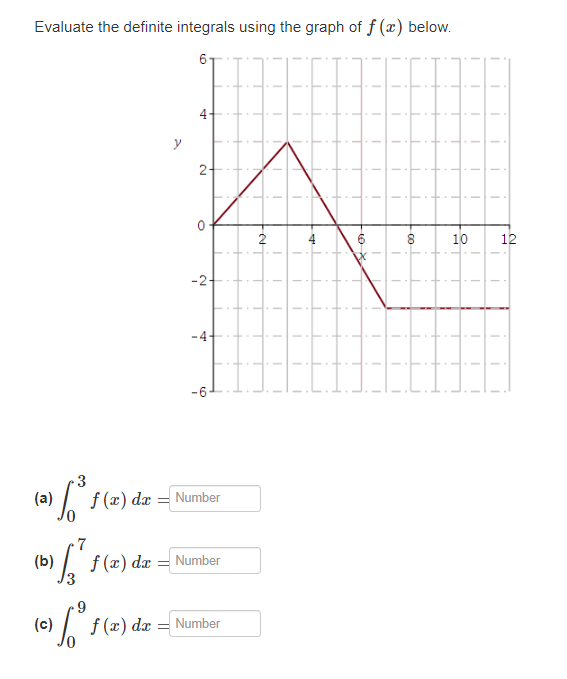
https://i.imgur.com/6O7AmIY.png
I've got no idea where to even start... lmao
 vocal sleetBOT
stark epoch
https://i.imgur.com/6O7AmIY.png
I've got no idea where to even start... lmao
vast shale
vocal sleetBOT
stark epoch
https://i.imgur.com/6O7AmIY.png
I've got no idea where to even start... lmao
vast shale
look at where the function starts and ends
stark epoch
(0, 0) and (12, -3) ?
stark epoch
oh yeah
vast shale
oh nvm, you just have to find the area of the triangle
i thought this was an integration subtractive problem
vocal sleetBOT
@stark epoch Has your question been resolved?
Channel closed
Closed by @stark epoch
Use .reopen if this was a mistake.
Available help channel!
Send your question here to claim the channel.
Remember:
• Ask your math question in a clear, concise manner.
• Show your work, and if possible, explain where you are stuck.
• After 15 minutes, feel free to ping <@&286206848099549185>.
• Type the command .close to free the channel when you're done.
• Be polite and have a nice day!
Read #❓how-to-get-help for further information on how to ask a good question, and about conduct in the question channels.
vast shale
if i say a set A is uncountably infinite then can i say |A| > |N| ? (N is the natural numbers)
vocal sleetBOT
vast shale
if i say a set A is uncountably infinite then can i say |A| > |N| ? (N is the na...
 valid turtle
vast shale
if i say a set A is uncountably infinite then can i say |A| > |N| ? (N is the na...
valid turtle
vast shale
if i say a set A is uncountably infinite then can i say |A| > |N| ? (N is the na...
Haa bhai ig
vocal sleetBOT
@vast shale Has your question been resolved?
 tame brook
vast shale
if i say a set A is uncountably infinite then can i say |A| > |N| ? (N is the na...
tame brook
vast shale
if i say a set A is uncountably infinite then can i say |A| > |N| ? (N is the na...
yes
vocal sleetBOT
Channel closed
Closed due to timeout
Use .reopen if this was a mistake.
vocal sleetBOT
Available help channel!
Send your question here to claim the channel.
Remember:
• Ask your math question in a clear, concise manner.
• Show your work, and if possible, explain where you are stuck.
• After 15 minutes, feel free to ping <@&286206848099549185>.
• Type the command .close to free the channel when you're done.
• Be polite and have a nice day!
Read #❓how-to-get-help for further information on how to ask a good question, and about conduct in the question channels.
 round eagle
 vocal sleetBOT
round eagle
vocal sleetBOT
round eagle
 vocal sleetBOT
@round eagle Has your question been resolved?
vocal sleetBOT
@round eagle Has your question been resolved?
 halcyon wing
draw a diagram, plz
vocal sleetBOT
@round eagle Has your question been resolved?
vocal sleetBOT
Channel closed
Closed due to timeout
Use .reopen if this was a mistake.
Available help channel!
Send your question here to claim the channel.
Remember:
• Ask your math question in a clear, concise manner.
• Show your work, and if possible, explain where you are stuck.
• After 15 minutes, feel free to ping <@&286206848099549185>.
• Type the command .close to free the channel when you're done.
• Be polite and have a nice day!
Read #❓how-to-get-help for further information on how to ask a good question, and about conduct in the question channels.
 hollow zephyr
I'm stuck on a second-order partial derivatives problem. I'm checking my answer with a student from previous semesters with confirmation from their professor, but its seems like there is a difference between my answer and theirs, and I am unsure who is correct.
vocal sleetBOT
hollow zephyr
I'm stuck on a second-order partial derivatives problem. I'm checking my answer ...
hollow zephyr

This is the question
This is my answer

This is their answer

The difference between both is that I do not have 2dz/dx
Is my answer correct, or theirs, and why?
vocal sleetBOT
@hollow zephyr Has your question been resolved?
Channel closed
Closed by @hollow zephyr
Use .reopen if this was a mistake.
Available help channel!
Send your question here to claim the channel.
Remember:
• Ask your math question in a clear, concise manner.
• Show your work, and if possible, explain where you are stuck.
• After 15 minutes, feel free to ping <@&286206848099549185>.
• Type the command .close to free the channel when you're done.
• Be polite and have a nice day!
Read #❓how-to-get-help for further information on how to ask a good question, and about conduct in the question channels.
 north sky
 north sky
so i did get C=48i-42j
and to get the direction its tan-1(y/x)
and when i do that
i get 41.1
which is none
so how's the answer is 320
okay forget about the first question

any idea how to solve this?
vocal sleetBOT
@north sky Has your question been resolved?
 sonic zinc
north sky
any idea how to solve this?
sonic zinc
north sky
any idea how to solve this?
E = 2A-B
Simply put the values
U get E
And then find its magnitude
vocal sleetBOT
@north sky Has your question been resolved?
Channel closed
Closed by @north sky
Use .reopen if this was a mistake.
vocal sleetBOT
Available help channel!
Send your question here to claim the channel.
Remember:
• Ask your math question in a clear, concise manner.
• Show your work, and if possible, explain where you are stuck.
• After 15 minutes, feel free to ping <@&286206848099549185>.
• Type the command .close to free the channel when you're done.
• Be polite and have a nice day!
Read #❓how-to-get-help for further information on how to ask a good question, and about conduct in the question channels.
 pallid ruin
7.3.2 I don't know what to do for this one what does jointly proportional mean
 vocal sleetBOT
pallid ruin
7.3.2 I don't know what to do for this one what does jointly proportional mean
flat whale
pallid ruin
A/bc
vocal sleetBOT
pallid ruin
7.3.2 I don't know what to do for this one what does jointly proportional mean
flat whale
pallid ruin
A/bc
This is a constant yes
pallid ruin
ok ty
flat whale
a = (constant) * b * c
pallid ruin
flat whale
a = (constant) * b * c
Foes that mean a is equal to 2?
flat whale
pallid ruin
Foes that mean a is equal to 2?
How'd you get this
Get in the habit of always explaining your answer
pallid ruin
flat whale
Get in the habit of always explaining your answer
Oh srry

does that make any sense?
flat whale
Yea looks right
vocal sleetBOT
Channel closed
Closed by @pallid ruin
Use .reopen if this was a mistake.
Available help channel!
Send your question here to claim the channel.
Remember:
• Ask your math question in a clear, concise manner.
• Show your work, and if possible, explain where you are stuck.
• After 15 minutes, feel free to ping <@&286206848099549185>.
• Type the command .close to free the channel when you're done.
• Be polite and have a nice day!
Read #❓how-to-get-help for further information on how to ask a good question, and about conduct in the question channels.
 wet shuttle
Help with these 2 questions please
 vocal sleetBOT
wet shuttle
Help with these 2 questions please
vocal sleetBOT
wet shuttle
Help with these 2 questions please
@wet shuttle Has your question been resolved?
vocal sleetBOT
Channel closed
Closed by @wet shuttle
Use .reopen if this was a mistake.
Available help channel!
Send your question here to claim the channel.
Remember:
• Ask your math question in a clear, concise manner.
• Show your work, and if possible, explain where you are stuck.
• After 15 minutes, feel free to ping <@&286206848099549185>.
• Type the command .close to free the channel when you're done.
• Be polite and have a nice day!
Read #❓how-to-get-help for further information on how to ask a good question, and about conduct in the question channels.
 turbid root
i need help with this question. i know i have to use some sort of double angle identity but im stuck as to where to start
 vocal sleetBOT
turbid root
i need help with this question. i know i have to use some sort of double angle i...
vocal sleetBOT
turbid root
i need help with this question. i know i have to use some sort of double angle i...
 reef hare
vocal sleetBOT
reef hare
vocal sleetBOT
Channel closed
Closed by @turbid root
Use .reopen if this was a mistake.
Available help channel!
Send your question here to claim the channel.
Remember:
• Ask your math question in a clear, concise manner.
• Show your work, and if possible, explain where you are stuck.
• After 15 minutes, feel free to ping <@&286206848099549185>.
• Type the command .close to free the channel when you're done.
• Be polite and have a nice day!
Read #❓how-to-get-help for further information on how to ask a good question, and about conduct in the question channels.
vast shale
struggling to wrap my head around this one, why does 7^-36*9^24 = 7^36/9^24?
vocal sleetBOT
vast shale
struggling to wrap my head around this one, why does 7^-36*9^24 = 7^36/9^24?
 outer warren
negative exponent law
$$a^{-n} = \frac{1}{a^n}$$
twin meteorBOT
ℝαμΩℕωⅤ
 vast shale
I understand negative exponents to some degree, its just this one in particular messing me up
outer warren
apply the law ^ above
vast shale
I can simplify it to 9^-24*7^36 or 9^-24/7^-36 but im just confused by this in particular
outer warren
${\red{a}}^{-\blue{n}} = \frac{1}{{\red{a}}^{\blue{n}}} \ \
{\red{9}}^{-\blue{24}} = \what$
twin meteorBOT
ℝαμΩℕωⅤ
 outer warren
you're doing
$$p^n = \frac{1}{p^{-n}}$$
pretty much the same law
vast shale
ohhh okay i think i get it
twin meteorBOT
ℝαμΩℕωⅤ
 vocal sleetBOT
Channel closed
Closed by @jaunty flower
Use .reopen if this was a mistake.
vocal sleetBOT
Available help channel!
Send your question here to claim the channel.
Remember:
• Ask your math question in a clear, concise manner.
• Show your work, and if possible, explain where you are stuck.
• After 15 minutes, feel free to ping <@&286206848099549185>.
• Type the command .close to free the channel when you're done.
• Be polite and have a nice day!
Read #❓how-to-get-help for further information on how to ask a good question, and about conduct in the question channels.
vast shale
hi
vocal sleetBOT
vast shale
hi
vast shale

this equation represents a parabola only for a = 4
how would i calculate that value aljebrically
livid horizon
For a general 2 degree equation to be a parabola,
h²-ab=0
e=1
livid horizon
There would be
I'm not sure about it
But you could take the equation of a line(say, lx+my+n=0) and a focus (p,q), and for a conic, the ratio of distances from the line to the point(e) is fixed
(It's 1 in case for a parabola)
vast shale
yes i know that
vocal sleetBOT
Channel closed
Closed by @gloomy rivet
Use .reopen if this was a mistake.
vocal sleetBOT
Available help channel!
Send your question here to claim the channel.
Remember:
• Ask your math question in a clear, concise manner.
• Show your work, and if possible, explain where you are stuck.
• After 15 minutes, feel free to ping <@&286206848099549185>.
• Type the command .close to free the channel when you're done.
• Be polite and have a nice day!
Read #❓how-to-get-help for further information on how to ask a good question, and about conduct in the question channels.
 oblique gazelle
Does the sum of convergent sequences give a convergent sequence?
paper depot
what do you think
oblique gazelle
paper depot
what do you think
I think not always
paper depot
do you have a counterexample in mind
oblique gazelle
for example a sequence that converges to 0 and another sequence that converges to 1?
both convergent but the sum will be divergent, yeah?
oblique gazelle
because there are two sub sequences that converge to two different numbers
paper depot
you're talking about sum, not interleave
oblique gazelle
oh I have no idea what interleave is. So what do we mean by sum?
vast shale
if $\p{a_n}{n \in \N}$ and $\p{b_n}{n \in \N}$ are convergent real sequences then [
\lim_{n \to \infty} \p{a_n + b_n} = \p{\lim_{n \to \infty} a_n}+ \p{\lim_{n \to \infty} b_n}
]
paper depot
from two sequences a_n and b_n, you construct their sum by just...
oblique gazelle
I think of it like putting the terms of given sequences next to each other
paper depot
adding each corresponding term together
like
a_1+b_1, a_2+b_2, a_3+b_3, a_4+b_4, ...
oblique gazelle
paper depot
adding each corresponding term together
ohh that makes more sense
paper depot
thats what addition means
were you thinking of like
a_1, b_1, a_2, b_2, a_3, b_3, ...?
twin meteorBOT
 vast shale
you can prove the above theorem
oblique gazelle
paper depot
a_1, b_1, a_2, b_2, a_3, b_3, ...?
yep
paper depot
yeah, that's interleave.
paper depot
and THEN you need them both converging to the same point for the interleaved seq to converge obviously.
oblique gazelle
is the sum of divergent series always divergent?
paper depot
no
oblique gazelle
yeah makes sense
paper depot
also are you once again sure that you are not confusing sequences vs. series
oblique gazelle
yeah
so we could make up two divergent sequences such that their sum gave a convergent sequence
that is if we added n1, n2, n3 terms to each other :>
paper depot
you could just take a divergent sequence and then itself times -1.
their sum would be 0
vocal sleetBOT
Channel closed
Closed by @oblique gazelle
Use .reopen if this was a mistake.
vocal sleetBOT
Available help channel!
Send your question here to claim the channel.
Remember:
• Ask your math question in a clear, concise manner.
• Show your work, and if possible, explain where you are stuck.
• After 15 minutes, feel free to ping <@&286206848099549185>.
• Type the command .close to free the channel when you're done.
• Be polite and have a nice day!
Read #❓how-to-get-help for further information on how to ask a good question, and about conduct in the question channels.
 lyric pewter
Find the limit of the function as (x, y) approaches (0, 0).
the answer is D but i dont understand at all
 vocal sleetBOT
lyric pewter
Find the limit of the function as (x, y) approaches (0, 0).
the answer is D but...
lyric pewter
vocal sleetBOT
lyric pewter
Find the limit of the function as (x, y) approaches (0, 0).
the answer is D but...
lyric pewter
so i plug in r^2cos^2(theta)/r^2
and then it cancels out to be cos(cos^2(theta))
which eventually becomes cos(1)
but i dont understand why from that it becomes no limit
 white whale
No, you can't just plug a random function for x and y.
To show how this function has no limit, try lim y-> 0 f(0, y) and lim x->0 f(x,0)
They will disagree in value.
lyric pewter
ooooooooooooooooooooh
i mean i dont think the function is random no? for other questions similar i pugged r etc but i think i understand when you separate the limit like that it makes more sense whyd itd be no limit
 cyan talon
you're getting cos(cos^2(theta)), that's already suspect, depending from which angle you approach (0,0), you'd get different answers
but yeah it's more obvious if you look explicitly at 2 paths which give you different limits
lyric pewter
ahhh yeah i think i see it way better
when you separate the limits it becomes way more obvious
white whale
You can't just substitute x and y with a function over a new variable r because the multivariable limit requires the value to be same over all such functions, and you can get two different values for different functions, which then results in no limit
vocal sleetBOT
Channel closed
Closed by @lyric pewter
Use .reopen if this was a mistake.
Available help channel!
Send your question here to claim the channel.
Remember:
• Ask your math question in a clear, concise manner.
• Show your work, and if possible, explain where you are stuck.
• After 15 minutes, feel free to ping <@&286206848099549185>.
• Type the command .close to free the channel when you're done.
• Be polite and have a nice day!
Read #❓how-to-get-help for further information on how to ask a good question, and about conduct in the question channels.
vocal sleetBOT
twin meteorBOT
Cabbage

 empty frigate
i think doing u = e^x - 1 should work fairly nicely
yep
then for u^5/(u+1) that becomes u^4 - u^3 + u^2 - u + 1 - 1/(u+1) (i think)
it's a little annoying but you only get 5 terms instead of 2^5 terms
vocal sleetBOT
Channel closed
Closed by @modest holly
Use .reopen if this was a mistake.
vocal sleetBOT
Available help channel!
Send your question here to claim the channel.
Remember:
• Ask your math question in a clear, concise manner.
• Show your work, and if possible, explain where you are stuck.
• After 15 minutes, feel free to ping <@&286206848099549185>.
• Type the command .close to free the channel when you're done.
• Be polite and have a nice day!
Read #❓how-to-get-help for further information on how to ask a good question, and about conduct in the question channels.
 swift meteor
x is the month number . y is number of views per month ( on a channel level ) (note y is in terms of 1000000 , i.e y=5478 for
example means 5478000000)
Fit the second degree polynomial/parabola for the collected data i.e. y = ax^2+bx+c using
matrix inversion method set x = {1,2,3,4,5,6,7,8,9,10} set y= {47,39,15,67,47,24,42,32,28,33}
vocal sleetBOT
swift meteor
x is the month number . y is number of views per month ( on a channel level ) (n...
@swift meteor Has your question been resolved?
vocal sleetBOT
@swift meteor Has your question been resolved?
vocal sleetBOT
@swift meteor Has your question been resolved?
vocal sleetBOT
Channel closed
Closed due to timeout
Use .reopen if this was a mistake.
Available help channel!
Send your question here to claim the channel.
Remember:
• Ask your math question in a clear, concise manner.
• Show your work, and if possible, explain where you are stuck.
• After 15 minutes, feel free to ping <@&286206848099549185>.
• Type the command .close to free the channel when you're done.
• Be polite and have a nice day!
Read #❓how-to-get-help for further information on how to ask a good question, and about conduct in the question channels.
 teal saffron
 vocal sleetBOT
teal saffron
vocal sleetBOT
teal saffron
 turbid forum
 vocal sleetBOT
Channel closed
Closed by @teal saffron
Use .reopen if this was a mistake.
vocal sleetBOT
Available help channel!
Send your question here to claim the channel.
Remember:
• Ask your math question in a clear, concise manner.
• Show your work, and if possible, explain where you are stuck.
• After 15 minutes, feel free to ping <@&286206848099549185>.
• Type the command .close to free the channel when you're done.
• Be polite and have a nice day!
Read #❓how-to-get-help for further information on how to ask a good question, and about conduct in the question channels.
 proud crypt

 vocal sleetBOT
proud crypt
proud crypt
vocal sleetBOT
proud crypt
proud crypt
im not sure what to do now after drawing out the function
vocal sleetBOT
@proud crypt Has your question been resolved?
proud crypt
<@&286206848099549185>
 jagged scroll
look at the three intervals. 0 to -1, -1 to -3 and -3 to -infinity.
at these points which function is greater than the other.
proud crypt
ay i didnt ask for this helper
vocal sleetBOT
@proud crypt Has your question been resolved?
Channel closed
Closed by @proud crypt
Use .reopen if this was a mistake.
Available help channel!
Send your question here to claim the channel.
Remember:
• Ask your math question in a clear, concise manner.
• Show your work, and if possible, explain where you are stuck.
• After 15 minutes, feel free to ping <@&286206848099549185>.
• Type the command .close to free the channel when you're done.
• Be polite and have a nice day!
Read #❓how-to-get-help for further information on how to ask a good question, and about conduct in the question channels.
 vast remnant
How would I evaluate this limit?
 vocal sleetBOT
vast remnant
How would I evaluate this limit?
vocal sleetBOT
vast remnant
How would I evaluate this limit?
 lucid bane
vast remnant
How would I evaluate this limit?
lucid bane
vast remnant
How would I evaluate this limit?
start by assuming the limit exists, and taking logs of both sides.
vocal sleetBOT
@vast remnant Has your question been resolved?
Channel closed
Closed by @vast remnant
Use .reopen if this was a mistake.
Available help channel!
Send your question here to claim the channel.
Remember:
• Ask your math question in a clear, concise manner.
• Show your work, and if possible, explain where you are stuck.
• After 15 minutes, feel free to ping <@&286206848099549185>.
• Type the command .close to free the channel when you're done.
• Be polite and have a nice day!
Read #❓how-to-get-help for further information on how to ask a good question, and about conduct in the question channels.
 vapid wedge
$lim x->0+ \frac{sin(ax)}{x^3+x}$
vocal sleetBOT
vapid wedge
$lim x->0+ \frac{sin(ax)}{x^3+x}$
twin meteorBOT
Merineth
 twin meteorBOT
Merineth
 vapid wedge
How do i determine what a should be
livid horizon
twin meteor
**Merineth**
Is that the right hand limit at x=0?
vapid wedge
no
livid horizon
Oh ok
vapid wedge
$lim x->0^+ \frac{sin(ax)}{x^3+x}$
livid horizon
Anyway so
twin meteorBOT
Merineth
 livid horizon
You can rewrite the denominator as x(x²+1) right?
vapid wedge
Yes
vapid wedge
I tried that however
$\frac{sin(ax)}{x(x^2+x)} = \frac{sin(ax)}{x} * \frac{1}{x^2+1}$
twin meteorBOT
Merineth
 livid horizon
Lim of sinx/x is 1 as x tends to 0
livid horizon
twin meteor
**Merineth**
Yes but
livid horizon
livid horizon
Lim of sinx/x is 1 as x tends to 0
Note that here the term inside sin and the denominator x have to be the same
So if the term inside sin is ax, the denominator has to be ax too for the limit to be 1
vapid wedge
ooooooh
so the variable in sin(ax) and the denominator has to have the same variable
livid horizon
Yeah
vapid wedge
$\frac{sin(ax)}{x(x^2+x)} = \frac{sin(ax)}{ax} * \frac{1}{x^2+1}$
twin meteorBOT
Merineth
 livid horizon
twin meteor
**Merineth**
livid horizon
twin meteor
**Merineth**
Multiply a in the numerator too
vapid wedge
why?
livid horizon
Coz to make the denominator same, you should multiply with a no both in numerator and denominator
Or else the fraction will change
For ex
vapid wedge
This is what we are trying to accomplish, right?
 livid horizon
$\frac{2}{3}$ is the same as $\frac{22}{32}$ and not $\frac{2}{3*2}$
twin meteorBOT
Lorentz
 vapid wedge
Yes, but if we multiply both nominator and denominator with a we'll not get the formula
livid horizon
twin meteor
**Merineth**
Same with here
vapid wedge
vapid wedge
This is what we are trying to accomplish, right?
this formula