#help-17
1 messages · Page 65 of 1
 long flame
 twin meteorBOT


 Requested by martymotown
 vocal sleetBOT
Channel closed
Closed by @long flame
Use .reopen if this was a mistake.
 Available help channel!
Send your question here to claim the channel.
Remember:
• Ask your math question in a clear, concise manner.
• Show your work, and if possible, explain where you are stuck.
• After 15 minutes, feel free to ping <@&286206848099549185>.
• Type the command .close to free the channel when you're done.
• Be polite and have a nice day!
Read #❓how-to-get-help for further information on how to ask a good question, and about conduct in the question channels.
 marsh bluff
how is expansion of binomials related to combination?
 round plover
if you look at the binomial (a+b)^n
when you're expanding it, you're basically picking between a or b, n times
if you pick a, k times, you have b n-k times, so you're on the a^kb^{n-k} term
marsh bluff
what do you mean by picking
round plover
but there are n choose k ways to pick k as from the n total brackets
(a+b)^n = (a+b)(a+b)...(a+b)
marsh bluff
ye
round plover
you can multiply this out by picking either a or b from each bracket
 civic otter
marsh bluff
what do you mean by picking
civic otter
marsh bluff
what do you mean by picking
Choosing, selecting, taking
marsh bluff
i dont understand
round plover
if you pick a every time, you get a * a * a * ... * a = a^n
marsh bluff
why are picking it out
marsh bluff
yes
round plover
the a*a term is the same as picking a from both brackets
we have to multiply every term in every bracket by the terms in every other bracket
where do we get a*a + a*b + b*a + b*b from
marsh bluff
from a(a+b)+b(a+b)
marsh bluff
ye
round plover

you multiply the first terms of each (same as "picking" the first term of each bracket, then multiplying them), then multiply the first term of the first bracket and last term of the second bracket, etc.
each multiplication requires picking a term from each bracket
in the longer set of brackets, (a+b)(a+b)(a+b)...(a+b), it's the same thing
you need to multiply a term from each bracket, which is the same as picking a or b for each bracket
marsh bluff
ok
round plover
so a term in the full expansion comes from a choice of a or b from each bracket
if you pick k a's, there must be n-k b brackets remaining
so you have an a^kb^{n-k} term
but there are n choose k ways to pick the k a's from the n brackets
marsh bluff
ok this is confusing
round plover
so this term has an additional coefficient of nCk
marsh bluff
round plover
so a term in the full expansion comes from a choice of a or b from each bracket
im confused on this part
what is the a term?
the a^2 term?
marsh bluff
ok
marsh bluff
ok
round plover
a term in the expansion of this comes from picking some x or y
like, with (x+y)(x+y), we can pick x from both
to get x^2
or x from first, y from second to get xy
etc.
so each term, like x^2, xy, y^2, comes from these choices
in the general case (x+y)(x+y)...(x+y) with n brackets
we can pick x from k of these brackets to get x^k
but if we didn't pick x, that means we picked y for that bracket
marsh bluff
round plover
a term in the expansion of this comes from picking some x or y
i think u mean a term in the expansion of this comes from picking some an x with some other x or y
why is it x or y
round plover
I mean x or y from each bracket
marsh bluff
and it x and some other term
round plover
it'll come from one choice of x or y from each of the n brackets
we can look at the cubic case: (x+y)(x+y)(x+y)
if we pick x from all 3, we get x^3
if we pick x from the first, y from the second and third, we get xy^2
right?
round plover
so with n brackets, (x+y)(x+y)(x+y)...(x+y)
if we pick k x's from among the n brackets
that means there are n-k brackets left over from which we pick y
so we have a x^k y^(n-k) term
marsh bluff
round plover
if we pick *k* x's from among the n brackets
i cant understand the k x's part
what does k x's mean
round plover
we pick x from k of the brackets
where k is just some number less than n
in the cubic case, we had k = 3, which is picking x from all 3
and k = 1, which is picking x from 1 of the brackets
it just means how many x's you have
marsh bluff
so n=k
round plover
no
marsh bluff
since n is also the number of brackets
round plover
in the cubic case, we could pick x from the first, and y from the last two
to get xy^2
this is an example of k=1
marsh bluff
ok
round plover
if we pick x from exactly k brackets
there are n-k brackets remaining from which we pick y
in the cubic case of n=3 and k=1, we had xy^2; note that 2 = 3-1
marsh bluff
ok
round plover
round plover
in the cubic case, we could pick x from the first, and y from the last two
in this example
we have n=3 (because we have 3 brackets)
and k=1, because we picked 1 x
marsh bluff
k can be 1, 2 or 3
round plover
if we don't pick x from a bracket, we have to pick y from that bracket
because we need something from each bracket
round plover
no
even when we had k = 1
we picked x from one of the brackets
that means we need y from the other 2
round plover
yes
but I'm saying you must have y in there even if k is not 0
we had y in there when k = 1
the only time you don't have any y is when you pick x from every bracket, so k=n
marsh bluff
ok
round plover
the number of x and y must add up to the number of brackets
because you need exactly one x or y from each bracket
so if you have n brackets, and you pick x, k times
you have n-k brackets where you must pick y
because k + (n-k) = n [read this as number of x + number of y = number of brackets]
is this okay?
marsh bluff
ye
round plover
gives a $x^ky^{n-k}$ term
twin meteorBOT
Desync
 marsh bluff
yes
round plover
but, there's more than 1 way to pick x k times from n brackets
there are exactly n choose k ways
wait, I'm assuming you know the choose function
since you asked about combinatorics
is this correct?
round plover
alright cool
marsh bluff
theres 1 than 1 way to pick x k times from n brackets
marsh bluff
ok
round plover
and say we have k=1
so we want 1 x
well, we could pick the x from the first bracket
or from the second
or from the third
there are 3 choose 1 ways to pick that single x from the 3 brackets
round plover
so more generally, there are n choose k ways to pick k x's from the n brackets
because we're choosing k brackets to pick x from out of n total brackets
marsh bluff
ye
round plover
that's exactly the binomial coefficients
marsh bluff
ye but why
why does it represent the coefficient of the terms
if its telling us the number of ways to pick x from the brackets
round plover
okay, so in the cubic case
we can pick x from the first bracket to get x * y * y = xy^2
marsh bluff
or
round plover
or we could pick x from the second to get y * x * y = yxy = xy^2
marsh bluff
yyx
round plover
yes
marsh bluff
3 choose 1
round plover
so that 3 is the coefficient
and it matches up with the number of ways to pick one x from three brackets
marsh bluff
yes
round plover
so the number of ways of picking
gives the coefficient on xy^2 when you sum them upp
marsh bluff
ok
round plover
because if you have 3 ways of picking, you have 3 copies of xy^2
round plover
the "ways of picking"
is given by 3 choose 1
because the choose function is defined to give the number of ways to pick
so if we have (3 choose 1) ways of picking
we have (3 choose 1) copies of xy^2
marsh bluff
ye
round plover
so the coefficient is (3 choose 1)
round plover
pascal's triangle is just a way of writing out (n choose k) for various values of n and k in a systematic way
marsh bluff
how does a triangle made from adding the numbers above it gives us the coefficient of binomial expansions
why not give us the coefficient of trinomial expansion
oh u know
is there a trinomial theorem?
round plover
there is
round plover
there's a general multinomial theorem
civic otter
marsh bluff
how does a triangle made from adding the numbers above it gives us the coefficie...
It's a property of the binomial coefficient (which in turn arises from the factorials)
round plover
I guess it'd be more of a tetrahedron
marsh bluff
oh ok
round plover
I don't know how to draw one, and I don't think they're really used in practice
because we have a formula for the coefficients
marsh bluff
maybe it can tell us some number sequence
round plover
you can go explore that if you wish
marsh bluff
ok
jk
thanks for rthe help btw
i really appreciate your help
and it really makes me understandthe topic better
round plover
np
combinatorics is fun, but a lot of the proofs are really condensed and hard to get into
round plover
you too, take care
remember to .close the channel if you don't have any more questions
vocal sleetBOT
Channel closed
Closed by @marsh bluff
Use .reopen if this was a mistake.
round plover
it's .reopen
marsh bluff
oh ok
civic otter
.reopen
vocal sleetBOT
✅
round plover
did you have a follow up?
vocal sleetBOT
@marsh bluff Has your question been resolved?
vocal sleetBOT
Channel closed
Closed due to timeout
Use .reopen if this was a mistake.
Available help channel!
Send your question here to claim the channel.
Remember:
• Ask your math question in a clear, concise manner.
• Show your work, and if possible, explain where you are stuck.
• After 15 minutes, feel free to ping <@&286206848099549185>.
• Type the command .close to free the channel when you're done.
• Be polite and have a nice day!
Read #❓how-to-get-help for further information on how to ask a good question, and about conduct in the question channels.
 elfin moon
 vocal sleetBOT
elfin moon
elfin moon
vocal sleetBOT
elfin moon
elfin moon
Here given rank of matric is 2
So i tried to 3×3 and determinant 0
How to find T it then

 full hatch
elfin moon
So i tried to 3×3 and determinant 0
full hatch
elfin moon
So i tried to 3×3 and determinant 0
Is the determinante only 0 for t=0?
 golden night
find the det in terms of t
 full hatch
Wait are those two different matrizes?
 woeful cloak
You should use the word submatrix here to fit the context. Saying "matrix" for a submatrix will confuse everyone
elfin moon
 woeful cloak
elfin moon
woeful cloak
elfin moon
anyway, this is not 0 for just t=0, and note that this is not the only submatrix of dimension 3 either
woeful cloak
yes, t=3 should be the only values that makes every submatrix of dimension 3 have a determinant of 0
 woeful cloak
well I don't see any other way than doing row operations. You could find the determinant of E if you are eager to do it by hand
woeful cloak
There is probably a way of making two of any columns/rows be dependent, but then that would involve solving a system, so that's not really any better
anyway, start out by choosing a pivoting column
elfin moon
Multiplying first row with-1 and adding gives many zeroes
I don't know if it's a good idea
woeful cloak
well the first thing to notice here is that when t=0, we will have all of the rows/columns be independent, meaning the rank of this matrix is 4 in this case. So, now we want to check for when t!=0. What this means is that you can now multiply/divide a row by t without worrying if it'll change the result
so now, can you find operations that makes all of the elements in the first column (except for the first one) to be 0?
woeful cloak
ok, I need some confirmation first, are we doing row operations or column operations?
elfin moon
I was doing row operations but when you are suggesting column operations
woeful cloak
woeful cloak
anyway, start out by choosing a pivoting column
oh oops, I meant this to be a pivoting row, excuse me there
technically doing column or row operations is fine, I just need us to agree on one
elfin moon
Let's go with row
woeful cloak
alright then
anyway, let's continue with the case when t!=0.
As you can see, a row operation R3-R4->R4 will make the first and second element on row 4 to be 0. Continue this with row 2 and 3 makes the first element on row 3 be 0. Now how can we make the first element on row 2 be 0?
elfin moon
If we multiply first row 2 with a t then subtraction with first row
elfin moon
 woeful cloak
alright looks good
now before moving on, let's see what happens when t=1
what would be the rank of E when t=1?
elfin moon
Rank will be <=3
woeful cloak
yes, but further note that when t=1, the bottom three rows will be all 0, what this means is that there is only one vector that spans this matrix
meaning the rank of E is 1 when t=1
so now we need to consider the case where t!=0,1
elfin moon
Yes rank will be 1
woeful cloak
you can see what the pattern should be, just keep working down the rows and consider the cases until you have reached the final row
shouldn't be too bad since our matrix is very nice
elfin moon
Can you elaborate more about cases?
What do you want me to do with rows?
If I put t=0
Then rank is 0
Null matrix
woeful cloak
again no, like I have said, when t=0, all of the row vectors are independent
this is trivial when you write it out, so in this case the rank is 4. Meaning you don't care about the value t=0 anymore
what this essential does is it allows you to multiply by the scalar t. You usually can't do this when t=0, because then that operation wouldn't make sense
so a similar thing happens for t=1, what this just does is to make sure that t=1 is not a value that we care about, so we can multiply by the scalar (t-1) or (1-t)
our goal is still trying to row reduce the matrix
(note that you only need to do one more row operation and you are good to go)
elfin moon
Now idea
Because each operation is disappearing leading zeroes
And this is taking so much time for me to solve just 5 minute thing
.close
vocal sleetBOT
Channel closed
Closed by @elfin moon
Use .reopen if this was a mistake.
vocal sleetBOT
Available help channel!
Send your question here to claim the channel.
Remember:
• Ask your math question in a clear, concise manner.
• Show your work, and if possible, explain where you are stuck.
• After 15 minutes, feel free to ping <@&286206848099549185>.
• Type the command .close to free the channel when you're done.
• Be polite and have a nice day!
Read #❓how-to-get-help for further information on how to ask a good question, and about conduct in the question channels.
 unborn locust
 vocal sleetBOT
unborn locust
unborn locust
vocal sleetBOT
unborn locust
unborn locust
Can someone teach me the steps for this?
 boreal path
@unborn locust
unborn locust
Yes
boreal path
How do you find the area of a square base 2 and height 3
unborn locust
2x3
unborn locust
2y+3
boreal path
remember multiplication doesn’t matter the order
2x3 equals 3x2 so it doesn’t matter what you choose as the bad
now what’s our heigh
t
if you chose 2y+3 as base
unborn locust
y-1
boreal path
So we just multiply them
unborn locust
Yeah
boreal path
Do you know to multiply (2y+3)(y-1)
unborn locust
Wdym?
boreal path
Like how to expand those brackets
boreal path
What did you get
unborn locust
2y^2 - 2y + 3y-3
boreal path
Collecting like terms what are we left with ?
unborn locust
Could you expand on that?
boreal path
Collecting like terms is like
x+3x+3 simplifies to 4x+3
The terms ahve the same pronumeral which is x
so we just add them
unborn locust
Oh so like 2y2 - 2y + 3y
boreal path
That simplifies to what
unborn locust
2y^2 - 5y = 3y
boreal path
How’d you get that
boreal path
unborn locust
2y^2 - 2y + 3y-3
go back here
and just simplify like you normally do
i think i confused you
unborn locust
2y^2 - 5y - 3?
unborn locust
Ohhh right nvm
boreal path
Do you underdtand the problem?
boreal path
1y is equal to y
unborn locust
Yeah
unborn locust
How would I put that in the equation?
unborn locust
Oh right
boreal path
It’s simply 2y^2+y-3
unborn locust
Oh ok
boreal path
as the expression for the area
unborn locust
Ohh
boreal path
hope this jelped
boreal path
Nope
unborn locust
Is that the final answer?
boreal path
ur done
boreal path
You can also solve similar problems
for example if you are asked that for a ttiangle
right angled
we know the area formula for a triangle
so we do the same thing
vocal sleetBOT
Channel closed
Closed by @unborn locust
Use .reopen if this was a mistake.
Available help channel!
Send your question here to claim the channel.
Remember:
• Ask your math question in a clear, concise manner.
• Show your work, and if possible, explain where you are stuck.
• After 15 minutes, feel free to ping <@&286206848099549185>.
• Type the command .close to free the channel when you're done.
• Be polite and have a nice day!
Read #❓how-to-get-help for further information on how to ask a good question, and about conduct in the question channels.
 naive sable
https://youtu.be/Ip3X9LOh2dk?t=504
I don't understand what he meant by this -- "If both b and c are non-zero then that b*c term tells you how much this parallelogram is stretched or squished in the diagonal direction."
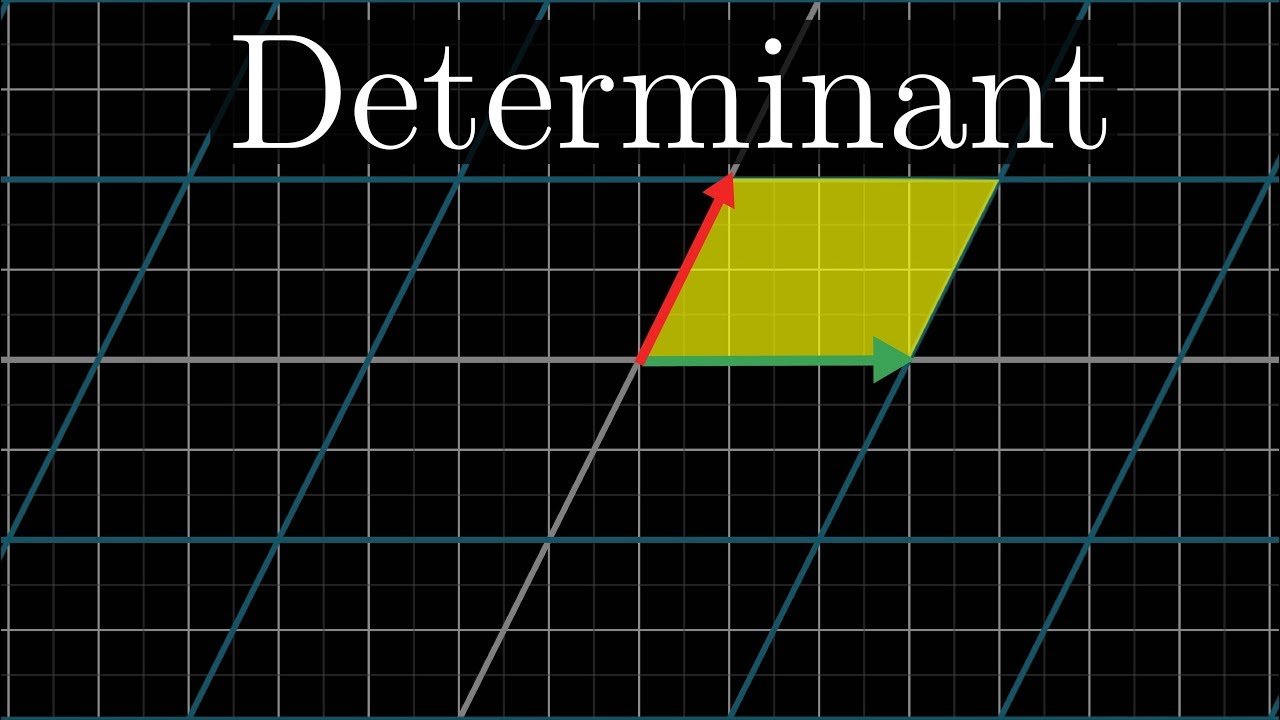
The determinant measures how much volumes change during a transformation.
Help fund future projects: https://www.patreon.com/3blue1brown
An equally valuable form of support is to simply share some of the videos.
Home page: https://www.3blue1brown.com/
Full series: http://3b1b.co/eola
Future series like this are funded by the community, throug...
vocal sleetBOT
naive sable
https://youtu.be/Ip3X9LOh2dk?t=504
I don't understand what he meant by this -- "...
 errant warren
it is more of a rough intuition than an exact description, but as the terms b and c grow very large compared to a and d the parallelogram will sort of tend to be longer and thinner
if you consider how the matrix translates the vectors (0,1) and (1,0) which will end up being the sides of the parallelogram that is perhaps a way to visualise it
naive sable
hmm also ig the orientation of the area bc is opposite (to the area ad) so it's subtracted from b*d ?
errant warren
yeah that’s a good way to describe it
vocal sleetBOT
Channel closed
Closed by @naive sable
Use .reopen if this was a mistake.
Available help channel!
Send your question here to claim the channel.
Remember:
• Ask your math question in a clear, concise manner.
• Show your work, and if possible, explain where you are stuck.
• After 15 minutes, feel free to ping <@&286206848099549185>.
• Type the command .close to free the channel when you're done.
• Be polite and have a nice day!
Read #❓how-to-get-help for further information on how to ask a good question, and about conduct in the question channels.
 remote vector
Hey, I'm trying to understand a proof which I found online and I'm stuck at an apperently fact, namely that the red and the yellow angles are the same. Unfortunately the proof doesn't discuss it further and I can't figure out why the two angles of the same color are the same
vocal sleetBOT
remote vector
Hey, I'm trying to understand a proof which I found online and I'm stuck at an a...

 vocal sleetBOT
@remote vector Has your question been resolved?
vocal sleetBOT
@remote vector Has your question been resolved?
 frozen cave
cyclic quadrilaterals my frend
BCQP is cyclic
so opposite angles are supplementary
cyclic means it can be inscribed in a cicrcle
and the diagram shows it being inscribed in a circle
@remote vector
so BPQ + BCQ = 180 so BPQ = 180 - BCQ = BCA
so BPQ = BCA
the yellow angles are equal
same for the red
does this answer your question?

In Euclidean geometry, a cyclic quadrilateral or inscribed quadrilateral is a quadrilateral whose vertices all lie on a single circle. This circle is called the circumcircle or circumscribed circle, and the vertices are said to be concyclic. The center of the circle and its radius are called the circumcenter and the circumradius respectively. Ot...
vocal sleetBOT
@remote vector Has your question been resolved?
remote vector
Yes, thanks a lot!
vocal sleetBOT
Channel closed
Closed by @remote vector
Use .reopen if this was a mistake.
vocal sleetBOT
Available help channel!
Send your question here to claim the channel.
Remember:
• Ask your math question in a clear, concise manner.
• Show your work, and if possible, explain where you are stuck.
• After 15 minutes, feel free to ping <@&286206848099549185>.
• Type the command .close to free the channel when you're done.
• Be polite and have a nice day!
Read #❓how-to-get-help for further information on how to ask a good question, and about conduct in the question channels.
 vast shale
Tried integrating a semi circle got this weird thign
 vocal sleetBOT
vast shale
Tried integrating a semi circle got this weird thign
vocal sleetBOT
vast shale
Tried integrating a semi circle got this weird thign

 vast shale
the divison shouldn't be there right?
 blissful sentinel
why are there degrees 
vast shale
$$ u = x \frac{90}{r}$$
$$ du = \frac{90}{r} dx$$
$$ dx = \frac{r}{90}du$$
$$\frac{2\pi r^2}{90} \int_0^r cos(u) du$$
twin meteorBOT
 vast shale
I did $$\frac{90}{r}$$ because that's how you umm
twin meteorBOT
 vast shale
you
find the radius of a cross section
with cos()
i think
cos(90) = 0 which would be the very end of the semi circle
blissful sentinel
Is your cosine in degrees??
If so sine is NOT an antiderivative
By the chain rule, the derivative of sine (in degrees) would be pi/180 cos (in degrees)
vast shale
blissful sentinel
If so sine is NOT an antiderivative
 wut?
wut?
blissful sentinel
The whole reason to use radians is that the derivative of cosine is -sine and the derivative of sine is cosine
If you scale the input differently, you need to use the chain rule to calculate what the result should be
blissful sentinel
It works the same as any other type of scaling a function
👍
No problem
It can be trippy
vast shale
.close
vocal sleetBOT
Channel closed
Closed by @torpid horizon
Use .reopen if this was a mistake.
vocal sleetBOT
Available help channel!
Send your question here to claim the channel.
Remember:
• Ask your math question in a clear, concise manner.
• Show your work, and if possible, explain where you are stuck.
• After 15 minutes, feel free to ping <@&286206848099549185>.
• Type the command .close to free the channel when you're done.
• Be polite and have a nice day!
Read #❓how-to-get-help for further information on how to ask a good question, and about conduct in the question channels.
 strange tiger
hello could i get help with this question? the proposition hint is included

 vocal sleetBOT
strange tiger
hello could i get help with this question? the proposition hint is included
strange tiger
vocal sleetBOT
strange tiger
hello could i get help with this question? the proposition hint is included
strange tiger
used lim laws to get to here but now i am stumped 💀

 ebon rapids
strange tiger
used lim laws to get to here but now i am stumped 💀
ebon rapids
strange tiger
used lim laws to get to here but now i am stumped 💀
Ok, so this is a misguided idea
You can’t use limit laws in the original just yet because your denominator will approach 0
strange tiger
ohh
ebon rapids
The limits won’t exist if you split it like this
strange tiger
my original idea was to say that since f(x) is a polynomial u could simplify the expression in the numerator and then factorize
and pray to god that one of the factors are x-3
 river minnow
What should the nominator approach so that the overall limit may exist given the denominator approaches 0?
ebon rapids
The key is to use the proposition hint
strange tiger
river minnow
What should the nominator approach so that the overall limit may exist given the...
both the top and bottom has to be 0 for the limit to exist?
sometimes
river minnow
Yeah, so f(x) - x - 4 should approach 0 as x -> 3
twin meteorBOT
CST
 ebon rapids
You should be able to answer the question by now
vocal sleetBOT
Channel closed
Closed by @strange tiger
Use .reopen if this was a mistake.
strange tiger
wow
vocal sleetBOT
Available help channel!
Send your question here to claim the channel.
Remember:
• Ask your math question in a clear, concise manner.
• Show your work, and if possible, explain where you are stuck.
• After 15 minutes, feel free to ping <@&286206848099549185>.
• Type the command .close to free the channel when you're done.
• Be polite and have a nice day!
Read #❓how-to-get-help for further information on how to ask a good question, and about conduct in the question channels.
 urban obsidian
 vocal sleetBOT
urban obsidian
urban obsidian
vocal sleetBOT
urban obsidian
urban obsidian
how would i do this?
Well intuitively i made the inscribed squares vertexes touch the midpoints of the bigger square
but idk how i could justify that
 rugged orchid
Have you learned calculus
urban obsidian
rugged orchid
Have you learned calculus
sure but i have like 1 minute for the problem
surely i can't be lost in the weeds of optimization
rugged orchid
That’s different to having to justify it
You just need to find the area

This is obvious yes?
vocal sleetBOT
@urban obsidian Has your question been resolved?
urban obsidian
rugged orchid
yes
rugged orchid
Use Pythagoras

If it’s multi choice
You just need to find the answer asap
Justification is not needed
But if you did want to justify I would probably use calculus
urban obsidian
rugged orchid
You just need to find the answer asap
oh no
i know how to find the area
of the inscribed square
i mean how do i know
which one minimizes the area?
like what orientation
urban obsidian
rugged orchid
Use Pythagoras
i did this too and found the area
it was correct but it was just a hunch tbh
rugged orchid
You just need a hunch
For MCQ
If you want to justify it you probably need calculus
urban obsidian
rugged orchid
If you want to justify it you probably need calculus
by hunch you mean
i assumed the orientation was 90 degree
well "sleeping rectangle"
whatever you call it
exactly what you drew tbh
rugged orchid
rugged orchid
Use Pythagoras
Like this right?
urban obsidian
is there anything i can "memorize" though?
rugged orchid
Yeah
urban obsidian
rugged orchid
Like this right?
yeah
i can do calc yeah but is there any facts i can memroize
rugged orchid
I mean that’s the obvious hunch
urban obsidian
about maximizing shit
urban obsidian
rugged orchid
I mean that’s the obvious hunch
it also is the easiest one ig lol
rugged orchid
I guess you can try to visualise it
They won’t make it too hard in mcq
That’s not the point of mcq
MCQ pretty much (in my experience) are always the ones where they mostly have tricks you can use
Like there’s a fast and short way
And if you do the short way it gives you more time for other questions
urban obsidian
rugged orchid
MCQ pretty much (in my experience) are always the ones where they mostly have tr...
you're right
i just saw some people were spreading "concepts" relevant to this

something like this
ofc i guess i could prove via calculus
or could i
i might be rusty actually so maybe not
but where does this originate from
rugged orchid
Well all this can be proven via calculus
As I’m dumb I would do it with calculus
But maybe there’s another way geometrically
I’m too dumb to see one if they exist
urban obsidian
rugged orchid
As I’m dumb I would do it with calculus
welp guess i'll do that as well then
rugged orchid
rugged orchid
As I’m dumb I would do it with calculus
Mainly because I know I can do it with calculus and I won’t run into problems
urban obsidian
onc ei prove it once ig it gets easier to remember
urban obsidian
rugged orchid
Mainly because I *know* I can do it with calculus and I won’t run into problems
i could probably but not sure tbh, i'll try and see
was looking more for geometric proof ig
rugged orchid
Although I do remember that the biggest volume for surface area is a sphere
And likewise perimeter and area for circle
Because bubbles are spherical
It’s got the least potential energy or something
Something physics something idk
urban obsidian
hmmmmm
welp lemme try
thanks for the lead
i guess you're right
in that the orientation that you chose
rugged orchid
There’s also one about hexagons
urban obsidian
it's probably the easiest to do in terms of finding the area
rugged orchid
They tile the plane with the least perimeter
urban obsidian
ooo never heard of that tbh
rugged orchid
Something about honeycombs I think
vocal sleetBOT
Channel closed
Closed by @urban obsidian
Use .reopen if this was a mistake.
rugged orchid
But this is really just random reading and stuff so I don’t expect schools to expect this to be just a known fact unless you specifically covered this
vocal sleetBOT
Available help channel!
Send your question here to claim the channel.
Remember:
• Ask your math question in a clear, concise manner.
• Show your work, and if possible, explain where you are stuck.
• After 15 minutes, feel free to ping <@&286206848099549185>.
• Type the command .close to free the channel when you're done.
• Be polite and have a nice day!
Read #❓how-to-get-help for further information on how to ask a good question, and about conduct in the question channels.
 craggy imp
 vocal sleetBOT
craggy imp
craggy imp
vocal sleetBOT
craggy imp
craggy imp
Don’t know what to do
 lilac plaza
,rccw
twin meteorBOT
 lilac plaza
I'm not sure but does knowing 2sin(Φ)cos(Φ) = sin(2Φ) help..?
 sudden cloud
lilac plaza
I'm not sure but does knowing 2sin(Φ)cos(Φ) = sin(2Φ) help..?
sudden cloud
lilac plaza
I'm not sure but does knowing 2sin(Φ)cos(Φ) = sin(2Φ) help..?
Hi
Use this formula
Products to sum
Nvm I read the q wrong
 sudden cloud
👍
craggy imp
i will try doing it now'
craggy imp
i got it it is D
 onyx gulch
twin meteor
onyx gulch
twin meteor
 craggy imp
thanks mate
onyx gulch

sudden cloud
craggy imp
i got it it is D
Yup 👍
craggy imp
thanks
vocal sleetBOT
@craggy imp Has your question been resolved?
Channel closed
Closed by @craggy imp
Use .reopen if this was a mistake.
Available help channel!
Send your question here to claim the channel.
Remember:
• Ask your math question in a clear, concise manner.
• Show your work, and if possible, explain where you are stuck.
• After 15 minutes, feel free to ping <@&286206848099549185>.
• Type the command .close to free the channel when you're done.
• Be polite and have a nice day!
Read #❓how-to-get-help for further information on how to ask a good question, and about conduct in the question channels.
vocal sleetBOT
 open spade
vast shale
can anyone help me
vocal sleetBOT
open spade
vast shale
can anyone help me
vocal sleetBOT
Channel closed
Closed due to the original message being deleted
vocal sleetBOT
Available help channel!
Send your question here to claim the channel.
Remember:
• Ask your math question in a clear, concise manner.
• Show your work, and if possible, explain where you are stuck.
• After 15 minutes, feel free to ping <@&286206848099549185>.
• Type the command .close to free the channel when you're done.
• Be polite and have a nice day!
Read #❓how-to-get-help for further information on how to ask a good question, and about conduct in the question channels.
 twin citrus
 vocal sleetBOT
twin citrus
twin citrus
vocal sleetBOT
twin citrus
twin citrus
and then autor writes this :

so my issue here is that in the first formula x goes to 0 from negative direction as well
and therefore I can not understand how we get second equation from the first one
 flat whale
twin citrus
and therefore I can not understand how we get second equation from the first one
flat whale
twin citrus
and therefore I can not understand how we get second equation from the first one
do x = -1/n
 flat whale
well you wanted x from 0^-
so x=-1/n will work for that direction
what does n approach?
writing n -> +- inf doesn't quite make sense

 peak matrix
twin citrus
and therefore I can not understand how we get second equation from the first one
peak matrix
twin citrus
and therefore I can not understand how we get second equation from the first one
1st limit converges to e => 1st limit from positive direction converges to e => 2nd limit converges to e
Shouldn't this be sufficient actually?
flat whale
twin citrus
but i want to get second formula of e
you already have 2?
flat whale
twin citrus
not this
why
peak matrix
twin citrus
and therefore I can not understand how we get second equation from the first one
 I think they just didnt understand how was the second formula derived from the first one
flat whale
oh
twin citrus
flat whale
you already have 2?
these two are not the same
 flat whale
twin citrus
flat whale
twin citrus
is that right? you don't understand how to get eqn 9?
right. so what's your question
twin citrus
i want to get secod eq from the first
peak matrix
twin citrus
and therefore I can not understand how we get second equation from the first one
The fact that first limit converges from both negative and positive direction is more than sufficient to conclude that the second limit converges
To make that conclusion, you need just the positive direction
twin citrus
peak matrix
The fact that first limit converges from both negative and positive direction is...
aa that is good explanation
i understand now
tnx
.close
vocal sleetBOT
Channel closed
Closed by @twin citrus
Use .reopen if this was a mistake.
Available help channel!
Send your question here to claim the channel.
Remember:
• Ask your math question in a clear, concise manner.
• Show your work, and if possible, explain where you are stuck.
• After 15 minutes, feel free to ping <@&286206848099549185>.
• Type the command .close to free the channel when you're done.
• Be polite and have a nice day!
Read #❓how-to-get-help for further information on how to ask a good question, and about conduct in the question channels.
 dim silo

 twin meteorBOT
hayley!
 vocal sleetBOT
@dim silo Has your question been resolved?
dim silo
 mild flower
you didn't do the power rule right
mild flower
you didn't do the power rule right
what should i have put?
mild flower
$2\log y$ is equal to $\log(y^2)$
twin meteorBOT
hayley!
 dim silo
oh ok
vocal sleetBOT
Channel closed
Closed due to timeout
Use .reopen if this was a mistake.
Available help channel!
Send your question here to claim the channel.
Remember:
• Ask your math question in a clear, concise manner.
• Show your work, and if possible, explain where you are stuck.
• After 15 minutes, feel free to ping <@&286206848099549185>.
• Type the command .close to free the channel when you're done.
• Be polite and have a nice day!
Read #❓how-to-get-help for further information on how to ask a good question, and about conduct in the question channels.
 knotty snow
 vocal sleetBOT
knotty snow
lilac plaza
vocal sleetBOT
knotty snow
lilac plaza
,rccw
twin meteorBOT


 terse forum
your handwriting looks neat
knotty snow
this does, but why did you switch the function of the 3rd part to 3x/2 + 2a
lilac plaza
terse forum
your handwriting looks neat
Thanks 🙂
lilac plaza
knotty snow
this does, but why did you switch the function of the 3rd part to 3x/2 + 2a
I don't think I switched it?
 obtuse sierra
knotty snow
obtuse sierra
knotty snow
for the function to be continuous on all real x, it should also be continuous on those points where it is changing its definition.
twin meteorBOT
Dyssrupt
 knotty snow
yeah
but then how do u solve for a and b? do you set it equal to 4 as mentioned in the 3rd piece
obtuse sierra
what is the definition of function at x = -1?
knotty snow
ax-b if x <_ -1
obtuse sierra
and for x>-1?
obtuse sierra
twin meteor
**Dyssrupt**
so now just do this
knotty snow
but a and b are not defined
obtuse sierra
just substitute the value of x
vocal sleetBOT
@knotty snow Has your question been resolved?
vocal sleetBOT
Channel closed
Closed due to timeout
Use .reopen if this was a mistake.
vocal sleetBOT
Available help channel!
Send your question here to claim the channel.
Remember:
• Ask your math question in a clear, concise manner.
• Show your work, and if possible, explain where you are stuck.
• After 15 minutes, feel free to ping <@&286206848099549185>.
• Type the command .close to free the channel when you're done.
• Be polite and have a nice day!
Read #❓how-to-get-help for further information on how to ask a good question, and about conduct in the question channels.
naive sable
 vocal sleetBOT
naive sable
naive sable
vocal sleetBOT
naive sable
naive sable
$$\Gamma(\pi) = \int_{0}^{\infty} t^{\pi - 1} e^{-t}dt$$ $$Let u = e^{-t}$$ $$\implies du = -e^{-t}dt$$ $$ln(u) = ln(e^{-t}) = -t$$ $$\implies t^{\pi - 1} = [-ln(u)]^{\pi - 1}$$ $$\Gamma(\pi) = -\int_{0}^{\infty} [-ln(u)]^{\pi - 1}du$$
just a sec
 undone pond
0 and infinity are limits correct? and not 0^infi
naive sable
undone pond
0 and infinity are limits correct? and not 0^infi
yes
twin meteorBOT
Climate
 naive sable
What should I do now ? Any substitution?
undone pond
naive sable
What should I do now ? Any substitution?
if I remember the formula correctly
lets assume
f(t) = t^PI
g(t) = e^(-t)
Integration by parts rule:
First as it is, Integration of Second, minus Integration of (Integration of second times derivative of first)
vocal sleetBOT
Channel closed
Closed by @naive sable
Use .reopen if this was a mistake.
vocal sleetBOT
Available help channel!
Send your question here to claim the channel.
Remember:
• Ask your math question in a clear, concise manner.
• Show your work, and if possible, explain where you are stuck.
• After 15 minutes, feel free to ping <@&286206848099549185>.
• Type the command .close to free the channel when you're done.
• Be polite and have a nice day!
Read #❓how-to-get-help for further information on how to ask a good question, and about conduct in the question channels.
 bleak crow
Find all continuous equations $f : \mathbb{R} \to \mathbb{R}$ such as:
$f(\sqrt{2}x)=2f(x)$ and
$f(x+1)=f(x)+2x+1$
For all $x \in \mathbb{R}$
vocal sleetBOT
bleak crow
Find all continuous equations $f : \mathbb{R} \to \mathbb{R}$ such as:
$f(\sqrt{...
twin meteorBOT
BeeReallyYum
 bleak crow
I figured that f(x)=x^2 is a solution
but it was just a guess and I couldn't prove it
I got 4f(x)=f(2x)
 hybrid flicker
bleak crow
I got 4f(x)=f(2x)
hybrid flicker
bleak crow
I got 4f(x)=f(2x)
this will be helpful
hybrid flicker
bleak crow
I figured that f(x)=x^2 is a solution
prove that this has to be true for integers first
bleak crow
right I think I can prove it easily with induction
but I don't think that's enough
because that's only one solution there could be more
but yeah i'm kinda stuck there
hybrid flicker
prove that f(n) = n^2, you're almost there
 distant eagle
bleak crow
Find all continuous equations $f : \mathbb{R} \to \mathbb{R}$ such as:
$f(\sqrt{...
distant eagle
bleak crow
Find all continuous equations $f : \mathbb{R} \to \mathbb{R}$ such as:
$f(\sqrt{...
Since f(0) = 0 because of the first equation, the second equation gives you a unique solution f: Z -> R, then use 4f(x) = f(2x) to extend uniquely to the rationals of the form k/2^n and then use continuity
bleak crow
hybrid flicker
prove that f(n) = n^2, you're almost there
and would that be enough?
like that doesn't really account for the other possible solutions
distant eagle
distant eagle
Since f(0) = 0 because of the first equation, the second equation gives you a un...
So there is at most one solution
bleak crow
wait i'm sorry could you explain how that works
hybrid flicker
bleak crow
wait i'm sorry could you explain how that works
ok so are you aware of the diadic numbers?
it's the base 2 version of decimal numbers basically
bleak crow
so a number's binary representation?
hybrid flicker
nono
Decimal numbers can be written as (integer).abcd or integer + a/10 + b/100 + ... AS LONG AS the sum is finite
diadic numbers are basically the equivalent with powers of 2 :
it can be written as integer + a/2 + b/4 + c/8 + ... with a finite sum
Or even better, as k/(2^n) as explained above
bleak crow
oh alright got it
distant eagle
hybrid flicker
it can be written as integer + a/2 + b/4 + c/8 + ... with a finite sum
Actually those are not 2-adic numbers but rather dyadic rationals
bleak crow
that makes sense
distant eagle
2-adic numbers are a different, more complicated thing
hybrid flicker
distant eagle
Actually those are not 2-adic numbers but rather dyadic rationals
sorry got confused with their french name
we get confused between diadic and diadic very easily
anyways
hybrid flicker
bleak crow
I figured that f(x)=x^2 is a solution
first prove this is true for integers
bleak crow
yeah so how does that help in this problem
hybrid flicker
then prove it is true for all diadic numbers
then, use that the set of diadic numbers is dense in R
bleak crow
alright yeah got it
but I guess I can't prove that it's true for all diadic numbers using induction right?
hybrid flicker
you can, because all diadic numbers can be written as k/2^n
so your induction will be on n
hybrid flicker
bleak crow
but then how would I prove it's also the only solution
this is the analysis synthesis reasoning we're doing
you're showing that f solution => f(x) = x^2
so there is at most one solution which is the square function
reciprocately, you can show that this possible solution works
and so x^2 is the only solution
bleak crow
i'm sorry i'm kinda confused
how can we prove there is only one solution by showing it works
hybrid flicker
that's not what we're doing
we're showing "if f is a solution, then it HAS to be this one"
Let S be your set of solution functions. You want to show S = {x-> x^2}
so you show $S\subseteq {x\longmapsto x^2}$
twin meteorBOT
rafilou2003
 hybrid flicker
because you know the other inclusion is true, so you only have to prove this one
vocal sleetBOT
Channel closed
Closed by @bleak crow
Use .reopen if this was a mistake.
Available help channel!
Send your question here to claim the channel.
Remember:
• Ask your math question in a clear, concise manner.
• Show your work, and if possible, explain where you are stuck.
• After 15 minutes, feel free to ping <@&286206848099549185>.
• Type the command .close to free the channel when you're done.
• Be polite and have a nice day!
Read #❓how-to-get-help for further information on how to ask a good question, and about conduct in the question channels.
 glacial meadow
What do we have to do to the conversion factor if we are dealing with units that measure area?
vocal sleetBOT
glacial meadow
What do we have to do to the conversion factor if we are dealing with units that...
 pale perch
the factor tends to be (the conversion factor between the units)^2, so say you have 1m^2, thats 10000cm^2 since 1m=100cm
 thin vale
1m=100cm, so 1m*1m=100cm*100cm => 1m^2=10,000cm^2
vocal sleetBOT
@glacial meadow Has your question been resolved?
vocal sleetBOT
Channel closed
Closed due to timeout
Use .reopen if this was a mistake.
vocal sleetBOT
Available help channel!
Send your question here to claim the channel.
Remember:
• Ask your math question in a clear, concise manner.
• Show your work, and if possible, explain where you are stuck.
• After 15 minutes, feel free to ping <@&286206848099549185>.
• Type the command .close to free the channel when you're done.
• Be polite and have a nice day!
Read #❓how-to-get-help for further information on how to ask a good question, and about conduct in the question channels.
 sweet minnow
I'm really stumped with this
 vocal sleetBOT
sweet minnow
I'm really stumped with this
vocal sleetBOT
sweet minnow
I'm really stumped with this
 sly sierra
does $\theta^2 \tan \theta$ do anything naughty at $\theta = \pi/6$?
twin meteorBOT
Bungo
 sly sierra
any discontinuity, does it blow up to infinity, etc
 vocal sleetBOT
@sweet minnow Has your question been resolved?
vocal sleetBOT
Channel closed
Closed due to timeout
Use .reopen if this was a mistake.
vocal sleetBOT
Available help channel!
Send your question here to claim the channel.
Remember:
• Ask your math question in a clear, concise manner.
• Show your work, and if possible, explain where you are stuck.
• After 15 minutes, feel free to ping <@&286206848099549185>.
• Type the command .close to free the channel when you're done.
• Be polite and have a nice day!
Read #❓how-to-get-help for further information on how to ask a good question, and about conduct in the question channels.
vast shale
Why is this definite integral not equal to 1 - pi/2 ? I can't come up with the solution wolfram alpha suggests
 vocal sleetBOT
vast shale
Why is this definite integral not equal to 1 - pi/2 ? I can't come up with the s...
vocal sleetBOT
vast shale
Why is this definite integral not equal to 1 - pi/2 ? I can't come up with the s...
 paper depot
show work?

 solid sage
,w integrate x^2/(1+x^2)
twin meteorBOT

 Requested by yooyooyoyooyooyooyoo
solid sage
Requested by yooyooyoyooyooyooyoo
solid sage
Lmao yeah thought so, arcsin is the root a^2-x^2
vast shale
solid sage
Lmao yeah thought so, arcsin is the root a^2-x^2
means?
solid sage
You used the wrong inverse trig identit
Derivative of arcsinx is not that
It’s arctan which you’re meant to use
vast shale
.close
vocal sleetBOT
Channel closed
Closed by @marble perch
Use .reopen if this was a mistake.
Available help channel!
Send your question here to claim the channel.
Remember:
• Ask your math question in a clear, concise manner.
• Show your work, and if possible, explain where you are stuck.
• After 15 minutes, feel free to ping <@&286206848099549185>.
• Type the command .close to free the channel when you're done.
• Be polite and have a nice day!
Read #❓how-to-get-help for further information on how to ask a good question, and about conduct in the question channels.
 dusk jackal
 vocal sleetBOT
dusk jackal
dusk jackal
vocal sleetBOT
dusk jackal
dusk jackal
how do you solve part a and b
something to do with Normal forces and stuff
i get that the weight of the person is 50*9.8
meaning force down
but the other force which is the normal is not equal to WEIGHT on the person cuz the lift is going down?
not sure where to go from there
vocal sleetBOT
@dusk jackal Has your question been resolved?
vocal sleetBOT
@dusk jackal Has your question been resolved?
vocal sleetBOT
@dusk jackal Has your question been resolved?
vocal sleetBOT
@dusk jackal Has your question been resolved?
 simple mason
@dusk jackal
I recommend you to watch this video that will help you understand how to solve this kind of questions
https://youtu.be/sVVKpRvuNG0

This physics video tutorial explains how to find the normal force on a scale in a typical elevator problem. It discusses how to calculate the apparent weight of a person when the elevator is at rest, moving upward with constant speed, downward with constant velocity, accelerating upward or downward. It uses free body diagrams and net force cal...
vocal sleetBOT
Channel closed
Closed due to timeout
Use .reopen if this was a mistake.
vocal sleetBOT
Available help channel!
Send your question here to claim the channel.
Remember:
• Ask your math question in a clear, concise manner.
• Show your work, and if possible, explain where you are stuck.
• After 15 minutes, feel free to ping <@&286206848099549185>.
• Type the command .close to free the channel when you're done.
• Be polite and have a nice day!
Read #❓how-to-get-help for further information on how to ask a good question, and about conduct in the question channels.
 woven gate
(\phi:\bR[X,Y]\to \bR[t]:X\mapsto t^2,Y\mapsto t^3)
prove that Kernel of (\phi) is ((X^3-Y^2))
vocal sleetBOT
woven gate
\(\phi:\bR[X,Y]\to \bR[t]:X\mapsto t^2,Y\mapsto t^3\)
prove that Kernel of \(\ph...
twin meteorBOT
 hybrid flicker
!status
vocal sleetBOT
What step are you on?
1. I don't know where to begin
2. I have begun but got stuck midway
3. I got an answer but I'm told it's wrong
4. I got an answer and would like my work checked
5. I have a question about someone else's worked solution
6. None of the above
 I how do I show there isn't any other polynomial without X^3-Y^2 as a factor in the kernel
hybrid flicker
You want to show Ker(phi) = (X^3-Y^2)
so it's a double inclusion principle
you show Ker(phi) subset of (X^3-Y^2)
woven gate
yea that idk how to do
 worthy citrus
the obvious hint here is a bit revealing so i'll try and be annoyingly vague: you're trying to show that something in the kernel, f, is divisible by (x^3-y^2), assume it's not, then how can you write f? (not actually a proof by contradiction)
 hybrid flicker
paper depot
im not sure thats correct
hybrid flicker
paper depot
im not sure thats correct
I had a much more difficult proof so I'll delete
woven gate
worthy citrus
the obvious hint here is a bit revealing so i'll try and be annoyingly vague: yo...
i dont really see it
hybrid flicker
We're dealing with polynomials, so we have division
woven gate
do I quotient R[X,Y] by that ideal, then look at all the other elements except the 0 element
worthy citrus
another annoying vague hint: 7 = 3*2 + 1
woven gate
alr so div algorithm
worthy citrus
yeah
woven gate
I've not seen it for 2 variable polynomials
how should the degree of r[X,Y] look like?
worthy citrus
it wont matter
hybrid flicker
well it will if you want to apply division
worthy citrus
actually its a good point whether it does general to multivariate polynomials i dont know off the top of my head
hybrid flicker
the degree would be deg(X^nY^m) = n+m
worthy citrus
since R is a pid then probably does
i was just mirroring what you do in the single variable case but here you might need grobner basis shite
woven gate

hybrid flicker
nah bruh just deal with it as if deg(X^n Y^m) = n+m
worthy citrus
sure i think its fine, you deffo can write f = g*(x^3-y^2) + r(x,y)
the degree of r wont matter as you'll soon see
worthy citrus
worthy citrus
sure i think its fine, you deffo can write f = g*(x^3-y^2) + r(x,y)
no im still unsure this guarantees r is a polynomial and not a rational function
woven gate
alr so
p=q(X^3-Y^2)+r
where r has degree <3?
how would X^5= X^2(X^3-Y^2 )+X^2Y^2
deg of r is 4
hybrid flicker
if r is of degree < 3, then r = aX^2 + bXY + cY^2 + ...
woven gate
 wot, yea but what went wrong in my example
worthy citrus
worthy citrus
sure i think its fine, you deffo can write f = g*(x^3-y^2) + r(x,y)
if this is fine, then you just apply the map, you dont need to worry about the degree of r beforehand
woven gate
worthy citrus
**if** this is fine, then you just apply the map, you dont need to worry about t...
is there some concrete reason why phi(r(x,y))!=0
 untold surge
You can just show that
$\mathbb{R}[X,Y]/(X^{3}-Y^{2}) \to \mathbb{R}[t]$ is injective actually
twin meteorBOT
Cogwheels of the mind
 untold surge
Because if (X^3-Y^2) is strictly contained in the kernel, this homomorphism isn’t injective
 untold surge
twin meteor
**Cogwheels of the mind**
untold surge
twin meteor
**Cogwheels of the mind**
x=X+(X^3-Y^2), y=Y+(X^3-Y^2). The image of f(x)+g(x)y, which is f(t^2)+g(t^2)t^3, being zero must imply that f(x)=g(x)=0 otherwise there is some even degree polynomial =odd degree polynomial
vocal sleetBOT
@woven gate Has your question been resolved?
woven gate
untold surge
x=X+(X^3-Y^2), y=Y+(X^3-Y^2). The image of f(x)+g(x)y, which is f(t^2)+g(t^2)t^3...
tyty, this was a really kool way
untold surge
Np
vocal sleetBOT
Channel closed
Closed by @woven gate
Use .reopen if this was a mistake.
Available help channel!
Send your question here to claim the channel.
Remember:
• Ask your math question in a clear, concise manner.
• Show your work, and if possible, explain where you are stuck.
• After 15 minutes, feel free to ping <@&286206848099549185>.
• Type the command .close to free the channel when you're done.
• Be polite and have a nice day!
Read #❓how-to-get-help for further information on how to ask a good question, and about conduct in the question channels.
vocal sleetBOT
vocal sleetBOT
@quaint creek Has your question been resolved?
vocal sleetBOT
Channel closed
Closed due to timeout
Use .reopen if this was a mistake.
vocal sleetBOT
Available help channel!
Send your question here to claim the channel.
Remember:
• Ask your math question in a clear, concise manner.
• Show your work, and if possible, explain where you are stuck.
• After 15 minutes, feel free to ping <@&286206848099549185>.
• Type the command .close to free the channel when you're done.
• Be polite and have a nice day!
Read #❓how-to-get-help for further information on how to ask a good question, and about conduct in the question channels.
 vagrant cypress
pls help
 vocal sleetBOT
vagrant cypress
pls help
vagrant cypress
vocal sleetBOT
vagrant cypress
pls help
vagrant cypress
function question btw
 karmic imp
vagrant cypress
karmic imp
vagrant cypress
determine if the relation is a function
then find the domain and range
i did the first one
y= 2x^2 -3
?
vagrant cypress
yep
 harsh canopy
ok
vagrant cypress
question is to determine if the equation is a function or not
vagrant cypress
now i need to find the range
harsh canopy
ok
harsh canopy
do you know where the minimum value is?
harsh canopy
vagrant cypress
(-inf , inf)?
yeah
vagrant cypress
harsh canopy
do you know where the minimum value is?
yes
OHHH
I SEE
so
[-3, inf)
harsh canopy
yes
harsh canopy
with this one yes
harsh canopy
with c it might be more helpful to isolate x
vagrant cypress
oh why could u explain
harsh canopy
because you have y^2, when you square root you will get +-
so it might be easier to get x = ....
vagrant cypress
so we divide to get the first variable by itself?
harsh canopy
yeah
vagrant cypress
not a function
harsh canopy
harsh canopy
so think of what the equation y = 0.5x^2 + 1.5 would look like
this would be a function
harsh canopy
harsh canopy
so think of what the equation y = 0.5x^2 + 1.5 would look like
the equation x = 0.5y^2 + 1.5 would be this curve on its side
vagrant cypress
 harsh canopy
vagrant cypress
not a function
harsh canopy
vagrant cypress
not a function
are you saying that x = 0.5y^2 + 1.5 isnt a function?
vagrant cypress
harsh canopy
are you saying that x = 0.5y^2 + 1.5 isnt a function?
my teacher said to use the vertical line test
vagrant cypress
and a function is supposed to have only 1 output
harsh canopy
wdym?
vagrant cypress
like the
f(x) but inside the x is a value
and u subsitute the x value in an equation with the x value from f(x)
harsh canopy
so what are you trying to figure out?

 vagrant cypress
ya
harsh canopy
but f(-x) is a graph
vagrant cypress
i’m rlly not sure
we did this in class but with a diff equation
and did nothing with graphs

E
harsh canopy
oh it means like that
well then the graph is exactly the same
if you sub -x into that equation of |x| - 3
vagrant cypress
would there be a domain and range for this
 harsh canopy
yes there is always a domain and range
vagrant cypress
(-1.3, inf) ??
harsh canopy
is there any boundary on what x can be?
vagrant cypress
wdym by boundary
harsh canopy
as in can x be any number, and if not, is there a boundary (or an interval) on what x is
vagrant cypress
x is approximately -1.286
harsh canopy
that doesnt have any relevance to the domain and range of this graph though
harsh canopy
yeah