#help-17
1 messages · Page 35 of 1
 mild flower
mild flower
mild flower
are you asking if that's angle B?
 old schooner
yes
mild flower
that's not what I get
let me fill in the values for you
$\frac{\sin(0.71)}{1.912} = \frac{\sin B}{2.7}$
 twin meteorBOT
kitten.in.a.teacup
 mild flower
so now we can solve for sin(B)
mild flower
uh, no - what did you do?
twin meteorBOT
kitten.in.a.teacup
 old schooner
yes
mild flower
now can you solve for sin B?
mild flower
yeah, that's what I get, okay so that's sin B, now let's get rid of the sin
so we have:
$\cancel{\sin B = 1.1693}$
wait no you already did that didn't you
because I get that sin(B) = 0.9204, and B = 1.17 rad
 mild flower
yeah great okay, so that's angle B
mild flower
idk, does it say how many decimal points to use? It gave you angle C in 2 decimal places so you could use that 
can you do the same thing to solve angle A? I can write out the equation for you if you want
mild flower
$\frac{\sin A}{1.3} = \frac{\sin(0.71)}{1.912}$
twin meteorBOT
kitten.in.a.teacup
 mild flower
Do you see where I'm pulling those numbers from?
mild flower
yeah
old schooner
thats A

 mild flower
what's a DNE?
old schooner
does not exist
idk what D is
i kind of have to submit something since im running out of time
so DNE it is
 pearl lynx
Hey guys, I've been stuck on this problem for quite some time. It falls under Linear Algebra, specifically Finding the Cross Product for vectors
 mild flower
old schooner
i kind of have to submit something since im running out of time
mild flower
old schooner
i kind of have to submit something since im running out of time
running out of time how?
pearl lynx
Here is my work
mild flower
pearl lynx
Hey guys, I've been stuck on this problem for quite some time. It falls under Li...
pearl lynx
mild flower
<#488120190538743810>
My bad, thanks
 vocal sleetBOT
@old schooner Has your question been resolved?
vocal sleetBOT
Channel closed
Closed due to timeout
Use .reopen if this was a mistake.
 Available help channel!
Send your question here to claim the channel.
Remember:
• Ask your math question in a clear, concise manner.
• Show your work, and if possible, explain where you are stuck.
• After 15 minutes, feel free to ping <@&286206848099549185>.
• Type the command .close to free the channel when you're done.
• Be polite and have a nice day!
Read #❓how-to-get-help for further information on how to ask a good question, and about conduct in the question channels.
 median sun
A wire is wound on the cylinder x^2 + y^2 = 4 with initial point (2,0,0), so that the height z of each point of the wire is a linear function of the angle t of winding up to the point. Suppose that in one revolution the wire reaches a height of 2pi. Calculate the mass of the first turn of the wire, if at each point the linear mass density is equal to the height z of point
I find the parametric equation, but, I don't know how to find the density function
 vocal sleetBOT
median sun
A wire is wound on the cylinder x^2 + y^2 = 4 with initial point (2,0,0), so tha...
vocal sleetBOT
median sun
A wire is wound on the cylinder x^2 + y^2 = 4 with initial point (2,0,0), so tha...
@median sun Has your question been resolved?
median sun
.close
vocal sleetBOT
Channel closed
Closed by @median sun
Use .reopen if this was a mistake.
Available help channel!
Send your question here to claim the channel.
Remember:
• Ask your math question in a clear, concise manner.
• Show your work, and if possible, explain where you are stuck.
• After 15 minutes, feel free to ping <@&286206848099549185>.
• Type the command .close to free the channel when you're done.
• Be polite and have a nice day!
Read #❓how-to-get-help for further information on how to ask a good question, and about conduct in the question channels.
 crisp python
Hello.
vocal sleetBOT
crisp python
Hello.
 ornate ember
howdy what's your question?

 ornate ember
that looks like a trig identity: $cos(a + b) = cos(a)cos(b) - sin(a)sin(b)$
twin meteorBOT
MellowDramaLlama
 ornate ember
so what would our a and b be here?
mild flower
crisp python
How does problem 15 turn into cos15cos135-sin15cos135?
those two expressions are not equivalent, looks like a typo to me
but yes that trig identity is useful for solving it
crisp python
Are there other trig identities I should know?
I'm just now learning about them.
Nvm, found the sheet in class.
Thanks.
.close
vocal sleetBOT
Channel closed
Closed by @crisp python
Use .reopen if this was a mistake.
vocal sleetBOT
Available help channel!
Send your question here to claim the channel.
Remember:
• Ask your math question in a clear, concise manner.
• Show your work, and if possible, explain where you are stuck.
• After 15 minutes, feel free to ping <@&286206848099549185>.
• Type the command .close to free the channel when you're done.
• Be polite and have a nice day!
Read #❓how-to-get-help for further information on how to ask a good question, and about conduct in the question channels.
 alpine crown
hi i need help
vocal sleetBOT
alpine crown
hi i need help
 patent nymph

 patent nymph
where are the numbers
alpine crown
patent nymph
where are the numbers
i think i have to find it but i dont know how to solve do you know how?
patent nymph
alpine crown
i think i have to find it but i dont know how to solve do you know how?
I mean that in the first question it says A=
alpine crown
cause in number 1 the measurement of angle A is missing and angle B
patent nymph
oh
patent nymph
is there something else above?
alpine crown
no😔😔
patent nymph
Are you reading a Word document on mobile?
alpine crown
yeah my teacher sent this and told us that we have to answer and didnt give any examples
patent nymph
can’t believe I guessed right, you’re really reading a word document on mobile?
try with computer
the spacing gets messed up sometimes on mobile
 alpine crown
alpine crown
alpine crown
i opened this on comp and it shows the answer lol
alpine crown
patent nymph
the spacing gets messed up sometimes on mobile
thanks
patent nymph
alpine crown
how bout this?
You can try drawing them
or use sine rule and cosine rule
vocal sleetBOT
Channel closed
Closed by @alpine crown
Use .reopen if this was a mistake.
Available help channel!
Send your question here to claim the channel.
Remember:
• Ask your math question in a clear, concise manner.
• Show your work, and if possible, explain where you are stuck.
• After 15 minutes, feel free to ping <@&286206848099549185>.
• Type the command .close to free the channel when you're done.
• Be polite and have a nice day!
Read #❓how-to-get-help for further information on how to ask a good question, and about conduct in the question channels.
 flint charm
 vocal sleetBOT
flint charm
flint charm
vocal sleetBOT
flint charm
flint charm
why is this the case
 rugged orchid
Raise a to the power of both sides
flint charm
then what do i do next
 merry python
a^(log_a b)=b
rugged orchid
Then you use $a^{\log_a{b}}=b$
twin meteorBOT
frosst
 rugged orchid
Me too
flint charm
listening to all too well 10 min rn
rugged orchid
A masterpiece I tell you
vocal sleetBOT
Channel closed
Closed by @flint charm
Use .reopen if this was a mistake.
vocal sleetBOT
Available help channel!
Send your question here to claim the channel.
Remember:
• Ask your math question in a clear, concise manner.
• Show your work, and if possible, explain where you are stuck.
• After 15 minutes, feel free to ping <@&286206848099549185>.
• Type the command .close to free the channel when you're done.
• Be polite and have a nice day!
Read #❓how-to-get-help for further information on how to ask a good question, and about conduct in the question channels.
 north glacier
Can someone help me
vocal sleetBOT
north glacier
Can someone help me
 midnight cape
Thats not what u ask here 💀😂😂 only for problems here bro
vocal sleetBOT
@north glacier Has your question been resolved?
vocal sleetBOT
Channel closed
Closed due to timeout
Use .reopen if this was a mistake.
vocal sleetBOT
Available help channel!
Send your question here to claim the channel.
Remember:
• Ask your math question in a clear, concise manner.
• Show your work, and if possible, explain where you are stuck.
• After 15 minutes, feel free to ping <@&286206848099549185>.
• Type the command .close to free the channel when you're done.
• Be polite and have a nice day!
Read #❓how-to-get-help for further information on how to ask a good question, and about conduct in the question channels.
 vast shale
Let $d$ be the distance function defined on $\mathbb{R}^n$ by the correspondence $d(x,y) = \max_{1\leq i \leq n} {d_i(x_i,y_i)}$ for $x = (x_1,x_2,\hdots,x_n),y=(y_1,y_2,\hdots,y_n)\in \mathbb{R}^n,$ let $d'$ be the euclidean distance function $d'(x,y) = \sqrt{\sum_{i=1}^n(x_i-y_i)^2}$, and let $d''$ be the distance function $d''(x,y) = \sum_{i=1}^n |x_i-y_i|.$ Then, for each pair of points $x,y \in \mathbb{R}^n$, $$d(x,y) \leq d'(x,y) \leq \sqrt{n} * d(x,y).$$
That is, $$\max_{1\leq i \leq n} {d_i(x_i,y_i)} \leq \sqrt{\sum_{i=1}^n(x_i-y_i)^2} \leq \sqrt{n}*\max_{1\leq i \leq n} {d_i(x_i,y_i)}.$$
My question is, how can the max distance $d$ be leq than the euclidean distance if it is defined to be the maximum of the distances?
vocal sleetBOT
vast shale
Let $d$ be the distance function defined on $\mathbb{R}^n$ by the correspondence...
twin meteorBOT
deimos the wizard

 brisk moss
are you asking about this inequality?
 vast shale
I am
vast shale
oh wait true, the maximum distance only spits out the one result that is greater than the others whereas the actual euclidean distance is that and all the other stuff
okay I think I kind of had that in the back of my head but you saying it made it click
alright imma close this if that's cool
brisk moss
sure haha
 vocal sleetBOT
Channel closed
Closed by @rare apex
Use .reopen if this was a mistake.
Available help channel!
Send your question here to claim the channel.
Remember:
• Ask your math question in a clear, concise manner.
• Show your work, and if possible, explain where you are stuck.
• After 15 minutes, feel free to ping <@&286206848099549185>.
• Type the command .close to free the channel when you're done.
• Be polite and have a nice day!
Read #❓how-to-get-help for further information on how to ask a good question, and about conduct in the question channels.
 zealous wren
 vocal sleetBOT
zealous wren
vocal sleetBOT
zealous wren
 violet prawn
Are you trying to solve for area
violet prawn
Do you know how to integrate along the y-axis
zealous wren
But idk how to find the intersected coordinate
violet prawn
Ohh
zealous wren
Do i need to find the y or x
violet prawn
Just y
merry python
y^2=5x
2y=-x
Set both y values equal
violet prawn
If youre integrating along y
Multiply the second equation by -5 so they both equal 5x
That way you can set them equal to each other and solve
violet prawn
?
zealous wren
violet prawn
y² = 5x
2y * -5 = 5x
Y² = -10y
violet prawn
zealous wren
Unable to open this for some reason
violet prawn
Yes but then you would have to solve for two variables
And wouldn't potentially get all negative answers
zealous wren
I get x=0 though
violet prawn
You need to have two pts
violet prawn
zealous wren
Can i just let one y on the other side
This works but then you're solving for x and then having to substitute it back in to solve for y
Since you're integrating along the y axis
Unless you want to integrate along the x-axis, both work but y is easier given these equations
vocal sleetBOT
@zealous wren Has your question been resolved?
vocal sleetBOT
Channel closed
Closed due to timeout
Use .reopen if this was a mistake.
Available help channel!
Send your question here to claim the channel.
Remember:
• Ask your math question in a clear, concise manner.
• Show your work, and if possible, explain where you are stuck.
• After 15 minutes, feel free to ping <@&286206848099549185>.
• Type the command .close to free the channel when you're done.
• Be polite and have a nice day!
Read #❓how-to-get-help for further information on how to ask a good question, and about conduct in the question channels.
vast shale
How can I prove that $(x_i-y_i)^2 \leq \max_{1\leq i\leq n} \left{\sum_{i=1}^n (x_i-y_i)\right}$ for all $1 \leq i \leq n$?
vocal sleetBOT
vast shale
How can I prove that $(x_i-y_i)^2 \leq \max_{1\leq i\leq n} \left\{\sum_{i=1}^n ...
brisk moss
that expression on the right doesn’t parse?
vast shale
o u right
holup
really it's just the euclidean metric inside the maximum squared, hence just the sum part
brisk moss
that looks worse
vast shale
oh shit
brisk moss
max 1 <= i <= 1?
twin meteorBOT
deimos the wizard
 vast shale
does it make sense to square the maximum?
brisk moss
i don’t get the “for all 1 <= i <= n” part
vast shale
as a note, this is still the earlier problem about the metric inequality, $d$ is the maximum as defined #help-17 message here, I asked the question on stack exchange and had the comment: "(x_i-y_i)² \leq d(x,y)^2" for all 1 \leq i \leq n
twin meteorBOT
deimos the wizard
Compile Error! Click the  reaction for more information.
(You may edit your message to recompile.)
 vast shale
which is somehow supposed to help
rugged orchid
Bot doesn’t like # :/
vast shale
ah it's cool, I think it would be okay if someone just helped me understand how the euclidean distance is less than or equal to the maximum of the euclidean distance times the square root of n
in R^n
this
 brisk moss
there are n things being summed
each of them is less than or equal to the max
so sum((x_i - y_i)^2) <= n*max(x_i - y_i)^2
vast shale
brisk moss
each of them is less than or equal to the max
but one of them must be the max, no?
brisk moss
sorry, less than or equal to
brisk moss
brisk moss
so sum((x_i - y\_i)^2) <= n*max(x\_i - y\_i)^2
taking square roots here gives the inequality
vast shale
okay that gives me something to ponder
Imma close the channel again if that's cool
will come back again if I get stuck on the third part too
brisk moss
sure lol
vocal sleetBOT
Channel closed
Closed by @rare apex
Use .reopen if this was a mistake.
Available help channel!
Send your question here to claim the channel.
Remember:
• Ask your math question in a clear, concise manner.
• Show your work, and if possible, explain where you are stuck.
• After 15 minutes, feel free to ping <@&286206848099549185>.
• Type the command .close to free the channel when you're done.
• Be polite and have a nice day!
Read #❓how-to-get-help for further information on how to ask a good question, and about conduct in the question channels.
vast shale
I am stuck on how to find convert the rectangular coordinates (4,-3) into polar coordinates.
vocal sleetBOT
vast shale
I am stuck on how to find convert the rectangular coordinates (4,-3) into polar ...
 jolly epoch
ok hi
vast shale
I used the formula (x^2)+(y^2) = (r^2)
jolly epoch
you can find the magnitude by doing root(4^2 + (-3)^2)
this is your ‘r’ value
to find theta, you can do tan^-1(y/x) = tan^-1(-3/4)
then you should get 5cis(arctan(-3/4))
@vast shale
 jagged gorge
cis lol
jolly epoch
cis 😍
vocal sleetBOT
Channel closed
Closed by @barren sigil
Use .reopen if this was a mistake.
vast shale
.reopen
vocal sleetBOT
✅
vast shale
I am a bit stuck on how to solve this problem

 rose kiln
How are polar coordinates and cartesian coordinates related?
vast shale
The Cartesian coordinates are general coordinates on what points the graphs passes?
 wary flame
$$\left{\begin{aligned}
r&=\sqrt{xy}\
\theta&=\tan\left(\frac ab\right)
\end{aligned}\right.$$
twin meteorBOT
Hokkaydo
 rose kiln
Probably easier to just notice $$x=r\cos \theta , y = r\sin \theta$$
twin meteorBOT
rcatalang
 vocal sleetBOT
Channel closed
Closed by @barren sigil
Use .reopen if this was a mistake.
Available help channel!
Send your question here to claim the channel.
Remember:
• Ask your math question in a clear, concise manner.
• Show your work, and if possible, explain where you are stuck.
• After 15 minutes, feel free to ping <@&286206848099549185>.
• Type the command .close to free the channel when you're done.
• Be polite and have a nice day!
Read #❓how-to-get-help for further information on how to ask a good question, and about conduct in the question channels.
 rich cargo
Propositional Logic question:
Knowing that p -> q = ~p v q, prove that p -> ~q = ~(p ^ q) = ~p v ~q.
What I tried:
First, I saw a solution to the following problem in a website that goes like this:
Problem: knowing that p -> q = ~p v q, prove that ~p -> q = p v q
Their solution:
p -> q = ~p v q
just replace, in p -> q = ~p v q, the proposition p by its negation. Look:
(~p) -> q = ~(~p) v q
~p -> q = p v q
Now, for the problem I want help to solve it:
We want to prove that p -> ~q = ~(p ^ q) = ~p v ~q
p -> q = ~p v q
replacing the proposition q by its negation:
p -> (~q) = **~**p v ~q
p -> ~q = ~p v ~q
So using the same method I didn't prove correctly what the question told me to, since p -> ~q is not equal to p ^ q. How can I solve it?
vocal sleetBOT
rich cargo
Propositional Logic question:
Knowing that p -> q = ~p v q, prove that p -> ~q...
@rich cargo Has your question been resolved?
rich cargo
<@&286206848099549185>
rich cargo
Using De Morgan's property in p and not q, we get:
~(p ^ ~q) = ~p v q
 lyric fossil
right, the question is not posed correctly
read your first 2 lines again
p ^ -q does not equal -p v q
rich cargo
what I meant there was that p -> q = p ^ ~q, and p -> q = ~p v q, sorry about that
lyric fossil
well again, p -> q is not equal to p ^ -q
rich cargo
Ohh, that's true, ~(p -> q) = p ^ ~q. I'll edit the question where I made this mistake
rich cargo
is it correct now?
lyric fossil
looks fine
rich cargo
Ok, so from p -> ~q = ~p v ~q I can use Morgan's property and find that
~p v ~q = ~(p ^ q)?
lyric fossil
yes
vocal sleetBOT
Channel closed
Closed by @rich cargo
Use .reopen if this was a mistake.
Available help channel!
Send your question here to claim the channel.
Remember:
• Ask your math question in a clear, concise manner.
• Show your work, and if possible, explain where you are stuck.
• After 15 minutes, feel free to ping <@&286206848099549185>.
• Type the command .close to free the channel when you're done.
• Be polite and have a nice day!
Read #❓how-to-get-help for further information on how to ask a good question, and about conduct in the question channels.
 dusky flax
So apparently I messed up so bad that I got the answer right. Can someone pls explain how to actually do the problem?
 vocal sleetBOT
dusky flax
So apparently I messed up so bad that I got the answer right. Can someone pls ex...
dusky flax
vocal sleetBOT
dusky flax
So apparently I messed up so bad that I got the answer right. Can someone pls ex...
dusky flax
Like correctly
 cerulean harbor
use $\tan(x)=\f{\sin(x)}{\cos(x)}$ and then use the unit circle to find what sin and cos are
twin meteorBOT
duhhello

 errant briar
Looks correct. Figure may be wrong
dusky flax
cerulean harbor
use $\tan(x)=\f{\sin(x)}{\cos(x)}$ and then use the unit circle to find what sin...
Ok ty
.close
vocal sleetBOT
Channel closed
Closed by @dusky flax
Use .reopen if this was a mistake.
Available help channel!
Send your question here to claim the channel.
Remember:
• Ask your math question in a clear, concise manner.
• Show your work, and if possible, explain where you are stuck.
• After 15 minutes, feel free to ping <@&286206848099549185>.
• Type the command .close to free the channel when you're done.
• Be polite and have a nice day!
Read #❓how-to-get-help for further information on how to ask a good question, and about conduct in the question channels.
 neat hearth
Is there any simple method of solving indices
vocal sleetBOT
neat hearth
Is there any simple method of solving indices
 formal pond
neat hearth
Is there any simple method of solving indices
formal pond
neat hearth
Is there any simple method of solving indices
depends on the quesiton
u got an example??
vocal sleetBOT
@neat hearth Has your question been resolved?
vocal sleetBOT
Channel closed
Closed due to timeout
Use .reopen if this was a mistake.
Available help channel!
Send your question here to claim the channel.
Remember:
• Ask your math question in a clear, concise manner.
• Show your work, and if possible, explain where you are stuck.
• After 15 minutes, feel free to ping <@&286206848099549185>.
• Type the command .close to free the channel when you're done.
• Be polite and have a nice day!
Read #❓how-to-get-help for further information on how to ask a good question, and about conduct in the question channels.
median sun
If I have this definition of the floor function, is correct to say that the definition of the ceiling function is f(t) := { n if n-1 < t <= n, for n belongs to naturals numbers}?
 vocal sleetBOT
median sun
If I have this definition of the floor function, is correct to say that the defi...
vocal sleetBOT
median sun
If I have this definition of the floor function, is correct to say that the defi...
 paper depot
integers, not just naturals
and n-1 ≤ t < n
the ceil of any integer is that integer itself still
ah uh
shit no you're riht
right*
vocal sleetBOT
Channel closed
Closed by @median sun
Use .reopen if this was a mistake.
Available help channel!
Send your question here to claim the channel.
Remember:
• Ask your math question in a clear, concise manner.
• Show your work, and if possible, explain where you are stuck.
• After 15 minutes, feel free to ping <@&286206848099549185>.
• Type the command .close to free the channel when you're done.
• Be polite and have a nice day!
Read #❓how-to-get-help for further information on how to ask a good question, and about conduct in the question channels.
median sun
Hi can someone please explain what happens, how the (1-e^-s)/s appears?

 silk kindle
Factor out e^(-ns)
vocal sleetBOT
Channel closed
Closed by @median sun
Use .reopen if this was a mistake.
Available help channel!
Send your question here to claim the channel.
Remember:
• Ask your math question in a clear, concise manner.
• Show your work, and if possible, explain where you are stuck.
• After 15 minutes, feel free to ping <@&286206848099549185>.
• Type the command .close to free the channel when you're done.
• Be polite and have a nice day!
Read #❓how-to-get-help for further information on how to ask a good question, and about conduct in the question channels.
 wide rapids
 vocal sleetBOT
wide rapids
vocal sleetBOT
vocal sleetBOT
wide rapids
vocal sleetBOT
@wide rapids Has your question been resolved?
mild flower
did 600 somehow turn into 60?
wide rapids
mild flower
did 600 somehow turn into 60?
oo typo
mild flower
otherwise yeah it's right (and you can get an actual value out of it)
vocal sleetBOT
Channel closed
Closed by @wide rapids
Use .reopen if this was a mistake.
Available help channel!
Send your question here to claim the channel.
Remember:
• Ask your math question in a clear, concise manner.
• Show your work, and if possible, explain where you are stuck.
• After 15 minutes, feel free to ping <@&286206848099549185>.
• Type the command .close to free the channel when you're done.
• Be polite and have a nice day!
Read #❓how-to-get-help for further information on how to ask a good question, and about conduct in the question channels.
wide rapids
 vocal sleetBOT
wide rapids
vocal sleetBOT
wide rapids
 vast shale
wide rapids
vast shale
wide rapids
sorry but i honestly have no clue what is happening here
what is the thing on the right?
 wide rapids
vast shale
what is the thing on the right?
wide rapids
vast shale
what is the thing on the right?
like r, the radius of the circle

the radius
 river minnow
r^2 then no?
wide rapids
river minnow
r^2 then no?
yeh but i got rid of the squared

 river minnow
Should be 2xy/sqrt(x^2 + y^2)
 desert hornet
????
mild flower
true if it's 1
river minnow
(x^2 + y^2)^2 squared is x^2 + y^2?
wide rapids
river minnow
(x^2 + y^2)^2 squared is x^2 + y^2?
u have to un square it right
cause its r^2
(x^2 + y^2)^2 is r^2?
wide rapids

river minnow
x^2 + y^2 = r^2
river minnow
Here yeah
But it still means 2xy will get divided by the root
Whatever you name x^2 + y^2
wide rapids
river minnow
Here yeah
i dont get it
if r^2 here is (x^2+y^2)^2
then r
is
(x^2+y^2)
river minnow
wide rapids
What do you get after dividing both sides by x^2 + y^2?
wide rapids
river minnow
What do you get after dividing both sides by x^2 + y^2?
rhs is x^2 + y^2
lhs is some weird stuff?
river minnow
Whatever it is, you'll have (2xy)^2/(x^2 + y^2), right?
wide rapids
river minnow
Whatever it is, you'll have (2xy)^2/(x^2 + y^2), right?
bean can u tell me where i went wrong
from the picture
wide rapids
river minnow
Instead of how you defined r
ok fine
x^2+y^2=(x^2+y^2)^2
is this correct
river minnow
Not in general
river minnow
Let x = 1 and y = 1
wide rapids
ok
river minnow
wide rapids
x^2+y^2=(x^2+y^2)^2
The equation then fails
river minnow
river minnow
Just say x^2 + y^2 = r^2
.
wide rapids
i calculated x^2+y^2 in this context
and my answer was
(x^2+y^2)^2
so now why dont i square root it
river minnow
How are you getting (x^2 + y^2)^2?
Oh
Why did you cross the ^2 ??
In the end
Yeah you are right
vocal sleetBOT
Channel closed
Closed by @wide rapids
Use .reopen if this was a mistake.
vocal sleetBOT
Available help channel!
Send your question here to claim the channel.
Remember:
• Ask your math question in a clear, concise manner.
• Show your work, and if possible, explain where you are stuck.
• After 15 minutes, feel free to ping <@&286206848099549185>.
• Type the command .close to free the channel when you're done.
• Be polite and have a nice day!
Read #❓how-to-get-help for further information on how to ask a good question, and about conduct in the question channels.
median sun
.close
vocal sleetBOT
Channel closed
Closed by @median sun
Use .reopen if this was a mistake.
Available help channel!
Send your question here to claim the channel.
Remember:
• Ask your math question in a clear, concise manner.
• Show your work, and if possible, explain where you are stuck.
• After 15 minutes, feel free to ping <@&286206848099549185>.
• Type the command .close to free the channel when you're done.
• Be polite and have a nice day!
Read #❓how-to-get-help for further information on how to ask a good question, and about conduct in the question channels.
 chilly rampart
Can someone check if both those questions are right
vocal sleetBOT
Channel closed
Closed due to the original message being deleted

 empty frigate
this channel is closed, you need to get a new one
vocal sleetBOT
Available help channel!
Send your question here to claim the channel.
Remember:
• Ask your math question in a clear, concise manner.
• Show your work, and if possible, explain where you are stuck.
• After 15 minutes, feel free to ping <@&286206848099549185>.
• Type the command .close to free the channel when you're done.
• Be polite and have a nice day!
Read #❓how-to-get-help for further information on how to ask a good question, and about conduct in the question channels.
 worthy citrus
no
vocal sleetBOT
Channel closed
Closed by @onyx python
Use .reopen if this was a mistake.
Available help channel!
Send your question here to claim the channel.
Remember:
• Ask your math question in a clear, concise manner.
• Show your work, and if possible, explain where you are stuck.
• After 15 minutes, feel free to ping <@&286206848099549185>.
• Type the command .close to free the channel when you're done.
• Be polite and have a nice day!
Read #❓how-to-get-help for further information on how to ask a good question, and about conduct in the question channels.
wary flame
Hello
I'm reading this proof of the Riesz theorem but I don't understand some things
- Why do we set x_l as the product of the complex conjugate of l(hat x) and hat x
- What are those l(x)/l(hat x) popping out of nowhere ?
 vocal sleetBOT
wary flame
Hello
I'm reading this proof of the Riesz theorem but I don't understand some th...
wary flame
vocal sleetBOT
wary flame
Hello
I'm reading this proof of the Riesz theorem but I don't understand some th...
wary flame
Its coming from this vid https://www.youtube.com/watch?v=rKiy6wEiQIk
wary flame
yey i know but i don't understand the proof at all :x
worthy citrus
you want the conjugate because it looks like your inner product is conjugate linear in the first slot
when you pull l(x^hat) into the first slot of the inner product you pick up a conjugate, motivating the choice of x_l
 flat whale
similar idea here:
https://math.uchicago.edu/~may/REU2021/REUPapers/Adler.pdf
 flat whale
wary flame
yey i know but i don't understand the proof at all :x
flat whale
wary flame
yey i know but i don't understand the proof at all :x
try reading the proof backwards
wary flame
when you pull l(x^hat) into the first slot of the inner product you pick up a conjugate
what is the reason of that ? (probably stupid question but i feel dumb)
flat whale
do you know the definition of inner product
wary flame
flat whale
do you know the definition of inner product
I don't see where complex involves in it :x
oh wait
i never used the inner product in complex space so didnt know that <x,y>= conjugate of <y,x>
in my head it just was <x,y>=<y,x> :o
flat whale
you should probably do some inner product calculations on complex numbers
like <1 + i, 3>
wary flame
never tried indeed
flat whale
if you haven't, i recommend taking complex analysis before functional analysis
wary flame
i got already but surpringly i didnt come to my mind
idk how i never had to use that property
.close
vocal sleetBOT
Channel closed
Closed by @wary flame
Use .reopen if this was a mistake.
Available help channel!
Send your question here to claim the channel.
Remember:
• Ask your math question in a clear, concise manner.
• Show your work, and if possible, explain where you are stuck.
• After 15 minutes, feel free to ping <@&286206848099549185>.
• Type the command .close to free the channel when you're done.
• Be polite and have a nice day!
Read #❓how-to-get-help for further information on how to ask a good question, and about conduct in the question channels.
 iron flame
my calculator says the answer is -1/2y. what am i doing wrong? https://i.imgur.com/1p5ZapH.png
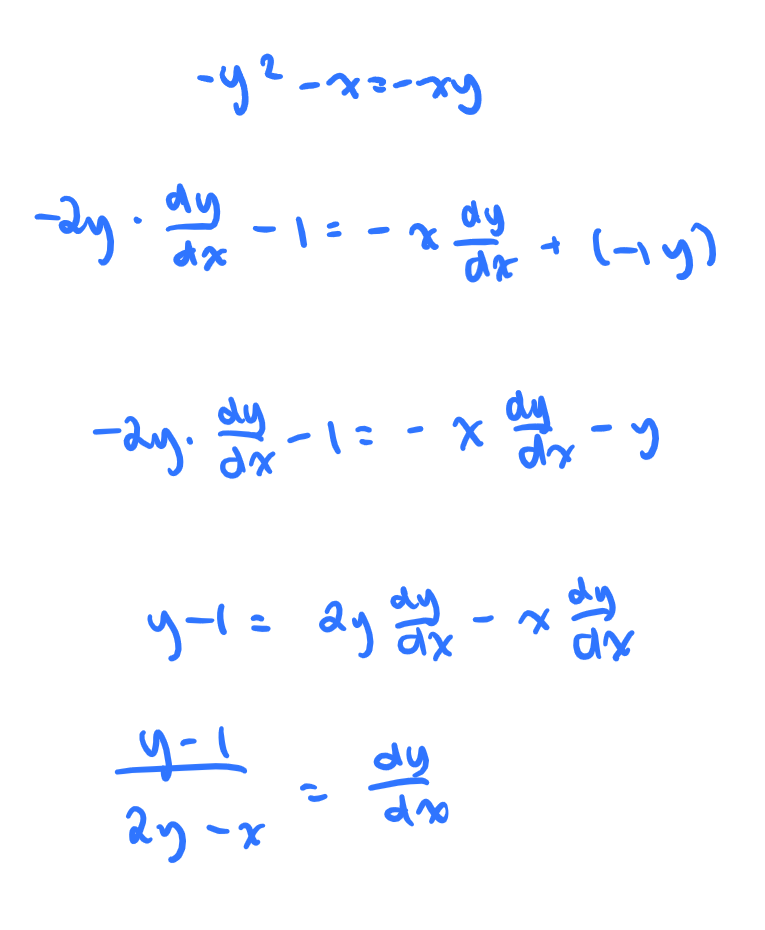 vocal sleetBOT
iron flame
my calculator says the answer is -1/2y. what am i doing wrong? https://i.imgur.c...
flat whale
iron flame
my calculator says the answer is -1/2y. what am i doing wrong? https://i.imgur.c...
vocal sleetBOT
iron flame
my calculator says the answer is -1/2y. what am i doing wrong? https://i.imgur.c...
flat whale
iron flame
my calculator says the answer is -1/2y. what am i doing wrong? https://i.imgur.c...
show what you input into the calculator
iron flame
 flat whale
do you know what implicit_diff does when you give it both x, y arguments at the end
iron flame
yeah x is the dependent, y is the independent
oh wait i fixed it
okay it was just some weird glitch with the -xy there
.close
vocal sleetBOT
Channel closed
Closed by @iron flame
Use .reopen if this was a mistake.
Available help channel!
Send your question here to claim the channel.
Remember:
• Ask your math question in a clear, concise manner.
• Show your work, and if possible, explain where you are stuck.
• After 15 minutes, feel free to ping <@&286206848099549185>.
• Type the command .close to free the channel when you're done.
• Be polite and have a nice day!
Read #❓how-to-get-help for further information on how to ask a good question, and about conduct in the question channels.
 timber gale
x is a positive real number , f(x) is a function, there is an equation in the pic, it asks f(1/e^3)
 vocal sleetBOT
timber gale
x is a positive real number , f(x) is a function, there is an equation in th...
vocal sleetBOT
timber gale
x is a positive real number , f(x) is a function, there is an equation in th...
 livid grotto
We need to try to get an expression for f(x), any idea how?
 upper iron
You use the natural logarithm to drop down the exponents
x^x = e^(xf)
ln(x^x) = ln[e^(xf)]
x.ln(x) = x.f
ln(x) = f
So, f(x) = ln(x)
worthy citrus
could've let them try it themself
upper iron
I mean, it's gonna be hard to discuss it with him, he is clearly Turkish
Prolly does not speak eng
So I showed him how to do it right away
livid grotto
Therefore doesn't deserve to learn maths!
Fantastic
If they have come into a majority English speaking discord I'm sure they're comfortable speaking English man
vocal sleetBOT
@timber gale Has your question been resolved?
vocal sleetBOT
Channel closed
Closed by @timber gale
Use .reopen if this was a mistake.
Available help channel!
Send your question here to claim the channel.
Remember:
• Ask your math question in a clear, concise manner.
• Show your work, and if possible, explain where you are stuck.
• After 15 minutes, feel free to ping <@&286206848099549185>.
• Type the command .close to free the channel when you're done.
• Be polite and have a nice day!
Read #❓how-to-get-help for further information on how to ask a good question, and about conduct in the question channels.
 nova zodiac
Why the derivative of inverse of B is 1/(B'(B^-1(x))?

 lone linden
Consider that $(B^{-1})(B(x))=x$
twin meteorBOT
Civil Service Pigeon
 lone linden
then apply ||chain rule||
vocal sleetBOT
Channel closed
Closed by @nova zodiac
Use .reopen if this was a mistake.
vocal sleetBOT
Available help channel!
Send your question here to claim the channel.
Remember:
• Ask your math question in a clear, concise manner.
• Show your work, and if possible, explain where you are stuck.
• After 15 minutes, feel free to ping <@&286206848099549185>.
• Type the command .close to free the channel when you're done.
• Be polite and have a nice day!
Read #❓how-to-get-help for further information on how to ask a good question, and about conduct in the question channels.
 storm arrow
help pls
 vocal sleetBOT
storm arrow
help pls
vocal sleetBOT
storm arrow
help pls
 sly sierra
storm arrow
help pls
sly sierra
storm arrow
help pls
have you been able to show this for any of the pairs?
for the first three, you can easily find counterexamples using a set of two elements
storm arrow
sly sierra
for the first three, you can easily find counterexamples using a set of two elem...
please explain that
sly sierra
storm arrow
please explain that
well, for example, if the set is {1,2} then here is a relation that is reflexive but not symmetric: {(1,1), (2,2), (1,2)}
do you see why?
storm arrow
i get why it is reflexive but not why it aint symmetric
sly sierra
it contains (1,2) but not (2,1)
storm arrow
wait wait
you know what can you explain me what exactly symmetric, anti symetric and transitive are
sly sierra
don't you have definitions in your book or whatever resource you're using?
storm arrow
sly sierra
don't you have definitions in your book or whatever resource you're using?
nope nothing we get resources day after tomorrow
we got pre homework
OKAY I GOT IT
so for symmetric relations
it needs to have the opposite set for every unequal set
so like (a,b) needs to be paired with (b,a)
sly sierra
storm arrow
so like (a,b) needs to be paired with (b,a)
yep that's right
and reflexive needs to contain every (a,a)
storm arrow
and antisymmetric?
sly sierra
antisymmetric must not contain (b,a) if it contains (a,b), where a and b are different
storm arrow
can you give me an example?
sly sierra
yeah, if the set is {1,2}, then an example of an antisymmetric relation would be {(1,1)}
storm arrow
sly sierra
yeah, if the set is {1,2}, then an example of an antisymmetric relation would be...
okay got it
so like {(1,1),(2,2)} is a symmetric relation of {1,2}
sly sierra
yes
storm arrow
okay cool thanks
storm arrow
storm arrow
so like {(1,1),(2,2)} is a symmetric relation of {1,2}
*asymmetric
sly sierra
yes it's actually both
sly sierra
well it's asymmetric because it contains no (a,b) with a,b distinct
storm arrow
so it doesnt need to have (b,a) in the first place
sly sierra
and it's symmetric because there are no mismatched (a,b)
sly sierra
yea, transitive means: if it contains (a,b) and (b,c) then it must contain (a,c)
in words: "if a is related to b, and b is related to c, then a is related to c"
storm arrow
sly sierra
yea, transitive means: if it contains (a,b) and (b,c) then it must contain (a,c)
so if the original set is {1,2,3} and its relation is {(1,2),(2,3)} it wont be transitive yeah?
storm arrow
okay okay so thats all ?
storm arrow
ok yes
sly sierra
and so is (2,2)
 storm arrow
okay
sly sierra
find an example of a relation that is the first but not the second
findi an example of a relation that is the second but not the first
do that for each pair
storm arrow
can you give me an example for just the first 2
sly sierra
yea
say we are working with the set {1,2} again
reflexive but not symmetric: {(1,1), (2,2), (1,2)}
because (2,1) is missing
symmetric but not reflexive: {(1,2), (2,1)}
because (1,1) and (2,2) are missing
storm arrow
can you give an example about the same except without using numbers
sly sierra
what should i use instead?
the numbers are just placeholders for whatever you call the two elements in the set
storm arrow
okok
sly sierra
could call them {a,b} instead if you like
storm arrow
can you also possibly give me an example of (a,b) where it is not antisymmetric and symmetric at the same time?
i cant figure out a relation which is reflexive but not symmetric, asymmetric and transitive?
sly sierra
storm arrow
can you also possibly give me an example of (a,b) where it is not antisymmetric ...
yeah, how about {(1,2), (2,1)} - that's symmetric but not antisymmetric
{(1,2)} is antisymmetric but not symmetric
storm arrow
storm arrow
i cant figure out a relation which is reflexive but not symmetric, asymmetric an...
this
i found one where it is symmetric but none of the others
sly sierra
reflexive but not symmetric: {(1,1), (2,2), (1,2)}
reflexive but not asymmetric: {(1,1), (2,2), (1,2), (2,1)}
for reflexive but not transitive, i think you will need three elements
vocal sleetBOT
@storm arrow Has your question been resolved?
vocal sleetBOT
Channel closed
Closed due to timeout
Use .reopen if this was a mistake.
Available help channel!
Send your question here to claim the channel.
Remember:
• Ask your math question in a clear, concise manner.
• Show your work, and if possible, explain where you are stuck.
• After 15 minutes, feel free to ping <@&286206848099549185>.
• Type the command .close to free the channel when you're done.
• Be polite and have a nice day!
Read #❓how-to-get-help for further information on how to ask a good question, and about conduct in the question channels.
 open mango
Help
 vocal sleetBOT
open mango
Help
vocal sleetBOT
open mango
Help
 hollow raptor
Do you know how to get the perimeter of a circle?
open mango
No
 karmic imp
open mango
No
karmic imp
open mango
No
Btw perimeter of a circle is another way to describe circumference
open mango
karmic imp
Btw perimeter of a circle is another way to describe circumference
This is one of the ways to do it right?

💀
.close
vocal sleetBOT
Channel closed
Closed by @open mango
Use .reopen if this was a mistake.
Available help channel!
Send your question here to claim the channel.
Remember:
• Ask your math question in a clear, concise manner.
• Show your work, and if possible, explain where you are stuck.
• After 15 minutes, feel free to ping <@&286206848099549185>.
• Type the command .close to free the channel when you're done.
• Be polite and have a nice day!
Read #❓how-to-get-help for further information on how to ask a good question, and about conduct in the question channels.
 deft leaf
I need help with this integral
 vocal sleetBOT
deft leaf
I need help with this integral
deft leaf
vocal sleetBOT
deft leaf
I need help with this integral
deft leaf
I tried u-sub and partial fractions
But the partial fractions way is very very long and I think there’s a better way to do this
The nominator is x-2
mb
paper depot
numerator*
paper depot
not without grueling partial fraction shit i dont
vocal sleetBOT
@deft leaf Has your question been resolved?
 indigo jay
you can split it into two fractions
one will come out nicely, but the other one will require partial fractions
mild flower
not only partial fractions but complex partial fractions since x^2 - 4x + 5 has no real roots
mild flower
that's a Mathematica Moment™️
vocal sleetBOT
@deft leaf Has your question been resolved?
vocal sleetBOT
Channel closed
Closed due to timeout
Use .reopen if this was a mistake.
Available help channel!
Send your question here to claim the channel.
Remember:
• Ask your math question in a clear, concise manner.
• Show your work, and if possible, explain where you are stuck.
• After 15 minutes, feel free to ping <@&286206848099549185>.
• Type the command .close to free the channel when you're done.
• Be polite and have a nice day!
Read #❓how-to-get-help for further information on how to ask a good question, and about conduct in the question channels.
 hasty token
 vocal sleetBOT
hasty token
vocal sleetBOT
hasty token
 dark field
!status
vocal sleetBOT
What step are you on?
1. I don't know where to begin
2. I have begun but got stuck midway
3. I got an answer but I'm told it's wrong
4. I got an answer and would like my work checked
5. I have a question about someone else's worked solution
6. None of the above
@hasty token Has your question been resolved?
 gaunt pendant
well i suppose it's motion is characterised parametrically
if you got a composite function you'll js wanna spam the chain rule
mild flower
hasty token
idek how to find the second derivative of this
start by finding the first derivative
hasty token
first derivative is 2 cos πt right?
 thin basin
vocal sleetBOT
thin basin
vocal sleetBOT
Channel closed
Closed due to timeout
Use .reopen if this was a mistake.
gaunt pendant
.reopen
vocal sleetBOT
Available help channel!
Send your question here to claim the channel.
Remember:
• Ask your math question in a clear, concise manner.
• Show your work, and if possible, explain where you are stuck.
• After 15 minutes, feel free to ping <@&286206848099549185>.
• Type the command .close to free the channel when you're done.
• Be polite and have a nice day!
Read #❓how-to-get-help for further information on how to ask a good question, and about conduct in the question channels.
 thin root
when you integrate this, are the C's different for each component?
 thin root
C1 for x
C2 for y
C3 for z ?
paper depot
yes, though in principle you could also package them all into one vector
thin root
paper depot
yes, though in principle you could also package them all into one vector
ty
.close
vocal sleetBOT
Channel closed
Closed by @thin root
Use .reopen if this was a mistake.
Available help channel!
Send your question here to claim the channel.
Remember:
• Ask your math question in a clear, concise manner.
• Show your work, and if possible, explain where you are stuck.
• After 15 minutes, feel free to ping <@&286206848099549185>.
• Type the command .close to free the channel when you're done.
• Be polite and have a nice day!
Read #❓how-to-get-help for further information on how to ask a good question, and about conduct in the question channels.
 oblique rivet
Find the dimension of the subspace
U = {(x1, x2, x3, x4, x5)∈ R^5: x1 − 4x2 − x4 + 3x5 = 0} ⊆ R^5
vocal sleetBOT
oblique rivet
Find the dimension of the subspace
U = {(x1, x2, x3, x4, x5)∈ R^5: x1 − 4x2 − x4...
oblique rivet
this question is just 1 mark
livid grotto
What is the dimension of the space it is living inside?
livid grotto
U is a subspace of a space, what dimension is that space
oblique rivet
the space i guess is 5 dim
livid grotto
Indeed
oblique rivet
it says R^5
livid grotto
And we can see that by requiring '5 different coordinates' to describe a vector
But now we have a single linear equation
So, for example, x_1=4x_2+x_4-3x_5
livid grotto
Well the point is that in restricting from R^5 to this subspace, x_1 is no longer a free variable
In all of R^5, all of x_1, ..., x_5 are free variables
But on U we reduce the number of free variables by 1 using our linear constraint
oblique rivet
so dim is 4??
livid grotto
Indeed
oblique rivet
ok tysm
livid grotto
The general prescription is 'n dimensional space subject to m linearly independent linear constraints has dimension n-m'
vocal sleetBOT
Channel closed
Closed by @oblique rivet
Use .reopen if this was a mistake.
Available help channel!
Send your question here to claim the channel.
Remember:
• Ask your math question in a clear, concise manner.
• Show your work, and if possible, explain where you are stuck.
• After 15 minutes, feel free to ping <@&286206848099549185>.
• Type the command .close to free the channel when you're done.
• Be polite and have a nice day!
Read #❓how-to-get-help for further information on how to ask a good question, and about conduct in the question channels.
vocal sleetBOT
 covert salmon
!status
vocal sleetBOT
What step are you on?
1. I don't know where to begin
2. I have begun but got stuck midway
3. I got an answer but I'm told it's wrong
4. I got an answer and would like my work checked
5. I have a question about someone else's worked solution
6. None of the above
 royal tapir
ok
 rapid swift
well you should know where to begin
covert salmon
Well yeah I sorta do
rapid swift
if you're clueless about anything related to solids of revolution
covert salmon
idk what my limits of integration will be
rapid swift
at the very least you can draw a diagram
 rapid swift
probably should paste it here
can you use mspaint or similar to shade the region that's being rotated?
covert salmon
sure, one sec
rapid swift
okay now can you identify the axis of rotation?
covert salmon
The x-axis.
rapid swift
can you sorta visualize what the solid looks like?
covert salmon
It will be a sphere but cut in half with a hole in the middle.
rapid swift
it won't be a sphere
it sorta looks like half a donut, yeah?
half a squished donut
rapid swift
so you asked about the bounds of integration
imagine you're stacking washers to make the thing
well actually first
what variable are you going to integrate with respect to
rapid swift
okay so the washers are sorta going to be up on their sides yeah?
covert salmon
yes
rapid swift
so your original question was asking where the bounds of integration will be
at what x coordinate are you going to put the first washer if you imagine you're stacking them up to make the shape?
covert salmon
At x = 0
rapid swift
and the last one is at x = 4
covert salmon
yeah
rapid swift
so that answers your question there
rapid swift
are you now interested in the radii of the two circles?
covert salmon
yes
covert salmon
Well, the radius of the semi circle is 4, yes
rapid swift
that's not the same thing as what I was saying
the outer and the inner radius are going to change with x
covert salmon
hmm ok
covert salmon
rapid swift
so the outer radius is the y coordinate of the top of the semicircle, right?
wdym by this?
rapid swift
covert salmon
wdym by this?
what part don't you understand
covert salmon
rapid swift
what part don't you understand
Is he y-coordinate of the top of the semi circle 8?
rapid swift
can you figure out how it changes with respect to x?
covert salmon
Well we represent that using the integrals we need to find?
covert salmon
What about the small area under the semi-circle that causes the hole?
covert salmon
rapid swift
there is a hole in a washer, no?
yeah
rapid swift
I honestly don't know what's hanging you up, except for maybe the actual task of determining the y coordinate of the top of the washer
but that's not terribly hard to do if you draw a horizontal line through the center of the semicircle
covert salmon
Well I need an outer and inner radius
and I just gotta subtract the two integrals using the disk integral formula
rapid swift
you need to review what the actual washer method is
not just divining out of thin air some stuff to put into the formula
the outer radius is literally where the ends of the washers are
draw the washers
covert salmon
oh
the outer radius is 8?
Wait no... the outer radius is 4
but how can my outer and inner radii be the same?
vocal sleetBOT
@covert salmon Has your question been resolved?
covert salmon
.close
vocal sleetBOT
Channel closed
Closed by @covert salmon
Use .reopen if this was a mistake.
Available help channel!
Send your question here to claim the channel.
Remember:
• Ask your math question in a clear, concise manner.
• Show your work, and if possible, explain where you are stuck.
• After 15 minutes, feel free to ping <@&286206848099549185>.
• Type the command .close to free the channel when you're done.
• Be polite and have a nice day!
Read #❓how-to-get-help for further information on how to ask a good question, and about conduct in the question channels.
vast shale
 vocal sleetBOT
vast shale
vast shale
vocal sleetBOT
vast shale
vast shale
how do I do this
sin(2pi)/tan(pi/3) = 0 so we can ignore that term
the summand simplifies via evaluation
vast shale
vast shale
sin(2pi)/tan(pi/3) = 0 so we can ignore that term
Yes
vocal sleetBOT
@vast shale Has your question been resolved?
vocal sleetBOT
Channel closed
Closed due to timeout
Use .reopen if this was a mistake.
Available help channel!
Send your question here to claim the channel.
Remember:
• Ask your math question in a clear, concise manner.
• Show your work, and if possible, explain where you are stuck.
• After 15 minutes, feel free to ping <@&286206848099549185>.
• Type the command .close to free the channel when you're done.
• Be polite and have a nice day!
Read #❓how-to-get-help for further information on how to ask a good question, and about conduct in the question channels.
vast shale
 vocal sleetBOT
vast shale
vast shale
vocal sleetBOT
vast shale
vast shale

I'm not sure how to continue.
"parallel to the x-axis" means y' = 0. So I used that to obtain an expression for y in terms of x. But I don't know how to use it.
vocal sleetBOT
@vast shale Has your question been resolved?
mild flower
I haven't run the numbers but it will probably be a lot easier to do implicit differentiation
but you can use what you have, just differentiate y and set y' = 0 then solve for x
vast shale
mild flower
I haven't run the numbers but it will probably be a lot easier to do implicit di...
Well yeah I used the implicit function theorem
mild flower
oh I should actually read what you wrote sorry
vast shale
mild flower
but you can use what you have, just differentiate y and set y' = 0 then solve fo...
That's a rewrite of what I said, not what I asked
vast shale
mild flower
oh I should actually read what you wrote sorry
Oh no worries
mild flower
so you have that eqn and you have your original one
you should be able to set them together and find two solutions
 mild flower
two cases
because y isn't a function of x
but also you can start with that y^2 eqn
it'll be a lot simpler that way
mild flower
should just be a rational equation in x
vast shale
 vast shale
mild flower
should just be a rational equation in x
vast shale
mild flower
should just be a rational equation in x
Well let me know if you solved it without a calculator
vocal sleetBOT
@vast shale Has your question been resolved?
mild flower
vast shale
Well let me know if you solved it without a calculator
yeah it's not that bad
vocal sleetBOT
Channel closed
Closed due to timeout
Use .reopen if this was a mistake.
vocal sleetBOT
Available help channel!
Send your question here to claim the channel.
Remember:
• Ask your math question in a clear, concise manner.
• Show your work, and if possible, explain where you are stuck.
• After 15 minutes, feel free to ping <@&286206848099549185>.
• Type the command .close to free the channel when you're done.
• Be polite and have a nice day!
Read #❓how-to-get-help for further information on how to ask a good question, and about conduct in the question channels.
 gritty zenith

 vocal sleetBOT
gritty zenith
vocal sleetBOT
vocal sleetBOT
gritty zenith
vocal sleetBOT
Channel closed
Closed by @gritty zenith
Use .reopen if this was a mistake.
Available help channel!
Send your question here to claim the channel.
Remember:
• Ask your math question in a clear, concise manner.
• Show your work, and if possible, explain where you are stuck.
• After 15 minutes, feel free to ping <@&286206848099549185>.
• Type the command .close to free the channel when you're done.
• Be polite and have a nice day!
Read #❓how-to-get-help for further information on how to ask a good question, and about conduct in the question channels.
 naive elbow
a stone is dropped from a 75-m high building. WHen this stone has dropped 15m, a second stone is thrown downward with an intial velocity such that the two stones hit the gound at the same time. What was the initial velocity of the second stone
vocal sleetBOT
Available help channel!
Send your question here to claim the channel.
Remember:
• Ask your math question in a clear, concise manner.
• Show your work, and if possible, explain where you are stuck.
• After 15 minutes, feel free to ping <@&286206848099549185>.
• Type the command .close to free the channel when you're done.
• Be polite and have a nice day!
Read #❓how-to-get-help for further information on how to ask a good question, and about conduct in the question channels.
 uneven hamlet
Hi, I've been unable to tackle the following problem, I am probably using the wrong relation, since I'm pretty sure a doesn't directly correspond to the distance the man has walked. Not sure what relation should be used, tried the law of sines/cosines. It is probably not something complex but I fail to point at it
 vocal sleetBOT
uneven hamlet
Hi, I've been unable to tackle the following problem, I am probably using the wr...
uneven hamlet
vocal sleetBOT
uneven hamlet
Hi, I've been unable to tackle the following problem, I am probably using the wr...
uneven hamlet
the actual solution is 0.633ft/sec from what I've been able to find
vocal sleetBOT
@uneven hamlet Has your question been resolved?
vocal sleetBOT
@uneven hamlet Has your question been resolved?
vocal sleetBOT
@uneven hamlet Has your question been resolved?
 summer lichen
uneven hamlet
Hi, I've been unable to tackle the following problem, I am probably using the wr...
summer lichen
uneven hamlet
Hi, I've been unable to tackle the following problem, I am probably using the wr...
I think you have the right idea, the relation is the pythagorean theorem. The problem seems to be that you're not being careful about the values of a,b, and c. These are all functions of time!! This is very important, since as the man moves horizontally the values of a,b, and c change drastically and b->0 eventually.
uneven hamlet
summer lichen
I think you have the right idea, the relation is the pythagorean theorem. The pr...
Did I take the derivatives incorrectly? I treated each side a,b&c as functions and took their derivatives using the chain rule (derivative of a/b/c with respect to itself * the derivative with respect to time), I think my issue lies where I treated a (the length between the man and the tip of the weigh) as being equal to the distance the man has walked which is incorrect. I think the length between the tip of the weigh and the ground needs to be accounted for as well (let's call that distance y), thus c = 60-b-y, though I am still not sure how to relate that
summer lichen
uneven hamlet
Did I take the derivatives incorrectly? I treated each side a,b&c as functions a...
Okay so you're just having trouble finding a relation?
uneven hamlet
I mean I did try to plug it into a pythagorean identity, i.e (10^2) + (b+y)^2 = (60-b-y)^2, though after expanding I'm left with y+b=29.16 which is not different from what I've calculated in the picture and it doesn't provide me any convenient info for finding dy/dt
summer lichen
Yeah I think that's the most important part of this question
there's a pretty simple relation between the rate that the weight moves and the rate at which the man moves
and it has to do with the rope and the pulley
uneven hamlet
isn't that the supposedly that they change at an opposite rate? (when c increases b decreases at the same rate)
summer lichen
It's close but we're looking for the rate at which the length change so the direction of change is irrelevant
uneven hamlet
summer lichen
It's close but we're looking for the rate at which the length change so the dire...
Found it!

Can't believe it was this simple
summer lichen
nice job
vocal sleetBOT
Channel closed
Closed by @uneven hamlet
Use .reopen if this was a mistake.
Available help channel!
Send your question here to claim the channel.
Remember:
• Ask your math question in a clear, concise manner.
• Show your work, and if possible, explain where you are stuck.
• After 15 minutes, feel free to ping <@&286206848099549185>.
• Type the command .close to free the channel when you're done.
• Be polite and have a nice day!
Read #❓how-to-get-help for further information on how to ask a good question, and about conduct in the question channels.
 glad pendant
 vocal sleetBOT
glad pendant
vocal sleetBOT
glad pendant


 livid grotto
probs a past paper
ornate ember
glad pendant
The key to solving this is using the rule that $log_b(a^c) = c \cdot log_b(a)$
twin meteorBOT
MellowDramaLlama
 glad pendant
twin meteor
**MellowDramaLlama**
glad pendant
twin meteor
**MellowDramaLlama**
how would i do that...
ornate ember
I'll give you the first log term
glad pendant
okok
ornate ember
$log_bx^{\frac{2}{3}} = \frac{2}{3} log_bx\\$
Now we know that $log_bx = 0.1$, so we get $\frac{2}{3}log_bx = \frac{2}{3}(0.1) = \frac{2}{3}\left(\frac{1}{10}\right) = \frac{2}{30} = \frac{1}{15}$
twin meteorBOT
MellowDramaLlama
 ornate ember
just do the same with the remaining terms and then add them all up
ornate ember
yep go for it!
glad pendant
i got 1/12 as my final answer
ornate ember
yep that's what I got too 🙂 Nice work
vocal sleetBOT
@glad pendant Has your question been resolved?
Channel closed
Closed by @glad pendant
Use .reopen if this was a mistake.
vocal sleetBOT
Available help channel!
Send your question here to claim the channel.
Remember:
• Ask your math question in a clear, concise manner.
• Show your work, and if possible, explain where you are stuck.
• After 15 minutes, feel free to ping <@&286206848099549185>.
• Type the command .close to free the channel when you're done.
• Be polite and have a nice day!
Read #❓how-to-get-help for further information on how to ask a good question, and about conduct in the question channels.
@uneven hamlet Has your question been resolved?
Channel closed
Closed due to the original message being deleted
vocal sleetBOT
Available help channel!
Send your question here to claim the channel.
Remember:
• Ask your math question in a clear, concise manner.
• Show your work, and if possible, explain where you are stuck.
• After 15 minutes, feel free to ping <@&286206848099549185>.
• Type the command .close to free the channel when you're done.
• Be polite and have a nice day!
Read #❓how-to-get-help for further information on how to ask a good question, and about conduct in the question channels.
 flint gulch
Hey I need help with this word problem:
A man is 5 times as old as his son. Four years ago, the product of their ages was 52. Find their present ages.
vocal sleetBOT
flint gulch
Hey I need help with this word problem:
A man is 5 times as old as his son. Fou...
 fast cipher
flint gulch
Hey I need help with this word problem:
A man is 5 times as old as his son. Fou...
fast cipher
flint gulch
Hey I need help with this word problem:
A man is 5 times as old as his son. Fou...
Try to write the informations the problem gave using maths.
flint gulch
I dont think this this can be solved with the model method.
fast cipher
I don't know what you mean by "model method".
fast cipher
flint gulch
Hey I need help with this word problem:
A man is 5 times as old as his son. Fou...
I will give a start point:
we know the man has some age in the present and his age is five times the age of his son. We could write this like:
(man's age) = (son's age)*5
vocal sleetBOT
@flint gulch Has your question been resolved?
vocal sleetBOT
Channel closed
Closed due to timeout
Use .reopen if this was a mistake.
Available help channel!
Send your question here to claim the channel.
Remember:
• Ask your math question in a clear, concise manner.
• Show your work, and if possible, explain where you are stuck.
• After 15 minutes, feel free to ping <@&286206848099549185>.
• Type the command .close to free the channel when you're done.
• Be polite and have a nice day!
Read #❓how-to-get-help for further information on how to ask a good question, and about conduct in the question channels.
vast shale
0 isnt real
vocal sleetBOT
vast shale
0 isnt real
vast shale
It means nothing
Yes it represents nothing
But
It doesnt sct like a number either
ornate ember
what makes you think 0 isn't real?
hollow raptor
It definitely acts like a number, it can be added and multiplied, etc
hollow raptor
Sure it can! It just makes 0
 urban edge
you cant do log base 1, does that make 1 not real?
rugged orchid
0 is a special number
ornate ember
in fact, it's incredibly special
vast shale
Its nothing
vast shale
rugged orchid
0 is a special number
What defines a number
Its represents nothing so its nothing
rugged orchid
What level of education are you at?
vast shale
Doesnt matter because youre just gonns judge me based on my answer to ur q
rugged orchid
No I’m not
vast shale
vast shale
Its represents nothing so its nothing
??~?~?~?~
ornate ember
vast shale
Doesnt matter because youre just gonns judge me based on my answer to ur q
lol wut? They said that to ask you where your education level is.
urban edge
"Number" means many different things and it gets more complicated
vast shale
ornate ember
lol wut? They said that to ask you where your education level is.
Its irrelevant
rugged orchid
It’s because as you go higher into math you will start thinking about what are numbers, and it’s called group theory
ornate ember
higher level math you do some deeper dives into properties of 0
actually it's relevant
urban edge
Wheel theory :D
hollow raptor
-1 is even less real then!
rugged orchid
It’s perfectly valid to ask what are numbers
vast shale
rugged orchid
It’s because as you go higher into math you will start thinking about what are n...
Math got theories
rugged orchid
They certainly do!
ornate ember
rugged orchid
It’s perfectly valid to ask what are numbers
in fact I would say it's the basis of a good math education. Question everything
urban edge
why?
vast shale
So what are numbers
urban edge
Numbers are representations of quantities
rugged orchid
I don’t think “numbers” themselves have a mathematical definition
vast shale
0 represents nothing no quantity so nothing
rugged orchid
But you could perhaps look at fields
urban edge
It represents the lack of quantity
In a way, quantity itself would be poorly defined as well
hollow raptor
vast shale
0 represents nothing no quantity so nothing
Wait until you learn about the empty set lmao
brisk moss
real numbers are just elements in the unique ordered field that has the least upper bound property and contains the rational numbers
ornate ember
"Hey look in my hands, I have 0 dollars in my hand" holds out empty palm. It represents the lack of a quantity.
I mean, my bank tells me I have $0 in the bank, lol
rugged orchid
Numbers themselves aren’t too useful, it’s what you can do with them
vast shale
rugged orchid
Numbers themselves aren’t too useful, it’s what you can do with them
Ok that makes them useful
Makes sense
hollow raptor
A set with no elements
vast shale
ornate ember
I mean, my bank tells me I have $0 in the bank, lol
Riht
vast shale
urban edge
why?
Why u laughing st him? U said to question everything so he questioned your statement
rugged orchid
It doesn’t change
urban edge
vast shale
Why u laughing st him? U said to question everything so he questioned your state...
It was a joke
vast shale
No humor
vast shale
rugged orchid
We get the something
Ig
rugged orchid
0 is also special because if we multiplied it by anything we get 0
urban edge
If you lack a sense of humor in mathematics, you would lose half the experience
rugged orchid
But then 1 is also pretty special, because 1 multiplied by something gives you something
vast shale
Yea
rugged orchid
There are names for these
But I’m sure you’ll learn them down the line if you’re interested
vast shale
Ok
vocal sleetBOT
@vast shale Has your question been resolved?
vocal sleetBOT
Channel closed
Closed due to timeout
Use .reopen if this was a mistake.
vocal sleetBOT
Available help channel!
Send your question here to claim the channel.
Remember:
• Ask your math question in a clear, concise manner.
• Show your work, and if possible, explain where you are stuck.
• After 15 minutes, feel free to ping <@&286206848099549185>.
• Type the command .close to free the channel when you're done.
• Be polite and have a nice day!
Read #❓how-to-get-help for further information on how to ask a good question, and about conduct in the question channels.
 primal knot
i just need a walk through and i’ll understand
vast shale
primal knot
i just need a walk through and i’ll understand
form an eqn for y in terms of x
vast shale
y = x + 5 + (green counters)?
vocal sleetBOT
Channel closed
Closed due to the original message being deleted
vocal sleetBOT
Available help channel!
Send your question here to claim the channel.
Remember:
• Ask your math question in a clear, concise manner.
• Show your work, and if possible, explain where you are stuck.
• After 15 minutes, feel free to ping <@&286206848099549185>.
• Type the command .close to free the channel when you're done.
• Be polite and have a nice day!
Read #❓how-to-get-help for further information on how to ask a good question, and about conduct in the question channels.
vast shale
how did they conclude that $G$ is not commutative?
 vocal sleetBOT
vast shale
how did they conclude that $G$ is not commutative?
twin meteorBOT
vocal sleetBOT
vast shale
how did they conclude that $G$ is not commutative?
twin meteorBOT

 hard atlas
well known fact about S_3
vast shale
oh i see okay
hard atlas
try to find two elements in S_3 with ab != ba
vast shale
hard atlas
try to find two elements in S_3 with ab != ba
like, swapping the first two elements and then swapping the last two gives a different result then swapping the last two and then the first two is what you are trying to say right?
like
[
(1 2)(2 3) = (1 3 2)\
(2 3)(1 2) = (1 2 3)
]
twin meteorBOT
 hard atlas
those products are wrong
vocal sleetBOT
Channel closed
Closed by @warm widget
Use .reopen if this was a mistake.
hard atlas
.reopen
vocal sleetBOT
✅
vast shale
oh?
hard atlas
you have to do them from the right
you plug stuff in on the right and then evaluate step by step
(12)(23) [1] = (12)[1] = 2
where I use [] for evaluation brackets
(12)(23)[2] = (12)[3] = 3
(12)(23)[3] = (12)[2] = 1
so 1->2, 2->3, 3->1, ie. (123)
vocal sleetBOT
Channel closed
Closed by @warm widget
Use .reopen if this was a mistake.
 real gale
Lixera is now white 
vast shale
whitewashed 
vocal sleetBOT
Available help channel!
Send your question here to claim the channel.
Remember:
• Ask your math question in a clear, concise manner.
• Show your work, and if possible, explain where you are stuck.
• After 15 minutes, feel free to ping <@&286206848099549185>.
• Type the command .close to free the channel when you're done.
• Be polite and have a nice day!
Read #❓how-to-get-help for further information on how to ask a good question, and about conduct in the question channels.
 gusty plume
For a i ve to find intersection point of plane and line and this is my solution is this correct?
 vocal sleetBOT
gusty plume
For a i ve to find intersection point of plane and line and this is my solution ...
gusty plume
vocal sleetBOT
gusty plume
For a i ve to find intersection point of plane and line and this is my solution ...
gusty plume
 vocal sleetBOT
@gusty plume Has your question been resolved?
gusty plume
<@&286206848099549185>
 cyan talon
euuh qu'est-ce que t'entends par 3d-2 ? @gusty plume
parce que d c'est le nom d'un plan
3 fois un plan je vois moyen ce que ça veut dire
cyan talon
ah ok c'est pour les points du plan l'équation paramétrique
gusty plume
donc c bon?
cyan talon
gusty plume
donc c bon?
oui c'est ok
vocal sleetBOT
Channel closed
Closed due to timeout
Use .reopen if this was a mistake.
cyan talon
.reopen
vocal sleetBOT
✅
gusty plume
merci bcp et j avais encore une 2eme question
cyan talon
yup
gusty plume
c possible d'avoir les reponses different quand on cherche l'intersection entre plan et droite
cyan talon
il y a plusieurs scénarios possible ouep
gusty plume
cmt ca se fait car ils s'intersect en un point nn?
cyan talon
ça dépend
quand t'as 2 droites en 2d, si elles sont parallèles (et pas identiques) t'as 0 intersection par exemple
gusty plume
oui logique
cyan talon
là c'est un peu pareil
- soit ta droite est pas parallèle au plan, là t'as une seule intersection
- soit ta droite est parallèle au plan
- si ta droite est contenue dans le plan, l'intersection c'est la droite entière
- sinon t'as 0 intersection (parallèle mais pas dedans)
vocal sleetBOT
Channel closed
Closed by @gusty plume
Use .reopen if this was a mistake.
vocal sleetBOT
Available help channel!
Send your question here to claim the channel.
Remember:
• Ask your math question in a clear, concise manner.
• Show your work, and if possible, explain where you are stuck.
• After 15 minutes, feel free to ping <@&286206848099549185>.
• Type the command .close to free the channel when you're done.
• Be polite and have a nice day!
Read #❓how-to-get-help for further information on how to ask a good question, and about conduct in the question channels.