 undone aurora

#help-17
1 messages · Page 9 of 1
 wraith venture
converges
 burnt totem
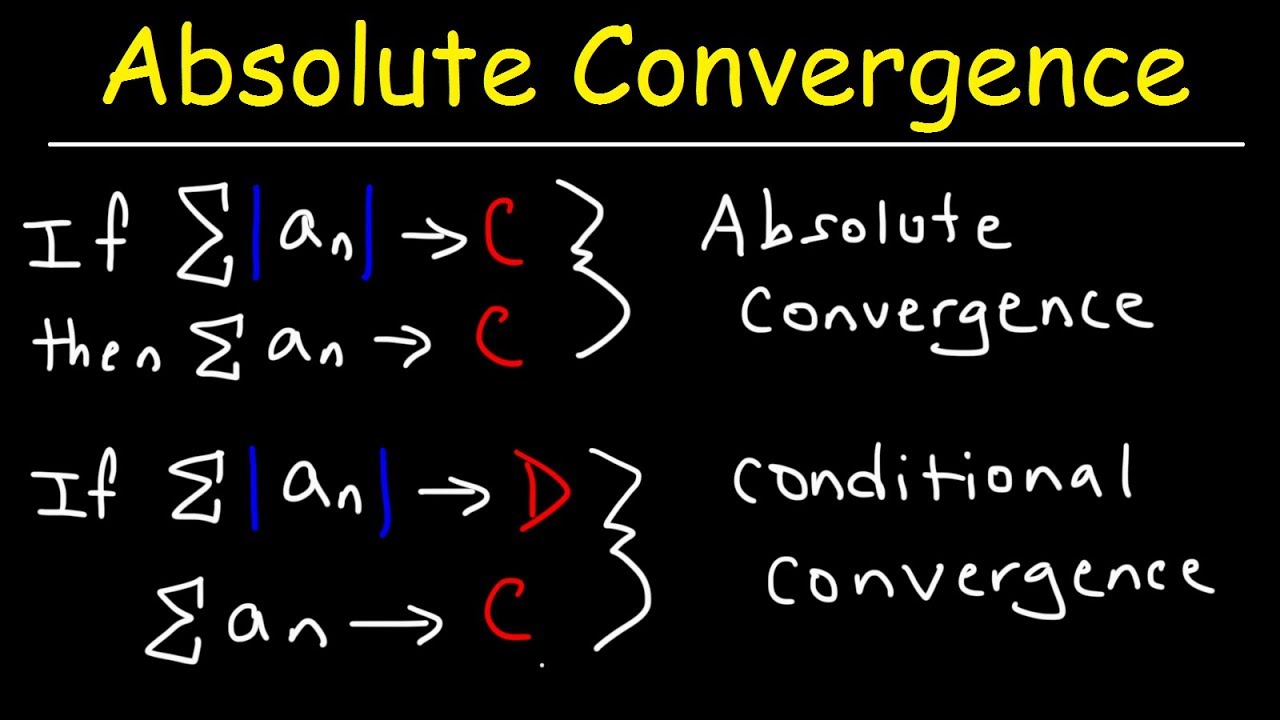
This calculus video tutorial provides a basic introduction into absolute convergence, conditional convergence, and divergence. If the absolute value of the series convergences, then the original series will converge based on the absolute convergence test. If the absolute value of the series diverges and if the original series is convergent, th...
wraith venture
Not converged absolutely
 vocal sleetBOT
Channel closed
Closed by @undone aurora
Use .reopen if this was a mistake.
 Available help channel!
Send your question here to claim the channel.
Remember:
• Ask your math question in a clear, concise manner.
• Show your work, and if possible, explain where you are stuck.
• After 15 minutes, feel free to ping <@&286206848099549185>.
• Type the command .close to free the channel when you're done.
• Be polite and have a nice day!
Read #❓how-to-get-help for further information on how to ask a good question, and about conduct in the question channels.
vocal sleetBOT
Channel closed
Closed due to the original message being deleted
Available help channel!
Send your question here to claim the channel.
Remember:
• Ask your math question in a clear, concise manner.
• Show your work, and if possible, explain where you are stuck.
• After 15 minutes, feel free to ping <@&286206848099549185>.
• Type the command .close to free the channel when you're done.
• Be polite and have a nice day!
Read #❓how-to-get-help for further information on how to ask a good question, and about conduct in the question channels.
 weak dome
Hi! How do I find the area of a scalene triangle? I know the side lengths, not the height
vocal sleetBOT
weak dome
Hi! How do I find the area of a scalene triangle? I know the side lengths, not t...
 urban edge

 vocal sleetBOT
@weak dome Has your question been resolved?
vocal sleetBOT
Channel closed
Closed due to timeout
Use .reopen if this was a mistake.
Available help channel!
Send your question here to claim the channel.
Remember:
• Ask your math question in a clear, concise manner.
• Show your work, and if possible, explain where you are stuck.
• After 15 minutes, feel free to ping <@&286206848099549185>.
• Type the command .close to free the channel when you're done.
• Be polite and have a nice day!
Read #❓how-to-get-help for further information on how to ask a good question, and about conduct in the question channels.
 wooden sable
Hey so why doesn’t 1/2AB sinC work for 14, but it does for 15? I got a incorrect answer when applying that rule for 14, but 15 worked?
 vocal sleetBOT
wooden sable
Hey so why doesn’t 1/2AB sinC work for 14, but it does for 15? I got a incorrect...
wooden sable
vocal sleetBOT
wooden sable
Hey so why doesn’t 1/2AB sinC work for 14, but it does for 15? I got a incorrect...
wooden sable
1/2 times 8.5 times 12 times Sin125 gave me -31.418, why didnt this work?
<@&286206848099549185>
 rose raft
you did sin 125 in radians
 twin meteorBOT
Result:
-0.61604045918866
uh
wooden sable
Okay so let me calculate with that number now 1 sec
rose raft
thats wrong
wooden sable
okay so you see why im confused right?
rose raft
 wooden sable
Oh'
rose raft
ye
wooden sable
Okay well whats the difference between radians and degrees?
rose raft
360 degrees = 2 pi radians
rose raft
ok
wooden sable
.close
vocal sleetBOT
Channel closed
Closed by @wooden sable
Use .reopen if this was a mistake.
vocal sleetBOT
Available help channel!
Send your question here to claim the channel.
Remember:
• Ask your math question in a clear, concise manner.
• Show your work, and if possible, explain where you are stuck.
• After 15 minutes, feel free to ping <@&286206848099549185>.
• Type the command .close to free the channel when you're done.
• Be polite and have a nice day!
Read #❓how-to-get-help for further information on how to ask a good question, and about conduct in the question channels.
 gray yarrow
right side
third row
you have 2/3
you forgot the 9
i think so
which should be 2/5+6=32/5 or 6.4
nice
 eager walrus
 acoustic monolith
what's the derivative of sin(x^36)/36
Simple as
The shortcut is probably what they taught you in class lol
Yea
u=x³⁶ du=36x³⁵dx
Change the boundaries
If x is 0 u is 0
If x is ³⁶√π u is π
Integrate
Yes, basically, in these examples the complicated part or the part that it's easier nested inside another is u
vocal sleetBOT
@bleak smelt Has your question been resolved?
vocal sleetBOT
Channel closed
Closed due to timeout
Use .reopen if this was a mistake.
Available help channel!
Send your question here to claim the channel.
Remember:
• Ask your math question in a clear, concise manner.
• Show your work, and if possible, explain where you are stuck.
• After 15 minutes, feel free to ping <@&286206848099549185>.
• Type the command .close to free the channel when you're done.
• Be polite and have a nice day!
Read #❓how-to-get-help for further information on how to ask a good question, and about conduct in the question channels.
 red crystal
i just have two quick questions
https://youtu.be/3d6DsjIBzJ4?t=71

Taylor polynomials are incredibly powerful for approximations and analysis.
Help fund future projects: https://www.patreon.com/3blue1brown
An equally valuable form of support is to simply share some of the videos.
Special thanks to these supporters: http://3b1b.co/lessons/taylor-series#thanks
Home page: https://www.3blue1brown.com/
Full series: ...
red crystal
why does he sub in theta squared over 2 instead of 1 - theta squared over 2
wait nvm
lmao
i just realizied
anyway
where can i use or find math animation softwares to help with tutoring friends online
i think his is harder to use for the purpose of tutoring which i think is manim right?
 trim walrus
Well there's a software that 3blue1brown has made but you've know coding for that
red crystal
yeah ik how to code but nothing crazy but pretty good knowledge
trim walrus
red crystal
i think his is harder to use for the purpose of tutoring which i think is manim ...
Yes
red crystal
its python right
trim walrus
Ye
red crystal
i think its harder to use for like making quick animations i think it really takes time and dedication to shell out what he does
i truly admire him
i was looking for anything that would be fairly easy to write math in so that i dont have to draw it in microsoft paint or something and then it would look awful
do they use latex when they make those animations too? i wonder how they actually write out the math
trim walrus
Manim is based on latex I guess
red crystal
i think after learning it it could make things easier but im not sure
alr i'll look into it
thx!
.close
vocal sleetBOT
Channel closed
Closed by @red crystal
Use .reopen if this was a mistake.
Available help channel!
Send your question here to claim the channel.
Remember:
• Ask your math question in a clear, concise manner.
• Show your work, and if possible, explain where you are stuck.
• After 15 minutes, feel free to ping <@&286206848099549185>.
• Type the command .close to free the channel when you're done.
• Be polite and have a nice day!
Read #❓how-to-get-help for further information on how to ask a good question, and about conduct in the question channels.
 chrome blade
how?
 vocal sleetBOT
chrome blade
how?
chrome blade
vocal sleetBOT
chrome blade
how?
chrome blade
how is it -x+5
 spare girder
I dont think they finished the question
 exotic arrow
 spare girder
-x+5 is the expansion of (x-5)(0-1)
exotic arrow
can someone help?
 vast shale
chrome blade
spare girder
I dont think they finished the question
vast shale
chrome blade
spare girder
I dont think they finished the question
looks like he first did 0-1
and then started multiplying
chrome blade
when you do the 0-1 it = (-1) right? or is it without brackets
vocal sleetBOT
Channel closed
Closed by @chrome blade
Use .reopen if this was a mistake.
vocal sleetBOT
Available help channel!
Send your question here to claim the channel.
Remember:
• Ask your math question in a clear, concise manner.
• Show your work, and if possible, explain where you are stuck.
• After 15 minutes, feel free to ping <@&286206848099549185>.
• Type the command .close to free the channel when you're done.
• Be polite and have a nice day!
Read #❓how-to-get-help for further information on how to ask a good question, and about conduct in the question channels.
 cinder aurora
 vocal sleetBOT
cinder aurora
cinder aurora
vocal sleetBOT
cinder aurora
cinder aurora
how do I solve for angle 1, and angle 2 in this problem?
vast shale
cinder aurora
What is 150° and 84°
cinder aurora
they're arcs on the circle
vast shale
cinder aurora
they're arcs on the circle
Length of those arcs?
cinder aurora
yeah the lengths of them
vast shale
Length of arcs
vast shale
,, X/360 × 2(22/7)r²
twin meteorBOT
Hakken
 vast shale
We dont have radius?
vocal sleetBOT
Channel closed
Closed by @cinder aurora
Use .reopen if this was a mistake.
Available help channel!
Send your question here to claim the channel.
Remember:
• Ask your math question in a clear, concise manner.
• Show your work, and if possible, explain where you are stuck.
• After 15 minutes, feel free to ping <@&286206848099549185>.
• Type the command .close to free the channel when you're done.
• Be polite and have a nice day!
Read #❓how-to-get-help for further information on how to ask a good question, and about conduct in the question channels.
 civic drift
 vocal sleetBOT
civic drift
civic drift
vocal sleetBOT
civic drift
civic drift
I'm having trouble finding the sum for the G.P for $cos{\frac{\pi}{3} + \frac{\pi}{3^2}.....}$ I found out it was in the form of $\frac{1}{3} + \frac{1}{9} + \frac{1}{27} + ..... \frac{1}{3^n}$ and the sum came out to be $\frac{1}{3} \times \frac{1 - \frac{1}{3^n}}{1 - \frac{1}{3}}$ which is not as shown in the book.
twin meteorBOT
ColdTee
 vocal sleetBOT
Channel closed
Closed by @civic drift
Use .reopen if this was a mistake.
vocal sleetBOT
Available help channel!
Send your question here to claim the channel.
Remember:
• Ask your math question in a clear, concise manner.
• Show your work, and if possible, explain where you are stuck.
• After 15 minutes, feel free to ping <@&286206848099549185>.
• Type the command .close to free the channel when you're done.
• Be polite and have a nice day!
Read #❓how-to-get-help for further information on how to ask a good question, and about conduct in the question channels.
 inner lodge
can i get help with 16b pls thanks
 vocal sleetBOT
inner lodge
can i get help with 16b pls thanks
vocal sleetBOT
inner lodge
can i get help with 16b pls thanks
 noble lily
inner lodge
can i get help with 16b pls thanks
noble lily
inner lodge
can i get help with 16b pls thanks
in problem a, both the numerator and denominator are in AP, and in problem b both the numerator and denominator are in GP.
use the nth term formulas for both and then you'll get your answer
inner lodge
do i separate the numerator and denominator
and dviide them both in terms of n?
also for a what would the difference be?
noble lily
inner lodge
do i separate the numerator and denominator
all you have to do is use the formula $a_n = a_0 + d(n-1)$ for problem a and $T_n = a * r^{n-1}$ for the second part
inner lodge
is the difference 2 for 16a?
twin meteorBOT
skadoosh
 noble lily
inner lodge
is the difference 2 for 16a?
noble lily
inner lodge
is the difference 2 for 16a?
yes, for both the numerator and denominator
inner lodge
wait why is it two because for the nuimerator if u expand it ( or just add it) it ouwld be 2, 6, 12
noble lily
inner lodge
wait why is it two because for the nuimerator if u expand it ( or just add it) i...
well think about it in terms of the arithmetic series and geometric series... the new terms in each series will still be 4 in the second one and 6 in the third one even though the sums will be 2, 6, 12 respectively ... for context, if you know the formula for the sum of an AP which is $S_n = \frac{n}{2}(2a + d(n-1))$, you should be able to solve this... looking at the first three terms alone which is n = 3, taking the sum of the arithmetic series you should have $\frac{3}{2}(2 * 2 + (3-1) * 2)$ which comes out to be 12... now instead of n = 3, replace it with just n, and cancel out the numerators and denomiators if need-be.
twin meteorBOT
skadoosh

 noble lily
inner lodge
noble lily
inner lodge
looks okay, yes
noble lily
because the nth term is the sum of all terms right from the first term onwards...
look at term 3 for example
2,4,6 are in arithmetic progression but the answer is simply 12, which is the sum of the arithmetic progression
now do the same thing with part b, except use the formulas for geometric progression instead
 noble lily
yes
the denominator $4^{n}-1$ can be expressed of $2^{2n} - 1$, and then you can simply express it in terms of $(a+b)(a-b)$ as it will be in the form of $a^{2} + b^{2}$ and then cancel terms in the numerator and denominator appropriately
twin meteorBOT
skadoosh
 vocal sleetBOT
Channel closed
Closed by @inner lodge
Use .reopen if this was a mistake.
Available help channel!
Send your question here to claim the channel.
Remember:
• Ask your math question in a clear, concise manner.
• Show your work, and if possible, explain where you are stuck.
• After 15 minutes, feel free to ping <@&286206848099549185>.
• Type the command .close to free the channel when you're done.
• Be polite and have a nice day!
Read #❓how-to-get-help for further information on how to ask a good question, and about conduct in the question channels.
 unborn vale
i undersand writing the formula for the terms i dont get what you put above and below the sigma
 vocal sleetBOT
unborn vale
i undersand writing the formula for the terms i dont get what you put above and ...
vocal sleetBOT
unborn vale
i undersand writing the formula for the terms i dont get what you put above and ...
 granite flicker
below the sigma is the integer you should plug in to get 47 and above the sigma is the integer your should plug in to get -83 (using the first example)
unborn vale
im not following sorry, this is what my teacher had written as an answer but i just dont get how she got 11 and n=1
 vocal sleetBOT
@unborn vale Has your question been resolved?
vocal sleetBOT
Channel closed
Closed due to timeout
Use .reopen if this was a mistake.
vocal sleetBOT
Available help channel!
Send your question here to claim the channel.
Remember:
• Ask your math question in a clear, concise manner.
• Show your work, and if possible, explain where you are stuck.
• After 15 minutes, feel free to ping <@&286206848099549185>.
• Type the command .close to free the channel when you're done.
• Be polite and have a nice day!
Read #❓how-to-get-help for further information on how to ask a good question, and about conduct in the question channels.
 fleet vessel
What did I do wrong?

 vocal sleetBOT
fleet vessel
What did I do wrong?
rose raft
vocal sleetBOT
fleet vessel
What did I do wrong?
rose raft
,rotate
twin meteorBOT
 rose raft
now how do i do the other one
 rose raft
,rotate
twin meteorBOT
 fleet vessel
.close
vocal sleetBOT
Channel closed
Closed by @fleet vessel
Use .reopen if this was a mistake.
Available help channel!
Send your question here to claim the channel.
Remember:
• Ask your math question in a clear, concise manner.
• Show your work, and if possible, explain where you are stuck.
• After 15 minutes, feel free to ping <@&286206848099549185>.
• Type the command .close to free the channel when you're done.
• Be polite and have a nice day!
Read #❓how-to-get-help for further information on how to ask a good question, and about conduct in the question channels.
 tall ore
 tall ore
I'm trying to solve the part c to this question, parts a and b are correct
These are my workings, I used the planes that are parallel to l1 and contain l2 to work out the shortest distance from any point on the line to the plane using the planes normal vector. Is this the correct approach or is there a better way
 vocal sleetBOT
@tall ore Has your question been resolved?
tall ore
<@&286206848099549185>
vocal sleetBOT
@tall ore Has your question been resolved?
 wet cedar
well there is a procedure to do that
basically what you have to do is
So yk what points l1 and l2 pass through
First just find the vector joining those 2 points
And yk the vector perpendicular to those 2 vectors
wet cedar
wet cedar
First just find the vector joining those 2 points
let us call this vector m
wet cedar
wet cedar
And yk the vector perpendicular to those 2 vectors
and this as vector n
now the shortest distance will be the component of vector m on vector n
tall ore
To find the vector joining them just subtract them right?
vocal sleetBOT
@tall ore Has your question been resolved?
vocal sleetBOT
Channel closed
Closed due to timeout
Use .reopen if this was a mistake.
vocal sleetBOT
Available help channel!
Send your question here to claim the channel.
Remember:
• Ask your math question in a clear, concise manner.
• Show your work, and if possible, explain where you are stuck.
• After 15 minutes, feel free to ping <@&286206848099549185>.
• Type the command .close to free the channel when you're done.
• Be polite and have a nice day!
Read #❓how-to-get-help for further information on how to ask a good question, and about conduct in the question channels.
 earnest whale
 vocal sleetBOT
earnest whale
earnest whale
vocal sleetBOT
earnest whale
earnest whale
<@&286206848099549185>
rose raft
!15m
vocal sleetBOT
Please only use the <@&286206848099549185> ping once if your question has not been answered for 15 minutes. Please do not ping or DM individual users about your question.
rose raft
which
earnest whale
7
 half imp
what's the function?
half imp
!status
vocal sleetBOT
What step are you on?
1. I don't know where to begin
2. I have begun but got stuck midway
3. I got an answer but I'm told it's wrong
4. I got an answer and would like my work checked
5. I have a question about someone else's worked solution
6. None of the above
first step is to set up the integral
earnest whale
Can u show me your work for this
I am really lost and have like 10 more problems like this. Just need an example from this problem.
twin meteorBOT
RedstonePlayz09
 earnest whale
Now how do you get the first five terms of the maclaurin series
<@&286206848099549185>
Yea thanks for the help d bag
 strange crater
earnest whale
Yea thanks for the help d bag
strange crater
earnest whale
Yea thanks for the help d bag
being rude ensures you won't get the help you ask for
earnest whale
I wasnt getting help anyway but its good that your lookout out for you team
You guys appear to be a lower level of math help group
Im looking for the more elite group
strange crater
k
vocal sleetBOT
@earnest whale Has your question been resolved?
vocal sleetBOT
Channel closed
Closed due to timeout
Use .reopen if this was a mistake.
Available help channel!
Send your question here to claim the channel.
Remember:
• Ask your math question in a clear, concise manner.
• Show your work, and if possible, explain where you are stuck.
• After 15 minutes, feel free to ping <@&286206848099549185>.
• Type the command .close to free the channel when you're done.
• Be polite and have a nice day!
Read #❓how-to-get-help for further information on how to ask a good question, and about conduct in the question channels.
 thin vale
 twin meteorBOT
AustinU

 worthy citrus
presumably in this case the generalized derivative is just the normal derivative
also presumably they're using "generalized" for things like the "derivative" of the step function being a dirac delta
thin vale
That does seem to be the case
because I went to check my work, and I saw this in the solution and I wasn't really able to follow

Why is f(t) actually f(t)u(t) ?
worthy citrus
because you're doing laplace transforms you only care about the value of the function for t > 0
so may aswell cut off everything before that
thats what u(t) does
worthy citrus
and then is not a derivative in the usual sense because dirac delta isnt a function
hm
im not sure
probably some weird condition required
like the function not blowing up close to 0
but its been ages since ive done this so i wouldnt really know
thin vale
because if $f(t)=e^{-t}cos(3t)$ or even if you include u(t) I feel like shouldn't we just be able to say f(0)=1
twin meteorBOT
AustinU
 thin vale
with or without including unit step function
thin vale
right
XD
I have one last question
Here is from the table of formulas the "t'th derivative" rule I am to be verifying with this question

I remember something happens about like initial conditions or what not that I don't see in this formula
is it really just tacking on an "s" to F(s)?
worthy citrus
ohhh
thats why they included it lol
yeah the full formula is sF(s) - f(0)
take f(0+) is fine i would imagine
thin vale
so and then since we know f(0+)=1 we just subtract 1 off
worthy citrus
yee
thin vale
Okay nice
I kinda knew it was all connected but I couldn't piece together how lol
thanks for your help
thin vale
.close
vocal sleetBOT
Channel closed
Closed by @thin vale
Use .reopen if this was a mistake.
Available help channel!
Send your question here to claim the channel.
Remember:
• Ask your math question in a clear, concise manner.
• Show your work, and if possible, explain where you are stuck.
• After 15 minutes, feel free to ping <@&286206848099549185>.
• Type the command .close to free the channel when you're done.
• Be polite and have a nice day!
Read #❓how-to-get-help for further information on how to ask a good question, and about conduct in the question channels.
thin vale
Actually I end up getting the wrong thing still :|
vocal sleetBOT
thin vale
Actually I end up getting the wrong thing still :|
thin vale
Previous channel right above ^

I find $f'(t)= \delta (t) -u(t) e^{-t}(cos(3t)+3sin(3t))$
twin meteorBOT
AustinU
 thin vale
taking the laplace transform of that gives me
$1-\frac{(s+1)}{(s+1)^{2}+9}-\frac{9}{(s+1)^{2}+9}-f(0)$
twin meteorBOT
AustinU
 thin vale
and since f(0+)=1 I get that the laplace transfrom is
$-(\frac{(s+1)}{(s+1)^2+9}+\frac{9}{(s+1)^2+9)})$
twin meteorBOT
AustinU
 thin vale
which is $\frac{-(s+10)}{s^2+2s+10}$
twin meteorBOT
AustinU
 worthy citrus
twin meteor
**AustinU**
worthy citrus
twin meteor
**AustinU**
you shouldnt be taking off f(0) here
thin vale
Okay
so forget that I subtracted 1 then
and I am just going for L{f'(t)}
I'll see if that makes this better
one sec
thin vale
twin meteor
**AustinU**
so I am still up to here, except not -f(0)
so I want to show that $1-\frac{s+10}{s^2+2s+10}=s \cdot \frac{s+1}{s^2+2s+10} -1$
unless I've made a mistake
worthy citrus
-1 on the rhs
twin meteorBOT
AustinU
 thin vale
right
worthy citrus
oo weird somethings off you dont need the -1 on the right
 hybrid flicker
thin vale
so I want to show that $1-\frac{s+10}{s^2+2s+10}=s \cdot \frac{s+1}{s^2+2s+10} -...
hybrid flicker
thin vale
so I want to show that $1-\frac{s+10}{s^2+2s+10}=s \cdot \frac{s+1}{s^2+2s+10} -...
I'd suggest put everything on the same side and on the same denominator
hybrid flicker
worthy citrus
oo weird somethings off you dont need the -1 on the right
I think so too
worthy citrus
checks out in desmos without the -1 on the RHS, dont think i know enough about the derivative rule for laplace to know why you shouldn't take off f(0)
 worthy citrus
ahhh neat
bottom formula is for the usual derivative
top is for generalized
with generalised you dont need to take off f(0+)
worthy citrus
yeah
worthy citrus
yeah it should come out the same
vocal sleetBOT
Channel closed
Closed by @thin vale
Use .reopen if this was a mistake.
Available help channel!
Send your question here to claim the channel.
Remember:
• Ask your math question in a clear, concise manner.
• Show your work, and if possible, explain where you are stuck.
• After 15 minutes, feel free to ping <@&286206848099549185>.
• Type the command .close to free the channel when you're done.
• Be polite and have a nice day!
Read #❓how-to-get-help for further information on how to ask a good question, and about conduct in the question channels.
 late sky
Why is the characteristic polynomial of C the same as the characteristic polynomial of T?
 vocal sleetBOT
late sky
Why is the characteristic polynomial of C the same as the characteristic polynom...
worthy citrus
vocal sleetBOT
late sky
Why is the characteristic polynomial of C the same as the characteristic polynom...
worthy citrus
well whats your definition of characteristic polynomial of a linear map?
late sky
Det([T]_c-xI_n)=0
worthy citrus
and how are you defining Det of a linear map
late sky
Det([T]_c-xI_n)= Det(P^-1CP-xI_n)=det(C-xIn)
vocal sleetBOT
@late sky Has your question been resolved?
worthy citrus
that should answer your question then
vocal sleetBOT
Channel closed
Closed due to timeout
Use .reopen if this was a mistake.
Available help channel!
Send your question here to claim the channel.
Remember:
• Ask your math question in a clear, concise manner.
• Show your work, and if possible, explain where you are stuck.
• After 15 minutes, feel free to ping <@&286206848099549185>.
• Type the command .close to free the channel when you're done.
• Be polite and have a nice day!
Read #❓how-to-get-help for further information on how to ask a good question, and about conduct in the question channels.
 woven thicket
would anyone know how to do part iii? Im struggling to see the resemblence between the prior equations and that graph
 vocal sleetBOT
woven thicket
would anyone know how to do part iii? Im struggling to see the resemblence betwe...
woven thicket
vocal sleetBOT
woven thicket
would anyone know how to do part iii? Im struggling to see the resemblence betwe...
woven thicket
<@&286206848099549185>
 flat whale
show your work for i) and ii)
woven thicket
 woven thicket
flat whale
show your work for i) and ii)
woven thicket
flat whale
show your work for i) and ii)
for some reason its upside down, I dont know how to rotate it
strange crater
,rotate
twin meteorBOT
 woven thicket
ahh awesome thank you
vocal sleetBOT
@woven thicket Has your question been resolved?
woven thicket
<@&286206848099549185>
vocal sleetBOT
@woven thicket Has your question been resolved?
vocal sleetBOT
@woven thicket Has your question been resolved?
vocal sleetBOT
Channel closed
Closed due to timeout
Use .reopen if this was a mistake.
Available help channel!
Send your question here to claim the channel.
Remember:
• Ask your math question in a clear, concise manner.
• Show your work, and if possible, explain where you are stuck.
• After 15 minutes, feel free to ping <@&286206848099549185>.
• Type the command .close to free the channel when you're done.
• Be polite and have a nice day!
Read #❓how-to-get-help for further information on how to ask a good question, and about conduct in the question channels.
vast shale
<@&268886789983436800>
vocal sleetBOT
Channel closed
Closed due to the original message being deleted
vocal sleetBOT
Available help channel!
Send your question here to claim the channel.
Remember:
• Ask your math question in a clear, concise manner.
• Show your work, and if possible, explain where you are stuck.
• After 15 minutes, feel free to ping <@&286206848099549185>.
• Type the command .close to free the channel when you're done.
• Be polite and have a nice day!
Read #❓how-to-get-help for further information on how to ask a good question, and about conduct in the question channels.
 cobalt fiber
 vocal sleetBOT
cobalt fiber
cobalt fiber
vocal sleetBOT
cobalt fiber
cobalt fiber
so what should i do first
 paper depot
instead you can write this equation in the form (cos(x)+a)(sin(x)+b)=c
find a, b and c to make that work
@royal garden #chill is that way ⬇️
cobalt fiber
i dont understand how to get to that equation
paper depot
you don't "get to" it
you recognize that the lhs of yours could have resulted from the expansion of (cos(x)+something)(sin(x)+something)
cobalt fiber
okay let me try to manipulate it, dont leave please lol
paper depot
give or take a constant
cobalt fiber
is it the expansion of sin(u + v)
that's the closest thing i can think of
@paper depot
cobalt fiber
must be overthinking but im still confused
paper depot
you recognize that the lhs of yours could have resulted from the expansion of (cos(x)+something)(sin(x)+something)
i am asking you to find those somethings
not by any formal process but just pattern matching
and knowledge of the distributive law...
vocal sleetBOT
Channel closed
Closed by @cobalt fiber
Use .reopen if this was a mistake.
vocal sleetBOT
Available help channel!
Send your question here to claim the channel.
Remember:
• Ask your math question in a clear, concise manner.
• Show your work, and if possible, explain where you are stuck.
• After 15 minutes, feel free to ping <@&286206848099549185>.
• Type the command .close to free the channel when you're done.
• Be polite and have a nice day!
Read #❓how-to-get-help for further information on how to ask a good question, and about conduct in the question channels.
 molten rain
how do I start question ii)
 vocal sleetBOT
molten rain
how do I start question ii)
vocal sleetBOT
molten rain
how do I start question ii)
 sharp lynx
Plug in t=7 and evaluate, rounding to the nearest 100
molten rain
i need to find k
u r not helping, u r just restating what the question is telling me
sharp lynx
Then you should've started by saying "I need to find k"
molten rain
okay
sharp lynx
What about that is giving you issue?
sharp lynx
You need to use the additional information provided
Everything after "where k is a positive constant"
sharp lynx
Show your work
molten rain

i ln bothside at the equation u see on the right
and I divide them
and
divide by -5
sharp lynx
You need to divide both sides by 142800 before you use ln
molten rain
why
sharp lynx
Because using log laws, ln(142800e^[-5k]) = ln(142800) + ln(e^-5k)
sharp lynx

 vocal sleetBOT
Channel closed
Closed by @molten rain
Use .reopen if this was a mistake.
Available help channel!
Send your question here to claim the channel.
Remember:
• Ask your math question in a clear, concise manner.
• Show your work, and if possible, explain where you are stuck.
• After 15 minutes, feel free to ping <@&286206848099549185>.
• Type the command .close to free the channel when you're done.
• Be polite and have a nice day!
Read #❓how-to-get-help for further information on how to ask a good question, and about conduct in the question channels.
molten rain
 vocal sleetBOT
molten rain
vocal sleetBOT
molten rain
 sudden compass
When u obtain (log base 5 x + log base 5 10)/2 = 1/2, it means log base 5 x + log base 5 10 = 1
sudden compass
Instead of writing RHS as log base 5 5
molten rain

sudden compass
molten rain
no?
Yes i mean
sudden compass
Yeah
molten rain
ouh
sudden compass
Then by log a + log b = log(ab)
sudden compass
It becomes log base 5 10x = 1
sudden compass
What..?
sudden compass
U could, it isn't wrong
 sudden compass
Huh
molten rain
ye
the answer rejected -5
and accepted 10
i see answer sheet
but i dont know why
sudden compass
Welp that's just weird
molten rain
a
worthy citrus
You have to reject -5 as you can't input a negative number into a log
worthy citrus
Log(x+10) is not log(x) + log(10)

 cursive turret
molten rain
i only got -5 as the answer
cursive turret
molten rain
i only got -5 as the answer
no, you didnt get -5 as answer as you mixed up notation. you have a x in the given equation and you used x then as log_5(x)
 worthy citrus
You need to use log(a)-log(b)= log(a/b)
 vocal sleetBOT
@molten rain Has your question been resolved?
Channel closed
Closed by @molten rain
Use .reopen if this was a mistake.
Available help channel!
Send your question here to claim the channel.
Remember:
• Ask your math question in a clear, concise manner.
• Show your work, and if possible, explain where you are stuck.
• After 15 minutes, feel free to ping <@&286206848099549185>.
• Type the command .close to free the channel when you're done.
• Be polite and have a nice day!
Read #❓how-to-get-help for further information on how to ask a good question, and about conduct in the question channels.
 half willow
 vocal sleetBOT
half willow
half willow
vocal sleetBOT
half willow
half willow

yo
for the H1 hypothesis how do we know that it is p>0.2
@ancient panther
pls help 😦
vocal sleetBOT
@half willow Has your question been resolved?
vocal sleetBOT
@half willow Has your question been resolved?
vocal sleetBOT
Channel closed
Closed due to timeout
Use .reopen if this was a mistake.
Available help channel!
Send your question here to claim the channel.
Remember:
• Ask your math question in a clear, concise manner.
• Show your work, and if possible, explain where you are stuck.
• After 15 minutes, feel free to ping <@&286206848099549185>.
• Type the command .close to free the channel when you're done.
• Be polite and have a nice day!
Read #❓how-to-get-help for further information on how to ask a good question, and about conduct in the question channels.
 twin rampart
 vocal sleetBOT
twin rampart
vocal sleetBOT
vocal sleetBOT
twin rampart
vocal sleetBOT
@twin rampart Has your question been resolved?
twin rampart
.close
vocal sleetBOT
Channel closed
Closed by @twin rampart
Use .reopen if this was a mistake.
Available help channel!
Send your question here to claim the channel.
Remember:
• Ask your math question in a clear, concise manner.
• Show your work, and if possible, explain where you are stuck.
• After 15 minutes, feel free to ping <@&286206848099549185>.
• Type the command .close to free the channel when you're done.
• Be polite and have a nice day!
Read #❓how-to-get-help for further information on how to ask a good question, and about conduct in the question channels.
Channel closed
Closed due to the original message being deleted
 wanton hound
.close
vocal sleetBOT
Available help channel!
Send your question here to claim the channel.
Remember:
• Ask your math question in a clear, concise manner.
• Show your work, and if possible, explain where you are stuck.
• After 15 minutes, feel free to ping <@&286206848099549185>.
• Type the command .close to free the channel when you're done.
• Be polite and have a nice day!
Read #❓how-to-get-help for further information on how to ask a good question, and about conduct in the question channels.
 coarse compass
I need help with this, I have never been taught this and this website doesn't explain how to do do this. Can someone please help.
 vocal sleetBOT
coarse compass
I need help with this, I have never been taught this and this website doesn't ex...
vocal sleetBOT
coarse compass
I need help with this, I have never been taught this and this website doesn't ex...
@coarse compass Has your question been resolved?
 torpid warren
coarse compass
I need help with this, I have never been taught this and this website doesn't ex...
torpid warren
coarse compass
I need help with this, I have never been taught this and this website doesn't ex...
is there any previous information i need to know
also does this website happen to be called seneca?
coarse compass
yes
coarse compass
torpid warren
is there any previous information i need to know
im not sure, it didnt give me any equasions
torpid warren
coarse compass
yes
lol shittest website ever
coarse compass
yeah its terrible
torpid warren
is it a level physics lmao
coarse compass
im in year 9
torpid warren
bruh
coarse compass
yeah it was all easy before
one sec


yeah this is what there was on the assignement
torpid warren
ok so
use E_el = fx to find the elastic energy
since it is transferred into kinetic
find kinetic using 1/2 mv^2
useful / total energy
= 23%
coarse compass
torpid warren
use E_el = fx to find the elastic energy
what does this bit mean?
 vocal sleetBOT
Channel closed
Closed by @coarse compass
Use .reopen if this was a mistake.
vocal sleetBOT
Available help channel!
Send your question here to claim the channel.
Remember:
• Ask your math question in a clear, concise manner.
• Show your work, and if possible, explain where you are stuck.
• After 15 minutes, feel free to ping <@&286206848099549185>.
• Type the command .close to free the channel when you're done.
• Be polite and have a nice day!
Read #❓how-to-get-help for further information on how to ask a good question, and about conduct in the question channels.
 mystic swift
 vocal sleetBOT
mystic swift
mystic swift
vocal sleetBOT
mystic swift
mystic swift
5 one
 dapper meteor
Translate plz
mystic swift
Calculate sin if sin x=3/5 dharp angle and yis pi/2
 echo badger
If $\sin(x) = \frac{3}{5}$, $x = \arcsin(\frac{3}{5})$
twin meteorBOT
Rub05
 vocal sleetBOT
@mystic swift Has your question been resolved?
Channel closed
Closed by @mystic swift
Use .reopen if this was a mistake.
Available help channel!
Send your question here to claim the channel.
Remember:
• Ask your math question in a clear, concise manner.
• Show your work, and if possible, explain where you are stuck.
• After 15 minutes, feel free to ping <@&286206848099549185>.
• Type the command .close to free the channel when you're done.
• Be polite and have a nice day!
Read #❓how-to-get-help for further information on how to ask a good question, and about conduct in the question channels.
 acoustic lance
i was trying to solve this question, generating functions. i'm stuck here now
 vocal sleetBOT
acoustic lance
i was trying to solve this question, generating functions. i'm stuck here now
acoustic lance
vocal sleetBOT
acoustic lance
i was trying to solve this question, generating functions. i'm stuck here now
acoustic lance
how can i proceed
 fluid obsidian
acoustic lance
how can i proceed
fluid obsidian
acoustic lance
how can i proceed
Get all the sums in n>=3 form
Write down the remaining terms
have you been provided with a1,a2,a3?
acoustic lance
fluid obsidian
have you been provided with a1,a2,a3?
yea
a_0 = 1
a_1 = -2 and a_2 = 4
acoustic lance
fluid obsidian
Get all the sums in n>=3 form
first one is in that form, first equation i mean
fluid obsidian
acoustic lance
first one is in that form, first equation i mean
Wdym
acoustic lance
like first one i wrote is, in n >= 3 form isnt it
fluid obsidian
You can write $\sum_{n\geq 2} a_n x^n = a_2 x^2 + \sum_{n\geq 3} a_n x^n$
twin meteorBOT
fäf
 fluid obsidian
Similarly do others
acoustic lance
i meant this part:
$2\sum_{n\geq 3}^{\infty} a_n x^n = -3\sum_{n\geq3}^{\infty} a_{n-1} x^n + 3\sum_{n\geq3}^{\infty} a_{n-2} x^n + 2\sum_{n\geq3}^{\infty} a_{n-3} x^n$
twin meteorBOT
fromliberty
 fluid obsidian
What about it?
acoustic lance
isnt it form you said ?
fluid obsidian
acoustic lance
i was trying to solve this question, generating functions. i'm stuck here now
So whatever you did till last line is right
fluid obsidian
twin meteor
**fäf**
Now you just need to write like this
acoustic lance
ah this one:
$2\sum_{n\geq 3}^{\infty} a_n x^n = -3x\sum_{n\geq 2}^{\infty} a_{n} x^{n} + 3x^2\sum_{n\geq1}^{\infty} a_{n} x^{n} + 2x^3\sum_{n\geq0}^{\infty} a_{n} x^{n}$
twin meteorBOT
fromliberty
 acoustic lance
shouldnt i get to $\sum_{n\geq 0} a_n x^n$
twin meteorBOT
fromliberty
 acoustic lance
since thats definition of GF
fluid obsidian
GF?
fluid obsidian
Yeah I think both ways work
twin meteorBOT
fromliberty
 fluid obsidian
Yes
fluid obsidian
Do it to 0
acoustic lance
i will post it
acoustic lance
fluid obsidian
Do it to 0
how ?
fluid obsidian
Why don't you try this first?
acoustic lance
which one
fluid obsidian
acoustic lance
how ?
Well by $\sum_{n\geq 3} a_n x^n = \sum_{n\geq 0} a_n x^n - a_0 - a_1 x - a_2 x²$
twin meteorBOT
fäf
 acoustic lance
the oher one
 acoustic lance
hmm
fluid obsidian
twin meteor
**fäf**
Can you first try solving by this
Maybe you get to some point
It's the same method, you will realise that, but first you have to try it
fluid obsidian
Then try it by hand first
acoustic lance
 acoustic lance
fluid obsidian
Then try it by hand first
acoustic lance
fluid obsidian
Then try it by hand first
i did now
fluid obsidian
Now substitute a0 ,a1 , a2
Write the sum as A now
Cuz all sums are equivalent
Then isolate A
 fluid obsidian
Now substitute a0 ,a1 , a2
fluid obsidian
fluid obsidian
Now substitute a0 ,a1 , a2
.
acoustic lance
oh right
 fluid obsidian
Isolate A
Get all terms with A on one side and rest on the other
Factor out A and isolate it
Please
 fluid obsidian
acoustic lance
yeah im doing that now
fluid obsidian
acoustic lance
yeah im doing that now
Do that for me
acoustic lance
yeah did it
fluid obsidian
For me?
acoustic lance
fluid obsidian
For me?
huh ?
fluid obsidian
Given that you did everything right in the way factorize the denominator
fluid obsidian
acoustic lance
hmm thats cubic equation
Yeah so
acoustic lance
(x+1)*(2x^2 - x - 2)
 fluid obsidian
That's strange
fluid obsidian
acoustic lance
lol yeah i have one mistake
Don't disappoint me please 
acoustic lance
fluid obsidian
Don't disappoint me please <:blobcry:971797574916907028>
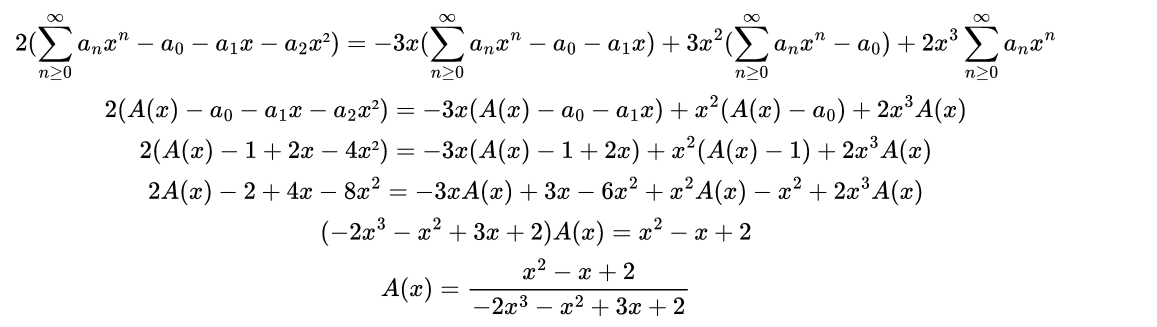
lol corrected one
but output is still strange
 fluid obsidian
Don't make any mistakes
You have the potential to be better
x²-x+2 = (x+1)(x-2)
Don't be like me
acoustic lance
lol i spotted my another mistake
fluid obsidian
Oh my god
acoustic lance
but i fgured out now i believe
fluid obsidian
acoustic lance
lol i spotted my another mistake
You won't have a stable relationship if you make two mistakes
acoustic lance
 fluid obsidian
One is acceptable but two is over
acoustic lance
lol okay 😄 i need help though
fluid obsidian
acoustic lance
https://i.imgur.com/46IxaXs.png
And you do something right but it's too late now, cuz she's gone already
That's how it is 
acoustic lance
hmmm
oh actually we can write in form of
1 - (-2x)
and thats GF for c^n * z^n
vocal sleetBOT
@acoustic lance Has your question been resolved?
fluid obsidian
acoustic lance
1 - (-2x)
Yea
vocal sleetBOT
@acoustic lance Has your question been resolved?
vocal sleetBOT
Channel closed
Closed due to timeout
Use .reopen if this was a mistake.
vocal sleetBOT
Available help channel!
Send your question here to claim the channel.
Remember:
• Ask your math question in a clear, concise manner.
• Show your work, and if possible, explain where you are stuck.
• After 15 minutes, feel free to ping <@&286206848099549185>.
• Type the command .close to free the channel when you're done.
• Be polite and have a nice day!
Read #❓how-to-get-help for further information on how to ask a good question, and about conduct in the question channels.
 nova stump
Hello. How are you? I was wondering if this is the correct explanation to the solution of this problem.
 vocal sleetBOT
nova stump
Hello. How are you? I was wondering if this is the correct explanation to the ...
nova stump
vocal sleetBOT
nova stump
Hello. How are you? I was wondering if this is the correct explanation to the ...
nova stump
It is the radius of the larger circle
Since the square is of length 1
The radius of the larger circle must be 1/2 I think
 river minnow
Yeah but that doesn't make y equal to the radius, unless you get that beta is 60 degrees
That line segment over there is just a chord
nova stump
I see.
river minnow
What I think you can do is write that r = (x + y + y - 1)/2
Because generally a circle inscribed in a right rectangle has the radius (a + b - c)/2 iirc
c being the hypotenuse and a and b being the legs
nova stump
So a circle inscribed in a right triangle has radius (a + b - c)/2
river minnow
Yup
 nova stump
Sure! 🙂
river minnow
river minnow
What I think you can do is write that r = (x + y + y - 1)/2
Anyways this should get you r = r + y - 1/2
Oh and y = 1/2
Okay yeah your answer is correct
One moment let me find my old notebook
nova stump
https://cdn.discordapp.com/attachments/903463353417072641/1096844193810350211/IMG_2626.jpg
(to make it closer)

I actually didn't make this answer
So I was just curious on how to understand it
river minnow
After y = 1/2 it's just applying the Pythagorean theorem
 twin meteorBOT
 river minnow
Alright so this is the diagram
You basically draw those radii from the center of the circle onto the sides of a right triangle
here c is getting divided into c1 and c2
nova stump
Are those kites? :0
river minnow
Hm? Those things on the lines you mean?
nova stump
The little shapes made by the radius of the circle and the points of intersection of the circle with the right triangle
river minnow
No those are right triangles
river minnow
Anyways, notice that there is a symmetry
river minnow
river minnow
We get a + b = 2r + c1 + c2
But c1 + c2 is simply c
So we have a + b = 2r + c
nova stump
Hold on he might be right
river minnow
Solving for r you will get r = (a + b - c)/2
river minnow
nova stump
Hold on he might be right
He is a troll, ignore him
river minnow
<@&268886789983436800>
nova stump
I hope you have a good day DOC
river minnow
river minnow
Solving for r you will get r = (a + b - c)/2
Alright, anyways, do you see now?
nova stump
river minnow
Alright, anyways, do you see now?
Thank you so much for your time helping me lonely bean :) I appreciate it
vocal sleetBOT
@nova stump Has your question been resolved?
nova stump
Yes but more to it
I'm just thinking rn
still
Okay.
Okay friends
I also found this solution
nova stump
to keep up with the style
river minnow
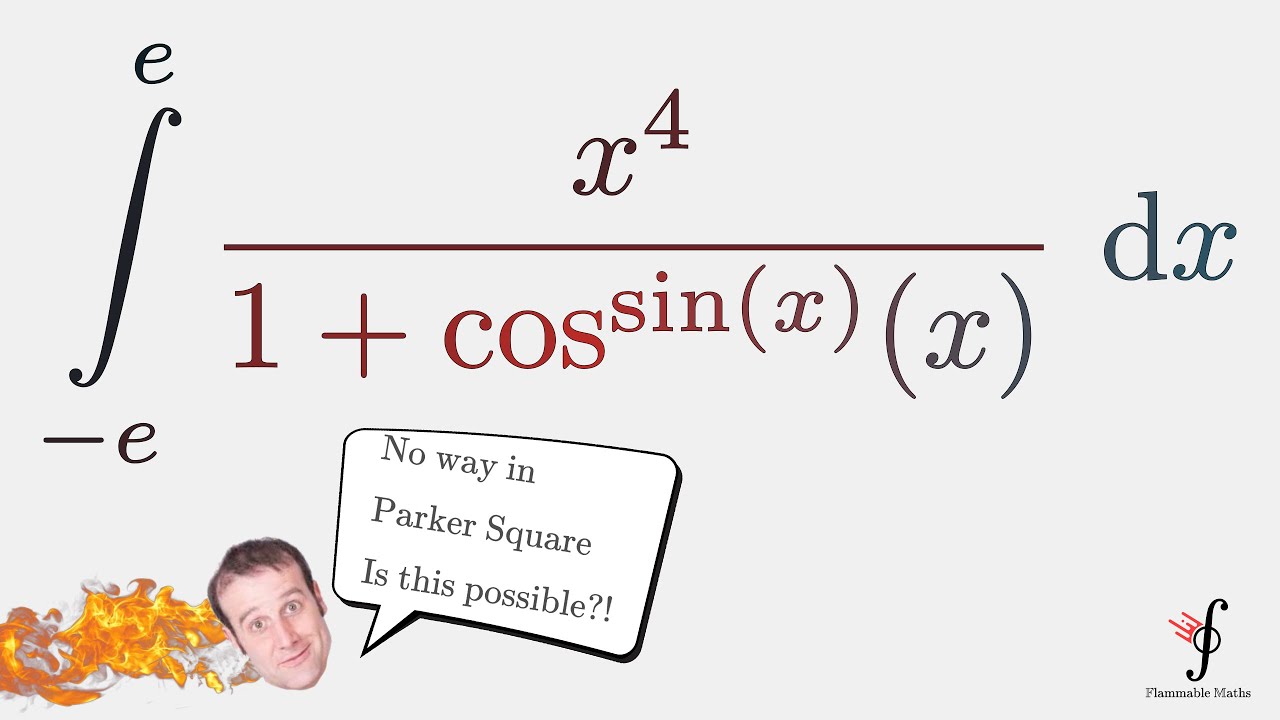
Check out STEMerch for the latest STEM goodies! =D https://stemerch.com/
Odd Even Decomposition: https://youtu.be/bCQv-BGIIjE
Even function over symmetric interval: https://youtu.be/ls2CNBhd77s
Odd function over symmetric interval: https://youtu.be/SuW_fChaqIs
Method Applied: https://youtu.be/RZr7RytBQHs
Help me create more free content! =)
ht...
What's on the thumbnail may seem irrelevant, but it's not
nova stump
Flammable maths
I used to watch that person a lot
I'm still processing some stuff

This is a lot more complicated
geez
river minnow
But it's the same 
nova stump
It is?
river minnow
Yeah it goes in line with what's in the video
nova stump
haha don't judge guys I-
Oh okay
I'll watch

It appears that there are different approaches to understanding this problem
vocal sleetBOT
@nova stump Has your question been resolved?
Channel closed
Closed by @nova stump
Use .reopen if this was a mistake.
vocal sleetBOT
Available help channel!
Send your question here to claim the channel.
Remember:
• Ask your math question in a clear, concise manner.
• Show your work, and if possible, explain where you are stuck.
• After 15 minutes, feel free to ping <@&286206848099549185>.
• Type the command .close to free the channel when you're done.
• Be polite and have a nice day!
Read #❓how-to-get-help for further information on how to ask a good question, and about conduct in the question channels.
 gritty onyx
An exponential function is given by f(x)=20∙1.15xa) Sketch the graph in the range −5≤𝑥≤10 How do I sketch this?
vocal sleetBOT
gritty onyx
An exponential function is given by f(x)=20∙1.15xa) Sketch the graph in the rang...
gritty onyx
An exponential function is given by f(x)=20∙1.15^x) Sketch the graph in the range −5≤𝑥≤10 How do I sketch this?
vocal sleetBOT
@gritty onyx Has your question been resolved?
What step are you on?
1. I don't know where to begin
2. I have begun but got stuck midway
3. I got an answer but I'm told it's wrong
4. I got an answer and would like my work checked
5. I have a question about someone else's worked solution
6. None of the above
Channel closed
Closed due to timeout
Use .reopen if this was a mistake.
Available help channel!
Send your question here to claim the channel.
Remember:
• Ask your math question in a clear, concise manner.
• Show your work, and if possible, explain where you are stuck.
• After 15 minutes, feel free to ping <@&286206848099549185>.
• Type the command .close to free the channel when you're done.
• Be polite and have a nice day!
Read #❓how-to-get-help for further information on how to ask a good question, and about conduct in the question channels.
 rain shuttle
How to do 10
 vocal sleetBOT
rain shuttle
How to do 10
rain shuttle
vocal sleetBOT
rain shuttle
How to do 10
rain shuttle
The function is (1-x^2)^1/4 btw
vocal sleetBOT
@rain shuttle Has your question been resolved?
rain shuttle
Anyone 🙏🏽
vocal sleetBOT
@rain shuttle Has your question been resolved?
 lone niche
rain shuttle
How to do 10
lone niche
rain shuttle
How to do 10
where are the x boundaries of the shape
then you find area of the cross section at every point and integrate from one side to the other
rain shuttle
X boundaries are 0 to 1
But idk how there’s pu
Pi
It’s squared right so why bring in pu
Pi
lone niche
pi just appears sometimes
something you kinda have to deal with
in this one it's not surprising
because ((1-x^2)^0.25)^2 is (1-x^2)^0.5, which graphs out ...
 random wave
Pi appears in circles
It's been defined with circles at the first place
And a point M=(x,y) which is on a circle of radius R means that x²+y²=R²
There is squares in the equation of a circle, based on the Pythagoras's theorem
Although here it's x²+y^4=1
vocal sleetBOT
Channel closed
Closed by @rain shuttle
Use .reopen if this was a mistake.
vocal sleetBOT
Available help channel!
Send your question here to claim the channel.
Remember:
• Ask your math question in a clear, concise manner.
• Show your work, and if possible, explain where you are stuck.
• After 15 minutes, feel free to ping <@&286206848099549185>.
• Type the command .close to free the channel when you're done.
• Be polite and have a nice day!
Read #❓how-to-get-help for further information on how to ask a good question, and about conduct in the question channels.
 winter hawk
.close
vocal sleetBOT
Channel closed
Closed by @winter hawk
Use .reopen if this was a mistake.
Available help channel!
Send your question here to claim the channel.
Remember:
• Ask your math question in a clear, concise manner.
• Show your work, and if possible, explain where you are stuck.
• After 15 minutes, feel free to ping <@&286206848099549185>.
• Type the command .close to free the channel when you're done.
• Be polite and have a nice day!
Read #❓how-to-get-help for further information on how to ask a good question, and about conduct in the question channels.
 brave ruin
Could someone explain why the limit is - infinity
 vocal sleetBOT
brave ruin
Could someone explain why the limit is - infinity
vocal sleetBOT
brave ruin
Could someone explain why the limit is - infinity
 desert hornet
Whenever you get (negative number)/0, it goes to -infinity
If it were a positive number in the numerator it would be +infinity
brave ruin
desert hornet
Whenever you get (negative number)/0, it goes to -infinity
Why wouldn't it be undefined ?
That does answer my question though thank you!
 stiff sandal
brave ruin
That does answer my question though thank you!
stiff sandal
brave ruin
That does answer my question though thank you!
close the channel if you are done
brave ruin
I'm still waiting on why it wouldn't be undef
desert hornet
brave ruin
Why wouldn't it be undefined ?
Well
It's a limit
The limit is -infinity means that if you graph the function, it will keep on decreasing without an asymptote
brave ruin
I'm not sure how to express this. So, should I have figured that out before I directly subbed in pi/2 + ?
Cause when I subbed in that, I got -1 / 0
desert hornet
Yeah
brave ruin
So to me it's like, there is no limit here
desert hornet
The fact that you got (negative number)/0 tells you the limit is -infinity
brave ruin
darn
okay
I guess I'll just need to look that up
cause idk why that is true
oh
so like
If I wrote 1 / x
hmm
desert hornet
That's the simplest case
lone niche
desert hornet
The fact that you got (negative number)/0 tells you the limit is -infinity
specifically if it's 0+
desert hornet
True
brave ruin
it's approaching from the right
so
hmm
will looking at a graph help me?

okie
I think I see that now
.close
vocal sleetBOT
Channel closed
Closed by @brave ruin
Use .reopen if this was a mistake.
vocal sleetBOT
Available help channel!
Send your question here to claim the channel.
Remember:
• Ask your math question in a clear, concise manner.
• Show your work, and if possible, explain where you are stuck.
• After 15 minutes, feel free to ping <@&286206848099549185>.
• Type the command .close to free the channel when you're done.
• Be polite and have a nice day!
Read #❓how-to-get-help for further information on how to ask a good question, and about conduct in the question channels.
 limpid vale
 vocal sleetBOT
limpid vale
vocal sleetBOT
vocal sleetBOT
limpid vale
vocal sleetBOT
@limpid vale Has your question been resolved?
vocal sleetBOT
Channel closed
Closed due to timeout
Use .reopen if this was a mistake.
Available help channel!
Send your question here to claim the channel.
Remember:
• Ask your math question in a clear, concise manner.
• Show your work, and if possible, explain where you are stuck.
• After 15 minutes, feel free to ping <@&286206848099549185>.
• Type the command .close to free the channel when you're done.
• Be polite and have a nice day!
Read #❓how-to-get-help for further information on how to ask a good question, and about conduct in the question channels.
molten rain
 vocal sleetBOT
molten rain
half imp
vocal sleetBOT
molten rain
half imp
3rd line from the bottom you have a quadratic equation
it's just hard to recognize
because it's a quadratic equation of e^y, not of y
So substitute u = e^y and then solve
also its hard to tell but you might have dropped a negative sign
from the line before that, unless it's the really faint dash
half imp
you're welcome
 half imp
u = -2 not 2
molten rain
i cannot ln a negative number
half imp
So
molten rain
uh
the answer sheet says
oh
oh
im suppose to find x
also
thank you
.close
vocal sleetBOT
Channel closed
Closed by @molten rain
Use .reopen if this was a mistake.
half imp
np
vocal sleetBOT
Available help channel!
Send your question here to claim the channel.
Remember:
• Ask your math question in a clear, concise manner.
• Show your work, and if possible, explain where you are stuck.
• After 15 minutes, feel free to ping <@&286206848099549185>.
• Type the command .close to free the channel when you're done.
• Be polite and have a nice day!
Read #❓how-to-get-help for further information on how to ask a good question, and about conduct in the question channels.
vast shale
Hey I was trying to prove this but I seem to have reached the negative of this somehow
 vocal sleetBOT
vast shale
Hey I was trying to prove this but I seem to have reached the negative of this s...
vocal sleetBOT
vast shale
Hey I was trying to prove this but I seem to have reached the negative of this s...


 twin meteorBOT
whatevermanjustcallmeanything
 vocal sleetBOT
@vast shale Has your question been resolved?
vocal sleetBOT
@vast shale Has your question been resolved?
vocal sleetBOT
Channel closed
Closed due to timeout
Use .reopen if this was a mistake.
Available help channel!
Send your question here to claim the channel.
Remember:
• Ask your math question in a clear, concise manner.
• Show your work, and if possible, explain where you are stuck.
• After 15 minutes, feel free to ping <@&286206848099549185>.
• Type the command .close to free the channel when you're done.
• Be polite and have a nice day!
Read #❓how-to-get-help for further information on how to ask a good question, and about conduct in the question channels.
 rough barn
determine the minimum value of
 vocal sleetBOT
rough barn
determine the minimum value of
vocal sleetBOT
rough barn
determine the minimum value of
 vague wadi
I would conjecture it's 13.5, but I am not so sure
you could try proving ... >= 13.5 but that would be a mess probably
it's definite that's you shouldn't use negative values so 0 <= x, y, z < 1
rough barn
vague wadi
I would conjecture it's 13.5, but I am not so sure
how did you arrive to that guess?
vague wadi
rough barn
how did you arrive to that guess?
minimum of 3(5 - 3x)/sqrt(1 - x^2)
just said x = y = z
rough barn
because it's symmetrical?
rough barn
I see
vague wadi
say x =< y =< z. then 5 - 3x >= 5 - 3y >= 5 - 3z and 1/sqrt(1 - x^2) <= 1/sqrt(1 - y^2) <= ...
so maybe you could try doing (5 - 3x)/sqrt(1 - z^2) + (5 - 3y)/sqrt(1 - y^2) + (5 - 3z)/sqrt(1 - x^2)
which simplifies the inequality into two: min of the second term and the first and third
you just have to show that the minimum is achievable by our big inequality
rough barn
Alright, I'll give it a shot
vague wadi
(5 - 3y)/sqrt(1 - y^2) can be resolved by calculus lol
or maybe your typical power inequalities, I didn't check
it's just 100% resolvable
vague wadi
rough barn
Alright, I'll give it a shot
ye try. ping me when you're done
rough barn
vague wadi
(5 - 3y)/sqrt(1 - y^2) can be resolved by calculus lol
or maybe your typical pow...
yes, but this is a simulation for an olympiad which syllabus does not include calculus
vague wadi
rough barn
yes, but this is a simulation for an olympiad which syllabus does not include ca...
well AM-GM-HM to your rescue
rough barn
im familiar with that one
vague wadi
no HM needed here prob
rough barn
vague wadi
ye try. ping me when you're done
alright
vague wadi
vague wadi
I would conjecture it's 13.5, but I am not so sure
nvm, it's 12
I didn't see the minimum right
vocal sleetBOT
@rough barn Has your question been resolved?
rough barn
yeah, no, I didn't get it, sorry @vague wadi
vague wadi
rough barn
yeah, no, I didn't get it, sorry <@670559252456407070>
ok it happens
it's just my ideas
I am quite bad at ineqs anyway. you could try asking this on the math olympiad server I think
rough barn
ah alright
vague wadi
np
rough barn
.close
vocal sleetBOT
Channel closed
Closed by @rough barn
Use .reopen if this was a mistake.
vocal sleetBOT
Available help channel!
Send your question here to claim the channel.
Remember:
• Ask your math question in a clear, concise manner.
• Show your work, and if possible, explain where you are stuck.
• After 15 minutes, feel free to ping <@&286206848099549185>.
• Type the command .close to free the channel when you're done.
• Be polite and have a nice day!
Read #❓how-to-get-help for further information on how to ask a good question, and about conduct in the question channels.
 vague parcel
the uniform charge density of an insulator-filled sphere with radius a is p and the total positive charge Q is. Using the Gaussian structure, calculate the electric field and electric potential at a point outside the sphere.
vocal sleetBOT
vague parcel
the uniform charge density of an insulator-filled sphere with radius a is p and ...
vague parcel

the uniform charge density of an insulator-filled sphere with radius a is p and the total positive charge Q is. Using the Gaussian structure, calculate the electric field and electric potential at a point outside the sphere.
fluid obsidian
vague parcel
the uniform charge density of an insulator-filled sphere with radius a is p and ...
Do you know the formula for electric field?
vocal sleetBOT
@vague parcel Has your question been resolved?
vocal sleetBOT
Channel closed
Closed due to timeout
Use .reopen if this was a mistake.
vocal sleetBOT
Available help channel!
Send your question here to claim the channel.
Remember:
• Ask your math question in a clear, concise manner.
• Show your work, and if possible, explain where you are stuck.
• After 15 minutes, feel free to ping <@&286206848099549185>.
• Type the command .close to free the channel when you're done.
• Be polite and have a nice day!
Read #❓how-to-get-help for further information on how to ask a good question, and about conduct in the question channels.
 cloud quiver
 vocal sleetBOT
cloud quiver
vocal sleetBOT
cloud quiver