#help-13
1 messages · Page 398 of 1
 steady lintel
 cedar kilnBOT
steady lintel
Not sure if this is fitting for a help channel but how could I go about bridging...
cedar kilnBOT
steady lintel
Not sure if this is fitting for a help channel but how could I go about bridging...
 crimson sedge
like?
 fossil dawn
wdym
 proven summit
steady lintel
Not sure if this is fitting for a help channel but how could I go about bridging...
proven summit
steady lintel
Not sure if this is fitting for a help channel but how could I go about bridging...
not sure what you mean
 dusk goblet
could you be more vague
steady lintel
For example when I integrate by itself I cam do it just fine but having to integrate in exams and actually apply it to questions I fail miserably.
crimson sedge
uh
 long swan
so like word problems?
steady lintel
long swan
so like word problems?
Usually yes
crimson sedge
clock ticking problems
steady lintel
ig it is just a problem of applying different concepts to practical problems
So how do I get better at freely applying math concepts to fitting problems
 tropic oxide
hold on wait
the issue you brought up seems to be one of exam stress
actually... one moment
steady lintel
I have usually mediocre stress at exams but I can still work some problems atleast.
If it rly is about stress how do you manage it during exams
tropic oxide
which of the following types of problems and settings would you have the most trouble with?
- Find this integral, as-is. [at home]
- Solve this problem that requires integration in some clever way. [at home]
- Find this integral, as-is. [exam conditions]
- Solve this problem that requires integration in some clever way. [exam conditions]
steady lintel
number 3 sometimes but mostly questions like number 4
crimson sedge
u are stressing too much
steady lintel
My brain is runnng smoothly at home normally but in exams i start stumbling on questions like number 4
crimson sedge
crimson sedge
u are stressing too much
.
 iron wren
so like a question like "the rate of the volume of a snowball decreasing is proportional to the surface area. show that the radius is decreasing at a uniform rate" that kind of question
steady lintel
I mean from personal experience it doesnt feel like I stress that much.
steady lintel
iron wren
so like a question like "the rate of the volume of a snowball decreasing is prop...
Yes. They are usually somewhat open ended
tropic oxide
so #2 would cause you no issue?
steady lintel
since im not restricted to a single topic its hard to know which way i should go
iron wren
its kind of about intuition
steady lintel
Yes 2 and 4
I could try and look up an example question that ive tried and failed on

so i ahd to prove this but didnt know how to continue
And ig it rly is a problem of intuition then
I dont rly care about the solution but just how to train the methods to solving questions that feel very open ended
fossil dawn
others can cmiiw, but i feel like intuition is best honed by not just practicing, but identifying why you need certain methods for certain questions (even if it's obvious to you)
steady lintel
So I guessing the simplest way to train my intuition is to just solve problems while actively thinking of the possible methods to solve it?
fossil dawn
write down the reasoning for each step
fossil dawn
iron wren
so like a question like "the rate of the volume of a snowball decreasing is prop...
for example, for things like this
you can write down the volume and surface area of the snowball, then write down that both equations use r
then write down the fact that the question wants us to find the rate, and that we can do this by finding the derivative
steady lintel
I think also why I cant seem to find the correct methods to solve problems is because I find it hard to connect different topics together. For example here the connection between differentiating and trig isnt clear so i cant seem to connect them
Idk how to explain it
But ill propably close this question and look elsewhere too
 rapid mauve
cedar kilnBOT
rapid mauve
cedar kilnBOT
Channel closed
Closed by @steady lintel
Use .reopen if this was a mistake.
 Available help channel!
Send your question here to claim the channel.
Remember:
• Ask your math question in a clear, concise manner.
• Show your work, and if possible, explain where you are stuck.
• After 15 minutes, feel free to ping <@&286206848099549185>.
• Type the command .close to free the channel when you're done.
• Be polite and have a nice day!
Read #❓how-to-get-help for further information on how to ask a good question, and about conduct in the question channels.
 quiet mica
Guys please help me
 cedar kilnBOT
quiet mica
Guys please help me
proven summit
cedar kilnBOT
quiet mica
Guys please help me
proven summit
!status
cedar kilnBOT
What step are you on?
1. I don't know where to begin.
2. I have begun but got stuck midway.
3. I got an answer but I was told that it's wrong.
4. I got an answer and would like my work checked.
5. I have a question about someone else's work/solution.
6. I have completed the problem and don't need help anymore. Thank you.
7. None of the above
uhh 1
fossil dawn
if the words "how fast" are converted to "rate of increase" would you be able to do it?
quiet mica
Do you mean knowing what the question is asking for?
fossil dawn
in a sense, yes
 fringe vine
,tex(maths) \relax it is just asking for $\displaystyle \frac{d\operatorname{Area}(OPA)}{dt} \big|_{x=8}$
 wraith daggerBOT
 fringe vine
since you can get expression for area(OPA) in terms of x, and dx/dt is given, you can apply the chain rule to compute it
quiet mica
I know dx/dt = 1/3 , x=8 y=2 and the area of a triangle is 1/2 xy
cedar kilnBOT
@quiet mica Has your question been resolved?
 upper laurel
quiet mica
I know dx/dt = 1/3 , x=8 y=2 and the area of a triangle is 1/2 xy
upper laurel
quiet mica
I know dx/dt = 1/3 , x=8 y=2 and the area of a triangle is 1/2 xy
try solving for y in the equation x = y^3 and tell me what you get
quiet mica
y = x^1/3 ? right?
upper laurel
quiet mica
y = x^1/3 ? right?
yep
now you can place that in the area of the triangle then d/dx it
remember that x(t) is a function of t, so you use chain rule

 rancid linden
quiet mica
rancid linden
quiet mica
Will look at this again if it is still unresolved when i am more free but for now i just checked the calculations and i believe the 1/2 should go with the y dx/dt aswell
(Added in cyan)
 cedar kilnBOT
@quiet mica Has your question been resolved?
 past wave
quiet mica
past wave
quiet mica
yes the yellow bit is correct
cedar kilnBOT
Channel closed
Closed by @quiet mica
Use .reopen if this was a mistake.
cedar kilnBOT
Available help channel!
Send your question here to claim the channel.
Remember:
• Ask your math question in a clear, concise manner.
• Show your work, and if possible, explain where you are stuck.
• After 15 minutes, feel free to ping <@&286206848099549185>.
• Type the command .close to free the channel when you're done.
• Be polite and have a nice day!
Read #❓how-to-get-help for further information on how to ask a good question, and about conduct in the question channels.
 uncut blaze
can someone what is factoring and when and how we need it ?
uncut blaze
 proven summit
uncut blaze
can someone what is factoring and when and how we need it ?
proven summit
uncut blaze
can someone what is factoring and when and how we need it ?
usually you use factoring for solving a quadratic, simplifying rational functions, etc
it's the process of breaking down an expression into simpler components, called factors
for example, let's say we factorize 10
 solid oasis
factoring is expressing a number or an expression as a product of two or more numbers or expressions
For example: 10 can be written as the product of 2 and 5 as 2 x 5
x^2 + 3x + 2 can be written as the product of (x+2)(x+1)
proven summit
proven summit
for example, let's say we factorize 10
that would be 5(2)
solid oasis
proven summit
for example, let's say we factorize 10
interestingly, we considered the same number as an example
proven summit
solid oasis
interestingly, we considered the same number as an example
at the same time too lol
uncut blaze
uncut blaze
and why here he said -1 + 6 and not 2.5*2 ?
 stiff brook
it should multiply to -6
solid oasis
uncut blaze
what if the number can be factored into two ways
factor it completely.
30 can be factored as 3 * 10 and 6 * 5, and both are fine.
It is expected to factor it completely. 30 is "completely" factored as 2 * 3 * 5
uncut blaze
solid oasis
factor it completely.
30 can be factored as 3 * 10 and 6 * 5, and both are fine...
ohhh i see that
stiff brook
you are finding two numbers (factors of the constant) such that they add up to the coefficient of the linear term and multiply to the constant term
uncut blaze
so is the factoring here is correct ?
 solid oasis
multiply to the product of the constant term and the leading coefficient*
proven summit
if you want to check. Expand the expression (x-1)(x+6)
solid oasis
uncut blaze
so is the factoring here is correct ?
there is no factoring done here
proven summit
uncut blaze
so is the factoring here is correct ?
the factoring would be like where the (x-1)(x+6) from our example
notice how they putted them into brackets?
uncut blaze
solid oasis
there is no factoring done here
i meen what i did above
-12x = -2*6
uncut blaze
proven summit
the factoring would be like where the (x-1)(x+6) from our example
why 6 we did not use 6
proven summit
yes
uncut blaze
uncut blaze
so is the factoring here is correct ?
ok let me factor this one and then till me if am right
proven summit
uncut blaze
so is the factoring here is correct ?
I was focusing on x^2 + 5x - 6 one, I didn't realise you sent a different quadratic you wanted to factor
uncut blaze
proven summit
sure? but the answer is kinda there already

i hope you understand my writing
uncut blaze
how ?
 upper ruin
Also don't write that 35 =
upper ruin
uncut blaze
how ?
Calculate (x+5)(x+7)
uncut blaze
oh sorry 35= is wrong
solid oasis
Prof. Alberto Z. shalt help you.
uncut blaze
what about the -12x ?
upper ruin
uncut blaze
what about the -12x ?
Do you get it?
upper ruin
upper ruin
Calculate (x+5)(x+7)
What's the result of this?
uncut blaze
upper ruin
Do you get it?
no sorry i did'nt
proven summit
uncut blaze
no sorry i did'nt
look at our quadratic one of the terms has an negative next to it
that being -12x
you factored it as (x+5)(x+7)
can you see why it is wrong?
uncut blaze

How to Factor Expressions
https://www.mathpapa.com/factoring-examples/
i just watched this one
it make it really easy
so this is the answer for it @upper ruin

@upper ruin
proven summit
that's correct
uncut blaze
oh ok now i do understand it thx alot
cedar kilnBOT
@uncut blaze Has your question been resolved?
proven summit
crimson sedge
!solved
!close
My dumbass forgot the factoid too for telling the helpee to close 
!done
cedar kilnBOT
If you are done with this channel, please mark your problem as solved by typing .close
proven summit
Yay I remembered it now 
crimson sedge
proven summit
!close
LMAO
cedar kilnBOT
Channel closed
Closed due to timeout
Use .reopen if this was a mistake.
cedar kilnBOT
Available help channel!
Send your question here to claim the channel.
Remember:
• Ask your math question in a clear, concise manner.
• Show your work, and if possible, explain where you are stuck.
• After 15 minutes, feel free to ping <@&286206848099549185>.
• Type the command .close to free the channel when you're done.
• Be polite and have a nice day!
Read #❓how-to-get-help for further information on how to ask a good question, and about conduct in the question channels.
 marble yoke
how to solve this without expanding
 cedar kilnBOT
marble yoke
how to solve this without expanding
cedar kilnBOT
marble yoke
how to solve this without expanding
 dusky panther
ah no worries
marble yoke
dusky panther
symmetry
can you help me with it? im just learing matrices
dusky panther
did you learn expanding?
marble yoke
yeah
dusky panther
Then Im guessing youll just have to expand it 👻
 stiff totem
you can use sarrus' rule, which should be faster than laplace expansion
 cedar kilnBOT
@marble yoke Has your question been resolved?
cedar kilnBOT
Channel closed
Closed due to timeout
Use .reopen if this was a mistake.
Available help channel!
Send your question here to claim the channel.
Remember:
• Ask your math question in a clear, concise manner.
• Show your work, and if possible, explain where you are stuck.
• After 15 minutes, feel free to ping <@&286206848099549185>.
• Type the command .close to free the channel when you're done.
• Be polite and have a nice day!
Read #❓how-to-get-help for further information on how to ask a good question, and about conduct in the question channels.
 pure scaffold
examine the number of solutions to the system of equations depending on the parameter p
px + 2py + (p − 1)z + 2pt = p
2px + (5p − 1)y + (p − 1)z + 5pt = 4p − 2
2px + (5p − 1)y + (2p − 2)z + (p2 + 5p)t = 5p − 3
−px − 2y + (−4p + 4)z − pt = 3p − 4
cedar kilnBOT
pure scaffold
examine the number of solutions to the system of equations depending on the para...
pure scaffold
i would really appreaciate someone showing me how to do this, I know i need to use matrix but every method i see is not only different but also goes against each other
 lyric plank
let's treat x, y, z, t as 4 variables we're solving for in our system, and construct the augmented matrix
the number of equations is the number of rows, and the number of variables is the number of columns (plus the augmented column)
try constructing the matrix first, using the coefficients here
 lyric plank
oh did you divide out ps somewhere
pure scaffold
but thats about all i know how to do in this problem 🙁 i also think you have to use gauss to clear the columns?
pure scaffold
lyric plank
bc p might be 0
is there a way to do it without dividing? i did divide and thought i would just check what happens if p is 0 (but thats just like my starting assumption because again i have no idea how to do this)
heres the starting one
 lyric plank
hm like even if u do that, you'll have reciprocal ps floating around that will be annoying to deal with
i think this form is easier
i would just try to row reduce this now, at least into row echelon form
that should be enough to characterize everything and i think you can do that here without having to divide by p ever
for instance, we can eliminate the first column really easily by multiplying the first row by 1 or 2 before adding
and im hoping that second column becomes less annoying
maybe not 😭 but i think its a good starting point
oh and you'll get various cases as you go if u ever do have to divide by a function of p
 surreal cave
R3<-R3-R2 seems to have some nice cancellation
surreal cave

pure scaffold
 lyric plank
ooh that looks super convenient ya
surreal cave
indeed
pure scaffold
and now continuing
surreal cave
this is already really close to be in upper trianglar form
pure scaffold

i have this one and continuing
oh wait
no i think its right so far, continuing
no i think i messed up
cuz like if i do R4 = R4-R2 the 0 before disappears
lyric plank
this looks good so far i think
its fine if 0s get readded in
your goal is just to eliminate column by column
and ur exactly doing that rn
i havent checked the actual operations but i think ur probably doing them right
surreal cave
R4 = -R4 would help
lyric plank
or just adding R3 to R4 tbh
surreal cave
yeah just hoping to help OP see that cancellation
pure scaffold
lyric plank
or just adding R3 to R4 tbh
WAIT OMG UR RIGHT
pure scaffold
surreal cave
R4 = -R4 would help
so like changing the signs of the whole row? i can do that?
surreal cave
pure scaffold
so like changing the signs of the whole row? i can do that?

cuase it's just ulpying the whoel row by a constant
and that constant is just -1 here
pure scaffold
sorry if its a dumb question im just like, terrible when it comes to those problems and every exam has one of them so i need to learn them lol
surreal cave
no worries, it's how learning happens 
pure scaffold
would chose the most insane integral any day man
lyric plank
dw linear algebra eventually gets way cooler than integration imo
pure scaffold
 lyric plank
eventually you start thinking of integrals and derivatives as linear operators :D
pure scaffold
and tbh from this point i have NO idea what to do 🙁
lyric plank
no thats amazing
pure scaffold
i saw ppl try to get to this point but i never understand the next steps
surreal cave
R4-> R4/(p^2-p)
lyric plank
i would avoid doing that even
surreal cave
make sure that diagonal is all 1s
lyric plank
all we really need to do is check if any of the diagonal entries are 0
if they're all nonzero, we will have exactly 1 solution
if any of them are zero, we then just need to check if any row is all 0s except for a nonzero augmented entry
if such a row exists, no solution. otherwise, infinite
pure scaffold
surreal cave
R4-> R4/(p^2-p)
but then like i need to check what happens if p = 0 right?
surreal cave
lyric plank
if any of them are zero, we then just need to check if any row is all 0s except ...
in other words, if we get (0 0 ... 0 | x) where x!=0
lyric plank
pure scaffold
but then like i need to check what happens if p = 0 right?
yeah this is why i would just directly analyze the matrix in its current form so u can directly tackle these roots
your current matrix form is all you need to solve the problem, you don't need to do any more matrix ops
pure scaffold
lyric plank
all we really need to do is check if any of the diagonal entries are 0
so like if any row is 0 or
im sorry i just dont understand this last point so muuuch
lyric plank
so like, if all diagonal entries are nonzero, do you see how we could guarantee that a unique solution exists
pure scaffold
surreal cave
in other words, if we get (0 0 ... 0 | x) where x!=0
so like i check what happens if p-1=0?
and i put everywhere where p is 1?
surreal cave
I'd suggest p^2-p=0
because we alr have the rest of the row being all zeroes
on the matrix entry a_44 we have a degree 2 polynomial and at the augmented entry 4 we have a one degree polynomial
we might expect one solution to the second degree polynomial that the first degree one does not
and thus an inconsistent system for some p
lyric plank
pure scaffold
and i put everywhere where p is 1?
but yes, put in a p value where one of the diags is 0, plug that in everywhere else, and check for zeroed rows
pure scaffold
do i need to check every row for the p that makes it 0 or any other number?
or just always the last row?
lyric plank
not just last row
any row could possibly be zeroed out here bc there's ps everywhere
and you might trigger other rows to zero out bc a lot of the diagonal entries share roots
like first and foremost, we have a condition for there to be exactly 1 solution to the system, let's maybe start there
that will make it easier to analyze the rest
lyric plank
lyric plank
so like, if all diagonal entries are nonzero, do you see how we could guarantee ...
specifically this
what values of p guarantee that the diagonal entries are nonzero
pure scaffold
you mean like
the ones we didn't clear
or the ones we did clear
like what guarantees that we have this form we have now?
lyric plank
pure scaffold
so in this form, there is a possible pivot in every row
referring to the first nonzero number in each row
and they all lie on the main diagonal (top left to bottom right)
if all of those main diagonal entries are nonzero, then we know we can eventually solve the entire matrix by finishing the row reduction
and we will get unique solutions for each variable
if any of the diagonal entries are zero, we are stuck with free variables in a row
and we have to check other stuff to know if there's 0 or infinite solutions
pure scaffold
they are zero if p = 0 and p = 1 i think?
pure scaffold
i dont need to calculate anything?
just check what makes the diagonal zero out?
for one solution
that is
pure scaffold
okay and what about infinite and contradictory solution? i mean i know 0=0 and for example 1=0 but i just have no idea how to check for them in the matrix like where i get them from
lyric plank
note if we had an extra equation or extra variable here, there's no way of getting eexactly 1 solution bc ur always stuck with free variables, so the squareness of our matrix was important here
lyric plank
pure scaffold
okay and what about infinite and contradictory solution? i mean i know 0=0 and f...
so there's only 2 cases right? p = 0 or p = 1. just try them both
and see what the matrix looks like
as long as u never have 0 = nonzero, there's infinite. if you do, it's no solution
 lyric plank
mhm so how many solutions here
pure scaffold
do i get the number of solutions from like matrix determinant? im sorry, my professor just suck and he only taught us to like, calculate matrix determinant, how to multiply them, add, like basic calculations and nothing more but this is what will be on the test so its my first encounter, i cant really find it on the internet either since idk what exactly im looking for other than a system of equations with a parameter
so sorry if the questions are dumb
lyric plank
no ur fine
so determinants are useful but they only work for square matrices
in other words, systems where the number of variables = number of equations
that would work here
but in terms of number of solutions, a determinant can really only tell you 2 things
if the determinant is nonzero, there will be exactly 1 solution, no matter what the augmented column is
if the determinant is zero, then there's either no solution or infinite solutions, but that depends on what the augmented vector is
and you won't be able to determine that without looking at the overall system
if you computed the determinant of the 4 by 4 system here, what you would get is a polynomial in p where the only roots are 0 and 1, and that would have told you the same thing that row reduction did
beyond that, we still have to plug those roots in to see how many solutions occur in those settings
pure scaffold
oh okay, so how do i get the answer of how many solutions there are from a matrix like the one where i put p = 1?
lyric plank
so there, we see there is no row where the variable coefs are all 0 and the RHS is nonzero
that means theres infinite solutions
if a row was all 0 except for a nonzero RHS, then there's no solution
pure scaffold
but what about the second and third row? we get 1=0 yes?
or do i only look at the last row once again
lyric plank
no u dont only look at the last row
well sort of, when u row reduce u naturaly get the diagonal structure so usually the last row(s) will tell u everything
but more importantly we should recognize what we're actually looking for
that row isn't saying 1 = 0
it's saying t = 0, since t was the fourth column variable
pure scaffold
OH
lyric plank
the first 4 columns are variable coefs, only the last column is numbers
pure scaffold
okay so the last row is real numbers (idk how to put it otherwise sorry), not variables, so only if every variable is 0 but the real number is different than that there are no solutions?
lyric plank
last column not row*
lyric plank
and yes exactly, if every variable has a 0 coef there's no way for it to sum to a nonzero number, and so a nonzero RHS would mean no solution
 lyric plank
exactlyy
pure scaffold
okay okayyy
so i get when there are no solutions
and when there are
but how do i tell when there is one solution and when there are infinite?
or is it like always infinite if there is a solution in those cases?
lyric plank
there is one solution if you have the same number of variables as equations, and either of the following is true:
the determinant of your system (without the RHS) is nonzero
after row reducing, your diagonal entries (again ignoring the RHS) are all nonzero
(those conditions are actually all equivalent)
if these aren't true, then there's either no solution or infinite solutions
if, after row reducing, you have a row where all 0 coefs = a nonzero number, there's no solution
if you don't have that, then there's infinite solutions
pure scaffold
okay but the diagonal entried are all non zero after putting in the p that we're checking or after? if its before then in my case, we have p = 1 has one solution, not infinite, yes? because the number of variables is the same as equations (i heard that the parametr doesnt count) and out diagonal entried are all nonzero?
lyric plank
we dont know if the diagonal entries are nonzero until we plug p in
lyric plank
mhm and there's no zeroed out row with a nonzero RHS
pure scaffold
and if after plugging in p i still have a diagonal that isnt zeroes but also no 0 = 1(or other number) and the same number of equations
then i have
one solution
so its = row reducing -> check what zeroes out the diagonal / check out what zeroes out p's in the last row
lyric plank
if your diagonal is fully nonzero after row reducing, and your system was square, youre guaranteed exactly 1 solution
doesnt matter what the rest of the matrix or the augmented column is
we only need to check other stuff if
number of equations doesnt equal number of variables
any of the diagonal entries are 0 after row reducing
if either of those are true, then and only then there will be either no solution or infinite solutions
pure scaffold
lyric plank
if your diagonal is fully nonzero after row reducing, and your system was square...
after row reducing and after plucking in p yes?
lyric plank
yup
and whenever i say square i wanna be clear i mean ignoring the augmented column
in case that wasnt clear
pure scaffold
in the cases our professor gives us, the numver of equations is always equal, so im not worrying about that one. So i only care about the latter. If there are no p's that could make the diagonal entries 0 there's one solution?
lyric plank
yes, bc nonzero diagonals mean we can solve the rest of the system by eliminating entries above
does the reasoning make sense
there are no free variables
and there's no way to ever have a zeroed out LHS
bc we're guaranteed nonzero diagonal entries
but once you have a zero diagonal entry, you're introducing at least 1 free variable, so we cant have exactly 1 solution anymore
and if the row is zeroed out, you might even have no solution
pure scaffold
yes, okay, so if i have a p that makes it zero it always means im looking at either infinite or no solutions? i understand what youre saying im just double checking everything since youre really helpful and its my chance to pass this test and i literally couldnt find anything on the internet that would help me before
makes the diagonal zero
i meant
lyric plank
yes, if a p makes a diagonal entry zero after row reducing, there is either 0 or infinite solutions
pure scaffold
alright! so if i cant find a p like that, im looking at one solution (assuming its square and all)
lyric plank
or if ur just plugging in a p that doesnt do that but yup
like here plugging in p != 0 or != 1 gave us exactly 1 sol
pure scaffold
and this is the last question i promise since now i get it finallyyyyy, if i cant find a p like that where do i find what this one solution is? is it just like u said, i will most likely just get a p that i plug in and it doesnt zero it out?
lyric plank
okay i think ur saying 2 things there
if there is no p that keeps the diagonal nonzero, then you will never have exactly 1 solution
if a specific p makes the diagonal nonzero, and you want to now find the 1 unique solution, you just finish row reducing by cancelling entries above in the matrix
until the only nonzero entries in the LHS are on the diagonal, and the RHS is the solutions
if you just want to know that 1 unique solution exists, all you need to do is row reduce, plug in p and check if the diagonal has any 0s
you also can compute the determinant if u want
pure scaffold
lyric plank
if a specific p makes the diagonal nonzero, and you want to now find the 1 uniqu...
so im row reducing up not down and only keeping the diagonal?
lyric plank
yes, to get the actual final solution
lyric plank
im glad it helpedd
pure scaffold
i might actually pass this class now
lyric plank
yess
pure scaffold
thank you for being patient
i literally couldnt find this info explained ANYWHERE u save meee
lyric plank
this is definitely a little tricky
usually ur not given systems with parameters
i think this is something ur prof likes doing
pure scaffold
lyric plank
i think this is something ur prof likes doing
yeah, we lost 70% of my major in a year
lyric plank
bc most of the time it wont be that straightforward to do the row reduction
lyric plank
omg
pure scaffold
during classes he shows us like the most basic things and then the exam has things we had NEVER seen before
i could find the reduction things and all
and i knew i could do that much
lyric plank
thats unfortunately very common in college 😭
pure scaffold
but the part about knowing how many solutions was hell
lyric plank
yeah its hard jumping into this when u dont have more experience with just regular nonparametrized systems
like a lot of the time ive seen the variatn of this question where a few of the matrix entries are variables
but a system where all of them have a p is obnoxious 😭
and u kind of have to make the system pretty specific for it to cancel out the way it did here
to be honest, determinants might be easier as a more generalizable method
pure scaffold
yeah, i mean, its not the worst thing he had done... He gave us some limits that could only be done using some advanced shit we wont do until our 4th year
lyric plank
theyre just obnoxious to do especially with quartics
pure scaffold
i remember he gave us questions about gradient shift of a function of two variables with absolute value. There was simply no info on the whole internet about it. Like with those matrix and p, there was SOME, not really explained just showed and i didnt understand it but this one? nowhere
lyric plank
oop
pure scaffold
no one had a clue how to do that, out of 100 student not one did get a single point on that question ugh
i have a few more questions that look exactly the same from his other tests, ii suppose that method will work on all of them
so thank you very much once again! have an amazing day
.close
cedar kilnBOT
Channel closed
Closed by @pure scaffold
Use .reopen if this was a mistake.
cedar kilnBOT
Available help channel!
Send your question here to claim the channel.
Remember:
• Ask your math question in a clear, concise manner.
• Show your work, and if possible, explain where you are stuck.
• After 15 minutes, feel free to ping <@&286206848099549185>.
• Type the command .close to free the channel when you're done.
• Be polite and have a nice day!
Read #❓how-to-get-help for further information on how to ask a good question, and about conduct in the question channels.
 supple grove
can L be negative
 cedar kilnBOT
supple grove
can L be negative
supple grove
cedar kilnBOT
supple grove
can L be negative
supple grove
i dont see any reason why it couldnt be but i dont know
upper laurel
supple grove
can L be negative
given an and bn are positive sequences?
cedar kilnBOT
Channel closed
Closed by @supple grove
Use .reopen if this was a mistake.
supple grove
guess i should read more carefully
cedar kilnBOT
Available help channel!
Send your question here to claim the channel.
Remember:
• Ask your math question in a clear, concise manner.
• Show your work, and if possible, explain where you are stuck.
• After 15 minutes, feel free to ping <@&286206848099549185>.
• Type the command .close to free the channel when you're done.
• Be polite and have a nice day!
Read #❓how-to-get-help for further information on how to ask a good question, and about conduct in the question channels.
 austere wasp
 cedar kilnBOT
austere wasp
austere wasp
cedar kilnBOT
austere wasp
austere wasp
Is there a way to solve this question?
 half gulch
you can draw a graph to visualize solution
 split ice
you should probably not draw a graph up to 18,000 degrees, actually
fossil dawn
use information from the period of cos
austere wasp

If there is an intersection every 180 degrees, then there would be 100 solutions right??
fossil dawn
the more proper description is 2 solutions per full period of cos (360), but that works for your purposes
yeah, correct
austere wasp
For (ii), since there is one intersection every 360 degrees there is 4 solutions
austere wasp
I am only getting 6 solutions for (iii)
fossil dawn
there should be 7
cedar kilnBOT
@austere wasp Has your question been resolved?
austere wasp
How??
cedar kilnBOT
@austere wasp Has your question been resolved?
fossil dawn
eh wait
yeah there's one solution at 0
cos x = 1 is the most basic value
then one solution every 360
cedar kilnBOT
Channel closed
Closed due to timeout
Use .reopen if this was a mistake.
Available help channel!
Send your question here to claim the channel.
Remember:
• Ask your math question in a clear, concise manner.
• Show your work, and if possible, explain where you are stuck.
• After 15 minutes, feel free to ping <@&286206848099549185>.
• Type the command .close to free the channel when you're done.
• Be polite and have a nice day!
Read #❓how-to-get-help for further information on how to ask a good question, and about conduct in the question channels.
 fleet oracle
Im trying to find the absolute value with I 2+9i I
fleet oracle
Can someone help me find it?
tropic oxide
do you know how to find |a+bi| generally?
i.e. do you know generally how absolute value works for complex numbers
fleet oracle
um no not really
well like
i got taught it
but i forgot
💀
i think its like
a x 2
then root it
or sumn like that
dusk goblet
fleet oracle
but i forgot
check your notes
tropic oxide
off the mark there
fleet oracle
dusk goblet
check your notes
there is none
tropic oxide
the absolute value of a complex number is its distance from zero
fleet oracle
tropic oxide
off the mark there
thank goodness i asked for help before doing it then
dusk goblet
and find the norm/length of that
tropic oxide
in the complex plane, that is
tropic oxide
no parabola
fleet oracle
she was saying sumn about that
oh
wait are we talkinga bout the samet hing?
im in algebra 2
tropic oxide
$|a+bi| = \sqrt{a^2+b^2}$
wraith daggerBOT
Ann
 fleet oracle
wait
why would you root
something that you squared
isnt that just gonna give you the same answer
as it was before it was squared
tropic oxide
it's not equal to a+b if you're wondering about that
roots don't distribute over addition and neither do exponents
this should be familiar to you as something that could've come from Pythagoras
fleet oracle
tropic oxide
it's not equal to a+b if you're wondering about that
oh yeah thats what i wsa wondering
fleet oracle
tropic oxide
roots don't distribute over addition and neither do exponents
so do you add both a^2 and b^2 then root it?
 modern estuary
Sqrt(2^2 + 3^2) is not the same as 2 +3 for example
fleet oracle
im kind of lost , and sorry if im seem pretty slow to speed, its almost 1am my time and im still doing hw lol
4 + 9 = 13
and yeah it doesnt
so
like
after i get 13
I root it?
tropic oxide
fleet oracle
so do you add both a^2 and b^2 then root it?
that's what the expression says to do, yes.
fleet oracle
ohh okay
so for 2 + 9i
itll be
4 -81
so -77
and then i root that?
cause like
tropic oxide
(-9)^2 ≠ -81
modern estuary
In 2+9i, a = 2 and b =9
fleet oracle
the original is 9i
tropic oxide
no
fleet oracle
so when i square it, its gonna be negative
tropic oxide
you take just the b, without the i
the b is attached to the i but does not include the i
fleet oracle
ye so -81 right?
tropic oxide
no
fleet oracle
modern estuary
In 2+9i, a = 2 and b =9
oh i see now looking here
modern estuary
wraith dagger
**Ann**
Read this properly and pattern match it with 2+9i
tropic oxide
"the number doesn't get affected" is strange wording but yes you'll have 4+81 under the root
fleet oracle
wraith dagger
**Ann**
so a^2 + b^2 = 4 + 81
so square root 85
but thats not a perfect square
modern estuary
Whats the problem with that
fleet oracle
i will have to do like
4 x 10
4i root 10
then just simplifiy
to 2i
root 5
right?
oh wait nvm lol
2i root 10
tropic oxide
you're going off into weird directions
modern estuary
Just leave it as sqrt(85)
tropic oxide
but i will say this:
modern estuary
Its a number. A number is a number is a number
tropic oxide
the absolute value of a complex number is always real and positive (except for 0, whose absolute value is also 0)
tropic oxide
fleet oracle
but thats not a perfect square
so what?
do you think that leaving the answer as sqrt(85) is wrong?
fleet oracle
so the absolute valie is just a square root?
i thought youd like
turn it into a
whatever those 5i root 2 things are yk
i forget what they are defined as
tropic oxide
i think you're overthinking it and also getting cross-i'd
fleet oracle
tropic oxide
i think you're overthinking it and also getting cross-i'd
what is cross-i'd
tropic oxide
cross-eyed but with a pun
tropic oxide
why are you trying to do math while sleepy
fleet oracle
well like
tropic oxide
go sleep dude
fleet oracle
i wasnt sleepy before
i was just like
getting sleepy cause ive been doing this since 10pm
and its almost 1 lol
1am
fleet oracle
its the weekend
ill just do the last question tommorow then
i just like doing stuff when i get it
or else i overthink and procrastinate it
and never get it done
cedar kilnBOT
@fleet oracle Has your question been resolved?
Channel closed
Closed by @fleet oracle
Use .reopen if this was a mistake.
cedar kilnBOT
Available help channel!
Send your question here to claim the channel.
Remember:
• Ask your math question in a clear, concise manner.
• Show your work, and if possible, explain where you are stuck.
• After 15 minutes, feel free to ping <@&286206848099549185>.
• Type the command .close to free the channel when you're done.
• Be polite and have a nice day!
Read #❓how-to-get-help for further information on how to ask a good question, and about conduct in the question channels.
 quaint galleon
<@&286206848099549185> can I get help please
 cedar kilnBOT
quaint galleon
<@&286206848099549185> can I get help please
cedar kilnBOT
quaint galleon
<@&286206848099549185> can I get help please
 fossil dawn
,rccw
wraith daggerBOT
 tropic oxide
whats the original question
 tough finch
quaint galleon
<@&286206848099549185> can I get help please
tough finch
quaint galleon
<@&286206848099549185> can I get help please
!15m
cedar kilnBOT
quaint galleon
<@&286206848099549185> can I get help please
Please only use the <@&286206848099549185> ping once if your question has not been answered for 15 minutes. Please do not ping or DM individual users about your question.
tough finch
what are you trying to solve for?
cedar kilnBOT
@quaint galleon Has your question been resolved?
 tranquil oracle
quaint galleon
<@&286206848099549185> can I get help please
tranquil oracle
quaint galleon
<@&286206848099549185> can I get help please
guessing the question:
Given $\alpha,\beta$ are real roots of $x^2+2ax+b=0$ such that $|\alpha-\beta|\leq2m$ show that... [some expression]
wraith daggerBOT
Element118

 magic solar
And what is m?
tranquil oracle
Too many possible guesses on what the expression is. I'm guessing m is a real
cedar kilnBOT
Channel closed
Closed due to timeout
Use .reopen if this was a mistake.
Available help channel!
Send your question here to claim the channel.
Remember:
• Ask your math question in a clear, concise manner.
• Show your work, and if possible, explain where you are stuck.
• After 15 minutes, feel free to ping <@&286206848099549185>.
• Type the command .close to free the channel when you're done.
• Be polite and have a nice day!
Read #❓how-to-get-help for further information on how to ask a good question, and about conduct in the question channels.
 nocturne yacht
Can anybody tell me how to solve this further
 fossil dawn
what are you trying to solve for and how did you get here?
nocturne yacht
It's the 10th question and thus is my solution

 fossil dawn
,rccw
wraith daggerBOT
 nocturne yacht
fossil dawn
,rccw
nocturne yacht
fossil dawn
,rccw
What does this mean
fossil dawn
that's to rotate an image counterclockwise. not for you
nocturne yacht
Ohh ok sorry i am quite new on discord
 pastel vault
nocturne yacht
Ohh ok sorry i am quite new on discord
pastel vault
nocturne yacht
Ohh ok sorry i am quite new on discord
that's the equation of the line already!
you don't need to simplify it further
nocturne yacht
Really
fossil dawn
mhm
nocturne yacht
But the answer of the question in the book is not it
pastel vault
sure then, what's the answer in your book?
there's always a way to convert it to that form
nocturne yacht
The 10th one
 pastel vault
nocturne yacht
Can anybody tell me how to solve this further
pastel vault
nocturne yacht
Can anybody tell me how to solve this further
yes so now you could multiply everything by 3(1 + n)
yeah your book always writes the equation of the line in either ax + by = c or ax + by + c = 0 form
that's just your book though, there's no reason why you have to use those forms in your answers
nocturne yacht
Ok thanks guys
cedar kilnBOT
Channel closed
Closed by @nocturne yacht
Use .reopen if this was a mistake.
cedar kilnBOT
Available help channel!
Send your question here to claim the channel.
Remember:
• Ask your math question in a clear, concise manner.
• Show your work, and if possible, explain where you are stuck.
• After 15 minutes, feel free to ping <@&286206848099549185>.
• Type the command .close to free the channel when you're done.
• Be polite and have a nice day!
Read #❓how-to-get-help for further information on how to ask a good question, and about conduct in the question channels.
 green drum
So I did .2/6 =1/30 for slope so I have y=1/30x+b. I plugged in x=0 for y intercept but can't figure out how b=19/15 when if x=0 I get 1.5
 cedar kilnBOT
green drum
So I did .2/6 =1/30 for slope so I have y=1/30x+b. I plugged in x=0 for y interc...
pastel vault
green drum
So I did .2/6 =1/30 for slope so I have y=1/30x+b. I plugged in x=0 for y interc...
cedar kilnBOT
green drum
So I did .2/6 =1/30 for slope so I have y=1/30x+b. I plugged in x=0 for y interc...
pastel vault
green drum
So I did .2/6 =1/30 for slope so I have y=1/30x+b. I plugged in x=0 for y interc...
why are you subbing in x = 0?
fossil dawn
x is the year, right?
pastel vault
fossil dawn
x is the year, right?
yes
green drum
pastel vault
why are you subbing in x = 0?
I want to find y-intercept
fossil dawn
x should be the exact year then, no?
pastel vault
green drum
I want to find y-intercept
well, if you want to find the c in y = (1/30)x + c
you can technically sub in x = year = 0
but of course you don't know what the salary is at year 0
green drum
yeah
pastel vault
yeah, so choose another x value then
green drum
fossil dawn
x should be the **exact year** then, no?
so 2007?
pastel vault
green drum
so 2007?
yep, that works
you could also use x = 2013 and it should give the same
green drum
thanks bros
pastel vault
np! (Hanako is a girl though)
cedar kilnBOT
Channel closed
Closed by @green drum
Use .reopen if this was a mistake.
Available help channel!
Send your question here to claim the channel.
Remember:
• Ask your math question in a clear, concise manner.
• Show your work, and if possible, explain where you are stuck.
• After 15 minutes, feel free to ping <@&286206848099549185>.
• Type the command .close to free the channel when you're done.
• Be polite and have a nice day!
Read #❓how-to-get-help for further information on how to ask a good question, and about conduct in the question channels.
 solid osprey
Given that the inequality
(
𝑥
+
5
)
(
𝑥
+
7
)
(
𝑥
−
4
)
(
𝑥
−
3
)
≤
3
(x−4)(x−3)
(x+5)(x+7)
≤3
has a solution set
𝑆
S of the form
(
−
∞
,
𝑎
]
∪
[
𝑏
,
𝑐
]
∪
(
𝑑
,
+
∞
)
(−∞,a]∪[b,c]∪(d,+∞), where
𝑎
<
𝑏
<
𝑐
<
𝑑
a<b<c<d, determine the value of
𝑎
+
𝑑
a+d.A.11+Square root of 2 B.12 Square root of 61 C.16 D.12
cedar kilnBOT
solid osprey
Given that the inequality
(
𝑥
+
5
)
(
𝑥
+
7
)
(
𝑥
−
4
)
(
𝑥
−
3
)
≤
3
(x−4)...
 rotund bloom
bruh wtf
solid osprey
Given that the inequality (x plus 5)(x plus 7) divided by (x minus 4)(x minus 3) is less than or equal to 3, the solution set S is of the form from negative infinity to a inclusive, union with from b to c inclusive, union with from d to positive infinity, where a is less than b, b is less than c, and c is less than d. Find the value of a plus d.A.11+Square root of 2 B.12 Square root of 61 C.16 D.12
rotund bloom
you know wavy curve method right?
solid osprey
no
rotund bloom
uhh
do u know what critical points mean?
u should check out that method on youtube
solid osprey
no
rotund bloom
that method will solve ur problem in under 3 mins
 slate lintel
have you done anything similar to this in the past
cedar kilnBOT
@solid osprey Has your question been resolved?
cedar kilnBOT
Channel closed
Closed due to timeout
Use .reopen if this was a mistake.
Available help channel!
Send your question here to claim the channel.
Remember:
• Ask your math question in a clear, concise manner.
• Show your work, and if possible, explain where you are stuck.
• After 15 minutes, feel free to ping <@&286206848099549185>.
• Type the command .close to free the channel when you're done.
• Be polite and have a nice day!
Read #❓how-to-get-help for further information on how to ask a good question, and about conduct in the question channels.
magic solar
 cedar kilnBOT
magic solar
magic solar
cedar kilnBOT
magic solar
magic solar
I don't see any incorrect option
slate lintel
there is an incorrect option
(a correct option? there is a statement that is not true)
slate lintel
i guess for each one, find a formula or algorithm or something for y
magic solar
is it perchance D when x=0
slate lintel
sure is
magic solar
sneaky
slate lintel
we love 0
magic solar
debatable
slate lintel
 cedar kilnBOT
Channel closed
Closed by @magic solar
Use .reopen if this was a mistake.
magic solar
.reopen
cedar kilnBOT
✅
magic solar
I also have a follow up question, if the order of the operators were different (there exists y for all x), would this mean that a single y value would satisfy ___ for every x?
which would be false in a large majority of cases
slate lintel
yep that's correct
magic solar
oh nice 😮
slate lintel
one way does imply the other: exists y forall x -----> forall x exists y, but not the other way around
the only one that would be true here would be A
magic solar
A is the only correct statement?
slate lintel
oh sorry and B would also be true, if you swapped the qualifiers around
slate lintel
yeah exactly
cedar kilnBOT
Channel closed
Closed by @magic solar
Use .reopen if this was a mistake.
Available help channel!
Send your question here to claim the channel.
Remember:
• Ask your math question in a clear, concise manner.
• Show your work, and if possible, explain where you are stuck.
• After 15 minutes, feel free to ping <@&286206848099549185>.
• Type the command .close to free the channel when you're done.
• Be polite and have a nice day!
Read #❓how-to-get-help for further information on how to ask a good question, and about conduct in the question channels.
 deft kiln
I am trying to find the derivative in this „find the local extremum with two variables” problem but I don’t understand how to properly substitute the last lines of the first derivatives
 proven summit
deft kiln
I am trying to find the derivative in this „find the local extremum with two var...
proven summit
deft kiln
I am trying to find the derivative in this „find the local extremum with two var...
,rotate
wraith daggerBOT
 deft kiln
Where the x^2 = y is and y^2 = x
stiff brook
I mean you just need to compute del F = 0 then use the hessian to check if it is a local extremum or a saddle point
Do you know the 2nd derivative test for multivariable functions?
deft kiln
Is it where I need to go back to the first derivative of x and find the derivative of y there and do the same for the first derivative of y?
stiff brook
okay first, you are having problem with the substitution, right?
deft kiln
Yeah it’s confusing
stiff brook
we have two equations
y=x^2
x=y^2
correct?
deft kiln
Yes
stiff brook
sub in the first one into the second one, ie
x = y^2 = (x^2)^2 = x^4
now solve for x
x-x^4 = 0
deft kiln
I am processing
Okay so I understand the substitution now we get the critical points 0 and 1 for x
Right?
deft kiln
P1 is 0,0 P2 is 1,1
stiff brook
good
now you need to do the 2nd derivative test
have you seen the determinant of the matrix of 2nd order partials of x and y
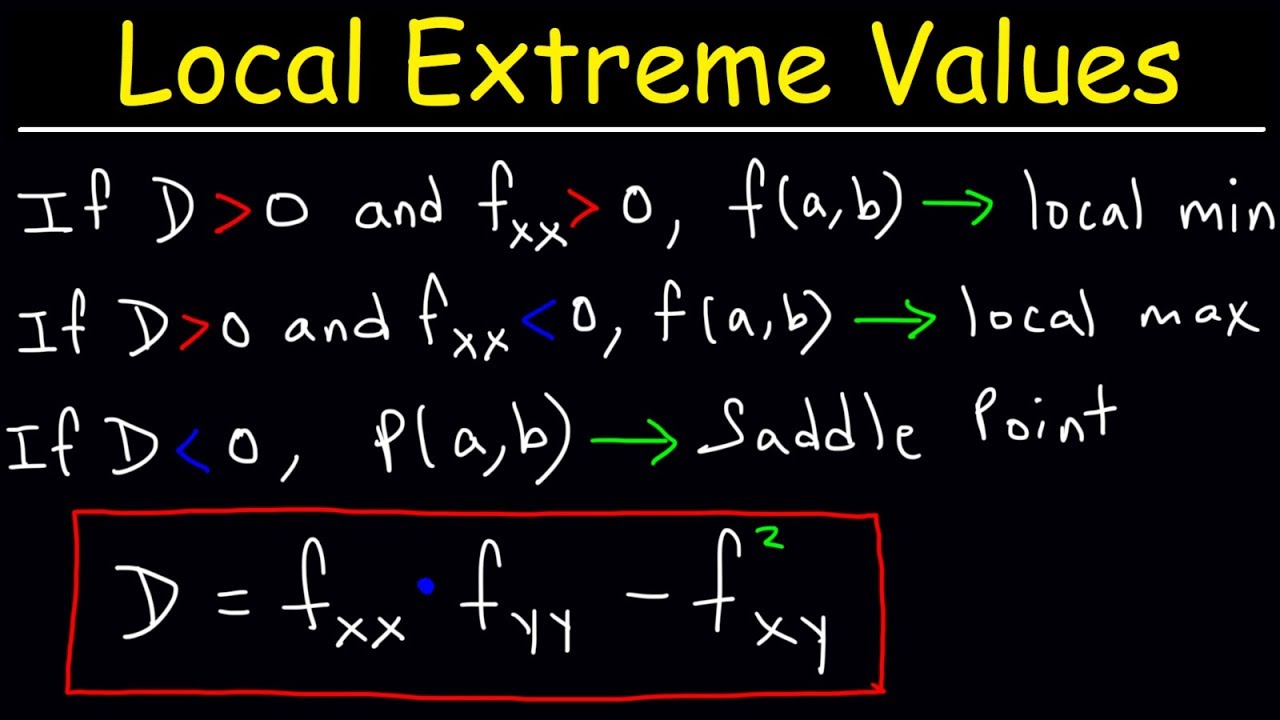
This calculus 3 video explains how to find local extreme values such as local maxima and local minima as well as how to identify any critical points and saddle points in a multivariable function such as f(x,y).
Lines & Planes - Intersection:
https://www.youtube.com/watch?v=_W3aVWsMp14
Angle Between Two Planes: ...
like have you seen that D before
deft kiln
Yes I did
stiff brook
okay so now compute the 2nd order partials of x and y
seems like u did
did u compute f_xy?
deft kiln
No I did not but wait
You are talking about finding a derivative of both variables right?
stiff brook
take the partial of x then take the partial of y for the remaining equation

that is f_yx
f_xy = f_yx in this case
so it doesnt matter what order u compute
deft kiln
stiff brook
so it doesnt matter what order u compute
Okay
deft kiln
stiff brook
I need a second to understand what this stands for
After I finish I will show the paper
So it’s 3?
The f_yx
stiff brook
are you sure?
deft kiln
I am not sure at all
deft kiln
stiff brook
I don’t remember this formula and that is why I am confused
stiff brook
first you did f_y = 3y^2 - 3x
Correct?
deft kiln
Yes
stiff brook
now we take the partial of x so
differentiate (f_y) with respect to x
stiff brook
yes
deft kiln
So the matrix should look like
6x 3
3 6y
stiff brook
well no
stiff brook
what does the new matrix look like?
deft kiln
6x -3
-3 6y
stiff brook
that is correct
deft kiln
Ok we can divide by 9 and get 4xy - 1
stiff brook
you dont need to do that
stiff brook
stiff brook
https://www.youtube.com/watch?v=UID893EosM8
Find the value of D at (0,0)
think of D as a function of x and y
D(x,y)
deft kiln
-9 which is < 0 so it does not have an extrema
deft kiln
I don’t know
deft kiln
Yeah it’s just 36 - 9 which is 27 > 0 which is a local minimum
stiff brook
not yet
you have D>0 but what is f_xx at (1,1)?
D>0 can imply either local min or local max so you need to check f_xx
deft kiln
It is just a 6
stiff brook
it is greater than 0 then
so we have a local min since
D>0 and f_xx > 0
only knowing D>0 is not conclusive
stiff brook
no problem
cedar kilnBOT
Channel closed
Closed by @deft kiln
Use .reopen if this was a mistake.
cedar kilnBOT
Available help channel!
Send your question here to claim the channel.
Remember:
• Ask your math question in a clear, concise manner.
• Show your work, and if possible, explain where you are stuck.
• After 15 minutes, feel free to ping <@&286206848099549185>.
• Type the command .close to free the channel when you're done.
• Be polite and have a nice day!
Read #❓how-to-get-help for further information on how to ask a good question, and about conduct in the question channels.
 velvet gust
hello
cedar kilnBOT
velvet gust
hello
velvet gust
imagination technique
rotund bloom
hello
velvet gust
help me'
rotund bloom
?
fossil dawn
?
 oblique flare
velvet gust
oblique flare
velvet gust
so im stuck at
 opal hinge
velvet gust
imagination technique
opal hinge
velvet gust
imagination technique
what technique is this
fossil dawn
we're mathcord, not psychology ward
rotund bloom
what does mathcord mean
fossil dawn
this server
opal hinge
please use \log instead of log
wraith daggerBOT
Communist Africa
 opal hinge
It hurt
fossil dawn
$\log{x^2 - 1}$

 velvet gust
wraith dagger
**Communist Africa**
velvet gust
wraith dagger
**Communist Africa**
this is where im stuck
rotund bloom
wraith dagger
**Communist Africa**
this aint possible
oblique flare
wraith dagger
**Communist Africa**
could you show your work if possible
rotund bloom
squared value cannot be negative
rotund bloom
opal hinge
log mean log base 10 or log base e
log is base 10 and ln is base e
fossil dawn
rotund bloom
log is base 10 and ln is base e
depends on context
opal hinge
yes but I saw someone write log base e as log b4
fossil dawn
sometimes in calc, ln is written as log
rotund bloom
fossil dawn
sometimes in calc, ln is written as log
yeah
velvet gust
im coming
opal hinge
 velvet gust
huh
tropic oxide
right now the correct answer should be that no such x exists
opal hinge
Well obviously this doesn't have any root
 blazing zephyr
rotund bloom
squared value cannot be negative
blazing zephyr
rotund bloom
squared value cannot be negative
complex?
tropic oxide
blazing zephyr
complex?
complex
logs
do you REALLY wanna open that can of worms
rotund bloom
blazing zephyr
complex?
yeah
blazing zephyr
is complex logs that ugly
 wicked mantle
blazing zephyr
is complex logs that ugly
wicked mantle
blazing zephyr
is complex logs that ugly
it is, let's not open Pandora's box.
 oblique flare
velvet gust
Here
oblique flare
velvet gust
Here
what do you conclude from this ?
 crude brook
velvet gust
Here
crude brook
velvet gust
Here
Looks correct so far
wraith daggerBOT
Communist Africa
 crude brook
No you have x^2=-1/9
 muted timber
why are you writing the argument of the logarithm as an exponent in your handwriting?
also, the original equation has log(x^2-1), so (x^2-1) must be greater than zero, and log(x), so x must also be greater than zero
tropic oxide
velvet gust
what shld i do
write "no solutions" and be done with it
velvet gust
bruh
crude brook
This problem has no real solutions
cedar kilnBOT
Channel closed
Closed by @velvet gust
Use .reopen if this was a mistake.
Available help channel!
Send your question here to claim the channel.
Remember:
• Ask your math question in a clear, concise manner.
• Show your work, and if possible, explain where you are stuck.
• After 15 minutes, feel free to ping <@&286206848099549185>.
• Type the command .close to free the channel when you're done.
• Be polite and have a nice day!
Read #❓how-to-get-help for further information on how to ask a good question, and about conduct in the question channels.
 hasty path
A physics question if you dont mind, but do objects have 2 different types of forces. because when i do Power = force * velocity and calculate force i get another answer compared to doing change of momentum divided by time
cedar kilnBOT
hasty path
A physics question if you dont mind, but do objects have 2 different types of fo...
fossil dawn
do you have the original problem?
hasty path
wait one sec ill find
upper ruin
hasty path
A physics question if you dont mind, but do objects have 2 different types of fo...
By the way, the formula power = F•v is valid only if the force is constant
 iron wren
upper ruin
By the way, the formula ``power = F•v`` is valid only if the force is constant
iron wren
upper ruin
By the way, the formula ``power = F•v`` is valid only if the force is constant
not true rly, as speed goes up force decreases, the power is constant
it depends i think
hasty path
upper ruin
By the way, the formula ``power = F•v`` is valid only if the force is constant
that makes sense now
but why wouldnt change of momentum over time not work in this context
iron wren
no the force is constant here because theres constant speed
yeah there wouldnt be change of momentum with constant speed that would be silly
hasty path
fossil dawn
momentum is not changing here, is it though
i mean it was 0 and now is something
hasty path
iron wren
yeah there wouldnt be change of momentum with constant speed that would be silly
it was 0
fossil dawn
is it? you're not told that the speed is changing
hasty path
it just says max speed of 1.5
cedar kilnBOT
Channel closed
Closed by @hasty path
Use .reopen if this was a mistake.
cedar kilnBOT
Available help channel!
Send your question here to claim the channel.
Remember:
• Ask your math question in a clear, concise manner.
• Show your work, and if possible, explain where you are stuck.
• After 15 minutes, feel free to ping <@&286206848099549185>.
• Type the command .close to free the channel when you're done.
• Be polite and have a nice day!
Read #❓how-to-get-help for further information on how to ask a good question, and about conduct in the question channels.
 fallow drift
so im in a calc course and im supposed to compare and pick the best shape for companies to make disks. like we wanna minimize the amount of materials used to make each disk and the options are using a rectangle vs a hexagon
cedar kilnBOT
fallow drift
so im in a calc course and im supposed to compare and pick the best shape for co...
fallow drift
it sounds so weird cuz theres no dimensions
but what i did was like i found the area wasted by finding percent yield (ik the wording doesnt make sense but) and subtratced it by 100
but it does say minimize,. i didnt use derivatives tho?!
proven summit
this sounds like an optimization problem
fallow drift
proven summit
this sounds like an optimization problem
yea but i didnt use derivatives tho
this was what i did
opal hinge
Is there any condition like the disk is cut from a square or smth
fallow drift
opal hinge
Is there any condition like the disk is cut from a square or smth
no, it says rectangle
i did some derivative to determine that a square would maximize area
tropic oxide
did you write this yourself
fallow drift
tropic oxide
did you write this yourself
yea?
why
nahh now that you mentio it
it kinda looks ai generated 💀
but yes i did write everything myself
tropic oxide
yeah that was my suspicion
fallow drift
am i gonna get flagged
fallow drift
tropic oxide
did you write this yourself
is my thought process correct
tropic oxide
yes
fallow drift
tropic oxide
yes
im scared tho since i didnt use any derivative
cedar kilnBOT
@fallow drift Has your question been resolved?
fallow drift
!helpers
cedar kilnBOT
To ask for mathematics help on this server, please open your own help channel or help thread. See #❓how-to-get-help for instructions.
fallow drift
<@&286206848099549185>
split ice
fallow drift
im scared tho since i didnt use any derivative
but you set A' = 0, so you are using derivatives at some points
also looks good to me 👍
split ice
hmm can you screenshot it? i am unsure how you got to "the top and bottom are thicker than the side"
fallow drift
split ice
hmm can you screenshot it? i am unsure how you got to "the top and bottom are th...
i sent you
my internet died
fossil dawn
why not send it here
 fallow drift
split ice
this is what i got... quite vague indeed
fallow drift
split ice
this is what i got... quite vague indeed
yea what do i do...
how do i model thickness lol
wait am i supposed to make a seperate cost function looking at just the top and bottom?
split ice
i am unsure, this is not a lot of information 😭
you could model thickness by turning the top and bottom discs into cylinders
i think if the top and bottom are the same material, you can just multiply the volume by price to get a cost, so it should be the same for both
i think the seams might have different price points depending on the cost, looking at this now
this seems like more of an exploration question. i hate to say it, but your best bet would be to try a few different things, with the understanding that a lot of them might not work. but you can talk about what did and didn't work in your "final report" so it's not wasted breath
i think you would be on the right track with modelling the discs as cylinders and trying to optimize for cost
fallow drift
split ice
you could model thickness by turning the top and bottom discs into cylinders
thank you
fallow drift
split ice
i think the seams might have different price points depending on the cost, looki...
that's a seperate matter lol
im tryna get the thickness to wor first
fallow drift
split ice
this seems like more of an exploration question. i hate to say it, but your best...
omg 😭
fallow drift
split ice
i think you would be on the right track with modelling the discs as cylinders an...
ookay ty
split ice
fallow drift
omg 😭
i knowww but this is the kind of work actual mathematicians do! you're one of us now :D
fallow drift
split ice
i knowww but this is the kind of work actual mathematicians do! you're one of us...
ty omfg i acc needed this
this assgnment feels so impossible
split ice
you can always ask for help with a specific part or ask if it's actually going to work or not (as long as you have some work to show)
fallow drift
okay wait i just hae 1 question
split ice
fallow drift
this assgnment feels so impossible
i believe in u  you have a good handle on the optimization part, that's half the battle
fallow drift
should i seperate the 2 disks from the body of the cyolinder? like write 2 different cost functions?
split ice
maybe? and that way you could make one cost function for both the material and the seam
fallow drift
split ice
i believe in u <:eeveekawaii:556858499930259471> you have a good handle on the o...
ty 😭 idk why i ffeel like this is way too simple (like the calculations i used)
split ice
but if they're the same material, you could probably do top + bottom
it kind of is simple, but its a lot of things thrown together so you're initially like 😵💫
cedar kilnBOT
@fallow drift Has your question been resolved?
fallow drift
split ice
but if they're the same material, you could probably do top + bottom
wait why?
im a bit confused
i thought of 2 options
like i can write cost in terms of both lid and body
or write a seperate function for the cost of lid
in order to find the height that'll minimize cost
this was what i was thinking
split ice
oh i see, yeah that should work
i was thinking one function for top + bottom, and one function for sides
but you can put the bottom and sides together fine
fallow drift
split ice
i was thinking one function for top + bottom, and one function for sides
ohh
that was what i was thinking too lol
fallow drift
split ice
but you can put the bottom and sides together fine
would that work??
i kinda wanted to find the ratio of radius to height for the top and bottoms if that made sense lol
split ice
since you're only varying the thickness of the bottom and top, then yes it should be ok i think? im afraid i haven't worked this out enough to say
fallow drift
split ice
since you're only varying the thickness of the bottom and top, then yes it shoul...
hmmmmmm
ty i genuinely appreciate it
.close
cedar kilnBOT
Channel closed
Closed by @fallow drift
Use .reopen if this was a mistake.
cedar kilnBOT
Available help channel!
Send your question here to claim the channel.
Remember:
• Ask your math question in a clear, concise manner.
• Show your work, and if possible, explain where you are stuck.
• After 15 minutes, feel free to ping <@&286206848099549185>.
• Type the command .close to free the channel when you're done.
• Be polite and have a nice day!
Read #❓how-to-get-help for further information on how to ask a good question, and about conduct in the question channels.
 half stratus
hello i am trying to prove that it is an equivlance relation and i got stuck on this part
 cedar kilnBOT
half stratus
hello i am trying to prove that it is an equivlance relation and i got stuck on ...
lyric plank
cedar kilnBOT
half stratus
hello i am trying to prove that it is an equivlance relation and i got stuck on ...
lyric plank
we can rewrite the condition as (y = y' and (x = x' or x = 0, x' = 1 or x = 1, x' = 0))
now consider (x1, y1), (x2, y2), (x3, y3) and suppose (x1, y1) ~ (x2, y2) and (x2, y2) ~ (x3, y3)
we want to show (x1, y1) ~ (x3, y3). in other words, we need y1 = y3, and we need either
x1 = x3
x1 = 0, x3 = 1
x1 = 1, x3 = 0
you can branch into cases of whether x1 and x2 are equal or unequal, and whether x2 and x3 are equal or unequal
that gives 4 cases which i think will be easier to handle without having to dive into specifics
cedar kilnBOT
@half stratus Has your question been resolved?
half stratus
lyric plank
we can rewrite the condition as (y = y' and (x = x' or x = 0, x' = 1 or x = 1, x...
yes i was able to figure it out thank you bro

@lyric plank

i am having trouble w this problem too
<@&286206848099549185>
cedar kilnBOT
Channel closed
Closed due to timeout
Use .reopen if this was a mistake.
cedar kilnBOT
✅
half stratus
<@&286206848099549185>
 torpid heath
are you having an issue when $n = p^k$?
wraith daggerBOT
Amiso_
 half stratus
wraith dagger
**Amiso\_**
half stratus
wraith dagger
**Amiso\_**
see the thing is i already proved it
its just how does the sketch work
wait
lemme take a look at my proof for it, how does the sketch work tho
torpid heath
please do
half stratus
torpid heath
please do
you construct a bijectio
half stratus
chinese remainder theroem