#help-13
1 messages · Page 366 of 1
 frigid dust
yes
so now we have a=100/b
and a=300/c
we can set them equal to each other
100/b=a=300/c
100/b=300/c
so now we have a "new" equation
\begin{equation}\frac{100}{b}=\frac{300}{c}\end{equation}
\begin{equation}bc=200\end{equation}
 wraith daggerBOT
Bonk
 frigid dust
once again, rewrite (1) as b=??? and rewrite (2) as b=???
frigid dust
 sinful zephyr
B = 100/a
sinful zephyr
B = 100/a
where are you getting the a from?
frigid dust
wraith dagger
**Bonk**
here we only have b's and c's
frigid dust
sinful zephyr
Then b = 300/c
300?
sinful zephyr
frigid dust
now try equation (1)
ab = 100
B = 100/a
A = 100/b
100/100/b
frigid dust
sinful zephyr
ab = 100
B = 100/a
A = 100/b
100/100/b
Stop. Using. A.
sinful zephyr
Then what do i use
frigid dust
wraith dagger
**Bonk**
just use these 2 equations
you have already rewritten the second equation correctly
now you just need to rewrite the first equation
frigid dust
sinful zephyr
How can i rewrite ab
stop using ab
????
\begin{equation}\frac{100}{b}=\frac{300}{c}\end{equation}
\begin{equation}bc=200\end{equation}
wraith daggerBOT
Bonk
 frigid dust
only this
sinful zephyr
frigid dust
stop using ab
You told me rewrite ab
frigid dust
sinful zephyr
You told me rewrite ab
where?
sinful zephyr
sinful zephyr
200/b = 200/c
Right?
sinful zephyr
frigid dust
100/b=300/c
What i do about thay
sinful zephyr
frigid dust
so that it is in the form of b=???
B = 300/c x 100
frigid dust
sinful zephyr
B = 300/c x 100
not quite
frigid dust
yes, but its wrong
sinful zephyr
How
frigid dust
sinful zephyr
btw one question
Ab + bc + ca can be written as
A^2 + B^2 + C^2
not in general, no
sinful zephyr
frigid dust
not in general, no
Can i write it as like
Ab x bc / ca
And cancel terms to get
B^2 then
B value is sqrt(b^2)?
Hmm
But i guess
frigid dust
yes, you could do that
frigid dust
and then repeat for a and c
sinful zephyr
frigid dust
and then repeat for a and c
a^2, b^2 , c^2
100 x 200 / 300
200/3
B^2 = 200/3
A ^ 2 = 150
C^2 = 60
I mean 600
frigid dust
so then what are a,b,c?
sinful zephyr
frigid dust
so then what are a,b,c?
Sqrt(a^2 + b^2 + c^2)?
sinful zephyr
Well there is no value of sqrt(150)
wraith daggerBOT


 sinful zephyr
Yeah
frigid dust
it exist, its just not a whole number
frigid dust
,w sqrt(6050/3)
wraith daggerBOT
 sinful zephyr
So i guess i just have to plus all number
frigid dust
,w sqrt(150)+sqrt(300)+sqrt(600)
wraith daggerBOT
 frigid dust
its not about the answer, its about the process
having the whole process correct but making a calculation mistake somewhere is much better than having the wrong process but correct answer
if you know how to solve it, then you can apply it to more problems
just having the solution doesnt teach you anything and might aswell have done nothing
sinful zephyr
frigid dust
if you know how to solve it, then you can apply it to more problems
I guess
I kinda hate math, because i found it hard to understand the concept
Like other subjects which is much easier to do
frigid dust
imo, most hate math because they havent been taught it properly
most of the people that "like" math are able to see it themselves and dont need as much help
sinful zephyr
frigid dust
imo, most hate math because they havent been taught it properly
I guess you are right, my math teacher just tells us solution but dont tell us the concept behind it
frigid dust
at least, thats what i believe
if you are able to understand how to solve it
and being able to go step by step
you will get much more enjoyment
because when you do another problem, you can see similar steps
and are able to apply what you did to other problems to the current problem
sinful zephyr
If you ask my class circle area they will know it, but they wont know why is it pi * r^2
Alright
I will close this channel now
.close
 cedar kilnBOT
Channel closed
Closed by @sinful zephyr
Use .reopen if this was a mistake.
cedar kilnBOT
 Available help channel!
Send your question here to claim the channel.
Remember:
• Ask your math question in a clear, concise manner.
• Show your work, and if possible, explain where you are stuck.
• After 15 minutes, feel free to ping <@&286206848099549185>.
• Type the command .close to free the channel when you're done.
• Be polite and have a nice day!
Read #❓how-to-get-help for further information on how to ask a good question, and about conduct in the question channels.
 fossil berry
can someone explain me characteristics of the cumulative distribution function
cedar kilnBOT
fossil berry
can someone explain me characteristics of the cumulative distribution function
 quartz coral
okay so cdf is just a way to describe how probabilities accumulate as we move along the number line in the simplest way possible
imagine you have a random variable, like the roll of a dice, or the height of people in a group. The CDF tells you, for any number, what is the probability that the random variable is less than or equal to that number
fossil berry
right hand continuity
 quartz coral
cdf starts at 0, and as we move along the number line, it adds up the probabilities.
fossil berry
can you explain this to me

can you explain right hand continuity and the last one
quartz coral
fossil berry
right hand continuity
right
so
that entire limit just means as h gets closer to x from the right (so it values slightly larger than x), the value of F(h) approaches F(x)
in other words, there’s no sudden jump in the CDF when moving towards x from the right. The function behaves smoothly at this point, which is a key property of cumulative distribution functions.
 lilac rampart
can some one help me with this proplem ?
 dire geode
lilac rampart
can some one help me with this proplem ?
dire geode
lilac rampart
can some one help me with this proplem ?
! occupied
cedar kilnBOT
lilac rampart
can some one help me with this proplem ?
Someone else is already using this help channel. If you need help with a question, please open your own help channel/thread (see #❓how-to-get-help for instructions).
quartz coral
fossil berry
can you explain this to me
and this
this formula just explains how to compute the probability that a random variable X takes on a specific value x, particularly for discrete random variables. Let’s break it down step by step in simple terms now
fossil berry
what does this small minus on top means
quartz coral
left-hand limit of the CDF at x
fossil berry
what do they mean
quartz coral
normal Fx(x) in that formula without any + or - is regular value of cdf at x
x- is the left hand limit of cdf at x
x+ the right hand limit of cdf at x
fossil berry
i see
quartz coral
although theres not one here
cedar kilnBOT
Channel closed
Closed by @fossil berry
Use .reopen if this was a mistake.
cedar kilnBOT
Available help channel!
Send your question here to claim the channel.
Remember:
• Ask your math question in a clear, concise manner.
• Show your work, and if possible, explain where you are stuck.
• After 15 minutes, feel free to ping <@&286206848099549185>.
• Type the command .close to free the channel when you're done.
• Be polite and have a nice day!
Read #❓how-to-get-help for further information on how to ask a good question, and about conduct in the question channels.
 vast ermine
Help please
cedar kilnBOT
vast ermine
Help please
 quartz coral
Just plug in 10 instead of x
frigid dust
,rotate
wraith daggerBOT

 fresh quarry
vast ermine
Or is the answer 20/4
fresh quarry
vast ermine
Or is the answer 20/4
20/4 = 5 , so theyre same
vast ermine
fresh quarry
20/4 = 5 , so theyre same
Oh okay and yeah I was just asking how to write the answer
Also how do I do the next part?

It's an inverse function but I'm not sure how or what to substitute-
vast ermine
 pallid parrot
express x as y and the value to be x
pallid parrot
express x as y and the value to be x
uhh so
pallid parrot
ex.. f(x)=23x+2/2
pallid parrot
then x = 23y+2/2
pallid parrot
vast ermine
x is 5 or 10?
you don't find x as a number
you find out the inverse function
vast ermine
I mean like
pallid parrot
f(x)=2x, then f-1(x) =
x = 2y
so y = x/2 so f-1(x)=x/2
fresh quarry
vast ermine
Oh okay and yeah I was just asking how to write the answer
Its the best to write the most simplified answer
In this case its 5
 pallid parrot
vast ermine
pallid parrot
vast ermine
replace 5 with x
vast ermine
Ok
pallid parrot
now find y
vast ermine
 vast ermine
pallid parrot
now find y
vast ermine
pallid parrot
now find y
umm how (I forgot)
pallid parrot
multiply both sides with y-6 to eliminate the denominator
 pallid parrot
yes put parenthesis
x(y-6)=2y
so multiply each side in the parenthesis by x
it's gonna be xy - 6x = 2y
vast ermine
Got it
 pallid parrot
no
pallid parrot
pallid parrot
it's gonna be xy - 6x = 2y
from xy-6x = 2y
rearranging
xy-2y=6x
so it's gonna he y(x-2)=6x
@vast ermine
now divide by x-2 to find y
vast ermine
Qait how did u get y(x-2)=6x
 pallid parrot
look at xy-6x=2y
what's the common factor in the left side
or what do they share?
vast ermine
Y-6
pallid parrot
so x(y-6)=2y!
vast ermine
okayy
pallid parrot
but this is gonna give us nothing
vast ermine
yes
pallid parrot
i want y not x
so i made the y a common factor
do you know what a common factor is now
vast ermine
Yes
pallid parrot
xy-2y=6x
just in the left side they share y
vast ermine
yes
vast ermine
Yes
vast ermine
y
pallid parrot
then can you get rid of the x-2
vast ermine
so ÷3?
pallid parrot
no like
vast ermine
÷x-2
vast ermine
 pallid parrot
CORRECT
now replace y with f-1(x)
and here's your function
you can now do direct substitution for x
pallid parrot
vast ermine
you dont need to find x
vast ermine
Does f-1 mean x-1?
vast ermine
pallid parrot
you dont need to find x
yeah i remember it
wraith daggerBOT
harue
 vast ermine
 pallid parrot
vast ermine
pallid parrot
vast ermine
it's gonna be the y you made
vast ermine
 vast ermine
ohh so y = 10?
wraith daggerBOT
harue
 pallid parrot
it asks just for the raw equation
vast ermine
So it just asks for the function okay
vast ermine
Alright and checked the mark scheme they wanted 6x/x-2 too, thank you for the help I appreciate it
pallid parrot
so the answer is gonna be
$$f^{-1}:x -> \frac{6x}{x-2}$$
wraith daggerBOT
harue
 vast ermine
gotcha
question uhh what's like
the steps to do this kinda question?
like uhh
is it
pallid parrot
did you understand the question how i did it
vast ermine
yes
vast ermine
okay
pallid parrot
the whole idea
is to replace x in your function with y
and replace f-(x) with x
and find y
the idea not steps
 pallid parrot
vast ermine
Is this fine so far?
pallid parrot
vast ermine
Is this fine so far?
yes!!
i got a good method

just apply this triangle
if you want c then b/x
if you want x then b/c
if you want b then x * c

 vast ermine
pallid parrot
vast ermine
pallid parrot
Thank you I'll add it ti my notebook
vast ermine
pallid parrot
you can multiply
i did it :D
vast ermine
alright noted
ill try more questions with this then!! thank you i really appreciate the help (catching up a year's missed knowledge for an expensive exam in 4 months)
pallid parrot
vast ermine
ill try more questions with this then!! thank you i really appreciate the help (...
good luck!
you could remember it with an example
$$ 5 = \frac{10}{2} $$
wraith daggerBOT
harue
 pallid parrot
10 is 5 * 2 and 2 is 10/5
cedar kilnBOT
Channel closed
Closed by @vast ermine
Use .reopen if this was a mistake.
cedar kilnBOT
Available help channel!
Send your question here to claim the channel.
Remember:
• Ask your math question in a clear, concise manner.
• Show your work, and if possible, explain where you are stuck.
• After 15 minutes, feel free to ping <@&286206848099549185>.
• Type the command .close to free the channel when you're done.
• Be polite and have a nice day!
Read #❓how-to-get-help for further information on how to ask a good question, and about conduct in the question channels.
 sand grotto
 cedar kilnBOT
sand grotto
cedar kilnBOT
sand grotto
 cedar kilnBOT
@sand grotto Has your question been resolved?
cedar kilnBOT
@sand grotto Has your question been resolved?
cedar kilnBOT
@sand grotto Has your question been resolved?
 pallid trout
For bottom,
Equation will be
Horizonal motion >> F - f = Ma,
frictional force will Max as both crate move together.
Ie. f_max = (u) *mg
F- umg =Ma
a= F/(M+m)
So, we get : F - umg =M(F/(M+m)
FM +Fm - umgM - umgm =MF
Fm = umg(M+m)
F= ug(M+m)
Then putting value you will get the answer
pallid trout
Yeah.
sand grotto
ok
can i ask another question or do i have to do the process again?
needs checking check sig figs and units


 unborn imp
I hate sig figs
cedar kilnBOT
@sand grotto Has your question been resolved?
cedar kilnBOT
Channel closed
Closed due to timeout
Use .reopen if this was a mistake.
cedar kilnBOT
Available help channel!
Send your question here to claim the channel.
Remember:
• Ask your math question in a clear, concise manner.
• Show your work, and if possible, explain where you are stuck.
• After 15 minutes, feel free to ping <@&286206848099549185>.
• Type the command .close to free the channel when you're done.
• Be polite and have a nice day!
Read #❓how-to-get-help for further information on how to ask a good question, and about conduct in the question channels.
 molten ocean
Yoooo what 1+1?
cedar kilnBOT
molten ocean
Yoooo what 1+1?
 flint plinth
cedar kilnBOT
flint plinth
cedar kilnBOT
Channel closed
Closed by @flint plinth
Use .reopen if this was a mistake.
Available help channel!
Send your question here to claim the channel.
Remember:
• Ask your math question in a clear, concise manner.
• Show your work, and if possible, explain where you are stuck.
• After 15 minutes, feel free to ping <@&286206848099549185>.
• Type the command .close to free the channel when you're done.
• Be polite and have a nice day!
Read #❓how-to-get-help for further information on how to ask a good question, and about conduct in the question channels.
 coral jewel
any idea with this? i'm stucked
 cedar kilnBOT
coral jewel
any idea with this? i'm stucked
cedar kilnBOT
coral jewel
any idea with this? i'm stucked
 worldly chasm
@coral jewel with 10 dimensions, the lowest dim that V1 intersect V2 can have is 4. And then the lowest the intersection between this space and V3 can have is 1. Do you see why?
coral jewel
let me think a bit
 mighty shuttle
coral jewel
any idea with this? i'm stucked
mighty shuttle
coral jewel
any idea with this? i'm stucked
Suppose that $\dim(V_1) \cap \dim (V_2) \cap dim(V_3) = {0}$. What would that mean about $\dim(V_1+V_2+V_3)$
wraith daggerBOT
math rocks(wai)
 cedar kilnBOT
Channel closed
Closed by @coral jewel
Use .reopen if this was a mistake.
cedar kilnBOT
Available help channel!
Send your question here to claim the channel.
Remember:
• Ask your math question in a clear, concise manner.
• Show your work, and if possible, explain where you are stuck.
• After 15 minutes, feel free to ping <@&286206848099549185>.
• Type the command .close to free the channel when you're done.
• Be polite and have a nice day!
Read #❓how-to-get-help for further information on how to ask a good question, and about conduct in the question channels.
 arctic vector
Derivative of f(x) = cot^2 (x+5)
cedar kilnBOT
arctic vector
Derivative of f(x) = cot^2 (x+5)
arctic vector
$f(x) = cot^2 (x+5)$
wraith daggerBOT
Ski
 arctic vector
I'm kinda confused with the chain rule here
 normal cipher
We are to express this as a combination of functions
arctic vector
What do you mean?
arctic vector
oh like composite function
normal cipher
Which is just 1/x^2 and tan x
 pseudo oasis
arctic vector
oh like composite function
pseudo oasis
arctic vector
oh like composite function
yeah something like that
normal cipher
And then peel the thing like onion using chain rule
pseudo oasis
and treat the (x+5) as a function although it didn't really matter much
normal cipher
But dont cry while doing it
pseudo oasis
normal cipher
But dont cry while doing it
if you cry on derivitive then i don't know how you can surive integration
arctic vector
Well so based on that
2cot(x+5) right
is the first step
just bringing down using the power rule
normal cipher
pseudo oasis
if you cry on derivitive then i don't know how you can surive integration
Its a metaphor since i said peel onion
pseudo oasis
normal cipher
Its a metaphor since i said peel onion
oh lol
normal cipher
But i like to approach from inside
arctic vector
inside?
normal cipher
Please interpret correctly btw
pseudo oasis
arctic vector
2cot(x+5) right
then solve cot(x+5)
 full urchin
normal cipher
But dont cry while doing it
full urchin
normal cipher
But dont cry while doing it
lol
full urchin
normal cipher
But i like to approach from inside
ayo pause
normal cipher
arctic vector
inside?
Yours is probably faster
arctic vector
derivative of cot(x+5)?
pseudo oasis
or just recite the derivitive of cot(x)
normal cipher
pseudo oasis
or just recite the derivitive of cot(x)
Well ok
Can never memorize those
arctic vector
2cot(x+5) * -csc^2(x+5) * 1?
pseudo oasis
normal cipher
Can never memorize those
memory is key
normal cipher
arctic vector
2cot(x+5) * -csc^2(x+5) * 1?
Probably
normal cipher
pseudo oasis
memory is key
...
pseudo oasis
nah in my school is basic requirement to recite the derivitive of inverse trigo 💀
normal cipher
pseudo oasis
nah in my school is basic requirement to recite the derivitive of inverse trigo ...
Tf man
arctic vector
pseudo oasis
nah in my school is basic requirement to recite the derivitive of inverse trigo ...
kinda same here
even the identities also
ion remember shit tho since my teacher just cramps all the topic
pseudo oasis
normal cipher
Tf man
yes I am talking about arcsin something
normal cipher
arctic vector
ion remember shit tho since my teacher just cramps all the topic
Sad
Use integral-calculator.net to check ans im too lazy fr
arctic vector
(cot(x+5))^2
2cot(x+5) * d/dx cot (x+5) * d/dx (x+5)
2cot(x+5) * -csc^2(x+5) * 1
-2cot(x+5)csc^2(x+5)
normal cipher
K i gtg bye
arctic vector
normal cipher
Use integral-calculator.net to check ans im too lazy fr
oh
cedar kilnBOT
@arctic vector Has your question been resolved?
Channel closed
Closed by @arctic vector
Use .reopen if this was a mistake.
Available help channel!
Send your question here to claim the channel.
Remember:
• Ask your math question in a clear, concise manner.
• Show your work, and if possible, explain where you are stuck.
• After 15 minutes, feel free to ping <@&286206848099549185>.
• Type the command .close to free the channel when you're done.
• Be polite and have a nice day!
Read #❓how-to-get-help for further information on how to ask a good question, and about conduct in the question channels.
 languid trail
What is the quotient for the following question (x²+16)÷(x+4)
Solve with long division
Solve with synthetic division
Solve by factoring
I can do the long division, and the synthetic, but when it comes to factoring I get complex numbers which I don't think is correct, as we havnt learned about them yet. Could anybody offer some advice?
cedar kilnBOT
languid trail
What is the quotient for the following question (x²+16)÷(x+4)
Solve with long d...
languid trail
This is an intro to algebra in trig, or ig trig identities work sheet btw
Then next question is a similar format of (sin²x+16)/(sinx+4)
when i solve by long div or synthetic i get x-4 r32
would i just leave it as (x²+16)÷(x+4) and consider it fully factored?
 crimson sedge
Try completing the square
For x^2+16
@languid trail
Would that come under factoring though 🤔
languid trail
not sure tbh, havnt used that method in a minute but lemme try
hold on how would i complete the square with no b term?
 pastel vault
languid trail
What is the quotient for the following question (x²+16)÷(x+4)
Solve with long d...
pastel vault
languid trail
What is the quotient for the following question (x²+16)÷(x+4)
Solve with long d...
are you sure it's not (x^2 - 16) / (x + 4) ?
 pastel vault
languid trail
That was the previous question
pastel vault
languid trail
That was the previous question
yeah then I don't know what they mean by solve by factoring for this question
languid trail
Ig ill just leave it in that form, lemme know if anybody else has any ideas
Nah that equals x²-16
 prisma pike
Oh mb
languid trail
Cuz 4*-4=-16
languid trail
Ig ill ask on Monday lol
languid trail
But the next question is the same form, and it asks for only "solve by factoring" I doubt it's a typo
Are u able to simplify (sin²x+16) into anything?
I don't think so right
prisma pike
Yea
That's kinda weird
Can we see the whole page
And the previous one
I just wanna see the context
languid trail

It's all been super simple.up till this point lol
It's just algebra trig connections as an intro for trig identities
pastel vault
yeah definitely seems like a typo
prisma pike
pastel vault
yeah definitely seems like a typo
Nah but the x^2-16 was the previous qn
pastel vault
hhmmmm
cedar kilnBOT
@languid trail Has your question been resolved?
cedar kilnBOT
Channel closed
Closed by @languid trail
Use .reopen if this was a mistake.
cedar kilnBOT
Available help channel!
Send your question here to claim the channel.
Remember:
• Ask your math question in a clear, concise manner.
• Show your work, and if possible, explain where you are stuck.
• After 15 minutes, feel free to ping <@&286206848099549185>.
• Type the command .close to free the channel when you're done.
• Be polite and have a nice day!
Read #❓how-to-get-help for further information on how to ask a good question, and about conduct in the question channels.
 vestal sandal
can someone explain the second paragraph? How is the dimension of a matrix MxN same as the vector MN and while you are at it can you simply explain the idea of dimension in vector spaces thank you very much
 cedar kilnBOT
vestal sandal
can someone explain the second paragraph? How is the dimension of a matrix MxN s...
cedar kilnBOT
vestal sandal
can someone explain the second paragraph? How is the dimension of a matrix MxN s...
 hollow trail
the dimension is the length of any basis of a given vector space (noting that every basis of a given vector space has the same length)
the dimension of the vector space of m x n matrices, and the vector space of vectors of length m*n are the same (i.e., we need the same number of basis vectors to describe them)
for example the vector space of $2\times2$ matrices ($\R[2\times2]$) has this basis:
[ \ab{\begin{bmatrix} 1 & 0 \ 0 & 0 \end{bmatrix},\begin{bmatrix} 0 & 1 \ 0 & 0 \end{bmatrix},\begin{bmatrix} 0 & 0 \ 1 & 0 \end{bmatrix},\begin{bmatrix} 0 & 0 \ 0 & 1 \end{bmatrix}} ]
and the vector space of vectors of length $2\cdot2=4$ ($\R[4]$) has this basis:
[ \ab{\begin{bmatrix} 1 \ 0 \ 0 \ 0 \end{bmatrix},\begin{bmatrix} 0 \ 1 \ 0 \ 0 \end{bmatrix},\begin{bmatrix} 0 \ 0 \ 1 \ 0 \end{bmatrix},\begin{bmatrix} 0 \ 0 \ 0 \ 1 \end{bmatrix}} ]
wraith daggerBOT
cloud
 hollow trail
so they are both 4-dimensional vector spaces
cedar kilnBOT
@vestal sandal Has your question been resolved?
vestal sandal
hollow trail
the dimension is the length of any basis of a given vector space (noting that ev...
Not really though let's say the basis vector is (0,1)
It's dimension is 1
And length is 2
Isn't it the number of independent columns
Vectors
hollow trail
by 'length of the basis' i mean the number of basis vectors
vestal sandal
Ohhhh aight okay gotchu
hollow trail
since the basis is really the set of basis vectors
vestal sandal
wraith dagger
**cloud**
What is the dimension of the set of matrices
4
Ohhh
Hmhmhmhnhmhmynehsiwhsjs
Okay I get it
Thank you so much
.close
cedar kilnBOT
Channel closed
Closed by @vestal sandal
Use .reopen if this was a mistake.
Available help channel!
Send your question here to claim the channel.
Remember:
• Ask your math question in a clear, concise manner.
• Show your work, and if possible, explain where you are stuck.
• After 15 minutes, feel free to ping <@&286206848099549185>.
• Type the command .close to free the channel when you're done.
• Be polite and have a nice day!
Read #❓how-to-get-help for further information on how to ask a good question, and about conduct in the question channels.
 vital torrent
help
cedar kilnBOT
vital torrent
help
vital torrent
hi i have a cuestion, im doing this exercise and i tried to obtain the basis resolving f1(x) = 0 and f2(x)=0 and i have obtain three vectors it is the correct way or there is another way to do it

<@&286206848099549185>
pastel vault
vital torrent
hi i have a cuestion, im doing this exercise and i tried to obtain the basis res...
yes that seems like you're describing the correct way
use Gaussian elimination / row reduction to obtain the RREF form
then you will have three free variables, say s, t, u
express x1, x2, x3, x4, x5 in terms of s, t, u
like if you have (2 + t, 2 + s, 5), this is (2, 2, 5) + t(1, 0, 0) + s(0, 1, 0)
a basis is (2, 2, 5), (1, 0, 0), (0, 1, 0)
vital torrent
okay i did that well but i wasnt sure if i did it right because after i need to calculate the algebraic complement and it should be U right ? and i need to calculate also a basis of the subspace annihilated by this complement. And all this things seems the same
thats why my question hahah
pastel vault
I'm not the best at explaining those sorry
vital torrent
dont worry
cedar kilnBOT
@vital torrent Has your question been resolved?
cedar kilnBOT
@vital torrent Has your question been resolved?
cedar kilnBOT
Channel closed
Closed due to timeout
Use .reopen if this was a mistake.
cedar kilnBOT
Available help channel!
Send your question here to claim the channel.
Remember:
• Ask your math question in a clear, concise manner.
• Show your work, and if possible, explain where you are stuck.
• After 15 minutes, feel free to ping <@&286206848099549185>.
• Type the command .close to free the channel when you're done.
• Be polite and have a nice day!
Read #❓how-to-get-help for further information on how to ask a good question, and about conduct in the question channels.
 twilit kraken
help
cedar kilnBOT
twilit kraken
help
twilit kraken
Hello i want help in this question is Logarithmic function and he wants me to find its derivative
 prisma pike
twilit kraken
Hello i want help in this question is Logarithmic function and he wants me to fi...
prisma pike
twilit kraken
Hello i want help in this question is Logarithmic function and he wants me to fi...
You can use a combination of chain rule and quotient rule
cedar kilnBOT
@twilit kraken Has your question been resolved?
cedar kilnBOT
Channel closed
Closed due to timeout
Use .reopen if this was a mistake.
Available help channel!
Send your question here to claim the channel.
Remember:
• Ask your math question in a clear, concise manner.
• Show your work, and if possible, explain where you are stuck.
• After 15 minutes, feel free to ping <@&286206848099549185>.
• Type the command .close to free the channel when you're done.
• Be polite and have a nice day!
Read #❓how-to-get-help for further information on how to ask a good question, and about conduct in the question channels.
 cerulean garnet
You have a gun that holds 6 bullets maximum. It is fully loaded.
You shoot at a target with a 20% chance of hitting it
Every time you hit the target you reload the gun with 2 more bullets.
What is the expected value for the number of shots taken before the gun is empty?
cedar kilnBOT
cerulean garnet
*You have a gun that holds 6 bullets maximum. It is fully loaded.
You shoot at ...
cerulean garnet
Not looking for a solution but just what topic in probability this would fall under
 steel crest
cedar kilnBOT
steel crest
cedar kilnBOT
@cerulean garnet Has your question been resolved?
Channel closed
Closed by @cerulean garnet
Use .reopen if this was a mistake.
Available help channel!
Send your question here to claim the channel.
Remember:
• Ask your math question in a clear, concise manner.
• Show your work, and if possible, explain where you are stuck.
• After 15 minutes, feel free to ping <@&286206848099549185>.
• Type the command .close to free the channel when you're done.
• Be polite and have a nice day!
Read #❓how-to-get-help for further information on how to ask a good question, and about conduct in the question channels.
 stray otter
why

 cedar kilnBOT
stray otter
why
cedar kilnBOT
stray otter
why
 hushed folio
stray otter
why
hushed folio
stray otter
why
They are just writing f(x) in the form you want to demonstrate
Where the denominator has all the variables multiplied
 stone kettle
A ladder, leaning against a wall, makes an angle of 60° to the ground. If the foot of the ladder is 9.5m away from the wall. The length of the ladder is (a) 16 m (b) 10m (c) 19m (d) 18m
Can anyone help
hushed folio
stone kettle
A ladder, leaning against a wall, makes an angle of 60° to the ground. If the fo...
First, draw a picture of what they are describing
Id draw it so that you're looking at the ladder from the side
 noble flame
stone kettle
A ladder, leaning against a wall, makes an angle of 60° to the ground. If the fo...
noble flame
stone kettle
A ladder, leaning against a wall, makes an angle of 60° to the ground. If the fo...
There's already a question in this channel already, ask in an available "help" channel
stray otter
hushed folio
They are just writing f(x) in the form you want to demonstrate
ah I see
alr
.close
cedar kilnBOT
Channel closed
Closed by @stray otter
Use .reopen if this was a mistake.
stone kettle
noble flame
There's already a question in this channel already, ask in an available "help" c...
Okay sry
cedar kilnBOT
Available help channel!
Send your question here to claim the channel.
Remember:
• Ask your math question in a clear, concise manner.
• Show your work, and if possible, explain where you are stuck.
• After 15 minutes, feel free to ping <@&286206848099549185>.
• Type the command .close to free the channel when you're done.
• Be polite and have a nice day!
Read #❓how-to-get-help for further information on how to ask a good question, and about conduct in the question channels.
 final spruce
hello i dont know how to solve the following
 cedar kilnBOT
final spruce
hello i dont know how to solve the following
final spruce
cedar kilnBOT
final spruce
hello i dont know how to solve the following
final spruce
i have already f' and f''
hushed folio
final spruce
i have already f' and f''
Set f' and f'' to 0
And find all the values of x that satisfy
hushed folio
final spruce
can i write f(x) as x*2ln(x)
Sadly not, as the exponent isn't inside the logarithm
final spruce
hushed folio
Sadly not, as the exponent isn't inside the logarithm
how should i do it than?
final spruce
and i wrote it wrong its x*(ln(x))^2
hushed folio
Mhm
final spruce
sorry for the missunderstanding
hushed folio
final spruce
sorry for the missunderstanding
No problem
 hushed folio
final spruce
so f' is (ln(x))^2+2ln(x)
hushed folio
final spruce
so f' is (ln(x))^2+2ln(x)
Yep but don't forget the negative
 humble arch
there is
final spruce
where?
humble arch
this -
 final spruce
humble arch
this -
final spruce
humble arch
this -
thats my bad the wrong excersice
hushed folio
Oh
So just the same but without the negative
In that case then ur derivative is right
final spruce
final spruce
the one in the picture top left
humble arch
alr
final spruce
humble arch
wanna factor out 2/x?
yea but how?
 mortal ledge
Heyy
humble arch
final spruce
yea but how?
do you see 2/x
 final spruce
yea
 final spruce
ohhh
final spruce
humble arch
i wouldnt factor it but it can
i think i will let it be
so now i put f' = 0
humble arch
yes cuz the point with f' = 0 is a peak with a flat slope
final spruce
Okay

so now i got x1 and x2
so now i put x1 and x2 into f''?

what do i do with this now?
<@&286206848099549185>
 cedar kilnBOT
@final spruce Has your question been resolved?
Channel closed
Closed by @final spruce
Use .reopen if this was a mistake.
cedar kilnBOT
Available help channel!
Send your question here to claim the channel.
Remember:
• Ask your math question in a clear, concise manner.
• Show your work, and if possible, explain where you are stuck.
• After 15 minutes, feel free to ping <@&286206848099549185>.
• Type the command .close to free the channel when you're done.
• Be polite and have a nice day!
Read #❓how-to-get-help for further information on how to ask a good question, and about conduct in the question channels.
crimson sedge
After the last step, Can I divide by e^2x on both sides to simplify further?
 cedar kilnBOT
crimson sedge
After the last step, Can I divide by e^2x on both sides to simplify further?
cedar kilnBOT
crimson sedge
After the last step, Can I divide by e^2x on both sides to simplify further?
 idle gulch
This seems fine !
idle gulch
crimson sedge
After the last step, Can I divide by e^2x on both sides to simplify further?
Yes you can surely do but that will make the constant part c/e²x
crimson sedge
idle gulch
Yes you can surely do but that will make the constant part c/e²x
Why?
idle gulch
So it's absolutely unnecessary
crimson sedge
Isn’t it arbitrary constant?
idle gulch
crimson sedge
Isn’t it arbitrary constant?
e²x isn't a constant right ?
 idle gulch
crimson sedge
idle gulch
crimson sedge
I think he has defined A = e^x then
crimson sedge
I don’t think so
Defined how?
This is the entire question:
Find the equation of a curve passing through the origin, given that the slope of the tangent to the curve at any point (x, y) is equal to the sum of the given point.
crimson sedge
idle gulch
I think he has defined A = e^x then
Do you think she made a mistake?
idle gulch
crimson sedge
Do you think she made a mistake?
Idk honestly, but that's not the way it should be ! It's fine to keep the e^(-x)
crimson sedge
Please tag me
crimson sedge
idle gulch
Idk honestly, but that's not the way it should be ! It's fine to keep the e^(-x)
Okay^^
Thank you
You think I should wait and see if anyone has another opinion on what she might have meant to do?
idle gulch
crimson sedge
You think I should wait and see if anyone has another opinion on what she might ...
Yes you can surely keep it open, but if the bot closes it
crimson sedge
crimson sedge
I’m just trying to figure out what the motive behind the last step could have been?
mighty shuttle
Pretty sure A would be a variable if you divide across by $e^{-x}$
wraith daggerBOT
math rocks(wai)
 crimson sedge
mighty shuttle
that seems to be a different question
crimson sedge
mighty shuttle
that seems to be a different question
No same question, I had trouble in the simplification part, so I hadn’t supplied the question before because I didn’t deem the context important then
mighty shuttle
so we have $e^{2x}= \frac{e^{5x}}{5}+C$
wraith daggerBOT
math rocks(wai)
 mighty shuttle
crimson sedge
mighty shuttle
crimson sedge
Pretty sure A has to be a variable here
mighty shuttle
Depends on what A is
cedar kilnBOT
@crimson sedge Has your question been resolved?
crimson sedge
mighty shuttle
Depends on what A is
Wdym?
cedar kilnBOT
@crimson sedge Has your question been resolved?
mighty shuttle
crimson sedge
Wdym?
I feel A should be a variable for this to make any sense
crimson sedge
Bro that A?
That’s just her habit to mark out the final answer
I’m so sorry it took me so long to answer what A you were talking about
mighty shuttle
crimson sedge
I’m so sorry it took me so long to answer what A you were talking about
I could be wrong
cedar kilnBOT
Channel closed
Closed by @white frigate
Use .reopen if this was a mistake.
cedar kilnBOT
Available help channel!
Send your question here to claim the channel.
Remember:
• Ask your math question in a clear, concise manner.
• Show your work, and if possible, explain where you are stuck.
• After 15 minutes, feel free to ping <@&286206848099549185>.
• Type the command .close to free the channel when you're done.
• Be polite and have a nice day!
Read #❓how-to-get-help for further information on how to ask a good question, and about conduct in the question channels.
 inner solar
how to solve $\int\frac{,dx}{x^4+1}$?
cedar kilnBOT
inner solar
how to solve $\int\frac{\,dx}{x^4+1}$?
wraith daggerBOT
Slowaq

 crimson delta
partial fractions
inner solar
crimson delta
partial fractions
but what should be in the denominators?
should i somehow factor x^4+1?
crimson sedge

This method involves smart replacement of the denominator after dividing each component by x^2. The rest is basic U-sub and trig sub. The final solution involves inverse hyperbolic tangent.,
This video should help
Literally watched it last week
If u wanna do factoring
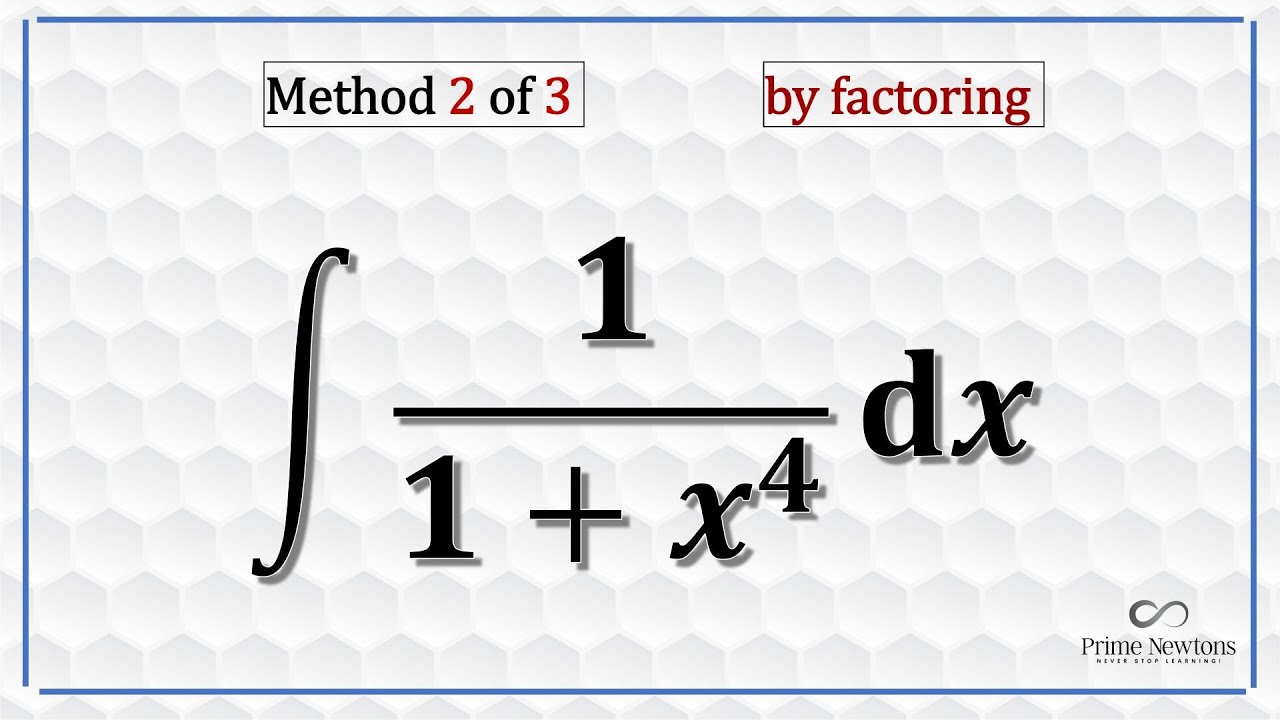
This methos involves smart replacement of the denominator by smartly writing it the the difference of two squares involving irrational coefficients. The rest is basic partial fraction decomposition, U-sub and trig sub. The final solution involves inverse hyperbolic tangent.,
Watch method 1 here:
https://youtu.be/to0bkvIl2cc
You can use this as well
Personally I find the second solution to be a bit more intuitive
cedar kilnBOT
@inner solar Has your question been resolved?
cedar kilnBOT
Channel closed
Closed due to timeout
Use .reopen if this was a mistake.
Available help channel!
Send your question here to claim the channel.
Remember:
• Ask your math question in a clear, concise manner.
• Show your work, and if possible, explain where you are stuck.
• After 15 minutes, feel free to ping <@&286206848099549185>.
• Type the command .close to free the channel when you're done.
• Be polite and have a nice day!
Read #❓how-to-get-help for further information on how to ask a good question, and about conduct in the question channels.
 graceful viper
 cedar kilnBOT
graceful viper
cedar kilnBOT
cedar kilnBOT
graceful viper
cedar kilnBOT
Channel closed
Closed by @graceful viper
Use .reopen if this was a mistake.
cedar kilnBOT
Available help channel!
Send your question here to claim the channel.
Remember:
• Ask your math question in a clear, concise manner.
• Show your work, and if possible, explain where you are stuck.
• After 15 minutes, feel free to ping <@&286206848099549185>.
• Type the command .close to free the channel when you're done.
• Be polite and have a nice day!
Read #❓how-to-get-help for further information on how to ask a good question, and about conduct in the question channels.
 limber yoke
Im losing my mind, somethings wrong with the derivative for x<0 I think but Ive checked it 7 times over
 cedar kilnBOT
limber yoke
Im losing my mind, somethings wrong with the derivative for x<0 I think but Ive ...
cedar kilnBOT
limber yoke
Im losing my mind, somethings wrong with the derivative for x<0 I think but Ive ...
 native heath
...yeah
what is this

i think you just ate a lot of steps to save writing space and ended up missing negatives
 south tundra
Looks like they replaced x with -x (for whatever reason)
native heath
well no just change the sign of the mod term
limber yoke
why just that?
native heath
because $f(x) \neq f(-x)$
wraith daggerBOT
Percy
 native heath
which i know doesn't sound like it's saying a lot but yeah no literally just that
you dont change the entire function for negative values
but the modulus opens with a negative yes
limber yoke
right so if I had |x|-x it would be -x-x for x<0 and x-x for x>0
cuz I only change the value inside the module since its that which Im trying to determine
humble arch
(x+1)^2 is NOT (-x+1)^2
 cedar kilnBOT
@limber yoke Has your question been resolved?
Channel closed
Closed by @limber yoke
Use .reopen if this was a mistake.
Available help channel!
Send your question here to claim the channel.
Remember:
• Ask your math question in a clear, concise manner.
• Show your work, and if possible, explain where you are stuck.
• After 15 minutes, feel free to ping <@&286206848099549185>.
• Type the command .close to free the channel when you're done.
• Be polite and have a nice day!
Read #❓how-to-get-help for further information on how to ask a good question, and about conduct in the question channels.
 dark girder
this may be a stupid question but on part b why do we not care abt adding c? its not a definite integral but the markscheme just ignores it and I dont think you can solve it if you put c in?
 cedar kilnBOT
dark girder
this may be a stupid question but on part b why do we not care abt adding c? its...
dark girder
cedar kilnBOT
dark girder
this may be a stupid question but on part b why do we not care abt adding c? its...
dark girder
*the value for t for part b is 3.5 and it integrates to this
 cedar kilnBOT
@dark girder Has your question been resolved?
cedar kilnBOT
@dark girder Has your question been resolved?
cedar kilnBOT
Channel closed
Closed by @dark girder
Use .reopen if this was a mistake.
Available help channel!
Send your question here to claim the channel.
Remember:
• Ask your math question in a clear, concise manner.
• Show your work, and if possible, explain where you are stuck.
• After 15 minutes, feel free to ping <@&286206848099549185>.
• Type the command .close to free the channel when you're done.
• Be polite and have a nice day!
Read #❓how-to-get-help for further information on how to ask a good question, and about conduct in the question channels.
 signal sigil
Could anyone please tell me what to do here? i'm blanking
 cedar kilnBOT
signal sigil
Could anyone please tell me what to do here? i'm blanking
cedar kilnBOT
signal sigil
Could anyone please tell me what to do here? i'm blanking
@signal sigil Has your question been resolved?
signal sigil
ah well, no worries.
cedar kilnBOT
Channel closed
Closed by @signal sigil
Use .reopen if this was a mistake.
 keen quest
alpha is 0, beta is pi.
 cedar kilnBOT
Available help channel!
cedar kilnBOT
Available help channel!
Send your question here to claim the channel.
Remember:
• Ask your math question in a clear, concise manner.
• Show your work, and if possible, explain where you are stuck.
• After 15 minutes, feel free to ping <@&286206848099549185>.
• Type the command .close to free the channel when you're done.
• Be polite and have a nice day!
Read #❓how-to-get-help for further information on how to ask a good question, and about conduct in the question channels.
 crystal merlin
help pls
 cedar kilnBOT
crystal merlin
help pls
cedar kilnBOT
crystal merlin
help pls
 cyan eagle
is it asking you to prove it combinatorially or something? (if so, think about picking l objects from a set of p objects that are part of a set of k objects)
cedar kilnBOT
@crystal merlin Has your question been resolved?
crystal merlin
yes I understand the interpretation of the left part but I can t understand how to prove the right part is equal if i only know that k >= p >= l
cyan eagle
so, it is a combinatorial proof? if so, then try to find a way to describe the same interpretation of the left with the expression on the right (or, i mean, find a way to count the objects in a different way)
crystal merlin
is it that In both cases, we select a subset of p elements from k by breaking down the choice into two steps: the selection of the first l elements, then the p - l elements among the remaining k−l.
cyan eagle
yeah, that's what i thought of (and should be correct)
cedar kilnBOT
Channel closed
Closed due to timeout
Use .reopen if this was a mistake.
crystal merlin
thank you
cedar kilnBOT
Available help channel!
Send your question here to claim the channel.
Remember:
• Ask your math question in a clear, concise manner.
• Show your work, and if possible, explain where you are stuck.
• After 15 minutes, feel free to ping <@&286206848099549185>.
• Type the command .close to free the channel when you're done.
• Be polite and have a nice day!
Read #❓how-to-get-help for further information on how to ask a good question, and about conduct in the question channels.
sand grotto
needs checking all answers should be to 3sig figs

 sand grotto
<@&286206848099549185>
 echo dagger
 what are you having difficulty with here?
 fringe folio
I can give you an answer but i don't think that would be particularly helpful
I agree with you about the tension. I think you lost precision along the way as my decimal places were different to yours (be careful of that).
The reaction force on the wall will be the horizontal component of the tension
Hopefully that will give you enought to find the answer @sand grotto
cedar kilnBOT
@sand grotto Has your question been resolved?
cedar kilnBOT
Channel closed
Closed due to timeout
Use .reopen if this was a mistake.
Available help channel!
Send your question here to claim the channel.
Remember:
• Ask your math question in a clear, concise manner.
• Show your work, and if possible, explain where you are stuck.
• After 15 minutes, feel free to ping <@&286206848099549185>.
• Type the command .close to free the channel when you're done.
• Be polite and have a nice day!
Read #❓how-to-get-help for further information on how to ask a good question, and about conduct in the question channels.
 strange vessel
I need help with question 8a
 cedar kilnBOT
strange vessel
I need help with question 8a
cedar kilnBOT
strange vessel
I need help with question 8a
 dusk goblet
the set of all points such that y = 3
(0, 3), (0.1, 3), (-69, 3), (420, 3) etc
notice anything
dusk goblet
mhm
what would that look like
graphically
you can always plot a few if you’re still confused
strange vessel
Wdym
dusk goblet
plot a few points
dusk goblet
dusk goblet
(0, 3), (0.1, 3), (-69, 3), (420, 3) etc
^
if you can’t tell what it will look like yet
strange vessel
I’m not sure
dusk goblet
dusk goblet
plot a few points
^
strange vessel
Alright gimme a sec
strange vessel
Well with 0, 3 it’s just a straight line going through the y axis
dusk goblet
sorry brother i don’t have much patience for this but good luck i’ll give the answer and cover it if you want to check your answer
or just use desmos
dusk goblet
||y = 3 looks like a horizontal line with all points having a y coordinate of 3||
strange vessel
Like how to do it or whatever
dusk goblet
brother
i told you
as i said
i don’t have the patience for this
have a nice day
cedar kilnBOT
Channel closed
Closed by @strange vessel
Use .reopen if this was a mistake.
cedar kilnBOT
Available help channel!
Send your question here to claim the channel.
Remember:
• Ask your math question in a clear, concise manner.
• Show your work, and if possible, explain where you are stuck.
• After 15 minutes, feel free to ping <@&286206848099549185>.
• Type the command .close to free the channel when you're done.
• Be polite and have a nice day!
Read #❓how-to-get-help for further information on how to ask a good question, and about conduct in the question channels.
 dire viper
I am stuck with the following problem
cedar kilnBOT
dire viper
I am stuck with the following problem
dire viper
Is this serie uniform convergent $\sum \frac{nx}{1+(nx)^2}$ for $x \in \mathbb{R}$
wraith daggerBOT
Erijoni
 dire viper
I found that x=-1/n and x=1/n are points where max and min of the function
I’ve tried to bound it to use Weierstrass Test but I don’t think it works
As for Abel’s and Dirichlet’s Tests I haven’t tried
 soft holly
$$\lim_{n \to \infty} \qty|\frac{(n + 1)x}{1 + ((n + 1)x)^2} \div \frac{nx}{1 + (nx)^2}| < 1$$
$$\lim_{n \to \infty} \qty|\frac{(n + 1)}{1 + ((n + 1)x)^2} \div \frac{n}{1 + (nx)^2}| < 1$$
$$\lim_{n \to \infty} \qty| \frac{1 + (nx)^2}{1 + ((n + 1)x)^2}|$$
wraith daggerBOT
Idli Robot
 dire viper
I don’t think this works
 celest gyro
maybe integral test?
dire viper
I’m not even sure if these test can be used for functional series
soft holly
dire viper
I’m not even sure if these test can be used for functional series
They definitely can
In fact, the [ratio test](#help-13 message) is use very often to find the interval of convergence of a power series
dire viper
Yeah thats true
soft holly
(A power series is usually of the form $\sum^\infty_{n = \dots} f_n(x)$
wraith daggerBOT
Idli Robot
 soft holly
I think you can try integral test
dire viper
You are right but in the problem I have seen abel dirichlet and wiererstrass were
Used more often
soft holly
dire viper
You are right but in the problem I have seen abel dirichlet and wiererstrass wer...
abel dirichlet and wiererstrass
i havent heard of this, so i cant help if you specifically need to use that
celest gyro
same abel dirichlet is unkown to me haha
dire viper
I think i solved it
celest gyro
tell us
dire viper
For the series to be uniform convergent
celest gyro
i'm waiting in awe
dire viper
We must have [ \lim_{x\to\infty}
sup(f_n(x))=0 ]
wraith daggerBOT
Erijoni
 dire viper
You can find that f_n(x) has a maximum of 1/2
celest gyro
i literally was thinking about "wasn't sup of something a thing?"
took this course a year ago haha, i'm a bit rusty
cedar kilnBOT
Channel closed
Closed by @dire viper
Use .reopen if this was a mistake.
cedar kilnBOT
Available help channel!
Send your question here to claim the channel.
Remember:
• Ask your math question in a clear, concise manner.
• Show your work, and if possible, explain where you are stuck.
• After 15 minutes, feel free to ping <@&286206848099549185>.
• Type the command .close to free the channel when you're done.
• Be polite and have a nice day!
Read #❓how-to-get-help for further information on how to ask a good question, and about conduct in the question channels.
 green crow
Need help on this exercise, I'm new to proofs
 cedar kilnBOT
green crow
Need help on this exercise, I'm new to proofs
cedar kilnBOT
green crow
Need help on this exercise, I'm new to proofs
 wraith daggerBOT
What a wonderful world!
 mighty shuttle
Recall that every non-empty set of real numbers that's bounded from above has a least upper bound (why?)
green crow
I don't know where to start but I wrote down , since A is bounded below then there is a number l≤x where x is in A, but I just wrote down a definition I believe
mighty shuttle
Have you done the axiom of completeness yet ?
green crow
No
mighty shuttle
I suggest you do that first
green crow
There's just a section that says Axiom of Completeness: Every non empty set of real numbers that is bounded above has a least upper bound. And that's all it says
green crow
From the question if b is a lower bound of A could that mean A is bounded below
green crow
There exists a number b where b≤a although I don't know what a is, I used a because it's part of definition
mighty shuttle
$B={x:x \leq a, \forall a \in A}$
wraith daggerBOT
What a wonderful world!
 mighty shuttle
Now what would the supremum of $B$ be?
wraith daggerBOT
What a wonderful world!
 green crow
Is B also a subset of R
green crow
mighty shuttle
Now what would the supremum of $B$ be?
I'm not sure because so far you've been describing a lower bound but the definition of supremum wants an upper bound
mighty shuttle
yeah, nut notice how the set of lower bounds is defined by saying it's all reals less than or equal to a given number
hushed folio
green crow
I'm not sure because so far you've been describing a lower bound but the definit...
It might be helpful to read the definition of B out in words
B is the set of all real numbers that is less than or equal to all values in A
green crow
I'm having some trouble visualizing the set B is it the interval [x,a] ?
hushed folio
green crow
I'm having some trouble visualizing the set B is it the interval [x,a] ?
I wouldnt look at it as an interval
Just look at how B is restricted by A
Every element in B has to be less than every element in A
green crow
The way I'm thinking of it isina number line x comes before a
Well if I want to find supremum of B I have to first find an upper bound of B but that would mean B is bounded above possibly?
hushed folio
green crow
Well if I want to find supremum of B I have to first find an upper bound of B bu...
Yep
Since B is defined by being less than all the elements of A, it has to be bounded above by those elements
green crow
If I use the definition of bounded above will it need to include this number a or not. I'm confused in the sense of introducing these variables
hushed folio
green crow
If I use the definition of bounded above will it need to include this number a o...
I guess let's look at a particular case
Say we had a set S that was defined as being a lower bound for the set of all real numbers 3 or above
What would be the infimum of that 3 or above set?
green crow
Would it be 3
green crow
Would there be no supremum
hushed folio
green crow
Would there be no supremum
There is a supremum
green crow
Is x≥3 is that same as x is in the interval [3, infinity)
mighty shuttle
yes
hushed folio
green crow
Is x≥3 is that same as x is in the interval [3, infinity)
Yep
So we have a set that is all the real numbers that are lower bounds for [3, infinity)
What is that set's greatest possible element
green crow
Well right of the number line it's going infinitely so you can't find a greatest possible element I would say
hushed folio
green crow
Well right of the number line it's going infinitely so you can't find a greatest...
It's not going infinitely to the right
If B is the set of elements that are lower bounds to [3, infinity), then asking what that set's supremum is means you're asking the "greatest lower bound" of [3, infinity)
green crow
But I thought supremum is least upper bound
hushed folio
green crow
But I thought supremum is least upper bound
It is
But B's supremum is the infimum of the other set
Because B is all the lower bounds of the other set
So the greatest B is the greatest lower bound of the other set
Which is the infimum
green crow
By other set you mean A?
hushed folio
green crow
By other set you mean A?
Yes
green crow
Do you have to use sets for this problem. It makes more sense to me saying b≤a because from the problem b is a lower bound of A
hushed folio
green crow
Do you have to use sets for this problem. It makes more sense to me saying b≤a b...
I mean $b \leq \text{min}(a)$
wraith daggerBOT
hiidostuff
 hushed folio
And min a is inf(A)
 hushed folio
green crow
This the definition I'm using
hushed folio
green crow
This the definition I'm using
I guess let's take this step by step then
$B = {b : b , \text{is a lower bound of} , A}$
green crow
The only part I understand is A is bounded below and then using the definition so far
wraith daggerBOT
hiidostuff
 wraith daggerBOT
hiidostuff
 hushed folio
Now suppose we look at the infimum of A
We know that all b in B must be less than or equal to the infimum of A
Because of how B is defined
green crow
Is the infinum of A and element of A?
hushed folio
And now that there exists a value such that all b is less than or equal to, we know B is bounded above
hushed folio
green crow
Is the infinum of A and element of A?
Not necessarily
The infimum of a set is just the greatest value that bounds the set below
green crow
hushed folio
Now suppose we look at the infimum of A
Could you instead use the definition of infimum and work from there
hushed folio
green crow
Could you instead use the definition of infimum and work from there
Sure
Actually instead I'll do a simpler two parter
This is what I would say is the simplest proof that sup B = inf A
Ok so we're gonna do two things
green crow
Wait, are A and B different sets or do they equal each other
green crow
We know A is bounded below but I don't know if B is bounded above or below
hushed folio
And that b is less than or equal to sup B
hushed folio
green crow
We know A is bounded below but I don't know if B is bounded above or below
If A consists of finite-valued elements then B is bounded above
Ok lets do part 1
Since B is the set of all lower bounds for A, then every b is less than or equal to every a
Where a and b are elements of A and B respectively
Because of this, sup(B) must also be less than or equal to every element in A, making it a lower bound for A
And of course, sup(B) is greater than every other b, making it the greatest lower bound of A
And the greatest lower bound of A is inf(A)
Thus, sup(B) = inf(A)
green crow
So are you saying b=supB
hushed folio
No
I'm saying that sup B is greater than all b
Remember b isn't one value
It represents all elements of B
hushed folio
Not sure honestly
hushed folio
green crow
From a picture
Actually there might be a way
green crow
The way I tried doing this problem at first is since A is bounded below there is a number l≤a , where a is in A. From set B, b≤a, So we have l≤a and b≤a but that would mean l≤b.
 green crow
But I don't know what l and b could be
hushed folio
Hold on

On the left, I drew some blue points to show instances of lower bounds to A
green crow
hushed folio
<@604738896672063500> here's the real line, and suppose the shaded red i drew is...
So is A half the real line
hushed folio
green crow
So is A half the real line
I mean "half the real line" isn't really a thing
But its some portion of the real line
Do the blue points make sense tho?
green crow
So something like [1,2] for example?
green crow
hushed folio
On the left, I drew some blue points to show instances of lower bounds to A
If the blue points are lower bounds to A then lower bounds can't be inside the set A?
hushed folio
green crow
If the blue points are lower bounds to A then lower bounds can't be inside the s...
Uhh that's kinda difficult
One lower bound can be in the set A
The infimum
But the infimum could also maybe not be in A
@green crow does my drawing make sense tho?
green crow
So if it was [1,2] 0 could be a lower bound of that set or -1 and so on
green crow
hushed folio
<@604738896672063500> does my drawing make sense tho?
Kind of
hushed folio
green crow
Kind of
I guess just a quick recap
The shaded red area is the set A
And the points I marked in blue are lower bounds to the set A
Since they are less than all the elements of A
green crow
hushed folio
Since they are less than all the elements of A
I can understand that
hushed folio
Alright
Look at that right most blue marker i put tho
Do you agree that we can keep putting points in between the blue mark and the leftmost portion of A, and it'll still be a lower bound of A?
green crow
hushed folio
Look at that right most blue marker i put tho
So the closest blue marker near set A?
hushed folio
green crow
So the closest blue marker near set A?
Yep
We can keep putting markers between that marker and set A, and all of those markers will be lower bounds to set A
Does that make sense?
green crow
I can see that
hushed folio
green crow
I can see that
As soon as we mark a point in blue that crosses A, however, that point isn't a lower bound of A anymore
And so its not in the set B
Basically meaning that every element of A bounds the set B above
Do u see that?
green crow
Well In the picture there is only set A I don't see set B
hushed folio
green crow
Well In the picture there is only set A I don't see set B
Well every point in blue that i marked is an element of B
Because it's a lower bound to A
But if I were to mark a point in A, then it's not a lower bound of A anymore
So it can't be in B
So if a point is in A, then it's not in B
green crow
So the set A comes after the set B?
hushed folio
Yes you could think of it like that
But more importantly, it comes directly after set B
green crow
So are these two sets connected in a way
hushed folio
green crow
So are these two sets connected in a way
I mean by definition yes
B is literally defined according to A
green crow
Maybe I can think of it like a border
hushed folio
Yes
And the largest value that B can take stops right as soon as it gets to A
And that largest value would be its supremum
(We do have to prove that sup B is in B tho)
green crow
So if b≤a then is b in set B and not A
green crow
When you say as soon as it gets to A is it near A or in A
hushed folio
It can either be infinitely close to A or right at the border of A, depending on if inf A is in A
green crow
From the picture the supremum of B is near the same place as the infmum of A
hushed folio
green crow
From the picture the supremum of B is near the same place as the infmum of A
Not just that but sup B is exactly equal to inf A
The largest that B can get is at the border of where A starts
Both of which are some visual definitions of the supremum and infimum
green crow
It makes sense visually but actually proving it although I mentioned I'm new to proofs is really difficult
hushed folio
green crow
It makes sense visually but actually proving it although I mentioned I'm new to ...
It is
The challenge of doing math really well is u gotta be smarter than ur eyes
You gotta let go of the dependence on visualizations