#help-13
1 messages · Page 351 of 1
 chrome quail
 brave pike
.25*
chrome quail
ah
brave pike
Typo
chrome quail
youre presetting ev and then solving for the value that yields it?
chrome quail
alright, could work, but it would only be valid in the continuous case.
brave pike
Discrete
brave pike
But because of before we know 13.5 would be nutral and anything greater would give you the ev you would want
chrome quail
what ev do we want
brave pike
I think my idea doesn’t work because we need to consider the multiplying by probability
chrome quail
yeah
brave pike

Schedule a consultation call with an HFT Quant for free: https://calendly.com/quantblueprint/quant-blueprint-consultation-call?utm_source=youtube&utm_medium=video_description&utm_campaign=2701_timestamp
Do you want to work as a Quant Trader or Quant Researcher at a High Frequency Trading (HFT) firm or Hedge Fund? We've worked with a team of top...
It’s the first question from this video
They say that 15 is optimal for p1
So I’m trying to figure out why
I’m gonna head to bed tho I think my sleep might be starting to impact my thinking lmao
chrome quail
Here's my solution
Tbh its pretty simple for a 2S interview
There is a value at which choosing x+1 no longer becomes the better option for P2. This value is the equilibrium point. This is because at this point, there is no difference between choosing x+1 and x-1 for P2, both would yield the same EV (7.75- or half the total EV).
By solving the following equation, we can see if x+1 is the better choice

I don't know if there's a clean way to solve this, which might be was the interviewer is looking for, but wolfram says 21.56
this means that for x1 less than 21.56, P2 should pick x+1, and for greater, they should pick x-1.
At this point, we can just try 21 and 22 for p1 (but we implicitly know 22 is better bc its closer to the equilibrium point).
21 for p1 gives an ev of 7.7, 22 gives an ev of 7.8
Thus, the best course of action is to be P1, and choose 22, this gives you an ev of 7.8, and leaves P2 with an ev of 7.7
What I was saying about discretization is that we can have an ev of more than 7.75 for p1 only because the sample space is discrete. If it was continuous, P2 would counter 22 with 21.99 and have a ev over 7.75
Then the nash equilibrium would be for p1 to hit this exact equilibrium point, 21.56, so that regardless of if p2 picks 21.57 or 21.55 (by definition of the equilibrium point), p1 and p2 would both have an ev of 7.75.
tldr: p1, pick 22 @brave pike
 cedar kilnBOT
@brave pike Has your question been resolved?
cedar kilnBOT
Channel closed
Closed due to timeout
Use .reopen if this was a mistake.
 Available help channel!
Send your question here to claim the channel.
Remember:
• Ask your math question in a clear, concise manner.
• Show your work, and if possible, explain where you are stuck.
• After 15 minutes, feel free to ping <@&286206848099549185>.
• Type the command .close to free the channel when you're done.
• Be polite and have a nice day!
Read #❓how-to-get-help for further information on how to ask a good question, and about conduct in the question channels.
 novel hound
How'd you solve
2sin^2(x)+3cosx = 0
cedar kilnBOT
novel hound
How'd you solve
2sin^2(x)+3cosx = 0
 south tundra
Rewriting sin^2 as 1 - cos^2, the equation turns into a quadratic with cos as the unknown
cedar kilnBOT
Channel closed
Closed by @novel hound
Use .reopen if this was a mistake.
cedar kilnBOT
Available help channel!
Send your question here to claim the channel.
Remember:
• Ask your math question in a clear, concise manner.
• Show your work, and if possible, explain where you are stuck.
• After 15 minutes, feel free to ping <@&286206848099549185>.
• Type the command .close to free the channel when you're done.
• Be polite and have a nice day!
Read #❓how-to-get-help for further information on how to ask a good question, and about conduct in the question channels.
 knotty harness
Why isnt the answer to this 20
 cedar kilnBOT
knotty harness
Why isnt the answer to this 20
cedar kilnBOT
knotty harness
Why isnt the answer to this 20
 dull oxide
knotty harness
Why isnt the answer to this 20
dull oxide
knotty harness
Why isnt the answer to this 20
!show
cedar kilnBOT
knotty harness
Why isnt the answer to this 20
Show your work, and if possible, explain where you are stuck.
knotty harness
dull oxide
!show
Idk if logically equivalent is all the columns for a row being the same (i.e. T or F) or just the columns of Y1 and Y2 for each row being the same
But I tried all the combinations for both which is a total of 11 and 20
And both are wrong
 wheat moss
if you look at the first row, where Y2 = T
for it to be not logically equivalent Y1 has to be F
similarly, rows 2, 3, 6, and 7 also have to be a certain fixed value
knotty harness
Yeah thats what I tried to do the first time
wheat moss
this leaves you with 3 rows that can be filled in any way
how many combinations of true and false can you make with 3 places to fill?
wheat moss
knotty harness
But I tried all the combinations for both which is a total of 11 and 20
the value 11 is wrong
knotty harness
10^(3)
wheat moss
here we have 3 places to fill with two choices for each (TF or FT)
wheat moss
knotty harness
10^(3)
so similarly, the number of combinations here would be?
wheat moss
but yea 8 should be the answer
 wheat moss
absolutely no idea then 8 should be correct
if theres additional context/info then show that
knotty harness
This is the entire question
 wheat moss
you might want to get that checked once it should indeed be 8
knotty harness
💀
The probability of the question being broken is like 1%
Pre sure we just cant get it
cedar kilnBOT
@knotty harness Has your question been resolved?
cedar kilnBOT
@knotty harness Has your question been resolved?
cedar kilnBOT
Channel closed
Closed due to timeout
Use .reopen if this was a mistake.
Available help channel!
Send your question here to claim the channel.
Remember:
• Ask your math question in a clear, concise manner.
• Show your work, and if possible, explain where you are stuck.
• After 15 minutes, feel free to ping <@&286206848099549185>.
• Type the command .close to free the channel when you're done.
• Be polite and have a nice day!
Read #❓how-to-get-help for further information on how to ask a good question, and about conduct in the question channels.
 crimson sedge
I GOT IT FIRST
cedar kilnBOT
crimson sedge
I GOT IT FIRST
crimson sedge
Anyways
 high kraken
fine go ahead
crimson sedge
I WAS SERIOUSLY TYPING SOMETHNG LMAO
high kraken
ME TOO
crimson sedge
high kraken
fine go ahead
Thank youuuuu
crimson sedge
high kraken
ME TOO
Blehhh I was faster
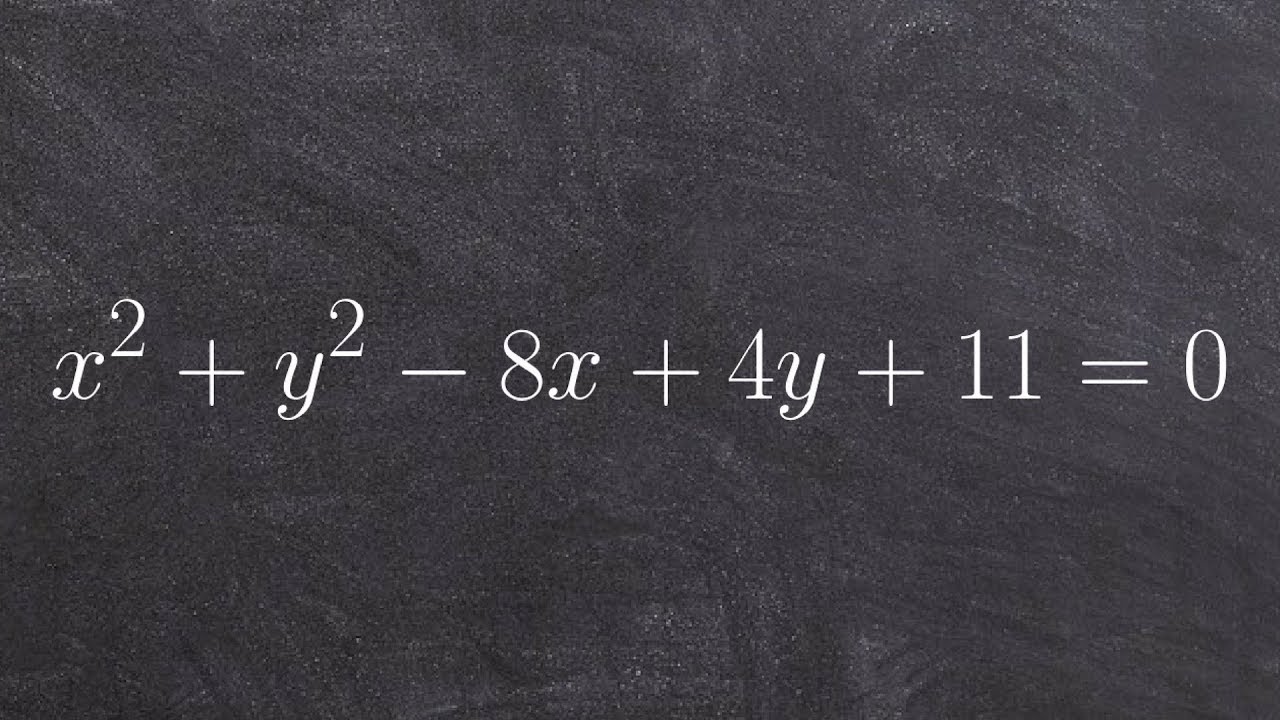
Learn how to graph the equation of a circle by completing the square. Completing the square will allow us to transform the equation of a circle from general form to standard form. When the equation is in standard form we can identify the center and radius of the circle to graph to then graph the circle.
#conicsections #circleconicsections
I didn't understand a word he said in 2:03
All I heard was "What 2 terms - Giggity Giggity Giggity - added by -28!"
 noble flame
He did talk a bit too fast lol but he was (I'm paraphrasing here) asking what is the factorisation of the quadratic
crimson sedge
How did he do that
noble flame
He factorised the quadratic, this can be done by remembering this case:
(x-a)²=x²-2ax+a² where a is a constant (can be 1,2,3,4...)
It was x²-8x+16
Through the use of that form you can factorise
crimson sedge
How.. do I factorise?
noble flame
you look at the formula I gave with the "a" constant
noble flame
noble flame
It was x²-8x+16
Look at this
If you want to find a, just root the 16, obtains 4
noble flame
Since it also satisfies the -2ax, the a being 4, -8x, that means that it can be factorized into a perfect square
I might look for a video this is a bit hard to explain in text wait

Learn how to recognize and factor Perfect Square Trinomials in this free math video tutorial by Mario's Math Tutoring.
0:22 What is a Perfect Square Binomial
1:26 Example 1 How to Recognize a Perfect Square Binomial Pattern
2:08 Example 2
2:55 Example 3
Related Videos:
Learn How to Factor (All Types)
https://youtu.be/kAHRBxLhkW8
Learn Algebr...
@crimson sedge
You can expand (a+b)² easily right?
crimson sedge
yes
noble flame
It's just a²+2ab+b²
so what you're doing is doing the reverse
Instead of expanding (a+b)², you factorize a²+2ab+b²
instead of starting with (a+b)² and ending with the expanded form, you are given the expanded form (a²+2ab+b²) and looking for the factorized form (a+b)²
 crimson sedge
How the hell did y^2 - 8y + 16 became (y + (-8))^2
 narrow girder

crimson sedge
so that tutorial is wrong
noble flame
crimson sedge
How the hell did y^2 - 8y + 16 became (y + (-8))^2
? No you mean (y-4)²
noble flame
crimson sedge
How the hell did y^2 - 8y + 16 became (y + (-8))^2
I think you may have meant [y+(-8/2)]²
Because you just divide the "2ab" in half since you can then find b which would be 4
cedar kilnBOT
@crimson sedge Has your question been resolved?
 frail shore
are you a middle school student?
cedar kilnBOT
@crimson sedge Has your question been resolved?
crimson sedge
frail shore
are you a middle school student?
no...
 past wave
 cedar kilnBOT
@crimson sedge Has your question been resolved?
 hard thistle
are you middle school student?
cedar kilnBOT
Channel closed
Closed due to timeout
Use .reopen if this was a mistake.
Available help channel!
Send your question here to claim the channel.
Remember:
• Ask your math question in a clear, concise manner.
• Show your work, and if possible, explain where you are stuck.
• After 15 minutes, feel free to ping <@&286206848099549185>.
• Type the command .close to free the channel when you're done.
• Be polite and have a nice day!
Read #❓how-to-get-help for further information on how to ask a good question, and about conduct in the question channels.
 pliant pine
if you're working in a polynomial vector space over field F (let's say P_3 (F) ), then if F is a field s.t. 1 + 1 = 0, would x^3 = x?
cedar kilnBOT
pliant pine
if you're working in a polynomial vector space over field F (let's say P_3 (F) )...
 dire geode
pliant pine
and x^2 = 1
dire geode
pliant pine
and x^2 = 1
This is false for x=0
pliant pine
dire geode
This is false for x=0
that would make sense since fields are groups excluding 0 where multiplication is the operator
is that true for every other value in F
dire geode
Is what true
cedar kilnBOT
@pliant pine Has your question been resolved?
 crimson delta
polynomials and polynomial functions are different over finite fields
if that is what you mean
x^3 and x both give the same map when you evaluate them
but they are different polynomials
pliant pine
crimson delta
x^3 and x both give the same map when you evaluate them
but in the field wher 1 + 1 = 0 wouldnt they be the same?
and x^(2) = 1 for all x not equal to 0
crimson delta
in F_2 we have x^3=x for every x, yes
but x^3 and x are not the same polynomial
they give the same polynomial function
polynomials and polynomial functions are not the same thing
pliant pine
what's the difference
crimson delta
polynomials are "symbols"
x^3 and x are different "symbols"
even if they give the same function
pliant pine
crimson delta
polynomials are "symbols"
so would it be wrong to say x^3 = x
crimson delta
as polynomials, yes
as functions, no
btw I wanna mention that F_2 is not the only field with 1+1=0. in other fields where 1+1=0 then x^3=x for all x is not true
cedar kilnBOT
@pliant pine Has your question been resolved?
cedar kilnBOT
@pliant pine Has your question been resolved?
Channel closed
Closed by @pliant pine
Use .reopen if this was a mistake.
Available help channel!
Send your question here to claim the channel.
Remember:
• Ask your math question in a clear, concise manner.
• Show your work, and if possible, explain where you are stuck.
• After 15 minutes, feel free to ping <@&286206848099549185>.
• Type the command .close to free the channel when you're done.
• Be polite and have a nice day!
Read #❓how-to-get-help for further information on how to ask a good question, and about conduct in the question channels.
 merry nebula
$\int \frac{\ln(x)}{(1+\ln(x))^2} dx$
cedar kilnBOT
merry nebula
$\int \frac{\ln(x)}{(1+\ln(x))^2} dx$
 wraith daggerBOT
Scruffy

 sacred frigate
its probably not elementary
merry nebula
sacred frigate
its probably not elementary
No, but it will be easy as long as I find the formula to solve it
sacred frigate
ye im saying theyre probably isn't an explicit formula
 dire geode
,w int log(x) /( 1+log(x))^2
wraith daggerBOT


 sacred frigate
oh lol
merry nebula
How do I memorize it
 twilit escarp
wraith daggerBOT
twilit escarp
wraith daggerBOT
mohammed
 merry nebula
What
 potent echo
You have to make these substitutions
merry nebula
Nope
potent echo
So you end up with
wraith daggerBOT
mohammed
 merry nebula
I saw it from blackredpen
And he does it in one pass
So he memorized it
So the integrals must be memorized
Easy
cedar kilnBOT
@merry nebula Has your question been resolved?
merry nebula
.close
cedar kilnBOT
Channel closed
Closed by @merry nebula
Use .reopen if this was a mistake.
cedar kilnBOT
Available help channel!
Send your question here to claim the channel.
Remember:
• Ask your math question in a clear, concise manner.
• Show your work, and if possible, explain where you are stuck.
• After 15 minutes, feel free to ping <@&286206848099549185>.
• Type the command .close to free the channel when you're done.
• Be polite and have a nice day!
Read #❓how-to-get-help for further information on how to ask a good question, and about conduct in the question channels.
 still storm
Hello , how is k(k-8) < 0 , k = 0 , and k = 8 , where does 0 come from ? Thanks
cedar kilnBOT
still storm
Hello , how is k(k-8) < 0 , k = 0 , and k = 8 , where does 0 come from ? Than...
 zenith sail
In order to find where k(k-8) is less than 0, the first step is to find where it is equal to 0.
In other words, where k(k-8)=0
still storm
yes
zenith sail
Since this is a product of two factors, k and k-8, it will equal 0 when either one of those factors equals 0
so k=0 or k-8=0
still storm
so one has to be 0 for the whole thing to be 0 ?
i see the second k (in the brackets) because its 8 - 8 = 0
zenith sail
Yes, if you think about it for a moment it's more clear than you might think. The only way to multiply two things and get 0 is if at least one of them already is 0
(1)(0)=0, (9)(0)=0, (0)(17)=0, etc
zenith sail
sure, k is the same as k+0 so that's fine
still storm
ok thank you , also leading on from that
because we have 2 values , k = 0 / 8 ,
I dont understand the meaning of 0 < k < 8 ,
is it saying K has to be less than 8 ? , and 0 is less than k ???
zenith sail
Well yes, but a better way to think of it is
k is greater than 0, and k is less than 8
or in other words, k is between 0 and 8
still storm
zenith sail
or in other words, k is between 0 and 8
that 0 > k < 8 , tho ?
k i less than 8 but greater than 0
zenith sail
still storm
that 0 > k < 8 , tho ?
this says k is less than 0
0 > k is the same as k < 0
0 < k says 0 is less than k, or k is greater than 0
still storm
ok I see that
zenith sail
0 < k < 8 says k is greater than 0 and less than 8
still storm
ahh ok thanks , one last thing to do with inequalities
zenith sail
sure
still storm
if we have x = 2 or x = -1 (x-2)(x+1) > 0 , and we want to show this on a parabola
you know how because its > 0 , we "shade" the both lines above the x axis , and each values is going out (-1 goes left) (2 goes right)
how do you say this with 2 seperate inequaltities
sorry if I explained it vaguely
zenith sail
No I understand
You can say "x < -1 or x > 2"
It's "or" because if x satisfies either one of those conditions, the original inequality will be true
still storm
zenith sail
You can say "x < -1 or x > 2"
still I dont see , how x is less than -1
I can see how x > 2 , because its going right
still storm
yes
ohhhhh right
so in a different scenario if (x-2)(x+1) < 0 (not > 0 this time)
its underneath the curve and its the whole region , going inwards this time , it would be
-1 >x <2
zenith sail
-1 < x < 2
The < signs will always be < signs when you do this
x is greater than -1 and less than 2
zenith sail
still storm
-1 >x <2
You'll never really have them pointing in opposite directions like this
still storm
I still cant do it
zenith sail
Do you agree, you're trying to describe that x is between -1 and 2, right?
still storm
yes
zenith sail
when you want to show that x is between a and b, it is always a < x < b
still storm
ok
zenith sail
with the lesser number a and greater number b
still storm
yes
still storm
what about with 2 seperate (lines / parts of curve)
zenith sail
still storm
you know how because its > 0 , we "shade" the both lines above the x axis , and ...
like this?
still storm
yes
zenith sail
zenith sail
You can say "x < -1 or x > 2"
it'll be like this
zenith sail
yeah I mean, x<-1 means "to the left of -1" and x>2 means "to the right of 2"
still storm
I like that "expanation"
why do we "shade" both Left and Right lines
and the bottom whole line
is it something to do with finding a random coordinate between , the 2 values (for shading the bottom) and it proves it
same with finding a random coordinate, out of the range of either 2 values (shading 2 seperate at the top) and proves it
zenith sail
Choosing values like that is another way to do it, helpful if you don't already know what the graph looks like
But you do know what the graph looks like
for something like (x-2)(x+1), part of it goes below the x axis, and part of it is above the x axis
If it's below the x axis, it's because the expression has a value less than 0 for that x-value
which is exactly what (x-2)(x+1)<0 says
you're looking for where the value is less than 0, so you're looking for the part below the x-axis
zenith sail
no problem 👍
still storm
.close
cedar kilnBOT
Channel closed
Closed by @still storm
Use .reopen if this was a mistake.
cedar kilnBOT
Available help channel!
Send your question here to claim the channel.
Remember:
• Ask your math question in a clear, concise manner.
• Show your work, and if possible, explain where you are stuck.
• After 15 minutes, feel free to ping <@&286206848099549185>.
• Type the command .close to free the channel when you're done.
• Be polite and have a nice day!
Read #❓how-to-get-help for further information on how to ask a good question, and about conduct in the question channels.
 deft nacelle
Is there a way to do this without using derivatives(de l'hopital)?
 noble flame
deft nacelle
Is there a way to do this without using derivatives(de l'hopital)?
noble flame
deft nacelle
Is there a way to do this without using derivatives(de l'hopital)?
, rotate
wraith daggerBOT
 noble flame
Hmm squeeze theorem?
if you don't know it's just putting inequalities onto the expression
deft nacelle
Would you be able to explain the cos>sin passage?
 swift terrace
you understood the first passage?
deft nacelle
Yes
It is the fact that it goes to sin that I don't get
Also i know the sinx/x=1 to do the last one
noble flame
deft nacelle
It is the fact that it goes to sin that I don't get
Properties of sin and cos graph
cos graph is just sin graph but shifted to the left by π/2
you have cos(π/2-yπ/2)
swift terrace
 noble flame
Yeah, just that
deft nacelle
AAA
Yes yes
Understood
Thanks very much
If there was no easy connection between the two the limit would not be easy to do no? I mean this time it is exactly pi/2 so it is easy to get the simple limit sinx/x after but if it was for example pi/3 it wouldn't have been easy after right?
Because you dom't have an easy shift cos to sin
swift terrace
correct
most of the times there will be tricks like that
that you`ll have to notice
deft nacelle
👍🏻
cedar kilnBOT
@deft nacelle Has your question been resolved?
cedar kilnBOT
Channel closed
Closed due to timeout
Use .reopen if this was a mistake.
cedar kilnBOT
Available help channel!
Send your question here to claim the channel.
Remember:
• Ask your math question in a clear, concise manner.
• Show your work, and if possible, explain where you are stuck.
• After 15 minutes, feel free to ping <@&286206848099549185>.
• Type the command .close to free the channel when you're done.
• Be polite and have a nice day!
Read #❓how-to-get-help for further information on how to ask a good question, and about conduct in the question channels.
 sterile elm
Help
cedar kilnBOT
sterile elm
Help
sterile elm
So if a guy played a game 603 times
And scored 81 100s in that amount of games
How many dose he average every 10 games
<@&286206848099549185>
 low bloom
so you mean he got 100 score 81 times
sterile elm
Yes
low bloom
and the maximum score is 100 right
low bloom
still i need more info to get the average score of the games
low bloom
sterile elm
A century is just a 100+
what is this
low bloom
oh ok
oh so if you divide 81/603
and then multiply it by 10
1.34328358209
this is his average score of 100s each 10 games
noble flame
sterile elm
No I want the average number of 100s he gets in 10 games
Ahhhh
sterile elm
Alright thanks
noble flame
I thought you were looking for some weird stats question with very little info
cedar kilnBOT
@sterile elm Has your question been resolved?
Channel closed
Closed by @sterile elm
Use .reopen if this was a mistake.
Available help channel!
Send your question here to claim the channel.
Remember:
• Ask your math question in a clear, concise manner.
• Show your work, and if possible, explain where you are stuck.
• After 15 minutes, feel free to ping <@&286206848099549185>.
• Type the command .close to free the channel when you're done.
• Be polite and have a nice day!
Read #❓how-to-get-help for further information on how to ask a good question, and about conduct in the question channels.
 dense jewel
Guys help
 cedar kilnBOT
dense jewel
Guys help
dense jewel
cedar kilnBOT
dense jewel
Guys help
dense jewel
i really need help asap
 heady hill
4 big 4 in between and 1 small I think
heady hill
dense jewel
Guys help

 pale cloud
heady hill
pale cloud
heady hill
that depends
this question is made poorly but like
is 1 to be considered a discrete space when overlapped with 5 and 6?
 wicked mantle
heady hill
wicked mantle
heady hill
 pale cloud
because its not a rectangle in that case or
wicked mantle
ig that’s every of them
heady hill
So 10
wicked mantle
10 in total
cedar kilnBOT
Channel closed
Closed by @dense jewel
Use .reopen if this was a mistake.
cedar kilnBOT
Available help channel!
Send your question here to claim the channel.
Remember:
• Ask your math question in a clear, concise manner.
• Show your work, and if possible, explain where you are stuck.
• After 15 minutes, feel free to ping <@&286206848099549185>.
• Type the command .close to free the channel when you're done.
• Be polite and have a nice day!
Read #❓how-to-get-help for further information on how to ask a good question, and about conduct in the question channels.
 clear ridge
Not sure if this is the right place to ask this kind of question, but I'm kind of at a loss of where to go for help lol. Suppose a linear hash file began as 2 buckets. The first two hash functions are
H0(key) = key mod 2
H1(key) = key mod 4
Now suppose the file has grown to 20 buckets.
Suppose a record with key 85 is to be inserted, where will it be placed?
cedar kilnBOT
clear ridge
Not sure if this is the right place to ask this kind of question, but I'm kind o...
cedar kilnBOT
@clear ridge Has your question been resolved?
clear ridge
<@&286206848099549185>
cedar kilnBOT
@clear ridge Has your question been resolved?
 wanton sail
clear ridge
Not sure if this is the right place to ask this kind of question, but I'm kind o...
wanton sail
clear ridge
Not sure if this is the right place to ask this kind of question, but I'm kind o...
There's also a CS server in #old-network that you could try if no one here responds
clear ridge
wanton sail
There's also a CS server in <#406129911992942593> that you could try if no one h...
Good to know. Thank you!
cedar kilnBOT
@clear ridge Has your question been resolved?
cedar kilnBOT
Channel closed
Closed due to timeout
Use .reopen if this was a mistake.
Available help channel!
Send your question here to claim the channel.
Remember:
• Ask your math question in a clear, concise manner.
• Show your work, and if possible, explain where you are stuck.
• After 15 minutes, feel free to ping <@&286206848099549185>.
• Type the command .close to free the channel when you're done.
• Be polite and have a nice day!
Read #❓how-to-get-help for further information on how to ask a good question, and about conduct in the question channels.
 cedar rapids
 cedar kilnBOT
cedar rapids
cedar rapids
cedar kilnBOT
cedar rapids
cedar rapids
a) let A in R3X3 which verifies
Nul(A+2I) = {(x,y,z) : x+y+z=0}, rank(A) = 2 and (1 1 1)^T is an eigenvector of A
so thus far I've found the null space vectors for A + 2I
rank(A) = 2 tells us the null space of A is of dimension 1 and its col space is of dimension 2
dull oxide
cedar rapids
a) let A in R3X3 which verifies
Nul(A+2I) = {(x,y,z) : x+y+z=0}, rank(A) = 2 and...
Not "which verifies". That's the literal translation, but in English it's more natural to say "which satisfies" in this context
cedar rapids
ah
i see
usually people understand 'which verifies'
i've asked tons of questions in here
dull oxide
Ay. Sí 
Yeah. From the context it is clear what you were asking. I'm sure you would know what i meant if i said "yo no habla español"
cedar rapids
yeah yeah i get it
it's just that some linear algebra terminology is hard to carry over
for example i used to say gen instead of span
dull oxide
Totally. I had the same problem trying to carry English terms into Spanish
It's hard
Que significa "espacios propios" en inglés
cedar rapids
dull oxide
Que significa "espacios propios" en inglés
it refers to column, row and null space i think
dull oxide
I think the English word is eigenspace
Oh. Yes that's it
"Eigen" is the German word for "proper". So "espacio propio" makes sense as "proper space" or "eigenspace" as it is normally called
Okay so you are trying to do part a right now?
cedar kilnBOT
@cedar rapids Has your question been resolved?
cedar kilnBOT
@cedar rapids Has your question been resolved?
cedar rapids
.close
cedar kilnBOT
Channel closed
Closed by @cedar rapids
Use .reopen if this was a mistake.
Available help channel!
Send your question here to claim the channel.
Remember:
• Ask your math question in a clear, concise manner.
• Show your work, and if possible, explain where you are stuck.
• After 15 minutes, feel free to ping <@&286206848099549185>.
• Type the command .close to free the channel when you're done.
• Be polite and have a nice day!
Read #❓how-to-get-help for further information on how to ask a good question, and about conduct in the question channels.
 drifting wind
idk how to start this, 😭
 cedar kilnBOT
drifting wind
idk how to start this, 😭
cedar kilnBOT
drifting wind
idk how to start this, 😭
 flint plinth
start by identifying the 4 intervals you would use
drifting wind
1,2,3, and 4 right?
flint plinth
what do you know about this midpoint rule, surely you have some reading material about it?
some examples?

 rare vault
insane definition to give for something easier as a picture, lemme find one

you are estimating the integral by making n (4 in your case) rectangles under it
does this pic help at all @drifting wind
drifting wind
uhh yes
but how does the formula apply?
not formula
equation
sin rad x times dx
rare vault
it's just the formalization of the addition of the areas of those rectangles
oh well you are aware that the integral calculates the area under the curve right?
so we are just using the midpoint approximation on $\sin\sqrt x$ from 0 to 24
drifting wind
kind of my prof just shows us like the formula and doesnt explain like what it represents
wraith daggerBOT
 drifting wind
so its like the rectangles but without the picture?
rare vault
I'm not sure what you mean
drifting wind
like
rare vault
yes, it's the way to visualize how the approximation works
the function in the graph is not the same as your function of course
drifting wind
ik
rare vault
so do you see how to do the original problem or still stuck?
wraith daggerBOT
 drifting wind
i = 4 ?
rare vault
you need to split the range [0,24] into 4 different parts, which you have correctly identified as splitting into groups of 6
drifting wind
oh
rare vault
so we have 4 rectangles under our graph, each of width 6
the first one goes from [0,6], then [6,12], [12,18], [18,24]
then you want to approximate the height of each of these rectangles by getting the value of the function at their midpoint
then the area is width*height, then you just add their areas, and this approximates the area under the function, which is the integral
notably if you had infinite sections instead of just 4, you would get the exact answer (this is what an integral is)
the "dx" is the infinitesimal width, and f(x) is the height
( @drifting wind )
 cedar kilnBOT
@drifting wind Has your question been resolved?
Channel closed
Closed by @drifting wind
Use .reopen if this was a mistake.
Available help channel!
Send your question here to claim the channel.
Remember:
• Ask your math question in a clear, concise manner.
• Show your work, and if possible, explain where you are stuck.
• After 15 minutes, feel free to ping <@&286206848099549185>.
• Type the command .close to free the channel when you're done.
• Be polite and have a nice day!
Read #❓how-to-get-help for further information on how to ask a good question, and about conduct in the question channels.
 blazing carbon
Hello, I need help with computing this series

 hollow trail
the convergence or the value of the sum?
hollow trail
does the question require you to find its sum?
blazing carbon
yes
cedar kilnBOT
@blazing carbon Has your question been resolved?
blazing carbon
idk if this helps but this is equal to $\sum_{n=0}^\infty \frac{(-1)^n(2n+1)^3}{(4n^2+1)(4n^2+8n+5)}$
wraith daggerBOT
ω
 blazing carbon
<@&286206848099549185>
this is $\sum_{n=0}^\infty (-1)^n\frac{(2n+1)^3}{((2n)^2+1)((2n+2)^2+1)}$
wraith daggerBOT
ω
 blazing carbon
wraith dagger
**ω**
blazing carbon
wraith dagger
**ω**
oh I got this from Wolfram but there is a formula for x^4+4 Sophie Germain identity
ok not like this its better to write it like this
this is $\sum_{n=0}^\infty (-1)^n\frac{(2n+1)^3}{(4n^2+1)(4(n+1)^2+1)}$
wraith daggerBOT
ω
 blazing carbon
this is equal to $\sum_{n=0}^\infty (-1)^n(\frac{n}{4n^2+1}+\frac{n+1}{4(n+1)^2+1})$
wraith daggerBOT
ω
 cedar kilnBOT
Channel closed
Closed by @blazing carbon
Use .reopen if this was a mistake.
cedar kilnBOT
Available help channel!
Send your question here to claim the channel.
Remember:
• Ask your math question in a clear, concise manner.
• Show your work, and if possible, explain where you are stuck.
• After 15 minutes, feel free to ping <@&286206848099549185>.
• Type the command .close to free the channel when you're done.
• Be polite and have a nice day!
Read #❓how-to-get-help for further information on how to ask a good question, and about conduct in the question channels.
cedar kilnBOT
@fair tendon Has your question been resolved?
Channel closed
Closed by @fair tendon
Use .reopen if this was a mistake.
Available help channel!
Send your question here to claim the channel.
Remember:
• Ask your math question in a clear, concise manner.
• Show your work, and if possible, explain where you are stuck.
• After 15 minutes, feel free to ping <@&286206848099549185>.
• Type the command .close to free the channel when you're done.
• Be polite and have a nice day!
Read #❓how-to-get-help for further information on how to ask a good question, and about conduct in the question channels.
 toxic lynx
im not exactly sure how, but can someone help me differentiate this with respect to un+1 ?
 cedar kilnBOT
toxic lynx
im not exactly sure how, but can someone help me differentiate this with respect...
toxic lynx
cedar kilnBOT
toxic lynx
im not exactly sure how, but can someone help me differentiate this with respect...
toxic lynx
heres the full context this time

i have g(un+1) = lhs - rhs and im differentiating that
cedar kilnBOT
@toxic lynx Has your question been resolved?
toxic lynx
<@&286206848099549185>
cedar kilnBOT
@toxic lynx Has your question been resolved?
toxic lynx
<@&286206848099549185>
 south viper
toxic lynx
south viper
toxic lynx
<@&286206848099549185>
 steep badge
what topic is this
toxic lynx
numerical methods
toxic lynx
ok
steep badge
check early university category or advanced math category
toxic lynx
which one
steep badge
I don't really know
toxic lynx
if it helps someone, i have this example of a simpler version in my notes
 cedar kilnBOT
@toxic lynx Has your question been resolved?
cedar kilnBOT
@toxic lynx Has your question been resolved?
cedar kilnBOT
@toxic lynx Has your question been resolved?
 trim valve
toxic lynx
if it helps someone, i have this example of a simpler version in my notes
trim valve
toxic lynx
if it helps someone, i have this example of a simpler version in my notes
uh, won't it be the same thing then
you write some v = (u_n + u_{n+1})/2 and differentiate wrt v
 still barn
Are you sure you are even expected to actually differentiate this? I don't know what your class is like, but I would just be applying a finite difference method to f
cedar kilnBOT
@toxic lynx Has your question been resolved?
cedar kilnBOT
Channel closed
Closed due to timeout
Use .reopen if this was a mistake.
cedar kilnBOT
Available help channel!
Send your question here to claim the channel.
Remember:
• Ask your math question in a clear, concise manner.
• Show your work, and if possible, explain where you are stuck.
• After 15 minutes, feel free to ping <@&286206848099549185>.
• Type the command .close to free the channel when you're done.
• Be polite and have a nice day!
Read #❓how-to-get-help for further information on how to ask a good question, and about conduct in the question channels.
 safe dragon
simple cost calculations it’s for some dumb class nd I forgot to do it nd it’s bringing my grade down
cedar kilnBOT
safe dragon
simple cost calculations it’s for some dumb class nd I forgot to do it nd it’s b...
 safe dragon
 torn pollen
ur not ment to offer money
torn pollen
ur not ment to offer money
Oh sorry
safe dragon
Thank you
torn pollen
just dont do it in the future and u should be all good
whats the questions so i can have a look


 torn pollen
okay
so for the first one
you need a certain amount of items
and those items cost money
so you gotta get the correct amount of ingredients
and figure out how much it cost
cedar kilnBOT
@safe dragon Has your question been resolved?
cedar kilnBOT
Channel closed
Closed due to timeout
Use .reopen if this was a mistake.
Available help channel!
Send your question here to claim the channel.
Remember:
• Ask your math question in a clear, concise manner.
• Show your work, and if possible, explain where you are stuck.
• After 15 minutes, feel free to ping <@&286206848099549185>.
• Type the command .close to free the channel when you're done.
• Be polite and have a nice day!
Read #❓how-to-get-help for further information on how to ask a good question, and about conduct in the question channels.
 polar oracle
can someone check my work (I have to find each angle degree)

 polar oracle
please and thank you
crimson sedge
What
 sudden lichen
first photo 2 is 180-43-102 (triangle)
crimson sedge
You third calculation is WRONG
Well, you made it clear that angle 3 = 45 deg in your fourth calculation.
Note:
Angle 2 can be directly found since it's vertically opposite to a 35 deg angle.
Angle 4 = angle 2 + 100 deg
polar oracle
so it would be
- 145
- 35
- 45
- 135
?
sudden lichen
polar oracle
so it would be
1. 145
2. 35
3. 45
4. 135
?
for 2nd photo, yes
polar oracle
and for photo one
- 43
- 35
- 45
?
sudden lichen
yes
cedar kilnBOT
Channel closed
Closed by @polar oracle
Use .reopen if this was a mistake.
cedar kilnBOT
Available help channel!
Send your question here to claim the channel.
Remember:
• Ask your math question in a clear, concise manner.
• Show your work, and if possible, explain where you are stuck.
• After 15 minutes, feel free to ping <@&286206848099549185>.
• Type the command .close to free the channel when you're done.
• Be polite and have a nice day!
Read #❓how-to-get-help for further information on how to ask a good question, and about conduct in the question channels.
 zinc crypt
 cedar kilnBOT
zinc crypt
cedar kilnBOT
zinc crypt
 acoustic quartz
Lim|an|^1/n
x*lim n->infinity (n-1 / 5n+2)
|x/5| is what u get after root test
And u know it had to be less than 1
|x/5| < 1
Multiply both sides by 5
|x| < 5
Ur ROC is therefore 5
 zinc crypt
this is how I was taught
zinc crypt
i didnt know you can use the root test
acoustic quartz
Take out the x
zinc crypt
wdym take out the x
acoustic quartz
Cause it’s limit as n approaches infinity rigjt
X in this case is basically a constant
zinc crypt
yea
acoustic quartz
And then aftwr taking x out evaluate the limit
acoustic quartz
Wdym
 acoustic quartz
U just simplified what was inside the limit and not evaluate it
acoustic quartz
Yea
zinc crypt
ok so now I have this right?
 zinc crypt
with the brackets
acoustic quartz
Yes
So now u have |x|*1/5
What’s the condition for the series to converge using ratio test
zinc crypt
it has to be less than 1
acoustic quartz
Yesss
zinc crypt
so then multiply 5
acoustic quartz
Yes
acoustic quartz
Yes
zinc crypt
Thanks your were a lot of help you clarified a question I had outside the problem
.close
cedar kilnBOT
Channel closed
Closed by @zinc crypt
Use .reopen if this was a mistake.
cedar kilnBOT
Available help channel!
Send your question here to claim the channel.
Remember:
• Ask your math question in a clear, concise manner.
• Show your work, and if possible, explain where you are stuck.
• After 15 minutes, feel free to ping <@&286206848099549185>.
• Type the command .close to free the channel when you're done.
• Be polite and have a nice day!
Read #❓how-to-get-help for further information on how to ask a good question, and about conduct in the question channels.
 modest storm

 cedar kilnBOT
modest storm
cedar kilnBOT
cedar kilnBOT
modest storm
cedar kilnBOT
@modest storm Has your question been resolved?
Channel closed
Closed by @modest storm
Use .reopen if this was a mistake.
Available help channel!
Send your question here to claim the channel.
Remember:
• Ask your math question in a clear, concise manner.
• Show your work, and if possible, explain where you are stuck.
• After 15 minutes, feel free to ping <@&286206848099549185>.
• Type the command .close to free the channel when you're done.
• Be polite and have a nice day!
Read #❓how-to-get-help for further information on how to ask a good question, and about conduct in the question channels.
 patent orchid
how to get (x-4)
 cedar kilnBOT
@patent orchid Has your question been resolved?
cedar kilnBOT
Channel closed
Closed due to timeout
Use .reopen if this was a mistake.
Available help channel!
Send your question here to claim the channel.
Remember:
• Ask your math question in a clear, concise manner.
• Show your work, and if possible, explain where you are stuck.
• After 15 minutes, feel free to ping <@&286206848099549185>.
• Type the command .close to free the channel when you're done.
• Be polite and have a nice day!
Read #❓how-to-get-help for further information on how to ask a good question, and about conduct in the question channels.
 wild belfry
 cedar kilnBOT
wild belfry
wild belfry
cedar kilnBOT
wild belfry
wild belfry
This is the question ^^
And this is the solution vv

I dont understand the second step in the solution
Where did the minus sign come from?
x^2 = y
x = sqrt(y)
Why negative?
hollow trail
,w plot{y=x^2, x = 0, y = 0, y = 2}
wraith daggerBOT


 Requested by cloudedhorizons
hollow trail
Requested by cloudedhorizons
hollow trail
so we can see that there are two choices of region (both will give the same solid when rotated about the y-axis)
the solution chose the left region
wild belfry
hollow trail
the solution chose the left region
How come?
hollow trail
well if you solve y = x^2 for x, we get two solutions: x = +sqrt(y) and x = -sqrt(y)
wild belfry
So there wasnt really a reason? They just picked the left region at random?
 dusk goblet
wild belfry
So there wasnt really a reason? They just picked the left region at random?
dusk goblet
wild belfry
So there wasnt really a reason? They just picked the left region at random?
you realize it doesn’t matter because it gets squared either way
hollow trail
the +sqrt(y) corresponds to the right half of the parabola, and the -sqrt(y) corresponds to the left half
they had to make a selection, and i think this choice helps to highlight an assumption you might make [solving y = x^2 only results in x = sqrt(y)]
wild belfry
hollow trail
they had to make *a* selection, and i think this choice helps to highlight an as...
Ahh that makes sense
Thank you so much!!
❤️
.close
cedar kilnBOT
Channel closed
Closed by @wild belfry
Use .reopen if this was a mistake.
cedar kilnBOT
Available help channel!
Send your question here to claim the channel.
Remember:
• Ask your math question in a clear, concise manner.
• Show your work, and if possible, explain where you are stuck.
• After 15 minutes, feel free to ping <@&286206848099549185>.
• Type the command .close to free the channel when you're done.
• Be polite and have a nice day!
Read #❓how-to-get-help for further information on how to ask a good question, and about conduct in the question channels.
 bitter garden
Does anyone understand math in french
cedar kilnBOT
bitter garden
Does anyone understand math in french
bitter garden
😭
 vernal leaf
bro translate it and write here
bitter garden
its not an exercise i want to understand how to calculate the coordintaes of a point where two lines pass through
vernal leaf
I'm italian, let's try
bitter garden
so uhh can u explain it to me
 vivid wadi
bitter garden
its not an exercise i want to understand how to calculate the coordintaes of a p...
vivid wadi
bitter garden
its not an exercise i want to understand how to calculate the coordintaes of a p...
do you have a specific example problem?
vernal leaf
you have to equal the two anlytic expression, of we are talking about functions
potent echo
vernal leaf
I'm italian, let's try
potent echo
potent echo
Im cooking pasta
bitter garden
vivid wadi
do you have a specific example problem?
lemme see
vernal leaf
potent echo
Im cooking pasta
mmmmhhhh, I love pasta
but bro
can you recognize italians not only for pasta?
bitter garden
vernal leaf
you have to equal the two anlytic expression, of we are talking about functions
like ax+by+c=0 ?
vernal leaf
bitter garden
like ax+by+c=0 ?
write y in function of x and then equal
bitter garden

i tried that by combining the equation of 2 lines into a system but got a different answer than in the corection
bitter garden
In an orthonormal coordinate system (O; i-vector; j-vector), let the points A(1; 3), B(-4; 7), and the line equation (x = 7 + 4t, vector U(2; -5)), and the line (Delta) be such that (4): x=7 + 4t
y = 1 + 3t (where t ∈ ℝ).
-
Show that A, B, and O are not collinear.
-
Determine the Cartesian equation of the line (D) passing through A with the direction vector U.
-
Determine the Cartesian equation of the line (A).
-
Show that the lines (D) and (Delta) intersect at a point I.
-
Determine the coordinates of point I.
-
Let the point E(m² + 2; m + 1) with m as a real parameter. Determine the values of m such that E ∈ (AB).
here is a rough translation
vernal leaf
- is easy
bitter garden
there was something wrong in the delta system i fixed it
bitter garden
vernal leaf
1) is easy
yh am just stuck on 5
vernal leaf
ok
write D and delta in function of x, equal these two expressions, then you find x and y of the point I
bitter garden
aight imma try
oh wait am a dumbass this is easier than all the other questions 😭
i got (3,-2)
bitter garden
vernal leaf
write D and delta in function of x, equal these two expressions, then you find x...
Thanks 😭🙏🙏
vernal leaf
you're welcome
cedar kilnBOT
@bitter garden Has your question been resolved?
cedar kilnBOT
Channel closed
Closed due to timeout
Use .reopen if this was a mistake.
cedar kilnBOT
Available help channel!
Send your question here to claim the channel.
Remember:
• Ask your math question in a clear, concise manner.
• Show your work, and if possible, explain where you are stuck.
• After 15 minutes, feel free to ping <@&286206848099549185>.
• Type the command .close to free the channel when you're done.
• Be polite and have a nice day!
Read #❓how-to-get-help for further information on how to ask a good question, and about conduct in the question channels.
 fervent moon
x is 2 and y is 4 and 2 thirds how do u graph the y exactly
fervent moon
fervent moon
x is 2 and y is 4 and 2 thirds how do u graph the y exactly
just like, how do i graph y
crimson delta
do you mean $x=2$ and $y=4\frac23$ ?
wraith daggerBOT
Denascite
 crimson delta
and you are asking where that point is in the plane?
fervent moon
crimson delta
and you are asking where that point is in the plane?
yez where would i put y
like the 2/3
crimson delta
.close
cedar kilnBOT
Channel closed
Closed by @crimson delta
Use .reopen if this was a mistake.
cedar kilnBOT
Available help channel!
Send your question here to claim the channel.
Remember:
• Ask your math question in a clear, concise manner.
• Show your work, and if possible, explain where you are stuck.
• After 15 minutes, feel free to ping <@&286206848099549185>.
• Type the command .close to free the channel when you're done.
• Be polite and have a nice day!
Read #❓how-to-get-help for further information on how to ask a good question, and about conduct in the question channels.
wild belfry
 cedar kilnBOT
wild belfry
wild belfry
cedar kilnBOT
wild belfry
wild belfry
I think im stuck
u = x+2
du = 1dx
(u-2)^2 = x^2
So when I sub in I get
(u-2)^2(sqrt(u))
This doesnt really help with integrating right?
Did I do something wrong?
dusk goblet
expand
dull oxide
wild belfry
This doesnt really help with integrating right?
expand and then distribute (u-2)²
wild belfry
Ah oke I will try
Ahhh yeye
Its very messy but it works haha
So there was never even an issue lol
Thank you everyone!!
❤️
.close
cedar kilnBOT
Channel closed
Closed by @wild belfry
Use .reopen if this was a mistake.
cedar kilnBOT
Available help channel!
Send your question here to claim the channel.
Remember:
• Ask your math question in a clear, concise manner.
• Show your work, and if possible, explain where you are stuck.
• After 15 minutes, feel free to ping <@&286206848099549185>.
• Type the command .close to free the channel when you're done.
• Be polite and have a nice day!
Read #❓how-to-get-help for further information on how to ask a good question, and about conduct in the question channels.
 long chasm
 cedar kilnBOT
long chasm
long chasm
cedar kilnBOT
long chasm
long chasm
Help pls
I tried s(3) = 5 and s(11) = 5 and it doesn't work as well
Also, I s(-4) = -4

Here is the graph I drew
<@&286206848099549185>
cedar kilnBOT
@long chasm Has your question been resolved?
long chasm
No
cedar kilnBOT
Channel closed
Closed by @long chasm
Use .reopen if this was a mistake.
long chasm
.reopen
cedar kilnBOT
@long chasm Has your question been resolved?
cedar kilnBOT
Channel closed
Closed due to timeout
Use .reopen if this was a mistake.
Available help channel!
Send your question here to claim the channel.
Remember:
• Ask your math question in a clear, concise manner.
• Show your work, and if possible, explain where you are stuck.
• After 15 minutes, feel free to ping <@&286206848099549185>.
• Type the command .close to free the channel when you're done.
• Be polite and have a nice day!
Read #❓how-to-get-help for further information on how to ask a good question, and about conduct in the question channels.
 dreamy patrol
It's been a while since I've done slope fields, but this doesn't seem right. Can someone take a look at this?

 cedar kilnBOT
dreamy patrol
It's been a while since I've done slope fields, but this doesn't seem right. Can...
cedar kilnBOT
cedar kilnBOT
dreamy patrol
It's been a while since I've done slope fields, but this doesn't seem right. Can...
cedar kilnBOT
Channel closed
Closed by @dreamy patrol
Use .reopen if this was a mistake.
Available help channel!
Send your question here to claim the channel.
Remember:
• Ask your math question in a clear, concise manner.
• Show your work, and if possible, explain where you are stuck.
• After 15 minutes, feel free to ping <@&286206848099549185>.
• Type the command .close to free the channel when you're done.
• Be polite and have a nice day!
Read #❓how-to-get-help for further information on how to ask a good question, and about conduct in the question channels.
crimson sedge
 cedar kilnBOT
crimson sedge
cedar kilnBOT
crimson sedge
 dull oxide
crimson sedge
dull oxide
crimson sedge
You are correct. It should be -y=13
 limber marsh
they had a typo at the beginning by the way, the original problem has $$2x-y=-9$$, and then in the circled section they miswrote it as $$2x-y=9$$
wraith daggerBOT
wifi receiver
 limber marsh
i don’t really follow their work at all because they’re trying to justify a correct answer with completely wrong steps
crimson sedge
limber marsh
i don’t really follow their work at all because they’re trying to justify a corr...
You think I should ditch the book?
crimson sedge
limber marsh
i don’t really follow their work at all because they’re trying to justify a corr...
On math at least
limber marsh
crimson sedge
You think I should ditch the book?
i’m not sure. maybe it’s a one-off error or maybe the whole book is like that. if this is the first time you noticed it and you’re already halfway through maybe it’s okay to keep going.
if you get to x=-2, then the correct lines should be
[2(-2)-y=-9\newline
-4-y=-9]
add 4 to both sides $$-y=-5$$ and then multiply by $-1$ $$ y=5$$
crimson sedge
limber marsh
i’m not sure. maybe it’s a one-off error or maybe the whole book is like that. i...
True. I’ll keep it but I’ll stay skeptical.
limber marsh
sorry i’m trying to get the tex right
wraith daggerBOT
wifi receiver
 limber marsh
wtf it’s not letting me newline. anyways pretend there’s a line break in the right spot 😭
crimson sedge
It turns positive cause y is negative?
limber marsh
yeah if -y is -5 then y has to be 5
cedar kilnBOT
Channel closed
Closed by @green forum
Use .reopen if this was a mistake.
Available help channel!
Send your question here to claim the channel.
Remember:
• Ask your math question in a clear, concise manner.
• Show your work, and if possible, explain where you are stuck.
• After 15 minutes, feel free to ping <@&286206848099549185>.
• Type the command .close to free the channel when you're done.
• Be polite and have a nice day!
Read #❓how-to-get-help for further information on how to ask a good question, and about conduct in the question channels.
cedar rapids
 cedar kilnBOT
cedar rapids
cedar rapids
cedar kilnBOT
cedar rapids
cedar rapids
Let V be a real vector space and B1={v1,v2,v3} a basis for V
a) Prove that for all alpha in R: B2 is a basis for V

this is what I've done thus far
that's slightly wrong hold on

anyways
not sure what to do now
for it to be LI, and as such a basis, b needs to be 0
i suppose since the quadratic isn't always 0 then b must be 0
which means a and c are 0
cedar kilnBOT
@cedar rapids Has your question been resolved?
cedar rapids
.close
cedar kilnBOT
Channel closed
Closed by @cedar rapids
Use .reopen if this was a mistake.
cedar kilnBOT
Available help channel!
Send your question here to claim the channel.
Remember:
• Ask your math question in a clear, concise manner.
• Show your work, and if possible, explain where you are stuck.
• After 15 minutes, feel free to ping <@&286206848099549185>.
• Type the command .close to free the channel when you're done.
• Be polite and have a nice day!
Read #❓how-to-get-help for further information on how to ask a good question, and about conduct in the question channels.
 silver ibex
 cedar kilnBOT
silver ibex
silver ibex
cedar kilnBOT
silver ibex
silver ibex
Pls help on 3 😭😭🙏
 weary flame
silver ibex
Pls help on 3 😭😭🙏
weary flame
silver ibex
Pls help on 3 😭😭🙏
If angle B is congruent to angle C what’s the value of angle A?
weary flame
triangle sum theorem
silver ibex
Bro how does that help 😭😭😭
silver ibex
Yeah
But I don’t think we’re supposed to use that
We’re not supposed to know it yet
weary flame
ok let’s start from the beginning
Oh wait
there should be a theorem that states that a line from the center of a circle to a chord on it bisects it
but im assuming they want you to prove
weary flame
yeah so let’s prove that
ok so first
what do we know about triangle ABC as a whole
what type of triangle is it
silver ibex
.close
cedar kilnBOT
Channel closed
Closed by @silver ibex
Use .reopen if this was a mistake.
cedar kilnBOT
Available help channel!
Send your question here to claim the channel.
Remember:
• Ask your math question in a clear, concise manner.
• Show your work, and if possible, explain where you are stuck.
• After 15 minutes, feel free to ping <@&286206848099549185>.
• Type the command .close to free the channel when you're done.
• Be polite and have a nice day!
Read #❓how-to-get-help for further information on how to ask a good question, and about conduct in the question channels.
 blazing wedge
How do I solve graphs like this? Couldn’t find it in my notes so can somebody show me, Linear systems of equations
 cedar kilnBOT
blazing wedge
How do I solve graphs like this? Couldn’t find it in my notes so can somebody sh...
dull oxide
blazing wedge
How do I solve graphs like this? Couldn’t find it in my notes so can somebody sh...
cedar kilnBOT
blazing wedge
How do I solve graphs like this? Couldn’t find it in my notes so can somebody sh...
dull oxide
blazing wedge
How do I solve graphs like this? Couldn’t find it in my notes so can somebody sh...
The solution is the point where the lines intersect
blazing wedge
Thank you
 left heart
blazing wedge
How do I solve graphs like this? Couldn’t find it in my notes so can somebody sh...
left heart
blazing wedge
How do I solve graphs like this? Couldn’t find it in my notes so can somebody sh...
for what x does y equal both 3x + 1 and -1/2x - 6?
to solve these on paper youd figure that out. if you have a graph, though, yeah just look at the lines
blazing wedge
Thank you, I understand now
cedar kilnBOT
@blazing wedge Has your question been resolved?
cedar kilnBOT
Channel closed
Closed due to timeout
Use .reopen if this was a mistake.
Available help channel!
Send your question here to claim the channel.
Remember:
• Ask your math question in a clear, concise manner.
• Show your work, and if possible, explain where you are stuck.
• After 15 minutes, feel free to ping <@&286206848099549185>.
• Type the command .close to free the channel when you're done.
• Be polite and have a nice day!
Read #❓how-to-get-help for further information on how to ask a good question, and about conduct in the question channels.
 plush wharf
What mistakes did I make

 cedar kilnBOT
plush wharf
What mistakes did I make
plush wharf
cedar kilnBOT
plush wharf
What mistakes did I make
plush wharf
I didn’t get the same answer
cedar kilnBOT
@plush wharf Has your question been resolved?
plush wharf
 humble karma
Can you show the whole thing
humble karma
Can you show the whole thing
I got -1/2 times the integral of (1-u)/sqrt(u)
Which become 1/sqrt(u) -sqrtu
humble karma
plush wharf
What mistakes did I make
I’m just not sure why you have a single term there
plush wharf
For what
humble karma
For your first picture
plush wharf
What single term
humble karma
You have just one term in there
You should have 2
You’ve written times instead of minus somewhere
plush wharf
I don’t see it
I did the same exact thing as this but instead I got -1/2 instead of 1/2 and 1-u instead of u-1
 humble karma
They subbed in the same thing they just changed the order because of the minus sign from the du
plush wharf
humble karma
You’ve written times instead of minus somewhere
Ok so what r u talking about
humble karma
plush wharf
What mistakes did I make

This should be two terms
It’s not a multiplication
humble karma
No
plush wharf
I thought it’s -1/2 times the integral of the thing
plush wharf
Oh I see now
Ok so -1/2 times 2sqrtu- 2/3* u^3/2
Does the -1/2 distribute to both of them
?
@humble karma
plush wharf
-sqrt(1-x^2)- 1/3(1-x^2)^3/2?
-sqrt(1-x^2) - (1-x^2)^(3/2) all divided by 3?
@humble karma its still different
humble karma
Take -1/3 sqrt(1-x^2) in common
plush wharf
humble karma
Take -1/3 sqrt(1-x^2) in common
?
humble karma

I guess you just need to plug 1-x^2 back in the u I left but that’s the reasoning
With + C ofc
cedar kilnBOT
@plush wharf Has your question been resolved?
cedar kilnBOT
Channel closed
Closed due to timeout
Use .reopen if this was a mistake.
Available help channel!
Send your question here to claim the channel.
Remember:
• Ask your math question in a clear, concise manner.
• Show your work, and if possible, explain where you are stuck.
• After 15 minutes, feel free to ping <@&286206848099549185>.
• Type the command .close to free the channel when you're done.
• Be polite and have a nice day!
Read #❓how-to-get-help for further information on how to ask a good question, and about conduct in the question channels.
 lone burrow
I'm trying to understand this proof for the alternating convergence theoren but I can't wrap my head around one part
 cedar kilnBOT
lone burrow
I'm trying to understand this proof for the alternating convergence theoren but ...
lone burrow
cedar kilnBOT
lone burrow
I'm trying to understand this proof for the alternating convergence theoren but ...
lone burrow
The first equality basically shows an infinite some of paired positive terms, so I see this as an increasing series. And it makes sense for it to be increasing, (10 - 9) + (8 - 7 )+ (6 - 5) ... increases. The terms themself decrease, but the series very obviously increases. However, when he re-arannged the inequality you can say the opposite, you have, for example, 10 + (7-8) + (5-6) ... which is a decreasing series
How is it both? He uses the fact that it decreases to b0 as justification for it having an upper bound, yet it never stops growing looking at the first equality
 neon prism
it is also decreasing in the first equality
let me try to think of how to explain this
neon prism
it's not strictly decreasing as in each term is less than the previous term but you can see an overall pattern of it decreasing. after you get b0 you'll never get back up to or higher than b0 again. reframing how we group numbers in the second equality gives us a way to write it as strictly decreasing however
idk if that makes sense
lone burrow
wdym its not strictly decreasing? I thought we assumed that at the start
neon prism
let me draw a picture
lone burrow
ok
neon prism

so essentially it's fluctuating, but you'll never get higher than b0 again
you'll never even reach it
now if you consider each pair of terms as one term in a sequence as in the second equality, each second term will be less than the first term (for example you can see that b0-b1+b2 < b0, similarly, b0-b1+b2-b3+b4 < b0-b1+b2 and so forth
lone burrow
hmm
@neon prism im still not sure
The series is gonna be the sum of those terms and so its still increasing
neon prism
you're looking at it the wrong way
the points i put are each partial sum
you don't take all of those points and add them together
so when i say b0-b1+b2 that's already summing the terms
we don't have to once again sum each dot
so b0 is the sum of the first term of the series
if i take the next term, the sum is b0-b1
and so forth
lone burrow
i see
neon prism
the diagram is just showing what happens to the partial sums when you stop after a certain term
lone burrow
so the series is generally decreasing right?
neon prism
yep
lone burrow
but when we view it as $$s_{2m}$$ we are really looking at pairs so we see a strictly decreasing sum
wraith daggerBOT
Nathan
 neon prism
if you're talking about the second equality you are correct
lone burrow
but is the first equality not generally increasing?
neon prism
nope. the first equality is what i drew
what the result is if i stop at each term
it's so hard to explain this over text lol
lone burrow
ohhhhhhhhhhhhhhhhhh
its like we look at your diagram and you can see the two sides of it
the upper side shows a decreasing partial sum while the lower shows an increasing one
we just shifted what we group
lone burrow
i think i get it
ill try and write out a proof one second
see if i find gaps in my logic
neon prism
oki
cedar kilnBOT
@lone burrow Has your question been resolved?
cedar kilnBOT
Channel closed
Closed due to timeout
Use .reopen if this was a mistake.
Available help channel!
Send your question here to claim the channel.
Remember:
• Ask your math question in a clear, concise manner.
• Show your work, and if possible, explain where you are stuck.
• After 15 minutes, feel free to ping <@&286206848099549185>.
• Type the command .close to free the channel when you're done.
• Be polite and have a nice day!
Read #❓how-to-get-help for further information on how to ask a good question, and about conduct in the question channels.
 frigid sinew
i would like to ask in a physixcs problem where angular velocity (w) is involved, how do i know if the result ill get is rad/s, rmp or m/s