#help-13
1 messages · Page 343 of 1
 vapid otter
so then my critical number is pi/2 + pik
vapid otter
in this problem though
pi/2 is out of bounds
so its neglible
all i have to do is now input my bounds into the derivative to find the extremas
 woeful isle
How to defined critical numbers?
woeful isle
Is it where the graph changes direction
Or where it goes undefined
Math is different everywhere
vapid otter
critical numbers are when the derivative equals zero or is undefined
woeful isle
And so are the terms
woeful isle
vapid otter
critical numbers are when the derivative equals zero or is undefined
Oh ok
Then we are correct
vapid otter
where does secxtanx equal 0?
vapid otter
oh yes
woeful isle
So that kpi
vapid otter
so then its
woeful isle
Tan is 0
woeful isle
Perfect!
vapid otter
ok gimme a sec
so is there an absolute minimum at pik?
oh wait
abs. max. at x = 0
abs. min. at x = pi/3
vapid otter
oh my bad
woeful isle
Max at x =pi/3
vapid otter
yeah i accidentally wrote the opposite on both
woeful isle
Yeah sure
vapid otter

number 10
it is applicable
but i dont get the last part
"find all values c in the open interval (a, b) such that f'(c) = 0."
would it just be 0 and 2pi?
wait hold on
i think i need to do first derivative test
woeful isle
What is differentiation of sinx
vapid otter
is it also okay if i do second derivative test?
woeful isle
1st derivative is fine
vapid otter
but isnt 2nd faster?
woeful isle
I mean we are just trying to find where the slope of the sinx function goes to zero
We just need to figure out where cos goes to zero in 0 to 2pi
And we will be done
@vapid otter
vapid otter
so the critical numbers are x = pi/2 + pik
but in the interval
it would be
x = pi/2, 3pi/2
so the answer would be c = pi/2, 3pi/2
vapid otter
those are the c values where f'(c) = 0
woeful isle
Yup
vapid otter
second derivative test is only better if you are looking for the max's and min's right
woeful isle
Yup
woeful isle
Usually
vapid otter
i think this will be all for now
woeful isle
Used to find inflection points
 cedar kilnBOT
Channel closed
Closed by @vapid otter
Use .reopen if this was a mistake.
 Available help channel!
Send your question here to claim the channel.
Remember:
• Ask your math question in a clear, concise manner.
• Show your work, and if possible, explain where you are stuck.
• After 15 minutes, feel free to ping <@&286206848099549185>.
• Type the command .close to free the channel when you're done.
• Be polite and have a nice day!
Read #❓how-to-get-help for further information on how to ask a good question, and about conduct in the question channels.
 peak wave
hello ive got a problem understanding where i went wrong with the following question .
 cedar kilnBOT
peak wave
hello ive got a problem understanding where i went wrong with the following ques...
peak wave
cedar kilnBOT
peak wave
hello ive got a problem understanding where i went wrong with the following ques...
peak wave
i have the points calculated for y=24-20x as (2,4) and (1,14) but for the equation y=3-8/3x i have (2,-2.33333)(repeating) and (6,-13) i get the feeling this wrong since i cant plot negatives on the graph
and when i set the equations equal to each other i get -6.3333333335 I believe i am making a simple mistake my brain is just too fogged over to realize what exactly it is.
HALLLLLPPP!!!!!! HELP ME PLEASE!!!!!
<@&286206848099549185>
cedar kilnBOT
@peak wave Has your question been resolved?
 carmine bronze
peak wave
HALLLLLPPP!!!!!! HELP ME PLEASE!!!!!
carmine bronze
peak wave
HALLLLLPPP!!!!!! HELP ME PLEASE!!!!!
8x+3y <= 24 should become y = 8 - (8/3)x
peak wave
carmine bronze
8x+3y <= 24 should become y = 8 - (8/3)x
i knew it was something simple. thank you man
.close
cedar kilnBOT
Channel closed
Closed by @peak wave
Use .reopen if this was a mistake.
Available help channel!
Send your question here to claim the channel.
Remember:
• Ask your math question in a clear, concise manner.
• Show your work, and if possible, explain where you are stuck.
• After 15 minutes, feel free to ping <@&286206848099549185>.
• Type the command .close to free the channel when you're done.
• Be polite and have a nice day!
Read #❓how-to-get-help for further information on how to ask a good question, and about conduct in the question channels.
 west marlin
for normal approx. to binomial distrubution, you have to use a continuity correction of 0.5. when do you add or subtract this correction from X value?
cedar kilnBOT
west marlin
for normal approx. to binomial distrubution, you have to use a continuity correc...
 worldly chasm
@west marlin "We add 0.5 if we are looking for the probability that is less than or equal to that number. We subtract 0.5 if we are looking for the probability that is greater than or equal to that number."
From openstax
west marlin
ok, so if you have (P>20), you would have to find 1-(P<20) by default, would it become 1-(P<20.5) or 1-(P<19.5)?
since you are originally looking for greater than, but use algebra to get to a less than
worldly chasm
You're looking for X > 20, so because you are looking for "greater than or equal" you use 20-0.5 = 19.5, then you translate it into a form where you can use the cdf
So 1 - P(X < 19.5)
cedar kilnBOT
Channel closed
Closed by @west marlin
Use .reopen if this was a mistake.
cedar kilnBOT
Available help channel!
Send your question here to claim the channel.
Remember:
• Ask your math question in a clear, concise manner.
• Show your work, and if possible, explain where you are stuck.
• After 15 minutes, feel free to ping <@&286206848099549185>.
• Type the command .close to free the channel when you're done.
• Be polite and have a nice day!
Read #❓how-to-get-help for further information on how to ask a good question, and about conduct in the question channels.
 silent forum
1st equation
- How do I simplify this equation (im just a bit lost on this one)
- How do I solve for y in this equation
- How do I make desmos graph possible answers of "a" if "y" is negative
2nd Equation
- How do I solve for y in this equation
- How do I make desmos graph possible answers of "a" if "y" is negative

 cedar kilnBOT
silent forum
1st equation
1. How do I simplify this equation (im just a bit lost on this one)...
worldly chasm
cedar kilnBOT
silent forum
1st equation
1. How do I simplify this equation (im just a bit lost on this one)...
worldly chasm
This seems horribly complicated for it to be the answer for a standard homework question.
What's the original question just as a sanity check?
 pastel vault
worldly chasm
This seems horribly complicated for it to be the answer for a standard homework ...
pastel vault
worldly chasm
This seems horribly complicated for it to be the answer for a standard homework ...
they're investigating star polygons btw
silent forum
finding the area of a regular polygon and finding the area of the new shape formed when 2 regular polygons of the same time are stacked on top of each other, 1 one an angle
x=length of one side
y= how many sides
pastel vault
silent forum
finding the area of a regular polygon and finding the area of the new shape form...
yeah can you post that other image you sent me
 pastel vault
wait, hexagon?
worldly chasm
Octogon
worldly chasm
So your question is just how to find the area of a generalized regular polygon with shlafli symbol {m/n}?
 worldly chasm
And y is the area?
worldly chasm
Wouldn't {8/2} have a different area from {8/3}?
silent forum
the formula works for {m/2} only
worldly chasm
Ok
worldly chasm
Are the middle two terms being multiplied intended to be exactly the same?
silent forum
yes
worldly chasm
Ok, just checking that there wasn't a minus dropped somewhere, because I would have just expected a ² instead
silent forum
its unsimplifyed, im too scared to simplify it
worldly chasm
This is unlikely to be able to be inverted. Given that you have a function in the form tan(f(y)) g(y) = C
silent forum
yeah but like
worldly chasm
(also is your tan in degrees or radians?)
silent forum
if you know x and y you can find a, why cant I find y if I know a and x?
silent forum
worldly chasm
(also is your tan in degrees or radians?)
degrees
worldly chasm
Ok, does desmos know that?
silent forum
yes i think
worldly chasm
It's a setting I think, but it's not the default
silent forum
its in degrees
worldly chasm
silent forum
if you know x and y you can find a, why cant I find y if I know a and x?
You can find values for y, just there isn't a way to do so systematically using only the standard functions we normally use on a day to day basis
silent forum
so
worldly chasm
There are many very simple expressions that are impossible to invert
Such as solving y = sin(x) + x for x
silent forum
💀 so I have been trying to solve something impossible for 3 weeks?
worldly chasm
Perhaps! There might be a special function that has been studied that can be used to do this.
But I'm not aware of it.
Given that tan has expressions involving exp
You might have a method of solving this using the Lambert W function
silent forum
worldly chasm
Given that tan has expressions involving exp
whta does this mean>?
silent forum
worldly chasm
You might have a method of solving this using the Lambert W function
whats that?
worldly chasm
So trigonometric functions are connected to the exponential function via complex numbers.
For instance, cos(x) = (e^(ix) + e^(-ix))/2
silent forum
okay
worldly chasm
and the Lambert W function is defined as follows:
x e^x = y implies W(y) = x
So if you can massage this expression into a form where you can apply the definition of the Lambert W function you might be able to manage this
But it would be, at the very least, extremely ugly
If not just down right impossible.
silent forum
damn
worldly chasm
tan(x) = (e^(ix) - e^(-ix))/(e^(ix) + e^(-ix))
Which is already pretty iffy
Because you need to combine these exponentials into a single one to make this work
worldly chasm
Black Pen Red Pen (the YouTuber) really enjoys content involving the Lambert W function. So he has several examples of the sorts of manipulations you need to do to put things in the correct form
silent forum
m alr thankyou
one last question though
how do I make desmos graph answers of "a" if "y" is negative?

.close
cedar kilnBOT
Channel closed
Closed by @silent forum
Use .reopen if this was a mistake.
worldly chasm
@silent forum how would a negative number of sides make sense?
silent forum
its theoretical
silent forum
worldly chasm
<@817593863626948609> how would a negative number of sides make sense?
^
.close
cedar kilnBOT
Available help channel!
Send your question here to claim the channel.
Remember:
• Ask your math question in a clear, concise manner.
• Show your work, and if possible, explain where you are stuck.
• After 15 minutes, feel free to ping <@&286206848099549185>.
• Type the command .close to free the channel when you're done.
• Be polite and have a nice day!
Read #❓how-to-get-help for further information on how to ask a good question, and about conduct in the question channels.
silent forum
2 questions, why is this a thing in my graph? is it bc desmos is not willing to solve for those values?
and why wont desmos give answers of "a" when y is negative even though I have this setting on?


 cedar kilnBOT
silent forum
2 questions, why is this a thing in my graph? is it bc desmos is not willing to ...
silent forum
cedar kilnBOT
silent forum
2 questions, why is this a thing in my graph? is it bc desmos is not willing to ...
silent forum
fr last questions
worldly chasm
@silent forum it's because you have an implicit (x,y) input, but the complex mode gives an (x,y) output. You're asking too much. You need 4 dimensions to display the required data
(a real, imaginary pair for each (x,y) input point)
worldly chasm
What would you expect from such a graph?
silent forum
something amazing 
idk I just wanna know what it looks like
im guessing this means its not possible to graph fully?
worldly chasm
It is possible, but it would require 4 dimensions!
silent forum
so not possible
worldly chasm
Depends on how clever you are about it
silent forum
so not possible
worldly chasm
For instance, you could get away with 3 dimensions if you plot the magnitude of the complex number instead of the full number
You throw away phase information though
worldly chasm
that's ok, I'm happy to explain
So.
Currently, you are graphing curves in the x, y plane that satisfy a given value a.
But you seem to want to see what happens when y is allowed to be negative.
In other words, you want to specify (x, y) and find out a from this, yes?
If a is a real number, then we can do this in 3 dimensions.
(x, y) as input and a as the output, using desmos.com/3d or similar
But if a is a complex number you normally need two values to specify it
a = b + ci
Which means you need two dimensions for output
However, we're not really good at visualizing 4d things in general.
So we've come up with a few tricks
Instead of showing a, we can show |a| = √(b^2 + c^2), in other words the magnitude of a.
This is the "length" of the complex number. Or the absolute value.
But we throw away information about the phase or angle. We generally compensate for this using color.
silent forum
mm
worldly chasm
Like color wheel math, where red is close to the real axis and green is close to the negative real axis. Yellow is near the positive imaginary axis, and blue is near the negative imaginary axis
silent forum
right
worldly chasm
Perhaps it might be helpful to study the polar form of complex numbers.
So this seems a little bit less out of left field
silent forum
okay 😭
worldly chasm
For any complex number z, we have z = x + iy = r e^(iθ)
Where r is the magnitude or length and θ is the phase or argument or angle. Different places use different language.
x = r cos θ
y = r sin θ
silent forum
worldly chasm
(x, y) as input and a as the output, using desmos.com/3d or similar
😭 things started to get confusing after this point
worldly chasm
Lol
If you have a function in two variables, then you need two dimensions for input, so to give an output you need a third dimension
So x and y are your inputs, and your output a is given by the height of the surface
f(x,y)
worldly chasm
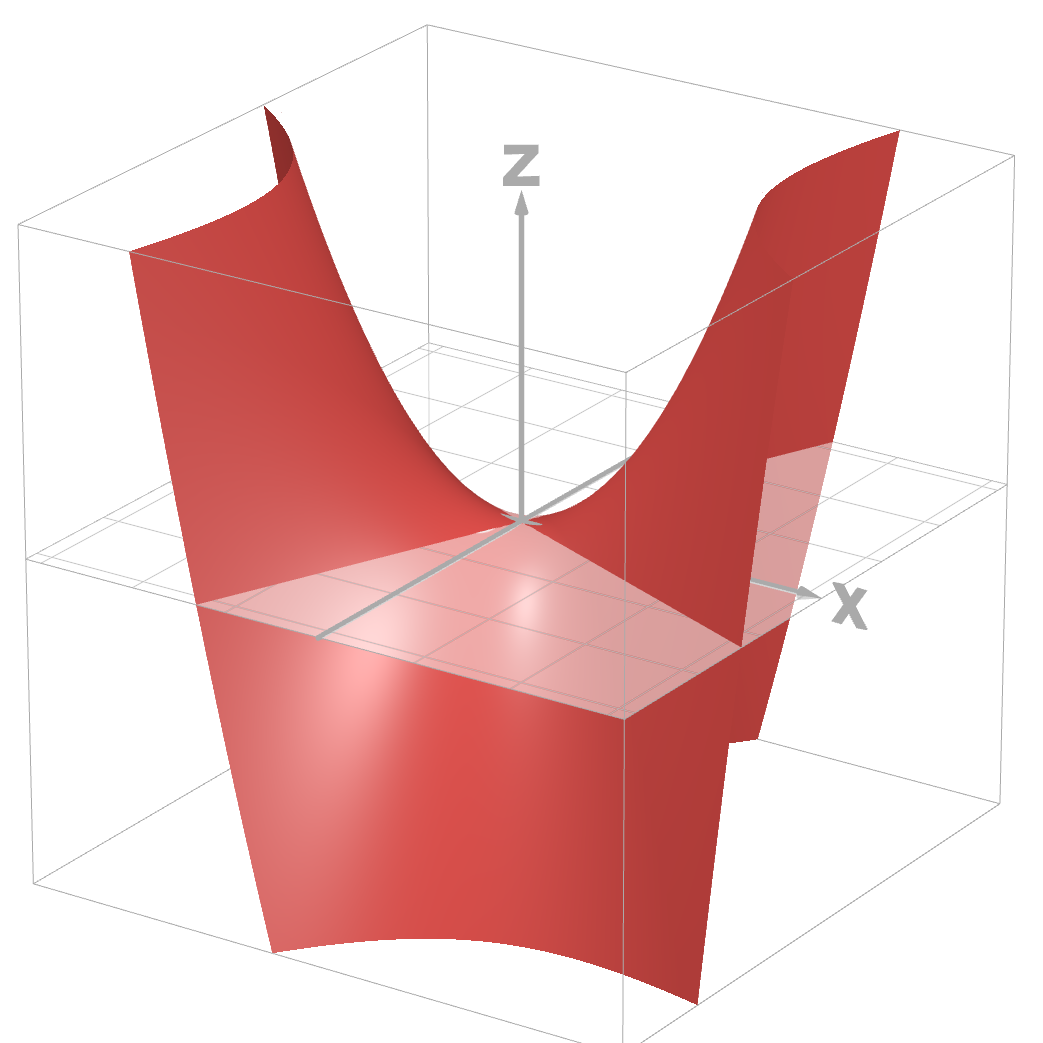
Desmos
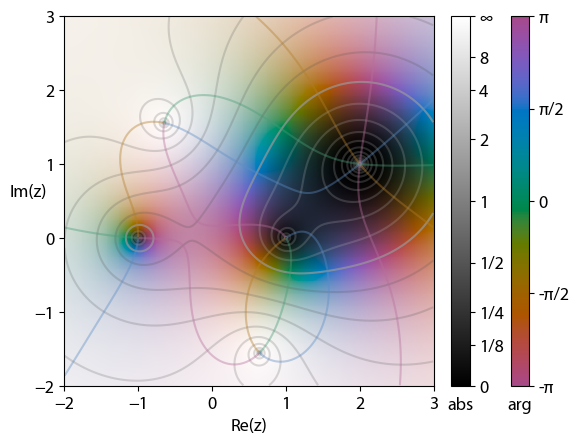
In complex analysis, domain coloring or a color wheel graph is a technique for visualizing complex functions by assigning a color to each point of the complex plane. By assigning points on the complex plane to different colors and brightness, domain coloring allows for a function from the complex plane to itself — whose graph would normally requ...
silent forum
so how am I suppose to apply this to the equation?
worldly chasm
Well, I'm honestly not sure how to make it work with desmos
I haven't played around with this sort of idea yet
And it's rather new support, not sure if it's made it to the 3d plotter
silent forum
okay
silent forum
worldly chasm
I know it's a lot like drinking from a firehose
mhm, and now I need to learn about these new stuff so I dont have to end up asking for answers
anyway thankyou
.close
cedar kilnBOT
Channel closed
Closed by @silent forum
Use .reopen if this was a mistake.
cedar kilnBOT
Available help channel!
Send your question here to claim the channel.
Remember:
• Ask your math question in a clear, concise manner.
• Show your work, and if possible, explain where you are stuck.
• After 15 minutes, feel free to ping <@&286206848099549185>.
• Type the command .close to free the channel when you're done.
• Be polite and have a nice day!
Read #❓how-to-get-help for further information on how to ask a good question, and about conduct in the question channels.
 olive dirge
hi
cedar kilnBOT
olive dirge
hi
olive dirge
help needed

Dont know whats wrong wit this

if anyone could help that would be great
cedar kilnBOT
@olive dirge Has your question been resolved?
olive dirge
nvm got it
worldly chasm
@olive dirge check your end points
olive dirge
did it myself
worldly chasm
I think
worldly chasm
olive dirge
nvm got it
Nice!
cedar kilnBOT
Channel closed
Closed due to timeout
Use .reopen if this was a mistake.
Available help channel!
Send your question here to claim the channel.
Remember:
• Ask your math question in a clear, concise manner.
• Show your work, and if possible, explain where you are stuck.
• After 15 minutes, feel free to ping <@&286206848099549185>.
• Type the command .close to free the channel when you're done.
• Be polite and have a nice day!
Read #❓how-to-get-help for further information on how to ask a good question, and about conduct in the question channels.
 crimson sedge
Hello! I was just wondering, can I somehow convert this graph into a quadratic equation?
 cedar kilnBOT
crimson sedge
Hello! I was just wondering, can I somehow convert this graph into a quadratic e...
cedar kilnBOT
crimson sedge
Hello! I was just wondering, can I somehow convert this graph into a quadratic e...
Please show the original problem, exactly as it was stated to you, with the entire original context. A picture or screenshot is best. If the original problem is not in English, then post it anyway! The additional context might still be helpful. Do your best to provide a translation.
crimson sedge
Oh, well I don't have an original problem (i'm only doing this out of curiosity) but the function I used to generate this is this:
 crimson sedge
 vagrant elbow
you want to find a quadratic approximation?
vagrant elbow
you want to find a quadratic approximation?
yes
 coral jewel
i present to you taylor
vagrant elbow
do you know about taylor polynomials?
crimson sedge
vagrant elbow
do you know about taylor polynomials?
sounds familiar
but I haven't used it
 wraith daggerBOT
neon
 vagrant elbow
Take a to be the minimum
 dusk goblet
in other words you’re just creating a function that passes through that point while also having the same first and second derivatives at that point
vagrant elbow
,w minimum of gamma(x)/x + 1/x
wraith daggerBOT


 Requested by neonperseus
crimson sedge
wraith dagger
**neon**
Requested by neonperseus
crimson sedge
wraith dagger
**neon**
Oh, I wasn't expecting this 🤣 Is there any like sources or tutorials that might help me understand me this even more
I'm very new to Calculus
 gentle flower
youtube/khan academy i guess
vagrant elbow
https://youtu.be/3d6DsjIBzJ4?si=tX9LmD5vmSCy2x_N
If you have 20 minutes this is an insane video
crimson sedge
Thank you soo much!!!
crimson sedge
crimson sedge
Hello! I was just wondering, can I somehow convert this graph into a quadratic e...
So with this, I can find the quadratic equation that can represent this graph something like that?
vagrant elbow
you'll find an approximation for it about a yeah
it won't be perfect
but around a it's decent
you can also make it a better approximation by increasing the degree of the polynomial
crimson sedge
Thank you for the info!
I initially guessed like I'm going to use the vertex form and convert it to the quadratic equation 🤣
cedar kilnBOT
@crimson sedge Has your question been resolved?
Channel closed
Closed by @winter comet
Use .reopen if this was a mistake.
Available help channel!
Send your question here to claim the channel.
Remember:
• Ask your math question in a clear, concise manner.
• Show your work, and if possible, explain where you are stuck.
• After 15 minutes, feel free to ping <@&286206848099549185>.
• Type the command .close to free the channel when you're done.
• Be polite and have a nice day!
Read #❓how-to-get-help for further information on how to ask a good question, and about conduct in the question channels.
 calm hedge
If the supply voltage is 5V, and two parallel resistors R1 and R2 have 0.7 and 0.5 ohms respectively
cedar kilnBOT
calm hedge
If the supply voltage is 5V, and two parallel resistors R1 and R2 have 0.7 and 0...
calm hedge
The current going into R1 will be?
So I need to find total current value first
I=V/R
need to find total resistance
total R = (R1*R2)/(R1+R2)
 hollow trail
calm hedge
So I need to find total current value first
hollow trail
calm hedge
So I need to find total current value first
do you?
calm hedge
hm
i mean thats what i think, my thought process was to find total current, divide that total current by the R1 to find that current into R1
hollow trail
think about what quantities are common between two parallel resistors
calm hedge
voltage stay the same across resistors in a parallel circuit
hollow trail
yes
calm hedge
OH
god damn
I = v/r
5/0.7
7.14A
oh yeah, where was i even going with my process
ok thanks man
If three 1.2V Ni-Cad Cells are connected in parallel to supply a 10 resistive load, then the supply current will be
I was thinking maybe to get supply current
I = V/R
so 1.2/10
is that correct?
 muted crest
multiply by 3?
cedar kilnBOT
@calm hedge Has your question been resolved?
cedar kilnBOT
Channel closed
Closed due to timeout
Use .reopen if this was a mistake.
cedar kilnBOT
Available help channel!
Send your question here to claim the channel.
Remember:
• Ask your math question in a clear, concise manner.
• Show your work, and if possible, explain where you are stuck.
• After 15 minutes, feel free to ping <@&286206848099549185>.
• Type the command .close to free the channel when you're done.
• Be polite and have a nice day!
Read #❓how-to-get-help for further information on how to ask a good question, and about conduct in the question channels.
 flat sage
let z=1+i, then what is the main argument of Z^8? 2π?
 ancient lodge
flat sage
let z=1+i, then what is the main argument of Z^8? 2π?
ancient lodge
flat sage
let z=1+i, then what is the main argument of Z^8? 2π?
,w argument of (1+i)^8
wraith daggerBOT

 Requested by civil_service_pigeon
flat sage
Requested by civil_service_pigeon
flat sage
oh
ancient lodge
flat sage
let z=1+i, then what is the main argument of Z^8? 2π?
If “main” means principal, then 0 is better
flat sage
tnx
ancient lodge
ancient lodge
If “main” means principal, then 0 is better
But 2pi is an argument, just not the principal one
flat sage
okok tnx so much
cedar kilnBOT
If you are done with this channel, please mark your problem as solved by typing .close
flat sage
sorry i have one question
if 1+i^8, i^8 is 1 , 1+1 is 2
so the resoult shuld be 2
so why your answer is 0?
ancient lodge
- (1+i)^8 isn’t 1+i^8
- You asked for the argument, not the value itself
cedar kilnBOT
Channel closed
Closed by @flat sage
Use .reopen if this was a mistake.
cedar kilnBOT
Available help channel!
Send your question here to claim the channel.
Remember:
• Ask your math question in a clear, concise manner.
• Show your work, and if possible, explain where you are stuck.
• After 15 minutes, feel free to ping <@&286206848099549185>.
• Type the command .close to free the channel when you're done.
• Be polite and have a nice day!
Read #❓how-to-get-help for further information on how to ask a good question, and about conduct in the question channels.
 analog crow
 cedar kilnBOT
analog crow
analog crow
cedar kilnBOT
analog crow
analog crow
I don’t get question (ii)
What am I supposed to do after figuring out the volume of the water
cedar kilnBOT
@analog crow Has your question been resolved?
cedar kilnBOT
Channel closed
Closed by @analog crow
Use .reopen if this was a mistake.
Available help channel!
Send your question here to claim the channel.
Remember:
• Ask your math question in a clear, concise manner.
• Show your work, and if possible, explain where you are stuck.
• After 15 minutes, feel free to ping <@&286206848099549185>.
• Type the command .close to free the channel when you're done.
• Be polite and have a nice day!
Read #❓how-to-get-help for further information on how to ask a good question, and about conduct in the question channels.
 manic acorn
how do i prove that they are equal?

 cedar kilnBOT
manic acorn
how do i prove that they are equal?
cedar kilnBOT
manic acorn
how do i prove that they are equal?
 potent fractal
Try expanding $\left(\sum_{i=0}^n a_i\right)^2$
wraith daggerBOT
EQUENOS
 potent fractal
You will get a bunch of terms like $a_i a_j$. Try grouping them together and see what happens
wraith daggerBOT
EQUENOS
 cedar kilnBOT
Channel closed
Closed by @manic acorn
Use .reopen if this was a mistake.
 analog summit
hello, how do i prove that the sequence (fn)n dont converge uniformly pls

x in ]0, 1]
 viscid ore
Hi
analog summit
hi
analog summit
uhm why
viscid ore
just curiosity
analog summit
fr
viscid ore
btw, I can guide you how to do this
analog summit
ok thank you
so the limit function is 1
and the norm difference is (1-x)^n
now i dont know how to justify the sup
analog summit
yes
viscid ore
solved?
analog summit
why?
viscid ore
to determine if fn converges uniformly to f(x)
we have to check if
sup(|fn-f|)->0(n->inf)
viscid ore
not clear yet?
analog summit
i mean, if we look at x in ]0, 1], how do i give the sup then
 solid juniper
you don’t actually need to compute the sup
you could just show that it is, e.g., greater than 1/2 for every n
which you can do by fixing n and then picking x so close to 0 that (1-x)^n is at least 1/2
analog summit
solid juniper
which you can do by fixing n and then picking x so close to 0 that (1-x)^n is at...
so i have to pick an exact x?
like 10e-3 or something?
solid juniper
you want to show one exists (don’t necessarily need to construct it)
you’ll need one for each n
 mental trail
At this point showing that f_n induces a bijection (or is surjective) between ]0,1] and [0,1[ with IVT is kinda same-ish
analog summit
uhm
analog summit
mental trail
At this point showing that f_n induces a bijection (or is surjective) between ]0...
dont think i get this
analog summit
solid juniper
you’ll need one for each n
and what is x then
solid juniper
something for you to think about
analog summit
do you mean i have to write x = n² for example?
or 1/n since n² would not be smaller than 1
solid juniper
n is fixed and you want an x for which (1-x)^n > 1/2
you can do some algebra to find one
analog summit
ok
analog summit
solid juniper
you can do some algebra to find one
x < n-th root of 1/2 - 1?
uhm
but it's negative
solid juniper
you made a sign error or something
 novel ice
well another insight could be to use the ratio of lim n=>0 abs fn+1/fn <1
then to find the radius of convergence to be null
solid juniper

analog summit
but does it work if i say the limit when x approaches 0 is 1 so not unif convergent?
solid juniper
novel ice
well enlighten my foolish mistake
i am not sure what that has to do with the problem
solid juniper
analog summit
but does it work if i say the limit when x approaches 0 is 1 so not unif converg...
yea. that’s a non-constructive way to find an x
solid juniper
solid juniper
n is fixed and you want an x for which (1-x)^n > 1/2
you can say an x exists because lim x to 0 of (1-x)^n is 1 for any n
analog summit
ok
novel ice
hmmm true my bad
analog summit
solid juniper
you can say an x exists because lim x to 0 of (1-x)^n is 1 for any n
one last question, is it true to say that the sup is fn(0)? even when x is never equal to 0, can i still say the sup is when x approaches 0? Or does it have to be when x strictly in ]0, 1]
solid juniper
well i would just say for any n, the sup of f_n over x in (0,1] is 1. and then also sure f_n(0) is 1 for any n if you extend the domain a little
analog summit
solid juniper
well i would just say for any n, the sup of f_n over x in (0,1] is 1. and then a...
so can i actually say sup|fn(x) - f(x)| = fn(0)?? when x in (0, 1]?
even if 0 is not even in the domain?
solid juniper
it depends how the f’s were introduced
if they were introduced as functions with domain (0,1] then i wouldn’t write that
analog summit
mmh yes makes sense
solid juniper
if they were declared functions with domain R then fine whatever
there’s still something about writing that that bugs me though. not because it’s wrong but because it maybe indicates misconception to me
cedar kilnBOT
Available help channel!
Send your question here to claim the channel.
Remember:
• Ask your math question in a clear, concise manner.
• Show your work, and if possible, explain where you are stuck.
• After 15 minutes, feel free to ping <@&286206848099549185>.
• Type the command .close to free the channel when you're done.
• Be polite and have a nice day!
Read #❓how-to-get-help for further information on how to ask a good question, and about conduct in the question channels.
potent fractal
Problem
Imagine a game where each of 2 players receives an infinite sequence of 1's and 0's obtained by tosses of a fair coin. Each player receives their own sequence. The players can not communicate in any way. Player 1 chooses a natural number a, and at the same moment player 2 chooses a natural number b. After that we compare a-th digit in the sequence of player 2 with the b-th digit of the sequence of player 1. Both players stay alive if the digits match, otherwise they DIE. Both players can discuss the strategy before the game starts.
If this is too verbose, read this interpretation of the problem: #help-13 message, #help-13 message
Warm-up question: is there a strategy such that the probability of staying alive is greater than 1/2?
Big question: what's the exact upper bound p of the probability of staying alive? Is it achievable with some strategy?
Progress
I reduced the problem to so-called finite strategies (more about that below) and proved that p > 0.699999 (precisely 5 nines). However, what I'd really want to achieve is at least finding an interesting upper bound for p. Currently it's just 1.
UPD: Correction of a definition from the message below (#help-13 message)
I forgot to mention that Im(f_n), Im(g_n) must be subsets of {1, ..., n}. Apologies
cedar kilnBOT
potent fractal
## Problem
Imagine a game where each of 2 players receives an infinite sequence...

 potent fractal
Spent some time solving this problem during summer and decided to share it here, because it seems fun and it will be awesome to see some progress with the upper bound for p
 limber marsh
potent fractal
## Problem
Imagine a game where each of 2 players receives an infinite sequence...
limber marsh
potent fractal
## Problem
Imagine a game where each of 2 players receives an infinite sequence...
what’s stopping both players from choosing the same number
 quiet plover
they dont know each others sequences
potent fractal
limber marsh
what’s stopping both players from choosing the same number
They can choose the same number, but the digits might not match and they'll loose

 rocky harness
once by the looks of it
potent fractal
quiet plover
does the process happen only once?
They play just once
limber marsh
sorry what happens if the players just both say beforehand “pick a number which matches up with a 1”?
limber marsh
limber marsh
sorry what happens if the players just both say beforehand “pick a number which ...
i will stop asking dumb questions after this
rocky harness
limber marsh
sorry what happens if the players just both say beforehand “pick a number which ...
the players cannot communicate in any way
potent fractal
limber marsh
sorry what happens if the players just both say beforehand “pick a number which ...
Sorry, wdym?
limber marsh
rocky harness
the players cannot communicate in any way
they can strategize beforehand
potent fractal
limber marsh
i will stop asking dumb questions after this
Those are good questions that help to understand the objective
rocky harness
im not sure if that is given or follows from the statemtnt
limber marsh
potent fractal
Sorry, wdym?
if i can strategize beforehand, i am just going to say “if there is a 1 in my sequence, then i am picking that number”
rocky harness
they can think all they want independently of what strategies the other one can employ
quiet plover
wh?
potent fractal
limber marsh
if i can strategize beforehand, i am just going to say “if there is a 1 in my se...
That's a decent idea. They can, for instance, pick the number of the first 1 in the sequence and this strategy will win with a probability of 2/3
limber marsh
what why is it 2/3
rocky harness
limber marsh
what why is it 2/3
oh they switch their numbers afterwards
if thats what youre confused about
potent fractal
I think an easier way to explain the game is using this definition:
 rocky harness
oh they switch their numbers afterwards
rocky harness
rocky harness
oh they switch their numbers afterwards
so they cannot be sure that the number they pick will also be 1 in the others sequence
potent fractal
Player 1 has sequence X, player 2 has sequence Y. Players win if and only if X[g(Y)] = Y[f(X)]
limber marsh
rocky harness
so they cannot be sure that the number they pick will also be 1 in the others se...
oh i see.
great, thanks. now i think this is an interesting problem and will go back and use my reading comprehension skills
rocky harness
unless im missing something, isnt the set M_n finite? you have 2^n x 2^n matrices whose rows are composed of 0 and 1 blocks of length 2^k. what stops you from bruteforcing AB and finding the maximum?
quiet plover
ohhh
potent fractal
rocky harness
unless im missing something, isnt the set M_n finite? you have 2^n x 2^n matrice...
M_n is indeed finite, but bruteforcing is too brutal
quiet plover
so we swap
potent fractal
At some point I made an iterative process that produces sub-optimal strategies, but the complexity is something like O(n 4^n)
So I stopped at n=10 which gave me the aforementioned lower bound of 0.699999
potent fractal
potent fractal
At some point I made an iterative process that produces sub-optimal strategies, ...
For reference, bruteforcing is O(n^{2^{n+1}})
quiet plover
how can you even bruteforce
rocky harness
there are finitely many elements in M_n, so all possible products give you a finite set, so the maximising trace is findable by bruteforce
rocky harness
potent fractal
At some point I made an iterative process that produces sub-optimal strategies, ...
i see
potent fractal
Also I'm not sure if that process gets sufficiently close to the true optimal pair of matrices
But at least it increases tr(AB) with each iteration
Useful intuition: tr(AB) is the dot product of "flattened" A and B^T
cedar kilnBOT
@potent fractal Has your question been resolved?
 haughty glen
potent fractal
Useful intuition: tr(AB) is the dot product of "flattened" A and B^T
haughty glen
potent fractal
Useful intuition: tr(AB) is the dot product of "flattened" A and B^T
Probably of no use but the trace is also the sum of the eigenvalues from the matrix A*B
potent fractal
I tried this intuition but unfortunately I haven't obtained anything from it
rocky harness
wraith dagger
**EQUENOS**
Sorry , im unsure if im missing something, but arent there infinitely many strategies? How are you finding a correspondence to a finite set. I can only assume the correspondence is not injective?
potent fractal
rocky harness
Sorry , im unsure if im missing something, but arent there infinitely many strat...
The set of finite strategies is finite. Sorry, I've just realised that I didn't specify that $\Im(f_n), \Im(g_n) \subset {1, \dots, n}$ in the definition
wraith daggerBOT
EQUENOS
 potent fractal
So basically we play a game where the sequences are truncated down to n digits
rocky harness
Ah so you are limiting the strategies to be such that the swapped numbers obtained from the strategy are in {1,..,n}
potent fractal
yes
 fair geyser
someone asked this question fairly recently i just told them what smay said
potent fractal
fair geyser
someone asked this question fairly recently i just told them what smay said
That's kind of mind-blowing because I came up with this question myself based on a similar question I saw in a russian youtube video
potent fractal
Nope, it's my first time occupying a help channel
Well, I posted this question in #1021175428326633542 over 2 months ago but I doubt that's what you meant
potent fractal
oh wow
Probably
Although it's a nerfed version
The answer to their question is "let both players pick the index of the first 1 in their sequence"
This will produce a probability fairly close to 2/3
fair geyser
i don't get it
it works unless one of them has all 0 and the other one doesn't
can't be 2/3
potent fractal
If all digits are 0 then we just say 1
potent fractal
Oh, they don't swap in that problem?
fair geyser
no it sounds like they don't
potent fractal
fair geyser
that's the nerf, not the 100
I meant that the nerf is that we're interested in some strategy, not the optimal one
potent fractal
fair geyser
how on earth is it 2/3
The most accurate explanation is just a straightforward computation
fair geyser
yeah but it's also like that, it's 50% if they don't pick the same position and 100 if they do and that happens often
so it's significantly above half
unless it's not 50%
fair geyser
yeah it is ok
cedar kilnBOT
@potent fractal Has your question been resolved?
cedar kilnBOT
@potent fractal Has your question been resolved?
cedar kilnBOT
@potent fractal Has your question been resolved?
cedar kilnBOT
@potent fractal Has your question been resolved?
cedar kilnBOT
Channel closed
Closed due to timeout
Use .reopen if this was a mistake.
Available help channel!
Send your question here to claim the channel.
Remember:
• Ask your math question in a clear, concise manner.
• Show your work, and if possible, explain where you are stuck.
• After 15 minutes, feel free to ping <@&286206848099549185>.
• Type the command .close to free the channel when you're done.
• Be polite and have a nice day!
Read #❓how-to-get-help for further information on how to ask a good question, and about conduct in the question channels.
 tepid delta
 cedar kilnBOT
tepid delta
tepid delta
cedar kilnBOT
tepid delta
tepid delta
is there any way to do this other than the long way
cedar kilnBOT
@tepid delta Has your question been resolved?
cedar kilnBOT
@tepid delta Has your question been resolved?
tepid delta
<@&286206848099549185>
cedar kilnBOT
@tepid delta Has your question been resolved?
cedar kilnBOT
@tepid delta Has your question been resolved?
crimson sedge
lol
 queen stirrup
try to instead find the sum of all numbers that contain seven in their base 10 representation
and find a pattern
 vague sparrow
work it out in a smaller case than 2024 so you can check it by hand, I'd suggest using inclusion-exclusion
cedar kilnBOT
Channel closed
Closed due to timeout
Use .reopen if this was a mistake.
cedar kilnBOT
Available help channel!
Send your question here to claim the channel.
Remember:
• Ask your math question in a clear, concise manner.
• Show your work, and if possible, explain where you are stuck.
• After 15 minutes, feel free to ping <@&286206848099549185>.
• Type the command .close to free the channel when you're done.
• Be polite and have a nice day!
Read #❓how-to-get-help for further information on how to ask a good question, and about conduct in the question channels.
 drowsy mountain
what does it mean to differentiate with respect with x?
cedar kilnBOT
Channel closed
Closed by @drowsy mountain
Use .reopen if this was a mistake.
drowsy mountain
i think i got it
 azure stirrup
drowsy mountain
what does it mean to differentiate with respect with x?
azure stirrup
drowsy mountain
what does it mean to differentiate with respect with x?
differentiate in terms of x only so eg u have to differentaite ax^2 with respect to x, x is the only variable affected by differentation, not a, which will give u the answer of 2ax
if it was differentiate ax^2 with respecr to a, itll be just x^2
azure stirrup
or even if thers no second variable it essentially means whatever ur differentating with respect to (variable) only that variable will be affected by the differentiation
cedar kilnBOT
✅
drowsy mountain
i didnt get it haha
azure stirrup
drowsy mountain
thank you!
nwwws
azure stirrup
drowsy mountain
i didnt get it haha
its okay, does it make sense now?
drowsy mountain
yes!
how do i apply that to uhhh
implicit differentiation
im just learning it, so i dont really know anything about it
there’s like an example question
which is
x^2+y^2=r^2
and its ike
like* differentiate that with respect to x
idrk how to do that 😅
azure stirrup
um
we could start off with
ur essentially differentiating both sides with respect to x yeah?
we could start off from the right side first since its easier
so u have d/dx r^2
do yk what that would be?
azure stirrup
yes
u got one part done
now for the lhs
we wanrt to d/dx (x^2 + y^2), we could expand it into d/dx x^2 + d/dx y^2
lets do the first part first, d/dx x^2
azure stirrup
mhmm
now
so far we ahve 2x + d/dx y^2 =0
forthe d/dx y^2 part
we need to apply chain rule
do yk what chain rule is?
azure stirrup
yes
as of now we cant rlly do anyhitng with d/dx y^2 as thers no x terms
in order to differentiate y^2 we want it to be d/dy (ie differneated with rrespect to y)
so we could do d/dx times dy/d times d/ dy y^2
the reason why we can multiple an additional dy/d times d/dy is bc it will equal 1
azure stirrup
azure stirrup
so we could do d/dx times dy/d times d/ dy y^2
from here when we multiple d/dx with dy/d first, itll give dy/dx, so now we have dy/dx times d/dy y^2
azure stirrup
drowsy mountain
okay yeah im following
sorry idrk how to explain it that well 😭
lmk if any parts doenst make sense
azure stirrup
azure stirrup
from here when we multiple d/dx with dy/d first, itll give dy/dx, so now we have...
for the d/dy y^2 part, itll just be 2y yeah?
drowsy mountain
yep
azure stirrup
so now we have dy/dx times 2y
back to the original, we went from d/dx (x^2 + y^2) = d/dx r^2
to
2x + dy/dx 2y = 0
drowsy mountain
azure stirrup
from here when we multiple d/dx with dy/d first, itll give dy/dx, so now we have...
how do we get dy/d
is it just 1/2y?
azure stirrup
so yk how the only way to differentiate y^2 is if its with d/dy?
drowsy mountain
yep
azure stirrup
wait let me draw smt
drowsy mountain
azure stirrup
so now we have dy/dx times 2y
im lost from this point on
if that helps!
azure stirrup
still drawing

 azure stirrup
remember the original equ was x^2 + y^2
azure stirrup
drowsy mountain
oh it’s plus not times
yesss
drowsy mountain
 azure stirrup
the times only applies to the derivative with the term
drowsy mountain
do i then re arrange for dy/dx
azure stirrup
drowsy mountain
it’ll be 2y times day/dx
drowsy mountain
oh right
azure stirrup
remember how we wanna like d/dx (x^2 +y^2)
u can think of it kinda like
expanding ur brackets
 azure stirrup
d/dx times x^2 plus d/dx times y^2
azure stirrup
drowsy mountain
is 2x+2y in brackets?
since we have expanded the brackets already there is no longer any brackets
azure stirrup
azure stirrup
does this kinda make more sense?
drowsy mountain
yeah, i just dont know where you got dy/dx(2y)
azure stirrup
azure stirrup
does the second line of working out makes sense
drowsy mountain
its a bit confusing
 remote trail
I prefer to think about it as d/dx[f(y)] = d/dy[f(y)]*dy/dx if that helps at all
^using chain rule to change d/dx to be derivable in terms of y
drowsy mountain
azure stirrup
does the second line of working out makes sense
it makes sense when i look at the bottom
so after i get uhhh
2x+dy/dx(2y)=0
do i re arrange for dy/dx
azure stirrup
umm its like the only way u can derive y^2 is with d/dy, but there is no d/dy so we can use chain rule where we multiple the already d/dx y^2 with d/dy times dy/d on top, so theres a d/dy we can use to deririve the y^2
drowsy mountain
oh right
azure stirrup
so u have d/dx times dy/d times d/dy times y^2
u can kinda think of it like fractions
drowsy mountain
mhm :]
azure stirrup
the d/dx times dy/d will give dy/dx
and the d/dy times y^2 = 2y
so were left with dy/dy times 2y
does this clear it up better?
drowsy mountain
azure stirrup
and the d/dy times y^2 = 2y
d/dy * y^2?
or y^ differentiated with respect to y?
or is that the same thing
azure stirrup
azure stirrup
so i introuced the purple (chain rule), the bliue highlgiher from the second to third line is the same thing,
azure stirrup
drowsy mountain
or is that the same thing
same thing
drowsy mountain
oh okay, that makes sense
drowsy mountain
azure stirrup
same thing
thank you!
azure stirrup
azure stirrup
so i introuced the purple (chain rule), the bliue highlgiher from the second to ...
and i left the d/dx times dy/d untouched from the second to third line
does the working out from the second to third line make sense now?
drowsy mountain
brb i have break
azure stirrup
um
drowsy mountain
azure stirrup
does the working out from the second to third line make sense now?
yes!
azure stirrup
i need to go soon
azure stirrup
azure stirrup
the third line the d/dx times dy/d gives dy/dx (works like fractions)
drowsy mountain
7
azure stirrup
left with 2x + dy/dx times 2y = 0
arrange so dy/dx is on one side only
dy/dx times 2y = -2x
dy/dx = -2x/2y
drowsy mountain
-x/y
azure stirrup
dy/dx = -x/y
azure stirrup
azure stirrup
dy/dx = -x/y
and thats ur asnwer
azure stirrup
drowsy mountain
thank you! i think i get it now
hurray nwws
drowsy mountain
.close
cedar kilnBOT
Channel closed
Closed by @drowsy mountain
Use .reopen if this was a mistake.
cedar kilnBOT
Available help channel!
Send your question here to claim the channel.
Remember:
• Ask your math question in a clear, concise manner.
• Show your work, and if possible, explain where you are stuck.
• After 15 minutes, feel free to ping <@&286206848099549185>.
• Type the command .close to free the channel when you're done.
• Be polite and have a nice day!
Read #❓how-to-get-help for further information on how to ask a good question, and about conduct in the question channels.
 thorny ferry
Hello!! I need help with an exercise:
write down all the divisors
a²-36b²
cedar kilnBOT
thorny ferry
Hello!! I need help with an exercise:
write down all the divisors
a²-36b²
thorny ferry
I don't understand what i have to do basically
 hot crag
factorize, i believe
 ocean grove
thorny ferry
Hello!! I need help with an exercise:
write down all the divisors
a²-36b²
ocean grove
thorny ferry
Hello!! I need help with an exercise:
write down all the divisors
a²-36b²
a²-b²= (a+b)(a-b)
thorny ferry
ocean grove
a²-b²= (a+b)(a-b)
Oh thank youuu
ocean grove
thorny ferry
Oh thank youuu
np!!
cedar kilnBOT
@thorny ferry Has your question been resolved?
Channel closed
Closed by @thorny ferry
Use .reopen if this was a mistake.
Available help channel!
Send your question here to claim the channel.
Remember:
• Ask your math question in a clear, concise manner.
• Show your work, and if possible, explain where you are stuck.
• After 15 minutes, feel free to ping <@&286206848099549185>.
• Type the command .close to free the channel when you're done.
• Be polite and have a nice day!
Read #❓how-to-get-help for further information on how to ask a good question, and about conduct in the question channels.
potent fractal
I fell asleep and this channel closed. 1 sec, I will post a link to the original message
cedar kilnBOT
potent fractal
I fell asleep and this channel closed. 1 sec, I will post a link to the original...
potent fractal
I will probably keep it open for several days and then let it close again (unless I miss bot's notification again)
If someone will be interested we will move to a forum thread
cedar kilnBOT
@potent fractal Has your question been resolved?
 proper mortar
any intuition why its not always just 50%?
or, what would be the strategy for n=2? There are 4*4 possibilities. If there is a 1 and they both choose the first one, and with no 1 they just choose index 1, then they win when both have any combination of (1, 0), (1, 1), (0, 0) (9 ways), or both have (0, 1) (1 more way), which gives a total of 10/16 I see
fair geyser
they point at the same spot alot of the time
1/3 precisely if infinite length
rest of the time it's 50%
proper mortar
so this strategy reduces it to the probability of both having the 1 at the same index, and if they don't, they still have a chance to win when their numbers match by coincidence. With 1 based indexing, for an infinite sequence we have P(X(k) = 1) = (1/2)^k. Then we need to sum up P(X(k) = 1 and Y(k) = 1) for any k, they are independent events, so it's just the sum of (1/2)^(2k) = (1/4)^k, geometric series and it yields 1/3, and then we add 50% times the probability of indices not matching (2/3), and it does indeed yield 2/3, interesting
how did current brute forcing attempts go?
proper mortar
proper mortar
so this strategy reduces it to the probability of both having the 1 at the same ...
(if the indices don't match, then one player with the lower index will guaranteed pick a 0, the other player will then indeed pick randomly 50/50, so the case that indices don't match does not influence this probability)
I don't really get how T_k are composed and what these blocks exactly need to look like
cedar kilnBOT
@potent fractal Has your question been resolved?
cedar kilnBOT
@potent fractal Has your question been resolved?
cedar kilnBOT
Channel closed
Closed due to timeout
Use .reopen if this was a mistake.
Available help channel!
Send your question here to claim the channel.
Remember:
• Ask your math question in a clear, concise manner.
• Show your work, and if possible, explain where you are stuck.
• After 15 minutes, feel free to ping <@&286206848099549185>.
• Type the command .close to free the channel when you're done.
• Be polite and have a nice day!
Read #❓how-to-get-help for further information on how to ask a good question, and about conduct in the question channels.
 ornate rune
what's the difference in using parenthesis in matrix and brackets
 crimson delta
you mean () vs [] ? nothing
ornate rune
crimson delta
you mean () vs [] ? nothing
wait so its just a matter of choice?
crimson delta
pretty much
ornate rune
crimson delta
pretty much
is n k a matrix here then
 wraith daggerBOT
Denascite
 crimson delta
a number
ornate rune
why does it look like a matrix
crimson delta
ask whoever came up with the notation ages ago
ornate rune
well how do i know if the notation represents a matrix or not
 modern compass
context
(x+y)^n is a number.
if that was a matrix or vector then the sums would be a vector. A number equaling a vector doesn't make sense. So it's not a matrix.
cedar kilnBOT
@ornate rune Has your question been resolved?
ornate rune
i see thanks
cedar kilnBOT
Channel closed
Closed by @ornate rune
Use .reopen if this was a mistake.
Available help channel!
Send your question here to claim the channel.
Remember:
• Ask your math question in a clear, concise manner.
• Show your work, and if possible, explain where you are stuck.
• After 15 minutes, feel free to ping <@&286206848099549185>.
• Type the command .close to free the channel when you're done.
• Be polite and have a nice day!
Read #❓how-to-get-help for further information on how to ask a good question, and about conduct in the question channels.
 pulsar blade
This is my problem
 cedar kilnBOT
pulsar blade
This is my problem
pulsar blade
cedar kilnBOT
pulsar blade
This is my problem
pulsar blade
So I understand that bounded functions f,g have some bounds M and N say, and U(f,P)<=M(b-a) and U(g,P)<=N(b-a) just not sure how to relate them
Everytime I try to connect them, the inequality signs are wrong
<@&286206848099549185> 
cedar kilnBOT
@pulsar blade Has your question been resolved?


 potent fractal
proper mortar
how did current brute forcing attempts go?
potent fractal
proper mortar
how did current brute forcing attempts go?
Full bruteforcing takes too much time. However, I made an iterative process that converges to suboptimal strategies (complexity O(n 4^n), as opposed to O(n^(2^n)) of true bruteforcing) and I stopped at n=10, getting 0.699999
pulsar blade
potent fractal
Full bruteforcing takes too much time. However, I made an iterative process that...
You gonms help me?
pulsar blade
😥
potent fractal
pulsar blade
This is my problem
For any $t_i$ from $P$ you have $\max_{t\in [t_i,t_{i+1}]} f(t) \le \max_{t\in [t_i,t_{i+1}]} g(t)$. The rest follows immediately
wraith daggerBOT
EQUENOS
 potent fractal
The inequality is due to the fact that if $\tau = \text{argmax}{t\in [t_i,t{i+1}]} f(t)$, then $g(\tau) \ge f(\tau)=\max_{...} f(t)$, and of course $g(\tau) \le \max_{...} g(t)$
wraith daggerBOT
EQUENOS
 pulsar blade
But how do you show that these maxes relate to their upper sums?
potent fractal
I thought that upper sums are sums of rectangles such that the height of each rectangle is just max of f on the corresponding segment
pulsar blade
potent fractal
I thought that upper sums are sums of rectangles such that the height of each re...
Sounds right
potent fractal
So i-th rectangle's area is just $(t_{i+1}-t_i)\max_{t\in [t_i,t_{i+1}]} f(t)$
wraith daggerBOT
EQUENOS
 pulsar blade
So it just can follow directly from the definiton of their upper sums?
potent fractal
pulsar blade
So it just can follow directly from the definiton of their upper sums?
(a)? Yes
 potent fractal
pulsar blade
You can say this?
potent fractal
pulsar blade
You can say this?
Yes
potent fractal
wraith dagger
**EQUENOS**
Where inequalities for max follow from this^
pulsar blade
Oh should I just mention something like since its true for each interval?
What about the other parts? 
Also can you try to explain infinum and supremum intuitively
potent fractal
pulsar blade
Also can you try to explain infinum and supremum intuitively
A set of real numbers, for example, can have a lower bound, so some number x such that all elements of that set are >= x.
You can try increasing x, as long as it keeps being a lower bound. At some point you won't be able to increase it anymore. That's when you reached the exact lower bound. That's called infimum
Supremum is the same thing but with upper bounds
pulsar blade
So the infinum of sinx is -1?
potent fractal
pulsar blade
What about the other parts? <:Prayge:789693932505923594>
By definition of inf, inf_P U(f, P) <= U(f, Q) for any Q
potent fractal
pulsar blade
So the infinum of sinx is -1?
Yes
If you mean the set of all values of sin(x) with real x
pulsar blade
potent fractal
By definition of inf, inf_P U(f, P) <= U(f, Q) for any Q
Did you mean P for the 2nd one and inf_P would just be U(f)?
potent fractal
pulsar blade
Did you mean P for the 2nd one and inf_P would just be U(f)?
In the second one I used Q because P is overloaded in inf
The notation inf_P U(f, P) means "the exact lower bound of {U(f, P) : P is a partition}
pulsar blade
Is this necessarily true?
 potent fractal
pulsar blade
Is this necessarily true?
potent fractal
pulsar blade
Is this necessarily true?
Yes
Wait the second inequality isn't true
But try avoiding the 3rd number
pulsar blade
potent fractal
Wait the second inequality isn't true
Im not sure how else to show it
potent fractal
pulsar blade
Im not sure how else to show it
After the first inequality you can directly use (a)
pulsar blade
But I need to show U(g)>=U(f)
pulsar blade
potent fractal
After the first inequality you can directly use (a)
But since f(x)<=g(x), wouldnt it have a smaller upper integral?
potent fractal
pulsar blade
But I need to show U(g)>=U(f)
It directly follows from (b)
pulsar blade
potent fractal
It directly follows from (b)
How
potent fractal
Essentially (b) is saying "U(f) is a lower bound for the set of all U(g, P)"
And therefore it's <= exact lower bound, which is U(g)
cedar kilnBOT
@pulsar blade Has your question been resolved?
Channel closed
Closed by @pulsar blade
Use .reopen if this was a mistake.
Available help channel!
Send your question here to claim the channel.
Remember:
• Ask your math question in a clear, concise manner.
• Show your work, and if possible, explain where you are stuck.
• After 15 minutes, feel free to ping <@&286206848099549185>.
• Type the command .close to free the channel when you're done.
• Be polite and have a nice day!
Read #❓how-to-get-help for further information on how to ask a good question, and about conduct in the question channels.
 solar venture
Hi
cedar kilnBOT
solar venture
Hi
solar venture
.close
cedar kilnBOT
Channel closed
Closed by @solar venture
Use .reopen if this was a mistake.
cedar kilnBOT
Available help channel!
Send your question here to claim the channel.
Remember:
• Ask your math question in a clear, concise manner.
• Show your work, and if possible, explain where you are stuck.
• After 15 minutes, feel free to ping <@&286206848099549185>.
• Type the command .close to free the channel when you're done.
• Be polite and have a nice day!
Read #❓how-to-get-help for further information on how to ask a good question, and about conduct in the question channels.
 fading garden
I'm not really sure how to set this up
 cedar kilnBOT
fading garden
I'm not really sure how to set this up
fading garden
cedar kilnBOT
fading garden
I'm not really sure how to set this up
fading garden
I'm pretty sure I need to parametrize C. So I would probably do r(t)=<t, 2t^2> as my parametrization, where 0<t<1. The unit tangent vector would be r'(t)=<1, 4t> divided by sqrt(16t^2+1) I think. But I'm not sure what to do about the rotation by pi/2
cedar kilnBOT
@fading garden Has your question been resolved?
 dreamy void
fading garden
I'm pretty sure I need to parametrize C. So I would probably do r(t)=<t, 2t^2> a...
dreamy void
fading garden
I'm pretty sure I need to parametrize C. So I would probably do r(t)=<t, 2t^2> a...
I think what is meant by "rotated clockwise by pi/2" is if you took the tangent vector at say (0,0).
It would be like this ➡️.
So I think by rotating they want you to rotate it now looking like ⬇️ 90 degrees clockwise which would resemble a vector that is normal to T.
So instead of <1,4t> we would do <4t,-1>
dreamy void
This also would explain the notation for n since it's normal to T
fading garden
That’s true. Although admittedly I didn’t look that far into the meaning of n in this problem
I’d just need to parametrize F now. So I think that would give F=<t^3, 2t^2+t>
dreamy void
fading garden
I’d just need to parametrize F now. So I *think* that would give F=<t^3, 2t^2+t>
It is rather doing F o n ds = F(r(t)) o n(t) dt
fading garden
fading garden
I’d just need to parametrize F now. So I *think* that would give F=<t^3, 2t^2+t>
Is this not F(r(t))?
dreamy void
it is, just you saying parametrize felt wrong lol
fading garden
Oh lol
fading garden
dreamy void
it is, just you saying parametrize felt wrong lol
I mean fair enough though. I see why you say that
Anyway I should be able to solve the rest of this later since I have a class that starts in 5 minutes. I’ll come back to it after and see what I get
dreamy void
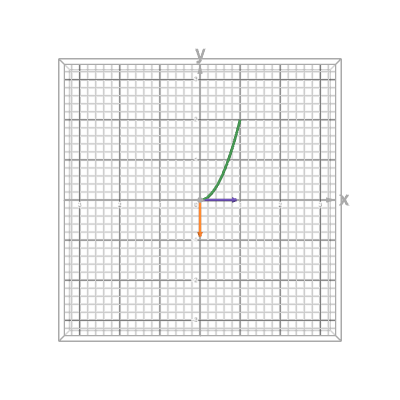
I am wondering though if one could also say r(t) = (t, 4t², 0) and then simply take as unit normal vector (0,0,1)
Ok I don't think you can, because we have F(x,y) instead of F(x,y,0)
Ok I noticed you would just end up with 0 because the dot product would yield 0 lol
cedar kilnBOT
@fading garden Has your question been resolved?
fading garden
dreamy void
Ok I noticed you would just end up with 0 because the dot product would yield 0 ...
how would it be 0?
we have <t^3, 2t^2+t> o <4t,-1>/sqrt(16t^2+1) right?
dreamy void
I was talking about something else forget it
fading garden
oh ok
dreamy void
Just don't forget ds = ||r'(t)|| dt
fading garden
dreamy void
Just don't forget ds = |\|**r**'(t)|\| dt
thats just sqrt(16t^2+1) right?
dreamy void
yes, you can basically cancel them out
fading garden
cool
dreamy void
||r'(t)|| = ||n(t)||
fading garden
dreamy void
Just don't forget ds = |\|**r**'(t)|\| dt
Im glad you said someting because id actually forgotten lol
dreamy void
This is basically Green's theorem here
fading garden
dreamy void
This is basically Green's theorem here
i havent learned that yet. we learn it tomorrow
dreamy void
You will see
fading garden
For my final answer, I got 4/5-2/3-1/2. Which is -11/30
dreamy void
seems right
also
,texsp [ \int_C \mathbf{F} \circ \hat{\mathbf{n}} : \dd s = \int_C M \dd y - N \dd x ]
wraith daggerBOT
𝔸dωn𝓲²s
 fading garden
wraith dagger
**𝔸dωn𝓲²s**
fading garden
wraith dagger
**𝔸dωn𝓲²s**
I'm assuming M=1/2xy and N=y+x?
dreamy void
F = <M,N>
yes
one could easily see why if you start on the right side with dt/dt
Then you basically end up seeing the dot product between F and n
cedar kilnBOT
@fading garden Has your question been resolved?
Channel closed
Closed by @fading garden
Use .reopen if this was a mistake.
Available help channel!
Send your question here to claim the channel.
Remember:
• Ask your math question in a clear, concise manner.
• Show your work, and if possible, explain where you are stuck.
• After 15 minutes, feel free to ping <@&286206848099549185>.
• Type the command .close to free the channel when you're done.
• Be polite and have a nice day!
Read #❓how-to-get-help for further information on how to ask a good question, and about conduct in the question channels.
 tame berry
This is a physics question, but I am really second-guessing myself here. In the y direction component should ma stayed instead of inputing zero bc gravity is technically an accelerator? And did I set up the components correctly?
cedar kilnBOT
tame berry
This is a physics question, but I am really second-guessing myself here. In the ...
tame berry

 pulsar scroll
Yes the net force should be the sum of her force, the friction and gravity, and they should total up to 0
tame berry
pulsar scroll
Yes the net force should be the sum of her force, the friction and gravity, and ...
Because of the constant velocity right?
pulsar scroll
yes basically
tame berry
pulsar scroll
yes basically
One last question
So the question gives the value for friction force here
But then asked me to find the coefficient of kinetic friction

And got the same thing lol
What was the point of asking? Is it a trick question?
pulsar scroll
The friction coefficent is the force of friction divided by the weight, it should not have a unit. You seems to have subtracted her pulling force from the weight so that seems to be incorrect.
pulsar scroll
tame berry
It should be 20.0N/F_g,
tame berry
pulsar scroll
It should be 20.0N/F_g,
Ohhh lol Dangg
pulsar scroll
That should solve it right?
cedar kilnBOT
@tame berry Has your question been resolved?
tame berry
pulsar scroll
That should solve it right?
Yeah, it's all solved. Gracias bro
Appreciate it
cedar kilnBOT
Channel closed
Closed by @tame berry
Use .reopen if this was a mistake.
Available help channel!
Send your question here to claim the channel.
Remember:
• Ask your math question in a clear, concise manner.
• Show your work, and if possible, explain where you are stuck.
• After 15 minutes, feel free to ping <@&286206848099549185>.
• Type the command .close to free the channel when you're done.
• Be polite and have a nice day!
Read #❓how-to-get-help for further information on how to ask a good question, and about conduct in the question channels.
 carmine terrace
Is the cardinality of irrational numbers (Q^c) equal to ℵ0? If not, is it larger or smaller?
cedar kilnBOT
carmine terrace
Is the cardinality of irrational numbers (Q^c) equal to ℵ0? If not, is it larg...
carmine terrace
ℵ is aleph
crimson sedge
what have you tried/what are your thoughts on this?
carmine terrace
I think its bigger
since there are Aleph null numbers from 1 - 2
and you can make a new number by taking the first digit of the first number, second digit of second number, and so on forever to make a new number
crimson sedge
if i recall correctly, you should be able to find the cardinality of the reals (R) and the rationals (Q)
crimson sedge
other way?
carmine terrace
?
crimson sedge
reals are aleph1 and rationals are aleph0
carmine terrace
crimson sedge
reals are aleph1 and rationals are aleph0
oh yeah
cedar kilnBOT
@carmine terrace Has your question been resolved?
Channel closed
Closed by @carmine terrace
Use .reopen if this was a mistake.
Available help channel!
Send your question here to claim the channel.
Remember:
• Ask your math question in a clear, concise manner.
• Show your work, and if possible, explain where you are stuck.
• After 15 minutes, feel free to ping <@&286206848099549185>.
• Type the command .close to free the channel when you're done.
• Be polite and have a nice day!
Read #❓how-to-get-help for further information on how to ask a good question, and about conduct in the question channels.
crimson sedge
 cedar kilnBOT
crimson sedge
crimson sedge
cedar kilnBOT
crimson sedge
crimson sedge
Need help. This is just a practice quiz to train for ASVAB. I already took the quiz and didnt do well. Just going back over questions
what have you tried?
I dont get what the whole 4 dogs are sold and now its 1:1
crimson sedge
crimson sedge
what have you tried?
All i got is 4:3 and dont know how to continue
crimson sedge
crimson sedge
All i got is 4:3 and dont know how to continue
so we can suppose that there were 4x dogs and 3x cats originally
crimson sedge
crimson sedge
so we can suppose that there were 4x dogs and 3x cats originally
Yes
how many cats and dogs are there after 4 dogs have been sold?
(in terms of x)
crimson sedge
crimson sedge
how many cats and dogs are there after 4 dogs have been sold?
I have no idea
there are originally 4x dogs, and 4 have been sold
so there are now 4 less than 4x dogs
crimson sedge
crimson sedge
not quite
Is the answer 28
did you guess and check that?
you’re correct, yes
crimson sedge
crimson sedge
did you guess and check that?
I dont know how to set it up as a fraction. I just seen 16 - 4 = 12. So thats 12 to 12 or 1:1. and 16 plus 12 is 28.
crimson sedge
crimson sedge
you’re correct, yes
Is this meant to be set up as a fraction?
if there were 4x dogs and 3x cats initially, there will be 4x-4 dogs and 3x cats after four dogs were sold
since you know that this is a 1:1 ratio, what can you say about 4x-4 and 3x?
crimson sedge
crimson sedge
if there were 4x dogs and 3x cats initially, there will be **4x-4** dogs and 3x ...
What im confused by is you have this equation right?
4x-4 = 3x
How did you know to multiply 4 on both sides? If thats what you did?
Im asking for reference to some more difficult problems thats arent as obvious as this one.
crimson sedge
crimson sedge
What im confused by is you have this equation right?
4x-4 = 3x
How did you kno...
i did not multiply by 4 on both sides
i moved all instances of x over to the left and everything else to the right
crimson sedge
crimson sedge
i moved all instances of x over to the left and everything else to the right
You set up an equation for that?
4x-4 = 3x is already an equation
crimson sedge
crimson sedge
4x-4 = 3x is already an equation
So whats your next step
4x - 3x = 4
crimson sedge
crimson sedge
4x - 3x = 4
Now how did you find out what x was
crimson sedge
crimson sedge
Now how did you find out what x was
simplify 4x - 3x
crimson sedge
crimson sedge
what did you get?
I dont know how to simplify
do you know the distributive law?
crimson sedge
crimson sedge
do you know the distributive law?
No, ill look that up real quick
pulsar blade
crimson sedge
I'm sorry but what is this question
crimson sedge
there is a - in front of the 3
crimson sedge
pulsar blade
I'm sorry but what is this question
part of a “practice quiz to train for ASVAB”, apparently
pulsar blade
it's a bad question imo, it's confusing
crimson sedge
pulsar blade
it's a bad question imo, it's confusing
What should it have been
crimson sedge
pulsar blade
it's a bad question imo, it's confusing
Im just confused cause they threw me a curveball. This one isnt like the examples
crimson sedge
crimson sedge
there is a - in front of the 3
X(4-3)
crimson sedge
pulsar blade
it's a bad question imo, it's confusing
it is perfectly clear to me
crimson sedge
crimson sedge
X(4-3)
yes, and what’s 4-3?
pulsar blade
crimson sedge
it is perfectly clear to me
I get it now, but I don't think this is clear at all
crimson sedge
1
crimson sedge
pulsar blade
I get it now, but I don't think this is clear at all
i am interested in where you think the ambiguity arises
pulsar blade
crimson sedge
i am interested in where you think the ambiguity arises
esp when you look at the next question is literally a simple ratio problem 😭
crimson sedge
pulsar blade
esp when you look at the next question is literally a simple ratio problem 😭
are you complaining that it’s too hard?
pulsar blade
crimson sedge
are you complaining that it’s too hard?
I just don't like its wording
crimson sedge
because that does not make a question confusing
crimson sedge
crimson sedge
i am interested in where you think the ambiguity arises
Im just bad at math. And never learned fractions and rations until this week
crimson sedge
pulsar blade
I just don't like its wording
i have not found that the wording is unclear, but perhaps that’s just me
crimson sedge
crimson sedge
Im just bad at math. And never learned fractions and rations until this week
that’s ok
pulsar blade
crimson sedge
i have not found that the wording is unclear, but perhaps that’s just me
it's easy to think math is easy when you understand it
crimson sedge
So now you just have x and 1 right
crimson sedge
pulsar blade
it's easy to think math is easy when you understand it
i never said that it was easy; i said that the wording was not confusing to me
perhaps it is easy to think that questions are confusing when you are confused
crimson sedge
crimson sedge
So now you just have x and 1 right
yes, and x*1 is equal to x
pulsar blade
crimson sedge
perhaps it is easy to think that questions are confusing when you are confused
but we're literally helping a person that doesn't understand the question
crimson sedge
that doesn’t inherently make the question confusing
crimson sedge
crimson sedge
yes, and x*1 is equal to x
So now how do you get to 28
sorry, i should specify: when i see a question being described as “bad because it is confusing”, i assume that there is some ambiguity in the question that could cause it to be answered in multiple different and valid ways, or even that there is not enough information to answer it at all
pulsar blade
I think a questions wording should never make a question harder than the content inside it
crimson sedge
if a question is more difficult than it should be, or has a trick or trap built into it (e.g. something holding for all x=0), then it is not “bad because confusing” but simply “difficult or has a pitfall”
crimson sedge
pulsar blade
I think a questions wording should never make a question harder than the content...
i don’t think that it did in this scenario
solving worded problems has always been a part of math
and learning to convert between the information provided by the question and mathematical equations is equally a skill that many tests will seek to assess
for me, i do not think there was an easier way to state the problem that would have conveyed the information in the same way
crimson sedge
crimson sedge
So now how do you get to 28
initially i set there to be 4x dogs and 3x cats
if x=4, how many dogs and cats is that?
crimson sedge
crimson sedge
if x=4, how many dogs and cats is that?
Where did you find out x was 4?
crimson sedge
crimson sedge
initially i set there to be 4x dogs and 3x cats
I know x is 4. But in your equation how did you get that
ok
do you first understand how i found the equation 4x-4 = 3x?
crimson sedge
crimson sedge
ok
Because 1x=4
crimson sedge
crimson sedge
Because 1x=4
yes, so x=4
crimson sedge
crimson sedge
yes, so x=4
Okay. I forgot about the = and the 4 on the other side. This is called the distributive law right?