#help-13
1 messages · Page 328 of 1
 wraith daggerBOT
Result:
96.610169491525
 dusk goblet
then
x = vot + 1/2at^2
and you’re solving the quadratic
1/2at^2 + vot - x = 0
solve for t
 odd sierra
dusk goblet
odd sierra
dusk goblet
you’re welcome
 cedar kilnBOT
@odd sierra Has your question been resolved?
cedar kilnBOT
Channel closed
Closed due to timeout
Use .reopen if this was a mistake.
 Available help channel!
Send your question here to claim the channel.
Remember:
• Ask your math question in a clear, concise manner.
• Show your work, and if possible, explain where you are stuck.
• After 15 minutes, feel free to ping <@&286206848099549185>.
• Type the command .close to free the channel when you're done.
• Be polite and have a nice day!
Read #❓how-to-get-help for further information on how to ask a good question, and about conduct in the question channels.
 merry basalt
How do I do this problem for precalc
 cedar kilnBOT
merry basalt
How do I do this problem for precalc
cedar kilnBOT
merry basalt
How do I do this problem for precalc
 odd verge
merry basalt
How do I do this problem for precalc
odd verge
merry basalt
How do I do this problem for precalc
Do you know what causes a "hole "
odd verge
merry basalt
0s on both sides
No
Just at the bottom
merry basalt
odd verge
No
Just at the bottom
oh okay
odd verge
It must not necessarily be on top too
merry basalt
No it’s just the both yea
odd verge
To be clear by hole you mean where it is not continuous?
merry basalt
odd verge
To be clear by hole you mean where it is not continuous?
no removable discontiny
odd verge
Oh ok
Then factor the bottom
Then use the remainder theorem to find which factor of the bottom is a factor on the top
@merry basalt
merry basalt
.close
cedar kilnBOT
Channel closed
Closed by @merry basalt
Use .reopen if this was a mistake.
cedar kilnBOT
Available help channel!
Send your question here to claim the channel.
Remember:
• Ask your math question in a clear, concise manner.
• Show your work, and if possible, explain where you are stuck.
• After 15 minutes, feel free to ping <@&286206848099549185>.
• Type the command .close to free the channel when you're done.
• Be polite and have a nice day!
Read #❓how-to-get-help for further information on how to ask a good question, and about conduct in the question channels.
 chilly portal
Why is this so hard
 cedar kilnBOT
chilly portal
Why is this so hard
cedar kilnBOT
chilly portal
Why is this so hard
 cedar kilnBOT
@chilly portal Has your question been resolved?
chilly portal
.close
cedar kilnBOT
Channel closed
Closed by @chilly portal
Use .reopen if this was a mistake.
cedar kilnBOT
Available help channel!
Send your question here to claim the channel.
Remember:
• Ask your math question in a clear, concise manner.
• Show your work, and if possible, explain where you are stuck.
• After 15 minutes, feel free to ping <@&286206848099549185>.
• Type the command .close to free the channel when you're done.
• Be polite and have a nice day!
Read #❓how-to-get-help for further information on how to ask a good question, and about conduct in the question channels.
 naive hill
Teacher did this in class, I'm trying to understand why he pulled those numbers specifically to multiply on each side
 cedar kilnBOT
naive hill
Teacher did this in class, I'm trying to understand why he pulled those numbers ...
cedar kilnBOT
naive hill
Teacher did this in class, I'm trying to understand why he pulled those numbers ...
 whole spear
I don't understand what that symbol is
is it 2r?
or is it 2 multiplied
oh okay I understand
He didn't really pull any numbers
whole spear
So, to be able to add these two terms together, they have to have the same values in the denominator
So the trick he uses is that he multiplies the values with 1
If you look, he multiplied with 2b both on the numerator and denominator
and 2b/2b is 1
but that way he can rearrange so that on the bottom he gets 20(a^2)(b^2)
naive hill
whole spear
So, to be able to add these two terms together, they have to have the same value...
oh i just noticed  yeah tysm
i understand it now
whole spear
And then on the other one he does the same, but with 5 instead
naive hill
He wanted the denominator to be the same like you said
whole spear
Ya
naive hill
yuh i get it now tysm
whole spear
And you can always utilise this trick
naive hill
😭
naive hill
whole spear
And you can always utilise this trick
yeah
whole spear
haha happens, it was weird
he seperated the b and 2
instead of writing 2b
and put them each on seperate side
naive hill
I know how to mulitply and divide Rational Expressions easily
addition was a little weird but i get it now
Methods are different
whole spear
Ya, addition the denominator always has to be the same
Hence why you need to play around with the equations a bit
naive hill
i might aswell ask, wb substracting?
naive hill
Ah ok
whole spear
Then you just substract the numerators
naive hill
thanks a lot, i appreciate the help
naive hill
.close
cedar kilnBOT
Channel closed
Closed by @naive hill
Use .reopen if this was a mistake.
cedar kilnBOT
Available help channel!
Send your question here to claim the channel.
Remember:
• Ask your math question in a clear, concise manner.
• Show your work, and if possible, explain where you are stuck.
• After 15 minutes, feel free to ping <@&286206848099549185>.
• Type the command .close to free the channel when you're done.
• Be polite and have a nice day!
Read #❓how-to-get-help for further information on how to ask a good question, and about conduct in the question channels.
 drowsy rock
How do you do this? I even asked a Math AI and it said none of the answers are correct
 cedar kilnBOT
drowsy rock
How do you do this? I even asked a Math AI and it said none of the answers are c...
cedar kilnBOT
drowsy rock
How do you do this? I even asked a Math AI and it said none of the answers are c...
 silver oxide
use the fact that sec is 1/cos
silver oxide
yeah same thing
 glad peak
silver oxide
yeah same thing
glad peak
silver oxide
yeah same thing
arcsec ≠ 1/sec
silver oxide
when did i say that?
drowsy rock
I tried to do implicit but I don't think I did it right

I think the question is just absolutely horrible
I tried using the derivative of arcsec I memorized but that didn't help much either
glad peak
drowsy rock
I tried to do implicit but I don't think I did it right
Use that d/dx sec = secx tanx
Then you can sub in y, for the secy term. This won’t work well for tany though so you need to use another identity
cedar kilnBOT
@drowsy rock Has your question been resolved?
Channel closed
Closed by @drowsy rock
Use .reopen if this was a mistake.
Available help channel!
Send your question here to claim the channel.
Remember:
• Ask your math question in a clear, concise manner.
• Show your work, and if possible, explain where you are stuck.
• After 15 minutes, feel free to ping <@&286206848099549185>.
• Type the command .close to free the channel when you're done.
• Be polite and have a nice day!
Read #❓how-to-get-help for further information on how to ask a good question, and about conduct in the question channels.
 mighty summit
I'm not sure whether this matrix represents the two matrix the question presented

 cedar kilnBOT
mighty summit
I'm not sure whether this matrix represents the two matrix the question presente...
mighty summit
cedar kilnBOT
mighty summit
I'm not sure whether this matrix represents the two matrix the question presente...
mighty summit
also the entries for the fist matrix seems to be unclear, because $T(v_k) \neq v_k ?$
wraith daggerBOT
eurgene114514
 cedar kilnBOT
@mighty summit Has your question been resolved?
Channel closed
Closed by @mighty summit
Use .reopen if this was a mistake.
Available help channel!
Send your question here to claim the channel.
Remember:
• Ask your math question in a clear, concise manner.
• Show your work, and if possible, explain where you are stuck.
• After 15 minutes, feel free to ping <@&286206848099549185>.
• Type the command .close to free the channel when you're done.
• Be polite and have a nice day!
Read #❓how-to-get-help for further information on how to ask a good question, and about conduct in the question channels.
 trail agate
Hi, I’m working on calc hw and could use a sanity check because I just fat-fingered my way onto the “right” answer and now I’m confused. I thought the answer should be -e^22+4, not 44? Can someone provide a second pair of eyes? 😅
 cedar kilnBOT
trail agate
Hi, I’m working on calc hw and could use a sanity check because I just fat-finge...
trail agate
cedar kilnBOT
trail agate
Hi, I’m working on calc hw and could use a sanity check because I just fat-finge...
trail agate
Like…I’ll take the point on my homework, but…it’s hurting my brain lol
 remote trail
trail agate
remote trail
trail agate
Ok, so my math was good. Maybe the person who programmed the homework made the exact same keyboard fumble I did.
Thanks for confirming I’m not crazy lol
.close
cedar kilnBOT
Channel closed
Closed by @trail agate
Use .reopen if this was a mistake.
cedar kilnBOT
Available help channel!
Send your question here to claim the channel.
Remember:
• Ask your math question in a clear, concise manner.
• Show your work, and if possible, explain where you are stuck.
• After 15 minutes, feel free to ping <@&286206848099549185>.
• Type the command .close to free the channel when you're done.
• Be polite and have a nice day!
Read #❓how-to-get-help for further information on how to ask a good question, and about conduct in the question channels.
@twin dune Has your question been resolved?
cedar kilnBOT
@twin dune Has your question been resolved?
cedar kilnBOT
Channel closed
Closed due to timeout
Use .reopen if this was a mistake.
Available help channel!
Send your question here to claim the channel.
Remember:
• Ask your math question in a clear, concise manner.
• Show your work, and if possible, explain where you are stuck.
• After 15 minutes, feel free to ping <@&286206848099549185>.
• Type the command .close to free the channel when you're done.
• Be polite and have a nice day!
Read #❓how-to-get-help for further information on how to ask a good question, and about conduct in the question channels.
 wet warren
how would i evaluate this to change base?
∛3x × 81^(x-4) = ∛9⁶

 quiet ledge
4.6 is not an exact value
quiet ledge
fraction
wet warren
tysm !
okayz
2more questions
Q2

I'm struggling to understand how it's a
tbh I didn't understand how I got b either
I tried making it into log form
b = Log 2a C
but still confused
quiet ledge
i think ur right tbh
wet warren
with b?
wait I think I read it wrong
d is correct answer
😭😭 still dk how
okayz I got that one
nvm
ahaha
last one
 wet warren
wet warren
wet warren
<@&286206848099549185> sorry to ping but I'd like guidance
cedar kilnBOT
@wet warren Has your question been resolved?
 rotund yacht
wet warren
<@&286206848099549185> sorry to ping but I'd like guidance
rotund yacht
wet warren
<@&286206848099549185> sorry to ping but I'd like guidance
Maybe this would be helpful? I've never had to really deal with base 2 logarithms in mathematics but this came up

And then these
 wet warren
rotund yacht
Maybe this would be helpful? I've never had to really deal with base 2 logarithm...
wet warren
rotund yacht
Maybe this would be helpful? I've never had to really deal with base 2 logarithm...
Well I tried to change it to exponential form before asking here
ik how to change it but in that example there's only 3 variables
in my example there's 4 if it makes sense
rotund yacht
wet warren
Well I tried to change it to exponential form before asking here
ik how to chang...
So you have an extra equation?
wet warren
extra exponent that I've not had experience with
rotund yacht
An extra variable means you are just going to rearrange the same expression but in a way to find the extra variable
wet warren
usually as an example it'd be like 5³ = c or so which is ez to transform
but I have no experience w 5³ = c²
yk
idk where to make room for it
rotund yacht
wet warren
Well I tried to change it to exponential form before asking here
ik how to chang...
Also, btw that example is already in exponential form. You should try changing it to logarithm form.
wet warren
rotund yacht
Also, btw that example is already in exponential form. You should try changing i...
yesyes it'd be log 5 n = 3
but idk how to convert with the extra ^2
rotund yacht
So is this the question you are trying to solve rn?

Or is this a different question?
rotund yacht
So you got:
log2(5^m) = 3m-1?
wet warren
I actually don't remember what my attempts were
its packed away but I thibk that seems correct
rotund yacht
wet warren
I actually don't remember what my attempts were
its packed away but I thibk tha...
Okay, so after log2(5^m) = 3m-1, what do you think you should do next?
rotund yacht
rotund yacht
So you got:
log2(5^m) = 3m-1?
Wait, are you sure this is what you got? I might've made a mistake.
Do you have the equation to transform exponent to logarithm?
wet warren
rotund yacht
Wait, are you sure this is what you got? I might've made a mistake.
not sure as it's away rn
I haven't made a full attempt at the question anyways I struggled at the first step
wet warren
rotund yacht
Do you have the equation to transform exponent to logarithm?
the only equation we have is the first image u sent
rotund yacht
Okay, let's just go with it being correct because I did some further research and found this:
 rotund yacht
wet warren
hhh somehow isolate the m
rotund yacht
wet warren
hhh somehow isolate the m
So, what do you need to first do to isolate the m?

log2(5^m) = 3m-1?
rotund yacht
rotund yacht
And then these
don't forget that u can use this to ur advantage
wet warren
yesyes js give me a sec I'll try pitting it into log form as well
I got
(3m - 1 ) Log 5 2 = m
rotund yacht
wet warren
(3m - 1 ) Log 5 2 = m
log5?
rotund yacht
wet warren
(3m - 1 ) Log 5 2 = m
Can you show me your steps?
 rotund yacht
So it seems like we maybe got the wrong form from the get go.
The formula above is right. But is it 5^m or is it 2^m?

This is the problem we are doing, right?
2^3m-1 = 5^m
We are trying to write this as m = 1/(a-log2(c)), now do you think we should do the conversion into logarithm from 5^m side or 2^3m-1 side?
rotund yacht
If we convert into log from 5^m side, what do we get as a result? Write it out.
wet warren
I see where we got confused
okay
what result do u want?
I've gotten (3m -1 ) Log 5 2 so far
rotund yacht
Is that 3m-1 = log5(2)?
wet warren
it's basically Log 5 2^3m-1 = m
rotund yacht
Mhmm, that is correct conversion. But, in the form m = 1/(a-log2(c)), do we see a log5?
 rotund yacht
mhmm, looks good. Now let's simplify further to solve for a and c
 wet warren
ik those rules but I don't think it'll be useful in this
rotund yacht
wet warren
ik those rules but I don't think it'll be useful in this
Why do you think that?
wet warren
I've used it before and it's for expanding
but there's nothing to expand here
example
rotund yacht
Yes, but if u expand, it can help you simplify at times.
wet warren
wet warren
example
If we had Log 2 (3)(4) then we can expand it to Log 2 3 + Log 2 4
but there's nothing multiplying or dividng
wet warren
wym repost?
rotund yacht
Can you reiterate at what point our equation is
wet warren
okay
rotund yacht
Like, we just converted from exponent to logarithm, can you show that
The logarithm form
wet warren
wet warren
like explain how we got this ?
rotund yacht
I just meant like repost it
wet warren
ah
 rotund yacht
Okay, so we got log2(5^m) = 3m-1.
Now, how can this help us get closer to m = 1/(a-log2(c))?
rotund yacht
Why do you think that?
wet warren
3m -1 isn't in log form
when we did it both shpuld end up having a log
like what u do to one side of the = u do to the other
rotund yacht
Let's relook at this
 rotund yacht
Okay.
 rotund yacht
Hmmm, okay, but this is incorrect logarithm form

Exponent form is:
2^(3m-1) = 5^m
Now, if we look at exponent form, what is K and what is N?
rotund yacht
wet warren
.
wet warren
rotund yacht
this log form is used when exponential form only had one exponent not including the one over n
wait just lemme cook a bit
rotund yacht
wet warren
This isn't a matter of algebra but more so following the equation/rule we have
rotund yacht
wet warren
this log form is used when exponential form only had one exponent not including ...
Where does it say that the log form is only used when there is one exponent on one side and not the other? That's not what the rule is saying. It just says if you have 2^K = N, then you can rewrite that as log2(N) = K.
It doesn't matter what K and N are, those are variables. It's just relevant to your equation.
wet warren
rotund yacht
Where does it say that the log form is only used when there is one exponent on o...
I'm just saying as past experience working with these logs
I'm super close to solving it
idk how to explain it but it's a process I've gone over before

the issue was the logs in the beginning but when I distributed it on both sides it started working out
I just have to change the 2/5
ah thank you so much for the help !
I got it solved
 rotund yacht
wet warren
I'm just saying as past experience working with these logs
I'm super close to so...
rotund yacht
wet warren
I'm just saying as past experience working with these logs
I'm super close to so...
Well, this is in the incorrect form to begin with. You are solving the wrong question from the beginning. This is what you are solving right now:
2^(Log(5^m)) = 3m-1
Because, you've set K = Log(5^m) and N = 3m-1
wet warren
 🙏🏽
🙏🏽
rotund yacht
wet warren
I got it solved
altho u did get the right answer somehow 🤔 That's so weird lol
wet warren
ahaha if it ain't broken don't fix it ig 😭
rotund yacht
Here, I think this is how u solve it

move m to the outside of log2(5^m) because of the logarithm rules. The rest is just distribution and factoring and rearranging
wet warren
😋😋🙏🏽 ty for the help I'll try figuring it out ur way too
rotund yacht
Just giving u this ahead of time in-case ur teacher gives u shit for that other work lol
I'm glad it worked out still, idk how it worked out but the start looked shaky ngl
cedar kilnBOT
Channel closed
Closed by @wet warren
Use .reopen if this was a mistake.
rotund yacht
wet warren
😭 real tho but at least we got the answer
I just realized your algebra is wrong
 rotund yacht
Log2() / 3(Log2() - Log2(5))
The Log2s can't cancel each other out
 wet warren
why not
rotund yacht
That is 3(Log2) - 3Log2(5), you can't cancel one out with the numerator because it's not like the entire denominator is being multiplied by Log2.
wet warren
😔 yikes
rotund yacht
Like:
a / (b+c), you can't just say if let's say b = a, you can't do 1 / c. That's not right lol.
wet warren
I'll try ur way in the morning then
After I sleep maybe a fresh set of eyes will help
😭 I think it's too late for me to think properly
rotund yacht
Sounds good, I think it was the incorrect form from the get-go, hope u feel better tomorrow lol
rotund yacht
wet warren
😭 I think it's too late for me to think properly
I feel that 😭
cedar kilnBOT
Available help channel!
Send your question here to claim the channel.
Remember:
• Ask your math question in a clear, concise manner.
• Show your work, and if possible, explain where you are stuck.
• After 15 minutes, feel free to ping <@&286206848099549185>.
• Type the command .close to free the channel when you're done.
• Be polite and have a nice day!
Read #❓how-to-get-help for further information on how to ask a good question, and about conduct in the question channels.
 hot crag
can someone explain quotient groups to me? i don't quite get how they work.
cedar kilnBOT
hot crag
can someone explain quotient groups to me? i don't quite get how they work.
 potent fractal
@hot crag
- Consider a subgroup H in a group G. If we multiply H by some elements of g on the left, we will either get H or a set gH that doesn't intersect with H.
Similarly, we can multiply by g on the right
 crimson delta
hot crag
(i know more ring and field theory than group theory, frankly)
crimson delta
hot crag
(i know more ring and field theory than group theory, frankly)
then surely you know quotient rings?
hot crag
crimson delta
then surely you know quotient rings?
mhm
crimson delta
take just the additive part of that
hot crag
potent fractal
<@1158357921290260500>
1. Consider a subgroup H in a group G. If we multiply H ...
okay
crimson delta
thats a quotient group
hot crag
crimson delta
take just the additive part of that
as in
potent fractal
If we now consider the set of those non-overlapping subsets of G, we may want to endow it with a group structure
The most natural way would be to inherit the group operation of G somehow
In each of H, g1 H, g2 H, ... we can choose one element and say that (g1 H)*(g2 H) = (g1 g2 H)
We now want to prove that this operation doesn't depend on the choice of g1 and g2.
In order for this idea to work we have to ask for gH=Hg
hot crag
yes i do get the bit about the quotient ring having the cosets of H as elements
crimson delta
hot crag
as in
as in forget that the multiplication exists
hot crag
crimson delta
as in forget that the multiplication exists
uhmmmmmmm
okay
what i don't get is how H is the identity
in what sense is it the identity?
crimson delta
in the quotient ring the coset 0+H is the identity of addition
hot crag
denascite btw can you explain further? the way i'm used to thinking of quotient rings is essentially remainders
and i don't quite get how those'd work in groups
crimson delta
well it doesnt quite work
hot crag
oh.
crimson delta
I mean remainders also only work in like integers or polynomials
hot crag
hm
potent fractal
Think of it as of cutting the group into many pieces
hot crag
hm okay
potent fractal
Each piece is similar to the subgroup H
And the operation on those pieces is naturally inherited from G
potent fractal
potent fractal
The most natural way would be to inherit the group operation of G somehow
In ea...
.
hot crag
yeah i got that bit
crimson delta
if we quotient by an ideal H, then two elements x,y are equivalent if x-y is in H. in practice for you thats often that y is the remainder when x is divided by whatever generated H
hot crag
sorry if i'm not being descriptive
i'm trying to figure out what exactly my problem is too
hot crag
crimson delta
if we quotient by an ideal H, then two elements x,y are equivalent if x-y is in ...
mhm
crimson delta
if you write that condition multiplicatively then you would have xy^-1 in H. which you should recognise
hot crag
yeah
oh i think i might be getting it
so essentially when i quotient by a group G, all elements of G are essentially made identities?
that makes sense
sort of
crimson delta
what
crimson delta
when you quotient by an ideal such as <p>, you say that elements are the same "up to multiples of p"
hot crag
crimson delta
if we quotient by an ideal H, then two elements x,y are equivalent if x-y is in ...
yeah...
crimson delta
in other words, up to addition of an element in <p>
or in multiplicative group speak, up to multiplication of an element in H
hot crag
*head spins*
hang on lemme try to make sense of this
so for xy in G/H, xy = e if xy is in H?
essentially
crimson delta
you are messing up what type of things the elements of G/H are
that certainly doesnt help
hot crag
sorry
:(
i think i'll go watch a youtube video instead
i think what's mainly confusing me is that the elements of a quotient ring are going to be the same as the parent ring; not the case w/ quotient groups
crimson delta
no no
the elements of a quotient ring are also cosets
often also called residue classes or something
written as [f] or \overline f or f+H or something if you want to be precise with your notation
hot crag
yeah no i feel like i have no idea what i'm confused about. just that i am
lemme go watch a video and come back
.close
cedar kilnBOT
Channel closed
Closed by @hot crag
Use .reopen if this was a mistake.
cedar kilnBOT
Available help channel!
Send your question here to claim the channel.
Remember:
• Ask your math question in a clear, concise manner.
• Show your work, and if possible, explain where you are stuck.
• After 15 minutes, feel free to ping <@&286206848099549185>.
• Type the command .close to free the channel when you're done.
• Be polite and have a nice day!
Read #❓how-to-get-help for further information on how to ask a good question, and about conduct in the question channels.
 oblique flare
How can I prove it
My process was naming the radii
OB and OD and OP all =1 then I just couldn’t think of a way for it
 cedar kilnBOT
oblique flare
How can I prove it
My process was naming the radii
OB and OD and OP all =1 the...
cedar kilnBOT
oblique flare
How can I prove it
My process was naming the radii
OB and OD and OP all =1 the...
 loud gyro
If you want a hint ||inscribed angle theorem||
try to represent the tan (theta/2) in terms of the sides in this diagram
In fact you can try writing all the sin, cos, tan mentioned in the formula in terms of the lengths of relevant sides in this diagram
oblique flare
OB and BP ?
loud gyro
oblique flare
Oh I saw it now
OA=sinθ
AP=cosθ but couldn’t write tan
thats because you have this down wrong
Can you write the basic definition of sin here?
as in ratio of what sides?
loud gyro

oblique flare
oblique flare
Messed up my trig ratios
Cuz I thought y=sinθ so used that without thinking
cedar kilnBOT
Channel closed
Closed by @oblique flare
Use .reopen if this was a mistake.
cedar kilnBOT
Available help channel!
Send your question here to claim the channel.
Remember:
• Ask your math question in a clear, concise manner.
• Show your work, and if possible, explain where you are stuck.
• After 15 minutes, feel free to ping <@&286206848099549185>.
• Type the command .close to free the channel when you're done.
• Be polite and have a nice day!
Read #❓how-to-get-help for further information on how to ask a good question, and about conduct in the question channels.
 calm depot
so far with 7a) thingking about the left most side if i place a left slanted tile i get Fn-1 but when it comes to the other two oreinetations i do not know what to do
 cedar kilnBOT
calm depot
so far with 7a) thingking about the left most side if i place a left slanted til...
cedar kilnBOT
calm depot
so far with 7a) thingking about the left most side if i place a left slanted til...
@calm depot Has your question been resolved?
calm depot
i have been told that it is a recursion which gives the answer as the sum from 1 to n
 mental trail
calm depot
so far with 7a) thingking about the left most side if i place a left slanted til...
mental trail
calm depot
so far with 7a) thingking about the left most side if i place a left slanted til...
uh do they mean F1 = 5
calm depot
F1 = 3 as in the number of certain tiling combinations possible
mental trail
oh ok yes I see it
cedar kilnBOT
@calm depot Has your question been resolved?
cedar kilnBOT
Channel closed
Closed due to timeout
Use .reopen if this was a mistake.
Available help channel!
Send your question here to claim the channel.
Remember:
• Ask your math question in a clear, concise manner.
• Show your work, and if possible, explain where you are stuck.
• After 15 minutes, feel free to ping <@&286206848099549185>.
• Type the command .close to free the channel when you're done.
• Be polite and have a nice day!
Read #❓how-to-get-help for further information on how to ask a good question, and about conduct in the question channels.
 fossil berry
 cedar kilnBOT
fossil berry
fossil berry
cedar kilnBOT
fossil berry
fossil berry
I stuck at b
 flint plinth
do you have any thoughts?
cedar kilnBOT
@fossil berry Has your question been resolved?
fossil berry
flint plinth
do you have any thoughts?
I have zero thoughts
flint plinth
see if you can construct even one injective function
let's say you start with f(1) = A
now there are two possibilities for f(2) because it can't be A
either f(2) = B or f(2) = C
say you chose f(2) = B
then f(3) has to be what
fossil berry
Can you please first explain what injective and surjective means. I read the definition but still didnt get it
flint plinth
injective is the same as one to one
the function can't assign the same "output" to two different "inputs"
so you can't have say, f(1) = A and f(2) = A
A can only appear once
flint plinth
surjective means that all three of A,B,C are used as outputs
so for example:
f(1) = A and f(2) = A and f(3) = B and f(4) = B and f(5) = B is not surjective because it doesn't send any input to C
whereas:
f(1) = A and f(2) = A and f(3) = B and f(4) = C and f(5) = B
is surjective
because A, B and C all show up as output values
fossil berry
So surjective means every element in Y have have something
flint plinth
every element in Y is equal to f(x) for some x in X
in words, every element in Y is the output for some input
flint plinth
in fact i cannot
it's impossible when there are more input values than output values
fossil berry
Why
flint plinth
you have five inputs
fossil berry
Why it need to be equal
flint plinth
and they all need to be assigned to different outputs
so you need at least five output values available
fossil berry
Can you get another example apart from the current problem
flint plinth
sure
if X = {1,2,3,4,5} and Y = {A,B,C,D,E,F,G}
then there are multiple solutions
for example,
f(1) = A, f(2) = B, f(3) = D, f(4) = F, f(5) = G
A,B,D,F,G are all different
so f is injective
fossil berry
How do you calculate that
flint plinth
wdym by calculate
fossil berry
I mean count the injective functions
flint plinth
to specify a function i just need to tell you what the output value is for each input
oh to count
well you can argue as follows
f(1) can be anything so 7 possibilities for f(1) (any of A,B,C,D,E,F,G)
then f(2) has 6 possibilities, it can't reuse the value you assigned to f(1)
f(3) has 5 possibilities
f(4) has 4 possibilities
f(5) has 3
so in total:
7x6x5x4x3
flint plinth
nice
flint plinth
just gonna recopy it here for reference

ok first of all, can you give an example of a surjective function
for this X and Y
just to make sure you understand it
fossil berry
Sorry. We havent had a lecture about this topic but our homework from seminar was this
f(1)->A , f(2) -> B, f(3) -> C
I just have to use all A B C right?
f(4)-> A , f(5) -> A
@flint plinth
cedar kilnBOT
@fossil berry Has your question been resolved?
Channel closed
Closed by @fossil berry
Use .reopen if this was a mistake.
Available help channel!
Send your question here to claim the channel.
Remember:
• Ask your math question in a clear, concise manner.
• Show your work, and if possible, explain where you are stuck.
• After 15 minutes, feel free to ping <@&286206848099549185>.
• Type the command .close to free the channel when you're done.
• Be polite and have a nice day!
Read #❓how-to-get-help for further information on how to ask a good question, and about conduct in the question channels.
 trail dune
Why does my method not match da quadratic formula?

 digital cliff
it does
sqrt(16)=4
(-2 pm 4)/6=(-1 pm 2)/3
your answer is
(-1 pm sqrt(4))/3=(-1 pm 2)/3
same thing
trail dune
digital cliff
it does
sqrt(16)=4
(-2 pm 4)/6=(-1 pm 2)/3
your answer is
(-1 pm sqrt(4))/3=(-...
Sqrt(16) is 4, but da sqrt(4) is not da sqrt(16) doe
trail dune
Calculate da numerator, mine gives you 1, the other gives you 2
digital cliff
digital cliff
it does
sqrt(16)=4
(-2 pm 4)/6=(-1 pm 2)/3
your answer is
(-1 pm sqrt(4))/3=(-...
i just showed you how theyre the same thing
trail dune
Oh my bad, ok I understand but I don't understand the sqrt(16) how it balances out w/ da sqrt(4)
digital cliff
youre just looking at the numerator, not the whole fraction
the whole reason theyre the same is because they simplify
trail dune
I put in da lowest form, n that one is just a step above lowest form yeah?
trail dune
Ohhhhh okay okay
I get it
Thank you bro
One more question tho, why doesn't the quadratic formula give da lowest form?
digital cliff
it would, you just didnt put it into its simplest form
trail dune
I se
digital cliff
the quadratic formula gives an answer, but any form fitting has to be done manually
cedar kilnBOT
Channel closed
Closed by @trail dune
Use .reopen if this was a mistake.
cedar kilnBOT
Available help channel!
Send your question here to claim the channel.
Remember:
• Ask your math question in a clear, concise manner.
• Show your work, and if possible, explain where you are stuck.
• After 15 minutes, feel free to ping <@&286206848099549185>.
• Type the command .close to free the channel when you're done.
• Be polite and have a nice day!
Read #❓how-to-get-help for further information on how to ask a good question, and about conduct in the question channels.
 pliant fulcrum
 cedar kilnBOT
pliant fulcrum
pliant fulcrum
cedar kilnBOT
pliant fulcrum
pliant fulcrum
i dont even understand what that third step wants
never seen it written like that

work^
.close
cedar kilnBOT
Channel closed
Closed by @pliant fulcrum
Use .reopen if this was a mistake.
cedar kilnBOT
Available help channel!
Send your question here to claim the channel.
Remember:
• Ask your math question in a clear, concise manner.
• Show your work, and if possible, explain where you are stuck.
• After 15 minutes, feel free to ping <@&286206848099549185>.
• Type the command .close to free the channel when you're done.
• Be polite and have a nice day!
Read #❓how-to-get-help for further information on how to ask a good question, and about conduct in the question channels.
 austere brook
need help understanding
 cedar kilnBOT
austere brook
need help understanding
austere brook
cedar kilnBOT
austere brook
need help understanding
austere brook
how this simplifies
 raven shard
austere brook
need help understanding
raven shard
austere brook
need help understanding
expand out the entire expression at the start and you can rewrite to get what you see on the bottom
@cerulean sail 

austere brook
sigma^2 + Npsigma^2 - psigma^2 / N

Which is like
I'm not sure how the middle n drops out
Unless it just does since N/N=1
raven shard
yes
austere brook
It's just weird that the ^1 dies and then the ^2 also dies when reduced
So the left right n cancel but then the middle n also cancels
Whatever
cedar kilnBOT
@austere brook Has your question been resolved?
Channel closed
Closed by @austere brook
Use .reopen if this was a mistake.
Available help channel!
Send your question here to claim the channel.
Remember:
• Ask your math question in a clear, concise manner.
• Show your work, and if possible, explain where you are stuck.
• After 15 minutes, feel free to ping <@&286206848099549185>.
• Type the command .close to free the channel when you're done.
• Be polite and have a nice day!
Read #❓how-to-get-help for further information on how to ask a good question, and about conduct in the question channels.
 marsh pond
I need help with this question
cedar kilnBOT
marsh pond
I need help with this question
marsh pond
State whether it is True or False. If True then give a proof. If False then give a counterexample.

I feel like this is false based on contrapositive: "If sqrt(x) is rational, then x is rational"
 dire geode
Wot

 violet jay
that's not a counterexample to the contrapositive
dire geode
What are you providing with the counter example
 nimble mountain
what is sqrt(pi)
marsh pond
I can still give counter example with this? If sqrt(x) is rational, then x is rational
p -> q has equality with ~q -> ~p
violet jay
if sqrt(x) = a/b with a,b integers, then can you express x as a ratio of integers?
marsh pond
nimble mountain
what is sqrt(pi)
1.7724538509
nimble mountain
in terms of an integer over another integer
marsh pond
nimble mountain
in terms of an integer over another integer
( 1.7724538509 ... ) / 1
its irrational
nimble mountain
do u know what is an integer
violet jay
1.7724538509..., my favorite integer
nimble mountain
what is your train of thought with what u are doing anyway
violet jay
violet jay
if sqrt(x) = a/b with a,b integers, then can you express x as a ratio of integer...
i'd recommend considering this question
nimble mountain
marsh pond
I feel like this is false based on contrapositive: "If sqrt(x) is rational, then...
this is the contrapositive yes and
it says for all
marsh pond
i gotta show all irrational numbers?
silver oxide
you have to prove it for all irrational numbers, u cant pick a specific example
nimble mountain
u were saying about the contrapositive
marsh pond
nimble mountain
u were saying about the contrapositive
i can prove with this?
If sqrt(x) is rational, then x is rational
marsh pond
nimble mountain
what do you know about the contrapositive

am I on the right track here?
 crimson sedge
What is the question 💀
marsh pond
crimson sedge
What is the question 💀
 nimble mountain
u have to show its true for all x

 marsh pond
crimson sedge
Discord buggin
marsh pond
crimson sedge
Discord buggin
only Nitro subscribers can see it
 marsh pond
 nimble mountain
u shouldnt be using exists here..
marsh pond
 crimson sedge
You could assume √x is rational, then we know rational times rational is rational and so x is rational. But it's not so hence proved
marsh pond
proof is annoying
nimble mountain
i dont get how u got that sqrtR=R nor how it is relevant
marsh pond
i'm just grasping at straws here, i really have no clue where to start with the proof
without using an example, that's not good enough
nimble mountain
what is a rational number
marsh pond
1,2,3,4
crimson sedge
Did you read my answer?
marsh pond
ya but you said "not so hence proved"
nimble mountain
nimble mountain
what is a rational number
what is the definition
marsh pond
 nimble mountain
definition
crimson sedge
See to prove that √x is irrational, we start by letting √x be a rational number and we prove THAT wrong. And hence come to conclusion that it is irrational
marsh pond
nimble mountain
definition
a rational number is a number that can be expressed as the quotient or fraction p/q of two integers, a numerator p and a non-zero denominator q.
nimble mountain
thank you
so now suppose that sqrt x is rational
what equation can u write from this
marsh pond
nimble mountain
what equation can u write from this

getting closer?
or should i use R, not Z
nimble mountain
i said suppose that sqrt x is rational
marsh pond
my definition says integers but the question says real
wraith daggerBOT
POKÉDANCE
 nimble mountain
yes x can be any real number
and we are trying to show the contrapositive statement which states
if sqrt x is irrational then x is rational
marsh pond
like this?
 marsh pond
nimble mountain
so what is x
marsh pond
nimble mountain
so what is x
(a/b)^2
nimble mountain
and is that rational?
marsh pond
yes
nimble mountain
so the contrapositive is true
and what does that say about the original statement
marsh pond
nimble mountain
and what does that say about the original statement

is this fine? should say *contrapositive for last word, Goodnotes still catching up to syncing at screenshot
nimble mountain
its fine except that statement where u said the contrapositive statement
maybe say the contrapositive is...
because it seems as though you are just stating the contrapositive as true
other than that its fine
marsh pond
nimble mountain
maybe say the contrapositive is...
this a bit better?
 nimble mountain
i mean at your third line
add something like
contrapositive:
this is equivalent to...
or something that denotes it is something you are trying to show rather than it being already true
we want to show..
cedar kilnBOT
@marsh pond Has your question been resolved?
cedar kilnBOT
Channel closed
Closed due to timeout
Use .reopen if this was a mistake.
Available help channel!
Send your question here to claim the channel.
Remember:
• Ask your math question in a clear, concise manner.
• Show your work, and if possible, explain where you are stuck.
• After 15 minutes, feel free to ping <@&286206848099549185>.
• Type the command .close to free the channel when you're done.
• Be polite and have a nice day!
Read #❓how-to-get-help for further information on how to ask a good question, and about conduct in the question channels.
 late rapids
 cedar kilnBOT
late rapids
late rapids
cedar kilnBOT
late rapids
late rapids
Can someone help me with this have no idea where to start
I think I could make a variable a = x/t
late rapids

Don’t know what to do about the square root divided by t
I think if I could get rid of the x the rest of the problem will be straight forward
The x is in the radical being divided by t
cedar kilnBOT
@late rapids Has your question been resolved?
cedar kilnBOT
@late rapids Has your question been resolved?
Channel closed
Closed by @late rapids
Use .reopen if this was a mistake.
cedar kilnBOT
Available help channel!
Send your question here to claim the channel.
Remember:
• Ask your math question in a clear, concise manner.
• Show your work, and if possible, explain where you are stuck.
• After 15 minutes, feel free to ping <@&286206848099549185>.
• Type the command .close to free the channel when you're done.
• Be polite and have a nice day!
Read #❓how-to-get-help for further information on how to ask a good question, and about conduct in the question channels.
 polar marsh
 cedar kilnBOT
polar marsh
polar marsh
cedar kilnBOT
polar marsh
polar marsh
where exactly do i go from here?
cedar kilnBOT
@polar marsh Has your question been resolved?
polar marsh
<@&286206848099549185>
cedar kilnBOT
@polar marsh Has your question been resolved?
Channel closed
Closed by @polar marsh
Use .reopen if this was a mistake.
Available help channel!
Send your question here to claim the channel.
Remember:
• Ask your math question in a clear, concise manner.
• Show your work, and if possible, explain where you are stuck.
• After 15 minutes, feel free to ping <@&286206848099549185>.
• Type the command .close to free the channel when you're done.
• Be polite and have a nice day!
Read #❓how-to-get-help for further information on how to ask a good question, and about conduct in the question channels.
 vernal shell
which
 void sand
where?
vernal shell
Do you want to know how the M is positive instead of negative?
if so it's just the distributive property
void sand
that would just be the distribution of the -1, if that's what you're asking
cedar kilnBOT
Channel closed
Closed by @high plume
Use .reopen if this was a mistake.
vernal shell
np
void sand
vernal shell
happy cat :]
cedar kilnBOT
Available help channel!
Send your question here to claim the channel.
Remember:
• Ask your math question in a clear, concise manner.
• Show your work, and if possible, explain where you are stuck.
• After 15 minutes, feel free to ping <@&286206848099549185>.
• Type the command .close to free the channel when you're done.
• Be polite and have a nice day!
Read #❓how-to-get-help for further information on how to ask a good question, and about conduct in the question channels.
 tepid delta
aaa
 cedar kilnBOT
tepid delta
aaa
tepid delta
cedar kilnBOT
tepid delta
aaa
tepid delta
<@&286206848099549185> idk how to start or do this its been 1 day
 turbid oracle
 high bridge
Ok I think I have an idea
Let UP=x and RQ=y
Total fencing used is 4y-2x=30
Total area=y^2-x^2
so it is maximizing y^2-x^2
Hmmmm
Actually no let me take a different approach
Let QP=x
2y+2x=30
And it is maximizing 2xy-x^2
So from equation 1
There is y+x=15
Thus y=15-x
Substitute that into equation 2
high bridge
You get
2x(15-x)-x^2
30x-3x^2
Now it is completing the square
-3(x^2-10x)
-3(x^2-10x+25) +75
-3(x-5)^2+75
So when x=5, the area is maxed
The dimension will be PQ=5, QR=10,RS=10 ST=5,TU=5,UP=5
There solved
high bridge
so the area of the thing is
You can see the area of the thing
two rectangles of lengths x and y with an extra square of length x
This it is xy +xy-xx
2xy-x^2
I need to go to sleep in 5 minutes so if you have question quick
cedar kilnBOT
@tepid delta Has your question been resolved?
Channel closed
Closed by @tepid delta
Use .reopen if this was a mistake.
Available help channel!
Send your question here to claim the channel.
Remember:
• Ask your math question in a clear, concise manner.
• Show your work, and if possible, explain where you are stuck.
• After 15 minutes, feel free to ping <@&286206848099549185>.
• Type the command .close to free the channel when you're done.
• Be polite and have a nice day!
Read #❓how-to-get-help for further information on how to ask a good question, and about conduct in the question channels.
 maiden fractal
 cedar kilnBOT
maiden fractal
maiden fractal
cedar kilnBOT
maiden fractal
maiden fractal
i got ||13|| as the answer because the only time the roots r integers is when its factorable(?)
so i assumed p and q would be 3 and 2 respectively
but is there any other way to get that
 worldly veldt
yeah, prime number q would have 2 factors q and 1
loud gyro
p and q are prime numbers means that the product of roots is a prime number. That means that the roots have to be +/- 1 and +/- q
loud gyro
1 is not a prime
maiden fractal
mistype
loud gyro
yea
loud gyro
p and q are 2 and 3
maiden fractal
.close
cedar kilnBOT
Channel closed
Closed by @maiden fractal
Use .reopen if this was a mistake.
Available help channel!
Send your question here to claim the channel.
Remember:
• Ask your math question in a clear, concise manner.
• Show your work, and if possible, explain where you are stuck.
• After 15 minutes, feel free to ping <@&286206848099549185>.
• Type the command .close to free the channel when you're done.
• Be polite and have a nice day!
Read #❓how-to-get-help for further information on how to ask a good question, and about conduct in the question channels.
wraith daggerBOT
BhokTjiang
Compile Error! Click the  reaction for more information.
(You may edit your message to recompile.)

BhokTjiang
 cedar kilnBOT
@calm yew Has your question been resolved?
 calm yew
<@&286206848099549185>
cedar kilnBOT
@calm yew Has your question been resolved?
 distant hearth
cedar kilnBOT
distant hearth
cedar kilnBOT
Channel closed
Closed due to timeout
Use .reopen if this was a mistake.
Available help channel!
Send your question here to claim the channel.
Remember:
• Ask your math question in a clear, concise manner.
• Show your work, and if possible, explain where you are stuck.
• After 15 minutes, feel free to ping <@&286206848099549185>.
• Type the command .close to free the channel when you're done.
• Be polite and have a nice day!
Read #❓how-to-get-help for further information on how to ask a good question, and about conduct in the question channels.
 deep burrow
Hi, I am learning math from scratch because I’ve never been good at it. I failed and barely managed to pass using grace marks. I am watching Organic Chemistry Tutor videos for pre-algebra, and in one of the videos, he talks about PEMDAS. I began to understand the priority of order of operations, but then I got confused. He mentioned that multiplication and division have the same priority, and you should solve them from left to right to get the correct answer. However, in PEMDAS, it seems like multiplication (M) has more priority than division (D). Why is that? I’m very confused. Can anyone help me?
 cedar kilnBOT
deep burrow
Hi, I am learning math from scratch because I’ve never been good at it. I failed...
cedar kilnBOT
deep burrow
Hi, I am learning math from scratch because I’ve never been good at it. I failed...
 haughty osprey
PEMDAS is just a general guide for beginners
In reality multiplication and division have the same priority
haughty osprey
haughty osprey
PEMDAS is just a general guide for beginners
BODMAS is another one used
You should solve
Brackets
Multiplication and division
Addition and subtraction
nimble mountain
haughty osprey
In reality multiplication and division have the same priority
no
 hollow trail
PEMDAS should really be PE(MD)(AS) where the parts in parentheses have equal priority
deep burrow
hollow trail
PEMDAS should really be PE(MD)(AS) where the parts in parentheses have equal pri...
Okay, so you mean multiplication and division (MD) have the same priority, while multiplication with addition or subtraction has a different priority? The same rule applies for division, right?
hollow trail
basically the priortity is:
- parentheses
- exponentiation
- multiplication and division
- addition and subtraction
going left-to-right on operations with equal priority
deep burrow
hollow trail
basically the priortity is:
1. parentheses
2. exponentiation
3. multiplication a...
Okay understood 😊👌🏻
.close
cedar kilnBOT
Channel closed
Closed by @deep burrow
Use .reopen if this was a mistake.
cedar kilnBOT
Available help channel!
Send your question here to claim the channel.
Remember:
• Ask your math question in a clear, concise manner.
• Show your work, and if possible, explain where you are stuck.
• After 15 minutes, feel free to ping <@&286206848099549185>.
• Type the command .close to free the channel when you're done.
• Be polite and have a nice day!
Read #❓how-to-get-help for further information on how to ask a good question, and about conduct in the question channels.
 candid finch
I'm unsure how to factor this polynomial
 cedar kilnBOT
candid finch
I'm unsure how to factor this polynomial
cedar kilnBOT
candid finch
I'm unsure how to factor this polynomial
@candid finch Has your question been resolved?
candid finch
Will someone help me?

 lean vapor
candid finch
Will someone help me?
lean vapor
candid finch
Will someone help me?
Im really sorry for the late reply 😔😔
@candid finch
candid finch
That's okay
lean vapor
So is it correct ?
cedar kilnBOT
Channel closed
Closed by @candid finch
Use .reopen if this was a mistake.
cedar kilnBOT
Available help channel!
Send your question here to claim the channel.
Remember:
• Ask your math question in a clear, concise manner.
• Show your work, and if possible, explain where you are stuck.
• After 15 minutes, feel free to ping <@&286206848099549185>.
• Type the command .close to free the channel when you're done.
• Be polite and have a nice day!
Read #❓how-to-get-help for further information on how to ask a good question, and about conduct in the question channels.
 drifting turtle
Hello, I need help proving the surjective part of this. I can't for the life of me figure out how to.
cedar kilnBOT
drifting turtle
Hello, I need help proving the surjective part of this. I can't for the life of ...
drifting turtle
 flint plinth
do you know the definition of surjective?
drifting turtle
my understanding of it is that
every element of the codomain has a preimage in the domain
or, the range is equal to the codomain
flint plinth
yea good
so take an arbitrary element in the codomain
say (a,b)
can you always find an n such that (2n, n+3) = (a,b)?
flint plinth
depends
drifting turtle
do i declare an integer n?
flint plinth
are you proving that it is surjective or that it is not?
drifting turtle
flint plinth
are you proving that it *is* surjective or that it is not?
well
is it
i legit dont know
flint plinth
that's where i'm trying to lead you
worry about how to prove it after you work out whether it is or not
you need to find n such that (a,b) = (2n, n+1)
that's equivalent to two equations:
a = 2n
b = n+1
and you need to find an n that solves both
drifting turtle
oh but i think it fails in a = 2n
since n = a/2
which isnt guaranteed integer
am i right
flint plinth
yep
drifting turtle
oh ok so its not surjective
flint plinth
so good
now you know it's not surjective
the way to show it formally is to just show one counterexample
like a particular (a,b) that doesn't work
flint plinth
yw
drifting turtle
.close
cedar kilnBOT
Channel closed
Closed by @drifting turtle
Use .reopen if this was a mistake.
cedar kilnBOT
Available help channel!
Send your question here to claim the channel.
Remember:
• Ask your math question in a clear, concise manner.
• Show your work, and if possible, explain where you are stuck.
• After 15 minutes, feel free to ping <@&286206848099549185>.
• Type the command .close to free the channel when you're done.
• Be polite and have a nice day!
Read #❓how-to-get-help for further information on how to ask a good question, and about conduct in the question channels.
 blazing carbon
I've been doing this problem and I got stuck, I need help
blazing carbon
,rotate
wraith daggerBOT
 cedar kilnBOT
@blazing carbon Has your question been resolved?
blazing carbon
<@&286206848099549185>
blazing carbon
btw all A's in the picture are the same thing
blazing carbon
Can i just say that ${x} \subseteq \mathbb{R}$ ?
wraith daggerBOT
ω
 cedar kilnBOT
@blazing carbon Has your question been resolved?
cedar kilnBOT
@blazing carbon Has your question been resolved?
blazing carbon
.close
cedar kilnBOT
Channel closed
Closed by @blazing carbon
Use .reopen if this was a mistake.
Available help channel!
Send your question here to claim the channel.
Remember:
• Ask your math question in a clear, concise manner.
• Show your work, and if possible, explain where you are stuck.
• After 15 minutes, feel free to ping <@&286206848099549185>.
• Type the command .close to free the channel when you're done.
• Be polite and have a nice day!
Read #❓how-to-get-help for further information on how to ask a good question, and about conduct in the question channels.
 storm marsh
 cedar kilnBOT
storm marsh
storm marsh
cedar kilnBOT
storm marsh
storm marsh
@odd verge
 odd verge
Bro just do what he said
dire geode
<@&268886789983436800>
storm marsh
k
 unkempt egret
Seems the situation is resolved?
cedar kilnBOT
Channel closed
Closed by @dire geode
Use .reopen if this was a mistake.
cedar kilnBOT
Available help channel!
Send your question here to claim the channel.
Remember:
• Ask your math question in a clear, concise manner.
• Show your work, and if possible, explain where you are stuck.
• After 15 minutes, feel free to ping <@&286206848099549185>.
• Type the command .close to free the channel when you're done.
• Be polite and have a nice day!
Read #❓how-to-get-help for further information on how to ask a good question, and about conduct in the question channels.
 livid hinge
cedar kiln
<@299537262344142849> Has your question been resolved?
livid hinge
cedar kiln
<@299537262344142849> Has your question been resolved?
Aw dang it
crimson sedge
livid hinge
Aw dang it
Can you close this channel?
cedar kilnBOT
Channel closed
Closed due to timeout
Use .reopen if this was a mistake.
Available help channel!
Send your question here to claim the channel.
Remember:
• Ask your math question in a clear, concise manner.
• Show your work, and if possible, explain where you are stuck.
• After 15 minutes, feel free to ping <@&286206848099549185>.
• Type the command .close to free the channel when you're done.
• Be polite and have a nice day!
Read #❓how-to-get-help for further information on how to ask a good question, and about conduct in the question channels.
crimson sedge
hi
cedar kilnBOT
crimson sedge
hi
crimson sedge

b) from A3
that 1/n ln
i have to calculate lim n -> infinity
ive taught of just applying Cezar Stolz but doesnt simplify
clustering criterion doesnt really work either
.close
cedar kilnBOT
Channel closed
Closed by @ocean idol
Use .reopen if this was a mistake.
Available help channel!
Send your question here to claim the channel.
Remember:
• Ask your math question in a clear, concise manner.
• Show your work, and if possible, explain where you are stuck.
• After 15 minutes, feel free to ping <@&286206848099549185>.
• Type the command .close to free the channel when you're done.
• Be polite and have a nice day!
Read #❓how-to-get-help for further information on how to ask a good question, and about conduct in the question channels.
 twilit plume
ok nvm chat gpt said bullshit
cedar kilnBOT
Channel closed
Channel closed due to the original message being deleted.
If you did not intend to do this, please open a new help channel,
as this action is irreversible, and this channel may abruptly lock.
twilit plume
.close
cedar kilnBOT
Available help channel!
Send your question here to claim the channel.
Remember:
• Ask your math question in a clear, concise manner.
• Show your work, and if possible, explain where you are stuck.
• After 15 minutes, feel free to ping <@&286206848099549185>.
• Type the command .close to free the channel when you're done.
• Be polite and have a nice day!
Read #❓how-to-get-help for further information on how to ask a good question, and about conduct in the question channels.
twilit plume
Hello, i'm trying to understand, how we go from left to right? what does it mean to integrate d(sqrt(2+y)) ? and where did the 2 on the denominator go? Thanks
 cedar kilnBOT
twilit plume
Hello, i'm trying to understand, how we go from left to right? what does it mean...
dire geode
cedar kilnBOT
twilit plume
Hello, i'm trying to understand, how we go from left to right? what does it mean...
dire geode
$d(f(y))$ is shorthand notation for $f'(y) \cdot \frac{dy}{dx}$
wraith daggerBOT
riemann
 dire geode
where f is explicitly a function of y
but y is a dummy variable anyway so it doesn't matter to integrals
$d(f) = f' dy$
wraith daggerBOT
riemann
 dire geode
,w diff sqrt(2+x)
wraith daggerBOT


 wraith daggerBOT
riemann

 bleak orbit
Guys can I have any sources to take notes from and explains Algebra at an in-depth level along with practice questions. I know the basics I just want to get a refresher on Algebra 1 and master Algebra 2 and jump straight into solving polynomials, functions, precalculus, and all the bigger stuff.
dire geode
bleak orbit
Guys can I have any sources to take notes from and explains Algebra at an in-dep...
!occupied
cedar kilnBOT
bleak orbit
Guys can I have any sources to take notes from and explains Algebra at an in-dep...
Someone else is already using this help channel. If you need help with a question, please open your own help channel/thread (see #❓how-to-get-help for instructions).
twilit plume
i should just solve it normally instead of focusing on this weird notation
dire geode
sure sounds reasonable
the point of the weird notation is to "undo" the integral
$\int d(f) = f$
wraith daggerBOT
riemann
 dire geode
physicists eat that shit up
cedar kilnBOT
Channel closed
Closed by @twilit plume
Use .reopen if this was a mistake.
cedar kilnBOT
Available help channel!
Send your question here to claim the channel.
Remember:
• Ask your math question in a clear, concise manner.
• Show your work, and if possible, explain where you are stuck.
• After 15 minutes, feel free to ping <@&286206848099549185>.
• Type the command .close to free the channel when you're done.
• Be polite and have a nice day!
Read #❓how-to-get-help for further information on how to ask a good question, and about conduct in the question channels.
crimson sedge
I need help
cedar kilnBOT
crimson sedge
I need help
 wheat herald
crimson sedge
I need help
crimson sedge
wheat herald
crimson sedge
I need help
crimson sedge
 oblique flare
crimson sedge
oblique flare
crimson sedge
In your head try rotating the triangle XYZ
oblique flare
crimson sedge
is it 2
Thought you want to solve but yea it is 2
oblique flare
The reason is what polygon is scale
oblique flare
crimson sedge
but my teacher says its 1/2
Polygon 1 is scaled by 1/2 to become like polygon 2
crimson sedge
is the scale factor 2 or 1/2 then
oblique flare
It is 1/2 from polygon 1 to polygon 2
oblique flare
crimson sedge
its 2 before
I just read the question wrong
crimson sedge
can you explain how it is 1/2
oblique flare
crimson sedge
can you explain how it is 1/2
It states what is the scale factor of polygon 1 to polygon 2
So kp1=p2
 fiery plaza
crimson sedge
can you explain how it is 1/2
fiery plaza
crimson sedge
can you explain how it is 1/2
You can see that in polygon 2, one of the sides is 15.
That 15 has to have a s.f with one of the sides
One of your sides is 30, 15 is half of 30
Now, you technically can't be 100% sure whether 15 was scaled from 30, so you try imagine what it would be like if it were half.
If it were half, then y would be 8, because half of 16 is 8, and x would be 17, because half of 34 is 17
Put it in your pythag formula a^2 + b^2 = c^2, and see if it works, if it does, then there you go, your s.f is 1/2
fiery plaza
np
cedar kilnBOT
@arctic heart Has your question been resolved?
cedar kilnBOT
Channel closed
Closed due to timeout
Use .reopen if this was a mistake.
Available help channel!
Send your question here to claim the channel.
Remember:
• Ask your math question in a clear, concise manner.
• Show your work, and if possible, explain where you are stuck.
• After 15 minutes, feel free to ping <@&286206848099549185>.
• Type the command .close to free the channel when you're done.
• Be polite and have a nice day!
Read #❓how-to-get-help for further information on how to ask a good question, and about conduct in the question channels.
 sly wyvern
could anyone please explain the steps to solve this problem I've been trying for 2 hours now and nothing seems to solve correctly
 cedar kilnBOT
sly wyvern
could anyone please explain the steps to solve this problem I've been trying for...
cedar kilnBOT
sly wyvern
could anyone please explain the steps to solve this problem I've been trying for...
 blazing dune
Liner algebra and gaussian elimination
sly wyvern
blazing dune
Liner algebra and gaussian elimination
how do I identify what to eliminate because I can't get the correct answer
blazing dune
You know gaussian elimination method right?
sly wyvern
I know what it is but my professor didn't really explain it
so I know I can use it I just struggle to do so correctly
blazing dune
It is kinda complicated to explain it so what about a video on YouTube
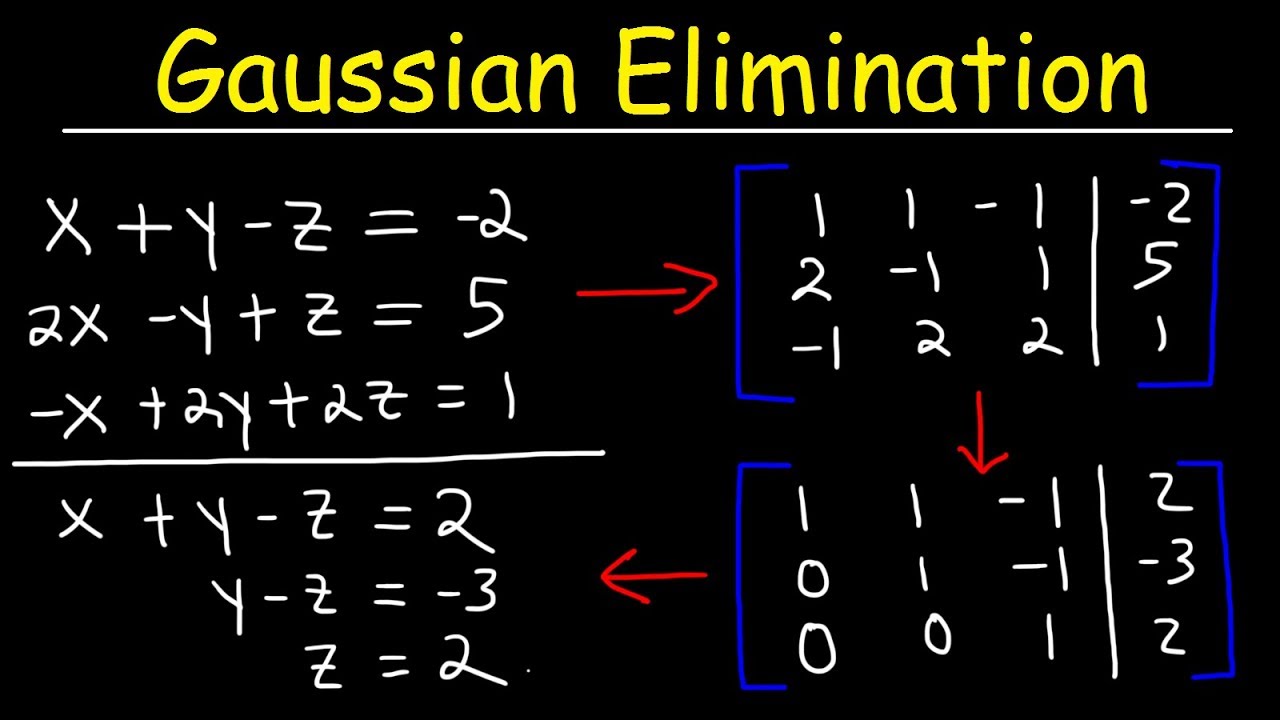
This precalculus video tutorial provides a basic introduction into the gaussian elimination - a process that involves elementary row operations with 3x3 matrices which allows you to solve a system of linear equations with 3 variables. You need to convert the system of equations into an augmented matrix and use matrix row operations to write it ...
This might be good
It explains it for 3 variables but the concept can be applied to bigger or smaller grids
If you didn't like it you can check other videos too
sly wyvern
ok thank you I'll look into it
cedar kilnBOT
@sly wyvern Has your question been resolved?
cedar kilnBOT
Channel closed
Closed due to timeout
Use .reopen if this was a mistake.
Available help channel!
Send your question here to claim the channel.
Remember:
• Ask your math question in a clear, concise manner.
• Show your work, and if possible, explain where you are stuck.
• After 15 minutes, feel free to ping <@&286206848099549185>.
• Type the command .close to free the channel when you're done.
• Be polite and have a nice day!
Read #❓how-to-get-help for further information on how to ask a good question, and about conduct in the question channels.
cedar kilnBOT
@exotic oracle Has your question been resolved?
dire geode
show the entire question
cedar kilnBOT
@exotic oracle Has your question been resolved?
cedar kilnBOT
Channel closed
Closed by @exotic oracle
Use .reopen if this was a mistake.
Available help channel!
Send your question here to claim the channel.
Remember:
• Ask your math question in a clear, concise manner.
• Show your work, and if possible, explain where you are stuck.
• After 15 minutes, feel free to ping <@&286206848099549185>.
• Type the command .close to free the channel when you're done.
• Be polite and have a nice day!
Read #❓how-to-get-help for further information on how to ask a good question, and about conduct in the question channels.
 celest otter
Prove:
$\forall k,l\in \mathbb{Z}^+$ the $kl$-th Fibonacci number $f_{kl}$ is
divisible by both $f_k$ and $f_l$.
cedar kilnBOT
celest otter
Prove:
$\forall k,l\in \mathbb{Z}^+$ the $kl$-th Fibonacci number $f_{kl}$ is
d...
wraith daggerBOT
hamr
 celest otter
I am thinking of a proof by induction for this one
 gritty viper
what I like to do is think of the values mod f_k
f_0 is 0
f_k is 0
Try to show that f_k being 0 (mod f_k) basically "resets" the sequence
and so if you write k more terms you'll get another 0 (mod f_k)
celest otter
gritty viper
Try to show that f_k being 0 (mod f_k) basically "resets" the sequence
Ok i will try this
 solid juniper
 rapid halo
you can also use binet's formula
rapid halo
you can also use binet's formula
i thought you were a random person
rapid halo
i am
solid juniper

cedar kilnBOT
@celest otter Has your question been resolved?
celest otter
Ok this is kinda what I have so far,
Prove:
$\forall k,l\in \mathbb{Z}^+$ the $kl$-th Fibonacci number $f_{kl}$ is
divisible by both $f_k$ and $f_l$.
[\text{or}]
[
P(k) = \left(f_k | f_{kl}\right)
]
And we w.t.s that $P(k)$ holds true $\forall k\in \mathbb{Z}^+$. From
it is symmetrically true that $\forall l\in \mathbb{Z}^+, : f_l | f_{kl}$
\textbf{Base case($k=1$):}
[\begin{aligned}
f_1 &| f_{l}\Leftrightarrow 1 | f_{l}\
f_l &= \frac{f_l}{1}, : f_l \in \mathbb{Z}\
\end{aligned}]
Thus, $ | f_{l}$ is true.
\textbf{Inductive step($P(n)\Rightarrow P(n+1)$):} Now, assume that
$n$ is a positive integer such that $P(n)$ is true. (In the base case,
we have just seen that $n = 1$ is such an integer.) We will now show
that $P(n + 1)$ is true.
$Proof$: by hypothesis $P(n)$:
[
\forall n,l \in \mathbb{Z}^+, :\left(f_n | f_{ln}\right)
]
Using the assumption, for $P(n+1)$:
[
\forall n,l \in \mathbb{Z}^+, :\left(f_{(n+1)} | f_{l(n+1)}\right)
]
Rewriting $f_{l(n+1)}$:
[\begin{aligned}
f_{l(n+1)} &= f_{(ln+l)}\
&= f_{ln-1}f_{l} + f_{ln}f_{l+1}\
&=
\end{aligned}]
Rewriting $f_{(n+1)}$:
[\begin{aligned}
f_{(n+1)}&= f_{(n-1)}f_{1} + f_{n}f_{1+1}\
&= f_{(n-1)} + f_{n}
\end{aligned}]
wraith daggerBOT
hamr
 cedar kilnBOT
@celest otter Has your question been resolved?
cedar kilnBOT
@celest otter Has your question been resolved?
celest otter
<@&286206848099549185>
celest otter
<@&286206848099549185>
celest otter
<@&286206848099549185>
cedar kilnBOT
@celest otter Has your question been resolved?
celest otter
<@&286206848099549185> pls