#help-13
1 messages · Page 294 of 1
 tough dock


 crimson sedge
the t is t, x and y are separate
tough dock
There is no 1
tough dock
crimson sedge
the t is t, x and y are separate
You are trying to use t to find your equation
Since x1 and y1 given to be functions of t in your document
crimson sedge
i'm just putting the table into desmos how it was presented to me
and i have to make x longitude vs t
tough dock
Try just using t instead of t1
 tough dock
Oh
Oops, I think I got confused because you changed it from the first screenshot
Anyways, you have your equation for your longitudes now
crimson sedge
is the ~ a symbol i can use in an actual equation
tough dock
crimson sedge
is the ~ a symbol i can use in an actual equation
~ is a symbol special to Desmos
Which tells it to fit an equation
crimson sedge
so there's nothing before the at1^2 then? like no x= or smth?
tough dock
Outside of Desmos, I have seen ~ used to represent "is proportional to"
tough dock
crimson sedge
so there's nothing before the at1^2 then? like no x= or smth?
That is what your x1 ~ is
~ replaces = in Desmos when you are trying to fit an equation
tough dock
crimson sedge
so the equation would be x1=at1^2+bt1+c then?
To be consistent with your original table, you would just use x = at²+bt+c in your document
 crimson sedge
oki
tough dock
And you would replace a, b, and c with their actual values given to you by Desmos
crimson sedge
i think it's just asking for the function, but i can do that when i go to solve the function
i think
tough dock
crimson sedge
i think it's just asking for the function, but i can do that when i go to solve ...
The screenshot you posted is just asking for the type of function
Which we found to be quadratic
So writing "quadratic" would probably work
crimson sedge
ah oki

would quadratic also be correct here too?
seems good to me but i'm not 100% bc i'm very confused on this lol
crimson sedge
oki
 tough dock
crimson sedge
this is what exponential looks like
tough dock
crimson sedge
this is what exponential looks like
You can add a + c at the the end of your exponential fitting, but the quadratic is already super accurate anyways
So using quadratic fitting for both your latitutde and longitude values should be fine
crimson sedge
oki

 tough dock
crimson sedge
tough dock
crimson sedge
Here
crimson sedge
for this, would i put the numbers desmos gives me or just the equation
tough dock
The numbers
crimson sedge
oki
tough dock
You would use the numbers here
 tough dock
You are missing a t at the end of the -1.66286
crimson sedge
ty
tough dock
Also, I would recommend rounding to ~3 decimal places, since 5 is a bit much
crimson sedge
my teacher likes us using 5 decimal places for some reason
at least in our last assignment he had us do that
How would I use desmos to do this?

i think i understand what i need to do, i just dunno how to do it with desmos
tough dock
Hmm
This is slightly annoying, but it isn't too bad to do with desmos if you still have the tab open
crimson sedge
i do
tough dock
I would change the names of the coefficients to something like this first

The reason why we would do this is so that we can use them as variables in other equations
crimson sedge
i see
tough dock
because if you just use a (etc) for both of them, if you try to use them in outside equations, Desmos won't know what to do
So now, we can just rewrite the quadratics, but as actual equations (keep the fitting things, we still need those)
crimson sedge
i'm a bit confused xd
tough dock
It will end up looking something like this

x_p and y_p are going to be your "predicting" functions
Since they use the values that you got from fitting your equations
 tough dock
crimson sedge
tough dock
crimson sedge
Since your argument to your predicting function is just t, use t instead of t1 for the equation
Since t1 is actual values
 tough dock
You should end up with a graph that just draws over the quadratics you just fit
crimson sedge
now i'm assuming i just plug the values on each point into the table and then do the same for y?
tough dock
crimson sedge
now i'm assuming i just plug the values on each point into the table and then do...
Yes, and you can do this quickly with the you have at the top
You can make the name of the column x_p(t1), and desmos will automatically fill in all the values for you
crimson sedge
oki
tough dock
Getting you something like this
 tough dock
Congratulations
crimson sedge
thank you :3
a few more questions on this thing
i meant i was done with that part
i'll try on my own and come here if i have questions
 tough dock
Rectangular just means "normal" here
So can you plot the y values as a function of the x values
tough dock
crimson sedge
which i don't think i can
Not necessarily
You can check by plotting (x1,y1) in Desmos and seeing if they make a valid function
crimson sedge
oki

the top left is where they're appearing

but also this is how i'm doing it, idk if this is what you meant
tough dock
crimson sedge
You can just write (x1,y1)
 tough dock
Okay, so now the question is
Do the black points make a curve that has one x value corresponding to 1 y value
tough dock
crimson sedge
ye
Are you sure?

 crimson sedge
oh wait
i see what you mean
ye no
i thought you meant like one x value corresponding to the y value on the chart, not one y value overall
tough dock
Yeah
 tough dock
Hmmm
It's a bit vague in my opinion
When you say "whenever an X value is graphed, ... associated in order to get the correct graph," I think this could be made more clear by specifying that there needs to be exactly one y-value for each x-value
 crimson sedge
i mean that there's a different y value that needs to be associated with every x value in order to get a graph that matches the chart that we're given
crimson sedge
i added "from the given values from the chart" after "looking for" :3
tough dock
So you are saying that when we attempt to fit a graph to the points, we sometimes get multiple, different values than what we need for f(x) to be a valid function?
crimson sedge
ye
tough dock
I see
crimson sedge
lemme try to rewrite it so it's more clear
 crimson sedge
tough dock
I think using a CER format here could help you to be more clear
crimson sedge
tough dock
I think using a CER format here could help you to be more clear
we were never taught that
imo if we weren't taught to answer in CER format then my teacher prob doesn't care that much as long as he gets that we understand why something does/doesn't work
tough dock
Okay
tough dock
crimson sedge
Hmm
I don't think I understand the "every x value would need to have the same y value" line of reasoning
crimson sedge
that's the line of reasoning that you gave me xd
that for that type of function to work every x value would need one y value
tough dock
crimson sedge
that's the line of reasoning that you gave me xd
I think I might've phrased it a bit strangely
Sorry
tough dock
crimson sedge
that for that type of function to work every x value would need one y value
Every x-value would need a y-value assigned to it, but different x-value can have different y-values
Let me try to draw something
crimson sedge
oki
tough dock
This is a valid function, since it has a single y-value for each point

Hence, the red vertical lines only cross the valid graph once
crimson sedge
so it's the vertical line rule?
tough dock
Here, the red vertical lines cross the graph multiple times each

Which means that an x-value has multiple y-values assigned to it
crimson sedge
ah, we learned that as the vertical line rule
tough dock
Which is not allowed in a valid rectangular function
tough dock
crimson sedge
ah, we learned that as the vertical line rule
yes
crimson sedge
so i could prob just write that it's because it doesn't pass the vertical line rule and he'd accept it most likely
tough dock
You can mention and use the vertical line rule here
Saying something like "A graph created using the longitude as an x-value and latitude as a y-value does not pass the vertical line test"
tough dock
crimson sedge
so i could prob just write that it's because it doesn't pass the vertical line r...
Yes
Don't know why I typed "Some", oops

 tough dock
crimson sedge
tough dock
crimson sedge
probably want "invalid" instead of "non linear", since "non linear" excludes things that are not straight lines
crimson sedge
the graph isn't a straight line when we plot it out
which is why i said "non linear" :3
oh wait i see
i think i'll just stick with my short answer lol
tough dock
 tough dock
No problem
crimson sedge
also sorry i got mad earlier just kind of stressed bc last few days of school trying to catch up grades xd
tough dock
I always find visualizations helpful when trying to solve problems, so I tend to use them a lot
tough dock
crimson sedge
also sorry i got mad earlier just kind of stressed bc last few days of school tr...
It's fine
Happens to everyone
 cedar kilnBOT
Channel closed
Closed by @storm mortar
Use .reopen if this was a mistake.
cedar kilnBOT
 Available help channel!
Send your question here to claim the channel.
Remember:
• Ask your math question in a clear, concise manner.
• Show your work, and if possible, explain where you are stuck.
• After 15 minutes, feel free to ping <@&286206848099549185>.
• Type the command .close to free the channel when you're done.
• Be polite and have a nice day!
Read #❓how-to-get-help for further information on how to ask a good question, and about conduct in the question channels.
 potent eagle
 cedar kilnBOT
potent eagle
potent eagle
cedar kilnBOT
potent eagle
potent eagle
need a little help on sequences
geometric sequences to be more specific
not sure where to begin here
besides that U6 = 64
 vague rapids
the information is insufficient
potent eagle
really?
 vague rapids
ahh
they used an example
you can come to infinite such cases
with first term being different in each case
 cedar kilnBOT
@potent eagle Has your question been resolved?
potent eagle
.close
cedar kilnBOT
Channel closed
Closed by @potent eagle
Use .reopen if this was a mistake.
cedar kilnBOT
Available help channel!
Send your question here to claim the channel.
Remember:
• Ask your math question in a clear, concise manner.
• Show your work, and if possible, explain where you are stuck.
• After 15 minutes, feel free to ping <@&286206848099549185>.
• Type the command .close to free the channel when you're done.
• Be polite and have a nice day!
Read #❓how-to-get-help for further information on how to ask a good question, and about conduct in the question channels.
 coral jewel
In a country, when moving from a province to another, there will be a guard to check at the gate. Sir Austin is sly alcohol distributor. Every time he passes a gate, he will bribe the guard by giving them a bottle of alcohol for each container. Given each container can hold a maximum of 15 bottles, what is the minimum amount of bottles Sir Austin needs to carry in order to go through 10 gates and supply 50 bottles for his customers?
cedar kilnBOT
coral jewel
In a country, when moving from a province to another, there will be a guard to c...
 nova snow
@royal loom sir?
 wicked stag
nova snow
<@779131727338930196> sir?
wicked stag
nova snow
<@779131727338930196> sir?

x is number of containers
15x = 10x + 50 + k
or 5x - 50 = k
If x = 10 k = 0 (least non -ve value)
Therfore he carries 15*10 = 150 bottles
Got this ?
@coral jewel ^^^
k is the remainder of extra bottles if any
cedar kilnBOT
@coral jewel Has your question been resolved?
cedar kilnBOT
Channel closed
Closed due to timeout
Use .reopen if this was a mistake.
Available help channel!
Send your question here to claim the channel.
Remember:
• Ask your math question in a clear, concise manner.
• Show your work, and if possible, explain where you are stuck.
• After 15 minutes, feel free to ping <@&286206848099549185>.
• Type the command .close to free the channel when you're done.
• Be polite and have a nice day!
Read #❓how-to-get-help for further information on how to ask a good question, and about conduct in the question channels.
 halcyon adder
 cedar kilnBOT
halcyon adder
halcyon adder
cedar kilnBOT
halcyon adder
halcyon adder
I have to find the laplace transform of this in matlab
what does the first equation mean
 subtle harbor
dirac delta
halcyon adder
subtle harbor
dirac delta
what does it stand for
what kind of function is it
is it a step or impulse function?
halcyon adder
so an impulse on t-1
subtle harbor
on t=1
cedar kilnBOT
@halcyon adder Has your question been resolved?
halcyon adder
.close
cedar kilnBOT
Channel closed
Closed by @halcyon adder
Use .reopen if this was a mistake.
Available help channel!
Send your question here to claim the channel.
Remember:
• Ask your math question in a clear, concise manner.
• Show your work, and if possible, explain where you are stuck.
• After 15 minutes, feel free to ping <@&286206848099549185>.
• Type the command .close to free the channel when you're done.
• Be polite and have a nice day!
Read #❓how-to-get-help for further information on how to ask a good question, and about conduct in the question channels.
 hoary parrot
 cedar kilnBOT
hoary parrot
cedar kilnBOT
hoary parrot
 dusk goblet
infinitely many solutions means they’re the same line
hoary parrot
Yeah, but how do I find what value of p makes them the same line?
dusk goblet
try making the two equations look the same
hoary parrot
I've tried setting both equations equal to 0, then putting both equations equal to each other, and then rearranging the equation but it got me nowhere
dusk goblet
do you have any work
hoary parrot
Yeah I'll send a picture althoughI crossed it out 😅
dusk goblet
what id do is
hoary parrot
 dusk goblet
divide the bottom equation by -2
and multiply by p
so that the left sides of both equations are equal
then i’d match the coefficients
hoary parrot
how does multiplying the bottom equation by (-2/p) make both LHS equal?
dusk goblet
because they’re both equal to p
dusk goblet
it should work out nicely

 late otter
p = 2 is the right answer yes
hoary parrot
late otter
p = 2 is the right answer yes
but was my method correct, of just looking at the coefficient of x towards the end?
late otter
i cant really tell what you have done here, sorry
hoary parrot
late otter
i cant really tell what you have done here, sorry
well once I got to -2px + 2y = (p²-4p)x + (p²-p)y
I took the coefficients of x and put them equal to each other so -2p = p² - 4p and then just solved for p
late otter
ohh youre on b) mb, give me a min
hoary parrot
Oh yeah sorry 😅
I already completed a
late otter
looks good, but you should test with the coefficients of y aswell, as p could also be equal to 0 in $p^2-2p = 0$
 wraith daggerBOT
caspar
 cedar kilnBOT
Channel closed
Closed by @hoary parrot
Use .reopen if this was a mistake.
cedar kilnBOT
Available help channel!
Send your question here to claim the channel.
Remember:
• Ask your math question in a clear, concise manner.
• Show your work, and if possible, explain where you are stuck.
• After 15 minutes, feel free to ping <@&286206848099549185>.
• Type the command .close to free the channel when you're done.
• Be polite and have a nice day!
Read #❓how-to-get-help for further information on how to ask a good question, and about conduct in the question channels.
Channel closed
Channel closed due to the original message being deleted.
If you did not intend to do this, please open a new help channel,
as this action is irreversible, and this channel may abruptly lock.
cedar kilnBOT
Available help channel!
Send your question here to claim the channel.
Remember:
• Ask your math question in a clear, concise manner.
• Show your work, and if possible, explain where you are stuck.
• After 15 minutes, feel free to ping <@&286206848099549185>.
• Type the command .close to free the channel when you're done.
• Be polite and have a nice day!
Read #❓how-to-get-help for further information on how to ask a good question, and about conduct in the question channels.
crimson sedge
 cedar kilnBOT
crimson sedge
crimson sedge
cedar kilnBOT
crimson sedge
crimson sedge
how do i do this
 granite knoll
show the whole question
crimson sedge
"in the expansion of : "
subtle harbor
the coefficient of x^()?
 grim nimbus
you know the equation of newton?
subtle harbor
you think????
 crimson sedge
example?
subtle harbor
(x+y)^n=sum( ... )
subtle harbor
 crimson sedge
yeah ik that
$6C0 \cdot (-\frac{1}{2}x)^6 \cdot (3)^0$ +
$6C1 \cdot (-\frac{1}{2}x)^5 \cdot (3)^1$ +
$6C2 \cdot (-\frac{1}{2}x)^4 \cdot (3)^2$ +
$6C3 \cdot (-\frac{1}{2}x)^3 \cdot (3)^3$ +
$6C4 \cdot (-\frac{1}{2}x)^2 \cdot (3)^4$ +
$6C5 \cdot (-\frac{1}{2}x)^1 \cdot (3)^5$ +
$6C6 \cdot (-\frac{1}{2}x)^0 \cdot (3)^6$
crimson sedge
like this yeah?
crimson sedge
subtle harbor
with addition between lines
yes
crimson sedge
nope
subtle harbor
crimson sedge
well look at this
subtle harbor
think if it was just (5+8x^2)(x^5+x^3)
what would it look like when you expand that
wraith daggerBOT
محمد احمد
 subtle harbor
what
crimson sedge
idk but i get the point
subtle harbor
your 8x^2 power is going to add with the x^3 power to get you an x^5 power
so it'll add to the x^5 coeff
wraith daggerBOT
محمد احمد
 crimson sedge
subtle harbor
so it'll add to the x^5 coeff
crimson sedge
subtle harbor
so it'll add to the x^5 coeff
yes it will
but thingy
mind re-explaining the
x^3
within context
$6C1 \cdot (-\frac{1}{2}x)^5 \cdot (3)^1$
$6C3 \cdot (-\frac{1}{2}x)^3 \cdot (3)^3$
wraith daggerBOT
محمد احمد
 crimson sedge
this is what we were after
subtle harbor
those are the coefficients yes
now you multiply them by each one to make them/keep them x^5 powers
wraith daggerBOT
محمد احمد
 cedar kilnBOT
@crimson sedge Has your question been resolved?
cedar kilnBOT
Channel closed
Closed by @rare cedar
Use .reopen if this was a mistake.
cedar kilnBOT
Available help channel!
Send your question here to claim the channel.
Remember:
• Ask your math question in a clear, concise manner.
• Show your work, and if possible, explain where you are stuck.
• After 15 minutes, feel free to ping <@&286206848099549185>.
• Type the command .close to free the channel when you're done.
• Be polite and have a nice day!
Read #❓how-to-get-help for further information on how to ask a good question, and about conduct in the question channels.
 short loom
“There are two bowls filled with 10l of alcohol. The first bowl has an alcohol percentage of 20% and the second bowl x%. Two liters were taken from the second bowl and put into the first bowl and after mixing two liters were taken from the first bowl and put into the second one. If the alcohol percentage in the second bowl was then 70%, what is the sum of the digits of x?”
cedar kilnBOT
short loom
“There are two bowls filled with 10l of alcohol. The first bowl has an alcohol p...
 flat prawn
short loom
“There are two bowls filled with 10l of alcohol. The first bowl has an alcohol p...
flat prawn
short loom
“There are two bowls filled with 10l of alcohol. The first bowl has an alcohol p...
10 L each in one bowl right?
short loom
yes
flat prawn
The 10L of alcohol comprises of 20 percent of the whole mixture in the first bowl right?
Um sorry for asking so many questions
short loom
yes i think so
short loom
flat prawn
Um sorry for asking so many questions
dw
cedar kilnBOT
@short loom Has your question been resolved?
short loom
<@&286206848099549185>
short loom
just a sec
short loom
short loom
“There are two bowls filled with 10l of alcohol. The first bowl has an alcohol p...
i just realised i translated the last part wrong
ill fix it lmao sorry
there
flat prawn
short loom
i just realised i translated the last part wrong
??💀
short loom
the question wasnt in english
flat prawn
Is it 6?
flat prawn
Oh shit
flat prawn
It's supposed to be a whole number then?
Like a two digit percentage and not a decimal
short loom
flat prawn
It's supposed to be a whole number then?
probably
if i knew i wouldnt be asking 🌝 idk where to start at the problem
flat prawn
I got the same equation again
I'm putting it in desmos agaij
78.95 percent
It's pretty close to 80

 cedar kilnBOT
Channel closed
Closed by @short loom
Use .reopen if this was a mistake.
cedar kilnBOT
Available help channel!
Send your question here to claim the channel.
Remember:
• Ask your math question in a clear, concise manner.
• Show your work, and if possible, explain where you are stuck.
• After 15 minutes, feel free to ping <@&286206848099549185>.
• Type the command .close to free the channel when you're done.
• Be polite and have a nice day!
Read #❓how-to-get-help for further information on how to ask a good question, and about conduct in the question channels.
 wise estuary
When you're evaluating limits approaching infinite, and there's a sqrt in the numerator of the leading number that has a power of 6
cedar kilnBOT
wise estuary
When you're evaluating limits approaching infinite, and there's a sqrt in the nu...
wise estuary
that becomes power of 3 right
 humble pivot
can you send the problem?
wise estuary
sure but trying to understand not just get answer haha
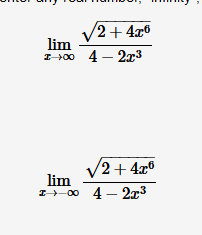
my intuition thought 1 and -1
OH
is it reverse
humble pivot
if im thinking correctly, it does become a x^3 term
wise estuary
yep ok
I misread the signs
it's -1 and 1
I struggle with ones that have an isolated sqrt
thanks
subtle harbor
wise estuary
that becomes power of 3 right
when you pull it out of the square root it becomes |x^{3}|
wise estuary
Is khan a good resource to look at somewhere different for Continuity work? calc1 practice
got a lot of heavy math this fall
subtle harbor
i.e. $\sqrt{2+4x^{6}}=|x^{3}|\sqrt{\frac{2}{x^6}+4}$
wraith daggerBOT
🫎MooseyMooseMooser 🫎
 wise estuary
interesting
subtle harbor
wise estuary
https://i.imgur.com/OJSxgO3.png
https://tutorial.math.lamar.edu/classes/calci/limitsatinfinityi.aspx for these types of problems
subtle harbor
glad to have helped :)
wise estuary
continuity is my biggest weakness right now I think
and various equations with sqrts
those fuck me up lol
done
 rough terrace
wise estuary
continuity is my biggest weakness right now I think
rough terrace
wise estuary
continuity is my biggest weakness right now I think
Are you doing analysis type of continuity or just non-proof ones?
I could give you some advice on how to practice 🙂
wise estuary
rough terrace
Are you doing analysis type of continuity or just non-proof ones?
Intro level, prior to this year I had math anxiety and irl stuff that made me withdraw from the class
So catching up on rudimentary
rough terrace
Ah! Then just keep practicing!
Just keep doing questions and you will ace it for sure.
Don't worry
You got this lol
wise estuary
Yep! Gotta practice practice
rough terrace
Yes yes yessss
Aight good luck!!!
Wish you all the best
Close the channel hahaha
That would be great
wise estuary
.close
cedar kilnBOT
Channel closed
Closed by @wise estuary
Use .reopen if this was a mistake.
Available help channel!
Send your question here to claim the channel.
Remember:
• Ask your math question in a clear, concise manner.
• Show your work, and if possible, explain where you are stuck.
• After 15 minutes, feel free to ping <@&286206848099549185>.
• Type the command .close to free the channel when you're done.
• Be polite and have a nice day!
Read #❓how-to-get-help for further information on how to ask a good question, and about conduct in the question channels.
 meager flare
 cedar kilnBOT
meager flare
meager flare
cedar kilnBOT
meager flare
meager flare
need to find the perforation, this is what ive done but i cannot check the answers as i dont have them
let me send sec

so for x = 3log(16)/2 the numerator and denominator are 0
but when drawing it I cannot see the perforation, neither in desmos nor in my graphical calculator
cedar kilnBOT
@meager flare Has your question been resolved?
cedar kilnBOT
@meager flare Has your question been resolved?
meager flare
😢
cedar kilnBOT
@meager flare Has your question been resolved?
cedar kilnBOT
Channel closed
Closed due to timeout
Use .reopen if this was a mistake.
Available help channel!
Send your question here to claim the channel.
Remember:
• Ask your math question in a clear, concise manner.
• Show your work, and if possible, explain where you are stuck.
• After 15 minutes, feel free to ping <@&286206848099549185>.
• Type the command .close to free the channel when you're done.
• Be polite and have a nice day!
Read #❓how-to-get-help for further information on how to ask a good question, and about conduct in the question channels.
 tawny drum
 cedar kilnBOT
tawny drum
rough terrace
cedar kilnBOT
tawny drum
rough terrace
!status
cedar kilnBOT
What step are you on?
1. I don't know where to begin.
2. I have begun but got stuck midway.
3. I got an answer but I was told that it's wrong.
4. I got an answer and would like my work checked.
5. I have a question about someone else's work/solution.
6. I have completed the problem and don't need help anymore. Thank you.
7. None of the above
 thorn robin
bro josen knows how to do that question
thorn robin
bro josen knows how to do that question
he just looked at the answers remember
and i cant understand it
tough dock
tawny drum
V=2/3 pir^3
Then you have to find the maximum of that function
thorn robin
tawny drum
and i cant understand it
damn
tough dock
Oh wait
tawny drum
tough dock
Then you have to find the maximum of that function
there cant be any r's
tough dock
You need to find the volume of the cylinder
tawny drum
need to get rid of the r
tough dock
as a function of radius
 tough dock
tawny drum
tough dock
tawny drum
It first finds the volume of the cylinder as a function of radius
That is the pi r²(3-2r)
tawny drum
how is h=3-2r thugh
tough dock
It is determined in the graph in the top left
That is a 2d cross-section of the cone
Right?
So it uses that to determine the height of a cylidner that fits inside of it
 tawny drum
yes
tough dock
To fit a cylinder in the cone, we need the top to not extend outside the cone
tawny drum
yes
tough dock
That looks something like this

We can find out the maximum height for a given in radius of a cylinder using the top right point

Since you have that the value of the radius is just the x-coordinate of the point, if you find a function that describes the right side of the cone, then your height will be the value of the function at that x-coordinate
For example, if the radius is 1, then the maximum height is 1

If the radius is 0.5, then the maximum height is 2

As you can see from the graph, the right side is just a line with an y-intercept of 3 and a slope of -2
tawny drum
yeah
tough dock
So, the equation that describes this line is y = mx + b = -2x + 3
Since height can be found from the radius using this equation, you get that h = -2r + 3
Going back to this, the volume of a cylinder is just pi r²h

Now that we have an equation for h in terms of r, we can just plug that in
Getting our second equation
And then just expand
Now, to find the maximum value of this function V, you need to use some calculus
cedar kilnBOT
@tawny drum Has your question been resolved?
cedar kilnBOT
Channel closed
Closed due to timeout
Use .reopen if this was a mistake.
cedar kilnBOT
Available help channel!
Send your question here to claim the channel.
Remember:
• Ask your math question in a clear, concise manner.
• Show your work, and if possible, explain where you are stuck.
• After 15 minutes, feel free to ping <@&286206848099549185>.
• Type the command .close to free the channel when you're done.
• Be polite and have a nice day!
Read #❓how-to-get-help for further information on how to ask a good question, and about conduct in the question channels.
 shell grotto
?help
cedar kilnBOT
shell grotto
?help

 torpid cipher
integral of cos(a) is sin(a)
shell grotto
yeah how about the other?
torpid cipher
(inverse of derivative)
shell grotto

 forest dust
shell grotto
yeah how about the other?
forest dust
shell grotto
yeah how about the other?
3/2 is a constant it can be taken out of the integral
shell grotto
u gonna put the 3/2 in the outsiede right?
forest dust
shell grotto
then how about the pie
that is a limit
torpid cipher
2/3 (sin(pi) - sin(0))
forest dust
no
torpid cipher
nope
shell grotto
oh
torpid cipher
its the integral basics
shell grotto
OH OKAY
torpid cipher
F(b) - F(a)
shell grotto
i'll change the (a) of sin?
forest dust
okay so the limits tell you what points your theta is varying from
torpid cipher
shell grotto
i'll change the (a) of sin?
basically
torpid cipher
yeah
torpid cipher
yeah
torpid cipher
sure
 brittle oyster
you can also use graphical approach @shell grotto
 cedar kilnBOT
@shell grotto Has your question been resolved?
Channel closed
Closed by @shell grotto
Use .reopen if this was a mistake.
Available help channel!
Send your question here to claim the channel.
Remember:
• Ask your math question in a clear, concise manner.
• Show your work, and if possible, explain where you are stuck.
• After 15 minutes, feel free to ping <@&286206848099549185>.
• Type the command .close to free the channel when you're done.
• Be polite and have a nice day!
Read #❓how-to-get-help for further information on how to ask a good question, and about conduct in the question channels.
crimson sedge
Hi am having problem with this math question


 cedar kilnBOT
crimson sedge
Hi am having problem with this math question
crimson sedge
cedar kilnBOT
crimson sedge
Hi am having problem with this math question
crimson sedge


 native ermine
Find the area of all the different sites, and add them together
crimson sedge
how?
native ermine
Do you know how to find the area of a square and a rectangle?
crimson sedge
am not listening to my math teacher so idk💀
 rustic raven
crimson sedge
am not listening to my math teacher so idk💀
rustic raven
crimson sedge
am not listening to my math teacher so idk💀
Yeah just try that 6a^2
crimson sedge
number 1?
rustic raven
For cuboids it's 2(lb+lh+bh)
 normal shore
crimson sedge
am not listening to my math teacher so idk💀
normal shore
crimson sedge
am not listening to my math teacher so idk💀
||start listening  ||
||
rustic raven
crimson sedge
number 1?
6*81= 486 cu.units
cedar kilnBOT
@crimson sedge Has your question been resolved?
Channel closed
Closed by @cold storm
Use .reopen if this was a mistake.
Available help channel!
Send your question here to claim the channel.
Remember:
• Ask your math question in a clear, concise manner.
• Show your work, and if possible, explain where you are stuck.
• After 15 minutes, feel free to ping <@&286206848099549185>.
• Type the command .close to free the channel when you're done.
• Be polite and have a nice day!
Read #❓how-to-get-help for further information on how to ask a good question, and about conduct in the question channels.
 proud mural
That’s the Task the task I got but got not really a plan what I should do
Taylor polynomials of functions f (x) = x + 1 with m > 1 can be used to calculate roots numerically.
(a) Determine the value T8(a;a) and the value T8′(a;a) (derivative with respect to x) of the Taylor polynomial T8(x,a) of f.
(b) Determine all coefficients of the Taylor polynomial T3(x;a) of f.
(c) Give the remainder term of Lagrange R4(x;a) for T3(x;a) of f. For which ξ between x and a is |R4(x;a)| largest for x > a and for x < a?
(d) Approximate the value of √2 through T3(x; a). Choose a favorable (i.e. easy for the calculation) expansion point a > −1. According to subtask (b), what is a limit for the largest possible error that occurs with this approximation?
cedar kilnBOT
proud mural
That’s the Task the task I got but got not really a plan what I should do
Taylor...
proud mural
And that’s what I got

 cedar kilnBOT
@proud mural Has your question been resolved?
cedar kilnBOT
@proud mural Has your question been resolved?
cedar kilnBOT
@proud mural Has your question been resolved?
 next palm
proud mural
That’s the Task the task I got but got not really a plan what I should do
Taylor...
next palm
proud mural
That’s the Task the task I got but got not really a plan what I should do
Taylor...
for a), do you really need to calculate all those derivatives? from the general shape of taylor polynomials, you could notice something about what happens when you insert x = a
proud mural
sorry, but i dont know what you mean
next palm
If you have a Taylor polynomial, say, T200(x,a) of a function f, can you tell me what T200(a,a) is without performing any calculations?
proud mural
it´s f(a) or?
next palm
Yea
So to get T8(a,a) you don't need to calculate eight derivatives
You just plug into the original function
And what is the derivative T8'(a,a)?
proud mural
im not sure but is it not also f(a) ? (sorry but have to translate everything first)
next palm
That's ok; i speak german, dutch, and a bit of finnish too if that helps hahaha
next palm
proud mural
im not sure but is it not also f(a) ? (sorry but have to translate everything f...
No, not quite f(a). Consider an example, T2(x,a) = f(a) + f'(a) (x - a) + f''(a)/2 * (x-a)^2
If you took the derivative of this taylor polynomial and inserted x = a, what would that equal?
proud mural
T8(x,a) = f(a) + f´(a)(x-a)+(f´´(a)/2!(x-a)^2+........+f´´´´´´´´(a)/8! * (x-a)^8
oder liege ich da falsch?
next palm
jau stimmt schon
aber wenn du das am punkt x = a auswertest wird das sehr einfach
und das gilt auch für die ableitungen davon
next palm
proud mural
T8(x,a) = f(a) + f´(a)*(x-a)+(f´´(a)/2!*(x-a)^2+........+f´´´´´´´´(a)/8! * (x-a)...
nimm die formel mal und schreib auf was die ableitung davon wäre
proud mural
die formel T(x,a) soll ich ableiten oder?
proud mural
T8´(x, a)= f(a) +f'(a) * (x-a) + f(a)/2! 3(x-a)^2+....+f´´´´´´´´(a)/7!8(x-a)^7
next palm
wo kommt das f(a) am anfang der summe her?
proud mural
gute frage, jedenfalls sollte nach erfahrung T8(a,a)=f(a) sein
next palm
ja das stimmt schon, aber die ableitung des taylorpolynomials ist nicht so
was wäre denn die ableitung des ersten taylorpolynoms T1(x,a) = f(a) + f'(a) (x - a)
proud mural
Okay, habe ich vergessen 😦 und wie bestimme ich jetzt den wert oder war das schon die bestimmung?
sorry bro, bin gerade ziemlich verwirrt also was soll ich als nächstes berechen?
cedar kilnBOT
@proud mural Has your question been resolved?
cedar kilnBOT
@proud mural Has your question been resolved?
Channel closed
Closed by @proud mural
Use .reopen if this was a mistake.
Available help channel!
Send your question here to claim the channel.
Remember:
• Ask your math question in a clear, concise manner.
• Show your work, and if possible, explain where you are stuck.
• After 15 minutes, feel free to ping <@&286206848099549185>.
• Type the command .close to free the channel when you're done.
• Be polite and have a nice day!
Read #❓how-to-get-help for further information on how to ask a good question, and about conduct in the question channels.
 shy cedar
hello
cedar kilnBOT
shy cedar
hello
shy cedar
could anyone help with solving these?

ive tried once but noone that could help replied
 red stone
German
shy cedar
its czech originally
<@&286206848099549185>
Yes
can you help ._.
yiipppeeee
you gonna read it or something?
yeah
idk how you did that but ok
oh
there are results but u need the whole calculation
cedar kilnBOT
@shy cedar Has your question been resolved?
shy cedar
i got the 2nd and 3rd right but the rest i dont have a clue
cedar kilnBOT
@shy cedar Has your question been resolved?
cedar kilnBOT
Channel closed
Closed due to timeout
Use .reopen if this was a mistake.
cedar kilnBOT
Available help channel!
Send your question here to claim the channel.
Remember:
• Ask your math question in a clear, concise manner.
• Show your work, and if possible, explain where you are stuck.
• After 15 minutes, feel free to ping <@&286206848099549185>.
• Type the command .close to free the channel when you're done.
• Be polite and have a nice day!
Read #❓how-to-get-help for further information on how to ask a good question, and about conduct in the question channels.
 languid trail
Hi i need some help.
I need to find f'(x) and calculate f'(2) when
A) f(x) = x^2
B) f(x) = 2x^3 - 3x
C) f(x) = 2
I thought i was doing good but it was all wrong, then realized some have f' and some just f
cedar kilnBOT
languid trail
Hi i need some help.
I need to find f'(x) and calculate f'(2) when
A) f(x) = x^2...
 wraith daggerBOT
 granite knoll
f'(x) is the derivative
granite knoll
you should review the concepts: https://www.khanacademy.org/math/differential-calculus/dc-diff-intro
cedar kilnBOT
Channel closed
Closed by @languid trail
Use .reopen if this was a mistake.
 subtle grotto
cedar kilnBOT
Available help channel!
subtle grotto
cedar kilnBOT
Available help channel!
Send your question here to claim the channel.
Remember:
• Ask your math question in a clear, concise manner.
• Show your work, and if possible, explain where you are stuck.
• After 15 minutes, feel free to ping <@&286206848099549185>.
• Type the command .close to free the channel when you're done.
• Be polite and have a nice day!
Read #❓how-to-get-help for further information on how to ask a good question, and about conduct in the question channels.
 daring talon
Determine the largest and smallest value, if any, of f(x, y) = 2x^2 + y^2 + 2y, on the part of the circular disc x^2 + y^2 ≤ 4 where x ≥ 1.
cedar kilnBOT
daring talon
Determine the largest and smallest value, if any, of f(x, y) = 2x^2 + y^2 + 2y, ...
daring talon
When I want to optimize the circular arc

The answer say use

Why do you put the gradients vertical in the determinant?
and not horizontal? Maybe a stupid question.
 dawn junco
it doesn't matter in this case
you just want to know where the two gradients are linearly dependent
(lagrange multipliers I suppose)
dawn junco
well the determinant doesn't change when you transpose a matrix..
dawn junco
daring talon
Okey, so they just did vertical for no reason?
ig
cedar kilnBOT
Channel closed
Closed by @daring talon
Use .reopen if this was a mistake.
Available help channel!
Send your question here to claim the channel.
Remember:
• Ask your math question in a clear, concise manner.
• Show your work, and if possible, explain where you are stuck.
• After 15 minutes, feel free to ping <@&286206848099549185>.
• Type the command .close to free the channel when you're done.
• Be polite and have a nice day!
Read #❓how-to-get-help for further information on how to ask a good question, and about conduct in the question channels.
 stoic void
small question, during linear transformation, the dimentions do not have to be multiplyable like in the matrix multiplication case? This is a slide from one of my lectures
cedar kilnBOT
stoic void
small question, during linear transformation, the dimentions do not have to be m...
stoic void
 granite knoll
what do you mean "multipliable"
stoic void
i mean
when u multiply a matrix by a matri
x
the dimentions have to be
take mxn as first matrix dimentions
and second matrix has to be nxp
granite knoll
yes
stoic void
right
 crimson delta
and here its 3x2 and 2x1
cedar kilnBOT
Channel closed
Closed by @granite knoll
Use .reopen if this was a mistake.
stoic void
.close
granite knoll
i gotchu
cedar kilnBOT
Available help channel!
Send your question here to claim the channel.
Remember:
• Ask your math question in a clear, concise manner.
• Show your work, and if possible, explain where you are stuck.
• After 15 minutes, feel free to ping <@&286206848099549185>.
• Type the command .close to free the channel when you're done.
• Be polite and have a nice day!
Read #❓how-to-get-help for further information on how to ask a good question, and about conduct in the question channels.
 worthy basalt
pls
cedar kilnBOT
worthy basalt
pls

 hidden mural
there are many 2's
 trim jetty
What is 2?
 muted bear
https://youtu.be/aXbT37IlyZQ?si=LxlNe8G8c71ZSbiT try checking out this video

There is a simple algebraic proof for why
1^2 + 2^2 + 3^2 +...+ n^2 = (n(n+1)(2n+1))/6 , and it's not that interesting. However I think that the visual explanation is a lot more beautiful and so I made a simple animation about it.
I know that I used only one example where n=4, but the same will work with any integer n. It's not a proof, but i...
worthy basalt
wait
hidden mural
trim jetty
What is 2?
1+1
worthy basalt

ok here
how do u do this
ik
r^2+3r+2
Ik how to write their specific formulae
but the thing above
adds a 2 as well
why
 modern sparrow
because
the series formula for r^2 and r start from r=1
but the sum in the question start from r=0
worthy basalt
what's that supposed to mean
modern sparrow
so you need to consider those as well in addition
worthy basalt
when r starts from 0 what does it mean
modern sparrow
same thing as starting from r=1 but add an extra term, i.e. if we let $f(r) = r^2+3r+2$, then the series is
$\sum_{r=0}^{n} f(r) = f(0) + \sum_{r=1}^{n} f(r)$
wraith daggerBOT
lgkoo
 modern sparrow
yah
cedar kilnBOT
@worthy basalt Has your question been resolved?
cedar kilnBOT
Channel closed
Closed due to timeout
Use .reopen if this was a mistake.
Available help channel!
Send your question here to claim the channel.
Remember:
• Ask your math question in a clear, concise manner.
• Show your work, and if possible, explain where you are stuck.
• After 15 minutes, feel free to ping <@&286206848099549185>.
• Type the command .close to free the channel when you're done.
• Be polite and have a nice day!
Read #❓how-to-get-help for further information on how to ask a good question, and about conduct in the question channels.
 fallen oyster
I want to do a proper proof of this statement but im not sure if im supposed to start from the middle AGM then do two-by-two comparisons and then put them all together, or am i supposed to start with a statement with the 3 inequalities with basic facts and then move up to what i want to prove?
 cedar kilnBOT
fallen oyster
I want to do a proper proof of this statement but im not sure if im supposed to ...
cedar kilnBOT
cedar kilnBOT
fallen oyster
I want to do a proper proof of this statement but im not sure if im supposed to ...
cedar kilnBOT
@fallen oyster Has your question been resolved?
fallen oyster
<@&286206848099549185>
flat prawn
U can start from the first two and proceed rightways
fallen oyster
flat prawn
U can start from the first two and proceed rightways
I see, another thing is i have to mention at the end when the equalities hold, do i do that seperately for each two or do i do one for all 4?
flat prawn
U can first prove (✓ab) ≥ 2/(1/a)+(1/b) , then a+b/2 ≥ ✓ab and soon
So ig seperately
I find it easier
fallen oyster
flat prawn
U can first prove (✓ab) ≥ 2/(1/a)+(1/b) , then a+b/2 ≥ ✓ab and soon
okay let me write that up rq
flat prawn
U can perform RHS - LHS and simplify it , in the end , it will show a result which can only be greater than or equal to zero
Therefore RHS - LHS ≥ 0
Which implies , RHS ≥ LHS
or , LHS ≤ RHS ( as in the question)
fallen oyster
flat prawn
U can perform RHS - LHS and simplify it , in the end , it will show a result whi...
wym? i was thinking of starting with the bf that for any real pos a b, (a-b)^2>=0 then derive all the two-by-two inequalities with that then connect them together
let me write the whole thing ill show
fallen oyster
nope i was mad stuck on the first inequality
i just got it
rest should be more free
gimme like 5 🙏
okay done
@flat prawn


 fallen oyster
flat prawn
fallen oyster
flat prawn
this is a really clever way of constructing the inequality
never seen that before
thank you so much for your help 😇
flat prawn
Welcs
fallen oyster
.close
cedar kilnBOT
Channel closed
Closed by @fallen oyster
Use .reopen if this was a mistake.
cedar kilnBOT
Available help channel!
Send your question here to claim the channel.
Remember:
• Ask your math question in a clear, concise manner.
• Show your work, and if possible, explain where you are stuck.
• After 15 minutes, feel free to ping <@&286206848099549185>.
• Type the command .close to free the channel when you're done.
• Be polite and have a nice day!
Read #❓how-to-get-help for further information on how to ask a good question, and about conduct in the question channels.
 astral relic
 cedar kilnBOT
astral relic
astral relic
cedar kilnBOT
astral relic
astral relic

 radiant fjord
similar triangles!
astral relic
but tan b gives the ratio of ac to ba
astral relic
radiant fjord
one sec
take ur time bud
radiant fjord
basically you have a pythagorean triple
the tan B = 3/4 tells you that both triangles BDE and BCA are similar to a triangle with (CCW from top) side lengths 4, 3, 5
astral relic
radiant fjord
the tan B = 3/4 tells you that both triangles BDE and BCA are similar to a trian...
but how did u know
radiant fjord
pythagorean triple
astral relic
okay
radiant fjord
5^2 = 3^2 + 4^2
astral relic
ty!
astral relic
 lone plaza
9 - 12 - 15
lone plaza
9 - 12 - 15
ty u too!
radiant fjord
hopefully you can solve for the rest now!
lone plaza
astral relic
ty u too!
np
astral relic
Yes!!! Thank you a million 
cedar kilnBOT
Channel closed
Closed by @astral relic
Use .reopen if this was a mistake.
cedar kilnBOT
Available help channel!
Send your question here to claim the channel.
Remember:
• Ask your math question in a clear, concise manner.
• Show your work, and if possible, explain where you are stuck.
• After 15 minutes, feel free to ping <@&286206848099549185>.
• Type the command .close to free the channel when you're done.
• Be polite and have a nice day!
Read #❓how-to-get-help for further information on how to ask a good question, and about conduct in the question channels.
 civic orchid
Hey, can anyone help me find the x intercepts in the equation "y=3x^3-14x^2-7x+10" (polynomial btw)
cedar kilnBOT
civic orchid
Hey, can anyone help me find the x intercepts in the equation "y=3x^3-14x^2-7x+1...
 void wasp
Have you tried anything yourself?
 teal berry
factor it
 undone halo
Try dividing it by the factor you have
void wasp
Maybe I misunderstood the question but an x intercept is only a number not depending of x no?
civic orchid
void wasp
Maybe I misunderstood the question but an x intercept is only a number not depen...
Coordinate
like x,0
void wasp
Yeah but what's your x value
undone halo
thats what theyre trying to find
lo
they want to find the values of x such that y=0
void wasp
With these types of equations you have to guess the first value
undone halo
u can use rational root theorem for that
void wasp
civic orchid
Yea I think one of them is (3x-2)
I am talking about this. Idk what this is and how he got that @undone halo
undone halo
they say that one of the factors of the polynomial is (3x-2)
meaning when x = 2/3 the polynomial is equal to zero
I havent checked if thats true
Well it is actually
void wasp
explaining math in your second language is hard
Well I hope you figure it out with your way
cedar kilnBOT
@civic orchid Has your question been resolved?
cedar kilnBOT
Channel closed
Closed due to timeout
Use .reopen if this was a mistake.
Available help channel!
Send your question here to claim the channel.
Remember:
• Ask your math question in a clear, concise manner.
• Show your work, and if possible, explain where you are stuck.
• After 15 minutes, feel free to ping <@&286206848099549185>.
• Type the command .close to free the channel when you're done.
• Be polite and have a nice day!
Read #❓how-to-get-help for further information on how to ask a good question, and about conduct in the question channels.
 quasi scarab
 cedar kilnBOT
quasi scarab
quasi scarab
cedar kilnBOT
quasi scarab
quasi scarab
I know what to do I just can get the ans
coral jewel
what have you tried
quasi scarab
24/12=20/x-4
coral jewel
well? what do you think about it
cedar kilnBOT
It is suggested that you limit yourself to one question per help channel, opening a new one once your original question is answered and your original channel has been closed. This is to make your channel easier to follow for potential helpers and can bring attention to the fact that your question has changed.
quasi scarab
.close
cedar kilnBOT
Channel closed
Closed by @quasi scarab
Use .reopen if this was a mistake.
cedar kilnBOT
Available help channel!
Send your question here to claim the channel.
Remember:
• Ask your math question in a clear, concise manner.
• Show your work, and if possible, explain where you are stuck.
• After 15 minutes, feel free to ping <@&286206848099549185>.
• Type the command .close to free the channel when you're done.
• Be polite and have a nice day!
Read #❓how-to-get-help for further information on how to ask a good question, and about conduct in the question channels.
 warm spruce
Can somebody explain what exactly a characteristic polynomial is? How is it invariant under matrix similarity and how does it have the eigenvalues as its roots?
cedar kilnBOT
warm spruce
Can somebody explain what exactly a characteristic polynomial is? How is it inva...
@warm spruce Has your question been resolved?
cedar kilnBOT
@warm spruce Has your question been resolved?
 tawdry pagoda
warm spruce
Can somebody explain what exactly a characteristic polynomial is? How is it inva...
tawdry pagoda
warm spruce
Can somebody explain what exactly a characteristic polynomial is? How is it inva...
f(lambda) = det(A-lambda*I)
cedar kilnBOT
Channel closed
Closed due to timeout
Use .reopen if this was a mistake.
Available help channel!
Send your question here to claim the channel.
Remember:
• Ask your math question in a clear, concise manner.
• Show your work, and if possible, explain where you are stuck.
• After 15 minutes, feel free to ping <@&286206848099549185>.
• Type the command .close to free the channel when you're done.
• Be polite and have a nice day!
Read #❓how-to-get-help for further information on how to ask a good question, and about conduct in the question channels.
hoary parrot
 cedar kilnBOT
hoary parrot
hoary parrot
cedar kilnBOT
hoary parrot
hoary parrot
I'm stuck on part b, please help
 languid bison
Where did you get stuck? If you solved part a, I guess you had some progress with part b as well
hoary parrot
Ill send a picture of my working

I have no idea what to do
I tried doing m-2 = -2 but that gives m=0 which isn't a solution
languid bison
You want to get it so that there is no solution, right?
hoary parrot
no unique solutions yeah
so just find the value of m which gives a unique solution and say that m != that value
languid bison
hoary parrot
so just find the value of m which gives a unique solution and say that ``m != th...
Uh I don't think this is how it works
In most cases (for most m), there are unique solution
hoary parrot
That's how I got the previous answer for part A, which was correct 👀
@languid bison these are the answers provided by the texbook
 languid bison
Huh, idk then.
I am half sure there is typo in the solution, but I don't want to do calculation right now. Maybe others could help with that
<@&286206848099549185>
cedar kilnBOT
@hoary parrot Has your question been resolved?
hoary parrot
<@&286206848099549185>
 haughty turtle
 late otter
the system will have no solutions for m = 2 and m = 3, so technically no unique solutions
cedar kilnBOT
Channel closed
Closed by @hoary parrot
Use .reopen if this was a mistake.
cedar kilnBOT
Available help channel!
Send your question here to claim the channel.
Remember:
• Ask your math question in a clear, concise manner.
• Show your work, and if possible, explain where you are stuck.
• After 15 minutes, feel free to ping <@&286206848099549185>.
• Type the command .close to free the channel when you're done.
• Be polite and have a nice day!
Read #❓how-to-get-help for further information on how to ask a good question, and about conduct in the question channels.
 errant eagle
Find the value of x
 cedar kilnBOT
errant eagle
Find the value of x
cedar kilnBOT
errant eagle
Find the value of x
 tepid quail
errant eagle
Find the value of x
tepid quail
errant eagle
Find the value of x
!status
cedar kilnBOT
errant eagle
Find the value of x
What step are you on?
1. I don't know where to begin.
2. I have begun but got stuck midway.
3. I got an answer but I was told that it's wrong.
4. I got an answer and would like my work checked.
5. I have a question about someone else's work/solution.
6. I have completed the problem and don't need help anymore. Thank you.
7. None of the above
 deft plank
errant eagle
Find the value of x
deft plank
errant eagle
Find the value of x
Shree dharacharya
cedar kilnBOT
@errant eagle Has your question been resolved?
cedar kilnBOT
Channel closed
Closed due to timeout
Use .reopen if this was a mistake.
 cedar kilnBOT
Available help channel!
cedar kilnBOT
Available help channel!
Send your question here to claim the channel.
Remember:
• Ask your math question in a clear, concise manner.
• Show your work, and if possible, explain where you are stuck.
• After 15 minutes, feel free to ping <@&286206848099549185>.
• Type the command .close to free the channel when you're done.
• Be polite and have a nice day!
Read #❓how-to-get-help for further information on how to ask a good question, and about conduct in the question channels.
 heavy crypt
It is given that these matrices commute,
i.e. AB = BA. Is the following statement true or false?
(a) if x = 0 and y ≠ 0 then b = c
 cedar kilnBOT
heavy crypt
It is given that these matrices commute,
i.e. AB = BA. Is the following statemen...
heavy crypt
cedar kilnBOT
heavy crypt
It is given that these matrices commute,
i.e. AB = BA. Is the following statemen...
heavy crypt
I did the multiplication but I don’t see the connection between b and c

cause then itll only be 'b*y'
 flint burrow
it's kinda weirdly stated but if they commute then AB=BA, you have done AB, do now BA, then let x=0, and given y ≠ 0 and b = c, is the statement true then? that is: is AB=BA?
heavy crypt
but if AB = BA then isnt the outcome the same
flint burrow
heavy crypt
but if AB = BA then isnt the outcome the same
indeed, the question is basically asking: given x=0, y ≠ 0 and b = c, is AB=BA?
if yes then the statement is true, if not then it's false
cedar kilnBOT
Channel closed
Closed by @heavy crypt
Use .reopen if this was a mistake.
cedar kilnBOT
Available help channel!
Send your question here to claim the channel.
Remember:
• Ask your math question in a clear, concise manner.
• Show your work, and if possible, explain where you are stuck.
• After 15 minutes, feel free to ping <@&286206848099549185>.
• Type the command .close to free the channel when you're done.
• Be polite and have a nice day!
Read #❓how-to-get-help for further information on how to ask a good question, and about conduct in the question channels.
 bright flame
Is it possible to go from the above general homogene characteristic equation to the general solution with the B?
Or did they skip the between steps? (I haven't solved a differential in a year but we need to solve one for electrical engineering) Because if they skipped steps I might as well learn this step by heart rather than try and solve it myself
And do you think the 2nd green arrow is a different way of writing the above (so also a solution) or is it an additional explanation for lambda?
 cedar kilnBOT
bright flame
Is it possible to go from the above general homogene characteristic equation to ...
dawn junco
cedar kilnBOT
bright flame
Is it possible to go from the above general homogene characteristic equation to ...
dawn junco
No the part with the Bs is still just the homogeneous solution
If all the roots of the characteristic equation are distinct, each root r will incur an e^rt term in the solution
@bright flame
bright flame
Allrighty that does ring a bell (but like I can barely hear it ring 😉 ) from mathematics a year or so ago
I'm assuming that e^rt can be written as the 2nd arrow (because e^rt is another way of writing a imaginary number iirc right?)
dangit I should've tried to remember some of this from mathematics
bright flame
it says r is either positively real or complex added imaginary so for some that would be the case
dawn junco
You mean the 3rd line you highlighted ?
bright flame

yellow
I have some extra notes on this on paper but I have zero clue what they mean, let me see if I can show them

I'm literally clueless what is what
dawn junco
Yeah the 2nd arrow is a way of extracting real solutions from the complex solutions e^(g+jd)t and e^(g-jd)t
cedar kilnBOT
@bright flame Has your question been resolved?
Channel closed
Closed by @bright flame
Use .reopen if this was a mistake.
dawn junco
.reopen
cedar kilnBOT
✅
dawn junco
Re my internet broke for a while
@bright flame
There's a small result that justifies that e^gt cos(dt) and e^gt sin(dt) are solutions
bright flame
I've gotten this from my math last year I think it's similar to this but still don't quite see how it's the same
 dawn junco
i.e. that if U(t) + iV(t) is a complex solution to a linear homogeneous DE, then U(t) and V(t) individually are also solutions
bright flame
mhm
dawn junco
It's not hard to check at all
So if we focus on e^(g+jd)t
Its real part is e^gt cos(dt)
Its imaginary part is e^gt sin(dt)
You can do the same for e^(g-jd)t but it turns out its real and imaginary parts are just a scalar multiple of e^gt cos(dt) or e^gt sin(dt)
So it's redudant to count them also
cedar kilnBOT
@bright flame Has your question been resolved?
Channel closed
Closed by @bright flame
Use .reopen if this was a mistake.
Available help channel!
Send your question here to claim the channel.
Remember:
• Ask your math question in a clear, concise manner.
• Show your work, and if possible, explain where you are stuck.
• After 15 minutes, feel free to ping <@&286206848099549185>.
• Type the command .close to free the channel when you're done.
• Be polite and have a nice day!
Read #❓how-to-get-help for further information on how to ask a good question, and about conduct in the question channels.
 analog sorrel
would the acceleration-time graph look like this?
 modern sparrow
yes
although, the acceleration-time curve shouldn't really intersect/touch the y-axis, since at t=0, the gradient is infinite
analog sorrel
modern sparrow
although, the acceleration-time curve shouldn't really intersect/touch the y-axi...
so the acceleration line is just the gradient
modern sparrow
yh, acceleration is the rate of change of velocity (definition), so is just gradient
analog sorrel
igh i always struggle on graphs like idk when to find the area under the graph, when to just read off the graph and when to work out the gradient
cedar kilnBOT
@analog sorrel Has your question been resolved?
cedar kilnBOT
Channel closed
Closed due to timeout
Use .reopen if this was a mistake.
cedar kilnBOT
Available help channel!
Send your question here to claim the channel.
Remember:
• Ask your math question in a clear, concise manner.
• Show your work, and if possible, explain where you are stuck.
• After 15 minutes, feel free to ping <@&286206848099549185>.
• Type the command .close to free the channel when you're done.
• Be polite and have a nice day!
Read #❓how-to-get-help for further information on how to ask a good question, and about conduct in the question channels.
Please don't occupy multiple help channels.
cedar kilnBOT
@deep hamlet Has your question been resolved?
cedar kilnBOT
Channel closed
Closed due to timeout
Use .reopen if this was a mistake.
Available help channel!
Send your question here to claim the channel.
Remember:
• Ask your math question in a clear, concise manner.
• Show your work, and if possible, explain where you are stuck.
• After 15 minutes, feel free to ping <@&286206848099549185>.
• Type the command .close to free the channel when you're done.
• Be polite and have a nice day!
Read #❓how-to-get-help for further information on how to ask a good question, and about conduct in the question channels.
 languid latch
help log(log(x-7))=0
cedar kilnBOT
languid latch
help log(log(x-7))=0
 clear umbra
tip: log(1) = 0
warm spruce
what's the base of the logarithm?
clear umbra
no
warm spruce
Lots of ways to approach it, but I like to go with the definition of log
languid latch
is that possible to calculate with no decimals?
granite knoll
plug that back in for x. what do you get?
clear umbra
oh nvm im dumb
warm spruce
x is not 3
clear umbra
languid latch
yes x is 3
its not 3
languid latch
must be, old national test
 grim yarrow
 clear umbra
languid latch
must be, old national test
clear umbra
languid latch
must be, old national test
if log(log(x-7)) = 0, what must log(x-7) be
warm spruce
log base a (x), is just what a needs to be raised to, to get x.
clear umbra
clear umbra
if log(log(x-7)) = 0, what must log(x-7) be
tip for this: log(1) = 0
languid latch
log(x-7)=1 ?
cedar kilnBOT
@languid latch Has your question been resolved?
cedar kilnBOT
Channel closed
Closed due to timeout
Use .reopen if this was a mistake.
Available help channel!
Send your question here to claim the channel.
Remember:
• Ask your math question in a clear, concise manner.
• Show your work, and if possible, explain where you are stuck.
• After 15 minutes, feel free to ping <@&286206848099549185>.
• Type the command .close to free the channel when you're done.
• Be polite and have a nice day!
Read #❓how-to-get-help for further information on how to ask a good question, and about conduct in the question channels.
 finite badger
hey can anyone help me build the differential equation for this system? (entrance is u, x is the output)
