#help-13
1 messages · Page 266 of 1
 plucky owl
 limpid brook
and under the square root its gonna be a negative
limpid brook
and under the square root its gonna be a negative
No it won't
How did you get that?
 wraith daggerBOT


 Requested by captainnova22
plucky owl
Requested by captainnova22
plucky owl
Oh 116
limpid brook
BRO MY MATH BRAIN IS NOT WORKING
OBVI
I KNEW THIS.
AHHHH
ok thanks. :)
.close
 cedar kilnBOT
Channel closed
Closed by @limpid brook
Use .reopen if this was a mistake.
cedar kilnBOT
 Available help channel!
Send your question here to claim the channel.
Remember:
• Ask your math question in a clear, concise manner.
• Show your work, and if possible, explain where you are stuck.
• After 15 minutes, feel free to ping <@&286206848099549185>.
• Type the command .close to free the channel when you're done.
• Be polite and have a nice day!
Read #❓how-to-get-help for further information on how to ask a good question, and about conduct in the question channels.
 dreamy void
$$\text{Hey guys, can anybody tell me why my other approach doesn't work out?}$$
$$\text{The task is the following:}$$
$$\int \int_A (4x-6y) : dx dy \text{ and } D = {1 \leq x^2 + y^2 \leq 4 : | : x \geq 0 }$$
$$\text{I figured out the right answer would be this Integral:}$$
$$\int_{-2}^{2} \int_{0}^{\sqrt{4-y^2}} (4x-6y) : dx dy - \int_{-1}^{1} \int_{0}^{\sqrt{1-y^2}} (4x-6y) : dx dy = \frac{56}{3}$$
$$\text{But why wouldn't I get the same result with the following Integral?}$$
$$\text{Is it because due to the bounds that too much area will be added up or some?}$$
$$\int_{-2}^{2} \int_{\sqrt{1-y^2}}^{\sqrt{4-y^2}} (4x-6y) : dx dy = 24$$
cedar kilnBOT
dreamy void
$$\text{Hey guys, can anybody tell me why my other approach doesn't work out?}$$...
wraith daggerBOT
adonhs
 dreamy void

 wraith jolt
wouldnt you have to split the second integral into two parts for y?
as in -2 to -1 and 1 to 2
dreamy void
i hoped you were right, but somehow wolfram gives me 12 as a result
,w Integrate[4x-6y,{y,1,2},{x,Sqrt[1-y^2],Sqrt[4-y^2]}]+Integrate[4x-6y,{y,-2,-1},{x,Sqrt[1-y^2],Sqrt[4-y^2]}]
wraith daggerBOT

 Requested by adoniszgks
wraith jolt
Requested by adoniszgks
wraith jolt
yeah im trying to find it too
 eager parcel
wraith jolt
eager parcel
wraith jolt
what im thinking about is breaking the correct integral up into parts
like making the -2 to 2 as -2 to 0 and 0 to 2 and similarly for -1 to 1
maybe if you think about it visually, first integrating from boundaries of the two disks then from -2 to 2 would give you an extra area of that small semicircle
so subtracting the integral from -1 to 1 should work
,w Integrate[4x-6y,{y,-2,2},{x,Sqrt[1-y^2],Sqrt[4-y^2]}]-Integrate[4x-6y,{y,-1,1},{x,Sqrt[1-y^2],Sqrt[4-y^2]}]
wraith daggerBOT

 Requested by anonymemes
wraith jolt
Requested by anonymemes
wraith jolt
,w Integrate[4x-6y,{y,-2,2},{x,Sqrt[1-y^2],Sqrt[4-y^2]}]-Integrate[4x-6y,{y,-1,1},{x,Sqrt[0],Sqrt[1-y^2]}]
wraith daggerBOT
 Requested by anonymemes
dreamy void
Requested by anonymemes
dreamy void
seems like it's getting more complicated
maybe my second approach just doesnt work out
that's technically the other approach with the only difference being the first integral that the lower bound is also 0
wraith jolt
yeah idk how to fix it
i know something is being overcounted
idk why the last integral isnt working
wraith jolt
yw gl
dreamy void
wraith jolt
i know something is being overcounted
yea i notice that too
wraith jolt
i suspect its because only the "y area" is being counted if that makes sense
dreamy void
i dont understand what you mean, can you elaborate?
wraith jolt

im in bed so i cant draw
but i think you know that what you do is you're taking this area in the x axis and sweeping from the green semicircle to the blue semicircle
and then you go to the y axis and you say -2 to 2 which is represented by the purple lines
the problem here is you are counting this extra green part but only in the y direction

maybe this is better
dreamy void
but that would mean i should subtract the small circle
wraith jolt
it would mean that if the small circle was counted in both directions
but it was only counted in the y direction
dreamy void
i'm currently trying to make sense of what's actually bein integrated, but i just can't lol but i appreciate your drawing
i just dont understand why this happens
because i thought due to the x direction being restricted, i thought the blue arrows should stop...
wraith daggerBOT
adonhs
 wraith jolt
but now you have an x in the integrand and the bounds lol
wraith jolt
i mean i might be wrong honestly
cartesian + circles will always get u in some weird nasty shit and its 5am so im not at 100%
dreamy void
wraith jolt
cartesian + circles will always get u in some weird nasty shit and its 5am so im...
I see that it's 5 am, for me as well
So i am wondering if you are from Germany or a neighbor
wraith jolt
yeah im near u
nvm
i figured it out
,w Integrate[4x-6y,{y,-1,1},{x,Sqrt[1-y^2],Sqrt[4-y^2]}]+Integrate[4x-6y,{y,-2,-1},{x,Sqrt[0],Sqrt[4-y^2]}]+Integrate[4x-6y,{y,1,2},{x,Sqrt[0],Sqrt[4-y^2
wraith daggerBOT
 Requested by anonymemes
 dreamy void
I see what you did
so it basically works between -1 and 1
but if it goes more it seems kinda to not work
wraith jolt
yeah because the bottom x bound is only defined there
wraith jolt
wraith jolt
you were doing this i believe
i think maybe the small area isnt overcounted here but idk
wraith daggerBOT
 Requested by adoniszgks
dreamy void
Requested by adoniszgks
dreamy void
yeah i think the mistake lies also in that the moment it goes further from 1 or -1
it kinda starts messing
because it probably doesnt make sense
as the smaller circle is not defined for further y > 1 or y < -1
if that makes also sense
but still thanks for your help though seems to make sense a bit now
i am curious what my professor has to say
.close
cedar kilnBOT
Channel closed
Closed by @dreamy void
Use .reopen if this was a mistake.
Available help channel!
Send your question here to claim the channel.
Remember:
• Ask your math question in a clear, concise manner.
• Show your work, and if possible, explain where you are stuck.
• After 15 minutes, feel free to ping <@&286206848099549185>.
• Type the command .close to free the channel when you're done.
• Be polite and have a nice day!
Read #❓how-to-get-help for further information on how to ask a good question, and about conduct in the question channels.
 dense kelp
 cedar kilnBOT
dense kelp
cedar kilnBOT
dense kelp
 candid mason
So what is the general formula for a arithmetic sequence
dense kelp
gotchu
oh wait
U solve it by a system of equations 🙈😭🤣💀🤦♂️
thanks for reminding me
have a good one
.close
cedar kilnBOT
Channel closed
Closed by @dense kelp
Use .reopen if this was a mistake.
Available help channel!
Send your question here to claim the channel.
Remember:
• Ask your math question in a clear, concise manner.
• Show your work, and if possible, explain where you are stuck.
• After 15 minutes, feel free to ping <@&286206848099549185>.
• Type the command .close to free the channel when you're done.
• Be polite and have a nice day!
Read #❓how-to-get-help for further information on how to ask a good question, and about conduct in the question channels.
 wide mortar
I need help with my assignment,
Context: i have an equation (with the solution), but I have an doubt in one of the steps in that solution
So in the photo 1 is the equation
And photo 2 line 4 is the step where i have the doubt in calculation, how did it happen? Can someone explain me the logic between the calculation in line 3 and 4 with examples

 cedar kilnBOT
wide mortar
I need help with my assignment,
Context: i have an equation (with the solution...
wide mortar
cedar kilnBOT
wide mortar
I need help with my assignment,
Context: i have an equation (with the solution...
wide mortar
(please don't mind my bad handwriting).
 slim gorge
wide mortar
I need help with my assignment,
Context: i have an equation (with the solution...
slim gorge
wide mortar
I need help with my assignment,
Context: i have an equation (with the solution...
so it seems you just have trouble with factoring the quadratic
correct?
slim gorge
yeah so basically what you did by splitting it up is just trying to factor by grouping
wide mortar
I'm very bad at factoring.
slim gorge
x^2 + 18x - 19 = x^2 + 19x - x -19 = x(x+19) - (x+19) = (x-1)(x+19)
wide mortar
slim gorge
so it seems you just have trouble with factoring the quadratic
I'm so bad at it that I didn't realise that we factored it
slim gorge
ah ouch
yeah basically the whole point is to factor out (x-1) so that when plugging in 1 you don't have the limitation of the denominator
slim gorge
ofc
wide mortar
.close
cedar kilnBOT
Channel closed
Closed by @wide mortar
Use .reopen if this was a mistake.
cedar kilnBOT
Available help channel!
Send your question here to claim the channel.
Remember:
• Ask your math question in a clear, concise manner.
• Show your work, and if possible, explain where you are stuck.
• After 15 minutes, feel free to ping <@&286206848099549185>.
• Type the command .close to free the channel when you're done.
• Be polite and have a nice day!
Read #❓how-to-get-help for further information on how to ask a good question, and about conduct in the question channels.
 paper cloud
is there a consistent step by step way to do this type of problem or is it just memorizing the unit circle and every possible sine cosine and tangent of each angle?
 cedar kilnBOT
paper cloud
is there a consistent step by step way to do this type of problem or is it just...
cedar kilnBOT
paper cloud
is there a consistent step by step way to do this type of problem or is it just...
 upper abyss
paper cloud
upper abyss
paper cloud
so would you just do trial and error at this point?
 cedar kilnBOT
Channel closed
Closed by @paper cloud
Use .reopen if this was a mistake.
slim gorge
paper cloud
one last question, is the range (-pi/2, pi/2) the same as (pi/2, 3pi/2)?
no
cedar kilnBOT
Available help channel!
Send your question here to claim the channel.
Remember:
• Ask your math question in a clear, concise manner.
• Show your work, and if possible, explain where you are stuck.
• After 15 minutes, feel free to ping <@&286206848099549185>.
• Type the command .close to free the channel when you're done.
• Be polite and have a nice day!
Read #❓how-to-get-help for further information on how to ask a good question, and about conduct in the question channels.
 crimson sedge
i got till integral tan(pi/4-x)dx
 cedar kilnBOT
crimson sedge
i got till integral tan(pi/4-x)dx
crimson sedge
cedar kilnBOT
crimson sedge
i got till integral tan(pi/4-x)dx
crimson sedge
bit confused after that
 lyric narwhal
u=tan(pi/4-x)
cedar kilnBOT
@crimson sedge Has your question been resolved?
cedar kilnBOT
Channel closed
Closed due to timeout
Use .reopen if this was a mistake.
Available help channel!
Send your question here to claim the channel.
Remember:
• Ask your math question in a clear, concise manner.
• Show your work, and if possible, explain where you are stuck.
• After 15 minutes, feel free to ping <@&286206848099549185>.
• Type the command .close to free the channel when you're done.
• Be polite and have a nice day!
Read #❓how-to-get-help for further information on how to ask a good question, and about conduct in the question channels.
 kind patio
i have a conceptual doubt if we're given 2 general curves a1x^2+2h1xy+b1y^2+2g1x+2f1y+c etc then can we homogenize them in some way to get the pair of lines passing through their point of intersection and origin
cedar kilnBOT
kind patio
i have a conceptual doubt if we're given 2 general curves a1x^2+2h1xy+b1y^2+2g1x...
lyric narwhal
Two second degree curves can have more than 2 intersection points
kind patio
ah ok
i was wondering if i had gotten the ans in this by accident

i had been able to homogenize the two curves directly
wondered if it was correct by just coincidence
cedar kilnBOT
@kind patio Has your question been resolved?
kind patio
<@&286206848099549185>
cedar kilnBOT
@kind patio Has your question been resolved?
cedar kilnBOT
@kind patio Has your question been resolved?
cedar kilnBOT
Channel closed
Closed due to timeout
Use .reopen if this was a mistake.
Available help channel!
Send your question here to claim the channel.
Remember:
• Ask your math question in a clear, concise manner.
• Show your work, and if possible, explain where you are stuck.
• After 15 minutes, feel free to ping <@&286206848099549185>.
• Type the command .close to free the channel when you're done.
• Be polite and have a nice day!
Read #❓how-to-get-help for further information on how to ask a good question, and about conduct in the question channels.
 tall reef

 summer pine
then?
tall reef
which got me to 10.606
summer pine
try calculating area of the base semicircle and multiply that by height
summer pine
summer pine
try calculating area of the base semicircle and multiply that by height
bruh that the same thing you said
tall reef
yeah
is the teacher wrong or am i?
cause i tried asking my friends but they also got 10. smth
summer pine
wait let me calculate on paper
tall reef
okay !
tall reef
i did r as 1.5 and h as 3
summer pine
what did you get in fraction form
 queen marlin
26.67 is definitely wrong
summer pine
1/2 * pi * 3/2 * 3/2 * 3
queen marlin
imagine a cube of side 3 encasing ur tank, that would have a volume of clearly more than double your tank, and itd be equal to 3x3x3=27
26.67 being that close to 27 is an anomaly
thats not right
10.6 is the right answer
ur teacher is probably wrong
tall reef
omg thank god
summer pine
see
 tall reef
i swear she is pulling numbers from her ass
summer pine
queen marlin
imagine a cube of side 3 encasing ur tank, that would have a volume of clearly m...
and cube will be 3 x 3 x 1.5
as the width is radius
did you understood?
understand*
queen marlin
im imagining a cube not a parallelepiped to rub insult to injury
thats why i said more than double, i just took a 3x3x3
to show how ridiculous 26.67 is
summer pine
tall reef
xD
that how PI was approximate
A century after Eudoxus, Archimedes found the first good approximation of π: 31071 < π < 317. He achieved this by approximating a circle with a 96-sided polygon (see animation).
summer pine
tall reef
okay thank you, i was stressing myself out from this
Trial and Error is part of process
do you know maths full form?
Mentally Affected Teacher Harassing Students
tall reef
😭
cedar kilnBOT
Channel closed
Closed by @tall reef
Use .reopen if this was a mistake.
cedar kilnBOT
Available help channel!
Send your question here to claim the channel.
Remember:
• Ask your math question in a clear, concise manner.
• Show your work, and if possible, explain where you are stuck.
• After 15 minutes, feel free to ping <@&286206848099549185>.
• Type the command .close to free the channel when you're done.
• Be polite and have a nice day!
Read #❓how-to-get-help for further information on how to ask a good question, and about conduct in the question channels.
 twilit star
Hello, can someone explain to me what is the required in this question?
 twilit star
like is X matrix of 3x5 or what? and what is the first 3x3 matrix
 peak minnow
u are to find the matrix X
 feral juniper
peak minnow
feral juniper
peak minnow
or u could shift the 3x3 matrix to right hand side , it would change into A^-1
and then multiply to find X
AX = B
X = A^-1 B
twilit star
so the first matrix is multiplied with X(the matrix I should find) and results in the RHS of the equation matrix?
peak minnow
yea
twilit star
oh got it, and X is for sure a matrix? couldnt be an eigenvector or something
peak minnow
i think so (i havent studied eigenvectors tho)
i mean if it says matrix equation , then X is matrix
twilit star
alright thanks for the help :).
cedar kilnBOT
@twilit star Has your question been resolved?
Channel closed
Closed by @twilit star
Use .reopen if this was a mistake.
Available help channel!
Send your question here to claim the channel.
Remember:
• Ask your math question in a clear, concise manner.
• Show your work, and if possible, explain where you are stuck.
• After 15 minutes, feel free to ping <@&286206848099549185>.
• Type the command .close to free the channel when you're done.
• Be polite and have a nice day!
Read #❓how-to-get-help for further information on how to ask a good question, and about conduct in the question channels.
 jagged holly
I can't seem to understand how you can pass the limit outside the expectation
 cedar kilnBOT
jagged holly
I can't seem to understand how you can pass the limit outside the expectation
cedar kilnBOT
jagged holly
I can't seem to understand how you can pass the limit outside the expectation
@jagged holly Has your question been resolved?
 void sand
jagged holly
I can't seem to understand how you can pass the limit outside the expectation
void sand
jagged holly
I can't seem to understand how you can pass the limit outside the expectation
I’ll tell you right now to save you time: you’re more likely to get help faster if you post this question in one of the advanced channels
this looks like probability theory?
jagged holly
yea this is time series
void sand
so #advanced-probability seems right
jagged holly
but i think this requires something from measure thry
void sand
void sand
so <#849783383626350592> seems right
yeah this channel is probably better suited for that
jagged holly
ight ty
void sand
perhaps #advanced-analysis too
cedar kilnBOT
@jagged holly Has your question been resolved?
Channel closed
Closed by @jagged holly
Use .reopen if this was a mistake.
Available help channel!
Send your question here to claim the channel.
Remember:
• Ask your math question in a clear, concise manner.
• Show your work, and if possible, explain where you are stuck.
• After 15 minutes, feel free to ping <@&286206848099549185>.
• Type the command .close to free the channel when you're done.
• Be polite and have a nice day!
Read #❓how-to-get-help for further information on how to ask a good question, and about conduct in the question channels.
 faint mango
A conservative vector field is given by
F=(-z-1)i+(-2y+2)j+(-x-1)k
answer give 2 potential function for F
cedar kilnBOT
faint mango
A conservative vector field is given by
F=(-z-1)i+(-2y+2)j+(-x-1)k
answer give 2...
@faint mango Has your question been resolved?
 junior flame
.reopen
cedar kilnBOT
@faint mango Has your question been resolved?
cedar kilnBOT
@faint mango Has your question been resolved?
cedar kilnBOT
Channel closed
Closed due to timeout
Use .reopen if this was a mistake.
Available help channel!
Send your question here to claim the channel.
Remember:
• Ask your math question in a clear, concise manner.
• Show your work, and if possible, explain where you are stuck.
• After 15 minutes, feel free to ping <@&286206848099549185>.
• Type the command .close to free the channel when you're done.
• Be polite and have a nice day!
Read #❓how-to-get-help for further information on how to ask a good question, and about conduct in the question channels.
 radiant shadow
the answer is
-5/4
and i just dont understand where i went wrong??? i did everything right??
 cedar kilnBOT
radiant shadow
the answer is
-5/4
and i just dont understand where i went wrong??? i did eve...
radiant shadow
cedar kilnBOT
radiant shadow
the answer is
-5/4
and i just dont understand where i went wrong??? i did eve...
radiant shadow
☹️
peak minnow
radiant shadow
the answer is
-5/4
and i just dont understand where i went wrong??? i did eve...
the first step
$$\cdot = \times$$
wraith daggerBOT
JustToPro

 spark talon
how do you get from -8*6x = 5 to 6x = -8+5
peak minnow
u multiply the fractions and then u can cross multily
peak minnow
spark talon
how do you get from -8*6x = 5 to 6x = -8+5
they think that dot is plus sign
spark talon
yeah ik but he should spot it himself xD
radiant shadow
spark talon
how do you get from -8*6x = 5 to 6x = -8+5
well i was taught that once i have
-8*6x = 5
im supposed to put the ones with x's or just x's in general to the left side
and the "normal" numbers to the other
wait..... when i take numbers from one side to the other im supposed to change minus to plus
let me count it again and notify yall if i get it correct
spark talon
nah you did a mistake before that even
spark talon
ah no nvm im dumb
radiant shadow
damn wait should i multiply the
-8*6x and then do what i was taught? or should i just start moving the numbers? but that doesnt make much sense
neither make sense
im lost
spark talon
what do you do to go from 2x to x
radiant shadow
divided by 2? i think?
spark talon
yes so what do you do to go from -8 * 6x to 6x
radiant shadow
** i havent got the slightest clue in the world man **
peak minnow
$$-\frac{8}{12} \cdot \frac{6x}{12} = \frac{5}{12}$$
here u can not remove the denominators and say its
$$-8 \cdot 6x = 5$$
both of them are not equal to each other
that only works if u are adding or subtracting not when u are multiplying
wraith daggerBOT
JustToPro
 radiant shadow
peak minnow
that only works if u are adding or subtracting not when u are multiplying
radiant shadow
peak minnow
that only works if u are adding or subtracting not when u are multiplying
shhhhhh i totally forgot about that
so i should multiply them? first?
or what
spark talon
ah oh man im really dumb didnt see that
peak minnow
yes
spark talon
ye

 cedar kilnBOT
Channel closed
Closed by @radiant shadow
Use .reopen if this was a mistake.
cedar kilnBOT
Available help channel!
Send your question here to claim the channel.
Remember:
• Ask your math question in a clear, concise manner.
• Show your work, and if possible, explain where you are stuck.
• After 15 minutes, feel free to ping <@&286206848099549185>.
• Type the command .close to free the channel when you're done.
• Be polite and have a nice day!
Read #❓how-to-get-help for further information on how to ask a good question, and about conduct in the question channels.
 nocturne saddle
heo
cedar kilnBOT
nocturne saddle
heo
nocturne saddle
Cool so doing some Lagrangian Mechanics type stuff:


Q1 And Q2 done succesfully
probably
now

heres my plot for Q3

As this is what Q3 is asking
so ive got theta vs t
now how the hell
do i get x versus y
i tried


alright so
i think
my goal is to plot it parametically
and i will do some funky business
to find the initial conditions x(0) and x'(0) using the fact that $x = \sin \theta$ and $\dot x = \cos \theta \dot \theta$
wraith daggerBOT
SollyPolly
 nocturne saddle
like my idea is that when t = 0 \theta = 0.2895
so i just use that in $x(0) = sin(0.2895) \approx 0.2895$ and similary for $\dot x (0) = cos(0.2895) \times (\dot \theta (0) )$ and \dot \theta (0) is given
wraith daggerBOT
SollyPolly
Compile Error! Click the  reaction for more information.
(You may edit your message to recompile.)
 cedar kilnBOT
@nocturne saddle Has your question been resolved?
cedar kilnBOT
@nocturne saddle Has your question been resolved?
cedar kilnBOT
@nocturne saddle Has your question been resolved?
cedar kilnBOT
@nocturne saddle Has your question been resolved?
cedar kilnBOT
@nocturne saddle Has your question been resolved?
cedar kilnBOT
@nocturne saddle Has your question been resolved?
cedar kilnBOT
@nocturne saddle Has your question been resolved?
 fringe oasis
the dedication to answering no is admirable
nocturne saddle
Thanks!
 next palm
nocturne saddle
to find the initial conditions x(0) and x'(0) using the fact that $x = \sin \the...
next palm
nocturne saddle
to find the initial conditions x(0) and x'(0) using the fact that $x = \sin \the...
friend i have a question
you managed to successfully plot theta with the initial conditions; why do you not just use that and insert that into the formula for x and y in dependence of theta
it sounds like you#re trying to instead rewrite the ODE in terms of x and y and solve that, but if you already have a (numerical) solution for theta, that seems unnecessary
sorry that you have not been getting any help for so long tho
@nocturne saddle feel free to ping me when you're back
nocturne saddle
omg
i get what ur saying but like how do i do this
ill check and see what mathematica is giving me later as an output
as im really not sure how i would just put in the numerical solution into the equation
not rlly seeing a value for theta other than the graph and the "scalar"
next palm
you already have theta[t] as a function, right? within your variable sol
I have to admit I really forget how to use mathematica for these things
 next palm
The nice thing is that you don't need to do anything crazy anymore to your function theta[t], even if it was just stored as a list of numbers, you would just have to apply the transformation x(theta) = l * sin(theta) to it (and same for y)
nocturne saddle
the first out is what it is. Ill hover over some stuff and see if i can plug in but need to get food
yeah i see what u mean
ty
ill have a gander
next palm
sorry that i can't give you the literal mathematica code hahaha but I'm sure you'll figure it out
enjoy ur food
nocturne saddle
was kinda going insane. Someone else definitely said i should do this earlier but i had no idea what they meant
next palm
it's best if u open your own help channel in one of the open ones
 rare widget
how?
rare widget
ok
next palm
it comes with instructions!
nocturne saddle
.close
cedar kilnBOT
Channel closed
Closed by @nocturne saddle
Use .reopen if this was a mistake.
next palm
@nocturne saddle did you do it?! i want a screenshot when you're done
nocturne saddle
oh nah not yet will probably look at it in 2hours or so
will dm or ping u when done if u like
next palm
sick
 teal seal
The boys decided to measure the height of the hill. For this purpose, they marked two points on a flat area on the same side of the hill, 200 m apart. The top of the hill and the marked points lie in a plane perpendicular to the horizontal. From these points you can see the top of the hill at angles of 25° and 50°, respectively. Calculate the height of the hill?
cedar kilnBOT
Available help channel!
Send your question here to claim the channel.
Remember:
• Ask your math question in a clear, concise manner.
• Show your work, and if possible, explain where you are stuck.
• After 15 minutes, feel free to ping <@&286206848099549185>.
• Type the command .close to free the channel when you're done.
• Be polite and have a nice day!
Read #❓how-to-get-help for further information on how to ask a good question, and about conduct in the question channels.
 ivory finch
X has a PDF Clog(X) if 1 < x <= e and 0 otherwise. What's X's its support?
cedar kilnBOT
ivory finch
X has a PDF Clog(X) if 1 < x <= e and 0 otherwise. What's X's its support?
 drowsy sage
cedar kiln
drowsy sage
cedar kiln
Show us your sketch
Or whatever work you've done on the problem thusfar
holy shit, how's this channel 7 hours old?
is my side broken?
ivory finch
drowsy sage
Show us your sketch
(1,e]?
support of x is all the values of x that are non 0.
cedar kilnBOT
@ivory finch Has your question been resolved?
ivory finch
<@&286206848099549185>
cedar kilnBOT
@ivory finch Has your question been resolved?
cedar kilnBOT
@ivory finch Has your question been resolved?
cedar kilnBOT
@ivory finch Has your question been resolved?
cedar kilnBOT
Channel closed
Closed due to timeout
Use .reopen if this was a mistake.
cedar kilnBOT
Available help channel!
Send your question here to claim the channel.
Remember:
• Ask your math question in a clear, concise manner.
• Show your work, and if possible, explain where you are stuck.
• After 15 minutes, feel free to ping <@&286206848099549185>.
• Type the command .close to free the channel when you're done.
• Be polite and have a nice day!
Read #❓how-to-get-help for further information on how to ask a good question, and about conduct in the question channels.
 late quail
how do I solve for k when I got 2 variables?
 cedar kilnBOT
late quail
how do I solve for k when I got 2 variables?
late quail
cedar kilnBOT
late quail
how do I solve for k when I got 2 variables?
late quail
if theres a point discontinuity the numerator and denominator has to cancel
but how will I end up with the answer?
 jaunty delta
the question is wrong
 fallen moat
note that by factor theorem,
if p(x) a polynomial is divisible by (x-k)
p(k)=0
fallen moat
late quail
(x-k)(x-2)/x-k
you can do that too since it's a multiple choice question
late quail
fallen moat
you can do that too since it's a multiple choice question
the question is originally FRQ
so no multiple choices
fallen moat
late quail
(x-k)(x-2)/x-k
the easier way is this, but it's not really correct since it "might not" cover all answer generally
late quail
assuming its multiple choice
i just try every answer?
and what answer am I looking for?
fallen moat
the easy way is
(x-k)(x-2)=x²-(2+k)x+6
so we can just guess from the answers,
oh (-2)×(-3) is 6, yea so k is 3
fallen moat
fallen moat
the easy way is
(x-k)(x-2)=x²-(2+k)x+6
so we can just guess from the answers,
oh...
like that
 fallen moat
since we know how to change from factored form to standard form
late quail
why does it say "must equal to 6"
fallen moat
e.g.
expand (x-k)(x-2), we have
x²-(2+k)x+2k
jaunty delta
this question is wrong
jaunty delta
it already is discontinued at x = k
fallen moat
or 2k must be 6
 gray fjord
@late quail type .close
cedar kilnBOT
@late quail Has your question been resolved?
cedar kilnBOT
Channel closed
Closed due to timeout
Use .reopen if this was a mistake.
Available help channel!
Send your question here to claim the channel.
Remember:
• Ask your math question in a clear, concise manner.
• Show your work, and if possible, explain where you are stuck.
• After 15 minutes, feel free to ping <@&286206848099549185>.
• Type the command .close to free the channel when you're done.
• Be polite and have a nice day!
Read #❓how-to-get-help for further information on how to ask a good question, and about conduct in the question channels.
Please don't occupy multiple help channels.
cedar kilnBOT
@vocal robin Has your question been resolved?
 crimson delta
well this equality is pretty obvious
its not an axiom
it follows from the usual rules of calculations
you dont have to completely reinvent the wheel everytime
cedar kilnBOT
@vocal robin Has your question been resolved?
Channel closed
Closed by @vocal robin
Use .reopen if this was a mistake.
Available help channel!
Send your question here to claim the channel.
Remember:
• Ask your math question in a clear, concise manner.
• Show your work, and if possible, explain where you are stuck.
• After 15 minutes, feel free to ping <@&286206848099549185>.
• Type the command .close to free the channel when you're done.
• Be polite and have a nice day!
Read #❓how-to-get-help for further information on how to ask a good question, and about conduct in the question channels.
dense kelp
are ref angles always postive?
cedar kilnBOT
dense kelp
are ref angles always postive?
dense kelp
alright so if I get a negative angle from -230 and then I do -230+180 = -50, would I then just do |-50| = 50deg?
 azure ridge
It's acute so yeah I think that'll work
 upper ruin
Not quite
cedar kilnBOT
Channel closed
Closed by @dense kelp
Use .reopen if this was a mistake.
cedar kilnBOT
✅
upper ruin
I mean, -50° means that you are in the 4th quadrant
azure ridge
I'm actually curious too
 upper ruin
Ahn ok I've never heard this definitio
cedar kilnBOT
Channel closed
Closed by @dense kelp
Use .reopen if this was a mistake.
upper ruin
It's the amplitude of the angle, it seems
cedar kilnBOT
✅
dense kelp
@azure ridge
azure ridge
What's up
azure ridge
let me -2pi that first
upper ruin
31π/9 rad = 31π/9 rad • 180° / π rad
wraith daggerBOT
Result:
-4.5378560551853
yeah I mean add 18/9pi onto it
wraith daggerBOT
Result:
1.3962634015955
Result:
620
,calc(620-360)
wraith daggerBOT
Result:
260
Hence it's 620°, which is the same as 260°
dense kelp
but ref angle suppose to be actute
upper ruin
Then they want 80° maybe
dense kelp
,calc(260-180)
wraith daggerBOT
Result:
80
Yeah actually it might be 260-180
azure ridge
80
dense kelp
,calc((4pi/9)*180/pi)
wraith daggerBOT
Result:
80
yep
I have to do 360 then 180 etc.
alr
thanks for the help @upper ruin and @azure ridge have a good one 😉
.close
cedar kilnBOT
Channel closed
Closed by @dense kelp
Use .reopen if this was a mistake.
dense kelp
,calc(pi/18*180/pi)
wraith daggerBOT
Result:
10
,calc(180/12)
wraith daggerBOT
Result:
15
,calc(-13*15)
wraith daggerBOT
Result:
-195
,calc(-195+180)
wraith daggerBOT
Result:
-15
,calc(-195+180)
wraith daggerBOT
Result:
-15
,calc(15*pi/180)
wraith daggerBOT
Result:
0.26179938779915
,calc(pi/12)
wraith daggerBOT
Result:
0.26179938779915
Send your question here to claim the channel.
Remember:
• Ask your math question in a clear, concise manner.
• Show your work, and if possible, explain where you are stuck.
• After 15 minutes, feel free to ping <@&286206848099549185>.
• Type the command .close to free the channel when you're done.
• Be polite and have a nice day!
Read #❓how-to-get-help for further information on how to ask a good question, and about conduct in the question channels.
 dreamy junco
Can anyone explain to me how i can do this with full induction? i basically have to prove that the statement is true using full induction with n + 1 but idk how to do it
 cedar kilnBOT
dreamy junco
Can anyone explain to me how i can do this with full induction? i basically have...
dreamy junco
cedar kilnBOT
dreamy junco
Can anyone explain to me how i can do this with full induction? i basically have...
dreamy junco
elo`?
dreamy junco
i do it and i get stuck at k(k-1) = 1/3 * (n-1) n (n+1) + (n+1)
i did the first step of A(n) for n = 1 and proving that the base works
dreamy junco
dreamy junco
i do it and i get stuck at k(k-1) = 1/3 * (n-1) n (n+1) + (n+1)
but idk what i am supposed to do from here
candid mason
So decide which side you want to work on. Let's work on the LHS
Our assumption what is that
dreamy junco
lhs = left hand side?
dreamy junco
candid mason
Our assumption what is that
we assume that if k(k-1) + n +1 would yield the same correct answer as it did without n + 1 no?
candid mason
sigma (1 to n) $k*(k-1) = 1/3 *(n-1) (n)(n+1)$
that is the assumption
Now what is the LHS for RTP (Required to prove step)
wraith daggerBOT
team132
 upper ruin
$$\sum_{k=1}^n \ k(k-1) = \frac{1}{3} (n-1) (n)(n+1)$$
dreamy junco
what? if you put in n_0 = 1 it proves it no?
upper ruin
(Just to visualize better)
wraith daggerBOT
Alberto Z.
 dreamy junco
how does one prove tho that n + 1 works?
upper ruin
Write the LHS with n+1 instead of n
candid mason
candid mason
Now what is the LHS for RTP (Required to prove step)
What is this
dreamy junco
SIGMA from k = 1 till n of k*(k-1) + (n+1)
candid mason
Oh I see what you are doing
I was expecting you would have the sigma go from 1 to n+1. All good
dreamy junco
no i skiped that step
SIGMA from k = 1 till n +1 of k*(k-1) == SIGMA from k = 1 till n of k*(k-1) + (n+1)
candid mason
Let start at the beginning I think you made an algebraic error
when k = n+1 we get (n+1)*n
dreamy junco
why k = n+1?
upper ruin
Seems you don't know what Sigma represents
dreamy junco
upper ruin
Seems you don't know what Sigma represents
Sum from k till n repitions going through?
upper ruin
Do you know what $\sum_{k=1}^n k$ means? Write that explicitly
wraith daggerBOT
Alberto Z.
 dreamy junco
Sigma from k = 1 till n = 3 of k:
1+2+3 = 6
upper ruin
Nice
upper ruin
And what is $\sum_{k=1}^n k^2$ ? Write that explicitly
wraith daggerBOT
Alberto Z.
 dreamy junco
if n = 3 then:
1^2+ 2^2+ 3^2 = 14?
upper ruin
Yep correct
So back to your exercise, what is $\sum_{k=1}^{n + 1}k(k-1)$ ? Write that in function of the inductive statement
wraith daggerBOT
Alberto Z.
 upper ruin
wraith dagger
**Alberto Z.**
upper ruin
wraith dagger
**Alberto Z.**
In other words, from this summation take out the last term (the one with k=n+1)
dreamy junco
sooooo if we were to say SIGMA from k = 1 till n=3 of k^2 with n +1 it would be:
SIGMA from k = 1 till 3 of k^2 + (n+1)^2?
wraith daggerBOT
Alberto Z.
 upper ruin
Do you agree with this?
upper ruin
What is k(k-1) when k=n+1 ?
dreamy junco
ohhhhhhhhhhhhhhhhhhhhhhhhhhhhhhhhhhh cause the function in of itself is n(n-1)
upper ruin
Yeah of course
dreamy junco
upper ruin
What is k(k-1) when k=n+1 ?
(n+1) * ((n+1) - 1)?
upper ruin
Yep
dreamy junco
bruhhhh shit makes SO much sense right now
wait let me give it another shot and i will send you the result
dreamy junco
upper ruin
Yep
would that be correct atleast for K?
 upper ruin
I don't understand that (n+1) at the end, I mean where does it come from?
dreamy junco
upper ruin
I don't understand that (n+1) at the end, I mean where does it come from?
isnt Sigma from m till n +1 of a_m == sigma from m till n of a_m +a_n?
 upper ruin
dreamy junco
upper ruin
dreamy junco
Yes this is correct, which is also what I wrote previously
upper ruin
dreamy junco
isnt Sigma from m till n +1 of a_m == sigma from m till n of a_m +a_n?
But not this one
dreamy junco
wraith dagger
**Alberto Z.**
so we dont replace the ks with n+1? but only add it once with n +1?
upper ruin
No
dreamy junco
wraith dagger
**Alberto Z.**
so all you did was add it with (n+1) * ((n+1) - 1) and that was your n +1
upper ruin
That was my $a_{n+1}$
wraith daggerBOT
Alberto Z.
 wraith daggerBOT
Alberto Z.
 dreamy junco
now?
 upper ruin
Now, it's correct yes
You are now left to prove that LHS actually equals RHS, and you need the inductive hypothesis
dreamy junco
which means
upper ruin
dreamy junco
which means
Is this a question?
cedar kilnBOT
Channel closed
Closed by @upper ruin
Use .reopen if this was a mistake.
Available help channel!
Send your question here to claim the channel.
Remember:
• Ask your math question in a clear, concise manner.
• Show your work, and if possible, explain where you are stuck.
• After 15 minutes, feel free to ping <@&286206848099549185>.
• Type the command .close to free the channel when you're done.
• Be polite and have a nice day!
Read #❓how-to-get-help for further information on how to ask a good question, and about conduct in the question channels.
crimson sedge
 cedar kilnBOT
crimson sedge
crimson sedge
cedar kilnBOT
crimson sedge
crimson sedge
Can someone explain me this,
im not getting sheeeeet
crimson sedge
I know the chain rule
But I dont understand how that is applied here
u.dv/dx . v.du/dx
cedar kilnBOT
@crimson sedge Has your question been resolved?
candid mason
crimson sedge
u.dv/dx . v.du/dx
It is not clear what your question you referring. What you have written though looks like the product rule, except there is no plus sign
cedar kilnBOT
Channel closed
Closed by @fervent apex
Use .reopen if this was a mistake.
cedar kilnBOT
Available help channel!
Send your question here to claim the channel.
Remember:
• Ask your math question in a clear, concise manner.
• Show your work, and if possible, explain where you are stuck.
• After 15 minutes, feel free to ping <@&286206848099549185>.
• Type the command .close to free the channel when you're done.
• Be polite and have a nice day!
Read #❓how-to-get-help for further information on how to ask a good question, and about conduct in the question channels.
 nocturne sinew
how do i find the zero points of a function like f(x) = x^3 + x^2 + 7
cedar kilnBOT
nocturne sinew
how do i find the zero points of a function like f(x) = x^3 + x^2 + 7
 low vine
First find a number by trick and trial
Here -2 satisfies it
Now divide the cubic by x+2
nocturne sinew
low vine
First find a number by trick and trial
is that the only way?
low vine
 mental trail
Not possible
mental trail
Not possible
I mean f(-2) give zero
mental trail
nocturne sinew
is that the only way?
There is a reliable, but LOOOONG method known as cardan's formula
mental trail
low vine
I mean f(-2) give zero
Yes, and I mean it doesn't
f(-2) is odd and thus cannot be 0
even+even+odd = odd
nocturne sinew
mental trail
There is a reliable, but LOOOONG method known as cardan's formula
i assume he wont use it in a class test then
mental trail
Its exact value is like f(-2) = 3
low vine
But if u put x as -2 it gives zero no?
nocturne sinew
it’s prob gonna be something like x^3 + 2x^ + x
mental trail
-8+4+7 = 3
mental trail
,w x^3+x^2+7=0
wraith daggerBOT

 Requested by rafilou2003
 delicate elm
Also by rational root theorem, there are no rational roots for that polynomial
mental trail
wraith dagger
We love these, only given by cardan's formula
But for curiosity, here's how you do Cardan's method :
!occupied
cedar kilnBOT
Someone else is already using this help channel. If you need help with a question, please open your own help channel/thread (see #❓how-to-get-help for instructions).
mental trail
mental trail
But for curiosity, here's how you do Cardan's method :
Suppose you start with any cubic equation like x³+bx²+cx+d = 0
delicate elm
Its the same as solving equations, but you have to flip the inequality sign in some cases, such as multiplying or dividing by a negative number
mental trail
Then, using the identity (...+...)³ = ..., you can rewrite this in the form y³+py = q where y = x+b/3 and p and q are coefficients
mental trail
delicate elm
Its the same as solving equations, but you have to flip the inequality sign in s...
Again, !occupied
mental trail
mental trail
Then, using the identity (...+...)³ = ..., you can rewrite this in the form y³+p...
Once you rewrite it in this form
nocturne sinew
i haven’t had any of that yet so i assume it won’t be part of my class test
but ty for ur help
 nocturne sinew
it’s also way to long
mental trail
This will NOT be in your test 
nocturne sinew
for like a 30 min test
i have another question
can i solve a 2x4 matrix
that questions bad
i’ll use an example
if i’m meant to find the function for a 3rd degree function and i only have 2 points
is it possible to find the function
delicate elm
Probably not in general
mental trail
nocturne sinew
if i’m meant to find the function for a 3rd degree function and i only have 2 po...
There's an infinity of functions that work
nocturne sinew
mental trail
There's an infinity of functions that work
alright thank you
for a 3rd degree function i will always need 4 points right?
mental trail
nocturne sinew
for a 3rd degree function i will always need 4 points right?
For existence and unicity yes
More points = unicity but not existence
nocturne sinew
ok thanks so much im prepared now
mental trail
Less points = existence but not unicity
nocturne sinew
okay thanks
cedar kilnBOT
@nocturne sinew Has your question been resolved?
cedar kilnBOT
Channel closed
Closed due to timeout
Use .reopen if this was a mistake.
Available help channel!
Send your question here to claim the channel.
Remember:
• Ask your math question in a clear, concise manner.
• Show your work, and if possible, explain where you are stuck.
• After 15 minutes, feel free to ping <@&286206848099549185>.
• Type the command .close to free the channel when you're done.
• Be polite and have a nice day!
Read #❓how-to-get-help for further information on how to ask a good question, and about conduct in the question channels.
Channel closed
Channel closed due to the original message being deleted.
If you did not intend to do this, please open a new help channel,
as this action is irreversible, and this channel may abruptly lock.
Available help channel!
Send your question here to claim the channel.
Remember:
• Ask your math question in a clear, concise manner.
• Show your work, and if possible, explain where you are stuck.
• After 15 minutes, feel free to ping <@&286206848099549185>.
• Type the command .close to free the channel when you're done.
• Be polite and have a nice day!
Read #❓how-to-get-help for further information on how to ask a good question, and about conduct in the question channels.
 topaz saddle
can someone please explain if im doing this correctly
 topaz saddle
or explain how i would go about doing the inductive step correctly, i feel like im missing smth

<@&286206848099549185>
cedar kilnBOT
@topaz saddle Has your question been resolved?
cedar kilnBOT
@topaz saddle Has your question been resolved?
cedar kilnBOT
Channel closed
Closed due to timeout
Use .reopen if this was a mistake.
Available help channel!
Send your question here to claim the channel.
Remember:
• Ask your math question in a clear, concise manner.
• Show your work, and if possible, explain where you are stuck.
• After 15 minutes, feel free to ping <@&286206848099549185>.
• Type the command .close to free the channel when you're done.
• Be polite and have a nice day!
Read #❓how-to-get-help for further information on how to ask a good question, and about conduct in the question channels.
 shut jolt
Hey, I have a camera mounted somewhere in 3d space at a known location. It is running obj detection to look at a circular object laying flat on the floor. The result I get from the camera is 4 vertices representing the bounding box of the object. I was wondering how, from this information, I can get the position of the center of the circle on the plane that the object is laying on.
cedar kilnBOT
shut jolt
Hey, I have a camera mounted somewhere in 3d space at a known location. It is ru...
shut jolt
So, this is how the camera view might look like. Btw, I converted the pixel locations of the verticies to yaw and pitch using the camera intrinsics because that might make the calculation easier. My inuition told me to calculate the xy distance to each of the points with the yaw and pitch via trig but this implementation didn't work great because you have to assume a height off the ground for the circle, and the circle has a thickness. I was wondering if anyone knows how to do this a better way.
 cedar kilnBOT
@shut jolt Has your question been resolved?
 main needle
what's that about the circle thickness? it should be the center of the bounding rectangle so yea you'd do tangent() of the yaw/pitch coordinates with the height of the camera at the top left and bottom right of the box and take the average
shut jolt
with the height of the camera at the top left and bottom right
Sorry I don't understand this part
To do the tangent, I thought you needed camera height - circle thickness for one of the sides of the triangle?
main needle
like this picture

factoring the circle thickness into the height would give you a big 3d geometry problem that might be overcomplicating it? depends on the scenario
cedar kilnBOT
Channel closed
Closed due to timeout
Use .reopen if this was a mistake.
shut jolt
.reopen
cedar kilnBOT
✅
shut jolt
factoring the circle thickness into the height would give you a big 3d geometry problem that might be overcomplicating it? depends on the scenario
That's definitely true
When I tried it before, I was just using a single point which was dumb so I'll reapproach the problem using all 4 points and see if it's better
Thanks
cedar kilnBOT
@shut jolt Has your question been resolved?
Channel closed
Closed by @shut jolt
Use .reopen if this was a mistake.
Available help channel!
Send your question here to claim the channel.
Remember:
• Ask your math question in a clear, concise manner.
• Show your work, and if possible, explain where you are stuck.
• After 15 minutes, feel free to ping <@&286206848099549185>.
• Type the command .close to free the channel when you're done.
• Be polite and have a nice day!
Read #❓how-to-get-help for further information on how to ask a good question, and about conduct in the question channels.
cedar kilnBOT
@marsh nebula Has your question been resolved?
cedar kilnBOT
@marsh nebula Has your question been resolved?
cedar kilnBOT
@marsh nebula Has your question been resolved?
cedar kilnBOT
@marsh nebula Has your question been resolved?
cedar kilnBOT
@marsh nebula Has your question been resolved?
cedar kilnBOT
Channel closed
Closed due to timeout
Use .reopen if this was a mistake.
Available help channel!
Send your question here to claim the channel.
Remember:
• Ask your math question in a clear, concise manner.
• Show your work, and if possible, explain where you are stuck.
• After 15 minutes, feel free to ping <@&286206848099549185>.
• Type the command .close to free the channel when you're done.
• Be polite and have a nice day!
Read #❓how-to-get-help for further information on how to ask a good question, and about conduct in the question channels.
 waxen hollow
 cedar kilnBOT
waxen hollow
waxen hollow
cedar kilnBOT
waxen hollow
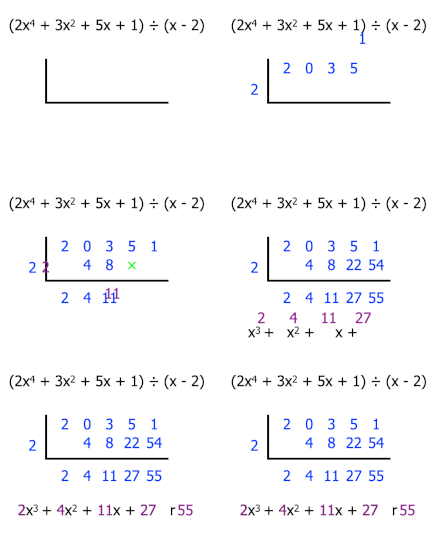
waxen hollow
i need help with this question
ive done the synthetic division correct
but the answer is mine but multiply by 1/3
except for the remainder

under is the correct answer
 coral jewel
you might want to use expansion synthetic division for non-monic polynomial divisor
coral jewel
waxen hollow
non monic?
the leading coefficient of the divisor is not 1
waxen hollow
word but i just seen a video of a guy just using a fraction
coral jewel
the usual synthetic division only works on monic divisor like x-1 or x+3
waxen hollow
i used 1/3
coral jewel
but for 3x-1, there are nuances
waxen hollow
ok ill have a look at what expansion synthetic division is
 waxen hollow
o my bad
coral jewel
In algebra, synthetic division is a method for manually performing Euclidean division of polynomials, with less writing and fewer calculations than long division.
It is mostly taught for division by linear monic polynomials (known as Ruffini's rule), but the method can be generalized to division by any polynomial.
The advantages of synthetic div...
waxen hollow
wait
coral jewel
refer to Expanded synthetic division - For non-monic divisors section
waxen hollow
can the remainder be rewritten as 27/(55(x-2))
or is it 55/x-2
@coral jewel thanks solved it
just one more question
can you factorise x^2-1 out of an equation with synthetic division
cedar kilnBOT
@waxen hollow Has your question been resolved?
cedar kilnBOT
Channel closed
Closed due to timeout
Use .reopen if this was a mistake.
Available help channel!
Send your question here to claim the channel.
Remember:
• Ask your math question in a clear, concise manner.
• Show your work, and if possible, explain where you are stuck.
• After 15 minutes, feel free to ping <@&286206848099549185>.
• Type the command .close to free the channel when you're done.
• Be polite and have a nice day!
Read #❓how-to-get-help for further information on how to ask a good question, and about conduct in the question channels.
 small cloak
no idea on how to solve this
 cedar kilnBOT
small cloak
no idea on how to solve this
cedar kilnBOT
small cloak
no idea on how to solve this
 slow jewel
Try finding the slope at the point given
And then use the point slope form to find the equation of the line
slow jewel
Correct
slow jewel
Yeah
That's the slope
Now you have a point and you have a slope
So find the equation of the line
slow jewel
I just realised, if you know the y=mx+c form then calculation is a bit easier ig
So, do you?
small cloak
yes
slow jewel
Cool
small cloak
y=e^k x + 1/2
small cloak
still idk how to solve
slow jewel
This line also passes through the point k,e^k
small cloak
so e^k = ke^k+1/2?
slow jewel
Yeah
slow jewel
Np
small cloak
what about htis

no idea on how to determine it
what i can infer is that f(t) is h'(x)
slow jewel
Gimme a min
h(2) would be the area under the graph of f(x) from 0 to 2
From the figure it's clear that the area will have some value >0
h'(2)=f(2)
And h"(x)=f'(x), f'(x) tells us if the graph is increasing or decreasing at a point
small cloak
slow jewel
And h"(x)=f'(x), f'(x) tells us if the graph is increasing or decreasing at a po...
i do not understand this
slow jewel
If its decreasing it's value will be less than 0 and if it's increasing its greater than 0 at that point
slow jewel
small cloak
i do not understand this
I just differentiated both sides of the equality h'(x)=f(x)
small cloak
i agree that h'(x) = f(x)
small cloak
sorry yes
slow jewel
I mean under the curve
small cloak
what do i do now after i have these information
slow jewel
You have some idea of the value of h(2), it's sign and magnitude
slow jewel
small cloak
i agree that h'(x) = f(x)
From here
small cloak
ok but how can i determine its value
small cloak
0
slow jewel
Correct
small cloak
so h(x) > h'(x)
slow jewel
Yup
small cloak
now h''(x), how do i determine that
slow jewel
h"(x)=f'(x)
small cloak
yes
slow jewel
f'(x) gives us the slope and also tells us if the curve is increasing or decreasing at a point
small cloak
yes
slow jewel
If you look at the graph then it's approaching a minima between x=2 and 3
slow jewel
You don't need to
But if it's approaching a minima, it's decreasing isn't it
The graph I mean
small cloak
yes but my arguement is that , dont we find minimas on the f'(x) graph
it doesnt make sense to me to find minimas in the g(x) graph
slow jewel
If we have info about f'(x), we have info about minimas and maximas about f(x)
And vice versa
You use the derivative of a graph to find turning points of the same graph
slow jewel
It's alright, all I meant was that it's approaching a value lesser than what it is at x=2
So that means it should be decreasing
And if it's decreasing then f'(x) should be less than 0(at that point)
small cloak
kk thanks alot
slow jewel
Np
cedar kilnBOT
@small cloak Has your question been resolved?
Channel closed
Closed by @small cloak
Use .reopen if this was a mistake.
Available help channel!
Send your question here to claim the channel.
Remember:
• Ask your math question in a clear, concise manner.
• Show your work, and if possible, explain where you are stuck.
• After 15 minutes, feel free to ping <@&286206848099549185>.
• Type the command .close to free the channel when you're done.
• Be polite and have a nice day!
Read #❓how-to-get-help for further information on how to ask a good question, and about conduct in the question channels.
 brisk dirge
do you know formula to get length of an arc
 twilit sage
hi, i really have small time and need someone to solv this with paint
i have to send this to my teacher fast

 twilit sage
after i send this to teacher i can learn
brisk dirge
use the arc length formula to get angle of that given sector
twilit sage
but i have small time
brisk dirge
then plug it in area formula
twilit sage
yes please...
 unique valley
brisk dirge
unique valley
brisk dirge
find theta using this
10=theta/360* 2pi* 5
and plug theta in area of sector formula
twilit sage
yes sure but i am on phone and need someone to solve this on paint with PC
 opaque root
Yes sure
unique valley
twilit sage
yes sure but i am on phone and need someone to solve this on paint with PC
its not our problem
slow jewel
I've never seen the word paint so many times in a day before
brisk dirge
maths on paint is crazy
opaque root
Let me help you out.
- Tell your teacher you didn’t study so you don’t know how to solve it.
- Get wrecked.
- Study for the next time.
cedar kilnBOT
Channel closed
Channel closed due to the original message being deleted.
If you did not intend to do this, please open a new help channel,
as this action is irreversible, and this channel may abruptly lock.
cedar kilnBOT
Available help channel!
Send your question here to claim the channel.
Remember:
• Ask your math question in a clear, concise manner.
• Show your work, and if possible, explain where you are stuck.
• After 15 minutes, feel free to ping <@&286206848099549185>.
• Type the command .close to free the channel when you're done.
• Be polite and have a nice day!
Read #❓how-to-get-help for further information on how to ask a good question, and about conduct in the question channels.
 tight vigil
can someone explain what to do here?
 cedar kilnBOT
tight vigil
can someone explain what to do here?
cedar kilnBOT
tight vigil
can someone explain what to do here?
@tight vigil Has your question been resolved?
 runic garnet
isnt it just: u have f(q_1, q_2), and set f(q_1,q_2) = f(12,1.5)?
then b is just solving for q2
then just graph just like youd graph any x,y graph for c
then set q2 = 16, solve for q1, and mark that point for d
idk, maybe thats right, maybe its not
cedar kilnBOT
@tight vigil Has your question been resolved?
tight vigil
runic garnet
then set q2 = 16, solve for q1, and mark that point for d
oh ok
yeah that's right
lmao
ty
cedar kilnBOT
Channel closed
Closed by @tight vigil
Use .reopen if this was a mistake.
Available help channel!
Send your question here to claim the channel.
Remember:
• Ask your math question in a clear, concise manner.
• Show your work, and if possible, explain where you are stuck.
• After 15 minutes, feel free to ping <@&286206848099549185>.
• Type the command .close to free the channel when you're done.
• Be polite and have a nice day!
Read #❓how-to-get-help for further information on how to ask a good question, and about conduct in the question channels.
 hoary dagger
hi guys, is this alright? or i did something wrong with the process
 hoary dagger
i can make tan^4 into tan^2 × tan^2? i thought you can only do that with addition and subtraction
like this
 wraith daggerBOT
FungusDesu MSC2020 34A05


 coral jewel
yes i believe so
hoary dagger
okay thank youuuuu very much
cedar kilnBOT
@hoary dagger Has your question been resolved?
Channel closed
Closed by @hoary dagger
Use .reopen if this was a mistake.
Available help channel!
Send your question here to claim the channel.
Remember:
• Ask your math question in a clear, concise manner.
• Show your work, and if possible, explain where you are stuck.
• After 15 minutes, feel free to ping <@&286206848099549185>.
• Type the command .close to free the channel when you're done.
• Be polite and have a nice day!
Read #❓how-to-get-help for further information on how to ask a good question, and about conduct in the question channels.
 sharp cradle
Hello, help me to understand something about this trigonometric equation.
 cedar kilnBOT
sharp cradle
Hello, help me to understand something about this trigonometric equation.
sharp cradle
cedar kilnBOT
sharp cradle
Hello, help me to understand something about this trigonometric equation.
sharp cradle
According to my book the solutions are these, but I don't understand how he got to the last one.

 marsh lake
what is sen
marsh lake
the question is 2cos^2x + sinx = 2?
sharp cradle
marsh lake
the question is 2cos^2x + sinx = 2?
yes
marsh lake
sharp cradle
Hello, help me to understand something about this trigonometric equation.
Is this the solution
sharp cradle
marsh lake
Is this the solution
all my resolution, the solution set is the ultimate
sharp cradle
what XD
marsh lake
sharp cradle
all my resolution, the solution set is the ultimate
I dont understand what does this mean
sharp cradle
I don't understand what the confusion is
sharp cradle
marsh lake
I dont understand what does this mean
I came to the conclusion that these are the solutions

but according to the book these are
 marsh lake
Oh
marsh lake
sharp cradle
i THINK its a factorization
sharp cradle
marsh lake
i THINK its a factorization
what is factored and how?
cedar kilnBOT
@sharp cradle Has your question been resolved?
sharp cradle
?
delicate elm
If n is odd, then (-1)^n pi/6 + n*pi would give 5pi/6 + 2kpi. If n is even it gives pi/6 + 2kpi
sharp cradle
delicate elm
If n is odd, then (-1)^n pi/6 + n*pi would give 5pi/6 + 2kpi. If n is even it gi...
I don't quite understand, if n is even, it is (pi/6) and if it is odd, it is -(pi/6).
delicate elm
Which part do you not get?
sharp cradle
delicate elm
Which part do you not get?
why if n is odd it would give 5pi/6 + 2kpi and if n is even it would give pi/6 + 2kpi?
delicate elm
Let’s say n is odd, so write n=2k+1
(-1)^(2k+1) pi/6 + (2k+1)pi
= (-1) pi/6 + pi + 2kpi
= 5pi/6 + 2kpi
If n is even, write n=2k
(-1)^(2k) pi/6 + (2k)pi
= (1) pi/6 + 2kpi
= pi/6 + 2kpi
sharp cradle
delicate elm
Let’s say n is odd, so write n=2k+1
(-1)^(2k+1) pi/6 + (2k+1)pi
= (-1) pi/6 + pi...
Now I understand, I only have one doubt, how is it easy to realize in this case that the solution can be written in this way?
delicate elm
it is not easy to realize and I would not write it in that way
i think any teacher would accept what you wrote
cedar kilnBOT
Channel closed
Closed by @sharp cradle
Use .reopen if this was a mistake.
cedar kilnBOT
Available help channel!
Send your question here to claim the channel.
Remember:
• Ask your math question in a clear, concise manner.
• Show your work, and if possible, explain where you are stuck.
• After 15 minutes, feel free to ping <@&286206848099549185>.
• Type the command .close to free the channel when you're done.
• Be polite and have a nice day!
Read #❓how-to-get-help for further information on how to ask a good question, and about conduct in the question channels.
 hot citrus
 cedar kilnBOT
hot citrus
hot citrus
cedar kilnBOT
hot citrus
hot citrus
pls can you go through it step by step for me?
 violet flume
which part are you confused about?
hot citrus
idk where to start
delicate elm
Assume there are a finite number of primes p1, p2, p3,…, pk. Your goal is to create a new prime to contradict this statement
violet flume
yes this is the contradiction
you start by contradiction right
so assume there are finitely many
hot citrus
ok
violet flume
then we can write them as p1, p2, ..., pk like ryan says
hot citrus
ok
violet flume
theres a pretty important lemma but a lot of people have seen it by this point
although theres a lot of ways to do this
to me the easiest way is to first prove that two consecutive numbers are coprime
hot citrus
ok
violet flume
now use this fact
hot citrus
im stuck after that
violet flume
whatd you try
violet flume
its meaningless to say you are stuck because this is exactly how euclids proof proceeds
so you can just google this
no offense
itd be more helpful if you can point to a specific step you are confused about
hot citrus
ok lemme try again and ill let you know
violet flume
Euclid's theorem is a fundamental statement in number theory that asserts that there are infinitely many prime numbers. It was first proven by Euclid in his work Elements. There are several proofs of the theorem.
 late lotus
https://brilliant.org/wiki/infinitely-many-primes/
proofs done by various mathematicians
violet flume
most proofs youll find implicitly use consecutive numbers are coprime without saying it
so its important to understand that its true before you go searching
cedar kilnBOT
@hot citrus Has your question been resolved?
cedar kilnBOT
Channel closed
Closed due to timeout
Use .reopen if this was a mistake.
Available help channel!
Send your question here to claim the channel.
Remember:
• Ask your math question in a clear, concise manner.
• Show your work, and if possible, explain where you are stuck.
• After 15 minutes, feel free to ping <@&286206848099549185>.
• Type the command .close to free the channel when you're done.
• Be polite and have a nice day!
Read #❓how-to-get-help for further information on how to ask a good question, and about conduct in the question channels.
lyric narwhal
Find y where $$y’=\frac{1-2y-\sin^2(x^2 y)}{x}$$
wraith daggerBOT
kheerii
 lyric narwhal
I substituted $v=x^2 y$ and after simplifying I got the equation $$v’=x\cos^2 v$$, which is separable
wraith daggerBOT
kheerii
 lyric narwhal
So I got $$\tan(x^2y)=\frac1{2}x^2+C$$ but I think there are more solutions here
wraith daggerBOT
kheerii
