#help-13
1 messages · Page 259 of 1
 unique valley
 left bison
is this right?
 unique valley
it is
left bison
unique valley
great, now find the maximum of this function
alrr
unique valley
unique valley
great, now find the maximum of this function
by comparing f'(x)=0 first
you know how i hope
and write the sol. for x in terms of a
 cedar kilnBOT
Channel closed
Closed due to timeout
Use .reopen if this was a mistake.
left bison
.reopen
cedar kilnBOT
✅
cedar kilnBOT
@left bison Has your question been resolved?
left bison
srry its taking me a while
getting distracted
wait

this is what I did
I based it on an example shown to me
but I honestly dont get the relation with all that solving
I mean I get some
but
not entirely
cedar kilnBOT
@left bison Has your question been resolved?
Channel closed
Closed by @left bison
Use .reopen if this was a mistake.
 Available help channel!
Send your question here to claim the channel.
Remember:
• Ask your math question in a clear, concise manner.
• Show your work, and if possible, explain where you are stuck.
• After 15 minutes, feel free to ping <@&286206848099549185>.
• Type the command .close to free the channel when you're done.
• Be polite and have a nice day!
Read #❓how-to-get-help for further information on how to ask a good question, and about conduct in the question channels.
 hardy swift
So i understand math but i dont see a clear connection with the negative ones like i do with the ones that are positive
 cedar kilnBOT
hardy swift
So i understand math but i dont see a clear connection with the negative ones li...
hardy swift
cedar kilnBOT
hardy swift
So i understand math but i dont see a clear connection with the negative ones li...
hardy swift
And i do understand how for example * and / are each others opposite though
 surreal hemlock
uh can you phrase your question more clearly?
what is it you need help understanding?
hardy swift
how are -, / and sqrt connected. It doesnt seem to be as simple as how 2+2+2 = 23, and 22*2=2 to the power of 3
 silent steeple
So you understand how do +, * and powers work, but you need an explanation on how do -, / and roots work? You need the explanation of how do opposite operations work?
cedar kilnBOT
Channel closed
Closed by @hardy swift
Use .reopen if this was a mistake.
cedar kilnBOT
Available help channel!
Send your question here to claim the channel.
Remember:
• Ask your math question in a clear, concise manner.
• Show your work, and if possible, explain where you are stuck.
• After 15 minutes, feel free to ping <@&286206848099549185>.
• Type the command .close to free the channel when you're done.
• Be polite and have a nice day!
Read #❓how-to-get-help for further information on how to ask a good question, and about conduct in the question channels.
 crimson sedge
I need help with calc 1 work
cedar kilnBOT
crimson sedge
I need help with calc 1 work
crimson sedge

this is the problem ik the answer is supposed to be 1.5 but i having trouble trying to find that answer with the limit definition
and the f(x)=3/x with the lim = 0
if more is needed i can provide
<@&286206848099549185>
 patent badger
The limit definition is calculating the derivative, but the table is just the function
crimson sedge
so would the answe be -3/4
shouldn't the derivative be close to the answer on the table which is 1.5
patent badger
No the table is just finding 3/x
You can plug in 2 there just fine
Ur mixing up derivatives and discontinuities i think
But yeah -3/4 sounds right for the derivative i think, dont quote me on that though
cedar kilnBOT
Channel closed
Closed by @quick tundra
Use .reopen if this was a mistake.
Available help channel!
Send your question here to claim the channel.
Remember:
• Ask your math question in a clear, concise manner.
• Show your work, and if possible, explain where you are stuck.
• After 15 minutes, feel free to ping <@&286206848099549185>.
• Type the command .close to free the channel when you're done.
• Be polite and have a nice day!
Read #❓how-to-get-help for further information on how to ask a good question, and about conduct in the question channels.
 high dawn
 high dawn
note that z* is the complex conjugate of z
and that z and w are complex numbers
I tried substituting but it I don’t work
unique valley
whats the question?
high dawn
solve for w and z
 slow jewel
high dawn
I tried substituting but it I don’t work
slow jewel
high dawn
I tried substituting but it I don’t work
Could u show your work?
unique valley
did you try w = a+bi z=c+di?
high dawn
hmm, no
 inland ocean
Is that 5 + 5i
unique valley
you just get 4 linear equation from that
slow jewel
Yes
inland ocean
And 2i
unique valley
for a,b,c,d
slow jewel
unique valley
you just get 4 linear equation from that
From 1st one you can get w*/z*= -2i and then sub in the second one
high dawn
I get it now
unique valley
i think both are fine
high dawn
.close
cedar kilnBOT
Channel closed
Closed by @high dawn
Use .reopen if this was a mistake.
cedar kilnBOT
Available help channel!
Send your question here to claim the channel.
Remember:
• Ask your math question in a clear, concise manner.
• Show your work, and if possible, explain where you are stuck.
• After 15 minutes, feel free to ping <@&286206848099549185>.
• Type the command .close to free the channel when you're done.
• Be polite and have a nice day!
Read #❓how-to-get-help for further information on how to ask a good question, and about conduct in the question channels.
 pseudo merlin
hi
cedar kilnBOT
pseudo merlin
hi

 smoky idol
All of them or only some of them?
smoky idol
Well, those letters read a statement, and they‘re asking you to find a pair (x,y) such that the statement becomes false
smoky idol
Yes
smoky idol
And backwards E means "there exists"
smoky idol
pseudo merlin
there exists
Exactly
 livid hound
upside down A
backwards E
pseudo merlin
smoky idol
Well, those letters read a statement, and they‘re asking you to find a pair (x,y...
how
is it
this chapter

 pseudo merlin
pseudo merlin
pseudo merlin
is it saying for all x belongs to an integer and there exists y belongs to an integer
smoky idol
Such that 2xy = 24
pseudo merlin
can i just be like 2(3)(2) does not equal 24
smoky idol
It‘s fairly easy to disprove when you think about it. First you can divide both sides by 2 for convenience, but then, it‘s saying: for all integers X, you can find an integer y such that xy = 12. that‘s obviously not true, otherwise 12 would have an infinite amount of factors
smoky idol
pseudo merlin
can i just be like 2(3)(2) does not equal 24
Yeah pretty much
livid hound
pseudo merlin
can i just be like 2(3)(2) does not equal 24
no
livid hound
choosing 3 for x
2 * 3 y = 24
there does indeed exist a integer value for y that results in 24
smoky idol
Oh I just read what they sent didn‘t compute. Oop
livid hound
for your counterexample, you'd want to find a value of x where you can't get an integer value for y that works
pseudo merlin
if its not an integer or something
for all
maybe lets say
if x=24
y has to be 1/2
wait im confused again
livid hound
yeh that works
livid hound
because 1/2 isn't an integer
livid hound
many many counterexamples
smoky idol
Because you just disproved the fact that for all integers X, there exists an integer Y such that xy = 12
pseudo merlin
smoky idol
Because you just disproved the fact that for all *integers* X, there exists an *...
why such that xy=12
livid hound
2xy = 24 simplifies to xy = 12
livid hound
for your counterexample, you'd want to find a value of x where you can't get an integer value for y that works
pseudo merlin
oh
i hate math
i rmb in this server i was asking how to prove similar triangles
and now im doing this
i hate life

.close
cedar kilnBOT
Channel closed
Closed by @pseudo merlin
Use .reopen if this was a mistake.
cedar kilnBOT
Available help channel!
Send your question here to claim the channel.
Remember:
• Ask your math question in a clear, concise manner.
• Show your work, and if possible, explain where you are stuck.
• After 15 minutes, feel free to ping <@&286206848099549185>.
• Type the command .close to free the channel when you're done.
• Be polite and have a nice day!
Read #❓how-to-get-help for further information on how to ask a good question, and about conduct in the question channels.
 ivory finch
Bob's tiktoks viralize with 10% chance. Model by X~Ber(0.10).
Note that Y represents the total number of viral Tiktoks.
 cedar kilnBOT
ivory finch
Bob's tiktoks viralize with 10% chance. Model by X~Ber(0.10).
Note that Y repres...
cedar kilnBOT
ivory finch
Bob's tiktoks viralize with 10% chance. Model by X~Ber(0.10).
Note that Y repres...
@ivory finch Has your question been resolved?
ivory finch
<@&286206848099549185>
cedar kilnBOT
@ivory finch Has your question been resolved?
 azure horizon
ivory finch
Bob's tiktoks viralize with 10% chance. Model by X~Ber(0.10).
Note that Y repres...
azure horizon
ivory finch
Bob's tiktoks viralize with 10% chance. Model by X~Ber(0.10).
Note that Y repres...
what have you tried
cedar kilnBOT
@ivory finch Has your question been resolved?
cedar kilnBOT
Channel closed
Closed due to timeout
Use .reopen if this was a mistake.
cedar kilnBOT
Available help channel!
Send your question here to claim the channel.
Remember:
• Ask your math question in a clear, concise manner.
• Show your work, and if possible, explain where you are stuck.
• After 15 minutes, feel free to ping <@&286206848099549185>.
• Type the command .close to free the channel when you're done.
• Be polite and have a nice day!
Read #❓how-to-get-help for further information on how to ask a good question, and about conduct in the question channels.
 crystal pendant
yo
cedar kilnBOT
crystal pendant
yo
crystal pendant
can i have some help
this is the question:

and I arrived at parametric equations
and a plane equation
however I am confused about how to check if they intersect because one equation is in t while the other involves three separate coordinates satisfying (x-1)-(y-0)-(z-1)=0
so how does checking if one point satisfies the equation going to prove that it doesnt intersect if there is no such t
would I just check a point on the plane other than the one i used to make the equation?
because i'm just confused as thats a single point
of infinite on the plane
and unlike with two lines or something
azure horizon
crystal pendant
however I am confused about how to check if they intersect because one equation ...
you can probably make the first equation in x, y, z also
instead of t
 crystal pendant
but thats not how we were told to do circles
crystal pendant
shoot
crystal pendant
im sorry i can ask my prof i do appreciate the help
azure horizon
so take any t
crystal pendant
that was acc mean asf
azure horizon
then the point will be (5cos(t)+2), 2, 5sin(t)+2)
assuming you've worked that out right
so then you plug that into the plane equation
crystal pendant
yes
azure horizon
and see if it's ever true
crystal pendant
but how many ts should i test?
azure horizon
you don't test any specific t
you have an equation in t
you can solve it
(5cos(t)+2), 2, 5sin(t)+2) could be any point on the circle, depending on t
so if any of these points satisfy the plane equation, there's an intersection
otherwise there's no intersection
so if (5cos(t) + 2 - 1) - (2) + (5sin(t) + 2 - 1) = 0 has any solutions, there's an intersection
otherwise there isn't
do you see how i got there
cedar kilnBOT
@crystal pendant Has your question been resolved?
cedar kilnBOT
Channel closed
Closed due to timeout
Use .reopen if this was a mistake.
Available help channel!
Send your question here to claim the channel.
Remember:
• Ask your math question in a clear, concise manner.
• Show your work, and if possible, explain where you are stuck.
• After 15 minutes, feel free to ping <@&286206848099549185>.
• Type the command .close to free the channel when you're done.
• Be polite and have a nice day!
Read #❓how-to-get-help for further information on how to ask a good question, and about conduct in the question channels.
 nova snow
 nova snow
can someoen walk me through how to solve this please
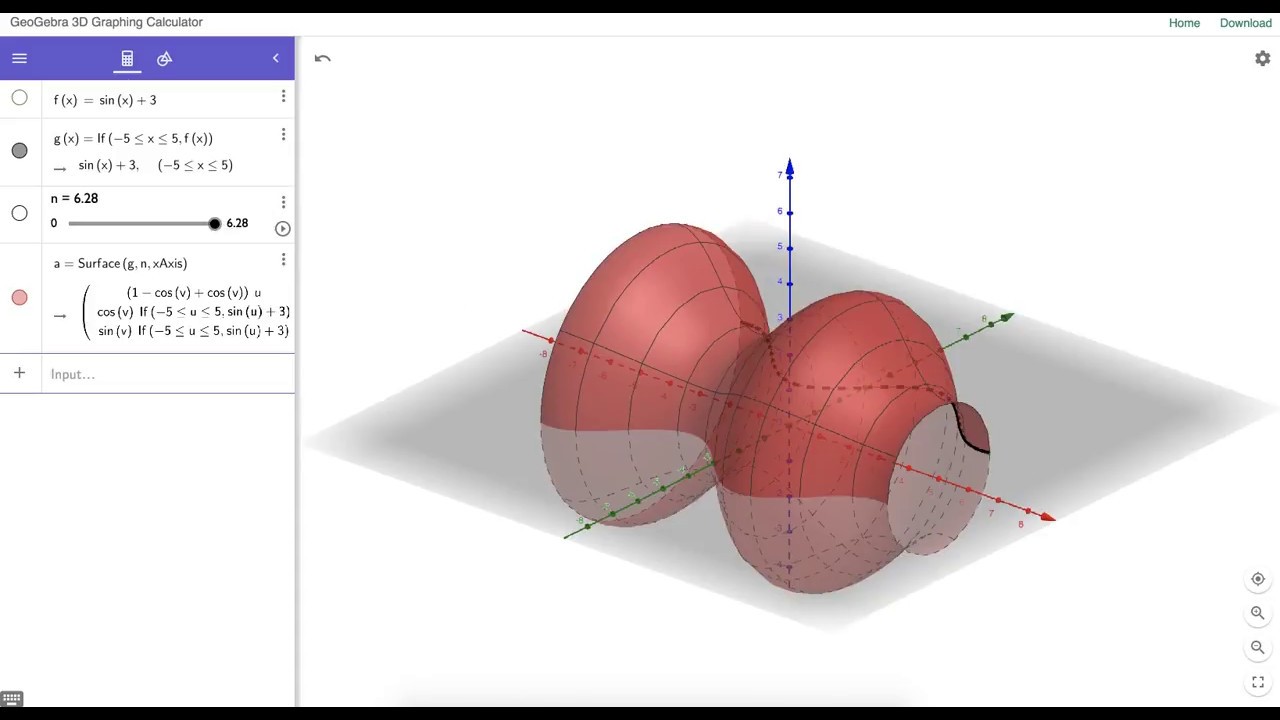
 dusky peak
the way i would set it up is similar to the shell method
let's say f(x) looks like this

then we can slice the surface area into rings
rings with circumference 2 pi r, where r is f(x)
do you see what the area of such a small slice would be?
dusky peak
the function, yes
the 3d shape, yes but i dont know how, maybe i can find it out
 dusky peak
ok i got it to graph in geogebra
but it's really laggy

now to get the surface area, we can slice it into these rings

this red ring has a radus of f(x)
and the area can be approximated as it's circumference times width
we are assuming it to be a hollow cylinder pretty much
which is ok because the width will be very small
this approximation becomes reality when the width get's arbitrarily small
as to how to graph it, i followed this tutorial: https://www.youtube.com/watch?v=dkF7edNwt3M
 cedar kilnBOT
@nova snow Has your question been resolved?
cedar kilnBOT
Channel closed
Closed due to timeout
Use .reopen if this was a mistake.
Available help channel!
Send your question here to claim the channel.
Remember:
• Ask your math question in a clear, concise manner.
• Show your work, and if possible, explain where you are stuck.
• After 15 minutes, feel free to ping <@&286206848099549185>.
• Type the command .close to free the channel when you're done.
• Be polite and have a nice day!
Read #❓how-to-get-help for further information on how to ask a good question, and about conduct in the question channels.
crimson sedge
Yo what did I do wrong here…?
 cedar kilnBOT
crimson sedge
Yo what did I do wrong here…?
cedar kilnBOT
crimson sedge
Yo what did I do wrong here…?
 kind snow
look carefully at g(x)
crimson sedge
I missed the square…
I always make silly mistakes like this… idk how and why
With these types of questions… is there a way for me to confirm/check my answr afterwards by plugging my answr back in or something like that?
kind snow
not unless u use the computer
crimson sedge
So you can’t plug things back in to check?
I like to double check my answers while writing tests
kind snow
what do u wanna plug?
crimson sedge
Like idk..
kind snow
the same thing u manually calculated?
crimson sedge
I want to double check my answr
crimson sedge
Like you how with certain types of questions you can plug ur x val back in…. Can I do this here ?
kind snow
there is nothing bad about having things wrong
kind snow
crimson sedge
Like you how with certain types of questions you can plug ur x val back in…. Can...
what?
crimson sedge
Nvm
And this is answr key
Does it matter that my x^2 and x are in opposite places
.close
cedar kilnBOT
Channel closed
Closed by @waxen hound
Use .reopen if this was a mistake.
cedar kilnBOT
Available help channel!
Send your question here to claim the channel.
Remember:
• Ask your math question in a clear, concise manner.
• Show your work, and if possible, explain where you are stuck.
• After 15 minutes, feel free to ping <@&286206848099549185>.
• Type the command .close to free the channel when you're done.
• Be polite and have a nice day!
Read #❓how-to-get-help for further information on how to ask a good question, and about conduct in the question channels.
 elder abyss
Hi, anyone can explain me how to solve a matrix 3x3 using theorem of cramer?
 cedar kilnBOT
elder abyss
Hi, anyone can explain me how to solve a matrix 3x3 using theorem of cramer?
elder abyss
cedar kilnBOT
elder abyss
Hi, anyone can explain me how to solve a matrix 3x3 using theorem of cramer?
elder abyss
i know when its a 2x2 you need to first calculate if you can do C-1, but if you can do it, how? (1 2 / 0 1) will be (1 1 / -2 -0) (i know 0 cant be - but only using it for the example) so how can i do that with a 2x2? Sorry for the hard explaining
<@&286206848099549185>
cedar kilnBOT
@elder abyss Has your question been resolved?
cedar kilnBOT
@elder abyss Has your question been resolved?
cedar kilnBOT
@elder abyss Has your question been resolved?
elder abyss
any1?
 plush yarrow
elder abyss
any1?
plush yarrow
elder abyss
any1?
To solve a system of linear equations using Cramer's Theorem, you need to have a matrix equation of the form ( AX = B ), where ( A ) is the coefficient matrix, ( X ) is the column matrix of variables, and ( B ) is the column matrix of constants. Cramer's Theorem can only be applied if the coefficient matrix ( A ) is a square matrix (same number of rows and columns) and has a non-zero determinant.
 wraith daggerBOT
Flamey

Flamey
Compile Error! Click the  reaction for more information.
(You may edit your message to recompile.)

Flamey
 cedar kilnBOT
@elder abyss Has your question been resolved?
elder abyss
plush yarrow
To solve a system of linear equations using Cramer's Theorem, you need to have a...
the next step is to calculate the Inverse, how do you calculate that in a 3x3.
 tribal kite
elder abyss
the next step is to calculate the Inverse, how do you calculate that in a 3x3.
tribal kite
elder abyss
the next step is to calculate the Inverse, how do you calculate that in a 3x3.
Extend the matrix
Like
 cedar kilnBOT
Channel closed
Closed due to timeout
Use .reopen if this was a mistake.
cedar kilnBOT
Available help channel!
Send your question here to claim the channel.
Remember:
• Ask your math question in a clear, concise manner.
• Show your work, and if possible, explain where you are stuck.
• After 15 minutes, feel free to ping <@&286206848099549185>.
• Type the command .close to free the channel when you're done.
• Be polite and have a nice day!
Read #❓how-to-get-help for further information on how to ask a good question, and about conduct in the question channels.
 pseudo trellis
How would I even start this problem? We certainly did not talk about this in class 😂
 cedar kilnBOT
pseudo trellis
How would I even start this problem? We certainly did not talk about this in cla...
cedar kilnBOT
pseudo trellis
How would I even start this problem? We certainly did not talk about this in cla...
 dire geode
pseudo trellis
How would I even start this problem? We certainly did not talk about this in cla...
dire geode
pseudo trellis
How would I even start this problem? We certainly did not talk about this in cla...
Differentiate piecewise
pseudo trellis
Do I just use the power rule on basically all of them to get the answer?
so -2x-8 would be -2
but not sure what the domain has to do with any of them
dire geode
pseudo trellis
but not sure what the domain has to do with any of them
They stay unchanged
pseudo trellis
so like what's the point of them being there when i've never seen them before?
just to kinda confuse us? 😂
just to make sure
-2
-4x
-4
0
are the answers?
dire geode
pseudo trellis
just to kinda confuse us? 😂
No they're part of the function
dire geode
pseudo trellis
just to make sure
-2
-4x
-4
0
are the answers?
No you're missing the domain of the function
pseudo trellis
dire geode
No you're missing the domain of the function
so I have to write
-2 -5 <= x <= -2
-4x -2<x<=1
-4 1<x<=2
0 2<x<=5
neater than that in LaTeX, but that's the gist?
dire geode
Yea
 dire geode
No
dire geode
pseudo trellis
How would I even start this problem? We certainly did not talk about this in cla...
Format should look like the function
pseudo trellis
oh
dire geode
pseudo trellis
Not individually
pseudo trellis
got it, so kinda copy what the original function is with v'(x)?
lemme write it up in LaTeX, hold up
wraith daggerBOT
Someone

 spice kraken
@pseudo trellis I think the derivative is not defined at x = -2 and 2
pseudo trellis
could you explain that a bit further? sorry
cedar kilnBOT
@pseudo trellis Has your question been resolved?
pseudo trellis
wait, so which ones are wrong?
spice kraken
the domains should be -5<=x<-2 and 1<x<2 respectively
pseudo trellis
They are, no?
wraith daggerBOT
Someone
 pseudo trellis
I'm confused :P
cedar kilnBOT
@pseudo trellis Has your question been resolved?
cedar kilnBOT
@pseudo trellis Has your question been resolved?
crimson sedge
wraith dagger
**Someone**

 crimson sedge
who is gona help
crimson sedge
crimson sedge
who is gona help
what the problem?
cedar kilnBOT
@pseudo trellis Has your question been resolved?
cedar kilnBOT
Channel closed
Closed due to timeout
Use .reopen if this was a mistake.
Available help channel!
Send your question here to claim the channel.
Remember:
• Ask your math question in a clear, concise manner.
• Show your work, and if possible, explain where you are stuck.
• After 15 minutes, feel free to ping <@&286206848099549185>.
• Type the command .close to free the channel when you're done.
• Be polite and have a nice day!
Read #❓how-to-get-help for further information on how to ask a good question, and about conduct in the question channels.
crimson sedge
.close
 dapper mirage
 cedar kilnBOT
dapper mirage
dapper mirage
cedar kilnBOT
dapper mirage
dapper mirage
Can anyone help me out with the shape of these contours?
I don’t really see how each of these contour give a different shape,
cedar kilnBOT
@dapper mirage Has your question been resolved?
Channel closed
Closed due to timeout
Use .reopen if this was a mistake.
cedar kilnBOT
Available help channel!
Send your question here to claim the channel.
Remember:
• Ask your math question in a clear, concise manner.
• Show your work, and if possible, explain where you are stuck.
• After 15 minutes, feel free to ping <@&286206848099549185>.
• Type the command .close to free the channel when you're done.
• Be polite and have a nice day!
Read #❓how-to-get-help for further information on how to ask a good question, and about conduct in the question channels.
slow jewel
I got |am|<=1 and |bn|<=1 but can't proceed after that
 wraith daggerBOT
Lorentz
 cedar kilnBOT
Channel closed
Closed by @slow jewel
Use .reopen if this was a mistake.
cedar kilnBOT
Available help channel!
Send your question here to claim the channel.
Remember:
• Ask your math question in a clear, concise manner.
• Show your work, and if possible, explain where you are stuck.
• After 15 minutes, feel free to ping <@&286206848099549185>.
• Type the command .close to free the channel when you're done.
• Be polite and have a nice day!
Read #❓how-to-get-help for further information on how to ask a good question, and about conduct in the question channels.
 long fiber
who knows physics pls dm me
cedar kilnBOT
long fiber
who knows physics pls dm me
 rustic fable
Help to calculate this integral
 cedar kilnBOT
@long fiber Has your question been resolved?
cedar kilnBOT
@long fiber Has your question been resolved?
cedar kilnBOT
Channel closed
Closed due to timeout
Use .reopen if this was a mistake.
Available help channel!
Send your question here to claim the channel.
Remember:
• Ask your math question in a clear, concise manner.
• Show your work, and if possible, explain where you are stuck.
• After 15 minutes, feel free to ping <@&286206848099549185>.
• Type the command .close to free the channel when you're done.
• Be polite and have a nice day!
Read #❓how-to-get-help for further information on how to ask a good question, and about conduct in the question channels.
 pliant oxide
How would I find the answer to this?
 cedar kilnBOT
pliant oxide
How would I find the answer to this?
pliant oxide
cedar kilnBOT
pliant oxide
How would I find the answer to this?
pliant oxide
I tried finding the derivative of x and using critical points to see where the intervals were increasing, but that didnt seem to work
i mean f(x) not x
 drifting marlin
what's f(x)?
drifting marlin
but you're asked to find where g is increasing
why are you looking at the derivative of something that isn't g?
pliant oxide
so how do I find it
drifting marlin
the same way you find where any other continuous function is increasing
take the derivative of g and see where it's >0
pliant oxide
finding the derivative of g would be finding the derivative of the inside as well
and then finding critical points no?
drifting marlin
pliant oxide
finding the derivative of g would be finding the derivative of the inside as wel...
no it would not
recall the fundamental theorem of calculus
 minor crystal
use ftc-1 to find the derivative of g
drifting marlin
thank you kanna but i'll be fine on my own
pliant oxide
drifting marlin
recall the fundamental theorem of calculus
sin(x-pi/2)
ohh then i find critical points
i see
drifting marlin
better
minor crystal
drifting marlin
thank you kanna but i'll be fine on my own
 okay sorry
cedar kilnBOT
@pliant oxide Has your question been resolved?
cedar kilnBOT
Channel closed
Closed due to timeout
Use .reopen if this was a mistake.
Available help channel!
Send your question here to claim the channel.
Remember:
• Ask your math question in a clear, concise manner.
• Show your work, and if possible, explain where you are stuck.
• After 15 minutes, feel free to ping <@&286206848099549185>.
• Type the command .close to free the channel when you're done.
• Be polite and have a nice day!
Read #❓how-to-get-help for further information on how to ask a good question, and about conduct in the question channels.
crimson sedge
 cedar kilnBOT
crimson sedge
crimson sedge
cedar kilnBOT
crimson sedge
crimson sedge
I understand why they've turned this into a piecewise function
but how come the bottom piece has -4 included?
 weary thistle
So we have an absolute value in our function right?
crimson sedge
yep
weary thistle
Well that's the one to determine the value of the function thats why we turn it into piece wise. So in one case the absolute value is positive and the other case its negative
The inside of the absolute value specifically
First case, x+4<0 so the absolute becomes -(x+4)
Second case, x+4≥0 so the absolute value is (x+4)
crimson sedge
but why
do they include
I'm confused why the first one didn't include -4
and the second did
weary thistle
Oh its the same thing if the problem you got doesn't specify where to put the equal
weary thistle
If the problem you got doesn't say where to put the equal you can either decide to put it for x<-4 or for x>-4
But are you sure it doesn't specify
crimson sedge
how are you allowed to do that
weary thistle
?
crimson sedge
 weary thistle
For x greater
weary thistle
weary thistle
For x greater
^
Thats what my teacher said well
Idk if you learn that any other way in uni
But usually my teacher said you put the equal for x greater
Wait, you want the function to be continuous?
crimson sedge
I'm checking if it's continuous
also there's nothing wrong with
two holes existing
i.e 2 unincluded values
it's just you can't (apparently) have two included values
in a piecewise
weary thistle
It depends where it came from
Pretty sure
Your initial function is a /
So |x+4|≠0
weary thistle
Even if you simplify the excluded values should still be there
weary thistle
crimson sedge
so I think based on can't equal zero you can't have an equals
I didn't get this
crimson sedge
or maybe one should and one shouldn't
crimson sedge
weary thistle
I didn't get this
so $x+4\neq0$
wraith daggerBOT
wyldinwilliam
 crimson sedge
$x\neq-4$
wraith daggerBOT
wyldinwilliam
 crimson sedge
there has to be an exclusion somewhere
which you achieved
but I'm curious why the flexibility
weary thistle
The function is also discontinuous at -4 btw
weary thistle
crimson sedge
but I'm curious why the flexibility
Wdym flexibility
crimson sedge
yeah
weary thistle
Well it should be the same thing thats why
Graphing wise
The function will still be discontinuous.
It will still not be defined at x=-4
Graphing wise, same thing
 weary thistle
You did graph your initial function
Im talking about the piecewise
You want to graph the piecewise, your problem is asking you thag
That*
crimson sedge
I think the proper way then to do the piecewise would be to not include any values because you would be saying that at a certain point either the left side or right side touches the asymptote
crimson sedge
so then how come the way this question is done they include -4?
weary thistle
Well I think a more proper way is to exclude -4 completely
If its not in the domain of the initial function
Then you should put it into the piecewise
crimson sedge
yeah, that's why I was skeptical when I saw the inclusion of it
weary thistle
Since it comes from this initial function
So a better thing would be to completely exclude -4
From the piecewise
crimson sedge
yup, going to ask my teacher about this
weary thistle
Due to the domain of the initial function
crimson sedge
weird they'd include it
weary thistle
crimson sedge
yup, going to ask my teacher about this
👍
Think im gonna ask mine too, bcz im a little confused as well haha
But thats probably it
weary thistle
You keep the domain of the initial function even if it simplifies
I think rhats it
crimson sedge
that makes sense, but I do remember doing questions where
that isn't the case
so curious why it is here
weary thistle
Example?
crimson sedge
uhh can't really pull one up but I've done piecewise examples where you actually do include the x value
just not with an absolute value like this one
where you actually had to come up with a piecewise
weary thistle
If the initial function is defined at the value then yes you include it
Its not defined in a value usually if you have /, √ or ln
(or in an Interval of values)
Like if you had f(x)=x|x-3|
Then the function would be defined everywhere
cedar kilnBOT
@crimson sedge Has your question been resolved?
cedar kilnBOT
@crimson sedge Has your question been resolved?
cedar kilnBOT
Channel closed
Closed due to timeout
Use .reopen if this was a mistake.
cedar kilnBOT
Available help channel!
Send your question here to claim the channel.
Remember:
• Ask your math question in a clear, concise manner.
• Show your work, and if possible, explain where you are stuck.
• After 15 minutes, feel free to ping <@&286206848099549185>.
• Type the command .close to free the channel when you're done.
• Be polite and have a nice day!
Read #❓how-to-get-help for further information on how to ask a good question, and about conduct in the question channels.
 sand cradle
Let $K$ be a field, $V$ a $K$-vector space and $\varphi: V \to V$ a linear mapping. Show that $\varphi(\varphi(v)) = \varphi(v) + v$ for all $v$ $\implies$ $\varphi$ bijective.
cedar kilnBOT
sand cradle
Let $K$ be a field, $V$ a $K$-vector space and $\varphi: V \to V$ a linear mappi...
sand cradle

Is there anything I need to know about linear mappings to prove this?
I haven't read about them yet
This is similar to what we did before @crimson gulch
 crimson gulch
There is maybe one theorem that can help you
crimson gulch
crimson gulch
There is maybe one theorem that can help you
but i think you can do without
sand cradle
$\varphi$ is injective if $\operatorname{Kern}(\varphi) = {0_V}$. So here, we have $\varphi(v) = \varphi(\varphi(v)) - v$ and that is $0_V$ when $\varphi(\varphi(v)) = v$. That was my first idea

We need to show that that holds
sand cradle
crimson gulch
There is maybe one theorem that can help you
Which one?
crimson gulch
bijective iff injective iff surjective since it s going from V to V
which has the same dimension
crimson gulch
so you only need to prove it is injective or surjective
sand cradle
So I can just show injective
crimson gulch
yeah
 crimson gulch
if you prove one you are done
 flint plinth
crimson gulch
bijective iff injective iff surjective since it s going from V to V
flint plinth
crimson gulch
bijective iff injective iff surjective since it s going from V to V
how do you know V is finite dimensional?
crimson gulch
oh yeah we dont
sand cradle
Ok, then we have to show both ig
flint plinth
for showing injectivity, try starting with
phi(v) + v = phi(u) + u
then apply phi to both sides
use both linearity of phi and the given condition
sand cradle
flint plinth
for showing injectivity, try starting with
phi(v) + v = phi(u) + u
then apply p...
How did you come up with that
flint plinth
sand cradle
How did you come up with that
just playing around with it, tbh
wraith daggerBOT
ThibaultF02
 sand cradle
Yes
 keen nest
I think there's an even simpler solution. Write the equation as $\phi^2 = \phi + Id \iff \phi^2 - \phi - Id = 0$ -- then you can say something very specific about $\phi$, I think
wraith daggerBOT
spq_64_t
 keen nest
Or maybe not, hmm
sand cradle
wraith dagger
**ThibaultF02**
@crimson gulch But I mean, that doesn't lead to phi(v) + v = phi(u) + u?
wraith daggerBOT
ThibaultF02
 sand cradle
Oh
flint plinth
@sand cradle basic idea here is, show that phi is injective by showing that phi^2 is injective
sand cradle
$\varphi(\varphi(v)) + \varphi(v) = \varphi(\varphi(u)) + \varphi(u)$

$\varphi(v) + v + \varphi(v) = \varphi(u) + u + \varphi(u)$

$2\varphi(v) + v = 2\varphi(u) + u$
 flint plinth
sand cradle
$\varphi(\varphi(v)) + \varphi(v) = \varphi(\varphi(u)) + \varphi(u)$
flint plinth
sand cradle
$\varphi(\varphi(v)) + \varphi(v) = \varphi(\varphi(u)) + \varphi(u)$
how did you get this first equation
crimson gulch
More like this $\varphi(\varphi(v))= \varphi(\varphi(u))$
wraith daggerBOT
ThibaultF02
 flint plinth
^
sand cradle
flint plinth
for showing injectivity, try starting with
phi(v) + v = phi(u) + u
then apply p...
Applying phi to both sides of this
sand cradle
crimson gulch
More like this $\varphi(\varphi(v))= \varphi(\varphi(u))$
But he said
for showing injectivity, try starting with
phi(v) + v = phi(u) + u
then apply phi to both sides
That should be

No?
sand cradle
flint plinth
^
?
flint plinth
one second, let me actually write it down, i did it in my head earlier, might have screwed it up haha
ah it still works out but a bit more manipulation is needed
from there you get:
2phi(v) + v = 2phi(u) + u
as you said
then:
2(phi(v) + v) - v = 2(phi(u) + u) - u
rewrite phi(v) + v as phi(phi(v)) and similarly for the other one
i bet there's a simpler way, btw
crimson gulch
flint plinth
for showing injectivity, try starting with
phi(v) + v = phi(u) + u
then apply p...
once you get there it's actually done
since you made the assumption that phi(v)=phi(u)
for injectivity
so v=u
flint plinth
oh right, i'm overthinking it, i assumed phi(phi(v)) = phi(phi(u))
keen nest
If we write it as $\varphi^2 - \varphi = Id$. Then for injectivity, for instance, assume $\varphi(v_1) = \varphi(v_2)$. Then on one hand, $\varphi^2(v_1) - \varphi(v_1) = v_1$, on the other hand, $\varphi^2(v_1) - \varphi(v_1) = v_2$. ||For surjectivity, $\varphi \circ (\varphi - Id) = Id$ should do the job||
wraith daggerBOT
spq_64_t
 flint plinth
sand cradle
Maybe v \neq u
flint plinth
sand cradle
Maybe v \neq u
2phi(v) + v = 2phi(u) + u
if phi(v) = phi(u) then you can subtract 2phi(v) = 2phi(u) from both sides
keen nest
Ok, it does render spoilers as latex, my fault
sand cradle
flint plinth
2phi(v) + v = 2phi(u) + u
if phi(v) = phi(u) then you can subtract 2phi(v) = 2ph...
Oh
sand cradle
flint plinth
2phi(v) + v = 2phi(u) + u
if phi(v) = phi(u) then you can subtract 2phi(v) = 2ph...
Is this way valid?
flint plinth
(and if we're in characteristic 2, then 2phi(v) = 2phi(u) are already zero 😁 )
sand cradle
phi(u) = phi(v), then apply phi and do what you said
flint plinth
sand cradle
phi(u) = phi(v), then apply phi and do what you said
sure, which step do you have a concern with
sand cradle
flint plinth
sure, which step do you have a concern with
Applying phi
sand cradle
Alright, well then phi(u) = phi(v) => phi(v) + v = phi(u) + u (after applying phi) => v = u and we are done, right?
flint plinth
yea, just subtract phi(v) = phi(u) from both sides
sand cradle
flint plinth
yea, just subtract phi(v) = phi(u) from both sides
Ok, then next, we need to show surjectivity
So all $v \in V$ can be written as $v = \varphi(z)$

For some z in V
flint plinth
yea, i'm still thinking about surjectivity haha
 crimson gulch
i think you would have to find an expression of z
sand cradle
Yeah
sand cradle
flint plinth
it's actually easy
?
flint plinth
just rearrange phi(phi(v)) = phi(v) + v
as
phi(phi(v)) - phi(v) = v
use linearity on the LHS
sand cradle
phi(phi(v) - v) = v
flint plinth
yep
so if we call w = phi(v) - v
then phi maps w to v
v was arbitrary
so phi is surjective
sand cradle
Oh
sand cradle
flint plinth
just rearrange phi(phi(v)) = phi(v) + v
as
phi(phi(v)) - phi(v) = v
How did you find this?
flint plinth
just noticed it for some reason
sand cradle
flint plinth
just noticed it for some reason
How, were you playing around with these on paper or just thinking about it?
flint plinth
i wrote down the original equation and was gonna start manipulating it when i just saw, wait, there's a v on its own, we can isolate it
and then use linearity
sand cradle
flint plinth
i wrote down the original equation and was gonna start manipulating it when i ju...
Ah, alright, thank you!
.close
cedar kilnBOT
Channel closed
Closed by @sand cradle
Use .reopen if this was a mistake.
Available help channel!
Send your question here to claim the channel.
Remember:
• Ask your math question in a clear, concise manner.
• Show your work, and if possible, explain where you are stuck.
• After 15 minutes, feel free to ping <@&286206848099549185>.
• Type the command .close to free the channel when you're done.
• Be polite and have a nice day!
Read #❓how-to-get-help for further information on how to ask a good question, and about conduct in the question channels.
 velvet bone
I need help understanding a few of these problems
vvvvvvvvvvv
velvet bone

 inner glacier
you can find BD using pythagoras
assume ab=x and ab=d and form two equations to solve
velvet bone
How does BD contribute to AC?
inner glacier
because you can make two equations with it
 drowsy sage
right triangles have well known ratios among all 3 sides
inner glacier
for two right angled triagles
drowsy sage
they are sine, cosine, and tangent
velvet bone
Haven't learned trig yet
inner glacier
trig is not needed
drowsy sage
you've learned a^2 + b^2 = c^2
velvet bone
Yeh
drowsy sage
They're the same thing 😉
velvet bone
Ik
inner glacier
ok, so which are all the right-angled triangles?
velvet bone
The 3 rights are ABC/ADB/BDC
velvet bone
Bc is the hypotenuse of the mid triangle and the leg
inner glacier
form an equation for the other two right angled triangles
velvet bone
So would it be 9/AC = AC/7?
inner glacier
no form two equations for the triangles using pythagoras theorem
velvet bone
9²=7²+BD²
inner glacier
yes
inner glacier
velvet bone
AC+7²=9²+BA²
how did you get this?
velvet bone
Large triangle
velvet bone
So after I solve ab I can get ac since it's js a normal theorem right
inner glacier
yes
velvet bone
Thank you imma try it
inner glacier
sure
cedar kilnBOT
@velvet bone Has your question been resolved?
Channel closed
Closed by @velvet bone
Use .reopen if this was a mistake.
Available help channel!
Send your question here to claim the channel.
Remember:
• Ask your math question in a clear, concise manner.
• Show your work, and if possible, explain where you are stuck.
• After 15 minutes, feel free to ping <@&286206848099549185>.
• Type the command .close to free the channel when you're done.
• Be polite and have a nice day!
Read #❓how-to-get-help for further information on how to ask a good question, and about conduct in the question channels.
 rain oasis
how to draw a trigonometry circle
cedar kilnBOT
rain oasis
how to draw a trigonometry circle
 night swift
rain oasis
how to draw a trigonometry circle
night swift
rain oasis
how to draw a trigonometry circle
You mean a unit circle?
rain oasis
yeah yeah that
night swift
I mean just google it. It will show all values. then if you have further quesitons I can answer them
Like what they represent
rain oasis
i tried but google is not googling
night swift
You googled "Unit circle"?
rain oasis
yeah
night swift
What didnt show up?
rain oasis
some vid bout teachers explining it
u see what i need is how to draw it with a ruler ad the stuff that draw circles that i dont know what its called in english
night swift
rain oasis
u see what i need is how to draw it with a ruler ad the stuff that draw circles...
Oh like the tool to make a circle?
Called a "compass" in english
rain oasis
idk english is not my first language
night swift
Yeah I got that
 vagrant pewter
You may also want a protractor to determine the angles
night swift
Not cause its bad its very good english
night swift
vagrant pewter
You may also want a protractor to determine the angles
Yeah I was just thinking that haha
vagrant pewter
But you could also use a 90 degree angle like on a piece of cardboard or something and at least get a start with that
You can also take a glass or a cup and use that the create the circle
You don’t need a compass explicitly
rain oasis
thats th point i cant use a protractor nor a marked ruler
night swift
I mean does it have to be a perfect representation of the unit circle? Or can you just lable a circle with like roughly the correct lines?
rain oasis
it have to be corret
vagrant pewter
Well once you have a circle you can always draw a diameter as long as you mark the centre
Then form that you can bisect it easily enough
That gives you right angles

Connecting points A and B gives you another line that you can bisect
So that can give you the 45 degree angles
One thing I’m not entirely sure about is how to get the 30 degree angles
I’m sure there’s a way
rain oasis
yeah thats what im stuck with the 30 and 60 degree angles
vagrant pewter

"Learn how to construct a 30degree angle using just a compass and a straightedge in this step-by-step tutorial. Perfect for students studying advanced geometry and trigonometry, this video will show you the easy and accurate way to draw a 30degree angle. Watch now and take your math skills to the next level!"
-----------------------------------...
drowsy sage
Bisect a radius (B to O, for example)
vagrant pewter
I’ll be real i don’t have a proof for why this works
drowsy sage
The line from that bisected radius to a point perpendicular to your bisected radius gives you a 30/60/90 triangle
The reason this is the case is because cos 60 (your x value) is 1/2

mm.. not back to A, but back to a line parallel to B
vagrant pewter
Oh wait I just realized
The point at which the two circles intersect is exactly where you have a equilateral triangle
Since the radius is equal in all faces
And the angle measure of an equilateral triangle is 60
drowsy sage
... what second circle? is this from the video?
vagrant pewter
So by creating a circle at A then a circle with the same radius at B, the point where they intersect is the third point of an equilateral triangle
rain oasis
i dont know what that is but it surly workedd
vagrant pewter
Then the arc is 60 degrees
Sorry the second circle isn’t made from B
It’s made in the line where the first circle has its edge
But that gives a triangle with equal sides
So the interior angle is 60
Then with a 60 degree angle it’s easy enough to bisect it
That’s cool
rain oasis
ah well strnger on discord thank u lotssss
drowsy sage

took too long to sketch, but hopefully this better shows what I was trying to explain
cos 60 = .5
rain oasis
oh wait now i seeeeee
drowsy sage
But that's why you get an equilateral...
.. because both of these are the radius of the circle
 rain oasis
yeah yeah i get ittt
drowsy sage
👍
rain oasis
.close
cedar kilnBOT
Channel closed
Closed by @rain oasis
Use .reopen if this was a mistake.
cedar kilnBOT
Available help channel!
Send your question here to claim the channel.
Remember:
• Ask your math question in a clear, concise manner.
• Show your work, and if possible, explain where you are stuck.
• After 15 minutes, feel free to ping <@&286206848099549185>.
• Type the command .close to free the channel when you're done.
• Be polite and have a nice day!
Read #❓how-to-get-help for further information on how to ask a good question, and about conduct in the question channels.
 slate garden
bruh im actually gonna ragequit
cedar kilnBOT
slate garden
bruh im actually gonna ragequit
slate garden
vectors are so aids
i never know which direction to go in

How the hell does this guy know how to draw the triangle
and that he needs to go QP
and not PQ
I thought it was PQ + RP
 cerulean star
slate garden
vectors are so aids
cerulean star
slate garden
vectors are so aids
Never heard this one
slate garden
for some reason i just drew a right angle triangle
i thought i could j straight up plot the points on a graph
and it would form the triangle
but no
cerulean star
You never know what direction to go in?
slate garden
like idk how the guy got the triangle in the first place
cerulean star
(I,j,k) <-> (x,y,z)
slate garden
how am i meant to know its meant to look like that
if i treat those letters
like x and y coordinates
they dont form a triangle at all
cerulean star
The number and direction of units in the cardinal directions
Cartesian coordinates
The direction is determined by the sign of the coefficients, - or +
cerulean star
slate garden
they dont form a triangle at all
Oh
Because you are supposed to draw both vectors from the same point
The starting point is (0,0)
However, the orientation and placement of the grid (not shown) is completely arbitrary for simple notes drawings like this
slate garden
cerulean star
However, the orientation and placement of the grid (not shown) is completely arb...
does that mean
i cant plot
the points on a graph
cerulean star
It does not mean that
slate garden
cerulean star
Because you are supposed to draw both vectors from the same point
cause im p sure thats what i did
cerulean star
The first point should Go right 3, up 5
slate garden
and i have PQ as (3,5) and PR as (13,-15)
yeah
but theres no way to connect these such that they form a triangle
cerulean star
Weird drawing
slate garden
ohhh wait
ig its not a straight line up
?
yeah
ok
idek bruh
idk what other explenation it can be
cause thats looking like a rectangle otherwise
i think thats it
thanks
or i may be wrong
yeahhhhh
p sure i got it now
god i hate this shit
.close
cedar kilnBOT
Channel closed
Closed by @slate garden
Use .reopen if this was a mistake.
cerulean star
To go from Q to R by following the existing vectors, you have to trace PQ backwards and proceed along PR
That is in fact
QR = QP + PR = -PQ + PR
cedar kilnBOT
Available help channel!
Send your question here to claim the channel.
Remember:
• Ask your math question in a clear, concise manner.
• Show your work, and if possible, explain where you are stuck.
• After 15 minutes, feel free to ping <@&286206848099549185>.
• Type the command .close to free the channel when you're done.
• Be polite and have a nice day!
Read #❓how-to-get-help for further information on how to ask a good question, and about conduct in the question channels.
 zenith wraith
How come a cotangent function's graph starts from zero and is not centred around zero such as tangent?
cedar kilnBOT
zenith wraith
How come a cotangent function's graph starts from zero and is not centred around...
 ancient lodge
Are you asking why there’s an asymptote at $x=0$?
wraith daggerBOT
Civil Service Pigeon
 zenith wraith
well yes, because with tangent if the period is pi over 3 then the 2 endpoints are $(-\frac{\pi}{6}), (\frac{\pi}{6})$
wraith daggerBOT
Tomi
 zenith wraith
wraith dagger
**Civil Service Pigeon**
zenith wraith
wraith dagger
**Civil Service Pigeon**
yes
ancient lodge
$\cot 0=\frac{1}{\tan 0}$
wraith daggerBOT
Civil Service Pigeon
 ancient lodge
What do you notice? (hint: ||what is tan 0||?)
zenith wraith
ancient lodge
What do you notice? (hint: ||what is tan 0||?)
well $\tan 0 = 0$
wraith daggerBOT
Tomi

 ashen shard
and what happens when you divide by 0?
zenith wraith
ashen shard
and what happens when you divide by 0?
its quite undefined.
ashen shard
And so you have an asymptote at that point
zenith wraith
ashen shard
And so you have an asymptote at that point
but what is the difference between this and tangent? how come tangent has a real number at the centre?
ancient lodge
Because $\tan 0=0$ and $\cot 0$ is undefined
wraith daggerBOT
Civil Service Pigeon
 zenith wraith
wraith dagger
**Civil Service Pigeon**
zenith wraith
wraith dagger
**Civil Service Pigeon**
ah yes because it is $\frac{0}{1} = 0$
wraith daggerBOT
Tomi
 zenith wraith
In terms of this, how would I graph it? Would I just add pi over 4 to my x axis so I would start there?

or would I change the period?
 zenith wraith
ancient lodge
Basically it’s the graph of y=tan(x) shifted pi/4 units to the left
zenith wraith
ancient lodge
Basically it’s the graph of y=tan(x) shifted pi/4 units to the left
what would the period be?
simply 1 pi?
ancient lodge
Yup
zenith wraith
ancient lodge
Yup <:catthumbsup:614540188747563008>
so an optimal interval would be $(\frac{-5\pi}{4})(\frac{3\pi}{4})$ being $\frac{-\pi}{4}$ at the middle.
wraith daggerBOT
Tomi
 ancient lodge
If you mean to show two cycles of the graph then sure
zenith wraith
hmm, isnt this a right shift?
 zenith wraith
makes sense
cedar kilnBOT
@zenith wraith Has your question been resolved?
Channel closed
Closed by @zenith wraith
Use .reopen if this was a mistake.
Available help channel!
Send your question here to claim the channel.
Remember:
• Ask your math question in a clear, concise manner.
• Show your work, and if possible, explain where you are stuck.
• After 15 minutes, feel free to ping <@&286206848099549185>.
• Type the command .close to free the channel when you're done.
• Be polite and have a nice day!
Read #❓how-to-get-help for further information on how to ask a good question, and about conduct in the question channels.
 gaunt nebula
I have 2 questions
 cedar kilnBOT
gaunt nebula
I have 2 questions
gaunt nebula
cedar kilnBOT
gaunt nebula
I have 2 questions
gaunt nebula
where did 1/2 come from and why is it t^2
this is a defined integral, doesn't that mean that we don't just work it out (if we did then it would be t^(2)/2) but substitute whatever is in the integral with our defined borders?
 royal loom
they integrated t dt
and they are substituting in the bounds of hte integral
see the vertical line
T on top 0 on bottom

@gaunt nebula
gaunt nebula
royal loom
oh so we do normally integrate it first
thank you
ok second question now
sinusoidal signal
royal loom
that is how you do a definite integral
integrate, and then substitute the bounds
$\int_{a}^{b} f(x)dx=F(b)-F(a)$
wraith daggerBOT
Austin
 gaunt nebula
royal loom
integrate, and then substitute the bounds
gaunt nebula
royal loom
integrate, and then substitute the bounds
yeah i guess i forgot
exams nuked my brain
anyways
why do we add omega in a sinusoidal signal?
 royal loom
I need more context to understand what you're asking about, but likely omega just represents the frequency of the sine wave
for example
,w plot y=sin(x), y=sin(5x)
wraith daggerBOT


 royal loom
if omega =1 or omega=5 the frequency changes
gaunt nebula
royal loom
I need more context to understand what you're asking about, but likely omega jus...
here

electricity
gaunt nebula
royal loom
I need more context to understand what you're asking about, but likely omega jus...
why did we add omega in the middle of the function then?
why not just in the beggining?
also is this only for a sinusoidal signal or?
royal loom
there's not enough context I don't know what your asking
 short blade
gaunt nebula
why not just in the beggining?
short blade
gaunt nebula
why not just in the beggining?
beginning of what
gaunt nebula
royal loom
there's not enough context I don't know what your asking
calculating the mean of the signal
I think its RMS but im not sure
 gaunt nebula
short blade
beginning of what
gaunt nebula
short blade
beginning of what
of the integral
we just seemingly randomly add it in step 2
short blade
how would you want to add the omega at the start
it’s not random, it represents the frequency of the signal
gaunt nebula
short blade
how would you want to add the omega at the start
I don't see how the equation would change by just making omega appear earlier
gaunt nebula
 gaunt nebula
short blade
where do you want omega to appear
gaunt nebula
short blade
where do you want omega to appear
here
short blade
that makes no sense
royal loom
we don't change the bounds of integration before making our substitution
short blade
what are you trying to do with the omega there
gaunt nebula
wait why we do substitute T with omega * T
short blade
it’s a u-sub
gaunt nebula
short blade
what are you trying to do with the omega there
Well they add it later on and it seems like the equation wouldn't change if we just add it in the beggining and its also less confusing
short blade
gaunt nebula
Well they add it later on and it seems like the equation wouldn't change if we j...
it does change it
royal loom
they don't just "add it"
short blade
i would suggest you go watch a video on definite integration, especially on definite integration using u-sub
it would clear up where the omega came from
cedar kilnBOT
Channel closed
Closed by @gaunt nebula
Use .reopen if this was a mistake.
cedar kilnBOT
Available help channel!
Send your question here to claim the channel.
Remember:
• Ask your math question in a clear, concise manner.
• Show your work, and if possible, explain where you are stuck.
• After 15 minutes, feel free to ping <@&286206848099549185>.
• Type the command .close to free the channel when you're done.
• Be polite and have a nice day!
Read #❓how-to-get-help for further information on how to ask a good question, and about conduct in the question channels.
 tulip silo
Here, it says the formula for trapezoid is 1/2 (a + b)h but my teacher says the formula for trapezoid is base 1 + base 2 x height then divide by 2
 cedar kilnBOT
tulip silo
Here, it says the formula for trapezoid is 1/2 (a + b)h but my teacher says the ...
tulip silo
cedar kilnBOT
tulip silo
Here, it says the formula for trapezoid is 1/2 (a + b)h but my teacher says the ...
tulip silo
Why one correct
 fair geyser
you said the same thing twice
tulip silo
fair geyser
you said the same thing twice
Huh
 slate lintel
$\frac12(a+b)h = \frac{(a+b)h}2$
fair geyser
i don't understand either, what's different
wraith daggerBOT
hayley!
 cedar kilnBOT
Channel closed
Closed by @tulip silo
Use .reopen if this was a mistake.
cedar kilnBOT
Available help channel!
Send your question here to claim the channel.
Remember:
• Ask your math question in a clear, concise manner.
• Show your work, and if possible, explain where you are stuck.
• After 15 minutes, feel free to ping <@&286206848099549185>.
• Type the command .close to free the channel when you're done.
• Be polite and have a nice day!
Read #❓how-to-get-help for further information on how to ask a good question, and about conduct in the question channels.
 sour horizon
you solution is pretty poorly written. it's like you took cases where f(x) = x^2 and f(x) = -x^2 and showed the integral converges in both those cases
while i agree what you're ta wrote isn't what you tried to do, you're solution still isn't great
yea ok ig that's true...

other than the 'must' part
doesn't matter, just that's not the only option you have
yea i can't really argue with that lol
it is sufficient to do that, yes
it wasn't clear to me what you were doing before this discussion tho
 dapper raven
Did you write anything after the statement both sides are convergent?
nvm i didn't read correctly
i don't get the ta
because it's clear to me that you're not trying to use squeeze theorem
sour horizon
are there some negative signs/inequality issues here?
 dapper raven
forgot a minus sign
sour horizon
you wanted to bound it above and below right
no i think you misunderstand what i'm saying
dapper raven
i think what might've been more clear is if for the first case instead of that you wrote $-\int_{1}^{\infty}e^{-x} dx \leq -\int_{1}^{\infty} \frac{1}{\sqrt{1 + e^{2x}}} dx$
sour horizon
$\int_1^\infty \ldots dx \geq -\int_1^\infty e^{-x}dx$ is what you get
didn't wanna type all that out

 dapper raven
in trying to prove it converges yes
as -infinity < that integral
:D
i think because they are both the same the ta thought it was supposed to be squeeze theorem
but idk
because to me there is no implication or statement that squeeze theorem is gonna be used
btw the graph of the function 1/sqrt(1+e^2x) is pretty
sour horizon
i don't see how the given solution is all that messy
 wraith daggerBOT

 wraith daggerBOT
 wraith daggerBOT

 wraith daggerBOT
4C
 crimson sedge
dapper raven
not a nice number :(
crimson sedge
dapper raven
not a nice number :(
there actually is something interesting
the first two terms cancel

the integral from -1 to infinity of that function is $\sinh^{-1}(e)$
wraith daggerBOT
4C
 crimson sedge
nice
cedar kilnBOT
@crimson sedge Has your question been resolved?
Channel closed
Closed by @grim kestrel
Use .reopen if this was a mistake.
Available help channel!
Send your question here to claim the channel.
Remember:
• Ask your math question in a clear, concise manner.
• Show your work, and if possible, explain where you are stuck.
• After 15 minutes, feel free to ping <@&286206848099549185>.
• Type the command .close to free the channel when you're done.
• Be polite and have a nice day!
Read #❓how-to-get-help for further information on how to ask a good question, and about conduct in the question channels.
 fair nymph
I wanna know how to do c
 cedar kilnBOT
fair nymph
I wanna know how to do c
fair nymph
cedar kilnBOT
fair nymph
I wanna know how to do c
fair nymph
Did I screw up on c
cedar kilnBOT
Please don't occupy multiple help channels.
ashen shard
What is t-formulae?
cedar kilnBOT
@fair nymph Has your question been resolved?
 wicked mantle
ashen shard
What is t-formulae?
wicked mantle
ashen shard
What is t-formulae?
@fair nymph
 wicked mantle
yea, it looks familiar right?
fair nymph
Wdym
wicked mantle
fair nymph
 fair nymph
Yh i did that
wicked mantle
fair nymph
I wanna know how to do c
 fair nymph
I wrote that it = tan theta
wicked mantle
Your confusion is about tan 11pi/6?
fair nymph
How
ashen shard
you can find any angle thats a multiple of pi/6 or pi/4 (without half-angle)
fair nymph
Oh
ashen shard
(or you should know)
wicked mantle
What a pity 🥲
wicked mantle
 fair nymph
Wait but tan 330 ain't right
wicked mantle
and 330° = 360°-30°
wicked mantle
fair nymph
Wait but tan 330 ain't right
It is
But the question requires you to simplify it
fair nymph
Can you explain 😭
wicked mantle
I guess you’ll learn them after a few courses in class…
fair nymph
ashen shard
you can find any angle thats a multiple of pi/6 or pi/4 (without half-angle)
Isn't that pi radians
 granite hare

