#help-13
1 messages · Page 253 of 1
 quick flume
 dire geode
quick flume
?
dire geode
quick flume
?
What
 cedar kilnBOT
Channel closed
Closed by @quick flume
Use .reopen if this was a mistake.
cedar kilnBOT
 Available help channel!
Send your question here to claim the channel.
Remember:
• Ask your math question in a clear, concise manner.
• Show your work, and if possible, explain where you are stuck.
• After 15 minutes, feel free to ping <@&286206848099549185>.
• Type the command .close to free the channel when you're done.
• Be polite and have a nice day!
Read #❓how-to-get-help for further information on how to ask a good question, and about conduct in the question channels.
 tall eagle
I am trying to solve the following vector problem:
A pilot is flying a Cessna airplane at 180 mph (airspeed). He would like to fly in the direction N45◦W, but there is a 32 mph wind in the S60◦W direction. What direction should the pilot set his course for in order to fly along his desired track? What will his speed relative to the ground be?
I know that I need to break things up in components and solve a system of equations but am struggling to create the system and then solving it.
cedar kilnBOT
tall eagle
I am trying to solve the following vector problem:
A pilot is flying a Cessna a...
@tall eagle Has your question been resolved?
tall eagle
<@&286206848099549185>
 slate plover
Oh that is a simple Galileo's transformation $\vec V_trans = \vec V_ref + \vec V_obs $
$$\vec{ V_trans} = \vec{ V_ref} + \vec{ V_obs} $
the wind vector is your reference vector while the fly direction is your desired transformed vector
the vector you are looking for ( the pilot vector is then $ \b V_pilot = \b V_wind - \b V_fly $
the speed relative to the ground is the same exceot that now the v_ref is now zero, so V_pilot = - V_fly
Correction V_pilot = V_fly - V_wind
and V_ground = V_fly
I messed up with the signs earlier
cedar kilnBOT
@tall eagle Has your question been resolved?
cedar kilnBOT
Channel closed
Closed due to timeout
Use .reopen if this was a mistake.
cedar kilnBOT
Available help channel!
Send your question here to claim the channel.
Remember:
• Ask your math question in a clear, concise manner.
• Show your work, and if possible, explain where you are stuck.
• After 15 minutes, feel free to ping <@&286206848099549185>.
• Type the command .close to free the channel when you're done.
• Be polite and have a nice day!
Read #❓how-to-get-help for further information on how to ask a good question, and about conduct in the question channels.
 hexed vortex
A rocket has an initial velocity vi =(-27.2 m/s)i+(12.8 m/s) j. The thrusters are fired, and the rocket undergoes constant acceleration for 21.6 s resulting in a final velocity of ve =(353 m/s)i + (34.4 m/s) j.
It's asking for the magnitude of the acceleration
cedar kilnBOT
hexed vortex
A rocket has an initial velocity vi =(-27.2 m/s)i+(12.8 m/s) j. The thrusters ar...
 crimson sedge

 hexed vortex
Yes it says my name on it
I think the other guy posted right after I posted
Posted at the same time
 tepid sail
hexed vortex
I did v - vi / t
tepid sail
hexed vortex
I did v - vi / t
calculate $a = \frac{v_f-v_i}{t}$
 wraith daggerBOT
nosqldb
 tepid sail
and then calculate the magnitude of a
hexed vortex
That's what I did yeah but I got the wrong answer somehow
hexed vortex
hexed vortex
This is my calculation
tepid sail
if I did my paranthesis correctly
tepid sail
hexed vortex
How come you divide by t inside parenthesis and not the whole thing by t
wym
again
calculate $a = \frac{v_f-v_i}{t}$
wraith daggerBOT
nosqldb
 tepid sail
THEN calculate magnitude of a
hexed vortex
Not sure if I'm understanding, are you getting the components of a and then finding the magnitude
tepid sail
hexed vortex
Not sure if I'm understanding, are you getting the components of a and then find...
yes
hexed vortex
tepid sail
THEN calculate magnitude of a
Why is the above equation not the acceleration? Why can't we do
(Magnitude of V - Magnitude of Vi)/t
tepid sail
hexed vortex
Why is the above equation not the acceleration? Why can't we do
(Magnitude of V ...
you can take out the t
and calculate the magnitude of $(v_f-v_i)$
wraith daggerBOT
nosqldb
 hexed vortex
Hmm I don't still don't quite understand what is wrong with
$\frac{sqrt({35.3}^2 + {34.4}^2) - sqrt({-27.7}^2 + {12.8}^2)}{21.6}$
tepid sail
hexed vortex
Hmm I don't still don't quite understand what is wrong with
jessa
alr
hmm
let's just consider a diff situation to see why
there are two drunk people on like frat row and
wraith daggerBOT
Jessa
 hexed vortex
How could we get the acceleration for one person from two people
What does [-1,0] mean I haven't encountered that notation before
-1 x direction and 0 y direction?
crimson sedge
tepid sail
there are two drunk people on like frat row and
real
tepid sail
hexed vortex
-1 x direction and 0 y direction?
ye lol
hexed vortex
I am confused still lol
tepid sail
hexed vortex
I am confused still lol
jessa uh
let's say you have two vectors in space
hexed vortex
Hmm the finding accerlation components make sense but why the other method doesn't work doesn't make sense
tepid sail
$x_1, x_2$
wraith daggerBOT
nosqldb
 hexed vortex
Ok
cedar kilnBOT
@hexed vortex Has your question been resolved?
cedar kilnBOT
Channel closed
Closed due to timeout
Use .reopen if this was a mistake.
Available help channel!
Send your question here to claim the channel.
Remember:
• Ask your math question in a clear, concise manner.
• Show your work, and if possible, explain where you are stuck.
• After 15 minutes, feel free to ping <@&286206848099549185>.
• Type the command .close to free the channel when you're done.
• Be polite and have a nice day!
Read #❓how-to-get-help for further information on how to ask a good question, and about conduct in the question channels.
 wraith trellis
 cedar kilnBOT
wraith trellis
wraith trellis
cedar kilnBOT
wraith trellis
wraith trellis
Is this proof valid
cedar kilnBOT
wraith trellis
Is this proof valid
cedar kilnBOT
@wraith trellis Has your question been resolved?
wraith trellis
 ornate hearth
you need to define 6 is congruent to 4
ornate hearth
you need to define 6 is congruent to 4
i did
cedar kilnBOT
Channel closed
Closed by @wraith trellis
Use .reopen if this was a mistake.
Available help channel!
Send your question here to claim the channel.
Remember:
• Ask your math question in a clear, concise manner.
• Show your work, and if possible, explain where you are stuck.
• After 15 minutes, feel free to ping <@&286206848099549185>.
• Type the command .close to free the channel when you're done.
• Be polite and have a nice day!
Read #❓how-to-get-help for further information on how to ask a good question, and about conduct in the question channels.
 native lion
 cedar kilnBOT
native lion
native lion
cedar kilnBOT
native lion
native lion
hello I need someeone to check this for me
can someone let mee know if this is right or not?
cedar kilnBOT
@native lion Has your question been resolved?
 spring rivet
It looks correct to me
native lion
ok
cedar kilnBOT
Channel closed
Closed by @native lion
Use .reopen if this was a mistake.
Available help channel!
Send your question here to claim the channel.
Remember:
• Ask your math question in a clear, concise manner.
• Show your work, and if possible, explain where you are stuck.
• After 15 minutes, feel free to ping <@&286206848099549185>.
• Type the command .close to free the channel when you're done.
• Be polite and have a nice day!
Read #❓how-to-get-help for further information on how to ask a good question, and about conduct in the question channels.
 royal loom
 cedar kilnBOT
royal loom
royal loom
cedar kilnBOT
royal loom
royal loom
Would anyone know any resources that do a good job with this? I'm not really following the book
Or if anyone is able to explain
I don't understand the first approximation why it is any good, or why we can justify that it becomes "better and better" as r->0
tepid sail
@royal loom I liked this exlpanation: https://www.youtube.com/watch?v=WfEQabCGAqI
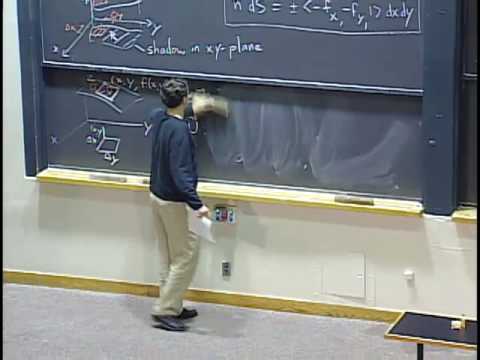
Lecture 28: Divergence theorem.
View the complete course at: http://ocw.mit.edu/18-02SCF10
License: Creative Commons BY-NC-SA
More information at http://ocw.mit.edu/terms
More courses at http://ocw.mit.edu
royal loom
MIT OCW goat
@tepid sail I just scrolled through that a bit, I'm not seeing the limit described above, are you sure it is in there?
I'm less asking about the divergence theorem and more so just about this specific corollary of it
 flint plinth
royal loom
I don't understand the first approximation why it is any good, or why we can jus...
flint plinth
royal loom
I don't understand the first approximation why it is any good, or why we can jus...
isn't this just another continuity argument
royal loom
Well why is the first approximation true?
flint plinth
if div F is continuous at a, then when you're within a small radius of a, div F approximately equals its value at a
flint plinth
royal loom
Well why is the first approximation true?
isn't that what the squiggly-equals part is saying?
LHS = divergence at a itself
RHS = average of divergence on a small ball of radius r
royal loom
I don't see how it is saying that though
royal loom
flint plinth
isn't that what the squiggly-equals part is saying?
LHS = divergence at a itself...
oh
the integral is giving the average divergence over that ball
royal loom
and as the ball gets smaller then the average approaches the value at the center supposedly by continuity
royal loom
using the integral mean value theorem?
flint plinth
yea, or just that abs(integral(blahblah) - divF(a)) <= delta
like we argued last night
here we assume that r is small enough that |divF(x) - divF(a)| < delta holds for all |x-a| < r
royal loom
So would something like this be good reasoning
$$\lim_{r\to 0}\frac{3}{4\pi r^3}\iint_{|x-a|=r} F\cdot n dA$$
By the integral MVT there is an $\vec{a}\in |x-a|=r$ such that
$$\lim_{r\to 0}\frac{3}{4\pi r^3} \text{div }(\vec{a})\cdot \iint_{|x-a|=r}1dA$$
$$\lim_{r\to 0} \text{div }(\vec{a})=\text{div }(\vec{a})$$
wraith daggerBOT
Austin
 royal loom
and this a becomes the a at the center of the ball in order for it to be in all of these intervals as r->0
flint plinth
probably you want to apply the integral MVT to the volume integral, not the flux integral
also i'm not sure what the distinction is between your arrow-a and ordinary a
flint plinth
well a is not in |x - a| = r, the latter is a circle around a, and does not include a
(or sphere or whatever)
royal loom
I see
flint plinth
i think you can just argue like before...
since F is C1, its divergence is continuous, hence given delta > 0 we have for sufficiently small r that |divF(x) - divF(a)| < delta for all |x - a| < r
royal loom
yes it makes more sense to do it to the volume integral
flint plinth
now use that estimate in the vol integral
(or you can use MVT if you prefer)
both ways you'll need to use continuity of divF at a
royal loom
$$\frac{3}{4\pi r^3}\iiint_{B_r} \text{div }\vec{F} dV$$
by the IMVT there is an $\vec{a}\in B_{r}$ for all $r$ such that $$=\text{div }(\vec{a})$$
So,
$$\lim_{r\to 0} \frac{3}{4\pi r^3} \iiint_{B_r} \text{div }\vec{F} dv= \lim_{r\to 0} \text{div }\vec{F}(\vec{a})$$
wraith daggerBOT
Austin
 royal loom
Where $\vec{a}$ is in $B_r$
wraith daggerBOT
Austin
 royal loom
so as r->0 by continuity then, this is going to be just the center of the ball
and we get our proof
?
I don't know if I am wording the last part good enough
but I get the idea
flint plinth
the point a is already in use, i don't think it's a good idea to reuse it
royal loom
Right
flint plinth
the point you're getting from the MVT might not be the center of the ball
(which is the a in the text)
royal loom
but it's always in the ball
flint plinth
yea
flint plinth
and by continuity, divF at your a is close to the divF at the center
flint plinth
royal loom
it is the center
well again, by continuity
flint plinth
the kind of limit is actually a derivative in disguise
royal loom
oh god
flint plinth
or maybe i guess you'd call it a generalization of a derivative
but that's not really relevant to understand this part of the textbook haha
 flint plinth
yes
royal loom
are you sure
flint plinth
100%
royal loom
I didn't think it had to be
royal loom
but
given a parametrization of S
there will be one normal vector
now the question is do you scale that down to unit
or not
flint plinth
dA is the "magnitude"
n is the direction
together they give you the surface area of a small patch, along with the orientation
if you scale either one of them by say 2, then you're inflating the area by 2
dA is supposed to be the one that captures the area
so leave n's magnitude alone as 1

right there in folland
unit normal vector
that's at the top of page 233
royal loom
that is for a different theorem
flint plinth
doesn't matter
flint plinth
all the surface integrals use the same convention
i thought green's was the 2d version
royal loom
it is
flint plinth
i'm in the same chapter as you, surface area and surface integrals
flint plinth
sure but it's using surface integrals
which are used throughtout this chatper
and they all have n dA

 final crag
I will note that when using parametrizations (and not the explicit one), the n finds a way of cancelling out often in that it feels like you didn't use a unit normal
royal loom
just a random example of stokes theorem I found

yes and also here this one is from my class
flint plinth
yea that vector is n dA
not just n
royal loom
the normal is (0,r,r)
which will have non-unit magnitude
not trying to like be picky I just don't think it is the unit normal, although now I feel less sure
royal loom
flint plinth
yea that vector is n dA
not just n
it does look like the dA is seperate in the image though?
final crag
final crag
I will note that when using parametrizations (and not the explicit one), the n f...
just to add to this as a side note but I don't think this is the issue here exactly, if you look at the lines leading up to equation 16.6.5 it kinda shows you how the unit normal tends to cancel out https://math.libretexts.org/Bookshelves/Calculus/Calculus_(OpenStax)/16%3A_Vector_Calculus/16.06%3A_Surface_Integrals#mjx-eqn-equation_5
just a plug to use differential forms so you don't even have to worry about it 😉

Mathematics LibreTexts
If we wish to integrate over a surface (a two-dimensional object) rather than a path (a one-dimensional object) in space, then we need a new kind of integral. We can extend the concept of a line …
flint plinth
check here

see how the n has a denominator
but it cancels with the factor next to it
royal loom
what is that formula
flint plinth

In mathematics, particularly multivariable calculus, a surface integral is a generalization of multiple integrals to integration over surfaces. It can be thought of as the double integral analogue of the line integral. Given a surface, one may integrate over this surface a scalar field (that is, a function of position which returns a scalar as...
royal loom
so

if something is cancelling
then what is going on in this example
where n=(0,r,r)

here's the rest of it
" Let C be the curve of intersection of y+z = 0 and x^+y^2=a^2 oriented in the counterclockwise direction when viewed from a point high on the z-axis"
so it's like we parametrize S which is the graph parametrization in polar
take r partial, cross theta partial
to get the normal
(0,r,r)
which points up so it's orientation preserving (but not unit)
and we dot it with the curl and the answer is still fine
if we normalized it our answer would be wrong
so I'm confused
final crag
this is a line integral so far
royal loom
yeah because it's stokes theorem
final crag
yes
I understand
but if you show the work for the surface integral, you'll see that when you do it
if you did the unit normal
and then you figured out dS
you'll get dS = ||(0,r,r)|| dr dtheta
royal loom
royal loom
Isn't this the work for the surface integral?
royal loom
No worries
final crag
Okay, so let's do it the "correct" way
You have G_r x G_t= (0, r, r), |G_r x G_t| = √2r right? So n = (0, 1/√2, 1/√2) so far so good
now what is dS? dS = |G_r x G_t| dr dtheta
so your integrand is (-r sin t, r cos t, 2)*(0, 1/√2, 1/√2) √2r dr dt
which ends up giving be (-r sin t, r cos t, 2)*(0, r, r) dr dt all over again
the idea is that when you normalize the normal, you divide by G_r x G_t coming from the parametrization, by the surface area element dS = |G_r x G_t| dr dt so this normalization cancels out
that's what the like I put above and the equation stuff that Bungo sent both show
royal loom
I think that I understand now
thank you @final crag and @flint plinth
okay but actually maybe that was a little preemptive I have one final clarifying question
in practice for stokes theorem, we don't have to actually normalize it right?
final crag
if you want to make this all better I would highly suggest differential forms instead, it unifies it all and makes it much easier! at the cost of some work up front for sure
in practice for flux integrals you don't have to normalize
yes
royal loom
Amazing
final crag
stokes has flux integralss so yes in that case too!
royal loom
final crag
if you want to make this all better I would highly suggest differential forms in...
I might get a book on differential forms to read sometime soon
but this is for my class right now so I can't pick the way I learn it XD
Ty very much
final crag
hahah I know! but just some side reading that helps you gain fluency and actually shows you that Stokes, Green, Divergence theorem are all actually the same thing
no worries!!
royal loom
final crag
hahah I know! but just some side reading that helps you gain fluency and actuall...
yes we've talked about this a bit
we went over the statement of generalized stokes but it uses lots of differntial forms like you're saying
so it kind of flys over my head
i don't know multi linear algebra
final crag
totally fair!
royal loom
.close
cedar kilnBOT
Channel closed
Closed by @royal loom
Use .reopen if this was a mistake.
Available help channel!
Send your question here to claim the channel.
Remember:
• Ask your math question in a clear, concise manner.
• Show your work, and if possible, explain where you are stuck.
• After 15 minutes, feel free to ping <@&286206848099549185>.
• Type the command .close to free the channel when you're done.
• Be polite and have a nice day!
Read #❓how-to-get-help for further information on how to ask a good question, and about conduct in the question channels.
 thick portal
What am i doing wrong?
 cedar kilnBOT
thick portal
What am i doing wrong?
cedar kilnBOT
thick portal
What am i doing wrong?
 surreal cave
Have you drawn a picture or the triangle?
 upper abyss
What you've put in is not an exact value. That's a decimal approximation.
thick portal
 upper abyss
Oh but you can't put in exact values, can you
upper abyss
Basically, make sure to check your signs. The method you've shown above doesn't always capture the signs.
cedar kilnBOT
Channel closed
Closed by @thick portal
Use .reopen if this was a mistake.
cedar kilnBOT
Available help channel!
Send your question here to claim the channel.
Remember:
• Ask your math question in a clear, concise manner.
• Show your work, and if possible, explain where you are stuck.
• After 15 minutes, feel free to ping <@&286206848099549185>.
• Type the command .close to free the channel when you're done.
• Be polite and have a nice day!
Read #❓how-to-get-help for further information on how to ask a good question, and about conduct in the question channels.
 loud ibex
what is the equation i need to use to solve this
 cedar kilnBOT
loud ibex
what is the equation i need to use to solve this
loud ibex
cedar kilnBOT
loud ibex
what is the equation i need to use to solve this
loud ibex
 flint plinth
!status
cedar kilnBOT
What step are you on?
1. I don't know where to begin.
2. I have begun but got stuck midway.
3. I got an answer but I was told that it's wrong.
4. I got an answer and would like my work checked.
5. I have a question about someone else's work/solution.
6. I have completed the problem and don't need help anymore. Thank you.
7. None of the above
2
flint plinth
can you show where you're stuck?
loud ibex
i know how to find slope but im not sure what numbers im suppossed to plug in
flint plinth
well you want (change in y) / (change in x)
between the given points P and Q
P is (5, -4)
and Q is given by that formula, where you have to plug in the given value of x for each part
cedar kilnBOT
@loud ibex Has your question been resolved?
loud ibex
flint plinth
P is (5, -4)
and Q is given by that formula, where you have to plug in the given...

is this what it should look like
cedar kilnBOT
Channel closed
Closed due to timeout
Use .reopen if this was a mistake.
Available help channel!
Send your question here to claim the channel.
Remember:
• Ask your math question in a clear, concise manner.
• Show your work, and if possible, explain where you are stuck.
• After 15 minutes, feel free to ping <@&286206848099549185>.
• Type the command .close to free the channel when you're done.
• Be polite and have a nice day!
Read #❓how-to-get-help for further information on how to ask a good question, and about conduct in the question channels.
 pseudo trellis
Is there a mistake on the answer key? I got 35, but the answer key says 45?
 cedar kilnBOT
pseudo trellis
Is there a mistake on the answer key? I got 35, but the answer key says 45?
pseudo trellis
cedar kilnBOT
pseudo trellis
Is there a mistake on the answer key? I got 35, but the answer key says 45?
pseudo trellis
I got:
wraith daggerBOT
Someone

 raven shard
10(2) not 10(3)
tepid sail
^^
tepid sail
raven shard
10(2) not 10(3)
the boy is a liar
raven shard
the boy
pseudo trellis
thank you 😂
raven shard
🙂 welc
pseudo trellis
.solved
cedar kilnBOT
Channel closed
Closed by @pseudo trellis
Use .reopen if this was a mistake.
cedar kilnBOT
Available help channel!
Send your question here to claim the channel.
Remember:
• Ask your math question in a clear, concise manner.
• Show your work, and if possible, explain where you are stuck.
• After 15 minutes, feel free to ping <@&286206848099549185>.
• Type the command .close to free the channel when you're done.
• Be polite and have a nice day!
Read #❓how-to-get-help for further information on how to ask a good question, and about conduct in the question channels.
crimson sedge
 cedar kilnBOT
crimson sedge
cedar kilnBOT
crimson sedge
 drifting marlin
log16 and log11 are just numbers, so treat them as such
they're just gonna be constants like that -7
 clear umbra
like the person above said, log 16 is just a number
maybe if you dont like looking at it we'll just call it A for now
so now on the left you have (-x-7)A
do you know how to expand that?
crimson sedge
-Ax -7A
crimson sedge
clear umbra
do you know how to expand that?
right?
clear umbra
yes
same thing on the right side
if you dont like looking at log(11), just call it B for now
clear umbra
crimson sedge
-Ax-7A = B
wheres your -7x on the right
clear umbra
whats log(11^-7x)
crimson sedge
-7x log 11
clear umbra
crimson sedge
A(-x-7) = B-7x
so what should this be
crimson sedge
A(-x-7) = -7x + B
clear umbra
no...
crimson sedge
log 11?
clear umbra
B = log 11
crimson sedge
A(-x-7) = -7xB
clear umbra
crimson sedge
log 16(-x-7) = -7x log 11
ok now put that log16 into the brackets
what will you get
crimson sedge
log -16x - 112
clear umbra
did you mean log(-16x) or?
clear umbra
no..
crimson sedge
whaaa
clear umbra
you dont put that -x into the log
crimson sedge
then what is it lol
clear umbra
its just -log(16)x
crimson sedge
16x - 7
crimson sedge
oh
clear umbra
its just simply -7log(16)
crimson sedge
but doesnt thjat mean log 16^-7
crimson sedge
-log(16)x -7log (16) = -7x log 11
clear umbra
ok good
clear umbra
yep
crimson sedge
-log(16)x = -7x log 11 + 7log(16)
clear umbra
then what do we do
crimson sedge
i have no idea :/
clear umbra
you have x on the left and x on the right
crimson sedge
add
clear umbra
ok good
clear umbra
7x*
crimson sedge
yes
clear umbra
no..
crimson sedge
i appreciate your patience, im teaching myself this as of rn
clear umbra
since both terms have an x
crimson sedge
take out x
clear umbra
ok good
crimson sedge
but idk how
clear umbra
what happens if you take an x out of -log(16)x
crimson sedge
x( -log16)
clear umbra
and what about 7xlog(11)
crimson sedge
x(7log(11)
crimson sedge
x(-log16)+(7log11)
clear umbra
no..
crimson sedge
😦
clear umbra
both of those things are added together
crimson sedge
crimson sedge
x(-log16)+(7log11)
?
clear umbra
- should be inside the brackets
crimson sedge
how so?
clear umbra
remove the brackets in the middle
crimson sedge
x(-log16+7log11)
crimson sedge
divide the right by (-log16+7log11)
clear umbra
ok good
crimson sedge
x = (7log16)/(-log16+7log11)?
clear umbra
yes
crimson sedge
how do u compute this on a calculator
clear umbra
just type it like how it is
crimson sedge
can you do it for me i dont have a calculator like that
i dont have a calculator option
on the hw
clear umbra
didnt the question ask for answer in logs
so you dont need to type it in a calculator
just leave it like that for your answer
cedar kilnBOT
Channel closed
Closed by @blissful crane
Use .reopen if this was a mistake.
cedar kilnBOT
Available help channel!
Send your question here to claim the channel.
Remember:
• Ask your math question in a clear, concise manner.
• Show your work, and if possible, explain where you are stuck.
• After 15 minutes, feel free to ping <@&286206848099549185>.
• Type the command .close to free the channel when you're done.
• Be polite and have a nice day!
Read #❓how-to-get-help for further information on how to ask a good question, and about conduct in the question channels.
royal loom
 cedar kilnBOT
royal loom
royal loom
cedar kilnBOT
royal loom
royal loom
I'm really not considering the proof sketch for this theorem at all
it references the proof of the last theorem, which made a lot of sense, but I don't see how it's applicable (I can send if anyone wants to see )
actually nvm, I see i misread and never saw the part that says "and satisfies *"
.close
cedar kilnBOT
Channel closed
Closed by @royal loom
Use .reopen if this was a mistake.
cedar kilnBOT
Available help channel!
Send your question here to claim the channel.
Remember:
• Ask your math question in a clear, concise manner.
• Show your work, and if possible, explain where you are stuck.
• After 15 minutes, feel free to ping <@&286206848099549185>.
• Type the command .close to free the channel when you're done.
• Be polite and have a nice day!
Read #❓how-to-get-help for further information on how to ask a good question, and about conduct in the question channels.
cedar kilnBOT
Channel closed
Channel closed due to the original message being deleted.
If you did not intend to do this, please open a new help channel,
as this action is irreversible, and this channel may abruptly lock.
Available help channel!
Send your question here to claim the channel.
Remember:
• Ask your math question in a clear, concise manner.
• Show your work, and if possible, explain where you are stuck.
• After 15 minutes, feel free to ping <@&286206848099549185>.
• Type the command .close to free the channel when you're done.
• Be polite and have a nice day!
Read #❓how-to-get-help for further information on how to ask a good question, and about conduct in the question channels.
 upper laurel
no idea what that means but at the very least you need to show that this happens for every not-divisible-by-3 p - 1 instead of just p = 3
by default a proof applies for anything and everything that fits
upper laurel
really could see the order you read those messages in
 forest flame
wym
forest flame
upper laurel
really could see the order you read those messages in
hi can u help me out a bit
what approach should i be taking here?
upper laurel
sorry though I have no idea what any of that means so youll have to ask someone else
cedar kilnBOT
@forest flame Has your question been resolved?
cedar kilnBOT
Channel closed
Closed due to timeout
Use .reopen if this was a mistake.
cedar kilnBOT
Available help channel!
Send your question here to claim the channel.
Remember:
• Ask your math question in a clear, concise manner.
• Show your work, and if possible, explain where you are stuck.
• After 15 minutes, feel free to ping <@&286206848099549185>.
• Type the command .close to free the channel when you're done.
• Be polite and have a nice day!
Read #❓how-to-get-help for further information on how to ask a good question, and about conduct in the question channels.
 split crest
A) If the derivative of f at 0 exists in R, does it imply that there exists some delta > 0 such that f is bounded on the interval (-delta, delta)?
B) If the derivative of f at 0 exists in R* (with +-infinity), does it imply that there exists some delta > 0 such that f is bounded on the interval (-delta, delta)?
cedar kilnBOT
split crest
A) If the derivative of f at 0 exists in R, does it imply that there exists some...
split crest
<@&286206848099549185>
wraith daggerBOT
spq_64_t
 cedar kilnBOT
@split crest Has your question been resolved?
cedar kilnBOT
Channel closed
Closed due to timeout
Use .reopen if this was a mistake.
Available help channel!
Send your question here to claim the channel.
Remember:
• Ask your math question in a clear, concise manner.
• Show your work, and if possible, explain where you are stuck.
• After 15 minutes, feel free to ping <@&286206848099549185>.
• Type the command .close to free the channel when you're done.
• Be polite and have a nice day!
Read #❓how-to-get-help for further information on how to ask a good question, and about conduct in the question channels.
 sharp sequoia
ummmmmm
cedar kilnBOT
sharp sequoia
ummmmmm
 wraith daggerBOT
spq_64_t

 keen nest
Brackets are a dot product
 keen nest
What does the hat mean above a?
 keen nest
Ah, if a is a unit vector, then it is true, I believe, the formula would simplify to $proj_a(b) = (a,b)a$ indeed
wraith daggerBOT
spq_64_t
 sharp sequoia
am just having an issue understanding this
what is it conveying
like i need a picture in my head
thats why i tried using desmo
keen nest
Are you confused why proj_a(b) is defined as it is in general, or how do you get a formula with a^hat from it?
sharp sequoia
no am confused as to what is its use
like what is it giving me
whats the meaning of the asnwer
like projab
 keen nest
I mean pictorially you kinda draw a perpendicular from b to a if that helps
keen nest
No, where it intersects the line in the direction of a would be the projection
 keen nest
The green one is collinear with u, not v
It should be (3, 1, 0) times some factor
Well, the factor is (u,v)/(v,v)
 keen nest
Yeah, just the scale isn't right
the projection is (18/5, 6/5, 0) -- try drawing this one
Then you may notice that u - proj_v(u) is orthogonal to v -- hopefully, this helps with the intuition
 keen nest
Yeah, that's alright
sharp sequoia
so what does this mean
is that how much of the red vector lies on the orange ?
or what
like this is so abstract whats the significance
keen nest
sharp sequoia
is that how much of the red vector lies on the orange ?
Pretty much
keen nest
sharp sequoia
like this is so abstract whats the significance
The significance of the projection? I mean it can be useful, one very famous example where it's used is gram-schmidt orthogonalization process
sharp sequoia
keen nest
Pretty much
oh wait that made sense since its the unit vector of the orange times the red
keen nest
Yeah
sharp sequoia
okay thanks for everything and thanks for having the patience dealing with my stupidity
.close
cedar kilnBOT
Channel closed
Closed by @sharp sequoia
Use .reopen if this was a mistake.
cedar kilnBOT
Available help channel!
Send your question here to claim the channel.
Remember:
• Ask your math question in a clear, concise manner.
• Show your work, and if possible, explain where you are stuck.
• After 15 minutes, feel free to ping <@&286206848099549185>.
• Type the command .close to free the channel when you're done.
• Be polite and have a nice day!
Read #❓how-to-get-help for further information on how to ask a good question, and about conduct in the question channels.
 finite raven
If A,B have measure zero, then A X B has measure zero.
cedar kilnBOT
Channel closed
Closed by @finite raven
Use .reopen if this was a mistake.
cedar kilnBOT
Available help channel!
Send your question here to claim the channel.
Remember:
• Ask your math question in a clear, concise manner.
• Show your work, and if possible, explain where you are stuck.
• After 15 minutes, feel free to ping <@&286206848099549185>.
• Type the command .close to free the channel when you're done.
• Be polite and have a nice day!
Read #❓how-to-get-help for further information on how to ask a good question, and about conduct in the question channels.
 unborn pond


 cedar kilnBOT
unborn pond
unborn pond
cedar kilnBOT
unborn pond
unborn pond
i can try it and then ill lyk if im capable of doing it
packaged food =32 hourly
frozen food = 6
32:6
which is 16:3
is that right
unborn pond
huh
crimson sedge
you werent finished yet lmao
crimson sedge
my yes wasnt a yes towards that being the answer
 crimson sedge
yeah so the net increase is 4%
crimson sedge
but now you have to find the percentage of the increase
so like
% Increase=Amount of increase/Original Whole amount
unborn pond
where'd you get that equation from
crimson sedge
idk uh, that's just how percentages work
crimson sedge
it was 29% originally so
crimson sedge
yes but multiply by 100
unborn pond
which is 14%
crimson sedge
yeah
unborn pond
okay i see!
crimson sedge
thats it
unborn pond
crimson sedge
yeah
^
crimson sedge
idk how to explain it. Like the 4% isn't weighted it's just how much the difference was
unborn pond
like the 4% is essentially the difference but not truly the percentage from 29 to 33???
crimson sedge
yes
 crimson sedge
i gotta go but just post them again someone else will come
cedar kilnBOT
Channel closed
Closed by @unborn pond
Use .reopen if this was a mistake.
cedar kilnBOT
Available help channel!
Send your question here to claim the channel.
Remember:
• Ask your math question in a clear, concise manner.
• Show your work, and if possible, explain where you are stuck.
• After 15 minutes, feel free to ping <@&286206848099549185>.
• Type the command .close to free the channel when you're done.
• Be polite and have a nice day!
Read #❓how-to-get-help for further information on how to ask a good question, and about conduct in the question channels.
 cobalt plover
Let ABC be the isosceles triangle, with base BC s, and the inscribed circle Ω. The center of the circle Ω is I again the tangent points of Ω with the sides BC, AB, respectively AC are X, Y, respectively Z. The circumscribed circle of the triangle XZC is denoted Γ and the tangent in Z to the circle Γ intersects XY in T. Prove that the points C, I, T are collinear.
cedar kilnBOT
cobalt plover
Let ABC be the isosceles triangle, with base BC s, and the inscribed circle Ω. T...
cobalt plover

I really think I need to use Menalaus' Theorem but I'm not sure where...
Any help please?
cedar kilnBOT
@cobalt plover Has your question been resolved?
cobalt plover
<@&286206848099549185>
cedar kilnBOT
@cobalt plover Has your question been resolved?
cobalt plover
<@&286206848099549185>
cedar kilnBOT
@cobalt plover Has your question been resolved?
cobalt plover
<@&286206848099549185>
cedar kilnBOT
@cobalt plover Has your question been resolved?
cedar kilnBOT
Channel closed
Closed due to timeout
Use .reopen if this was a mistake.
Available help channel!
Send your question here to claim the channel.
Remember:
• Ask your math question in a clear, concise manner.
• Show your work, and if possible, explain where you are stuck.
• After 15 minutes, feel free to ping <@&286206848099549185>.
• Type the command .close to free the channel when you're done.
• Be polite and have a nice day!
Read #❓how-to-get-help for further information on how to ask a good question, and about conduct in the question channels.
 mighty rune
are there any good rules of thumbs for determining what a decent order of integration is for 3 axes in triple integration?
 cedar kilnBOT
mighty rune
are there any good rules of thumbs for determining what a decent order of integr...
cedar kilnBOT
mighty rune
are there any good rules of thumbs for determining what a decent order of integr...
@mighty rune Has your question been resolved?
Channel closed
Closed by @mighty rune
Use .reopen if this was a mistake.
Available help channel!
Send your question here to claim the channel.
Remember:
• Ask your math question in a clear, concise manner.
• Show your work, and if possible, explain where you are stuck.
• After 15 minutes, feel free to ping <@&286206848099549185>.
• Type the command .close to free the channel when you're done.
• Be polite and have a nice day!
Read #❓how-to-get-help for further information on how to ask a good question, and about conduct in the question channels.
 severe elm
 cedar kilnBOT
severe elm
severe elm
cedar kilnBOT
severe elm
severe elm
dont i not have enough information to answer?
 stable edge
is it known that LN is a diameter?
severe elm
it wasnt mentioned but that might b true
stable edge
it looks like one but idk if that's just the diagram
cedar kilnBOT
Channel closed
Closed by @severe elm
Use .reopen if this was a mistake.
cedar kilnBOT
Available help channel!
Send your question here to claim the channel.
Remember:
• Ask your math question in a clear, concise manner.
• Show your work, and if possible, explain where you are stuck.
• After 15 minutes, feel free to ping <@&286206848099549185>.
• Type the command .close to free the channel when you're done.
• Be polite and have a nice day!
Read #❓how-to-get-help for further information on how to ask a good question, and about conduct in the question channels.
 grizzled shale
hi can i get help with a problem
cedar kilnBOT
grizzled shale
hi can i get help with a problem

 grizzled shale
i dont know where to start
 lyric galleon
hahah me neither
 rapid elk
grizzled shale
rapid elk
grizzled shale
bro
clear umbra
grizzled shale
which one exactly do you need help with
grizzled shale
33 and 34 and 36 specifically
clear umbra
for 33 have you tried expanding the right side
grizzled shale
yes and i got tan theta/2 squared
cedar kilnBOT
@grizzled shale Has your question been resolved?
cedar kilnBOT
Channel closed
Closed due to timeout
Use .reopen if this was a mistake.
Available help channel!
Send your question here to claim the channel.
Remember:
• Ask your math question in a clear, concise manner.
• Show your work, and if possible, explain where you are stuck.
• After 15 minutes, feel free to ping <@&286206848099549185>.
• Type the command .close to free the channel when you're done.
• Be polite and have a nice day!
Read #❓how-to-get-help for further information on how to ask a good question, and about conduct in the question channels.
 cinder shard
Hello, I am looking with some help understanding the following:
Distance from point to plane
Distance from origin to plane
Distance between planes
Intersection of lines and planes
Intersection of three planes
Angle between planes
cedar kilnBOT
cinder shard
Hello, I am looking with some help understanding the following:
Distance from ...
cinder shard
Could anyone please assist?
cedar kilnBOT
@cinder shard Has your question been resolved?
flint plinth
cinder shard
Hello, I am looking with some help understanding the following:
Distance from ...
what is your specific question
cinder shard
flint plinth
what is your specific question
Its more assistance with understanding the processes
But I can share the examples I have if it helps?
flint plinth
sure, pls focus on one question at a time tho
the above list is the content of like a full lecture or more

 flint plinth
ok
cinder shard
Do you mind if I DM you?
flint plinth
do you know about normal vectors to planes
flint plinth
ok
cinder shard
i can tell that their normal vectors are parallel, and since they are both orthogonal to each plane, then each plane is parallel to each other
thank you!
 flint plinth
ok, any thoughts on how to do that one?
cinder shard
previous one has given me an idea, thought I am not certain how to resolve it yet
flint plinth
yea, think about normal vectors
cinder shard
i am thinking that the "step" vectors must be dot product 0
so yeah
n dot step = 0
e.g. i-2j for line 1
flint plinth
step = direction vector of the line?
cinder shard
yeah
flint plinth
yes that's true
cinder shard
i dont know the terms cuz im picking this stuff back up
flint plinth
if you're given two vectors (the direction vectors for the two lines in this case), do you know how to find a third vector that is orthogonal to both?
cinder shard
is that the easiest way to prove it though? I feel like if i had more planes/lines it would be a HUGE question manually testing each
cross product
flint plinth
yep
cinder shard
gotchu
flint plinth
that's what you want here
flint plinth
and they want the plane itself
so you need two things
normal vector
which you get from the cross product
and a point on the plane
which you can get using any point on either line
since both lines are contained in the plane
cinder shard
got you, cheers
i have done it before with intersecting lines (rather than lines in the plane)
it was just the cross product idea i didnt immediately see
which is quite easy to use
Do you mind if we keep going?
flint plinth
sure
cinder shard
smashing these out so quick
thank you!
okay so, for F

is it
just a simultaneous application?
gaussian?
or similar
just throwing out ideas can't really see it quite yet
flint plinth
well that line is in both planes
so its' orthogonal to both of their normal vectors
so...
flint plinth
yep
flint plinth
yea you just need a point in both planes
cinder shard
in the new line eqn
flint plinth
do you know how to get such a point?
cinder shard
just trying to think of a way rn, one sec if thats okay
flint plinth
sure
cinder shard
going through these ideas super quick, which I love, but I gotta contain it all haha. Thanks again
All I can see
is that if I apply a simultaneous approach I can eliminnate one variable
and then i have a bi-variate equation which describes a line in cartesian form
flint plinth
yea
flint plinth
you have one degree of freedom (since the intersection is a line)
you can freely choose one of the coordinates
say take z = 0
flint plinth
then the plane equations become 2 eq, 2 vars
cinder shard
yeah got ya
just not used to finishing with a solution like that
effectively i have a line equation
in 2 dimensions
which i take at face value
sub anything i want
flint plinth
there are probably other equivalent ways, that's just the first that occurred to me
cinder shard
get the other
use that with one of the original equations
and then i have the full 3 coord
plus the direction vector from before
flint plinth
yes
 cinder shard
i have done the point to a plane now
specifically origin
i have a textbook in front of me with a method i dont quite understand but it appears to be a shortcut so i am trying to get my head around it
flint plinth
my first thought would be, take the normal vector to the plane
the shortest line between the origin and the plane is in that direction
the origin is a point on the line
find the equation for the line using those two pieces of info
and find where the line intersects the plane
but there's probably a shorter way
cinder shard
okay do you mind trying to work out this alternate way with me if I post a screenshot?
flint plinth
sure
 flint plinth
,rotate
wraith daggerBOT
 cinder shard
so let me clarify here
i can see the process
if i have ax+by+cz = constant
I can do n given by ai+bj+ck
Divide the constant by the magnitude of n i mean
and that apparently gives distance
I can't picture the connection to the distance
flint plinth
yea that's valid, did you work through the logic involving the dot product?
cinder shard
i tried to but i just couldnt see it
flint plinth
what's the first statement that you don't get
cinder shard
(m x unit-n) dot n = k
flint plinth
you agree that (m n_unit) is the point in the plane that is closest to the origin?
cinder shard
yeah
i think fundamentally
i dont understand the meaning of k
in a vector plane eqn
flint plinth
that's just a measure of how much the plane is "shifted"
flint plinth
if k is zero then (0,0,0) is in the plane, right?
flint plinth
and otherwise it's not
cinder shard
if k is 2
does that mean there is a distance of 2
no because there are coefficients
so its related but not direct...
flint plinth
yea it depends on the coefficients
you can scale the whole equation by some constant and that will change the coefficients and k by the same factor
cinder shard
okay so like is there a conceptual way to picture k exactly or because of tri-variate coefficients its hard
flint plinth
so in some sense only their "ratio" matters
well one way to view it is this
suppose we normalize the plane equation so that the coefficients (which are a normal vector) correspond to a unit normal vector
then the equation (in vector form) is:
n . (x,y,z) = k
now recall that hte dot product can be expressed in terms of lengths and cosine of angle:
n . (x,y,z) = |n| |(x,y,z)| cos(theta)
= |(x,y,z)| cos(theta)
since |n| = 1
and this all equals k
rearrange this:
cos(theta) = k / |(x,y,z)|
cinder shard
where is that theta
flint plinth
it's the angle between the (x,y,z) vector and the normal vector
now recall cos = adj/hyp
so viewing |(x,y,z)| as the hypotenuse of a triangle
then k is the adjacent
which is the distance (in the normal direction) to the plane
cinder shard
oh okay
flint plinth
so basically a geometric explanation of what your book says
cinder shard
so i think i was struggling because of not having a concrete picture of that
but i may be there
flint plinth
now i assumed that n was unit length
if not then you have to scale by |n|
hence your book's formula
cinder shard
so for any arbitrary point in the plane
flint plinth
k/|n|
cinder shard
x,y,z
i can basically see the magnitude of the position vector to x,y,z
as the hypotenuse of a triangle
where the base of the triangle is the shortest distance
vector/line
from origin to the plane
cinder shard
got u
flint plinth
(the plane could be on either "side" of the origin)
cinder shard
right so
correct me if i am wrong here
my understand seems to be a little different to the form that the book has it in. It seems to relate to the idea of a normalised plane
I am effectively finding the distance by simply "normalising" k in isolation
using k/mag(n)
flint plinth
yea
think of it as normalizing the whole plane equation
by dividing by |n|
then the coefficients are just the unit normal
and by my argument above,
cinder shard
right
flint plinth
the new constant, which is k/|n|
cinder shard
100%
flint plinth
is the distance
flint plinth
sure, glad it helped!
cinder shard
do you mind looking at the last 3 or gtg?
cinder shard
all good, i really appreciate the help
flint plinth
sure, gl
cedar kilnBOT
Channel closed
Closed by @cinder shard
Use .reopen if this was a mistake.
cedar kilnBOT
Available help channel!
Send your question here to claim the channel.
Remember:
• Ask your math question in a clear, concise manner.
• Show your work, and if possible, explain where you are stuck.
• After 15 minutes, feel free to ping <@&286206848099549185>.
• Type the command .close to free the channel when you're done.
• Be polite and have a nice day!
Read #❓how-to-get-help for further information on how to ask a good question, and about conduct in the question channels.
severe elm
 cedar kilnBOT
severe elm
cinder shard
cedar kilnBOT
severe elm
cinder shard
hey
severe elm
i got to (x-4)^2 + (y-3)^2 = 13
cinder shard
okay
severe elm
but r needs to be a whole number
 formal prism
severe elm
i got to (x-4)^2 + (y-3)^2 = 13
formal prism
severe elm
i got to (x-4)^2 + (y-3)^2 = 13
it should be x-2)^2
severe elm
cinder shard
why does R need to be a whole number?
part of the question is graphing a point on the circle and it only accepts whole numbers
ohhhh
severe elm
formal prism
it should be x-2)^2
ty one esc
cinder shard
haha
cedar kilnBOT
Channel closed
Closed by @severe elm
Use .reopen if this was a mistake.
cedar kilnBOT
Available help channel!
Send your question here to claim the channel.
Remember:
• Ask your math question in a clear, concise manner.
• Show your work, and if possible, explain where you are stuck.
• After 15 minutes, feel free to ping <@&286206848099549185>.
• Type the command .close to free the channel when you're done.
• Be polite and have a nice day!
Read #❓how-to-get-help for further information on how to ask a good question, and about conduct in the question channels.
 remote lantern
 cedar kilnBOT
remote lantern
cedar kilnBOT
remote lantern
 abstract lotus
i believe it is only 2
remote lantern
hm
because this is how i see it

because thats still less than 2pi correct
5pi / 3 = 5.23
which is less than 6.28 = 2pi
 brazen wigeon
i dont think youre doing this right
remote lantern
hm
brazen wigeon
can you please explain $$\pi - \frac{\pi}{3} = \frac{2\pi}{3} = 2.09$$
wraith daggerBOT
@brazen wigeon
 brazen wigeon
like how did you get these numbers
remote lantern
im finding the critical points right
brazen wigeon
remote lantern
im finding the critical points right
yep
remote lantern
so pi/3 is my xra which the reference angle
brazen wigeon
do you know about derivatives
remote lantern
ik those 2 are right because my teacher got it too
im following her example for it
remote lantern
canada
brazen wigeon
ok what math class are you in
remote lantern
i did
i used the first derivative and made it equal 0 and solved for x
because its a trig funciton u need to find the acute reference angle
abstract lotus
d/dx = 1 + 2cosx = 0 : x = cos^-1(-1/2) :x = 2pi/3, 4pi/3
remote lantern
and that reference angl is pi/3
brazen wigeon
,tex $$\frac{\dd }{\dd x} = 1 + 2 \cos(x) = 0$$
wraith daggerBOT
@brazen wigeon
 remote lantern
yes
brazen wigeon
so that means:
remote lantern
cosx = -1/2 now
brazen wigeon
remote lantern
cosx = -1/2 now
yep
abstract lotus
find where x is -1/2
 remote lantern
yea
then u do
cos^-1 (1/2) = pi/3
cos inv(1/2)
its negative but u make the ref always postive right
brazen wigeon
,tex $$\text{Wrong: }\arccos(\frac{1}{2}) = \frac{\pi}{3}$$
$$\text{Correct: }\arccos(-\frac{1}{2}) = \frac{\pi}{3}$$
remote lantern
so thats why
brazen wigeon
i think that is your mistake
remote lantern
abstract lotus
d/dx = 1 + 2cosx = 0 : x = cos^-1(-1/2) :x = 2pi/3, 4pi/3
i get the first two
but shouldnt there be a thiurd
brazen wigeon
remote lantern
cos^-1 (1/2) = pi/3
the 1/2 should bee negative
abstract lotus
look at unit circle
wraith daggerBOT
@brazen wigeon
 brazen wigeon
remote lantern
it has to be positive
brazen wigeon
remote lantern
it has to be positive
what is it
remote lantern
im following the teachers video atm as wel
she stated that when finding the ref angle it has to be postive
when u arc cos or arc sin it
no matter what
i get how to get the first two
and that it fits between the interval of 0 - 2pi
but i thought there would be another crtical point which is 2pi - p/3 becaue if u do that it still fits in that given interval
we were taught to use the CAST rule to find the CP
remote lantern
hm im confused
abstract lotus
im not sure why u think there is a third
remote lantern
5pi /3 = 5.23?
thats less than 6.28
because the 5.23 is still less than than the given interval
abstract lotus
but cos(5pi/3)=1/2 ur looking for where cosx = -1/2
remote lantern
it cant go beyond 2pi which is 6.28 right
brazen wigeon
remote lantern
it cant go beyond 2pi which is 6.28 right
right now, the interval is not your problem
brazen wigeon
abstract lotus
but cos(5pi/3)=1/2 ur looking for where cosx = -1/2
,tex $$\cos(\frac{5\pi}{3}) \neq -\frac{1}{2}$$
wraith daggerBOT
@brazen wigeon
 remote lantern
hm
i thought we would keep going around the cast rule in the quadrants
until we hit a point where it extends the interval
abstract lotus
im not sure what you are referring to
brazen wigeon
remote lantern
like im using the cast rule to find the CP
one sec lemme research this cast rule
brazen wigeon
 remote lantern
because our value for cos x = -1/2 we have to draw the lines in quadrant S and T because thats where Cos is negative
so 2 and 4^
like I have
brazen wigeon
but 5pi/3 is in quadrant 4
brazen wigeon
and in quadrant 4, cosine is positive
remote lantern
so from quadrant 1 to 2 is pi
abstract lotus
ur looking for angles in 2 and 3 not 2 and 4
remote lantern
il draw it out