#help-13
1 messages · Page 246 of 1
 tepid sail

 sudden mirage

 cedar kilnBOT
Channel closed
Closed by @sudden mirage
Use .reopen if this was a mistake.
 Available help channel!
Send your question here to claim the channel.
Remember:
• Ask your math question in a clear, concise manner.
• Show your work, and if possible, explain where you are stuck.
• After 15 minutes, feel free to ping <@&286206848099549185>.
• Type the command .close to free the channel when you're done.
• Be polite and have a nice day!
Read #❓how-to-get-help for further information on how to ask a good question, and about conduct in the question channels.
 pearl vigil
 cedar kilnBOT
pearl vigil
cedar kilnBOT
pearl vigil

 vagrant elbow
that series is just e
vagrant elbow
,w integrate 1/(x + x^a)
 wraith daggerBOT


 Requested by neonperseus
cedar kilnBOT
Requested by neonperseus
cedar kilnBOT
Channel closed
Closed by @pearl vigil
Use .reopen if this was a mistake.
Available help channel!
Send your question here to claim the channel.
Remember:
• Ask your math question in a clear, concise manner.
• Show your work, and if possible, explain where you are stuck.
• After 15 minutes, feel free to ping <@&286206848099549185>.
• Type the command .close to free the channel when you're done.
• Be polite and have a nice day!
Read #❓how-to-get-help for further information on how to ask a good question, and about conduct in the question channels.
 wheat cairn
Help
cedar kilnBOT
wheat cairn
Help

 wheat cairn
Yes
wheat cairn
Where does 5x come from
wheat cairn
Yeah I got 6x
 mortal dove
wheat cairn
mortal dove
wheat cairn

Yeah u get a remainder
-5x is the remainder
And the quotient is 7x+1
wheat cairn
Where’d the one come from
mortal dove
Take a new step
cedar kilnBOT
Channel closed
Closed by @wheat cairn
Use .reopen if this was a mistake.
Available help channel!
Send your question here to claim the channel.
Remember:
• Ask your math question in a clear, concise manner.
• Show your work, and if possible, explain where you are stuck.
• After 15 minutes, feel free to ping <@&286206848099549185>.
• Type the command .close to free the channel when you're done.
• Be polite and have a nice day!
Read #❓how-to-get-help for further information on how to ask a good question, and about conduct in the question channels.
 proper palm
hello i have a problem, i don’t know how to begin this exercise :
Let u(n) be a sequence of real numbers.
v(n)=1/n * sum(u(k)) for k who begin at 1 and go to n
Using the definition, show that if u(n) converges to 0, then v(n) also converges to 0.
cedar kilnBOT
proper palm
hello i have a problem, i don’t know how to begin this exercise :
Let u(n) be a...
proper palm

 dire geode
What definition were you taught
proper palm
the definition of a sequence converging to 0
my teacher told me to choose an n0
and separate the sum logically but i didn’t understood what he wanted to say 😭
proper palm
proper palm
the definition of a sequence converging to 0
this one
 dire geode
I see
You can bound the first N terms of u_n by the max of them. Call that max M. Then the rest of the terms are less than some 2^(-N)
proper palm
but how to show that v(n) converges to 0
dire geode
So that when you sum all of u_n, you get v_n <= (1/n)[ sum k=1 to N u_k + sum k=N+1 to n 2^-k ] <= N * M /n + 1/n
proper palm
okay i see but i don’t know where the 2^-k is from 💀
proper palm
eps?
wraith daggerBOT
riemann
 dire geode
That's just an arbitrary series that when you sum an infinite number of terms, converges
dire geode
proper palm
but we didn’t saw the series 💀
Geometric series is usually taught before calculus
dire geode
proper palm
but we didn’t saw the series 💀
So you do know geometric series
proper palm
yes
dire geode
There's no Fourier series here
cedar kilnBOT
@proper palm Has your question been resolved?
Channel closed
Closed by @proper palm
Use .reopen if this was a mistake.
Available help channel!
Send your question here to claim the channel.
Remember:
• Ask your math question in a clear, concise manner.
• Show your work, and if possible, explain where you are stuck.
• After 15 minutes, feel free to ping <@&286206848099549185>.
• Type the command .close to free the channel when you're done.
• Be polite and have a nice day!
Read #❓how-to-get-help for further information on how to ask a good question, and about conduct in the question channels.
 verbal veldt
any easy way to factor this without using horner that I am not seeing?

 raw gulch
verbal veldt
any easy way to factor this without using horner that I am not seeing?
raw gulch
verbal veldt
any easy way to factor this without using horner that I am not seeing?
I see immediately that the zero is 1, so I quickly divide it in memory by lambda - 1
cedar kilnBOT
Channel closed
Closed by @verbal veldt
Use .reopen if this was a mistake.
cedar kilnBOT
Available help channel!
Send your question here to claim the channel.
Remember:
• Ask your math question in a clear, concise manner.
• Show your work, and if possible, explain where you are stuck.
• After 15 minutes, feel free to ping <@&286206848099549185>.
• Type the command .close to free the channel when you're done.
• Be polite and have a nice day!
Read #❓how-to-get-help for further information on how to ask a good question, and about conduct in the question channels.
 coral jetty
im currently on part e here, z is just x+yi. ive tried solving it graphically by choosing the lowest point of (4,1) but that was wrong when i checked it afterwards and now im just stumped on how to progress any further through the question

 cedar kilnBOT
coral jetty
im currently on part e here, z is just x+yi. ive tried solving it graphically by...
cedar kilnBOT
coral jetty
im currently on part e here, z is just x+yi. ive tried solving it graphically by...
 muted bear
draw the tangent to the circle through the origin
coral jetty
how would i find the tangent?
coral jetty
a right triangle
muted bear
use some trig then you got it
coral jetty
sorry im still having a bit of trouble, would it be something along the lines of the opp side having a length of 2?
cedar kilnBOT
@coral jetty Has your question been resolved?
coral jetty
<@&286206848099549185>
raw gulch
coral jetty
<@&286206848099549185>
your given set is a circle with center at z = 4 + 3i and radius r = 2, all you need to do is take a straight line with the equation y = ax, and check for what value of parameter a, the straight line y = ax is a tangent to this circle
coral jetty
oh wait yeah i think ive figured it out now, thank you sm
coral jetty
.close
cedar kilnBOT
Channel closed
Closed by @coral jetty
Use .reopen if this was a mistake.
Available help channel!
Send your question here to claim the channel.
Remember:
• Ask your math question in a clear, concise manner.
• Show your work, and if possible, explain where you are stuck.
• After 15 minutes, feel free to ping <@&286206848099549185>.
• Type the command .close to free the channel when you're done.
• Be polite and have a nice day!
Read #❓how-to-get-help for further information on how to ask a good question, and about conduct in the question channels.
 signal cave
 cedar kilnBOT
signal cave
signal cave
cedar kilnBOT
signal cave
signal cave
I've got $$ 1 + tP\cdot Q - t = 0 $$
wraith daggerBOT
waris
 signal cave
I'm not sure where to go from here
signal cave
 slim quiver
What are you trying to solve for?
slim quiver
What are you trying to solve for?
i'm supposed to show t = 1/2 and P = -Q
slim quiver
Thought that was in the previous discussion
Sorry... not familiar with this type of problem
signal cave
i feel like there's insufficient info
cedar kilnBOT
@signal cave Has your question been resolved?
cedar kilnBOT
@signal cave Has your question been resolved?
signal cave
.close
cedar kilnBOT
Channel closed
Closed by @signal cave
Use .reopen if this was a mistake.
cedar kilnBOT
Available help channel!
Send your question here to claim the channel.
Remember:
• Ask your math question in a clear, concise manner.
• Show your work, and if possible, explain where you are stuck.
• After 15 minutes, feel free to ping <@&286206848099549185>.
• Type the command .close to free the channel when you're done.
• Be polite and have a nice day!
Read #❓how-to-get-help for further information on how to ask a good question, and about conduct in the question channels.
 sweet imp
 sweet imp
Can someone explain me the process on how the final answer was gotten?
<@&286206848099549185>
 silver oxide
.rotate
silver oxide
,rotate
wraith daggerBOT

 brittle stag
square the 4?
 lavish stratus
silver oxide
first thing that i notice is that u forgot to square the 4
lavish stratus
silver oxide
first thing that i notice is that u forgot to square the 4
there's no square for 4
sweet imp
Yupp
brittle stag
aight what's the problem exactly?
sweet imp
Trying to prove that f(ax,ay) is a^3f(x,y)
brittle stag
aight seems good
sweet imp
Still wondering what happened to (x^3 + 4xy^2 + y^3)
silver oxide
i assume f(x,y) is equal to that
brittle stag
same as how you came up with f(ax, ay) = (...), it's just different inputs
cedar kilnBOT
Channel closed
Closed by @sweet imp
Use .reopen if this was a mistake.
Available help channel!
Send your question here to claim the channel.
Remember:
• Ask your math question in a clear, concise manner.
• Show your work, and if possible, explain where you are stuck.
• After 15 minutes, feel free to ping <@&286206848099549185>.
• Type the command .close to free the channel when you're done.
• Be polite and have a nice day!
Read #❓how-to-get-help for further information on how to ask a good question, and about conduct in the question channels.
 lone compass
 cedar kilnBOT
lone compass
lone compass
cedar kilnBOT
lone compass
lone compass
am i crazy
why is this true
wouldnt the top fraction be multiplied by h/1
1/2 / 2 is 1/2 * 2
unless my brain is just completely fucked rn
 undone epoch
Is that filled in the answer?
undone epoch
$\frac{\frac{a}{b}}{\frac{c}{d}}=\frac{a}{b} \cdot \frac{d}{c}$
wraith daggerBOT
Good
 cedar kilnBOT
Channel closed
Closed by @lone compass
Use .reopen if this was a mistake.
Available help channel!
Send your question here to claim the channel.
Remember:
• Ask your math question in a clear, concise manner.
• Show your work, and if possible, explain where you are stuck.
• After 15 minutes, feel free to ping <@&286206848099549185>.
• Type the command .close to free the channel when you're done.
• Be polite and have a nice day!
Read #❓how-to-get-help for further information on how to ask a good question, and about conduct in the question channels.
 glad dagger
hey
cedar kilnBOT
glad dagger
hey
glad dagger


i go t that
and idk what am i doing wrong
bcus
wolfram alfa gives me another answer

 livid hound
you didn't integrate the x^2
glad dagger
sorry i was just erasing it and writting again im correcting but in the anser its integratted
 livid hound
oh 1 sec, you integrated wrt y first instead of x
glad dagger
o so it does matter?
livid hound
yes
cedar kilnBOT
Channel closed
Closed by @glad dagger
Use .reopen if this was a mistake.
Available help channel!
Send your question here to claim the channel.
Remember:
• Ask your math question in a clear, concise manner.
• Show your work, and if possible, explain where you are stuck.
• After 15 minutes, feel free to ping <@&286206848099549185>.
• Type the command .close to free the channel when you're done.
• Be polite and have a nice day!
Read #❓how-to-get-help for further information on how to ask a good question, and about conduct in the question channels.
lone compass
 cedar kilnBOT
lone compass
lone compass
cedar kilnBOT
lone compass
lone compass
we started limits but did not go over how to solve problems like this
i got everything in A correct but
im not exactly sure what im doing from here
i think i need a tangent line but no idea how we set those up
undone epoch
It looks like you're going to draft a one.
lone compass
i guess in better words i dont know how
we talked about tangent lines for a little bit and all i know is what a secant line is
and if im correct a secant line is placed between two points on the line while a tangent line is just through a single point
undone epoch
How do you find the average rate of change in a given interval?
lone compass
f(x2) - f(x1) / x2 - x1
undone epoch
What does it mean with instanteneous rate of change?
lone compass
in this case its just the slope since there is no function to be had and we already know that each "remaining amount" is the fx2 and fx1
im not sure
undone epoch
It means the current rate of change at a point.
lone compass
ah i see
so its asking for the rate of change at t=1
only issue is i do not know what y is because it's between 16 and 15.5
closer to 15.5 than 16
undone epoch
Since you're learning about limits, I assume you'll be using this formula https://www.youtube.com/watch?v=hSK7f4durxI&pp=ygUZaW5zdGFudGFuZW91cyBncm93dGggcmF0ZQ%3D%3D

Some of the links below are affiliate links. As an Amazon Associate I earn from qualifying purchases. If you purchase through these links, it won't cost you any additional cash, but it will help to support my channel. Thank you!
►PRODUCT RECOMMENDATIONS https://www.amazon.com/shop/brithemathguy (affiliate links)
Average vs Instantaneous Rates o...
lone compass
what is a and b in regards to the normal roc formula ?
undone epoch
But another way is to draw a tangent on that spesific point.
lone compass
the only thing he taught us about limits is the notation lim x>a
i have a feeling our homework should have probably waited until the next lecture lol
the "help" section of my homework works through it and does it with a line through a point vs a formula
i just dont understand why yet
undone epoch
lone compass
the "help" section of my homework works through it and does it with a line throu...
Mind taking a picture? I'm already forgetting how to use this formula.
lone compass
for t = 1 they drew a line through

2,13 and 5,11 which is where im lost
no idea why theyre choosing these points
because 2,13 and 5,11 arent even points on the actual graph
undone epoch
I guess they just chose two point that are on the tangent line you're suppose to find. If you just draw a tangent at the exact direction of the change of rate, you'll get the same answer.
But as said, I'm already forgetting how to use this formula, so if you want to learn it, you might want another person to help you.
lone compass
i guess my main confusion is this; how are they choosing to draw their line ?
why is it going in the exact direction they chose
undone epoch
If you draw a quadratic function on desmos, and have a movable tangent, you probably would visualize it more.
lone compass
i kind of get it but idrk how im supposed to just reflect the entire graph without being terribly wrong
and idk the function so i cant use a graphing tool
undone epoch
The point of it, is to have, draw a tangent that is close to the graph. Draw some graph when you go trough questions like this, you'll come along.
And a point to have when drawing a tangent, is to have the line close to the graph at the intersection, there should be no gap between them.
I'm out of time, so if you want an explanation from another perspective, wait for another person to explain.
cedar kilnBOT
@lone compass Has your question been resolved?
lone compass
<@&286206848099549185>
cedar kilnBOT
@lone compass Has your question been resolved?
lone compass
.close
cedar kilnBOT
Channel closed
Closed by @lone compass
Use .reopen if this was a mistake.
Available help channel!
Send your question here to claim the channel.
Remember:
• Ask your math question in a clear, concise manner.
• Show your work, and if possible, explain where you are stuck.
• After 15 minutes, feel free to ping <@&286206848099549185>.
• Type the command .close to free the channel when you're done.
• Be polite and have a nice day!
Read #❓how-to-get-help for further information on how to ask a good question, and about conduct in the question channels.
cedar kilnBOT
Channel closed
Channel closed due to the original message being deleted.
If you did not intend to do this, please open a new help channel,
as this action is irreversible, and this channel may abruptly lock.
Available help channel!
Send your question here to claim the channel.
Remember:
• Ask your math question in a clear, concise manner.
• Show your work, and if possible, explain where you are stuck.
• After 15 minutes, feel free to ping <@&286206848099549185>.
• Type the command .close to free the channel when you're done.
• Be polite and have a nice day!
Read #❓how-to-get-help for further information on how to ask a good question, and about conduct in the question channels.
 viscid token
 cedar kilnBOT
viscid token
viscid token
cedar kilnBOT
viscid token
viscid token
<@&286206848099549185> can you just give me a yes or no is this right or not . Just need 1 minutes
 vast pike
depends
 idle tusk
viscid token
<@&286206848099549185> can you just give me a yes or no is this right or not . J...
idle tusk
viscid token
<@&286206848099549185> can you just give me a yes or no is this right or not . J...
yes
 lyric narwhal
viscid token
<@&286206848099549185> can you just give me a yes or no is this right or not . J...
lyric narwhal
viscid token
<@&286206848099549185> can you just give me a yes or no is this right or not . J...
!15m
cedar kilnBOT
viscid token
<@&286206848099549185> can you just give me a yes or no is this right or not . J...
Please only use the <@&286206848099549185> ping once if your question has not been answered for 15 minutes. Please do not ping or DM individual users about your question.
vast pike
if you mean $e^{(x^2)}$
wraith daggerBOT
everg
 vast pike
then yes
viscid token
Yes I mean that
vast pike
if you meant $(e^x)^2$, then the answ is no
wraith daggerBOT
everg
 cedar kilnBOT
Channel closed
Closed by @viscid token
Use .reopen if this was a mistake.
 ionic snow
Yes
cedar kilnBOT
Available help channel!
Send your question here to claim the channel.
Remember:
• Ask your math question in a clear, concise manner.
• Show your work, and if possible, explain where you are stuck.
• After 15 minutes, feel free to ping <@&286206848099549185>.
• Type the command .close to free the channel when you're done.
• Be polite and have a nice day!
Read #❓how-to-get-help for further information on how to ask a good question, and about conduct in the question channels.
 delicate abyss
Пытаюсь решить для (x) = 2y - (a)
cedar kilnBOT
delicate abyss
Пытаюсь решить для (x) = 2y - (a)
cedar kilnBOT
Please show the original problem, exactly as it was stated to you, with the entire original context. A picture or screenshot is best. If the original problem is not in English, then post it anyway! The additional context might still be helpful. Do your best to provide a translation.
delicate abyss
lyric narwhal
translate?
Пытаюсь решить для (x) = 2y - (a) - Trying to solve for (x) = 2y - (a) (bad englsh)
cedar kilnBOT
@delicate abyss Has your question been resolved?
 tropic oxide
@delicate abyss можно исходное условие задачи посмотреть?
а то сейчас как-то непонятно, в чем задача
cedar kilnBOT
@delicate abyss Has your question been resolved?
cedar kilnBOT
Channel closed
Closed due to timeout
Use .reopen if this was a mistake.
Available help channel!
Send your question here to claim the channel.
Remember:
• Ask your math question in a clear, concise manner.
• Show your work, and if possible, explain where you are stuck.
• After 15 minutes, feel free to ping <@&286206848099549185>.
• Type the command .close to free the channel when you're done.
• Be polite and have a nice day!
Read #❓how-to-get-help for further information on how to ask a good question, and about conduct in the question channels.
 half jungle
Can someone explain how in example 3 , -0.33<x-2<0.5 becomes -0.3<x-2<0.3
 cedar kilnBOT
half jungle
Can someone explain how in example 3 , -0.33<x-2<0.5 becomes -0.3<x-2<0.3
cedar kilnBOT
half jungle
Can someone explain how in example 3 , -0.33<x-2<0.5 becomes -0.3<x-2<0.3
@half jungle Has your question been resolved?
 cerulean sail
You're making the first inequality more restrictive, so that as they said, "both ends of the last compound inequality are satisfied"
If you have -0.3... < x - 2 < 0.3..., then you definitely have -0.3... < x - 2 < 0.5
cedar kilnBOT
@half jungle Has your question been resolved?
Channel closed
Closed by @half jungle
Use .reopen if this was a mistake.
Available help channel!
Send your question here to claim the channel.
Remember:
• Ask your math question in a clear, concise manner.
• Show your work, and if possible, explain where you are stuck.
• After 15 minutes, feel free to ping <@&286206848099549185>.
• Type the command .close to free the channel when you're done.
• Be polite and have a nice day!
Read #❓how-to-get-help for further information on how to ask a good question, and about conduct in the question channels.
 vernal basin
Tan(x) + 2sec(x) = 3
No GDC
cedar kilnBOT
vernal basin
Tan(x) + 2sec(x) = 3
No GDC
vernal basin
I’ve been going in circles with this problem idk what to do tbh
This is a trig identities problem
I usually factor out a secant
 crimson obsidian
!status
cedar kilnBOT
What step are you on?
1. I don't know where to begin.
2. I have begun but got stuck midway.
3. I got an answer but I was told that it's wrong.
4. I got an answer and would like my work checked.
5. I have a question about someone else's work/solution.
6. I have completed the problem and don't need help anymore. Thank you.
7. None of the above
Sec(x) (sin(x) + 2) = 3
vernal basin
cedar kiln
```
What step are you on?
1. I don't know where to begin.
2. I have begun but go...
2 I suppose
crimson obsidian
I would go by converting to sin and cos because I would get common denominator cos
vernal basin
I actually did some different approaches then it got too long should I take a picture
Yeah I did that
crimson obsidian
Oh
vernal basin
Sin(x) + 2 = 3cos(x)
crimson obsidian
Sinx+2=3cosx
vernal basin
Yeah
crimson obsidian
Ih
vernal basin
Let me try that way
crimson obsidian
Ok
crimson obsidian
Okay so this is what I was taught
crimson obsidian
Whenever I get acosx +- bsinx
I multiply and divide by (a^2+b^2)
Maybe that helps
vernal basin
Oh right I did that once
crimson obsidian
Ohh
crimson obsidian
crimson obsidian
3cosx-sinx=2
Here
vernal basin
Cuz last time when I did it it was = to a negative constant
crimson obsidian
Here it's already = 2
crimson obsidian
What haopened
vernal basin
What
vernal basin
but the cos is squared
crimson obsidian
Where did you get this
 zealous compass
$9\cos ^2 x - \sin^2 x = 4$?
crimson obsidian
Oh
wraith daggerBOT
ed
 crimson obsidian
8cos^2x +cos2x=4
vernal basin
then I will expand the constant into
Wait no
expand the constant into sin^2(x) + cos^2(x)
So = 4(cos^2(x) + sin^2(x)
zealous compass
convert the sin^2 into 1-cos^2
zealous compass
vernal basin
expand the constant into sin^2(x) + cos^2(x)
this works but i think it’s a little more complicated to solve
vernal basin
Ok well let me try the other way
vernal basin
right
Ok if I do the other way
8cos^2(x) + cos(2x) = 3
uhhhhhhh
I feel like this is the harder way
crimson obsidian
Cos2x formula
crimson obsidian
Yeah
vernal basin
So cos(x) = +/- sqrt(4/10)
crimson obsidian
2/√10
vernal basin
yes
crimson obsidian
Very absurd answer
vernal basin
vernal basin
and cos(x) = sin(x)
This is the other answer I got
That’s not correct is it?
crimson obsidian
Yeah
vernal basin
vernal basin
So cos(x) = +/- sqrt(4/10)
This one isn’t right
vernal basin
Oh
vernal basin
vernal basin
So 10 cos^2(x) = 4
This = 5
vernal basin
Wait isn’t that also wrong
Oh nvm
+/-Sqrt(2)/2
Wow that was a good solution I think I died
Ok Ty for help
crimson obsidian
Np 🌅
vernal basin
!close
crimson obsidian
.cl
vernal basin
/close
crimson obsidian
.close
cedar kilnBOT
Channel closed
Closed by @crimson obsidian
Use .reopen if this was a mistake.
Available help channel!
Send your question here to claim the channel.
Remember:
• Ask your math question in a clear, concise manner.
• Show your work, and if possible, explain where you are stuck.
• After 15 minutes, feel free to ping <@&286206848099549185>.
• Type the command .close to free the channel when you're done.
• Be polite and have a nice day!
Read #❓how-to-get-help for further information on how to ask a good question, and about conduct in the question channels.
Channel closed
Channel closed due to the original message being deleted.
If you did not intend to do this, please open a new help channel,
as this action is irreversible, and this channel may abruptly lock.
 wind nexus
.close
vast pike
.close
cedar kilnBOT
Available help channel!
Send your question here to claim the channel.
Remember:
• Ask your math question in a clear, concise manner.
• Show your work, and if possible, explain where you are stuck.
• After 15 minutes, feel free to ping <@&286206848099549185>.
• Type the command .close to free the channel when you're done.
• Be polite and have a nice day!
Read #❓how-to-get-help for further information on how to ask a good question, and about conduct in the question channels.
 sleek wharf
 cedar kilnBOT
sleek wharf
sleek wharf
cedar kilnBOT
sleek wharf
sleek wharf
😭
 surreal cave
difference of sqaures!!
cedar kilnBOT
Channel closed
Closed by @sleek wharf
Use .reopen if this was a mistake.
sleek wharf
.reopen
cedar kilnBOT
✅
surreal cave

sleek wharf
TS IS WORSE
 surreal cave
$\sqrt{x}=x^{\frac12}$
wraith daggerBOT
PajamaMamaLlama
 sleek wharf
.close
cedar kilnBOT
Channel closed
Closed by @sleek wharf
Use .reopen if this was a mistake.
sleek wharf
.reopen
cedar kilnBOT
✅
sleek wharf

 digital cliff
how'd you do that?
ah i see, youve misunderstood a rule a tad bit
$ln(a)-ln(b)=ln\left(\frac{a}{b}\right)$
wraith daggerBOT
AℤØ
 digital cliff
not ln(a)/ln(b)
sleek wharf
.close
cedar kilnBOT
Channel closed
Closed by @sleek wharf
Use .reopen if this was a mistake.
Available help channel!
Send your question here to claim the channel.
Remember:
• Ask your math question in a clear, concise manner.
• Show your work, and if possible, explain where you are stuck.
• After 15 minutes, feel free to ping <@&286206848099549185>.
• Type the command .close to free the channel when you're done.
• Be polite and have a nice day!
Read #❓how-to-get-help for further information on how to ask a good question, and about conduct in the question channels.
 crimson sedge
how to solve 6raised to the power of -3
cedar kilnBOT
crimson sedge
how to solve 6raised to the power of -3
 dusk goblet
do you know how negative exponents work
crimson sedge
nope
crimson sedge
ya
crimson sedge
36
crimson sedge
6
dusk goblet
and 6^0 is …
crimson sedge
0
dusk goblet
no
crimson sedge
1
crimson sedge
idk
dusk goblet
notice that every time we subtracted 1 from the exponent
we divided by 6
6^2 was 36
2-1=1
6^1=6
=36/6
6^0=1 because 6/6=1
and 1-1=0
so when we subtract one from the exponent again and let the pattern continue
we get 0-1=-1
crimson sedge
0- -1 = 0+1
crimson sedge
-36
crimson sedge
so?
dusk goblet
every time u decrease the exponent by 1
we divided by 6
so we established that 6^0=1
correct
crimson sedge
hm hm
dusk goblet
now if we subtracted 1 from the exponent
crimson sedge
it is -2
dusk goblet
is what -2
look look
6^0 is 1
6^(0-1)=6^-1=1/6
6^-2=1/36
u can also think of it like this
crimson sedge
1/36
crimson sedge
1/36*6
dusk goblet
which is
crimson sedge
idk 36*6
dusk goblet
216
dusk goblet
1/216
crimson sedge
ook
dusk goblet
so what would 4^-2 be
cedar kilnBOT
Channel closed
Closed by @glass nova
Use .reopen if this was a mistake.
 stiff totem
it's closed
cedar kilnBOT
Available help channel!
Send your question here to claim the channel.
Remember:
• Ask your math question in a clear, concise manner.
• Show your work, and if possible, explain where you are stuck.
• After 15 minutes, feel free to ping <@&286206848099549185>.
• Type the command .close to free the channel when you're done.
• Be polite and have a nice day!
Read #❓how-to-get-help for further information on how to ask a good question, and about conduct in the question channels.
 modest shadow
 cedar kilnBOT
modest shadow
cedar kilnBOT
modest shadow
 tame zodiac
any more question?
tame zodiac
np
modest shadow
.close
cedar kilnBOT
Channel closed
Closed by @modest shadow
Use .reopen if this was a mistake.
cedar kilnBOT
Available help channel!
Send your question here to claim the channel.
Remember:
• Ask your math question in a clear, concise manner.
• Show your work, and if possible, explain where you are stuck.
• After 15 minutes, feel free to ping <@&286206848099549185>.
• Type the command .close to free the channel when you're done.
• Be polite and have a nice day!
Read #❓how-to-get-help for further information on how to ask a good question, and about conduct in the question channels.
 distant snow
 cedar kilnBOT
distant snow
distant snow
cedar kilnBOT
distant snow
distant snow
What do i do about the dx as the numerator?
 raven shard
i would imagine nothing... integral seems to be typod
so you would probably solve the question as if that dx wasn't there
cedar kilnBOT
Channel closed
Closed by @distant snow
Use .reopen if this was a mistake.
cedar kilnBOT
Available help channel!
Send your question here to claim the channel.
Remember:
• Ask your math question in a clear, concise manner.
• Show your work, and if possible, explain where you are stuck.
• After 15 minutes, feel free to ping <@&286206848099549185>.
• Type the command .close to free the channel when you're done.
• Be polite and have a nice day!
Read #❓how-to-get-help for further information on how to ask a good question, and about conduct in the question channels.
 clear depot
cam someone explain to me the step by step process to finding x?

 split pike
clear depot
cam someone explain to me the step by step process to finding x?
split pike
clear depot
cam someone explain to me the step by step process to finding x?
use cross multiplication
livid hound
to break it down a bit more,
first multiply both sides by 7 to rid yourself of skyscraper fractions
dusk goblet
livid hound
to break it down a bit more,
first multiply both sides by 7 to rid yourself of s...
never heard someone call it that before
clear depot
split pike
use cross multiplication
so 6 x 3/7?
clear depot
dusk goblet
never heard someone call it that before
same, i like that term
split pike
clear depot
so 6 x 3/7?
yeah it equals to x * (4/7)
cedar kilnBOT
@clear depot Has your question been resolved?
cedar kilnBOT
Channel closed
Closed by @clear depot
Use .reopen if this was a mistake.
cedar kilnBOT
Available help channel!
Send your question here to claim the channel.
Remember:
• Ask your math question in a clear, concise manner.
• Show your work, and if possible, explain where you are stuck.
• After 15 minutes, feel free to ping <@&286206848099549185>.
• Type the command .close to free the channel when you're done.
• Be polite and have a nice day!
Read #❓how-to-get-help for further information on how to ask a good question, and about conduct in the question channels.
 drowsy sage
i need to find the ingegal of 1/suare root 9x-25x2
 flint plinth
what did you try so far?
drowsy sage
square root is a neg .5 exponent, so 9-25x2 is up to -.5
our teacher said we had to use subsitution, so i think i'm supposed to use 9-25x2 for u?
 visual flicker
drowsy sage
i need to find the ingegal of 1/suare root 9x-25x2
visual flicker
drowsy sage
i need to find the ingegal of 1/suare root 9x-25x2
are there limits?
drowsy sage
visual flicker
are there limits?
i dont think so?
the space above and below the integral sin are empty
flint plinth
this smells like probably a trig substitution
visual flicker
hmm
flint plinth
have you tried completing the square of 9x - 25x^2
 earnest socket
drowsy sage
square root is a neg .5 exponent, so 9-25x2 is up to -.5
earnest socket
drowsy sage
square root is a neg .5 exponent, so 9-25x2 is up to -.5
your first post said 9x - 25x^2 but this says 9 - 25x^2?
drowsy sage
oh! sry... just 9 - 25x2
earnest socket
then yeah, sine substitution
drowsy sage
but i don't have any tri gfuncs in the problem?
is thre a table im supposed to have?
earnest socket
that’s true, but it’ll be useful to introduce one
you can look at the table here: https://tutorial.math.lamar.edu/classes/calcii/TrigSubstitutions.aspx
drowsy sage
oh wait, sry... we're subosed to use subs, starting by factoring our 9
or is that subs?
looks like square (a2 - b2x2)?
x = 3 sin0/5?
what is the 0? is that theta?
do i put x there?
earnest socket
drowsy sage
what is the 0? is that theta?
it’s theta
you should keep it that way
you want to substitute x = (3/5)sin(theta)
drowsy sage
1/ 3/5 sin 0?
drowsy sage
no, the prob is 1/square root (9 - 25x2)
so does the 3/5 stuff go where the square root is?
drowsy sage
1/square root (9 - 25(3/5 sin 0))?
earnest socket
forgot x^2
drowsy sage
oh!
how does that work? i now integrals are opposite of definitives
this is trying to get back to the definitive?
earnest socket
the point of a substitution is to transform the integral into another integral that you know how to evaluate
you need to complete the substitution by replacing dx with the equivalent expression for dtheta though
drowsy sage
the dx was the 1 at the top, but the problem said dx = 1?
earnest socket
do you have a picture of the problem
 earnest socket
okay so that doesn’t say dx = 1, it’s just sometimes written that way instead of 1/(stuff) * dx
and secondly if you want to follow the instruction there, you can factor out the 9 before performing your trig substitution
drowsy sage
oh
i thought you couldn't separate stuff under the square root when a + or - was there?
so i'm lost on that, to
trying not to be too complicated, thou, sry
earnest socket
$\sqrt{9-25x^2} = \sqrt{9(1-25/9 \cdot x^2)} = \sqrt{9} \cdot \sqrt{1-25/9 \cdot x^2}$
wraith daggerBOT
Tushar
 drowsy sage
oh god
i guess i see what that is, but now i'm rly lost
what do i do with that?
3 x ?
drowsy sage
1/3(square root(9) x square root(1-25x2 / 9)?
or no
wait, what am i supposed to do with that?
our teacher hasn't gone over any of th is..
drowsy sage
i now it takes a part of the function and pretends its just u...
earnest socket
i.e. if I tell you x = (3/5)sin(theta) can you tell me what dx is?
drowsy sage
wjhat is dtheta?
drowsy sage
what do i write there?
earnest socket
after you substitute x for theta
earnest socket
maybe look at a video on trig substitution
I have to leave soon
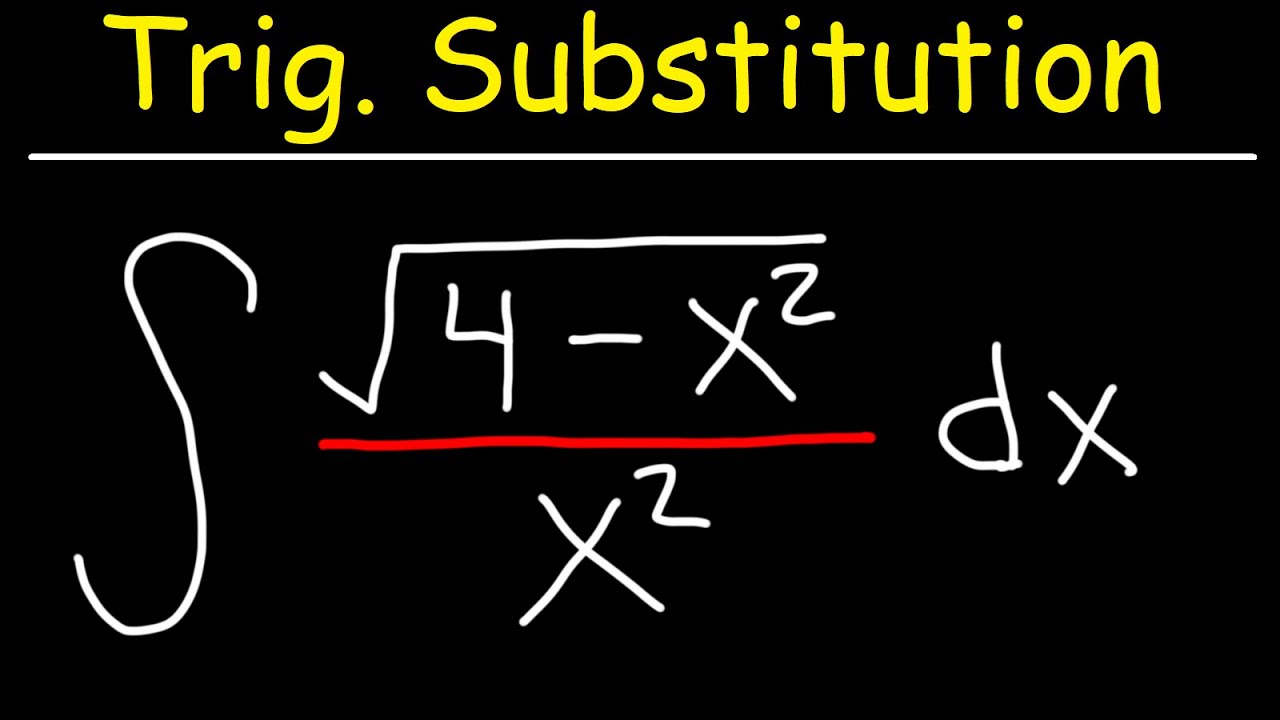
This calculus video tutorial provides a basic introduction into trigonometric substitution. It explains when to substitute x with sin, cos, or sec. It also explains how to perform a change of variables using u-substitution integration techniques and how to use right triangle trigonometry with sohcahtoa to convert back from angles in the form o...
drowsy sage
i dont understand what theyr talking about... god, this isnt fair, im going to fail my class
theyr just replacing things with other things and i dont understand
earnest socket
Might need to work on u-substitution first then
drowsy sage
what is u?
earnest socket
Varies depending on the problem

This calculus video tutorial provides a basic introduction into u-substitution. It explains how to integrate using u-substitution. You need to determine which part of the function to set equal to the u variable and you to find the derivative of u to get du and solve for dx. After replacing all x variables with u variables, find the antideriva...
cedar kilnBOT
@drowsy sage Has your question been resolved?
cedar kilnBOT
@drowsy sage Has your question been resolved?
cedar kilnBOT
Channel closed
Closed due to timeout
Use .reopen if this was a mistake.
Available help channel!
Send your question here to claim the channel.
Remember:
• Ask your math question in a clear, concise manner.
• Show your work, and if possible, explain where you are stuck.
• After 15 minutes, feel free to ping <@&286206848099549185>.
• Type the command .close to free the channel when you're done.
• Be polite and have a nice day!
Read #❓how-to-get-help for further information on how to ask a good question, and about conduct in the question channels.
 limber wing
Hello, I need help with a simple geometry problem. I need to find the length of DC here :
 cedar kilnBOT
limber wing
Hello, I need help with a simple geometry problem. I need to find the length of ...
limber wing
cedar kilnBOT
limber wing
Hello, I need help with a simple geometry problem. I need to find the length of ...
limber wing
I tried using trigonometry but I can't find the solution
livid hound
show the trig you tried
limber wing
I know it's possible to solve this but I'm not sure how we can calculate the length of anything
Well, first I calculated the angle BCA = 48°
livid hound
BCA isn't 48°
 hot crag
let's call AD "$x$";
so we know that $\tan27=\frac{h}{\left(x+10\right)}$
wraith daggerBOT
ren
 limber wing
yes that's what i had
hot crag
okay
limber wing
i tried this: sin(27°) = h / AH
sin(27°) * AH = h
AH = h / sin(27°)
Ainsi AH = h / sin(27°)
but we don't have AH
hot crag
then we get $\tan42=\frac{h}{x}$
wraith daggerBOT
ren
 limber wing
oh ok
hot crag
so can we simplify to get "h" as values of tan 42 and tan 27??
limber wing
i don't know if we can
hot crag
$\tan42=\frac{h}{x}$ and $\tan27=\frac{h}{x+10}$. how can you simplify so that they reduce to $h$?
wraith daggerBOT
ren
 hot crag
you got anything?
limber wing
so we can try to subtract tan42 and tan27 and we know that the difference is 10 right?*
limber wing
sry i'm rly slow
limber wing
oh ok
limber wing
i don't know exactly how to use the two informations
limber wing
 limber wing
how am i supposed to mix these two equations
wraith daggerBOT
ren
 limber wing
oh yes
hot crag
alright
limber wing
and we need to distribute or not?
hot crag
so then we can set them to be equal to each other, right?
limber wing
yes
hot crag
limber wing
and we need to distribute or not?
yes!
good
so we get $10\tan27+x\tan27=x\tan42$
limber wing
tan27x+tan2710
wraith daggerBOT
ren
 hot crag
limber wing
tan27*x+tan27*10
hot crag
limber wing
tan27*x+tan27*10
no actually that is smh else, we write it as x tan 27 and 10 tan 27
but i get what ur tryna say
limber wing
yes
limber wing
alright so that gives us 10tan27 = xtan42-xtan27
hot crag
correct
limber wing
we can't subtract the degrees though right?*
hot crag
no
hot crag
nope
but that does give us a way to solve for x
how do we do that?
dw you won't need to calculate tan 27 or tan 42 on ur own, u can use a calculator
limber wing
ohh
hot crag
BUT
before doing that
give me an equation
that solves for x
$x\tan42-x\tan27=10\tan27$
wraith daggerBOT
ren
 limber wing
9tan27 = xtan42
hot crag
no?
limber wing
oh no sry
limber wing
i got 1tan27 and put it on the other side
hot crag
oh lol
limber wing
but does it work or not
hot crag
okay so we can distribute x right?
hot crag
limber wing
but does it work or not
no
limber wing
x(tan42-tan27) = 10tan27
limber wing
then we have two results
hot crag
wdym
hot crag
no no no
hot crag
$\frac{10\tan27}{\tan42-\tan27}=x$
wraith daggerBOT
ren
 limber wing
oh yes
limber wing
oh that was simple
hot crag
XD
limber wing
so that gives us 13,0353889
hot crag
hot crag
so remember we had tan 42 = h/x
we changed that to turn into x tan 42 = h
hot crag
limber wing
so that gives us 13,0353889
yes!
limber wing
oh nice
limber wing
my brain's almost fried but at least i understood most of it
hot crag
lol i'm sorry
limber wing
no dw
limber wing
ty for your help
hot crag
im sorry if it was confusing
limber wing
i might have got the question mixed up
hot crag
im doing calculus so this should be easy for me
limber wing
yeah
limber wing
lol
limber wing
11,7367667
hot crag
yes!
limber wing
nice ty
hot crag
gj
hot crag
okay
limber wing
.closed*
hot crag
just do .close
limber wing
.close
cedar kilnBOT
Channel closed
Closed by @limber wing
Use .reopen if this was a mistake.
Available help channel!
Send your question here to claim the channel.
Remember:
• Ask your math question in a clear, concise manner.
• Show your work, and if possible, explain where you are stuck.
• After 15 minutes, feel free to ping <@&286206848099549185>.
• Type the command .close to free the channel when you're done.
• Be polite and have a nice day!
Read #❓how-to-get-help for further information on how to ask a good question, and about conduct in the question channels.
crimson sedge
If r vector is a linear combination of a and b vectors
can i write r= a + lambda b vector instead of r = mu a + lambda b
cedar kilnBOT
crimson sedge
If r vector is a linear combination of a and b vectors
can i write r= a + lambd...
cerulean sail
Not necessarily (e.g. mu could be zero)
crimson sedge
cerulean sail
Not necessarily (e.g. mu could be zero)
What if it's not zero?


Like in the above problem, the solution is r= a + tb. They just consider 1 variable in coplanarity. What's the logic here?
tropic oxide
this is suspicious
crimson sedge
tropic oxide
this is suspicious
Lot of solution takes a + lambda b vector in coplanarity and answer is right.
I don't get the logic
tropic oxide
honestly neither do i. it looks like a sleight of hand.
crimson sedge
tropic oxide
honestly neither do i. it looks like a sleight of hand.
:/
 solar vector
You don't understand the coplanarity or the choice of r?
@crimson sedge
The formula for r is just one of the general equations for a line
In this case values of t give you points along a line thru a in the direction of b (or the opposite direction).
I'm kinda getting messed up on the sense of coplanarity.
As points any three distinct points determine a plane.
So, a,b and r are coplanar in that sense once you pick a t.
As vectors by the geometric definition of vector addition r lies in the plane you'd get when you align the tails of the vectors a and b.
I think either way the intuition here is that they're picking the line I mentioned previously and then finding the parameter t that gives them the correct projection value the problem mentions.
crimson sedge
solar vector
You don't understand the coplanarity or the choice of r?
I don't understand the solution here. Like how did they write just with one scalar variable like r = a + tb instead of r= lambda a + mu vector which has 2 scalars. Like what's the logic? I mean it does got you the correct answer
solar vector
I think there's probably a geometric interpretation here coming from the bit about projections.
crimson sedge
solar vector
I think there's probably a geometric interpretation here coming from the bit abo...
Could you elaborate please on that?
 solar vector
crimson sedge
Could you elaborate please on that?
solar vector
crimson sedge
Could you elaborate please on that?
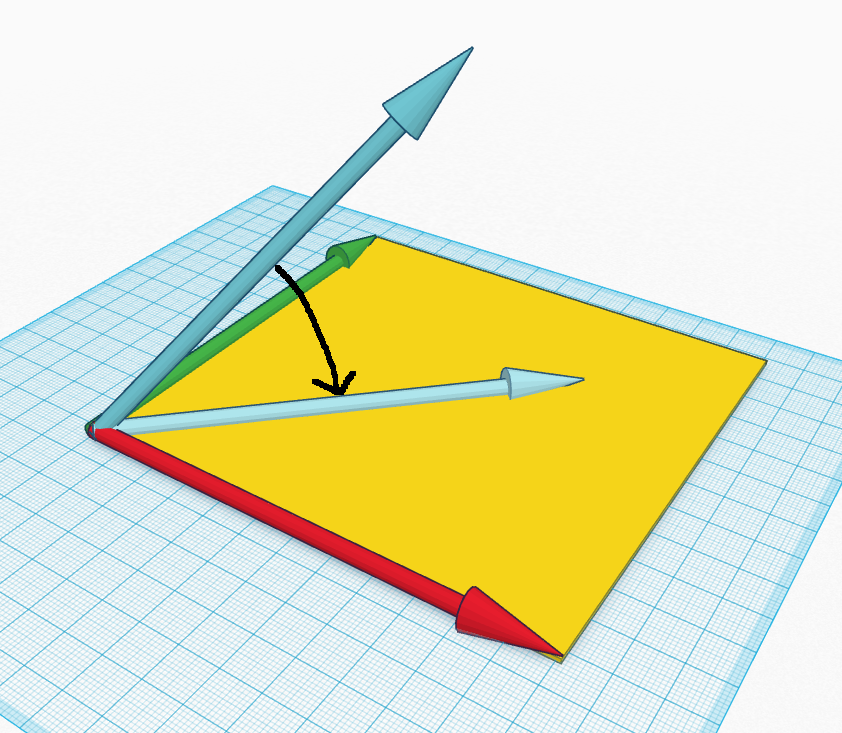
Perhaps geometrically they have an image like this in mind?
a and b being the two vectors in the plane
c being the vector out of the plane
There will only be one line in the direction of c in the plane maybe?
crimson sedge
solar vector
Perhaps geometrically they have an image like this in mind?
Yeah. That's the interpretation they have
solar vector
My geometry visualisation might be backwards
But either way there is only one parameter you can scale here the length of the vector in the plane
So something like ua+tb would be too many variables.
So maybe they are fixing u=1 arbitrarily for this reason.
Not sure now exactly why they picked u=1 actually

 royal finch
Personally the way I would do this problem is to just take the triple scalar product of the unknown vector, a and b
You then have a vector you can project with c
solar vector
You can probably leave u in general like this and follow the same logic they did and just pick both u and t at the end to get a correct value for the projection.
solar vector
solar vector
So something like ua+tb would be too many variables.
Referring to the u here I mean
solar vector
royal finch
You then have a vector you can project with c
I don't see how you are using triple scalar product. The method I'm suggesting is already to project a vector along c. So are you using triple scalar product to also find the t and u (I mentioned) somehow in advance?
royal finch
Basically you take the triple scalar product and equate it to zero. This gets you the unknown vector in a parametric form
Then project and it simplifies
cedar kilnBOT
@crimson sedge Has your question been resolved?
crimson sedge
solar vector
You can probably leave u in general like this and follow the same logic they did...
Everybody confused🥲
solar vector
crimson sedge
Everybody confused🥲
I'm pretty sure the same exact method they did but with r=au+tb instead will also work, you'll just have to pick a suitable value of u too at the end. Notice they just picked u=1 at the start. I think JessicaK is probably on to some more geometricly elegant way to solve this problem.
crimson sedge
solar vector
I'm pretty sure the same exact method they did but with r=au+tb instead will als...
do u think at u=1 it will leave out extra answers?
royal finch
If you try my solution, you would realize that using the R linearity of the cross product in each argument, it doesn't matter of you take ua + tb, a + tb or ua + b.
solar vector
royal finch
Personally the way I would do this problem is to just take the triple scalar pro...
The issue is that I don't understand your method very well. The triple scalar product gives us the signed volume of the paralleliped determined by a, b and the vector r here right?
But if r is coplanar to a and b is that value not just 0?
solar vector
So, then solve for t and u and just project I see.
Not sure why that didn't click lmao
Idk if the asker knows triple scalar products tho
Gimme a sec
In geometry and algebra, the triple product is a product of three 3-dimensional vectors, usually Euclidean vectors. The name "triple product" is used for two different products, the scalar-valued scalar triple product and, less often, the vector-valued vector triple product.
Not sure if there is a better online resource for this
cedar kilnBOT
@crimson sedge Has your question been resolved?
crimson sedge
royal finch
Basically you take the triple scalar product and equate it to zero. This gets yo...
Yes that method i know but i wanted to know the logic of that method
cedar kilnBOT
Channel closed
Closed by @wicked chasm
Use .reopen if this was a mistake.
crimson sedge
solar vector
Idk if the asker knows triple scalar products tho
I know that.
Thanks for the help 🙂
cedar kilnBOT
Available help channel!
Send your question here to claim the channel.
Remember:
• Ask your math question in a clear, concise manner.
• Show your work, and if possible, explain where you are stuck.
• After 15 minutes, feel free to ping <@&286206848099549185>.
• Type the command .close to free the channel when you're done.
• Be polite and have a nice day!
Read #❓how-to-get-help for further information on how to ask a good question, and about conduct in the question channels.
 twin wagon
hello
cedar kilnBOT
twin wagon
hello
twin wagon
i need help can you understand exercises in french?
livid hound
some people (not me) can
post both the original and the translation
twin wagon
ok wait

Exercise 34
- Let f be a function defined and continuous on the segment [a; b] such that
f(x) > 0 for all x of [a; b].
Show that: (3α € IR); (vx = [a;b]); f(x) ≥ α - Let g be a function defined and continuous on the segment [a; b] such that g(x) ‡ x
for all x of [a,b].
Show that: (BEIR:): (vx E[a,b]); g(x)=x ≥B
the translation may be inaccurate, i only used google translate
@livid hound
cedar kilnBOT
@twin wagon Has your question been resolved?
twin wagon
no
cedar kilnBOT
@twin wagon Has your question been resolved?
twin wagon
.close
cedar kilnBOT
Channel closed
Closed by @twin wagon
Use .reopen if this was a mistake.
cedar kilnBOT
Available help channel!
Send your question here to claim the channel.
Remember:
• Ask your math question in a clear, concise manner.
• Show your work, and if possible, explain where you are stuck.
• After 15 minutes, feel free to ping <@&286206848099549185>.
• Type the command .close to free the channel when you're done.
• Be polite and have a nice day!
Read #❓how-to-get-help for further information on how to ask a good question, and about conduct in the question channels.
 chrome basin
can someone pls explain me how the (2ˆ10)ˆ200 becomes 1ˆ200
 cerulean sail
2^10 is 1 mod 11, they used that (see (2))
cedar kilnBOT
Channel closed
Closed by @chrome basin
Use .reopen if this was a mistake.
Available help channel!
Send your question here to claim the channel.
Remember:
• Ask your math question in a clear, concise manner.
• Show your work, and if possible, explain where you are stuck.
• After 15 minutes, feel free to ping <@&286206848099549185>.
• Type the command .close to free the channel when you're done.
• Be polite and have a nice day!
Read #❓how-to-get-help for further information on how to ask a good question, and about conduct in the question channels.
 magic solar
i simply thought it was (7-1)!/2x2!x4!
 cedar kilnBOT
magic solar
i simply thought it was (7-1)!/2x2!x4!
magic solar
cedar kilnBOT
magic solar
i simply thought it was (7-1)!/2x2!x4!
magic solar
its weird because for another question, "1 green key, 3 blue keys and 2 red keys on a ring" was just (6-1)!/2x3!x2
but apparantly this time I can't use this method, almost seems like there is no such thing as consistency in combinatorics
crimson sedge
magic solar
but apparantly this time I can't use this method, almost seems like there is no ...
yeah the thing about PnC is that intuition is very important
you cant really be formulaic as with other stuff
magic solar
whats PnC
crimson sedge
permutations and combinations
magic solar
oh
so is the formula (n-1)!/2 only for specific cases on a bracelet
or did i not account for the repetitions preoperly
crimson sedge
i think outside of the mathematical side of things
without minusing anything, it should be clear that 15 (6 choose 2) braclets can be formed
magic solar
6 choose 2?
crimson sedge
is the answer 9 or something
tropic oxide
we can make our life a bit easier by picking a canonical orientation for our bracelets
specifically we can demand that the one yellow bead be on top
we need to be careful about bracelets that are symmetric wrt flips vs ones that are not
crimson sedge
magic solar
how
I fixed one of the beads and then accounted for all the repetitions that result from anticlockwise and clockwise arrangements
magic solar
Ok so
like Ann said, if we fix the yellow bead,
can we just consider the number of cases where the red are equidstant from the yellow bead
magic solar
ooh
crimson sedge
because if you like flip the braclet
magic solar
although I don't get 9
crimson sedge
they will be the same
magic solar
right
crimson sedge
magic solar
although I don't get 9
do u get 6 im guessing
magic solar
I get 3
crimson sedge
yeah
crimson sedge
i think its better for you if you maybe draw circles for all the 15 cases
magic solar
ok
crimson sedge
and then intuitively check for yourself how you account for those repetitions
magic solar
I haven't draw it all out yet, but just drawing out the cases where the red is equidistant from yellow i got 3 combinations.

Drawing them all out is so confusing sorry I just can't tell if theyre the same or not
crimson sedge
magic solar
I haven't draw it all out yet, but just drawing out the cases where the red is e...
yeah thats true i think
but like
the other 12 are like
6 but the other half is like
the same
so like for the other 12, place each two into 6 groups where they are symmetrically identical
magic solar
Ah i see how that could be
since we count flipped as a unique permutation in a circle
and these 3 are the exact same in a circle and dont count as 6, so we don't halve thsee
magic solar
I couldn't do a question myself if my life depended on it smh. Thanks again
.close
.cloes
.close
cedar kilnBOT
Channel closed
Closed by @magic solar
Use .reopen if this was a mistake.
crimson sedge
magic solar
.close
triple fail
cedar kilnBOT
Available help channel!
Send your question here to claim the channel.
Remember:
• Ask your math question in a clear, concise manner.
• Show your work, and if possible, explain where you are stuck.
• After 15 minutes, feel free to ping <@&286206848099549185>.
• Type the command .close to free the channel when you're done.
• Be polite and have a nice day!
Read #❓how-to-get-help for further information on how to ask a good question, and about conduct in the question channels.
cedar kilnBOT
crimson sedge
triple fail

 cedar kilnBOT
Channel closed
Closed by @lone wigeon
Use .reopen if this was a mistake.
crimson sedge
magic solar
I couldn't do a question myself if my life depended on it smh. Thanks again
but no worries
cedar kilnBOT
Available help channel!
Send your question here to claim the channel.
Remember:
• Ask your math question in a clear, concise manner.
• Show your work, and if possible, explain where you are stuck.
• After 15 minutes, feel free to ping <@&286206848099549185>.
• Type the command .close to free the channel when you're done.
• Be polite and have a nice day!
Read #❓how-to-get-help for further information on how to ask a good question, and about conduct in the question channels.
crimson sedge
im trying to do part d from this question.. but im not sure..
 magic solar
-a/1 = alpha ^2 + beta ^2 + gamma ^2 = (alpha + beta + gamma)^2 - 2(alpha beta + alpha gamma + gamma beta)
so basically using $(a+b+c)^2 = a^2 + b^2 +c^2 +2(ab+bc+ca)$
wraith daggerBOT
annyeong
 crimson sedge
vieta's equations are always the answer to those type of questions
so you can just use them
crimson sedge
magic solar
-a/1 = alpha ^2 + beta ^2 + gamma ^2 = (alpha + beta + gamma)^2 - 2(alpha beta +...
thanksss
an yeaong
crimson sedge
magic solar
-a/1 = alpha ^2 + beta ^2 + gamma ^2 = (alpha + beta + gamma)^2 - 2(alpha beta +...
the next question says 'find b'
so do i do
$a^2b^2 + b^2c^2 + c^2c^2$
wraith daggerBOT
rella
 crimson sedge
.close
cedar kilnBOT
Channel closed
Closed by @spark basin
Use .reopen if this was a mistake.
Available help channel!
Send your question here to claim the channel.
Remember:
• Ask your math question in a clear, concise manner.
• Show your work, and if possible, explain where you are stuck.
• After 15 minutes, feel free to ping <@&286206848099549185>.
• Type the command .close to free the channel when you're done.
• Be polite and have a nice day!
Read #❓how-to-get-help for further information on how to ask a good question, and about conduct in the question channels.