#help-13
1 messages · Page 225 of 1
 verbal gust
 coral swallow
but still you get an expression in x mixed with a t, but wait I think I see, maybe I should use that formula before the substitution?
coral swallow
ohhhhhhhhhhhhhhh
 light night
So I need some intuitive help guys,
Suppose you got a string of arbitrary length using the characters A B C D,such that they appear in the same frequency, 25% each
Would the permutations and combinations of A B C D also have the same frequency?
coral swallow
Damn that's actually pretty simple 😂
coral swallow
light night
So I need some intuitive help guys,
Suppose you got a string of arbitrary leng...
you need to post your question in an available channel
verbal gust
Integrate it like usual and replace the T
verbal gust
light night
So I need some intuitive help guys,
Suppose you got a string of arbitrary leng...
I don't understand
And yeah you should occupy an empty channel instead
coral swallow
Wait I'll close this one then
verbal gust
coral swallow
Damn that's actually pretty simple 😂
You also did pretty well, when given some of the wrong procedure you know the right rule and whatnot
Yw
coral swallow
Thanks 😄
Allright I'll close the channel now, again thanks a lot for your help :)
.close
 cedar kilnBOT
Channel closed
Closed by @coral swallow
Use .reopen if this was a mistake.
 Available help channel!
Send your question here to claim the channel.
Remember:
• Ask your math question in a clear, concise manner.
• Show your work, and if possible, explain where you are stuck.
• After 15 minutes, feel free to ping <@&286206848099549185>.
• Type the command .close to free the channel when you're done.
• Be polite and have a nice day!
Read #❓how-to-get-help for further information on how to ask a good question, and about conduct in the question channels.
 pale lake
need some help please
 slow jewel
What is y' differentiated with respect to?
slow jewel
Oh
pale lake
but idk if its gonna work
slow jewel
Go on
pale lake
one sec
pale lake
slow jewel
Go on
so ive written it in the form x' = Ax
where the vector x is (x,y,z)
we can see there are two block diagonal matrices
maybe we can solve them both
cedar kilnBOT
@pale lake Has your question been resolved?
Channel closed
Closed by @pale lake
Use .reopen if this was a mistake.
Available help channel!
Send your question here to claim the channel.
Remember:
• Ask your math question in a clear, concise manner.
• Show your work, and if possible, explain where you are stuck.
• After 15 minutes, feel free to ping <@&286206848099549185>.
• Type the command .close to free the channel when you're done.
• Be polite and have a nice day!
Read #❓how-to-get-help for further information on how to ask a good question, and about conduct in the question channels.
 small radish
can anyone help with no. 4?
 cedar kilnBOT
small radish
can anyone help with no. 4?
small radish
cedar kilnBOT
small radish
can anyone help with no. 4?
small radish
.close
cedar kilnBOT
Channel closed
Closed by @small radish
Use .reopen if this was a mistake.
Available help channel!
Send your question here to claim the channel.
Remember:
• Ask your math question in a clear, concise manner.
• Show your work, and if possible, explain where you are stuck.
• After 15 minutes, feel free to ping <@&286206848099549185>.
• Type the command .close to free the channel when you're done.
• Be polite and have a nice day!
Read #❓how-to-get-help for further information on how to ask a good question, and about conduct in the question channels.
 raven sandal
I have this hidden markov chain and am trying to calculate the probability of X2, how do i go about doing this?
 cedar kilnBOT
raven sandal
I have this hidden markov chain and am trying to calculate the probability of X2...
raven sandal
cedar kilnBOT
raven sandal
I have this hidden markov chain and am trying to calculate the probability of X2...
raven sandal
i also have this prior information
 cedar kilnBOT
@raven sandal Has your question been resolved?
 hazy oxide
raven sandal
I have this hidden markov chain and am trying to calculate the probability of X2...
hazy oxide
raven sandal
I have this hidden markov chain and am trying to calculate the probability of X2...
16
raven sandal
What do you mean by 16
hazy oxide
1/6
raven sandal
Could you explain how you get that though?
cedar kilnBOT
@raven sandal Has your question been resolved?
cedar kilnBOT
@raven sandal Has your question been resolved?
cedar kilnBOT
Channel closed
Closed due to timeout
Use .reopen if this was a mistake.
Available help channel!
Send your question here to claim the channel.
Remember:
• Ask your math question in a clear, concise manner.
• Show your work, and if possible, explain where you are stuck.
• After 15 minutes, feel free to ping <@&286206848099549185>.
• Type the command .close to free the channel when you're done.
• Be polite and have a nice day!
Read #❓how-to-get-help for further information on how to ask a good question, and about conduct in the question channels.
 still barn
LMK if you need translations. I need help to tackle this problem

 still barn
(click on pictures for full size)
 crimson delta
do you know how to expand the determinant along a row or column?
still barn
no I do not know of the Laplace expansion
perhaps I should read about it, would it be useful?
 calm sierra
you should since there are very few other ways of finding the det of a general size matrix
cedar kilnBOT
Channel closed
Closed by @still barn
Use .reopen if this was a mistake.
Available help channel!
Send your question here to claim the channel.
Remember:
• Ask your math question in a clear, concise manner.
• Show your work, and if possible, explain where you are stuck.
• After 15 minutes, feel free to ping <@&286206848099549185>.
• Type the command .close to free the channel when you're done.
• Be polite and have a nice day!
Read #❓how-to-get-help for further information on how to ask a good question, and about conduct in the question channels.
 twin orbit
is it possible to have a harmonic function f:R^d->R and a function g:R->R such that g∘f is a harmonic function and G is not affine, if so provide an example and if not make a proof
cedar kilnBOT
twin orbit
is it possible to have a harmonic function f:R^d->R and a function g:R->R such t...
@twin orbit Has your question been resolved?
calm sierra
to start investigating the claim, compute $\Delta(g\circ f)$ for $f$ harmonic and $g\in C^2$
 wraith daggerBOT
Roketsune Janiku
 cedar kilnBOT
Channel closed
Closed due to timeout
Use .reopen if this was a mistake.
Available help channel!
Send your question here to claim the channel.
Remember:
• Ask your math question in a clear, concise manner.
• Show your work, and if possible, explain where you are stuck.
• After 15 minutes, feel free to ping <@&286206848099549185>.
• Type the command .close to free the channel when you're done.
• Be polite and have a nice day!
Read #❓how-to-get-help for further information on how to ask a good question, and about conduct in the question channels.
 errant wasp
when you find the elimination matricies of a matrix A, why do you essentially multiply them backwards
cedar kilnBOT
errant wasp
when you find the elimination matricies of a matrix A, why do you essentially mu...


 upper abyss
"Matrix action" is done right to left
This is so they're seen as functions
Kind of like how f(g(x)) has g act on x, then f act on that
If A and B are matricies, and x is a column vector, then ABx is applying the effect of B, then applying the effect of A onto x
errant wasp
okay this makes sense
what also confuses me is like
so now we want to find the E's that belong to A
but then why do you take the inverse, starting at E3,1
 clever sinew
$(A B )^{-1} = B^{-1} A^{-1}$ Multiply on both sides by B then A
wraith daggerBOT
Tobi
 clever sinew
Seems to look related to de-morgan laws with "break the line flip the sign" actually here its more like "take the inverse change the order"
In your case its a few more steps with same idear
errant wasp
upper abyss
Kind of like how f(g(x)) has g act on x, then f act on that
this was super hlepful
errant wasp
clever sinew
In your case its a few more steps with same idear
hmm im still confused why
cedar kilnBOT
@errant wasp Has your question been resolved?
cedar kilnBOT
Channel closed
Closed due to timeout
Use .reopen if this was a mistake.
Available help channel!
Send your question here to claim the channel.
Remember:
• Ask your math question in a clear, concise manner.
• Show your work, and if possible, explain where you are stuck.
• After 15 minutes, feel free to ping <@&286206848099549185>.
• Type the command .close to free the channel when you're done.
• Be polite and have a nice day!
Read #❓how-to-get-help for further information on how to ask a good question, and about conduct in the question channels.
 vestal fern
Hello, I need help with this question. I'm not sure what it means that I should use the dot product to solve this. I have attempted to do c_1b_1+c_2b_2+c_3*b_3 = <1,1,1> then set up a system of equations out of it and solve for c3 that way, however I didn't get the correct answer
 cedar kilnBOT
vestal fern
Hello, I need help with this question. I'm not sure what it means that I should ...
cedar kilnBOT
vestal fern
Hello, I need help with this question. I'm not sure what it means that I should ...
Show your work, and if possible, explain where you are stuck.
 shut tapir
I think i got it
shut tapir
vdotb_3=(b_1+b_2+b_3)dotb_3
Since bi's are orthogonal, their dot product will be zero
vdotb3 is 3+0+1=4
b_3dotb_3 is 3^2+1^2=10*c_1
10c_1=4
c_1=0.4
I mean c_3
shut tapir
vestal fern
c_1 + c_2 +3c_2 = 1 -> c_1 = -c_2 - c_3
2(-c_2 - c_3) -5c_2 = 1 ->
Comparing coefficients?
vestal fern
shut tapir
Comparing coefficients?
disregard
vestal fern
shut tapir
b_3dotb_3 is 3^2+1^2=10*c_1
i dont understand why you did b_3 dot b_3
shut tapir
, w solve a+b+3c=1, 2a-5b=1 and - 3a-3b+c=1
wraith daggerBOT


 Requested by ericsson6890
shut tapir
Requested by ericsson6890
shut tapir
@vestal fern should have worked, c is c_3
shut tapir
vestal fern
i dont understand why you did b_3 dot b_3
Exploit the fact that they are orthogonal vectors and also question mentioned that
vestal fern
yeah but
normally you dot another vector
like b_2 dot b_3
instead of b_3 dot b_3
and that is why im confused
shut tapir
b2 dot b3 will result in a zero, you can't calculate the value of c3 with that
vestal fern
ok thanks for your help, I think I understand
do you know how to do the second part? I have no idea
I think it has something to do with normalizing right?
cedar kilnBOT
@vestal fern Has your question been resolved?
vestal fern
.close
cedar kilnBOT
Channel closed
Closed by @vestal fern
Use .reopen if this was a mistake.
Available help channel!
Send your question here to claim the channel.
Remember:
• Ask your math question in a clear, concise manner.
• Show your work, and if possible, explain where you are stuck.
• After 15 minutes, feel free to ping <@&286206848099549185>.
• Type the command .close to free the channel when you're done.
• Be polite and have a nice day!
Read #❓how-to-get-help for further information on how to ask a good question, and about conduct in the question channels.
 errant turret
confused.. can someone explain?
 cedar kilnBOT
errant turret
confused.. can someone explain?
cedar kilnBOT
errant turret
confused.. can someone explain?
 cedar kilnBOT
 elfin hill
Someone else is already using this help channel. If you need help with a question, please open your own help channel/thread (see #❓how-to-get-help for instructions).
errant turret
.close
cedar kilnBOT
Channel closed
Closed by @errant turret
Use .reopen if this was a mistake.
cedar kilnBOT
Available help channel!
Send your question here to claim the channel.
Remember:
• Ask your math question in a clear, concise manner.
• Show your work, and if possible, explain where you are stuck.
• After 15 minutes, feel free to ping <@&286206848099549185>.
• Type the command .close to free the channel when you're done.
• Be polite and have a nice day!
Read #❓how-to-get-help for further information on how to ask a good question, and about conduct in the question channels.
 high goblet
Hi I need to multiple these together to get the answer below but I don’t know how to start
cedar kilnBOT
high goblet
Hi I need to multiple these together to get the answer below but I don’t know ho...
high goblet
 high goblet
 crimson sedge
We'll do it step-by-step
crimson sedge
We'll do it step-by-step
So I think it’s just √16w for the first left one right?
Or would it be rooted so it would be √ 4w
crimson sedge
high goblet
Or would it be rooted so it would be √ 4w
You'd have to take the 4 out of the square root to do that
sqrt(16w)=sqrt(16)*sqrt(w)=4sqrt(w)
high goblet
Ah I see
crimson sedge
Though I don't think it requires you to simplify (unless the question specifically states that)
Because sqrt(8) could become 2sqrt(2) and sqrt(u^5) could become u^2sqrt(u)
But I'm getting ahead of myself
high goblet
I’m thinking it’s √2u^-1?
crimson sedge
high goblet
So it’s more like √2 u^-1
Be careful...
In the 3rd square on the top row, the u^5 is inside the square root
crimson sedge
It has an odd power, so that would be a bit of an issue
Try getting the bottom square's u^4 inside the square root instead
crimson sedge
high goblet
Am I too dumb for this
Am I smart enough for this?
wraith daggerBOT
jan Lapiwin
 crimson sedge
Can you get the u inside the square root?
crimson sedge
high goblet
Wait so is it just √2u?
Uh... No
It needs to stay equal
Let's try something else
$\sqrt{2u^2}$
wraith daggerBOT
jan Lapiwin
 crimson sedge
Can you get the u^2 outside the square root?
high goblet
I’ll be honest with you I don’t know how to
crimson sedge
high goblet
I’ll be honest with you I don’t know how to
Okay, let's try one last thing
$\sqrt{u^2}$
wraith daggerBOT
jan Lapiwin
 crimson sedge
Get rid of the square root
high goblet
The closest thing I could think of is multiply it?
Wait
Wait
Do we just square it then?
Square from both sides
crimson sedge
high goblet
Do we just square it then?
What? No
Okay okay, one last chance
$\sqrt{u}^2$
wraith daggerBOT
jan Lapiwin
 crimson sedge
Simplify this
high goblet
Does it just become u
wraith daggerBOT
jan Lapiwin
 crimson sedge
Simplify this
high goblet
Is it just u again?
wraith daggerBOT
jan Lapiwin
 high goblet
Yeah to be honest
crimson sedge
$\sqrt{u^2}=u$
wraith daggerBOT
jan Lapiwin
 wraith daggerBOT
jan Lapiwin
 crimson sedge
Makes sense?
crimson sedge
wraith dagger
**jan Lapiwin**
@high goblet Well, just as I did here I guess
That's what I mean
high goblet
But how do we get the u^4 then
crimson sedge
high goblet
But how do we get the u^4 then
Let's do something simpler
First I wnat to confirm you can do this:
$\sqrt{2u^2}=?$
wraith daggerBOT
jan Lapiwin
 cedar kilnBOT
@high goblet Has your question been resolved?
crimson sedge
You know what, maybe I am keeping you guessing a bit too much
$\sqrt{2u^2}=\sqrt{2}u$
wraith daggerBOT
jan Lapiwin
 crimson sedge
Well actually we nearly always put the u at the front for aesthetic reasons but you get the point
And similarily:
$\sqrt{2u^4}=\sqrt{2}u^2$
wraith daggerBOT
jan Lapiwin
 crimson sedge
(If you have trouble understanding that one, just realise u^4=(u^2)^2)
cedar kilnBOT
Channel closed
Closed due to timeout
Use .reopen if this was a mistake.
Available help channel!
Send your question here to claim the channel.
Remember:
• Ask your math question in a clear, concise manner.
• Show your work, and if possible, explain where you are stuck.
• After 15 minutes, feel free to ping <@&286206848099549185>.
• Type the command .close to free the channel when you're done.
• Be polite and have a nice day!
Read #❓how-to-get-help for further information on how to ask a good question, and about conduct in the question channels.
 latent hazel
Hi, do you know how to solve this integral?
 cedar kilnBOT
latent hazel
Hi, do you know how to solve this integral?
cedar kilnBOT
latent hazel
Hi, do you know how to solve this integral?
 dim tiger
!status
cedar kilnBOT
What step are you on?
1. I don't know where to begin.
2. I have begun but got stuck midway.
3. I got an answer but I was told that it's wrong.
4. I got an answer and would like my work checked.
5. I have a question about someone else's work/solution.
6. I have completed the problem and don't need help anymore. Thank you.
7. None of the above
ok can you show your work
latent hazel
But I do not know how to work out that 7/4
dim tiger
ok so do you know that $\int{\frac{dx}{x^2+a^2}}=\frac{tan^{-1}(\frac{x}{a})}{a}$?
wraith daggerBOT
calculus is fun

 sly granite
latent hazel
Hi, do you know how to solve this integral?
sly granite
latent hazel
Hi, do you know how to solve this integral?
that's one loooong integral sign
latent hazel
wraith dagger
**calculus is fun**
No it is my first time seeing this
Is there some prove
Because I might be asked
dim tiger
then what integral do you know that results in arctan
latent hazel
1/(x^2+1)
dim tiger
ok so from $\int{\frac{dx}{x^2+a^2}}$ take $a^2$ as a common factor in the denom what do you get
wraith daggerBOT
calculus is fun
 latent hazel
so in the denom I would get x^2/a^2 + 1
dim tiger
latent hazel
so in the denom I would get x^2/a^2 + 1
is multiplied by this
so overall you have 1/[a^2[(x/a)^2+1]]
this is under the integral sign
wrt x
so now 1/a^2 is a constant
you can "drag" it outside the integral sign since it is a constant multiplied by the integrated function
this gives$\frac{1}{a^2}\int{\frac{dx}{(\frac{x}{a})^2+1}}$
wraith daggerBOT
calculus is fun
 dim tiger
now from here what can you do
try this
@latent hazel
are you there
sorry for the ping but i need to go sleep soon
thats why
latent hazel
yes I think I managed to calculate it so thank you very much for help
wraith daggerBOT
calculus is fun
 dim tiger
is this what you got ?
cedar kilnBOT
Channel closed
Closed by @latent hazel
Use .reopen if this was a mistake.
dim tiger
np you did the whole work
cedar kilnBOT
Available help channel!
Send your question here to claim the channel.
Remember:
• Ask your math question in a clear, concise manner.
• Show your work, and if possible, explain where you are stuck.
• After 15 minutes, feel free to ping <@&286206848099549185>.
• Type the command .close to free the channel when you're done.
• Be polite and have a nice day!
Read #❓how-to-get-help for further information on how to ask a good question, and about conduct in the question channels.
 void sand
 void sand
!status
cedar kilnBOT
What step are you on?
1. I don't know where to begin.
2. I have begun but got stuck midway.
3. I got an answer but I was told that it's wrong.
4. I got an answer and would like my work checked.
5. I have a question about someone else's work/solution.
6. I have completed the problem and don't need help anymore. Thank you.
7. None of the above
 vast pike
do you know the definition of uniform continuous ? if yes, can you please write it up
void sand
vast pike
do you know the definition of uniform continuous ? if yes, can you please write ...
for all ε>0, there exists a δ>0 st. for all x,y in (a,b), 0< |x-y| < δ => |f(x) - f(y)| < ε
vast pike
nice
so lets take $x_1,...,x_n\in(a,b)$ such that $(a,b)\subset \bigcup (x_i-\delta/2, x_i+\delta/2)$
wraith daggerBOT
everg
 void sand
why?
vast pike
i ll draw a quick picture to show the geoemtric idea


in the picture, the dots's height are values f(x1) f(x2) f(x3)
because every interval has diameter equal to delta
we know that the function restricted e.g. in the red interval is near to the red dot (at most it moves away espilon from the red dot)
void sand
ok...
 wraith daggerBOT
everg
 vast pike
now for every $x$ in $(a,b)$ there is an $x_i$ such that $|x_1-x|<\delta$
wraith daggerBOT
everg
 vast pike
hence $|f(x)-f(x_i)|<\epsilon\implies |f(x)|<|f(x_i)|+\epsilon$
wraith daggerBOT
everg
 vast pike
implies $f(x)<M+\epsilon\implies \sup f(x)< M+\epsilon<\infty$
wraith daggerBOT
everg
 void sand
but don't we want to show that f is bounded on R, not (a,b)?
 polar goblet
vast pike
implies $f(x)<M+\epsilon\implies \sup f(x)< M+\epsilon<\infty$
polar goblet
vast pike
implies $f(x)<M+\epsilon\implies \sup f(x)< M+\epsilon<\infty$
how does one master this discord mathematics lingo?
vast pike
wdym with lingo ?
polar goblet
that language you speak to generate the math synboks
symbols
it truly appears as if it is divine
 fair geyser
you don't want to master it, like with anything else, it becomes not worth the effort much earlier
vast pike
that is latex, i am a university so i know by my onw
polar goblet
ok
vast pike
striker try this
https://texnique.xyz/ you can learn some basis latex lines
A LaTeX Typesetting Game
(a) talks about (a,b)
 vast pike
ok any ideas ?
void sand
vast pike
ok any ideas ?
unfortunately no; existence proofs have always stumped me
wraith daggerBOT
everg
 vast pike
if $x\in (\delta,2\delta)$ then $|f(x)|<|f(\delta)|+\epsilon<|f(0)|+\epsilon+\epsilon$
wraith daggerBOT
everg
 void sand
vast pike
if $x\in (\delta,2\delta)$ then $|f(x)|<|f(\delta)|+\epsilon<|f(0)|+\epsilon+\ep...
void sand
vast pike
if $x\in (\delta,2\delta)$ then $|f(x)|<|f(\delta)|+\epsilon<|f(0)|+\epsilon+\ep...
i dont follow
 vast pike
by unifotm cont
void sand
isnt it then |f(x) - f(y)| < eps?
vast pike
$|f(x)|-|f(0)|<|f(x)-f(0)|<\epsilon$
wraith daggerBOT
everg
 vast pike
are you ok with (1) then ?
void sand
give me a moment
vast pike
is it passed that moment ?
void sand
wraith dagger
**everg**
sorry, I'm really not following this
how are we getting these inequalities?
it's non-obvious to me, even though i feel like it shouldnt be
I suppose I should start with the right-side inequality
why is |f(x)| < eps
wraith daggerBOT
everg
 vast pike
now is it better ?
wraith daggerBOT
everg
 wraith daggerBOT
everg
 void sand
but the reverse triangle inequality is | |x| - |y| | <= |x-y| no?
vast pike
the use b=f(x)-f(0) and a=-f(0)
void sand
ok im good with this one
void sand
vast pike
which part you don t follow
whats going on in 2 and 3?
vast pike
(2) is just like (1) but in (delta, 2delta) instead of (0,delta)
void sand
ok, got it
vast pike
(3) is just (2)+(1) ok ?
cedar kilnBOT
@void sand Has your question been resolved?
cedar kilnBOT
Channel closed
Closed due to timeout
Use .reopen if this was a mistake.
void sand
.reopen
cedar kilnBOT
✅
cedar kilnBOT
@void sand Has your question been resolved?
Channel closed
Closed by @void sand
Use .reopen if this was a mistake.
Available help channel!
Send your question here to claim the channel.
Remember:
• Ask your math question in a clear, concise manner.
• Show your work, and if possible, explain where you are stuck.
• After 15 minutes, feel free to ping <@&286206848099549185>.
• Type the command .close to free the channel when you're done.
• Be polite and have a nice day!
Read #❓how-to-get-help for further information on how to ask a good question, and about conduct in the question channels.
crimson sedge
help with lagranges multipliers
cedar kilnBOT
crimson sedge
help with lagranges multipliers
 crimson sedge
yh i did it wrong

@runic garnet have you done this the same
thus far
oh its root of 2/5**
 runic garnet
no need to solve a numerical answer for lambda, but lemme see
no its still wrong
those two equations right under "solve for x and y"
crimson sedge
yh
crimson sedge
well -3/2 lamda?
runic garnet
with lambda in numerator or denominator?
runic garnet
lol
crimson sedge
i've dont the same in y have i not
crimson sedge
how do u do it then
runic garnet
$-3 = 2x\lambda \newline \newline 4 = 2y \lambda \newline \newline \frac {-3}{2x} = \frac 2y$
wraith daggerBOT
Stephen

 runic garnet
what
ok so u have x = -3y/4
and x^2 + y^2 = 1
plug in the first into the second
then just solve
runic garnet
u plugged in both x and y, whats the point
runic garnet
crimson sedge
do i not need to solve for both
u cant solve if u do this obv
runic garnet
x = -3y/4
x^2 + y^2 = 1
runic garnet
ok now find the points: (x,y,z) and (x,y,z)
crimson sedge
how do i find z
runic garnet
ur given f(x,y) are you not?
runic garnet
why every combo? u found y = 4/5 and y = -4/5, find which value of x goes with y = 4/5 and y = -4/5
crimson sedge
why isnt it the negative one
crimson sedge
how do i find x from equation with no x in them?
runic garnet
y = 4/5 and we have x = -3y/4
plug in y into that equation
to solve for x
idk, am i not being clear or smth lol
crimson sedge
you're probably being clear, i am just missing something
if y=4/5 and x=-3y/4
how can i solve for this equation:
4/5 = -3y/4 and find x?
runic garnet
nono
just tell me how u got that
$y = \frac 45 \newline \newline x = \frac {-3y}{4}$
wraith daggerBOT
Stephen
 crimson sedge
yes, i agree
runic garnet
so if y = 4/5, what would u do to find the value of x here
ik im just repeating but maybe the latex makes it more obvious
like we are given the value of y
if u put that value of y into the equation x = -3y/4 , what do u get
crimson sedge
oh
you meant it like so
lets see

Can i write in latex here or is it only you?
runic garnet
anyone can do it
runic garnet
👍
crimson sedge
z sorry
runic garnet
yea, z = 5 for (-.6,0.8)
crimson sedge
-6?
crimson sedge
i had to use lagrange multipliers to find the max and min
under some condition
which was x^2+y^2=1
runic garnet
yea so u got the values of the max and min
cedar kilnBOT
@crimson sedge Has your question been resolved?
cedar kilnBOT
Channel closed
Closed due to timeout
Use .reopen if this was a mistake.
Available help channel!
Send your question here to claim the channel.
Remember:
• Ask your math question in a clear, concise manner.
• Show your work, and if possible, explain where you are stuck.
• After 15 minutes, feel free to ping <@&286206848099549185>.
• Type the command .close to free the channel when you're done.
• Be polite and have a nice day!
Read #❓how-to-get-help for further information on how to ask a good question, and about conduct in the question channels.
 sage vine
A cylinder has a radius of x+4 units and a height of 6 units greater. Express the volume of the cylinder as a polynomial function.
cedar kilnBOT
sage vine
A cylinder has a radius of x+4 units and a height of 6 units greater. Express ...
 civic coral
sage vine
A cylinder has a radius of x+4 units and a height of 6 units greater. Express ...
civic coral
sage vine
A cylinder has a radius of x+4 units and a height of 6 units greater. Express ...
I suppose the height can be expressed as x+10?
sage vine
It's asking for a whole polynomial
civic coral
sage vine
It's asking for a whole polynomial
Express the volume of cylinder by given information
Then it is done
sage vine
I don't understand how do to that, that's why I'm asking
civic coral
Ok
Do you know how to find the volume of cylinder with its radius and height given to you
civic coral
civic coral
Do you know how to find the volume of cylinder with its radius and height given ...
Something wrong in the grammar
civic coral
Then let me teach you how to calculate the volume
It should be very intuitive, that you will never forget once you learnt it
sage vine
okay thank you
civic coral
Given the radius of the cylinder is x+4
Could you tell me the bottom area of the cylinder?
cedar kilnBOT
Channel closed
Closed by @sage vine
Use .reopen if this was a mistake.
Available help channel!
Send your question here to claim the channel.
Remember:
• Ask your math question in a clear, concise manner.
• Show your work, and if possible, explain where you are stuck.
• After 15 minutes, feel free to ping <@&286206848099549185>.
• Type the command .close to free the channel when you're done.
• Be polite and have a nice day!
Read #❓how-to-get-help for further information on how to ask a good question, and about conduct in the question channels.
 bold pond
Why is the answer not -9?
 cedar kilnBOT
bold pond
Why is the answer not -9?
civic coral
cedar kilnBOT
bold pond
Why is the answer not -9?
civic coral
Is has an minimum
 zealous compass
-2+4-3=-1
civic coral
My bad
civic coral
Let me see
bold pond
zealous compass
-2+4-3=-1
Is b/-2a = -1? Am I doing math wrong?
bold pond
zealous compass
-2+4-3=-1
Y isn’t it -4?
civic coral
I got -1 as the maximum too
bold pond
Can u show me
civic coral
bold pond
Can u show me
But the way I finding it is quite different from yours
bold pond
You need to use a formula b/-2a
bold pond
Oh damn
civic coral
Let me try your method
civic coral
Terrific
bold pond
.close
cedar kilnBOT
Channel closed
Closed by @bold pond
Use .reopen if this was a mistake.
Available help channel!
Send your question here to claim the channel.
Remember:
• Ask your math question in a clear, concise manner.
• Show your work, and if possible, explain where you are stuck.
• After 15 minutes, feel free to ping <@&286206848099549185>.
• Type the command .close to free the channel when you're done.
• Be polite and have a nice day!
Read #❓how-to-get-help for further information on how to ask a good question, and about conduct in the question channels.
crimson sedge
can i have help
cedar kilnBOT
crimson sedge
can i have help
crimson sedge
im doing linear inequalities with two variables and i plugged in all the multi choice ordered number pairs they gave me and none were true
and i just cant figure out what to do
it says "Which of the following points lies in the solution set of the inequality y ≥ 3x + 10
(1) (1, 10)
(2) (-1, 3)
(3) (4, 20)
(4) (2, 18)
i plugged 1, in for 1, -1 in for 2, 4 in for 3, and 2 in for 4 and none of them were true
because 1 is 13, and 10 is not ≥ 13
because 2 is 7 and 3 is not ≥ 7
because 3 is 22 and 20 is not ≥ 22
OHHH WAIT
i switched up 4 i think
i put 16≥18 and its supposed to be 18≥16
nice lol
thanks @crimson sedge
cedar kilnBOT
Channel closed
Closed by @daring ice
Use .reopen if this was a mistake.
Available help channel!
Send your question here to claim the channel.
Remember:
• Ask your math question in a clear, concise manner.
• Show your work, and if possible, explain where you are stuck.
• After 15 minutes, feel free to ping <@&286206848099549185>.
• Type the command .close to free the channel when you're done.
• Be polite and have a nice day!
Read #❓how-to-get-help for further information on how to ask a good question, and about conduct in the question channels.
 ancient vector
 cedar kilnBOT
ancient vector
cedar kilnBOT
ancient vector

 dire geode
Looks like you wrote down the same answer 3 times
You didn't actually plug in k=0,1,2
Do that
ancient vector
yea im working on it

yea when doing this problem i don't think it ever took this long thats why im curious if i did anything wrong so far
 lavish wedge
,rotate
wraith daggerBOT
 ancient vector
 cedar kilnBOT
@ancient vector Has your question been resolved?
cedar kilnBOT
@ancient vector Has your question been resolved?
cedar kilnBOT
Channel closed
Closed due to timeout
Use .reopen if this was a mistake.
Available help channel!
Send your question here to claim the channel.
Remember:
• Ask your math question in a clear, concise manner.
• Show your work, and if possible, explain where you are stuck.
• After 15 minutes, feel free to ping <@&286206848099549185>.
• Type the command .close to free the channel when you're done.
• Be polite and have a nice day!
Read #❓how-to-get-help for further information on how to ask a good question, and about conduct in the question channels.
 dull spoke
 cedar kilnBOT
dull spoke
dull spoke
cedar kilnBOT
dull spoke
dull spoke
im confused
 opal schooner
christ that has awful wording
so what I'm getting from it is that this graph is of the derivative function
and so when you find the area underneath the curve and all that you should be able to apply 2FTC to find F(1) and F(7)
dull spoke
what is 2FTC?
opal schooner
2nd fundamental theorem of calculus
dull spoke
oh
wraith daggerBOT
Triaxyz
 dull spoke
so its the area or whatever
opal schooner
yes
dull spoke
of F(0) - minus the ones i find
opal schooner
so for example integral from 0 to 1 is the area of that triangle
opal schooner
opal schooner
so for example integral from 0 to 1 is the area of that triangle
which is equal to F(1) - F(0)
dull spoke
okay
opal schooner
then you solve for F(1)
dull spoke
so -1.5-5
opal schooner
I'd imagine it is
cedar kilnBOT
Channel closed
Closed by @dull spoke
Use .reopen if this was a mistake.
Available help channel!
Send your question here to claim the channel.
Remember:
• Ask your math question in a clear, concise manner.
• Show your work, and if possible, explain where you are stuck.
• After 15 minutes, feel free to ping <@&286206848099549185>.
• Type the command .close to free the channel when you're done.
• Be polite and have a nice day!
Read #❓how-to-get-help for further information on how to ask a good question, and about conduct in the question channels.
 outer pelican
So I have a function f(x,y,z)=ax^2 - by^2 - 3zx+yz where a and b are parameters. I found the Hessian matrix but the question I am trying to answer is, "Determine if there are conditions on a,b that would make f concave in some region of R3. If so, what conditions and what region?" Any guidance or help on this would be great!
cedar kilnBOT
outer pelican
So I have a function f(x,y,z)=ax^2 - by^2 - 3zx+yz where a and b are parameters....
outer pelican
I originally found the leading principal minors and was going to create the conditions off of that but thinking of it, i dont believe that would work(?)
cedar kilnBOT
@outer pelican Has your question been resolved?
cedar kilnBOT
@outer pelican Has your question been resolved?
cedar kilnBOT
Channel closed
Closed due to timeout
Use .reopen if this was a mistake.
cedar kilnBOT
Available help channel!
Send your question here to claim the channel.
Remember:
• Ask your math question in a clear, concise manner.
• Show your work, and if possible, explain where you are stuck.
• After 15 minutes, feel free to ping <@&286206848099549185>.
• Type the command .close to free the channel when you're done.
• Be polite and have a nice day!
Read #❓how-to-get-help for further information on how to ask a good question, and about conduct in the question channels.
 rocky harness
How is $\frac{1}{\mid x \mid \sqrt{1-x^{2}}}$ the derivative of arcsec(x)? The domain of this function is (-1,1) while the domain for arcsec is $(-\infty,-1) \cup (1, \infty)$. How would I find the derivative of arcsec at, say x=85?
cedar kilnBOT
rocky harness
How is $\frac{1}{\mid x \mid \sqrt{1-x^{2}}}$ the derivative of arcsec(x)? The d...
wraith daggerBOT
smidgin
 crimson delta
its x^2-1 in the sqrt
rocky harness
Yeah, I just realised, the first answer on google being wrong doesn't help
Thanks!
.close
cedar kilnBOT
Channel closed
Closed by @rocky harness
Use .reopen if this was a mistake.
Available help channel!
Send your question here to claim the channel.
Remember:
• Ask your math question in a clear, concise manner.
• Show your work, and if possible, explain where you are stuck.
• After 15 minutes, feel free to ping <@&286206848099549185>.
• Type the command .close to free the channel when you're done.
• Be polite and have a nice day!
Read #❓how-to-get-help for further information on how to ask a good question, and about conduct in the question channels.
 modern glen
This is calculus 3.
I need help on 38.
 cedar kilnBOT
modern glen
# This is calculus 3.
I need help on 38.
modern glen
cedar kilnBOT
modern glen
# This is calculus 3.
I need help on 38.
modern glen
I know I have to use this equation

using polar coordinates because this is a circle
I know
r(t) = <x,y,z> = <rcost, rsint, z> = <4cost, 4sint, 5>
and I found r'(t)
i don't understand how
F(r(t)) = <20sint, 40 cost, e^16sintcost>
from my teacher's solution below

<@&286206848099549185>
.close
cedar kilnBOT
Channel closed
Closed by @modern glen
Use .reopen if this was a mistake.
cedar kilnBOT
Available help channel!
Send your question here to claim the channel.
Remember:
• Ask your math question in a clear, concise manner.
• Show your work, and if possible, explain where you are stuck.
• After 15 minutes, feel free to ping <@&286206848099549185>.
• Type the command .close to free the channel when you're done.
• Be polite and have a nice day!
Read #❓how-to-get-help for further information on how to ask a good question, and about conduct in the question channels.
 umbral tapir
hey can someone help me with this? i already started it but im a bit lost of what to do enxt (antidifferentiation)
cedar kilnBOT
umbral tapir
hey can someone help me with this? i already started it but im a bit lost of wha...
umbral tapir

 paper vigil
umbral tapir
paper vigil
umbral tapir
$u=1-\ln\left(x\right)\to du=\frac{dx}{-x}$
wraith daggerBOT
Combustion
 paper vigil
no
you didn't
if you did, these x's would be gone and this whole thing would be negative
 paper vigil
yeah you did do that
umbral tapir
im so confused cuz my other classmates also did the same beginning process as shown on the right and our teacher said it was right
paper vigil
what you did is right
paper vigil
wraith dagger
**Combustion**
but you forgot this step
wraith daggerBOT
Combustion
 umbral tapir
so i take out the negative one from the integral sign
paper vigil

umbral tapir
what i have so far is
idk if that thing will work for me too
$2∫{2}\frac{x(u)^2}-1 ∫{(1-u)^2}\frac{x(u)^2}\cdot du
helpp
ill just take a picture

wait thats 1/x(u)^2 cuz i moved the 2 out
is this right
what do i do next
wraith daggerBOT
Combustion
 paper vigil
remember that dx/x = -du, so there should be no x left
umbral tapir
ohhhh
paper vigil
and this should also have a negative one
 paper vigil
yep
umbral tapir
wraith dagger
**Combustion**
so both were merged at this point rigth
paper vigil
yeah
umbral tapir
our teacher didnt discuss it and just gave us a seatwork right away assuming we read in advanance
paper vigil
and then expand (1-u)^2
umbral tapir
oh okok hold on
umbral tapir
umbral tapir
ohh like what i did on the top right except it shouldve been just (u)^2 left and theres -1 on the outside
paper vigil
umbral tapir
i already split them up
can i use the ln thing with this format now
or do i still haev to do further anipulations
manipulations*
since its u^2
paper vigil
1/u^2 can be easily integrated using the power rule
paper vigil
yep
umbral tapir
wait how do i do that, do i recriprocate it so u is on numerator?
or do i keep it on donminator
since the power rule for integration is the u^n+1 over n+1?
or am i mistaken
paper vigil
yeah sure you can do that
umbral tapir
then ill ask u to verify if thats okay
did i do it right?

sorry its quite long and i didnt do the other one yet i did the first one first
paper vigil
you have to remove the integration sign
but yeah that's right
for the second one you expand (1-u)^2
umbral tapir
ohh yeah im sorry i always do this mistake
ohh okok hold on
thank you so much btw this really means alot
paper vigil

umbral tapir
did i expand it right? also is it right what i did on the left side or do i have to wait until i do the right side
 paper vigil
we already integrated u^-2, you can't integrate 1/-u again
paper vigil
yes
paper vigil
we split them up again
umbral tapir
into three?
paper vigil
yes
umbral tapir
then i do the same process?
paper vigil
yep
paper vigil
yep
umbral tapir
and so i take it out?
paper vigil
no we still have to integrate it
umbral tapir
ohh okok
what happens to 2u/u^2 if i take 2 out its still gonna be u/u^1 right not 1/u^2?
wraith daggerBOT
Combustion

 paper vigil
don't forget the negative 1 applies to everything, not just the first 2/u^2
also
integral of -1/u is -ln(|u|)
 umbral tapir
ohh yeah i forgot the -1 from the beginning
umbral tapir
paper vigil
integral of -1/u is -ln(|u|)
i think this was already integrated
from 1/u^2 i did the product rule and so it became -1/u
 umbral tapir
did i expand it right? also is it right what i did on the left side or do i have...
umbral tapir
umbral tapir
did i expand it right? also is it right what i did on the left side or do i have...
yupp i actually integrated it again by mistake on this part but u brought it up
umbral tapir
paper vigil
it should've been 1/u not 1/u^2
ohhh i see
so for that one i do the ln thing
paper vigil
yep
umbral tapir
oki oki hold on
hold on
what did u mean again by the -1 applies on everything
like i switch all their signs at the end?
or just for the -2 part
paper vigil
yeah because we had this $-1\int_{ }^{ }\frac{u^{2}-2u+1}{u^{2}}du$
wraith daggerBOT
Combustion
 umbral tapir
umbral tapir
umbral tapir
ohh so i should have multiplied it here? i did -1 x 2 making it -2
i shouldnt have had*
paper vigil
yes
 paper vigil
nice!
umbral tapir
omggg really
paper vigil
yep good job
umbral tapir
ooo thank you!!!
paper vigil
have a good day
paper vigil
?
 paper vigil
that's right
umbral tapir
thank u so so so much!!!!! have a nice day bless you!!!!
cedar kilnBOT
@umbral tapir Has your question been resolved?
cedar kilnBOT
Channel closed
Closed due to timeout
Use .reopen if this was a mistake.
Available help channel!
Send your question here to claim the channel.
Remember:
• Ask your math question in a clear, concise manner.
• Show your work, and if possible, explain where you are stuck.
• After 15 minutes, feel free to ping <@&286206848099549185>.
• Type the command .close to free the channel when you're done.
• Be polite and have a nice day!
Read #❓how-to-get-help for further information on how to ask a good question, and about conduct in the question channels.
 summer panther
I'll denote theta by @ here for convenience.
To find the Z-transform of sin(n@) or cos(n@), the common strategy that everybody uses seems to be to equate the real and imaginary parts of the Z-transform of (e^i@)^n.
But I think this is just not valid because how do we know that Z{cos(n@} and Z{sin(n@)} are real?
Moreover, we also need to be sure that the corresponding expressions that occur on the right (when finding Z{(e^i@)^n}) are also real.
We can equate Re. and Im. parts of two complex numbers a+ib and c+id but don't we need to be sure that a, b, c, and d are all real in the first place?
My question is whether or not I'm right in raising this question?
I have seen an alternate way to just compute using the exponential expression of cosine and sine, with which I don't see any problem.
cedar kilnBOT
summer panther
I'll denote theta by @ here for convenience.
To find the Z-transform of sin(n@)...
 astral bay
i don't really know what a z-transform is, but as a guess: is it generally true that the z transform of a real number is a real number?
summer panther
No.
The Z-transform of a function f(n) defined for integers n is, sum over all n of f(n)/z^n.
Where z is a non-zero complex number.
So in most cases the Z-transform is actually not real.
astral bay
hmmm
ok maybe a slight variant of this strategy works: you can also compute the z-transform of (e^-i@)^n, and then e^i@ + e^-i@ = 2cos(@) and e^i@ - e^-i@ = 2isin(@)
but yeah it sounds like just splitting it into real and imaginary parts doesn't make much sense if you don't already know that the result is going to be a real number
summer panther
hmm..
I still want a more expertise answer but I thank you nevertheless for your help.
cedar kilnBOT
@summer panther Has your question been resolved?
cedar kilnBOT
@summer panther Has your question been resolved?
cedar kilnBOT
Channel closed
Closed due to timeout
Use .reopen if this was a mistake.
Available help channel!
Send your question here to claim the channel.
Remember:
• Ask your math question in a clear, concise manner.
• Show your work, and if possible, explain where you are stuck.
• After 15 minutes, feel free to ping <@&286206848099549185>.
• Type the command .close to free the channel when you're done.
• Be polite and have a nice day!
Read #❓how-to-get-help for further information on how to ask a good question, and about conduct in the question channels.
crimson sedge
 cedar kilnBOT
crimson sedge
crimson sedge
cedar kilnBOT
crimson sedge
crimson sedge
This is from the bluebook sat practice test, it's not homework
I just don't understand this
cedar kilnBOT
@crimson sedge Has your question been resolved?
verbal gust
crimson sedge
do you know that a diameter split a circle in half
does that ring a bell
crimson sedge
verbal gust
do you know that a diameter split a circle in half
What does that give us?
verbal gust
crimson sedge
What does that give us?
If the circle is split in half then that split the circumference and the area
crimson sedge
Ohh i see
I solved it in another way already but that seems much easier
It's 48pi right?
verbal gust
The only information you're given here is PS arc and PQ arc
Which if you combine both of them it makes the arc of half a circle
verbal gust
crimson sedge
It's 48pi right?
Yes
verbal gust
crimson sedge
I solved it in another way already but that seems much easier
Stick to what you think is correct, I can stop here or do you want to keep going
verbal gust
crimson sedge
Ty for the help
Alright
You're welcome
crimson sedge
verbal gust
Stick to what you think is correct, I can stop here or do you want to keep going
No i get it now
Ty
.close
cedar kilnBOT
Channel closed
Closed by @hollow rain
Use .reopen if this was a mistake.
Available help channel!
Send your question here to claim the channel.
Remember:
• Ask your math question in a clear, concise manner.
• Show your work, and if possible, explain where you are stuck.
• After 15 minutes, feel free to ping <@&286206848099549185>.
• Type the command .close to free the channel when you're done.
• Be polite and have a nice day!
Read #❓how-to-get-help for further information on how to ask a good question, and about conduct in the question channels.
 thick mauve
Hello
cedar kilnBOT
thick mauve
Hello
thick mauve
How could I find the derivative of e^(2*(x-1))?
 thick tiger
chain rule
derivative of function with input unmodified, times the derivative of the input
cedar kilnBOT
Channel closed
Closed by @thick mauve
Use .reopen if this was a mistake.
Available help channel!
Send your question here to claim the channel.
Remember:
• Ask your math question in a clear, concise manner.
• Show your work, and if possible, explain where you are stuck.
• After 15 minutes, feel free to ping <@&286206848099549185>.
• Type the command .close to free the channel when you're done.
• Be polite and have a nice day!
Read #❓how-to-get-help for further information on how to ask a good question, and about conduct in the question channels.
 brave loom
Hey guys, I am just curious about this trivia I found. Does anyone have any idea whats going on?

 cedar kilnBOT
brave loom
Hey guys, I am just curious about this trivia I found. Does anyone have any idea...
cedar kilnBOT
brave loom
Hey guys, I am just curious about this trivia I found. Does anyone have any idea...
 muted timber
first one is a question about logic
the truth table that you're asked for is that of:
q AND (NOT p)
if p is true, then NOT p is false
the same way, if p is false, NOT p is true
for the whole proposition to be true, q needs to be true, and (NOT p) needs to be also true
the second is a question about operations with sets, specifically union of sets.
The union of two sets is another set, which contains the elements of both sets
So A U C contains every element in A and every element in C
cedar kilnBOT
@brave loom Has your question been resolved?
brave loom
muted timber
So A U C contains every element in A and every element in C
Much appreciated
cedar kilnBOT
Channel closed
Closed by @brave loom
Use .reopen if this was a mistake.
Available help channel!
Send your question here to claim the channel.
Remember:
• Ask your math question in a clear, concise manner.
• Show your work, and if possible, explain where you are stuck.
• After 15 minutes, feel free to ping <@&286206848099549185>.
• Type the command .close to free the channel when you're done.
• Be polite and have a nice day!
Read #❓how-to-get-help for further information on how to ask a good question, and about conduct in the question channels.
 vestal hedge
So I checked and its diff-able at 0
 cedar kilnBOT
vestal hedge
So I checked and its diff-able at 0
vestal hedge
cedar kilnBOT
vestal hedge
So I checked and its diff-able at 0
vestal hedge
but for 4 I check by the limit definition of derivative from left and right cause |x^2-4x|
is it -4sin4 from left and 4sin4 from right?
im not sure how to delete the | | sign when its limit from the left
cedar kilnBOT
@vestal hedge Has your question been resolved?
cedar kilnBOT
@vestal hedge Has your question been resolved?
cedar kilnBOT
Channel closed
Closed by @vestal hedge
Use .reopen if this was a mistake.
Available help channel!
Send your question here to claim the channel.
Remember:
• Ask your math question in a clear, concise manner.
• Show your work, and if possible, explain where you are stuck.
• After 15 minutes, feel free to ping <@&286206848099549185>.
• Type the command .close to free the channel when you're done.
• Be polite and have a nice day!
Read #❓how-to-get-help for further information on how to ask a good question, and about conduct in the question channels.
crimson sedge
 cedar kilnBOT
Channel closed
Closed due to timeout
Use .reopen if this was a mistake.
Available help channel!
Send your question here to claim the channel.
Remember:
• Ask your math question in a clear, concise manner.
• Show your work, and if possible, explain where you are stuck.
• After 15 minutes, feel free to ping <@&286206848099549185>.
• Type the command .close to free the channel when you're done.
• Be polite and have a nice day!
Read #❓how-to-get-help for further information on how to ask a good question, and about conduct in the question channels.
 wet flume

 dire thorn
 livid hound
what did you find when you started that up
wet flume
Im finding tutorials on how to solve it if it has an equation like f(x)=x^3−5x^2+17^x−13
but i dont have that so i dont necissarily know what to do still
this says that its 4-51=0 i presume but i dont know what i need to do to see what else is also 0
i just need some help explaining it :[
livid hound
that doesn't sound like you're looking up what was recommended
livid hound
show me
wet flume
The complex conjugate zeros, or roots, theorem, for polynomials, enables us to find a polynomial's complex zeros in pairs. If a complex number is a zero then so is its complex conjugate. We learn the theorem and illustrate how it can be used for finding a polynomial's zeros. We also work through some typical exam style questions.
this is one of the ones i looked at
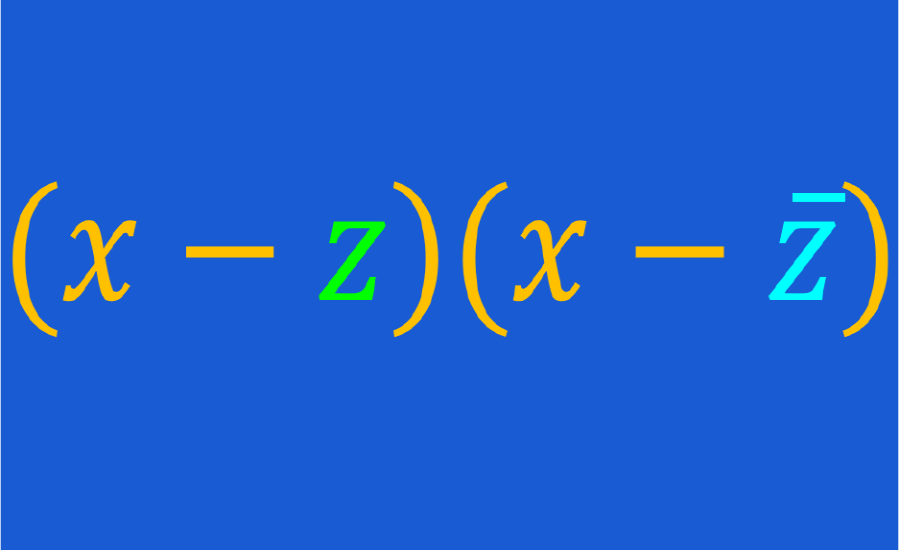
The complex conjugate roots of a polynomial are those complex roots that are conjugate to each other. Remember that conjugates ... Read more
another one
livid hound
what you want is mentioned multiple times
wet flume
is it? okay, ill have to reread it. i was just hoping to recieve one on one help i guess
livid hound
for a polynomial with real coefficients,
if a complex number is a zero, so is its complex conjugate
cedar kilnBOT
@wet flume Has your question been resolved?
cedar kilnBOT
Channel closed
Closed due to timeout
Use .reopen if this was a mistake.
Available help channel!
Send your question here to claim the channel.
Remember:
• Ask your math question in a clear, concise manner.
• Show your work, and if possible, explain where you are stuck.
• After 15 minutes, feel free to ping <@&286206848099549185>.
• Type the command .close to free the channel when you're done.
• Be polite and have a nice day!
Read #❓how-to-get-help for further information on how to ask a good question, and about conduct in the question channels.
 opal anvil
If I encounter a difficult math question, how should I begin to solve it. Let's say I know all math behind the topic of it, let's say deriviate. How do I start solving it?
cedar kilnBOT
opal anvil
If I encounter a difficult math question, how should I begin to solve it. Let's ...
thick tiger
that's very broad
i would say split the task into subproblems and/or visualize it with a graphing calculator, if applicable
 subtle harbor
opal anvil
If I encounter a difficult math question, how should I begin to solve it. Let's ...
subtle harbor
opal anvil
If I encounter a difficult math question, how should I begin to solve it. Let's ...
listing off what you know/given in the problem is always helpful
and your objective
opal anvil
subtle harbor
listing off what you know/given in the problem is always helpful
So if the topic is deriviate I should think how to solve it with deriviate stuff?
 hollow valve
Sadly, there is no true one task-solving method. If there were, there wouldn't be all these 100 Million USD open questions. But, if you are able to specify more, you can begin to tread beaten paths in the particular branch you exist on. Look at similiar problems, maybe their easier version, a generalized example to unravel some sort of pattern. There always is going to be a degree of specificity, which will dictate your approach somewhat, and sometimes, that is good to break.
subtle harbor
like for a related rates problem, it'd be useful to list off the formulas related to the problem (i.e. if you got a sphere and something with volume mentioned, probably good to write down formula for volume of a sphere)
hollow valve
It is also good to know your theory, and, at any point, if you feel totally lost, it's ok to ✨ ask ✨
subtle harbor
and if you know the radius, know the rate of change of volume or radius, basically just write down all of your knowns and givens from the problem. :)
opal anvil
hollow valve
Sadly, there is no *true one task-solving method*. If there were, there wouldn't...
English is not my first language so I have to ask what does "begin to tread beaten paths in particular branch" mean in this context
opal anvil
subtle harbor
like for a related rates problem, it'd be useful to list off the formulas relate...
ok
hollow valve
opal anvil
English is not my first language so I have to ask what does "begin to tread beat...
Sorry, I was being kinda vague. I just meant look for what you need on the internet, a particular book, an excercise sheets. Check definitions, theroems, corollaries. Simplify your example. It is likely people have done your sort of math before.
opal anvil
hollow valve
Sorry, I was being kinda vague. I just meant look for what you need on the inter...
Ah I understand, So I should write down formulas related to the topic, write down what I know, use the Internet to understand the question?
Is undergraduate lower level of education than pre university?
I'm not familiar with that term, hence the question
 dawn junco
cedar kilnBOT
dawn junco
cedar kilnBOT
@opal anvil Has your question been resolved?
cedar kilnBOT
Channel closed
Closed due to timeout
Use .reopen if this was a mistake.
Available help channel!
Send your question here to claim the channel.
Remember:
• Ask your math question in a clear, concise manner.
• Show your work, and if possible, explain where you are stuck.
• After 15 minutes, feel free to ping <@&286206848099549185>.
• Type the command .close to free the channel when you're done.
• Be polite and have a nice day!
Read #❓how-to-get-help for further information on how to ask a good question, and about conduct in the question channels.
 unkempt crater
Pls help me solve this quick
 cedar kilnBOT
unkempt crater
Pls help me solve this quick
cedar kilnBOT
cedar kilnBOT
unkempt crater
Pls help me solve this quick
cedar kilnBOT
@unkempt crater Has your question been resolved?
unkempt crater
yes
I managed to get something along the terms where OP = RS yet idk if thats true
tbh I am so lost
 swift sorrel
unkempt crater
Pls help me solve this quick
swift sorrel
unkempt crater
Pls help me solve this quick
Can you explain what you wrote below the diagram
I can't understand it
unkempt crater
swift sorrel
Can you explain what you wrote below the diagram
I can't understand it
Value of RS Compared to OQ
I need to calculate RS
THis is what I have so far but I need to find the value and idk if this is even corect

it is not a prism
wait
then that doesn't make any sence
.close
cedar kilnBOT
Channel closed
Closed by @unkempt crater
Use .reopen if this was a mistake.
Available help channel!
Send your question here to claim the channel.
Remember:
• Ask your math question in a clear, concise manner.
• Show your work, and if possible, explain where you are stuck.
• After 15 minutes, feel free to ping <@&286206848099549185>.
• Type the command .close to free the channel when you're done.
• Be polite and have a nice day!
Read #❓how-to-get-help for further information on how to ask a good question, and about conduct in the question channels.
 minor acorn
 cedar kilnBOT
minor acorn
minor acorn
cedar kilnBOT
minor acorn
minor acorn
i am not sure exactly how to begin this but i sketched thr triangle so far

<@&286206848099549185>
cedar kilnBOT
@minor acorn Has your question been resolved?
minor acorn
@gleaming path
 elfin hollow
what does average value of 9 means?
minor acorn
i am not sure, its just given in the problem
cedar kilnBOT
Channel closed
Closed by @minor acorn
Use .reopen if this was a mistake.
Available help channel!
Send your question here to claim the channel.
Remember:
• Ask your math question in a clear, concise manner.
• Show your work, and if possible, explain where you are stuck.
• After 15 minutes, feel free to ping <@&286206848099549185>.
• Type the command .close to free the channel when you're done.
• Be polite and have a nice day!
Read #❓how-to-get-help for further information on how to ask a good question, and about conduct in the question channels.
 ionic wolf
 ionic wolf
I don't rlly get 1/3 of the bacteria duplicates
crimson sedge
I think that each minute there are 1/3 more bacteria
ionic wolf
Is less than 100000
crimson sedge
Exactly
ionic wolf
50,000(4/3)^t < 100,000
crimson sedge
👍👍
cedar kilnBOT
Channel closed
Closed by @ionic wolf
Use .reopen if this was a mistake.
Available help channel!
Send your question here to claim the channel.
Remember:
• Ask your math question in a clear, concise manner.
• Show your work, and if possible, explain where you are stuck.
• After 15 minutes, feel free to ping <@&286206848099549185>.
• Type the command .close to free the channel when you're done.
• Be polite and have a nice day!
Read #❓how-to-get-help for further information on how to ask a good question, and about conduct in the question channels.