#help-13
1 messages · Page 218 of 1
 hollow trail
really it's the derivative of 2x + 1
if we think of y = f(g(x))
then
f(x) = √x
g(x) = 2x + 1
then by the chain rule:
dy/dx = df/dg • dg/dx = f'(g(x)) • g'(x)
 deep otter
that makes sense to me
why do we multiply this by dx/dt though
I think I'm just confused on how y is a function of t if t isn't present in y(x)
hollow trail
because x is a function of t
so we start by finding dy/dx, which is
dy/dx = 1/2(2x+1)^(1/2) • 2
then we have
y(x(t)), since x is a function of t
so
dy/dt = dy/dx • dx/dt
 cedar kilnBOT
@deep otter Has your question been resolved?
cedar kilnBOT
Channel closed
Closed by @deep otter
Use .reopen if this was a mistake.
 Available help channel!
Send your question here to claim the channel.
Remember:
• Ask your math question in a clear, concise manner.
• Show your work, and if possible, explain where you are stuck.
• After 15 minutes, feel free to ping <@&286206848099549185>.
• Type the command .close to free the channel when you're done.
• Be polite and have a nice day!
Read #❓how-to-get-help for further information on how to ask a good question, and about conduct in the question channels.
 green meadow
So I don't know if I need to put a specific equation in or not but I need help learning how to solve quadratics for a test tomorrow and this is where I thought of to ask for help first.
cedar kilnBOT
green meadow
So I don't know if I need to put a specific equation in or not but I need help l...
green meadow
.close
cedar kilnBOT
Channel closed
Closed by @green meadow
Use .reopen if this was a mistake.
cedar kilnBOT
Available help channel!
Send your question here to claim the channel.
Remember:
• Ask your math question in a clear, concise manner.
• Show your work, and if possible, explain where you are stuck.
• After 15 minutes, feel free to ping <@&286206848099549185>.
• Type the command .close to free the channel when you're done.
• Be polite and have a nice day!
Read #❓how-to-get-help for further information on how to ask a good question, and about conduct in the question channels.
 turbid isle
isn’t the average value of a function tbe same thing as rienmums sums but just in intergal notation?
cedar kilnBOT
turbid isle
isn’t the average value of a function tbe same thing as rienmums sums but just i...
 scenic chasm
turbid isle
isn’t the average value of a function tbe same thing as rienmums sums but just i...
scenic chasm
turbid isle
isn’t the average value of a function tbe same thing as rienmums sums but just i...
You mean if rienmums is the same thing as integral?
 hollow minnow
turbid isle
isn’t the average value of a function tbe same thing as rienmums sums but just i...
hollow minnow
turbid isle
isn’t the average value of a function tbe same thing as rienmums sums but just i...
average of a function as in ( \frac{1}{b-a} \int_a^b f(x) \mathrm d x)
 wraith daggerBOT
Pure
 scenic chasm
Oh
turbid isle
ya
cedar kilnBOT
@turbid isle Has your question been resolved?
cedar kilnBOT
Channel closed
Closed due to timeout
Use .reopen if this was a mistake.
Available help channel!
Send your question here to claim the channel.
Remember:
• Ask your math question in a clear, concise manner.
• Show your work, and if possible, explain where you are stuck.
• After 15 minutes, feel free to ping <@&286206848099549185>.
• Type the command .close to free the channel when you're done.
• Be polite and have a nice day!
Read #❓how-to-get-help for further information on how to ask a good question, and about conduct in the question channels.
 hearty mist
 cedar kilnBOT
hearty mist
hearty mist
cedar kilnBOT
hearty mist
hearty mist
what test would i use to solve this?
 dire geode
Try any
hearty mist
could i use root test?

 digital cliff
sure, i dont think l'hopital was necessary though
hearty mist
was there a better way to do it
wihtout that rule
its like my go to rule for limits
 misty birch
 supple flume
hearty mist
supple flume
hearty mist
In my opinion if it works for you and you find it easy keep at it. (It’s probably better to find more ways though just in case)
digital cliff
yeah i never said it was wrong, youre in the clear
hearty mist
oh alright thx
im doing one more problem but ill like it if u could check it
should i keep this help open?
digital cliff
sure
cedar kilnBOT
@hearty mist Has your question been resolved?

 cedar kilnBOT
To ask for mathematics help on this server, please open your own help channel or help thread. See #❓how-to-get-help for instructions.
digital cliff
would just be 2<x<4
digital cliff
have you checked that?
you know it converges for |x-3|<1 ie 2<x<4
you havent checked to see if it converges at 2 or 4
 hearty mist
so am i correct?
digital cliff
what have you done here, youve shown the terms tend to 0, you havent strictly shown the series do, though i can say they do
 hearty mist
im showing the terms for alternating test
so im using b sub n to prove that the series converges
digital cliff
oh right, sorry, its been a while
digital cliff
yeah i think youre good to go
cedar kilnBOT
@hearty mist Has your question been resolved?
cedar kilnBOT
Channel closed
Closed due to timeout
Use .reopen if this was a mistake.
cedar kilnBOT
Available help channel!
Send your question here to claim the channel.
Remember:
• Ask your math question in a clear, concise manner.
• Show your work, and if possible, explain where you are stuck.
• After 15 minutes, feel free to ping <@&286206848099549185>.
• Type the command .close to free the channel when you're done.
• Be polite and have a nice day!
Read #❓how-to-get-help for further information on how to ask a good question, and about conduct in the question channels.
 crimson sedge
In how many ways can a rook from the bottom left corner of an 8 x 8 chessboard reach the top right corner in exactly 4 moves? (The rook must not be on the top right corner prior to the 4th move.)?
The answer key was 532 how did they arrived with the answer
cedar kilnBOT
crimson sedge
In how many ways can a rook from the bottom left corner of an 8 x 8 chessboard r...
@crimson sedge Has your question been resolved?
cedar kilnBOT
Channel closed
Closed due to timeout
Use .reopen if this was a mistake.
Available help channel!
Send your question here to claim the channel.
Remember:
• Ask your math question in a clear, concise manner.
• Show your work, and if possible, explain where you are stuck.
• After 15 minutes, feel free to ping <@&286206848099549185>.
• Type the command .close to free the channel when you're done.
• Be polite and have a nice day!
Read #❓how-to-get-help for further information on how to ask a good question, and about conduct in the question channels.
 hollow storm
Can somebody help me with this please? Prove that the R^2 plane cannot be written as a finite union of lines. Prove that it is not even a finite union of circles.
cedar kilnBOT
hollow storm
Can somebody help me with this please? Prove that the R^2 plane cannot be writte...
hollow storm
hollow storm
Can somebody help me with this please? Prove that the R^2 plane cannot be writte...
it's google translated sorry
 dull oxide
Circles one is easier than lines as a finite union is bounded
hollow storm
dull oxide
Circles one is easier than lines as a finite union is bounded
both finite union of lines and circles are bounded?
 mental trail
no, that's the point, only for circles
hollow storm
oh so
the circles themselves are bounded
or the union of circles
sorry if i am dumb
 crimson delta
the only thing I can think of for lines is that their union isnt open. but that seems rather overkill, surely it should be easier?
I suppose we can check that for some other line you can have at most n intersections
hollow storm
hollow storm
Can somebody help me with this please? Prove that the R^2 plane cannot be writte...
how do you write this in terms of a function?
crimson delta
why a function
hollow storm
uh i dont know
but if a line has a dimension of R and the plane has a dimension of R^2
can we prove somehow that R --> R^2 is not surjective and so the plane cannot be written as a union of lines
no wait i am tripping
R and R^2 have the same cardinality,, right?
crimson delta
yes
hollow storm
hollow storm
Can somebody help me with this please? Prove that the R^2 plane cannot be writte...
dumb question
if R^2 is infinite and the union of lines is finite
crimson delta
well the lines are still infinite
hollow storm
oh right
 indigo yoke
Hello how can i Create a frequency distribution, Create cumulative frequency distribution, Calculate mean, median, mode, STD and variance from this data set .
Im so confused (like no clue & i lost my notebook so im even more screwed)
Thanks
 cedar kilnBOT
@hollow storm Has your question been resolved?
hollow storm
crimson delta
well the lines are still infinite
sorry, the translation was faulty. it wasn't circles but circumferences. can we still prove that the plane can't be written as a finite union of circumferences?
cedar kilnBOT
@hollow storm Has your question been resolved?
hollow storm
.close
cedar kilnBOT
Channel closed
Closed by @hollow storm
Use .reopen if this was a mistake.
Available help channel!
Send your question here to claim the channel.
Remember:
• Ask your math question in a clear, concise manner.
• Show your work, and if possible, explain where you are stuck.
• After 15 minutes, feel free to ping <@&286206848099549185>.
• Type the command .close to free the channel when you're done.
• Be polite and have a nice day!
Read #❓how-to-get-help for further information on how to ask a good question, and about conduct in the question channels.
 golden relic
May I ask for help in this matter
 cedar kilnBOT
golden relic
May I ask for help in this matter
cedar kilnBOT
golden relic
May I ask for help in this matter
 fallen moat
,rccw
golden relic
Ccw?
wraith daggerBOT
 cedar kilnBOT
What step are you on?
1. I don't know where to begin.
2. I have begun but got stuck midway.
3. I got an answer but I was told that it's wrong.
4. I got an answer and would like my work checked.
5. I have a question about someone else's work/solution.
6. I have completed the problem and don't need help anymore. Thank you.
7. None of the above
1
fallen moat
First, name the center as O
hint: consider angle WOS and angle VOT
how are they related (in measures)
fallen moat
yes
golden relic
Something is VOU I think
fallen moat
golden relic
12x-2=5x+10+something
and with that, you can find VOU
golden relic
fallen moat
and with that, you can find VOU
That's where I got stuck
fallen moat
golden relic
That's where I got stuck
how?
golden relic
12x-2-5x+10 right?
fallen moat
nope
golden relic
How then
fallen moat
12x-2=5x+10+VOU
then
12x-2 -5x -10 = 5x+10+VOU -5x -10
fallen moat
next
golden relic
Ok
golden relic
180?
fallen moat
good
golden relic
What is it?
golden relic
fallen moat
why TOU and VOU are marked?
Oh that's just an indication that it has the same angle with WOS
fallen moat
golden relic
Oh that's just an indication that it has the same angle with WOS
i am thinking
with the same angle notation
is meaning they are of the same measure
(which may have covered in class, but I don't know if that true)
i.e. TOU=VOU
does this make sense?
golden relic
fallen moat
does this make sense?
I don't get it
 golden relic
I ask my teach she said that the red mark indicates that WOS=VOS+TOU
fallen moat
fallen moat
for isosceles triangle, we have the base angles equal
golden relic
fallen moat
for isosceles triangle, we have the base angles equal
Yes
fallen moat
fallen moat
for isosceles triangle, we have the base angles equal
i thought it's about the same as this one
same marking means angles of same measure
golden relic
fallen moat
i thought it's about the same as this one
I think Its different
fallen moat
golden relic
I think Its different
oh ok
fallen moat
golden relic
I think Its different
if that's the case
my help ends here, since I don't know how to proceed.
golden relic
Oh
golden relic
Hmm
fallen moat
sorry man
golden relic
It's fine
fallen moat
but I would personally suggest to ask a bit more about the 2 angle notations with the same color
I really think they are somewhat related to something crucial
golden relic
I can't ask her rn since it's already late sorry mate
fallen moat
golden relic
I can't ask her rn since it's already late sorry mate
it's okay, in case you wanna continue with that question, treat those two red notations as equal in measure.
if not, you can just wait to ask her tomorrow
golden relic
Let us continue
fallen moat
golden relic
7x-12?
after this VOU we find, we know that
VOU=TOU
so we have....?
hint: TOU=5x+10
golden relic
2(5x+10)?
fallen moat
nah
golden relic
They are both 5x+10?
golden relic
Oh
fallen moat
hence we can find x
golden relic
Ohh
fallen moat
golden relic
Subtract 12x-2?
and with this, we can find all measures of other angles
golden relic
Is X=11?
cedar kilnBOT
Channel closed
Closed by @golden relic
Use .reopen if this was a mistake.
Available help channel!
Send your question here to claim the channel.
Remember:
• Ask your math question in a clear, concise manner.
• Show your work, and if possible, explain where you are stuck.
• After 15 minutes, feel free to ping <@&286206848099549185>.
• Type the command .close to free the channel when you're done.
• Be polite and have a nice day!
Read #❓how-to-get-help for further information on how to ask a good question, and about conduct in the question channels.
 spice torrent
 cedar kilnBOT
spice torrent
cedar kilnBOT
spice torrent
 green coral
what is the total lenght of the wire
spice torrent
60
 alpine rune
the total length is 60
the area is 120
and its a rectangle
now what's the area of a rectangle?
spice torrent
Lw
green coral
width im guesing
alpine rune
now, what's the perimeter of a rectangle?
alpine rune
green coral
width im guesing
gotcha
spice torrent
2l + 2w
green coral
no?
alpine rune
no
green coral
its in multiplication
spice torrent
Oh ya
green coral
so... l = 210 (?) w
spice torrent
210/w
green coral
e substitute
spice torrent
Got it
green coral
quadratic in w , solve the thing
spice torrent
Thanks
green coral
cool
spice torrent
.close
cedar kilnBOT
Channel closed
Closed by @spice torrent
Use .reopen if this was a mistake.
Available help channel!
Send your question here to claim the channel.
Remember:
• Ask your math question in a clear, concise manner.
• Show your work, and if possible, explain where you are stuck.
• After 15 minutes, feel free to ping <@&286206848099549185>.
• Type the command .close to free the channel when you're done.
• Be polite and have a nice day!
Read #❓how-to-get-help for further information on how to ask a good question, and about conduct in the question channels.
 errant wasp
i think im sort of confused, could someone explain the definition of the quotion of a set?
cedar kilnBOT
errant wasp
i think im sort of confused, could someone explain the definition of the quotion...
 umbral dew
errant wasp
i think im sort of confused, could someone explain the definition of the quotion...
umbral dew
errant wasp
i think im sort of confused, could someone explain the definition of the quotion...
are you sure that's a correct question?, first time hearing something like "quotion of a set"
 olive crescent
quotient set?

 errant wasp
yeah, basically all the elements of a set that have the same relation right?
 cerulean sail
Yep pretty much - all the related elements
The quotient of a set under an equivalence relation is basically the set of all the equivalence classes you can get
So e.g. taking the integers and the equivalence relation to be the modulo 2 one (two elements equivalent if their difference is divisible by 2) then you have only equivalence classes [0] and [1], so the integers “quotiented” out by that equivalence relation is {[0], [1]}
(Which I’m sure is somewhat familiar!)
errant wasp
oh i gotcha
cerulean sail
Does that at least help a bit? 
errant wasp
of all the equivalence classes you can get --> i think im confused about this
cerulean sail
 so basically you know like with the previous example I said
You could consider [2], but that equivalence class is the same as [0]
Similarly [3], [5], [7] etc etc is really just [1]
errant wasp
[0] and [1] belong to the same equivalence class, a quotient or whatever is just the set of all elements belonging to the same equivalence class?
cerulean sail
[0] and [1] are in the quotient of Z (with respect to the “difference divisible by 2” equivalence relation)
(That’s partly why the notation Z/2Z is used for it)
But of course [0] and [1] are distinct equivalence classes
Basically you have the equivalence classes, which is the set of all elements that are equivalent to some representative
Then go through all possible equivalence classes (there may be finitely many, or infinitely many), and put them in a set
cerulean sail
cerulean sail
Then go through all possible equivalence classes (there may be finitely many, or...
The quotient is that set you get
errant wasp
yeah i think the part that there are multiple equivalence classes in a set confused me
cerulean sail
Yeah  it’s like a set of sets there (but of course those equivalence classes in the set don’t need to be the same!)
errant wasp
like it could also include other modulo equivalence classes?
cerulean sail
For another example of an equivalence relation, you can define one on the real numbers by saying that a pair of them are equivalent if their difference is an integer, and there are infinitely many equivalence classes you get from that one
cerulean sail
errant wasp
like it could also include other modulo equivalence classes?
It would contain different equivalence classes - but under the same equivalence relation you’re considering
errant wasp
cerulean sail
For another example of an equivalence relation, you can define one on the real n...
because there are infinitely many differences?
cerulean sail
errant wasp
because there are infinitely many differences?
Basically yeah, in fact each real number would be equivalent to one within [0,1) and you have infinitely many numbers in there (I’m sure someone will come around and elaborate on what that becomes, better than I can!)
errant wasp
cerulean sail
It would contain different equivalence classes - but under the same equivalence ...
like the equivalence class of integers pairs that have a difference of 0 and have a difference of 1
cerulean sail
errant wasp
like the equivalence class of integers pairs that have a difference of 0 and hav...
Yep basically 
errant wasp
okay thanl you that makes a lot of sense
cerulean sail
But if e.g. you changed it to be “difference divisible by 5” the equivalence classes you get will change and as I’m sure you know, Z/5Z and Z/2Z are different
errant wasp
z/5z --> set of elements congruent to mod 5 right
congruence --> a = bmodn => a - b is divisible by mod n
cerulean sail
Yep, basically  congruence being one of the typical equivalence relation examples!
errant wasp
also this is the integers modulo 4 right

honestly im ngl im still really bad with congruences, and understanding why a = bmodn is so useful
cerulean sail
errant wasp
also this is the integers modulo 4 right
I’m assuming that’s what they mean
cerulean sail
errant wasp
honestly im ngl im still really bad with congruences, and understanding why a = ...
Awww  they are something and can take time to get used to
cerulean sail
errant wasp
can i ask another question
Yep sure! 
errant wasp
can you help me go over this proof

the equivalence relation is juse that there is a bijection between A and B
cerulean sail
Are you happy with the part where they basically say that two sets are equivalent iff they have the same number of elements?
errant wasp
yes
cerulean sail
Cool cool  and how they found the equivalence class [{1,2}] as well?
errant wasp
no not really
cerulean sail
Alright, so from the part above, a subset of X is equivalent to {1,2} if and only if it has two (distinct) elements
So you want to find the subsets of X that have two elements in them
{1,2} is one of them quite clearly
You can get the other by picking two of the three elements from X to make your subset
Does that make it any better? 
cerulean sail
cerulean sail
Are you happy with the part where they basically say that two sets are equivalen...
As the subsets are equivalent iff they have the same number of elements
errant wasp
ohh
cerulean sail
The possibilities are having a subset with no elements, a subset with 1 element, a subset with 2 elements and a subset with 3 elements (all of those will be in the same respective equivalence classes!)
errant wasp
so like {2} is equivalent to 1
cerulean sail
{2} is equivalent to the set {1} yep
Both having 1 element
Similarly {3} is equivalent to both!
errant wasp
so thats why you do like [{1}] ~= in P(x)/ ~
so you could have included {2} instead of 1 there right
cerulean sail
Yep, you can choose whatever you want (in the equivalence class) to represent it, and remember that equivalence classes are identical or disjoint
So [{1}] = [{2}] = [{3}]
errant wasp
im also sort of confused about the role of the powerset here
also can i brb in 15 mins, i need to walk to class
cerulean sail
errant wasp
im also sort of confused about the role of the powerset here
Basically you’re defining the equivalence relation on the power set, not X itself
cerulean sail
errant wasp
also can i brb in 15 mins, i need to walk to class
Sure, ping me when you’re back
errant wasp
also the bijection is solely to do with the size of the set
ie like p({1, 2}) --> p({3, 4}) maps to eachother because their powersets are the same size
cerulean sail
errant wasp
also the bijection is solely to do with the size of the set
Yeah, the bijection you make basically is based on the size of the set you’re trying to make a bijection from
If you had a set of two elements, you need to pick two elements to map to as per the previous example
cerulean sail
errant wasp
ie like p({1, 2}) --> p({3, 4}) maps to eachother because their powersets are th...
are you using p to represent the power set here?
It is a true statement sure…
cedar kilnBOT
@errant wasp Has your question been resolved?
errant wasp
cerulean sail
<:catThink:1073406415575728200> are you using p to represent the power set here?...
yeah is there a flaw in this?
because once you take the power set, you want to check that every element in the powerset maps to an element in the other powerset?
because wouldnt it be p(a) --> p(b)
@cerulean sail
cerulean sail
errant wasp
yeah is there a flaw in this?
Well, erm, you want to consider that in the power set, that any two sets you find will have a bijection between them if they have the same number of elements
You’re more wanting to e.g. think that there is at least one bijection between {1,2} and {3,4}
errant wasp
cerulean sail
You’re more wanting to e.g. think that there is at least one bijection between {...
between the set or the elements in the set
cerulean sail
errant wasp
between the set or the elements in the set
Between the elements within the set* sorry
errant wasp
then whast the binjection of the elements of {1,2} and {3,4}
cerulean sail
errant wasp
then whast the binjection of the elements of {1,2} and {3,4}
You can e.g. define f(1) = 3 and f(2) = 4, which is clearly invertible (you can also do, say, f(1) = 4 and f(2) = 3)
errant wasp
gotcha
i also forgot invertability is a way to define injections/surjections/bijections
errant wasp
cerulean sail
You’re more wanting to e.g. think that there is at least one bijection between {...
then idk still why is the poweorset important
cerulean sail
errant wasp
then idk still why is the poweorset important
Because you're defining the subsets of X as equivalent, not the elements of X themselves
errant wasp
cerulean sail
Because you're defining the *subsets of X* as equivalent, not the elements of X ...
thanks, can i also ask about partial orders
cerulean sail
errant wasp
thanks, can i also ask about partial orders
Erm I may not be the best to answer about those  you might be better off starting a new channel and asking there, don't want to explain anything poorly for you
errant wasp
cerulean sail
Erm I may not be the best to answer about those <:sadcat:1073406457220956170> yo...
thank you for helping!
cerulean sail
errant wasp
thank you for helping!
Always a pleasure to 
errant wasp
.close
cedar kilnBOT
Channel closed
Closed by @errant wasp
Use .reopen if this was a mistake.
cedar kilnBOT
Available help channel!
Send your question here to claim the channel.
Remember:
• Ask your math question in a clear, concise manner.
• Show your work, and if possible, explain where you are stuck.
• After 15 minutes, feel free to ping <@&286206848099549185>.
• Type the command .close to free the channel when you're done.
• Be polite and have a nice day!
Read #❓how-to-get-help for further information on how to ask a good question, and about conduct in the question channels.
 cold briar
Given point P, (a, b, c) how would I find the distance from the x axis?
cold briar
is it just distance to (a, 0, 0)?
 subtle spruce
yes
cold briar
.close
cedar kilnBOT
Channel closed
Closed by @cold briar
Use .reopen if this was a mistake.
Available help channel!
Send your question here to claim the channel.
Remember:
• Ask your math question in a clear, concise manner.
• Show your work, and if possible, explain where you are stuck.
• After 15 minutes, feel free to ping <@&286206848099549185>.
• Type the command .close to free the channel when you're done.
• Be polite and have a nice day!
Read #❓how-to-get-help for further information on how to ask a good question, and about conduct in the question channels.
 small raptor
8x - 5 = 2x + 6
cedar kilnBOT
small raptor
8x - 5 = 2x + 6
 rich blaze
You have to solve for x?

 primal socket
Awkward question
rich blaze
You can "move" both of them 🤔 it probably wants you to have the x on the left side, and the numbers on the right side
small raptor
right
primal socket
First of all we still don't know the objective so right now I don't see the point in "moving" anything. Second of all we don't "move" terms. We add or substract on both sides.
rich blaze
small raptor
Are you sure thats the whole exercise?
cedar kilnBOT
@small raptor Has your question been resolved?
cedar kilnBOT
Channel closed
Closed due to timeout
Use .reopen if this was a mistake.
Available help channel!
Send your question here to claim the channel.
Remember:
• Ask your math question in a clear, concise manner.
• Show your work, and if possible, explain where you are stuck.
• After 15 minutes, feel free to ping <@&286206848099549185>.
• Type the command .close to free the channel when you're done.
• Be polite and have a nice day!
Read #❓how-to-get-help for further information on how to ask a good question, and about conduct in the question channels.
 marsh turret
not sure how to do
 cedar kilnBOT
marsh turret
not sure how to do
cedar kilnBOT
marsh turret
not sure how to do
 chilly geyser
You can find the length of BC by using cosine law
Then, apply sine rule to find the measure of angle B.
 silver fable
 marsh turret
sooo would i use the 11 and 10 or the 34
silver fable
Find BC using second equation first
Then u should be able to calculate cos of the angle using first equation
marsh turret
soooo it wouldnt be C i assume
silver fable
wdym?
marsh turret
like the answer cause the number is too small
idk if i did this right but i got a^2=121+100-2ac.cosB
silver fable
a² = 121 + 100 -2×11×10×cosÂ
silver fable
marsh turret
idk if i did this right but i got a^2=121+100-2ac.cosB
You mixed 2nd and 3rd equation i think
marsh turret
ah yes that what i meant
silver fable
There's no need to use the 3rd equation
If we add 1st and 2nd equation we get:
$\ a^2+c^2=a^2+b^2-2ab \cos B +b^2+c^2-2bc \cos A$
wraith daggerBOT
Adam Chebil
 marsh turret
.close
cedar kilnBOT
Channel closed
Closed by @marsh turret
Use .reopen if this was a mistake.
Available help channel!
Send your question here to claim the channel.
Remember:
• Ask your math question in a clear, concise manner.
• Show your work, and if possible, explain where you are stuck.
• After 15 minutes, feel free to ping <@&286206848099549185>.
• Type the command .close to free the channel when you're done.
• Be polite and have a nice day!
Read #❓how-to-get-help for further information on how to ask a good question, and about conduct in the question channels.
hollow storm
Hello, can somebody please help me with this?
cedar kilnBOT
hollow storm
Hello, can somebody please help me with this?
hollow storm
Let f : R → R be a function defined by the formula f(x) = ax + b. Prove that if f fixes two points of R then f is the identity on R
So this means that if it fixes two points like f(x1) = x1 and f(x2) = x2 then for all x f(x) = x ?
cedar kilnBOT
@hollow storm Has your question been resolved?
cerulean sail
Might be worth noting that $\frac{f(p_1) - f(p_2)}{p_1 - p_2} = a$ for any choice of distinct $p_1, p_2$
wraith daggerBOT
@cerulean sail
 cedar kilnBOT
@hollow storm Has your question been resolved?
Channel closed
Closed by @hollow storm
Use .reopen if this was a mistake.
hollow storm
cerulean sail
Might be worth noting that $\frac{f(p_1) - f(p_2)}{p_1 - p_2} = a$ for any choic...
thank you
cedar kilnBOT
Available help channel!
Send your question here to claim the channel.
Remember:
• Ask your math question in a clear, concise manner.
• Show your work, and if possible, explain where you are stuck.
• After 15 minutes, feel free to ping <@&286206848099549185>.
• Type the command .close to free the channel when you're done.
• Be polite and have a nice day!
Read #❓how-to-get-help for further information on how to ask a good question, and about conduct in the question channels.
 bright sorrel
I have these 3 vectors and I'm trying to find the basis
 bright sorrel
seems to me like a_1, and a_2 are linearly independent
but then a_2 and a_3 are also linearly independent
can I just choose a_2 and a_3
or a_1 and a_2
oh wait they are linearly independent to each other
so
they form the basis
 pastel vault
bright sorrel
I have these 3 vectors and I'm trying to find the basis
pastel vault
bright sorrel
I have these 3 vectors and I'm trying to find the basis
a basis for a subspace means that we have vectors v1, v2, v3 etc.
such that av1 + bv2 + cv3 + ... = (x, y, z, ...) where a, b, c... are not all 0
so they're finding the column space of that matrix
there's a typo: the first vector in the basis should be (3, 6, 0)
the first column of the original matrix
pastel vault
no
only (3, 6, 0) and (2, 1, 3) are the basis vectors
for the subspace
@bright sorrel
bright sorrel
pastel vault
only (3, 6, 0) and (2, 1, 3) are the basis vectors
right, how did you see this?
taking the first coordinate from each vector?
pastel vault
bright sorrel
right, how did you see this?
cause the answer states the first and the third columns are pivot columns
so you go back to the original matrix
and read off the pivot columns from there
bright sorrel
can you pls point it out?
pastel vault
in the RREF
bright sorrel
I think I'm confused from the language barrier
pastel vault
you look at the RREF to find the pivot columns
bright sorrel
can you pls point it out using a software or something? :c
pastel vault
 bright sorrel
right, those are linearly independent
pastel vault
yes
bright sorrel
but aren't second and fourth column also?
bright sorrel
😭
 wraith garnet
Is this chatgpt...
bright sorrel
yes
pastel vault
shit
wraith garnet
bright sorrel
yes
well thats ur first issue
bright sorrel
right so
I have the vectors
(3, 1, 2, 4) (6, 2, 1, 1) and (0, 0, 3, 4)
using a matrix I deduce it to
pastel vault
PLEASE STOP USING CHATGPT
oml
okay the pivot columns have a 1 in each column in RREF
bright sorrel
(3, 1, 0, 0) (0, 0, 1, 0) (0, 0, 0, 1)
pastel vault
so the 1st, 2nd, and 3rd columns are actually pivot columns
pastel vault
anyways that's not the point
just read off the rows of the RREF to find the basis
as you've noticed they're all linearly independent
so the basis is just the original 3 vectors
(3, 1, 2, 4); (6, 2, 1, 1); (0, 0, 3, 4)
chatGPT sucks at stuff related to maths
cedar kilnBOT
Channel closed
Closed by @bright sorrel
Use .reopen if this was a mistake.
Available help channel!
Send your question here to claim the channel.
Remember:
• Ask your math question in a clear, concise manner.
• Show your work, and if possible, explain where you are stuck.
• After 15 minutes, feel free to ping <@&286206848099549185>.
• Type the command .close to free the channel when you're done.
• Be polite and have a nice day!
Read #❓how-to-get-help for further information on how to ask a good question, and about conduct in the question channels.
 static loom
can anyone help
 cedar kilnBOT
static loom
can anyone help
cedar kilnBOT
static loom
can anyone help
 gritty viper
What are the common differences for the first sequence in section A
static loom
hm
gritty viper
Also the "nth term" column, the answer should not be a number
gritty viper
gritty viper
What are the common differences for the first sequence in section A
Do you know the answer to this?
gritty viper
The difference between one number in the sequence and the next
static loom
3
gritty viper
I shouldn't have said "common"
static loom
2nd right?
gritty viper
Eventually
static loom
is it 3
static loom
yes
gritty viper
so what's the next difference
static loom
5
gritty viper
brb
static loom
alr
same wanna continue this in 7 min?
currently doing a tutor class but tutor is delaying answering the ques so came here.
 modest lichen
static loom
can anyone help
modest lichen
static loom
can anyone help
search up quadratic sequences
static loom
Yeah since then I have made some progress but wondering if they are correct
Do you want to confirm with me
 dire thorn
static loom
Do you want to confirm with me
dire thorn
static loom
Do you want to confirm with me
I will confirm if u send
 modest lichen
static loom
can anyone help
modest lichen
static loom
can anyone help
no
modest lichen
dire thorn
I will confirm if u send
same
static loom
For the second sequence on section A , will the 6th term be 38 and 7th 51?
dire thorn
static loom
For the second sequence on section A , will the 6th term be 38 and 7th 51?
yeah
dire thorn
yeah let me think about it for a sec
static loom
alr
 dire thorn
do you know what those constants are for
static loom
No
dire thorn
ok so your learning about quadratic sequences. A quadratic is anything of the form an^2+bn+c (n is a variable, a,b,c are constants)
If we can find a,b,c, you plug them into that representation and thats is the formula for the nth term
static loom
so for the second sequence , what would the constant be for?
dire thorn
Do you know what the 2nd difference would be
dire thorn
nvm I was trippin but thats the next part
static loom
Ah ok
dire thorn
yeah
lets now do the 2nd part. Whats u2-u1 (2nd term - 1st term)
we need to solve for a,b, and c before we get the formula
static loom
2nd term - 1st term
So would those terms be
the 3,5,7,9 or the actual sequence terms?
dire thorn
actual sequence
static loom
so 3+b=3
a = 1
b+3 = 3
3+b is equal to 3
I dont know what to do after the stpe
step
dire thorn
What number does b have to be in order for 3+b=3 to be true
static loom
B has to be 0
dire thorn
yeah so a=1, b= 0
static loom
In order for 3+b equal to 3
 static loom
Pass me the equation for c , ill see if i can do it. Also , any quicker ways to find it?
dire thorn
dire thorn
use 3rd formula here
plugging in the values we already know we get 1+0+c=3
dire thorn
static loom
Pass me the equation for c , ill see if i can do it. Also , any quicker ways to ...
I do not think there is any quicker way to find it using a 100% process. If you pay close attention you will probably (not 100% sure) find the solution has the same form as the last entry for each section and could skip a bit but its better to go through the process
dire thorn
if n2 means n squared yeah
dire thorn
dire thorn
plugging in the values we already know we get 1+0+c=3
here we find c=2
we have a=1, b=0, c=2, so plugging that into an^2+bn+c we get n^2+0b+2 aka n^2+2
dire thorn
dire thorn
use 3rd formula here
I gotta go now but it should be exactly the same process for all the problems. Solve for a using 1st formula in the picture im replying to, solve for b using 2nd, solve for c using 3rd
cedar kilnBOT
@static loom Has your question been resolved?
cedar kilnBOT
Channel closed
Closed due to timeout
Use .reopen if this was a mistake.
Available help channel!
Send your question here to claim the channel.
Remember:
• Ask your math question in a clear, concise manner.
• Show your work, and if possible, explain where you are stuck.
• After 15 minutes, feel free to ping <@&286206848099549185>.
• Type the command .close to free the channel when you're done.
• Be polite and have a nice day!
Read #❓how-to-get-help for further information on how to ask a good question, and about conduct in the question channels.
crimson sedge
 cedar kilnBOT
crimson sedge
crimson sedge
cedar kilnBOT
crimson sedge
crimson sedge
How do I begin
dire thorn
$\frac{x^a}{x^b}=x^{a-b}$
wraith daggerBOT
Anton Yakunin.
 crimson sedge
?
dire thorn
crimson sedge
?
Apply it to your question
crimson sedge
What do u mean
dire thorn
Ok lets do this differently
30 = 3 * 5 * 2, x^4=x * x * x * x, y^6 = y * y * y * y * y * y
20 = 2 * 2 * 5, x^3 = x * x * x, y^2 = y * y
crimson sedge
Ok
dire thorn
How would you simplify $\frac{3\cdot 5 \cdot 2 \cdot x \cdot x \cdot x \cdot x \cdot y \cdot y \cdot y \cdot y \cdot y \cdot y}{2\cdot 2\cdot 5 \cdot x \cdot x \cdot x \cdot y \cdot y}$
wraith daggerBOT
Anton Yakunin.
 crimson sedge

dire thorn
you know how a number divided by itself is 1? use that to simplify this
If it appears on the top, and on the bottom, then you can just delete them
for example we can cancel a 2 from the numerator and denominator to get
$\frac{3\cdot 5 \cdot x \cdot x \cdot x \cdot x \cdot y \cdot y \cdot y \cdot y \cdot y \cdot y}{ 2\cdot 5 \cdot x \cdot x \cdot x \cdot y \cdot y}$
wraith daggerBOT
Anton Yakunin.
 dire thorn
Keep doing this until you cant anymore
dire thorn
crimson sedge
I don’t get it man
dw I will start much simpler then we'll get back to this
crimson sedge
Ok
dire thorn
You know what $\frac{7}{7}$ is
wraith daggerBOT
Anton Yakunin.
 crimson sedge
Yea
dire thorn
What is it
crimson sedge
1 whole
dire thorn
Yeah how about $\frac{38}{38}$
wraith daggerBOT
Anton Yakunin.
 dire thorn
yeah so whenever a number is divided by itself, it is equivalent to 1
crimson sedge
Ok
dire thorn
Lets move on. What is $\frac{10}{2}$
wraith daggerBOT
Anton Yakunin.
 crimson sedge
5
wraith daggerBOT
Anton Yakunin.
 crimson sedge
Yes
wraith daggerBOT
Anton Yakunin.
 dire thorn
Notice we can get 5 as the result by cancelling the 2s
crimson sedge
Yes
wraith daggerBOT
Anton Yakunin.
 crimson sedge
X?
crimson sedge
10?
dire thorn
dire thorn
yeah so whenever a number is divided by itself, it is equivalent to 1
Use this
crimson sedge
10
dire thorn
Yeah
dire thorn
As long as x is not 0 of course because we cant divide by 0
That doesnt really matter though
crimson sedge
Ye
dire thorn
Ok whats $\frac{5 \cdot 5 \cdot 5 \cdot 5}{5 \cdot 5}$
wraith daggerBOT
Anton Yakunin.
 dire thorn
yeah thats the long way of doing it. Although that works for now, thinking that way will make it harder to do it with variables (also its 5^4 but im pretty sure that was typo)
dire thorn
dire thorn
Notice we can get 5 as the result by cancelling the 2s
Remember what I did here
I did not do 5*2=10, then do 10/2 = 5. I just immediately cancelled the 2s and found the answer to be 5. I never multiplied anything
We can do the same thing here
crimson sedge
Ok
dire thorn
I will look for a video on this I think it will be more helpful

This math video tutorial explains how to simplify fractions.
Fractions - Basic Introduction: https://www.youtube.com/watch?v=3TklZi6MeJ4
Simplifying Fractions: https://www.youtube.com/watch?v=PcEwj5_v75g
Adding Fractions - Unlike Denominators: https://www.you...
Watch this first
Then watch this after
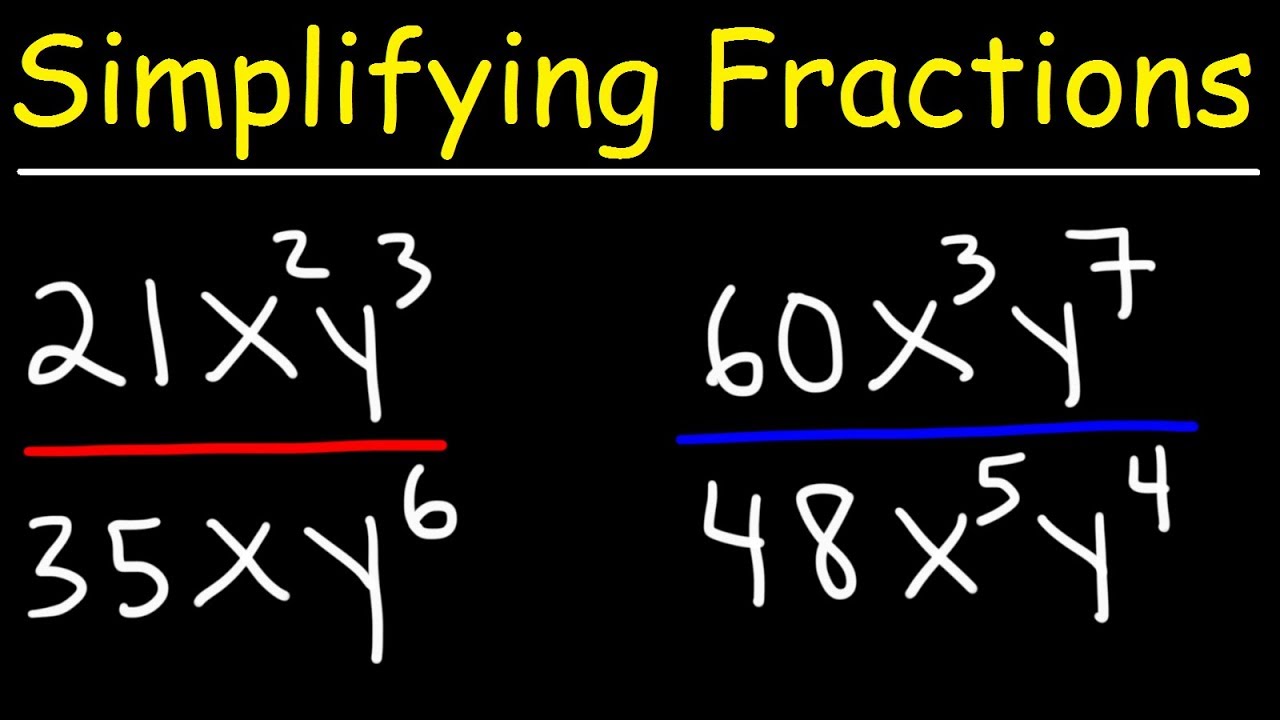
This Pre-Algebra video tutorial explains the process of simplifying algebraic fractions with exponents and variables. It discusses how to simplify algebraic expressions with powers & exponents by factoring.
Algebra For Beginners: ...
 sinful field
do you know how to solve it now ?
sinful field
good for you, just keep trying
crimson sedge
This was my question btw
 sinful field
i would give you the answer but i will wait for your guy that helped above, if he doesn't respond in a while i will help.
crimson sedge
Hmm?
bright sorrel
?
crimson sedge
What is that
crimson sedge
Uhh
dire thorn
bright sorrel
x^y/x^z=x^(y-z)
Along with the videos I sent, you should look up more about variables and unknown constants. The message I am replying to (same thing as the first message I sent), is a formula/rule. If you can understand what variables and unknown constants are, you can apply formulas like these and solve the problem in seconds.
sinful field
btw (x^2) is the same as (x to the power of 2), just if its confusing
crimson sedge
.close
cedar kilnBOT
Channel closed
Closed by @verbal spruce
Use .reopen if this was a mistake.
Available help channel!
Send your question here to claim the channel.
Remember:
• Ask your math question in a clear, concise manner.
• Show your work, and if possible, explain where you are stuck.
• After 15 minutes, feel free to ping <@&286206848099549185>.
• Type the command .close to free the channel when you're done.
• Be polite and have a nice day!
Read #❓how-to-get-help for further information on how to ask a good question, and about conduct in the question channels.
crimson sedge
1.5x^0.5 = 12x^-2
whats x???
i tried to use log but idk
dire thorn
crimson sedge
1.5x^0.5 = 12x^-2
whats x???
i tried to use log but idk
log is usualyl for when something is raised to the power of x. In this case you can divide one of the variables on both sides and use exponent rules
$\frac{x^a}{x^b}=x^{a-b}$
wraith daggerBOT
Anton Yakunin.
 scenic chasm
crimson sedge
1.5x^0.5 = 12x^-2
whats x???
i tried to use log but idk
scenic chasm
crimson sedge
1.5x^0.5 = 12x^-2
whats x???
i tried to use log but idk
is that (1.5)x^(1/2) or (1.5x)^(1/2)?
dire thorn
how would you remove the power for smth like x^2=1? Do same thing here
crimson sedge
scenic chasm
is that (1.5)x^(1/2) or (1.5x)^(1/2)?
umm the first part
1/2 in each side
so do i do -1/2.5 in each side?
crimson sedge
yh ok
cedar kilnBOT
@crimson sedge Has your question been resolved?
cedar kilnBOT
Channel closed
Closed due to timeout
Use .reopen if this was a mistake.
Available help channel!
Send your question here to claim the channel.
Remember:
• Ask your math question in a clear, concise manner.
• Show your work, and if possible, explain where you are stuck.
• After 15 minutes, feel free to ping <@&286206848099549185>.
• Type the command .close to free the channel when you're done.
• Be polite and have a nice day!
Read #❓how-to-get-help for further information on how to ask a good question, and about conduct in the question channels.
 bold pond
3x =0 in mod 18
cedar kilnBOT
bold pond
3x =0 in mod 18
bold pond
so i know that x is equal to 0,6,12 but i need to solve it for all possible solutions
im using the euclidean algoritm but having difficulties
crimson delta
well I mean that is all solutions
bold pond
but i havent proved that thats all possible solutions
its asking to prove it and i dont feel like writing every number out
so ik to use the euclidean algorithm
crimson delta
well ok
you are looking for solutions to 3x+18y=0
equivalently, x+6y=0
and from there its easy
you dont need eea
bold pond
crimson delta
and from there its easy
ok uhh 😅 i just started this topic so im not sure but how would this give the all 3 solutions? so we have x+6y=0 and thus also x=12y
bold pond
but negatives cant exist in mod no? so -6=12 in mod 18
crimson delta
well I started with 3x+18y=0
there I meant integers x,y
this then turns into just x=0,6,12 mod 18, yes
first solve it in the integers
then restrict to mod 18
cedar kilnBOT
Channel closed
Closed by @bold pond
Use .reopen if this was a mistake.
Available help channel!
Send your question here to claim the channel.
Remember:
• Ask your math question in a clear, concise manner.
• Show your work, and if possible, explain where you are stuck.
• After 15 minutes, feel free to ping <@&286206848099549185>.
• Type the command .close to free the channel when you're done.
• Be polite and have a nice day!
Read #❓how-to-get-help for further information on how to ask a good question, and about conduct in the question channels.
 fossil thorn

 cedar kilnBOT
fossil thorn
fossil thorn
cedar kilnBOT
fossil thorn
fossil thorn
Oops sorry didn't see you typing 😭😭
fossil thorn
fossil thorn
I don't get what im doing wrong
cedar kilnBOT
@fossil thorn Has your question been resolved?
 errant chasm
Yeah tough one
I think I got it tho
It's 92/47 K
U forgot the K
@fossil thorn
cedar kilnBOT
Channel closed
Closed by @fossil thorn
Use .reopen if this was a mistake.
Available help channel!
Send your question here to claim the channel.
Remember:
• Ask your math question in a clear, concise manner.
• Show your work, and if possible, explain where you are stuck.
• After 15 minutes, feel free to ping <@&286206848099549185>.
• Type the command .close to free the channel when you're done.
• Be polite and have a nice day!
Read #❓how-to-get-help for further information on how to ask a good question, and about conduct in the question channels.
crimson sedge
Systems of linear equations with 2 variables, i have a few of them that I'd appreciate if someone could explain to me
cedar kilnBOT
crimson sedge
Systems of linear equations with 2 variables, i have a few of them that I'd appr...
crimson sedge
crimson sedge
Systems of linear equations with 2 variables, i have a few of them that I'd appr...
- |3x-y=13
|2x-3y=-4
- |3x+2y=4x-5
|3x+2y=y+1
- If |x+3y=4
|2x-7=1
Find x-y=?
crimson sedge
crimson sedge
|3x+2y=y+1
^
 cedar kilnBOT
@crimson sedge Has your question been resolved?
crimson sedge
<@&286206848099549185>
 lusty ridge
Yes
You can rearrange 3x - y = 13
By isolating for example -y
so by subtracting 3x on both sides
so you have -y = 13 - 3x
And times it by -1 to remove the minus
so it will be
y = -(13 - 3x)
Now try and insert this known y, into -2x + 3y = -4
Ok wait
I have a simpler method
I just realized
lusty ridge
3x - y = 13
-2x + 3y = -4
Let's multiply the first equation by 3 so that the coefficients of y in both equations are opposites:
That'll be
9x - 3y = 39
-2x + 3y = -4
And now
We add the two equations to get rid of y
(9x−3y) + (−2x + 3y) = 39 + (−4)
Removing paranthesis:
9x − 3y − 2x + 3y = 39 − 4
That is simplified to
7x = 35
Simply divide both sides by 7
to find x
x = 5
And now insert the value of x into one of the original equations
and isolate y
I dont have time you can now, I think you got it now
I know you're smart enough
basically just
3x − y = 13
3(5) − y = 13
15 − y = 13
-y = -2
times both sides by -1
to get rid of minus
y = 2
All in all:
x = 5
y = 2
You can confirm these by inserting both values in original equations to see if they add up
no problem 😊
cedar kilnBOT
@crimson sedge Has your question been resolved?
cedar kilnBOT
@crimson sedge Has your question been resolved?
cedar kilnBOT
Channel closed
Closed due to timeout
Use .reopen if this was a mistake.
Available help channel!
Send your question here to claim the channel.
Remember:
• Ask your math question in a clear, concise manner.
• Show your work, and if possible, explain where you are stuck.
• After 15 minutes, feel free to ping <@&286206848099549185>.
• Type the command .close to free the channel when you're done.
• Be polite and have a nice day!
Read #❓how-to-get-help for further information on how to ask a good question, and about conduct in the question channels.
 tough dock
On a recent test for Geometry 1, there was the question "What goes up must come down. The ball went up. It will come down. Decide weather inductive reasoning or deductive reasoning is used to reach the conclusion." I answered deductive reasoning because it does not use specific observations and pattern recognition, it uses existing theory (newtons 2nd law) to formulate a hypothesis. I was marked incorrect on this question, but I would like to argue for my grade because I believe it is deductive reasoning. Am I correct?
cedar kilnBOT
tough dock
On a recent test for Geometry 1, there was the question "What goes up must come ...
 solid juniper
what a weird question
tough dock
Yeah
This teacher adds a lot of non objective questions, it's super annoying
Oh yeah also this 1 question would push me from a B to an A
<@&286206848099549185>
 minor quest
hi
tough dock
Hello, the question is the long message above, 15 minutes thingy
tough dock
minor quest
hi
Can you help me sir
minor quest
tough dock
9th grade
alr
lets see
im from canada, so the currciculum might be a bit different
my math teacher is absolutely dogwater
he doesnt teach anything
he jsut writes questions and expects us to do it
lol
tough dock
Its alr, mine is also terrible
minor quest
tough dock
Its alr, mine is also terrible
im in math 9 enriched
so we learn like 1 unit in like3 days
rn we're doing imaginary number and polynomials combines
anyway what u need help with
tough dock
tough dock
On a recent test for Geometry 1, there was the question "What goes up must come ...
This
minor quest
first of all, its "whether", not "weather"
tough dock
I'ma math kid not an English kid mb
minor quest
ok
Given the exact wording of the prompt, the question may be searching for a contrast between inductive and deductive thinking.
and i see ur using newton law
if u r not sure, u can always ask ur teach
also, why do i feel like this is physics
tough dock
It's a geometry bruh moment
minor quest
tough dock
It's a geometry bruh moment
mmm
If the question emphasized the idea of observing a specific instance (the ball going up) and making a generalization (it will come down), they might be looking for an inductive reasoning response.
tough dock
My teacher puts random shit that isn't related to standards on the tests
minor quest
tough dock
My teacher puts random shit that isn't related to standards on the tests
my teacher asked us the janitor's name at the very end of a test...
tough dock
minor quest
If the question emphasized the idea of observing a specific instance (the ball g...
That was the entirety of the question
minor quest
and that was worth 30%
tough dock
Yeah
But in general I feel like I don't agree with the teachers awnser on this
Because it isn't pattern recognition
minor quest
i dont agree with the treachers answer on this because it is not math
tough dock
And it's presented not in the context of a scenario
minor quest
and ur teacher is dogwater
tough dock
By that I mean that they don't say "a ball goes up and comes back down"
They say what goes up must come down
tough dock
Which makes it sound like it's a law
minor quest
tough dock
Which makes it sound like it's a law
m
tough dock
And not a specific observation
 tough dock
Yeah I'm gonna double check the standards on that for my area
tough dock
Oh is that precalc?
tough dock
That doesn't look complicated
minor quest
thats our curriculum
tough dock
minor quest
im built different
Fr
tough dock
Wish me luck, my teacher is very stubborn
tough dock
She barely ever admits she's wrong
Even though she's wrong a lot
She just blames us
minor quest

this our new cyu
simple
as i said

the whiteboard
i feel like american curriculum is so different
like, its not even related
its clearly physics
she needs jesus
minor quest
ye
cedar kilnBOT
@tough dock Has your question been resolved?
Channel closed
Closed by @tough dock
Use .reopen if this was a mistake.
Available help channel!
Send your question here to claim the channel.
Remember:
• Ask your math question in a clear, concise manner.
• Show your work, and if possible, explain where you are stuck.
• After 15 minutes, feel free to ping <@&286206848099549185>.
• Type the command .close to free the channel when you're done.
• Be polite and have a nice day!
Read #❓how-to-get-help for further information on how to ask a good question, and about conduct in the question channels.
 jolly swan
To approximate the length of a lake, a surveyor starts at one end of the lake and walks 245 yards. He then turns 110 and walks 270 yards until he arrives at the other end of the lake. Approximately how long is the lake?
cedar kilnBOT
jolly swan
To approximate the length of a lake, a surveyor starts at one end of the lake an...

 ocean mural
do u know law of cosines
cedar kilnBOT
@jolly swan Has your question been resolved?
jolly swan
ocean mural
do u know law of cosines
Yes
Thats why I labeled them
b^2 = a^2 + c^2 - 2(a)(b)cosc
Or something along the lines of that
cedar kilnBOT
Channel closed
Closed due to timeout
Use .reopen if this was a mistake.
Available help channel!
Send your question here to claim the channel.
Remember:
• Ask your math question in a clear, concise manner.
• Show your work, and if possible, explain where you are stuck.
• After 15 minutes, feel free to ping <@&286206848099549185>.
• Type the command .close to free the channel when you're done.
• Be polite and have a nice day!
Read #❓how-to-get-help for further information on how to ask a good question, and about conduct in the question channels.
cedar kilnBOT
@faint yoke Has your question been resolved?
cedar kilnBOT
Channel closed
Closed due to timeout
Use .reopen if this was a mistake.
cedar kilnBOT
Available help channel!
Send your question here to claim the channel.
Remember:
• Ask your math question in a clear, concise manner.
• Show your work, and if possible, explain where you are stuck.
• After 15 minutes, feel free to ping <@&286206848099549185>.
• Type the command .close to free the channel when you're done.
• Be polite and have a nice day!
Read #❓how-to-get-help for further information on how to ask a good question, and about conduct in the question channels.
 shrewd forge
 cedar kilnBOT
shrewd forge
shrewd forge
cedar kilnBOT
shrewd forge
shrewd forge
hey guys
is this true or false?
i try to prove X is finite iff dim is finite
and the direct part is easy since there now could be only a finitely many functions
but how to prove the converse part ?
.close
cedar kilnBOT
Channel closed
Closed by @shrewd forge
Use .reopen if this was a mistake.
Available help channel!
Send your question here to claim the channel.
Remember:
• Ask your math question in a clear, concise manner.
• Show your work, and if possible, explain where you are stuck.
• After 15 minutes, feel free to ping <@&286206848099549185>.
• Type the command .close to free the channel when you're done.
• Be polite and have a nice day!
Read #❓how-to-get-help for further information on how to ask a good question, and about conduct in the question channels.
crimson sedge
 cedar kilnBOT
crimson sedge
crimson sedge
cedar kilnBOT
crimson sedge
crimson sedge
Hi, for question (a), I used the definition of Taylor Series
$f(x) = \sum_{n = 0}^\infty \frac{f^{(n)}(0)x^n}{n!}$
wraith daggerBOT
XO
 crimson sedge
For (b), am I expected to use this same formula?
And do the ratio test
Setting $a_n = \frac{f^{(n)}(0)x^n}{n!}$
wraith daggerBOT
XO

 gritty galleon
wraith dagger
**XO**
gritty galleon
wraith dagger
**XO**
Yeah
crimson sedge
gritty galleon
Yeah
Using nth derivative, all that?
gritty galleon
crimson sedge
Using nth derivative, all that?
Yeah ig
I thinku can find a formula here for the nth derivative
crimson sedge
gritty galleon
I thinku can find a formula here for the nth derivative
Can you actually?
Well
f(0) = 1
f'(0) = 1
f''(0) = 2
f'''(0) = 6
So I would say that nth derivative at zero is given by n(n - 1)
gritty galleon
Check for the 4th too
wraith daggerBOT


 Requested by hidingandseeking
gritty galleon
crimson sedge
But that doesn't work for n = 0
Requested by hidingandseeking
gritty galleon
crimson sedge
But that doesn't work for n = 0
Wdym
wraith daggerBOT
 Requested by hidingandseeking
gritty galleon
Requested by hidingandseeking
gritty galleon
Oh
crimson sedge
Are my derivatives correct
gritty galleon
Till second it's correct
