#help-13
1 messages · Page 184 of 1
 jolly remnant
it should simplify down to something *t + something else where t_0 <= t<= t_1
for any a,b,c with a<=b<=c and f linear then f(a)<=f(b)<=f(c)
this is because if f is lienar it can be written mt+k
a<=b<=c
ma<=mb<=mc or mc<=mb<=ma (depending on sign of m)
ma+k<=mb+k<=mc+k or mc+k<=mb+k<=ma+k
but this is exactly what you want
(replace the expression with f(a), f(b), f(c)
 cedar kilnBOT
Channel closed
Closed due to timeout
Use .reopen if this was a mistake.
 modest nebula
oh okay so f is either increasing or deacreasing, (say increasing), then f(t_0) <= f(t') <= f(t_1)
however f(t_0) > 0, f(t_1) > 0, but f(t') = 0, contradiction
cedar kilnBOT
 Available help channel!
Send your question here to claim the channel.
Remember:
• Ask your math question in a clear, concise manner.
• Show your work, and if possible, explain where you are stuck.
• After 15 minutes, feel free to ping <@&286206848099549185>.
• Type the command .close to free the channel when you're done.
• Be polite and have a nice day!
Read #❓how-to-get-help for further information on how to ask a good question, and about conduct in the question channels.
cedar kilnBOT
modest nebula
however f(t_0) > 0, f(t_1) > 0, but f(t') = 0, contradiction
@modest nebula Has your question been resolved?
cedar kilnBOT
Channel closed
Closed due to timeout
Use .reopen if this was a mistake.
Available help channel!
Send your question here to claim the channel.
Remember:
• Ask your math question in a clear, concise manner.
• Show your work, and if possible, explain where you are stuck.
• After 15 minutes, feel free to ping <@&286206848099549185>.
• Type the command .close to free the channel when you're done.
• Be polite and have a nice day!
Read #❓how-to-get-help for further information on how to ask a good question, and about conduct in the question channels.
 slim zinc
I HAVE A QUESTION
cedar kilnBOT
slim zinc
I HAVE A QUESTION
slim zinc
woops

substituting this u value (8)
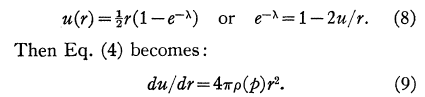
i cant get to (9)
i think i might be doing something wrong
my next idea is to try and brute force it by using the product rule
i will picture what i worked out in a moment
cedar kilnBOT
@slim zinc Has your question been resolved?

 slim zinc
<@&286206848099549185>
cedar kilnBOT
@slim zinc Has your question been resolved?
cedar kilnBOT
@slim zinc Has your question been resolved?
cedar kilnBOT
@slim zinc Has your question been resolved?
cedar kilnBOT
@slim zinc Has your question been resolved?
slim zinc
<@&286206848099549185>
 feral coyote
no one knows how to do this
 torpid sable
There seems to be some missing information
slim zinc
torpid sable
There seems to be some missing information
i can give the whole paper but it requires knowledge of general relativity
and probably wont give anymore information than i gave
cause thats all it mentions of it
maybe ill take it to a pure physics discord and someone can make sense of it
torpid sable
but like where did that other P looking character come from. Not the rho, but the other one
Yeah, that might be your best bet
slim zinc
torpid sable
but like where did that other P looking character come from. Not the rho, but th...
it was just showing that the density is explicitely a function of pressure
i dont think its relevantr
torpid sable
okay, that's what I was guessing, that it's just another function
slim zinc
its the only equation in the entire paper i cant follow
and it looks trivial
ill ask a physics discord
thanks
.close
cedar kilnBOT
Channel closed
Closed by @slim zinc
Use .reopen if this was a mistake.
cedar kilnBOT
Available help channel!
Send your question here to claim the channel.
Remember:
• Ask your math question in a clear, concise manner.
• Show your work, and if possible, explain where you are stuck.
• After 15 minutes, feel free to ping <@&286206848099549185>.
• Type the command .close to free the channel when you're done.
• Be polite and have a nice day!
Read #❓how-to-get-help for further information on how to ask a good question, and about conduct in the question channels.
 crimson meteor
Is it possible to simplify this further??
 cedar kilnBOT
crimson meteor
Is it possible to simplify this further??
crimson meteor
cedar kilnBOT
crimson meteor
Is it possible to simplify this further??
crimson meteor
(x+y)^2 = x^2 + 2xy + y^2
cedar kilnBOT
@crimson meteor Has your question been resolved?
cedar kilnBOT
@crimson meteor Has your question been resolved?
cedar kilnBOT
Channel closed
Closed due to timeout
Use .reopen if this was a mistake.
cedar kilnBOT
Available help channel!
Send your question here to claim the channel.
Remember:
• Ask your math question in a clear, concise manner.
• Show your work, and if possible, explain where you are stuck.
• After 15 minutes, feel free to ping <@&286206848099549185>.
• Type the command .close to free the channel when you're done.
• Be polite and have a nice day!
Read #❓how-to-get-help for further information on how to ask a good question, and about conduct in the question channels.
 west island
Hey I have trouble understanding the last two steps
 west island
I/2 is supposed to be I^2/2 right??
Full problem + what I did


<@&286206848099549185>
cedar kilnBOT
@west island Has your question been resolved?
cedar kilnBOT
@west island Has your question been resolved?
cedar kilnBOT
@west island Has your question been resolved?
cedar kilnBOT
Channel closed
Closed due to timeout
Use .reopen if this was a mistake.
Available help channel!
Send your question here to claim the channel.
Remember:
• Ask your math question in a clear, concise manner.
• Show your work, and if possible, explain where you are stuck.
• After 15 minutes, feel free to ping <@&286206848099549185>.
• Type the command .close to free the channel when you're done.
• Be polite and have a nice day!
Read #❓how-to-get-help for further information on how to ask a good question, and about conduct in the question channels.
 crimson pike
i proved that empty set is a subset of P(A) - P(B) already but im not sure how to continue
 wet fossil
hmm for (ii) notice that the empty set belongs to both P(A) and P(B) and P(A) - P(B) equals all the subsets of A which are not subsets of B
crimson pike
yea so i got to the point where since empty set is in P(B) and empty set is in P(A) the difference would result in P(A) - P(B) not having the element empty set
but from b)i) i proved that empty set is always a subset of P(A) - P(B)
so i dont really get the distinction between empty set not being an element and it being a subset
wet fossil
The empty set is a element of P(P(A) - P(B))?
P(A) - P(B) is a set so the empty set is a subset of it but it's not a element of P(A) - P(B)
crimson pike
ohhh
okay i get it now
bruh its like i just got enlightened
TY so much man
.close
cedar kilnBOT
Channel closed
Closed by @crimson pike
Use .reopen if this was a mistake.
Available help channel!
Send your question here to claim the channel.
Remember:
• Ask your math question in a clear, concise manner.
• Show your work, and if possible, explain where you are stuck.
• After 15 minutes, feel free to ping <@&286206848099549185>.
• Type the command .close to free the channel when you're done.
• Be polite and have a nice day!
Read #❓how-to-get-help for further information on how to ask a good question, and about conduct in the question channels.
 crimson sedge
how do you prove that:
x(y) = z(y) + t
(if originally x = z + (t/y) * y)
cedar kilnBOT
crimson sedge
how do you prove that:
x(y) = z(y) + t
(if originally x = z + (t/y) * y)
 crimson sedge
External angle = 180 - ((n-2)180)/n
someone has already helped me solve this in a simple way that does involve that the rule I mentioned above but I am still curious
 tropic oxide
???
crimson sedge
n = the side of a polygon
 wanton grove
how are these two related at all
crimson sedge
first
wanton grove
crimson sedge
External angle = 180 - ((n-2)180)/n
is this supposed to be the measure of an external angle of a n sided regular polygon?
or something else
crimson sedge
lemme first edit it bcz i typed something wrong
now,
E = 180 -((n-2)180)/n
En = 180n - ((n-2(180)/n * n
En = 180n - (180n - 360)
En = 180n (-180n + 360)
En = 180n - 180n + 360
En = 360
N = 360/E
I wanna now why En = 180n - ((n-2)180) instead of En = 180 - ((n-2)180)
.close
cedar kilnBOT
Channel closed
Closed by @fathom hinge
Use .reopen if this was a mistake.
Available help channel!
Send your question here to claim the channel.
Remember:
• Ask your math question in a clear, concise manner.
• Show your work, and if possible, explain where you are stuck.
• After 15 minutes, feel free to ping <@&286206848099549185>.
• Type the command .close to free the channel when you're done.
• Be polite and have a nice day!
Read #❓how-to-get-help for further information on how to ask a good question, and about conduct in the question channels.
 zinc mural
$\frac{dM}{dt(n-aM)}=1$
cedar kilnBOT
zinc mural
$\frac{dM}{dt(n-aM)}=1$
 wraith daggerBOT
Xiszt
 zinc mural
where n and a are constants
would you say this ode is seperable?
like could you intergrate both sides to dt and say its a seperable equation
 mental trail
I mean technically you could integrate it in this form
have you tried integrating and doing the change of variables u = 1/(n-aM)?
zinc mural
I have intergrated it yeah
i said it counts as a seperable equation but my friend says a constant doesnt count
he says it needs to be a function
mental trail
huh?
a constant is a function
f(t) = C if he likes functions so much
$\int \frac{dM}{n-aM} = \int f(t)dt$ where $f(t) = 1$
wraith daggerBOT
rafilou2003
 zinc mural
hmm yeah

Just learnt
I can perform intergrating factor methon when its a constant co-efficient right?
or am i not allowed and have to use method of undetermined co-efficients
.close
cedar kilnBOT
Channel closed
Closed by @zinc mural
Use .reopen if this was a mistake.
Available help channel!
Send your question here to claim the channel.
Remember:
• Ask your math question in a clear, concise manner.
• Show your work, and if possible, explain where you are stuck.
• After 15 minutes, feel free to ping <@&286206848099549185>.
• Type the command .close to free the channel when you're done.
• Be polite and have a nice day!
Read #❓how-to-get-help for further information on how to ask a good question, and about conduct in the question channels.
 bleak juniper
Can anyone help me with this??
 cedar kilnBOT
bleak juniper
Can anyone help me with this??
tropic oxide
cedar kilnBOT
bleak juniper
Can anyone help me with this??
tropic oxide
!status
cedar kilnBOT
What step are you on?
1. I don't know where to begin
2. I have begun but got stuck midway
3. I got an answer but I'm told it's wrong
4. I got an answer and would like my work checked
5. I have a question about someone else's worked solution
6. None of the above
do you understand the notation, at least?
bleak juniper
yep.
tropic oxide
right
so then $\sum_{d_i \leq 6} (6-d_i) \geq \sum_{i=1}^n (6 - d_i)$ should be obvious, no?
wraith daggerBOT
Ann
 bleak juniper
yes this is clear
tropic oxide
right
so then the other half can be written as $6n - \sum_{i=1}^n d_i \overset?\geq 12$ can't it
wraith daggerBOT
Ann
 bleak juniper
no of vertices
bleak juniper
wraith dagger
**Ann**
clear mam
tropic oxide
right so at least 3 vertices
oh, it matters that G is planar actually.
theres a bound on the edge count of a planar graph that's linear in n, isnt there?
bleak juniper
can you just tell me how to do it.
This is my assignment . I just want to be done with it
bleak juniper
tropic oxide
theres a bound on the edge count of a planar graph that's linear in n, isnt ther...
didnt get it
tropic oxide
i remember that there was a theorem that went like "if G is a planar graph on n vertices and e edges then e ≤ (some linear function of n)"
but i do not remember what that linear function was
 sweet crest
e=n(n-1)/2 if you pair all n
cedar kilnBOT
@bleak juniper Has your question been resolved?
cedar kilnBOT
@bleak juniper Has your question been resolved?
Channel closed
Closed by @bleak juniper
Use .reopen if this was a mistake.
Available help channel!
Send your question here to claim the channel.
Remember:
• Ask your math question in a clear, concise manner.
• Show your work, and if possible, explain where you are stuck.
• After 15 minutes, feel free to ping <@&286206848099549185>.
• Type the command .close to free the channel when you're done.
• Be polite and have a nice day!
Read #❓how-to-get-help for further information on how to ask a good question, and about conduct in the question channels.
 inland valley
 cedar kilnBOT
inland valley
inland valley
cedar kilnBOT
inland valley
inland valley
how would I set this up as a system of linear equations when to find the distance from 2 points in 3D space is a non-linear process
cedar kilnBOT
@inland valley Has your question been resolved?
cedar kilnBOT
@inland valley Has your question been resolved?
cedar kilnBOT
Channel closed
Closed due to timeout
Use .reopen if this was a mistake.
inland valley
.reopen
cedar kilnBOT
✅
cedar kilnBOT
@inland valley Has your question been resolved?
cedar kilnBOT
@inland valley Has your question been resolved?
cedar kilnBOT
@inland valley Has your question been resolved?
cedar kilnBOT
Channel closed
The owner is missing!
Available help channel!
Send your question here to claim the channel.
Remember:
• Ask your math question in a clear, concise manner.
• Show your work, and if possible, explain where you are stuck.
• After 15 minutes, feel free to ping <@&286206848099549185>.
• Type the command .close to free the channel when you're done.
• Be polite and have a nice day!
Read #❓how-to-get-help for further information on how to ask a good question, and about conduct in the question channels.
crimson sedge
Having trouble on this problem
 cedar kilnBOT
crimson sedge
Having trouble on this problem
crimson sedge
cedar kilnBOT
crimson sedge
Having trouble on this problem
crimson sedge
So I think the answer to the first one is 1 right?
But like
There is an open circle there
At -1 where I circled here

I guess I just don't really understand how to do this problem
cedar kilnBOT
@crimson sedge Has your question been resolved?
cedar kilnBOT
@crimson sedge Has your question been resolved?
 stable oyster
crimson sedge
Having trouble on this problem
stable oyster
crimson sedge
Having trouble on this problem
thats not a multiple choice question
each of that is a question you have to do
oh nvm i misread your message
stable oyster
crimson sedge
There is an open circle there
the open circle doesn't matter
the function still approaches 1 as x -> -1 from both sides
stable oyster
crimson sedge
So I think the answer to the first one is 1 right?
so you're right about this
cedar kilnBOT
@crimson sedge Has your question been resolved?
crimson sedge
stable oyster
so you're right about this
Oh ok
Sorry for the late response byw
Btw
crimson sedge
stable oyster
so you're right about this
Can we work on part b for it pleaseM
?
So I think it says x approaching 2 from the left side
stable oyster
thats what the negative thing is yea
crimson sedge
stable oyster
thats what the negative thing is yea
So like
How would I do that
Would it be 0?
stable oyster
its what it sounds like
crimson sedge
But like I'm confused since there's 2 graphs
stable oyster
where?
crimson sedge
 stable oyster
just view it as one function with a bunch of disconnected parts
yeah its a bitwise function so just google that to see roughly what it is
cedar kilnBOT
@crimson sedge Has your question been resolved?
Channel closed
Closed by @solid coral
Use .reopen if this was a mistake.
Available help channel!
Send your question here to claim the channel.
Remember:
• Ask your math question in a clear, concise manner.
• Show your work, and if possible, explain where you are stuck.
• After 15 minutes, feel free to ping <@&286206848099549185>.
• Type the command .close to free the channel when you're done.
• Be polite and have a nice day!
Read #❓how-to-get-help for further information on how to ask a good question, and about conduct in the question channels.
 bright karma
do i replace f(a) with 1
 cedar kilnBOT
bright karma
do i replace f(a) with 1
bright karma
cedar kilnBOT
bright karma
do i replace f(a) with 1
bright karma
@spice kraken you needed
wraith daggerBOT
WhereWolf(ping if needed)
 wraith daggerBOT
WhereWolf(ping if needed)

 spice kraken
bruh there are no x in the limit
 spice kraken
bruh what are you doing
first
change the limit
second you plugged in all the wrong values
bright karma
WHAT
bright karma
spice kraken
second you plugged in all the wrong values
help 😭
spice kraken
.
bright karma
x?
spice kraken
no
spice kraken
no
bright karma
bothh???
spice kraken
yes
bright karma
so h -> 0?
spice kraken
calculate $\lim_{h\to 0}\frac{f(a+h)-f(a)}{h}$
wraith daggerBOT
WhereWolf(ping if needed)
 spice kraken
change the limit from $\lim_{x\to a} \text{to} \lim_{h\to 0}$ because we changed variables
wraith daggerBOT
WhereWolf(ping if needed)
 bright karma
 bright karma
f(1)
spice kraken
no
bright karma
but h approaches 0
bright karma
then how do i find h
bright karma
x;yuol9867545364tgh
spice kraken
plug in 1+h for 5x^2-3x+1
spice kraken
we have $\lim_{h\to 0}\frac{f(1+h)-f(1)}{h}=\lim_{h\to 0}\frac{(5h^2-3h+3)-3}{h}$
wraith daggerBOT
WhereWolf(ping if needed)
 spice kraken
good
bright karma
spice kraken
good
i thought f(a) = 1
spice kraken
yes
bright karma
which gives 3
 spice kraken
you forgot to write f'(1)
bright karma
where
spice kraken
line 6
bright karma

where in line 6
if i need to write it in line 6 i need to write it in every line after?
spice kraken
left most
spice kraken
bright karma
if i need to write it in line 6 i need to write it in every line after?
no
bright karma
f'(1) = [(5....
spice kraken
yep
 spice kraken
look good
cedar kilnBOT
Channel closed
Closed by @bright karma
Use .reopen if this was a mistake.
Available help channel!
Send your question here to claim the channel.
Remember:
• Ask your math question in a clear, concise manner.
• Show your work, and if possible, explain where you are stuck.
• After 15 minutes, feel free to ping <@&286206848099549185>.
• Type the command .close to free the channel when you're done.
• Be polite and have a nice day!
Read #❓how-to-get-help for further information on how to ask a good question, and about conduct in the question channels.
 turbid spoke
help
cedar kilnBOT
turbid spoke
help
turbid spoke
.close
cedar kilnBOT
Channel closed
Closed by @turbid spoke
Use .reopen if this was a mistake.
Available help channel!
Send your question here to claim the channel.
Remember:
• Ask your math question in a clear, concise manner.
• Show your work, and if possible, explain where you are stuck.
• After 15 minutes, feel free to ping <@&286206848099549185>.
• Type the command .close to free the channel when you're done.
• Be polite and have a nice day!
Read #❓how-to-get-help for further information on how to ask a good question, and about conduct in the question channels.
 worldly bluff
Got wrong answer
 cedar kilnBOT
worldly bluff
Got wrong answer
worldly bluff
cedar kilnBOT
worldly bluff
Got wrong answer
worldly bluff
Not sure where I messed up
spice kraken
what's the correct answer?
worldly bluff
x=ab/(a-b-c)
worldly bluff
this is my answer written more clearly

 thorn hollow
Oh you’ve got an overall negative yeah this works
 worldly bluff
 thorn hollow
Difference of squares on the right
worldly bluff
what is that
thorn hollow
a^2-b^2=(a+b)(a-b)
worldly bluff
 thorn hollow
And you can factor (a+b) out then cancel it
 cedar kilnBOT
Channel closed
Closed by @worldly bluff
Use .reopen if this was a mistake.
Available help channel!
Send your question here to claim the channel.
Remember:
• Ask your math question in a clear, concise manner.
• Show your work, and if possible, explain where you are stuck.
• After 15 minutes, feel free to ping <@&286206848099549185>.
• Type the command .close to free the channel when you're done.
• Be polite and have a nice day!
Read #❓how-to-get-help for further information on how to ask a good question, and about conduct in the question channels.
 small igloo
I need help on solving this equation csc^6 10º - cot^6 10º - 3csc^2 10º x cot^2 10º
cedar kilnBOT
small igloo
I need help on solving this equation csc^6 10º - cot^6 10º - 3csc^2 10º x cot^2 ...
small igloo
how do i use the bot thingy
 carmine whale
U mean calculator ?
If u r talking about Wolfram alpha
,w csc^6 10º - cot^6 10º - 3csc^2 10º × cot^2 10º
small igloo
carmine whale
If u r talking about Wolfram alpha
not that
the bot that uploads the equation as a png
small igloo
yeah that
wraith daggerBOT
•Iᴛᴀᴅᴏʀɪ•
 thorn hollow
$\csc^6 10^\circ - \cot^6 10 ^\circ - 3 \csc^2 10 ^\circ \cdot \cot^2 10 ^\circ$
wraith daggerBOT
Alti
 small igloo
that's better
I know to solve this equation I need to use the Pytaghorean identities
I believe I should be dividing the equation by sin^2 first
actually hm
cedar kilnBOT
@small igloo Has your question been resolved?
Channel closed
Closed by @small igloo
Use .reopen if this was a mistake.
Available help channel!
Send your question here to claim the channel.
Remember:
• Ask your math question in a clear, concise manner.
• Show your work, and if possible, explain where you are stuck.
• After 15 minutes, feel free to ping <@&286206848099549185>.
• Type the command .close to free the channel when you're done.
• Be polite and have a nice day!
Read #❓how-to-get-help for further information on how to ask a good question, and about conduct in the question channels.
 ornate crescent
 cedar kilnBOT
ornate crescent
ornate crescent
cedar kilnBOT
ornate crescent
ornate crescent
How exactly would I go about this problem? I imagine I would integrate from 0 to 6, but other than that I'm very confused on what f(x) would be here.
 muted bear
What is the function for a circle (or really a semicircle)
muted bear
The function, not the fprmula for area
ornate crescent
I'm unsure.
muted bear
does $\sqrt{x^2-r^2}$ look familiar
wraith daggerBOT
GarlicB
 ornate crescent
It does not.
wraith daggerBOT
GarlicB
 ornate crescent
That does look more familiar, yes.
muted bear
try to isolate y
ornate crescent
I'm not sure this is something I would say I've worked with before though.
I see how that would become the function you created earlier.
muted bear
What is r in this problem?
muted bear
Function for a semicircle
Because of the squareroot, we have to choose one of either positive or negatibe
In this case, i chose positive
So we can cheat by multiplying by 2
ornate crescent
Ah that makes sense.
muted bear
So then do you know how to use the cross section formula in tjis case?
ornate crescent
I'm a bit confused about that as it says the slices are squares.
Or rather, unsure how to incorporate this information with the rest of the problem.
muted bear
ok lets look at one slice at say x=1
Im not gonna simplify anything
we have the length of the line segment with endpoints on the circle is $2\sqrt{9-1}$
wraith daggerBOT
GarlicB
 muted bear
wraith dagger
**GarlicB**
muted bear
wraith dagger
**GarlicB**
Excuse my idiocy, this formula is for a hyperbola
The r and x should be switched for the semicircle
ornate crescent
so r^2-x^2 under the root?
muted bear
wraith dagger
**GarlicB**
So $2\sqrt{9-1}$ is the side length of the square
wraith daggerBOT
GarlicB
 muted bear
the area of said square is 4(9-1)
ornate crescent
Wait how do I know that that is the side length of the square?
That was using the formula of the circle right?
muted bear
Yes
ornate crescent
Which is how we obtained this equation initially.
So, by squaring that, that just gives us a square?
muted bear
Yes
ornate crescent
This sound ridiculous to type out but
muted bear
Its good to type it out
ornate crescent
Interesting. Okay.
muted bear
Help it make sense
ornate crescent
Yeah.
I mean "so by making it a square makes it a square" feels very silly to ask. lol.
But, okay cool. that is a good information to have.
muted bear
So in general, to find the volume when the cross section is squares is the formula (let me type out the tex)
$\int_a^b(f(x))^2dx$
wraith daggerBOT
GarlicB
 muted bear
So you know your bounds and the function then plug and chug
ornate crescent
and f(x) here is the formula of a circle. which can be derived with y^2+x^2=r^2
Correct?
and 2*int from 0 to 3?
muted bear
Yeah
muted bear
$2\int_0^3 (2\sqrt{9-x^2})^2dx$
wraith daggerBOT
GarlicB
 ornate crescent
Okay so I'm a little confused on where to find x here.
in the function of a circle, where would x come from?
thinking of this on a 2d plane makes sense.
ornate crescent
but with the given information I'm not following.
ornate crescent
yeah that makes sense.
I think I'm just unsure where I would find x with the information given.
muted bear
What do you mean by find x?
ornate crescent
Oh you know what.
I'm smooth braining hard.
lol
nvm.
This does make sense.
Thank you so much! This actually fills in a lot of gaps I was having with some of the more recent material.
muted bear
Youre very welcome!
ornate crescent
.close
cedar kilnBOT
Channel closed
Closed by @ornate crescent
Use .reopen if this was a mistake.
Available help channel!
Send your question here to claim the channel.
Remember:
• Ask your math question in a clear, concise manner.
• Show your work, and if possible, explain where you are stuck.
• After 15 minutes, feel free to ping <@&286206848099549185>.
• Type the command .close to free the channel when you're done.
• Be polite and have a nice day!
Read #❓how-to-get-help for further information on how to ask a good question, and about conduct in the question channels.
 late wadi
hi, i just have a quick question about this problem:
i initally say that x is NOT in the set of anbnc (because it is in the complement)
after this, if i was to split anbnc into something like
x is not in the set of a, x is not in the set of b, x is not in the set of c
are they connected by ands? or by ors?
 cedar kilnBOT
late wadi
hi, i just have a quick question about this problem:
i initally say that x is N...
late wadi
cedar kilnBOT
late wadi
hi, i just have a quick question about this problem:
i initally say that x is N...
late wadi
i see that the formal definition of an intersection is A ∩ B = {x ∣ x ∈ A ∧ x ∈ B}.
but does this switch when x is NOT in the set?
 flint plinth
late wadi
hi, i just have a quick question about this problem:
i initally say that x is N...
flint plinth
late wadi
hi, i just have a quick question about this problem:
i initally say that x is N...
if it's not in A∩B∩C, then it's not in all of them, so there's at least one that it's not in
late wadi
hmm
flint plinth
so it's not in A, or it's not in B, or it's not in C
flint plinth
sure
late wadi
.close
cedar kilnBOT
Channel closed
Closed by @late wadi
Use .reopen if this was a mistake.
Available help channel!
Send your question here to claim the channel.
Remember:
• Ask your math question in a clear, concise manner.
• Show your work, and if possible, explain where you are stuck.
• After 15 minutes, feel free to ping <@&286206848099549185>.
• Type the command .close to free the channel when you're done.
• Be polite and have a nice day!
Read #❓how-to-get-help for further information on how to ask a good question, and about conduct in the question channels.
 flint whale
Not sure if this is a jump discontinuity or a infinite discontinuity.

 royal loom
infinite discontinuities only require one side of the limit to approach infinity
jump discontinuities require both sides to approach finite values, yet that these finite values are not equal to eachother
flint whale
So it would be a non removable infinite discontinuity?
flint plinth
if the limits on each side are different, it's not a removable discontinuity
 royal loom
idk what do u think
flint whale
yes
also
would you consider a piecewise function
discontinuous outside of its domain?
royal loom
flint whale
discontinuous outside of its domain?
@solid juniper
you would consider it undefined
flint plinth
does it make sense to talk about continuity or discontinuity outside of the domain?
the definition of continuity at a point requires the function to be defined at that point
 solid juniper
royal loom
<@984319941417250907>
solid juniper
royal loom
<@984319941417250907>

cedar kilnBOT
@flint whale Has your question been resolved?
Channel closed
Closed by @flint whale
Use .reopen if this was a mistake.
Available help channel!
Send your question here to claim the channel.
Remember:
• Ask your math question in a clear, concise manner.
• Show your work, and if possible, explain where you are stuck.
• After 15 minutes, feel free to ping <@&286206848099549185>.
• Type the command .close to free the channel when you're done.
• Be polite and have a nice day!
Read #❓how-to-get-help for further information on how to ask a good question, and about conduct in the question channels.
 odd sierra
 cedar kilnBOT
odd sierra
cedar kilnBOT
odd sierra

 modern compass
are you converting the .83 into seconds?
modern compass
multiply .83 by 60 to get the number of seconds
modern compass
seems reasonable, yeah.
cedar kilnBOT
Channel closed
Closed by @odd sierra
Use .reopen if this was a mistake.
Available help channel!
Send your question here to claim the channel.
Remember:
• Ask your math question in a clear, concise manner.
• Show your work, and if possible, explain where you are stuck.
• After 15 minutes, feel free to ping <@&286206848099549185>.
• Type the command .close to free the channel when you're done.
• Be polite and have a nice day!
Read #❓how-to-get-help for further information on how to ask a good question, and about conduct in the question channels.
 uneven siren
 cedar kilnBOT
uneven siren
tropic oxide
cedar kilnBOT
uneven siren
tropic oxide
,rccw
wraith daggerBOT
 uneven siren
- I get it that the answer is b
But the mathematical proof is something like Vct= Vc-Vt
Just wanna know why its minus here
tropic oxide
imagine you're on the train
compared to a stationary observer, all speeds as observed by you are shifted by the same vector
your own speed is v_t to the stationary observer (bc you're on the train), but 0 to you
so that shift is -v_t
cedar kilnBOT
@uneven siren Has your question been resolved?
cedar kilnBOT
Channel closed
Closed due to timeout
Use .reopen if this was a mistake.
cedar kilnBOT
Available help channel!
Send your question here to claim the channel.
Remember:
• Ask your math question in a clear, concise manner.
• Show your work, and if possible, explain where you are stuck.
• After 15 minutes, feel free to ping <@&286206848099549185>.
• Type the command .close to free the channel when you're done.
• Be polite and have a nice day!
Read #❓how-to-get-help for further information on how to ask a good question, and about conduct in the question channels.
 somber talon
 cedar kilnBOT
somber talon
somber talon
cedar kilnBOT
somber talon
somber talon
wouldn't the answer be $5?
the answer booklet says $6
300cm of wire means 3m of wire
$2 for every wire, means, $2 for 1 metre
now we have 2m left
another $2 spent
1m left
spent $4
oh I got it ty
.close
cedar kilnBOT
Channel closed
Closed by @somber talon
Use .reopen if this was a mistake.
cedar kilnBOT
Available help channel!
Send your question here to claim the channel.
Remember:
• Ask your math question in a clear, concise manner.
• Show your work, and if possible, explain where you are stuck.
• After 15 minutes, feel free to ping <@&286206848099549185>.
• Type the command .close to free the channel when you're done.
• Be polite and have a nice day!
Read #❓how-to-get-help for further information on how to ask a good question, and about conduct in the question channels.
 dreamy zenith
if i calculate the direction of a vector thats in quadrant 4 and it comes out as -16.11 can i write the direction as 343.89 degrees instead of -16.11 degrees ?
cedar kilnBOT
dreamy zenith
if i calculate the direction of a vector thats in quadrant 4 and it comes out as...
@dreamy zenith Has your question been resolved?
cedar kilnBOT
Channel closed
Closed due to timeout
Use .reopen if this was a mistake.
Available help channel!
Send your question here to claim the channel.
Remember:
• Ask your math question in a clear, concise manner.
• Show your work, and if possible, explain where you are stuck.
• After 15 minutes, feel free to ping <@&286206848099549185>.
• Type the command .close to free the channel when you're done.
• Be polite and have a nice day!
Read #❓how-to-get-help for further information on how to ask a good question, and about conduct in the question channels.
 stray otter
how is this even logical?
 cedar kilnBOT
stray otter
how is this even logical?
stray otter
cedar kilnBOT
stray otter
how is this even logical?
stray otter
these 2 parts are the same thing isn't it?
 crimson sedge
Well, yeah, kinda
The line on the right is also the extra block peeping out
1s
 sweet crest
some cubes have all except one side transparent 
cedar kilnBOT
Channel closed
Closed by @stray otter
Use .reopen if this was a mistake.
Available help channel!
Send your question here to claim the channel.
Remember:
• Ask your math question in a clear, concise manner.
• Show your work, and if possible, explain where you are stuck.
• After 15 minutes, feel free to ping <@&286206848099549185>.
• Type the command .close to free the channel when you're done.
• Be polite and have a nice day!
Read #❓how-to-get-help for further information on how to ask a good question, and about conduct in the question channels.
 green vapor
Hi, I am writing the proof of the triangle inequality but I am stuck on this part and not sure how to progress. I did the other two cases where a < 0, b <0 and a>=0,b>=0. Not sure how to finish this one.
 cedar kilnBOT
green vapor
Hi, I am writing the proof of the triangle inequality but I am stuck on this par...
green vapor
cedar kilnBOT
green vapor
Hi, I am writing the proof of the triangle inequality but I am stuck on this par...
green vapor
<@&286206848099549185>
sweet crest
what's |a| when a<0?
green vapor
-a
sweet crest
so where is the problem?
sweet crest
so you need to prove b-a>=|a+b| a<0, b>=0?
green vapor
i am trying to prove |a+b| <=|a|+|b|
sweet crest
well, you already proved |a|+|b|=b-a a<0, b=>0
green vapor
sweet crest
look at cases |a|>b and |a|<=b
wdym
wouldnt i need to create subcases where a+b>=0, a+b<0
green vapor
yeah
sweet crest
green vapor
wouldnt i need to create subcases where a+b>=0, a+b<0
so look at those two
green vapor
ok
honestly idk man
i have been working since yesterday morning
im running on 3 hours of sleep
and this assignment is due in 2 hours
sweet crest
time scheduling problem
green vapor
sweet crest
time scheduling problem
perhaps
i forgot this assignment existed until 2 days ago
so it was unfortunate
green vapor
sweet crest
so look at those two
Wdym tho
do i create those subcases?
and even if i do how would i write that
sweet crest
suppose a+b<0 then solve
sweet crest
*prove that it holds
green vapor
gotcha
cedar kilnBOT
@green vapor Has your question been resolved?
green vapor
@sweet crest

Is this good?
changed it a bit

but i think thats all?
@sweet crest do you think this is good?
if so i think im done
sweet crest
yeh, looks messy but ok
green vapor
ok sick
sweet crest
0>=-b
green vapor
sweet crest
0>=-b
wdym
sweet crest
Since b>=0
sweet crest
there is a simpler way btw
green vapor
you mean like this?
 green vapor
sweet crest
there is a simpler way btw
green vapor
sweet crest
there is a simpler way btw
well too late for that now
wait that makes no sense
why is it 0>=-b
sweet crest
-a<=|a|<=a same for b, add them up -(a+b)<=|a+b|<=a+b and a<=|a|
So |a+b|<=a+b<=|a+b|
wops
sweet crest
-|a|<=a<=|a|
green vapor
or is thre still something wrong?
green vapor
sweet crest
-|a|<=a<=|a|
yeah i learned that before
sweet crest
-(|a|+|b|)<=a+b<=|a|+|b|
green vapor
thats the simpler way right?
welp nothing i can do about it now
as long as my current proof is ok im fine
sweet crest
sweet crest
-(|a|+|b|)<=a+b<=|a|+|b|
then you prove |b|<|a| <=> -|a|<=b<=|a|
yeah, should be fine
green vapor
ok thank you
sweet crest
except <= and <
sweet crest
Since b>=0 b>0

 sweet crest
both
green vapor
oh
whats the right way then
i dont get how the first one is wrong
oh
its supposed to be >=-b right
sweet crest
yeh second one is ok
green vapor
yeah i see where i messed up on the first one
green vapor
sweet crest
yeh second one is ok
ok
im gonna hand it in now
i should start doing this from an earlier date now
finally done
my god
cedar kilnBOT
@green vapor Has your question been resolved?
Channel closed
Closed by @green vapor
Use .reopen if this was a mistake.
Available help channel!
Send your question here to claim the channel.
Remember:
• Ask your math question in a clear, concise manner.
• Show your work, and if possible, explain where you are stuck.
• After 15 minutes, feel free to ping <@&286206848099549185>.
• Type the command .close to free the channel when you're done.
• Be polite and have a nice day!
Read #❓how-to-get-help for further information on how to ask a good question, and about conduct in the question channels.
 floral pagoda
How can I show that matrix A is the root of the equation?

 uneven matrix
plug it in and calculate
floral pagoda
uneven matrix
plug it in and calculate
I need to show it on paper, any suggestions?
also west coast>>>
uneven matrix
floral pagoda
I need to show it on paper, any suggestions?
my suggestion is to deal with it
its not as bad as u think
uneven matrix
floral pagoda
also west coast>>>
idek bro im just down bad and hit play on lana del ray spotify
floral pagoda
uneven matrix
my suggestion is to deal with it
yeah I understand, I just started learning matrix
so im kinda confused where to even start
floral pagoda
uneven matrix
oh just calculate A*A - 6A + detA * E
okay thank youuu
what does E mean tho?
floral pagoda
uneven matrix
the identity matrix
ah ok thanks
appreciate you spending your time explaining
uneven matrix
np
cedar kilnBOT
@floral pagoda Has your question been resolved?
floral pagoda
uneven matrix
np
ok I got to this part, what should my next step be?
 floral pagoda
uneven matrix
you calculated -6A and then did -(-6A) --> +6A
floral pagoda
uneven matrix
you calculated -6A and then did -(-6A) --> +6A
thanks for pointing it out, should be good now
 uneven matrix
once again you have a mistake, you copied A^2 incorrectly
floral pagoda
uneven matrix
once again you have a mistake, you copied A^2 incorrectly
ok, so its 0 instead of -36, fixed👍
what should my next step be?
uneven matrix
now youd multiply E by the determinant of A just like you did with -6A
and add it again
floral pagoda
uneven matrix
now youd multiply E by the determinant of A just like you did with -6A
🫡
 uneven matrix
yep
floral pagoda
uneven matrix
yep
I am very gratefull for your help. How may I prove that the matrix is the square of the equation?
floral pagoda
yes the root
uneven matrix
say p(x) = x^2 -6x + |x|E then a root means that p(A) = 0
and you just showed that p(A) = 0
floral pagoda
uneven matrix
and you just showed that p(A) = 0
ohhh ok thanks a lot man!
you saved me so much time
uneven matrix
no problem!
floral pagoda
.close
cedar kilnBOT
Channel closed
Closed by @floral pagoda
Use .reopen if this was a mistake.
Available help channel!
Send your question here to claim the channel.
Remember:
• Ask your math question in a clear, concise manner.
• Show your work, and if possible, explain where you are stuck.
• After 15 minutes, feel free to ping <@&286206848099549185>.
• Type the command .close to free the channel when you're done.
• Be polite and have a nice day!
Read #❓how-to-get-help for further information on how to ask a good question, and about conduct in the question channels.
 tired violet
I need to derive a closed-form expression for this summation.
I tried using partial fractions but at last i obtained some harmonic numbers which do not have any known closed-form expressions.
How can I solve this?
 cedar kilnBOT
tired violet
I need to derive a closed-form expression for this summation.
I tried using part...
cedar kilnBOT
tired violet
I need to derive a closed-form expression for this summation.
I tried using part...
 neat dune
Mind if u show what u get from partial fractions
I sorta had to work with this sorta thing to find $\sum_{n= 1}^\infty \frac{1}{\sum_{m= 1}^n m^2}$ recently 
Anyways if ur not taking to infinity and there isn't any telescoping going on there probably isn't any pretty closed form
Just a bunch of Euler constant and digamma function ish u can find by inputting into wolframalpha
However at least for my problem, when you take the series it turned out to be 6(3 - 2log(4)) which was somewhat pretty
I kinda did it in a complicated manner but you might have an easier time using the aymptotics of harmonic numbers
wraith daggerBOT
992qqoloy

 tired violet
neat dune
Anyways if ur not taking to infinity and there isn't any telescoping going on th...
tired violet
neat dune
Anyways if ur not taking to infinity and there isn't any telescoping going on th...
this is from wolframalpha lol
 crimson sedge
this is correct i think
neat dune
oh yeah that's probably the prettiest you can get  , but if you take to infinity there's telescoping that cancels out most terms but the first 4 from the sum 1/(4(j-2))
crimson sedge
its not that difficult
yu[
yup
just expand and this will come
i tried a different approach tho
1/j^-4=1/(j-2)(j+2) and then plug values from 3 to n and terms will start getting cancelled and ull be left with 8 terms
which on simplifying will give the answers i suppose
neat dune
my thing had partial fractions on a cubic cus sum of squares is (n(2n + 1)(n+1)/6 so that's why it was harder I guess
crimson sedge
cube?
neat dune
yeah cus 3 factors of first degree
crimson sedge
first as much as i remember square is n(2n+1)(n+1)/6
neat dune
It partial fractioned out to like 1/n + 1/(n + 1) - 4/(2n +1)
crimson sedge
cubic is (n(n+1)/2)^2
neat dune
no im saying the closed Form of sum of squares is a cubic poly
neat dune
I don't wanna try to figure out what the sum of the reciprocal of the sum of cubes is
cedar kilnBOT
@tired violet Has your question been resolved?
neat dune
But yeh it was really fun cus then you could split into like (1/n - 2/(2n + 1)) + (1/(n+1) - 2/(2n + 1)) and then with some slight correction (hence the +3) you'd have the negative of partial sums of the alternating harmonic series, minus the 2nd half of the partial sum of the harmonic series. Then take to infinity, so ln(2) for the alternating, and u could calculate the other value by rewriting it as a Riemann sum and then taking the integral from 1 to 2 of 1/x, which was also ln(2)
And that's how u got 6(3 - 4ln(2)) 
cedar kilnBOT
Channel closed
Closed due to timeout
Use .reopen if this was a mistake.
Available help channel!
Send your question here to claim the channel.
Remember:
• Ask your math question in a clear, concise manner.
• Show your work, and if possible, explain where you are stuck.
• After 15 minutes, feel free to ping <@&286206848099549185>.
• Type the command .close to free the channel when you're done.
• Be polite and have a nice day!
Read #❓how-to-get-help for further information on how to ask a good question, and about conduct in the question channels.
 hollow igloo
I need help
cedar kilnBOT
hollow igloo
I need help
 crimson sedge
hollow igloo
7x+28+x-9=180
crimson sedge
hollow igloo
7x+28+x-9=180
29?
hollow igloo
oh mb i meant 28
crimson sedge
then yes
crimson sedge
hollow igloo
interior angle of the polygon? is this the full question
hollow igloo
 hollow igloo
crimson sedge
interior angle of the polygon? is this the full question
hollow igloo
crimson sedge
interior angle of the polygon? is this the full question
yup
crimson sedge
hollow igloo
yup
what would be the angle then
hollow igloo
i got 168
crimson sedge
yes
hollow igloo
not sure how i am meant to get the number of sides
crimson sedge
hollow igloo
not sure how i am meant to get the number of sides
you divide the exterior angle by 360
do you see the exterior angle
hollow igloo
x-8?
hollow igloo
okay thanks
 crimson sedge
hollow igloo
okay thanks
crimson sedge
hollow igloo
okay thanks
what would be the exterior angle
hollow igloo
120
crimson sedge
using that do you see how we can get the number of sides
crimson sedge
crimson sedge
you divide the exterior angle by 360
.
hollow igloo
so 360/120?
crimson sedge
what do you get
crimson sedge
see
hollow igloo
so 360/x-8?
crimson sedge
and what is x-8
hollow igloo
12
crimson sedge
so how many sides
hollow igloo
30 💀
crimson sedge
 yes
yes
crimson sedge
np np
hollow igloo
is trianle ABC right angle?
 crimson sedge
hollow igloo
is trianle ABC right angle?
crimson sedge
hollow igloo
is trianle ABC right angle?
how can you tell?
hollow igloo
im just guessing tbh
it looks like a right angle triangle
but is there any way i can be sure
cedar kilnBOT
@hollow igloo Has your question been resolved?
Channel closed
Closed by @hollow igloo
Use .reopen if this was a mistake.
Available help channel!
Send your question here to claim the channel.
Remember:
• Ask your math question in a clear, concise manner.
• Show your work, and if possible, explain where you are stuck.
• After 15 minutes, feel free to ping <@&286206848099549185>.
• Type the command .close to free the channel when you're done.
• Be polite and have a nice day!
Read #❓how-to-get-help for further information on how to ask a good question, and about conduct in the question channels.
 warm tree
 warm tree

really confused by what im doing wrong here, i've attempted variations of this problem. I feel like I'm applying the product rule correctly, so ig there's an algebra mistake somewhere or something
just saw it, didn't carry the half for some reason
.close
cedar kilnBOT
Channel closed
Closed by @warm tree
Use .reopen if this was a mistake.
warm tree
.reopen
cedar kilnBOT
✅
 dire geode
cedar kilnBOT
dire geode
cedar kilnBOT
Channel closed
Closed by @warm tree
Use .reopen if this was a mistake.
Available help channel!
Send your question here to claim the channel.
Remember:
• Ask your math question in a clear, concise manner.
• Show your work, and if possible, explain where you are stuck.
• After 15 minutes, feel free to ping <@&286206848099549185>.
• Type the command .close to free the channel when you're done.
• Be polite and have a nice day!
Read #❓how-to-get-help for further information on how to ask a good question, and about conduct in the question channels.
 pseudo hinge
hi, I would like help with these please

 cedar kilnBOT
pseudo hinge
hi, I would like help with these please
pseudo hinge
cedar kilnBOT
pseudo hinge
hi, I would like help with these please
pseudo hinge
i really couldnt get my head around this one
pls ping me if you respond (sorry ik thats rude)
 paper robin
for the first one start by completing the cone and getting its volume
pseudo hinge
paper robin
for the first one start by completing the cone and getting its volume
how would i complete the cone
paper robin
pseudo hinge
how would i complete the cone
like draw the whole cone
pseudo hinge
sure
but then, how would i know the height
(sorry if im asking really dumb questions)
paper robin
pseudo hinge
but then, how would i know the height
similarity of triangles
paper robin
pseudo hinge
(sorry if im asking really dumb questions)
oh no they're not dumb dw
pseudo hinge
paper robin
similarity of triangles
right, i don't know anything about that
okay, thats fine
i'll study similarity of triangles
can you tell me something about the second one
cedar kilnBOT
@pseudo hinge Has your question been resolved?
pseudo hinge
pseudo hinge
hi, I would like help with these please
but can someone help me with these
 gilded sonnet
Well for the first one just count the volume
The formula is V=\dfrac{\pi h}{3}({r}{1}^{2}+{{r}{1}}{{r}{2}}+{r}{2}^{2})
$V=\dfrac{\pi h}{3}({r}{1}^{2}+{{r}{1}}{{r}{2}}+{r}{2}^{2})
idk how to use the bots o nthis server
It's just this

@pseudo hinge
cedar kilnBOT
@pseudo hinge Has your question been resolved?
Channel closed
Closed by @pseudo hinge
Use .reopen if this was a mistake.
Available help channel!
Send your question here to claim the channel.
Remember:
• Ask your math question in a clear, concise manner.
• Show your work, and if possible, explain where you are stuck.
• After 15 minutes, feel free to ping <@&286206848099549185>.
• Type the command .close to free the channel when you're done.
• Be polite and have a nice day!
Read #❓how-to-get-help for further information on how to ask a good question, and about conduct in the question channels.
 ornate wadi
Trying one more time, as I couldn't grasp from the last explanation before a bot closed the channel.
cedar kilnBOT
ornate wadi
Trying one more time, as I couldn't grasp from the last explanation before a bot...
ornate wadi
I'm a math teacher in a small school, but trained in English--I say that to point out that while I'm passionate about math, I'm not extensively formally trained. That said, I'm motivated to pass on to students why certain patterns/methods work, not just that they do. I need to make sense of it for myself before I can do the same for others, obviously. Considering the photo/snip below:
...how do I explain to students, mathematically, why I can simplify before the multiplication, instead of multiplying "straight across" the fraction, and being left with a very awkward fraction to reduce to lowest terms.
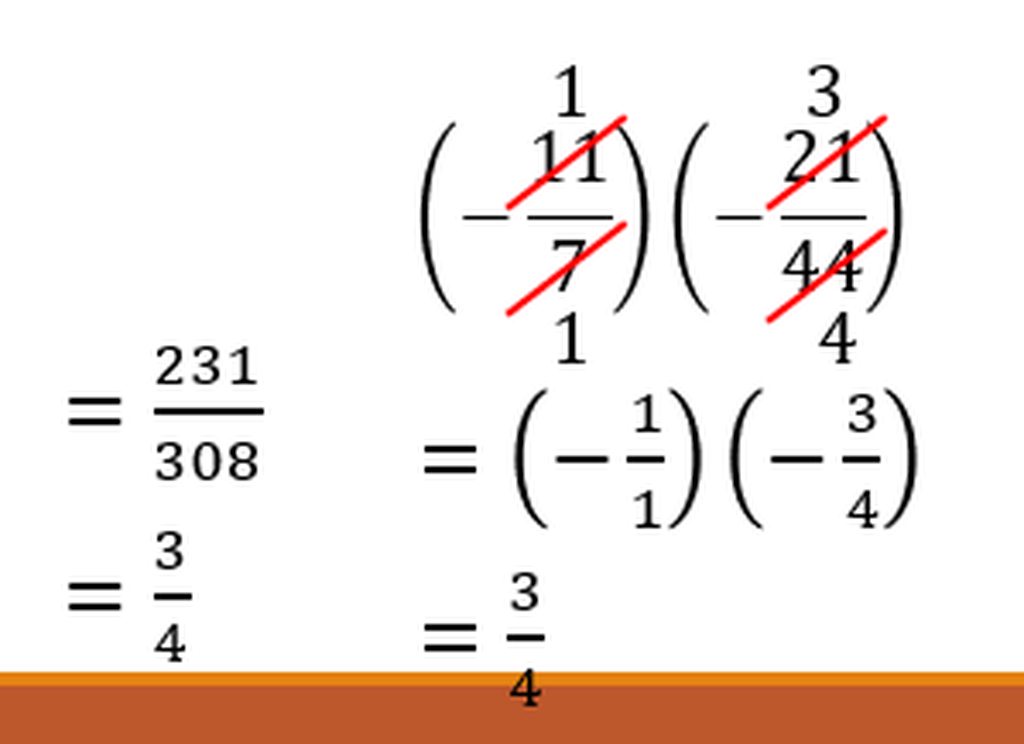
 cinder venture
They are divisible by each other
ornate wadi
Advice from previous respondant that I couldn't quite make heads or tails of how it helps break things down: do the explanation of fraction multiplication in the opposite direction to factor 21/44 into 7/11 and 3/4
multiplication is associative
multiply 11/7 with 7/11 to get 1
ornate wadi
cinder venture
They are divisible by each other
I get that multiplication is commutative, but isn't there division at play as well?
cinder venture
That’s now what I meant
You’re asking why you can divide those fractions, simplifying them before multiplying no?
ornate wadi
Yeah, specifically the numerator of one fraction by the denominator of another, before doing the multiplication?
cinder venture
Do you agree that if you look at 21 and 7 they both have something they can be divided by?
cinder venture
Yeah, so you can simplify before multiplication because the values have terms they can be divided by
ornate wadi
Coming from a different angle, the muliplication at play is essentially multiplying the result of two division problems (fractions) together. Written like this: (-11/7)*(-21/44). I can't rationalize how I can "reduce" the terms of the "division" problems when they're in different parts of the equation.
I recognize I'm not being terribly clear. I understand if you can't make heads or tails or my "roadblock"
wraith daggerBOT
Dyssrupt

 junior dome
ornate wadi
junior dome
ornate wadi
It shows me that it works, but *why * am I able to swap denominators, mathematically? Perhaps it's easier to break down/explain using the multiplication of the fractions (2/3) * (15/16). I've tried working out why this concept works using those simpler numbers, with no success.
cedar kilnBOT
@ornate wadi Has your question been resolved?
 worn kraken
Perhaps it would be clearer in a general form, where you have $\frac{a}{b}\cdot \frac{c}{d}$. That is equal to $a \cdot (1/b) \cdot c \cdot (1/d)$. \ Because multiplication is communative, we may rearrange it to get $a \cdot (1/d) \cdot c \cdot (1/b)$, which is equal to $\frac{a}{d} \cdot \frac{c}{b}$.
wraith daggerBOT
Calculustache
 cedar kilnBOT
@ornate wadi Has your question been resolved?
ornate wadi
@worn kraken that was so very helpful! Thanks! For my Grade 8 students, that's probably a bit much, but it helped me make sense of it!
I honestly spent the last hour in a circular loop with ChatGPT trying to explain that he commutative property applied to the operation in the below picture, without breaking down how!

.close
cedar kilnBOT
Channel closed
Closed by @ornate wadi
Use .reopen if this was a mistake.
cedar kilnBOT
Available help channel!
Send your question here to claim the channel.
Remember:
• Ask your math question in a clear, concise manner.
• Show your work, and if possible, explain where you are stuck.
• After 15 minutes, feel free to ping <@&286206848099549185>.
• Type the command .close to free the channel when you're done.
• Be polite and have a nice day!
Read #❓how-to-get-help for further information on how to ask a good question, and about conduct in the question channels.
dreamy zenith
$4cm+10cm/s^2$
cedar kilnBOT
dreamy zenith
$4cm+10cm/s^2$
wraith daggerBOT
putridplanet

 vestal bear
what
 lucid topaz
no
dreamy zenith
if im finding the displacement how do i solve this
vestal bear
show the entire question
dreamy zenith
do i just get rid of s^2 because displacement is distance
dreamy zenith
 vestal bear
is the s^-2 just there because of the t^2
dreamy zenith
no
 vestal bear
the t^2 cancels it out
vestal bear
t^2 has units of s^2
dreamy zenith
?
vestal bear
s^2/s^2=1
this can also be turned into paramterics if you know what those are
I'm more familiar with that
cedar kilnBOT
@dreamy zenith Has your question been resolved?
Channel closed
Closed by @dreamy zenith
Use .reopen if this was a mistake.
Available help channel!
Send your question here to claim the channel.
Remember:
• Ask your math question in a clear, concise manner.
• Show your work, and if possible, explain where you are stuck.
• After 15 minutes, feel free to ping <@&286206848099549185>.
• Type the command .close to free the channel when you're done.
• Be polite and have a nice day!
Read #❓how-to-get-help for further information on how to ask a good question, and about conduct in the question channels.
 opal crystal
How do I do this without graphing it?
 cedar kilnBOT
opal crystal
How do I do this without graphing it?
cedar kilnBOT
opal crystal
How do I do this without graphing it?
 thorn lotus
Are you familiar with translations, scaling, etc.?
opal crystal
I am not
thorn lotus
ok. you're familiar with y = x^2, no?
opal crystal
Yes, I am
thorn lotus
Good. Translation just means moving it around the graph
so if you have (x-a)^2, that means you're moving y = x^2 to the right by 'a' units
so if you have (x-1)^2, that's x^2 moved to the right by 1
opal crystal
Would (x+2)^2 mean it's moving one to the left?
thorn lotus
Yes! Exactly!
opal crystal
Ahh so it's backwards ha, interesting
thorn lotus
Now let's do up down
thorn lotus
Yeah I got what you meant
 plain umbra
opal crystal
Is that what the '-1' is?
plain umbra
opal crystal
Is that what the '-1' is?
Yes, the -1 shifts the whole parabola one unit down
opal crystal
In the equation here, would the -1 be the up/down?
 thorn lotus
Ah, then yes
opal crystal
Okay, that makes sense
thorn lotus
The 8 scales the y =x^2, making it thinner or wider
Also
the sign of that 8 dictates where it opens
opal crystal
How exactly does it do that?
thorn lotus
if it's positive, the parabola opens up, negative means it opens down
Imagine y = -x^2
what does that look like
,w plot -x^2
wraith daggerBOT


 Requested by toomanycooks_
opal crystal
Requested by toomanycooks_
opal crystal
Parabola
thorn lotus
It opens downwards because of the minus sign
opal crystal
Yes
thorn lotus
if it's positive, it opens upwards
I do want to note though that for all of this to work, your parabola has to be in the form $a (x-h)^2 + k$
wraith daggerBOT
TooManyCooks
 opal crystal
Up, since hte 8 is positive
thorn lotus
Good. Now the vertex is the determined by the left/right and up/down translations you did
in this case, where is the new vertex
opal crystal
(2,-1)
opal crystal
Minimum and maximum
opal crystal
-1 i believe
thorn lotus
right
so, knowing that the parabola opens upwards, would that be a minimum or maximum?
opal crystal
So minimum since it's opening upwards
thorn lotus
Yes, exactly
opal crystal
I'm just confused on the 8 now. I know it affects the upwards/downward, but how can I figure out exactly how it affects how thin/thick it is?
wraith daggerBOT
 Requested by toomanycooks_
thorn lotus
Requested by toomanycooks_
thorn lotus
,w plot y = 8x^2
wraith daggerBOT
 Requested by toomanycooks_
plain umbra
Requested by toomanycooks_
plain umbra
Wolfram did a poor job at explaining it, it changed the axis scale lol
 opal crystal
Ahhh yes, that makes it a lot more clear
So positive = thinner
negative = wider
right?
thorn lotus
no
opal crystal
Oh
thorn lotus
positive or negative jsut tells you whether it opens up or down
opal crystal
Ohhh right
opal crystal
I see, that makes sense. I forgot about how the negative affects it here lol
 opal crystal
Sweet, thank you all for the help! That cleared things up a lot
thorn lotus
👍
opal crystal
Yes! That's perfect, it helps seeing it on a graph
You all have a good one:)
.close
cedar kilnBOT
Channel closed
Closed by @opal crystal
Use .reopen if this was a mistake.
Available help channel!
Send your question here to claim the channel.
Remember:
• Ask your math question in a clear, concise manner.
• Show your work, and if possible, explain where you are stuck.
• After 15 minutes, feel free to ping <@&286206848099549185>.
• Type the command .close to free the channel when you're done.
• Be polite and have a nice day!
Read #❓how-to-get-help for further information on how to ask a good question, and about conduct in the question channels.
 flat sparrow
how'd they get 1/4?
 cedar kilnBOT
flat sparrow
how'd they get 1/4?
cedar kilnBOT
flat sparrow
how'd they get 1/4?
 surreal cave
$\left(\frac{f}{g}\right)(-1)=\frac{f(-1)}{g(-1)}$
wraith daggerBOT
MrFancy
 flat sparrow
?
 rain drift

