#help-13
1 messages · Page 164 of 1
 weary vessel
 rigid gulch
Okay
weary vessel
Tell me what you find
weary vessel
nnnnope
weary vessel
nooo
rigid gulch
Yes it is
weary vessel
You want y to be minimum
rigid gulch
Yes
weary vessel
y=u-v
weary vessel
0<=u<=2
0<=v<=1
rigid gulch
0-0
weary vessel
u=0 and v=1
rigid gulch
-1
rigid gulch
Is this sort of like Jacobian?
rigid gulch
So what work do I erase and work do I start writing
weary vessel
what do you say!
rigid gulch
Max of y is 1
weary vessel
Nooo
rigid gulch
2?
weary vessel
yess
rigid gulch
1
weary vessel
right right
There you go, you have them all
$$0 \le x \le 3$$
$$-1 \le y \le 2$$
$$1 \le z \le 6$$
rigid gulch
why is this significant?
 wraith daggerBOT
LUNA
 weary vessel
Because
When you divide the integral into 6 integrals
Each integral will have its own bounds
depending on the face
of the paralellogram
weary vessel
6 double integrals
6 because paralellogram has 6 faces
and double because it is a surface integral
takes forever honestly
that's why the divergence theorem is used
rigid gulch
my professor said
idk
for the final
we can use either stokes theorem or divergence theorem for one of the problems
whatever we are more comfortable with
so divergence theorem is prob the more comfortable one
for our final boss problem?
weary vessel
rigid gulch
whatever we are more comfortable with
That's awesome!
weary vessel
rigid gulch
for our final boss problem?
Yeah, look
instead of computing 6 double integrals
and involving vector fields and normal vectors
you only do 1 triple integral
involving SCALAR field and no vectors
rigid gulch
Actually divergence theorem sounds kind of nice
weary vessel
i have a picture of it, wait
weary vessel
Oh you know it!
rigid gulch
I haven’t watched that tho
weary vessel
Nice

 weary vessel
rigid gulch
And I’m not watching Oppenheimer
weary vessel
rigid gulch
And I’m not watching Oppenheimer
😛
You can still do it using ordinary method
but 6 double integrals
Wanna do one of them for practice?
rigid gulch
Yes
I have like
9 more problems left
For this section
16.7
I still gotta do 16.8 Stokes’ Theorem
rigid gulch
I gotta graph it
weary vessel
$$0 \le x \le 3$$
$$-1 \le y \le 2$$
$$1 \le z \le 6$$
wraith daggerBOT
LUNA
 weary vessel
just imagine it, don't graph
it's like a box in the middle (origin) of 3D space
length from x=0 to x=3
width from y=-1 to y=2
and height from z=1 to z=6
 weary vessel
I will try, wait
i can't lol
just imagine a box
around the origin of 3D space
length from x=0 to x=3
width from y=-1 to y=2
and height from z=1 to z=6
rigid gulch
let me graph it by hand
weary vessel

 weary vessel
Something like this
it's okay, it's just to observe
what we doing
does not need to be exact
 rigid gulch
K
weary vessel
Let's do these 2 surfaces for example

The surface integral across S1
$$\iint_{S_{1}} \vec{F} \cdot \vec{dS_{1}}$$
wraith daggerBOT
LUNA
 weary vessel
Let's start with F
$$\vec{F}=z , e^{xy} , \hat{i} -3z , e^{xy} , \hat{j} + xy , \hat{k}$$
wraith daggerBOT
LUNA
 weary vessel
Do you think we can simplify F here?
Like do modifications to it
Only valid for the surface S1
weary vessel
All points in S1 have one thing in common, which is consant
rigid gulch
Z=1 to 6
weary vessel
All points in S1 have one thing in common, which is consant
rigid gulch
How
rigid gulch
Isn’t it Y
weary vessel
y is varying, z is varying
rigid gulch
That is constant
weary vessel
it's constant, 3, for all points in S1
weary vessel
Therefore, only within this integral, you can substitute x=3
instead of leaving it variable x
weary vessel
$$\vec{F_{1}}=z , e^{3y} , \hat{i} -3z , e^{3y} , \hat{j} + 3y , \hat{k}$$
wraith daggerBOT
LUNA
 rigid gulch
 weary vessel
,rccw
wraith daggerBOT
 rigid gulch
Now take curl?
weary vessel
$$\iint_{S_{1}} \vec{F_{1}} \cdot \vec{dS_{1}}$$
wraith daggerBOT
LUNA
 rigid gulch
0 0 0?
weary vessel
 weary vessel
you don't calculate it
it's given by

Since the normal vector is in direction of x
you use dSx
$$\vec{dS_{1}}=dy , dz , \hat{i}$$
wraith daggerBOT
LUNA
 weary vessel
Did you digest it?
rigid gulch
No
weary vessel
I think this is all new to you
rigid gulch
I mean I don’t think my lecture notes has that
weary vessel
This is how you express differential surfaces
we're just evaluating the integral right
We simplified F
rigid gulch
weary vessel
now, dS
rigid gulch
He doesn’t have that anywhere
weary vessel
eeeeh, you should do it the way you guys do it then
this one is direct
substitute F, substitute dS
integrate
check with your classmates for example, how they did it
or consult your professor
weary vessel
mhmm
what can i say, this is the method I know
the direct way
but stick to how you guys did it
you must learn mine though!
even when you use the divergence theorem, you will need to express differential volume
rigid gulch
 weary vessel
stokes' theorem, you express both differential length and differential surface
no way to get around it
😛
weary vessel
rigid gulch
Why is your teacher making it tedioussss
rigid gulch
Well
weary vessel
I wish you luck!
weary vessel
I'll help you when it gets a little bit more advanced
I hate the way your teacher is doing it tbh
😆
do i send you some of the laws?
save them for later use
i have them written in latex already
weary vessel
Divergence theorem

Divergence computation

Stokes' theorem

Curl computation

How to express dl, dS, and dV

Save them for later use, you will need them
weary vessel
Yeah yeah, im just saying, have them, not use them
Someday you will encounter them
You will have the laws ready
 wanton sail
Are you saying doing surface integrals isn't your passion??
 primal pendant
chris i feel you
rigid gulch
Okay
Soo my buddy texted me this
That one is for a later question about a cube (saw it in answer guild while checking my work) but what you do after finding the crossproduct is replace all the x, y and z parts of the intial F forumla with the intial S parenters given (in this case x= u+v y = u-v z=1+2u+v) and then multiply it by the crossproduct you got
 cedar kilnBOT
@rigid gulch Has your question been resolved?
Channel closed
Closed by @rigid gulch
Use .reopen if this was a mistake.
 Available help channel!
Send your question here to claim the channel.
Remember:
• Ask your math question in a clear, concise manner.
• Show your work, and if possible, explain where you are stuck.
• After 15 minutes, feel free to ping <@&286206848099549185>.
• Type the command .close to free the channel when you're done.
• Be polite and have a nice day!
Read #❓how-to-get-help for further information on how to ask a good question, and about conduct in the question channels.
 ripe wasp

 zenith sail
What have you tried so far?
ripe wasp
Tried getting value of R in terms of other values and stuff
didnt really work
and the trig to find sides doesnt work either
zenith sail
yeah without knowing another angle I don't think trig functions are going to be much help
but what else could we do with a right triangle?
zenith sail
awesome, go for it
ripe wasp
.close
cedar kilnBOT
Channel closed
Closed by @ripe wasp
Use .reopen if this was a mistake.
zenith sail
I didn't mean you had to close the channel lol
unless you already got it, in which case, nice job 👍
cedar kilnBOT
Available help channel!
Send your question here to claim the channel.
Remember:
• Ask your math question in a clear, concise manner.
• Show your work, and if possible, explain where you are stuck.
• After 15 minutes, feel free to ping <@&286206848099549185>.
• Type the command .close to free the channel when you're done.
• Be polite and have a nice day!
Read #❓how-to-get-help for further information on how to ask a good question, and about conduct in the question channels.
 distant adder
if anyone is around to help with this again i could use some 
cedar kilnBOT
distant adder
if anyone is around to help with this again i could use some <:pensivebread:5567...
 dire geode
distant adder
if anyone is around to help with this again i could use some <:pensivebread:5567...
dire geode
distant adder
if anyone is around to help with this again i could use some <:pensivebread:5567...
Just repost it here
distant adder
I know nobody is going to want to help with this but I was trying to work through some of the details in a paper by Knuth and couldn’t work out the step notated by the blue arrow https://media.discordapp.net/attachments/886483914410049556/1135765501797224671/IMG_2040.png

not really sure where the $\tau_j$ terms pop out from
wraith daggerBOT
rubixcyouber
 distant adder
from $$ \frac{\sqrt{2 \pi}}{e^m} \sum_{1 \le k \le m-1,;; j \ge 0} \frac{\sigma_j}{m^j} \frac{k^{k-1} e^{-k}}{k!} \left( 1 + k/m\right)^{\frac{1}{2} - j} \frac{1}{k+m-1}$$ , we can swap order of summation and sum j first to get something like
$$ \frac{\sqrt{2 \pi}}{e^m} \sum_{j \ge 0} \frac{1}{m^j} \sum_{k=1}^{m-1} \frac{k^{k-1} e^{-k} }{ {k! (k+m-1)}} \sigma_j (1 + k/m)^{1/2-j}$$
kinda looks like the result but not really - thats currently where im at
wanton sail
wow knuth really didn't like writing out his steps did he....
distant adder
trying to expand it out
wraith daggerBOT
rubixcyouber
 distant adder
Yeah I got no ideas
wanton sail
If it makes you feel any better, you're definitely not missing anything obvious....
distant adder
I think riemman was onto something earlier but not sure
If anyone has any suggestions I’m all ears
cedar kilnBOT
@distant adder Has your question been resolved?
cedar kilnBOT
@distant adder Has your question been resolved?
distant adder
I don’t think will be answered 
cedar kilnBOT
@distant adder Has your question been resolved?
cedar kilnBOT
@distant adder Has your question been resolved?
wraith daggerBOT
BillyTheDancingKid
Compile Error! Click the  reaction for more information.
(You may edit your message to recompile.)

 brazen grove
Hi, instead of trying to get the 3rd line from the 2nd you can do a reverse approach and try to get the 2nd one from the 3rd. I'll leave you the steps to follow:
Prove that the 3rd line is equal to
$$
\frac{2 \pi}{e^{m}} \sum_{k=1}^{m-1} \frac{k^{k-1} e^{-k}}{k!} \frac{\sqrt{k+m}}{(k+m-1)} \sum_{j=1}^{\infty} \frac{\tau_{j}}{(k+m)^{j}} (k+m-1)
$$
Just reducing terms and swapping the order of summation
After this check that
\begin{align*}
\sum_{j=1}^{\infty} \frac{\tau_{j}}{(k+m)^{j}} (k+m-1) &= \sum_{j=1}^{\infty} \frac{\tau_{j}}{(k+m)^{j-1}} - \frac{\tau_{j}}{(k+m)^{j}} \ &= \sum_{j=1}^{\infty} \tau_{j} (\frac{1}{(k+m)^{j-1}} - \frac{1}{(k+m)^{j}}) \ &= \tau_{1} - \sum_{j=2}^{\infty} \frac{\tau_{j}-\tau_{j-1}}{(k+m)^{j-1}}
\end{align*}
Finally use the definition of $\tau_{i}$ to obtain the 2nd line.
wraith daggerBOT
BillyTheDancingKid
 cedar kilnBOT
Channel closed
Closed by @distant adder
Use .reopen if this was a mistake.
Available help channel!
Send your question here to claim the channel.
Remember:
• Ask your math question in a clear, concise manner.
• Show your work, and if possible, explain where you are stuck.
• After 15 minutes, feel free to ping <@&286206848099549185>.
• Type the command .close to free the channel when you're done.
• Be polite and have a nice day!
Read #❓how-to-get-help for further information on how to ask a good question, and about conduct in the question channels.
 keen nova
why can't we 1) solve a^2 and sqrt(a) separately to begin with and 2) how can we perform the last simplification?
 cedar kilnBOT
keen nova
why can't we 1) solve a^2 and sqrt(a) separately to begin with and 2) how can we...
keen nova
cedar kilnBOT
keen nova
why can't we 1) solve a^2 and sqrt(a) separately to begin with and 2) how can we...
keen nova
if we did a^2 and sqrt(a) separately they would be 2a and 1/2sqrt(a) , which gave me a v different answer
and i cannot understand exactly how the last simplification is performed. I know sqrt(a) = a^(1/2) . But I just see the variable removed from its exponent and magically there's a square root
 simple plume
It's a raise to the power 3/2
3/2 can be written as (1+2)/2
Which will give you
1/2 + 1
Powers of the same base add when they are mutiplied
It's kinda the reverse of the procedure of step 2 and step 3
keen nova
the way i see it is we take a^(2/2) away from the right quotient and multiply it to the left, leaving us with a^(1/2)
is that right
simple plume
 keen nova
and still can't see why we do the multiplication of powers. I know it's a rule and that we CAN do that, but I don't see why we HAVE to do that instead of solving them by themselves
simple plume
keen nova
and still can't see why we do the multiplication of powers. I know it's a rule a...
Like the 1st one why we add powers during multiplication with same base??
keen nova
a^2 * a^(1/2)
i know we CAN do 2+(1/2) giving a^(5/2)
but why do we HAVE to do that instead of solving them by themselves
simple plume
So really don't have to add powers you can solve it without that as well
keen nova
keen nova
if we did a^2 and sqrt(a) separately they would be 2a and 1/2sqrt(a) , which gav...
.
simple plume
Just use the multiplication rule of derivatives
simple plume
keen nova
.
Lemme see ans should be same
simple plume
keen nova
so then they would be separate derivatives?
Like we treat them as different functions a^2 and a^1/2
But I'll recommend this method only. It's way more simpler and efficient
keen nova
so if we don't add powers during multiplication, we have to do derivation for these functions separately, and then it would be the same?
what is the multiplication rule of derivatives btw ? maybe i know but
nvm, found it
simple plume
 keen nova
then i get $(a^2 * 1/(2sqrt(a)) + (2a * sqrt(a))$
wraith daggerBOT
marty
 simple plume
Now combine them using LCM
simple plume
simple plume
Either way you'll have to use these rules
For the first term you'll get (a^3/2)/2
keen nova
i rearrange and get a^2 (which can be seen as a^4/2) multiplied with sqrt(a) (which can be seen as a^1/2). Thus I get a^(5/2)
and then i multiply a^5/2 with 1/2 and get 1/2a^5/2
thats my left term
what am i doing wrong
ah wait
it should be a^2 * 1/a^1/2
which is equal to 4/2 - 1/2
that gives a^3/2
divided by 2
but for the right term i get 2a^3/2
$(1/2a^(^3^/^2^)) + (2a^(^3^/^2^))$
wraith daggerBOT
marty
Compile Error! Click the reaction for more information.
(You may edit your message to recompile.)
 wraith daggerBOT
marty
Compile Error! Click the reaction for more information.
(You may edit your message to recompile.)
 simple plume
So now you are on second last step??
wraith daggerBOT
marty
 keen nova
i did the terms through using the derivative mulitplication rule
and now added like terms
simple plume
keen nova
well yeah if that's the same as 5/2a^3/2
Nah that's now same
Here
a is in denominator
You can share the pic of ur work
It's kinda confusing
keen nova

where the last term in my eyes could also be 1/2 * a^3/2 which would be 1/2a^3/2
is correct?
keen nova
 keen nova
ohhhhhhhhhhhhhhhhh it's reverse power addition rule
keen nova
a^3/2 = a^2/2 * a^1/2
simple plume
Yeahh
keen nova
which equals a * sqrt(a)
keen nova
but now i learned how to do it from scratch, used the product rule for the first time lol, and got more experience with powers
yes its faster
simple plume
1st method is more convenient
keen nova
but now i learned more
simple plume
Instead of product rule
simple plume
keen nova
but now i learned how to do it from scratch, used the product rule for the first...
Ohh good for ya!!!
simple plume
No issues!!
keen nova
wow
simple plume
Btw where are you from?
simple plume
keen nova
magic
Yeahh maths is magic in itself
keen nova
i'm from norway but live in netherlands how about u
simple plume
India
simple plume
keen nova
have a nice day!
Same to you!!!
simple plume
keen nova
now math break
Sure!!
cedar kilnBOT
@keen nova Has your question been resolved?
cedar kilnBOT
Channel closed
Closed due to timeout
Use .reopen if this was a mistake.
Available help channel!
Send your question here to claim the channel.
Remember:
• Ask your math question in a clear, concise manner.
• Show your work, and if possible, explain where you are stuck.
• After 15 minutes, feel free to ping <@&286206848099549185>.
• Type the command .close to free the channel when you're done.
• Be polite and have a nice day!
Read #❓how-to-get-help for further information on how to ask a good question, and about conduct in the question channels.
 mystic abyss
how do i do B?
 cedar kilnBOT
mystic abyss
how do i do B?
cedar kilnBOT
mystic abyss
how do i do B?
 cinder shard
Did you solve a ?
mystic abyss
?
mystic abyss
cinder shard
Is B not just the value 200 then
it's asking for the domain
mystic abyss
alr
 mystic abyss
mhm
cinder shard
the turning point is in the middle
mystic abyss
yeah
cinder shard
what is x representing in your question?
mystic abyss
the horizontal length
mystic abyss
the horizontal coordinate?
mystic abyss
0
mystic abyss
OH
cinder shard
xD
cinder shard
Yeah
cedar kilnBOT
Channel closed
Closed by @mystic abyss
Use .reopen if this was a mistake.
Available help channel!
Send your question here to claim the channel.
Remember:
• Ask your math question in a clear, concise manner.
• Show your work, and if possible, explain where you are stuck.
• After 15 minutes, feel free to ping <@&286206848099549185>.
• Type the command .close to free the channel when you're done.
• Be polite and have a nice day!
Read #❓how-to-get-help for further information on how to ask a good question, and about conduct in the question channels.
 unkempt bison
How to find the extremum of f(x)=x^2-6x+5
cedar kilnBOT
unkempt bison
How to find the extremum of f(x)=x^2-6x+5
unkempt bison
?
 sand meadow
derive them
 dusk finch
Do you know differentiation?
 gritty galleon
sand meadow
derive them
gritty galleon
sand meadow
derive them
*differentiate it
sand meadow
yp
 mighty shuttle
unkempt bison
How to find the extremum of f(x)=x^2-6x+5
mighty shuttle
unkempt bison
How to find the extremum of f(x)=x^2-6x+5
Given that it's a parabola, I suggest you find its vertex instead of using calculus
unkempt bison
.close
cedar kilnBOT
Channel closed
Closed by @unkempt bison
Use .reopen if this was a mistake.
Available help channel!
Send your question here to claim the channel.
Remember:
• Ask your math question in a clear, concise manner.
• Show your work, and if possible, explain where you are stuck.
• After 15 minutes, feel free to ping <@&286206848099549185>.
• Type the command .close to free the channel when you're done.
• Be polite and have a nice day!
Read #❓how-to-get-help for further information on how to ask a good question, and about conduct in the question channels.
 nova snow
 nova snow
whats the tips with these sorts of probability questions
 tropic oxide
these ones in particular are combinatorics questions in disguise tbh
nova snow
really?
tropic oxide
yes really
they can all be solved without pain by doing the (favorable outcomes)/(total outcomes) thing
btw i really dont like the wording of question 9
nova snow
what part about 9
 upper ruin
Where's the problem?
gritty galleon
nova snow
what part about 9
that too, but that isnt fully combinatrics
tropic oxide
should i repeat myself as to the grievance i take with how question 9 is written
 junior dome
the permutation questions i have in my book have a similar wording
upper ruin
I don't understand what is not correct
upper ruin
I still don't understand what's wrong with it 😅
tropic oxide
@gritty galleon don't sotrue me when i'm being 100% serious and genuine.
gritty galleon
tropic oxide
<@717652530061901855> don't sotrue me when i'm being 100% serious and genuine.
isnt sotrue supposed to mean 'so true'??
or is it sarcasm 
 nova snow
so to start simple with q7 what should be my approach
tropic oxide
upper ruin
I still don't understand what's wrong with it 😅
using "female" as a noun when you mean "woman" is creepy
gritty galleon
can we please help OP
gritty galleon
tropic oxide
it's ironic/sarcasm
sorry i didnt know
nova snow
gritty galleon
can we please help OP

tropic oxide
nova snow
so to start simple with q7 what should be my approach
find the number of ways to draw 2 balls from the bag -- for these purposes, all 9 balls count as distinct
then find the number of ways to draw 2 balls of the colors specified
upper ruin
tropic oxide
using "female" as a noun when you mean "woman" is creepy
Well, but females includes girls, women and so on, so I don't see why they should use women instead of females
gritty galleon
I am worried about the other genders ...we forgot abt them
nova snow
so 3 yellow, 4 pink, 2 black
if 2 balls are randomly chosen find probability of getting a yellow and black ball
a) with replacement.
so 9 balls in total but i think i need a little more help
so do i do 3/9 * 2/9 * 3?
tropic oxide
where did the last 3 come from
nova snow
from the three different colours
tropic oxide
well ok let's forget that you didn't follow my instructions here but like
if you're gonna do 3/9 (for yellow) * 2/9 (for black)
then surely you will want to do that times 2 for the two orders in which you could get them
(BY vs YB)
nova snow
is this product rule?
tropic oxide
if you wanna call it that
nova snow
may i ask why the order matters here
isnt getting a black yellow and yellow black the same thing
tropic oxide
drawing a black then a yellow is a different event than drawing a yellow then a black
nova snow
are we drawing them at the same time
tropic oxide
no
we are drawing with replacement
this means we draw 1, record its color, put it back, and only then draw the second one
nova snow
okay
nova snow
tropic oxide
we are drawing with replacement
so how about without replacement
tropic oxide
well, if you want to go the non-combinatorial way then you still have to account for the different drawing orders
since you do still conceptualize your drawing as happening one by one, you just don't put the balls back
so P(B, then Y) = 2/9 * 3/8 and P(Y, then B) = 3/9 * 2/8
nova snow
tropic oxide
so P(B, then Y) = 2/9 * 3/**8** and P(Y, then B) = 3/9 * 2/**8**
do i multiply by those 4?
nova snow
hm
nova snow
tropic oxide
you **add** these two products.
i dont understand why we're doing what we are doing
tropic oxide
ok let's try this
if $A$ and $B$ are disjoint (mutually exclusive) events, then $$P(A \cup B) = P(A)+P(B).$$ agree or disagree?
wraith daggerBOT
Ann
 nova snow
agree
tropic oxide
"we draw a black and a yellow in some order" = "we draw B, then Y" union "we draw Y, then B"
and the union is disjoint
agree or disagree?
nova snow
tropic oxide
"we draw a black and a yellow in some order" = "we draw B, then Y" union "we dra...
im confused here so P(A) and P(B) can have multiple things happening? not just a single thing
tropic oxide
P(A) and P(B) are not events but numbers. do not conflate an event with its probability!
also A and B are events. i am naming the events im talking about by their plain-english (but precise) descriptions.
said descriptions can, and routinely do, involve "multiple things happening".
nova snow
okay
nova snow
tropic oxide
if $A$ and $B$ are disjoint (mutually exclusive) events, then $$P(A \cup B) = P(...
agree
tropic oxide
i mean you don't need to agree to the same thing a second time...
tropic oxide
wym what's next
i told you how to do problem 7, you said you got confused, now i am uncertain as to whether or not your confusion has been resolved
 main hazel
help
 nova snow
i would like to try question 8 now this time with the combinatorics approach
nova snow
nova snow
i would like to try question 8 now this time with the combinatorics approach
@tropic oxide how can i do this
nova snow
main hazel
help
get your own channel in #❓how-to-get-help
tropic oxide
nova snow
a deck of 100 tickets, 2 winners, 98 losers, we draw 4 w/o replacement
there are 100C4 ways to do that
er wait no ok
nova snow
what is a c4
tropic oxide
it's not 2 indistinguishable winners
it's a gold and silver again
100C4 means 100 choose 4
variously written as ${}_{100}C_4$ or ${}^{100}C_4$ or $\binom{100}{4}$
wraith daggerBOT
Ann
 nova snow
ill just resend it here

with these n choose k stuff i dont how how to really apply it to the questions
can we start with a
 dreamy sleet
nova snow
can we start with a
dreamy sleet
nova snow
can we start with a
Ok, how would you start for a?
cedar kilnBOT
Channel closed
Closed by @nova snow
Use .reopen if this was a mistake.
Available help channel!
Send your question here to claim the channel.
Remember:
• Ask your math question in a clear, concise manner.
• Show your work, and if possible, explain where you are stuck.
• After 15 minutes, feel free to ping <@&286206848099549185>.
• Type the command .close to free the channel when you're done.
• Be polite and have a nice day!
Read #❓how-to-get-help for further information on how to ask a good question, and about conduct in the question channels.
 old basalt
Can someone please tell me why is this true if the sequence of (An) is increasing
 cedar kilnBOT
old basalt
Can someone please tell me why is this true if the sequence of (An) is increasin...
old basalt
cedar kilnBOT
old basalt
Can someone please tell me why is this true if the sequence of (An) is increasin...
old basalt
The union sign with a dot on top means that the events are incompatible
tropic oxide
the events are disjoint, you mean..?
old basalt
Meaning the intersection of the two sets is the empty set
tropic oxide
yes, disjoint
old basalt
Yes
tropic oxide
ok
old basalt
Yes thank you
tropic oxide
have you attempted writing out a proof of this equality?
old basalt
Yes ,what I don’t understand is how a serie became a limit
tropic oxide
there are no series or limits...
there are only indexed unions
$x \in \bigcup_{n \in \bN} A_n$ iff $(\exists n \in \bN)(x \in A_n)$
wraith daggerBOT
Ann
 old basalt
Yes but we can work with sequences,and series of sets the same as with ordinary ones
tropic oxide
not really
old basalt
Since the relation of intersection and union are relations of order
old basalt
tropic oxide
not really
Really?
tropic oxide
union and intersection are not even relations, they are operations.
the notion of 'limit' is somewhat... involved for sets.
union and intersection are like 100 times more elementary.
old basalt
I see
I am sorry for my mistake
So what are the first and second sides of the equality
I mean I can understand the first one as a union of n sets but what about the second one
tropic oxide
no, it's not a union of n sets, it's a union of infinitely many sets
as is the right-hand side
old basalt
Alright it worked since I can form any An from the union of the other sets
Thanks for your help
.close
cedar kilnBOT
Channel closed
Closed by @old basalt
Use .reopen if this was a mistake.
Available help channel!
Send your question here to claim the channel.
Remember:
• Ask your math question in a clear, concise manner.
• Show your work, and if possible, explain where you are stuck.
• After 15 minutes, feel free to ping <@&286206848099549185>.
• Type the command .close to free the channel when you're done.
• Be polite and have a nice day!
Read #❓how-to-get-help for further information on how to ask a good question, and about conduct in the question channels.
 turbid spoke
why
 cedar kilnBOT
turbid spoke
why
cedar kilnBOT
turbid spoke
why
 vague rapids
which step you don't understand?
 vague rapids
turbid spoke
Why is a2 transformed together with the trigonometric function?
vague rapids
turbid spoke
Why is a2 transformed together with the trigonometric function?
Like you mean RHS of steps 2 and 3?

 cedar kilnBOT
Channel closed
Closed by @turbid spoke
Use .reopen if this was a mistake.
Available help channel!
Send your question here to claim the channel.
Remember:
• Ask your math question in a clear, concise manner.
• Show your work, and if possible, explain where you are stuck.
• After 15 minutes, feel free to ping <@&286206848099549185>.
• Type the command .close to free the channel when you're done.
• Be polite and have a nice day!
Read #❓how-to-get-help for further information on how to ask a good question, and about conduct in the question channels.
 carmine pilot
Hi
cedar kilnBOT
carmine pilot
Hi
carmine pilot
I wanna ask why can system of linear equation can be represent by matrix
cedar kilnBOT
Channel closed
Closed by @carmine pilot
Use .reopen if this was a mistake.
Available help channel!
Send your question here to claim the channel.
Remember:
• Ask your math question in a clear, concise manner.
• Show your work, and if possible, explain where you are stuck.
• After 15 minutes, feel free to ping <@&286206848099549185>.
• Type the command .close to free the channel when you're done.
• Be polite and have a nice day!
Read #❓how-to-get-help for further information on how to ask a good question, and about conduct in the question channels.
 crude gale
 cedar kilnBOT
crude gale
crude gale
cedar kilnBOT
crude gale
crude gale
Kind of confused whats going on here
the 3rd matrix there seems like it would be inconsistent
since i have 4x_2=3 and 6.5x_2=4
oh wait nvm
.close
cedar kilnBOT
Channel closed
Closed by @crude gale
Use .reopen if this was a mistake.
cedar kilnBOT
Available help channel!
Send your question here to claim the channel.
Remember:
• Ask your math question in a clear, concise manner.
• Show your work, and if possible, explain where you are stuck.
• After 15 minutes, feel free to ping <@&286206848099549185>.
• Type the command .close to free the channel when you're done.
• Be polite and have a nice day!
Read #❓how-to-get-help for further information on how to ask a good question, and about conduct in the question channels.
 spring owl
Let the matrix A ∈ R 3×3 have the eigenvalues 0, i and -i. Then the linear system y'(x)= Ay(x) is:
stable and asymptotically stable
stable and not asymptotically stable
unstable and asymptotically stable
unstable and not asymptotically stable
I choose stable and not asymptotically stable because we only have 0 as a real eigenvalue. Am I right?
cedar kilnBOT
spring owl
Let the matrix A ∈ R 3×3 have the eigenvalues 0, i and -i. Then the linear syste...
@spring owl Has your question been resolved?
spring owl
<@&286206848099549185>
cedar kilnBOT
@spring owl Has your question been resolved?
 frozen meadow
gotta wait for the smart people
spring owl
frozen meadow
gotta wait for the smart people
lmao
dire geode

Engineering LibreTexts
In this section, we will first show how to use eigenvalues to solve a system of linear ODEs. We will use the eigenvalues to show us the stability of the system. After that, another method of …
spring owl
dire geode
https://eng.libretexts.org/Bookshelves/Industrial_and_Systems_Engineering/Chemic...
wow this hits the nail on the head, thank you!
.close
cedar kilnBOT
Channel closed
Closed by @spring owl
Use .reopen if this was a mistake.
Available help channel!
Send your question here to claim the channel.
Remember:
• Ask your math question in a clear, concise manner.
• Show your work, and if possible, explain where you are stuck.
• After 15 minutes, feel free to ping <@&286206848099549185>.
• Type the command .close to free the channel when you're done.
• Be polite and have a nice day!
Read #❓how-to-get-help for further information on how to ask a good question, and about conduct in the question channels.
 spring coyote
 cedar kilnBOT
spring coyote
cedar kilnBOT
spring coyote
 austere merlin
yes
cedar kilnBOT
Channel closed
Closed by @spring coyote
Use .reopen if this was a mistake.
Available help channel!
Send your question here to claim the channel.
Remember:
• Ask your math question in a clear, concise manner.
• Show your work, and if possible, explain where you are stuck.
• After 15 minutes, feel free to ping <@&286206848099549185>.
• Type the command .close to free the channel when you're done.
• Be polite and have a nice day!
Read #❓how-to-get-help for further information on how to ask a good question, and about conduct in the question channels.
 lament kelp
I’m tryna understand the question of my book. It says determine the period for the following rational number
cedar kilnBOT
lament kelp
I’m tryna understand the question of my book. It says determine the period for t...
lament kelp
What is the period
 vestal bear
it would be awesome if you could show us the rational number in question
usually period is a term for trig functions
lament kelp
vestal bear
usually period is a term for trig functions
It shows diffrent numbers
Like 2/3
-63/99
16/7
vestal bear
send a picture of the question please
lament kelp
2
lament kelp
vestal bear
send a picture of the question please
Its on swedish
lament kelp
tl?
vestal bear
translate
lament kelp
I just translated
vestal bear
I looked up period of rational numbers and it said it is the repeating digits of the rational number
of its decimal expansion
lament kelp
I dont have a great calculator
vestal bear
so 2/3 I assume it's period is something along the lines of 66
lament kelp
No on my book it says 6
vestal bear
,w compute 63/99
wraith daggerBOT


 Requested by Arctic#1647
vestal bear
Requested by Arctic#1647
vestal bear
63
lament kelp
Here book Says its 63
vestal bear
yeah
lament kelp
,w compute 16/7
wraith daggerBOT

 wraith daggerBOT
 lament kelp

vestal bear
2 doesn't repeat
lament kelp
vestal bear
yeah
Thank you
lament kelp
 uneven matrix
or send pictures of the nonswedish parts
uneven matrix
or send pictures of the nonswedish parts
Thank you
cedar kilnBOT
Channel closed
Closed by @lament kelp
Use .reopen if this was a mistake.
Available help channel!
Send your question here to claim the channel.
Remember:
• Ask your math question in a clear, concise manner.
• Show your work, and if possible, explain where you are stuck.
• After 15 minutes, feel free to ping <@&286206848099549185>.
• Type the command .close to free the channel when you're done.
• Be polite and have a nice day!
Read #❓how-to-get-help for further information on how to ask a good question, and about conduct in the question channels.
 crimson sedge
Hmmm trying to find the inverse laplace transform of [
\cmap {\mathcal L}{\map f t} = \map \log{\f{s^2+1}{s(s+1)}}
]
cedar kilnBOT
crimson sedge
Hmmm trying to find the inverse laplace transform of \[
\cmap {\mathcal L}{\map ...
wraith daggerBOT
 crimson sedge
It's kind of weird though because I'm unsure on how to deal with that log
 smoky idol
I'm not sure, but is it like with limits where you can bring it outside since it's continuous or smth?
 royal loom
log(a/b)=?
crimson sedge
royal loom
log(a/b)=?
Yes loga - logb but you still have to deal with the log
Do you take e^log or something
crimson sedge
Yes
wraith daggerBOT
Austin
 crimson sedge
Well definition of Laplace here we go
dire geode
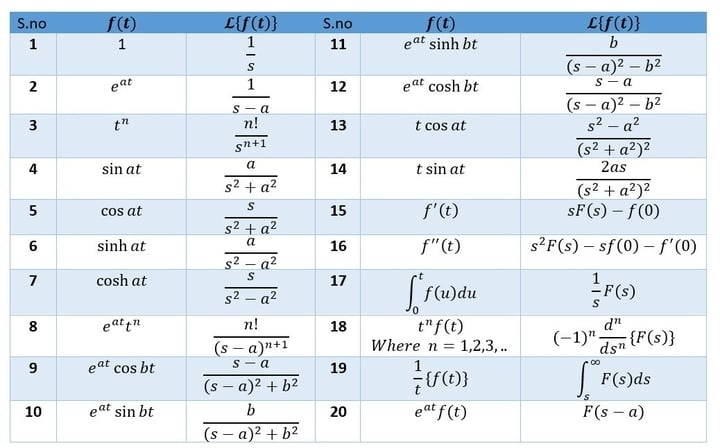
Is it in a table you have

 cedar kilnBOT
@crimson sedge Has your question been resolved?
crimson sedge
dire geode
Do you have something like 17-19
No truth be told I am familiar with all of those except 17-19
Any link for me to understand them?
dire geode
crimson sedge
No truth be told I am familiar with all of those except 17-19
Just follows from integration by parts
https://math.libretexts.org/Bookshelves/Differential_Equations/Differential_Equations_for_Engineers_(Lebl)/6%3A_The_Laplace_Transform/6.2%3A_Transforms_of_derivatives_and_ODEs

Mathematics LibreTexts
The procedure for linear constant coefficient equations is as follows. We take an ordinary differential equation in the time variable t . We apply the Laplace transform to transform the equation into …
cedar kilnBOT
@crimson sedge Has your question been resolved?
 cedar kilnBOT
Channel closed
Closed due to timeout
Use .reopen if this was a mistake.
cedar kilnBOT
Available help channel!
Send your question here to claim the channel.
Remember:
• Ask your math question in a clear, concise manner.
• Show your work, and if possible, explain where you are stuck.
• After 15 minutes, feel free to ping <@&286206848099549185>.
• Type the command .close to free the channel when you're done.
• Be polite and have a nice day!
Read #❓how-to-get-help for further information on how to ask a good question, and about conduct in the question channels.
 crude scroll
 cedar kilnBOT
crude scroll
crude scroll
cedar kilnBOT
crude scroll
crude scroll
Im not sure how to do this?
Do we have to re parameterize t in terms of something else?
 wanton sail
yeah, can you write out the equation?
 wanton sail
yup, so what's the curl of F?
wanton sail
awesome and then how can we parameterize the disc?
crude scroll
that im am not sur
wanton sail
okay so we have a parameterization of the circle already
we need to figure out how to turn it to a disc
crude scroll
maybe in terms of cylindrical or spherical coordinates?
wanton sail
hmmmm well
first let's start with this
what are the parameterizations of the unit circle and unit disc in 2d?
crude scroll
$(r\cos\theta, r\sin\theta)$
wraith daggerBOT
KN
 wanton sail
yup
so the circle comes from setting r=1
and the disc comes from letting r range between 0 to 1
right?
wraith daggerBOT
KN
 crude scroll
idt that is correct.
wanton sail
almost
so like
in 2D we went from (cos t, sin t) to (r cos t, r sin t)
now we have (cos t, sin t, sin t)
how should we "fill in the circle" to make a disc?
crude scroll
Based on how we did that in 2d, it should be (rcos t, rsin t, rsin t)?
wanton sail
yes!
wanton sail
no problem, do you know how to do the surface integral from there?
cedar kilnBOT
Channel closed
Closed by @crude scroll
Use .reopen if this was a mistake.
Available help channel!
Send your question here to claim the channel.
Remember:
• Ask your math question in a clear, concise manner.
• Show your work, and if possible, explain where you are stuck.
• After 15 minutes, feel free to ping <@&286206848099549185>.
• Type the command .close to free the channel when you're done.
• Be polite and have a nice day!
Read #❓how-to-get-help for further information on how to ask a good question, and about conduct in the question channels.
crude scroll
actually
cedar kilnBOT
crude scroll
actually
wanton sail
crude scroll
would 0 <= r <= 1 and 0 <= t <= 2pi?
yes!
r=0 corresponds to the center
and r=1 corresponds to the outer ellipse
wanton sail
no problem!
crude scroll
.close
cedar kilnBOT
Channel closed
Closed by @crude scroll
Use .reopen if this was a mistake.
Available help channel!
Send your question here to claim the channel.
Remember:
• Ask your math question in a clear, concise manner.
• Show your work, and if possible, explain where you are stuck.
• After 15 minutes, feel free to ping <@&286206848099549185>.
• Type the command .close to free the channel when you're done.
• Be polite and have a nice day!
Read #❓how-to-get-help for further information on how to ask a good question, and about conduct in the question channels.
 sharp viper
 cedar kilnBOT
sharp viper
dire geode
sharp viper
like how did that prove they r equal
cedar kilnBOT
sharp viper
dire geode
sharp viper
like how did that prove they r equal
Is there more to the answer
dire geode
Which part exactly is confusing
dire geode
sharp viper
What's below the last line
dire geode
Can you show it anyway
sharp viper
 dire geode
How annoying
Yea they used demorgans law for intersection of two compliment sets
Did you learn demorgans laws yet
sharp viper
yep
so there is more to the answer?
like doesnt wut he just proved just show that x is subset of AUB(complements) so then its also of AnB(complements) since its not in AuB?
 slate lintel
wanton sail
sharp viper
slate lintel
wanton sail
sharp viper
Yeah I think the answer given there is just incomplete
cedar kilnBOT
@sharp viper Has your question been resolved?
cedar kilnBOT
Channel closed
Closed due to timeout
Use .reopen if this was a mistake.
Available help channel!
Send your question here to claim the channel.
Remember:
• Ask your math question in a clear, concise manner.
• Show your work, and if possible, explain where you are stuck.
• After 15 minutes, feel free to ping <@&286206848099549185>.
• Type the command .close to free the channel when you're done.
• Be polite and have a nice day!
Read #❓how-to-get-help for further information on how to ask a good question, and about conduct in the question channels.
 lethal bison
how can they determine this?
 cedar kilnBOT
lethal bison
how can they determine this?
lethal bison
cedar kilnBOT
lethal bison
how can they determine this?
lethal bison
here's the problem

 violet flume
lethal bison
how can they determine this?
violet flume
lethal bison
how can they determine this?
this is a known property of normal RVs
Sums and linear combinations of jointly normal random variables, proofs, exercises.
see example one
it also contains a proof
lethal bison
oh ok I'll look at that thanks
lethal bison
it's a minus
 buoyant latch
lethal bison
buoyant latch
lethal bison
yeah Ik
violet flume
well generally $var [aX+bY] = a^2 var X + b^2 var Y$
lethal bison
I meant in the question
violet flume
what
wraith daggerBOT
jan Niku


 violet flume
lethal bison
the minus becomes a plus
violet flume
lethal bison
the minus becomes a plus
yes, but i think its better you just use the linear combo form i posted
cedar kilnBOT
Channel closed
Closed by @lethal bison
Use .reopen if this was a mistake.
Available help channel!
Send your question here to claim the channel.
Remember:
• Ask your math question in a clear, concise manner.
• Show your work, and if possible, explain where you are stuck.
• After 15 minutes, feel free to ping <@&286206848099549185>.
• Type the command .close to free the channel when you're done.
• Be polite and have a nice day!
Read #❓how-to-get-help for further information on how to ask a good question, and about conduct in the question channels.
crimson sedge
 cedar kilnBOT
crimson sedge
crimson sedge
cedar kilnBOT
crimson sedge
crimson sedge
Can someone please explain me the red underlined part?
 violet jay
I don't have a slick way of seeing it, but one thing to note is that if t > s then t/(1-t) > s/(1-s), so you can check the two cases t > s and t <= s.
crimson sedge
I see. That I realised, but I don't understand how they came up with these terms?
austere merlin
If t < s, then E(BtBs) = (1-t)(1-s)t/(1-t) = t(1-s) = min(t,s)(1-max(t,s))
If t > s, then E(BtBs) = (1-t)(1-s)s/(1-s) = s(1-t) = min(t,s)(1-max(t,s))
crimson sedge
austere merlin
If t < s, then E(BtBs) = (1-t)(1-s)t/(1-t) = t(1-s) = min(t,s)(1-max(t,s))
If t...
Many Thanks!
.close
cedar kilnBOT
Channel closed
Closed by @ocean wolf
Use .reopen if this was a mistake.
Available help channel!
Send your question here to claim the channel.
Remember:
• Ask your math question in a clear, concise manner.
• Show your work, and if possible, explain where you are stuck.
• After 15 minutes, feel free to ping <@&286206848099549185>.
• Type the command .close to free the channel when you're done.
• Be polite and have a nice day!
Read #❓how-to-get-help for further information on how to ask a good question, and about conduct in the question channels.
 soft wagon
if my mom say my dad not at home to get milk yesterday, when will he get the milk today? and how many milk he have?
cedar kilnBOT
soft wagon
if my mom say my dad not at home to get milk yesterday, when will he get the mil...
 nimble mulch
soft wagon
if my mom say my dad not at home to get milk yesterday, when will he get the mil...
nimble mulch
soft wagon
if my mom say my dad not at home to get milk yesterday, when will he get the mil...
exactly e^(pi*i)
soft wagon
i know it equals -1 but where he stole it from? need the answer for that
nimble mulch
from somewhere he wants to keep secret from you ofc
cedar kilnBOT
@soft wagon Has your question been resolved?
cedar kilnBOT
Channel closed
Closed due to timeout
Use .reopen if this was a mistake.
cedar kilnBOT
Available help channel!
Send your question here to claim the channel.
Remember:
• Ask your math question in a clear, concise manner.
• Show your work, and if possible, explain where you are stuck.
• After 15 minutes, feel free to ping <@&286206848099549185>.
• Type the command .close to free the channel when you're done.
• Be polite and have a nice day!
Read #❓how-to-get-help for further information on how to ask a good question, and about conduct in the question channels.
crimson sedge
how do i solve this? it's a calculus concept that i haven't really learned much about
 cedar kilnBOT
crimson sedge
how do i solve this? it's a calculus concept that i haven't really learned much ...
crimson sedge
cedar kilnBOT
crimson sedge
how do i solve this? it's a calculus concept that i haven't really learned much ...
crimson sedge
 restive shard
just undo each log
restive shard
just undo each log
how would i do that?
restive shard
well what's the inverse of log base 10?
crimson sedge
restive shard
well what's the inverse of log base 10?
is it just ten?
sorry im not good at this
crimson sedge
restive shard
yea it's 10^x
6^x?
restive shard
exactly
now look at the problem
imagine that everything inside log base 6 is equal to a variable u
giving you log6(u)=0
try solving for u
crimson sedge
okay so u = 1
restive shard
alright now substitute u for whatever was in log base 6
restive shard
yep
crimson sedge
alright, ty
restive shard
np!
crimson sedge
restive shard
np!
wait also sorry one other thing
for this one, is it the same method or do i start from like the inside?
 restive shard
you should start from the inside
crimson sedge
okay, ty
crimson sedge
restive shard
you should start from the inside
wait would the one on the inside be equal to x too or a different number?
oh wait would i just set it equal to a different variable
 rich mason
crimson sedge
oh wait would i just set it equal to a different variable
rich mason
crimson sedge
oh wait would i just set it equal to a different variable
you can calculate from the inside
log5(25) is 2
log2(2) is 1
crimson sedge
rich mason
log2(2) is 1
well i got to 1=3^x, im not sure how to solve that
cedar kilnBOT
@crimson sedge Has your question been resolved?
Channel closed
Closed by @signal hollow
Use .reopen if this was a mistake.
Available help channel!
Send your question here to claim the channel.
Remember:
• Ask your math question in a clear, concise manner.
• Show your work, and if possible, explain where you are stuck.
• After 15 minutes, feel free to ping <@&286206848099549185>.
• Type the command .close to free the channel when you're done.
• Be polite and have a nice day!
Read #❓how-to-get-help for further information on how to ask a good question, and about conduct in the question channels.
crimson sedge
i can use a calculator on this, but im not sure how to interpret the given function because of the subscript 0 and the k next to the t. how should i go about solving this?
 cedar kilnBOT
crimson sedge
i can use a calculator on this, but im not sure how to interpret the given funct...
cedar kilnBOT
crimson sedge
i can use a calculator on this, but im not sure how to interpret the given funct...
 magic solar
The k is constant subscript is no. Of bacteria at t=0
crimson sedge
magic solar
The k is constant subscript is no. Of bacteria at t=0
do i need to know the value of k?
cedar kilnBOT
@crimson sedge Has your question been resolved?
crimson sedge
never mind
 hearty arch
did you end up figuring it out
crimson sedge
hearty arch
did you end up figuring it out
not really
no one showed up but i asked this question somewhere else
i have another question though
but its unrelated to this problem
does anyone know what it means when it says to say what values of theta does it intersect the pole? because isn't the pole the center of the polar graph? im not sure how it can have an angle measure

 ember halo
Math sucks
 hollow trail
crimson sedge
i can use a calculator on this, but im not sure how to interpret the given funct...
hollow trail
crimson sedge
i can use a calculator on this, but im not sure how to interpret the given funct...
a 0 subscript typically indicates a starting condition. To find the function, start by setting t=0. When t=0 then eᵏᵗ = 1, so n = n₀ (we are given the start amount in the problem).
then solve for k with the value you have for n₀, and with the given information (n = 1200 when t = 1)
hollow trail
crimson sedge
does anyone know what it means when it says to say what values of theta does it ...
for certain values of θ the function will return r = 0. remember that multiple different polar coordinates can point to the same spot
crimson sedge
hollow trail
for certain values of θ the function will return r = 0. remember that multiple d...
oh okay, thank you
also do you know what it means when it says to tell the values of theta that make it so the graph is drawn only once
hollow trail
for some of the graphs once you get a high enough value of θ it will go over the exact same points over again (because sin and cos are periodic functions), so you want to find a range for θ where it draws the whole function without going back over itself
crimson sedge
hollow trail
for some of the graphs once you get a high enough value of θ it will go over the...
do you know how i would figure that out?
hollow trail
probably easiest to work it out from the graph
crimson sedge
hollow trail
probably easiest to work it out from the graph
oh okay
so would a circle just have the range of 0 to 2pi
hollow trail
yes
crimson sedge
hollow trail
yes
okay - and would that be for any circle or just a circle that isn't touching the pole
hollow trail
it would be true for the usual form of a circle in polar coordinates, which is a constant radius (e.g. problem 60)
crimson sedge
hollow trail
it would be true for the usual form of a circle in polar coordinates, which is a...
so it wouldn't be true for 61?
hollow trail
it wouldn't, no
crimson sedge
hollow trail
it wouldn't, no
is there another way to figure it out for that type of problem then? or do i just need to look at what polar coordinate lines the graph touches?
hollow trail
it can be difficult to tell purely from where the graph touches since any given angle can put you in one of 2 quadrants. if the graphing software you use supports it, try changing the angles used as inputs until you find the smallest range that still has a complete graph
crimson sedge
hollow trail
it can be difficult to tell purely from where the graph touches since any given ...
i can't use any technology on these types of problems though
for this specific assginment
hollow trail
in that case i'd start drawing until it seems like it "completes a loop". that may be before or after you reach 2π
crimson sedge
i drew out the graph and it's just a circle thats on the right side of the y axis
hollow trail
while you're graphing, try to keep track of which angles you're going through. in that case, it started in the first quadrant, then went to 0 at θ=π/2 and completed the circle at θ=π
cedar kilnBOT
@crimson sedge Has your question been resolved?
cedar kilnBOT
Channel closed
Closed due to timeout
Use .reopen if this was a mistake.
Available help channel!
Send your question here to claim the channel.
Remember:
• Ask your math question in a clear, concise manner.
• Show your work, and if possible, explain where you are stuck.
• After 15 minutes, feel free to ping <@&286206848099549185>.
• Type the command .close to free the channel when you're done.
• Be polite and have a nice day!
Read #❓how-to-get-help for further information on how to ask a good question, and about conduct in the question channels.
 hot python
is this a good enough tesselation?
 cedar kilnBOT
hot python
is this a good enough tesselation?
cedar kilnBOT
hot python
is this a good enough tesselation?
 whole bloom
Yeah
cedar kilnBOT
@hot python Has your question been resolved?
cedar kilnBOT
Channel closed
Closed due to timeout
Use .reopen if this was a mistake.
Available help channel!
Send your question here to claim the channel.
Remember:
• Ask your math question in a clear, concise manner.
• Show your work, and if possible, explain where you are stuck.
• After 15 minutes, feel free to ping <@&286206848099549185>.
• Type the command .close to free the channel when you're done.
• Be polite and have a nice day!
Read #❓how-to-get-help for further information on how to ask a good question, and about conduct in the question channels.
 quasi plover
/
 cedar kilnBOT
quasi plover
/
quasi plover
cedar kilnBOT
quasi plover
/
quasi plover
Idk what to start
 lunar lynx
hollow trail
lunar lynx
hollow trail
generally in statistics when we look at a sample we're trying to use the data to find a statistic (calculated from the data in the sample) to estimate a parameter (calculated from the population, difficult to measure).
quasi plover
Parameter?
Idk, but if i answer. Ill answer B, but the answer A and C i dont understand
hollow trail
just because the mean number of dramas was 15 doesn't mean many people watched exactly that number. It may be that none of them watched exactly 15 dramas.
remember we're talking about the mean, or average
quasi plover
Ya
But like
It also say like margin of error of 3
Thats the part i felt most uncomfortable with
hollow trail
basically we couldn't interview every single student. but we want to have some idea of what the average is for every student anyway.