#help-13
1 messages · Page 163 of 1
 pliant valley
 calm helm
doesnt this prove its exactly 1
pliant valley
depends on ur course
 native cosmos
this... you learn in middle school.
 stiff totem
yes, the repeating 9s is an artefact of decimal representation
they are both equal to 1
 south tundra
Well, if we were to talk rigorously,
You would first need to define what 0.9 repeating is
 calm helm
yeah
 vestal bear
you didn't prove 0.9999... is 1 yet though why are you using that inside your proof
south tundra
vestal bear
you didn't prove 0.9999... is 1 yet though why are you using that inside your pr...
They didn't use it there
stiff totem
where are they using it?
south tundra
9a = 10a - a = 9.999... - 0.999... = 9
vestal bear
nvm
south tundra
They used the "definition" of a
I believe for now you can keep that in mind as the proof
native cosmos
 pliant valley
its like a notation thing
in some cases 0.99... can be used interchangbly as one
and in others mostly calculus no
calm helm
so = exactly 1 right
native cosmos
calm helm
so = exactly 1 right
right
just think it like that it's gonna get complicated if you don't.
pliant valley
numerically theres ins't anything between 0.999... and 1 so they are essentially the same number
but in calculus we treat it as like just before 1
 cedar kilnBOT
@calm helm Has your question been resolved?
Channel closed
Closed by @calm helm
Use .reopen if this was a mistake.
cedar kilnBOT
 Available help channel!
Send your question here to claim the channel.
Remember:
• Ask your math question in a clear, concise manner.
• Show your work, and if possible, explain where you are stuck.
• After 15 minutes, feel free to ping <@&286206848099549185>.
• Type the command .close to free the channel when you're done.
• Be polite and have a nice day!
Read #❓how-to-get-help for further information on how to ask a good question, and about conduct in the question channels.
 dusk vale
Hi, I know that correct answers are (1; 6), (6; 1), (-1; -6), (-6; -1). What's wrong with my solution?
cedar kilnBOT
dusk vale
Hi, I know that correct answers are (1; 6), (6; 1), (-1; -6), (-6; -1). What's w...
 dreamy sleet
dusk vale
Hi, I know that correct answers are (1; 6), (6; 1), (-1; -6), (-6; -1). What's w...
dreamy sleet
dusk vale
Hi, I know that correct answers are (1; 6), (6; 1), (-1; -6), (-6; -1). What's w...
correct answers to what?

 ashen shard
when you take square root, you have to take plus-or-minus
dusk vale
thank you I see now
cedar kilnBOT
@dusk vale Has your question been resolved?
 high coyote
.close
cedar kilnBOT
Channel closed
Closed by @high coyote
Use .reopen if this was a mistake.
Available help channel!
Send your question here to claim the channel.
Remember:
• Ask your math question in a clear, concise manner.
• Show your work, and if possible, explain where you are stuck.
• After 15 minutes, feel free to ping <@&286206848099549185>.
• Type the command .close to free the channel when you're done.
• Be polite and have a nice day!
Read #❓how-to-get-help for further information on how to ask a good question, and about conduct in the question channels.
 livid tiger
Need help with this calculus question about the differentiation using the chain rule. I did past 4 questions, and have been stuck on this one for like half an hour. Help is appreciated :)
cedar kilnBOT
livid tiger
Need help with this calculus question about the differentiation using the chain ...
livid tiger

 vagrant elbow
!show
cedar kilnBOT
Show your work, and if possible, explain where you are stuck.
 livid hound
my advice would be to take things slowly
apply chain rule in stages
don't attempt to apply like 4 layers of chain rule in a single step
livid tiger
can i apply chain rule twice in one equation?
 buoyant latch
You apply it as many times as is necessary
livid tiger
so for the first one it would be u = sqrt x^22 5^x
buoyant latch
Sure
livid tiger
ohh alright
livid hound
leave (stuff)' as (stuff)' after the initial application of chain rule
and repeat as needed
livid tiger
now i know how to solve it
im gonna keep the channel open for now incase i run into some problems
cedar kilnBOT
@livid tiger Has your question been resolved?
livid tiger
Wait let me cook

i dont understand where i made a mistake
im pretty sure my answer is wrong
cedar kilnBOT
Channel closed
Closed due to timeout
Use .reopen if this was a mistake.
livid tiger
.reopen
cedar kilnBOT
✅
livid tiger
<@&286206848099549185>
high coyote
What is the derivative of a product?
$x^{22}5^x$ is a product of functions, apply the product rule.
 wraith daggerBOT
Categorist
 livid tiger
yep, just realized this
derivative of 5^x is ln(5) x 5^x
i think i should be able to solve it now
high coyote
Were I you, I'd start asap to apply the chain rule in one step, but take your time.
cedar kilnBOT
Channel closed
Closed by @livid tiger
Use .reopen if this was a mistake.
cedar kilnBOT
Available help channel!
Send your question here to claim the channel.
Remember:
• Ask your math question in a clear, concise manner.
• Show your work, and if possible, explain where you are stuck.
• After 15 minutes, feel free to ping <@&286206848099549185>.
• Type the command .close to free the channel when you're done.
• Be polite and have a nice day!
Read #❓how-to-get-help for further information on how to ask a good question, and about conduct in the question channels.
 sullen storm
hello i want to ask how to solve this question
cedar kilnBOT
sullen storm
hello i want to ask how to solve this question
sullen storm

 dire geode
do you know FOIL?
sullen storm
i have multiplied first row and second row and i got this result is it wrong
sullen storm
dire geode
do you know FOIL?
uhmm im unfamiliar
dire geode
show work
sullen storm
wait
dire geode
 sullen storm
oh ik that but idk with 3 row

this is what i get so far
i multiply it with 6root6?
dire geode
you need parentheses
dire geode
you could try to simplify the square roots before multiplying by the third term, but yea 8 terms total unless something cancels
sullen storm
wait its like this?

 slate lintel
I think of it like a grid
sullen storm
sorry im unfamilliar with english math terms xD
sullen storm
sullen storm
wait its like this?
sorry to ping but this right? @dire geode
slate lintel
 sullen storm
slate lintel
sullen storm
slate lintel
yeah i understand with 4 variable
slate lintel
and then that in three dimensions
cedar kilnBOT
Channel closed
Closed by @sullen storm
Use .reopen if this was a mistake.
Available help channel!
Send your question here to claim the channel.
Remember:
• Ask your math question in a clear, concise manner.
• Show your work, and if possible, explain where you are stuck.
• After 15 minutes, feel free to ping <@&286206848099549185>.
• Type the command .close to free the channel when you're done.
• Be polite and have a nice day!
Read #❓how-to-get-help for further information on how to ask a good question, and about conduct in the question channels.
 ripe dirge
Hey guys so I know we can use infinite geometric series formula but idk

 sonic thicket
What do you not know?
 long swan
3 + 3x0.8 + 3x0.8^2 + ...
 dusk finch
It goes 3 meters down, 0.8*3 meters up, 0.8*3 meters down, 0.8^2*3 meters up....
long swan
can you write this as a sum?
yeah i guess you do need a factor of 2 for the up and down, good catch
sonic thicket
|| Maybe first find number of bounces ||
dusk finch
sonic thicket
|| Maybe first find number of bounces ||
number of bounces before what?
sonic thicket
Nvm nvm
dusk finch
There will be infinitely many bounces
sonic thicket
Its always greater than 0
long swan
we're assuming perfect elasticity here
so it will never stop bouncing
obviously not how real balls work as there exists a lot of energy loss, drag, etc
dusk finch
ripe dirge
Hey guys so I know we can use infinite geometric series formula but idk
Are you here?
dusk finch
Yeah
dusk finch
dusk finch
It goes 3 meters down, 0.8*3 meters up, 0.8\*3 meters down, 0.8^2\*3 meters up....
So you need to know first term and common ratio
I'd start by writting out first few terms of the series, can you do that?
ripe dirge
dusk finch
I'd start by writting out first few terms of the series, can you do that?
Yes
The common ratio is 0.80 right and the first few terms are 0.8 x 3
dusk finch
The common ratio is 0.8, that's correct
dusk finch
dusk finch
It goes 3 meters down, 0.8*3 meters up, 0.8\*3 meters down, 0.8^2\*3 meters up....
As I described here, the slight issue with the series is that it's not purely geometric. You will have to group few terms before it will be geometric. The series itself is 3 + 0.8*3 + 0.8*3 + 0.8^2*3 + 0.8^2*3...
because you go 3 down, then 0.8*3 up and back down (so you go twice 0.8*3), then 0.8^2*3 up and back down etc....
Did you understand this part? If so, do you know how to find the sum?
cedar kilnBOT
@ripe dirge Has your question been resolved?
cedar kilnBOT
Channel closed
Closed due to timeout
Use .reopen if this was a mistake.
cedar kilnBOT
Available help channel!
Send your question here to claim the channel.
Remember:
• Ask your math question in a clear, concise manner.
• Show your work, and if possible, explain where you are stuck.
• After 15 minutes, feel free to ping <@&286206848099549185>.
• Type the command .close to free the channel when you're done.
• Be polite and have a nice day!
Read #❓how-to-get-help for further information on how to ask a good question, and about conduct in the question channels.
 lunar radish
how to simplify 6/(2 + sqrt5)
cedar kilnBOT
lunar radish
how to simplify 6/(2 + sqrt5)
 smoky idol
multiply by the conjugate on both numerator and denominator
lunar radish
so 2 - sqrt(5)?
smoky idol
exactly :)
cedar kilnBOT
Channel closed
Closed by @lunar radish
Use .reopen if this was a mistake.
Available help channel!
Send your question here to claim the channel.
Remember:
• Ask your math question in a clear, concise manner.
• Show your work, and if possible, explain where you are stuck.
• After 15 minutes, feel free to ping <@&286206848099549185>.
• Type the command .close to free the channel when you're done.
• Be polite and have a nice day!
Read #❓how-to-get-help for further information on how to ask a good question, and about conduct in the question channels.
 umbral pulsar
Hello, is this correct? Or have I made a mistake
 umbral pulsar
I did not know if should do n^8/2-n^6/2= n^2/2 = n
 crimson delta
how did the n^(3/2) turn into n^(8/2)
umbral pulsar
crimson delta
how did the n^(3/2) turn into n^(8/2)
Oh isn’t n^(3/2)+n^(5/2)=n^(8/2)?
umbral pulsar
vestal bear
what's the gamma looking thing
Oh where it’s a limit
crimson delta
umbral pulsar
Oh isn’t n^(3/2)+n^(5/2)=n^(8/2)?
not even close
do you also think n+n^2 = n^3 ?
 compact junco
yeah
umbral pulsar
And factor n^(5/2)?
vestal bear
you multiplied the denominator wrong too
umbral pulsar
crimson delta
the n^5/2 just cancels
Oh true. Thank you
umbral pulsar
vestal bear
you multiplied the denominator wrong too
Oh where please
crimson delta
what is 2n*3
umbral pulsar
Oh.. my bad. Yeah. I will try again
vestal bear
distributive property
compact junco
umbral pulsar
Oh.. my bad. Yeah. I will try again
its okay, happens all the time
vestal bear
$x(a+b)=ax+bx$
wraith daggerBOT
Arctic
 umbral pulsar
compact junco
its okay, happens all the time
umbral pulsar
compact junco
its okay, happens all the time
Thanks.
umbral pulsar
vestal bear
$x(a+b)=ax+bx$
Thanks.
umbral pulsar
crimson delta
what is 2n*3
Could this be now correct
 crimson delta
what is 3/2 - 2
crimson delta
you cant just ignore those fractions that go to 0 in the limit
you cant choose to do the limit "in steps"
first use limit to get rid of fractions and then later for the rest
thats not how this works
umbral pulsar
alright. Thank you
cedar kilnBOT
@umbral pulsar Has your question been resolved?
cedar kilnBOT
Channel closed
Closed due to timeout
Use .reopen if this was a mistake.
cedar kilnBOT
Available help channel!
Send your question here to claim the channel.
Remember:
• Ask your math question in a clear, concise manner.
• Show your work, and if possible, explain where you are stuck.
• After 15 minutes, feel free to ping <@&286206848099549185>.
• Type the command .close to free the channel when you're done.
• Be polite and have a nice day!
Read #❓how-to-get-help for further information on how to ask a good question, and about conduct in the question channels.
 cedar kilnBOT
Available help channel!
cedar kilnBOT
Available help channel!
Send your question here to claim the channel.
Remember:
• Ask your math question in a clear, concise manner.
• Show your work, and if possible, explain where you are stuck.
• After 15 minutes, feel free to ping <@&286206848099549185>.
• Type the command .close to free the channel when you're done.
• Be polite and have a nice day!
Read #❓how-to-get-help for further information on how to ask a good question, and about conduct in the question channels.
 left warren
.reopen
cedar kilnBOT
left warren
dk why it closed
smoky idol
cedar kiln
It closed because you deleted your original message as stated here..
left warren
i then reposted
but its alright

ill put it here to prevent the need for scrolling
 gritty viper
See if you can find regions with area exactly half that of the big rectangle
The solution will be setting two of those regions equal
 gritty viper
A "region" isn't just 1 sector but it can contain several
 radiant fjord
 native halo
!help
cedar kilnBOT
native halo
Please read #❓how-to-get-help
high coyote
native halo
Shut up.
high coyote
Go to an open help channel.
native halo
radiant fjord
!help
ight thank you
gritty viper
left warren
Reminds me of https://youtu.be/OuJQaxZvlYs

Thanks to Bill from New York for this suggestion! Bill emailed me a problem asked in China to identify talented students. A few very talented students did solve it in less than one minute! I was not able to solve the problem at all. The question involves finding the area of a red triangle in a parallelogram, for a diagram you can see in the vide...
radiant fjord
this problem is actually so fun
 gritty viper
Nice
gritty viper
No problem
cedar kilnBOT
Channel closed
Closed by @left warren
Use .reopen if this was a mistake.
Available help channel!
Send your question here to claim the channel.
Remember:
• Ask your math question in a clear, concise manner.
• Show your work, and if possible, explain where you are stuck.
• After 15 minutes, feel free to ping <@&286206848099549185>.
• Type the command .close to free the channel when you're done.
• Be polite and have a nice day!
Read #❓how-to-get-help for further information on how to ask a good question, and about conduct in the question channels.
 crimson sedge
Hey
cedar kilnBOT
crimson sedge
Hey
crimson sedge
Hi I need help with a hyperbole
I have to find te equation of the hyperbole with the next data:
The vertex are B(3,4) and B'(3,-4) also the focal points are F(0,0) and F'(6,0)
That is not a hyperbole no?
Or at least it is rotated
gritty viper
Yeah it's rotated
crimson sedge
There are only two vertex on hyperbole no?
gritty viper
Right
crimson sedge
or four like in ellipses?
gritty viper
Wait, that doesn't even seem consistent
crimson sedge
yup
gritty viper
Even in a rotated hyperbola, the focii and the vertices have to be collinear
crimson sedge
that is my homework for tomorrow and I am stuck in this problem
maybe B' and B are the other 2 vertex to find the center(as a middle point) but if it only have 2 vertex I don't know what to do
gritty viper
Idk it doesn't seem possible
crimson sedge
I know but that is the only option, anyways we are not prepared in class to solve a rotated conic
so it is strange
And I have it on my paper in that way, maybe the task is wrong
gritty viper
Must be
cedar kilnBOT
Channel closed
Closed by @tranquil kraken
Use .reopen if this was a mistake.
gritty viper
np
cedar kilnBOT
Available help channel!
Send your question here to claim the channel.
Remember:
• Ask your math question in a clear, concise manner.
• Show your work, and if possible, explain where you are stuck.
• After 15 minutes, feel free to ping <@&286206848099549185>.
• Type the command .close to free the channel when you're done.
• Be polite and have a nice day!
Read #❓how-to-get-help for further information on how to ask a good question, and about conduct in the question channels.
crimson sedge
Hello
cedar kilnBOT
crimson sedge
Hello
crimson sedge
I have a problem and I want a hint
Show that the number of group structures defined on a set with n elements, isomorphic with a fixed group G, is equal to n!/|Aut(G)|
I said that there are k maximum group structures and I want to show k=n!/|Aut(G)|
Let S1,S2,...,Sk be these structers with the same order n (and same elements)
I am trying to find what n! means in this problem
I know it is the number of permutations for the set
I feel like this has something to do with graphs
gritty viper
n! is a factorial, is that the question?
 mental trail
By simplicity, suppose your set with n elements is ${1,...,n}.\$
Consider any bijection $\phi:{1,...,n} \rrbracket\longrightarrow G$, making an isomorphism with $G$. If you define over $\mathfrak{S}_n$ a nice equivalence relation...
wraith daggerBOT
rafilou2003
Compile Error! Click the  reaction for more information.
(You may edit your message to recompile.)
 crimson sedge
Thank you!!
mental trail
No problem :)
crimson sedge
.close
cedar kilnBOT
Channel closed
Closed by @patent swallow
Use .reopen if this was a mistake.
Available help channel!
Send your question here to claim the channel.
Remember:
• Ask your math question in a clear, concise manner.
• Show your work, and if possible, explain where you are stuck.
• After 15 minutes, feel free to ping <@&286206848099549185>.
• Type the command .close to free the channel when you're done.
• Be polite and have a nice day!
Read #❓how-to-get-help for further information on how to ask a good question, and about conduct in the question channels.
 tulip harness
Let $s:[0,1]\rightarrow \mathbb{R}_{\geq 0}$ be a real positive function and $\sigma: [0,1]\rightarrow \mathbb{R}^n$ be the parameterization of a curve $C$. Find a reparameterization $\tau: [0,1]\rightarrow \mathbb{R}^n$ such that $||\tau '(t)|| = a*s(t)$ for all $t\in [0,1]$, for some $a\in \mathbb{R}$.
cedar kilnBOT
tulip harness
Let $s:[0,1]\rightarrow \mathbb{R}_{\geq 0}$ be a real positive function and $\s...
wraith daggerBOT
Casiel368
 tulip harness
I might be able to do it if I recalled the case in which s = 1, but I don't
mental trail
A reparameterization will be a function $\tau = \sigma\circ f$ with $f:[0,1]\longrightarrow [0,1]$ bijective and differentiable. Find $f$ based on what you need
wraith daggerBOT
rafilou2003

 tulip harness
what is lhs?
mental trail
left hand side
tulip harness
mental trail
find a using what is necessary
a is just there so that the integrals are the same
mental trail
oh I see your problem
tulip harness
but I'd like to find h
or h^-1
I don't remember how to solve this even for v = a = 1, which is what we see in calculus courses
But I was wondering what happens if I get to choose the speed
tulip harness
tulip harness
I don't remember how to solve this even for v = a = 1, which is what we see in c...
It's very likely that h is not solved per se, but that I define some h and see that it works
mental trail
have you tried along the likes of $h = \frac{\int_{0}^ts(t)dt}{\int_0^1s(t)dt}$ ?
wraith daggerBOT
rafilou2003
 tulip harness
oh god
let's see
Hm okay I didn't try that yet but the proof for v = 1 uses a change of variables to remove h^-1. I can't do that now because v is a function of t and that wouldn't remove h entirely
tulip harness
wraith dagger
**rafilou2003**
Oh yeah that works for s = 1
The numerator is the arc length up to t
Huh I think I'll just approximate the differential equation here:

rip my computer
I'll leave this open just in case someone knows how to solve this, because I still didn't
<@&286206848099549185>
cedar kilnBOT
@tulip harness Has your question been resolved?
cedar kilnBOT
@tulip harness Has your question been resolved?
 jaunty mural
#calculus #multivariable-calculus might be good
cedar kilnBOT
@tulip harness Has your question been resolved?
cedar kilnBOT
@tulip harness Has your question been resolved?
cedar kilnBOT
@tulip harness Has your question been resolved?
cedar kilnBOT
Channel closed
Closed due to timeout
Use .reopen if this was a mistake.
Available help channel!
Send your question here to claim the channel.
Remember:
• Ask your math question in a clear, concise manner.
• Show your work, and if possible, explain where you are stuck.
• After 15 minutes, feel free to ping <@&286206848099549185>.
• Type the command .close to free the channel when you're done.
• Be polite and have a nice day!
Read #❓how-to-get-help for further information on how to ask a good question, and about conduct in the question channels.
sonic thicket
 cedar kilnBOT
sonic thicket
sonic thicket
cedar kilnBOT
sonic thicket
sonic thicket
Why would the roots change as value of x changes?
 deep oriole
One of them are asking where the curve intercepts 0, the other is asking where it intercepts y = 4
sonic thicket
deep oriole
One of them are asking where the curve intercepts 0, the other is asking where i...
For 0, there should be no solution then?
deep oriole
The curve does go through the x axis
deep oriole
Yeah
sonic thicket
and for f(x) = g(x), its when they intercept?
deep oriole
Yeah
cedar kilnBOT
Channel closed
Closed by @sonic thicket
Use .reopen if this was a mistake.
deep oriole
np
sonic thicket
.reopen
cedar kilnBOT
✅
cedar kilnBOT
Channel closed
Closed by @sonic thicket
Use .reopen if this was a mistake.
deep oriole
Sorry typo
cedar kilnBOT
Available help channel!
Send your question here to claim the channel.
Remember:
• Ask your math question in a clear, concise manner.
• Show your work, and if possible, explain where you are stuck.
• After 15 minutes, feel free to ping <@&286206848099549185>.
• Type the command .close to free the channel when you're done.
• Be polite and have a nice day!
Read #❓how-to-get-help for further information on how to ask a good question, and about conduct in the question channels.
crimson sedge
 cedar kilnBOT
crimson sedge
crimson sedge
cedar kilnBOT
crimson sedge
crimson sedge
help karlo
I don't see why my logic is wrong

Basically I counted number of possibilities
 sinful dome
You have to consider 2 cases:
- The lower left and lower right sections have the same color.
- Both sections have different colors.
Both cases have a different number of possible outcomes for the two upper sections.
cedar kilnBOT
@crimson sedge Has your question been resolved?
crimson sedge
sinful dome
You have to consider 2 cases:
1. The lower left and lower right sections have th...
Can you explain the thought process behind this
sinful dome
I think you should try to sketch it for yourself:
Let r, g, b be the three colors.
Give the lowest section the color r.
Case 1: give the lower right and lower left sections both the color g
Case 2: give the lower right section the color g and the lower left the color b.
Now find for both cases all possibilities for both upper sections.
cedar kilnBOT
@crimson sedge Has your question been resolved?
cedar kilnBOT
Channel closed
Closed due to timeout
Use .reopen if this was a mistake.
Available help channel!
Send your question here to claim the channel.
Remember:
• Ask your math question in a clear, concise manner.
• Show your work, and if possible, explain where you are stuck.
• After 15 minutes, feel free to ping <@&286206848099549185>.
• Type the command .close to free the channel when you're done.
• Be polite and have a nice day!
Read #❓how-to-get-help for further information on how to ask a good question, and about conduct in the question channels.
 mental zephyr
 cedar kilnBOT
mental zephyr
mental zephyr
cedar kilnBOT
mental zephyr
mental zephyr
im not sure how to continue

do I keep squaring the equation to get rid of the square roots?
 still smelt
mental zephyr
still smelt
mental zephyr
From the LHS you can factor √(2x+6) out
 junior dome
first factor out 4 from each sqroot
 sonic jewel
still smelt
From the LHS you can factor √(2x+6) out
sonic jewel
still smelt
From the LHS you can factor √(2x+6) out
which term are you talking about
mental zephyr
thats what I did

 tropic oxide
btw your second line has a pair of parentheses that should not be there

also some bullshit went down with how you squared the product of those two roots.
and there is also a sign error in squaring -4x-8
cedar kilnBOT
@mental zephyr Has your question been resolved?
cedar kilnBOT
Channel closed
Closed due to timeout
Use .reopen if this was a mistake.
cedar kilnBOT
Available help channel!
Send your question here to claim the channel.
Remember:
• Ask your math question in a clear, concise manner.
• Show your work, and if possible, explain where you are stuck.
• After 15 minutes, feel free to ping <@&286206848099549185>.
• Type the command .close to free the channel when you're done.
• Be polite and have a nice day!
Read #❓how-to-get-help for further information on how to ask a good question, and about conduct in the question channels.
 strange fulcrum
 cedar kilnBOT
strange fulcrum
strange fulcrum
cedar kilnBOT
strange fulcrum
strange fulcrum
Can I integrate first dr then d(phi)?
dire geode
strange fulcrum
Can I integrate first dr then d(phi)?
then yes?
strange fulcrum
dire geode
then yes?
But i'm not sure
 brittle lynx
Fubini
dire geode
strange fulcrum
yes it works
then how do you know it works
you surely get the same answer?
strange fulcrum
dire geode
then how do you know it works
I shouldn't be any difference
since it's an area we should have same area right
dire geode
you either did the dr d(phi) integral and showed it's also pi - 2 or you didn't
there's no ambiguity about it
if you get pi - 2 then yes it works
if you didn't then it doesn't easily work
dire geode
brittle lynx
Fubini
in principle, yes fubini's theorem tells you it's the same answer, but in practice the integral can be much harder in one order than the other
strange fulcrum
dire geode
if you didn't then it doesn't easily work
But it has to work or am I wrong
dire geode
wrong about what
strange fulcrum
but you said fubini's theorem tells us it's same answer
dire geode
dire geode
you either did the dr d(phi) integral and showed it's also pi - 2 or you didn't
did you or did you not get pi-2
strange fulcrum
I didn't do it actually because it's hard
dire geode
strange fulcrum
yes it works
then why did you say this when i asked if you tried
strange fulcrum
I mean i tried to begin with it halfway but I saw it's much harder so i stopped
dire geode
when you say "it works" that doesn't imply you stopped halfway
strange fulcrum
dire geode
when you say "it works" that doesn't imply you stopped halfway
That's why I asked here and wanna know
dire geode
well people can't answer your question when you give false information
strange fulcrum
dire geode
well people can't answer your question when you give false information
it ended up in a misunderstanding, sorry!
dire geode
dire geode
in principle, yes fubini's theorem tells you it's the same answer, but in practi...
it's just this
if you don't want to keep trying then don't
no one's making you
strange fulcrum
dire geode
it's just this
I tried to try but i get stuck when i'm doing r^3/3
dire geode
am i supposed to understand that?
strange fulcrum
dire geode
if you don't want to keep trying then don't
I would love to try, but i need some help
strange fulcrum
dire geode
am i supposed to understand that?
i meant if we begun with dr and integrate r in the nominator we will get r^3/3
strange fulcrum
of couse sorry
but anyway, I just have another quick question. Am I supposed to apply PFD first then integrate since we have higher exponent in the nominator
Or I mean do polynoimialdivision
 smoky idol
,w d/dx ( 1+r^2 cos^2(x) )
wraith daggerBOT


 smoky idol
You might want to consider a sub?
strange fulcrum
smoky idol
You might want to consider a sub?
to?
smoky idol
I was thinking you let u = denominator. Cause du is pretty close to the numerator. You might have to manipulate your fraction a bit first tho
strange fulcrum
smoky idol
I was thinking you let u = denominator. Cause du is pretty close to the numerato...
true but this integral reminds me of arctan
isn't that 1/1+x^2
wraith daggerBOT
imTypθ
 smoky idol
Good vision Yousef
strange fulcrum
smoky idol
Good vision Yousef
Thank you :)@smoky idol
But should I do like you said u=1+r^2cos^2(phi)
or u=rcos(phi)
 strange fulcrum
but wait this is all wrong
I'm having dr and d(phi) I changed to polar coordinates
so i don't think I can do u sub
smoky idol
slate lintel
this didn't seem to really match the numerator
Yeah my first idea was wrong, but the second sub should work for the last image they sent
smoky idol
strange fulcrum
I'm having dr and d(phi) I changed to polar coordinates
Wait, you changed to polar? I don't have all the context let me scroll >-<
strange fulcrum
smoky idol
Wait, you changed to polar? I don't have all the context let me scroll >-<
yeaah
smoky idol
Well, if you're solving that integral in parentheses, you can absolutely do a u sub
That is, in fact, what they did
strange fulcrum
 slate lintel
strange fulcrum
so i don't think I can do u sub
slate lintel
strange fulcrum
so i don't think I can do u sub
you can still do a sub (we were using x for phi because lol typing phi)
slate lintel
no, the one you found
smoky idol
no, I made a mistake on that one
slate lintel
ya
smoky idol
When you said it looks like arctan, I said that you were on the right track
strange fulcrum
because the derivative of cos (phi) is -sin (phi)
then we can maybe cancel out the numerator
and we will be leaved with 1 as we want to righ?
smoky idol
1 on the numerator, yes
strange fulcrum
.close
cedar kilnBOT
Channel closed
Closed by @strange fulcrum
Use .reopen if this was a mistake.
Available help channel!
Send your question here to claim the channel.
Remember:
• Ask your math question in a clear, concise manner.
• Show your work, and if possible, explain where you are stuck.
• After 15 minutes, feel free to ping <@&286206848099549185>.
• Type the command .close to free the channel when you're done.
• Be polite and have a nice day!
Read #❓how-to-get-help for further information on how to ask a good question, and about conduct in the question channels.
strange fulcrum
How do integrate x^2/1+x
cedar kilnBOT
strange fulcrum
How do integrate x^2/1+x
tropic oxide
$\int \paren{\frac{x^2}{1} + x} \dd{x} = \frac{x^3}{3} + \frac{x^2}{2} + C$
wraith daggerBOT
Ann

 gleaming cloud
💀 💀
tropic oxide

junior dome
i think he means $\frac{x^2}{1+x}$
wraith daggerBOT
Dissrupt
 tropic oxide
if he means that, he has to type that
gleaming cloud
strange fulcrum
How do integrate x^2/1+x
polynomial long division
strange fulcrum
junior dome
i think he means $\frac{x^2}{1+x}$
yes thanks
strange fulcrum
junior dome
i think he means $\frac{x^2}{1+x}$
yes thanks
crimson sedge
!help
cedar kilnBOT
Please read #❓how-to-get-help
strange fulcrum
I need help with integrating $\frac{x^2}{1+x^2}$
wraith daggerBOT
Yousef
 strange fulcrum
.close
cedar kilnBOT
Channel closed
Closed by @strange fulcrum
Use .reopen if this was a mistake.
Available help channel!
Send your question here to claim the channel.
Remember:
• Ask your math question in a clear, concise manner.
• Show your work, and if possible, explain where you are stuck.
• After 15 minutes, feel free to ping <@&286206848099549185>.
• Type the command .close to free the channel when you're done.
• Be polite and have a nice day!
Read #❓how-to-get-help for further information on how to ask a good question, and about conduct in the question channels.
 tribal elm
I want to prove n^3 + 2n is divisible by 3 (for simplicity just for n>=0)
so for 0: it's true
inserting m+1 for n I get m^3+6m^2+3m+1+2m+2 = m^3+6m^2+5m+3 = m^3+2m + 6m^2+3m+3 (1)
now I can assume m^3+2m=3l, where l needs to be integer to prove divisibility (2)
now here is the part I'm unsure about. If I partially replace the m in 1 with 2 I can prove the divisibility for the step(m+1). But I'm not sure if this is valid, also I wonder if this is the only way?
cedar kilnBOT
tribal elm
I want to prove `n^3 + 2n` is divisible by 3 (for simplicity just for `n>=0`)
**...
tribal elm
maybe I could define f(m) = m^3+2m and insert that instead of partially replacing a variable?
 fallen moat
i am guessing you are using mathematical induction, which is this sort of the way to work with it, and yes, there are other way(s) to solve it
tribal elm
yes its about induction
but I'm currently thinking about the problem of eliminating/replacing m(partially), and I think this can run into some sort of logical errors
would you be able to tell(or show) other solutions?
fallen moat
Usually when we do mathematical induction. there are a few steps that we need.
- proof of initial condition
- assume the k-th condition is true
- use the above to prove (k+1)th condition is true
tribal elm
I think I didn't do it explicitly but the assumption I make for your 2. is: for l an integer m^3+2m is 3 divisible. hence m^3+2m=3l
and 1. is also not explicitly but it's the 0 case I did
provided I did this right 3. would be the issue, which I am unsure whether it makes sense the way I did
fallen moat
as for my habit, i would do it as follows:
Let the statment be S(n).
When n=0,
0³ + 2(0) = 0 = 3*0
Therefore S(0) is true.
Assume S(k) is true for some integer k≥0.
i.e. k³+2k=3m for some integer m
When n=k+1,
(k+1)³+2(k+1)
=k³+3k²+3k+1+2k+2
=(k³+2k) + (3k²+3)
=3m+3(k²+1)
=3(m+k²+1)
Therefore S(k+1) is true
By mathemical induction, S(nl is true for all integers n≥0
tribal elm
right. is this valid though?
fallen moat
yes, that's how mathematical induction works
tribal elm
you also partially replaced a variable at the same spot i did
well induction is not at question
the part of partially replacing a term that contains k(in your case) is
fallen moat
in case you wanna dig deep into why induction of such works, feel free to google!
tribal elm
I recall getting errors when doing it for some things long ago
fallen moat
maybe that's really an error
tribal elm
again: not about induction
I think what is more correct is letting the term there (that you and I replaced)
tribal elm
and then claiming it's 3 divisible because the sum of the left and right terms is 3 divisible (because left and right terms are 3 divisible)
fallen moat
of course, from top down
tribal elm
m^3+2m + 6m^2+3m+3
tribal elm
no
hmmm i try to understand rn if i did this in my previous inductions as well 😄 (that what I question if it's valid)
tribal elm
fallen moat
do you mean why writing
k³+2k=3m is valid?
actually yes
at the point you insert it
tribal elm
tribal elm
`m^3+2m + 6m^2+3m+3`
the step from the previous to this: 3l + 6m^2+3m+3
i question whether that is valid
fallen moat
actually there are multiple points that worth discussing
for this, it's not easy to explain, shall i give an example to show?
fallen moat
lemme think
for example
prove by contradiction
we assume the statment is false, right?
tribal elm
i think you're right now thinking this through, about it being valid
(but still not sure)
fallen moat
I'll continue
when we assume the statment is false
we can use every property inside the statment when the statment is false
that's how assumption works
tribal elm
but to be honest there should be some knowledge about partially replacing variables
I sure didn't learn it in school lol
fallen moat
it's usually called dummy variables
tribal elm
so now my question is justified whether it's even valid
i mean
a + a = 5, a = b => b + a = 5 hm
fallen moat
looks good
tribal elm
why not just replace all the as with bs. I never did it before(the partial replacing) 😛
fallen moat
which works too
tribal elm
in this instance it definitely works
fallen moat
if it works this way, it works in more complicated ways, unless it has something that obstruct you from doing so
fallen moat
tribal elm
would you be able to tell(or show) other solutions?
i have a way in my mind
lets see if that works too
tribal elm
alright
tribal elm
i should carry on soon though. but I'll listen to what else you think 🙂
fallen moat
the easiest wohld be
when n=3m, 3m+1 and 3m+2
which with my mental calculation, it should work
all 3 situations can be written into a form
3(something)
so they all divisible by 3
done
tribal elm
ah that makes sense
you'd do something like n->m+1, n->m+2, n->m+3
nice
(well what you did. just using a notation I'm more familiar with :P)
well you used 3m hmmm
that makes sense but interestingly you don't even have to do this
becaue you know for sure if m is divisible by 3 then m+3 and m+6 and .. is too (add 1 for the remaining 2 cases)
tribal elm
well thanks for the help !
fallen moat
you're welcome!
tribal elm
ima write that thing that makes us wonder here and hope someone else can point out resources
open question
Is it valid generally and in all cases to partially replace a variable?
e.g. a + a = 5, a = b => b + a = 5
this is a simple example. I guess if this causes problems they happen in more tricky situations
(If someone knows the answer, I would appreciate resources on the topic too. thanks)
 surreal aurora
Hmm
I love this word valid
Substituting some variable for some other value, variable or not, has no effect on the predicate when what we are substituting doesn't semantically change what's being said.
surreal aurora
tribal elm
** **
**open question**
Is it valid generally and in all cases to partially repl...
So, yes. It is ok to partially substitute.
Is your question that you first sought out to answer, settled?
tribal elm
guessing the answer now really is "yes" it answers it yeah
I think my math teacher once corrected me for attempting to partially replace 😛
but it then must have been because it wouldn't solve the problem, but not because it was invalid
surreal aurora
surreal aurora
Substituting some variable for some other value, variable or not, has no effect ...
Also, a short follow up on this comment: You cannot substitute whatever you want. A rational number denoted by variable a is not an integer denoted variable b. If both variables have the same constraints on their identity, the naming convention be comes arbitrary.
Since a = b, we may freely state b whenever a.
tribal elm
hm what does that mean for our case(the induction example). where we replace a term with another term?
tribal elm
well that last comment raised more questions for me, but I think it's alright, most things make sense now
thank you
.close
cedar kilnBOT
Channel closed
Closed by @tribal elm
Use .reopen if this was a mistake.
Available help channel!
Send your question here to claim the channel.
Remember:
• Ask your math question in a clear, concise manner.
• Show your work, and if possible, explain where you are stuck.
• After 15 minutes, feel free to ping <@&286206848099549185>.
• Type the command .close to free the channel when you're done.
• Be polite and have a nice day!
Read #❓how-to-get-help for further information on how to ask a good question, and about conduct in the question channels.
wraith daggerBOT
Maria
 cedar kilnBOT
@grave knot Has your question been resolved?
cedar kilnBOT
Channel closed
Closed due to timeout
Use .reopen if this was a mistake.
Available help channel!
Send your question here to claim the channel.
Remember:
• Ask your math question in a clear, concise manner.
• Show your work, and if possible, explain where you are stuck.
• After 15 minutes, feel free to ping <@&286206848099549185>.
• Type the command .close to free the channel when you're done.
• Be polite and have a nice day!
Read #❓how-to-get-help for further information on how to ask a good question, and about conduct in the question channels.
 wild belfry
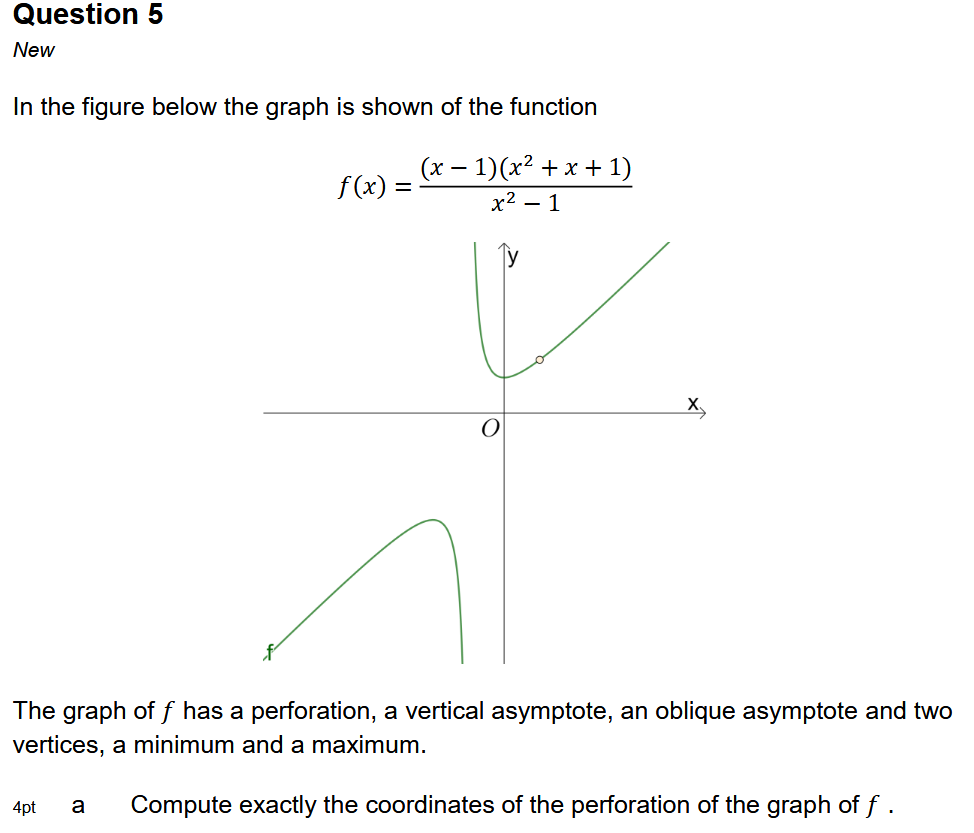 cedar kilnBOT
wild belfry
https://i.imgur.com/ZKeJFJC.png
wild belfry
cedar kilnBOT
wild belfry
https://i.imgur.com/ZKeJFJC.png
wild belfry
x^2 - 1 can be rewritten as (x - 1)(x + 1), so x = 1 is the x coordinate of the hole right? But plugging x = 1 into the function gives 0, which makes no sense? Its clearly not on the y axis...
 modern compass
plugging 1 in should give you something undefined. unless you're canceling out the x-1 terms.
wild belfry
Ah yes youre right
I just solved the numerator and saw it was 0 so I got lazy and didnt check the denominator 😂 🤦♂️
modern compass
???
modern compass
cancel out the x-1's and then plug in x=1
modern compass
yep
cedar kilnBOT
Channel closed
Closed by @wild belfry
Use .reopen if this was a mistake.
Available help channel!
Send your question here to claim the channel.
Remember:
• Ask your math question in a clear, concise manner.
• Show your work, and if possible, explain where you are stuck.
• After 15 minutes, feel free to ping <@&286206848099549185>.
• Type the command .close to free the channel when you're done.
• Be polite and have a nice day!
Read #❓how-to-get-help for further information on how to ask a good question, and about conduct in the question channels.
 hard pumice
Hey! Can anyone help me out with this?
 cedar kilnBOT
hard pumice
Hey! Can anyone help me out with this?
cedar kilnBOT
hard pumice
Hey! Can anyone help me out with this?
 wanton heron
Have you made any progress?
hard pumice
Absolutely not, im not sure how to break 12.3 up, are the segments all equal?
junior dome
yes
hard pumice
Okay so they are all 3.075?
wanton heron
Where'd you get that number?
wanton heron
Look closer, how many line segments are there?
hard pumice
4, right?
wanton heron
Can you name the 4 of them for me?
hard pumice
A B C & D
wanton heron
Those are points, not line segments
A line segments is the line drawn between 2 points
hard pumice
so there’s 3 line segments?
wanton heron
It would appear so, at least if we're talking about the smallest possible segments
 obsidian coral
hard pumice
Hey! Can anyone help me out with this?
obsidian coral
hard pumice
Hey! Can anyone help me out with this?
No because that's a quiz and it's graded, it is academic dishonesty to be helping you cheat on a quiz, unless it is specifically said by your teacher that you are allowed outside resources that isn't your notes/book
wanton heron
Oop
cedar kilnBOT
@hard pumice Has your question been resolved?
cedar kilnBOT
Channel closed
Closed due to timeout
Use .reopen if this was a mistake.
Available help channel!
Send your question here to claim the channel.
Remember:
• Ask your math question in a clear, concise manner.
• Show your work, and if possible, explain where you are stuck.
• After 15 minutes, feel free to ping <@&286206848099549185>.
• Type the command .close to free the channel when you're done.
• Be polite and have a nice day!
Read #❓how-to-get-help for further information on how to ask a good question, and about conduct in the question channels.
 steel seal
<OCD=60
BO=OC
BC=12
CD=?
 cedar kilnBOT
steel seal
<OCD=60
BO=OC
BC=12
CD=?
cedar kilnBOT
steel seal
<OCD=60
BO=OC
BC=12
CD=?
 oblique prawn
steel seal
<OCD=60
BO=OC
BC=12
CD=?
oblique prawn
steel seal
<OCD=60
BO=OC
BC=12
CD=?
is BD perpendicular to AC
steel seal
yes
oblique prawn
so observe triangle BDC
you know one of the angles is 60 deg
and one of the angles is 90 deg
that implies that the last angle is what
steel seal
30
oblique prawn
yes and what do you know about the sides of the triangle
steel seal
wait i forgot to mention, its not the line DC its circumference DC
i need to find the arch DC
native halo
steel seal
<OCD=60
BO=OC
BC=12
CD=?
Angles
steel seal
well i think i tried to use the formula but it wasnt the right answer i think
i had the answers and they were differenet
oblique prawn
steel seal
well i think i tried to use the formula but it wasnt the right answer i think
what did you get for it
steel seal
6.283
oblique prawn
are you talking about the arc measure or arc length
steel seal
length
steel seal
60
steel seal
60
steel seal
oblique prawn
so the length of arc CD / circumference of the entire circle = 60/360 right
yes
oblique prawn
so what is the circumference
steel seal
2pieR
oblique prawn
what is it in this case
 oblique prawn
wtf
oblique prawn
nvm
steel seal
4
 wanton sail
Muted them, sorry about that
steel seal
thanks
oblique prawn
are u sure BD is perp to AC
cedar kilnBOT
@steel seal Has your question been resolved?
steel seal
<@&286206848099549185>
 steel cloak
What can you tell about triangle ABC?
Oh, you need the arc
Wait, something is wrong
4 is not the arc
You have misread something
 silent finch
cedar kilnBOT
silent finch
cedar kilnBOT
@steel seal Has your question been resolved?
Channel closed
Closed by @steel seal
Use .reopen if this was a mistake.
Available help channel!
Send your question here to claim the channel.
Remember:
• Ask your math question in a clear, concise manner.
• Show your work, and if possible, explain where you are stuck.
• After 15 minutes, feel free to ping <@&286206848099549185>.
• Type the command .close to free the channel when you're done.
• Be polite and have a nice day!
Read #❓how-to-get-help for further information on how to ask a good question, and about conduct in the question channels.
 thin hedge
Can someone walk me through how to solve this problem
 cedar kilnBOT
Channel closed
Closed by @thin hedge
Use .reopen if this was a mistake.
Available help channel!
Send your question here to claim the channel.
Remember:
• Ask your math question in a clear, concise manner.
• Show your work, and if possible, explain where you are stuck.
• After 15 minutes, feel free to ping <@&286206848099549185>.
• Type the command .close to free the channel when you're done.
• Be polite and have a nice day!
Read #❓how-to-get-help for further information on how to ask a good question, and about conduct in the question channels.
 unkempt imp
hey, this question is asking me to find which of the four options is a subset of {2j ∣ j∈N}
a) {2, 20, 200}
b) {x∈R ∣ x^2−6x+8=0}
c) {j∈N ∣ cos(jπ)=1}
d) {j∈N ∣ sin(2jπ)=1}
I selected a, b and c but it said it was wrong. can anyone tell me why?
the way i understand it is that the set {2j ∣ j∈N} includes {2, 4, 6, 8, 10, 12, ...}, basically all positive even numbers excluding 0, therefore:
a) is a subset since 2, 20 and 200 are all divisible by 2
b) is a subset because the set is the solution to the quadratic equation which is {2, 4}
c) is a subset because if you plug any even number into cos(j*π) you get 1, so the set would look like {2, 4, 6, 8, ...}
cedar kilnBOT
unkempt imp
hey, this question is asking me to find which of the four options is a subset of...
@unkempt imp Has your question been resolved?
unkempt imp
<@&286206848099549185>
 pulsar granite
thin hedge
Can someone walk me through how to solve this problem
pulsar granite
thin hedge
Can someone walk me through how to solve this problem
YES
pulsar granite
thin hedge
Can someone walk me through how to solve this problem
C is the rirgt answer
wanton sail
pulsar granite
C is the rirgt answer
!nosols
cedar kilnBOT
pulsar granite
C is the rirgt answer
As a helper, please do not give out answers that could be copied as a homework solution. Have the student work through the problem themselves and guide them along the way.
wanton sail
Lemme take a look
wanton sail
unkempt imp
hey, this question is asking me to find which of the four options is a subset of...
You're correct about a, b, and c being subsets! What about d?
unkempt imp
i dont think d is a subset because if you plug into it a number from {2j ∣ j∈N} it gives you 0
wanton sail
unkempt imp
i dont think d is a subset because if you plug into it a number from {2j ∣ j∈N} ...
Your logic is a little reversed: that would be the criterion for {2j | j∈N} being a subset of d
Remember that "A is a subset of B" means that "if you have an element of A, it should also belong to B"
it doesn't say "if you have an element of B, it should also belong to A"
this is a little tricky to get the hang of at first
unkempt imp
but still, isnt d an empty set because nothing satisfies the condition? if sin(2jπ) = 1 then j is not a natural number
wanton sail
unkempt imp
but still, isnt d an empty set because nothing satisfies the condition? if sin(2...
Yup, d is an empty set
But is the empty set a subset of {2j ∣ j∈N}?
wanton sail
yup it is :)
cedar kilnBOT
Channel closed
Closed by @unkempt imp
Use .reopen if this was a mistake.
Available help channel!
Send your question here to claim the channel.
Remember:
• Ask your math question in a clear, concise manner.
• Show your work, and if possible, explain where you are stuck.
• After 15 minutes, feel free to ping <@&286206848099549185>.
• Type the command .close to free the channel when you're done.
• Be polite and have a nice day!
Read #❓how-to-get-help for further information on how to ask a good question, and about conduct in the question channels.
 uneven elm
 cedar kilnBOT
uneven elm
cedar kilnBOT
uneven elm
 wanton sail
I'll take a look!
uneven elm
Thank you
wanton sail
it looks perfect!
uneven elm
Thank you!!!
Is subbing in the infinity a proper convention?
I know some books don't use it
@wanton sail
wanton sail
uneven elm
Is subbing in the infinity a proper convention?
It's not really proper, no, but I understand what you mean
uneven elm
Ohh okay thank you
wanton sail
no problem!
uneven elm
It's to be graded
wanton sail
in this case, it's totally fine to think of it that way
uneven elm
So that's why I'm asking
wanton sail
but you might get cases where it leads to weird stuff like ∞/∞ or ∞-∞
uneven elm
Cool!!!
wanton sail
which doesn't make any sense
uneven elm
Then u use l'hopitals rule
wanton sail
Yeah, the point is that ∞ is not really a well-defined number though
wanton sail
👍
cedar kilnBOT
Channel closed
Closed by @uneven elm
Use .reopen if this was a mistake.
wanton sail
no problem!
cedar kilnBOT
Available help channel!
Send your question here to claim the channel.
Remember:
• Ask your math question in a clear, concise manner.
• Show your work, and if possible, explain where you are stuck.
• After 15 minutes, feel free to ping <@&286206848099549185>.
• Type the command .close to free the channel when you're done.
• Be polite and have a nice day!
Read #❓how-to-get-help for further information on how to ask a good question, and about conduct in the question channels.
 lethal bison
I need help for a)
 cedar kilnBOT
lethal bison
I need help for a)
lethal bison
cedar kilnBOT
lethal bison
I need help for a)
lethal bison
I dont know where to start
lethal bison
addition?
 thick cipher
No like what is the probability law that one line vanishes at time t?
lethal bison
oh
the negative was a typo
ok so I'm not sure to understand
even my answer was random
thick cipher
lethal bison
the negative was a typo
No
Let X be the time one line lasts, what is P(X>40)?
The statement tells you X follows an exponential law
From there you can compute for one line and because all of the lines are independent, to get the final result, you put it to power 3
lethal bison
ok I see why you put to power 3
it's just how did u assume the function was 1/40e^(-t/40)
thick cipher
lethal bison
it's just how did u assume the function was 1/40e^(-t/40)
Because that's the distribution of an exponential law of parameter 40
cedar kilnBOT
Channel closed
Closed by @lethal bison
Use .reopen if this was a mistake.
Available help channel!
Send your question here to claim the channel.
Remember:
• Ask your math question in a clear, concise manner.
• Show your work, and if possible, explain where you are stuck.
• After 15 minutes, feel free to ping <@&286206848099549185>.
• Type the command .close to free the channel when you're done.
• Be polite and have a nice day!
Read #❓how-to-get-help for further information on how to ask a good question, and about conduct in the question channels.
 lavish wedge
 cedar kilnBOT
lavish wedge
lavish wedge
cedar kilnBOT
lavish wedge
lavish wedge
@stuck walrus

did i do this right finally? have i regained my triangle integral street cred?
cedar kilnBOT
@lavish wedge Has your question been resolved?
Channel closed
Closed by @lavish wedge
Use .reopen if this was a mistake.
Available help channel!
Send your question here to claim the channel.
Remember:
• Ask your math question in a clear, concise manner.
• Show your work, and if possible, explain where you are stuck.
• After 15 minutes, feel free to ping <@&286206848099549185>.
• Type the command .close to free the channel when you're done.
• Be polite and have a nice day!
Read #❓how-to-get-help for further information on how to ask a good question, and about conduct in the question channels.
 runic sage
 cedar kilnBOT
runic sage
runic sage
cedar kilnBOT
runic sage
runic sage
I don't know where to start, but I know that this uses Vietas
Well we can rewrite (x^2 + 6x + 9)^50 into uh (x+3)^100
$(x+3)^{100} - 4x +3 = 0$
for all roots of f(x)
wraith daggerBOT
dabbingpotato
 runic sage
The coeffecient of the x^99 term would be 300
Would we use that somehow
Idk
<@&286206848099549185>
cedar kilnBOT
@runic sage Has your question been resolved?
cedar kilnBOT
Channel closed
Closed due to timeout
Use .reopen if this was a mistake.
cedar kilnBOT
Available help channel!
Send your question here to claim the channel.
Remember:
• Ask your math question in a clear, concise manner.
• Show your work, and if possible, explain where you are stuck.
• After 15 minutes, feel free to ping <@&286206848099549185>.
• Type the command .close to free the channel when you're done.
• Be polite and have a nice day!
Read #❓how-to-get-help for further information on how to ask a good question, and about conduct in the question channels.
crimson sedge
 cedar kilnBOT
crimson sedge
stiff totem
cedar kilnBOT
crimson sedge
stiff totem
if F(s) is the transform of f(t), then F(s-c) is the transform of e^(ct)f(t)
crimson sedge
Oh okay I see now
cedar kilnBOT
@crimson sedge Has your question been resolved?
cedar kilnBOT
Channel closed
Closed due to timeout
Use .reopen if this was a mistake.
cedar kilnBOT
Available help channel!
Send your question here to claim the channel.
Remember:
• Ask your math question in a clear, concise manner.
• Show your work, and if possible, explain where you are stuck.
• After 15 minutes, feel free to ping <@&286206848099549185>.
• Type the command .close to free the channel when you're done.
• Be polite and have a nice day!
Read #❓how-to-get-help for further information on how to ask a good question, and about conduct in the question channels.
 umbral arrow
Hi I was wondering is there a particular condition on what range x needs to be for it to be a power series or even a Taylor series
cedar kilnBOT
umbral arrow
Hi I was wondering is there a particular condition on what range x needs to be f...
umbral arrow
So like absolute value of x needs to be less than 1?
cedar kilnBOT
@umbral arrow Has your question been resolved?
umbral arrow
<@&286206848099549185>
cedar kilnBOT
@umbral arrow Has your question been resolved?
 fallow steppe
umbral arrow
Hi I was wondering is there a particular condition on what range x needs to be f...
fallow steppe
umbral arrow
Hi I was wondering is there a particular condition on what range x needs to be f...
this question makes no sense; functions may have taylor series representations around a single point and if they do there are conditions that x must fulfill, i.e. the taylor series only converges in a certain radius around that point (that may be finite or infinite), either way there are criteria to check that
cedar kilnBOT
Channel closed
Closed due to timeout
Use .reopen if this was a mistake.
Available help channel!
Send your question here to claim the channel.
Remember:
• Ask your math question in a clear, concise manner.
• Show your work, and if possible, explain where you are stuck.
• After 15 minutes, feel free to ping <@&286206848099549185>.
• Type the command .close to free the channel when you're done.
• Be polite and have a nice day!
Read #❓how-to-get-help for further information on how to ask a good question, and about conduct in the question channels.
 unkempt bison
Quick question: It is given that EF is a Midsegment in triangle ABD so he is parallel to AD correct?
 cedar kilnBOT
unkempt bison
Quick question: It is given that EF is a Midsegment in triangle ABD so he is par...
livid hound
cedar kilnBOT
unkempt bison
Quick question: It is given that EF is a Midsegment in triangle ABD so he is par...
livid hound
yes
unkempt bison
thanks How to know that regularly
livid hound
property of midsegment
unkempt bison
I never understoond what is the third line
unkempt bison
livid hound
property of midsegment
I know but how to know to which one he is parallel
livid hound
the base of the triangle its the midsegment of
 fluid pulsar
unkempt bison
I never understoond what is the third line
fluid pulsar
unkempt bison
I never understoond what is the third line
what do u mean 'the third line'?
unkempt bison
fluid pulsar
what do u mean 'the third line'?
idk that is how it is translated in my lanugage
not line like
side
cedar kilnBOT
Channel closed
Closed by @unkempt bison
Use .reopen if this was a mistake.
cedar kilnBOT
Available help channel!
Send your question here to claim the channel.
Remember:
• Ask your math question in a clear, concise manner.
• Show your work, and if possible, explain where you are stuck.
• After 15 minutes, feel free to ping <@&286206848099549185>.
• Type the command .close to free the channel when you're done.
• Be polite and have a nice day!
Read #❓how-to-get-help for further information on how to ask a good question, and about conduct in the question channels.
crimson sedge
What is wrong with the following?
 crimson sedge
Objective is to solve the differential equation
dire geode
What makes you say it's wrong
crimson sedge
WA gives me a different answer form which I guess is why I see my answer as wrong but maybe equivalent and I'm not noticing?
,w solve y'' + 2y' + 2y = delta(t-pi), y(0)=1, y'(0)= 0
wraith daggerBOT

 crimson sedge
Oh I see it I think
In my step where I like
[
\map G s = e^{-st} \map F s \implies \map g t =\map {u_{c}}t \map f{t-c}
] I made it $\map f t$ instead of $\map f{t-c}$
wraith daggerBOT

 wraith daggerBOT
 crimson sedge
wraith dagger
crimson sedge
wraith dagger
I'm still missing a sin(t) term somehow
Okay sigh this is probably very unreadable so I'll latex it all
.close
cedar kilnBOT
Channel closed
Closed by @stray spruce
Use .reopen if this was a mistake.
Available help channel!
Send your question here to claim the channel.
Remember:
• Ask your math question in a clear, concise manner.
• Show your work, and if possible, explain where you are stuck.
• After 15 minutes, feel free to ping <@&286206848099549185>.
• Type the command .close to free the channel when you're done.
• Be polite and have a nice day!
Read #❓how-to-get-help for further information on how to ask a good question, and about conduct in the question channels.
 crude scroll
 cedar kilnBOT
crude scroll
crude scroll
cedar kilnBOT
crude scroll
crude scroll
It is asking for the flux of F across S
I'm not sure how to parameterize this thing
Oh no, so we have to set up 6 integrals?
slate lintel
you could, or you could use the divergence theorem if you've seen that
slate lintel
crude scroll
Im not sure how to set it up actually.
they're all fairly simple, there's one for each face like you said
and i think they'll all be integrals of a constant
 cedar kilnBOT
@crude scroll Has your question been resolved?
Channel closed
Closed by @crude scroll
Use .reopen if this was a mistake.
crude scroll
ty
cedar kilnBOT
Available help channel!
Send your question here to claim the channel.
Remember:
• Ask your math question in a clear, concise manner.
• Show your work, and if possible, explain where you are stuck.
• After 15 minutes, feel free to ping <@&286206848099549185>.
• Type the command .close to free the channel when you're done.
• Be polite and have a nice day!
Read #❓how-to-get-help for further information on how to ask a good question, and about conduct in the question channels.
crimson sedge
Just curious, but how does I(tau) converge exactly? (And to 1 specifically?)
 cedar kilnBOT
crimson sedge
Just curious, but how does I(tau) converge exactly? (And to 1 specifically?)
cedar kilnBOT
crimson sedge
Just curious, but how does I(tau) converge exactly? (And to 1 specifically?)
Please don't occupy multiple help channels.
crimson sedge
Like I don't see why it follows that it is always equal to 1
tropic oxide
your function is equal to 1/(2tau) over an interval of length 2tau
crimson sedge
tropic oxide
your function is equal to 1/(2tau) over an interval of length 2tau
Ohhhh I see now
I was trying to achieve that by looking at the integral equation (3)
 royal loom
cedar kiln
royal loom
cedar kiln

crimson sedge
Like I'm guessing [
\f 12\int_{-\tau}^\tau \f1\tau \dd t = \f12\bracks{ \f \tau \tau + \f \tau \tau}=1 ]
wraith daggerBOT
 cedar kilnBOT
Channel closed
Closed by @stray spruce
Use .reopen if this was a mistake.
royal loom
crimson sedge
What 
royal loom
cedar kiln

crimson sedge
It's two different questions okay..
royal loom

cedar kilnBOT
Available help channel!
Send your question here to claim the channel.
Remember:
• Ask your math question in a clear, concise manner.
• Show your work, and if possible, explain where you are stuck.
• After 15 minutes, feel free to ping <@&286206848099549185>.
• Type the command .close to free the channel when you're done.
• Be polite and have a nice day!
Read #❓how-to-get-help for further information on how to ask a good question, and about conduct in the question channels.
 forest swan
quick, what is the mistake? the answer is supposed to be 4
 modern compass
50^2 isn't 500?
cedar kilnBOT
Channel closed
Closed by @forest swan
Use .reopen if this was a mistake.
Available help channel!
Send your question here to claim the channel.
Remember:
• Ask your math question in a clear, concise manner.
• Show your work, and if possible, explain where you are stuck.
• After 15 minutes, feel free to ping <@&286206848099549185>.
• Type the command .close to free the channel when you're done.
• Be polite and have a nice day!
Read #❓how-to-get-help for further information on how to ask a good question, and about conduct in the question channels.
 keen nova
cannot see how 1/10 can be moved outside of brackets
 keen nova
when i tried to solve, i expanded the brackets for both terms. But in the solution, instead, they move 1/10 outside of the brackets. I cannot even see how, nor why, this is done
obsidian coral
keen nova
cannot see how 1/10 can be moved outside of brackets
By factoring
ab + ac = a(b + c)
keen nova
ohhhhh
and thus they cancel
now i see it
3^2 - 3^2
but one has the exponent inside, other outside, the paranthesis. is that important?
3^2 - (3)^2 = 0 ?
i guess it doesnt make any difference
cedar kilnBOT
@keen nova Has your question been resolved?
Channel closed
Closed by @keen nova
Use .reopen if this was a mistake.
Available help channel!
Send your question here to claim the channel.
Remember:
• Ask your math question in a clear, concise manner.
• Show your work, and if possible, explain where you are stuck.
• After 15 minutes, feel free to ping <@&286206848099549185>.
• Type the command .close to free the channel when you're done.
• Be polite and have a nice day!
Read #❓how-to-get-help for further information on how to ask a good question, and about conduct in the question channels.
 rigid gulch
Excuse me
cedar kilnBOT
rigid gulch
Excuse me

 cedar kilnBOT
@rigid gulch Has your question been resolved?
rigid gulch
<@&286206848099549185>

 rigid gulch
We haven’t learned that yet
I mean I could self teach myself that

But still
Id rather do the problems like how they are in sequence
Since this is still 16.7
 weary vessel
Yes yes
rigid gulch
I would rather get used to doing it the right way
I don’t think im doing the setup correctly
weary vessel
yep
So, in this case, you divide the integral into 6 sub integrals
Since the paralellogram has 6 faces
rigid gulch
It does?
weary vessel
Look at the parameters
weary vessel
x=u+v for example
rigid gulch
Intersecting each other
weary vessel
i prefer if you use those equations to find ranges of x,y, and z
Take x for example, x=u+v
What is the minimum value of x
rigid gulch
Thank you
rigid gulch
0
rigid gulch
3
weary vessel
yess