#help-13
1 messages · Page 144 of 1
 azure stirrup
 crimson sedge
yea
crimson sedge
Yes
crimson sedge
Lemme see
azure stirrup

i did those for 11a and b
sorry kinda messy i draw it with my finger
when asks to sketch the curve would it be f(x) or f’(x)
crimson sedge
f(x)
f'(x) is there to tell you about the slope at different points, f'(x) is a curve yes but right now we are only concerned with it to know the slope
azure stirrup
 crimson sedge
it should be 1/x not -1/x
 crimson sedge
you don't have to sketch the derivative
azure stirrup
just gonna send it here again so no need to scroll up
 crimson sedge
kk
azure stirrup
crimson sedge
you don't have to sketch the derivative
so we don’t need to sketch the tangents?
crimson sedge
the sketch of the derivative is not the sketch of the tangents
azure stirrup
oh-
crimson sedge
a tangent is a line and always a line, the curve of the derivative isn't necessarily a line
And
azure stirrup
crimson sedge
a tangent is a line and always a line, the curve of the derivative isn't necessa...
icic
crimson sedge
The derivative at a point tells you the slope of the curve at that point, only the slope it doesn't give you a tangent and it can't give you a tangent it returns a number lol
azure stirrup
ahh okk
when it says all the tangents slopes downwards
like that?

is the slope of the tangents the derivative
azure stirrup
what does it mean by x-> 0^+ ans 0^-1
azure stirrup
crimson sedge
you can remove the -1/x² curve from the sketch
okk
what is 0^+ amd ^-1
crimson sedge
azure stirrup
when it says all the tangents slopes downwards
it means negative slope as it says in the qsn and negative slope means obtuse angle formed by tangent anti clockwise from the positive x-axis
azure stirrup
obtuse angle??
crimson sedge
azure stirrup
what does it mean by x-> 0^+ ans 0^-1
it means as x approaches that value, so 0+ means as x approaches 0 from the right hand side meaning from the positive side and x -> 0- means as x approaches 0 from the LHS or negative side, so the question is what happens to the slope as x approaches those values
crimson sedge
azure stirrup
obtuse angle??
greater than 90° angle
azure stirrup
crimson sedge
it means as x approaches that value, so 0+ means as x approaches 0 from the righ...
ohhhhh
uhhh as they approach 0 uh it gets closer but then turns away from x??
that is worded very poorly
crimson sedge
away from x-axis yes but what does that mean for it's value
azure stirrup
crimson sedge
Yes but does it have a stopping point how much does it increases
infinity(?)
crimson sedge
Yea
but but
you see the slope is already negative and it stays that way
And keeps increasing
So negative infinity
azure stirrup
ahhh right
thr solution paper says aa x ->0^+ and 0^-1 “the gradient decreases
without bound, so the tangents slope more and more steeply backwards.”
what does without bound mean
crimson sedge
without bound means without a stopping point it happens forever
azure stirrup
ohhh okk
azure stirrup
crimson sedge
away from x-axis yes but what does that mean for it's value
so as x approaches 0^+ and 0^-, it approaches away from the x axis as it increases to infinity and negative infinity?
crimson sedge
heyyyyy we are talking of the slope
Not the curve itself
The slope is always negative
in both cases visualise that using the graph
Imagine drawing a tangent and then moving the point on the curve closer to 0
And seeing how the slope changes
azure stirrup
crimson sedge
Not the curve itself
o h whoops
azure stirrup
crimson sedge
Imagine drawing a tangent and then moving the point on the curve closer to 0
the tangents become sorta looking more vertically straight ish?
crimson sedge
Yes what's their slope then
azure stirrup
still negative…?
crimson sedge
that is right but what's the slope of a vertical line
azure stirrup
yea
crimson sedge
where theta is the angle made by it from the positive x-axis in anti clockwise direction
what's the angle made by a vertical line with the x-axis then
azure stirrup
there’s no angle..?
azure stirrup
oh 180
crimson sedge
no
azure stirrup
uhm
crimson sedge
The angle with x - axis
azure stirrup
90?
azure stirrup
yes
 azure stirrup
90
crimson sedge
yea so a vertical line with the x-axis, does it not form the same angle
azure stirrup
yes
crimson sedge
and what would be the slop then the tan of that angle
azure stirrup
tan(90)?
crimson sedge
Yea which is
azure stirrup
my calculator gave me math error
crimson sedge
Lol
azure stirrup
crimson sedge
Yea which is
indefinite..?
crimson sedge
it's like as the line would become more and more vertical meaning as it goes from 89° to 89.5° and 89.9°, 89.99°
Put these values in calculator
crimson sedge
What about 89.9999999
azure stirrup
5.72953173 x 10^10
azure stirrup
a lot more than a billion
azure stirrup
oh-
crimson sedge
bruh see how fast it grows
Like at first it's so slow
tan(0) = 0, tan(45°) = 1
tan(89°) = 57
azure stirrup
yesyes
crimson sedge
so yea as the line becomes vertical it's slope in magnitude goes to infinity but it's negative so negative infinity
azure stirrup
ahhh okk
crimson sedge
do you see why it's negative though
azure stirrup
sorta
crimson sedge
if it makes an angle greater than 90° from the positive x-axis then the slope is negative
azure stirrup
so for as x approaches infinity the slope becomes more horizontal?
crimson sedge
Yes
azure stirrup
the line gets closer to 0 right
crimson sedge
the slope yes
crimson sedge
You're welcome
azure stirrup
.close
 cedar kilnBOT
Channel closed
Closed by @azure stirrup
Use .reopen if this was a mistake.
 Available help channel!
Send your question here to claim the channel.
Remember:
• Ask your math question in a clear, concise manner.
• Show your work, and if possible, explain where you are stuck.
• After 15 minutes, feel free to ping <@&286206848099549185>.
• Type the command .close to free the channel when you're done.
• Be polite and have a nice day!
Read #❓how-to-get-help for further information on how to ask a good question, and about conduct in the question channels.
 small wave
How would I simplify this?
 cedar kilnBOT
small wave
How would I simplify this?
cedar kilnBOT
small wave
How would I simplify this?
 rotund jasper
small wave
How would I simplify this?
rotund jasper
small wave
How would I simplify this?
multiply and divide by the conjugate pair
small wave
.close
cedar kilnBOT
Channel closed
Closed by @small wave
Use .reopen if this was a mistake.
Available help channel!
Send your question here to claim the channel.
Remember:
• Ask your math question in a clear, concise manner.
• Show your work, and if possible, explain where you are stuck.
• After 15 minutes, feel free to ping <@&286206848099549185>.
• Type the command .close to free the channel when you're done.
• Be polite and have a nice day!
Read #❓how-to-get-help for further information on how to ask a good question, and about conduct in the question channels.
crimson sedge
If ܽa ⊗ ܾb = ܽa− 2 × ܾb find the value of 7 ⊗ (5 ⊗ 2) anyone have any idea?
cedar kilnBOT
crimson sedge
If ܽa ⊗ ܾb = ܽa− 2 × ܾb find the value of 7 ⊗ (5 ⊗ 2) anyone have any idea?
@crimson sedge Has your question been resolved?
Channel closed
Closed by @wraith lava
Use .reopen if this was a mistake.
cedar kilnBOT
Available help channel!
Send your question here to claim the channel.
Remember:
• Ask your math question in a clear, concise manner.
• Show your work, and if possible, explain where you are stuck.
• After 15 minutes, feel free to ping <@&286206848099549185>.
• Type the command .close to free the channel when you're done.
• Be polite and have a nice day!
Read #❓how-to-get-help for further information on how to ask a good question, and about conduct in the question channels.
 mystic fiber
Solve the equation $\frac{\sqrt[3]{7-x}-\sqrt[3]{x-5}}{\sqrt[3]{7-x}+\sqrt[3]{x-5}}=6-x$
cedar kilnBOT
mystic fiber
Solve the equation $\frac{\sqrt[3]{7-x}-\sqrt[3]{x-5}}{\sqrt[3]{7-x}+\sqrt[3]{x-...
 wraith daggerBOT
mendeleevpro

 vestal bear
have you gotten anywhere on thisd
cedar kilnBOT
@mystic fiber Has your question been resolved?
mystic fiber
vestal bear
have you gotten anywhere on thisd
No
vestal bear

 south tundra
Try rationalizing the denominator
Might be messy at first but everything gets simplified
vestal bear
i was thinking that but im not sure how to rationalize cube roots
south tundra
To rationalize with square roots we multiply a - b by a + b (or vice versa) because (a - b)(a + b) = a^2 - b^2
And, similarly, (a + b)(a^2 - ab + b^2) = a^3 + b^3 can be used for cube roots
vestal bear
oh interesting
cedar kilnBOT
@mystic fiber Has your question been resolved?
cedar kilnBOT
@mystic fiber Has your question been resolved?
mystic fiber
<@&286206848099549185>
 lapis beacon
@mystic fiber what is your question??
mystic fiber
lapis beacon
<@1122436532222034072> what is your question??
Solve the equation $\frac{\sqrt[3]{7-x}-\sqrt[3]{x-5}}{\sqrt[3]{7-x}+\sqrt[3]{x-5}}=6-x$
wraith daggerBOT
mendeleevpro
 lapis beacon
mystic fiber
Solve the equation $\frac{\sqrt[3]{7-x}-\sqrt[3]{x-5}}{\sqrt[3]{7-x}+\sqrt[3]{x-...
lapis beacon
mystic fiber
Solve the equation $\frac{\sqrt[3]{7-x}-\sqrt[3]{x-5}}{\sqrt[3]{7-x}+\sqrt[3]{x-...
is the answer 6
mystic fiber
lapis beacon
is the answer 6
???
lapis beacon
value of x=6
 gritty coral
What?
mystic fiber
lapis beacon
value of x=6
Explain why?
lapis beacon
mystic fiber
Explain why?
solve th given equation you will get the answer..
mystic fiber
lapis beacon
solve th given equation you will get the answer..
But how lol
 cunning forum
wraith dagger
**mendeleevpro**
cunning forum
wraith dagger
**mendeleevpro**
It is obvious that x=5,6,7 work
Note that if you expand it and do all the messy algebra it will become a cubic(not necessary to actually do this)
Cubics have at most 3 roots, but you've already found 3
So 5,6,7 are the only roots
wait is it a cubic?
doesnt matter should still have no other roots
mystic fiber
only cube roots
lapis beacon
@mystic fiber ??
cunning forum
what do you mean
mystic fiber
nvm
lapis beacon
cunning forum
It is obvious that x=5,6,7 work
Note that if you expand it and do all the messy ...
no the only answer is 6 which is in positive and all other rest are negative..
cunning forum
lapis beacon
no the only answer is 6 which is in positive and all other rest are negative..
no, 5,6,7 all work
check it
gritty coral
5 is not a solution
lapis beacon
cunning forum
no, 5,6,7 all work
yes you are right all the 3 are solution.
mystic fiber
gritty coral
5 is not a solution
$\frac{\sqrt[3]{7-5}-\sqrt[3]{5-5}}{\sqrt[3]{7-5}+\sqrt[3]{5-5}}=\frac{\sqrt[3]{2}}{\sqrt[3]{2}}=1=6-5$ ...
wraith daggerBOT
mendeleevpro
 gritty coral
Sorry mb
 frozen path
woah this place is active
gritty coral
They are solutions
gritty coral
Lmao
mystic fiber
bruh
gritty coral
 zealous quail
wraith dagger
**mendeleevpro**
zealous quail
wraith dagger
**mendeleevpro**
We can use componendo dividendo
Here
It will make it much easier
mystic fiber
wraith dagger
**mendeleevpro**
Can u pls solve it
cunning forum
I did, the answer is x=5,6,7...
 waxen plume
mystic fiber
Can u pls solve it
waxen plume
mystic fiber
Can u pls solve it
Do you need help?
mystic fiber
Yes
waxen plume
Alright do you know any way to remove the cube roots?
mystic fiber
cunning forum
I did, the answer is x=5,6,7...
Show ur work
cunning forum
mystic fiber
Show ur work
i did
cunning forum
cunning forum
It is obvious that x=5,6,7 work
Note that if you expand it and do all the messy ...
here
mystic fiber
waxen plume
Alright do you know any way to remove the cube roots?
No (Idk where to start)
waxen plume
What's the given equation?
mystic fiber
waxen plume
What's the given equation?
$\frac{\sqrt[3]{7-x}-\sqrt[3]{x-5}}{\sqrt[3]{7-x}+\sqrt[3]{x-5}}=6-x$
wraith daggerBOT
mendeleevpro
 mystic fiber
cunning forum
here
mystic fiber
cunning forum
here
No one will understand it bro
cunning forum
no
its not that hard to understand
imagine expanding it it should become a cubic right
waxen plume
$(\frac{\sqrt[3]{7-x}-\sqrt[3]{x-5}}{\sqrt[3]{7-x}+\sqrt[3]{x-5}})^3=(6-x)^3$
wraith daggerBOT
literatus
 waxen plume
Do you get what I just did?
mystic fiber
Yeah
waxen plume
Then what do you get
As the fraction is ^3 the same as the square root of 3, the square just dissapear
This is what you should get after
$\frac{{7-x}-({x-5})}{{7-x}+({x-5})}=(6-x)^3$
wraith daggerBOT
literatus
 waxen plume
Maybe this helps you out solving this in order for x
mystic fiber
wraith dagger
**literatus**
The truth
 cunning forum
wraith dagger
**literatus**
cunning forum
wraith dagger
**literatus**
No, this is wrong
There is indeed a common term but it is not the same
Even if it was it wouldn't cancle like that
mystic fiber
wraith dagger
**literatus**
$(a+b)^3=a^3+3a^2b+3ab^2+b^3$ ...
wraith daggerBOT
mendeleevpro
 cunning forum
expanding SHOULD give you a cubic i think
all that matters is that its a cubic
then it has at most three roots
which must be 5,6,7 since they work
mystic fiber
Notes : continue to solve it from 16:00:00 (4 p.m) - 23:00:00 (11 p.m) UTC + 00:00 (23:00:00 (11 p.m) - 06:00:00 (6 a.m) UTC + 07:00) because I'll offline at that time (I'm from 🇻🇳 )
cedar kilnBOT
@mystic fiber Has your question been resolved?
cedar kilnBOT
Channel closed
Closed due to timeout
Use .reopen if this was a mistake.
Available help channel!
Send your question here to claim the channel.
Remember:
• Ask your math question in a clear, concise manner.
• Show your work, and if possible, explain where you are stuck.
• After 15 minutes, feel free to ping <@&286206848099549185>.
• Type the command .close to free the channel when you're done.
• Be polite and have a nice day!
Read #❓how-to-get-help for further information on how to ask a good question, and about conduct in the question channels.
 tulip harness
Let $A={1,2,\cdots,200}$ and $B\subseteq A$ such that $|B| = 101$. Show that there are two numbers in B such that one divides the other.
cedar kilnBOT
tulip harness
Let $A=\{1,2,\cdots,200\}$ and $B\subseteq A$ such that $|B| = 101$. Show that t...
wraith daggerBOT
casiel368
 tulip harness
No idea on where to start here
cedar kilnBOT
@tulip harness Has your question been resolved?
Channel closed
Closed by @tulip harness
Use .reopen if this was a mistake.
Available help channel!
Send your question here to claim the channel.
Remember:
• Ask your math question in a clear, concise manner.
• Show your work, and if possible, explain where you are stuck.
• After 15 minutes, feel free to ping <@&286206848099549185>.
• Type the command .close to free the channel when you're done.
• Be polite and have a nice day!
Read #❓how-to-get-help for further information on how to ask a good question, and about conduct in the question channels.
 signal kiln
Which one is a simple event?
 cedar kilnBOT
signal kiln
Which one is a simple event?
cedar kilnBOT
cedar kilnBOT
signal kiln
Which one is a simple event?
cedar kilnBOT
@signal kiln Has your question been resolved?
signal kiln
<@&286206848099549185>
 bold vine
Which event looks the simplest?
signal kiln
tossing two coins
signal kiln
none of them have just one thing
bold vine
One does
cedar kilnBOT
Channel closed
Closed by @signal kiln
Use .reopen if this was a mistake.
cedar kilnBOT
Available help channel!
Send your question here to claim the channel.
Remember:
• Ask your math question in a clear, concise manner.
• Show your work, and if possible, explain where you are stuck.
• After 15 minutes, feel free to ping <@&286206848099549185>.
• Type the command .close to free the channel when you're done.
• Be polite and have a nice day!
Read #❓how-to-get-help for further information on how to ask a good question, and about conduct in the question channels.
 eager marsh
Hello! Im trying to confirm that the math I have done is correct,, im slightly unsure about the compass heading but I am confident about the asnwer
cedar kilnBOT
eager marsh
Hello! Im trying to confirm that the math I have done is correct,, im slightly u...
eager marsh

this is kinda what im plotting

except the degrees on the second diagram are incorrect
cedar kilnBOT
@eager marsh Has your question been resolved?
cedar kilnBOT
@eager marsh Has your question been resolved?
cedar kilnBOT
Channel closed
Closed due to timeout
Use .reopen if this was a mistake.
Available help channel!
Send your question here to claim the channel.
Remember:
• Ask your math question in a clear, concise manner.
• Show your work, and if possible, explain where you are stuck.
• After 15 minutes, feel free to ping <@&286206848099549185>.
• Type the command .close to free the channel when you're done.
• Be polite and have a nice day!
Read #❓how-to-get-help for further information on how to ask a good question, and about conduct in the question channels.
 wild belfry
 cedar kilnBOT
wild belfry
https://i.imgur.com/1zvn11j.png
wild belfry
cedar kilnBOT
wild belfry
https://i.imgur.com/1zvn11j.png
wild belfry
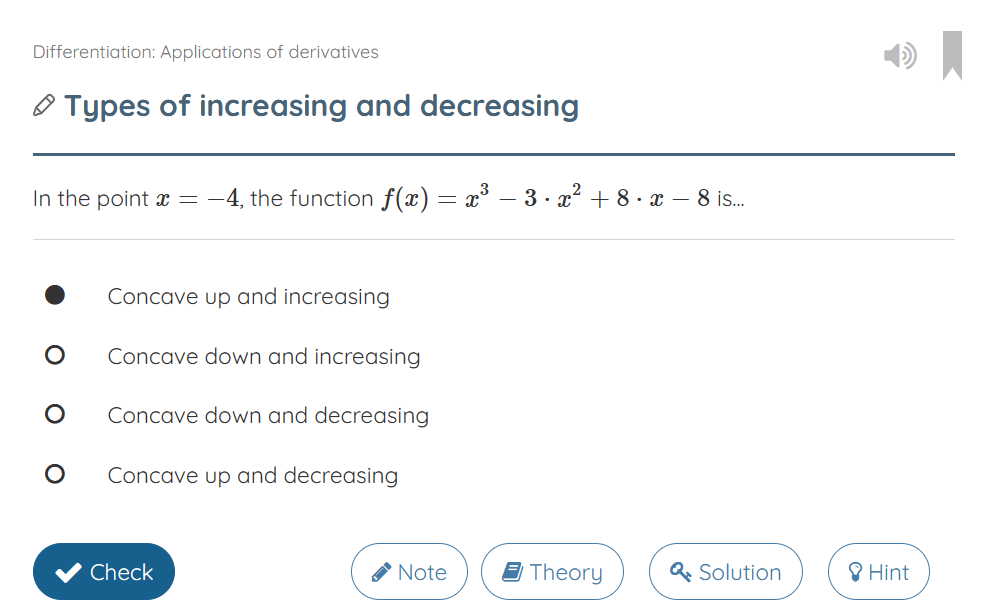
I can figure out if its increasing easily, but any time I got this question before I would just use my graphing calculator to see if it was concave up or down 😅
cunning forum
Try differentiating
wild belfry
Now I gotta actually learn how to do it haha
wild belfry
cunning forum
Try differentiating
okok 1 moment I will do it
cunning forum
Then find dy/dx when x=-4
that’s your increasing decreasing
then differentiate again etc
wild belfry
cunning forum
Try differentiating
I got a negative in the discriminant...
cunning forum
Why is the discriminant involved in differentiation
wild belfry
Oh
cunning forum
Discriminant is for solving the thing
cunning forum
wild belfry
Wait what is differentiation again
the rate of change of a function
wild belfry
ah yeye sry
cunning forum
if you’ve been using your GC to do these questions I’d suggest you revise your differentiation
wild belfry
I got 3x^2 - 6x + 8
wild belfry
cunning forum
Then find dy/dx when x=-4
for this I got 80
cunning forum
wild belfry
for this I got 80
So is it increasing or decreasing
wild belfry
increasing
cunning forum
Now do the same for concave
cunning forum
wild belfry
How do I figure out which it is, up or down
Oh sorry was busy
wild belfry
npnp
cunning forum
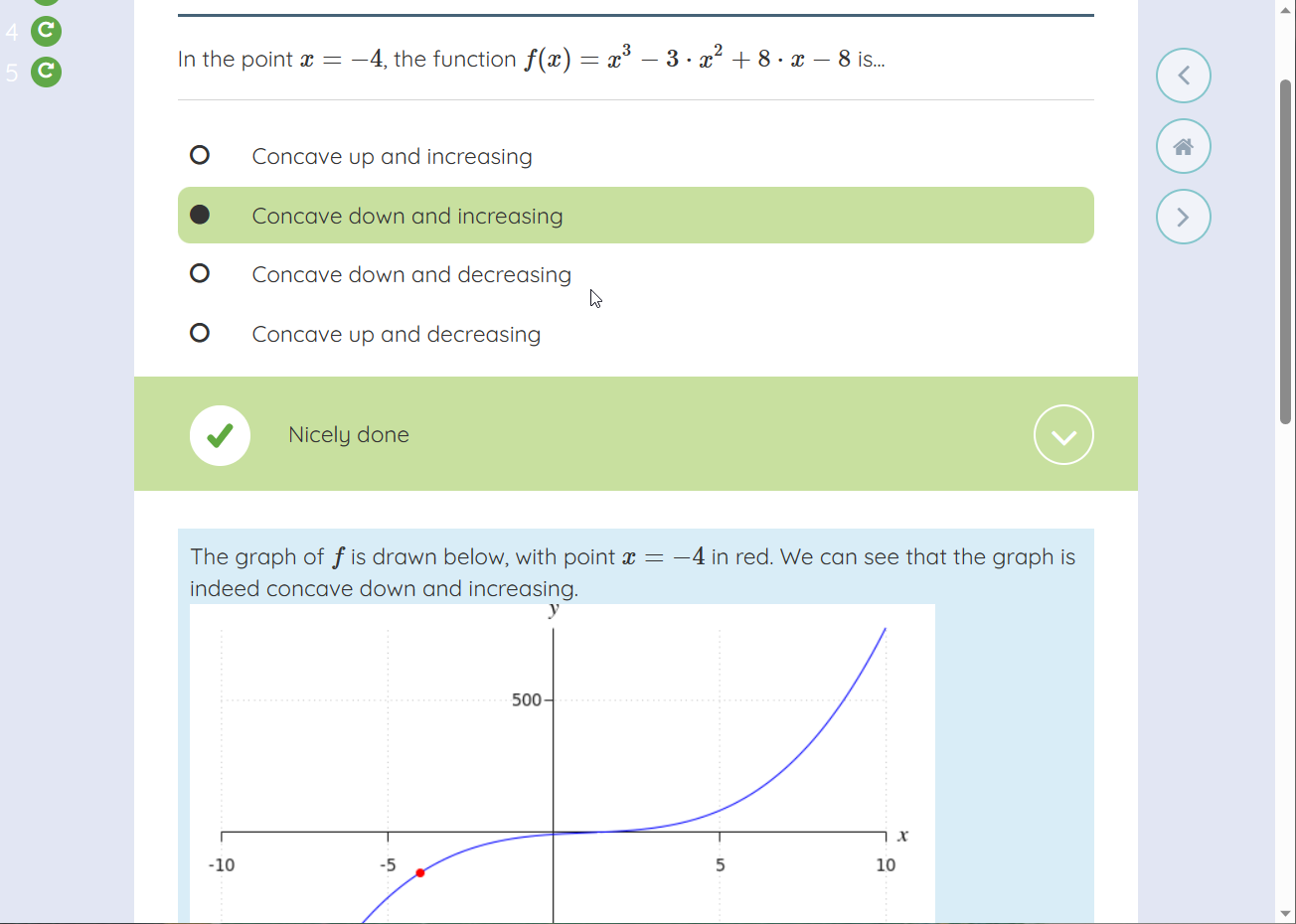
If it’s positive the graph is concave upwards at that point
Otherwise concave downward
 cedar kilnBOT
Channel closed
Closed by @wild belfry
Use .reopen if this was a mistake.
Available help channel!
Send your question here to claim the channel.
Remember:
• Ask your math question in a clear, concise manner.
• Show your work, and if possible, explain where you are stuck.
• After 15 minutes, feel free to ping <@&286206848099549185>.
• Type the command .close to free the channel when you're done.
• Be polite and have a nice day!
Read #❓how-to-get-help for further information on how to ask a good question, and about conduct in the question channels.
wild belfry
does f(x)=1/2 have a horizontal asymptote
cedar kilnBOT
wild belfry
does f(x)=1/2 have a horizontal asymptote
wild belfry
Okok
vestal bear
no\
wild belfry
Oh?
vestal bear
thats not an asymptote
asymptote is when a function approaches a value but never reaches it
1/2 reaches it
,w graph y=1/2
wraith daggerBOT


 Requested by Arctic#1647
vestal bear
Requested by Arctic#1647
vestal bear
,w graph 1/x +2
wraith daggerBOT
 Requested by Arctic#1647
wild belfry
Requested by Arctic#1647
wild belfry
 vestal bear
horizontal asymptote at 2
vestal bear
did you find the limit as x appraches infinity and -infinity
wild belfry
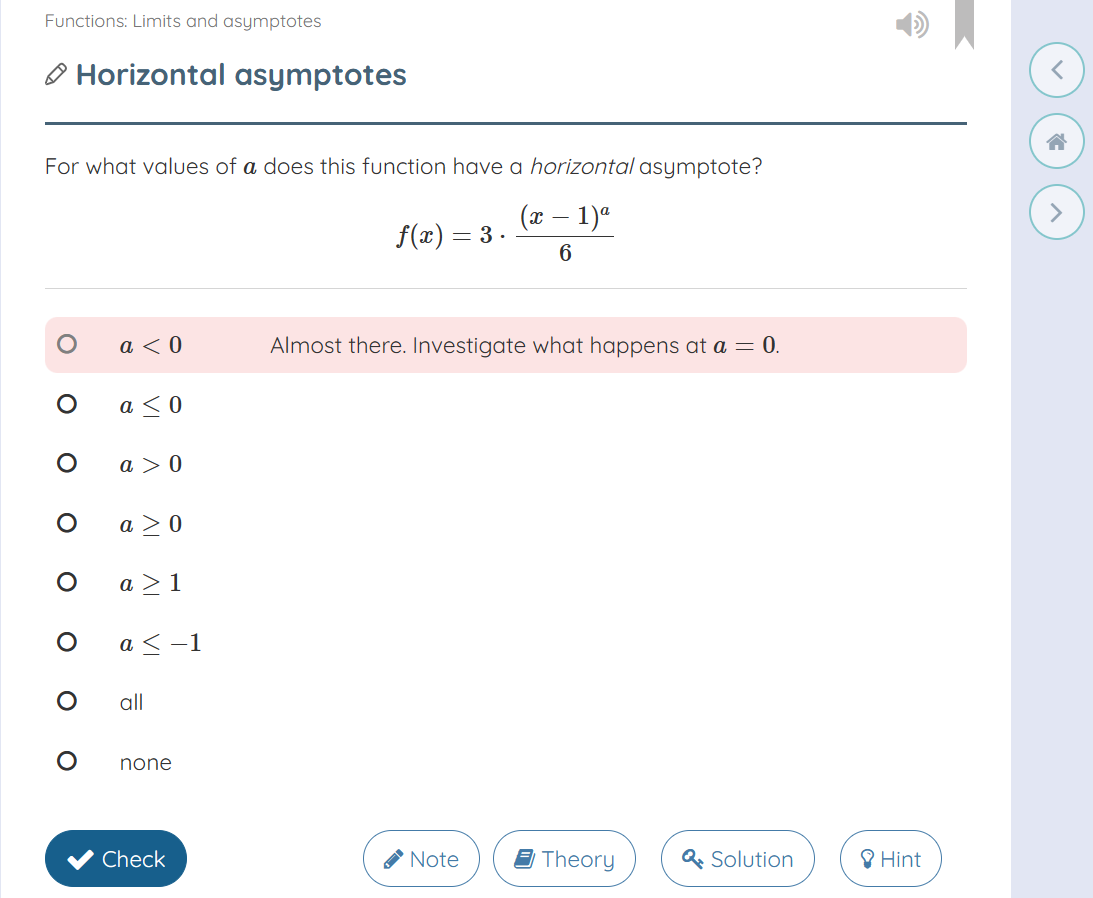
But I guess the website is wrong? Idk anymore hahaha
wild belfry
vestal bear
did you find the limit as x appraches infinity and -infinity
It will be 1/2 right?
vestal bear
wild belfry
It says a=0 has an asymptote
theres not even an option for a=0
you can use desmos for this, make a a variable with a slider'
and see how it affects the equation
wild belfry

 crystal raptor
This just depends on how that website defined a horizontal asymptote
vestal bear
yeah thats not an asymptote
wild belfry
crystal raptor
This just depends on how that website defined a horizontal asymptote
What do you think is a safe bet for me to put in my exam
Asymptote or no asymptote?
 slow wing
asymptote means it approaches a value not that its actually at the value
vestal bear
,w define asymptote
wraith daggerBOT
 Requested by Arctic#1647
wraith daggerBOT
Requested by Arctic#1647
wraith daggerBOT

 Requested by odietje#0
wild belfry
Requested by odietje#0
wild belfry
😄
vestal bear
im trying to use latex and the bot functions more
crystal raptor
wild belfry
What do you think is a safe bet for me to put in my exam
You should ask your lecturers, there are valid arguments for allowing a straight line to be asymptotic to itself or not
wild belfry
Unfortunatly I dont have any haha I am just doing self study
 foggy estuary
the asymptote exists when the limit is a real number but it doesn't mean the function can't be equal to this limit 🤷♂️
wild belfry
So what do you guys think is the safest bet to put in an exam?
It probably wont come up but just to be sure haha
crystal raptor
Find your courses definition of asymptote
wild belfry
Okok I will email the examiners
I will do it now haha
Thank you everyone
❤️
.close
cedar kilnBOT
Channel closed
Closed by @wild belfry
Use .reopen if this was a mistake.
Available help channel!
Send your question here to claim the channel.
Remember:
• Ask your math question in a clear, concise manner.
• Show your work, and if possible, explain where you are stuck.
• After 15 minutes, feel free to ping <@&286206848099549185>.
• Type the command .close to free the channel when you're done.
• Be polite and have a nice day!
Read #❓how-to-get-help for further information on how to ask a good question, and about conduct in the question channels.
 twin flax
Find the coordinates of the absolute minimum for the function f(x) = sqrt(x-3)
I got (3,0)
Is this correct?
cedar kilnBOT
twin flax
Find the coordinates of the absolute minimum for the function f(x) = sqrt(x-3)
...
cunning forum
Yes
Sqrt always nonnegative output
So it can’t be any smaller
There’s also only one equality case
twin flax
cunning forum
No =0
I have another question, would this conclusion be correct?
For this function, f'(x) > 0 on (-infinite, -1) U (0, infinite) right?
 twin flax
Oh, it's increasing, for the y-output
 slate lintel
i think you have a typo or something, check your answer again
like I'm pretty sure you have the right idea but there's a typo
twin flax
Which typo?
slate lintel
you say f'(x) > 0 on (-infinity, 1) U (0, infinity)
twin flax
My other conclusion was this:
 twin flax
My other conclusion was this:
twin flax
twin flax
My other conclusion was this:
This kinda made sense to me because it was concave down till -1
Then its concave down from 0 to infinite
slate lintel
the function isn't even visible at x=1 so i'm not sure where you're getting that
twin flax
It's going up exponentially then
It would mean that it's a polynomial function
Which would explain that massive jump
slate lintel
exponential functions are not polynomial functions but ok i think i see what you're saying
still though, why do you think it stops increasing at x=1?
or maybe -- could you highlight the regions where f(x) is increasing?

 upper abyss
You mean -1, not 1.
slate lintel
yehh
cedar kilnBOT
Channel closed
Closed by @twin flax
Use .reopen if this was a mistake.
Available help channel!
Send your question here to claim the channel.
Remember:
• Ask your math question in a clear, concise manner.
• Show your work, and if possible, explain where you are stuck.
• After 15 minutes, feel free to ping <@&286206848099549185>.
• Type the command .close to free the channel when you're done.
• Be polite and have a nice day!
Read #❓how-to-get-help for further information on how to ask a good question, and about conduct in the question channels.
 viscid pendant
 cedar kilnBOT
viscid pendant
viscid pendant
cedar kilnBOT
viscid pendant
viscid pendant
How do I compute the limit?
 long arrow
divide both the top and bottom by n
viscid pendant
Do I divide everything by n^2
viscid pendant
long arrow
divide both the top and bottom by n
isn't it highest power?
 long arrow
not like that
long arrow
$$\lim_{n \to \infty} \frac{\sqrt{n^2+4}}{n+8}=\lim_{n \to \infty}\frac{\sqrt{n^2\Big(1+\frac{4}{n^2}\Big)}}{n\Big(1+\frac{8}{n}\Big)}=...$$
wraith daggerBOT
modus7591
 long arrow
and now sqrt(n^2) = n
long arrow
yes
cedar kilnBOT
@viscid pendant Has your question been resolved?
viscid pendant
long arrow
yes
do you always do this method for these types of problems?
long arrow
yes, similar way to solve other problems like this
cedar kilnBOT
Channel closed
Closed due to timeout
Use .reopen if this was a mistake.
Available help channel!
Send your question here to claim the channel.
Remember:
• Ask your math question in a clear, concise manner.
• Show your work, and if possible, explain where you are stuck.
• After 15 minutes, feel free to ping <@&286206848099549185>.
• Type the command .close to free the channel when you're done.
• Be polite and have a nice day!
Read #❓how-to-get-help for further information on how to ask a good question, and about conduct in the question channels.
 granite shuttle
 cedar kilnBOT
granite shuttle
cedar kilnBOT
granite shuttle


 long arrow
noo, that was an other example
to ilustrate how it works
but
I mean
we take square root
but you have to remember to do +/-
like with x^2 = 25
we have
x = +/- 5
and same thing happens with yours

 cedar kilnBOT
@granite shuttle Has your question been resolved?

 spare ore
granite shuttle
spare ore
granite shuttle
If your question has been resolved, you can type .close to close this channel and make it available for others to use
cedar kilnBOT
Channel closed
Closed due to timeout
Use .reopen if this was a mistake.
Available help channel!
Send your question here to claim the channel.
Remember:
• Ask your math question in a clear, concise manner.
• Show your work, and if possible, explain where you are stuck.
• After 15 minutes, feel free to ping <@&286206848099549185>.
• Type the command .close to free the channel when you're done.
• Be polite and have a nice day!
Read #❓how-to-get-help for further information on how to ask a good question, and about conduct in the question channels.
 lucid adder
I want to find the minimal polynomial of sin(2 pi / 7) = cos(3 pi / 14) over Q[X], I think it should enter galois theory in somewhat moment but I already have finded the minimal polynomial of cos(2 pi / 7) and no uses nothing on galois theory.
Any Hints?
cedar kilnBOT
lucid adder
I want to find the minimal polynomial of sin(2 pi / 7) = cos(3 pi / 14) over Q[...
@lucid adder Has your question been resolved?
cedar kilnBOT
Channel closed
Closed due to timeout
Use .reopen if this was a mistake.
cedar kilnBOT
Available help channel!
Send your question here to claim the channel.
Remember:
• Ask your math question in a clear, concise manner.
• Show your work, and if possible, explain where you are stuck.
• After 15 minutes, feel free to ping <@&286206848099549185>.
• Type the command .close to free the channel when you're done.
• Be polite and have a nice day!
Read #❓how-to-get-help for further information on how to ask a good question, and about conduct in the question channels.
 hollow patrol
how is the first one increasing?
cedar kilnBOT
hollow patrol
how is the first one increasing?
hollow patrol
heres a better pic

since if you plug in any number lower than -3 in the s'(x) u still get a neg answer
so how is the behavior increasing?
is because its the derivative so its going the opposite?
hollow patrol
they didnt give me one, ill show you everything they showed me
 main sage
you have to make one to solve the problem
hollow patrol
 main sage
"determine the behavior of s on each interval"
behavior of s and s' are different
when first derivative is positive, that means s is increasing
I think that is where you are getting confused
Read carefully
when s' is pos, s is increasing
s' is neg, s is decreasing
just a fundamental relationship between first derivative to original
hollow patrol
yes i understand that part, so are you saying whatever the answer is for the derivative you have to flip the sign?
main sage
no
no sign flipping
You found out that the first derivative at any number less than -3 is positive right
you plugged say -4 into derivative, got a positive result
hollow patrol
hollow patrol
since if you plug in any number lower than -3 in the s'(x) u still get a neg ans...
i did this and got confused
main sage
that means that the original s will be increasing at that interval
hollow patrol
main sage
you plugged say -4 into derivative, got a positive result
let me do it again
main sage
the question is asking you to determine the sign of s', so you have to plug in
just plug in -4 and tell me what u get
hollow patrol
i got a neg tho
main sage
the sign of the number is whats important
hollow patrol
since u have to plug it into the denom too right
main sage
did u use parenthesis?
hollow patrol
for the denom?
main sage
it should be positive mate
plug it into a calculator carefully
in this case (-4)^2 = 16
top is positive
hollow patrol
ok ill do them separately: for the numerator if i plug in -4 i get 819
main sage
and denom
hollow patrol
yes
hollow patrol
i was going to show u how i got the demon neg tho
if i do the whole hting i get a domain error on my calc
main sage
no
bottom is positive
i promise you it's positive
u are not inputting into the calculator correctly
first derivative at -4 is positive
do you know what fractional exponents mean
hollow patrol
but if i plug in 5(-4)^2/5 in my calc i get domain error
main sage
basically, if ur pluggin negative 4, the denominator will be 5 times 5radical (16)
convert it to a radical
5 times root 5 radical 16
5th root 16
hollow patrol
oh so its 1.7?
main sage
also, never assume domain error means negative
main sage
hollow patrol
oh so its 1.7?
the value doesn't matter in this case, the sign does
it's positive
i didn't calcualte it, but i'll tell u denom is positive
hollow patrol
yeah ik the value but im jst sayin that its pos
main sage
pos / pos = pos
hollow patrol
main sage
do you know what fractional exponents mean
wow thanks for this, i never did this for these questions
main sage
u have to
don't plug in exponents like that calcualtor can get confused if u don't use parenthesis correctly
hollow patrol
so how would you use parenthesis correctly?
hollow patrol
it was neg 4 tho is that fine?
and if i plug the neg 4 in my calc i still get a neg answer even with the parenthesis
hollow patrol
main sage
basically, if ur pluggin negative 4, the denominator will be 5 times 5radical (1...
ill practice doing questions like these
instead of using the calc
thx again
main sage
i know it's positive because the 5th root of 16 is
1.7
positive
ur doing something wrong with ur calcualor
i guarentee it
hollow patrol
main sage
positive
yeah i got that too
hollow patrol
main sage
5 * (4^(2/5))
but when i inpunt something like this but with -4 i get a neg idk what im doin wrong
but doesnt matter anyways ill do the radical thing, thx
cedar kilnBOT
Channel closed
Closed by @hollow patrol
Use .reopen if this was a mistake.
Available help channel!
Send your question here to claim the channel.
Remember:
• Ask your math question in a clear, concise manner.
• Show your work, and if possible, explain where you are stuck.
• After 15 minutes, feel free to ping <@&286206848099549185>.
• Type the command .close to free the channel when you're done.
• Be polite and have a nice day!
Read #❓how-to-get-help for further information on how to ask a good question, and about conduct in the question channels.
 wicked brook
Is there a nice intuition for the definition of $D_4$ compared to the other $D_{2n}$?
cedar kilnBOT
wicked brook
Is there a nice intuition for the definition of $D_4$ compared to the other $D_{...
wraith daggerBOT
zander_a
 wicked brook
Like $D_{2n} \cong \Sigma(\pi_n)$, where $\Sigma$ is the symmetry group of an n-gon
wraith daggerBOT
zander_a
 wicked brook
Of course, there is no 2-gon and using a line with two points fails to be group
So why do we bother with $D_4?$
wraith daggerBOT
zander_a
 upper abyss
Why not?
I don't see how there's less value in recognizing this is a group
Even though it's just Z2
wicked brook
I guess my question is why is it called like this
upper abyss
Or wait, it's 4 elements isn't it
upper abyss
Okay yeah, so it's just V4
upper abyss
The presentation is probably the best way to see why it works
{r, s | r² = e, s² = e, rs = sr^-1}
wicked brook
Ah ok
upper abyss
That's clearly a dihedral group, the way I've presented it, but it's obviously just V4 lol
cedar kilnBOT
Channel closed
Closed by @wicked brook
Use .reopen if this was a mistake.
Available help channel!
Send your question here to claim the channel.
Remember:
• Ask your math question in a clear, concise manner.
• Show your work, and if possible, explain where you are stuck.
• After 15 minutes, feel free to ping <@&286206848099549185>.
• Type the command .close to free the channel when you're done.
• Be polite and have a nice day!
Read #❓how-to-get-help for further information on how to ask a good question, and about conduct in the question channels.
 abstract relic
so i basically have no idea how to begin, the only thing i noticed is that the 1/5 corresponds to the 5th root that the question wants. other than that im pretty lost. also probably know it has something to do with the (1+x)^n formula but no idea how its being applied
cedar kilnBOT
abstract relic
so i basically have no idea how to begin, the only thing i noticed is that the ...
abstract relic

 austere hull
,tex .exp rules
wraith daggerBOT
Akira
 austere hull
@abstract relic
abstract relic
wraith dagger
**Akira**
oh i know that 5th root equals ^1/5
but i dont really know how youd work it out
i did this question on an exam and sorta winged it so wanna knwo for sure if i got it right
i set X to 30 and then substituted it in every term on the series
abstract relic
 runic garnet
That was wrong?
runic garnet
That was wrong?
oh i dont know yet
i just did the exam i havent gotten the test back yet
austere hull
Yes
cedar kilnBOT
Channel closed
Closed by @abstract relic
Use .reopen if this was a mistake.
Available help channel!
Send your question here to claim the channel.
Remember:
• Ask your math question in a clear, concise manner.
• Show your work, and if possible, explain where you are stuck.
• After 15 minutes, feel free to ping <@&286206848099549185>.
• Type the command .close to free the channel when you're done.
• Be polite and have a nice day!
Read #❓how-to-get-help for further information on how to ask a good question, and about conduct in the question channels.
 deep rivet
I was looking through my syllabus, and came across this:
Describe the radian measure of an angle as the ratio of the length of an arc intercepted by a central angle and the radius of the circle
Could someone explain what this means? My interpretation is; Describe a degree measure as a radian (I don't understand the rest)
cedar kilnBOT
deep rivet
I was looking through my syllabus, and came across this:
**Describe the radian m...
 flat oracle
@deep rivet it s just θ=L/r
cedar kilnBOT
Channel closed
Closed by @deep rivet
Use .reopen if this was a mistake.
cedar kilnBOT
Available help channel!
Send your question here to claim the channel.
Remember:
• Ask your math question in a clear, concise manner.
• Show your work, and if possible, explain where you are stuck.
• After 15 minutes, feel free to ping <@&286206848099549185>.
• Type the command .close to free the channel when you're done.
• Be polite and have a nice day!
Read #❓how-to-get-help for further information on how to ask a good question, and about conduct in the question channels.
 spiral star
How do I do this? Thanks
 cedar kilnBOT
spiral star
How do I do this? Thanks
cedar kilnBOT
spiral star
How do I do this? Thanks
 dim mist
yes
find BC using SOH CAH TOA
THEN BC + 22 units = BD
then use pythagorean theorem to find AD
u don't need to find AD
then find Angle BDA
using soh cah toa
spiral star
Tq
cedar kilnBOT
@spiral star Has your question been resolved?
Channel closed
Closed by @spiral star
Use .reopen if this was a mistake.
cedar kilnBOT
Available help channel!
Send your question here to claim the channel.
Remember:
• Ask your math question in a clear, concise manner.
• Show your work, and if possible, explain where you are stuck.
• After 15 minutes, feel free to ping <@&286206848099549185>.
• Type the command .close to free the channel when you're done.
• Be polite and have a nice day!
Read #❓how-to-get-help for further information on how to ask a good question, and about conduct in the question channels.
 true grove
Did I do this correctly?
 cedar kilnBOT
true grove
Did I do this correctly?
true grove
cedar kilnBOT
true grove
Did I do this correctly?
true grove
A parabolic bridge over a river has a span of 100 meters and a height of 30 meters. What is the maximum height of a boat that can go under the bridge at a point 20 meters from the shoreline?
That’s was the question
 dreamy sleet
true grove
Did I do this correctly?
dreamy sleet
true grove
Did I do this correctly?
Notice that in the question it says the height of the bridge is 30m
930m is way over that, so you can tell you didn’t do it right
The part you got wrong is the equation of the bridge
cedar kilnBOT
@true grove Has your question been resolved?
cedar kilnBOT
Channel closed
Closed due to timeout
Use .reopen if this was a mistake.
true grove
.reopen
cedar kilnBOT
✅
true grove
<@&286206848099549185>
crimson sedge
😡
 dawn junco
<@&268886789983436800> ban this guy already
crimson sedge
What he sent
true grove
Adult film
crimson sedge
In study group
 severe estuary
Corn
true grove
.close
cedar kilnBOT
Channel closed
Closed by @true grove
Use .reopen if this was a mistake.
cedar kilnBOT
Available help channel!
Send your question here to claim the channel.
Remember:
• Ask your math question in a clear, concise manner.
• Show your work, and if possible, explain where you are stuck.
• After 15 minutes, feel free to ping <@&286206848099549185>.
• Type the command .close to free the channel when you're done.
• Be polite and have a nice day!
Read #❓how-to-get-help for further information on how to ask a good question, and about conduct in the question channels.
 woven crater
given a 3x3x3 rubik's cube with 1 edge piece (a piece with two colours) missing, what algorithm can you use to decide how to put that edge piece back in so that the cube is solvable?
cedar kilnBOT
woven crater
given a 3x3x3 rubik's cube with 1 edge piece (a piece with two colours) missing,...
woven crater
so for example how do you make an algorithm that decided wether the green and white piece should be oriented with the green or white sticker up in this cube?

 woven crater
yes. Is there a more efficient way though? for the corner pieces there is as you can give each piece a 'rotation value' of 0, 1 or 2, based on wether the sticker that should be horizontal is horizontal, 1 clockwise rotation away from being horizontal, or 2 clockwise rotations being away from being horizontal, and then if the sum of rotation values of all corner pieces is divisible by 3, the cube is solvable @slate lintel
@dreamy sleet is this maybe a question you can solve? Because this is also a parity issue
 dull oxide
You can add the orientation number of each piece
You don't have to solve it
Total orientation must be even
woven crater
dull oxide
You can add the orientation number of each piece
how do you find the orientation number of pieces if they're not on their original spot?
dull oxide
It's a bit tricky, but I recently devised a system for this when I was trying to prove the number of positions in a rubiks cube
This will be a longish explanation
woven crater
if you have time for it then yes please :)
dull oxide
I'm assuming you have a standard color rubiks cube. White opposite yellow, green opposite blue, red opposite orange, and blue orange yellow faces go clockwise
woven crater
yes
dull oxide
We will let green be the front face (F) and yellow will be the up face (U)
I'm assuming you know the faces U F B L R D
woven crater
yes
dull oxide
Okay
The orientation number of every edge piece is zero when it's in its solved state. If you flip an edge piece, you add one to it's orientation number. You only care if this number is even or odd.
The total 3x3x3 edge orientation number is the sum all of orientation numbers of the 12 edges
It must always be even
Now for how we change orientation number
Twisting the U F D or B faces does not change the orientation number of any edge
A 90 degrees L move adds 1 to the four edges on the L face. A 90 degrees R move adds 1 to the four edges on the R face
That's it
You can get the orientation number of any edge at any position by mentally twisting it to it's solved state and counting it's orientation number along the way
You have to do it 11 times, which is rough
With practice, you can identify orientation quickly
Usually 1 second per piece
woven crater
cool algorithm! I'll play around with it a bit to see if I can figure out why that's true, and then ill get back to you. Many thanks for telling me this. Also, was your attempt to prove the amount of combinations succesful? If not I may have a video you'd be interested in
woven crater
cool, how about N^4? ;)
dull oxide
woven crater
thanks!
woven crater
thanks :)
cedar kilnBOT
@woven crater Has your question been resolved?
woven crater
I think I proved that its true :)
cedar kilnBOT
Channel closed
Closed by @woven crater
Use .reopen if this was a mistake.
Available help channel!
Send your question here to claim the channel.
Remember:
• Ask your math question in a clear, concise manner.
• Show your work, and if possible, explain where you are stuck.
• After 15 minutes, feel free to ping <@&286206848099549185>.
• Type the command .close to free the channel when you're done.
• Be polite and have a nice day!
Read #❓how-to-get-help for further information on how to ask a good question, and about conduct in the question channels.
 wanton summit
5 random points are distrubuted on the area of the sphere.
 wanton summit
im not sure where to start
 turbid mesa
Okay, let's try to convert the problem first.
wanton summit
how so
turbid mesa
The maximum distance between two points in the same hemisphere is equal to the diameter. Can we use this?
turbid mesa
Hmm, idts. That's also the maximum distance between any two points on the sphere, so this does not provide us with any additional info
The only idea I can think of rn trying to prove that when the 5 points are written in Cartesian coordinates, we have to prove that there exists an isometry (only rotational ig), which when applied to all the 5 points give us atleast one coordinate of atleast 4 points to be the same (either + or -)
turbid mesa
Should be ig
 turbid mesa
Can you explicitly state out what you did?
wanton summit
Put two points anywhere on the sphere
and draw an equator
between them
it makes 2 hemisphere
s
remaining 3 points can go in those places
turbid mesa
Hmm, I see it working, but need to write it properly
 wanton summit
turbid mesa
Hmm, I see it working, but need to write it properly
wanton summit
turbid mesa
Hmm, I see it working, but need to write it properly
know how to solve for n ??
turbid mesa
Do you know the formula for sum of consecutive naturals?
wanton summit
no
 dire geode
wanton summit
nCn-2
dire geode
wanton summit
nCn-2
yes but it's not as useful as their formula
wanton summit
dire geode
yes but it's not as useful as their formula
no just an observation
cant do algebra with c and p
thank you
.close
cedar kilnBOT
Channel closed
Closed by @wanton summit
Use .reopen if this was a mistake.
Available help channel!
Send your question here to claim the channel.
Remember:
• Ask your math question in a clear, concise manner.
• Show your work, and if possible, explain where you are stuck.
• After 15 minutes, feel free to ping <@&286206848099549185>.
• Type the command .close to free the channel when you're done.
• Be polite and have a nice day!
Read #❓how-to-get-help for further information on how to ask a good question, and about conduct in the question channels.
crimson sedge
Show that for any natural number 𝑛 there exist two integers 𝑎𝑛 and 𝑏𝑛 such that (3+2sqrt(2))^n = an + bn sqrt(2). How can I solve this one ?
cedar kilnBOT
crimson sedge
Show that for any natural number 𝑛 there exist two integers 𝑎𝑛 and 𝑏𝑛 such ...
 inland fossil
you can use induction
cedar kilnBOT
Channel closed
Closed by @dull ruin
Use .reopen if this was a mistake.
Available help channel!
Send your question here to claim the channel.
Remember:
• Ask your math question in a clear, concise manner.
• Show your work, and if possible, explain where you are stuck.
• After 15 minutes, feel free to ping <@&286206848099549185>.
• Type the command .close to free the channel when you're done.
• Be polite and have a nice day!
Read #❓how-to-get-help for further information on how to ask a good question, and about conduct in the question channels.
 hot sand
Please help
hot sand
.close
cedar kilnBOT
Channel closed
Closed by @hot sand
Use .reopen if this was a mistake.
dire geode
hot sand
Please help
you're getting help. don't open new channels
cedar kilnBOT
Available help channel!
Send your question here to claim the channel.
Remember:
• Ask your math question in a clear, concise manner.
• Show your work, and if possible, explain where you are stuck.
• After 15 minutes, feel free to ping <@&286206848099549185>.
• Type the command .close to free the channel when you're done.
• Be polite and have a nice day!
Read #❓how-to-get-help for further information on how to ask a good question, and about conduct in the question channels.
 quaint spear
How did i get this wrong? The answer is soppused to be 63/40
 long arrow
,rccw
wraith daggerBOT
 quaint spear
How come
long arrow
$$\frac23 - \frac19 = \frac69 - \frac19 = \frac{6-1}{9}=\frac59\neq\frac79$$
wraith daggerBOT
modus7591
 quaint spear
Ooo i added im so stupid🥲thank u
cedar kilnBOT
@quaint spear Has your question been resolved?
Channel closed
Closed by @quaint spear
Use .reopen if this was a mistake.
Available help channel!
Send your question here to claim the channel.
Remember:
• Ask your math question in a clear, concise manner.
• Show your work, and if possible, explain where you are stuck.
• After 15 minutes, feel free to ping <@&286206848099549185>.
• Type the command .close to free the channel when you're done.
• Be polite and have a nice day!
Read #❓how-to-get-help for further information on how to ask a good question, and about conduct in the question channels.
 atomic vapor
a coin is flipped 20 times, in how much combinations you can get side A 14 times and side B 6 times while you never get B side twice in a row
cedar kilnBOT
atomic vapor
a coin is flipped 20 times, in how much combinations you can get side A 14 times...
atomic vapor
I wanted to see how much posibble arengemnts are there while ignoring the second rule and then suntract the illegal combinations
so there are 20!/(6!x14!) different ways to arrange the 20 flips
 fair geyser
it's actually not easier that way
atomic vapor
so how should I approch it?

 fair geyser
it's stars and bars basically
fair geyser
you get 7 buckets between 6 Bs
but the outermost buckets can be empty
so you use 5 As to fill the insides
and then solve for 7 buckets that can all be empty
there's also a very specific trick, where instead you have 15 spaces between all the As
so that's 2 different ways
atomic vapor
I didnt really get the first one
atomic vapor
fair geyser
and then solve for 7 buckets that can all be empty
how can all of the seven be empty if we need the spaces?
fair geyser
we have 14 As, we can say we actually have 9, 5 are already placed
fair geyser
somewhere among 7 buckets
atomic vapor
D(7,9) right?
fair geyser
like suppose you have 2 bars and 3 stars ***||
there's 10 permutations of this, and each one corresponds to placing 3 stars into 3 buckets
1+0+2: *||**
d for distribute?
never saw that but probably
atomic vapor
 fair geyser
yes
fair geyser
sure
atomic vapor
.close
cedar kilnBOT
Channel closed
Closed by @atomic vapor
Use .reopen if this was a mistake.
cedar kilnBOT
Available help channel!
Send your question here to claim the channel.
Remember:
• Ask your math question in a clear, concise manner.
• Show your work, and if possible, explain where you are stuck.
• After 15 minutes, feel free to ping <@&286206848099549185>.
• Type the command .close to free the channel when you're done.
• Be polite and have a nice day!
Read #❓how-to-get-help for further information on how to ask a good question, and about conduct in the question channels.
atomic vapor
A is a set with 2n+1 members, how many subsets of A have n or less members?
cedar kilnBOT
atomic vapor
A is a set with 2n+1 members, how many subsets of A have n or less members?
atomic vapor
I dont know how to even begin
 crimson delta
if S is such a subset. what can you tell me about its complement
atomic vapor
If the universe is A than it should have more than n members right?
wait I got confused
A has 2^(2n+1) subsets
crimson delta
you might try an example
eg A={1,2,3} or A={1,2,3,4,5}
what are the relevant sets? why did I ask about complements?
atomic vapor
lets take A={1,2,3}
n=1
so the subsets are:
empty group,{1},{2},{3}
their complement are
{1,2,3}, {2,3}, {1,3}, {1,2}
south tundra
Hm, do you have the answer by any chance?
south tundra
Oh 
south tundra
The problem becomes easy if you recall combinatorics
crimson delta
so, we have pairs
S and S^C
one has <=n elements, the other >=n+1
what does that mean for the problem
 atomic vapor
4
crimson delta
so not n pairs
atomic vapor
yeah
atomic vapor
2^2n
 crimson delta
please dont tell me you added binomial coefficients
so, 2^(2n) pairs and in every pair there is one subset we want
so how many subsets
atomic vapor
how do we know for sure that no number was left without a piar?
south tundra
crimson delta
please dont tell me you added binomial coefficients
Yes, thanks to the symmetry of binomial coefficients you just half the 2^(2n+1) and get 2^2n
atomic vapor
crimson delta
so how many subsets
2^(2n)
atomic vapor
atomic vapor
how do we know for sure that no number was left without a piar?
but I still dont 100% get this part
crimson delta
the map S->S^C is a bijection
because it has an inverse
(itself)
and because we have 2n+1 elements, we cant have |S|=|S^C|
atomic vapor
so we made a func that gives us the complement of a subset, each subset is paired (not to itself)
it is inverseable therefor its bijection and surjective which means the number of the range and domain is equal and addition of them gives us 2^2n+1
so there are 2^2n pairs and 2^2n subsets with less than n members
took me pretty long but I think I got it
If this explanation is correct Im gonna close the room
thanks alot for the help 🙂
crimson delta
well range and codomain are both all subsets
so 2^(2n+1) elements each
the point is more that you can actually find pairs S, S^C and it doenst end up weird that you have a single set S without a partner and some triple maybe
because for each set you find one partner (S^C) which also has the original set S as its partner
atomic vapor
yeah thats why its invertable
cedar kilnBOT
@atomic vapor Has your question been resolved?
Channel closed
Closed by @atomic vapor
Use .reopen if this was a mistake.
Available help channel!
Send your question here to claim the channel.
Remember:
• Ask your math question in a clear, concise manner.
• Show your work, and if possible, explain where you are stuck.
• After 15 minutes, feel free to ping <@&286206848099549185>.
• Type the command .close to free the channel when you're done.
• Be polite and have a nice day!
Read #❓how-to-get-help for further information on how to ask a good question, and about conduct in the question channels.
 amber parrot
I have zero clue how to even start these...
 cedar kilnBOT
amber parrot
I have zero clue how to even start these...
slate lintel
cedar kilnBOT
amber parrot
I have zero clue how to even start these...
slate lintel
well the bottom one involves reading a graph and the top one involves using trig angles (sin/cos/tan) kind of like that problem you did yesterday I think
amber parrot
Oh okay so this switches into relations after the top question
south tundra
What's the name of the point at which the right angle is located? Can't see
slate lintel
R i think. PQ is the line going down the middle along the bottom to the right
amber parrot
 south tundra
amber parrot
south tundra
amber parrot
So, here RP + PQ = RQ, right?


 south tundra
Can you calculate RP?
 frigid tundra
guys, any one can explain what's the diffrene between the courbe and the graph of a function, or lets say an application ?
south tundra
Ask your question in an available help channel
frigid tundra
ohh right, thanks
amber parrot
Ill try give me one sec
south tundra
Sure, take your time
amber parrot
My calculator can be weird sometimes so I got 0.857...., and 7.349....,
slate lintel
how did you calculate those?
amber parrot
I used cos over 1 = 6.3 over h. I did cross multiply divide.
south tundra
Make sure your calculator is in angles mode
Oh
Why would you use cosine though? You don't know the hypotenuse
Perhaps using tan(31) could be helpful
slate lintel
(you don't know the hypotenuse and Bean didn't ask you to calculate the hypotenuse)
amber parrot
Using the same formula but using Tan(31) I got 3.78
amber parrot
Calculating RQ is where I got confused.
south tundra
We know the length of RS and the angle RSQ, don't we?
amber parrot
RS is 6.3, angle I'm not sure would it be 43 degrees?
amber parrot
so 5.87..?
south tundra
Yup
Let us recall the very first fact that I mention
RP + PQ = RQ
We now know the values of RP and RQ
south tundra
south tundra
RP + PQ = RQ
So we can calculate PQ using this equation
As it's the only unknown variable there
amber parrot
I'm a tad confused would you use Pythagorean theorem?
south tundra
south tundra
RP + PQ = RQ
No, you just imply that PQ = RQ - RP and plug in the values of RQ and RP that we calculated previously
And you will get the answer for PQ
amber parrot
Oh I see. So PQ is = to 2.09
south tundra
Yup
amber parrot
That helped a lot thank you!
Am I able to get come clearance on the second question?
south tundra
Generally to calculate a value of the function at a point like x = -4 given the graph, you could image (or draw) a vertical line crossing the x-axis at the point where the -4 is marked at and checking the y coordinate of the intersection point with the graph of the function
But here the graph just crosses the x-axis at x = -4, directly hinting at the fact that g(-4) = 0
And to solve g(x) = 4 you do something similar;
Image (or draw) the horizontal line crossing the y-axis at the point where the 4 is marked at and check the x coordinate of the intersection with the graph of the function
amber parrot
4?
south tundra
Yup
amber parrot
Hm okay, would this be same throughout the functions and relation questions? dealing with stating the domain and range, and the if the relation is a function or not..?
south tundra
Yup
amber parrot
.close
cedar kilnBOT
Channel closed
Closed by @amber parrot
Use .reopen if this was a mistake.
Available help channel!
Send your question here to claim the channel.
Remember:
• Ask your math question in a clear, concise manner.
• Show your work, and if possible, explain where you are stuck.
• After 15 minutes, feel free to ping <@&286206848099549185>.
• Type the command .close to free the channel when you're done.
• Be polite and have a nice day!
Read #❓how-to-get-help for further information on how to ask a good question, and about conduct in the question channels.
 silver mason
No clue how to do this lol
 cedar kilnBOT
silver mason
No clue how to do this lol
cedar kilnBOT
silver mason
No clue how to do this lol
 worthy leaf
Have u done any working yet?
worthy leaf
Okay so the two lines intersect right?
silver mason
Yup
worthy leaf
Okay so we want to find the area of the bounded reigon
silver mason
Gotcha
worthy leaf
Do u know how u would do this?
silver mason
Nope
worthy leaf
Okay have u done integration?
silver mason
Yeah
silver mason
How so?
worthy leaf
Okay so find the point where the two lines intersect
silver mason
(0.5,0.25)
silver mason
Got it
worthy leaf
So this finds u the area under the quadratic
But we want the area of the bounded reigon
So what do u think we should do
silver mason
Find the antiderivative
worthy leaf
So find the area of the triangle (using the point found earlier) and take away the area under the quadratic
This will give the area of the bounded area
silver mason
I got 0.01308
worthy leaf
What is that as a fraction
silver mason
pi/240
worthy leaf
Im guessing u have rotated it by pi
worthy leaf
Its ok dw
silver mason
Wait so would it be -pi/240?
But that can't happen because area is never negative
Pretty sure it is pi/240
I did it again
austere hull
silver mason
Sorry I'm really bad at Calculus
it's pre-calc not calc
silver mason
Well the course is Calc 1
cedar kilnBOT
@silver mason Has your question been resolved?
Channel closed
Closed by @silver mason
Use .reopen if this was a mistake.
Available help channel!
Send your question here to claim the channel.
Remember:
• Ask your math question in a clear, concise manner.
• Show your work, and if possible, explain where you are stuck.
• After 15 minutes, feel free to ping <@&286206848099549185>.
• Type the command .close to free the channel when you're done.
• Be polite and have a nice day!
Read #❓how-to-get-help for further information on how to ask a good question, and about conduct in the question channels.
cedar kilnBOT
Available help channel!
Send your question here to claim the channel.
Remember:
• Ask your math question in a clear, concise manner.
• Show your work, and if possible, explain where you are stuck.
• After 15 minutes, feel free to ping <@&286206848099549185>.
• Type the command .close to free the channel when you're done.
• Be polite and have a nice day!
Read #❓how-to-get-help for further information on how to ask a good question, and about conduct in the question channels.