#help-13
1 messages · Page 127 of 1
 crimson sedge
 faint dirge
That’s how they usually happen, or through a similar method
faint dirge
That’s how they usually happen, or through a similar method
Ah ok, so there are multiple tangents because it is the convergence of multiple functions
 faint dirge
crimson sedge
Ah ok, so there are multiple tangents because it is the convergence of multiple ...
faint dirge
crimson sedge
Ah ok, so there are multiple tangents because it is the convergence of multiple ...
No, because the point is a single point
 obsidian coral
Passing at x = 0, there is only one possible tangent
faint dirge
But the point is there because it’s a junction yes
crimson sedge
obsidian coral
The gray line is the *only* tangent, if you actually draw it out
gotcha
wait i'm confused is absolute x continous or not
 civic eagle
it is, it is jsut not differentiable at x=0
faint dirge
It is continuous but its derivative is not
It may be a piecewise function pretending to be a single function, but is still continuous
crimson sedge
faint dirge
It may be a piecewise function pretending to be a single function, but is still ...
wait how is it continous if there is no value at x = 0
civic eagle
|0| = 0?
faint dirge
crimson sedge
wait how is it continous if there is no value at x = 0
|0| = 0
continuous basically just means can be drawn without lifting your pencil
It usually coincides with a continuous derivative though
crimson sedge
faint dirge
continuous basically just means can be drawn without lifting your pencil
yeah my brain was getting confused and for some reason confused it with some (something / x) function
faint dirge
In this case, no, bc it’s a piecewise function designed not for its derivative but just, as || lol
crimson sedge
civic eagle
kinks are the exception
what's a kink
faint dirge
Sharp turn they mean
crimson sedge
alright i see thanks guys
last question, I don't understand khan academy's phrasing "In case of a sharp point, the slopes differ from both sides. In the case of a sharp point, the limit from the positive side differs from the limit from the negative side, so there is no limit. The derivative at that point does not exist."
from my point of view for I x I, the limit from both sides to x = 0, would be 0
faint dirge
the derivative of |x| is -1 for negative x, 1 for positive x l, and undefined otherwise (at zero) afaik
You can’t just average them to get 0
crimson sedge
faint dirge
the derivative of |x| is -1 for negative x, 1 for positive x l, and undefined ot...
i see but for x^2, wouldn't from negative x, it's derivative be negative and from positive, it's derivative be positive
faint dirge
yup
and at 0 x^2 has a derivative of 0
It always has a single derivative at every point
And it’s derivative is also continuous
crimson sedge
faint dirge
yup
oh ok so khan academy is just really bad at phrasing or just lying
crimson sedge
faint dirge
Why are they confusing you again?
well I'm not confused anymore, but I was confused because it said the limit doesn't exist for a sharp turn because it's negative from negative x and positive for positive x
which was confusing because i thought the latter description could be applied to x^2
faint dirge
ohhh
They mean like this
So for |x| the derivative goes from -1 straight to 1 no in between yeah?
There is no value at 0
crimson sedge
faint dirge
So for |x| the derivative goes from -1 straight to 1 no in between yeah?
okay
faint dirge
But x^2 has a derivative that approaches 0 then reaches it then moves away
crimson sedge
ah ok i see that makes sense
faint dirge
All continuously
crimson sedge
so the derivative slowly decreases
to reach 0
where as in a sharp turn
it remains constant at that turn
so the derivative can't eventually reach 0
faint dirge
faint dirge
So for |x| the derivative goes from -1 straight to 1 no in between yeah?
Here it’s an abrupt shift
faint dirge
crimson sedge
it remains constant at that turn
Almost
It simply… doesn’t exist
There is no transition
crimson sedge
faint dirge
It simply… doesn’t exist
yeah it was poor phrasing on my part
faint dirge
One moment it’s negative one the next its positive one
crimson sedge
I meant from negative x, before hitting x = 0, the derivative doesn't change in value for the sharp turn
crimson sedge
faint dirge
One moment it’s negative one the next its positive one
Ok thanks so much
very helpful, enjoy your day
.close
 cedar kilnBOT
Channel closed
Closed by @queen jacinth
Use .reopen if this was a mistake.
 Available help channel!
Send your question here to claim the channel.
Remember:
• Ask your math question in a clear, concise manner.
• Show your work, and if possible, explain where you are stuck.
• After 15 minutes, feel free to ping <@&286206848099549185>.
• Type the command .close to free the channel when you're done.
• Be polite and have a nice day!
Read #❓how-to-get-help for further information on how to ask a good question, and about conduct in the question channels.
 light pine
(2x, 2xz, 0)?
 runic garnet
No
light pine
dont u take the partial derivatices of F1 F2 F3?
 buoyant latch
light pine
dont u take the partial derivatices of F1 F2 F3?
buoyant latch
light pine
dont u take the partial derivatices of F1 F2 F3?
What if I have f(x, y, z) = x + x + x
runic garnet
What’s the partial wrt x?
buoyant latch
What if my function has more than 3 terms
 buoyant latch
(It’s ok I don’t even know what curl is)
runic garnet
(Same)
buoyant latch

 light pine
lol
runic garnet
I only learned grad in calc3
light pine
.close
cedar kilnBOT
Channel closed
Closed by @light pine
Use .reopen if this was a mistake.
Available help channel!
Send your question here to claim the channel.
Remember:
• Ask your math question in a clear, concise manner.
• Show your work, and if possible, explain where you are stuck.
• After 15 minutes, feel free to ping <@&286206848099549185>.
• Type the command .close to free the channel when you're done.
• Be polite and have a nice day!
Read #❓how-to-get-help for further information on how to ask a good question, and about conduct in the question channels.
 twin flax
Algebraically determine the general solution to the equation cos2x = cos(x). Express your answers in pi radians
I got:
X = 2pi/3 + 2pi(n), n in Z, 4pi/3 + 2pi(n), n in Z
X = 2pi(n), n in Z
Are these correct?
cedar kilnBOT
twin flax
Algebraically determine the general solution to the equation cos2x = cos(x). Exp...
 smoky idol
,w cos(2x) = cos(x)
 wraith daggerBOT


 Requested by imTyp0#2390
smoky idol
Requested by imTyp0#2390
smoky idol
looks like it?
smoky idol
I mean if you plug in and it works, then yes
Wolfram sometimes presents answers in a weird way
cedar kilnBOT
@twin flax Has your question been resolved?
cedar kilnBOT
Channel closed
Closed due to timeout
Use .reopen if this was a mistake.
cedar kilnBOT
Available help channel!
Send your question here to claim the channel.
Remember:
• Ask your math question in a clear, concise manner.
• Show your work, and if possible, explain where you are stuck.
• After 15 minutes, feel free to ping <@&286206848099549185>.
• Type the command .close to free the channel when you're done.
• Be polite and have a nice day!
Read #❓how-to-get-help for further information on how to ask a good question, and about conduct in the question channels.
 bold hazel
with minimal spanning trees, using Prim's algorithm...
bold hazel
is it important that after you pick your first edge, the next edge has to be incident to one of the vertices already connected?
crimson sedge
if its cs i think erricto's server is better
bold hazel

it's a discrete math class, but there's no coding, we just do it all on paper
it looks like that's my answer
"incident to a vertex already in the tree"
.close
cedar kilnBOT
Channel closed
Closed by @bold hazel
Use .reopen if this was a mistake.
cedar kilnBOT
Available help channel!
Send your question here to claim the channel.
Remember:
• Ask your math question in a clear, concise manner.
• Show your work, and if possible, explain where you are stuck.
• After 15 minutes, feel free to ping <@&286206848099549185>.
• Type the command .close to free the channel when you're done.
• Be polite and have a nice day!
Read #❓how-to-get-help for further information on how to ask a good question, and about conduct in the question channels.
 scenic delta
 cedar kilnBOT
scenic delta
scenic delta
cedar kilnBOT
scenic delta
scenic delta
!status
cedar kilnBOT
What step are you on?
1. I don't know where to begin
2. I have begun but got stuck midway
3. I got an answer but I'm told it's wrong
4. I got an answer and would like my work checked
5. I have a question about someone else's worked solution
6. None of the above
- I'll post my work
I let y = x^m and found y' = mx^{m-1}, y'' = m(m-1)x^{m-2}, y''' = m(m-1)(m-2)x^{m-3}
then I tried plugging it into the differential equation
and I got to this:
m^3 - 3m^2 + 3m - 1 = 0
Am I doing it right, I don't think we need to know how to solve cubics
oh yeah it's a Cuachey Euler DE
cedar kilnBOT
@scenic delta Has your question been resolved?
cedar kilnBOT
Channel closed
Closed due to timeout
Use .reopen if this was a mistake.
cedar kilnBOT
Available help channel!
Send your question here to claim the channel.
Remember:
• Ask your math question in a clear, concise manner.
• Show your work, and if possible, explain where you are stuck.
• After 15 minutes, feel free to ping <@&286206848099549185>.
• Type the command .close to free the channel when you're done.
• Be polite and have a nice day!
Read #❓how-to-get-help for further information on how to ask a good question, and about conduct in the question channels.
 sterile arch
 cedar kilnBOT
sterile arch
cedar kilnBOT
cedar kilnBOT
sterile arch
cedar kilnBOT
Channel closed
Closed by @sterile arch
Use .reopen if this was a mistake.
Available help channel!
Send your question here to claim the channel.
Remember:
• Ask your math question in a clear, concise manner.
• Show your work, and if possible, explain where you are stuck.
• After 15 minutes, feel free to ping <@&286206848099549185>.
• Type the command .close to free the channel when you're done.
• Be polite and have a nice day!
Read #❓how-to-get-help for further information on how to ask a good question, and about conduct in the question channels.
 spring coyote
 cedar kilnBOT
spring coyote
spring coyote
cedar kilnBOT
spring coyote
spring coyote
guys
2/10 up there , what it has to do with this graph?
Is it the thing
slope of this curve?
cedar kilnBOT
@spring coyote Has your question been resolved?
cedar kilnBOT
Channel closed
Closed due to timeout
Use .reopen if this was a mistake.
Available help channel!
Send your question here to claim the channel.
Remember:
• Ask your math question in a clear, concise manner.
• Show your work, and if possible, explain where you are stuck.
• After 15 minutes, feel free to ping <@&286206848099549185>.
• Type the command .close to free the channel when you're done.
• Be polite and have a nice day!
Read #❓how-to-get-help for further information on how to ask a good question, and about conduct in the question channels.
 maiden sequoia
How do I find the equation that would pass through the points (-2,3) and (-4,8)
cedar kilnBOT
maiden sequoia
How do I find the equation that would pass through the points (-2,3) and (-4,8)
maiden sequoia
oh sorry line
 dusk finch
do you know how to calculate slope of line given 2 points?
maiden sequoia
yeah
dusk finch
alright, start by calculating that
maiden sequoia
5/-2
dusk finch
yeah, it can be also written as -5/2 which looks better
maiden sequoia
is it technically wrong?
dusk finch
so your line will be in form $y=-\frac{5}{2}x+c$
wraith daggerBOT
MethIsAlwaysRight
 maiden sequoia
just to be correct
dusk finch
maiden sequoia
is it technically wrong?
If it was written on paper, it wouldnt be wrong
maiden sequoia
ok thanks
 dusk finch
wraith dagger
**MethIsAlwaysRight**
dusk finch
wraith dagger
**MethIsAlwaysRight**
Now you can just plug in one of the points to calculate c
maiden sequoia
for x?
dusk finch
for x and y, or how do you standarly do it? Do you do sth like y = -5/2(x-2)+3?
aka slope point form
dusk finch
wraith dagger
**MethIsAlwaysRight**
you would just plug x=-2 and y=3 to calculate c. Or you can use something like slope point form, depends on what youve learnt in school
maiden sequoia
i thought whatever is in the brackets is the opposite operation?
nevermind ignore that
cedar kilnBOT
@maiden sequoia Has your question been resolved?
maiden sequoia
how do I divide polynomials on the calculator
cedar kilnBOT
Channel closed
Closed due to timeout
Use .reopen if this was a mistake.
Available help channel!
Send your question here to claim the channel.
Remember:
• Ask your math question in a clear, concise manner.
• Show your work, and if possible, explain where you are stuck.
• After 15 minutes, feel free to ping <@&286206848099549185>.
• Type the command .close to free the channel when you're done.
• Be polite and have a nice day!
Read #❓how-to-get-help for further information on how to ask a good question, and about conduct in the question channels.
 half vault
let's say I have two types of elements of a set 'R': either they are form K(x>0) or of form K(x<0)
Now let's say I wanne sum over only the elements with the form K(x>0) can I then just say:
\sum_{ K(x>0) ∈ R }^{} to basically sum over only those elements with that form, i.e. for which K(x>0) is true. Or should this be represented differently?
cedar kilnBOT
half vault
let's say I have two types of elements of a set 'R': either they are form K(x>0)...
 crystal raptor
What does your K mean?
half vault
crystal raptor
What does your K mean?
um in what I am working on it's the knowledge operator, that should be read as 'one knows that ... '
half vault
crystal raptor
What does your K mean?
but that should not matter
crystal raptor
I think $\sum_{x\in R, K(x > 0)}$ would be fine then
wraith daggerBOT
ΣAC
 crystal raptor
Just because $K(x>0) \in R$ doesn't make sense if I understand right, K(x>0) isn't an element of R its a statement
wraith daggerBOT
ΣAC
 half vault
hmm
half vault
crystal raptor
Just because $K(x>0) \in R$ doesn't make sense if I understand right, K(x>0) isn...
alright I see what you mean, imma gonna try that out and see if I can give R a definition such that this works, if I can't figure it out I will come back (thus it might be nice therefore if when I come back I can use this help channel again, thus it would be nice to leave it open for a bit), but thanks for now ❤️
half vault
crystal raptor
Just because $K(x>0) \in R$ doesn't make sense if I understand right, K(x>0) isn...
lets say we have a set 'R' with elements 'r'
thus $r \in R$
wraith daggerBOT
Benne-girl
 half vault
but I come to know that all r are of the form K(x > 0)
can I then say:
$K(x>0) \in R$
wraith daggerBOT
Benne-girl
 half vault
?
crystal raptor
if K(x > 0) really does describe things in R, then sure
i.e. is K(x > 0) actually the name for something in R
half vault
crystal raptor
if K(x > 0) really does describe things in R, then sure
well the elements in R all satisfy the condition K(x > 0) like some might be x = 2 others x = 5, etc
crystal raptor
if K(x > 0) is a condition, then it does not indicate an element
it sounds like its a property that something in R can have
half vault
crystal raptor
if K(x > 0) is a *condition*, then it does not indicate an element
maybe I should be more precise, what is actually is going on is that we have a set of propositions, this is R and these propositions are all either of the form K(OV[q] >0) or of the form K(OV[q] < 0)
half vault
crystal raptor
it sounds like its a *property* that something in R can have
yes
with OV[q] some function that takes in a proposition q and puts out a number between 5 and -5
should I do something like:
if element r from the set R satisfies this condition then I sum over it?
how would one put something like that formally?
should I then make a new set? That I define by all elements of R that satisfy the condition K(OV[q] < 0) ?
crystal raptor
does $q \in R, K(OV[q] < 0)$ not work for you?
wraith daggerBOT
ΣAC
 crystal raptor
although what summing propositions means i am not sure
crystal raptor
wraith dagger
**ΣAC**
like it sounds like you want so sum all propositions (whatever that means) in R that satisfy K(OV[q] < 0)? in which case this would indicate that in the bottom of the sum
half vault
crystal raptor
although what summing propositions means i am not sure
I sum over a set of propositions, but the expression in the sum contains functions that take in a proposition and put out a number, these numbers are then summed
half vault
wraith dagger
**ΣAC**
it might work, but I think I made a mistake earlier in my derivation
crystal raptor
$\sum_{q \in R, K(OV[q] < 0)} OV[q]$ ?
wraith daggerBOT
ΣAC
 half vault
crystal raptor
$\sum_{q \in R, K(OV[q] < 0)} OV[q]$ ?
half vault
crystal raptor
$\sum_{q \in R, K(OV[q] < 0)} OV[q]$ ?
ye something like that, let me think about it for a bit
crystal raptor
wraith dagger
**ΣAC**
in words this is saying "im adding up all the OV[q] for propositions such that OV[q] < 0"
you could probably do without the K tbh if K(OV[q] < 0) just means OV[q] < 0 is true
half vault
wraith dagger
**ΣAC**
the problem is that my sum becomes more clear, like it makes more sense what is being expressed (im writing a philosophy bachelor thesis), if I use elements that show the structure of the element
like we have set R and all propositions in R are of a certain form and I would like to make that form apparent in the expression that is summed, not just under the sum if that make sense?
half vault
crystal raptor
in words this is saying "im adding up all the OV[q] for propositions such that O...

AK(q) is 'K(OV[q] >0) v K(OV[q] < 0)'
thus propositions that are either of the form K(OV[q] >0) or of the form K(OV[q] < 0)
crystal raptor
yeesh okay this is becoming above my familiarity/knowledge sorry
you might want to try the people in #foundations
half vault
alrihgt
half vault
crystal raptor
yeesh okay this is becoming above my familiarity/knowledge sorry
I think it looks significantly more complicated then it is, because for my question you don't need to understand the meaning of the functions
all that I meant to express with the picture is that in the first 4 lines we have a sum over elements r in R ( R depends on something called 'S(AK)', but that's irrevant for us) and in the next 4 lines we just placed r with AK(q)
because all elements r entail some proposition of the form AK(q)
which is what I meant to express with they are of the form AK(q)
but ye I basically want to somehow indicate that these are the same
cedar kilnBOT
@half vault Has your question been resolved?
cedar kilnBOT
@half vault Has your question been resolved?
cedar kilnBOT
@half vault Has your question been resolved?
cedar kilnBOT
@half vault Has your question been resolved?
Channel closed
Closed by @half vault
Use .reopen if this was a mistake.
Available help channel!
Send your question here to claim the channel.
Remember:
• Ask your math question in a clear, concise manner.
• Show your work, and if possible, explain where you are stuck.
• After 15 minutes, feel free to ping <@&286206848099549185>.
• Type the command .close to free the channel when you're done.
• Be polite and have a nice day!
Read #❓how-to-get-help for further information on how to ask a good question, and about conduct in the question channels.
 leaden tree
How can i draw a graph of f(x) = 2 - |x^2-4|? I know how to draw just f(x) = |x^2-4| but I have no idea what to do with that "2 - ...." in the front
 cedar kilnBOT
leaden tree
How can i draw a graph of f(x) = 2 - |x^2-4|? I know how to draw just f(x) = |x^...
leaden tree
cedar kilnBOT
leaden tree
How can i draw a graph of f(x) = 2 - |x^2-4|? I know how to draw just f(x) = |x^...
leaden tree
.close
cedar kilnBOT
Channel closed
Closed by @leaden tree
Use .reopen if this was a mistake.
leaden tree
.reopen
cedar kilnBOT
✅
cedar kilnBOT
Channel closed
Closed by @leaden tree
Use .reopen if this was a mistake.
cedar kilnBOT
Available help channel!
Send your question here to claim the channel.
Remember:
• Ask your math question in a clear, concise manner.
• Show your work, and if possible, explain where you are stuck.
• After 15 minutes, feel free to ping <@&286206848099549185>.
• Type the command .close to free the channel when you're done.
• Be polite and have a nice day!
Read #❓how-to-get-help for further information on how to ask a good question, and about conduct in the question channels.
 wide light
 cedar kilnBOT
wide light
wide light
cedar kilnBOT
wide light
wide light
unsure how to do part c

dont even entirely understand the question
i assume it means whats the minimum intersection?
 royal loom
You don't need to close your channel when someone else posts something in it, just direct them that the channel is occupied and to read #❓how-to-get-help. Most of the time helpers will help you deal with it aswell
cedar kilnBOT
@wide light Has your question been resolved?
cedar kilnBOT
@wide light Has your question been resolved?
wide light
.close
cedar kilnBOT
Channel closed
Closed by @wide light
Use .reopen if this was a mistake.
Available help channel!
Send your question here to claim the channel.
Remember:
• Ask your math question in a clear, concise manner.
• Show your work, and if possible, explain where you are stuck.
• After 15 minutes, feel free to ping <@&286206848099549185>.
• Type the command .close to free the channel when you're done.
• Be polite and have a nice day!
Read #❓how-to-get-help for further information on how to ask a good question, and about conduct in the question channels.
 torpid urchin
how can i do this question using linear algebra?
 torpid urchin
.close
cedar kilnBOT
Channel closed
Closed by @torpid urchin
Use .reopen if this was a mistake.
Available help channel!
Send your question here to claim the channel.
Remember:
• Ask your math question in a clear, concise manner.
• Show your work, and if possible, explain where you are stuck.
• After 15 minutes, feel free to ping <@&286206848099549185>.
• Type the command .close to free the channel when you're done.
• Be polite and have a nice day!
Read #❓how-to-get-help for further information on how to ask a good question, and about conduct in the question channels.
 fresh imp
 fresh imp
i first thought we could just add the radii but then i realised only the width is 72
so how can i find the height

 fiery whale
create a right triangle with the hypotenuse connecting a top circles center with the bottom circles center
you can find vertical height with that
cedar kilnBOT
@fresh imp Has your question been resolved?
cedar kilnBOT
Channel closed
Closed due to timeout
Use .reopen if this was a mistake.
Available help channel!
Send your question here to claim the channel.
Remember:
• Ask your math question in a clear, concise manner.
• Show your work, and if possible, explain where you are stuck.
• After 15 minutes, feel free to ping <@&286206848099549185>.
• Type the command .close to free the channel when you're done.
• Be polite and have a nice day!
Read #❓how-to-get-help for further information on how to ask a good question, and about conduct in the question channels.
 vital valley
How to find domain of tan(t)>1
cedar kilnBOT
vital valley
How to find domain of tan(t)>1
 short blade
you can do this with the unit circle. are you familiar with it?
vital valley
Kind of yeah
short blade
what values of t give tan(t) = 1?
vital valley
45
short blade
let's say pi/4
 surreal cave
in radians?
vital valley
Ok
short blade
and which other angle between 0 and 2pi also gives tan(t) = 1?
short blade
no
vital valley
Ah shit wait
surreal cave
vital valley
315 idk what's that in rads
do you know the formula to convert from deg to rad?
vital valley
Yeah
vital valley
short blade
and which other angle between 0 and 2pi also gives tan(t) = 1?
pi + pi/4
no?
vital valley
Ye
surreal cave

vital valley
What's next
short blade
there's a more general form to this
surreal cave
think about the cyclic nature of the unit circle
vital valley
Huh
short blade
do you know what tan(0) and tan(pi/2) are?
vital valley
0 and undefined?
short blade
yes
the important thing to notice is that tan(x) is increasing from 0 to pi/2
(and moreso from -pi/2 to pi/2)
vital valley
Why/how
short blade
how do you write tangent in terms of sin and cosine
vital valley
Sin/cos
short blade
note that sin(x) is increasing from 0 to pi/2
and cosine is decreasing
hence tan(x) is increasing
vital valley
Ah got it
short blade
so you should already see part of the values of t that make tan(t) > 1
vital valley
But after pi/2 it decreases?
short blade
have you ever seen the graph for tan(x)?
vital valley
Afaik no
short blade
,w graph tan(x) from -10pi to 10pi
wraith daggerBOT

 Requested by maximo#5992
vital valley
Requested by maximo#5992
vital valley
The heck
vital valley
f
wraith daggerBOT
 Requested by maximo#5992
vital valley
Requested by maximo#5992
vital valley
It seems it's always increasing?
short blade
sort of
short blade
there are vertical asymptotes at pi/2 + npi, where n is an integer
the important thing to note is
tan(pi/4) = 1
so if t > pi/4 (and t < pi/2) tan(t) > 1
because tan(t) is increasing in that interval
vital valley
But there is another interval in 3rd quadrant?
short blade
there's infinitely many more intervals
we can go around the circle many many times
in what form do they want you to give your answer?
vital valley
Hm then in [-2pi, 2pi] there are two?
vital valley
Huh but isn't it only positive in 1st and 3rd quads
short blade
in [0,2pi) there's 2 intervals
vital valley
How
short blade
that's what the unit circle models
quadrant 1 and quadrant 3
it's what you were saying
vital valley
short blade
in [0,2pi) there's 2 intervals
[pi/4, pi/2] but what's the second one
vital valley
Oh shit I said [-2pi, 2pi] I meant [0,2pi] my bad
vital valley
short blade
where did we say tan(t) = 1 in the third quadrant
5/4pi
short blade
vital valley
[pi/4, pi/2] but what's the second one
also
this is incorrect
we need (pi/4, pi/2)
exclusive
short blade
vital valley
5/4pi
yes, so t > 5pi/4, and where does the third quadrant end
vital valley
Ahem my bad again
short blade
no worries
cedar kilnBOT
@vital valley Has your question been resolved?
cedar kilnBOT
Channel closed
Closed due to timeout
Use .reopen if this was a mistake.
Available help channel!
Send your question here to claim the channel.
Remember:
• Ask your math question in a clear, concise manner.
• Show your work, and if possible, explain where you are stuck.
• After 15 minutes, feel free to ping <@&286206848099549185>.
• Type the command .close to free the channel when you're done.
• Be polite and have a nice day!
Read #❓how-to-get-help for further information on how to ask a good question, and about conduct in the question channels.
 gusty barn
 cedar kilnBOT
gusty barn
gusty barn
cedar kilnBOT
gusty barn
gusty barn
I could use some assistance with this problem. I think I am on the right track but I'm confused on how exactly to solve it. It feels like I am missing variables.
If I'm feeling 10% heavier, then the normal force should be higher right?
To get the normal force would I just solve the force of gravity using 1650kg since the passenger feels 10% heavier?
I know that to get Fg I need the mass x -9.8m/s^2
So 1500 x -9.8
But for the normal force do I do the same thing but using 1650 as the weight because of the feeling of being 10% heavier?
Which I would make positive since it is opposing my negative force of gravity
cedar kilnBOT
@gusty barn Has your question been resolved?
gusty barn
!help
cedar kilnBOT
Please read #❓how-to-get-help
gusty barn
<@&286206848099549185>
 brave wind
$a=0.1g\approx0.98\frac{m}{s^2}, r=\frac{v^2}{a}, F=am$
wraith daggerBOT
airbases
 cedar kilnBOT
Channel closed
Closed by @gusty barn
Use .reopen if this was a mistake.
Available help channel!
Send your question here to claim the channel.
Remember:
• Ask your math question in a clear, concise manner.
• Show your work, and if possible, explain where you are stuck.
• After 15 minutes, feel free to ping <@&286206848099549185>.
• Type the command .close to free the channel when you're done.
• Be polite and have a nice day!
Read #❓how-to-get-help for further information on how to ask a good question, and about conduct in the question channels.
crimson sedge
hi
cedar kilnBOT
crimson sedge
hi
light pine
what help do u need?
cedar kilnBOT
Please read #❓how-to-get-help
@crimson sedge Has your question been resolved?
Channel closed
Closed by @terse comet
Use .reopen if this was a mistake.
Available help channel!
Send your question here to claim the channel.
Remember:
• Ask your math question in a clear, concise manner.
• Show your work, and if possible, explain where you are stuck.
• After 15 minutes, feel free to ping <@&286206848099549185>.
• Type the command .close to free the channel when you're done.
• Be polite and have a nice day!
Read #❓how-to-get-help for further information on how to ask a good question, and about conduct in the question channels.
cedar kilnBOT
 lucid skiff
I just don’t know where to start
 ancient lodge
Hint: Average = (sum of values)/(number of values), meaning that ||(sum of values)=(Average)(number of values)||
 modest lichen
lucid skiff
I just don’t know where to start
modest lichen
lucid skiff
I just don’t know where to start
find the totals
lucid skiff
y being the sum of list t
modest lichen
of each list
ancient lodge
lucid skiff
y being the sum of list t
Looks good so far
👍
Find the totals and see if you can take it from here
modest lichen
idk what else 2 say
lucid skiff
I’m not sure how to find totals
ancient lodge
Let's work with the first equation
x/20 = 75
We're dividing by 20 on the left hand side, so we want to 'cancel' that out somehow
How would we do this?
lucid skiff
720
After we get totals
Do we subtract it from each other and then divide by 11 to get the average
ancient lodge
✅
ancient lodge
👍
lucid skiff
.close
cedar kilnBOT
Channel closed
Closed by @lucid skiff
Use .reopen if this was a mistake.
Available help channel!
Send your question here to claim the channel.
Remember:
• Ask your math question in a clear, concise manner.
• Show your work, and if possible, explain where you are stuck.
• After 15 minutes, feel free to ping <@&286206848099549185>.
• Type the command .close to free the channel when you're done.
• Be polite and have a nice day!
Read #❓how-to-get-help for further information on how to ask a good question, and about conduct in the question channels.
crimson sedge
hi
cedar kilnBOT
crimson sedge
hi
crimson sedge

for this one I am aware that I find two vectors using one conflux point
and then i cross product the vectors to get anormal vector
and then use the normal vector in conjunction with the conflux point to get a plane equation
however my answers are just not matching
the vectors im using are PQ and PR
cedar kilnBOT
Show your work, and if possible, explain where you are stuck.
crimson sedge
yup just a sec getting the picture from my ipad

and the point im using for conflux is P
i dont know if its a me problem or its a pearson problem
for vector PQ, IM getting <6,5,-4>
and for vector PR im getting <2,-1,-8>
and i know the cross product for the two of them is <-44,40,-16>
by all rights the equation for the plane using this normal vector and point P should be as follows:
-44(x+1)+40(y+2)-16(z-3)=0
in standard form
or in regular form
-44x+40y-16z=-84
simplified -11+10y-4x=-3
oh wait my bad it should be 84
ohhhh wait and that simplified is -11x+10y-4z=-21
@ancient lodge thanks for the !show, it actually helped me process the work

for this one however i am rather stumped
i dont have any work to show but i do have theories
i somehow find the cross product between the vectors of the two lines and then use one of the points from the lines to form a plane

I have this so far
Now I don’t know how to progress
cedar kilnBOT
@crimson sedge Has your question been resolved?
cedar kilnBOT
Channel closed
Closed due to timeout
Use .reopen if this was a mistake.
cedar kilnBOT
Available help channel!
Send your question here to claim the channel.
Remember:
• Ask your math question in a clear, concise manner.
• Show your work, and if possible, explain where you are stuck.
• After 15 minutes, feel free to ping <@&286206848099549185>.
• Type the command .close to free the channel when you're done.
• Be polite and have a nice day!
Read #❓how-to-get-help for further information on how to ask a good question, and about conduct in the question channels.
 covert halo
@crimson sedge do you still need help?
cedar kilnBOT
covert halo
<@456226577798135808> do you still need help?
crimson sedge
covert halo
<@456226577798135808> do you still need help?
yessir i do but with a diffrent question if that is ok
covert halo
sure
crimson sedge

i havent quite been taught how to do this one
i know that the normal vector is <0,4,2>
 crimson sedge
i see so in this case it would be
|0+16-2-8|/sqrt(4^2+2^2)?
but could you also help me derive that? it helps me understand the concept a whole lot better
if possible
you dont have to
covert halo
crimson sedge
|0+16-2-8|/sqrt(4^2+2^2)?
right
covert halo
crimson sedge
but could you also help me derive that? it helps me understand the concept a who...
Well the distance from a point to a plane is the absolute value of the scalar projection of b onto the normal vector n or comp_n(b).
crimson sedge
"b" being?
covert halo
$comp_nb=\frac{\left|n\cdot b\right|}{\left|n\right|$
covert halo
crimson sedge
"b" being?
b is a vector in this case
$comp_nb=\frac{\left|n\cdot b\right|}{\left|n\right|}$
wraith daggerBOT
Supreme Goosling
 covert halo
from here you can farily easy make a subtitution if we take n = <a,b,c> and we take two points P_0 and P_1 with vector b corresponding to P_0 and P_1
with the arrow on top of them
crimson sedge
i see so one second let me draw this out

so like this yeah?
a being P_0 and the other popint on the plane being P_1
covert halo
crimson sedge
right and vector b corresponds to ab
crimson sedge
so its exactly like doing the distance formula with a line then
but this time a plane instead of a line
crimson sedge
i think i get it
well i atleast understand why the normal vector magnitude is in the denominator
and i also understand that N*B in your provided prompt results in ax_0+by_0+cz_0+d
crimson sedge
crimson sedge
and i also understand that N*B in your provided prompt results in ax_0+by_0+cz_0...
its this part that confuses me a little bit
covert halo
crimson sedge
and i also understand that N*B in your provided prompt results in ax_0+by_0+cz_0...
the dot product operation?
crimson sedge
yeah, not the concept of the dot product but this specific operation
covert halo
let me work it out
$\frac{\left|n\cdot b\right|}{\left|n\right|}=\frac{\left|a\left(x_1-x_0\right)+b\left(y_1-y_0\right)+c\left(z_1-z_0\right)\right|}{\sqrt{a^2+b^2+c^2}},:b=:<x_1-x_0,y_1-y_0,z_1-z_0>$
wraith daggerBOT
Supreme Goosling
 covert halo
then once we distribute terms we see that, $ax_0+by_0+cz_0+d=0$ since the initial point, P_0, satisifes the equation of the plane
wraith daggerBOT
Supreme Goosling
Compile Error! Click the  reaction for more information.
(You may edit your message to recompile.)
 covert halo
does this make sense @crimson sedge
crimson sedge
one second
covert halo
vector b represents P_0 P_1 with the arrow on both
crimson sedge
oh I see
crimson sedge
right
crimson sedge
and then we take the dot product because thats the definition of sin(theta)
or wait no
i confused myself one second let me write my logic out for you
covert halo
crimson sedge
or wait no
we're doing a dot product because the scalar projection is given by
$comp_nb=\frac{\left|n\cdot b\right|}{\left|n\right|}$
wraith daggerBOT
Supreme Goosling

 covert halo
crimson sedge
covert halo
crimson sedge
be careful, a dot b = |a||b| cos(theta)
crimson sedge
yeah but we are trying to find the distance right
so in this parenthetical wouldn't it be sin(theta)
or i suppose if you were to take it from angle ABC it would be cos(theta)
in which case
covert halo
crimson sedge
or i suppose if you were to take it from angle ABC it would be cos(theta)
remember we're dealing with a scalar projection here, which by definition leads to a dot b = |a||b|cos(theta)
crimson sedge
covert halo
remember we're dealing with a scalar projection here, which by definition leads ...
i think i need to reread what a scalar projection is because im going wrong somewhere
so the cosine
should be from angle ABC right
covert halo
@crimson sedge

heres how I represent it
with n being the normal vector and D being the distance from P_1 to the plane
in this case, we would use cos(theta) since its between the normal vector and b
actually wait
covert halo
crimson sedge
take the angle theta from ABC
crimson sedge
right
covert halo
if we take it from BAC like you have, then we arent defining a projection
covert halo
crimson sedge
right because the normal vector should run along AC like the distance
crimson sedge
Right
But the issue with ABC is we are no longer using the AC vector
Which defines the plane
covert halo
crimson sedge
there is no AC vector
crimson sedge
Ah right these only the vector normal to the plane
covert halo
crimson sedge
Ah right these only the vector normal to the plane
right normal vector and vector b which we defined as P_0 P_1
crimson sedge
Gotcha it’s all starting to come together now
Ok so now the final(I hope) question
So the in the a dot b
A is the normal vector defined by a,b,c
And b is what
covert halo
crimson sedge
So the in the a dot b
a dot b = |a||b| cos(theta) a and b in this formula?
covert halo
crimson sedge
A is the normal vector defined by a,b,c
Not necessarily. We only define a and b to be vectors that have the same starting point. This is for vector/scalar projections in general
crimson sedge
Understood
covert halo
crimson sedge
Wait b is x-x0,y-y0,z-z0
right b represents a position vector P_0 P_1
again pretend there's arrows there
cedar kilnBOT
Channel closed
Closed by @covert halo
Use .reopen if this was a mistake.
Available help channel!
Send your question here to claim the channel.
Remember:
• Ask your math question in a clear, concise manner.
• Show your work, and if possible, explain where you are stuck.
• After 15 minutes, feel free to ping <@&286206848099549185>.
• Type the command .close to free the channel when you're done.
• Be polite and have a nice day!
Read #❓how-to-get-help for further information on how to ask a good question, and about conduct in the question channels.
 thin roost
Use distributive property
cedar kilnBOT
Channel closed
Closed due to the original message being deleted
Available help channel!
Send your question here to claim the channel.
Remember:
• Ask your math question in a clear, concise manner.
• Show your work, and if possible, explain where you are stuck.
• After 15 minutes, feel free to ping <@&286206848099549185>.
• Type the command .close to free the channel when you're done.
• Be polite and have a nice day!
Read #❓how-to-get-help for further information on how to ask a good question, and about conduct in the question channels.
crimson sedge
hello again
cedar kilnBOT
crimson sedge
hello again
crimson sedge

for this one i realized that l1 and l2 are parallel
but i dont know where to go from here
cedar kilnBOT
@crimson sedge Has your question been resolved?
 hollow trail
for a set of parallel lines you can treat it like finding the distance between a point and a line since any point on one line will be equally far from the other line
cedar kilnBOT
@crimson sedge Has your question been resolved?
crimson sedge
hollow trail
for a set of parallel lines you can treat it like finding the distance between a...
gotcha
cedar kilnBOT
Channel closed
Closed due to timeout
Use .reopen if this was a mistake.
cedar kilnBOT
Available help channel!
Send your question here to claim the channel.
Remember:
• Ask your math question in a clear, concise manner.
• Show your work, and if possible, explain where you are stuck.
• After 15 minutes, feel free to ping <@&286206848099549185>.
• Type the command .close to free the channel when you're done.
• Be polite and have a nice day!
Read #❓how-to-get-help for further information on how to ask a good question, and about conduct in the question channels.
 dry cargo
Anyone can explain to me what is the f(x) is -9 stand for ?
 dry cargo
crimson sedge
the minimum point
dry cargo
crimson sedge
the minimum point
mean the vertex is ( 1 , -9 ) right ?
crimson sedge
yeah
 latent pond
f(1) = -9
dry cargo
latent pond
f(1) = -9
2p + q = -9 the ans right ?
dry cargo
yes
crimson sedge
well you need to find p and q
dry cargo
whats the another clue ?
crimson sedge
try writing the function in vertex form
dry cargo
latent pond
next hint: (x+a)^2 >= 0
So I should use x² + 2px + q to discriminat ?
dry cargo
latent pond
x^2 + 2px + q = (x+ blank)^2 + q + blank
what should i put the blank ?
dry cargo
yup
dry cargo
latent pond
i would try to complete the square
My complete the square is getting weird
 dry cargo
So cancel the complete the square right?
latent pond
no all we are doing so far is getting the equation into a different form
here
$f(x) = x^2 + 2px + q = (x+p)^2 +q -p^2$
wraith daggerBOT
chaac
 latent pond
do you agree with this?
dry cargo
yea
latent pond
so we dont even need to use the -9 yet, just the fact that there is a minimum at x = 1
q - p^2 does not change with x
so we know that (x+p)^2 takes on its minimum value when x = 1
we know that the square of something is always >= 0 right?
from these facts, can you figure out what p must be
dry cargo
p = 1
dry cargo
p not 1
latent pond
we want x+p = 0 when x = 1
dry cargo
why x+p = 0 ?
latent pond
because when x=1, the value of f(x) is at a minimum, which means that (x+p)^2 is at a minimum
anything squared is always greater than or equal to zero (can never be negative) right?
dry cargo
latent pond
anything squared is always greater than or equal to zero (can never be negative)...
yup
p = -1 ?
dry cargo
Oki
 wraith daggerBOT
chaac
 wraith daggerBOT
chaac
 latent pond
in other words: 1-2+q = -9
(this is reffering to part a btw, your value for q was wrong)
dry cargo
latent pond
(this is reffering to part a btw, your value for q was wrong)
and then what is part b need for ?
dry cargo
ya i change it
latent pond
g(x) should have no p or q in it because you are plugging in the values you already found
dry cargo
okay
dry cargo
latent pond
g(x) should have no p or q in it because you are plugging in the values you alre...
is it sub g(-3) into it ?
and g(5) too
 latent pond
so it would help to know what the function is at the endpoints and also in the middle
|x| means the absolute value of x
 open canyon
Can anyone pls tell me how am I supposed to solve these 2 equations
 latent pond
dry cargo
latent pond
dry cargo
No
latent pond
it means make whatever is inside of it positive
dry cargo
I know if negative value inside must turns to positive
latent pond
so if the thing inside of it is positive, it remains positive
dry cargo
But the function x² - 2x - 8 does not meet at (5,7) and (-3,7) tho
latent pond
you just calculated that it does
dry cargo
Ok
latent pond
dry cargo
But the function x² - 2x - 8 does not meet at (5,7) and (-3,7) tho
what makes you say that
anyways, you want to sketch the graph right?
dry cargo
I check the website call geogebra
latent pond
so it would help to plug in some more points
(try x=1)
and you know the general shape of a parabola right?
well just make any of the negative parts positive
cedar kilnBOT
@dry cargo Has your question been resolved?
latent pond
no
just dealing with minimums there
this is y=x^2, do you see that the minimum occurs when x=0

this is (x-1)^2, do you see that the minimum occurs when (x-1)=0, or when x=1
 cedar kilnBOT
Channel closed
Closed due to timeout
Use .reopen if this was a mistake.
Available help channel!
Send your question here to claim the channel.
Remember:
• Ask your math question in a clear, concise manner.
• Show your work, and if possible, explain where you are stuck.
• After 15 minutes, feel free to ping <@&286206848099549185>.
• Type the command .close to free the channel when you're done.
• Be polite and have a nice day!
Read #❓how-to-get-help for further information on how to ask a good question, and about conduct in the question channels.
 tardy ember
An isosceles triangle ABC (CA=CB) is given. On the ray AB-> construct the segment BD=AB. Prove that AC<CD, angle ACB> angle BCD
cedar kilnBOT
tardy ember
An isosceles triangle ABC (CA=CB) is given. On the ray AB-> construct the segmen...
 wraith daggerBOT
 tardy ember
beta<alpha<90°
cedar kilnBOT
@tardy ember Has your question been resolved?
tardy ember
<@&286206848099549185>
cedar kilnBOT
@tardy ember Has your question been resolved?
cedar kilnBOT
@tardy ember Has your question been resolved?
 earnest acorn
Draw DCB = ECB with E on AB. Since CAB is isoceles, it's <90 so CD>CB, CE<CA=CB. So EB<BD=AB, so ECB=BCD<ACB
cedar kilnBOT
Channel closed
Closed due to timeout
Use .reopen if this was a mistake.
Available help channel!
Send your question here to claim the channel.
Remember:
• Ask your math question in a clear, concise manner.
• Show your work, and if possible, explain where you are stuck.
• After 15 minutes, feel free to ping <@&286206848099549185>.
• Type the command .close to free the channel when you're done.
• Be polite and have a nice day!
Read #❓how-to-get-help for further information on how to ask a good question, and about conduct in the question channels.
 static hound
 cedar kilnBOT
static hound
static hound
cedar kilnBOT
static hound
static hound
Anyone got any idea of how to start question 14c)
cedar kilnBOT
@static hound Has your question been resolved?
 ripe siren
alright so
can you describe the random variable explicitly?
then just brute force it from the definition of Var(X)=sigma^2=E[X^2]-E[X]^2
@static hound
 neon moon
Hint: What is the formula for calculating variance of binomial distribution?
static hound
neon moon
Hint: What is the formula for calculating variance of binomial distribution?
is that np(1-p)
neon moon
Yep, and how does it help when you are given the exact value of standard deviation for Y? 🙂
ripe siren
yea, but i doubt u have to just plug that in with so much space provided
static hound
neon moon
Yep, and how does it help when you are given the exact value of standard deviati...
so do i square root that equation to st.dev. Then sub in our values for "n" and rearrange for "p" ?
neon moon
I will not say putting root over variables is the best idea.
Consider beginning with variance = square of (standard deviation) if you want to solve for p.
static hound
wait just square st.dev and rearrange
static hound
neon moon
I will not say putting root over variables is the best idea.
Consider beginning...
yeah that sounds right. Thank you for your help
cedar kilnBOT
@static hound Has your question been resolved?
cedar kilnBOT
Channel closed
Closed due to timeout
Use .reopen if this was a mistake.
Available help channel!
Send your question here to claim the channel.
Remember:
• Ask your math question in a clear, concise manner.
• Show your work, and if possible, explain where you are stuck.
• After 15 minutes, feel free to ping <@&286206848099549185>.
• Type the command .close to free the channel when you're done.
• Be polite and have a nice day!
Read #❓how-to-get-help for further information on how to ask a good question, and about conduct in the question channels.
 fallen needle
I need help with part b
 cedar kilnBOT
fallen needle
I need help with part b
cedar kilnBOT
fallen needle
I need help with part b
 stable edge
fallen needle
I need help with part b
stable edge
fallen needle
I need help with part b
,rotate
wraith daggerBOT
 stable edge
ok first thing to do is write sqrt(x) as x^(1/2)
 livid hound
what have you tried for b)
fallen needle
I made the derivative = 0
And I got bobs claim but i got it on a graph and there a stationary point at x = 1/3 without negative
livid hound
that doesn't make sense
if you're somehow getting 1/3 instead of -1/3
that's not getting bob's claim
also how are you getting 1/3
fallen needle
No I got - 1/3 but the graph shows 1/3 instead and I have no idea how
livid hound
show your graph
fallen needle
 livid hound
that's the location of the stationary point of the first derivative (which is not the same as the stationary point of the original function)
not when the first derivative is 0
also you need to be careful
just because y' = 0 when x=-1/3
doesn't necessarily mean that there is a stationary point there
cedar kilnBOT
@fallen needle Has your question been resolved?
cedar kilnBOT
Channel closed
Closed due to timeout
Use .reopen if this was a mistake.
cedar kilnBOT
Available help channel!
Send your question here to claim the channel.
Remember:
• Ask your math question in a clear, concise manner.
• Show your work, and if possible, explain where you are stuck.
• After 15 minutes, feel free to ping <@&286206848099549185>.
• Type the command .close to free the channel when you're done.
• Be polite and have a nice day!
Read #❓how-to-get-help for further information on how to ask a good question, and about conduct in the question channels.
 green grove
i get it taylor series is a tool to approximate a function using an nth-degree polynomial
but why do we need taylor series if polynomial regression is possible?
cedar kilnBOT
green grove
i get it taylor series is a tool to approximate a function using an nth-degree p...
green grove
and which method fits the problem of finding a polynomial approximation better?
cedar kilnBOT
@green grove Has your question been resolved?
Channel closed
Closed by @green grove
Use .reopen if this was a mistake.
Available help channel!
Send your question here to claim the channel.
Remember:
• Ask your math question in a clear, concise manner.
• Show your work, and if possible, explain where you are stuck.
• After 15 minutes, feel free to ping <@&286206848099549185>.
• Type the command .close to free the channel when you're done.
• Be polite and have a nice day!
Read #❓how-to-get-help for further information on how to ask a good question, and about conduct in the question channels.
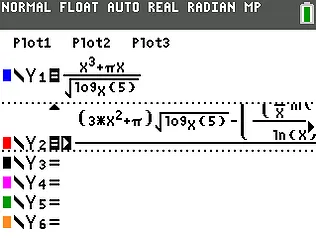
 fleet terrace
i wanna calculate the symbolic derivative on the ti-84 plus ce and found a program
cedar kilnBOT
fleet terrace
i wanna calculate the symbolic derivative on the ti-84 plus ce and found a progr...
fleet terrace
how to use it?
i put the 5 files in the calculator directory, and selected it in the prgm menu, how do i use it?

TI84CalcWiz
Author: Nathan Farlow Apps & Programs > Math Programs What is it? This program allows you to find the symbolic derivative of any function on the TI-84 Plus CE graphing calculator. How Does it Work? All you have to do is type the function you would like to find the derivative of in Y1. Then, ... Read more
cedar kilnBOT
@fleet terrace Has your question been resolved?
cedar kilnBOT
@fleet terrace Has your question been resolved?
cedar kilnBOT
Channel closed
Closed due to timeout
Use .reopen if this was a mistake.
Available help channel!
Send your question here to claim the channel.
Remember:
• Ask your math question in a clear, concise manner.
• Show your work, and if possible, explain where you are stuck.
• After 15 minutes, feel free to ping <@&286206848099549185>.
• Type the command .close to free the channel when you're done.
• Be polite and have a nice day!
Read #❓how-to-get-help for further information on how to ask a good question, and about conduct in the question channels.
 tawny prism
Question on the quadratic formula
cedar kilnBOT
tawny prism
Question on the quadratic formula
tawny prism
So when you find the values of b² and 4ac
how do you know when to add or subtract them
tawny prism
but my teacher also adds them after you find the values sometimes
is it when b² is greater than 4ac
that you subtract
because whenever 4ac is greater
she seems to sdd
add*
livid hound
if 4ac is negative, you'd end up "adding" a value to b^2,
but ultimately 4ac is being subtracted from b^2
don't get hung up on specific cases
its just general simplification
add/subtract depending on the signs of what you have
cedar kilnBOT
Channel closed
Closed by @tawny prism
Use .reopen if this was a mistake.
Available help channel!
Send your question here to claim the channel.
Remember:
• Ask your math question in a clear, concise manner.
• Show your work, and if possible, explain where you are stuck.
• After 15 minutes, feel free to ping <@&286206848099549185>.
• Type the command .close to free the channel when you're done.
• Be polite and have a nice day!
Read #❓how-to-get-help for further information on how to ask a good question, and about conduct in the question channels.
 steady elk
in 35 question book says option a
 cedar kilnBOT
steady elk
in 35 question book says option a
steady elk
cedar kilnBOT
steady elk
in 35 question book says option a
steady elk
but isnt option c right ?
livid hound
how are you getting c
 livid hound
1/x doesn't approach 0 as x→0
livid hound
$\lim_{u\to0} \frac{\sin(u)}{u} = 1$ doesn't apply here
wraith daggerBOT
ℝamonov
 livid hound
just because you see something in the form sin(u)/u with a limit, doesn't mean its automatically 1
steady elk
so basically this should had been equal to 1 if the argument of sine and the same thing below tends to zero
when we arrange them in fraction
livid hound
if they tend to 0 at the same rate
livid hound
youtube vids from organic chem tut, prof leonard come highly recommended
livid hound
for this specific question
you should consider stuff like squeeze/sandwich theorem and/or that sin is a bounded function
cedar kilnBOT
Channel closed
Closed by @steady elk
Use .reopen if this was a mistake.
Available help channel!
Send your question here to claim the channel.
Remember:
• Ask your math question in a clear, concise manner.
• Show your work, and if possible, explain where you are stuck.
• After 15 minutes, feel free to ping <@&286206848099549185>.
• Type the command .close to free the channel when you're done.
• Be polite and have a nice day!
Read #❓how-to-get-help for further information on how to ask a good question, and about conduct in the question channels.
 small cloak
idk what to do
 cedar kilnBOT
small cloak
idk what to do
cedar kilnBOT
small cloak
idk what to do
 vague rapids
Did you make the diagram yourself?
cedar kilnBOT
@small cloak Has your question been resolved?
small cloak
vague rapids
Did you make the diagram yourself?
yes
vague rapids
AD is the diameter
your diagram seems wrong
Redraw it with AD=diameter (it will pass through centre of circle)
small cloak
how
vague rapids
This should be the correct one

use angle in a semicircle and properties of cyclic quadrilateral to solve it
Ping me if you're stuck
vague rapids
Property 2

Hint:|| Connect A to C and B to D||

These both should be enough for this problem
small cloak
so b and c are 90?
vague rapids
Write the complete angle not just b and c
angle ABD and angle ACD are equal to 90 degrees
small cloak
these are 90 right?

 cedar kilnBOT
@small cloak Has your question been resolved?
cedar kilnBOT
Channel closed
Closed due to timeout
Use .reopen if this was a mistake.
Available help channel!
Send your question here to claim the channel.
Remember:
• Ask your math question in a clear, concise manner.
• Show your work, and if possible, explain where you are stuck.
• After 15 minutes, feel free to ping <@&286206848099549185>.
• Type the command .close to free the channel when you're done.
• Be polite and have a nice day!
Read #❓how-to-get-help for further information on how to ask a good question, and about conduct in the question channels.
 atomic pelican
 cedar kilnBOT
atomic pelican
cedar kilnBOT
atomic pelican
What step are you on?
1. I don't know where to begin
2. I have begun but got stuck midway
3. I got an answer but I'm told it's wrong
4. I got an answer and would like my work checked
5. I have a question about someone else's worked solution
6. None of the above
Show your work, and if possible, explain where you are stuck.
atomic pelican
its a pretty straight foward equation man
im just not sure if any of these options are correct
obsidian coral
You got an answer and want your work checked, is the option you picked. How can people check your work if you don't show any?
atomic pelican
fair
crystal raptor
You could also just check on a calculator
atomic pelican
so whats the point of the server then
 humble fjord
atomic pelican
so whats the point of the server then
humble fjord
atomic pelican
so whats the point of the server then
more complex problems
obsidian coral
Mostly as a last resort if you're truely stuck and exhausted all resources
atomic pelican
...
atomic pelican
humble fjord
more complex problems
dont you see the problem with this statement
humble fjord
no
atomic pelican
obsidian coral
Mostly as a last resort if you're truely stuck and exhausted all resources
understandable
humble fjord
by this time you could've checked the result
obsidian coral
Anyways, instead of bickering, how about you show what you did?
atomic pelican
humble fjord
no
help is help regardless of the complexity, i came here for help not for you to tell me the questions easy
atomic pelican
obsidian coral
Anyways, instead of bickering, how about you show what you did?
i added
lemme get my phone so i can take a pic
obsidian coral
Also is there any more context to that question?
atomic pelican
nope
humble fjord
misprint i would say
atomic pelican
its in the first section of a csec paper 1
not expecting yall to know csec

it keeps flipping...
obsidian coral
If it's a past paper, to a common exam, most of the time, the answers are online
And just to ask, what year are you?
,rotate
wraith daggerBOT
 atomic pelican
obsidian coral
And just to ask, what year are you?
atomic pelican
obsidian coral
And just to ask, what year are you?
5th form
obsidian coral
5th form? What does that mean?
obsidian coral
I'm only asking because 11.1 + 0.01 is most of the time basic math taught in primary schools, like in grade 4 or 5ish
 zenith stag
atomic pelican
zenith stag
atomic pelican
it's probably not addition
atomic pelican
as i said its like the second question on the paper
zenith stag
divison seems more resonable
obsidian coral
atomic pelican
as i said its like the second question on the paper
What paper is it? Like what year was the paper?
atomic pelican
zenith stag
it's probably not addition
OH YEAH
atomic pelican
obsidian coral
What paper is it? Like what year was the paper?
ok so
csec maths paper 1
from jan 2006
obsidian coral
You see, that context would have been helpful, because then people could have looked that paper up
And would have told you what shik said
atomic pelican
obsidian coral
And would have told you what shik said
you asked and you got it sir no need to fret
obsidian coral
Because clearly looking at your screenshot, it's hard to tell what operation it was asking but looking it up myself, I can see the dots
atomic pelican
i can barely see them myself on the paper
obsidian coral
I definitely see the separation
 obsidian coral
There is a little gap between the dot and fraction
Anyways, close the channel if you're done
atomic pelican
yeah i appreciate your effort man
dont think a calculator wouldve done anything for me
thanks
also
how do i close
zenith stag
.close
atomic pelican
.close
cedar kilnBOT
Channel closed
Closed by @atomic pelican
Use .reopen if this was a mistake.
Available help channel!
Send your question here to claim the channel.
Remember:
• Ask your math question in a clear, concise manner.
• Show your work, and if possible, explain where you are stuck.
• After 15 minutes, feel free to ping <@&286206848099549185>.
• Type the command .close to free the channel when you're done.
• Be polite and have a nice day!
Read #❓how-to-get-help for further information on how to ask a good question, and about conduct in the question channels.
 worthy leaf
Can anyone help with part d
 cedar kilnBOT
worthy leaf
Can anyone help with part d
worthy leaf
cedar kilnBOT
worthy leaf
Can anyone help with part d
worthy leaf
Heres my current working up until part d. Im not sure if its correct so it may need checking
 cedar kilnBOT
@worthy leaf Has your question been resolved?
worthy leaf
<@&286206848099549185>
worthy leaf
<@&286206848099549185>
worthy leaf
.close
cedar kilnBOT
Channel closed
Closed by @worthy leaf
Use .reopen if this was a mistake.
Available help channel!
Send your question here to claim the channel.
Remember:
• Ask your math question in a clear, concise manner.
• Show your work, and if possible, explain where you are stuck.
• After 15 minutes, feel free to ping <@&286206848099549185>.
• Type the command .close to free the channel when you're done.
• Be polite and have a nice day!
Read #❓how-to-get-help for further information on how to ask a good question, and about conduct in the question channels.
 grizzled widget
what are the steps
 cedar kilnBOT
Channel closed
Closed by @grizzled widget
Use .reopen if this was a mistake.
Available help channel!
Send your question here to claim the channel.
Remember:
• Ask your math question in a clear, concise manner.
• Show your work, and if possible, explain where you are stuck.
• After 15 minutes, feel free to ping <@&286206848099549185>.
• Type the command .close to free the channel when you're done.
• Be polite and have a nice day!
Read #❓how-to-get-help for further information on how to ask a good question, and about conduct in the question channels.
cedar kilnBOT
cedar kilnBOT
@bleak ether Has your question been resolved?
 celest seal
.close
cedar kilnBOT
Channel closed
Closed by @celest seal
Use .reopen if this was a mistake.
Available help channel!
Send your question here to claim the channel.
Remember:
• Ask your math question in a clear, concise manner.
• Show your work, and if possible, explain where you are stuck.
• After 15 minutes, feel free to ping <@&286206848099549185>.
• Type the command .close to free the channel when you're done.
• Be polite and have a nice day!
Read #❓how-to-get-help for further information on how to ask a good question, and about conduct in the question channels.
 marsh pond
how would I solve this?
 cedar kilnBOT
marsh pond
how would I solve this?
marsh pond
cedar kilnBOT
marsh pond
how would I solve this?
marsh pond
A^T is a 4x1 matrix
[1x4] x [4x1] = [1x1] matrix
so A * A^T = [1x1] matrix
but A^T * A = [4x1] x [1x4]
so A^T * A = [4x4] matrix
am I just looking for B here?
so B = [4x4] matrix + [4x4] identity matrix
i would end up with:
2 1 1 1 1 2 1 1 1 1 2 1 1 1 1 2
now I just find the determinant of this?
 tropic oxide
yes that is A^T A + I and yes now you just find the det of that
marsh pond
OK
marsh pond
tropic oxide
yes that is A^T A + I and yes now you just find the det of that

I should be getting 5 but somehow I'm really messing this up
oh it should be 3[6-2]
but still wrong
12 - 1 - 2 = 9
wraith daggerBOT
adamchebil33
 marsh pond
wraith dagger
**adamchebil33**
marsh pond
wraith dagger
**adamchebil33**
I don't think we learned this yet
but semi-interesting nonetheless..
doesn't really help me here unfortunately
I still need to find the determinant of the 4x4 matrix
I am pretty sure I know what I did wrong tho
I multiplied the scalar too early
I needed to find the determinant of the 3x3 first, and then multiplied that with the scalar
 dire geode
marsh pond
dire geode
marsh pond
Your first line after the equal sign
You expanded the determinant incorrectly
 silver fable
Yes u don't need it you need to use row operations
dire geode
You multiplied 2 to the 3x3 matrix instead of multiplying 2 to the determinant
marsh pond
dire geode
Your first line after the equal sign
i need to do this instead for each 3x3?

i'm looking for a good way to organize this, it's getting very messy