
#help-13
1 messages · Page 123 of 1
 tight cove
 cedar kilnBOT
tight cove
The sheet says to “Graph then state whether the following relations are function...
cedar kilnBOT
tight cove
The sheet says to “Graph then state whether the following relations are function...
 sage badge
tight cove
The sheet says to “Graph then state whether the following relations are function...
sage badge
tight cove
The sheet says to “Graph then state whether the following relations are function...
Find y by itself
 surreal cave
tight cove
The sheet says to “Graph then state whether the following relations are function...
surreal cave
tight cove
The sheet says to “Graph then state whether the following relations are function...
solve for y
tight cove
Would it be x = y2
surreal cave
Solve for $y$ in $3x+2y=10$
 wraith daggerBOT
XxMrFancyu2xX
 surreal cave
Ok, instead how about try to pick point values $x$ and $y$ that $3x+2y=10$ for example $x=2$ and $y=2$ works
wraith daggerBOT
XxMrFancyu2xX
 surreal cave
can you try to find any other points that work?
tight cove
x = 1 and y = 3.5
 neon moon
Non-integer points are tough to be drawn. Consider we have a 3x term on LHS and a 10 on RHS, we may not want x to be odd number.
Some suggested points for you will be (-2, ?), (0, ?), (2, ?), (4, ?), etc, in which those ? can be found by solving equation with the preset x value.
 odd remnant
tight cove
LHS?
odd remnant
tight cove
LHS?
left hand side
odd remnant
tight cove
RHS?
right hand side
neon moon
In case you need any help on the vocabulary.
 tight cove
Brain hurt
tight cove
tight cove
The sheet says to “Graph then state whether the following relations are function...
This is supposed to just be an example all I need is an answer
cedar kilnBOT
@tight cove Has your question been resolved?
cedar kilnBOT
Channel closed
Closed by @tight cove
Use .reopen if this was a mistake.
 Available help channel!
Send your question here to claim the channel.
Remember:
• Ask your math question in a clear, concise manner.
• Show your work, and if possible, explain where you are stuck.
• After 15 minutes, feel free to ping <@&286206848099549185>.
• Type the command .close to free the channel when you're done.
• Be polite and have a nice day!
Read #❓how-to-get-help for further information on how to ask a good question, and about conduct in the question channels.
 lunar flare
Hi! Could someone help me understand what I'm doing wrong in this question? I tried differentiating f(x,y) and multiplying fx by va and fy by vb, but that didn't work.
 cedar kilnBOT
lunar flare
Hi! Could someone help me understand what I'm doing wrong in this question? I tr...
neon moon
cedar kilnBOT
lunar flare
Hi! Could someone help me understand what I'm doing wrong in this question? I tr...
neon moon
Hint: What is the sign of dx/dt and dy/dt?
cedar kilnBOT
Channel closed
Closed by @lunar flare
Use .reopen if this was a mistake.
cedar kilnBOT
Available help channel!
Send your question here to claim the channel.
Remember:
• Ask your math question in a clear, concise manner.
• Show your work, and if possible, explain where you are stuck.
• After 15 minutes, feel free to ping <@&286206848099549185>.
• Type the command .close to free the channel when you're done.
• Be polite and have a nice day!
Read #❓how-to-get-help for further information on how to ask a good question, and about conduct in the question channels.
 crimson sedge
7p^2- 38p - 24 = 0 i want to check my answers with someone for my vertex i got (19/7, -529/7), for my roots i got (-4/7,0) and (6,0) i got my parabola is upwards and a minimum, my y int is -24, for my aos i got 19/7. If someone could check these id be really happy cause im stressing about this project due tmmr that determines if i take the final exam
cedar kilnBOT
crimson sedge
7p^2- 38p - 24 = 0 i want to check my answers with someone for my vertex i got ...
@crimson sedge Has your question been resolved?
crimson sedge
.close
cedar kilnBOT
Channel closed
Closed by @runic gust
Use .reopen if this was a mistake.
Available help channel!
Send your question here to claim the channel.
Remember:
• Ask your math question in a clear, concise manner.
• Show your work, and if possible, explain where you are stuck.
• After 15 minutes, feel free to ping <@&286206848099549185>.
• Type the command .close to free the channel when you're done.
• Be polite and have a nice day!
Read #❓how-to-get-help for further information on how to ask a good question, and about conduct in the question channels.
 simple breach
how do I know if the sequence (6n^3-2n)/(3n^2+2) converges or diverges?
I tried dividing all the terms of the numerator and denominator by n^3 first:
for the numerator, I got 6- 2/n^2, which evaluates to 6 as n approaches infinity
for the denominator, the function I was trying to evaluate was 3/n + 2/n^3. When I try to evaluate it as n approaches infinity I got 0. I'm not sure what to do from here, since the denominator's limit is 0 so I can't divide the limits
cedar kilnBOT
simple breach
how do I know if the sequence (6n^3-2n)/(3n^2+2) converges or diverges?
I tried ...
 dire geode
simple breach
how do I know if the sequence (6n^3-2n)/(3n^2+2) converges or diverges?
I tried ...
dire geode
simple breach
how do I know if the sequence (6n^3-2n)/(3n^2+2) converges or diverges?
I tried ...
Don't divide by the highest term in the numerator. Divide by the highest term in the denominator
simple breach
ok I see, so since the numerator 6n- 2/n will evaluate to infinity, then the whole fraction will evaluate to infinity and thus the sequence diverges?
.close
cedar kilnBOT
Channel closed
Closed by @simple breach
Use .reopen if this was a mistake.
cedar kilnBOT
Available help channel!
Send your question here to claim the channel.
Remember:
• Ask your math question in a clear, concise manner.
• Show your work, and if possible, explain where you are stuck.
• After 15 minutes, feel free to ping <@&286206848099549185>.
• Type the command .close to free the channel when you're done.
• Be polite and have a nice day!
Read #❓how-to-get-help for further information on how to ask a good question, and about conduct in the question channels.
 rain vine
The process I did:
$$ (1-4x)^{-1} \geq 7 $$
$$ \frac {1}{1-4x} \geq 7 $$
$$ 1 \geq 7 - 28x $$
$$ 28x + 1 \geq 7 $$
$$ 28x \geq 6 $$
$$ x \geq \frac {6} {28} $$
$$ x \geq \frac {3} {14} $$
but the answer is $\left[\frac {3} {14}, \frac 1 4\right) $
 cedar kilnBOT
rain vine
The process I did:
$$ (1-4x)^{-1} \geq 7 $$
$$ \frac {1}{1-4x} \geq 7 $$
$$ 1 \...
wraith daggerBOT
cedar kilnBOT
rain vine
The process I did:
$$ (1-4x)^{-1} \geq 7 $$
$$ \frac {1}{1-4x} \geq 7 $$
$$ 1 \...
wraith daggerBOT
JXHN
 neon moon
Hint: 1 - 4x has to be greater than 0, but why?
rain vine
neon moon
Hint: 1 - 4x has to be greater than 0, but why?
reciporcal property of inequalities i know that but there is not zero here
neon moon
Or let’s put it this way, your step 2 to step 3 is wrong, since you don’t know what os the sign of 1 - 4x, you cannot just multiply that denominator to the other side and pretend the inequality direction remains unchanged
rain vine
oh okay then can i take 7 to left hand side in step 2 then?
neon moon
A better way would be to do it like this,
$$ (1-4x)^{-1} \geq 7 $$
$$ \frac {1}{1-4x} \geq 7 $$
$$ \frac {1}{1-4x} \cdot (1 - 4x)^2 \geq 7 (1 - 4x)^2 \text{ and } 1 - 4x \neq 0 $$
$$ \dots $$
wraith daggerBOT
jimmy1234
 rain vine
i don't understand i understand the process but i don't understand the concept
rain vine
neon moon
A better way would be to do it like this,
$$ (1-4x)^{-1} \geq 7 $$
$$ \frac {1}...
this would just make the question in quadratic equation
from that we get two values?
for x?
neon moon
You are right it makes it a quadratics, but then we can make the "move-denominator-to-the-other-side" step legit.
Method 2 is to consider the question case by case. It applies whenever you have variable in denominators.
Case 1, 1 - 4x > 0, then should you change sign in step 3 or not
Case 2. 1 - 4x < 0, then you should again think about sign change at that step and so on.
cedar kilnBOT
@rain vine Has your question been resolved?
rain vine
@neon moon sorry I was afk.
I understand why (1-4x)^2 makes the denoinators moves since a^2 >= 0.
so I just have to solve the quadratic equation after that right?
cedar kilnBOT
Channel closed
Closed due to timeout
Use .reopen if this was a mistake.
Available help channel!
Send your question here to claim the channel.
Remember:
• Ask your math question in a clear, concise manner.
• Show your work, and if possible, explain where you are stuck.
• After 15 minutes, feel free to ping <@&286206848099549185>.
• Type the command .close to free the channel when you're done.
• Be polite and have a nice day!
Read #❓how-to-get-help for further information on how to ask a good question, and about conduct in the question channels.
crimson sedge
Consider an elastic string whose ends are held fixed ($u(0,t) = 0 = u(L,t)$). The string is set in motion from its equilibrium position with an initial velocity $u_t(x,0) = g(x)$, where $g(x)$ is $f(x)$ from Exercise 2.
$f(x) = \begin{cases}
\frac{4x}{L} & 0 \le x \le \frac{L}{4} \
1 & \frac{L}{4} < x < \frac{3L}{4} \
\frac{4(L-x)}{L} & \frac{3L}{4} \le x \le L
\end{cases}$
a) Find the displacement $u(x,t)$ for $g(x)$ as given by $f(x)$ above. \
b) Plot $u(x,t)$ vs $x$ for $0 \le x \le 10$ and for several values of $t$ for $0 \le t \le 20$. \
c) Plot $u(x,t)$ vs $t$ for $0 \le t \le 20$ and for several values of $x$. \
d) Describe the motion of the string.
cedar kilnBOT
crimson sedge
Consider an elastic string whose ends are held fixed ($u(0,t) = 0 = u(L,t)$). Th...
wraith daggerBOT
CrimsonDevil_Rias
 crimson sedge
I've solved a similar problem to this before except $f(x)$ and $g(x)$ were swapped.
Now that $f(x) = 0$ and $g(x) = u_t(x,0)$, what do I do here?
wraith daggerBOT
CrimsonDevil_Rias
 cedar kilnBOT
@crimson sedge Has your question been resolved?
cedar kilnBOT
@crimson sedge Has your question been resolved?
cedar kilnBOT
@crimson sedge Has your question been resolved?
cedar kilnBOT
@crimson sedge Has your question been resolved?
 crimson sedge
crimson sedge
crimson sedge
Uh
Were no help channels available?
1170
Ratio of savings to spending is 9 to 4
Thus, 9/13 out of 1170 is used for saving and 4/13 out of 1170 is used for spending
Therefore, 810 is saved and 360 is spent
95
Ratio of comedy to action to horror is 6 to 8 to 5
Total number is 19
Thus 6/19 out of 95 is comedy
8/19 out of 95 is action
5/19 out of 95 is horror
Arthur owns 40 action movies, 30 comedy movies, and 25 horror movies
You're welcome
I answered your question, now someone please come help me answer mine
Lest I get the process out of Quizlet
@crimson sedge I hope my explanation helped you
If you are dealing with ratios, add all of the numbers up. That's your denominator. The individual numbers each serve as the numerator of said category
If the ratio is 9:4 like in this example, then 13 is your denominator
Thus, one part is 9/13 and the other is 4/13
Same applies with n-category ratios
n1 : n2 : n3 : n4 : ...
The distribution of is as follows:
n1/(n1 + n2 + n3 + n4 + ...), n2/(n1 + n2 + n3 + n4 + ...), n3/(n1 + n2 + n3 + n4 + ...), n4/(n1 + n2 + n3 + n4 + ...),
crimson sedge
<@&286206848099549185>
 torpid shard
@crimson sedge don't tag without any need
crimson sedge
Bruh
crimson sedge
torpid shard
<@456226577798135808> don't tag without any need
Did you even read the question?
torpid shard
Where's the question?
crimson sedge
Pinned message
torpid shard
Last question was DarkAmber's
cedar kilnBOT
@crimson sedge Has your question been resolved?
crimson sedge
torpid shard
Last question was DarkAmber's
They posted their question in this channel because they thought my own question had been resolved
cedar kilnBOT
@crimson sedge Has your question been resolved?
crimson sedge
crimson sedge
You should ask the question in the physics server as well
I left that server
This question is more directed towards Fourier series
I see
crimson sedge
I already have part a) solved. Parts b) and c) require me to just plot graphs and stuff Part d) asks me to describe the motion of the string
crimson sedge
Find the amplitude of the resulting wave
Basically find maximum of X(x) and T(t)
Answer= ||A^2||
Weird that nobody helped u
Isn't that difficult
crimson sedge
@crimson sedge
crimson sedge
crimson sedge
Weird that nobody helped u

To find the Fourier series of the function, you must first set up eigenvalue problems involving X and T
$\alpha^2 u_{xx} = u_{tt}$
wraith daggerBOT
CrimsonDevil_Rias
 crimson sedge
If $u(x,t)$ be written as $X(x)T(t)$, then the above becomes the following
wraith daggerBOT
CrimsonDevil_Rias
 crimson sedge
$\alpha^2 X''T = XT''$
wraith daggerBOT
CrimsonDevil_Rias
 wraith daggerBOT
CrimsonDevil_Rias
 crimson sedge
Since these are to be turned into eigenvalue problems, we need to equate them to a certain constant
We call this constant -λ
Thus we have
$\alpha^2 \frac{X''}{X} = -\lambda$
wraith daggerBOT
CrimsonDevil_Rias
 wraith daggerBOT
CrimsonDevil_Rias
 crimson sedge
Both of these are second order differential equations
$\alpha^2 X'' + X \lambda= 0 \
T'' + T\lambda = 0$
wraith daggerBOT
CrimsonDevil_Rias
 crimson sedge
Use the method of characteristic equations to solve for X(x) and T(t)
$\alpha^2 r^2 + \lambda = 0$ for $X(x)$ \
$r^2 + \lambda = 0$ for $T(t)$
wraith daggerBOT
CrimsonDevil_Rias
 crimson sedge
Solve for $r$ in each characteristic equation
wraith daggerBOT
CrimsonDevil_Rias
 crimson sedge
$X(x) : r = \pm \frac{i\sqrt{\lambda}}{\alpha} \
T(t) : r = \pm i\sqrt{\lambda}$
wraith daggerBOT
CrimsonDevil_Rias
 crimson sedge
The general solutions for each differential equation are given as follows
$X(x) : c_1e^{\frac{i\sqrt{\lambda}}{\alpha}} + c_2e^{-\frac{i\sqrt{\lambda}}{\alpha}} = 0 \
T(t) : c_1e^{i\sqrt{\lambda}} + c_2e^{-i\sqrt{\lambda}} = 0$
wraith daggerBOT
CrimsonDevil_Rias
 crimson sedge
Use Euler's identity
$X(x) : c_1 \left(\cos{\frac{\sqrt{\lambda}}{\alpha}} + i \sin{\frac{\sqrt{\lambda}}{\alpha}}\right) + c_2 \left(\cos{\frac{i\sqrt{\lambda}}{\alpha}} - i \sin{\frac{\sqrt{\lambda}}{\alpha}}\right) = 0 \
T(t) : c_1 (\cos{\sqrt{\lambda}} + i \sin{\sqrt{\lambda}}) + c_2 (\cos{\sqrt{\lambda}} - i \sin{\sqrt{\lambda}}) = 0$
wraith daggerBOT
CrimsonDevil_Rias
 crimson sedge
Distributive property gives us
crimson sedge
crimson sedge
$X(x) : c_1 \left(\cos{\frac{\sqrt{\lambda}}{\alpha}} + i \sin{\frac{\sqrt{\lamb...
$X(x) : k_1 \cos{\frac{\sqrt{\lambda}}{\alpha}} + k_2 \sin{\frac{\sqrt{\lambda}}{\alpha}} = 0 \
T(t) : k_1 \cos{\sqrt{\lambda}} + k_2 \sin{\sqrt{\lambda}} = 0$
wraith daggerBOT
CrimsonDevil_Rias
 crimson sedge
Now that we have $X(x)$ and $T(t)$, we need to impose our boundary conditions
wraith daggerBOT
CrimsonDevil_Rias
 crimson sedge
The string of length $L$ is held fixed at its ends
wraith daggerBOT
CrimsonDevil_Rias
 wraith daggerBOT
CrimsonDevil_Rias
 wraith daggerBOT
CrimsonDevil_Rias
 crimson sedge
Now do you understand where this is going?
When all of the conditions are satisfied, you will be left with something resembling a Fourier series
That means
$u(x,t) = \sum_{n = 1}^\infty u_n(x,t) \cdot c_n$
wraith daggerBOT
CrimsonDevil_Rias
 wraith daggerBOT
CrimsonDevil_Rias
 crimson sedge
And in those eigenfunctions,
$\lambda_n$ are your eigenvalues $\forall n \in \mathbb{N}$
wraith daggerBOT
CrimsonDevil_Rias
 crimson sedge
This
This right here is exactly why I said this is leaning more towards Fourier series than complex physics
 sonic thistle
Rias>Akeno
 livid tusk
wraith dagger
**CrimsonDevil\_Rias**
livid tusk
wraith dagger
**CrimsonDevil\_Rias**
@crimson sedge easier to set it up this way
$$X''+\Lm X=0$$
$$T''+\a^2\Lm T=0$$
wraith daggerBOT
nilpotent nix (nix)
 livid tusk
just makes everything come out nicer
since you need $X(0)=X(L)=0$ then you know $X_n(x)=\sin\paren{\frac{n\pi x}{L}}$
so $\Lm=\paren{\frac{n\pi}{L}}^2$
it's been a bit since i've done PDEs so does that sound about right
wraith daggerBOT
nilpotent nix (nix)
 livid tusk
then that means $T_n(t)=a_n\cos\paren{\frac{n\a\pi x}{L}}+b_n\sin\paren{\frac{n\a\pi x}{L}}$
wraith daggerBOT
nilpotent nix (nix)
 livid tusk
is this all ringing a bell
cedar kilnBOT
@crimson sedge Has your question been resolved?
cedar kilnBOT
Channel closed
Closed due to timeout
Use .reopen if this was a mistake.
Available help channel!
Send your question here to claim the channel.
Remember:
• Ask your math question in a clear, concise manner.
• Show your work, and if possible, explain where you are stuck.
• After 15 minutes, feel free to ping <@&286206848099549185>.
• Type the command .close to free the channel when you're done.
• Be polite and have a nice day!
Read #❓how-to-get-help for further information on how to ask a good question, and about conduct in the question channels.
 muted nest
hi
cedar kilnBOT
muted nest
hi
 runic garnet
cedar kilnBOT
runic garnet
cedar kilnBOT
@muted nest Has your question been resolved?
cedar kilnBOT
Channel closed
Closed due to timeout
Use .reopen if this was a mistake.
Available help channel!
Send your question here to claim the channel.
Remember:
• Ask your math question in a clear, concise manner.
• Show your work, and if possible, explain where you are stuck.
• After 15 minutes, feel free to ping <@&286206848099549185>.
• Type the command .close to free the channel when you're done.
• Be polite and have a nice day!
Read #❓how-to-get-help for further information on how to ask a good question, and about conduct in the question channels.
 inland fossil
 cedar kilnBOT
inland fossil
cedar kilnBOT
cedar kilnBOT
inland fossil
cedar kilnBOT
@inland fossil Has your question been resolved?
cedar kilnBOT
@inland fossil Has your question been resolved?
cedar kilnBOT
Channel closed
Closed due to timeout
Use .reopen if this was a mistake.
Available help channel!
Send your question here to claim the channel.
Remember:
• Ask your math question in a clear, concise manner.
• Show your work, and if possible, explain where you are stuck.
• After 15 minutes, feel free to ping <@&286206848099549185>.
• Type the command .close to free the channel when you're done.
• Be polite and have a nice day!
Read #❓how-to-get-help for further information on how to ask a good question, and about conduct in the question channels.
 solemn basin
the question is find the equation of a cruve with derivitive 10e^2-(3/2)x dx and passes through the origin. I integrated it to get the answer of -2e^-5x-1 but it has a +2/e
cedar kilnBOT
solemn basin
the question is find the equation of a cruve with derivitive 10e^2-(3/2)x dx an...
solemn basin
how do you get that part?
 worthy cairn
solemn basin
how do you get that part?
worthy cairn
solemn basin
how do you get that part?
Is the derivative $10e^2- \frac{3}{2} x$ or $10e^{2-(3/2)x}$? Either way, that integral looks wrong
wraith daggerBOT
catGPT
 worthy cairn
Ok so then your integral is $y = -2e^{-5x-1}+c$. You need the +c because it's an indefinite integral. Then you use the condition they give you to find c
wraith daggerBOT
catGPT
 worthy cairn
They say it goes through the origin, so plug in the coordinates of the origin into the integral and find c
cedar kilnBOT
Channel closed
Closed by @solemn basin
Use .reopen if this was a mistake.
cedar kilnBOT
Available help channel!
Send your question here to claim the channel.
Remember:
• Ask your math question in a clear, concise manner.
• Show your work, and if possible, explain where you are stuck.
• After 15 minutes, feel free to ping <@&286206848099549185>.
• Type the command .close to free the channel when you're done.
• Be polite and have a nice day!
Read #❓how-to-get-help for further information on how to ask a good question, and about conduct in the question channels.
 native blaze
Given any function f : R → (0, +∞) we define a new function ∆f : R → R
per:
∆f(x) = f(x + 1) − f(x).
Define ∆2f(x) := ∆(∆f)(x) and, given any n ∈ N, define ∆nf(x) = ∆(∆n−1f(x)).
1.Prove that ∆(f + g)(x) = ∆f(x) + ∆g(x).
2.Prove that ∆(f · g)(x) = f(x + 1)∆g(x) + g(x)∆f(x).
3.Prove that ∆(f/g)(x) = (g(x) · ∆f(x) − f(x)∆g(x))/(g(x)g(x + 1)).
4.Find a function h(x) that satisfies:
∆h(x) = h(x).
cedar kilnBOT
native blaze
Given any function f : R → (0, +∞) we define a new function ∆f : R → R
per:
∆f(x...
@native blaze Has your question been resolved?
cedar kilnBOT
Channel closed
Closed due to timeout
Use .reopen if this was a mistake.
Available help channel!
Send your question here to claim the channel.
Remember:
• Ask your math question in a clear, concise manner.
• Show your work, and if possible, explain where you are stuck.
• After 15 minutes, feel free to ping <@&286206848099549185>.
• Type the command .close to free the channel when you're done.
• Be polite and have a nice day!
Read #❓how-to-get-help for further information on how to ask a good question, and about conduct in the question channels.


 atomic ember
just for clarification, the . is multiplication operator right?
wraith daggerBOT
actually legend
 atomic ember
nw :)

 atomic ember
wraith dagger
**actually legend**
atomic ember
wraith dagger
**actually legend**
hmm from what i could observe is that one possible solution for x here would be to try to get both then numerator and denominator equal so u can have 1 + 1 = 2, so x in this case will be -23*10^8
wraith daggerBOT
actually legend
 atomic ember
im trying to think, i dont know if i have enough experience/knowledge to help but ill try 😅
cedar kilnBOT
@crimson sedge Has your question been resolved?
cedar kilnBOT
@crimson sedge Has your question been resolved?
cedar kilnBOT
Channel closed
Closed due to timeout
Use .reopen if this was a mistake.
Available help channel!
Send your question here to claim the channel.
Remember:
• Ask your math question in a clear, concise manner.
• Show your work, and if possible, explain where you are stuck.
• After 15 minutes, feel free to ping <@&286206848099549185>.
• Type the command .close to free the channel when you're done.
• Be polite and have a nice day!
Read #❓how-to-get-help for further information on how to ask a good question, and about conduct in the question channels.
 oak beacon
So I have got a problem solving this. The electron numbers of Nitrogen and oxygen in there last shells are 5 and 6 respectively. The last shell contains 4 orbitals and each orbital can hold up to 2 electrons. Now how many ways can we arrange N and O's last electron configuration? ( assuming they will create a bond by sharing single or multiple electrons but we won't consider it's chemical properties here)
cedar kilnBOT
oak beacon
So I have got a problem solving this. The electron numbers of Nitrogen and oxyge...
dire geode
oak beacon
So I have got a problem solving this. The electron numbers of Nitrogen and oxyge...
#old-network for physics or chemistry server
cedar kilnBOT
@oak beacon Has your question been resolved?
cedar kilnBOT
Channel closed
Closed due to timeout
Use .reopen if this was a mistake.
cedar kilnBOT
Available help channel!
Send your question here to claim the channel.
Remember:
• Ask your math question in a clear, concise manner.
• Show your work, and if possible, explain where you are stuck.
• After 15 minutes, feel free to ping <@&286206848099549185>.
• Type the command .close to free the channel when you're done.
• Be polite and have a nice day!
Read #❓how-to-get-help for further information on how to ask a good question, and about conduct in the question channels.
 tawdry summit
How do i write the decimal value of a binary number?
tawdry summit

 carmine bronze
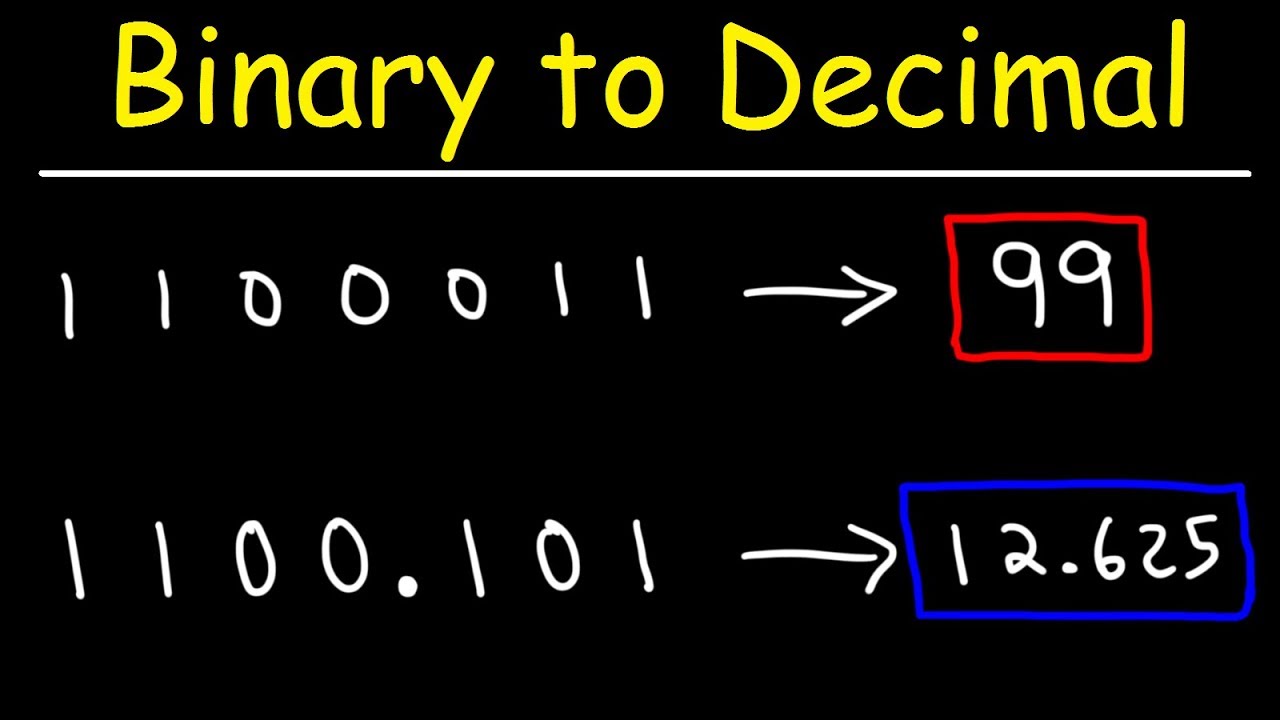
This video explains how to convert binary to decimal numbers.
Video Playlists:
https://www.video-tutor.net/video-playlist.html
My Twitter Page:
https://twitter.com/OrgoChemTutor21
Seems like you have already done the first two, what are you having difficulty with?
 rain drift
tawdry summit
rain drift
tawdry summit
You're on the right track for the first two.
Every digit to the left is a new power of 2. If it has a 1 in the slot then you count it.
So for example if you had 11111111, that would be 2^7 + 2^6 + 2^5 + 2^4 + 2^3 + 2^2 + 2^1+ 2^0 = 128 + 64 + 32 + 16 + 8 + 4 + 2 + 1 = 255
cedar kilnBOT
Channel closed
Closed by @tawdry summit
Use .reopen if this was a mistake.
cedar kilnBOT
Available help channel!
Send your question here to claim the channel.
Remember:
• Ask your math question in a clear, concise manner.
• Show your work, and if possible, explain where you are stuck.
• After 15 minutes, feel free to ping <@&286206848099549185>.
• Type the command .close to free the channel when you're done.
• Be polite and have a nice day!
Read #❓how-to-get-help for further information on how to ask a good question, and about conduct in the question channels.
 mighty mortar
Is this correct, specially 169/36 in the second step.
 cedar kilnBOT
mighty mortar
Is this correct, specially 169/36 in the second step.
cedar kilnBOT
mighty mortar
Is this correct, specially 169/36 in the second step.
@mighty mortar Has your question been resolved?
 molten compass
I know this doesn’t directly answer your question but have you tried using partial fractions
There seems to be a lot of algebra mess that could be avoided with partial fractions
Also your second line seems to work
Your 5th to 6th line doesn’t seem to work
I don’t know how you got log in one step
cedar kilnBOT
Channel closed
Closed due to timeout
Use .reopen if this was a mistake.
cedar kilnBOT
Available help channel!
Send your question here to claim the channel.
Remember:
• Ask your math question in a clear, concise manner.
• Show your work, and if possible, explain where you are stuck.
• After 15 minutes, feel free to ping <@&286206848099549185>.
• Type the command .close to free the channel when you're done.
• Be polite and have a nice day!
Read #❓how-to-get-help for further information on how to ask a good question, and about conduct in the question channels.
 uneven iron
Do you see something similar to the derivative of ln(2x+1) there?
Yes
Yes
Think about a way to eliminate the 2 in the denominator
Integrals are the anitderivatives
The result of the integral is a function which derivative is the function you already integrated
 sand cradle
This has been asked on Math StackExchange before:
https://math.stackexchange.com/questions/770792/how-to-integrate-int-frac112xdx?noredirect=1
https://math.stackexchange.com/questions/2188691/can-you-solve-int-frac12x1-dx-without-substitution?noredirect=1
uneven iron
$$\int{f(x)} = F(x)$$
$$F'(x) = f(x)$$
wraith daggerBOT
Rub05
 sand cradle
Np, I just wanted to point out that it has already been solved on MSE, google sometimes doesn't find LaTeX code
uneven iron
sand cradle
This has been asked on Math StackExchange before:
<https://math.stackexchange.co...
What's that website?
sand cradle
uneven iron
What's that website?
Math StackExchange. It's a math forum
uneven iron
1/2 ln|1+2x|...
It's just one step if you know derivatives and chain rule
Do you know how to differentiate?
uneven iron
uneven iron
Do you know how to differentiate?
.
Now that makes sense
What's your first language?
Hm... I'll just put and example of chain rule
$$f(x) = \ln(2x +1)$$
$$ f'(x) = \frac{1}{2x + 1} \times 2$$
wraith daggerBOT
Rub05
 uneven iron
If you want the function that's inside the integral you have to remove the 2, so divide the function by 2 and you have it
$$f(x) = \frac{\ln(2x+1)}{2}$$
$$f'(x) = \frac{1}{2} \times \frac{1}{2x+1} \times 2 = \frac{1}{2x +1}$$
wraith daggerBOT
Rub05
 uneven iron
Correct
It's more mechanical
But you should learn that method too
There are other integral that can be solved by parts
And sometimes, that method is really long
But sometimes, doing the method I told you (it's not even a method), you can do it in seconds
That method is not always useful
You have to see first if the function has the form of the derivative of a ln, a arctan or a chain rule
Not really
U-Sub doesn't work always
Integration is hard, don't worry
Nop
It's been a while since I don't use U-Sub
Maybe because your integrals are built for that method
Did you learn by parts or partial fractions?
$\int{\sqrt{9-x^2}dx}$
wraith daggerBOT
Rub05
 uneven iron
You need u-sub for that
That's the question
I know you said u = 9 - x²
Nope
You would make a harder integral
 short blade
have you heard of trigonometric substitutions?
uneven iron
I don't think so
wraith daggerBOT
maximo
 short blade
well let's work it out
first of all, we find dx in terms of dtheta
so $dx = 3\cos\theta , d\theta$
wraith daggerBOT
maximo
 short blade
you'll see
now we can sub in
$\int 3\sqrt{9 - (3\sin\theta)^2}\cos\theta ,d\theta$
wraith daggerBOT
maximo
 short blade
it works out nicely
you can simplify the square root
what is (3sin(theta))^2
$\sqrt{9-(3\sin\theta)^2} = \sqrt{9 - 9\sin^2\theta} = \sqrt{9\cdot(1-\sin^2\theta)}$
yes
wraith daggerBOT
maximo
 short blade
and what is 1-sin^2theta?
 ember mesa
$cos^{2}(θ)$
wraith daggerBOT
Zouni
 wraith daggerBOT
maximo
 short blade
yes
wraith daggerBOT
maximo
 short blade
but we usually forget the absolute value for integrals
so we just express it as $3\cos\theta$
wraith daggerBOT
maximo
 short blade
you can, but this is standard
ember mesa
it's called theta
short blade
theta is a very common letter for variable angles
uneven iron
$\alpha$ enjoyer
ember mesa
you can use phi, might look nicer
wraith daggerBOT
Rub05
 ember mesa
$φ$
wraith daggerBOT
Zouni

 dreamy sleet
x is already taken
wraith daggerBOT
maximo
 wraith daggerBOT
maximo
 short blade
doesn't that look nice?
ember mesa
let me guess, gcse?
short blade
trigonometric integrals are relatively easy
there's an identity here which is particularly handy
$\cos^2 u = \frac{1+\cos 2u}{2}$
wraith daggerBOT
maximo
 short blade
so we just substitute
no
integrating this is far easier
we have cos now instead of cos^2
short blade
wraith dagger
**maximo**
this holds every time yes
anyhow
now we get to $9\int\frac{1+\cos 2u}{2}, du$
wraith daggerBOT
maximo
 short blade
and using linearity $\frac{9}{2}\int 1, du + \frac{9}{2}\int \cos 2u, du$
wraith daggerBOT
maximo
 ember mesa
well you technically could just learn integration by parts and skip the substitution
have you done integration by parts
yeah you could technically just use that and not do substitution
but substitution is nicer
no
short blade
wraith dagger
**maximo**
are you asking how i got here @low lake
ember mesa
when you get 9cos^2u
short blade
$9\int\frac{1+\cos 2u}{2}, du = \frac{9}{2}\int 1, du + \frac{9}{2}\int \cos 2u, du$
wraith daggerBOT
maximo
 short blade
i pulled out the 2 in the bottom
and split the integral
now
what is the integral of 1?
u in our case
but yes
and the integral of cos(2u)?
it'll matter here
let's do a u sub then
let $v = 2u$
wraith daggerBOT
maximo
 wraith daggerBOT
maximo
 short blade
so we get
$\frac{9}{2}\int 1, du + \frac{9}{2}\int \cos 2u, du = \frac{9}{2}u + \frac{9}{2}\int \cos v\cdot \frac{1}{2}, dv$
what is the integral of cos(v)?
whoops
hold on
no i did
wraith daggerBOT
maximo
 ember mesa
$S (\omega)=\frac{\alpha g^2}{\omega^5} ,
e ^{[-0.74\scaleleftright[.7ex]{{}{\frac{\omega U_\omega 19.5}{g}}{}}^{-4}]}$
wraith daggerBOT
Zouni
Compile Error! Click the  reaction for more information.
(You may edit your message to recompile.)
 short blade
wraith dagger
**maximo**
short blade
wraith dagger
**maximo**
are you following up to here temmie
ember mesa
it is very important
short blade
it's just a bigger formula, don't worry about it
you don't need to know it
yes
that's not going to show up
no, but im like 99% sure
ember mesa
gobbler formula is very important
@short blade I think you have overcomplicated the question a little bit
short blade
how so
ember mesa
if someone isn't strong at maths, show the most algorithmic approach
short blade
the dv will go away relatively quickly
ember mesa
so trig sub then integratin by parts
short blade
i beg to differ, i think this is fine
ember mesa
I agree with you
short blade
 ember mesa
short blade
i beg to differ, i think this is fine
ember mesa
short blade
i beg to differ, i think this is fine
might be complicated to someone not familiar with substitution
short blade
yup
so let's write it in
$\frac{9}{2}u + \frac{9}{2}\int \cos v\cdot \frac{1}{2}, dv = \frac{9}{2}u + \frac{9}{4}\sin v + C$
wraith daggerBOT
maximo
 short blade
and what did we say v was?
$\frac{9}{2}u + \frac{9}{4}\sin v + C = \frac{9}{2}u + \frac{9}{4}\sin 2u + C$
wraith daggerBOT
maximo
 ember mesa
hint: gobbler formula
short blade
yes
wraith daggerBOT
maximo
 short blade
so what is u?
yes
plugging in
$\frac{9}{2}u + \frac{9}{4}\sin 2u + C = \frac{9}{2}\sin^{-1} \frac{x}{3} + \frac{9}{4}\sin(2\sin^{-1} \frac{x}{3}) + C$
wraith daggerBOT
maximo
 ember mesa
how are you that fast at typing laytex
short blade
the good thing is that we're done (barring some simplifying)
short blade
ember mesa
how are you that fast at typing laytex
copy paste
yes
we can simplify some
but it still isn't super pretty
dreamy sleet
is there a way to simplify $$ \sin (2 \arcsin \frac x3) $$ here
wraith daggerBOT
l33t_syncopations
 short blade
yes
ember mesa
yes
short blade
it should be 2x * sqrt(9-x^2) / 9
as to how, you use a right triangle
i would show you but i think that's something you learnt in trig and not really the point
short blade
ember mesa
wouldn't you run into domain problems <@217089972933623808>
we just assume the domain works
the questions aren't really about trig
ember mesa
right
short blade
it's about integration, but you're right
we'd have to specify domains
the domain for x
ember mesa
dw
wraith daggerBOT
maximo
 short blade
suppose we said $x = \cos u$
wraith daggerBOT
maximo
 short blade
experience
short blade
wraith dagger
**maximo**
so
ember mesa
the trig sub comes from $sin^{2}x + cos^{2}x = 1$
wraith daggerBOT
Zouni
 short blade
$\sqrt{9 - \cos^2 u}$
wraith daggerBOT
maximo
 short blade
now we can't use $1 - \cos^2 u = \sin^2 u$
wraith daggerBOT
maximo
 short blade
we needed a 9 in front of the cos^2
yeah pretty sure
let's try something
$\int \sqrt{9-x^2}, dx$
wraith daggerBOT
maximo
 short blade
and we integrate by parts
ember mesa
what was the original integral
short blade
what i wrote
ember mesa
oh my f** god are you serious
short blade
$u = \sqrt{9-x^2}, dv = 1$
wraith daggerBOT
maximo
 ember mesa
no you don;t need trig sub
short blade
ember mesa
no you don;t need trig sub
what would you suggest?
wraith daggerBOT
Zouni
 ember mesa
and then apply taylor series
and integrate
no you do need trig sub im just smooth brained
my bad
no you do need trig sub
well technically you don't but trig sub is the easiest way
I saw the $(9-x^{2})^{\frac{1}{2}}$ and thought of derivative for some reason
wraith daggerBOT
Zouni
 ember mesa
@short blade will you ever forgive me?
short blade
yes lol it's nbd
when i saw what you were doing i thought it might have worked too
but you get to x = sqrt{u - 9}
ember mesa
ah
dreamy sleet
wraith dagger
**Zouni**
Compile Error! Click the <:errors:504266556054962196> reaction for mor...
this?
short blade
or + 9
short blade
trig sub is the way here
it's quite an important topic
if you haven't discussed it in your class, don't worry about it (yet)
but it does show up
are you sure it will show up?
have you seen the syllabus for it?
i mean
it depends
ember mesa
if it's uni level it will 100% show up
short blade
why would they put something uni level on an entrance exam?
isn't that why you go to uni
ember mesa
scholarship
short blade
i think the right course of action is consulting the materials you have about what can be on the exam
ember mesa
or if it's jeet/gaokao related
short blade
speculation doesn't help
ember mesa
hmm
not that hard to learn. my opinion, learn it
you'll have to learn it eventually regardless
short blade
if the concern right now is university entrance, i think they should prioritize what they need to learn
ember mesa
trig sub takes like one poop worth of time to learn the basics of
do you mind sharing the list
it's probably implied in calculus
short blade
can you share the list?
short blade
how do you know we don't speak romanian?
ember mesa
try me
not sharing the list is a pretty Hungarian thing to do if you ask me @short blade
 fair geyser
just german things
ember mesa
ok
bro it's in Romanian I can't read that
joke*
canned laughter
list seems pretty short, I think you'll be fine if it's in 2 months
short blade
this one doesn't have any mentions of integration or trig integrals
dreamy sleet
ember mesa
bro it's in Romanian I can't read that
this formula might help $S (\omega)=\frac{\alpha g^2}{\omega^5} ,
e ^{[-0.74\scaleleftright[.7ex]{{}{\frac{\omega U_\omega 19.5}{g}}{}}^{-4}]}$
short blade
so it should be good
wraith daggerBOT
l33t_syncopations
Compile Error! Click the reaction for more information.
(You may edit your message to recompile.)
 short blade
this also doesn't seem to include trig sub
are you familiar with group theory and analysis?
that should be your main concern before studying trig subs
ember mesa
do you know romanina
short blade
ember mesa
do you know romanina
pretty easy to see what it says
straight trig though
not in an integral
ember mesa
what tf
short blade
"integrarea prin schimbare de variablila"
ember mesa
one hundred and eighty intelligence quotient moment
short blade
this is change of variables right?
ember mesa
finally
short blade
and the one after is partial fraction decomposition right?
"integrarea prin metoda descompunerii in fractii simple"
ember mesa
bro what
short blade
either way, it seems to me that the most they'll give you is a trig integral, not a trig sub
and i want to restate that analysis and group theory are far more difficult than integration
might fuck around, learn romanian
dreamy sleet
the first thing on this picture you sent
short blade
the "grupuri si izomorfisme de grupuri" section
ember mesa
short blade
might fuck around, learn romanian
math major moment
short blade
ember mesa
math major moment
seems pretty straightforward lol
dreamy sleet
short blade
the "grupuri si izomorfisme de grupuri" section
yes not hard to see roughly what that means
ember mesa
uhh
short blade
also have a friend that speaks romanian
ember mesa
not to scare you, but group theory looks like this
short blade
so it would be cool to speak with him
 dreamy sleet
is “corpuri” a field? if you just need to know definition and example then it’s fine
short blade
tbf it looks like they're only asking for basic applications/definitions of groups, subgroups, homo/isomorphisms
so not that bad
ember mesa
probably region blocked
ah ok then
weird to not know trig-sub but know discrete
what
short blade
i'm surprised integrals gave you such a hard time haha
 dreamy sleet
groups are baby stuff?
short blade
i mean fair enough
group theory isn't crazy
it's when you get to the advanced stuff that it's more challenging
ember mesa
it's very left field for 99% of people
short blade
good on the romanian education system, or wherever you're at
short blade
ember mesa
it's very left field for 99% of people
they learn it young though
so it makes sense for it to click more easily
ember mesa
I suppose
short blade
younger peeps absorb info like sponges
dreamy sleet
short blade
it's when you get to the advanced stuff that it's more challenging
where does it get challenging
short blade
izomorfisme!
dreamy sleet
when do they learn group theory?
short blade
it's pretty similar to english, i'm surprised
ember mesa
theres no way you absorbed vocabulary that quickly
short blade
don't be afraid to send stuff in romanian here btw, it's quite easy to tell what it's saying
short blade
ember mesa
theres no way you absorbed vocabulary that quickly
nah i scrolled back up
but tbf
ember mesa
de ce îmi miros farturile
short blade
it's like a mix of italian and english
dreamy sleet
short blade
it's pretty similar to english, i'm surprised
only the vocabulary
ember mesa
ah ok if you speak italian then fair
short blade
im doing french rn. i don't have the will to learn a new alphabet
ember mesa
languages should stop at 1 alphabet
dreamy sleet
did you learn about groups in primary school or something?
ember mesa
short blade
im doing french rn. i don't have the will to learn a new alphabet
it's all roman
wtf
cracked education system
dreamy sleet
did you get to isomorphisms?
ember mesa
did you get to homo erectus?
everyone learns about homo erectus in group theory, come on
short blade
ember mesa
it's all roman
everything is romanian in disguise
ember mesa
means upright man in latin
I don't know if you would've learned group theory from just reading a book as a kid
no
do you know what a relation is
no
ember mesa
if you see something that kind of looks like pythagorean identity, use strig sub
$sin^{2} + cos^{2} = 1$
wraith daggerBOT
Zouni
 dreamy sleet
or like $$ a - a \cos^2 x = a \sin^2 x $$
wraith daggerBOT
l33t_syncopations
 dreamy sleet
sure

what is the question asking?
for those n, n will probably be around sqrt(2022)
which is around 45
this comes from minimizing x + 2022/x
by differentiating it
by computing d/dx (x + 2022/x)
ember mesa
yes
@low lake you have to be screwing with people lol
finding the stationary points of the derivative and then find the minimum stat point
-_-
dreamy sleet
you’ll need to learn about this before taking that entrance exam
alternative notation
then set it to 0 to find the minimum
ember mesa
set that equal to 0 and solve the quadratic using quadratic formula
dreamy sleet
you may want to review taking stationary points with differentiation
so that means the minimum numbers for your original function f(n) will be close
so you can try values near 45 like 44, 46, and see which ones give the minimum for f
trial and error in this case is simple, so it can be tried first
dreamy sleet
but the function is from N, so only nonnegative integers
you can use a calculator
or you can notice that 45^2 = 2025
which is very close to 2022
again, the domain is N, which should mean the natural numbers
so the least values should be 45 or 44 or 46
and also there’s a floor function, which may change things a bit
find f(44), f(45), and f(46)
and also try f(43) and f(47) just to be sure
if no calculator allowed, you can do long division with 2022 / 45
looks like there are 3 answers then
from the derivative earlier, the smallest has to be around 45, so there are only 3
see the derivative earlier: from that, we know the minimum must be near 45, as the floor function changes things, but not by much
if you like, you can check 42 and 48 too
so it doesn’t go down
this is an application of it
optimization of functions
gradient descent in multivariable calculus
linearization of a function/taylor series
what do you mean?
where
cedar kilnBOT
Channel closed
Closed by @low lake
Use .reopen if this was a mistake.
dreamy sleet
no, that was because they misread it
cedar kilnBOT
Available help channel!
Send your question here to claim the channel.
Remember:
• Ask your math question in a clear, concise manner.
• Show your work, and if possible, explain where you are stuck.
• After 15 minutes, feel free to ping <@&286206848099549185>.
• Type the command .close to free the channel when you're done.
• Be polite and have a nice day!
Read #❓how-to-get-help for further information on how to ask a good question, and about conduct in the question channels.
 safe dragon
 cedar kilnBOT
safe dragon
safe dragon
cedar kilnBOT
safe dragon
safe dragon
how do i solve
 stable edge
safe dragon
stable edge
safe dragon
,rotate
wraith daggerBOT

 idle cedar
stable edge
,rotate
idle cedar
stable edge
,rotate
thanks I was rotating my head like an idiot right now sitting in the library lol
cedar kilnBOT
safe dragon
What step are you on?
1. I don't know where to begin
2. I have begun but got stuck midway
3. I got an answer but I'm told it's wrong
4. I got an answer and would like my work checked
5. I have a question about someone else's worked solution
6. None of the above
@safe dragon Has your question been resolved?
safe dragon
cedar kiln
```
What step are you on?
1. I don't know where to begin
2. I have begun but got...
1
stable edge
I guess you could just try listing them
safe dragon
Okay
stable edge
there's nine possible results, but some of them will get you the same sum
 inland roost
stable edge
there's nine possible results, but some of them will get you the same sum
inland roost
stable edge
there's nine possible results, but some of them will get you the same sum
isn’t there 6
stable edge
there's nine ways to spin the wheel
there might be 6 different money sums
idk i didn't count them
cedar kilnBOT
@safe dragon Has your question been resolved?

 pulsar garden
safe dragon
pulsar garden
safe dragon
idk how to do it at all
 hazy escarp
so do you know what an x-intercept is?
do you know what a y-intercept is?
or how to find it?
torpid shard
I think he got discouraged
cedar kilnBOT
@safe dragon Has your question been resolved?
cedar kilnBOT
Channel closed
Closed due to timeout
Use .reopen if this was a mistake.
Available help channel!
Send your question here to claim the channel.
Remember:
• Ask your math question in a clear, concise manner.
• Show your work, and if possible, explain where you are stuck.
• After 15 minutes, feel free to ping <@&286206848099549185>.
• Type the command .close to free the channel when you're done.
• Be polite and have a nice day!
Read #❓how-to-get-help for further information on how to ask a good question, and about conduct in the question channels.
 rich yew
 rich yew
need some help here
 tropic oxide
!status
cedar kilnBOT
What step are you on?
1. I don't know where to begin
2. I have begun but got stuck midway
3. I got an answer but I'm told it's wrong
4. I got an answer and would like my work checked
5. I have a question about someone else's worked solution
6. None of the above
2
tropic oxide
show current progress
rich yew
well 1 and 2
tropic oxide

tropic oxide
ok so you do not have a diagram
rich yew
nope
tropic oxide
 cedar kilnBOT
Channel closed
Closed by @rich yew
Use .reopen if this was a mistake.
Available help channel!
Send your question here to claim the channel.
Remember:
• Ask your math question in a clear, concise manner.
• Show your work, and if possible, explain where you are stuck.
• After 15 minutes, feel free to ping <@&286206848099549185>.
• Type the command .close to free the channel when you're done.
• Be polite and have a nice day!
Read #❓how-to-get-help for further information on how to ask a good question, and about conduct in the question channels.
 gentle perch
 cedar kilnBOT
gentle perch
dire geode
cedar kilnBOT
gentle perch
dire geode
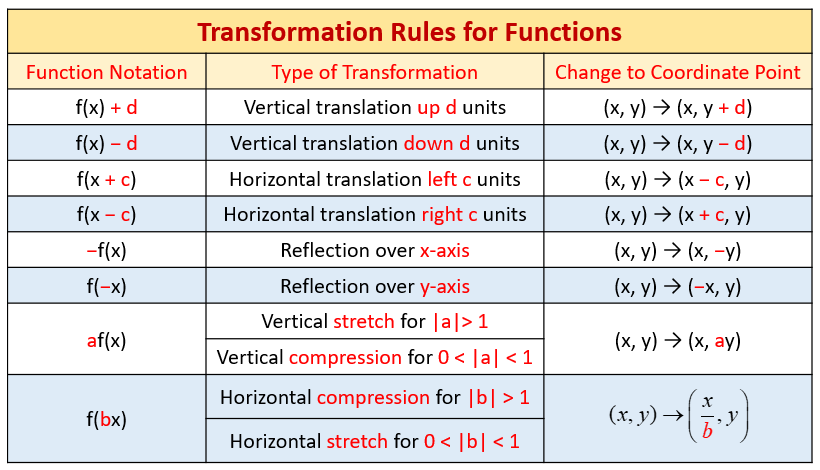
www.onlinemathlearning.com
Function Transformation lessons suitable for Common Core High School: Functions, HSF-BF.B.3, stretch, compress, vertical shift, horizontal shift, with video lessons, examples and step-by-step solutions.
cedar kilnBOT
@gentle perch Has your question been resolved?
cedar kilnBOT
Channel closed
Closed due to timeout
Use .reopen if this was a mistake.
Available help channel!
Send your question here to claim the channel.
Remember:
• Ask your math question in a clear, concise manner.
• Show your work, and if possible, explain where you are stuck.
• After 15 minutes, feel free to ping <@&286206848099549185>.
• Type the command .close to free the channel when you're done.
• Be polite and have a nice day!
Read #❓how-to-get-help for further information on how to ask a good question, and about conduct in the question channels.
 plucky carbon
 cedar kilnBOT
plucky carbon
plucky carbon
cedar kilnBOT
plucky carbon
plucky carbon
Is this a separable form for a differential equation? I was told you had to have the Y and X terms separate
but the definition is written as multiplication, this is subtraction.
cedar kilnBOT
@plucky carbon Has your question been resolved?
plucky carbon
.close
cedar kilnBOT
Channel closed
Closed by @plucky carbon
Use .reopen if this was a mistake.
cedar kilnBOT
Available help channel!
Send your question here to claim the channel.
Remember:
• Ask your math question in a clear, concise manner.
• Show your work, and if possible, explain where you are stuck.
• After 15 minutes, feel free to ping <@&286206848099549185>.
• Type the command .close to free the channel when you're done.
• Be polite and have a nice day!
Read #❓how-to-get-help for further information on how to ask a good question, and about conduct in the question channels.
 light pine
im rly stuck here
idk what to use as my parameters not my limits
this is all ive done so far
cedar kilnBOT
@light pine Has your question been resolved?
cedar kilnBOT
Channel closed
Closed due to timeout
Use .reopen if this was a mistake.
Available help channel!
Send your question here to claim the channel.
Remember:
• Ask your math question in a clear, concise manner.
• Show your work, and if possible, explain where you are stuck.
• After 15 minutes, feel free to ping <@&286206848099549185>.
• Type the command .close to free the channel when you're done.
• Be polite and have a nice day!
Read #❓how-to-get-help for further information on how to ask a good question, and about conduct in the question channels.
 lime wagon
How can I find the upper and lower bounds of each integral, and have I sketched it correctly?
cedar kilnBOT
lime wagon
How can I find the upper and lower bounds of each integral, and have I sketched ...
lime wagon

It seems I can find the bounds from the given formulae
Is that correct?
Taking the integrals is actually really easy. What is difficult is finding the correct bounds. Having wrong bounds yields 0 points in the exam. So if someone can explain to me how to find the correct bounds for these 3 integrals I would be very appreciative!!
Pls someone
dire geode
the question is... very small
lime wagon
Wait..what?
Oh

I guess you see it in worse quality than me in the chat
Okay so
I have the solutions
And I can calculate the integrals no problem when I have the bounds
But I wouldn’t have figured the bounds out myself
So I need help with that
cedar kilnBOT
@lime wagon Has your question been resolved?
lime wagon
@dire geode how would you get your boundaries for this problem if I may ask?
dire geode
i usually just draw the domain in a plane
lime wagon
So you draw 3 2D plots?
dire geode
yea
lime wagon
Uuuu
That actually makes so much sense
Thanks lol
That was rlly helpful idk why I didn’t think of that
.close
cedar kilnBOT
Channel closed
Closed by @lime wagon
Use .reopen if this was a mistake.
dire geode
lime wagon
That was rlly helpful idk why I didn’t think of that
"shadow method" here is pretty similar
https://mathinsight.org/triple_integral_shadow_method
Explanation of the shadow method for turning a triple integral into a double integral combined with a single integral in order to compute the limits of integration.
In this section we will define the triple integral. We will also illustrate quite a few examples of setting up the limits of integration from the three dimensional region of integration. Getting the limits of integration is often the difficult part of these problems.
cedar kilnBOT
Available help channel!
Send your question here to claim the channel.
Remember:
• Ask your math question in a clear, concise manner.
• Show your work, and if possible, explain where you are stuck.
• After 15 minutes, feel free to ping <@&286206848099549185>.
• Type the command .close to free the channel when you're done.
• Be polite and have a nice day!
Read #❓how-to-get-help for further information on how to ask a good question, and about conduct in the question channels.
lime wagon
Also, is there a latex converter in this discord?
lime wagon
Where I can put stuff like (9x+3^y) and it converts it into latex?
dire geode
lime wagon
Where I can put stuff like (9x+3^y) and it converts it into latex?
See #latex-help
cedar kilnBOT
@lime wagon Has your question been resolved?
Channel closed
Closed by @lime wagon
Use .reopen if this was a mistake.
Available help channel!
Send your question here to claim the channel.
Remember:
• Ask your math question in a clear, concise manner.
• Show your work, and if possible, explain where you are stuck.
• After 15 minutes, feel free to ping <@&286206848099549185>.
• Type the command .close to free the channel when you're done.
• Be polite and have a nice day!
Read #❓how-to-get-help for further information on how to ask a good question, and about conduct in the question channels.
 tall grotto
 cedar kilnBOT
tall grotto
tall grotto
cedar kilnBOT
tall grotto
tall grotto

i think ik how to do it, but not sure
should i be just plugging in t=8 and 11, and see if D(t) increased?
like D(11)>D(8)
seems too simple which is y im not sure
tall grotto
i got 6.7902 for D(11) and 6.7964 for D(8)
so it was overall decreasing?
which automatically makes Jaya's claim incorrect then
 ancient lodge
I misread the question earlier, see the edits
but I'm still pretty sure Jayla is incorrect
ancient lodge
I trust you can use a calculator
ancient lodge
👍
tall grotto
i have two more questions if u have the time?


i feel like im supposed to use identities somewhere, but i can't find them lol
i know i should probably move the root2cosx over to make +2cosx on the right
tall grotto
ancient lodge
per hour
wait, if D(11)-D(8) was /3h, shouldn't we multiply by 3 instead of divide?
shouldn't change the final answer though but is this step correct?
ancient lodge
tall grotto
wait, if D(11)-D(8) was /3h, shouldn't we multiply by 3 instead of divide?
(change in tide)/(hours) = change in height/hr
and I don't rlly have time to help with your eq.
srry
tall grotto
its ok np
tall grotto
ancient lodge
(change in tide)/(hours) = change in height/hr
but i still dont understand this
would the units for d(11)-d(8) be m/3h?
cedar kilnBOT
@tall grotto Has your question been resolved?


 tall grotto
.close
cedar kilnBOT
Channel closed
Closed by @tall grotto
Use .reopen if this was a mistake.
cedar kilnBOT
Available help channel!
Send your question here to claim the channel.
Remember:
• Ask your math question in a clear, concise manner.
• Show your work, and if possible, explain where you are stuck.
• After 15 minutes, feel free to ping <@&286206848099549185>.
• Type the command .close to free the channel when you're done.
• Be polite and have a nice day!
Read #❓how-to-get-help for further information on how to ask a good question, and about conduct in the question channels.
 clear sage
bacteria in a culture increased from 4 to 80 in 2 hours
clear sage
assuming that the rate of increase is directly proportional to the number present
determine the time from now at which the population will reach 500
clear sage
calc
 violet flume
okay
create a differential equation
"the rate of increase is directly proportional to the number present"
you need to write out using calculus:
- the rate of increase
- directly proportional
- the number present
say y(t) gives the number of bacteria present
can you complete the other two and give a differential equation?
clear sage
hmm would i be able to write that dp/dt=kp
clear sage
yh
violet flume
clear sage
hmm would i be able to write that dp/dt=kp
works for me
okay, solve for p(t)
clear sage
.close
cedar kilnBOT
Channel closed
Closed by @clear sage
Use .reopen if this was a mistake.
violet flume
clear sage
.close
everything okay?
cedar kilnBOT
Available help channel!
Send your question here to claim the channel.
Remember:
• Ask your math question in a clear, concise manner.
• Show your work, and if possible, explain where you are stuck.
• After 15 minutes, feel free to ping <@&286206848099549185>.
• Type the command .close to free the channel when you're done.
• Be polite and have a nice day!
Read #❓how-to-get-help for further information on how to ask a good question, and about conduct in the question channels.
 tulip pecan
8th question, dunno what to do after this

 cedar kilnBOT
tulip pecan
8th question, dunno what to do after this
cedar kilnBOT
tulip pecan
8th question, dunno what to do after this
@tulip pecan Has your question been resolved?
tulip pecan
.close
cedar kilnBOT
Channel closed
Closed by @tulip pecan
Use .reopen if this was a mistake.
Available help channel!
Send your question here to claim the channel.
Remember:
• Ask your math question in a clear, concise manner.
• Show your work, and if possible, explain where you are stuck.
• After 15 minutes, feel free to ping <@&286206848099549185>.
• Type the command .close to free the channel when you're done.
• Be polite and have a nice day!
Read #❓how-to-get-help for further information on how to ask a good question, and about conduct in the question channels.
crimson sedge
i got stuck at finding the values for c1 and c2

 foggy merlin
what are c1 and c2 ?
 brisk dirge

cedar kilnBOT
@crimson sedge Has your question been resolved?
crimson sedge
 livid hound
probably the constants of integration
livid hound
probably the constants of integration
yes it is the constant of integration
crimson sedge
livid hound
can you show what you've tried
the final function i got is -ln(x)+c1x+c2
using the power rule f'(x)=-1/x
livid hound
use f(1) = 0, f(4) = 0
and solve a system of equations
crimson sedge
livid hound
use f(1) = 0, f(4) = 0
and solve a system of equations
I tried but i end up with 2 constants of integration
livid hound
show work
crimson sedge
That's what i was able to do the only question i did that is similar to this one i was able to get rid of c1 to find c2 but now i don't know if the antiderivative is correct in the first place
 livid hound
don't use a calculator for the ln(4)
your antiderivative is correct
use f(1) = 0, f(4) = 0
and solve a system of equations
$\begin{cases} c_1 + c_2 = 0 \
-\ln(4) + 4c_1 + c_2 = 0 \end{cases}$
wraith daggerBOT
ℝamonov
 livid hound
ln(4) is just a number,
use substitution/elimination like you would any other linear system
cedar kilnBOT
@crimson sedge Has your question been resolved?
crimson sedge
livid hound
ln(4) is just a number,
use substitution/elimination like you would any other li...
I'm not sure how or what is a linear system could you show me how i would do it and what is a linear system?
I'm bad at math 🙂
crimson sedge
It's a miracle i made it to calc 1
livid hound
this is something you should've done well before calc 1
crimson sedge
livid hound
have you ever solved system of equations before
No
livid hound
look up systems of equations
crimson sedge
Is c2=ln4?
crimson sedge
livid hound
look up systems of equations
My bad i did study it but it's been a while i never really used in calculus
livid hound
algebra is used continuously throughout math
earlier concepts/ideas/principles are applicable to more complex problems
how are you getting c_2 = ln4
crimson sedge
Idk
crimson sedge
Yes
livid hound
show, not tell /give vague descriptions
what did you have after multiplying by -4
and what did you do after that
that led to getting what you got
crimson sedge
 livid hound
work is messy,
but result is ok
crimson sedge
So it's correct?
livid hound
but result is ok
livid hound
the ln(4) can be simplified though
(and no i don't mean use a calculator)
crimson sedge
How?
crimson sedge
livid hound
power rule for log
Is this the one where you bring the power to front?
crimson sedge
livid hound
power rule for log
This?
 livid hound
yeh
crimson sedge
livid hound
power rule for log
?
 livid hound
that goes in the opposite intended direction
i said ln(4) itself could be simplified
crimson sedge
ln2^2?
crimson sedge
livid hound
i said ln(4) itself could be simplified
2ln2?
livid hound
yes
crimson sedge
Ok thank you
cedar kilnBOT
@crimson sedge Has your question been resolved?
cedar kilnBOT
Channel closed
Closed due to timeout
Use .reopen if this was a mistake.
Available help channel!
Send your question here to claim the channel.
Remember:
• Ask your math question in a clear, concise manner.
• Show your work, and if possible, explain where you are stuck.
• After 15 minutes, feel free to ping <@&286206848099549185>.
• Type the command .close to free the channel when you're done.
• Be polite and have a nice day!
Read #❓how-to-get-help for further information on how to ask a good question, and about conduct in the question channels.
 short vapor
This might be something real trivial (idk anything about proofs just done basic eng major requirement math) but I just watched this veritasium video (https://www.youtube.com/watch?v=HeQX2HjkcNo @ around 4:30) and he's talking about how Cantor proves the number of reals between 0 and 1 is greater than the number of natural numbers. I understand his argument that once you've listed out and matched all the reals and natural numbers you can generate another real by adding 1 along a diagonal, but why is it that you can't add 1 to every number in the list of natural numbers all the way to the "last" natural number, shift everything down, and match 1 (since now the list starts with 2) with the new real? I know my reasoning is flawed I just don't understand why you can't do this as well
Not everything that is true can be proven. This discovery transformed infinity, changed the course of a world war and led to the modern computer. This video is sponsored by Brilliant. The first 200 people to sign up via https://brilliant.org/veritasium get 20% off a yearly subscription.
Special thanks to Prof. Asaf Karagila for consultation on...
cedar kilnBOT
short vapor
This might be something real trivial (idk anything about proofs just done basic ...
 crimson delta
there is no "last" natural number
the problem isnt really that you cant find a matching that also includes the new number
the problem is that for every matching you will find such a new number
no matter what you do, there will always be a number that you miss
short vapor
My bad computer died lol